M
ASTER IN
FINANCE
M
ASTER
’
S
F
INAL
W
ORK
P
ROJECT WORK
F
ITTING THE
T
ERM
S
TRUCTURE OF YIELD SPREADS
V
ELMA DE
J
ESUS
R
ODRIGUES
M
ASTER IN
FINANCE
M
ASTER
’
S
F
INAL
W
ORK
P
ROJECT WORK
F
ITTING
T
HE
T
ERM
S
TRUCTURE OF
Y
IELD
S
PREADS
V
ELMA DE
J
ESUS
R
ODRIGUES
S
UPERVISOR
:
P
ROFESSOR
D
OCTOR
R
AQUEL
M
EDEIROS
G
ASPAR
C
O
-S
UPERVISOR
:
D
OCTOR
P
EDRO
B
ALTAZAR
Abstract
This study aims to fit and analyze the behavior of the Yield Spread curve in the
context of Portugal Government Bonds, covering a period of January 2004 through
June 2014, when Portugal faced a liquidity and debt crisis. In order to extract
the Yield Spread curve, we use a disjoint method. This method requires as an
in-put both a defaultable and non-defaultable term structure: we use the default-free
curve estimated by the ECB and the defaultable term structure is estimated by
the Nelson-Siegel model (1987). Due to the important role that forecasting plays
in understanding how term structure evolves, the secondary objective of this work
is to forecast the yield curve by predicting the parameters of Nelson-Siegel model
(1987) using the Random Walk with drift as the benchmark model and the AR(1)
and the VAR(1) model as competitors models. The results include the empirical
analysis of Portuguese Government yield spread curve and, concerning the yield
curve forecasting, we conclude that AR(1) and VAR(1) slightly outperformed the
benchmark model and these models performance improves as the forecasting time
horizon increases.
Keywords: Yield Curve, Yield Spread, Nelson-Siegel Model, Forecasting, Term
List of Abbreviations
ACT/ACT- Actual/Actual convention
AIC -Akaike’s Information Criterion
AR(1)- Autoregressive Process of Order 1
BIC - Bayesian Information Criterion
ECB - European Central Bank
EMU- Economic Monetary Union
ICMA - International Capital Market Association
ISIN- International Securities Identification Number
OLS - Ordinary Least Squares
GLS - Generalized Least Squares
RW- Random walk
VAR(1)- Vector Autoregressive Process of Order 1
List of Tables
1 Regressions estimated for Random Walk with Drift . . . 26
2 Regressions estimated for AR(1) . . . 27
3 Regressions estimated for VAR(1) . . . 28
A1 Descriptive Statistics of Portuguese Government Bonds Yield Curve.The
A2 Descriptive Statistics of Estimated Parameters, sample period: 2004:01
to 2014:06. . . 35
A3 Descriptive Statistics Portuguese Government Bonds of Yield Spread. Sample Period: 2004:01 to 2014:06. . . 36
A4 Out-of-sample Forecasting Results, RW with drift: 1-month ahead . . 37
A5 Out-of-sample Forecasting Results, RW with drift: 3-month ahead . . 37
A6 Out-of-sample Forecasting Results, RW with drift: 6-month ahead . . 37
A7 Out-of-sample Forecasting Results, AR(1): 1-month ahead . . . 38
A8 Out-of-sample Forecasting Results, AR(1): 3-month ahead . . . 38
A9 Out-of-sample Forecasting Results, AR(1): 6-month ahead . . . 38
A10 Out-of-sample Forecasting Results, VAR(1): 1-month ahead . . . 39
A11 Out-of-sample Forecasting Results, VAR(1): 3-month ahead . . . 39
A12 Out-of-sample Forecasting Results, VAR(1): 6-month ahead . . . 39
A13 Forecasting Model Selection Criteria computed for the RW with drift, AR(1) and VAR(1). . . 40
List of Figures
1 Selected Fitted Yield Curve . . . 182 Selected Fitted Yield Curve (Continuation) . . . 19
4 Portuguese Government Bonds Yield Spread over the period January
2004 through June 2014 . . . 21
5 Impact of financial bailout on the yield curve . . . 24
A1 Portuguese Treasury Bonds Yield Curve daily fit of year 2006. . . 41
A2 Portuguese Government Bonds Yield Curve daily fit of year 2011. . . 41
A3 Portuguese Government Bonds Yield Curve daily fit of year 2012. . . 42
A4 Portuguese Government Bonds Yield Curve daily fit of year 2014. . . 42
A5 Pricing errors generated by estimating the yield curve over the period
January 1st 2004 through June 30th 2014. . . 43
A6 Yield errors generated by estimating the yield curve over the period
Contents
1 Introduction 1
2 Theoretical Framework 4
2.1 Term Structure: Basic Concepts . . . 4
2.2 Nelson-Siegel Model (1987) . . . 6
2.3 Modeling the Yield Spread . . . 7
2.4 Forecasting the Yield Curve . . . 9
3 Data and Methodology 12 3.1 Data Description . . . 12
3.2 Methodology . . . 13
3.2.1 Fitting the Yield Spread Curve . . . 13
3.2.2 Forecasting . . . 15
4 Empirical Results 16 4.1 In-sample fit Results . . . 17
4.2 Out-of-sample Results . . . 25
5 Conclusion 29
1 INTRODUCTION
1
Introduction
In the recent past, the financial industry as a whole has changed rapidly. The rapid
development of government bond markets in Euro-zone may be explained by the
ef-fects of globalization and the process of European Monetary integration. Although
the creation of European Monetary Union theoretically eliminates the exchange rate
risk, yield spread still exists due to liquidity issues and country-specific default risk
explained by the adoption of a certain fiscal policy and external shocks. So,
un-derstanding the evolution of yield spread is a crucial subject in finance, since the
historical spreads may give to investors an overview about market expectations,
po-tential investment opportunities or how to hedge portfolios. A proper yield spread
evolution assessment will bring value to fixed income managers and, since the yield
spread is a source of risk, it must be considered in financial risk management,
pric-ing financial products, fiscal debt, portfolio allocation, or even in monetary policy
implementation.
Given the importance of this topic, there are several empirical literature that
focus on the time-series dynamics of yield spread. Duffee (1999) and Elton et al.
(2001) both fitted the credit spread using non-callable corporate bonds. The
em-pirical research of Elton et al. (2001) investigates the existence of risk premium
in corporate bonds spread and they conclude that the credit spread may be
ex-plained by the expected default loss, tax premium and risk premium. Since a large
part of existence empirical research on fitting the yield spread of corporate bond
1 INTRODUCTION
of callable corporate bonds by treating simultaneously the effect of credit risk and
optionality. There are also empirical studies based on the extraction of
Govern-ment yield spread, such as, Dullman and Windfuhr (2000), Geyer et al. (2003) and
Duffie et al. (2003). The research of Dullman and Windfuhr (2000) investigates
the dynamics of the yield spread between Italian and German Government bonds
after the exchange-rate agreement in 1998. Geyer et al. (2003) deducted the yield
spread of Government bonds issued by member states of EMU and they noted a
significant and volatile credit spread between German Bund yields and the others
member states of EMU yields. Duffie et al. (2003) developed a model, under the
framework of Duffie and Singleton (1999), that estimate the term structure of credit
spread using the Russian dollar-denominated bonds, which takes into consideration
the risks of default, risk of restructuring and compensation for lack of liquidity.
Regarding the term structure modeling, there are also a vast literature concerning
this field. The most used approach among the financial market practitioners and
central banks is the class of Nelson-Siegel Models (1987), which is used to fit the
term structure of interest rates through a flexible and smooth parametric function.
In order to increase flexibility in the standard Nelson-Siegel model (1987), Svensson
(1994) proposed to add a second hump-shape factor with its own decay parameter.
However, a multicolinearity problem may arise by adding a second decay parameter.
To overcome the multicolinearity issue Pooter (2007) proposed an Adjusted Svensson
model. Note that the original Nelson-Siegel model is a static model, which fits the
cross section of interest rates at a given point in time. That is why Diebold and Li
1 INTRODUCTION
Despite the progress in the term structure of interest rate modeling, the
practi-cal estimation of yield spread field using Portugal empiripracti-cal data has been
under-explored. This study tries to fill this gap by fitting the yield spread curve in the
context of Portuguese Government Bonds. The latter yield spread curve is computed
as the difference of Portuguese Yield Curve, which is estimated using the standard
Nelson-Siegel model (1987), and the yield curve of AAA-rated countries in euro area
estimated by ECB, which is considered as the benchmark zero-coupon yield curve.
Since this research covers the period that Portugal was under the Economic and
Financial Adjustment Programme, besides the yield spread curve behavior analysis,
is also addressed the impact of the financial bailout.
Much of this research focuses on fitting the Portuguese Treasury Bonds yield
curve and consequently the extraction of its yield spread. However, many tasks
such as pricing financial instruments, portfolio diversification or risk management,
require not only the term structure of interest rates but also the knowledge of how
the term structure will evolve plays an important role in finance. So, the secondary
aim of this research is to better understand the dynamic evolution of the yield curve.
To meet the latter objective, is performed the forecasting of the yield curve using
three different models: Random Walk with drift, AR(1) and VAR(1).
The remaining of the text is organized as follows. Section two provides a brief
discussion of the theoretical framework, where some basic concepts are highlighted.
Section 3 presents the methodology used to fit the term structure of yield spread
as well as the data chosen to achieve this purpose. Section 4 analyses the empirical
2 THEORETICAL FRAMEWORK
of this study.
2
Theoretical Framework
Here is introduced some basic concepts prior to discussing in detail the term
struc-ture model used to generate the yield curve in this research. Afterwards, is explained
the approach used to extract the yield spread curve as well as different models used
in the yield curve forecasting.
2.1
Term Structure: Basic Concepts
The term structure of interest rate depicts a series of interest rates as a function of
time to maturity. Further, there are three equivalent theoretical representation of
term structure: yield curve, forward curve and discount curve. As the latter curves
names suggest, they graphically depict a series of yields, forward rates and discount
factors as a function of maturity, respectively.
Regarding the yield curve, yt(τ), it can be computed as an equally-weighted
average of instantaneous forward rates. This sort of rate is defined as forward rate,
ft(τ), with the limit of maturity tending to zero. More precisely, it can be interpreted
as a forward rate marginal cost for a very short period of time. So, the yield curve
or spot rate curve, withτ periods to maturity, is given by:
yt(τ) =
1
τ
Z τ
0
2.1 Term Structure: Basic Concepts 2 THEORETICAL FRAMEWORK
This important relationship between yield and forward rate is a critical point of the
Nelson-Siegel class of model.
The discount curve,Pt(τ), as mentioned before, is a function that depicts the
re-lationship between the discount factors and term to maturity and it can be obtained
from the yield curve by the following relation:
Pt(τ) = exp[−τ yt(τ)] (2)
Therefore given the relations mentioned above, we can find the following link
be-tween these three curves:
ft(τ) =− 1
Pt(τ)
dPt(τ)
dτ =yt(τ) +τ dyt(τ)
dτ (3)
Once the yield curve or the forward curve is known, any coupon bearing bond can
be priced as a sum of discounted cash flows. Though, the three term structures
representation mentioned before are not directly observed in the market for an
ex-tensive range of maturities. Saying so, these curves must be estimated from bond
prices observed in the market using theoretical models to fit the term structure, such
as the Bootstrapping of Fama and Bliss (1987), cubic spline function of McCulloch
(1975), exponential splines of Vasicek and Fong (1982), parametric function
sug-gested by Nelson-Siegel (1987), and later extended by Svensson (1994), Bjork and
Christensen (1999), Pooter (2007) or non-parametric model introduced by Linton
et al. (2001). There are several studies that empirically compare these different
2.2 Nelson-Siegel Model (1987) 2 THEORETICAL FRAMEWORK
2.2
Nelson-Siegel Model (1987)
Nelson and Siegel (1987) proposed a three parameter exponential-polynomial
func-tion. This approach fits the forward curve with:
ft(τ) = β0,t+β1,texp
−τ
λt
+β2,t
τ λt exp −τ λt (4)
This expression can be viewed as a constant plus a Laguerre function, which is a
product between a polynomial and an exponential decay term.
As described in the previous subsection, the yield curve is obtained by an
equally-weighted average of instantaneous forward rates. So the spot yield curve is given
by:
yt(τ) =β0,t+β1,t
1−exp −τ λt τ λt
+β2,t
1−exp −τ λt τ λt −exp −τ λt (5)
Thus, the shape of the yield curve is given by the sum of three components, each of
them resulting from the product of weighting functions and the model parameters
β0,t, β1,t and β2,t. Each component can be interpreted as follows. The component
β0 is multiplied by one for all maturities, so it can be interpreted as a long-term
component. The component of β1 is the short-term component, since its weighting
function starts at 1 and afterwards will decay rapidly to zero. Lastly, in the
com-ponent ofβ2, the weighting function starts at zero, increases for medium maturities
and then decays to zero again, which produce a hump-shaped curve. Moreover,
yields converge to β0 if maturity tends to infinity and converge to the sum of β0
and β1 if maturity tends to be an infinitely short period of time. Thus, β0+β1 can
2.3 Modeling the Yield Spread 2 THEORETICAL FRAMEWORK
β0 +β1 must be positive. Note that the λt parameter determines the rate of decay
and also at which maturity the medium-term component reaches its maximum.
The basic parametric model of Nelson-Siegel (1987) is a static approach, which
gives an estimation of yield curve at a certain point in time. However, Diebold and
Li (2006) suggest a dynamic version of Nelson-Siegel, where the dynamics factors
β0,β1 and β2 can be viewed as level, slope and curvature of yield curve, respectively.
Besides that, in the new dynamic framework they propose to fix the decay parameter
λ at a pre-specified value in order to ease the estimation process. More precisely, if
λ is fixed, the nonlinear measurement equations become linear and the estimation
proceed using the cross-sectional OLS procedure.
It is also worth noting that Nelson-Siegel model has enough flexibility to capture
a range of shapes of yield curve observed in the market (such as monotonic, humped
and S-shaped curve) and its dynamic version is able to replicate the stylized facts
of yield curves such as: yield curve are normally upward sloping, when yields reach
high (low) levels tend to decrease (increase) in the next moment -behavior of mean
reversion, shorter term yields are more volatile than the longer term yields,
long-term yields are more persistent than the shorter long-term.
2.3
Modeling the Yield Spread
With respect to the literature about the yield spread modeling, there are two
dif-ferent parametric models: disjoint and joint method.
Regarding the disjoint method, the basic idea is deriving both the term structure
2.3 Modeling the Yield Spread 2 THEORETICAL FRAMEWORK
separately. Thus, the term structure of zero-coupon yield spread is obtained by
the difference between the risky coupon yield curve and the benchmark
zero-coupon yield curve. In short, it is a three-step procedure. Dullman et Windfuhr
(2000) empirically computed the yield spread between German and Italian Sovereign
Bonds as the difference between the yields of Italian and German bonds. Annaert
(2000) and Landschoot (2004) both modeled the European credit spread as the
difference between the yield of the corporate bond and the yield of government
bond. However, Annaert (2000) made this subtraction with respect to the bonds
with same average duration and Landschoot (2004) divided the term structure of
yield spread by rating categories. Elton et al. (2001) empirically computed the yield
spread curve as the difference between the yield of the zero-coupon corporate bond
and the yield of zero-coupon government bond of the same maturity.
The joint estimation framework, proposed by Houweling et al. (2001), consists in
jointly estimating both term structure of zero-coupon yields simultaneously. In other
words, since a defaultable term-structure comprises in a default-free curve (proxied
by a theoretically riskless government curve) and in a yield spread curve, the basic
idea of this approach is a decomposition of the defaultable term structure into these
two features. By saying so, this method focuses in modeling the spread and the
default-free is considered as a part from the government curve. In short, all the
parameters in the model for the discount spread function and the government curve
are simultaneously estimated from a combination of both data set and performing
2.4 Forecasting the Yield Curve 2 THEORETICAL FRAMEWORK
2.4
Forecasting the Yield Curve
Modeling the yield curve is an important field in financial economics, so the
fore-casting. Many tasks such as pricing financial instruments, portfolios allocation,
managing financial risks require not only the current term structure of interest rates
but also the understanding how the yield curve may evolve. The results of the
forecast also may serve as a guideline for strategic plans concerning the fiscal debt
structuring and monetary policy.
In the context of the Nelson-Siegel model, time series models can fit to the
history of β parameters and used to forecasts. To accomplish the latter aim, the
out-of-sample forecasting will be performed using three different models: Random
Walk with drift, AR(1) and VAR(1).
The Random Walk is the simplest model. It is defined as a process where the
future value is given by the previous value plus an error. The error term is defined
as a white noise process, which is formed by a sequence of uncorrelated variables
with zero mean and constant variance. This process has the following form:
yt(τi) =yt−1(τi) +εt(τi), εt(τi)∼N(0, σ2(τi)) (6)
and it implies that all the expected future values ofYt+δ,δ >0, is given by Yt.
Whenever the time series present an average upward or downward trend, it is
expected that the forecasted values continue to exhibit a trend. In this case, a
non-zero constant trend is added to the random walk and the process is represent as
follows:
2.4 Forecasting the Yield Curve 2 THEORETICAL FRAMEWORK
Note that forα >0 the time series will exhibit an upward trend and, consequently,
α <0 will denote a downward trend.
The random walk with drift process is particularly relevant since many financial
time series seem to follow a pattern that exhibits a trend.
The AR(1) is an univariate autoregressive model of first order and is represented
as follows:
yt(τi) =θ(τi) +φ(τi)yt−1(τi) +εt(τi), εt(τi)∼N(0, σ
2(τ
i)) (8)
Actually, it is a linear regression model, which the forecasted value depends on its
own past values. In this case, since there is only one lag in the autoregressive process,
the expected future value is given by the previous value plus the θ(τi). The value
of φ defines whether the time series is stationary or not. If |φ| >1, the process is
non-stationary and it grows exponentially. If|φ|<1, the process is stationary. Once
again, the error term is formed by a series of random shocks and it is uncorrelated
with the past values of the AR series. Note that whenφ(τi) takes the value of 1 this
becomes a random walk process.
The VAR(1) is a vector autoregressive process of first order, which may be used
to forecast multivariate time series. This process is given by:
yt=µ+ ΓFt−1+εt, εt∼N(0,Σ) (9)
Where Ft−1 represents the factor matrix.
The VAR(1) assumes that theεtare uncorrelated through time and independent
and identically distributed.
2.4 Forecasting the Yield Curve 2 THEORETICAL FRAMEWORK
parameter of the Nelson-Siegel (1987) model is regressed against its own past values.
In the other hand, in VAR(1) is created a matrix where each parameter forecasted
is regressed against its own past values and against all other parameters included in
the system.
Regarding the empirical research of this field, there are several authors that
in-vestigated the quality of forecasting models based on Nelson Siegel model (1987).
Diebold and Li (2006) used several forecasting model such as Random Walk, Slope
Regression, Fama-Bliss forward rate regression, Cochrane-Piazzesi (2002) forward
curve regression, AR(1) and VAR(1) on yield levels and VAR(1) on yield changes.
By assessing the quality of the forecast based on dynamic version of Nelson-Siegel,
Diebold and Li (2006) argued that their forecasting approach produced accurate
re-sults, outperforming several benchmark forecasting model, especially for a 6 and
12-months forecast horizon. Pooter (2007) used the benchmark Random Walk model,
AR(1) and VAR(1) and the empirical results suggest that the four-factor model,
which is the model that adds a second slope to the Nelson-Siegel model, produces
forecast that outperform the benchmark Random Walk. Molenaars et al (2003)
re-sults suggest that the forecasting models used, which are the AR(1) and dynamic
Nelson-Siegel model, underperform the random walk model. Further, there is no
3 DATA AND METHODOLOGY
3
Data and Methodology
In this section is provided a detailed discussion regarding the data used in this
re-search as well as the procedure followed to fit the term structure of yield spread.
Hereafter, will be explained how the forecasting is performed.
3.1
Data Description
This research uses daily prices of Government bonds of varying maturities issued by
Portugal over the period January 1st 2004 through June 30th 2014, providing ten
years and six months of daily data, taken from Bloomberg database. Besides daily
bonds prices, the data set includes for each bond considered the issue date, maturity
date, ISIN, first coupon payment date, coupon rate, date count convention and the
amount issued.
In order to avoid distortions in the estimation, several filters are considered to
determine the sample of bonds. Similar to Diebold and Li (2006), we exclude bonds
with liquidity issues, which are Treasury Bills with less than one month to maturity
and bonds with less than one year to maturity, bonds with option features and
perpetual bonds are excluded as well.These filters, which are also applied by the
Center for Research in Security Prices, leaves us with a data set of 116 bonds.
For yield spread fitting purpose, besides the Portuguese yield curve, which is
con-sidered as the term-structure of risky zero-coupon yield, we also need a nondefault
3.2 Methodology 3 DATA AND METHODOLOGY
the government bonds yield curve of AAA-rated countries in euro area estimated
by ECB using the Svensson model (1994). Note that the ECB considered the
rat-ing provided by Fitch Ratrat-ings. Usrat-ing this AAA-rated yield curve, we extract the
yield for maturities 3-months, 6-months, 9-months, 1-year, 15-months, 18-months,
21-months, 2-years, 30-months, 3-years, 4-years, 5-years, 6-years, 7-years, 8-years,
9-years, 10-years, 15-years and 20-years. We select these maturities with the aim
to analyze the behavior of yield spread throughout the maturity spectrum, which
ranges from short to long-term maturities.
3.2
Methodology
3.2.1 Fitting the Yield Spread Curve
The traditional disjoint method mentioned in subsection 2.3 is used to fit the term
structure of yield spread. According to this method, the defautable term structure
and the riskless term structure must be estimated separately. In this study, the
defaultable term structure is the Portuguese Government Bonds yield curve and as
the risk-free term structure is assumed the yield curve of AAA-rated countries in
euro area estimated by ECB.
The Nelson-Siegel model (1987) and Svensson model (1994) is two of the most
widely used approach to model yield curves. This research uses the Nelson-Siegel
model to fit the Portuguese yield curve because the Svensson model produces higher
yield errors than the Nelson-Siegel approach (see Geyer and Mader 1999)) and the
fit using Svensson method is a time-consuming process, Bolder and Streliski (1999)
3.2 Methodology 3 DATA AND METHODOLOGY
time than Nelson-Siegel method. Besides that, Nelson-Siegel model produces a
parsimonious function of yield curve and avoids over-parametrization. Since the
latter model provides a continuous function, there is not necessary to apply other
models to interpolate intermediate points to obtain the discounted cash flows for all
maturities.
Given the filtered sample of bonds, the first step is to determine the cash-flow
and the corresponding cash-flow payment date associated to each bond. With these
information is possible to create a matrix that include all cash flows payments dates
and the respective cash-flow of the sample of bonds. Note that each bond is identified
by their ISIN. Suppose that bond j pays the cash-flow cij in the date mij; for the
sample of k bonds, the matrix is given by M = {mij} and C = {cij} with t rows
and k columns, with i = 1,...,t and j = 1,...,k. The number of rows defined by t
determines the number of cash-flows of the bond with longest maturity. The dates
when the bondj does not pay any cash-flow is completed with zero.
Prior to proceed with the estimation, is also required the computation of the
ac-crued interest, which is calculated following the day convention ACT/ACT (ICMA).
Therefore, the price of the bond,p, is given by the sum of accrued interest plus the
quoted market price and the theoretical price of the bond j, ˆpj, is given by:
ˆ
p=
n
X
i=1
cije−y(τi)τi (10)
which cij denotes the cash-flow i paid by the bond j with τi periods to maturity.
Regarding the yield curve estimation, by analyzing the functional form of
Nelson-Siegel model (1987) described in section 2.2 we conclude that there are four
3.2 Methodology 3 DATA AND METHODOLOGY
analyzed. So, an optimization process is needed to obtain the accurate parameters
that best fit the existing bond prices. The parameters vector of the yield function,
θ, is obtained by a nonlinear minimization of residual sum of squares between the
observed prices, p, and the theoretical prices,ˆp:
RSS(θ) =
n
X
i=1
(pi−pˆ)2 (11)
Once the parameters of Nelson-Siegel model is estimated, we obtain the Portuguese
yield curve fitted from observed coupon prices.
The termstrc package in R (see Ferstl and Hayden (2010)), allows the search
for the optimal set of starting value by applying the start parameter grid search
and, then, it applies numerical optimization approaches to perform the nonlinear
minimization of RSS.
Therefore, in order to fit the yield spread curve, we assume as default-free yield
curve the term structure estimated by ECB that contains only the AAA-rated euro
area central government bonds. By the disjoint method, the yield spread is computed
as the difference between the Portuguese Governemnt Yield and the AAA-rated euro
area central government bonds yield both with the same maturity.
3.2.2 Forecasting
This research predicts the Portuguese Treasury Bonds yield curve by forecasting
each parameters of the Nelson-Siegel model (1987)
To accomplish this aim we, follow the framework used in Diebold and Li (2006),
Pooter (2007) and Molenaars et al. (2003). These empirical researches assess the
4 EMPIRICAL RESULTS
Walk as the benchmark model. Duffee (2002) suggested that forecast results are
more accurate under the assumption that yields follow a Random Walk model.
Therefore, we assumed as the benchmark model the Random Walk with drift
due to the pattern that is observed in many economic time series, which suggests
a trend component. To analyze the forecasting capacity of Nelson-Siegel model, we
forecasted its parameters using AR(1) and VAR(1). For each one of the models
applied, the forecasting time horizon was 1-month, 3-months and 6-months ahead.
The conclusion concerning the forecasting capacity of Nelson-Siegel model is
obtained by comparing the out-of-sample results of AR(1) and VAR(1) with the
benchmark model. Lastly, in order to determine which model provides a better fit,
the forecasting model selection criteria computed are AIC and BIC. The AIC is
computed as:
AIC =−2∗log(L) + 2∗k (12)
and BIC is calculated as:
BIC =−2∗log(L) +k∗log(n) (13)
Which L stands for the likelihood value, k is the number of estimated parameters
and n the sample size used in the estimation.
4
Empirical Results
Prior to detail and analyze through descriptive statistics and graphical
representa-tions the results of in-sample as well as the out-of-sample fit, we should stress the
4.1 In-sample fit Results 4 EMPIRICAL RESULTS
When an estimation process is made in an automatic way for a large sample as the
one used in this study, it becomes difficult to control and ensure the quality of the
entire output set. Therefore, it is important to adopt the cleaning data process,
which consists in removing particular invalid data points from the output set and
then confirm if the remaining data is reliable.
Diebold and Li (2006) obtained the interval values of 4.427 < βˆ0,t < 12.088,
−5.616 < βˆ1,t < 0.919 and −5.249 < βˆ0,t < 4.234 for the parameters estimated
in the context of U.S. Treasuries. Even taking into consideration the differences
between the US Treasury and Portugal Government Bonds regarding the liquidity
issues, amount of Treasury Bonds issued, nature of bonds and others factors that
affect the estimation of yield curve; we considered that the parameters estimated
with value higher than 100 is not reliable. So, is considered as outliers the dates
which the absolute value of the corresponding parameters estimated are higher than
100. Particularly in this research is removed a total of 14 data points.
4.1
In-sample fit Results
In this subsection will be discussed the results of fitting the yield curve and
conse-quently the yield spread curve.
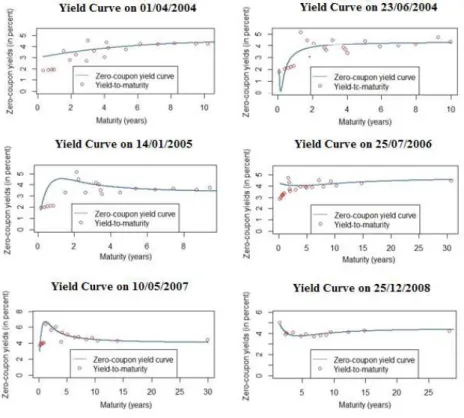
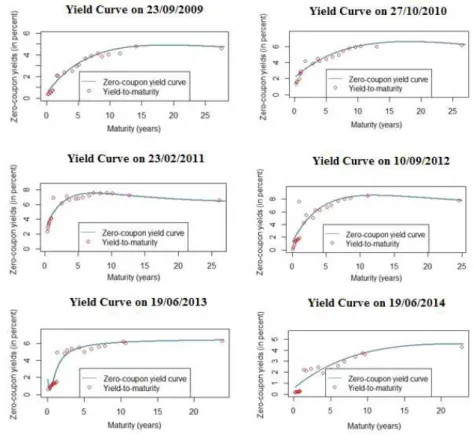
The Figure 1 and 2 depict several yield curve fitted by Nelson-Siegel model at
some specific dates throughout the period studied . As these yield curves show, the
Nelson-Siegel model is capable to capture different range of yield curve shapes: flat
or almost flat (e.g. yield curve on 01/04/2004 and 25/07/2006), upward sloping
4.1 In-sample fit Results 4 EMPIRICAL RESULTS
Figure 1: Selected Fitted Yield Curve
yield curve on 23/06/2004, 14/01/2005 and 10/05/2007). In this case, the yield
curve depicts how the yield of the Portuguese Government Bond depends on its
maturity. Note that the slope of the yield curve depicts the gap between the short
and long term yields.
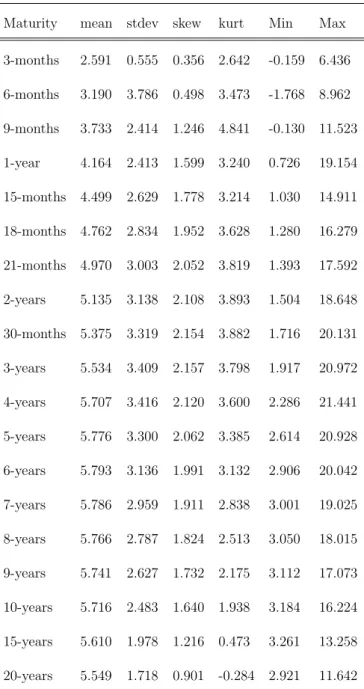
The Table A1 in the appendix, presents for varying maturities the descriptive
statistics of the estimated Portuguese Government Bonds yield curve that covers
the period from January 2004 through June 2014, such as mean yield, standard
deviation, kurtosis, skewness, minimum and maximum value achieved. Through the
analysis of these descriptive statistics, we can see that the yield curve on average
is upward sloping since the yields increase as the maturity increases, achieving its
4.1 In-sample fit Results 4 EMPIRICAL RESULTS
Figure 2: Selected Fitted Yield Curve (Continuation)
analysis, we conclude that on average the medium-term maturity is more volatile
than the short and long-term maturity, achieving its maximum at the maturity of
5 years; this means that, at some point, the volatility decreases as the maturity
increases.
The Table A2 in the appendix, details the basic descriptive statistics of the
parametersβ0, β1, β2, λt estimated by nonlinear least squares for each day t of the
period analyzed and in Figure 3 plots the evolution of each one of the parameters
estimated.
The β0, which can interpreted as long-term factor and defines the level of the
4.1 In-sample fit Results 4 EMPIRICAL RESULTS
Figure 3: Evolution of Estimated Parameters over the period January 2004 through
June 2014.
maturity approaches to infinite. On average, β1 is negative, which means that
throughout the period from January 2004 to June 2014 the yield curve is on average
upward sloping. Theβ2, on average, is also positive and specified the position of the
curvature. The parameter more volatile is β2, which can explain that the curvature
of the yield curve is changing over time and in some cases the hump does not even
exist (e.g. yield curve on 19/06/2014, Figure 2). It is also important to stress the
ADF test done for each one of the parameters estimated. An Augmented version
of the Dickey-Fuller tests the existence of unit root for a univariate time series and
this result is particularly relevant for forecasting purpose. The more negative it is
the value of ADF, stronger is the rejection of the hypothesis that the univariate
time series has an unit root. Saying so, in this case the hypothesis of unit root is
rejected for all the parameters, which make the time series estimation appropriate
4.1 In-sample fit Results 4 EMPIRICAL RESULTS
As the Figure 3 confirms, the curvature factor represented by β2 is the most
volatile parameter, especially in years 2009 to the end of 2013. Since the existence
of a ”hump” in the yield curve can be interpreted as a predictor of financial instability
and economic transition; the high volatility of parameter β2 may be explained by
the global financial crisis in July 2007 and by the impact of European Sovereign
debt crisis, consequently by the austerity measures applied in Portugal at 2011.
The primary objective of this study is to extract the term structure of yield
spread. Saying so, once the Portuguese yield curve is estimated, the yield spread
curve can be fitted using the disjoint method. In Figure 4 is depicted the yield
spread curve for varying maturities. Table A3 reports the descriptive statistics of
yield spread for varying maturities.
Figure 4: Portuguese Government Bonds Yield Spread over the period January 2004
through June 2014
In order to understand how the yield spread performs along the maturity
4.1 In-sample fit Results 4 EMPIRICAL RESULTS
Table A3 in the appendix, we can see that, on average, the medium-term maturities
yield spread is higher than the shorter term maturities; however, at about 3-years
maturity the average yield spread tends to decrease as the maturity increases.
Re-garding the volatility of the mean yield spread, the medium-term maturities are
more volatile than the shorter and longer term maturity.
Figure 4 depicts the evolution of yield spread over the period January 1st 2004 to
June 30th2014 for the maturities of 3-months, 9-months, 1-year, 3-years, 5-years,
10-years, 15-years and 20-years. Instead of depicts all the maturities analyzed in Table
A3, we chose references maturities in order to ease the graphical analysis. We can
see that until late of 2009, the yield spread has been following a stable pattern, with
some seasonal fluctuations. Afterwards, the yield spread rose steadily and peaked
in 2012. Taking into consideration the high level of yield spread experimented by
Portugal during this period, Portugal Government revealed a statement in January
15th 2010 to reassure to investors that the government is committed to reduce the
deficit. However, during the period from 2010 through 2012, the Portuguese
Gov-ernment Bonds credit spread of maturities of three and five years have still changed
significantly and reached a peak of about 20% in 2012. And during this period,
sev-eral credit agency lowered Portugal’s sovereign credit ranting by sevsev-eral notch. For
instance, in July 13th 2010 Moody’s Investors Service lowered Portugal government
bond rating from Aa2 to A1 and they pointed out the weak growth prospects faced
by Portugal; in March 29th 2011 Standards & Poor’s downgrades the rating to
BBB-from BBB; in April 1th 2011 Fitch Ratings cutted the rating to BBB- from A-; in
4.1 In-sample fit Results 4 EMPIRICAL RESULTS
The yield curve estimated from observed prices and the yield spread are strictly
related. The Figure A1 in the appendix depicts the daily yield curve fit of year 2006,
as we can see in this figure the yield remains between 1% to 4% (with some peaks
reaching 5%); consequently, we can see in the Figure 4 that this period corresponds
to relatively low yield spread. Likewise, we can see in the Figure A2 and A3 (which
represent the daily yield curve fit of 2011 and 2012, respectively) that the yield is
increasing over time and reaching a peak of about 20% at the beginning of 2012
and the Figure 4 shows that the yield spread follows the same pattern. Once again,
through the analysis of the Figure A4 (daily fit of year 2014), we can see that the
yield and credit spread are positively correlated.
Not only Portugal, but other countries such as Ireland, Greece, Italy and Spain
have been affected by European Sovereign debt crisis, and consequently all of these
countries experimented significant changes in their yield spread, especially during
2012.
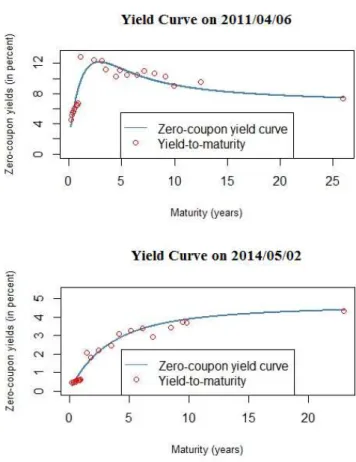
The Figure 5 shows the impact of the financial turmoil faced and the impact
of the austerity measures in Portugal. In April 6th 2011 Portugal requested for a
financial bailout from the European Union. As we can see in the first graph of the
Figure 5, the yields are already relatively high at the time of the request due to the
financial instability, Portugal’s government announcement about budget cuts and a
series of measures. In May 3rd 2011 Portugal agreed with the European Union and
the International Monetary Fund for ae72 billion financial bailout program. At the
beginning of the program the yield spread increases significantly, especially yield
4.1 In-sample fit Results 4 EMPIRICAL RESULTS
Figure 5: Impact of financial bailout on the yield curve
spread reached a peak about 20%). However, after several mission review during
the last three years, the yield spread has been following a decreasing pattern. The
second graph of the Figure 5 depicts the yield curve at the date of the final review
mission to Portugal and, as we can see, the yield reduced significantly and tends to
about 5% for long-term maturity Government bonds.
Moreover, it is also important to address the fitting errors. The price errors are
calculated as the difference between market bonds prices and its theoretical price
and the yield errors is computed as the difference between the bond yield and its
theoretical yield. Figure A5 and A6 in the appendix depict the price errors and
4.2 Out-of-sample Results 4 EMPIRICAL RESULTS
analysis of these two figures is noticed that the year that provided higher errors is
2012. These errors could be explained by different liquidity premium in the bond
market due to the conditions faced by Portugal described above.
4.2
Out-of-sample Results
As mentioned in the Section 3.2.2, the yield curve is forecasted by predicting the
estimated parameters of Nelson-Siegel model.
This research uses the Random Walk with drift as the benchmark forecast model
and as the competitor models the AR(1) and VAR(1). For each model, we use the
data from January 1st2004 to December 31th2013 and the forecast begins at January
1st 2014 and go through June 30th2014 for the forecast horizon of 1-month, 3-months
and 6-months.
Regarding the benchmark Random Walk with drift, the regressions estimated is
presented in the Table 1 and the out-of-sample results can be found in Tables A4,
A5 and A6 for time horizon of 1, 3 and 6-month ahead, respectively.
By analyzing the regressions of the Random Walk with drift, the positive
non-zero constant term suggests that time series of β0,t and λ show an upward trend;
otherwise, the β1,t and β2,t suggest a downward trend. All the estimated drift
com-ponent is significant1.
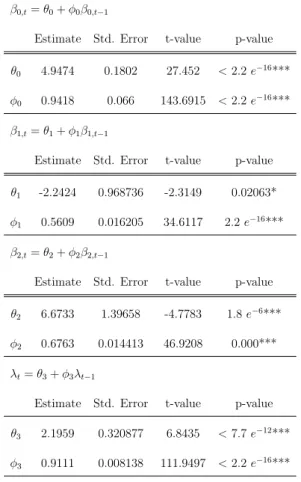
Relatively the AR(1), the regressions estimation are described in Table 2 and
the out-of-sample results are shown in Tables A7, A8 and A9 for forecast horizon of
1, 3 and 6-month ahead, respectively.
4.2 Out-of-sample Results 4 EMPIRICAL RESULTS
β0,t=α0+β0,t−1
Estimate Std. Error t-value p-value α0 0.000923 0.010713 0.086148 <2.2e−16***
β1,t=α1+β1,t−1
Estimate Std. Error t-value p-value α1 -0.000041 0.482021 -0.000085 0.000013***
β2,t=α2+β2,t−1
Estimate Std. Error t-value p-value α2 -0.00725 0.494452 -0.014657 <2.2e−16***
λt=α3+λt−1
Estimate Std. Error t-value p-value α3 0.000069 0.029321 0.000047 <2.2e−16***
Table 1: Regressions estimated for Random Walk with Drift
The stationarity of the these time-series is proved by the value estimated forφi,
i=0,1,2,3, which is smaller than 1. Note that all the parameters estimated in AR(1)
are significant.
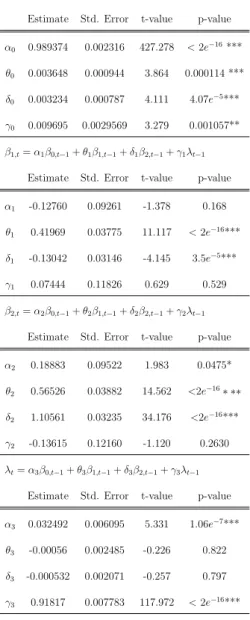
Lastly, the Table 3 details the matrix of regressions for the VAR(1) model and
the Tables A10 ,A11 and A12 display its out-of-sample results for the time horizon
of 1, 3 and 6-months ahead.
To assess the out-of-sample results, we use the yield fitted by Nelson-Siegel model
(1987) for the period of January 1st 2004 through June 30th 2014. Using these yields
we computed the RMSE for the maturities of 3-months, 1-year, 3-years, 5-years and
10-years. The RMSE is computed as:
RM SE =
v u u t 1 n n X t=1
(ˆyt−yt)2 (14)
which n stands for the number of observations, ˆyt stands for the forecasted yield
and yt stands for the yield extracted from the fitted yield curve.
4.2 Out-of-sample Results 4 EMPIRICAL RESULTS
β0,t=θ0+φ0β0,t−1
Estimate Std. Error t-value p-value
θ0 4.9474 0.1802 27.452 <2.2e−16***
φ0 0.9418 0.066 143.6915 <2.2e−16***
β1,t=θ1+φ1β1,t−1
Estimate Std. Error t-value p-value
θ1 -2.2424 0.968736 -2.3149 0.02063*
φ1 0.5609 0.016205 34.6117 2.2e−16***
β2,t=θ2+φ2β2,t−1
Estimate Std. Error t-value p-value
θ2 6.6733 1.39658 -4.7783 1.8e−6***
φ2 0.6763 0.014413 46.9208 0.000***
λt=θ3+φ3λt−1
Estimate Std. Error t-value p-value
θ3 2.1959 0.320877 6.8435 <7.7e−12***
φ3 0.9111 0.008138 111.9497 <2.2e−16***
Table 2: Regressions estimated for AR(1)
are quite similar. Both, depending the maturity and the forecast horizon, may
slightly outperform the results of the benchmark model. By comparing the RMSE
of AR(1) and VAR(1), we can observe that AR(1) seems to produce lower errors as
the maturity increases and this performance tends to improve as the forecasting time
horizon increases. This results agree with the Diebold and Li (2006) conclusions,
which argue that the forecasting models based on the Nelson-Siegel model perform
well and this performance improves as the forecasting time-horizon increases.
Regarding the forecasting model selection criteria, Table A13 shows the values
of log-likelihood, AIC and BIC (is a Schwarz criterion also known as Schwarz
4.2 Out-of-sample Results 4 EMPIRICAL RESULTS
β0,t=α0β0,t−1+θ0β1,t−1+δ0β2,t−1+γ0λt−1
Estimate Std. Error t-value p-value
α0 0.989374 0.002316 427.278 <2e−16***
θ0 0.003648 0.000944 3.864 0.000114 ***
δ0 0.003234 0.000787 4.111 4.07e−5***
γ0 0.009695 0.0029569 3.279 0.001057**
β1,t=α1β0,t−1+θ1β1,t−1+δ1β2,t−1+γ1λt−1
Estimate Std. Error t-value p-value
α1 -0.12760 0.09261 -1.378 0.168
θ1 0.41969 0.03775 11.117 <2e−16***
δ1 -0.13042 0.03146 -4.145 3.5e−5***
γ1 0.07444 0.11826 0.629 0.529
β2,t=α2β0,t−1+θ2β1,t−1+δ2β2,t−1+γ2λt−1
Estimate Std. Error t-value p-value
α2 0.18883 0.09522 1.983 0.0475*
θ2 0.56526 0.03882 14.562 <2e−16∗ ∗∗
δ2 1.10561 0.03235 34.176 <2e−16***
γ2 -0.13615 0.12160 -1.120 0.2630
λt=α3β0,t−1+θ3β1,t−1+δ3β2,t−1+γ3λt−1
Estimate Std. Error t-value p-value
α3 0.032492 0.006095 5.331 1.06e−7***
θ3 -0.00056 0.002485 -0.226 0.822
δ3 -0.000532 0.002071 -0.257 0.797
γ3 0.91817 0.007783 117.972 <2e−16***
Table 3: Regressions estimated for VAR(1)
The model that exhibits a higher log-likelihood and that minimizes AIC and BIC
is considered the one which produces a better forecasts. Saying so, through the
analyses of values displayed in Table A13, one concludes that AR(1) is the model
that reveals a better forecast.
The underperformance of VAR(1) may be explained mainly by two reasons.
First, the regressions are estimated by OLS and when the parameters are
5 CONCLUSION
economic time series are highly correlated with its own past values and with the past
values of the other time series added in data set, a multicollinearity problem tends
to increase as more time series and lagged values are added in the model. Besides
that, the major drawback of VAR(1) is the fact that by increasing the number of
parameters to be estimated, higher will be the number of variables of the model.
5
Conclusion
The primary aim of this research is to fit the term structure of yield spread, focusing
on Portugal Government Bond over the period January 1st 2004 through June 30th
2014. To accomplish this objective, this study uses the disjoint method. Since
the latter method requires as an input a defaultable term structure and a
non-defaultable term structure, we estimated in daily basis the risky term-structure
based on Portuguese Government Bonds daily prices and using the Nelson-Siegel
model (1987). And we assumed as non-defaultable term structure the AAA-rated
curve of euro area government central banks, estimated by ECB using the Svensson
model (1994). Afterwards, the yield spread curve is obtained by the difference of
these two curves.
By analyzing the fitting results, we can see that some stylized facts of yield curves
are replicated in this research, such as: an upward sloping yield curve was the most
frequent shape estimated; the yield curves assumed several of shapes throughout
the time horizon (up sloping, humped and almost flat); some humped-shape curves
5 CONCLUSION
as the maturity increases.
Regarding the Portuguese Government Bonds Yield Spread, we conclude that
it followed a stable pattern, with some seasonal fluctuations, until the late of 2009.
Hereafter, the yield spread experimented a significant change, especially between the
end of 2009 to 2013. From the period 2009 to 2012, Portugal yield spread increased
sharply and spread of bonds with maturity of 3 and 5-years reached a peak of about
20% at the beginning of 2012. Afterwards, it started to decrease gradually until
2014, where the yield spread values are close to pre-crisis values. Note that the
period from 2009 to 2013 was precisely the years when Portugal faced a liquidity
and debt crisis. This weak debt and financial position leaded Portugal asks for ae72
billion financial bailout from European Union and since then, Portugal was under
an Economic and Financial Adjustment Programme. After several mission review,
the final one was at May 2nd and since then, the yield spread seems to stabilize.
Regarding the out-of-sample results, this research shows that the AR(1) and
VAR(1) slightly outperform the benchmark Random Walk with drift model. This
re-sult agrees with the conclusion of Diebold and Li (2006), which argued that forecasts
based on Nelson-Siegel model provides accurate results and this good performance
increases as the forecasting time-horizon increases.We also computed the forecasting
model selection criterions, which conclude that the AR(1) model provides a better
6 REFERENCES
6
References
Annaert, J., Ceuster, M. and Jonghr, F. (2000). Modelling European Credit Spreads.
Deloitte & Touche, Reaserch Report.
Berndt, A. (2003). Estimating the term structure of Credit Spreads Callable
Corporate Debt. Stanford University, Department of Statistics, Technical Report
2003-7.
Bjork, T. and B. Christensen (1999). Interest Rate Dynamics and COnsistent
Forward Rate Curves. Mathematical Finance, 323-348.
Bliss, R. R. (1997). Testing Term Structure Estimation Methods. Advances in
Futures and Options Researh (9), 197-231.
Bolder, D. and Str´eliski, D. (1999)Yield Curve Modeling at the Bank of Canada.
Bank of Canada, Technical Report 84.
Cochrane, J. H. and Piazzesi, M. (2002). Bond Risk Premia. Manuscript,
Uni-versity of Chicago and UCLA.
Diebold, F. X. and Li, C. (2006). Forecasting the Term Structure of Government
Bond Yields. Journal of Econometrics 130, 337-364.
Duffee, G. (1999). Estimating the Price of Default Risk. Review of Financial
Studies.
Duffee, G. (2002). Term Premia and Interest Rate Forecast in Affine Models.
The Journal of Finance 57(1).
Duffie, D. and Lando, D. (2001). Term Structures of Credit Spread with
6 REFERENCES
Duffie, D., Pedersen, L. H. and Singleton, K. J. (2003). Modeling Sovereign Yield
Spreads: A Case Study of Russian Debt. The Journal of Finance, 58(1), 119-159.
Duffie, D. and Singleton, K. J. (1999). Modeling Term Structure of Defaultable
Bonds. The Review of Financial Studies 12(4), 687-720.
D¨ullmann, k. and Windfuhr, M. (2000). Credit Spreads between German and
Italian sovereign bonds - do affine models work, Canadian Journal of Administrative
Sciences 17, 166-181.
Elton, E. J., Gruber, M. J., Agrawal, D. and Mann, C. (2001). Explaining the
Rate Spread on Corporate Bonds. Journal of Finance, 56, 247-77.
Fama, E. F. and Bliss, R. R. (1987). The Information in Long-Maturity Forward
Rates.The American Economic Review 77(4), 680-692.
Ferstl, R. and Hayden, J. (2010). Zero-Coupon Yield Curve Estimation with the
Package termstrc. Journal of Statistical Software 36(1).
Geyer, A. and Mader, R. (1999). Estimation of the Term Structure of Interest
Rates: a Parametric Approach. Austrian National Bank, Working Paper 37.
Geyer, A., Kossmeier, S. and Pichler, S. (2003). Measuring Systematic Risk in
EMU Government Yield Spreads. Review of Finance 8(2), 171-197.
Houweling, P., Hoek, J. and Kleibergen, F. (2001).The Joint Estimation of Term
Structures and Credit Spreads. Journal of Empirical Finance 8, 297 - 323.
Jeffrey, A., Linton, O. and Nguyen, T. (2006). Flexible Term Structure
Estima-tion: Which Method is Preferred? Metrika, 1-24.
Landschoot, A. V. (2004). Determinants of Euro Term Structure of Credit
6 REFERENCES
Linton, O., Mammen, E., Nielson, J. P. and Tanggaard, C. (2001) Yield Curve
Estimation by Kernel Smoothing Methods. Journal of Econometrics, Elsevier 105(1),
185-223.
McCulloch, J. H. (1975). The Tax-Adjusted Yield Curve. The Journal of Finance
30(3).
Molenaars, T. K., Reinerink, N. H. and Hemminga, M. A. (2013). Forecasting
the yield curve - Forecast performance of the dynamic Nelson-Siegel model from 197
to 2008. RiskCO BV, version 2.
Nelson, C. R. and Siegel, A. F. (1987). Parsimonious Modeling of Yield Curves.
The Journal of Business 60(4), 473-489.
Pooter, M. D. (2007). Modeling and Forecasting Stock Return Volatility and the
Term Structure of Interest Rates. Erasmus Universiteit Rotterdam.
Svensson, L. (1994). Estimating and Interpreting Forward Interest Rates:
Swe-den 1992-1994. National Bureau of Economic Research, Technical Reports 4871.
Vasicek, O. and Fong, H. G. (1982). Term Structure Modeling Using Exponential
Appendix
Descriptive Statistics of Portuguese Government Bonds Yield Curve
Maturity mean stdev skew kurt Min Max
3-months 2.591 0.555 0.356 2.642 -0.159 6.436
6-months 3.190 3.786 0.498 3.473 -1.768 8.962
9-months 3.733 2.414 1.246 4.841 -0.130 11.523
1-year 4.164 2.413 1.599 3.240 0.726 19.154
15-months 4.499 2.629 1.778 3.214 1.030 14.911
18-months 4.762 2.834 1.952 3.628 1.280 16.279
21-months 4.970 3.003 2.052 3.819 1.393 17.592
2-years 5.135 3.138 2.108 3.893 1.504 18.648
30-months 5.375 3.319 2.154 3.882 1.716 20.131
3-years 5.534 3.409 2.157 3.798 1.917 20.972
4-years 5.707 3.416 2.120 3.600 2.286 21.441
5-years 5.776 3.300 2.062 3.385 2.614 20.928
6-years 5.793 3.136 1.991 3.132 2.906 20.042
7-years 5.786 2.959 1.911 2.838 3.001 19.025
8-years 5.766 2.787 1.824 2.513 3.050 18.015
9-years 5.741 2.627 1.732 2.175 3.112 17.073
10-years 5.716 2.483 1.640 1.938 3.184 16.224
15-years 5.610 1.978 1.216 0.473 3.261 13.258
20-years 5.549 1.718 0.901 -0.284 2.921 11.642
Table A1: Descriptive Statistics of Portuguese Government Bonds Yield Curve.The
Descriptive Statistics of Estimated Parameters
Parameter mean stdev min max ρ1 ρ12 ρ30 ADF
β0,t 5.522 3.041 7.048e-09 21.529 0.963 0.714 0.486 -5.273
β1,t -3.790 3.557 -1.771e+01 28.013 0.986 0.559 0.248 -6.694
β2,t 5.216 14.702 -5.142e+01 62.634 0.973 0.674 0.194 -4.122
λ 2.842 3.937 6.134e-02 28.460 0.912 0.510 0.301 -6.2641
Table A2: Descriptive Statistics of Estimated Parameters, sample period: 2004:01
Descriptive Statistics of Portuguese Government Bonds Yield Spread
Maturity mean stdev min max Skew Kurt
3-months 0.759 1.231 -1.350 4.863 1.173 1.028
6-months 1.493 1.726 -1.840 8.415 1.922 3.162
9-months 2.076 2.226 -0.207 11.123 2.040 3.532
1-year 2.506 2.654 -0.013 13.055 2.039 3.455
15-months 2.823 3.008 0.006 14.391 2.007 3.261
18-months 3.056 3.295 0.033 15.944 1.966 3.047
21-months 3.228 3.524 0.065 17.194 1.924 2.845
2-years 3.353 3.704 0.095 18.182 1.884 2.665
30-months 3.504 3.944 0.159 19.519 1.812 2.373
3-years 3.566 4.066 0.217 20.204 1.751 2.153
4-years 3.535 4.093 0.305 20.318 1.653 1.833
5-years 3.400 3.970 0.285 19.510 1.569 1.574
6-years 3.224 3.786 0.202 18.319 1.491 1.327
7-years 3.038 3.586 0.108 17.025 1.416 1.079
8-years 2.858 3.391 -0.048 15.770 1.342 0.835
9-years 2.693 3.209 -0.189 14.617 1.271 0.598
10-years 2.544 3.046 -0.312 13.589 1.204 0.378
15-years 2.047 2.483 -0.724 10.135 0.932 -0.432
20-years 1.829 2.215 -0.949 8.451 0.749 -0.834
Table A3: Descriptive Statistics Portuguese Government Bonds of Yield Spread.
Out-of-sample Results: Random Walk with Drift
Maturity mean stdev RMSE ρ1 ρ12
3-months 2.273 0.003 0.697 0.864 -0.251
1-year 0.911 0.004 1.927 0.728 -0.313
3-years 0.624 0.009 2.282 0.595 -0.395
5-years 1.687 0.007 2.070 0.466 -0.414
10-years 3.814 0.002 1.405 0.438 -0.360
Table A4: Out-of-sample Forecasting Results, RW with drift: 1-month ahead
Maturity mean stdev RMSE ρ3 ρ18
3-months 2.282 0.008 0.677 0.886 0.2611
1-year 0.899 0.011 1.930 0.863 0.222
3-years 0.595 0.025 2.289 0.729 0.146
5-years 1.662 0.022 2.076 0.641 0.184
10-years 3.805 0.007 1.400 0.596 0.146
Table A5: Out-of-sample Forecasting Results, RW with drift: 3-month ahead
Maturity mean stdev RMSE ρ6 ρ24
3-months 2.296 0.016 0.667 0.841 0.488
1-year 0.881 0.021 1.935 0.864 0.467
3-years 0.552 0.050 2.298 0.886 0.445
5-years 1.624 0.043 2.085 0.751 0.424
10-years 3.793 0.0145 1.412 0.774 0.403
Out-of-sample Results: AR(1)
Maturity mean stdev RMSE ρ1 ρ12
3-months 1.448 0.098 1.043 0.121 -0.151
1-year 3.721 0.124 1.630 0.720 -0.163
3-years 6.097 0.197 1.676 0.846 -0.248
5-years 6.715 0.209 1.601 0.324 -0.162
10-years 7.137 0.283 1.499 0.367 -0.171
Table A7: Out-of-sample Forecasting Results, AR(1): 1-month ahead
Maturity mean stdev RMSE ρ3 ρ18 3-months 1.547 0.087 1.089 0.851 0.176
1-year 3.547 0.151 1.576 0.811 0.154
3-years 5.743 0.303 1.567 0.831 0.172
5-years 6.350 0.347 1.482 0.838 0.181
10-years 6.6719 0.435 1.335 0.846 0.193
Table A8: Out-of-sample Forecasting Results, AR(1): 3-month ahead
Maturity mean stdev RMSE ρ6 ρ24
3-months 1.590 0.074 1.073 0.747 0.186
1-year 3.469 0.133 1.075 0.725 0.249
3-years 5.580 0.270 0.503 0.739 0.243
5-years 6.141 0.324 0.410 0.771 0.288
10-years 6.345 0.452 0.748 0.801 0.345
Out-of-sample Results: VAR(1)
Maturity mean stdev RMSE ρ1 ρ12
3-months 1.243 0.026 0.940 0.709 -0.291
1-year 3.456 0.194 1.546 0.827 -0.264
3-years 6.051 0.193 1.662 0.835 -0.269
5-years 6.853 0.148 1.643 0.834 -0.268
10-years 7.321 0.168 1.559 0.851 -0.287
Table A10: Out-of-sample Forecasting Results, VAR(1): 1-month ahead
Maturity mean stdev RMSE ρ3 ρ18 3-months 1.339 0.087 0.989 0.911 0.211
1-year 3.368 0.132 1.518 0.636 -0.141
3-years 5.943 0.139 1.630 0.672 -0.125
5-years 6.761 0.107 1.615 0.669 -0.097
10-years 7.077 0.206 1.478 0.669 -0.097
Table A11: Out-of-sample Forecasting Results, VAR(1): 3-month ahead
Maturity mean stdev RMSE ρ6 ρ24 3-months 1.455 0.129 1.286 0.526 0.358
1-year 3.563 0.268 1.061 0.309 -0.039
3-years 5.968 0.457 0.135 0.086 0.002
5-years 6.622 0.514 0.649 -0.007 0.026
10-years 6.789 0.316 1.003 0.370 0.229
Forecasting Model Selection Criteria
Random Walk with drift
Selection Criteria β1,t β2,t β3,t λ
log-likelihood -2152.85 -12034.08 -12100.38 -4595.53
AIC 4307.69 24070.15 24202.76 9193.06
BIC 4313.89 24076.02 24208.63 9198.9
AR(1)
Selection Criteria β1,t β2,t β3,t λ
log-likelihood -2086.48 -11715.62 -11875.13 -4540.19
AIC 4178.96 23437.24 23756.26 9086.38
BIC 4196.55 23454.84 23773.86 9103.9
VAR(1)
Selection Criteria β1,t β2,t β3,t λ
log-likelihood -24151.55
AIC 48367.11
BIC 48554.78
Table A13: Forecasting Model Selection Criteria computed for the RW with drift,
Portuguese Government Bonds Daily Yield Curve Estimation
Figure A1: Portuguese Treasury Bonds Yield Curve daily fit of year 2006.
Figure A3: Portuguese Government Bonds Yield Curve daily fit of year 2012.
Price Errors of the Yield Curve Estimation
Figure A5: Pricing errors generated by estimating the yield curve over the period
January 1st 2004 through June 30th 2014.
Yield Errors of the Yield Curve Estimation
Figure A6: Yield errors generated by estimating the yield curve over the period