Heinz and Cumba, Carlos and Hopmann, David Nicolas and O'Malley,
Eoin and Poletti, Monica and Popescu, Marina and Teperoglou, Eftichia
and Tworzecki, Hubert (2016) Media and campaign effects on vote choice
at national elections in Europe : a review of a multilingual research
landscape. Studies in Communication/Media, 5 (2). pp. 129-172. ISSN
2192-4007 , http://dx.doi.org/10.5771/2192-4007-2016-2-129
This version is available at http://strathprints.strath.ac.uk/59379/
Strathprints is designed to allow users to access the research output of the University of
Strathclyde. Unless otherwise explicitly stated on the manuscript, Copyright © and Moral Rights for the papers on this site are retained by the individual authors and/or other copyright owners. Please check the manuscript for details of any other licences that may have been applied. You may not engage in further distribution of the material for any profitmaking activities or any commercial gain. You may freely distribute both the url (http://strathprints.strath.ac.uk/) and the content of this paper for research or private study, educational, or not-for-profit purposes without prior permission or charge.
Any correspondence concerning this service should be sent to the Strathprints administrator:
The Strathprints institutional repository (http://strathprints.strath.ac.uk) is a digital archive of University of Strathclyde research outputs. It has been developed to disseminate open access research outputs, expose data about those outputs, and enable the
M
tion | Media
S
C
|
M
Studies in Communication | Media
EXTENDED PAPER
Media and campaign effects on vote choice at national elections
in Europe: A review of a multilingual research landscape
Medien- und Kampagneneffekte auf Wahlentscheidungen
bei nationalen Hauptwahlen in Europa: Literaturbericht
über eine vielsprachige Forschungslandschaft
Hajo G. Boomgaarden & Rüdiger Schmitt-Beck
with Heinz Brandenburg, Carlos Cunha, David Nicolas Hopmann, Eoin O’Malley, Monica Poletti, Marina Popescu, Eftichia Teperoglou and Hubert Tworzecki
19/9, 1010 Vienna, Austria; Kontakt: hajo.boomgaarden(at)univie.ac.at
Rüdiger Schmitt-Beck, Chair of Political Science – Political Sociology, University of Mann-heim, A 5, 6, 68131 MannMann-heim, Germany; Kontakt: schmitt-beck(at)uni-mannheim.de
With:
Heinz Brandenburg, University of Strathclyde, 16 Richmond Street, Glasgow G1 1XQ, UK; Kontakt: heinz.brandenburg(at)strath.ac.uk
Carlos Cunha, Department of Politics, Dowling College Oakdale, 319 Fortunof Hall, Long Island, NY 11769, USA; Kontakt: Cunhac(at)Dowling.edu
David Nicolas Hopmann, Center for Journalism, Institut for Statskundskab, University of Southern Denmark, Campusvej 55, 5230 Odense M, Denmark; Kontakt: dnh(at)sam.sdu.dk
Eoin O’Malley, Department of Government, Dublin City University, Glasnevin, Dublin 9, Ireland; Kontakt: eoin.omalley(at)dcu.ie
Monica Poletti, European Institute, Cowdray House, London School of Economics and Poli-tical Science, Houghton Street, London WC2A 2AE, UK; Kontakt: m.poletti(at)lse.ac.uk
Marina Popescu, Central European University, Nador u. 9, 1051 Budapest, Hungary; Kontakt: mpope(at)ceu.hu
Eftichia Teperoglou, CIES-IUL, Morada Institucional, Avenida das Forças Armadas, Edifício ISCTE, 1649-026 Lisboa, Portugal; Kontakt: efteperoglou(at)gmail.com
Hubert Tworzecki, Department of Political Science, Emory University, 1555 Dickey Drive, Atlanta, Georgia 30322, USA; Kontakt: htworze(at)emory.edu.
Media and campaign effects on vote choice at national elections in
Europe: A review of a multilingual research landscape
Medien- und Kampagneneffekte auf Wahlentscheidungen bei
nationalen Hauptwahlen in Europa: Literaturbericht über eine
vielsprachige Forschungslandschaft
Hajo G. Boomgaarden & Rüdiger Schmitt-Beck
with Heinz Brandenburg, Carlos Cunha, David Nicolas Hopmann, Eoin O’Malley, Monica Poletti, Marina Popescu, Eftichia Teperoglou and Hubert Tworzecki
Abstract: This article reviews the empirical research literature on campaign and media
ef-fects on vote choice at national elections in European countries for the post-World War II period. Particular efforts are undertaken to obtain a comprehensive picture by including publications in many different languages. With regard to the amount of research, but also the topics addressed, the survey reveals considerable differences between countries. Studies of campaign effects have focused on the temporal dynamics of campaigns, on the modes of campaign communications (such as personal contacts at the local level, advertising on TV and in the press or online social media) and on certain aspects of its content. Research on media effects has explored the role of partisan bias and certain topical categories of news (climate of opinion, issue and candidate coverage) as well as speciic new media formats, notably televised candidate debates and vote advice applications (VAA). Overall, the re-view reveals that there is little in the way of an integrated and consolidated body of cam-paign and media effects research on national elections in Europe. While political commu-nication research increasingly acknowledges the potential importance of news media and political parties’ electioneering for voting behaviour, there appears as of yet to be little convergence regarding approaches and research indings. Particularly striking is the degree to which research questions are guided by national institutional contexts.
Keywords: National elections, media effects, campaign effects, Europe.
Zusammenfassung: Der Beitrag präsentiert einen Überblick der empirischen
Forschungs-literatur über Kampagnen- und Medieneffekte auf Wahlentscheidungen bei nationalen Hauptwahlen in den europäischen Ländern seit dem 2. Weltkrieg. Er zielt auf ein möglichst umfassendes Bild und unternimmt daher besondere Anstrengungen, Publikationen in mög-lichst vielen verschiedenen europäischen Sprachen zu erschließen. Hinsichtlich des Um-fangs der relevanten Forschung, aber auch mit Blick auf die untersuchten Forschungs-gegenstände zeigen sich erhebliche Unterschiede zwischen den Ländern Europas. Studien über Effekte der Wahlkampfkommunikation der Parteien haben sich konzentriert auf die
zeitliche Dynamik von Wahlkämpfen, auf Modi der Kampagnenkommunikation (z. B. per-sönliche Ansprache der Wähler in lokalen Wahlkämpfen, Wahlwerbung im Fernsehen und der Presse, Soziale (Online-)Medien) und auf einige inhaltliche Aspekte der Parteienkom-munikation. Die Forschung über Medieneffekte hat sich vor allem mit den Konsequenzen von parteipolitischem Nachrichten-Bias beschäftigt, aber auch Wirkungen verschiedener inhaltlicher Kategorien von Nachrichten (Meinungsklima-, Sachfragen- und Kandidatenbe-richterstattung) sowie speziischer neuer Medienformate, insbesondere TV-Duellen von Spitzenkandidaten und Internetapplikationen wie dem „Wahl-O-Mat“. In der Gesamt-schau erscheint die europäische Forschung wenig integriert und konsolidiert. Zwar belegt sie die potenzielle Bedeutung der Medien- und Parteienkommunikation für Wahlentschei-dungen, aber bezüglich methodischer Ansätze sowie Forschungserträge ist wenig Konver-genz erkennbar. Besonders augenfällig ist das Ausmaß, in dem Forschungsfragen von den institutionellen Rahmenbedingungen der einzelnen Länder geprägt werden.
Schlagwörter: Nationale Hauptwahlen, Medienwirkungen, Kampagnenwirkungen, Europa.
1. Introduction
Over the past decades, the relevance of stable long-term predispositions for Euro-pean citizens’ voting decisions has been receding. In the established West-EuroEuro-pean democracies, the shares of voters deriving electoral guidance from ties to structur-ally deined cleavage groups or lasting attachments to political parties have been shrinking, and the impact of such political predispositions on electoral choices has weakened during processes of social-structural and partisan dealignment (Franklin et al., 1992; Dalton & Wattenberg, 2000; Dalton, 2013; Denver & Garnett, 2014; Dassonneville, 2013). In the Southern as well as Central and Eastern European newer democracies full-ledged systems of political cleavages never developed and party systems remained in a stage of ‘pre-alignment’ (McDonough & Lopez Pina, 1984, p. 367; Markowski, 1997). Party-group linkages appear less stable in newer democracies (Enyedi, 2008). Hence, electorates throughout the continent nowadays are rather volatile, electoral processes more luid, and election outcomes more dif-icult to predict. Presumably, voters have ‘begun to choose’ (Rose & McAllister, 1986) and rely more strongly on short-term factors related to the situational speci-ics of particular elections, such as issue attitudes or candidate evaluations (e.g., Lachat, 2014; Lobo & Curtice, 2014). These factors, in turn, respond closely to political information lows during election campaigns (Magalhaes, 2007).
This weakening of voter-party alignments led to a marked tendency to post-pone voting decisions. On average, voters nowadays make up their minds whom to vote for much later than in the past (Dalton et al., 2000). In the Netherlands, for instance, during the 1970s the share of voters who took their voting decisions only during campaigns amounted to not more than about ten per cent. In 2006, by contrast, 30 per cent decided whom to vote for in the inal days of the cam-paign, and twelve per cent even only on Election Day itself (van Holsteyn & de Ridder, 2005; van der Kolk et al., 2007). Similar developments have been report-ed for many other European countries (Schmitt-Beck & Partheymüller, 2012). The number of voters potentially responsive to the political information lows during campaign periods has thus increased considerably (Converse, 1962; Zaller, 1992; Lachat, 2007), opening up for political information inluences on voting
behaviour. While such a claim appears highly plausible, it is no trivial task to sub-stantiate it by unequivocal empirical evidence, and research has overall not been overly successful in doing so. This contribution seeks to identify, systematize, and summarize what we so far know about the role of political communication
dur-ing election campaigns for Europeans’ vote choices at national elections.
Election campaigns are periods of intensiied political communication, with in-formation originating from different sources, including political organizations, the mass media, and citizens’ social networks (Beck et al., 2002; Gunther et al., 2007, 2016). Analyses of the relevance of campaigns for voting ultimately come down to the question whether and how the reception of political information, obtained from different sources and conveyed in different modes, inluences electoral choices. Our review concentrates on those two forms of public political communication that – still – most eficiently bridge the gap between political elites and citizens: political parties’ campaign communications and the political coverage of the mass media.
Political parties’ campaign communications are determined attempts to
inlu-ence how voters see the political world (Swanson, 1991). Accordingly, citizens are provided with carefully selected information, biased to increase parties’ or candi-dates’ likelihood to gain votes. The arsenal of techniques used in modern election-eering is vast (e.g. Norris, 2000), ranging from traditional forms of door-to-door canvassing in electoral districts to mediated, highly professionalized forms of party communications utilizing conventional mass media such as advertisements in the press or on television, but increasingly also newer online and mobile communica-tion tools such as websites, email, social networks, blogs, or texting (Dolezal, 2015, Lilleker & Jackson, 2011, 2013; Vergeer et al. 2013). Likewise, a wide va-riety of strategic choices is available with regard to the content of electioneering. Campaigners can opt for emphasizing policy issues such as the economy, the envi-ronment, or immigration, symbolic topics such as values and ideological identities, or more personalized styles of communicating politics focusing on candidates and their characteristics (McAllister, 2007). Unseen to voters, the party or candidate activities rest to varying degrees on careful strategic analysis and planning, thought-through allocation of resources, and basic strategic philosophies, such as ‘political marketing’ that directly addresses voters’ needs and wishes, as opposed to ‘selling’ that seeks to convince voters of the parties’ or candidates’ qualities (Lees-Marshment, 2012). Obviously, national regulatory environments, but also political structures and cultures are important contextual determinants of such variation (Schmitt-Beck, 2007; de Vreese, 2010; Esser & Strömbäck, 2012a; Wlezien, 2014). Overall studies of political parties’ campaign effects assume a rather direct, unmediated link between campaign information and voting.
In addition to parties’ campaign activities, the mass media are a central infor-mation provider during election campaigns. On the one hand, parties seek to reach the electorate indirectly via the news media’s political coverage (Esser & Strömbäck, 2012b). On the other hand, however, in contemporary liberal democ-racies, parties’ control over the mass media’s editorial content is limited, while the media exert considerable discretionary power in constructing the news. Election news is thus best described as “joint product of an interactive process involving political communicators and media professionals” (Semetko et al., 1991, p. 3) which oscillates between cooperative and adversary orientations. Features of me-dia systems account for much of this variation (Hallin & Mancini, 2004; Norris,
2011), but speciic media also follow their own logics. The mass media thus serve as both, a passive mediator of party communications, and an active gatekeeper and interpreter of political information in its own right.
Beyond general mass mediated news coverage, two trends are of increasing importance. The irst is the adoption of so-called TV debates in a growing num-ber of countries (de Vreese, 2010) – highly ritualized televised debates between party leaders which point to a hybridization of campaign communications by mixing not only information and entertainment, but also journalistic and party control over the conveyed messages. Second, recently the blurring of the borders between mediated political information and entertainment (Boukes & Boom-gaarden, 2016) as well as the proliferation of ever new forms of online media and formats of presenting politics has led to an enormous increase in the complexity of ways how citizens potentially become exposed to mediated political informa-tion (Williams & Delli Carpini, 2011). While some see such fragmentainforma-tion as a cause for potentially diminishing media effects (Bennett & Iyengar, 2008), it also opens up avenues for hitherto unobserved inluences.
The focus of this paper is on research looking into media and campaign effects on vote choice – the decision taken by voters at the ballot box. Surprisingly, this core dependent variable of electoral research has infrequently been addressed in studies on the role of political communications. To arrive at a comprehensive overview, we therefore extend the range of our review to analyses of media effects and electioneering on key predictors of vote choice, most notably beliefs and at-titudes on candidates and issues, thus establishing indirect effects of political in-formation on voting. Moreover, we are also interested in how qualitative aspects
of voting behaviour, such as electoral volatility, or the relationship between
po-litical predispositions, other popo-litical attitudes and vote choice, may be moderated by the reception of political information during the campaign.
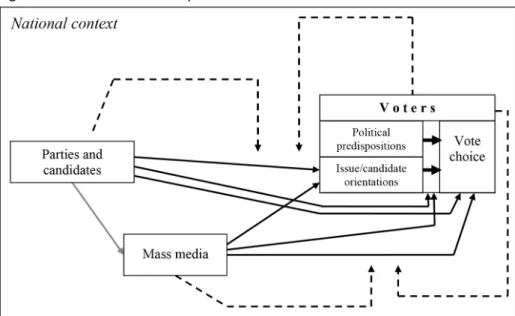
Different types of communication effects need to be taken into account, as il-lustrated in Figure 1. The information provided by parties and mass media may directly affect the distributions and means of variables. But it may become rele-vant for voting also indirectly, by strengthening or weakening its dependence on certain predictors (Bartels, 2006). A classic hypothesis is, for instance, that cam-paign exposure activates political predispositions and thereby increases their in-luence on vote choices (Lazarsfeld et al., 1968). Gelman and King’s (1993) ‘en-ligthenment’ hypothesis generalizes this idea to other ‘fundamentals’, such as the economy. Another variant is the notion of priming effects which presumes voters to give prominence to topics highlighted by communications when making up their minds about how to vote (Iyengar & Simon, 2000). Lastly, it must be taken into account that campaign-related communication effects may not occur across the board, but only under certain conditions, depending, for instance, on attribu-tes of information sources and channels, message contents, recipient characteris-tics (political predispositions, awareness, etc.), or national contexts. The relation-ships illustrated in Figure 1 represent a range of different types of theoretical approaches to explain why and how information lows during the campaign may affect vote choices. These are sometimes more, sometimes less explicated in the empirical research. Our review, rather than progressing along the lines of theore-tical traditions, is structured by the different independent variables relating to different types of communications. When relevant and also clearly stated, we
re-fer to theoretical approaches throughout the text, but we deem it beyond the scope of this contribution to provide a thorough and comparative assessment of the different theoretical approaches underlying the empirical contributions.
Figure 1: A heuristic model of political communication efects on vote choices
Notes: Illustration by authors. Copyright 2016.
Precisely speciied, the present article thus seeks to provide a comprehensive over-view of empirical research on the direct and indirect relevance of the mass media’s
political coverage as well as the parties’ campaign communications for vote choices at national elections in European countries during the post-World War II period.1 In the United States research into political media effects as well as the
1 To clearly deine the aim of this review, it seems useful to also clarify what has – for the sake of manageability – been deliberately excluded from its scope. As the study concentrates on national elections, it does not attempt to cover any research on referenda and other direct-democratic choices, nor on ‘second-order elections’ at both the sub-national (local, regional, state) and supra-national (European) levels (cf. Reif & Schmitt, 1980), although we acknowledge that high quality research has been published on these other types of elections (e.g. van Spanje & de Vreese, 2014; Matthes, 2012; Schuck & de Vreese, 2008; Schemer et al., 2012). By deinition, research on communication effects at elections establishes a relationship between attributes of communications originating from political parties or mass media and responses to these communications on the part of voters (cf. Brady et al., 2006; McLeod et al., 2009). Research focusing on other aspects of party or media communication at national elections than its effects on voters, such as campaign strategies, communication modes or attributes of media content, is therefore outside the scope of this review. Further, it does not deal with communication effects concerning other aspects of elec-tions than vote choice, such as mobilization or learning (to which we also count the agenda-setting effect that has often been explored in the situational context of elections, but usually without relat-ing it to electoral behaviour). Publications are only taken into account if they seek to demonstrate effects of party campaigns or mass media on electoral choices and, in doing so, meet minimum re-quirements in terms of adequacy of their methodological approach. Lastly, with very few excep-tions, we concentrate only on published research, neglecting conference papers.
impact of campaigns on electoral behaviour has thrived during the past two deca-des, and its indings are well documented in a number of recent reviews (Kinder 1998, 2003; Schmitt-Beck & Farrell, 2002; Iyengar & McGrady, 2007, pp. 197– 269; Kaufmann et al., 2008, pp. 163–190; Hillygus, 2010; Bishop & Hillygus, 2011; Druckman, 2012; Jacobson, 2015). Our study seeks to complement these publications with regard to the outcomes of research conducted in Europe. Im-portantly, unlike most review publications of similar scope, our investigation takes into account that the proliferation of English as lingua franca of scientiic discourse has not progressed similarly far in the social sciences as in the natural sciences (Gordin, 2015). It therefore places special emphasis on surveying and documenting not only indings accessible in English, but also from studies that have only been published in one of the many other tongues of European commu-nication research, from Portuguese to Norwegian. This ambitious aim could only be achieved by means of a cooperative project mobilizing, within a common con-ceptual framework, the expertise of a broad range of country and regional specia-lists from all over the continent.
An important outcome of our review is that European research on the effects of political communications on vote choices at national elections substantively, regionally and temporally presents itself as an archipelago of knowledge, rather little integrated by common themes, motives or approaches. As a consequence, an inductive, ‘data-driven’ strategy that starts from what phenomena have actually been studied in Europe appears most appropriate for eficiently organizing our overview of extant research. The review of European research compiled in this contribution is divided in two sections. The irst discusses the effects of parties’ and candidates’ campaign communications, the second deals with what is known about the role of the mass media. The conclusion then attempts to put the coun-try-speciic indings into a larger context.
2. Effects of parties’ campaigning
Isolating the effects of campaigns from those of other predictors of the vote is no trivial endeavour and entails serious methodological challenges (Brady et al., 2006). Problems of endogeneity must be solved to demarcate genuine communi-cation effects from mere selectivity. However, research into the effects of parties’ electioneering on citizens’ vote choices has gained momentum and nowadays of-fers a number of interesting indings that overall indicate that parties’ campaign communication is indeed of relevance for citizens’ behaviour at the ballots. Euro-pean research into campaign effects has thus far only made use of a limited range of the many approaches that in principle can be utilized to study campaign effects: irst, longitudinal analyses of campaign dynamics, focusing on develop-ments in party support during the weeks and months preceding elections, second, enquiries of whether exposure to different modes of parties’ campaigning is of relevance for voters’ choices, and third, studies on the impact of the content of parties’ campaign communications.
2.1 Campaign dynamics
We begin our stocktake with studies on the longitudinal dynamics of electorally relevant variables and their relationships to one another due to campaign expo-sure. Here, the fact that a campaign takes place at all is what supposedly matters whereas little if any relevance is accorded to the speciics of individual campaigns or to message contents. The conceptual premise of this research is the idea that campaigns unfold in time as series of events that carry electorally relevant infor-mation (Shaw, 1999).
Studies of this type have been carried out in several countries, utilizing different types of longitudinal survey designs. Although often not explicitly referring to La-zarsfeld’s conceptual framework (Lazarsfeld et al., 1968), much of that research suggests that campaigns are indeed of relevance for Europeans’ electoral behav-iour by mobilizing undecided voters’ latent political leanings (‘activation’) and
sta-bilizing electoral preferences once they have been developed (‘reinforcement’).
Preference change during campaigns (‘conversion’), in contrast, appears to occur relatively rarely, although in more recent times it seems to have become a more frequent outcome of campaigns. Among others, this was demonstrated for several German elections (Finkel & Schrott, 1995; Schoen, 2003; Lachat, 2007). Other research suggests that – in line with theories of government popularity cycles – ac-tivation is especially important for government parties that need to win back estranged voters (Stöss, 1997; Erhardt, 1998; Schmitt-Beck, 2009). Similar conclu-sions can be drawn from a series of studies spanning across several Dutch election campaigns (van der Brug & van der Eijk, 2000, 2005). They indicate that in very general terms, diffuse support for parties has been rising throughout the election campaigns of 1994 to 2003. Voters indeed found their way back to the parties they used to appreciate, due to the campaign. Similar conclusions come from Spain for 1993, where the campaign largely reinforced the predisposed and only to some degree activated the undecided (Mellizo-Soto, 2000). In 2000, the campaign mobi-lized in particular the electorate of the incumbent party (Anduiza-Perea, 2005).
A study of the Austrian general election 1999 also registered considerable pre-electoral stability in pre-electoral preferences, supplemented by a ‘homing tendency’ for many undecided voters. Overall, the campaign led to consistency rather than change, with some 15 percent of voters, however, still being converted by the cam-paign (Plasser et al., 2000). These numbers are mirrored by a study of the 2000 Spanish election (Anduiza-Perea & Oñate, 2004). Italian research additionally found that mobilization of existing voter potentials also implies preventing them from abstention. Schadee and Segatti (2002a) showed how a wide part of electors that were undecided during the campaign inally voted as they had done previ-ously, while only a small part of those that during a campaign had no clear ideas on which party to vote for inally decided to support a party from another coali-tion than at the previous eleccoali-tion (see also Pagnoncelli & Vannucci, 2006; Sani, 2006; Natale, 2006; Legnante & Baldassarri, 2010; Schadee, Segatti &, Bellucci, 2010). For the UK 2005 election, Clarke et al. (2009) showed that a third of those who indicated they were undecided ultimately did not vote, while Labour and the Liberal Democrats were clearly more successful than the Conservatives in securing
support among previously undecided voters. So while activation and reinforce-ment are the more obvious consequences of campaigns as such, it appears that in some instances and some countries, considerable shares of voters actually change their party preferences during the campaign. Even if the numbers of converted voters are relatively smaller, they can still be decisive for election outcomes.
Based on rolling cross-section campaign surveys conducted at the 2005 and 2009 German elections, a direct test of the hypothesis that campaigns activate a
broader range of electoral ‘fundamentals’, including not only political
predisposi-tions, but also the economy (Gelman & King, 1993), found little overall support for this general idea. Indications for electoral activation were observed, though not unequivocally, but varying by type of ‘fundamental’, party, and situational circumstances (Johnston et al., 2014). Christian (forthcoming) addressed a similar question from a more normatively accentuated angle. Using rolling cross-section data collected at the 2013 German Federal Election, he demonstrated that elec-tion campaigns increase voters’ likelihood to choose ‘correctly’, that is, to pick the party which, in view of its policies, matches their political interests most closely (cf. Lau & Redlawsk, 1997). By way of contrast, with regard to Eastern Europe-an newer democracies, it is noted that well understood ‘fundamentals’ from es-tablished democracies are less applicable, and scholars still ask whether or not they are dealing with a situation of ‘pure chaos’ (Markowski, 2006, 2008). With-out stable predispositions that could be activated by campaigns, attempting to isolate the impact of campaigns from other inluences on the vote appears rather hopeless, and accordingly little research has been conducted so far in these con-texts.
Other regularities of campaign dynamics have been indicated by some British studies. For instance, the parties leading in pre-election polls and likely to win usually see their lead eroded over the campaign (Wlezien & Norris, 2005, p. 875). Clarke et al. (2009) strongly supported this and showed that poll ratings moved in line with changing public perceptions about campaign performance of the three main parties. Some studies also paid particular attention to patterns of in-tra-campaign volatility, thus changes of voting intention from one party to an-other. A rise of overall volatility during campaign periods seems to conirm the increased importance of campaigns in the UK (Mughan, 1978), but also in Ger-many and Switzerland (Lachat, 2007). Importantly, Blais (2004) found for the Dutch elections of 1971 and 1989 to 1998 and for UK elections from 1992 to 2001 that the likelihood to switch vote intentions from one party to another de-pended on the time distance to Election Day. A campaign-induced polarization of party preferences has been demonstrated for the 2011 Danish election (Hansen & Kosiara-Pedersen, 2015).
There also has been some interest in the development of candidate attitudes both within and across campaigns. For instance, a German study on elections from 1980 to 2002 revealed that as polling day came closer, evaluations of the parties’ leading candidates became more polarized, and more in line with partisan attitudes (Schoen, 2007). For the Netherlands, van Holsteyn and Andeweg (2008) reported that the number of voters giving a preferential vote for the main party candidate had been decreasing from some 95 per cent in the post-war period to
almost 75 per cent in 2006 which appears surprising in light of an increasing per-sonalization of Dutch election campaigns (Kleinnijenhuis et al., 2007a). The new far right parties have played a role in somewhat reversing the trend in 2010, with some 95 per cent of the PVV voters giving a preferential vote to Geert Wilders. Van der Brug and van der Eijk (2005) suggested that in particular, new candidates proited from the campaigns in terms of increases in support.
Expanding research on activation, some studies focused more broadly on devel-opmental patterns in the predictive power of important antecedent factors of vote choice, including partisanship, but also issue attitudes or candidate preferences. Mughan (1978) showed for the UK election of 1974 that leadership considera-tions and issue concerns best explained conversions and defecconsidera-tions away from the governing Labour party. According to Clarke et al. (2009), part of the inluence of party identiication, leadership evaluations, issue handling abilities and economic evaluations on vote choice only occurs during the campaign. As it seems, valence factors are thus in part campaign effects; voters become more aware of their parti-san tendencies as well as leader and issue evaluations and these consequentially become more important for their vote choice. Even more compelling, Stephens et al. (2011a) showed for the 2010 election how leadership evaluations and their relevance for voting changed during the campaign. Trustworthiness and respon-siveness became more important predictors of leadership evaluations as the cam-paign progressed. Comparable indings for Germany and Switzerland were less clear-cut. While the relevance of predictors of the vote shifted during campaigns (Schoen & Falter, 2003; Lachat, 2007), what counted most for voters’ choices were the attitudes held immediately before polling day (Lachat, 2007).
Overall, the studies reviewed above suggest that campaigns do matter for vari-ous qualities of voting. It is important to note, however, that we learn very little, if anything at all, about what aspects of the campaign would drive such effects. The studies generally seem to take the presumption that campaigns make politics more important to people, increase awareness, etc. Knowing that campaigns can differ to great extends in terms of their intensities or competitiveness, it would be important to consider what types of campaigns would drive the effects discussed above, or whether campaign effects are rather structural or rather context de-pendent. This can only be achieved by more awareness of the actual characteris-tics of different campaigns. Furthermore, it should be noted that understanding of such general campaign effects in Europe is by and large driven by research from only a handful of countries, in particular Germany, the Netherlands and the UK. 2.2 Modes of campaigning
When planning their campaigns, parties have to take decisions on how – by which techniques and through which media – to best convey their messages to voters. Some studies have been concerned with the electoral role of the modes by which parties or candidates seek to communicate to voters. Mainly driven by ield experiments on campaign mobilization, U.S. research on the effectiveness of different forms of campaigning, from canvassing to Web 2.0 applications, has lourished in recent years and overall found less mediated modes of contacting
more potently (Green & Gerber, 2008). Furthermore, an extensive literature exists on effects of television advertising (Huber & Arceneaux, 2007; Ridout & Franz, 2011). European research thus far has been more restricted.
For German elections, it was shown that for most parties, higher numbers of
campaign contacts via different modes resulted in signiicantly increased electoral
support and improved evaluations of parties’ leading candidates (Podschuweit, 2007). Importantly, these effects seem to have affected not only partisans, but also followers of other parties (Schoen & Teusch, 2011). For Ireland in 2002, Marsh (2004, p. 249) also found a clear association between various forms of campaign exposure and vote choice. A Finnish study by Ruostetsaari and Mattila (2002) suggested that for candidates, it pays off to rely on a broad range of dif-ferent forms of electioneering. This is supported by a study of the 2010 UK elec-tion, which also shows that the more ways in which a voter is contacted by a party, the more likely s/he is to cast a vote for that party (Johnston et al., 2012). A study from Austria suggests that it is particularly personal contacts with parties that increase the likelihood of vote switching to that party during the campaign (Kritzinger et al., forthcoming). From a normative point of view, a German study investigated the relevance of campaign contacts for the quality of electoral deci-sion-making. Its indings suggest that exposure to various modes of campaign communications can under certain conditions enhance voters’ prospects to cast ‘correct’ votes (Schmitt-Beck & Kraft, 2014; cf. Lau & Redlawsk, 1997).
Local campaigning appears to have been much more thoroughly studied than
any other mode, although with a clear concentration on countries with strong constituency systems, such as the UK, Belgium or Ireland. British research convinc-ingly challenged the notion that campaign effects are virtually negligible and thus need not to be considered (Butler & Stokes, 1974, p. 486). Three ways of opera-tionalizing campaign intensity have been pursued: irst, campaign spending per constituency (Johnston et al., 1989; Johnston & Pattie, 1995, 1997; Pattie et al., 1995), second, surveys of party activists across constituencies (Whiteley & Seyd, 1994, 1998), and third, surveys of local campaign coordinators (Denver & Hands, 1985, 1997). All three approaches produced evidence supporting the notion that local campaigning matters, with some suggesting mobilization rather than conver-sion effects. Also for Belgium, Maddens et al. (2006) showed that campaign spend-ing was signiicantly related to the share of preferential candidate votes in the 2003 election in Flanders. According to a study by Benoit and Marsh (2010), the effect of extra spending in Irish local constituencies in 2007 mattered in a variety of contexts: between all candidates, between candidates from the same party, be-tween incumbents and challengers. They found the effect of a marginal spend to be much greater among challengers than incumbents. Also in Ireland, Sudulich and Wall (2011) looked at disaggregated spending returns for the 2007 election and found a weak positive relationship between spending and electoral performance. Spanish 1996 district campaign spending was observed to matter for parties’ elec-toral success, but voter predispositions moderated the effect (Criado, 2008). For the German context, there is some evidence for a positive effect of campaign spending in elections under a PR system (Fink, 2012). For Ireland and Finland, it has been shown that incumbents and challengers alike beneit from campaign
spending (Johnson, 2012). Research from Belgium suggests that the spending ef-fect depends on the status of the candidate (Maddens & Put, 2013).
Considering other aspects of local campaigns, Denver et al. (2003, 2004) showed for the UK that campaign intensity impacts on party vote shares mostly through mobilization. Gains from intensiied local campaigns, however, appeared to remain modest. Whiteley and Seyd (2003) estimated the impact of increased exposure to canvassing and other campaign efforts. Comparing the impact of dif-ferent campaign activities, they stated that “the combined effect of the local cam-paigns is roughly the same as that of party political broadcasts” (Whiteley & Seyd, 2003, p. 650). For 2005, Clarke et al. (2009) took into account campaign spending by different parties at the aggregate level and exposure to party mobili-zation at the individual level. The study showed that allocation of resources across constituencies and labour-intensive canvassing can contribute indepen-dently to increasing the vote share of a party. But, as Pattie and Johnston (2004) showed, constituency campaign effects cannot be reduced to a mere question of either converting or mobilizing voters. Whether effective local campaigning gen-erates awareness of the candidates standing for election is also important.
The role of campaign advertising has received less attention across Europe compared to the U.S., relecting the overall much stricter legal restrictions, espe-cially for party commercials on television (Kaid & Holtz-Bacha, 2006). Cam-paigns are largely fought out in the news media and advertising plays a rather marginal role in most countries (van Praag & van Aelst, 2010; see Holtz-Bacha & Kaid, 2006, for a comparative overview). Nonetheless, for instance, British stud-ies suggest that party election broadcasts (PEBs) can be quite effective, although not for all parties similarly. At the 2001 and 2005 elections, Labour proited much more from its television ads than the other parties (Whiteley & Seyd, 2003; Clarke et al., 2009). For 2010, Stephens et al. (2011a) found that exposure to PEBs invariably increased evaluations of the respective party leader. These ind-ings echoed earlier evidence from Pattie and Johnston (2002) who had reported effects on leader and party image evaluations. Norris (2006) added that exposure to PEBs can inluence perceptions of government handling of crucial election is-sues like the economy and tax which are key drivers of vote choice (Clarke et al., 2009). Several German studies indicated that watching party ads on television can affect leader and party evaluations, although not unequivocally and some-times even resulting in negative boomerang effects (Holtz-Bacha & Kaid, 1995; Kaid & Tedesco, 1999; Podschuweit, 2007). In Switzerland, there is a ban on political TV commercials, but advertising in print media has been shown to be effective (Selb, 2003), although mostly among less sophisticated and independent voters (Lachat & Sciarini, 2002). That newspaper advertising can help to gain votes was also suggested by a study from Finland (Ruostetsaari & Mattila, 2002).
The advent of the Internet has opened up new avenues for parties to reach prospective voters. Existing research on ‘cyber campaigning’ has often tended to focus on candidate data, because that is what is most easily available. For in-stance, an Irish study found having a personal website to be positively related to candidates’ vote shares (Sudulich & Wall, 2010). A replication of this study for the 2009 German election found only candidates from one of the ive major
par-ties proiting from maintaining personal websites (Marcinkowski & Metag, 2013). Focusing on inluences of parties’ websites on voting intentions, a Greek study reported a small-to-moderate effect (Papagiannidis et al., 2012, p. 304). In the 2010 Dutch parliamentary elections, the interactive use of Twitter by political candidates increased the number of preferential votes they received (Kruikemeier et al., 2013). Similarly, Jacobs and Spierings (2015) show that the more Tweets a candidate sent out during the 2010 and 2012 Dutch elections, the more votes s/he received, but with diminishing returns. For Finland, Strandberg (2013) provides some suggestive evidence that exposure to candidate and party websites may in-luence vote choices of particularly young voters.
In sum, we see evidence for campaign effects when it comes to the modes of campaigning. Again, this evidence, however, stems largely from a few countries only. To some degree, this is predetermined by the electoral system. Studies on local campaigning or campaign spending are easier to conduct in strong constitu-ency systems, studies on social media campaigns of single candidates are possible in systems with preferential candidate votes. While the irst section above strongly emphasized temporal variation throughout the campaigns, such a perspective is pretty much missing from the studies reviewed here. Also, we seem to see less theoretical nuances in these studies which by and large assume a simple positive relationship between any increase in campaign mode contact with a given party and vote share for that party.
2.3 Campaign messages
The dimension of parties’ electioneering that is least thoroughly studied with re-gard to its relevance for electoral choices is the content of their campaigns. Parties invest substantial creativity, planning, and professional expertise in carefully tailoring the messages they systematically seek to communicate to voters. We dis-tinguish between three types of campaign content, corresponding to substantive, symbolic and relational communication strategies. The irst concerns issues and issue positions that are emphasized in highly selective ways (Adams et al., 2005; Budge & Farlie, 1983). The second distinguishes communication strategies that focus on candidate personalities or on basic (often only marginally political) val-ues (Sarcinelli, 1987; Schval-uessler, 2000). The third concerns parties’ statements about their relations with one another, with research putting an emphasis on neg-ative campaigning (Nai & Walter, 2015).
Overall, not much European research can be identiied that investigates how parties’ issue emphasis and positioning on issues affects how citizens vote at na-tional elections. Even the vast comparative data on party manifestoes (Budge et al., 2001; Klingemann et al., 2006) have not yet been used extensively to look at how issue communications affect electoral choices. An exception is a study of four Western European democracies that indicated how parties can gain votes by em-phasizing issues they ‘own’ in their election platforms, thus issues they are per-ceived to be competent on (Franzmann, 2006; on issue ownership theory more generally cf. Petrocik, 1996). Based on survey experiments, a Norwegian study also found a campaign’s emphasis on ‘owned’ issues to be helpful for the ‘owning’
parties (Beyer et al., 2014). A Swedish study showed that while the immigration issue had received little attention in election campaigns from 1970 to 2006 (with somewhat of an exception in 2002), the 2010 election supported the claim that the probability for anti-immigrant party success increased with the saliency of the im-migration issue induced by parties during the campaign (Dahlström & Esaiasson, 2011). A study of the 1983 German federal election found attributions of policy competence on the part of the CDU/CSU to improve speciically with regard to those policy issues that the party had selected as core campaign themes (Bowler et al., 1992). Another German study dealt with parties’ self-positioning and found the Social Democrats’ 2005 campaign strategy that included an ideological reposi-tioning towards more traditional leftist positions contributing strongly to the suc-cessful last-minute activation of its partisans (Schmitt-Beck, 2009).
Often claimed to be one of the main elements of campaign modernization (Swanson & Mancini, 1996), the personalization of party communications is an important variant of symbolic strategies (Sarcinelli, 1987). It often, but not always, appears that party leaders make a difference, and sometimes even a sub-stantial one, but convincing evidence for a long-term trend towards more person-alized voting is still missing (Karvonen, 2010; Holmberg & Oscarsson, 2011). Nonetheless, studies from Germany indicate that personalized campaigning may pay off. A comparison of elections between 1980 and 2002 suggested that cam-paign strategies centred around the parties’ leading candidates may affect voting indirectly, by increasing the impact of candidate preferences on vote choices (Schoen, 2007). For 2005 it appeared that the strong personalization of the SPD’s campaign on the party’s popular chancellor Schröder contributed to the success-ful activation of the party’s core support groups (Schmitt-Beck, 2009). For 2009, it was found that candidates for district seats can gain personal votes by opting for personalized campaigns (Gschwend & Zittel, 2012). The relevance of other symbolic campaign features has rarely been addressed. A study of the SPD cam-paign at the 1998 German election which was centred around the slogan ‘Innova-tion and Social Justice’ found that symbolic strategies may entail a signiicant capacity to alter voters’ images of parties and improve their prospects at the bal-lot box (Schmitt-Beck, 2001).
In their campaign rhetoric, parties often also refer to one another. Unlike the U.S. (Lau and Rovner, 2009), negative campaigning, though being addressed in studies of campaigns (Walter & Vliegenthart, 2010; Walter, 2012; Holtz-Bacha, 2001), is not a prominent strand of research in Europe when it comes to voting behaviour – presumably a consequence of the overall less hostile style of paigning in most European countries. In Germany, (rather unusual) negative cam-paigning seems to work detrimentally for the communicating party (Leidecker, 2010). Also for Italy due to a negative campaign in 2001, there was a sort of ‘counter-leader’ effect (Mannheimer, 2002, pp. 180–193). It was the fear of disaf-fected voters of the centre-left that made them voting ‘against’ the likely victory of Berlusconi. Yet, a study by Schadee and Segatti (2002a, p. 227) showed that, among undecided voters, negative campaigning against Berlusconi of 2001 had a demobilizing effect for both coalitions. Most studies thus suggest that in Europe negative campaigning tends to backire, alienating rather than attracting voters.
Another relational element of party communications of particular relevance in multi-party systems emphasizes cooperation instead of attack – coalition signals. According to a study by Bytzek et al. (2012), on the 2009 German election voters are quite receptive to such statements and take them into account in their voting decisions. Coalition signals help voters to choose strategically.
In sum, for campaign effects on voting behaviour, a few indings stick out be-yond single country or study contexts. Most notably, it appears that irrespective of context campaigns largely mobilize partisan supporters and reinforce pre-exist-ing vote intentions. Campaign-induced conversions are relatively less evident, al-though they may have become more frequent in recent years. Regarding modes for addressing voters, the most convincing evidence comes from studies of the most traditional form of campaigning, face-to-face electioneering in local con-stituencies, showing that more campaign efforts usually pay off. But campaign advertising both on television and in the press seems to be effective too – at least where national regulations allow for it. Of growing importance is the use of so-cial media during campaigns, which seems to beneit the respective candidates. With regard to campaign messages, most studies deal with the impact of person-alization and some also with the negativity of campaigns, with the former seem-ingly working to the favour of candidates, and the latter increasing the chances to back-ire onto the sender. What is missing is a more uniied picture of campaign effects, which would take into account the contents of campaign messages trans-ported through different modes of campaigns and the temporal variation of the inluences throughout the campaign on voting intentions and ultimately behav-iour. Such a certainly demanding design would also call for a better integration of the diverse strands of theorizing present in the literature reviewed above.
3. Effects of Mass Media
Parties do not restrict their campaigns to informing voters directly through com-munication under their own control, but also seek to inluence the mass media’s coverage of politics (Semetko et al., 1991). During the past decades, the expan-sion of the mass media, especially of televiexpan-sion, has led to a situation where medi-ated political information reaches almost every European citizen (e.g. Tenscher & Hayek, 2012). Moreover, in contrast to the news media’s editorial content, citi-zens are well aware that the parties’ direct communication is biased, impairing its credibility. To some degree, the extent of which is dificult to assess, research into the effects of news media on electoral behaviour is therefore inevitably also re-search on the effects of party communications. But primarily, it provides insights on the relevance of the mass media as main carrier of public communication and bridge for citizens to experience the distant world of (electoral) politics.
Genuine studies about the relevance of mass media’s editorial content for voters’ decision-making in national elections are still a rarity in Europe. Norris (2006) for instance pointed out that while there has been increasing focus on (the effects of) party campaigning, “the more general neglect of studying media effects on voting behaviour relects the traditional approach in the British literature” (p. 196). From the Nufield studies through to the recent monographs of the British Election
Stud-ies serStud-ies (Clarke et al., 2009; Whiteley et al. 2013), the absence of media exposure variables, let alone more directional media input measures, in vote choice models remains conspicuous. More recently, however to a limited extent, media effects on electoral behaviour have gained scholarly attention in the UK. In Germany, while research into the role of mediated political communication at elections has devel-oped quite productively, vote choice also has seldom appeared as the dependent variable (Holtz-Bacha, 1999, p. 52). In the Netherlands and Belgium, one promi-nent strand of studies considers how the media present political information during election campaigns (de Vreese, 2008), but only sometimes and implicitly and specu-latively addresses potential effects of such coverage on voters. In Italy, it was pri-marily the victory in the 1994 elections of media tycoon Silvio Berlusconi that opened a debate on the role of media for voting. In the post-communist countries, politicians take it for granted that media effects are real. For evidence, one only needs to look at the 20+ year-old history of the so-called ‘media wars’ over the con-trol of state-owned radio and television stations, waged across the entire region under the oft-heard motto of ‘whoever has the media, has the power’ (Mungiu- Pippidi, 2003; Tworzecki, 2011). There is, however, very little in terms of system-atic research in this region that addresses the impact of media on voting behaviour. More recently, studies on the impact of televised leader debates or of online vote advice applications (VAA) have gained attention in a number of countries.
3.1 Partisan bias
Already in the earliest studies, the persuasive role of news media has been a core interest of research into media effects at elections (Esser, 2008). The pioneer study of Lazarsfeld et al. (1968) gave rise to profound scepticism about the mass media’s capacity to exert ‘strong’ effects by altering their audience’s political atti-tudes and behavioural intentions like, most prominently, vote choices. Yet, more recently claims of persuasive media effects have been boldly renewed (Bartels, 1993; Zaller, 1996; Iyengar & McGrady 2005; Maurer, 2014). According to this line of reasoning, exposure to news that is biased in favour of a particular party may lead to an increased likelihood to choose that party at the polls – directly or mediated by electorally relevant attitudes, most notably candidate evaluations. Spurred by the prevalence of editorial leanings and occasionally outright parti-sanship of the press and sometimes also TV in Europe’s ‘democratic-corporatist’ and ‘polarized-pluralist’ media systems (Hallin & Mancini, 2004), research has taken a considerable interest in the electoral role of partisan bias. Mostly, this re-ferred to statement bias, that is, the extent to which coverage favours particular parties or candidates with regard to its evaluative tone, but sometimes also cover-age bias, that is, the visibility granted to differing parties by media (cf. D’Alessio & Allen, 2000; Groeling, 2013).
Demonstrating persuasive media effects poses considerable methodological challenges (Yanovitzky & Greene, 2009; Jerit & Barabas, 2011; Maurer, 2014). Whereas in the U.S. experimental research has proliferated enormously in recent years to study media effects on voting (Nelson et al., 2011), surveys, sometimes combined with indings from content analyses, are still the dominant source of
data in Europe. Most basic and therefore often used, but least satisfactory from a methodological point of view is the ‘attentiveness approach’ which draws conclu-sions from covariations between media exposure and electoral behaviour. The ‘linkage approach’ is superior, because it takes direct measures of editorial con-tent into account in combination with media exposure, but it is also methodo-logically much more demanding (Dobrzynska et al., 2003; Jerit & Barabas, 2011). It comes in varying degrees of reinement, ranging from using content data only as background information to derive expectations about the direction of exposure effects with regard to particular media, to cross-sectional or, preferably, longitudinal models that directly estimate the amount and direction of covaria-tion between speciic features of media content and electoral responses.
Simple exposure studies often found only weak and inconsistent effects. For the
1994 Dutch election, van Praag and van der Eijk (1998) assessed the impact of ex-posure to news of commercial versus public broadcasters on sympathy towards the main candidates and voting for their parties. Findings suggested that it did matter whether one watched television news at all, but not on which channel. More recent studies from the Netherlands found no exposure effects during the 1994 and 1998 election on changes in party preferences and only marginal and scattered effects in 2002 and 2003 (van der Brug & van der Eijk, 1998, 2005). Similarly, German stud-ies also reported only few exposure effects (Semetko & Schönbach, 1994; Zeh, 2005; Maier, 2007), whereas a Norwegian study registered none at all (Aardal & Berglud, 2004). A Swedish study found weak correlations between media exposure and change of party preferences (Petterson et al., 2006, p. 133).
In Italy, a highly controversial study on the effect of television on voting claimed after the 1994 election that four million voters had changed their politi-cal preferences after watching television (Ricoli, 1994), but was heavily criticized on methodological grounds (Legrenzi, 1995, pp. 134–135; Sani, 1995; Pisati, 2000). Still, many studies have shown a strong correlation between following certain television channels and voting preferences (Sani, 2001). Schadee and Segatti (2002b, p. 346) demonstrated that voters that used both major Italian TV networks were more likely to change their electoral preferences, while their vote choices remained stable if they used only one network. Also for Spain, some cor-relations were established between watching certain channels and party prefer-ences (Díez-Nicolás & Semetko, 1995, 1999). Results related to the 1994 and 1998 elections in Hungary (Toka & Popescu, 2002) suggested both direct and indirect effects of media exposure on vote choice in new democracies, mainly originating from the continuous pro-governmental bias of public television which, during most of the times, had a modest positive impact on the ratings of governmental parties. The indings were conirmed by a longitudinal analysis of Hungary (Popescu, 2009) covering elections from 1994 to 2006 that suggested that in a competitive media environment and as voter volatility abruptly de-creased, media had a lower discernible impact on party preferences (see also Popa et al., 2012, for both Hungary and Romania).
Methodologically, pure exposure studies such as these are little convincing be-cause they infer backwards from empirically observed covariations between ex-posure and political behaviour to the content that presumably caused the latter.
Measuring media content directly helps to avoid this circularity. Otherwise, such types of studies are helpful only in contexts in which clear political leanings can be objectively attributed to different mass media outlets, arguably more often the case in systems with strong political parallelism (Hallin & Mancini, 2004). In its most basic form, such research relies on explicit media endorsements. For in-stance, in the case of Poland, some attention has been paid to the electoral conse-quences of exposure to endorsements in religious media, in particular the so-called ‘media empire’ of Father Tadeusz Rydzyk, including Radio Maryja. It was found that at the 2001 and 2005 parliamentary elections, 40 per cent of the sta-tion’s listeners voted in accordance with these endorsements, with the igure rising to 62 per cent in 2007 (Grabowska, 2008).
Similarly, unveiled ‘media-party parallelism’ (Seymour-Ure, 1974) has for a long time been characteristic of the British daily press, especially the tabloids, and a considerable number of studies suggest corresponding effects on voting. News-paper reading has repeatedly been found to relate to party choice (Dunleavy & Husbands, 1985; Miller, 1991; Newton, 1991; Curtice & Semetko, 1994). More recent research sought to deal effectively with the endogeneity problem notori-ously affecting such indings and conirmed endorsement effects even controlling for prior partisan predisposition (Newton & Brynin, 2001; Norris, 2006). Using newspaper switching between elections as a quasi-experimental set-up, Ladd and Lenz (2009) produced robust indings showing readers of newspaper that switched endorsement towards New Labour became signiicantly more likely to change their vote accordingly. Focusing particularly on The Sun that shifted to endorse Labour in 1997 and back to the Conservatives in 2010, it has been ar-gued that these endorsements caused about a two per cent shift of the popular vote in both elections (Reeves et al., 2016).
In other countries, researchers also were especially interested in the impact of the tabloid press. Both for the German Bild and for the Austrian Kronen-Zeitung, signiicant effects on readers’ voting decisions were found, improving the electoral prospects of parties supported by these newspapers (Schmitt-Beck & Macken-rodt, 2009; Plasser & Seeber, 2010). A comparative study of Germany, Britain, Spain and the U.S. also found signiicant relationships between media exposure and vote choices, but the overall impact of the media varied by media system. It appeared highest in systems with moderate, but not extreme – and thus very bla-tant – degrees of statement bias and limited opportunities for audience selectivity (Schmitt-Beck, 2000, 2004).
The most advanced studies of media effects link behavioural outcomes directly to measures of statement bias contained in news reports. Brandenburg and van Egmond (2012), through content analysis, assessed the relative stances of news-papers towards parties in the UK. By linking content with survey data, they found that strongly partisan voters were being further polarized during the campaign, while undecided voters were signiicantly affected by the tone of coverage about the governing Labour party. Using experimental methods, Norris et al. (1999) found that exposure to ‘good news stories’ signiicantly boosted party images and somewhat increased party support (see also Sanders & Norris, 1998). A study of the 2007 Danish election distinguished between the effects of direct exposure to
speciic news content and the effects of the cumulative information environment created by the media. It found that the more positive the overall tone toward a given party was in the media, the more voters were generally inclined to vote for this party. But direct exposure effects were restricted to undecided voters (Hop-mann et al., 2010). Recently, by matching newspaper content data with panel surveys for the 2013 Austrian election, Eberl et al. (2015) provided evidence for effects of statement bias and agenda bias in the news on party preferences. In particular, those with low levels of political sophistication and weak political pre-dispositions were inluenced by political bias in the news (see also Lengauer & Johann, 2013, for the 2008 Austrian election). In Poland, since 2005 some work linking content analysis of television news broadcasts to self-reported media ex-posure and voting behaviour has been done by Tworzecki and Semetko (2009, 2010, 2012) suggesting the presence of limited media effects. By matching TV content data to longitudinal data from a rolling cross-section survey, a study of the 2009 election assessed direct effects of partisan biases contained in the news-casts watched by respondents on their voting intentions. Findings suggested that the evaluative tone of the news affected voting decisions (Boomgaarden & Sem-etko, 2012). For the same election, Reinemann et al. (2013) reported partly simi-lar indings based on a combination of media content data and a panel survey. According to their study, statement bias can stimulate short-term changes in eval-uations and preferences concerning candidates, parties and party coalitions (see also Maurer et al., 2013). Evidence for effects of statement bias at the 2002 elec-tion is reported by Brettschneider and Rettich (2005).
In sum, we see emerging evidence for partisan bias effects on party preferences or vote choice. It is interesting to note that in particular those designs that explic-itly link media content characteristics and exposure and then relate these com-bined measures to outcome variables, often in longitudinal, panel survey designs, do detect signiicant and sometimes sizable effects. Mere exposure studies, with-out explicit analysis and linkage of media contents, appear to provide considera-ble media inluences on voting only in cases in which there is a strong partisan-ship of the news media.
3.2 Candidate coverage
Candidates are important to consider, both in terms of candidate media coverage inluencing voting behaviour and of that media coverage may inluence candidate assessments that in turn affect vote choices. German studies were primarily inte-rested in effects of media favouritism on party leader evaluations. Using aggregate time series analysis, a study of the 1990 election demonstrated parallels between statement bias and preferences for parties’ lead candidates (Kindelmann, 1994). Similar indings were provided for far-right parties in a number of countries (Vliegenthart et al., 2012). For the Dutch situation, it was shown in a time-series design that the visibility and positivity of media coverage of Pim Fortuyn was decisive for his party’s success in the 2002 election (Koopmans & Muis, 2009). Findings regarding the coverage of Dutch populist politician Wilders are less con-clusive, however (van der Pas et al., 2011). A study combining a content analysis
of television news and qualitative as well as quantitative surveys by Kepplinger et al. (1994) found voters’ character assessments of chancellor candidates to re-spond more to visual media information, and assessments of problem-solving competency more to textual information (see also Boomgaarden et al. (2016) pro-viding such evidence in a hypothetical experimental context). A follow-up study at the 2002 election again established how voters derived beliefs about candi-dates’ character traits from their TV appearance (Kepplinger & Maurer, 2005).
The 2002 Dutch election campaign has been described as being unusually negative. It was demonstrated that the strongly negatively tinted news coverage towards particular party leaders led to signiicantly lower levels of trust in them (Kleinnijenhuis et al., 2006). Trust in a particular leader, in turn, increased the likelihood to cast a vote for the associated party. Other evidence suggests that
coverage bias may also inluence vote choices. For the 2003 Belgian election, it
was demonstrated that media attention for certain candidates increased these candidates’ vote shares (Maddens et al., 2006). In particular, those constituency candidates that were covered prominently in newspapers and that appeared on television were more successful (van Aelst et al., 2006). In a similar vein, Hopmann et al. (2010) demonstrated a visibility effect with regard to party sup-port at a Danish election. For the Dutch 1998 elections, is was shown that in particular attention to politicians in sound bites contributed to voters’ responding favourably to their party (Oegema & Kleinnijenhuis, 2000). Related, for the 2010 Dutch election, it was shown that personalized news coverage can prime party leader evaluations. Based on a 11-wave panel survey combined with media con-tent analysis, the authors demonstrate that those respondents who were more strongly exposed to personalized news coverage of the candidates were more like-ly to draw heavilike-ly on leader evaluations what choosing which party to vote for (Takens et al., 2015). Some German studies indicated similar priming effects of candidate-centred coverage; during strongly personalized election campaigns heavy users of media that place a great emphasis on personalities seemed to take candidate orientations more strongly into account when deciding how to vote (Schulz et al., 2005; Zeh, 2005; Prinzen, 2010).
Concerning candidate coverage, a study by Kleinnijenhuis et al. (2001) also demonstrated a considerable visibility effect that was conditioned by the candi-date’s likeability as perceived by the voters, on vote intentions in the Netherlands. Compared to issue effects, these candidate effects were substantially stronger. This inding is mirrored in a study of the 2003 Belgian election (van Aelst, 2006). For the UK in 2005, it was shown how evaluations of Prime Minister Tony Blair, which were very inluential for voting, responded intensely to personality cover-age in the media (Stephens et al., 2009). More speciically, attitudes towards Blair as well as vote intentions were inluenced by the tone of media reporting about the Iraq war (Stephens et al., 2011b). A Romanian study by Stefuriuc (2003) linked the increased personalization of media coverage from the 1996 to the 2000 elections with a continuous focus on presidential candidates and perfor-mance evaluations in vote choice.
In sum, these studies convincingly show that candidate media coverage regard-ing the tone towards candidates, but also personalization in terms of coverage
putting a strong focus on candidates, are important factors explaining candidate perceptions, vote choice, or the strength of the relationship between these two. In those few studies that make an explicit comparison between candidate and issue coverage effects, candidate coverage seems to yield the stronger inluences. Re-search would be well advised to take into account the plethora of different candi-date coverage characteristics used in the studies reviewed above into account and draw a more coherent theoretical account of what it is in candidate coverage that causes the most substantial effects on voting. Experimental studies may be well complementing the extant literature that by and large draws on – in some cases rather advanced – designs combining content analysis and longitudinal survey data.
3.3 Coverage of party support and issues
In some countries scholars developed an interest in how certain rather speciic topics in news media coverage might impact on electoral behaviour. Numerous studies focused on electoral effects of issue and candidate-related coverage. Espe-cially in Germany, research also took a strong, and at times highly controversial, interest in media coverage on the so-called climate of opinion. With regard to elections, it refers to party support and expectations about election outcomes, in particular about who will win the election. Referring to survey data on various federal elections of the 1960s and 1970s, Noelle-Neumann (1980, 1990, 1993; Noelle-Neumann & Petersen, 2004) argued that voters are characterized by a desire to side with apparent majorities and therefore are inclined to support par-ties that they expect to win. According to her reasoning, the opinion climate im-pressions that give rise to such ‘bandwagon effects’ (and ‘spirals of silence’ on the part of apparent minorities) must not match reality, but can in fact be misleading with regard to true party support, and are mainly a product of media coverage, especially on TV. They are assumed to derive from representations of party
sup-port in the media that basically relect journalists’ own political loyalties. With
regard to electoral behaviour, the empirical record of this theory is mixed; most of it rests on circumstantial evidence rather than rigorous analysis. Still, due to its political implications, it obtained unusually intense public attention accompanied by quite heated scholarly controversy (e.g. Merten, 1985).
Another element of coverage that is potentially relevant for opinion climate perceptions is reporting on pre-election polls. Time and again, speculation has arisen about possible electoral inluences of this kind of mediated voter feedback (Moy & Rinke, 2012). German and Dutch studies indicate that media polls in-deed inluence voters’ expectations concerning election outcomes (Irwin & Van Holsteyn, 2002; Faas et al., 2008). Such expectations may lead to differing behav-ioural outcomes. A study of the 1990 German election demonstrated a band-wagon effect. Voters supported the party coalition that according to media re-ports appeared likely to win the election (Schmitt-Beck, 1996). Experimental evidence from Switzerland points in the same direction (Hardmeier & Sidler, 2003). In contrast, indings by Faas et al. (2008) indicated that during the run-up to the German 2005 election poll, results caused an underdog effect among