Department of Science and Information Technology
Maturity Model of Incident Management
João Filipe Ferreira Aguiar
Nº66810
A Thesis presented in partial fulfillment of the Requirements for the degree of Master in Information Technology and Management
Supervisor:
Prof. Ph. D. Ruben Pereira ISCTE-IUL
i Department of Science and Information Technology
Maturity Model of Incident Management
João Filipe Ferreira Aguiar
Nº66810
A Thesis presented in partial fulfillment of the Requirements for the degree of Master in Information Technology and Management
Supervisor:
Prof. Ph. D. Ruben Pereira ISCTE-IUL
iii
Acknowledgements
Since September of 2016 when I start this thesis, I had the pleasure of learn and collaborate with several people. All of them helped me to develop my skills.
First, I would like to thank to my supervisor, Professor Rúben Pereira, for all the effort and availability dedicated to this thesis. The weekly situation points gave me working guidelines which was very useful. Thank you once again, for all the time you spent with me.
Thanks to all the people of organizations that collaborated with this thesis. The priceless time spent to evaluate their process was very useful to this investigation.
I would also like to thank to my closest family. To my parents, my sisters, my brothers-in-law, nephews and parents-in-law for all the help they gave me and for the moments that I gave up of their company to work on this thesis.
Last but not least, I would like to thank to my fiancée, Ondina Aguiar, who supported me all the time. Without her loving support and help I would have never been able to accomplish this thesis.
v
Título: Modelo de Maturidade para a Gestão de Incidências Nome: João Filipe Ferreira Aguiar
Mestrado em: Informática e Gestão
Orientador: Doutor Rúben Filipe de Sousa Pereira
Resumo
Nos últimos 25 anos a preocupação da generalidade das empresas com as Tecnologias da Informação (TI) é claramente exponencial. De tal forma que, para conseguirem organizar, planear, selecionar, suportar e entregar os serviços de TI, foi necessário implementar frameworks de TI. Estas frameworks são um conjunto de boas práticas a implementar para gestão de serviços de TI.
Nestas frameworks estão incluídos vários processos das diferentes áreas das TI. Este trabalho de investigação focou-se muito concretamente no processo de Gestão de Incidências. Sendo que a operacionalidade da generalidade dos serviços requerer disponibilidade de quase 24/7, a implementação deste processo é fulcral.
Muitas das frameworks de TI contem processos similares. Muitas organizações, quando tentam aplicar mais que uma framework acabam por fazer trabalho redundante. Assim sendo, a eliminação de sobreposições das atividades torna-se bastante útil para qualquer processo das frameworks de IT. Desta forma o processo torna-se mais simples e menos dispendioso para a organização.
Dada a necessidade das organizações de avaliarem a maturidade do seu processo de gestão de incidências e que diferentes organizações têm diferentes frameworks de TI, nasceu a necessidade deste trabalho de investigação.
Esta tese propõe um Modelo de Maturidade para o processo de gestão de incidências que abranja as principais e mais utilizadas frameworks de TI.
Palavras-Chave: Gestão de Incidências, Modelo de Maturidade, Frameworks de TI,
vi
Title: Maturity Model of Incident Management Name: João Filipe Ferreira Aguiar
Master: IT and Management
Supervisor: Doctor Rúben Filipe de Sousa Pereira
Abstract
Over the last 25 years the concern of most organizations with Information Technology (IT) has been clearly exponential. In order to plan, organize, select, support and deliver IT services, it was necessary to implement IT frameworks. These frameworks are a set of the best practices to implement on IT service management.
These frameworks are included in several processes of different areas of IT. This research work is focused very concretely on the Incident Management process. Once the organizations technical consulting services are available 24/7, an implementation of this process is crucial.
Many of the IT frameworks contain similar processes. Many organizations, when trying to apply more than one framework, end up doing redundant work. Therefore, eliminating overlaps of activities becomes very useful for any process of IT frameworks. In this way, the process becomes simpler and less expensive for the organization.
Given the need of the organizations evaluate the maturity of their incident management process and different organizations and different IT frameworks, was born the need for this research.
This thesis proposes a Maturity Model for the incident management process that covers the main and most used IT frameworks.
Keywords: Incident Management, Maturity Model, IT Framework, Overlapping
vii
Table of Contents
Acknowledgements ... iii
Resumo ... v
Abstract ... vi
Table of Contents ... vii
List of Tables ... ix
List of Figures ... x
Chapter 1 – Introduction ... 11
Chapter 2 – State of the Art ... 15
2.1. IT Frameworks ... 16
2.1.1. ITIL ... 17
2.1.2. COBIT ... 23
2.1.3. CMMI ... 26
2.1.4. Frameworks conclusions and summary ... 29
2.2. Maturity Model Frameworks ... 30
2.2.1. COBIT PAM ... 32
2.2.2. ISO/IEC 15504 ... 34
2.2.3. CMMI-SVC ... 36
2.2.4. TIPA ... 39
2.2.5. AXELOS ... 41
2.2.6. J. Flores, L. Rusu and P. Johannesson Model ... 43
2.2.7. R. Pereira, and M. Silva Model ... 46
2.2.8. M. Vitoriano and J. Neto Model ... 49
2.2.9. M. Simonsson, P. Johnson and H. Hijkstrom Model ... 51
2.2.10. Comparison Maturity Models Frameworks ... 53
Chapter 3 – Research Methodology ... 55
3.1. Data collection ... 56
3.2. Data analysis ... 57
Chapter 4 – Proposal ... 59
Chapter 5 - Analysis and discussion of results ... 65
Chapter 6 – Conclusions ... 73 Bibliography ... 75 Appendix ... 78 Appendix A ... 78 Appendix B ... 89 Appendix C ... 101
viii Appendix D ... 110 Appendix E ... 120 Appendix F ... 126
ix
List of Tables
Table 1- Processes – ITIL ... 19
Table 2- IM Roles – ITIL ... 21
Table 3- DSS Domain – COBIT 5 ... 24
Table 4- Activities from COBIT 5 ... 25
Table 5 -Process Areas from CMMI SVC... 27
Table 6- Relationship between IRP Process - CMMI ... 27
Table 7- Specific Goal and Practices – CMMI... 28
Table 8- Activities – CMMI ... 28
Table 9- Comparison IT Frameworks ... 29
Table 10- Capability Levels – COBIT PAM ... 33
Table 11- Capability Levels- ISO/IEC 15504 ... 35
Table 12- Capability Levels – CMMI-SVC ... 36
Table 13- Maturity Levels – CMMI ... 37
Table 14 -Maturity Levels – TIPA ... 39
Table 15- Maturity Levels- Axelos ... 42
Table 16- Proposed Activities ... 43
Table 17- Service Capacity and Service Continuity ... 44
Table 18- Stage Model and Continuous Model ... 47
Table 19- Type of Questions and Answers ... 47
Table 20- Fulfill of Requirements ... 51
Table 21- Comparison Maturity Models Frameworks ... 53
Table 22- Comparison of Maturity Models Levels ... 53
Table 23- Interviewees Profile ... 56
Table 24- Excerpt of CMMI activities ... 59
Table 25- Excerpt of activities merged ... 60
Table 26- Excerpt of applied questionnaire ... 61
Table 27- Questionnaire header ... 62
Table 28- Questionnaire header 2 ... 63
Table 29- Organizations Comparison ... 65
Table 30- Activities completed by all organizations ... 69
x
List of Figures
Figure 1- Service Life Cycle - ITIL ... 18
Figure 2- Incident Management Process - ITIL ... 20
Figure 3- COBIT Principles ... 23
Figure 4- Areas from COBIT 5 ... 24
Figure 5- Process DSS02 – Manage Service Requests and Incidents- COBIT 5 ... 25
Figure 6- Process Assessment Model -COBIT PAM ... 32
Figure 7- Part of questionnaire used in IM ... 48
Figure 8- Proposed Maturity Levels ... 52
Figure 9- Research Process Diagram ... 55
Figure 10- IT Strategy ... 65
Figure 11- IT Structure ... 65
Figure 12- Expected and achieved Maturity Level ... 66
Figure 13- Activities Completed by Maturity Level ... 66
Figure 14- Average of activities completed ... 67
Figure 15- IT framework distribution ... 67
Figure 16- Distribution of activities by framework ... 68
11
Chapter 1 – Introduction
The Information Technology (IT) has been growing steadily, and organizations whether they are larger or smaller are totally dependent on it if they intend to succeed and optimize their services. IT has become crucial to the support, sustainability and growth of most businesses [1], by supporting existing business strategies as well as new strategies [2]. IT has ceased to act simply as a supportive role and has taken on a central position within organizations. Currently, having an IT department is not enough to ensure that they are technologically successful.
But the IT-Services relationship has not always been successful. Due to the high number of services and the different types of organizations, IT’s had to grow rapidly and widely. IT service managers are under pressure to reduce costs while helping the organization to generate revenue and quickly deliver cost effective services to their customers [3]. Due to this rapid and somewhat unstructured growth, there was a need to plan IT strategies and manage IT processes. To meet this need some organizations have adopted/developed IT frameworks.
Information Technologic Infrastructure Library (ITIL) is the most widely accepted approach to IT service management in the World [4], [5].
Capability Maturity Model Integration (CMMI) is another widely used IT framework. This model, focuses on the activities that are associated with the service provided by the organization, to provide quality of service to customers and final consumers [6]. CMMI provides to organizations a means to achieve service improvement [7].
COBIT is a framework that provides a set of support tools that enable managers to fill gaps with respect to control requirements, technical issues and business risks, and communicate the level of control to stakeholders. It establishes a clear relationship between the governance requirements of IT, IT processes and their control [8].
Many organizations due to being so different in size, objectives and focus found difficulties to implement these frameworks and there was a need to apply maturity models to the different frameworks. Many frameworks overlap each other and tend to propose the same processes with different names [9].
“What you can’t measure, you can’t control”, the phrase is from a British Physicist and Mathematician Peter Drucker and translates the need to measure performance to control.
12 Assigning more and more importance to the quality and quantity of information obtained in the IT, a good management of these elements is paramount.
Maturity models in IT management have been proposed since at least 1973 [10]. More than one hundred different maturity models have been proposed [11] but most are too general and, as a result, are not well defined and documented [12].
One of the most common ITIL process and top priority of adoption by organizations, is the Incident Management (IM) process [13]. IM is a key element of supporting [14]. Due to the monetary, operational, and image impact that IM can bring to an organization, it is critical that it is fully implemented and constantly improved. One of the ultimate measures of an IT support organization’s success is the amount of time it takes to resolve an incident [5].
This type of coordination of incident management is only possible if the organization has implemented a solid and clear IT framework.
The implementation of the IM process is long, complex and expensive. Failure of properly operate this process may generate monetary losses and tarnish the image of the organization.
More specifically, the failure to implement IM can result in ongoing interruptions by IT Support technicians, poorly defined resolution priorities, poor management information and forgotten, poorly managed events.
The main causes for failure to implement effective IM are [15]:
Absence of visible management or staff commitment, resulting in non-availability of resources for implementation;
Lack of clarity about the business/organization’s needs; Out of date working practices;
Poorly defined objectives, goals and responsibilities; Absence of knowledge for resolving incidents; Inadequate staff training;
Resistance to change;
The reality of IT support organization is much more complicated, with staff working around the clock in the most disparate geographies [5]. When the IM process is done
13 manually causes a loss of time and degradation of user work performance due to the shutdown of a service and the delay of this service to resumes their operational status [16].
References and guidelines on how to develop and improve the service maturity are foundations to improve service performance and customer satisfaction [17].
After the previous IM contextualization, this thesis will address the following two problems:
P1: Many IT Frameworks overlap each other. [18]
P2: The lack of completeness in the Maturity Models. [12]
These two subproblems are the ones that I will address in this thesis and the ones that our proposal contributes to solve. In order to strengthen our theoretical contribution, I have decided to transform the subproblems in one major hypotheses to be tested.
RQ: Is it possible to develop an overlap less IT Maturity Model?
This work is organized by chapters and subdivided into topics to help its structuring and understanding.
In this chapter, is introduced the research theme and its proposal as well as a brief description of the work structure. The second chapter reflects the theoretical review where I analyse the most relevant research in the main areas covered by this thesis. It’s called State of the Art. Third chapter is dedicated to the methodology used in the data collection and the process used as well as the data analysis methods. The fourth chapter reflects the proposal to be tested and how it was reached.The fifth chapter presents the analysis of the results obtained, according to the methodology that was considered appropriate. The final chapter presents the conclusions of this study.
15
Chapter 2 – State of the Art
This thesis aims to prove that it is possible to develop of a new maturity model mitigate the frameworks overlap problem. Bearing this in mind is important to analyse the current SotA about IT frameworks and IT maturity models.
The SotA contains two major topics:
IT Frameworks: The most used and famous IT Management frameworks were analyzed. ITIL V3, COBIT5 and CMMI-SVC were the IT frameworks analyzed. IT Maturity Models: Some Maturity Models were analysed and it was done a
comparison between them at the end in order to choose the best reference to develop our own. The analysed maturity models are COBIT PAM, ISO/IEC 15504, CMMI-SVC, TIPA and AXELOS. It was also performed a research, and we analyzed, reflected and took conclusions about researches/papers done in the area of Maturity Model’s in IT Management.
16
2.1. IT Frameworks
IT frameworks have been created to manage, measure, and align IT objectives with the organization’s objectives.
Among the most known, important and used IT management frameworks, ITIL, COBIT and CMMI stand out.
At the next sections, I will provide a short presentation of the main IT Frameworks as well as a comparison between them.
17
2.1.1. ITIL
The Information Technology Infrastructure Library (ITIL) is a set of publications on best practices for managing IT services [19]. ITIL is the most widely accepted approach to IT service management in the world [20], [21].
It was created in the late 1980s from the need of the English Government to have organized processes in the IT field. ITIL proposes that in order to improve service quality, IT must organize activities around standardized process and perform these activities repeatedly. Since the 1990s, ITIL has been adopted by several European private organizations, mainly due to the great focus on quality, guaranteed by the definition of processes and making ISO 9000 more practicable.
ITIL requires too much change in culture and it is too focused on technology, toolsets and software, it is too high-level to implement, and the organizations usually lacks experienced consultants in ITIL [22].
In 2007, ITIL suffered the biggest update. New models and architectures like outsourcing, cloud, virtualization, web service and mobile were considered. This modernization became known as ITIL V3. In 2011, ITIL V3 2011 was published with the aim of improving consistency between the main publications.
The ultimate goal of ITIL is to improve how IT delivers and supports valued business services. ITIL is not just technology management or process management. ITIL also focuses on improving the capabilities of people, processes, and technology.
Organizational benefits of adopting ITIL best practices may include: Stronger alignment between IT and the business;
Improved service delivery and customer satisfaction; Reduced costs through improved use of resources; Greater visibility of IT costs and assets;
Better management of business risk and service disruption or failure; More stable service environment to support constant business change.
More detailed benefits and advantages of the ITIL framework are documented in each of the stages and in the 26 ITIL process areas defined in the core books. Essentially, the benefit lies in aligning process area with desired business outcome.
18 ITIL has been used by organizations in all industries and sectors, including: large, medium, and small organizations, governments and universities. ITIL can benefit any organization that provides an IT service management (ITSM) product or service [23]. Every organization has unique qualities and parameters, therefore it’s important for a team who uses ITIL that evaluate and apply the guidelines in a way that fits the needs of its business.
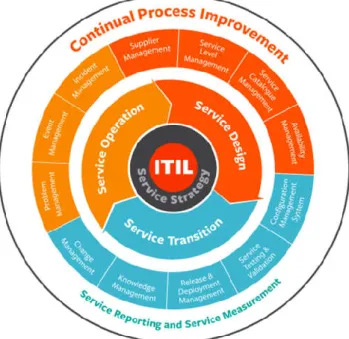
Since ITIL is a set of best practices and not a standard, organizations are free to adopt as much of the ITIL framework as is valuable to them. However, the more ITIL-compliant an organization’s processes are, the greater the benefits that organization will realize [24]. ITIL suggests that service management activities should be structured in the service life cycle (Figure 1).
The main content of ITIL is described in 5 books. Each of the 5 books refer to a specific stage of the service life cycle.
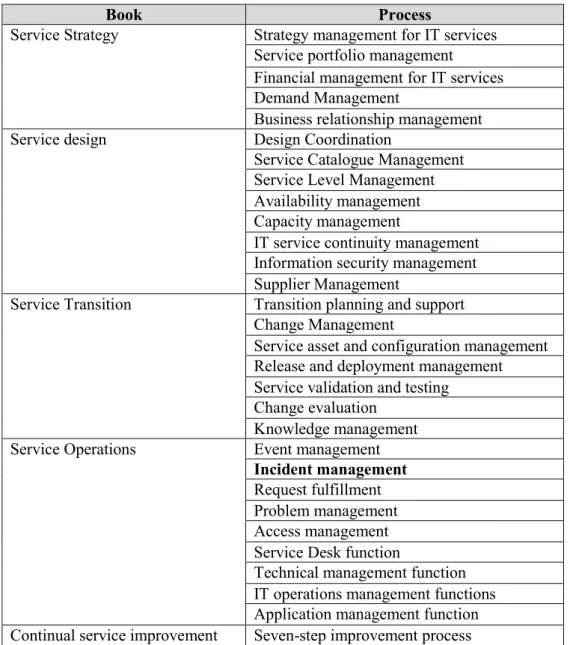
Since the focus of this thesis is the IM, I have highlighted (Table 1) the process that better match with such topic, which I will further analyze forwardly.
19
Table 1- Processes – ITIL
Service Operation is the phase in the ITIL Lifecycle that is responsible for ‘business-as-usual’ activities. The Service Operation can be viewed as the ‘factory’ of IT. This implies a closer focus on the day-to-day activities and infrastructures that are used to deliver services.
The Service Operations book is where the activities and processes necessary to deliver customer service and business users are coordinated and performed.
Yet, is in the Service Operations that the contact is more direct with the client or user and consequently when the value of the service is more valued.
Book Process
Service Strategy Strategy management for IT services Service portfolio management Financial management for IT services Demand Management
Business relationship management
Service design Design Coordination
Service Catalogue Management Service Level Management Availability management Capacity management
IT service continuity management Information security management Supplier Management
Service Transition Transition planning and support Change Management
Service asset and configuration management Release and deployment management Service validation and testing
Change evaluation Knowledge management
Service Operations Event management
Incident management
Request fulfillment Problem management Access management Service Desk function
Technical management function IT operations management functions Application management function Continual service improvement Seven-step improvement process
20 According to ITIL, IM is the process responsible for managing the life cycle of all incidents. Ensures that normal service is reestablished as quickly as possible while creating the smallest possible impact on the business.
There are some basic things that need to be taken into account and decided when considering IM:
Timescales – Must be agreed for all incident-handling stages;
Incident Models – Is a way of predefining the steps that should be taken to handle a process in an agreed way;
Major Incidents – A separate procedure, with shorter timescales and greater urgency must be used for ‘major’ incidents.
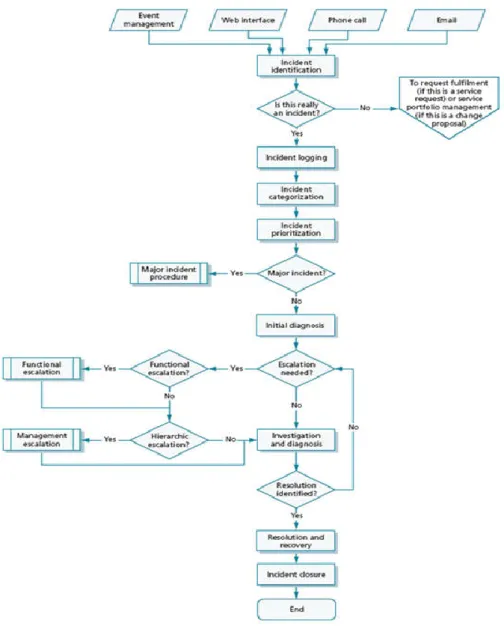
21 In ITIL, incidents go through a structured workflow that encourages efficiency and best results for both providers and customers. ITIL recommends the IM process follow on Figure 2.
ITIL roles are used in order to define responsibilities. In particular, they are used to assign process owners to the various ITIL processes, and to illustrate responsibilities for the single activities within the detailed process descriptions. Regarding IM roles, ITIL proposes the following ones in Table 2.
Table 2- IM Roles – ITIL
Roles Function
Incident Manager Have the responsibility for, developing and maintaining the IM systems, process and procedures. Managing the work of incident support staff (1st and 2nd line) and managing major incidents was
their responsibility too. Driving the efficiency and effectiveness of the IM process and making recommendations for improvement. First Line Is the primary point of contact for users when there is a service
disruption, take the first actions to resolve the issue. If can’t resolved, escalate to second level.
Second Line Made up of staff with greater (though still general) technical skills than the Service Desk and with additional time to devote to incident diagnosis and resolution without interference from telephone interruptions.
Third Line Will be provided by a number of internal technical groups and/or third-party suppliers. Network, Server, Desktop, Database or Voice Support, Application Management and others are the activities usually use for this support group
22 IM has close relationships with and dependencies on other service management processes, including:
Change management. The resolution of an incident may require the raising of a change request. Also, since a large percentage of incidents are known to be caused by implementation of changes, the number of incidents caused by change is a key performance indicator for change management;
Problem management. An important tool in the diagnosis of incidents is the known error database (KEDB), which is maintained by problem management. Problem management, in turn, depends on the accurate collection of incident data in order to carry out its diagnostic responsibilities;
Service asset and configuration management. The configuration management system (CMS) is a vital tool for incident resolution because it identifies the relationships among service components and also provides the integration of configuration data with incident and problem data;
Service level management. The breach of a service level is itself an incident and a trigger to the service level management process. Also, service level agreements (SLAs) may define timescales and escalation procedures for different types of incidents.
In conclusion, ITIL is one of the most used and known IT Framework. Is pointed in the literature as being very complete and organized. The process with interest to this investigation is the Incident Management and is one of the most important. It is inserted in Service Operations book.
23
2.1.2. COBIT
COBIT is a framework for developing, implementing, monitoring and improving IT governance and its management practices as well as one of the most adopted worldwide for such purpose.
The COBIT framework is published by the IT Governance Institute and the Information Systems Audit and Control Association (ISACA) [24]. The purpose of the framework is to provide a common language for business executives to communicate with each other about goals, objectives and results. The original version, published in 1996, focused largely on auditing. The latest version, published in 2013, COBIT 5, emphasizes the value that information governance can provide to a business’ success. It also provides quite a bit of advice about enterprise risk management.
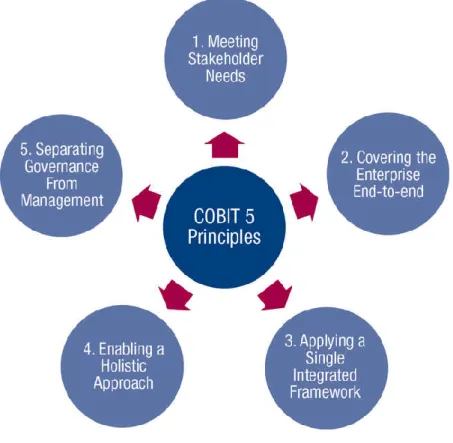
COBIT 5 is based on five key principles for governance and management of enterprise IT as we can see in Figure 3.
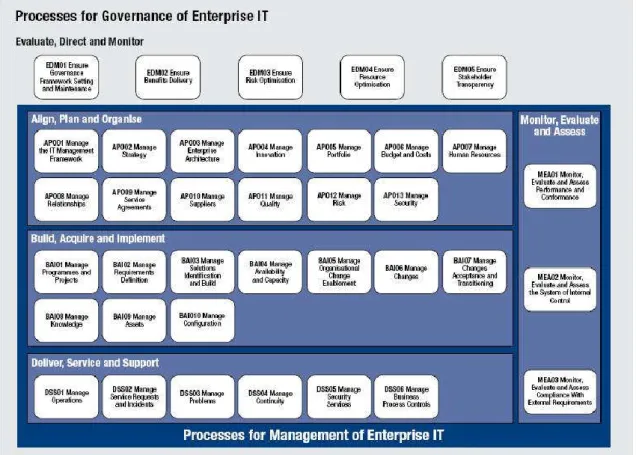
The COBIT 5 processes are split into governance and management areas. These two areas contain a total of five domains and thirty-seven processes (Figure 4):
24 Since this thesis focus on IM, I decided to analyze in more detail the process DSS02 Manage Service, Requests and Incidents that is inserted in the domain Deliver, Service and Support (DSS).
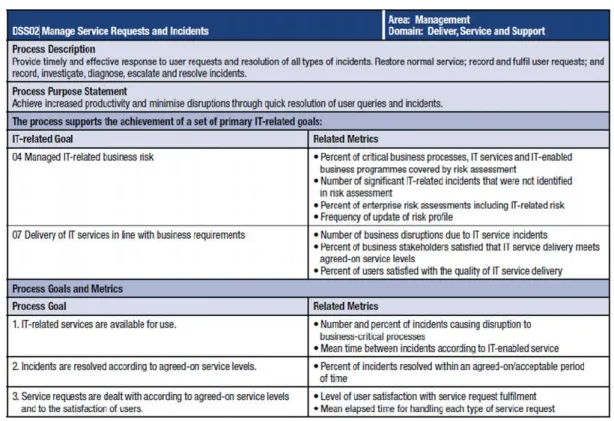
The DSS domain center on the delivery aspects of the information technology. It covers areas such as the execution of the applications within the IT system and its results, as well as the support processes that enable the effective and efficient execution of these IT systems. The Table 3 lists the high-level control objectives for the DSS domain.
The process DSS02, Manage Service Requests and Incidents aims to: Record, investigate, diagnose, escalate and resolve incidents;
Table 3- DSS Domain – COBIT 5
Deliver, Service and Support (DSS)
DSS01 Manage Operations
DSS02 Manage Service Requests and Incidents
DSS03 Manage Problems DSS04 Manage Continuity DSS05 Manage Security Services
DSS06 Manage Business Process Controls
25 Restore normal services;
Provide timely and effective response to user requests and resolution of all types of incidents.
The Process, DSS02 is described in more detail in Figure 5.
Figure 5- Process DSS02 – Manage Service Requests and Incidents- COBIT 5
COBIT 5 activities provide the ‘how’, ‘why’ and ‘what’ to implement according to each governance or management practice to improve IT performance and/or address IT solution and service delivery risk. The activities of this process are described in Table 4.
Table 4- Activities from COBIT 5
Activities – COBIT
B1 DSS02.01 Define incident and service request classification schemes
B2 DSS02.02 Record, classify and prioritize requests and incidents
B3 DSS02.03 Verify, approve and fulfil service requests B4 DSS02.04 Investigate, diagnose and
allocate incidents
B5 DSS02.05 Resolve and recover from incidents B6 DSS02.06 Close service requests and incidents B7 DSS02.07 Track status and produce reports
26
2.1.3. CMMI
Capability Maturity Model Integration (CMMI) is a best practice framework [25]. The CMMI model does not describe the processes themselves, it describes the characteristics of good processes, thus providing guidelines for organizations developing or honing their own sets of processes [26].
The first CMMI model (V1.02) was released in 2000 and designed for being used by development organizations in their pursuit of enterprise-wide process improvement. By the time that version 1.2 was released, two other CMMI models were being planned. Because of this planned expansion, the name of the first CMMI model had to change and became CMMI for Development.
The CMMI for Acquisition model was released in 2007. Two years later, the CMMI-SVC for Services model was released.
In 2008 plans were drawn to begin developing Version 1.3, which would ensure consistency among all three models and improve high maturity material. Version 1.3 of CMMI for Acquisition, CMMI for Development and CMMI for Services were released in November 2009 [27].
CMMI-SVC draws on concepts and practices from CMMI and other service focused standards and models, including the following:
Information Technology Infrastructure Library (ITIL);
ISO/IEC 20000: Information Technology – Service Management; Control Objectives for Information and related Technology (COBIT); Information Technology Services Capability Maturity Model (ITSCMM).
According CMMI-SVC, process areas are a cluster of related practices in an area that, when implemented collectively, satisfy a set of goals considered important for making improvement in that area. CMMI-SVC contains twenty-four process areas (Table 5).
27
Table 5 -Process Areas from CMMI SVC
Process Areas
CAM Capacity and Availability Management CAR Causal Analysis and Resolution CM Configuration Management DAR Decision Analysis and Resolution
IRP Incident Resolution and Prevention
IWM Integrated Work Management MA Measurement and Analysis OPD Organizational Process Definition OPF Organizational Process Focus
OPM Organizational Performance Management OPP Organizational Process Performance OT Organizational Training
PPQA Process and Product Quality Assurance QWM Quantitative Work Management REQM Requirements Management RSKM Risk Management
SAM Supplier Agreement Management SCON Service Continuity
SD Service Delivery
SSD Service System Development SST Service System Transition STSM Strategic Service Management WMC Work Monitoring and Control
WP Work Planning
The purpose of Incident Resolution and Prevention (IRP) is to ensure timely and effective resolution of service incidents and prevention of service incidents as appropriate. Once again, this framework also indicates that this process is one of the most important and most valued.
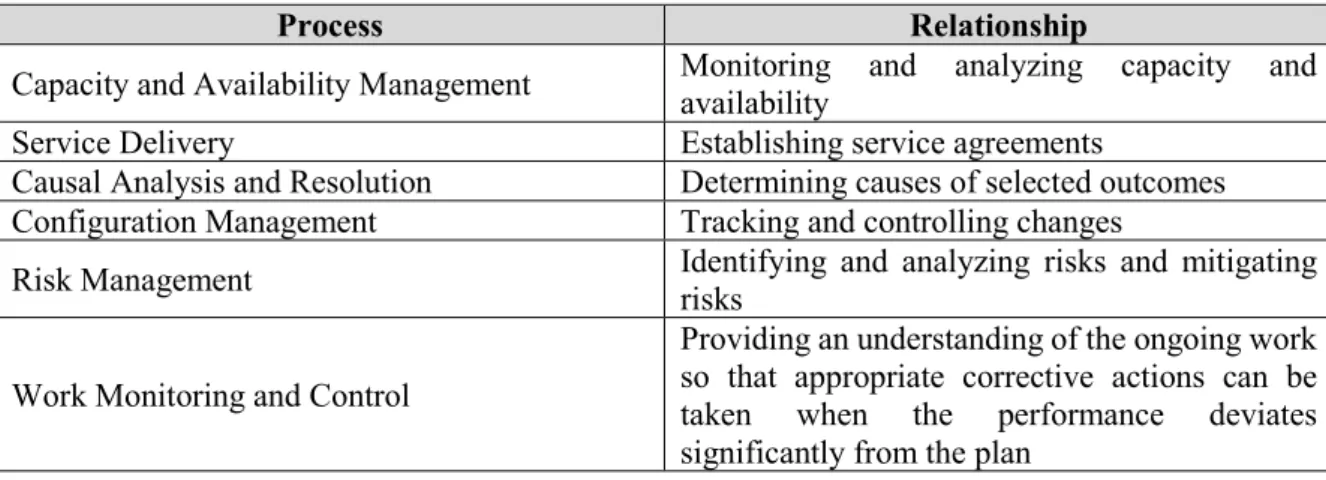
Some processes are affected by the IRP process which is detailed on Table 6.
Process Relationship
Capacity and Availability Management Monitoring and analyzing capacity and availability
Service Delivery Establishing service agreements
Causal Analysis and Resolution Determining causes of selected outcomes Configuration Management Tracking and controlling changes
Risk Management Identifying and analyzing risks and mitigating risks
Work Monitoring and Control
Providing an understanding of the ongoing work so that appropriate corrective actions can be taken when the performance deviates significantly from the plan
28 According to CMMI framework, a specific goal describes the unique characteristics that must be present to satisfy the process area. A specific practice is the description of an activity that is considered important in achieving the associated specific goal. The specific practices describe the activities that are expected to result in achievement of the specific goals of a process area.
The Specific Goals and Specific Practices of this process and the activities were described in Table 7 and Table 8 respectively.
Table 7- Specific Goal and Practices – CMMI
Specific Goals Specific Practices
SG 1 Preparation for incident resolution and prevention is conducted.
SP 1.1 Establish and maintain an approach to incident resolution and prevention.
SP 1.2 Establish and maintain an incident management system for processing and tracking incident information.
SG 2 Individual incidents are identified, controlled, and addressed.
SP 2.1 Identify incidents and record information about them.
SP 2.2 Analyze individual incident data to determine a course of action.
SP 2.3 Resolve incidents.
SP 2.4 Manage the status of incidents to closure.
SP 2.5 Communicate the status of incidents. SG 3 Causes and Impacts of selected incidents
are analyzed and addressed.
SP 3.1 Analyze the underlying causes of selected incidents.
SP 3.2 Establish and maintain solutions to respond to future incidents.
SP 3.3 Establish and apply solutions to reduce the occurrence of selected incidents.
In conclusion CMMI is also one of the most used frameworks. This framework contains a process with interest to this investigation, the Incident Resolution and Prevention.
Activities – CMMI
C1 Identifying and analyzing service incidents C2 Initiating specific actions to address incidents
C3 Monitoring the status of incidents, tracking progress of incident status, and escalating as necessary
C4 Identifying and analyzing the underlying causes of incidents C5 Identifying workarounds that enable service to continue
C6 Initiating specific actions to either address the underlying causes of incidents or to provide workarounds
C7 Communicating the status of incidents to relevant stakeholders
C8 Validating the complete resolution of incidents with relevant stakeholders
29
2.1.4. Frameworks conclusions and summary
After describe the most important, used and relevant IT Frameworks, this section intends to present a brief analysis of them (Table 9).
Table 9- Comparison IT Frameworks
ITIL V3 COBIT 5 CMMI-SVC
Founded
OGC ISACA Software
Engineering Institute (SEI)
Last Update July 2011 April 2012 November 2010
Focus Service Service Service
IM Yes Yes Yes
Name of Process Incident Management Manage Service Requests and Incidents Incident Resolution and Prevention Number of Processes 26 37 24
It’s possible to see that the three principal IT frameworks are quite similar in the terms of focus and the last update was recently made. Nevertheless, COBIT 5 has the most recent released version.
The numbers of management processes are similar in ITIL V3 and CMMI-SVC, in the other hand, COBIT 5 have a few more.
All frameworks seem to have information about the IM which make them suitable frameworks to provide inputs to our proposal.
30
2.2. Maturity Model Frameworks
Maturity models is a measurement of the ability of an organisation for continuous improvement in a particular discipline. Also, is a structured collection of elements that describe characteristics of effective processes. A maturity model provides [50]:
a place to start;
the benefit of a community’s prior experiences; a common language and a shared vision; a framework for prioritizing actions;
a way to define what improvement means for your organization.
A maturity model can be used as a benchmark for assessing different organizations for equivalent comparison. It describes the maturity of the company based upon the project the company is dealing with and the clients.
Maturity models in IT management have been proposed since at least 1973 [10]. More than one hundred different maturity models have been proposed [11] but most are too general and, as a result, not well defined and documented [12].
The use of a maturity model allows an organization to have its methods and processes evaluated in accordance with good management practices and with a set of external parameters. Maturity is indicated by the assignment of a particular “Maturity Level”. When the organization knows the maturity level at the specific process will benefit [30] as follows:
Knowledge of maturity level with clear recommendations on how to drive improvements;
Ability to compare itself with other organizations, or with other sectors within the organization;
Significant progress in self-assessments; A consistent set of questionnaires and scores; Independent verification and certification; A set of independent parameters.
The maturity level evaluation can be supported by certain procedures, including the use of questionnaires.
31 The advantage of maturity models is their simplicity which facilitates their understanding and communication as well as the fact that they may be used for benchmarking.
Considering the purpose of this thesis, the following sections will analyze the most relevant maturity models and some recent scientific works that propose new IT maturity models. At the end of the chapter comparison between them will be done.
32
2.2.1. COBIT PAM
Included in COBIT 5 documentation is a maturity model that can be used by organizations to assess COBIT processes maturity [28]. It is called Process Assessment Model (PAM). COBIT 5 PAM is an evolution from the previous COBIT 4.1 maturity model which is more aligned with a generally accepted process assessment standard.
COBIT PAM was based on the ISO/IEC 15504 standard since it uses the ISO 15504 capability model and the standard’s principle of assessment.
Moreover, COBIT PAM is a pillar of COBIT assessment programmed, it provides a base for:
The process reference model, which defines level 1 base requirements; Determining the capability levels (the measurement framework).
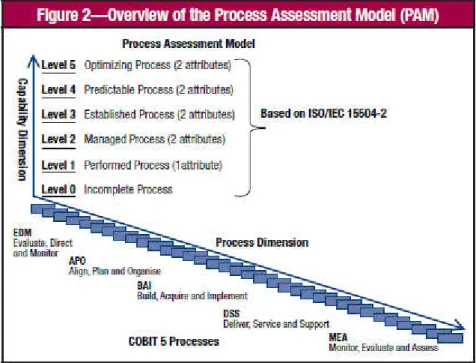
As we can see in Figure 6, PAM is a two-dimensional model of process capability. In the process dimension, the processes are defined and classified according of established process categories
In process dimension, the processes are defined and classified into process categories. The process dimension uses COBIT 5 as the process reference model. COBIT 5 provides
33 definitions of processes in a life cycle, together with an architecture describing the relationships amongst the processes.
In the capability dimension, a set of process attributes grouped into capability levels is defined. The process attributes provide the measurable characteristics of process capability. The capability dimension provides a way to assess the project business goals into organizations.
They have capability levels to classify the processes, as we can see on Table 10.
Table 10- Capability Levels – COBIT PAM
Capability Level Description
Level 0- Incomplete Process The process is not implemented or fails to achieve its process purpose
Level 1- Performed Process The implemented process achieves its process purpose. Level 2- Managed Process The previously described performed process is now
implemented in a managed fashion (planned, monitored and adjusted) and its work products are appropriately established, controlled and maintained.
Level 3- Established Process The previously described managed process is now implemented using a defined process that is capable of achieving its process outcomes.
Level 4- Predictable Process The previously described established process now operates within defined limits to achieve its process outcomes
Level 5- Optimizing Process The previously described predictable process is continuously improved to meet relevant current and projected business goals
In conclusion, COBIT PAM is one of the most used and important maturity models. It has two dimensions and six maturity levels. As it happens in IT framework, COBIT 5, the maturity model COBIT PAM is more focused in the management level.
34
2.2.2. ISO/IEC 15504
ISO/IEC 15504 Information Technology – Process Assessment, also termed Software Process Improvement and Capability Determination (SPICE) was developed by the International Organization for Standardization (ISO) and International Electrotechnical Commission (IEC).
ISO/IEC 15504 is the international standard for process assessment. It defines a generic way of measuring the effectiveness of processes.
ISO/IEC 15504 has been designed to satisfy the needs of acquirers, suppliers and assessors, and their individual requirements from within a single source [29].
The main objective of IEC/ISO 15504 is to help the software industry to make gains in efficiency and quality and deals with software processes such as development, management, customer support and quality.
Process assessments have two different results:
Process improvement, current practices in terms of the capability of the selected processes of an organization;
Capability determination that consists in analyzing the proposed capability of selected processes against a target process capability profile, in order to identify the risks involved in undertaking a project using the selected processes.
35 As can we see in Table 11 there are six capability levels in the reference model.
Table 11- Capability Levels- ISO/IEC 15504
Level Description
Level 0 – Incomplete There is general failure to attain the purpose of the process. There are few or no easily identifiable work products or outputs of the process.
Level 1- Performed The purpose of the process is generally achieved. The achievement may not be rigorously planned and tracked. Individuals within the organization recognize that an action should be performed, and there is general agreement that this action is performed as and when required. There are identifiable work products for the process, and these testify to the achievement of the purpose.
Level 2- Managed The process delivers work products according to specified procedures and is planned and tracked. Work products conform to specified standards and requirements. The primary distinction from the Performed Level is that the performance of the process now delivers work products that fulfill expressed quality requirements within defined timescales and resource needs.
Level 3- Established The process is performed and managed using a defined process based upon good software engineering principles. Individual implementations of the process use approved, tailored versions of standard, documented processes to achieve the process outcomes. The resources necessary to establish the process definition are also in place. The primary distinction from the Managed Level is that the process of the Established Level is using a defined process that is capable of achieving its process outcomes.
Level 4- Predictable The defined process is performed consistently in practice within defined control limits, to achieve its defined process goals. Detailed measures of performance are collected and analyzed. This leads to a quantitative understanding of process capability and an improved ability to predict and manage performance.
Performance is quantitatively managed. The quality of work products is quantitatively known. The primary distinction from the Established Level is that the defined process is now performed consistently within defined limits to achieve its process outcomes. Level 5- Optimizing Performance of the process is optimized to meet current and future
business needs, and the process achieves repeatability in meeting its defined business goals. Quantitative process effectiveness and efficiency goals (targets) for performance are established, based on the business goals of the organization.
Continuous process monitoring against these goals is enabled by obtaining quantitative feedback and improvement is achieved by analysis of the results. Optimizing a process involves piloting innovative ideas and technologies and changing non-effective processes to meet defined goals or objectives. The primary distinction from the Predictable Level is that the defined and standard processes now dynamically change and adapt to effectively meet current and future business goals.
36
2.2.3. CMMI-SVC
CMMI-SVC use levels to describe an evolutionary path recommended for an organization that wants to improve its processes.
Capability and Maturity are the two levels which reflect two improvement paths, defined as two representations and called Continuous and Staged. Both provide ways to improve processes to achieve business objectives.
The staged representation uses:
Maturity levels to define the overall state of the organization’s processes relative to the model in Staged representation;
Capability levels used in Continuous representation to define the state of the organization’s processes relative to process area.
To support those who use the continuous representation, all CMMI models reflect capability levels in their design and content.
A short description of each capability level follows in Table 12.
Table 12- Capability Levels – CMMI-SVC
Level Description
Level 0 – Incomplete An incomplete process is a process that either is not performed or is partially performed. One or more of the specific goals of the process area are not satisfied and no generic goals exist for this level since there is no reason to institutionalize a partially performed process. Level 1 – Performed A performed process is a process that accomplishes the needed work
to produce work products; the specific goals of the process area are satisfied.
Although capability level 1 results in important improvements, those improvements can be lost over time if they are not institutionalized. Level 2- Managed A managed process is a performed process that is planned and
executed in accordance with policy; employs skilled people having adequate resources to produce controlled outputs; involves relevant stakeholders; is monitored, controlled, and reviewed; and is evaluated for adherence to its process description.
The process discipline reflected by capability level 2 helps to ensure that existing practices are retained during times of stress.
Level 3- Defined A defined process is a managed process that is tailored from the organization’s set of standard processes according to the organization’s tailoring guidelines; has a maintained process description; and contributes process related assets to the organizational process assets.
37 In case of Staged representation, CMMI models reflect maturity levels in their design and content.
A maturity level consists of related specific and generic practices for a predefined set of process areas that improve the organization’s overall performance. The maturity level of an organization provides a way to characterize its performance.
The five Maturity Levels is describing in Table 13.
Table 13- Maturity Levels – CMMI
Level Description
Level 1- Initial Processes are usually ad hoc and chaotic. The organization usually does not provide a stable environment to support processes. Success in these organizations depends on the competence and heroics of the people in the organization and not
on the use of proven processes.
Organizations on this level provide services that often work, but they frequently exceed the budget and schedule documented in their plans. They are also characterized by a tendency to overcommit, abandon their processes in a time of crisis, and are unable to repeat their successes.
Level 2- Managed Work groups establish the foundation for an organization to become an effective service provider by institutionalizing selected Project and Work Management, Support, and Service Establishment and Delivery processes. Work groups define a service strategy, create work plans, and monitor and control the work to ensure the service is delivered as planned. The service provider establishes agreements with customers and develops and manages customer and contractual requirements. Configuration management and process and product quality assurance are institutionalized, and the service provider also develops the capability to measure and analyze process performance.
Level 3- Defined Service providers use defined processes for managing work. They embed tenets of project and work management and services best practices, such as service continuity and incident resolution and prevention, into the standard process set. The service provider verifies that selected work products meet their requirements and validates services to ensure they meet the needs of the customer and end user. These processes are well characterized and understood and are described in standards, procedures, tools, and methods.
Level 4- Quantitatively Managed
Service providers establish quantitative objectives for quality and process performance and use them as criteria in managing processes. Quantitative objectives are based on the needs of the customer, end users, organization, and process implementers. Quality and process performance is understood in statistical terms and is managed throughout the life of processes.
Level 5- Optimizing An organization continually improves its processes based on a quantitative understanding of its business objectives and performance needs. The
organization uses a quantitative approach to understand the variation inherent in the process and the causes of process outcomes.
38 The maturity levels are measured by the achievement of the specific and generic goals associated with each predefined set of process areas. Each maturity level matures an important subset of the organization’s processes, preparing it to move to the next maturity level.
As we can verify, CMMI-SVC have 5 maturity levels. This framework is one of the most used and known among service management community. As the CMMI framework from which it derives, the CMMI-SVC is more focused on operation processes.
39
2.2.4. TIPA
The Tudor IT Process Assessment (TIPA) is a framework for IT process assessment. It uses the principles of the ISO/IEC 15504-33000 standard to determine the maturity level within an organization.
TIPA has been defined as an interview based assessment methodology. It is considered the most effective way to gather information concerning the process performance and it helps initiate the organizational change required to later improve the processes.
TIPA methodology has six maturity levels that are described in Table 14.
Table 14 -Maturity Levels – TIPA
The assessment approach used in TIPA delineates an assessment project with six clearly defined phases:
Definition phase: the main objectives are to set the scope of the assessment, to identify the key actors, to agree on a service offer and concur on the assessment scope agreement;
Preparation phase: discover the organizational context, and then perform an assessment planning and define the organization (by preparing the Assessment team, the supporting documents used during the assessment and the people who will be interviewed);
Assessment phase: during which interviews are done and documents reviewed to enable process rating and process capability level determination. This phase is the key of the process assessment;
Analysis phase: the collected information is evaluated and a SWOT analysis is performed before making improvement recommendations;
Levels Description
Level 1- Incomplete The process is not implemented or fails to achieve its purpose
Level 2- Performed The process is implemented and achieves its Process Purpose
Level 3- Managed The process is managed and work products are established, controlled and maintained
Level – Established A defined process is used and based on a standard process Level 5- Predictable The process is enacted consistently within defined limits Level 6- Optimizing The process is continuously improved to meet relevant
40 Result presentation phase: the results are presented to the relevant stakeholders,
and the detailed assessment report is rendered;
41
2.2.5. AXELOS
AXELOS was created in 2013 by the Cabinet Office on behalf of Her Majesty’s Government (HMG) in the United Kingdom and Capita, to manage, develop and grow the Global Best Practice portfolio [30].
AXELOS was an evolution of PMF.
Moreover, AXELOS is responsible for developing, enhancing and promoting a number of best practice methodologies used globally by professionals working primarily in project, programming and portfolio management, IT service management and cyber resilience.
AXELOS consists of a set of assessments, in the form of questionnaires, for each process and function across the ITIL service lifecycle.
Each questionnaire comprises:
Process/function demographic questions; Process/function-generic attributes; Process/function-specific attributes; Process/function outcomes and outputs; Interfaces and inputs.
42 The AXELOS have 5 different maturity levels that are aligned with CMMI and COBIT definitions (Table 15).
Table 15- Maturity Levels- Axelos
Levels Description
Level 1 – Initial Processes or functions are ad hoc, disorganized or chaotic. There is evidence that the organization has recognized that the issues exist and need to be addressed. There are, however, no standardized procedures or process/function management activity, and the process/function is regarded as of minor importance, with few resources allocated to it within the organization. There are instead ad hoc approaches that tend to be applied on an individual or case-by-case basis. The overall approach to management is disorganized.
Level 2 – Repeatable Processes or functions follow a regular pattern. They have developed to the stage where similar procedures are followed by different people undertaking the same task. Training is informal, there is no communication of standard procedures, and responsibility is left to the individual. There is a high degree of reliance on the knowledge of individuals and therefore errors are likely. In general, activities related to the process or function are uncoordinated, irregular and directed towards process or function efficiency.
Level 3- Defined The process or function has been recognized and procedures have been standardized, documented and communicated through training. The procedures themselves are not sophisticated but are the formalization of existing practices. It is, however, left to the individual to follow these procedures and deviations may occur. The process has a process owner, formal objectives and targets with allocated resources, and is focused on both efficiency and effectiveness. Activities are becoming more proactive and less reactive.
Level 4 – Managed The process or function has now been fully recognized and accepted throughout IT. It is service-focused and has objectives and targets that are aligned with business objectives and goals. It is fully defined, managed and is becoming pre-emptive, with documented and established interfaces and dependencies with other IT processes. Processes and functions are monitored and measured. Procedures are monitored and measured for compliance and action taken where processes or functions appear not to be working effectively. Processes or functions are under constant improvement and demonstrate good practice. Automation and tools are increasingly used to deliver efficient operations.
Level 5 – Optimized Leading practices are followed and automated. A self-contained continuous process of improvement is established, which has now resulted in a pre-emptive approach. IT is used in an integrated way to automate the workflow, providing tools to improve quality and effectiveness, making the organization quick to adapt. The process or function has strategic objectives and goals aligned with overall strategic business and IT goals. These have now become ‘institutionalized’ as part of the everyday activity for everyone involved with the process or function.
43
2.2.6. J. Flores, L. Rusu and P. Johannesson Model
According to A Maturity Model of IT Service Delivery [31], the proposed IT Service Delivery Maturity Model was a mechanism for formalizing and assessing IT Service Delivery Elements.
The authors defined five levels of maturity: Level 1 – Initial;
Level 2 – Repeatable; Level 3 – Defined; Level 4 – Managed; Level 5 – Optimized;
To an agile manipulation of the information the authors score the IT Service delivery element maturity level in a scale of 1 to 5. With the need to differentiate maturity states the authors add a “+” or a “-” if is closer the level up or down respectively.
In order to reduce the complexity, the activities are grouped as in the Table 16.
Table 16- Proposed Activities
Service Definition
Business and technical service information
Service Operation
Negotiation, agreement and maintenance of Service Level Agreement with the customer
Service Achievement
Budgeting, IT accounting and charging Service Economy Future business requirements, service
performance and resource utilization
Service Capacity The recovery of required IT technical and
service facilities
Service Continuity Required availability of IT service Service Availability Management of a defined level of
security
Security Measures
In this particular case is explored in more detail the Service Capacity and Service Continuity activity in order to analyze the areas of IM (Table 17).
44 The Model was applied, and the activities most relevant related to IM are:
Service performance is reported by customers through a help desk system. When an incident is reported, a ticket is opened in the troubleshooting system until the incident is solved. Is used ORION to monitoring network performance, that
Table 17- Service Capacity and Service Continuity
Level Description
Service Capacity Service Continuity
1 - Customer trends are not analyzed
- IT service performance is not monitored against Service Level Agreement (SLA) target
- Resource utilization is not always analyzed right when an incident occurs
- Personnel are reactive to customer IT service incidents and do not inform customers about the solution in progress
2 - Future business requirements are considered for formulating a new service or characterized for the service contracted - IT service performance is analyzed based on customer complaints
- Changes of component parts of the IT infrastructure are appropriate to ensure service availability
- Continuity and recovery mechanisms are well known and established through the personnel, who are conscious of the importance of providing good IT service
3 - Methods for forecasting future customer requirements have been implemented but their accuracy is not always analyzed - A tool is used to identify and understand IT service performance incidents
- A tool is used to monitor and measure components within the IT infrastructure
- Business Impact analysis is used to quantify the loss of the IT services and assess the impact of all changes
4 - Forecasted business requirements are accurate and satisfy the customer SLRs - A tool is used to monitor and supervise IT service performance constraints
- Current resource utilization trends are produced and future resource requirement estimations are instituted in the organization
- IT recovery plan is implemented and supports critical business processes
5 - Future business requirements for IT services are considered and understood, and sufficient capacity to support the services is planned for and implemented in a capacity plan with an appropriate
timescale
- IT service performance is accurately analyzed, improved and forecasted
- Designed, procured or amended configuration of IT infrastructure component is based on capacity and utilization addressed by required response times, expected throughput and usage pattern, and is articulated in the capacity plan
- ITSCM Plan is established and derived from Business Plan Continuity Plan
45 enables quick detection, diagnosis and resolution of network outages and performance issues.
These functionalities score “2+” for service capacity.
The Service continuity score “2” for the functionalities followed. The personnel are not proactive at preventing customer complaints. The IT staff is reactive and informs the customer of any progress regarding the incident reported. Any incident is recorded and followed up on in a troubleshooting system as knowledge database. The troubleshooting system cannot identify or follow patterns of service performance. The personnel seem to know what to do to keep the continuity and recovery of IT service; their dynamic organization structure promotes personnel commitment.
This article also presents a comparison with the paper A maturity model for implementing ITIL v3 [32] which will be analyzed in the following sections.
46
2.2.7. R. Pereira, and M. Silva Model
The authors start by performing a comparison among several maturity models in the market. Rúben Pereira compares different Maturity Models in his work, ‘A maturity model of implementing ITIL V3 (2010)’. In this model, the maturity levels used were the same used in CMMI, which can be seen on Table 13.
At the end, the authors chose ITSCMM and CMMI-SVC as a basis to their own model for three main reasons:
Both focus on service;
ITSCMM is very well detailed;
CMM-SVC has Staged Model and Continuous Model, so they decided to design their model following the same rational to give organizations more flexibility in ITIL assessment.
This maturity model was completely different from other models in the market at the time because:
It was specifically designed to help organizations measure their ITIL maturity; Guided them in the implementation of ITIL, in order to reduce risks;
It was specifically created for ITIL context, as PMF, however PMF was initially designed for ITIL V2 and was too simple in terms of factors.
As we can see in table 18, both models, Staged and Continuous, are connected. While Staged Model provides a global view about the main processes to implement, Continuous Model enables the assessment of each ITIL process.
In order to support the proposed questionnaires, the authors designed and implemented a software prototype that helped organizations to assess their ITIL processes more professionally, easily and efficiently.
In this model, they chose the evaluation of IM, Configuration Management Processes and the Service Desk because they are the most popular in organizations implementing ITIL.
47 Each questionnaire contains three kinds of questions and four possible answers (Table 19):
Table 19- Type of Questions and Answers
Questions Answers
Key questions: All these questions are
essential for the correct implementation of each specific level of the process, and all must be implemented to reach the level. Basically, they’re related with roles, responsibilities, activities, documents, audits, reviews, etc.
Yes: They have the question implemented
Non-key questions: Not all of these questions
need to be implemented, just 75 percent of them.
Basically, they’re related with sub-practices; they are not the main focus.
No: They don’t have the question implemented
Dependent key questions: These questions
are related to dependencies between processes. If the process that is being assessed depends in some way on other ITIL processes and the organization has those processes implemented too, then the question must be implemented; otherwise, it shouldn’t be.
Don’t know: They don’t understand the
question or don’t know the answer
In implementation: If they are already in an
implementation phase of that question
Part of the IM questionnaire can be seen in Figure 7. I have chosen this questionnaire since this thesis is also focused on IM process.
48
Figure 7- Part of questionnaire used in IM
After a few interviews, the authors concluded that most organizations failed to implement ITIL properly and remaining at a low maturity level, not because they cannot implement a high percentage of what ITIL proposes, but because they failed to implement specific and crucial details.
49
2.2.8. M. Vitoriano and J. Neto Model
The methodology used by Vitoriano and Neto was based on the Process Maturity Framework (PMF), a maturity model described in the ITIL’s reference model.
In fact, they disagree with Pereira and Silva (2010) who stated that the model was fairly simple and were just described in a few pages in ITIL v2, and little information was provided to help the ITIL’s implementation.
PMF was incorporated into ITIL v3, and it can be found in Appendix H of the Design Service book (OGC, 2007a).
To use this maturity model, it is required to perform some interviews with questions related to the five maturity levels, such as: initial, repetitive, defined, managed and optimized; the information was collected on five basic processes of ITSM [33].
In addition to the classification of processes in maturity levels, the interviews gathered information on the possible causes of low process maturity.
As already explained in Table 15, the PMF defines an ITSM maturity model when it comprises five dimensions of organizational evolution.
For each of these dimensions there is a maturity scale, organized in sequential and cumulative stages, from a simple level to a higher level of growth and improvement. Maturity levels described in the PMF, which follows the same nomenclature used by other maturity models such as ITSCMM, SW-CMM and CMM-SVC are described, as already mentioned, on Table 13.
A method to calculate this maturity has been defined for this purpose, as described below:
1. To find the maturity level in each Dimension, a questionnaire is applied to check
if all the requirements indicated in the PMF are met;
2. In order to reach a certain level of maturity in any of the dimensions, all the
answers must be positive in the respective level;
3. If there is a negative response, the interview is interrupted at that dimension, the
maturity level reached at that point is stored and indications of possible causes for the negative response are presented;
50
4. At the end of the evaluation, when the level in each dimension has been identified,
the process of maturity level may be calculated, as follows:
Where :
GPM- General Process Maturity
Dimensions- Maturity in each dimension