Copyright: This is an open-access article distributed under the terms of the Creative Commons Attribution License®, which permits unrestricted use, distribution, and reproduction in any medium, provided that the original author and source are credited.
Factors associated with sedentary behavior among
ELSA-Brasil participants: ecological model
Fatores associados ao comportamento sedentário entre participantes do ELSA-Brasil:
modelo ecológico
AUTHOR’S
Francisco José Gondim Pitanga1 Sheila Maria Alvim Matos2 Maria da Conceição Almeida3 Rosane Härter Griep4 Maria Carmen Viana5 Enirtes Caetano Prates Melo3,6 Estela M.L. Aquino2
1 Department of Physical Education. Federal University of Bahia, Salvador, Bahia, Brazil. 2 Institute for Collective Health. Federal University of Bahia Salvador, Bahia, Brazil.
3 Institute Gonçalo Moniz - Fundação Oswaldo Cruz, Brazil.
4 Laboratory of Education in Environment and Health, Fundação Oswaldo Cruz. Brazil. 5 Section of Psychiatric Epidemiology, Department of Social Medicine, Postgraduate Program in Public Health, Federal University of Espírito Santo, Vitória, Espírito Santo, Brazil.
6 Department of Epidemiology, National School of Public Health, Fundação Oswaldo Cruz. Brazil. CORRESPONDING
Francisco José Gondim Pitanga [email protected]
Universidade Federal da Bahia. Faculdade de Educação. Av. Reitor Miguel Calmon, s/n, Vale do Canela. Salvador, Bahia, Brazil. CEP: 40000-000.
DOI
10.12820/rbafs.23e0006
ABSTRACT
The main objective was to identify the prevalence and factors associated with sedentary behavior (SB). The study comprising a total of 13,765 individuals of both sexes participating in the Longitu-dinal Study of Adult Health (ELSA-Brasil) assessed in the second wave (2012-2014). The SB was measured using questions related to sitting time during the week and weekend. The associated factors were assessed by face-to-face interviews, with blocks of questionnaires and anthropometric meas-urements. A hierarchical ecological model was built with all possible factors associated with SB: so-ciodemographic environment (age and level of education; economic status); behavioral environment (leisure time physical activity, commuting physical activity, beer consumption, current smoking); and biological environment (overweight, obesity and abdominal obesity). Crude and adjusted odds ratios (ORs) and 95% confidence intervals (95% CIs) were estimated using logistic regression. Among men and women, higher education, current smoking and abdominal obesity were positively associated with SB, while being over 51 years old and being physically active were negatively associated with SB. The proposed ecological model explains the SB through the sociodemographic, behavioral and biological environment.
Keywords: Sedentary lifestyle; Adult; Epidemiology.
RESUMO
O objetivo principal do estudo foi identificar a prevalência e fatores associados ao comportamento sedentário (CS). O estudo compreendeu um total de 13.765 indivíduos de ambos os sexos participantes do Estudo Lon-gitudinal de Saúde do Adulto (ELSA-Brasil) avaliados na segunda onda (2012-2014). O CS foi medido usando questões relacionadas ao tempo sentado durante a semana e o final de semana. Os fatores associados foram avaliados por meio de entrevistas face a face com blocos de questionários e medidas antropométricas. Um modelo ecológico hierárquico foi construído com todos os possíveis fatores associados ao CS: ambiente so-ciodemográfico (idade e nível de instrução; situação econômica); ambiente comportamental (atividade física no tempo livre, atividade física de deslocamento, consumo de cerveja, tabagismo atual); e ambiente biológico (sobrepeso, obesidade e obesidade abdominal). Odds ratios (OR) brutos e ajustados e intervalos de confiança de 95% (95% ICs) foram estimados usando regressão logística. Entre homens e mulheres, a maior escolari-dade, o tabagismo atual e a obesidade abdominal foram positivamente associados ao CS, enquanto que ter mais de 51 anos e ser fisicamente ativo estavam associados negativamente ao CS. O modelo ecológico proposto explica o CS por meio do ambiente sociodemográfico, comportamental e biológico.
Palavras-chave: Comportamento sedentário; Adulto; Epidemiologia.
Introduction
Sedentary behavior (SB) refers to any activity charac-terized by low energy expenditure, not exceeding 1.5
metabolic equivalents, and includes specific behaviors such as sitting for reading, studying, watching televi-sion, etc. Generally, these habits are considered
diffe-rent from practicing small amounts of physical activity, a behavior in which the individual also fails to engage in moderate or vigorous physical activity that would require an energy expenditure above 3 metabolic equi-valents1.
Various studies have shown an association between time spent in SB and a greater incidence of cardiovas-cular disease2, type 2 diabetes3, obesity4 and
metabol-ic syndrome5, as well as a greater risk of death from
cardiovascular disorders6,7. Moreover there is evidence
that excess SB such as television viewing and computer use represents relevant risk factors and merits as much investigation as that conducted on physical activity lev-els. Sitting for prolonged periods of time constitutes an important risk factor for all causes of mortality ir-respective of the regular practice of physical activity8.
Although research on the mechanisms involved in the influence of SB on cardio-metabolic disorders is in the early stages, it is speculated that during seden-tary activity there is a significant reduction in muscle liproprotein lipase (LPL) activity, the key enzyme that regulates lipid metabolism. Low LPL activity levels were associated with a substantial decrease in plasma triglyceride absorption by skeletal muscles, and, thus, fat is deposited in the vessels or adipose tissue9.
To successfully develop interventions to reduce this unhealthy behavior the factors associated with SB need to be identified. Recent research in Cana-da has shown that there are different determinants of SB, including marital status, presence of children in the household and social support10. Another study
conducted in Japan showed that SB is more prevalent among the elderly, single and unemployed11. In a study
carried out in Brazil it was observed that older workers with higher income and more schooling had a higher chance of having sedentary behaviors12, but new
stud-ies are needed to identify other factors associated with this type of behavior.
SB identification in adults using an ecological model to summarize the different levels of the socio demographic, behavioral and biological environment can provide important information for planning and implementing public policies to reduce sedentary be-havior in specific population groups. Within the scope of ELSA-Brasil, in which the study population is com-posed of individuals with predominantly sedentary ac-tivities, and only 33.8% of women and 44.1% of men reported leisure time physical activity at baseline13, the
investigation of this topic may add knowledge to the
theme that has not yet been explored.
The aim of this study was to evaluate the prevalence and factors associated with sedentary behavior in men and women participating in the Brazilian Longitudi-nal Study of Adult Health (ELSA-Brasil).
Methods
The ELSA-Brasil is a cohort study involving 15,105 active or retired civil servants aged 35-74 years, from five different universities and one research institution located in the cities of Salvador, Vitória, Belo Horizon-te, Rio de Janeiro, São Paulo and Porto Alegre. Metho-dological procedures of the study have been described in detail elsewhere14,15. All participants assessed in the
second wave (2012-2014) with complete data on se-dentary behavior were included in the present analysis, comprising a total of 13,765 participants of both sexes.
The ELSA-Brasil was approved by internal review boards from all research centers involved. Data was col-lected after all participants signed an informed consent form, and confidentiality was assured to all participants.
The data were produced by a team of interviewers and then verified by trained personnel and certified by a quality control committee15.The supervisory
per-sonnel were authorized to apply the study protocol in any of the ELSA-Brasil study centers. The interviews were conducted face-to-face, with blocks of question-naires and anthropometric measurements of weight, height and waist circumference were applied. Body weight without shoes and while wearing standardized dress of negligible weight was obtained in the morn-ing, after participants fasted for 8 to 12 hours, using an electronic scale, Toledo®, with a capacity of up to 200 Kg. To measure the standing height, a SECA® brand stadiometer was used, with the participant positioned standing straight with his back to the stadiometer, barefoot (at an angle of 45°) and with his head in the Frankfurt plane. Waist circumference was obtained by placing an inelastic tape over the point marking the av-erage distance between the lower rib and the iliac crest on the right side or at the umbilicus if it was impossible to mark points. Standards and recommended technical criteria were observed at all stages of the anthropomet-ric evaluation16. The equipment was installed and
cal-ibrated following standard procedures in all research centers (RC)17.
SB was documented for the first time in the second wave of the study. Participants were asked to report the daily average number of accumulated hours they spent
the following questions: a) how much time per day, on average, you spend seated during the weekdays; b) how much time per day, on average, do you spend seated during the weekend. A level of sedentary behavior was classified as ≥8 hours/day of total sitting time during the week or during the weekend8
The International Physical Activity Questionnaire (IPAQ) was used to identify and quantify physical activity. Leisure-time physical activity was classified as follows: 0 = insufficiently active ( < 150 minutes/ week of moderate physical activity or walking and/or < 60 minutes per week of vigorous physical activity or < 150 minutes per week of any combination of walking, moderate or vigorous physical activity); and 1 = physi-cally active (≥ 150 minutes per week of moderate phys-ical activity or walking and/or ≥ 60 minutes per week of vigorous physical activity or ≥ 150 minutes per week of any combination of walking, moderate or vigorous physical activity). Commuting physical activity was categorized as insufficiently active ( < 150 min/week in physical walking and / or bicycle) and physically active (≥ 150 min/week in physical walking and / or bicycle).
Overweight and obese participants were identified by the body mass index (BMI) measurement with the equation BMI = weight (kg) / height (m)2. The
follow-ing cutoffs were adopted: overweight = 0 if BMI < 25.0 and overweight = 1 if BMI ≥ 25.0; and obesity = 0 if BMI < 30.0 and obesity = 1 if BMI ≥ 30.0. Abdominal obesity was defined as a waist circumference >88 cm in women and >102 cm in men.
The schooling, weekly consumption of beer and current smoking was evaluated through an interview. The schooling was classified in incomplete elementar, complete elementar, high-school and college. The weekly consumption of beer was classified in “ < 1500 ml” = 0 or “≥ 1500 ml” = 1; and the current smoking was clas-sified in “no” = 0 and “yes” = 1
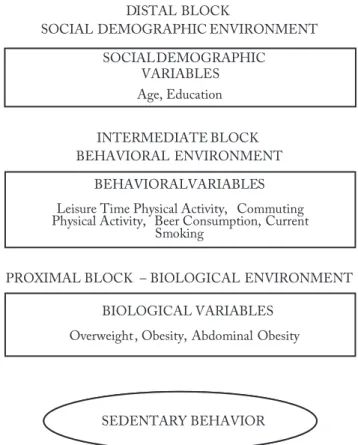
SB was the dependent variable, while the inde-pendent variables were grouped into blocks from an adapted theoretical ecological model13,18: the social
de-mographic environment (age and level of education); the behavioral environment (leisure time physical ac-tivity, commuting physical acac-tivity, beer consumption, current smoking); and biological environment (over-weight, obesity and abdominal obesity).
All analyzes were stratified by sex to highlight dif-erences between males and females. The prevalence of SB by RC and the strata of each independent
varia-95% confidence intervals. We estimated crude and ad-justed odds ratios (ORs) and 95% confidence intervals (95% CIs) using logistic regression from the adapted theoretical model13,18 to discriminate against potential
associated factors of hierarchical levels (Figure 1). The strategy used for the entry of variable blocks was the forward method in the following order: distal blocks (socio-demographic variables), intermediate blocks (behavioral variables) and proximal block (biological variables). During the steps of hierarchical analysis re-mained in the model variables with p < 0.10. We used the statistical software Stata, version 12.0.
Figure 1 – A hierarchical ecological model for the analysis of factors associated with sedentary behavior in adults from the ELSA-BRASIL.
Results
A total of 6.264 men and 7.501 women were included in the analysis. The SB prevalence rates were 23.7% and 22.7% among men and women, respectively. It is impor-tant to emphasize that the prevalences were calculated for the sitting time classified as ≥8 hours/day of total sit-ting time during the week or during the weekend. When the prevalences are calculated separately there is a reduc-tion in sitting time at the weekend in both men (week = 20.3% and weekend = 10.4%) and women (week =
20.2% and weekend = 6.7%). Both male and female par-ticipants in the Rio de Janeiro RC have more sedentary behavior, while in the Salvador RC the lowest prevalence of sedentary behavior was observed (Figure 2 and 3). In all RC, woman reported significantly less sitting-time than men, except in the São Paulo and Rio de Janeiro sites. The prevalence and confidence intervals of SB per stratum of each variable analyzed in the study are shown in Table 1. Both men and women reported lowest SB in older age (60 years or more). Higher educational attain-ment was associated with increased SB in both sexes.
10,0 15,0 20,0 25,0 35,0 40,0 30,0 All Centers 22.7SSA 17.1 RJ 28.9VIT 29.2 SP 25.7BH 21.2 POA 20.0 %
Figure 2 – Prevalence and CI95% of sedentary behavior for centers (Female). Longitudinal Study of Adult Health (ELSA-Brasil), 2012-2014. SSA, Salvador; RJ, Rio de Janeiro; VIT, Vitória; SP, São Paulo; BH, Belo Horizonte; POA, Porto Alegre.
Figure 3 – Prevalence and CI95% of sedentary behavior (Male). Longitudinal Study of Adult Health (ELSA-Brasil), 2012-2014. SSA, Salvador; RJ, Rio de Janeiro; VIT, Vitória; SP, São Paulo; BH, Belo Horizonte; POA, Porto Alegre.
Smaller proportions of SB were observed in men and women who reported more leisure time physical ac-tivity. The SB frequency was higher in current smokers, but was not associated with beer consumption. The pro-portion of SB was higher in men and women who were overweight, obese and had abdominal obesity. However, none of these differences was statistically significant.
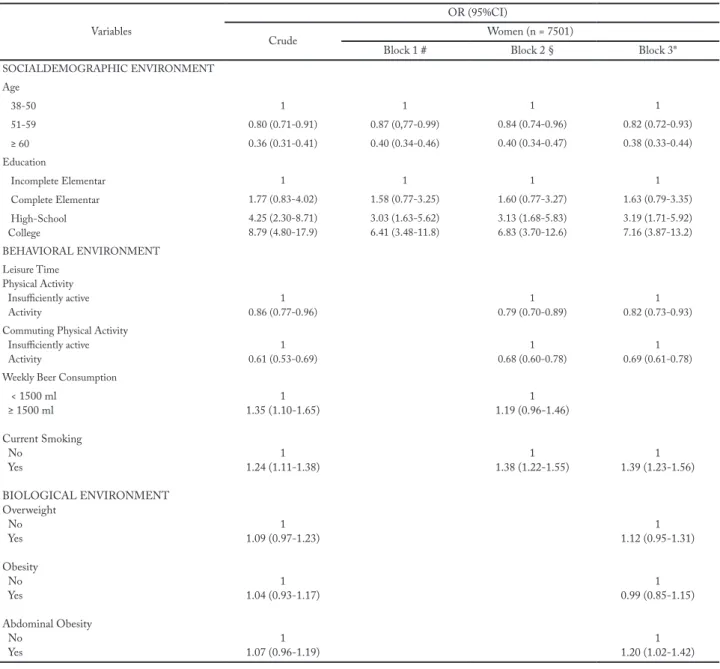
The social demographic, behavioral and biological varia-bles included in the hierarchical model were associated with SB in leisure time in both sexes (Tables 2 and 3). Among
men and women being better educated, being a current smoker and having abdominal obesity were positively asso-ciated with SB, while being over 51 years old and physically active were negatively associated with SB (Table 2 and 3).
Table 1 – The prevalence of sedentary behavior by strata of the variables analyzed in the study. Longitudinal Study of Adult Health (ELSA-Brasil), 2012-2014.
Variables n = 6,264 Men % (CI95%) n = 7,501Women% (CI95%)
Socialdemographic environment Age (years) 38-50 2039 28.1 (26.1-30.1) 2321 29.6 (27.9-31.6) 51-59 2155 23.4 (21.6-25.2) 2718 25.4 (23.8-27.1) ≥60 2070 19.9 (18.2-21.7) 2462 13.1 (11.8-14.5) Education Incomplete elementar 434 8.8 (8.4-9,1) 253 4.3 (3.7-5.0) Complete elementar 479 10.8 (8.2-14,0) 376 7.4 (7.9-7.9) High-school 1905 17.0 (15.3-18.8) 2409 16.2 (14.8-17.8) College 3442 31.1 (25.6-32.3) 4463 28.6 (27.2-29.9) Behavioral environment
Leisure time physical activity
Insufficiently
active 3267 24.8 (23.4-26.4) 4667 23.7 (22.5-24.9)
Active 2994 22.5 (21.1-24.1) 2834 21.1 (19.6-22.6)
Commuting physical activity
Insufficiently
active 4108 26.8 (25.5-28.2) 5152 25.3 (24.1-26.5)
Active 2154 17.9 (16.3-19.6) 2348 17.0 (15.5-18.6)
Weekly beer consumption
< 1500 ml 4651 24.0 (21.5-26.6) 6978 22.3 (20.2-24.4) ≥ 1500 ml 1613 23.0 (18.7-27.5) 523 27.9 (21.0-36.1) Current smoking No 3269 22.9 (20.1-26.2) 4803 21.3 (18.9-24.0) Yes 2994 24.5 (21.4-27.8) 2698 25.1 (21.8-28.5) Biological environment Overweight No 1811 21.1 (17.2-25.6) 2442 21.7 (18.3-25.5) Yes 4453 24.8 (22.3-27.5) 5059 23.2 (20.8-25.7) Obesity No 4722 22.7 (20.1-25.2) 5240 22.5 (20.1-25.0) Yes 1542 27.0 (22.9-31.6) 2261 23.2 (19.7-27.1) Abdominal obesity No 4246 22.0 (19.3-24.7) 3435 22.1 (19.2-25.3) Yes 2003 27.5(23.9-21.5) 4053 23.2 (20.6-26.1)
Discussion
The study sought to identify the prevalence and factors associated with SB in adult participants of the Longi-tudinal Study of Adult Health (ELSA-Brasil). The pre-valence of SB among participants of the ELSA-Brasil, 23.7% in men and 22.7% in women were minor than
was observed that men spend more sitting time at the weekend (10.4%) than women (6.7%), although they do more leisure-time physical13 thatis, it is possible that
the sitting time that the women do not have at the wee-kend is due to the inadequate division of tasks at the domestic level that overloads them. It is noteworthy that in the study conducted in Germany SB was con-sidered with the cutoff point> 6 hours of sitting time.
In a recent systematic review study20 with the aim
of identifying individual, social, environmental, and
adults aged 18–65 years it was not iced that factors such as age and socio-economic level were all signif-icantly correlated with sedentariness
In our study in the Block 1 (social demographic en-vironment) it was observed that age was inversely asso-ciated and level of education was positively assoasso-ciated with SB among men and women. These results are very similar to those observed in the study carried out in Ger-many19 and confirm the current trend of reducing
seden-tary behavior in older people. The greater use of
technol-Table 2 – The association between sedentary behavior and selected variables among men. Longitudinal Study of Adult Health (ELSA-Brasil), 2012-2014.
Variables
OR (95%CI)
Crude Men (n = 6,264)
Block 1 # Block 2 § Block 3*
SOCIALDEMOGRAPHIC ENVIRONMENT Age 38-50 1 1 1 1 51-59 0.78 (0.68-0.90) 0.91 (0.79-1.05) 0.86 (0.74-0,99) 0.84 (0.73-0.98) ≥ 60 0.64 (0.55-0.74) 0.67 (0.58-0.78) 0.62 (0.53-0.72) 0.61 (0.52-0.71) Education Incomplete Elementar 1 1 1 1 Complete Elementar 1.27 (0.80-2.03) 1.23 (0.79-1.92) 1.26 (0.81-1.96) 1.21 (0.77-1.88) High-School College 2.14 (1.49-3.13)4.71 (3.34-6.81) 1.92 (1.35-2.75)4.41 (3.13-6.21) 1.99 (1.39-2.84)4.74 (3.35-6.70) 1.95 (1.37-2.79)4.64 (3.28-6.56) BEHAVIORAL ENVIRONMENT Leisure Time Physical Activity Insufficiently active Activity 0.88 (0.79-0.99)1 0.80 (0.71-0.90)1 0.80 (0.73-0.93)1
Commuting Physical Activity Insufficiently active
Activity 0.59 (0.52-0.68)1 0.70 (0.61-0.80)1 0.70 (0.62-0.81)1
Weekly Beer Consumption < 1500 ml ≥ 1500 ml Current Smoking No Yes BIOLOGICAL ENVIRONMENT Overweight No Yes Obesity No Yes Abdominal Obesity No Yes 1 0.95 (0.86-1.08) 1 1.09 (0.97-1.23) 1 1.23 (1.08-1.41) 1 1.27 (1.11-1.45) 1 1.35 (1.19-1.52) 1 0.96 (0.84-1.11) 1 1.44 (1.26-1.63) 1.38 (1.22-1.57)1 1 1.07 (0.92-1.25) 1 1.06 (0.88-1.28) 1 1.22 (1.02-1.47)
# Adjusted for sociodemographic variables; § Adjusted for sociodemographic and behavioral variables; * Adjusted for socio demographic, behavioral and biological variables; Variable with drawn analysis: p > 0.10.
ogy, work and seated occupations, and forms of passive displacement among younger adults could explain this behavior. In addition, particularly in ELSA-Brasil partic-ipants it was observed that retirees are more physically active than those still in professional activity, fact that reflects the specific characteristics of this population of civil servants who become elderly and retired in more fa-vorable social conditions than other population groups.
Regarding education level, a positive association with SB was observed, indicating that interventions to reduce the sitting time in more educated people should be developed. It is important to note that, in
studies that specifically investigate screen time, people with lower levels of schooling present more sedentary behavioral in relation to time watching television21.
Results similar to ours were found in a study with Bra-zilian elderly workers when it was observed that higher income and schooling increase sedentary behavior12.
As for block 2 (behavior environment) we found that leisure time physical activity and commuting physical activity was inversely associated with SB among men and women. We also found appositively association between tobacco use and SB among men and women. Regarding physical activity, it should be emphasized
Table 2 – The association between sedentary behavior and selected variables among men. Longitudinal Study of Adult Health (ELSA-Brasil), 2012-2014.
Variables
OR (95%CI)
Crude Women (n = 7501)
Block 1 # Block 2 § Block 3*
SOCIALDEMOGRAPHIC ENVIRONMENT Age 38-50 1 1 1 1 51-59 0.80 (0.71-0.91) 0.87 (0,77-0.99) 0.84 (0.74-0.96) 0.82 (0.72-0.93) ≥ 60 0.36 (0.31-0.41) 0.40 (0.34-0.46) 0.40 (0.34-0.47) 0.38 (0.33-0.44) Education Incomplete Elementar 1 1 1 1 Complete Elementar 1.77 (0.83-4.02) 1.58 (0.77-3.25) 1.60 (0.77-3.27) 1.63 (0.79-3.35) High-School College 4.25 (2.30-8.71)8.79 (4.80-17.9) 3.03 (1.63-5.62)6.41 (3.48-11.8) 3.13 (1.68-5.83)6.83 (3.70-12.6) 3.19 (1.71-5.92)7.16 (3.87-13.2) BEHAVIORAL ENVIRONMENT Leisure Time Physical Activity Insufficiently active Activity 0.86 (0.77-0.96)1 0.79 (0.70-0.89)1 0.82 (0.73-0.93)1
Commuting Physical Activity
Insufficiently active
Activity 0.61 (0.53-0.69)1 0.68 (0.60-0.78)1 0.69 (0.61-0.78)1
Weekly Beer Consumption
< 1500 ml ≥ 1500 ml Current Smoking No Yes BIOLOGICAL ENVIRONMENT Overweight No Yes Obesity No Yes Abdominal Obesity No Yes 1 1.35 (1.10-1.65) 1 1.24 (1.11-1.38) 1 1.09 (0.97-1.23) 1 1.04 (0.93-1.17) 1 1.07 (0.96-1.19) 1 1.19 (0.96-1.46) 1 1.38 (1.22-1.55) 1.39 (1.23-1.56)1 1 1.12 (0.95-1.31) 1 0.99 (0.85-1.15) 1 1.20 (1.02-1.42)
# Adjusted for socio demographic variables; § Adjusted for sociodemographic and behavioral variables; * Adjusted for socio demographic, behavioral and biological variables; Variable with drawn analysis: p> 0.10.
have not been able to find an association22, and
oth-ers have observed positive associations indicating that physical activity and sedentary behavior are independ-ent constructs, that is, being physically active is not a guarantee that you will not have sedentary behavior23.
In our study only the domains of leisure time physical activity and commuting physical activity were analyz-ed and it was expectanalyz-ed that these two physical activity contexts presented inverse associations with SB, since, principally, active displacement may influence the re-duction of sedentary behavior.
With regard to smoking, a positive association be-tween smoking and SB was observed in both men and women. On the other hand we cannot demonstrate associations between weekly beer consumption and SB. Contrary results were observed in a recent study in
Stockholm, Sweden24, when it was observed that
un-favorable alcohol consumption, but not smoking, was associated with sedentary behavior.
As for block 3 (biological environment) there were positive associations only between abdominal obesity and SB both among men and women. No association between overweight or obesity with SB was observed. These results are not consistent with the recent sys-tematic review cited above19,when it was found that in
the majority of studies analyzed it was observed that the higher the BMI, the higher the SB level. Another study carried out in Korea25 found an association
be-tween obesity and abdominal obesity with SB among men and only in obesity with SB among women.
On the other hand, the results found in our study that there is no association between overweight and obesity with sitting time are consistent with the find-ings of systematic review26, which identified only
lim-ited evidence of longitudinal association between sed-entary behavior, overweight and obesity. In addition, other studies suggest the existence of an association between overweight and time watching television27
,
al-though there is no association between overweight and obesity with total sitting time, as analyzed in the pres-ent study. These results may have been found by virtue of the fact that food consumption may be increased during the time in front of the television.
A possible limitation of the study is that the infor-mation on SB was obtained by self-reported question-naires, which nevertheless are a widely used instrument in national and international studies. It is important to mention that the ELSA-Brasil is a longitudinal study
ures, such as accelerometry, which may increase the va-lidity of information on physical activity.
It is noteworthy that while the study population is not representative of the general population, the prev-alence of among SB of the six centers is located in dif-ferent regions provides important information.
The proposed ecological model explains the SB through the social demographic, behavioral and bio-logical environment. These results can make important contributions to public policies to promote reduction of sedentary behavior by acting on factors associated with this human behavior. The SB prevalence were 23.7% and 22.7% among men and women, respective-ly. The information that social demographic, behavioral and biological environment of the proposed ecological model are associated with SB should be used by public health managers to encourage reduction of sedentary behavior in the most vulnerable groups, such as men and women with higher educational level, younger and who do not comply with the recommendations for physical activity practice. Our findings should also encourage programs to reduce abdominal obesity and smoking, as all of these actions together can influence the population to reduction sedentary behavior.
Conflict of interest
The authors declared no conflict of interest.
Contribution of the authors
Pitanga FJG was responsible for analyzing and interpreting the data and for writing the manuscript. Matos SMA and Melo ECP contributed writing and revision of the manuscript, Almeida MC participated in the interpretation and analysis of data, Griep RH, Viana MC and Aquino EML were responsible for the project that originated the database, coordination of data collection and final revision of the text.
Acknowledgements
The ELSA-Brasil baseline study was supported by the Brazilian Ministry of Health (Science and Technology Department) and the Brazilian Ministry of Science and Technology (Financiadora de Estudos e Projetos and CNPq National Research Council), grants 01 06 0010.00 RS, 01 06 0212.00 BA, 01 06 0300.00 ES, 01 06 0278.00 MG, 01 06 0115.00SP, 01 06 0071.00 RJ.
References
1. Pate RR, O’Neill JR, Lobelo F. The evolving definition of “sedentary”. Exerc Sport Sci Rev. 2008;36(4):173-8.
Quote this article as:
Pitanga FJG, Matos SMA, Almeida MC, Griep RH, Viana MC, Melo ECP, Aquino EML. Factors associated with sedentary behavior among ELSA-Brasil participants: ecological model. Rev Bras Ati Fis Saúde. 2018;23:e0006. DOI: 10.12820/rbafs.23e0006
2. Jakes RW, Day NE, Khaw KT, Luben R, Oakes S, Welch A, et al. Television viewing and low participation in vigorous recreation are independently associated with obesity and markers of cardiovascular disease risk: EPIC-Norfolk population-based study. Eur J Clin Nutr. 2003;57(9):1089-96.
3. Hu FB, Li TY, Colditz GA, Willett WC, Manson JE. Television watching and other sedentary behaviors in relation to risk of obesity and type 2 diabetes mellitus in women. JAMA. 2003;289(14):1785-91.
4. Banks E, Jorm L, Rogers K, Clements M, Bauman A. Screen-time, obesity, ageing and disability: findings from 91266 participants in the 45 and Up Study. Public Health Nutr. 2011;14(1):34-43.
5. Chang PC, Li TC, Wu MT, Liu CS, Li CI, Chen CC, et al. Association between television viewing and the risk of metabolic syndrome in a community-based population. BMC Public Health. 2008;8:193.
6. E, Hamer M, Dunstan DW. Screen-based entertainment time, all-cause mortality, and cardiovascular events: population-based study with ongoing mortality and hospital events follow-up. J Am Coll Cardiol. 2011;57(3):292-9.
7. Dunstan DW, Barr EL, Healy GN, Salmon J, Shaw JE, Balkau B et al. Television viewing time and mortality: the Australian Diabetes, Obesity and Lifestyle Study (AusDiab). Circulation. 2010;121(3):384-91.
8. Van der Ploeg HP, Chey T, Korda RJ, Banks E, Bauman A. Sitting time and all-cause mortality risk in 222 497 Australian adults. Arch Intern Med. 2012;172(6):494-500.
9. Edwardson CL, Gorely T, Davies MJ, Gray LJ, Khunti K, Wilmot EG et al. Association of sedentary behaviour with metabolic syndrome: a meta-analysis. PLoS One. 2012;7(4):e34916.
10. Huffman S, Szafron M. Social correlates of leisure-time sedentary behaviours in Canadian adults. Prev Med Rep. 2017;5:268-74.
11. Ishii, K, Shibata, A, Oka, K. Sociodemographic and anthropometric factors associated with screen-based sedentary behavior among Japanese adults: a population-based cross-sectional study. J Epidemiol. 2013;23(5):382–88.
12. Garcia LM, Barros MV, Silva KS, Del Duca GF, Costa FF, Oliveira ES et al. Socio-demographic factors associated with three sedentary behaviors in Brazilian workers. Cad Saude Publica. 2015;31(5):1015-24..
13. Pitanga FJ, Matos SM, Almeida MC, Molina MC, Aquino EM. Factors associated with leisure time physical activity among ELSA-Brasil participants: Ecological Model. Prev Med. 2016;90:17-25.
14. Aquino EM, Barreto SM, Bensenor IM, Carvalho MS, Chor D, Duncan BB, et al. Brazilian Longitudinal Study of Adult Health (ELSA-Brasil): objectives and design. Am J Epidemiol. 2012;175(4):315-24.
15. Schmidt MI, Griep RH, Passos VM, Luft VC, Goulart AC, Menezes GM, et al. Strategies and development of quality assurance and control in the ELSA-Brasil. Rev Saude Publica. 2013;47(Suppl 2):105-12.
16. Lohman TG, Roche AF, Martorell R. Anthropometric Standardization Reference Manual. Human Kinetics: Champaign, IL, USA; 1988 p. 177.
17. Mill JG, Pinto K, Griep RH, Goulart A, Foppa M, Lotufo PA et al. Medical assessments and measurements in ELSA-Brasil. Rev Saude Publica. 2013;47(Suppl 2):54-62.
18. Matsudo VR, Andrade DR, Araújo TL, Andrade E, Oliveira L, Braggion G. Physical Activity Promotion: Experiences and Evaluation of the Agita São Paulo Program Using the Ecological Mobile Model. J Phys Act Health. 2004;1:81-97.
19. Wallmann-Sperlich B, Bucksch J, Hansen S, Schantz P, Froboese I. Sitting time in Germany: an analysis of socio-demographic and environmental correlates. BMC Public Health. 2013;13:196.
20. O’Donoghue G, Perchoux C, Mensah K, Lakerveld J, van der Ploeg H, Bernaards C et al. DEDIPAC Consortium. A systematic review of correlates of sedentary behaviour in adults aged 18-65 years: a socio-ecological approach. BMC Public Health. 2016;16:163.
21. Burton NW, Haynes M, van Uffelen JG, Brown WJ, Turrell G: Mid-aged adults’ sitting time in three contexts. Am J Prev Med 2012; 42(4):363–373.
22. Rosenberg DE, Bull FC, Marshall AL, Sallis JF, Bauman AE. Assessment of sedentary behavior with the International Physical Activity Questionnaire. J Phys Act Health 2008;5(Suppl 1):S30–S44.
23. Burton NW, Khan A, Brown WJ, Turrell G. The association between sedentary leisure and physical activity in middle-aged adults. Br J Sports Med. 2012;46(10):747-52.
24. Nooijen CFJ, Möller J, Forsell Y, Ekblom M, Galanti MR, Engström K. Do unfavourable alcohol, smoking, nutrition and physical activity predict sustained leisure time sedentary behaviour? A population-based cohort study. Prev Med. 2017;101:23-27.
25. Sohn M, Cho KH, Han KD, Choi M, Kim YH. Sitting time and obesity or abdominal obesity in older south Koreans: Korean National Health and Nutrition Examination Survey 2013. Behav Med. 2016:1-8.
26. Thorp AA, Owen N, Neuhaus M, Dunstan DW: Sedentary behaviors and subsequent health outcomes in adults a systematic review of longitudinal studies, 1996–2011. Am J Prev Med. 2011;41(2):207–15.
27. Williams DM, Raynor HA, Ciccolo JT. A review of TV viewing and its association with health outcomes in adults. Am J Lifestyle Med. 2008;2(3):250–59.
Recebido: 29/08/2017 Aprovado: 28/12/2017