EARTHEN PLASTERS: THE POTENTIAL OF THE CLAYEY SOILS
OF BARROCAL REGION IN ALGARVE
José Lima1*, Paulina Faria2
1: Faculty of Architecture University of Lisbon
1349-055 Lisboa
e-mail: [email protected], web: http://www.fa.ulisboa.pt/
2: UNIC, Department of Civil Engineering NOVA University of Lisbon
2829-516 Caparica
e-mail: [email protected] web: http://www.fct.unl.pt/
Keywords: Earthen plaster, relative humidity, clay mineralogy, Barrocal clayey soil.
Abstract: Due to their high adsorption capacity of water vapor, earthen plasters can act as a moisture buffer, contributing to balance the relative humidity of the indoor environment of buildings. As a consequence of this capacity earthen plasters may also contribute to the perception of thermal comfort, since a high relative humidity increases the thermal conductivity of air and restricts skin evaporation, increasing the discomfort associated with the perception of heat or cold. Simultaneously, earthen plasters may also contribute to the indoor air quality. In one hand, by mitigating health problems of the respiratory system associated with indoor environment with high relative humidity, in which increases the risk of development of microorganisms usually responsible for infections, allergies or asthma. In the other hand, by mitigating the probability of inflammation of the respiratory system airways associated to exceedingly dry indoor environments. Therefore it also becomes expectable that earthen plasters may contribute for reducing the needs for air conditioning and mechanical ventilation in buildings and, thereby, also allowing the reduction of the associated energy consumption.
1. INTRODUCTION
There are an increasing international interest regarding earthen-based mortars due to its recognition as eco-efficient products, namely for indoor plastering, since they can contribute to improve the building performance, particularly in the areas of comfort, health and sustainability.
Earthen-based mortars are consider a product with low embodied energy [1] due to the fact of using clayish earth as natural binder without any associated heat treatment. When compared to other types of plasters, their application on the interior surface of walls may give a significant contribution for the health of inhabitants due they high humidity buffer capacity
[2], that comes from the high hygroscopicity of the clay.
Since 2013 there is a German standard on the subject [3] and in recent years this type of mortars have been supported by several scientific studies [4],[5]. As part of an ongoing research on earthen-based plasters this work followed that standard for the assessment of physical and mechanical properties of four mortars formulated based on a selected clayey soil from "Barrocal" sub-region, in order to evaluate their suitability for application in interior plasters.
2. GEOMORPHOLOGY OF THE ALGARVE REGION
The Algarve region, in southern Portugal, comprises three geomorphological sub-regions that exhibit appreciable differences in geology, landscape morphology and soil composition. This three sub-regions take place longitudinally, from east to west, along all the Algarve region as shown in Figure 1.
2.1. The northern sub-region – «Serra»
The northern sub-region is named «Serra algarvia» [1], which means Algarve hills, and consist in a mountainous barrier that separates the Alentejo region from the Algarve region, covering more than half of its territory. Is dominated by two sets of mountainous relief, namely: the «Caldeirão» hills, to the East, characterized by sloping landforms that develop between 100m and 600m; and the «Monchique» mountain, in the west, shaped by a granitic massif with a development up to 900m.
This sub-region is mainly formed by a geologic formation from the Carboniferous period of the Paleozoic era known as Iberian massif or Mira formation, that consist in marine terrains of deep formation, strongly folded and fractured by subsequent tectonic action. It presents a monotonous succession of alternating layers of shale and greywacke, with tints grayish, brownish, or reddish [7],[8].
2.2. The central sub-region – «Barrocal»
The central sub-region of Algarve is named «Barrocal» [1], which means the land of limestone and clay. This sub-region is characterized by a rugged topography with sloping valleys and ridge lines, developing mainly between altitudes of 100m to 300m, with occasional elevations of 400m [7],[8].
This sub-region is set in the highest area of the Algarve sedimentary basin and comprises essentially an extensive area of calcite and dolomite rocks along with carbonated terrains, formed in the Triassic and Jurassic periods of the Mesozoic era, extending from West to East, throughout the central belt of the Algarve region [9].
The rugged relief of this sub-region is partially promoted by the proximity of the Iberian massif and also, and not less important, due to the differential erosion of hard rocks and soft rocks, where the hardness of limestone and dolomite contrasts with the softness of marls. An extensive variety of clayish soils were formed in this erosion process as well as with the karstification process of the limestone and dolomite rocks that is also present in this sub-region [10].
2.3. The coastland sub-region – «Litoral»
The «Litoral» sub-region correspond to the entire coastland of the Algarve region and comprise two main areas: the western and the southern coastlands (Figure 1).
The western coastland is where the Paleozoic formation of the Iberian massif reaches the Atlantic ocean shaping a coastline characterized by high cliffs carved in shale and greywacke rocks formations with high resistance to erosion. The relief is moderate and develops up to an altitude of 150m.
shoreline formed by soft carbonated and detrital rocks shaping cliffs of low elevation intersected with sandy beaches sometimes with appreciable extent. The relief is moderate and develops northward until near the altitude of 100m.
The East sector of the southern coastland, known locally as «Sotavento», presents a coastline formed by extensive sandy beaches and occasional low cliffs and a offshore barrier island system. The relief is smooth and develops northward up to 50m of altitude. This sector presents an extensive flat central area that reaches 5km wide in the Faro city area [7],[8],[10].
Figure 2. Algarve region lithology map (adapted from [11]).
3. THE CLAYEY SOILS OF «BARROCAL» SUB-REGION
Among the three sub-regions of the Algarve the «Barrocal» is the one that presents a higher concentration of clayey soils. Naturally «Barrocal» it is also the Algarve sub-region that notes throughout history the largest number of clay quarries, whose role has been primarily the supply of raw material for local manufacturers of tiles, bricks and pottery [12].
3.1. Characterization of the clay quarries of Algarve region
lithology of each exploration zone, as well as the sampling of different clay layers from each quarry. The samples were subsequently analyzed in laboratory in order to assess their mineralogy and chemical and mechanical characterization. For each one of the clay quarries studied the researchers provide a detailed lithological log, including the quarry chronostratigraphy, the precise geographic coordinates and the mineralogical predominant composition for each clay layer sampled. Table 1 shows this information aggregated and summarized and Figure 3 shows the location of each clay quarry studied superimposed to the lithological map of the Algarve region.
From Figure X one can observe that apart of exploration zone n.1, all other clay quarries studied are located in «Barrocal» sub-region. According to the researchers conclusions, that can be observed in Table 1, the clay samples studied have a mineralogy dominated by the illite clay mineral, also being observed, but in small amounts, the presence of kaolinite, dolomite, calcite and quartz. This evidence is consistent with a sedimentogenesis process based in a marine environment (which is the case of «Barrocal» sub-region, located in Algarve sedimentary basin).
From the chronostratigraphy analysis of the exploration zones the researchers concluded that the most important clay quarries were located in geologic formations from the Mesozoic era. And among those, the clay quarries located in formations from the Rhaetian / Hettangian age, in the transition from Triassic to Jurassic period, present higher predominance of the illite clay mineral.
In 2011 another study was undertaken by a local company, dedicated to the building material industry, in order to characterize a specific clayey soil, used as raw material in one of their readymade mortars for interior plastering [14], mainly composed by sand and clayey soil. The clayey soil in question was collected near the clay quarry referenced as nº14 in the study from 1985, previous mentioned [13]. The mineralogical results presented in the laboratory test report [15] were also consistent with presence of illite as the dominant clay mineral. Furthermore this study also comprises a water vapor adsorption test of plaster samples. The results revealed that the tested samples achieved an extraordinary water vapor adsorption capacity.
3.2. Selection of a clay quarry for collecting clayey soil for the experimental campaign
The illite clay mineral concentration was the primary factor to determine which clay quarry should be used for collecting clayey soil for the experimental campaign of the present work. The illite clay mineral is characterized by a significant water vapor adsorption capacity combined with low swelling when wetted, due to it alumino-silicate crystalline structure arranged in a succession of tetrahedron/octahedron/tetrahedron layers, with a interlayer space mainly occupied by potassium cations responsible for the lowered swelling [16],[17]. These properties are most important for interior plastering once it maximize the moisture buffering capacity of the plaster and simultaneously mitigate the chance of the occurrence of shrinkage cracking during the drying of the plaster.
extracting, prepare and supply the amount of clayey soil needed for the present ongoing research on earthen-based plasters.
Ref. Municipality Ex ploration zone / clay quarry Chronostratigraphy (1) Mineralogy (2) Longitude (3) Latitude (3) 1 Aljezur Ponto Alto nº2 (AJZ-2) Pliocene I/C c +I/I+K/I 141800.00 41600.00 2 Vila do Bispo Vale do Boi nº1 Rhaetian / Hettangian I+K 139700.00 14200.00 3 Lagos José Brav o (3697/LGS-2) Carboniferous I 142800.00 21000.00 4 Lagos Barão (3698/LGS-3) Rhaetian / Hettangian I+K 143400.00 20500.00 5 Lagos Barrada Redonda (3699/LGS-1) Rhaetian / Hettangian I+Do l 152000.00 22100.00 6 Silv es Sítio dos Vales (SVL-32) Cretaceous I / I, Q 183800.00 21200.00 7a Silv es Barreia dos Vales (3493/SVL-3) Cretaceous I+Q 185100.00 20700.00 7b Silv es Vales nº2 (3730/SVL-7) Cretaceous I+Q 185400.00 20800.00 7c Silv es Vales nº7 (3813/SVL-4) Cretaceous I+Q 185200.00 21000.00 7d Silv es Vales nº3 (381/SVL-5) Cretaceous I+Q 185600.00 20900.00 8 Silv es Vale de Silv es (SVL-31) Cretaceous I, Q 189700.00 22100.00 9a Albufeira Mem Moniz (ABF-4) Cretaceous I, Q 192300.00 22300.00 9b Albufeira Vale de Pegas (3855/ABF-5) Cretaceous I, Q 191000.00 22000.00 10 Albufeira Barreiros (ABF-31) Quaternary I+Q 194500.00 24500.00 11 Loulé Morgado da Tor (LLE-450+LLE-10) Quaternary I+Q 210000.00 23900.00 12 Faro Telheiro (3673/FAR-6+Far-7) Callov ian C c +I 218000.00 16400.00 13 Faro Cancela (FAR-5) Callov ian C c +I 219900.00 16300.00 14a Tav ira Montes e Lagares nº1 (3676/TVR-7) Rhaetian / Hettangian I 229400.00 20900.00 14b Tav ira Espartosa (3675/TVR-9) Rhaetian / Hettangian I 229100.00 20900.00 15 Tav ira Fonte do Bispo (TVR-24) Rhaetian / Hettangian I+Do l 233100.00 21200.00 16a Tav ira Marco (TVR-26) (?) Rhaetian / Hettangian I 243700.00 21700.00 16b Tav ira Marco (TVR-26) (?) Rhaetian / Hettangian I 233000.00 20700.00 17a Tav ira Julião (TVR-10) Rhaetian / Hettangian I 235100.00 20900.00 17b Tav ira Julião 1 (3711/TVR-11) Rhaetian / Hettangian I 235000.00 20900.00 17c Tav ira Julião 2 (3777/TVR-12) Rhaetian / Hettangian I 234900.00 20900.00
Table 1. Characterization of the clay quarries of Algarve region in 1985 (aggregated data from [13]). Notes: (1) According to ICS - International Chronostratigraphic Chart v2014/02; (2) Cc - Calcite; Dol - Dolimite; I - Illite; K - Kaolinite; Q - Quartz; (3) Portugal military coordinate system Datum Lisboa.
According with this criteria was possible to select a clay quarry in close proximity to the clay quarry referenced as nº17 in previously mentioned study from 1985 [13]. This clay quarry integrate a group of still currently active exploration zone comprising also the clay quarries referenced as nº14, 15, 16 (Figure 3).
4. MECHANICAL AND PHYSICAL CHARACTERIZATION CAMPAIGN
4.1. Mortar´s formulations and fresh state characterization
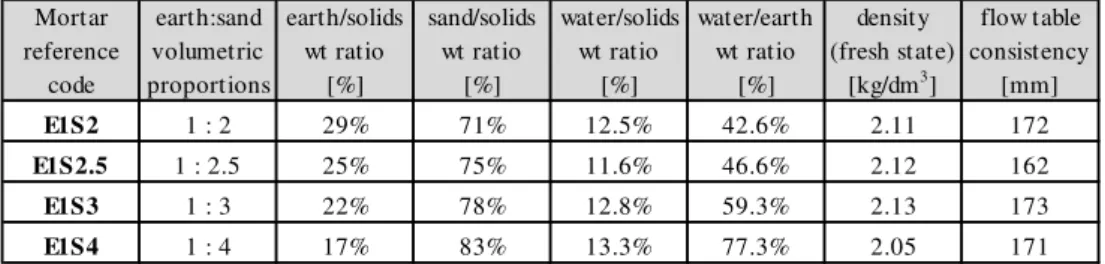
Four mortars were formulated only with the clayish disaggregated earth and a siliceous sand, varying the earth:sand volumetric proportion: 1:2 (E1S2), 1:2.5 (E1S2.5), 1:3 (E1S3) and 1:4 (S1E4). The DIN standard 18947 was followed for preparing and mixing the mortars formulations and fresh state characterization. Mortars were assessed in terms of weigth percentage of earth, sand and water to the total of solid components, water/earth weight ratio, density and flow table consistency (Table 2). The mortars were prepared with the minimum amount of water needed in order to achieve the flow table consistency defined in the DIN 18947 (175 ± 5mm) and ensuring a very good workability.
Mortar earth:sand earth/solids sand/solids water/solids water/earth density flow table
reference volumetric wt ratio wt ratio wt ratio wt ratio (fresh state) consistency
code proportions [%] [%] [%] [%] [kg/dm3] [mm]
E1S2 1 : 2 29% 71% 12.5% 42.6% 2.11 172
E1S2.5 1 : 2.5 25% 75% 11.6% 46.6% 2.12 162
E1S3 1 : 3 22% 78% 12.8% 59.3% 2.13 173
E1S4 1 : 4 17% 83% 13.3% 77.3% 2.05 171
Table 2. Fresh state mortars characterization.
4.2. Hardened state characterization
The hardened state characterization also followed the DIN 18947. The mortars were characterized in terms of density, linear drying shrinkage, flexural, compressive strength and adhesive strength (Table 3).
Mortar density linear flexural compressive adhesive adsorption
reference (hardened) shrinkage strength strength strength 12 h
code [kg/dm3] [%] [N/mm2] [N/mm2] [N/mm2] [g/m2]
E1S2 1.96 1.4% 0.27 0.99 0.07 72.3
E1S2.5 1.94 1.1% 0.26 0.95 0.07 65.3
E1S3 1.91 0.8% 0.25 0.88 0.07 62.3
E1S4 1.84 0.3% 0.22 0.53 0.07 53.7
Table 3. Hardened state mortars characterization.
(RH) and 20ºC. After the stabilization of the samples the climatic chamber condition was set to 80% RH for the adsorption test phase. The samples were weighted at time intervals defined on the standard, respectively: 0.5h; 1.0h; 3h; 6h and 12h. The adsorption test was extended till 24h, beyond the 12h interval defined in the standard, in order to achieve a more thorough understanding of the behavior of the samples. After 24h the samples were weighted and the condition of the chamber was changed back to 50% RH forcing the samples to a desorption phase, that was assessed with the same time interval protocol during another period of 24h. The test results are shown in Figure 4.
Figure 4. Water vapor adsorption and desorption test.
5. DISCUSSION AND CONCLUSION
The hardened stage characterization reveals that according to the DIN 18947 all four mortars present a hardened state density within the same density class 2.0 (from 1.81 kg/dm3 till 2.0 1.81 kg/dm3). The linear drying shrinkage results (with less than 1.5% for mortar E1S2 the one with the highest content of clayish earth) confirmed the low expansibility of the clayish earth used, which is consistent with the dominance of the illite clay mineral.
The mechanical tests results however showed that, regarding flexural and compressive strength, these mortars have not achieved (even if in some of the mortars for a short difference) the minimum values of mechanical resistance defined in the class S-I of the DIN 18947 (compressive strength ≥1.0 N/mm2;andflexuralstrength≥0.3N/mm2). Nevertheless
the adhesion strength of all four mortars has complied with the limits of the resistance class S-I (≥0.05N/mm2) and does not follow exactly the tendency of decrease with the increase of
sand in the mortars composition, noticed for the other properties.
Although the promising results of the adhesion test, one of the most important properties for plasters, the flexural and compressive strength results suggest that the mechanical resistance of these mortars should be improved, for instance through the addition of natural fibers for reinforcement, which will be investigated in future research.
The results of the adsorption and desorption test (Figure 4) indicate that all four mortars have a similar dynamic behavior of adsorption and desorption, however showing some desorption
0 10 20 30 40 50 60 70 80 90 100 110
0 2 4 6 8 10 12 14 16 18 20 22 24 26 28 30 32 34 36 38 40 42 44 46 48 50
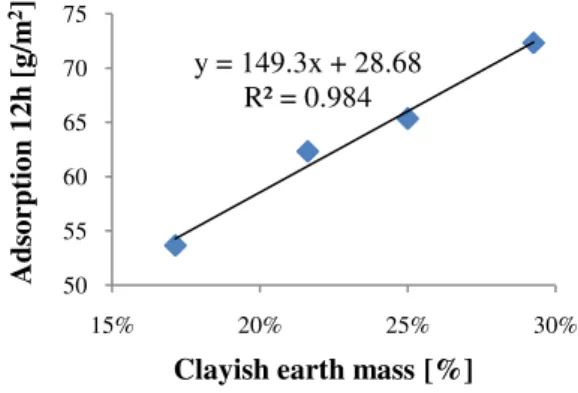
delay that can generate a lag effect after consecutive cycles of adsorption and desorption. The adsorption and desorption capacity of the tested mortars seems to be dependent of the mass percentage of clayish earth present in the mortar formulation. This dependence could be better perceived in Figure 5, which represents the positive correlation between the mass percentage of clayish earth in mortar formulation and the plaster adsorption capacity for the 12h time interval.
Figure 5. Correlation of mass percentage of clayish earth present in mortar formulation and the plaster adsorption capacity for the 12h time interval.
According to the adsorption classes defined in the standard [3], excluding the mortar E1S4, the one with less clayish earth in the formulation, all other mortars achieved adsorption values within the WS-III class, the higher adsorption class defined in the standard.
This research contributed to increase certainty regarding the potential of clayey soils of the «Barrocal» sub-region of Algarve to produce mortars suitable for eco-efficient interior plastering.
ACKNOWLEDGMENTS
The authors gratefully acknowledge the help of Vitor Silva on the experimental campaign held at NOVA University of Lisbon.
REFERENCES
[1] MELIÀ, P.; RUGGIERI, G.; SABBADINI, S.; DOTELLI, G. (2014) – Environmental impacts of natural and conventional building materials: a case study on earth plasters. J. Clean. Prod., 2014, p.179-186.
[2] MADDISON, M.; MAURING, T.; KIRSIMAE, K.; MANDER, U. (2009) – The humidity buffer capacity of clay-sand plaster filled with phytomass from treatment wetlands. Build. Environ., 2009, p.1864-1868.
[3] DIN 18947. 2013 – Earth plasters - Terms and definitions, requirements, test methods (in German). Berlin: DIN – Deutsches Institut für Normung.
y = 149.3x + 28.68 R² = 0.984
50 55 60 65 70 75
15% 20% 25% 30%
Ads
o
rpt
io
n 1
2
h
[g
/m
2]
mineralogical and mechanical characterization of ready-mixed clay plaster. Build. Environ., 2014, p.11-17.
[5] FARIA, P.; SANTOS, T.; SILVA, V. (2014) – Earth-based mortars for masonry plastering. In: 9th International Masonry Conference 2014 (CD).
[6] BONNET, Charles (1850) – Memória sobre o Reino do Algarve: descrição geográfica e geológica. Lisboa: Tipografia da Academia Real de Ciências de Lisboa, 1850. Faro: Secretaria de Estado da Cultura, Delegação Regional do Sul, 1990. 189 p. Tradução de: Maria Armanda Viegas. Introdução de: José Carlos Mesquita.
[7] KOPP, Erwin [et al.] (1989) – Os solos do Algarve e suas características: Vista geral. 1ª reimpressão. Faro: Direcção Regional de Agricultura do Algarve, 2000.
[8] LOPES, Francisco (2006) – Geologia e génese do relevo da Rocha da Pena (Algarve, Portugal) e o seu enquadramento educativo. Faro: Faculdade de Ciências do Mar e do Ambiente da Universidade do Algarve, 2006. 114p.
[9] MANUPPELLA, Giuseppe (1992) – Traços Gerais da Geologia Algarvia, Mesozóico. In MANUPPELLA, Giuseppe [Coord.] (1992) – Carta Geológica da Região do Algarve: Escala 1/100.000. Noticia explicativa. Serviços de Geologia de Portugal, 1992. [10] PINTO-GOMES, Carlos; PAIVA-FERREIRA, Rodrigo (2005) - Flora e Vegetação do Barrocal Algarvio (Tavira - Portimão). Faro: Comissão de Coordenação e Desenvolvimento do Algarve, 2005. 354 p. ISBN 972-95734-9-2.
[11] Agência Portuguesa do Ambiente – Atlas do Ambiente. [On-line]. Lisboa: Agência Portuguesa do Ambiente, 2013. [Accessed 2013-10-09]. Available at WWW:<URL: http://sniamb.apambiente.pt/atlas/>.
[12] GOMES, Celso (1988) – Argilas: o que são e para que servem. 1ª edição. Lisboa: Fundação Calouste Gulbenkian, 1988.
[13] MANUPPELLA, Giuseppe [et.al.] (1985) – Contribuição para o conhecimento das características das argilas do Algarve. Porto: Estudos, Notas e Trabalhos do Serviço de Fomento Mineiro e Laboratório da D.G.G.M. Tomo 27, 1985. p.59-75.
[14] EMBARRO (2012) – Argamassa Embarro Universal. Ficha técnica de produto. [on-line]. São Brás de Alportel: Edição Embarro Ibérica, 2012. [Consultado em 2013.07.01]. Disponível em WWW:<URL:http://www.embarro.com/.
[15] ZIEGERT , C.; KUBAN, S. (2011) - Relatório de teste 11045a - Análise de argila para construção, reboco de argila EMBARRO Universal. Seiler Ingenieure GmbH, Laboratório Ziegert, Maio 2011.
[16] BOTELHO-COSTA, Joaquim (1973) – Caracterização e constituição do solo. 7ª edição. Lisboa: Fundação Calouste Gulbenkian, 2004. ISBN 972-31-0073-8.

![Figure 2. Algarve region lithology map (adapted from [11]).](https://thumb-eu.123doks.com/thumbv2/123dok_br/16605874.739499/4.892.122.774.316.766/figure-algarve-region-lithology-map-adapted.webp)
![Table 1. Characterization of the clay quarries of Algarve region in 1985 (aggregated data from [13])](https://thumb-eu.123doks.com/thumbv2/123dok_br/16605874.739499/6.892.138.752.207.694/table-characterization-clay-quarries-algarve-region-aggregated-data.webp)