MIETE
M
ASTER
P
ROGRAM IN
I
NNOVATION AND
T
ECHNOLOGICAL
ENTREPRENEURSHIP
A multidimensional framework to improve knowledge flow and
innovation process at the fuzzy front-end: a case study in a
Brazilian technology-based firm
Poliana Godinho Pires
Dissertation
Supervisor: Prof. João José da Cunha e Silva Pinto Ferreira
Faculty of Engine ering of the Unive rsit y of Porto
I dedicate this victory to my parents, Francisco and Maria Aparecida, wonderful people who taught me to value education, by the incentives throughout my training and the examples of dedication and work!
Dedico essa vitória aos meus pais, Francisco e Maria Aparecida, pessoas maravilhosas que me ensinaram a valorizar a educação, pelos incentivos ao longo da minha formação e pelos exemplos de dedicação e trabalho.
Abstract
Considering our competitive environment, with rapid technology changes, it is possible to observe a decrease in the product life cycle and a clear need for companies to develop innovative products with viable cost. In this context, companies are increasing their attention to the New Product Development (NPD) activities, recognized as a key driver of both top-and-bottom line performance in the technology sector.
The first part of NPD, called Fuzzy Front-End (FFE), is generally regarded in the literature as one of the greatest opportunities for improvements in the innovation process, considering that this phase is characterized by the product strategy formulation, opportunity identification, idea generation and planning in general. Effectiveness in this phase requires a large amount of knowledge and expertise from several actors, both internal and external to the company. Because of this, an efficiency in knowledge sharing management become strategic for organizing the information and knowledge available inside the company and support the relationship with external actors.
After understanding and analyzing how the “knowledge creation” unfolds within the FFE of NPD, the main goal of this work is to model this process into a multidimensional framework to enhance innovation process and knowledge management, through the perspective of absorptive capacity - emerging from the dynamic interactions between the individuals, the environment and the organization. The framework will be verified with insights and some empirical findings into a Brazilian technology-based firm, in the context of a value network with its stakeholders.
Keywords: Knowledge management, Fuzzy front-end of Innovation, Absorptive capacity,
New product development, Brazilian technology-based firms
Acknowledgements My sincere thanks votes:
First TO GOD, for my life and the ability to undertake this evolutionary path, for providing so many opportunities to study and to put in my way wonderful and precious people;
TO MY FAMILY, especially my parents Francisco and Maria Aparecida and my brothers Cris and Junior, for the support and understanding of our family time, often sacrificed for this work;
TO MY BOYFRIEND, my faithful reader, lovely and sweet Léo, by the unconditional support in carrying out this reseacrh, by reading, reviewing and giving references and suggestions for improvements;
TO MY SUPERVISOR, João José, by the competence and confidence for believing, until the end, in my potential to carry out this research;
TO MY PROFESSORS AND COLLEAGUES, who shared with me many good moments of learning;
TO MY SINCERE FRIENDS, recent or long-standing, Ale, Eliza, Fabrícia, Katinha, Kellyta and Regis, who were always present with memories, words of encouragement and love; TO THE COMPANY TAKE.NET, to open its doors to the realization of this study, THE FOCAL GROUP PARTICIPANTS and, in particular, to Sérgio Passos, by the immeasurable contribution in the preparation of this study, through his experience and competence as the company's CTO;
TO COLLEAGUES OF E-MOTION, for their patience during the execution of this research, especially to Fred and Leno, by the vision and opportunity given to me, also enabling some hours of working time for dedication to the development of the study;
TO YOU, that is reading this now;
And TO ALL those who, in one way or another, contributed to the conclusion of this research.
“Thus, the task is not so much to see what no one yet has seen, but to think what nobody yet has thought about that which everybody sees.”
Index of Contents
Index of Contents ... 1
Index of Figures ... 2
Index of Tables ... 3
Index of Abbreviations and Acronyms ... 4
1 Introduction ... 5
2 Literature review ... 8
2.1 Innovation: concepts and importance ... 8
2.2 Fuzzy front-end: concept and models ... 9
2.3 Knowledge flow in the fuzzy front-end ... 12
2.4 Final considerations ... 14
3 Front-End of Innovation Practices in IT Firms. ... 15
3.1 Introduction ... 15
3.2 Practices in IT Firms... 15
3.3 Another Point of View into the Agile Development ... 18
3.4 Other eligible approaches ... 19
3.5 Final considerations ... 21
4 Methodological considerations ... 22
5 Proposal of a multidimensional framework ... 24
5.1 Understanding the framework: the inputs ... 26
5.2 Understanding the framework: the process ... 26
5.3 Understanding the framework: the outputs... 27
6 Case study ... 29
6.1 Unit of analysis context ... 29
6.2 Perspectives of analysis & Data Collection ... 32
6.3 Data analysis ... 43
7 Conclusions ... 47
References ... 50
Index of Figures
Figure 1 The three sub-process of innovation process ... 9
Figure 2 The knowledge creation process ... 13
Figure 3 Scrum software development process ... 17
Figure 4 The Customer Development Process ... 18
Figure 5 Conceptual framework for understanding research combining behavioral science and design science paradigms ... 22
Figure 6 Multidimensional framework to improve knowledge flow and innovation process at the fuzzy front-end ... 25
Figure 7 The unit of analisys’s context ... 30
Index of Tables
Table 1: Comparison of fuzzy front-end models ... 10 Table 2: Perspectives of analysis, results and verified framework elements ... 33
Index of Abbreviations and Acronyms
ACAP - Absorptive CapacityBI - Business Inteligence FFE - Fuzzy Front-End
GPD - Gross Domestic Product HR - Human Resources IT – Information Technology
ICT - Information and Communications Technologies IoT - Internet of Things
MIT - Massachusetts Institute of Tecnology MVP - Minimum Viable Product
NPD - New Product Development P&I - Products and Innovation PMO - Project Management Office PO - Product Owner
QA - Quality assurance
R&D - Research and Development
R&D&I - Research, Development and Innovation ROI - Return on Investment
SECI - Socialization, Externalization, Combination, Internalization XP - Extreme Programming
1 Introduction
Nowadays, innovation is considered one of the biggest challenges for contemporary organizations. In this context, the rapid changes that happen in organizational environments make the innovation management process an essential firm capability in generating competitive advantage. Thus, useful knowledge to the innovation process has become a necessary and disputed resource, perhaps the most important asset for businesses. However, at the same time companies are faced with this challenge, they may encounter internal conditions that limit their ability to innovate, like human, financial and infrastructure resources. This limitations results in the need to incorporate knowledge of the external environment or from external actors to its innovation processes. Thinking about this, there is a clear need to better understand the mechanisms that cause innovation. To maintain competitive advantage, companies need to launch new products on the market in the shortest possible development time (Koen et al., 2002). Consequently, the products’ life cycle needs to be smaller and smaller, and technological development ever faster. To achieve these goals, companies need to know about the innovation process, its peculiarities and structure, so that they can plan right strategies aligned with their mission (Koen et al., 2001). Nevertheless, nowadays it is common, especially in IT based companies, the approach of launching the so-called Minimum Viable Products (MVP). The term was popularized in recent years by Eric Ries, a Silicon Valley entrepreneur and author, famous for being the creator of the Lean Startup movement, a new business model development strategy for startup1 companies, focused in allocating their resources more efficiently. According the author, "a Minimum
Viable Product is that version of a new product which allows a team to collect the maximum amount of validated learning about customers with the least effort"2.
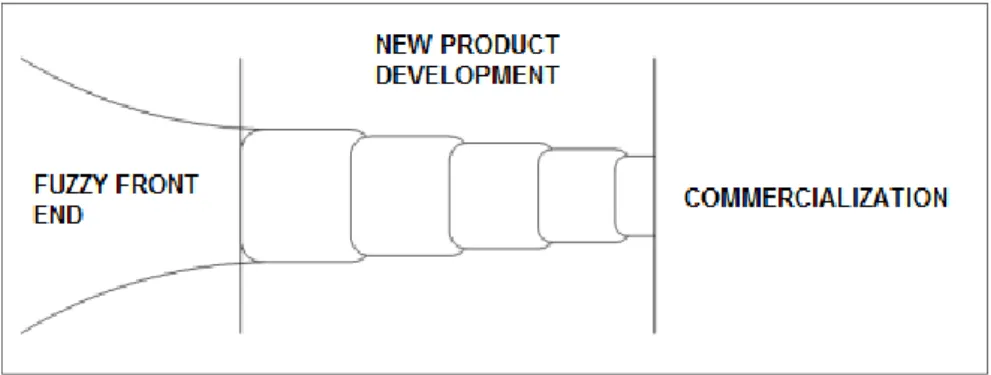
In 1991, Smith and Reinertsen proposed a new way of viewing the innovation process, dividing it into 3 stages: Fuzzy Front-End (FFE), New Product Development (NPD) and Commercialization. Many studies were done over the last two sub-processes of innovation process. However, studies on the initial phase of idea generation, the fuzzy front-end, are gaining now more space in organizations and academia (Frishammar et al., 2011). Even so, the FFE is known among researchers as one of the greatest weaknesses and uncertainties of the innovation process and fundamentally determines its success (Koen et al., 2001). Artto et al. (2011) consider that the FFE is a problematic step in the innovation process, which should be explored, as it provides companies greater opportunities to improve the overallhability to innovate. In the same direction, Cooper (1993a) points out that the early stages of FFE need to be structured in a systematic way. All these assumptions brought opportunities to develop this research.
As in the initial stage of innovation process, the FFE is characterized by a high degree of uncertainty. However, it is the basis for the project choices. According to Tsai et al. (2011), the creation and sharing of knowledge drives innovation. And when it comes to the fuzzy front-end, several studies claim that an organization can substantially benefit from the optimization and active improvement of this stage, once this increases the chances of
1 This is an organization formed to search for a repeatable and scalable business model (Blank and Dorf, 2012) or, in a complementary way, is a human institution designed to deliver a new product or service under conditions of extreme uncertainty (Ries, 2011)
developing innovations. (e.g. Reinertsen, 1999; Dahl and Moreau, 2002; Boeddrich, 2004). On the other hand, some studies indicate that there are still uncertainties in both organizations and academy when talking about FFE, bringing the need of new studies and perspectives. (e.g. Chang et al., 2007; Frishammar et al., 2011).
Effectively managing the FFE is a difficult and very important challenge that innovation managers face nowadays, and approaches to handling this phase have been suggested to explore the internal and external communication flows (Kim and Wilemon, 2002). Although, to better understand knowledge management in the FFE, it is necessary to investigate more about how to capitalize knowledge assets and how to manage the shared information, both creating new or using already existing knowledge. So, the literature review conducted in the scope of this research project will focus in understanding the concepts of innovation and their importance, as well as the FFE, it’s concepts, models and the knowledge flow in this phase. Given this context of gaps and opportunities, a starting point was established for the research, with the following research question:
How does “knowledge creation” unfold within the front-end of innovation and how can we model this knowledge creation process, building on the concept of absorptive capacity?
Thus, through the literature analysis related to the knowledge management and the fuzzy front-end of innovation, with emphasis in the models related to this sub-process of NPD, this research will propose a multidimensional framework that aims at helping the future development of specific models, suitable for specific situations or organizational contexts. From the research question, the general and specific objectives were defined.
General objective:
To propose a multidimensional framework to the fuzzy front-end to improve knowledge flow along the innovation process, through the integration of Organizational Knowledge and Absorptive Capacity (ACAP) dimensions.
Specific objectives:
1. From the literature, identify knowledge management, fuzzy front-end of innovation and absorptive capacity models;
2. Identify, from the literature and market analysis, new trends on product development that could enhance the FFE process;
3. Based on the analysis of the models and trends, propose a generic framework that integrates the three dimensions mentioned in the first objective;
4. To verify the framework through a case study in a technology-based firm
The research aims to bring contributions both to the scientific literature and the corporate world. In one hand it will verify the influence of knowledge management and absorptive capacity in product innovation, the relationship of different components of these key studies with the firms’ innovative capacity and propose a framework developed under empirical data, once most of the models presented in the literature are theoretical ones. In the other hand, the research will offer a prescriptive contribution and driver to managers of technological based firms.
To reach the objectives, the research was divided in some sections. Chapter 2 addresses the literature review, with focus in understanding the importance and concepts of innovation, as well as the ACAP and FFE, it’s concepts, models and the knowledge flow in this phase. Trends and practices in the FFE of IT firms are adressed in Chapter 3. Chapter 4 presents the
methodological considerations to achieve the answer for the research question, using the "Design Science" approach to research. Chapter 5 shows the new multi-dimensional framework proposed in this research and an explanation of all the elements. The case study is adressed on chapter 6, through the unit of analysis' context mapping, together with the perspectives of analysis, results and verified framework elements and, consequently, an analysis of the collected data. Finally, chapter 7 brings the final conclusions, contributions and suggestion of new studies under the results of this research
2 Literature review
This literaute review aims at providing the theoretical support for the development of the proposed framework that is the object of this research. In this sense, the main goal of this chapter is to give the background needed, regarding the fuzzy front-end of innovation, knowledge management, absorptive capacity and underlying themes necessary for the understanding of these key studies.
2.1 Innovation: concepts and importance
This topic intends to describe the innovation from the point of view of its importance for organizations, serving as a support for other perspectives. Given the breadth of the subject innovation, this topic also seeks to delimit the scope of the research. Innovation has always been part of human history. However, in recent decades, more precisely from the 1980s, it has received more attention from scholars, organizations and society in general. This attention is because in today's business environment organizations need to innovate to respond fast to customer demands and lifestyles, seeking to achieve the opportunities offered by technology and markets in constant changes (Baregheh et al., 2009). It happens because constant demands and environmental changes lead organizations to adapt constantly through innovation, which can be performed in terms of products, services, operations, processes, people or business model (Baregheh et al., 2009).
Innovation represents the main renovation process of any organization, once their survival and growth perspective is influenced by the changes that organizations offer to the environment, through its products, and the ways in which it creates and provides these offerings (through innovation process) (Bessant et al., 2005). The importance of innovation can be compared with that given to quality in the late 60’s. It is directly related to the organizations sustainability.
Given the importance of innovation, it is interesting to conceptualize it, trying to understand its process. According to the Oslo Manual:
An innovation is the implementation of a new or significantly improved product (good or service), or process, a new marketing method, or a new organisational method in business practices, workplace organisation or external relations. (OECD, 2005, p. 46)
The expansion of the presented definition enables a new point of view, in order to form a broader understanding. Thus, based on an analysis of the literature definitions and seeking for an innovation definition that represents its essence, Baregheh et al. (2009, p. 1334) claim that
"Innovation is the multi-stage process whereby organizations transform ideas into new/improved products, service or processes, in order to advance, compete and differentiate themselves successfully in their marketplace". This concept refers to innovation as a process
that leads to the product development of the organization, as shown by the definition of the Oslo Manual.
In this context, a strong relationship was created between the innovation and new product development studies. As mentioned before, Smith and Reinertsen (1991) proposed a new way of viewing the innovation process, dividing it into 3 sub-processes, according to Figure 1.
Source: Adapted from Koen et al. (2001, p. 51)
Figure 1 The three sub-process of innovation process
Decisions taken at the beginning of a process tend to give directions to it and strongly influence the outcome. Thus, it is clear that an improvement in this stage has great impact on the process as a whole (Reid and Brentani, 2004). Based on this, this research proposes an emphasis on the early stage of the innovation process. This beginning, called Fuzzy Front-End, will be handled in further detail in the following paragraphs.
2.2 Fuzzy front-end: concept and models
As mentioned before, the term "fuzzy front-end" was popularized by Smith and Reinertsen (1991), which consider this as the first stage of the new product development process. The word "fuzzy" indicates that this stage can be chaotic, unpredictable and uncertain (Koen et al., 2001). However, beyond that, other terms in the literature are also used to indicate this stage of the innovation process. The most used are: “fuzzy front-end” (Flint, 2002; Koen et al., 2001; Koen et al., 2002; Kim and Wilemon, 2002), “front-end of innovation” (Khurana and Rosenthal, 1998), “front-end process” (Nobelius and Trygg, 2002), “front-end of new product development” (Rozenfeld and Forcellini, 2006), “early phases of innovation” (Muhdi et al., 2011) or “pre-development” (Cooper, 1988).
Koen et al. (2001) states that this phase involves activities that occur before the formal and structured process of development of new products. Khurana e Rosenthal (1998, p. 59) complement, saying that this stage "include product strategy formulation and communication,
opportunity identification and assessment, idea generation, product definition, project planning and executive reviews". For research purposes, the definition of idea and opportunity
used here are from Koen et al. (2002). For the authors, an opportunity is "a business or
technology gap, that a company or individual realizes, that exists between the current situation and a envisioned future in order to capture competitive advantage, respond to a threat, solve a problem or ameliorate a difficulty" (p. 7). In its turn, an idea is "the most embryonic form of a new product or service. It often consists of a high-level view of the solution envisioned for the problem identified by the opportunity" (p. 7).
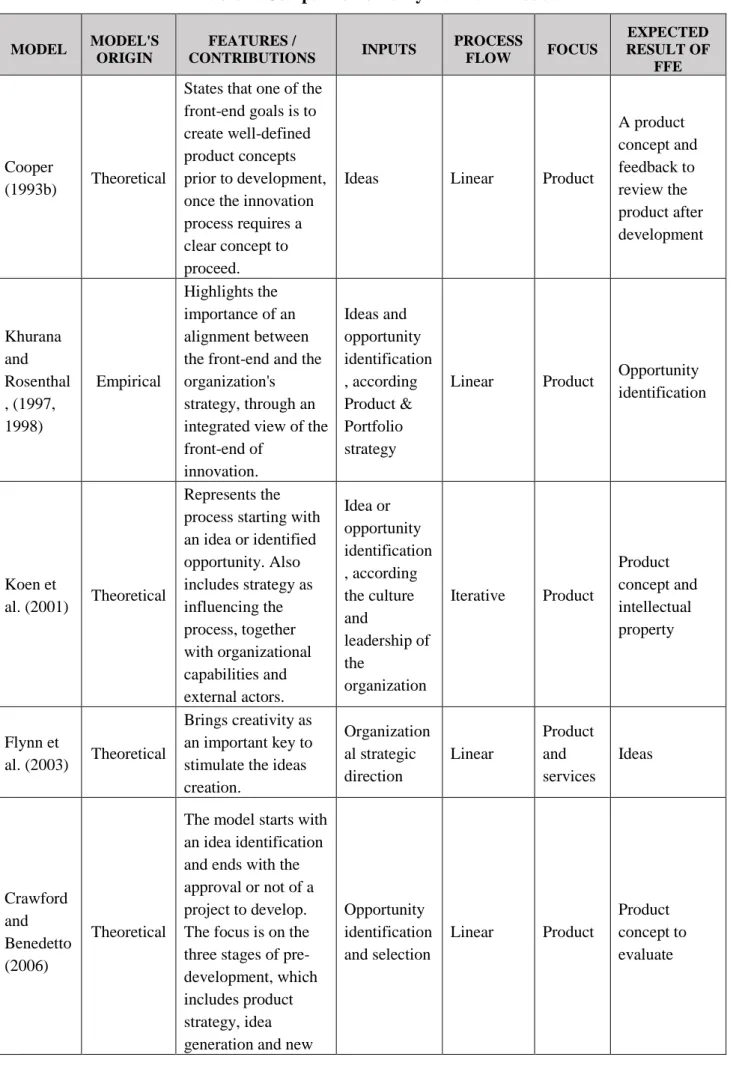
Regarding FFE models, there are many of them in the literature. However, through a systematic review of the most mentioned models and others considered relevant to this research, a summary table to discuss their main contribution to the literature and to this investigation will be presented, listing their main features, inputs, type of process flow, focus and the output or expected result of the FFE. The table 1 shows a comparison of the analyzed models and aim a better understanding in how to conduct the activities in this phase.
Table 1: Comparison of fuzzy front-end models MODEL MODEL'S ORIGIN FEATURES / CONTRIBUTIONS INPUTS PROCESS FLOW FOCUS EXPECTED RESULT OF FFE Cooper (1993b) Theoretical
States that one of the front-end goals is to create well-defined product concepts prior to development, once the innovation process requires a clear concept to proceed.
Ideas Linear Product
A product concept and feedback to review the product after development Khurana and Rosenthal , (1997, 1998) Empirical Highlights the importance of an alignment between the front-end and the organization's strategy, through an integrated view of the front-end of innovation. Ideas and opportunity identification , according Product & Portfolio strategy
Linear Product Opportunity identification
Koen et
al. (2001) Theoretical
Represents the process starting with an idea or identified opportunity. Also includes strategy as influencing the process, together with organizational capabilities and external actors. Idea or opportunity identification , according the culture and leadership of the organization Iterative Product Product concept and intellectual property Flynn et al. (2003) Theoretical Brings creativity as an important key to stimulate the ideas creation. Organization al strategic direction Linear Product and services Ideas Crawford and Benedetto (2006) Theoretical
The model starts with an idea identification and ends with the approval or not of a project to develop. The focus is on the three stages of pre-development, which includes product strategy, idea generation and new
Opportunity identification and selection Linear Product Product concept to evaluate
projects portfolio management.
Whitney
(2007) Theoretical
The model describes the importance of analysis and control during all the process, through feedback. Ideas and opportunity Iterative Product, with focus on technolo gy A new or improved technology, ready to be developed Brem and Voigt (2009) Empirical
Show the importance of an integration between market and technology visions. Ideas (creation and selection) Iterative Services Ideas for implementatio n Kurkkio et al. (2011) Empirical
It addresses the front-end of new processes development
Ideas (generation and refining)
Iterative Process Process concept
Source: Prepared by the author based on the main FFE models found in the literature.
From the analyzed models, some points in common or differences were identified between them. Table 1 show that ideas are inputs in most of the FFE models. Some of them have taken ideas, creation and ideation and others bring both ideas as opportunities identification. As outputs, we can see a project, a concept, an innovation or even feedback. In the influencing factors were identified: strategy, environment, culture, time, information (internal and external), creativity programs, motivation, opportunities identification, knowledge sharing, policy, research and development.
Regarding the relevance, most models bring some stimulus that encourages creativity and the idea generation, as well as a way to select it. Most models are in the context of innovations in product. Some include products and service and others are limited to create a new technology or improve an already existent one (i.e. Whitney, 2007).
Concerning the ideas bank, only two models that specify how the portfolio of ideas will be stored were found. Cooper et al. (2002) report that the ideas stored in the bank of ideas should be available to all employees. Thus, they can contribute with improvements, and the manager can analyze this periodically to bring back to the evaluation process those ideas that were improved. According to Cooper et al. (2002), if there is not a bank of ideas, potential ideas will be lost. So, the company must have a bank of ideas and a repository for ideas that were rejected, to avoid waste of ideas and thereby increase process efficiency. Kim and Wilemon (2002) also suggest that the organization describe and justify the reasons for rejecting an idea,
because a change in the business environment can reactivate an idea that was previously rejected.
The models present, which one in its context, three main elements: ideas, opportunities and concept. In this sense, the model of Koen et al. (2001), which was used later by Whitney (2007), translates the relationship of these three elements in an interesting way, emphasizing the interactions between them. Koen et al. (2001) say that the process can start with idea generation or opportunity identification, considering that an idea requires one or more opportunities, as well as an opportunity can require one or more ideas.
Although some models are not classified as iteractive, once this movement is not properly explained in the authors’ work, most models recognize that each activity influence the others. Several models, with emphasis on Khurana and Rosenthal (1997), highlight the importance of an alignment between the FFE and the organization's strategy. Koen et al. (2001) include a process engine in their FFE model, considering the leadership and organization culture as drivers of this process. As well as Khurana and Rosenthal (1997), Koen et al. (2001) include the strategy as an influencing factor of the process, along with the organizational capabilities and the external world (e.g., distribution channels, customers and competitors). In a strategic sense, the evaluation of the competitive situation (scan and environmental analysis) is an activity that needs to be addressed during the FFE (Kurkkio et al, 2011).
In addition, some models show the importance of integration between the market and technology views, considering different levels according to specific sectors. In this sense, the attention should be given to the research done by Brem and Voigt (2009), as these authors worked precisely on this relationship.
2.3 Knowledge flow in the fuzzy front-end
Harkema (2003) defines innovation as a process of information, aiming the creation of new knowledge to drive the market and develop effective solutions. According the author, for an innovation to become a reality, it is necessary to apply and mix the knowledge of various organizational areas, encouraging the planned return. Thus, the level of organizations maturity can also be represented by the acquired and used knowledge to improve the innovation process. A team that conducts an experiment, being this successful or not, will learn something during the project that may be useful in the future.
Nonaka and Takeuchi (1999) cite, as an example, the knowledge about management acquired by teams and managers. This tacit knowledge can be organized and transformed into explicit. In addition, this knowledge can even be valuable to an innovative organization, especially for multidisciplinary teams that require integration and good leadership. The organization also needs knowledge to improve productivity and develop new products quickly, with less probability of errors.
Because of this, the new knowledge management practices become essential for innovation to occur in organizations. According to Davenport and Prusak (1998), the most innovative companies are those that have the greatest power to create and manage their new knowledge. In this context, knowledge management is a practice that should be part of the organizational culture, thus facilitating the innovation process.
The knowledge creation process starts when a group of individuals shares their knowledge about a subject. Most of this knowledge is classified as tacit, which is the basis of the organizational knowledge creation process, including knowledge about market, demand
requirements, information on new technologies, personal skills etc., that can be very useful for the innovation development (Von et al., 2000).
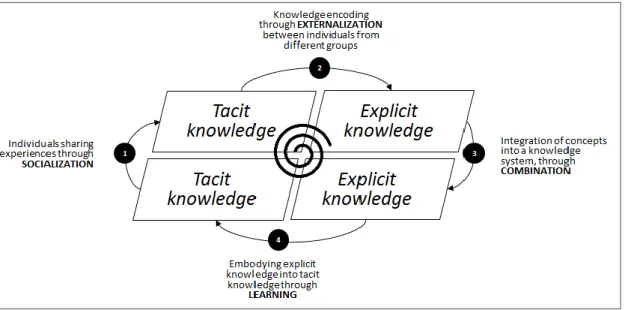
Nonaka e Takeuchi (1995) point out that this tacit knowledge, embedded in the experience of an individual, is difficult to formalize. This, to be transferred, must be first converted into explicit knowledge. According to these authors, this conversion occurs in four ways, through the interaction between tacit and explicit knowledge, which culminated in the SECI model of knowledge creation, as described below and the Figure 2:
1. Socialization: tacit to tacit knowledge; 2. Externalization: tacit to explicit knowledge; 3. Combination: explicit to explicit;
4. Internalization: explicit to tacit.
Source: Adapted from Nonaka e Takeuchi (1995, p. 57)
Figure 2 The knowledge creation process
Therefore, it is very important to create an environment that stimulates the knowledge creation and sharing, as well as the training that helps in learning of employees (Dalkir, 2005).
Another key aspect of the knowledge creation and innovation process refers to the firm’s ACAP. Nieto and Quevedo (2005) state that companies have different capacities to innovate, precisely because their ability to absorb knowledge is different. Although there are other factors that can lead to different innovative performances, the absorptive capacity may be an important driver to understand the differences of asymmetric use of knowledge. From a conceptual point of view, Cohen and Levinthal (1990, p. 128) define ACAP as “the ability of a firm to recognize the value of new, external information, assimilate it, and apply it to commercial ends”. After their studies, the process of absorbing knowledge becomes an essential element for achieving competitive advantage because, according to the authors, the higher the absorptive capacity, the greater the innovative capacity of the firm. Thus, the ability to exploit external knowledge becomes an important component of innovation capabilities.
The foundation of absorptive capacity notion is that the organization needs prior knowledge to assimilate and use new knowledge, which can affect innovative performance in an uncertain
environment (Cohen and Levinthal, 1990), which is very common, for example, in the FFE phase. In order to validate this construct empirically, Zahra and George (2002, p. 186) extend the concept of ACAP, considering it as “a set of organizational routines and processes by
which firms acquire, assimilate, transform, and exploit knowledge to produce a dynamic organizational capability”. For Todorova and Durisin (2007), when new knowledge fits the
cognitive processes existing in the company, the assimilation occurs, and then it is incorporated. It menas that the company can interpret and understand it with existing cognitive structures, because it is compatible with the existing context and with a prior knowledge. However, when new knowledge is perceived as incompatible with prior knowledge or when new situations cannot be changed and absorbed by the existing knowledge structures, the company has to build new cognitive structures through the transformation.
Although the capacity to absorb external knowledge can generate significant benefits, several internal and external factors can have different effects in the absorptive capacity dimensions and can lead to different results of innovation and performance.
2.4 Final considerations
With the analysis of the FFE models, it was possible to realize the dominance of theoretical models, where few of them were developed from empirical data. This further increase the relevance of the case study conducted in this research.
The literature review also confirms that innovation process is influenced by many internal and external factors of a company and this has lead the author to ask if it would be possible to identify a vision of a process that could operate across multi-dimensions. With this objective in mind, topic 5 will propose a unifying conceptual approach, which could link knowledge management with the fuzzy front-end of innovation as a multidimensional process in the organizational level.
3 Front-End of Innovation Practices in IT Firms.
3.1 Introduction
Information Technology (IT) is one of the fastest growing and develops areas worldwide. It is also one of the most rapidly changing segments. The IT market launches trends all the time and creates new needs, besides supplying some existing ones. In its turn, the innovation in the IT sector, considering its transformational and horizontal penetration character in all other economy sectors, has been a major enabler to generate value to the businesses.
Considering this, IT companies operate in a relevant way in building a more competitive power of the Brazilian business sector. According to a study of the IDC Brazil3, the Brazilian Information and Communication Technology (ICT) market is expected to hit $ 165,6 billion in 2015, with 5% growth compared to last year4, even with the apparent crisis the country is experiencing. The impulse will be given by the third platform - technologies such as the Internet of Things (IoT), 3D printing, cognitive systems, robotics and neural interfaces will be the basis for accelerating innovation and business in companies. With this, Brazil is expected to reach, by the end of this year (2015), the sixth position as the most important market in the world in ICT.
Considering the current environment of economic crisis, it is the new products launched on the market that can create better business opportunities. Therefore, and allied to the Research and Develoment (R&D) investments, it is necessary to point and understand the main challenges, practices and trends in the segment in order to enable IT professionals and companies with greater insight in developing new applications, such as improved processes or products .
3.2 Practices in IT Firms
With the globalization advent and, consequently, the fierce competition market, companies are seeking for factors that differentiate themselves from the others. The relentless pursuit for cost savings, as well as reducing the profit margin in order to obtain impact on costs, are no longer differentiating components, since these benefits are not sustainable over time. The era of information and knowledge, combined with the technological developments, the internet revolution and dissemination of online communities, have brought a set of new challenges to the business community. The new challenge for companies is: more and more innovative products, with lower costs and faster time to market.
Considering this, the agility, ease of adaptation and the ability to offer new products and services also become important competitive advantages and, in some cases, a prerequisite for the businesses survival. Nevertheless, agile methodologies have also been identified as an alternative to traditional approaches to the NPD process, mainly in technology companies. The term "Agile Methodologies" became popular in 2001 when seventeen experts in software development processes, representing the Scrum methods (Schwaber and Beedle, 2001),
3 International Data Corporation Pesquisa de Mercado e Consultoria Ltda
4 Source:
Extreme Programming (XP) (Beck, 1999) and others, established common principles shared by all of these methods. As a result, the Agile Alliance was created and the "Agile Manifesto"5 was established. The key concepts of "Agile Manifesto" are:
Individuals and interactions rather than processes and tools;
Executable software rather than documentation;
Customer collaboration rather than contract negotiation;
Fast response to changes rather than following plans.
“That is, while there is value in the items on the right, we value the items on the left more”.
(Agile Manifesto)
Most agile methodologies have nothing new (Highsmith and Cockburn, 2001). What differentiates them from traditional methodologies are the focus and values. The idea of agile methodologies is the focus on people rather than processes or algorithms. In addition, there is a concern about spending less time on documentation and more with the implementation. In the last decade agile methodologies are gaining space in the Information and Communication Technology market. Several surveys show the good results achieved by some companies, for example, the research conducted by Scott Ambler6 in 2008 reported that 82% of companies have seen improvements in productivity, while 77% showed improvements in product quality and 78% realized increase in the stakeholder satisfaction. In 20137, Ambler reports a success rate of 65% on the projects using agile methodologies. Another survey8, conducted by Version One regarding the adoption of agile methods, shows that 88% of the respondents said that ther organizations were practicing agile development in 2013, 4% more comparing to 2012.
A fundamental premise of agile methodologies is the recognition of the users’ difficulty to know, in advance, the features they would like to have in the system. Therefore, these methodologies adopt a bottom-up approach, creating favorable conditions for the interactions and feedbacks between users and the system developers throughout the project. The real users’ needs and not the "concept" of an ideal system is the key point of the project's success. Some companies still use the traditional "waterfall" methodology for software development, also known as sequential or linear, once it is based on a series of steps where one only starts after the end of the step before it. But unlike traditional methodologies, which have well-defined and separate phases, the phases of planning and development interact throughout the project in the agile methodologies, thus allowing a constant interaction between users and developers. This enables a nonlinear model, which emphasizes the retroaction on the later stages preceding previous stages and an interaction between planning and production.
5 The Agile Manifesto. Available on: http://agilemanifesto.org. Access in 22 august 2015. 6 Scott Ambler, Agile Adoption Survey 2008. Available on
http://www.ambysoft.com/downloads/surveys/AgileAdoption2008.ppt. Access in 7 June 2015. 7 Scott Ambler, 2013. IT Project Success Survey Results. Available on
http://www.ambysoft.com/surveys/success2013.html. Access in 7 June 2015
8 8th annual state of agile survey, 2014, VersionOne. Available on: https://www.versionone.com/pdf/2013-state-of-agile-survey.pdf. Access in 08 September 2015.
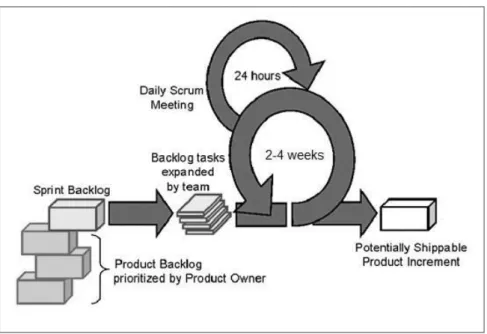
Agile methodologies are designed to accelerate the development of software for continuous process improvement, generating benefits, such as increase communication and team interaction, daily organization to achieve the set target, prevent failures in the development, rapid responses to changes and significant increase in productivity. The Scrum, in turn, is a process of iterative and incremental development to project management and agile software development. In Scrum, the projects are divided into cycles called Sprints. Each sprint represents a set of time within a group of activities that should be executed. In this process there are 3 main roles and responsibilities: The Product Owner (PO), the Scrum Master and the Scrum Team. The Product Owner is "the person responsible for managing the Product
Backlog so as to maximize the value of the project. The Product Owner represents all stakeholders in the project". (Schwaber and Beedle, 2001, p. 113) The Scrum Master is "the person responsible for the Scrum process, its correct implementation and the maximization of its benefits." (Schwaber and Beedle, 2001, p. 113) The Scrum Team is "a cross-functional group of people that is responsible for managing itself to develop software every Sprint."
(Schwaber and Beedle, 2001, p. 113) The team may also have a "working framework", called Kanban9, to organize the list of activities (Product Backlog) in the Sprint, separating them in four states (which can vary with each project): To-Do, Doing, Testing and Done. This "framework" is very productive and visual. After a simple look at it, it is possible to visualize the Sprint progress.
In general, the central idea is to work with short iterations. Each iteration delivers a final and complete product ready to be used, which contains a new subset of features implementation. The use of short iterations allows users and customers to make an assessment of the system as soon as an initial version is put into production. At this point, users, customers and developers decide what features should be added, which should be modified, and even, which must be removed from the system. On this way, the system is developed in the most iterative way as possible. This process can be seen in the Figure 3.
Source: Adapted from Schwaber and Beedle (2001, p. 11)
Figure 3 Scrum software development process
9 Kanban is about choosing the right work at the right time, using the same Lean principles from manufacturing and applying it to individual and team work. (Benson and Berry, 2011)
3.3 Another Point of View into the Agile Development
Another important issue to consider in the Agile Development is the consumers. They are increasingly demanding, sophisticated and interventional (Ancona et al., 2008) and have been recognized as part of the innovation chain, becoming central engines of a market in constant mutation (Franke and Shah, 2003; Moon and Sproull, 2001).
"Users have been found to be the inventors of reliable prototypes of what later became successful products in different markets [...]. End users, likewise, seem to be willing and able to develop substantial ideas, concepts and prototypes for new products"(Tietz et al., 2004, p. 3)
These end users are used to share innovations spontaneously in the context of their communities. These innovators-consumers, also called Lead Users, are valuable to businesses, because they have the consumer perspective by benefeting from the use, getting to see beyond the R&D teams.
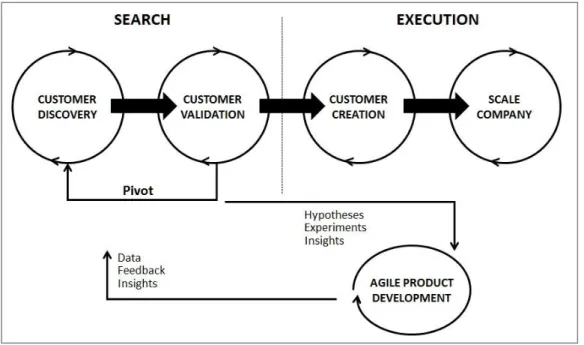
Considering this, the literature for startups has addressed the "customer" issue. Blank (2007), Ries (2011) and Cooper (2013) works have put the customer at the center of the process for innovative businesses. Blank (2007) brings the important concept of hypothesis for the world of startups, which are generally outlined by business model canvas tool (Business Model Panel), a single vision divided into nine blocks. Hypothesis, according to Blank (2007), are assumptions that entrepreneurs should do at the beginning of the business model and are part of the "Customer Discovery" process. However, they only gain validity when they are tested in the market. According to Blank (2007, p. 28), "customer discovery goal is to turn the
founders initial hypotheses about their market and customers into facts". The customer
development process is pictured in the Figure 4.
Source: Adapted from Blank (2007, p. 16)
Figure 4 The Customer Development Process
The Lean Startup was designed in 2011 by Eric Ries, based on his previous experience working in several startups. The concept of Lean Startup is based on Customer
Development10 plus the Lean concept, created by Toyota to leave the production process leaner, avoiding waste of any resource type. The main premise of the Lean Startup is that the higher the hypotheses validation speed, the lower the cost of each big iteration - in this way the Startup is able to validate or discard important assumptions about the product or market. The Lean Startup methodology uses a more immediate approach to the client to test their hypotheses. They ask potential users, buyers and partners for feedback on all elements of the business model, such as features, prices and distribution channels. The emphasis is on the speed of the feedback which will enable the rapid construction of a MVP, that will also be used as an input for new customer feedbacks, allowing to review the hypotheses and execute a new cycle of development. This process is, in fact, very much about agility and integrates with the above SCRUM vision, with sprints used to validate successive MVPs.
3.4 Other eligible approaches
Innovation is not a new theme in organizations, particularly in sectors that rely heavily on R&D to grow or even stay on the market. However, growth opportunities on the one hand, and market competitiveness on the other, are driving organizations to rethink their approaches in order to amplify the impact with customers, shorten the development lifecycle and optimize the investments. The task of developing a new product or new service within R&D&I (research, development and innovation) involves different functions within the company, sharing of scarce resources as well as managing tight deadlines. In summary, the product development activity is complex and interferes in normal activities of the company operation. For this and other reasons the NPD process seeks to achieve a high level of efficiency.
In several R&D&I processes, the engineering systems’ perspective is based on systemic thinking (Josef Oehmen, 2012). Systemic thinking occurs through discovery, learning, diagnosis, and dialogue that leads to the detection, modeling and talk about the real world to better understand, define and work with any system. The approaches presented below are derived from this systemic thinking and, although they have gained visibility in recent years, its origin goes back to the 70’s (Visual Thinking and then Design Thinking, with the origins in Stanford) and 80’s (Lead Users, with the origins in MIT Sloan). Studies, like Churchill et al. (2009) highlight the excellent results based on the Lead User approach, with probability of 80% of success, compared to traditional methods and sales generation potential 8 times higher, in a lower time of development compared to the classical methods. Olson and Bakke (2004) points out that 3M deepens enough discussions in the initial phase, aiming at minimally mature project goals, assumptions and initial hypotheses, avoiding projects with excessively vague scope.
Hippel (1986) - Professor at MIT (Massachusetts Institute of Technology) and scientific director of the Danish User-Centered Innovation Lab - set the Lead Users of a new or improved product, process or service as those who: (i) face the needs that will be general in the market, but face them months or years before the consumption is widespread and (ii) are positioned to significantly benefit from the solution of their needs.
10 The concept of Customer Development was created by Steve Blank as opposed to the conventional management model. It is an iterative process that starts from the premise that "the facts are outside the building (workplace)" and that the entrepreneur should validate their fundamental assumptions of the market as soon as possible (Blank and Dorf, 2012). It is extremely important to find out who will be the first customers and which markets they are inserted, making the "customer development" a parallel process and with the same importance of product development.
This methodology of new products or services concept identification is based on the idea that the best insight into the needs of new products or services arises from the perception obtained by Lead Users. These users can be systematically identified and the information they have can be used for purposes ranging from the development of new products and services to the development of corporate strategies (Hippel and Riggs, 1996).
Hippel and Cornelius (1991) concluded that consumers and users often selected as a source of information for the development of new products or services have an important limitation: its perception of new requirements and potential solutions to these questions come from their own daily experience. Additionally, traditional methods of generating ideas for new products, processes or services are made based on information from traditional consumers, taking as a starting point the comparison with families or categories of products or services that already exist. This restriction, necessary to limit the attributes to a manageable number, tends to limit consumers perceptions to the attributes that fit the categories of existing products (Hippel, 1986).
Innovation processes, focused on users applying the Lead User methodology, follow the following steps, obtained after years of improvements (Olson and Bakke, 2004):
Phase 1 - Project planning and multidisciplinary resources allocation
Phase 2 - Determination of the main trends
Phase 3 - Reference users identification (Lead users)
Phase 4 - Development of innovative ideas and goods and services concept (ideation)
Phase 5 - Prototyping, testing and concepts validation
Recently, another methodology of the innovation process, also user-centric, gained visibility in the world, including Brazil. Called Design Thinking, it indicates that Design is a creative, iterative and interactive process where designers create relations between concepts/ideias to solve a problem. (Razzouk and Shute, 2012). Although the company IDEO did not invent the term, it was one of the 1st opinion leaders on the subject. Currently, there is great interest in Design Thinking and cognitive design, both in the academic and business world. The methodology is based on three main areas:
Inspiration: where insights of all kinds are collected;
Ideation: where insights are translated into ideas;
Implementation: where the best ideas are developed in a concrete action plan, fully prepared.
At IDEO the following principle drives the dynamics of projects: "Fail often, to succeed sooner"11.
Some global leaders in their segments as Apple, SAP, Google, Intel, Amazon and others, come extending the concept for “Design Led Innovation”, where all or most of the organization assumes that the strategic initiatives are formulated and implemented according to the concept of Design Thinking, spreading the need for executives to be Design Thinkers.
3.5 Final considerations
The latest version of the Standish Group study12 on IT projects indicates that, despite a fall in recent years, 74% of projects in the industry extrapolate time and 59% exceed the allocated initial cost. The study considers projects where the total cost is below $ 1 million, although indicates that projects exceeding this value have even greater chances of non-compliance with budget and deadline.
Another interesting fact pointed out by the study is the few use of the features/functions delivered by the projects. In most cases, only 20% of the features are continuously used by end users and about 30% were used intermittently with the remaining 50% almost or never used. With this in mind, it is not difficult to conclude that if it were possible to find out, in advance, which of these features will not be used - probably because they do not make sense or are unnecessary - all the parameters above would be reduced. Projects would be smaller, it would cost less, it would have more chance of being delivered on time and thus allow the organization to respond more quickly to the market and the demands of their customers. The most important question here is how to innovate in this world where the projects constantly fail, the cost overruns and people do not know what to do. There is not a simple or final answer, but the last ten years has presented some answers that follow the same philosophy: Make less.
When the subject is innovation, technology and new product development, there is not a recipe for repeatable innovation. But making less can take the organization to a point where experimentation becomes possible and there is a possibility to change the course without penalizing profitability and business continuity. Also, it is important to create environments that encourage loyalty and learning.
Ronaldo Ferraz, Managing Director of ThoughtWorks Brazil and expert on innovation and fast deliveries, gives some tips to organizations that want to keep relevant13:
Start a disciplined experimentation process: For an innovation project, identify the minimum product that enables a market test and prove it. It is important to get feedback and repeat the process until have the final product.
Prototype: Prototypes are essential for experimentation and allow transform the development process into something based on real facts.
Eliminate waste: Discard unused feature/functions or customization whose cost exceeds the project budget is very important for success.
12 The Standish Group Report Chaos - Project Smart, 2014. Available on https://www.projectsmart.co.uk/white-papers/chaos-report.pdf. Access in 20 August 2015.
13 Available at http://www.thoughtworks.com/pt/insights/blog/faca-menos-uma-estrategia-solida-de-inovacao-em-ti. Access in 30 August 2015
4 Methodological considerations
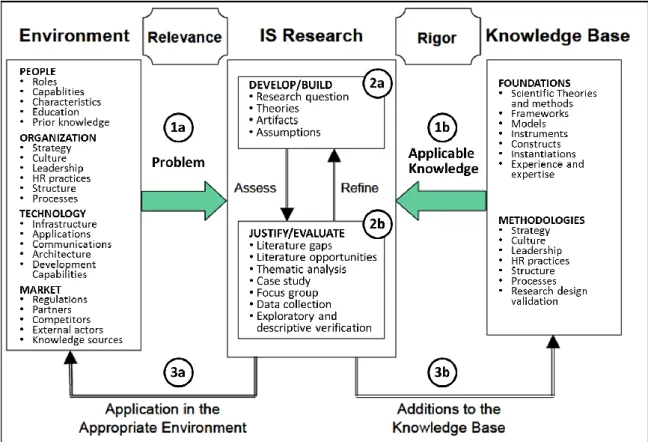
From the analysis of the main FFE and Knowledge Management models found in the literature it was possible to realize a predominance of theoretical models and few of them developed under empirical data. Moreover, as mentioned before, other studies indicate uncertainties in both organizations and academy when talking about FFE, bringing the need of new studies and perspectives. To approach this research we followed the Design Science Approach (pictured in Figure 5) (Hevener et al., 2004). “Design science addresses research
through the building and evaluation of artifacts designed to meet the identified business need” (p. 79-80). In the scope of this model, we propose a Framework for the FFE of
innovation.
Source: Adapted from Hevner et al. (2004, p. 80)
Figure 5 Conceptual framework for understanding research combining behavioral science and design science paradigms
This framework was built considering the gaps identified in previous chapters (“Knowledge Base”) and the author professional experience of more than 8 years working with new product development in a technology-based company (“Environment”). In this context, the following research question emerged:
How does “knowledge creation” unfold within the front-end of innovation and how can we model this knowledge creation process, building on the concept of absorptive capacity?
This research question, in the context of the Design Science, has led to use the case study methodology to validate the proposed framework for the FFE of Innovation. This exploratory
case study unfolds in a Brazilian technology-based firm, that uses agile methodologies, also seeking opportunities for improvement from this research. Because this is still a verification, exploratory and descriptive, a focus group approach, with interviews, will be used in this research. A focus group is a group interview widely used in exploratory studies, with the purpose to provide better understanding of the problem, generate hypotheses and provide elements for the construction of data collection instruments (Gil, 2010).
The IT sector was selected for this analysis due to its relevance. According to the survey conducted by Deloitte14, which annually identifies the 250 small and medium fastest growing companies in the country and makes an x-ray of these businesses, IT companies are on the top of the list. 27% of the fastest growing companies in Brazil are information technology ones. The chosen unit of analysis is a Brazilian technology-based firm that develops mobile solutions. Founded in 1999, the company was pioneer in the mobile telephony value added services and technologies in Brazil.
In 2015 the company was named the 52nd best IT Company in Brazil to work, by the Great Place to Work Institute (3rd best in its state) and, in 2014, was in 70th position among the 250 fastest growing SMEs in Brazil. The choice of the unit of analysis was influenced not only by these factors, but also because of ease of access. The author of this research has worked for 6 years in the company (3 of them as product and innovation coordinator).
According to data from “Serviço Brasileiro de Apoio às Micro e Pequenas Empresas”15 (SEBRAE, 2014), it was estimated that in Brazil there were 5.7 million micro, small and medium enterprises in 2012, which corresponds to 99% of companies, 60% of occupations and 20% of GDP (Gross Domestic Product). Besides, SMEs have specific characteristics that distinguish them from larger companies; this data demonstrates the importance of them in generating wealth for the country's economy. If in the one hand its organizational structure enables faster reaction to a context of instability and rapid changes, on the other, it is very important to be aware to face these difficulties and remain competitive in the long term. And for this, they will be required to integrate certain capabilities and innovative performance to achieve the desired results, considering that new ideas can be used as innovation in product management, stemming from different external sources, that can be customers, end users, universities, research institutes, competitors etc.
14 Available on http://www2.deloitte.com/br/pt/pages/strategy/articles/pmes.html. Access in 20 August 2015. 15 Brazilian Support Service for Micro and Small Enterprises
5 Proposal of a multidimensional framework
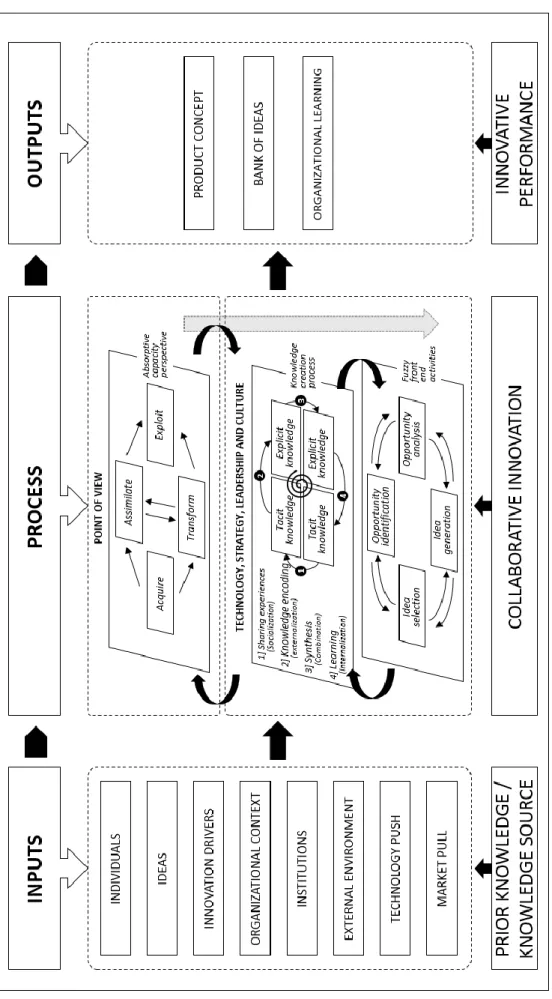
This chapter aims at presenting the proposal of a multidimensional framework to improve the knowledge flow and innovation process in the fuzzy front-end activities. The proposal was based, mainly, on the studied models, presented in the previous sections and their respective influencing factors. The proposed framework is illustrated in Figure 6, with three sets of main elements that make up the process: 1) The "inputs", considered in the proposal as prior knowledge acquired by individuals linked to the organization or internal and external sources of knowledge, that have influence and direct impact in the fuzzy front-end activities; 2) the innovation process itself, which takes place collaboratively, including the fuzzy front-end activities and knowledge management processes; 3) the outputs of these processes, directly linked to the innovative performance of the organization.
The details of the framework will be outlined in three parts. The first describes the input elements and how they influence the innovation process, the second describes the elements and activities of the presented processes and the third describes the output elements and how they result from those processes.
Source: Prepared by the author based on the gaps and oportunities found in the literature
Figure 6 Multidimensional framework to improve knowledge flow and innovation process at the fuzzy front-end
5.1 Understanding the framework: the inputs
From a micro to a macro perspective, several elements that directly influence the fuzzy front-end activities were listed as inputs. These are considered prior knowledge brought by internal and external actors or sources of knowledge, which also influence the firms’ absorptive capacity. The individuals, whether internal or external to the organizations, can generate
ideas for new products or services to be developed. This systematic process of creating and
capturing ideas is based on requirements defined by the organization and includes components related to creativity and the organizational structure to support the process, this latter affected by innovation drivers. The innovation drivers are presented here with the same idea that Koen et al. (2001) calls "engine" (leadership and culture) and "influencing factors" (technology and the organization strategy). The decision to classify them as innovation drivers is due to the understanding that the innovation process will be driven by these factors. Khurana and Rosenthal (1998) also emphasize the need to consider
organizational context of the firm in the FFE activities. Some of these contextual factors are
team experience, innovation support and level of product radicalness. All this comprises the internal environment, where employees are the key actors. Whitney (2007) adds that this organizational context has factors that limit the system operation, as for example the
institutions, considered in this framework as government policies, laws and regulations. In
addition, other external environment factors can also have great influence on the innovation process and serve as important sources of knowledge and information. The actors of this environment are end users, customers, suppliers, competitors and others. Technology-push and market-pull approaches are also relevant for innovation process. For Brem and Voigt (2003) the market and technology vision should coexist, but in different degrees, according to specific sectors.
5.2 Understanding the framework: the process
The proposed process for the fuzzy front-end of innovation, based on the iterative FFE model of Koen et al. (2001), can start with a generated idea or opportunity identification. The iteration between them should take place until the organization identifies that there is a strong association between one or more ideas and one or more opportunities, through an analysis. In this sense, the selection should be a constant activity in all stages of the process (Whitney, 2007). A strong association means a strong alignment with business objectives, interpreted by innovation drivers: technology available, organization strategy, leadership and culture (Koen et al., 2001). Eling et al. (2013) argues that intuition can be very useful in decision-making during the FFE. When used correctly, this can help team members to increase the creativity in developing a product concept. Moreover, multidisciplinary knowledge in the team can generate better outcomes in this phase.
However, the basis of innovation is in the knowledge and continuous organizational learning, which requires companies to develop skills aimed at creating new knowledge - involving its creation, diffusion and incorporation in products, services and systems (Nonaka and Takeuchi, 1995). According to these authors, for the organizational knowledge creation to occur, conditions that enable companies and allow conversions between tacit and explicit knowledge are necessary. Thus, the knowledge creation process presented in the framework has made reference to the four modes of knowledge conversion proposed by Nonaka and Takeuchi (1995), presented in the section 2.3.
Nonaka and Toyama (2003) consider that organizational knowledge creation is a never-ending process and it is continuously upgraded by itself. Moreover, the internal and external characters that encompass the knowledge creation process provide resources for continuous innovation, which allows the company to have competitive advantage (Von et al., 2000). As mentioned before, several studies have argued that firms have different innovation capacities; this is because the ability to absorb and use external knowledge is different. (Cohen and Levinthal, 1990; Nieto and Quevedo, 2005). In this context and as a point of
view, the perspective of absorptive capacity was used in the framework to understand the
interaction that occurs between the fuzzy front-end activities and the process of knowledge creation, taking into account all the inputs, considered as influencing factors in the innovation process.
For this perspective, the absorptive capacity model of Todorova and Durisin (2007) was used as reference, presenting the four main activities of the external knowledge absorption process. The acquisition is the firm's ability to value, identify and acquire critical external knowledge for the company's operations. The elements that make up this dimension are related to the level that the company uses external information, such as partnership with other organizations, relationship networks, seminars, workshop, internet, database, professional magazines, academic publications, laws, regulations etc. The assimilation refers to the firm's ability to analyze, interpret and understand the knowledge obtained from external sources. Thus, the understanding promotes the assimilation, which allows the firm to internalize the knowledge generated externally. The elements that make up this dimension are related to the information and ideas communication flow between departments, especially the exchange of news, issues, developments and achievements. The transformation is the firm's ability to combine existing and assimilated knowledge in order to reach a new scheme. The elements that make up this dimension are related to the capacity of structuring and using this new knowledge to propose new insights and uses for it. The exploitation refers to the organizational capacity that enables the firm to refine, expand and leverage existing skills, allowing the creation of new ones, through the internalization and transformation of the acquired knowledge. A collaborative environment can enhance both Knowledge Creation and Front-End of Innovation process. It is also necessary to create bridges between inputs for innovation and the process as a whole.
5.3 Understanding the framework: the outputs
As expected result of the interaction between the processes presented in the framework, three main elements were listed. When the FFE phase ends with a product concept, that is, with the transformation of an idea into an opportunity, this concept will continue to evolve throughout the innovation process. However, several ideas that started the process as inputs will not become an opportunity or will be rejected. Thinking about this, Cooper et al. (2002) mentioned that a bank of ideas is very important for organizations to store them, leaving the ideas susceptible for future improvements suggestions. This eliminates the risk of losing good ideas that are not at the right moment or need more resources and time to be developed. Considering this, most of the time the FFE phase will end with both product concept and a bank of ideas, probably to be evaluated and improved in the future, or serve as a learning source for employees, that can check whenever they want.
These ouputs of the process encourage knowledge accumulation and enhance the ability to learn, intensifying organizational learning and the creation of a knowledge environment
within the organization. Moreover, the learning process can be seen as part of the conditions that favor the creation of such knowledge, as long as it results, continuously, in innovative learning.
Organizational learning also can be promoted by incentive, training, conversations, meetings to discuss ideas, brainstorms etc., where employees can share their knowledge, allowing new inputs like new knowledge and skills. The company that provides space for knowledge sharing also creates learning space and becomes a good environment for development and innovation.
The influence of all the previously mentioned factors in the innovation process, as well as the way companies recognize, acquire, assimilate, transform and exploit the knowledge, can lead to different results of innovative performance.