POST-RELEASE MORTALITY OF SHORTFIN MAKO IN THE ATLANTIC USING
SATELLITE TELEMETRY: PRELIMINARY RESULTS
Andrés Domingo1,*, Catarina C. Santos2, John Carlson3, Lisa Natanson4, Enric Cortes3, Federico Mas5, Philip Miller5 F. Hazin6, Paulo Travassos6, Rui Coelho1
SUMMARY
This paper provides an update of the study on post-release mortality of the shortfin mako, Isurus oxyrinchus developed within the ICCAT Shark Research and Data Collection Program (SRDCP). Up to date, 34 tags (14 sPATs and 20 miniPATs) have been deployed by observers on Brazilian, Portuguese, Uruguayan, and US vessels in the temperate NE and NW, Equatorial and SW Atlantic. Data from 28 out of 34 tagged specimens could be used to obtain preliminary information regarding post-release mortality, resulting in a total of 7 mortality and 21 survival events.
KEYWORDS: Post-release mortality; Satellite tagging; Shortfin mako; Sharks research program
1: DINARA - Dirección Nacional de Recursos Acuáticos, Laboratorio de Recursos Pelágicos. CP 11200 Montevideo, Uruguay. 2: IPMA - Portuguese Institute for the Ocean and Atmosphere. Av. 5 de Outubro s/n, 8700-305 Olhão, Portugal.
3: NOAA Fisheries - Southeast Fisheries Science Center. Panama City, FL, US.
4: NOAA Fisheries - Northeast Fisheries Science Center. Narragansett Laboratory, RI, US.
5: CICMAR - Centro de Investigación y Conservación Marina, Giannattasio km. 30,5 El Pinar, Canelones, CP 15008, Uruguay. 6 Departamento de Pesca e Aquicultura, Universidade Federal Rural de Pernambuco, Av. Dom Manoel de Medeiros, s/n., Dois Irmãos, CEP: 52.171-030, Recife, PE, Brasil.
1. Introduction
Fishing activities are one of the most important sources of extrinsic mortality for shark populations (Stevens et al. 2000; Dulvy et al. 2008). Particularly for semi-pelagic and oceanic species, longline fisheries are responsible for a large amount of global catches, and also one of the most important sources of mortality (Bonfil 1994; Camhi et al. 2008; Clarke et al. 2014). Therefore, understanding species interactions with these fisheries is a key aspect for the development of sound management and conservation strategies (Gilman et al. 2008; Campana et al. 2015; Musyl & Gilman 2018).
Once hooked in a longline, a shark is exposed to different levels of physical damage (e.g. damage caused by the hook, abrasion caused by the leader) and physiological stress (e.g. increase in metabolic rate, exhaustion, reduced ventilation capabilities, and higher cortisol levels), which may be augmented depending on how the fishing crew handle the fish during the haul and release (Skomal 2007; Ellis et al. 2017). Several studies have shown that hooking mortality in sharks may be affected by a wide array of factors, including size, sex, behavior and physiology, but also the season of the year, region, water temperature, and fishing characteristics (e.g. soak time, hook type, and manipulation practices) (Poisson et al. 2010; Coelho et al. 2012, 2013; Gallagher et al. 2014; Ellis et al. 2017). These results also highlight the fact that hooking mortality estimations are likely to vary among different fishing fleets as many nations use different fishing gear configurations and fishing practices, such as hook type and size, soak time, depth of the gear (shallow vs. deep), fishing areas, among others (Clarke et al. 2014).
Hooking mortality provides useful information for management advice. For example, knowing if sharks are prone to survive or die by the time the fishing gear is retrieved may help assess the effectiveness of management and conservation strategies such as size specific limits on catches or the prohibition of onboard retention of certain species (Coelho et al. 2013; Clarke et al. 2014; Ellis et al. 2017), some of which have already been recommended by ICCAT for several oceanic shark species (Alopias superciliosus, ICCAT Rec. 09-07; Carcharhinus longimanus, ICCAT Rec. 10-07; Sphyrna spp., ICCAT Rec. 10-08; Carcharhinus falciformis, ICCAT Rec. 11-08). Post-release mortality, on the other hand, represents the probability of a shark dying due to causes related to the fishing event after being caught and released alive (Campana et al. 2015). Therefore, the combination of both hooking and post-release mortality is indicative of total fishing induced mortality (F), which at the same time represents one of the major parameters estimated in stock assessments.
In 2013 the Shark Research and Data Collection Program (SRDCP) was created by ICCAT’s Shark Species Group. The main objective of this project is the development and coordination of research and science-related initiatives in order to provide grounded scientific advice for the sustainable management and conservation of sharks in the Atlantic Ocean. During the 2014 inter-sessional meeting, the Shark Working Group updated the SRDCP, which was framed within the 2015-2020 SCRS Strategic Plan. The initial 3-year implementation of this Research Program focuses on biological aspects, ecology and fisheries of shortfin mako shark (Isurus oxyrinchus) that are relevant to the upcoming stock assessment of this important species. Within the ICCAT SRDCP, two specific studies using satellite telemetry were developed for the shortfin mako: 1) a study aimed at gathering and providing information on stock boundaries, movement patterns and habitat use in the Atlantic; and 2) a study focused on the assessment of post-release mortality. This document presents preliminary results of the post-release mortality study (2).
2. Materials and methods
2.1. Tag acquisition
Two models of tags were used: MiniPAT and Survivorship PAT (sPAT) tags built by Wildlife Computers (WC). The former model was used to address the objective 1 of the SRDCP, and the latter to address the objective 2 (see Introduction). The first tag acquisition process was completed during October-November 2015 by the ICCAT Secretariat, and the tags were then distributed to the participating Institutes in late 2015. In this first project phase, a total of 9 miniPATs and 14 sPATs were acquired (funds from 2015). Additionally, in late 2016, 12 additional miniPATs were acquired with the funds from 2016 for deployment during 2017-2018, during the second phase of the project. As one of the original miniPATs (2015) failed due to a depth sensor problem, the tag manufacturer provided one additional replacement tag. As such, for the second phase of the project a total of 13 miniPATs were available for deployment in 2017-2018.
2.2. Tagging procedure
A total of 34 tags (14 sPATs and 20 miniPATs) were deployed on shortfin mako sharks during this study. Sharks were tagged during several research trips and commercial fishing trips in different areas of the Atlantic Ocean (Figure 1), including the NW Atlantic (n = 7), NE Atlantic (n = 10), Equatorial Atlantic (n = 5) and SW Atlantic (n = 12).
Sharks were either hoisted alongside the vessel or brought on board for tagging. All tags had a plastic Domeier-type anchor which was inserted into the dorsal musculature below the base of the first dorsal fin. Tagging operations lasted for a maximum of 2 minutes and did not produce any additional injuries or damage to the specimens. Before attachment, tags were tested for accurate data collection. All sPATs were pre-programmed to detach 30 days after deployment (see below), whereas miniPATs were programmed to record information for periods between 30 and 120 days. In order to prevent tag damage, both tag types had a safety release mechanism that would initiate a premature detachment if depth surpass 1700 or 1800 m (depending on tag model).
All tagged animals were sexed and their fork length (FL) measured or estimated. Date and time were recorded, and the geographic tagging location (latitude and longitude) was determined by Global Positioning System (GPS). Whenever possible, for each tagged individual additional information was recorded, including sea surface temperature, whether the hook was removed or not prior to release, soak time (defined as the duration between first hook deployment and time of tagging following Musyl & Gilman 2018) and animal condition. Condition was assessed qualitatively following ICCAT codes for tagging studies: Perfect (P, no visual damage), Moderate (M, superficial damage), Severe (S, damage could affect survival), and Unkown (U). When possible, injury states of tagged sharks were assessed globally (Global condition) and specifically for different body parts (head, mouth, eyes, skin, fins and gill slits). If a shark had any body part classified to have Severe damage, its global condition was also classified as Severe.
2.3. Data analysis
sPAT tags are specifically designed to assess mortality events, transmitting only a summary of data from which either mortality or survival is inferred (French et al. 2015; Hutchinson et al. 2015; Musyl & Gilman 2018). Once popped-off, a tag report is sent describing the reason for detachment, which in most cases is a direct indicator of mortality-survival (see https://wildlifecomputers.com/our-tags/spat/ for further information on this tags). Sharks that had been tagged with sPATs that detached at day 30 were considered as post-release survival events (Complete Deployment). On the other hand, tags that detached prematurely due to reaching depths in excess of 1700 m (Sinker) or that had recorded a constant depth for an extended period of time (Sitter, indicative of dead sharks lying dead in the bottom but shallower than 1700m) can both be attributed to post-release mortality events. Lastly, tags can detach prematurely for unknown reasons, float on to surface and transmit (Floater), or directly fail to transmit any data. In these cases, no definite conclusion regarding mortality or survival can be inferred and therefore should not be considered for post-release mortality estimations.
MiniPAT tags are mainly designed to study horizontal and vertical movements, as well as habitat use, therefore being more data-recording intensive and having a better time resolution, including temperature and depth time series, light curve changes, and percentage of time spent at specifically pre-defined depth and temperature bins (e.g. Biais et al. 2017; see https://wildlifecomputers.com/our-tags/minipat/ for further details on data products). Sharks tagged with these tags were considered to have survived the fishing event if it was possible to determine that the individuals were actively swimming (depth profiles) for 30 days or more after deployment. Mortality events, on the other hand, were assigned in cases where depth profiles showed individuals rapidly sinking to depths greater than 1700 m, thus initiating the safety release mechanism, before 30 days after release. All cases in which tags either failed to transmit or detached prematurely for unknown reasons before 30 days were regarded as inconclusive in terms of mortality-survival and thus were left out of the analysis.
Post-release mortality was assessed against shark’s size, sex, condition (injuries), hook fate (removed or not) and soak time, and geographical region. Our results were compared to those from other previous projects from which information was made available to ICCAT Shark Working Group.
All statistical analyses for this paper were carried out with the R language (R Core Team, 2016). Plots and maps were created using libraries “ggplot2” (Wickham, 2009) and “rgdal” (Bivand et al., 2011).
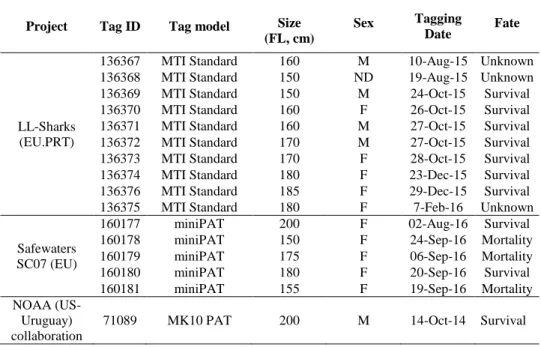
The participating scientists and Institutes in this study had other ongoing projects and initiatives that also included the deployment of satellite telemetry tags in SMA (Table 2, and see more details in SCRS/2018/094). Our results were compared to those from these previous projects from which information was made available to the working group (Table 2).
3. Results and Discussion
3.1. Tag performance
To increase the sample size and complement the information obtained from the 14 shortfin mako sharks equipped with survival tags (sPATs), we pooled together the data obtained from 20 other sharks tagged with miniPAT tags (with the aim of generating data about movements and habitat use). While this allows for a bigger and more representative sample, it might introduce bias in post-release mortality estimates as sharks in better conditions are preferred for the deployment of the more expensive miniPAT tags, therefore avoiding the deployment in sharks with compromised conditions. However, preliminary post-release mortality rates were very similar among both groups of tagged individuals (see below in section 3.3), thus it was decided to pool them together for subsequent analysis.
Of the 34 satellite tags deployed on shortfin mako sharks during this study, 2 failed to relay any kind of data and 4 detached from the shark earlier than 30 days after being deployed, thus the fate of these 6 individuals could not be ascertained and remains unknown (Table 1). Data from the remaining 28 tags were used to assess post-release survival, which means 82% success in mortality determination. For these 28 tags, the monitoring period ranged between 1 and 121 days.
3.2. Information on tagged sharks
The shark size distribution was not homogeneous along different geographical regions. In general, larger sharks were tagged in the NW Atlantic, while most of the smaller sharks were tagged in the NE Atlantic (Figure 2). There was almost no overlap in the shark size between these two areas. Except for one individual, all sharks tagged in the NW Atlantic were equal or larger than 180 cm FL, while all the sharks tagged in the NE Atlantic were equal or smaller than 173 cm FL. Most sharks tagged in the Equatorial Atlantic were also larger than those tagged in the NE Atlantic, while sharks tagged in the SW Atlantic encompassed a broader size range that overlaps that of all other regions.
A total of 16 males, 8 females and 4 unsexed individuals were successfully monitored during the present study. The smallest and largest male sharks were 104 and 240 cm FL, while the smallest and largest females were 112 and 214 cm FL.
3.3. Post-release mortality Generalities
A total of 21 sharks survived for more than 30 days, while 7 died before 30 days. Overall overall post-release mortality rate was 25%. The post-release mortality rate for the group of individuals tagged with sPATs (23.1%) was very similar to that of the group tagged with miniPATs (26.7%, Figure 3).
Recent studies carried out in several locations across the globe have shown varying post-release mortality rates. Campana et al. (2015) determined a post-release mortality rate of 30-33% for shortfin makos captured by pelagic longliners in the NW Atlantic (off Canada). A post-release mortality of 10% was determined for game fisheries (catch and release) in Australia, where 3 out of 30 shortfin mako sharks died within 30 days (French et al. 2015). In the SE Pacific, Abascal et al. (2011) determined that 1 out of 9 sharks (11%) died within 30 days after being captured and released by a pelagic longliner. A study by Musyl et al. (2011) in the central North Pacific, could not provide conclusive evidence of shortfin mako post-release mortality after being caught by pelagic longliners; 2 (40%) of the tagged sharks survived for at least 5 months, while the tags failed to report for the remaining 3 individuals (60%). In
SE Australia, Rogers et al. (2015) tagged 10 juvenile shortfin mako sharks (120-240 cm TL) with fin mounted satellite tags. Although no attempts on estimating post-release mortality rates were done in this study, all deployment durations exceeded the 30 day mark, ranging between 46 and 672 days and suggesting that they all survived. These sharks were tagged after being captured by commercial demersal longlines, chartered tuna fishing vessels and game fishing vessels.
Size and Sex comparisons
Larger individuals exhibited lower post-release mortality rate than smaller ones. For sharks equal or larger than 180 cm FL, mortality occurred in 2 of 13 individuals (15%), while for sharks smaller than 180 cm it occurred in 5 of 15 individuals (33%) (Figure 4). Considering a size at maturity of 180cm FL for males (Maia et al. 2007) and 242cm or 264cm FL for females (for southern hemisphere and North Atlantic, respectively, Mollet et al. 2000), most of the sharks that died were immature. While maturity by itself probably is not a useful post-release mortality predictor, it is important to further assess the potential effect of shark size in their post-release survival probability. The difference in mortality found in this study may be related to the fact that some of the largest individuals tagged during this project were not brought onboard for tagging, thus they may have been subject to better ventilation/respiration, lower amounts of stress and potentially reduced handling damage than smaller individuals which were brought onboard.
Campana et al. (2015) also confronted this issue, where some individuals were tagged while in the water while other were brought onboard for tagging. Nevertheless, using used a GLM to test if post-release mortality rate was influenced by the boarding practice, they concluded that the fate of the healthy makos was independent of boarding practice or shark size (fork length).
Most of the mortality events were observed in males (n=6), which had a post-release mortality rate of 37.5%, while only 1 mortality event was observed in tagged females (post-release mortality rate of 12.5%, Figure 4). Unfortunately, 4 of the tagged individuals were not sexed.
Shark Condition (Injuries)
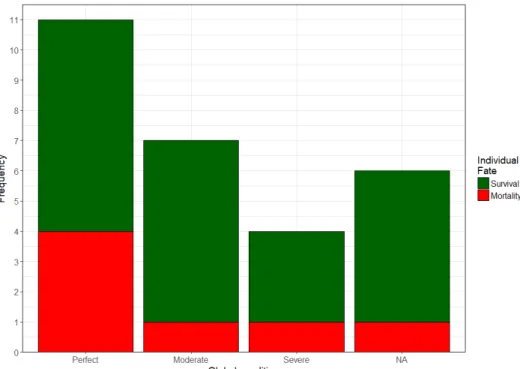
Information about injury condition was obtained from 22 of the 28 individuals for which it was possible to determine post-release fate. While most individuals were considered by the taggers to be in “Perfect” status in their global condition, this status actually exhibited a higher post-release mortality rate (36%) than the other statuses (“Moderate” = 14%, and “Severe” = 25%) (Figure 5). Of the 7 sharks that died within the first 30 days after capture, 4 were classified to be in “Perfect” global condition (57%) by the tagger, while 1 was classified as having moderate damage, another presented severe damage, and the remaining one has no associated information (Figure 5). These results appear to be different from those obtained by Campana et al. (2015), who reported that “Healthy” makos had a release mortality rate of 30% (7 out of 23 individuals), very similar to that of “Injured” makos which had a post-release mortality rate of 33% (1 out of 3 individuals).
Regarding conditions of specific body parts, all the monitored sharks were classified as having perfect conditions in their eyes, and there were no individuals classified as having severe damage on head, mouth, skin, fins, or body. The only condition that received a score of “severe damage” on 4 of the monitored individuals was gill slits condition. However, only 1 of the 4 sharks (25%) classified with this status died within 30 days (Figure 6). On the other hand, of those sharks assigned a perfect condition for gills slit, 5 out of 15 (33%) died within 30 days.
Our results suggest that there is a need to discuss about possible ways to enhance our shark condition assessment criteria, as the currently employed method is very subjective, is based only on visual examination, and does not consider any behavioral or physiological variables. Visual observation of a shark’s injuries onboard a vessel or even in water, may not be enough to properly ascertain their actual condition, and it failed during this study to provide any insight about the shark’s chances of survival. Physiological and hematological indicators, for instance, have already been used by several authors to assess the level of stress and its influence on post-release chances of survival of various shark species (Brooks et al. 2012, Marshall et al. 2012, Gallagher et al. 2014, French et al. 2015).
Hook Fate
None of the sharks that were released without previously removing the hook died within 30 days, whereas mortality occurred in 5 out of 13 (38%) sharks that had the hook removed. Unfortunately, there was a lack of information regarding whether the hook was removed or not for 32% of the monitored individuals (Figure 7).
Soak Time
Soak time, defined as the elapsed time between the beginning of the longline set and the time when the fish is brought onboard, tagged and released, represents the maximum time that a fish could have remained captured by the fishing gear, which in turn can affect its survival. The available data do not allow any conclusion regarding the effect of soak time on post-release mortality, but all mortality events of sharks with available soak time data occurred when this variable exceeded 16 hours (Figure 8). It is important to consider, however, that soak time data were lacking for almost 50% of the tagged sharks.
Survival Time
Mortality events occurred mostly during the first two days after capture (n= 4, 57%). Two other individuals died during the second week after capture (days 10 and 13), while the remaining shark survived until day 17 (Figure 9). There were no mortality events after 17 days; all individuals with tags programmed for longer than 30 days remained alive until the tags reached their pop-off date, detached prematurely without any indication of mortality, or failed to transmit for some reason (non-reporting tags).
Campana et al. (2015) also observed that most sharks that died did so a few days after release, with 69% of mortalities (20 out of 29 sharks) occurring during the first 5 days after capture. However, 10% of the mortality events occurred after 30 days, which contrasts with our findings (null mortality after 17 days). While the data provided by Campana et al. (2015) correspond to a large (n= 109) mixed group of shortfin mako, blue and porbeagle sharks, the authors highlighted that there was no significant difference in survival time across species, and also that there was no significant difference between “injured” and “healthy” sharks.
A study on shortfin mako sharks post-release mortality in recreational catch and release fisheries in Australia also recorded mortalities in the very short term. According to French et al. (2015), 100% of the mortality events occurred within 24 hours of release. Contrastingly, our results are very different from those obtained by Abascal et al. (2011) in the SE Pacific, who determined that 75% (3 out of 4) of shortfin mako post-release mortality events occurred after 30 days of being captured by commercial pelagic longliners in the SE Pacific.
Although the use of satellite tags has allowed to obtain more robust and reliable post-release mortality estimations (e.g. Musyl et al. 2011; Campana et al. 2015; Musyl & Gilman 2018), it is likely that some long-term cryptic mortality still occurs. One possible cause of long-term mortality due to fishing activities could be related with whether hooks were removed or not prior to release. Several studies have shown the long-term negative effects of hooks that were left behind in sharks (Borucinska et al. 2001, 2002; Adams et al. 2015). Although these studies have focused on hooks that punctured the esophagus, stomach, heart or liver, it is clear that hooks can produce long-term negative effects ranging from the development of fibrous connective tissue masses surrounding the hook, which could produce luminal obstructions, to esophagitis, gastritis, hepatitis, necrosis, pericarditis, proliferative peritonitis, and subsequent death (Borucinska et al. 2001, 2002; Adams et al. 2015). These pathologies may take a long time to manifest and eventually kill the sharks, even longer than the predefined 30-day time window most commonly used for post-release mortality studies until today, hence being undetectable by the present methodology. Although all hooks that were not removed from tagged sharks in our study were located somewhere in the mouth, it is still not clear how they could affect individual fitness on the long term, therefore constituting a potential source of cryptic mortality. This issue warrants further consideration as bite-off from the fishing gear is a recurrent event in sharks caught by longlines, especially when using nylon leaders (e.g. Afonso et al. 2012).
Regional-Geographical differences
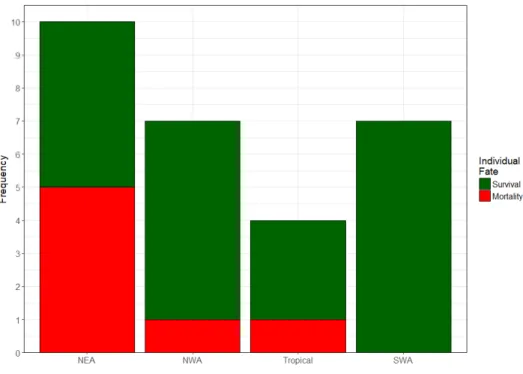
Dissimilar post-release mortality rates were observed along different areas during this study (Figure 10). Most of the mortality events corresponded to sharks tagged in the NE Atlantic (n=5); there were also mortality events in sharks tagged in the NW Atlantic and Equatorial Atlantic (1 on each region), and no mortality in the sharks tagged in the SW Atlantic.
Other considerations
Almost all (5 of 7) the individuals that died were captured during the same fishing trip, on April 2016. It is possible that one, or a combination of several variables related to gear configuration, operational variables, environmental factors, shark handling and/or tagging techniques may have affected the survival probability of the sharks tagged
during this particular trip, but it is not clear if this was the case, or which are the underlying processes that may explain this high post-release mortality. The strikingly high post-release mortality rate for sharks tagged during this trip raises doubts as to whether to consider or not these individuals for the mortality analysis. Also, 3 out of 5 individuals that subsequently died were categorized to be in Perfect global condition. Such high mortality rate lies well outside the ranges of any other trips in this study, which further suggests that it may be worth to further investigate potential causes, and eventually consider the possibility of excluding these sharks from further analysis. If these 3 individuals are excluded from the analysis, the estimated post-release mortality rate decreases considerably, from 25% to 16%. We caution that further consideration should be given to this particular issue as it could affect the outcome of future stock assessments.
A similar issue was encountered by Campana et al (2015), who found an unusually high mortality rate associated with sharks tagged by a single fisheries observer during a single trip. All sharks were small (110 cm FL), and all were tagged onboard the vessel. As the mortality rates were outside the bounds of any other of their observations, the authors were led to consider that inappropriate handling-tagging methods or excessive period on deck might have been responsible, and for this reason they decided to exclude the data from further analysis.
SMA satellite tracking data from other projects
Data available from previous tagging initiatives includes 16 tagged individuals (Table 2), most of which were tagged and released in the Equatorial Atlantic, and also in the SW Atlantic (Figure 11). Three of these tags detached prematurely (before 30 days) or failed to transmit (81% success for mortality estimation), while for the remaining 13 individuals it was possible to determine that 10 survived over 30 days, and 3 died before 10 days (23% Post-release mortality, see Table 2). Pooling together SRDCP’s data with these previously generated data provides a post-release mortality rate of 24%, which is very similar to the one obtained from the SRDCP project alone. Consideration should be given to the fact that these projects were mainly focused on obtaining movements and habitat use data rather than particularly providing post-release mortality estimates, thus they may be biased towards tagging healthier sharks, which could under-estimate post-release mortality rates.
Size range of the individuals tagged during previous initiatives was similar to that of the SRDCP project (Figure 12). In general terms, mortality occurred predominantly in immature individuals, in agreement with what was observed in the SRDCP data.
4. Final Remarks
• It was possible to ascertain the post-release fate for 82% of the shortfin mako sharks equipped with satellite tags.
• The preliminary post-release mortality rate of shortfin mako sharks after being captured and released by pelagic longliners accounted for 25% of the monitored individuals.
• All mortality events occurred within 17 days after capture, with 57% of the deceases occurring during the first two days after capture.
• In general, the data and preliminary results from this study provide an important contribution to further understand post-release mortality of shortfin mako and complement the still incipient body of knowledge about this issue.
• Due to the patchiness and clustering of spatial, temporal, size and sex distribution of the tagged individuals, as well as their fate, it is important to highlight that these data and preliminary results should be carefully analyzed to try to assess and potentially mitigate the effects of any possible sampling bias. Further deliberation should be given to the potential uses and implications of these preliminary results.
• Our results suggest that there is a need to discuss about possible ways to enhance our shark condition assessment criteria, as the currently employed method is very subjective, and is based only on visual examination, not considering any behavioral or physiological variables. Visual observation of a shark’s injuries onboard a vessel or even in water, may not be enough to properly ascertain their actual condition,
and it failed during this study to provide any insight about the shark’s chances of survival. The collection of blood samples for the analysis of physiological and hematological parameters that might be indicators of stress and post-release survival may be an alternative to overcome such deficiency.
• We suggest that increasing the sample size could be beneficial in order to complement the current sample with a wider range and more representative size and sex distribution, individual injuries condition, as well as to account for deep-set longlines, which could potentially cause different post-release mortality rates.
5. Acknowledgments
This study was carried out as part of a cooperative work conducted by the ICCAT Shark species group integrated in the ICCAT Shark Research and Data Collection Program (SRDCP). The authors are grateful to all fishery observers and longline skippers from the Nations involved in this study. Tags from additional sources have been contributed and deployed with several national Projects, specifically: Project "LL-Sharks: Mitigação das capturas de tubarões na pescaria de palangre de superfície (Ref: 31-03-05-FEP-44, funded by PROMAR)", Project "MAKO-WIDE - "A wide scale inter-hemispheric and inter-disciplinary study aiming the conservation of the shortfin mako shark in the Atlantic Ocean (Ref: FAPESP/19740/2014)", funded by FCT (Portuguese Foundation for Science and Technology) and FAPESP (São Paulo Research Foundation, Brazil), and Project SAFEWATERS SC7 (The provision of advice on the conservation of pelagic sharks associated to fishing activity under EU Sustainable Fisheries Partnership Agreements in the Atlantic Ocean) under the Framework Contract MARE/2012/21, funded by the European Commission. Additional satellite tags were acquired by NOAA in US-Uruguay and US-Portugal-Uruguay collaboration initiatives. Rui Coelho is supported by an Investigador-FCT contract from the Portuguese Foundation for Science and Technology (FCT) supported by the EU European Social Fund and the Programa Operacional Potencial Humano (Ref: IF/00253/2014).
6. References
Abascal F.J., Quintans M., Ramos-Cartelle A., Mejuto J. 2011. Movements and environmental preferences of the shortfin mako, Isurus oxyrinchus, in the southeastern Pacific Ocean. Mar Biol 158: 1175–1184.
Adams, D.H., Borucinska, J.D., Maillett, K., Whitburn, K., Sander, T.E. 2015. Mortality due to a retained circle hook in a longfin mako shark Isurus paucus (Guitart‐M anday). Journal of fish diseases 38(7): 621 -628.
Afonso, A.S., Santiago, R., Hazin, H., Hazin, F.H. 2012. Shark bycatch and mortality and hook bite-offs in pelagic longlines: Interactions between hook types and leader materials. Fisheries Research 131: 9-14.
Biais, G., Coupeau, Y., Séret, B., Calmettes, B., Lopez, R., Hetherington, S., & Righton, D. (2017). Return migration patterns of porbeagle shark (Lamna nasus) in the Northeast Atlantic: implications for stock range and structure. ICES Journal of Marine Science, 74(5), 1268-1276.
Bivand, R., Keitt, T., Rowlingson, B. 2018. rgdal: Bindings for the 'Geospatial' Data Abstraction Library. R package version 1.3-3. https://CRAN.R-project.org/package=rgdal
Bonfil R. 1994. Overview of world elasmobranch fisheries. FAO Fisheries Technical Paper 341. Rome, FAO. 119p.
Borucinska, J., Martin, J., Skomal, G. 2001. Peritonitis and pericarditis associated with gastric perforation by a retained fishing hook in a blue shark. Journal of Aquatic Animal Health 13(4): 347-354.
Borucinska, J., Kohler, N., Natanson, L., Skomal, G. 2002. Pathology associated with retained fishing hooks in blue sharks, Prionace glauca (L.), with implications for their conservation. Journal of Fish Diseases 25(9): 515-521.
Brooks, E. J., Mandelman, J. W., Sloman, K. A., Liss, S., Danylchuk, A. J., Cooke, S. J., ... & Suski, C. D. 2012. The physiological response of the Caribbean reef shark (Carcharhinus perezi) to longline capture. Comparative Biochemistry and Physiology Part A: Molecular & Integrative Physiology, 162(2), 94-100.
Camhi M.D., Lauck E., Pikitch E.K. & Babcock E.A. 2008. A Global Overview of Commercial Fisheries for Open Ocean Sharks. En: Sharks of the open ocean: biology, fisheries and conservation. Camhi M.D., Pikitch E.K. & Babcock E.A. (eds.), pp. 166–192, Blackwell Publishing, Oxford, UK.
Campana, S. E., Joyce, W., Fowler, M., & Showell, M. 2015. Discards, hooking, and post-release mortality of porbeagle (Lamna nasus), shortfin mako (Isurus oxyrinchus), and blue shark (Prionace glauca) in the Canadian pelagic longline fishery. ICES Journal of Marine Science, 73(2), 520-528.
Clarke S., Sato M., Small C., Sullivan B., Inoue Y. & Ochi D. 2014. Bycatch in longline fisheries for tuna and tuna-like species: a global review of status and mitigation measures. FAO Fisheries and Aquaculture Technical Paper No. 588. Rome, FAO. 199p.
Coelho R., Fernandez-Carvalho J., Lino P.G. & Santos M.N. 2012. An overview of the hooking mortality of elasmobranchs caught in a swordfish pelagic longline fishery in the Atlantic Ocean. Aquatic Living Resources 25: 311-319.
Coelho R., Infante P. & Santos M.N. 2013. Application of generalized linear models and generalized estimation equations to model at-haulback mortality of blue sharks captured in a pelagic longline fishery in the Atlantic Ocean. Fisheries research 145: 66-75.
Dulvy, N. K., Baum, J. K., Clarke, S., Compagno, L. J., Cortés, E., Domingo, A., ... & Martínez, J. 2008. You can swim but you can't hide: the global status and conservation of oceanic pelagic sharks and rays. Aquatic Conservation: Marine and Freshwater Ecosystems, 18(5), 459-482.
Ellis J.R., McCully Phillips S.R. & Poisson F. 2017. A review of capture and post‐release mortality of elasmobranchs. Journal of fish biology, 90(3), 653-722.
French, R. P., Lyle, J., Tracey, S., Currie, S., & Semmens, J. M. 2015. High survivorship after catch-and-release fishing suggests physiological resilience in the endothermic shortfin mako shark (Isurus oxyrinchus). Conservation physiology, 3(1), cov044.
Gallagher, A. J., Serafy, J. E., Cooke, S. J., & Hammerschlag, N. 2014. Physiological stress response, reflex impairment, and survival of five sympatric shark species following experimental capture and release. Marine Ecology Progress Series, 496, 207-218.
Gallagher A.J., Orbesen E.S., Hammerschlag N. & Serafy J.E. 2014. Vulnerability of oceanic sharks as pelagic longline bycatch. Global Ecology and Conservation 1: 50-59.
Gilman, E., Clarke, S., Brothers, N., Alfaro-Shigueto, J., Mandelman, J., Mangel, J., Petersen, S., Piovano, S., Thomson, N., Dalzell, P., Donoso, M., Goren, M. & Werner, T. 2008. Shark interactions in pelagic longline fisheries. Marine Policy, 32(1), 1-18.
Hutchinson, M. R., Itano, D. G., Muir, J. A., & Holland, K. N. 2015. Post-release survival of juvenile silky sharks captured in a tropical tuna purse seine fishery. Marine Ecology Progress Series, 521, 143-154.
Maia, A., Queiroz, N., Cabral, H. N., Santos, A. M., & Correia, J. P. 2007. Reproductive biology and population dynamics of the shortfin mako, Isurus oxyrinchus Rafinesque, 1810, off the southwest Portuguese coast, eastern North Atlantic. Journal of Applied Ichthyology, 23(3), 246-251.
Marshall, H., Field, L., Afiadata, A., Sepulveda, C., Skomal, G., & Bernal, D. 2012. Hematological indicators of stress in longline-captured sharks. Comparative Biochemistry and Physiology Part A: Molecular & Integrative Physiology, 162(2), 121-129.
Mollet, H. F., Cliff, G., Pratt Jr, H. L., & Stevens, J. 2000. Reproductive biology of the female shortfin mako, Isurus oxyrinchus Rafinesque, 1810, with comments on the embryonic development of lamnoids. Fishery Bulletin, (2).
Musyl, M. K., Brill, R. W., Curran, D. S., Fragoso, N. M., McNaughton, L. M., Nielsen, A., ... & Moyes, C. D. 2011. Postrelease survival, vertical and horizontal movements, and thermal habitats of five species of pelagic sharks in the central Pacific Ocean. Fishery Bulletin, 109(4), 341-368.
Musyl, M.K. & Gilman, E. (2018). Post-release fishing mortality of blue (Prionace glauca) and silky shark (Carcharhinus falciformis) from a Palauan based commercial longline fishery. Reviews in Fish Biology and Fisheries. https://doi.org/10.1007/s11160-018-9517-2
Poisson F., Gaertner J.C., Taquet M., Durbec J.P. & Bigelow K. 2010. Effects of lunar cycle and fishing operations on longline-caught pelagic fish: fishing performance, capture time, and survival of fish. Fishery Bulletin 108: 268-281.
R Core Team. 2016. R: A language and environment for statistical computing. R Foundation for Statistical Computing, Vienna, Austria. Available from: http://www.R-project.org/.
Rogers, P.J., Huveneers, C., Page, B., Goldsworthy, S.D., Coyne, M., Lowther, A.D., Mitchell, J.G., Seuront, L. 2015. Living on the continental shelf edge: habitat use of juvenile shortfin makos Isurus oxyrinchus in the Great Australian Bight, southern Australia. Fisheries Oceanography, 24(3): 205-218.
Stevens, J. D., Bonfil, R., Dulvy, N. K., & Walker, P. A. (2000). The effects of fishing on sharks, rays, and chimaeras (Chondrichthyans), and the implications for marine ecosystems. ICES Journal of Marine Science, 57(3), 476-494.
Skomal G.B. 2007. Evaluating the physiological and physical consequences of capture on post‐release survivorship in large pelagic fishes. Fisheries Management and Ecology 14: 81-89.
Wickham H. ggplot2: elegant graphics for data analysis. 1st ed. New York: Springer. 2009. Available from:
Tables
Table 1. Details of the sharks equipped with miniPATs and sPATs during this project. Fish condition (injuries) is used according to the ICCAT codes for tagging studies: P = Perfect (no visual damage); M = Moderate (superficial damage); S = Severe (could affect survival); U = Unknow.
Tag ID Tag model Size (FL, cm) Sex Tagging Date
Fish condition (injuries)
Fate
Global head mouth eyes skin fins body gill
slits
70638 miniPAT 146 M 06-Jun-17 M P M P P P P P Survival
157339 miniPAT 128 F 21-Dec-15 P P P P P P P P Survival
157340 miniPAT 129 F 17-Apr-16 P P P P P P P P Mortality
157341 miniPAT 124 M 09-Apr-16 P P P P P P P P Survival
157342 miniPAT 112 F 24-Jan-16 P P P P P P P P Survival
157343 miniPAT 157 M 12-Apr-16 P P P P P P P P Mortality
157344 miniPAT 107 M 12-Apr-16 P P P P P P P P Mortality
157345 miniPAT 139 M 27-Jun-16 P P P P P P P P Unknown
157346 miniPAT 194 M 12-Dec-16 M P M P M P P M Unknown
157347 miniPAT 176 M 17-Dec-16 M P M P M P P P Unknown
167199 miniPAT 115 M 06-Dec-17 M P M P P P M P Survival
167201 miniPAT 165 F 03-Jun-17 M P M P P P P M Survival
167202 miniPAT 148 M 06-Jun-17 M P M P P P P M Unknown
167203 miniPAT 160 U 18-Feb-18 ND ND ND ND ND ND ND ND Survival 167204 miniPAT 200 U 09-Feb-18 ND ND ND ND ND ND ND ND Survival 167206 miniPAT 180 M 04-May-18 ND ND ND ND ND ND ND ND Mortality 167207 miniPAT 205 M 20-Nov-17 ND ND ND ND ND ND ND ND Survival 167208 miniPAT 185 F 13-Nov-17 ND ND ND ND ND ND ND ND Survival 167209 miniPAT 110 M 01-Mar-18 ND ND ND ND ND ND ND ND Survival 167210 miniPAT 220 F 01-Mar-18 ND ND ND ND ND ND ND ND Unknown
157365 sPAT 190 F 18-Dec-16 M M M P P P M S Survival
157366 sPAT 145 M 17-Dec-15 M P M P P P P M Survival
157367 sPAT 104 M 30-Jan-16 S P M P P P P S Survival
157368 sPAT 214 F 18-Dec-16 M P P P M P M M Survival
157369 sPAT 190 U 28-Apr-16 P P P P P P P P Survival
157370 sPAT 180 M 12-Sep-16 P P P P P P P P Survival
157371 sPAT 173 M 19-Apr-16 M P M P P P M P Mortality
157372 sPAT 195 F 19-Dec-16 M P M P P P M P Survival
157373 sPAT 180 M 06-Sep-16 P P P P P P P P Survival
157374 sPAT 142 F 19-Dec-16 M P M P M P P P Unknown
157375 sPAT 215 U 06-Sep-16 P P P P P P P P Survival
157376 sPAT 190 M 18-Dec-16 M P M P P P P S Survival
157377 sPAT 240 M 17-Sep-16 P P P P P P P P Mortality
Table 2. Information from the tags deployed by participating national scientists and institutes with additional funds from other sources and projects.
Project Tag ID Tag model Size
(FL, cm)
Sex Tagging
Date Fate
LL-Sharks (EU.PRT)
136367 MTI Standard 160 M 10-Aug-15 Unknown 136368 MTI Standard 150 ND 19-Aug-15 Unknown 136369 MTI Standard 150 M 24-Oct-15 Survival 136370 MTI Standard 160 F 26-Oct-15 Survival 136371 MTI Standard 160 M 27-Oct-15 Survival 136372 MTI Standard 170 M 27-Oct-15 Survival 136373 MTI Standard 170 F 28-Oct-15 Survival 136374 MTI Standard 180 F 23-Dec-15 Survival 136376 MTI Standard 185 F 29-Dec-15 Survival 136375 MTI Standard 180 F 7-Feb-16 Unknown
Safewaters SC07 (EU)
160177 miniPAT 200 F 02-Aug-16 Survival 160178 miniPAT 150 F 24-Sep-16 Mortality 160179 miniPAT 175 F 06-Sep-16 Mortality 160180 miniPAT 180 F 20-Sep-16 Survival 160181 miniPAT 155 F 19-Sep-16 Mortality NOAA
(US-Uruguay) collaboration
Figures
Figure 1. Location of satellite tag deployments for shortfin mako sharks (Isurus oxyrinchus), within the ICCAT/SRDCP Project. Red rectangles represent coarse geographic regions used for data analysis (Northwestern
Atlantic, NWA; Northeastern Atlantic, NEA; Tropical Atlantic, Tropical; Southwestern Atlantic, SWA).
Figure 3. Individual fate (survived or not for at least 30 days) for all 34 shortfin mako sharks (Isurus oxyrinchus) tagged during the SRDCP initiative. Unknown category includes all tagged sharks (n = 6) for which it was not
possible to determine whether they survived or not for at least 30 days.
Figure 4. Size distribution of shortfin mako sharks (Isurus oxyrinchus) tagged by sex (ICCAT/SRDCP habitat and survival initiatives combined). Individual fate for each shark (whether it survived or not for at least 30 days) is
Figure 5. Frequency of survival (survive for at least 30 days) and mortality events as a function of individual global condition for shortfin mako sharks (Isurus oxyrinchus) tagged by the ICCAT/SRDCP initiative. NA category
includes sharks for which global condition was not available.
Figure 6. Frequency of survival (survive for at least 30 days) and mortality events as a function of gill slits condition for shortfin mako sharks (Isurus oxyrinchus) tagged by the ICCAT/SRDCP initiative. NA category includes sharks
Figure 7. Frequency of survival (survive for at least 30 days) and mortality events for shortfin mako sharks (Isurus oxyrinchus) tagged by the ICCAT/SRDCP initiative considering whether the hook was removed or not. NA category
includes sharks for which hook fate was not available.
Figure 8. Individual fate (mortality or survival for at least 30 days) for shortfin mako sharks (Isurus oxyrinchus) tagged by the ICCAT/SRDCP initiative as a function of soak time.
Figure 9. Percentage of alive shortfin mako sharks (Isurus oxyrinchus) tagged by the ICCAT/SRDCP initiative as a function of time after tagging (days at liberty).
Figure 10. Figure 11. Frequency of survival (survive for at least 30 days) and mortality events as a function of geographic region for shortfin mako sharks (Isurus oxyrinchus) tagged by the ICCAT/SRDCP initiative.
Figure 11. Location of satellite tag deployments for shortfin mako sharks (Isurus oxyrinchus) tagged by ICCAT/SRDCP and other past tagging initiatives. Red rectangles represent coarse geographic regions later used in data analysis (Northwestern Atlantic, NWA; Northeastern Atlantic, NEA; Tropical Atlantic, Tropical; Southwestern
Atlantic, SWA)
Figure 12. Figure 13. Size distribution of shortfin mako sharks (Isurus oxyrinchus) tagged by each of the ICCAT/SRDCP initiatives (habitat and survival) as well as past tagging projects. Individual fate of each shark (whether it survived or not for at least 30 days) is shown in colors.