
I
Universidade do Algarve
Faculdade de Ciências e Tecnologia
“Exploitation of Bioactive Molecules in the
Processing of Microalgal Biomass into Biodiesel”
Ana Margarida Branco Raposo
Dissertação
Mestrado em Biologia Molecular e Microbiana
Trabalho efetuado sob a orientação de:
Prof. João Varela (CCMAR)
Prof. Luísa Barreira (CCMAR)
II
“Exploitation of Bioactive Molecules in the Processing of
Microalgal Biomass into Biodiesel”
Declaração de autoria do trabalho
Declaro ser a autora deste trabalho, que é original e inédito. Autores e trabalhos consultados estão devidamente citados no texto e constam da listagem de referências incluída.
_____________________________________________ (Ana Margarida Branco Raposo)
Copyright Ana Raposo
A Universidade do Algarve tem o direito, perpétuo e sem limites geográficos, de arquivar e publicitar este trabalho através de exemplares impressos reproduzidos em papel ou de forma digital, ou por qualquer outro meio conhecido ou que venha a ser inventado, de o divulgar através de repositórios científicos e de admitir a sua cópia e distribuição com objetivos educacionais ou de investigação, não comerciais, desde que seja dado crédito ao autor e editor.
III
Agradecimentos
Em primeiro lugar gostaria de agradecer aos meus orientadores, o Professor Doutor João Varela e a Professora Doutora Luísa Barreira, pela oportunidade que me proporcionaram de trabalhar com eles, pelo conhecimento transmitido e pelo tempo e paciência que me dispensaram ao longo da realização deste trabalho.
Ao Hugo Pereira agradeço não só o cuidado com que me explicou cada pormenor do trabalho que tinha que realizar, mas também por ter acompanhado cada passo do mesmo. Agradeço também a força e coragem que me transmitiu quando elas me começavam a faltar. O que aprendi contigo, não só em termos académicos, mas numa prespectiva geral de vida, vai-me acompanhar sempre.
Ao Dr. Katkam agradeço as aulas de química, a constante disponibilidade de me ajudar e as palavras sábias e muitas vezes divertidas que me acalmavam nas horas de maior stress.
À Doutora Luísa Custódio, à Catarina Pereira e à Maria João Rodrigues, agradeço o apoio que me deram na dor de cabeça que foram para mim as determinações das bioactividades. Fico grata também pelas conversas em que me incluiram e me proporcionaram umas valentes risotas.
À Tamára Santos e ao Pedro Leitão agradeço acima de tudo o companheirismo e a solidariedade nos processos mais demorados. Definitivamente o tempo passou mais depressa com a Tamára a cantar Spice Girls e a envergonhar o Pedro.
De um modo geral, quero agradecer a todos os membros do grupo MarBiotech por me terem aceite como um deles, e terem demonstrado sem falha uma grande disponibilidade de cooperação.
Quero também agradecer à minha família por todo o apoio que me deram, não só na realização desta tese, mas ao longo de toda a minha vida. Todos os ralhetes, todos os stresses (às vezes sem sentido) e todos os mimos também, tornaram-me na pessoa que hoje sou, e sou feliz por causa disso. Destaco aqui os meus pais, que nunca, por razão nenhuma me falharam, e a minha avó, que sempre teve um beijinho guardado para mim. À Flor, agradeço não só as mil e uma vezes que me perguntou como estava a tese, mas também a preocupação diária, e todo o carinho, que não diminuiu nem com 5000 km entre nós.
IV
Aos meus amigos que me têm vindo a acompanhar, quer no percurso académico, quer na vida, um muito obrigado. Xaninha e Pintinha, obrigado por me terem puxado para cima quando eu tava em baixo, por me terem dado na cabeça quando estava errada, e principalmente por me terem ouvido sempre, mesmo quando o assunto não mudava. Esbroxinha, obrigado por teres sempre insistido comigo para fazer o meu trabalho, mas principalmente por teres insistido também que eu me fosse divertir sempre que podia. Nata, quero agradecer-te todos os momentos que passámos, pela companhia fantástica que sempre foste nas aulas, no café, em casa, pelas noitadas de estudo e pelas noitadas de diversão. Patricia, obrigada por teres sido mais que amiga, a minha mãe no Algarve. Nunca me vou esquecer que passei a matemática por me teres sentado com os exercicios à frente sem me deixares levantar até que estivessem resolvidos.
Por fim quero agradecer à Micaela por tudo, sabendo que não preciso elaborar mais que isto para que percebas.
V
Abstract
Microalgae have been purported as a promising feedstock for the production of biodiesel, presenting a potential solution to overcome the high demand for transportation fuels. Although the production of biodiesel from microalgal biomass is feasible, the costs of production are not competitive when compared to those of fossil fuels. The biorefinery concept is a promising route to lower the costs of production of microalgal-based biofuels and enhance the final value of microalgal biomass.
In this work, the potential of Tetraselmis sp. CTP4 for a biorefinery approach was evaluated, through a screening for bioactive compounds and biodiesel production.
Crude (CB) and purified (PB) biodiesel were synthesized from wet microalgal biomass, and their properties were estimated based on the fatty acid methyl ester (FAME) profile obtained. Only the FAME, linoleic acid and PUFA (≥4 double bonds) contents, met the EN 14214 specifications in both. CB also met the iodine value defined in this regulation and the cetane number (CN) set in ASTM D6751 specification. Viscosity, density and cold filter plugging point (CFPP) were improved by the purification process.
Concerning the biorefinery concept, three different types of activities were studied: Antioxidant, metal chelating and neuroprotection. Five different solvents were used on 2 different sources to produce the extracts: crude and spent biomass (after lipid extraction). The colloidal (CP) and water phases (WL) obtained in the crude lipid extract fractionation were also screened.
The ethyl acetate, acetone and ethanol extracts from both crude and spent biomass, as well as the CP extract showed the highest antioxidant and metal chelating activities. As for the neuroprotection activity, the best results were obtained with the spent biomass extracts, using the same solvents mentioned above.
Key-words
VI
Resumo
As microalgas são um grupo polifilético de organismos eucariotas unicelulares fotossintéticos. Estes organismos têm vindo a ser considerados como uma matéria prima promissora para a produção de biodiesel, apresentando, assim, uma possível solução para a crise energética que se tem observado, principalmente no que diz respeito a combustíveis líquidos para utilização em transportes motorizados. Apesar do processo de conversão da biomassa microalgal em biodiesel já ser possível, os custos associados ao mesmo não são competitivos quando comparados com combustíveis fósseis.
A utilização de um conceito de biorrefinaria tem sido sugerido como uma possível solução para este problema. Este conceito depreende a exploração de todos os componentes bioquímicos da biomassa durante o processamento da mesma. O interesse comercial destes compostos pode incluir várias indústrias, como por exemplo, a indústria farmacêutica, cosmética ou alimentar.
Neste trabalho foi avaliado o potencial da microalga Tetraselmis sp. CTP4 para implementação de um processo de biorrefinaria, através da exploração das propriedades do biodiesel obtido através da sua biomassa, bem como a presença de compostos bioactivos com capacidade de ação em diferentes campos.
Para a obtenção do biodiesel foi realizada uma extracção lipídica, utilizando a biomassa húmida previamente cultivada, bem como uma separação do extrato obtido em três fracções distintas: a fase de hexano, posteriormente transesterificada para obter o biodiesel; a fase coloidal e a fase aquosa, sendo que as duas últimas foram utilizadas para avaliação de bioatividades.
Foram depois determinadas as propriedades do biodiesel cru (CB) e purificado (PB) com base no perfil de ácidos gordos dos mesmos. Foi realizada uma comparação entre os valores obtidos para cada uma das amostras de biodiesel, e com os valores definidos nas normativas europeia (EN 14214) e americana (ATSM D6751). Apenas algumas das propriedades estudadas respeitaram, igualmente entre as duas amostras, os valores delineados nas normativas. Estas propriedades foram: a quantidade mínima de FAME (CB = 98.9%; PB = 98.7%) e a quantidade de ácido linoleico (CB = 3.73%; PB = 3.61%) presentes no biodiesel, bem como a presença de ácidos gordos polinsaturados (PUFA) com ≥ 4 ligações duplas (0% em ambos os casos).
VII
O valor de iodo do CB (114 g I/100 g) também esteve dentro dos valores definidos em EN 14214 e o número de cetano (49.3) dentro dos valores definidos em ASTM D6751. Nenhuma das amostras cumpriu com os valores definidos para a densidade (CB = 822; PB = 851 kg.m-3), e a viscosidade apenas foi cumprida dentro dos valores definidos em ASTM D6751 pelo PB (2.65 cSt).
Também foi avaliado o “cold filter plugging point” (CFPP), que representa a temperatura a que o biodiesel entope filtros com poros de 0.45 μm. No entanto os valores padrão desta propriedade variam consoante o país e a estação do ano, o que torna difícil a sua comparação.
De um modo geral as propriedades que foram melhoradas pela purificação do biodiesel foram a viscosidade, a densidade e o CFPP. No entanto, para propriedades como o número de cetano e o valor de iodo, observaram-se valores piores que os obtidos para CB.
Como foi mencionado anteriormente, as fases coloidal e aquosa foram utilizadas para determinação das bioatividades, juntamente com extratos preparados a partir da biomassa crua e da biomassa residual, sendo que por esta última se entende a biomassa recolhida após a extração lipídica. Cinco solventes com diferentes polaridades foram utilizados no processo de extração, sendo eles o hexano, acetato de etilo, acetona, etanol e água destilada.
Três tipos de atividades foram selecionados: antioxidante, quelante de metais e neuroprotectora. Várias doenças têm sido associadas com a ocorrência de stress oxidativo, nomeadamente doenças neurodegenerativas.
O stress oxidativo ocorre quando se verifica um desequilíbrio entre as espécies reativas de oxigénio (ROS) e os antioxidantes presentes numa determinada célula, e dá-se a oxidação de biomoléculas constituintes da mesma. O cérebro é um órgão particularmente vulnerável a danos oxidativos, devido à escassez de antioxidantes, e altas concentrações de metais de transição (Fe3+ e Cu2+) que podem participar na formação de ROS.
Apesar de existirem já vários compostos antioxidantes sintéticos em comercialização, foi recentemente demonstrado que os mesmos podem ter atividade carcinogénica. Torna-se então necessária a procura de compostos de origem natural capazes de combater este processo, sejam eles antioxidantes ou quelantes de metais.
Para a atividade antioxidante determinou-se a capacidade de cada extrato para sequestrar os radicais (RSA) DPPH e ABTS. Verificou-se que os extratos com melhores
VIII
RSAs foram os obtidos com acetato de etilo, acetona e etanol, tanto na biomassa crua como na residual, bem como o extrato da fase coloidal.
Para as atividades quelantes de metais determinou-se a capacidade de cada extrato para quelar Fe e Cu. Os extratos que demonstraram melhor atividade foram, novamente, os descritos na atividade antioxidante.
Para determinar a atividade neuroprotectora dos extratos, foi avaliada a capacidade de inibição de duas enzimas, acetilcolinesterase (AChE) e butirilcolinesterase (BChE). Estudos demonstraram que ambas as enzimas tomam parte no desenvolvimento da doença de Alzheimer (AD). Foi já aprovada a administração de inibidores destas enzimas em pacientes com Alzheimer. No entanto, estes inibidores podem provocar vários efeitos secundários bem como, em determinados casos, apresentar toxicidade, pelo que se torna importante a descoberta de novos compostos que, tendo o mesmo efeito terapêutico, reduzam ou eliminem os efeitos adversos.
Os extratos que demonstraram maior capacidade inibitória foram os obtidos da biomassa residual com acetona e etanol, bem como a fase aquosa no caso da AChE e a fase coloidal no caso da BChE.
Apesar dos extratos da biomassa crua terem demonstrado potencial bioactivo, para a implementação de uma biorrefinaria é necessário que os compostos bioactivos possam ser extraídos durante o processo de obtenção do biodiesel ou da biomassa residual. Uma vez que foi detetada a presença de compostos bioactivos na biomassa residual, bem como na fase coloidal recomenda-se que estes sejam fracionados, numa tentativa de obter compostos puros, dado que o facto dos extratos serem uma mistura de compostos pode alterar de alguma forma a sua atividade.
Palavras-Chave
IX
Abreviations
Aβ amyloid-β
ABTS 2,2′-Azino-bis (3-Ethylbenzothiazoline-6-sulphonic Acid)
Ach Acetylcholine
AchE Acetylcholinesterase
AD Alzheimer’s disease
BHT Butylated hydroxytoluene
CB Crude biodiesel
CCA Cu chelating activity
CFPP Cold filter plugging point
CN Cetane number CP Colloidal phase dH2O Destilled water DMSO Dimethylsulfoxide DPPH 1,1-Diphenyl-2-picrylhydrazyl DW Dry weight OD Optical Density
EDTA Ethylenediamine tetraacetic acid
X GC-MS Gas chromatography coupled with mass spectrometry
HHV High heating value
IC50 Half maximal inhibitory concentration
ICA Fe chelating activity
LCSF Long chain saturated factor
MEP Methylerythritol phosphate pathway
MUFA Monounsaturated fatty acids
PB Purified biodiesel
PUFA Polyunsaturated fatty acids
ROS Reactive oxygen species
RSA Radical scavenging activity
SFA Saturated fatty acids
TAG Triacylglycerol
THF Tetrahydrofuran
XI
Contents
1. Introduction ... 1 1.1 Microalgae ... 1 1.2 Biodiesel ... 2 1.3 Biorefinery ... 4 1.4 Bioactive Compounds ... 51.4.1 Antioxidant and Metal Chelating Activity ... 6
1.4.2 Neuroprotective Activity ... 8
2. Objectives ... 11
3. Material and Methods ... 12
3.1 General Outlook ... 12
3.2 Microalgae Growth ... 13
3.3 Growth Assessment ... 14
3.4 Downstream Processing of Wet Biomass into Biodiesel... 15
3.4.1 Lipid Extraction ... 15
3.4.2 Separation of Lipid Fraction from Polar Compounds ... 16
3.4.3 Biodiesel preparation and purification ... 17
3.4.4 Evaluation of Biodiesel Properties ... 17
3.5 Evaluation of Bioactivities ... 19
3.5.1 Preparation of the extracts ... 19
3.5.2 Radical Scavenging Activity (RSA) ... 19
3.5.3 Metal Chelating Activity ... 20
XII
4. Results and Discussion ... 22
4.1 Culture growth ... 22
4.2 Lipid extraction ... 24
4.3 Biochemical characterization of produced biodiesel ... 24
4.3.1 Fatty acid methyl esters (FAME) profile ... 24
4.3.2 Biodiesel Properties ... 25
4.4 Evaluation of Bioactivities ... 28
4.4.1 Antioxidant activity ... 29
4.4.2 Metal chelating activity ... 33
4.4.3 Neuroprotection activity ... 38
1 1. Introduction
1.1 Microalgae
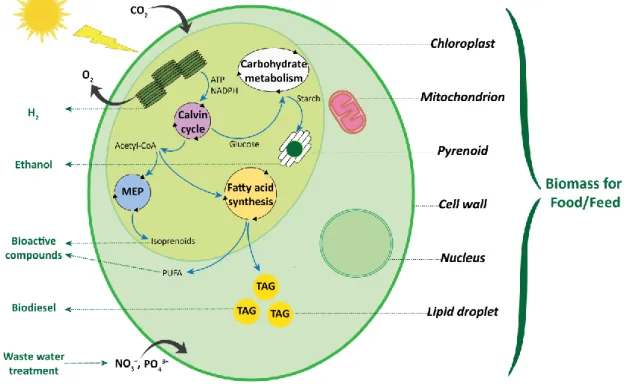
Microalgae are a polyphyletic group of photosynthetic unicellular eukaryotes (Dragone et al. 2010). These microorganisms have evolved and adapted to almost every known habitat, during evolution, which led to a biodiversity currently estimated in more than 50,000 species (Mata et al. 2010). Because of their wide biodiversity, microalgae display a wide variation in their biochemical profiles, which leads to a wide array of biotechnological applications, namely biofuels, bioremediation, pharmaceuticals, biomedical products, animal and human nutrition (Fig.1.1).
Figure 1.1. - Schematic representation of different metabolisms occurring inside a microalgal cell. TAG – triacylglycerol; MEP - methylerythritol phosphate pathway.
The interest in studying microalgal biomass for different biotechnological applications began long ago with the first works on the subject being published in the 19th century, such as those from Cohn (1850) and Famintzin (1871). At this stage, microalgal research was carried out under laboratorial conditions, focusing on a better understanding of their nutritional requirements and physiology. However, during the last decades, crucial developments in microalgal biotechnology allowed the cultivation of microalgae at a larger, commercial scale (Borowitzka, 2013).
2
The main commercial production of microalgae biomass was focused on animal and human nutrition due to their high content of protein and the presence of essential fatty acids and vitamins (Spolaore et al. 2006). Microalgae are indispensable for the aquaculture industry, as live feed, during the first stages of fish larvae rearing and bivalve culture. From the beginning of the 1960’s, microalgae such as Spirulina,
Dunaliella salina and Chlorella were commercially produced for human nutrition,
either for direct consumption or as food supplements (Spolaore et al. 2006).
In recent years, microalgae research trends were diverted to the development of different biofuels mainly because these organisms can be a source of lipids for biodiesel production, as first suggested in 1942 by Harder and von Witsch (Borowitzka, 2013).
1.2 Biodiesel
In recent years, microalgae have been purported as a promising feedstock for the production of biodiesel, which can be a potential solution to overcome the high demand for transportation fuels, triggered by the increasing world population and the high instability in the crude oil prices. Although other promising forms of renewable energy (e.g. wind, solar) can provide electricity to homes and industry currently, they cannot realistically provide the energy needed to be used by the heavy transportation sector (e.g. lorries, planes and ships), due to the low net mechanical propulsion energy when compared to those obtained by hydrocarbon-based fuels (Guzzella & Sciarretta, 2007; Amaro et. al. 2012). In this context, the production of lipid-based biofuels (e.g. biodiesel and biokerosene) from microalgae through a transesterification reaction is considered one of the most promising alternatives to fossil fuels in the medium term (Wijffels & Barbosa, 2010, Chisti, 2013).
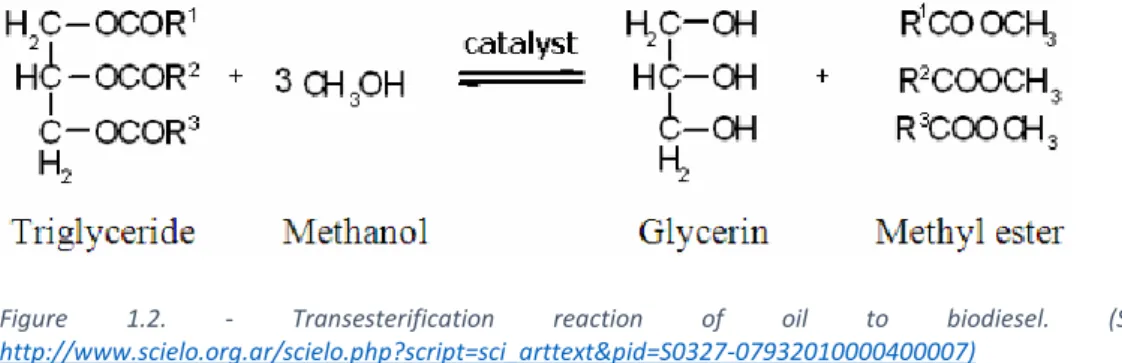
Biodiesel can be described as a mixture of mono-alkyl esters obtained from vegetable oils or animal fat (Knothe, 2013). Prior to the production of biodiesel from oil-rich feedstock, the extraction of the parental oil needs to be performed by means of mechanical and/or chemical methods. Afterwards, the oil fraction, mainly composed of triacylglycerols, is converted by a transesterification reaction to the corresponding methyl esters (biodiesel fraction), through the addition of an alcohol (e.g. methanol or ethanol) and a catalyst (Fig. 1.2). The transesterification reaction can be achieved using different catalysts, such as acids (e.g. H2SO4), alkalis (e.g. NaOH) or enzymes (e.g.
3
lipases). All catalysts present different advantages and disadvantages. For instance, alkali-based catalysts are the first choice in the biodiesel industry, as the reaction is 4000 times faster than acid-catalyzed transesterification (Chisti, 2007). However, acid-based transesterification presents a key advantage if moisture is present in the parent oil since the catalyst tolerates water without a significant effect on the reaction. On the other hand, in the presence of water, the alkali-based transesterification produces soap as a co-product, which is detrimental to the final yield of methyl esters. More recently, enzymatic-based transesterification resorting to lipases is considered to be a promising research line for the biodiesel sector due to the fast reaction and high tolerance to the presence of water. However, the current high costs of the enzymes make these catalysts the least viable option.
Figure 1.2. - Transesterification reaction of oil to biodiesel. (Source:
http://www.scielo.org.ar/scielo.php?script=sci_arttext&pid=S0327-07932010000400007)
The high potential of microalgal biomass for biofuel production derives from the high photosynthetic efficiency of these unicellular eukaryotes. This feature turns microalgae into a highly productive, renewable source of chemical energy.
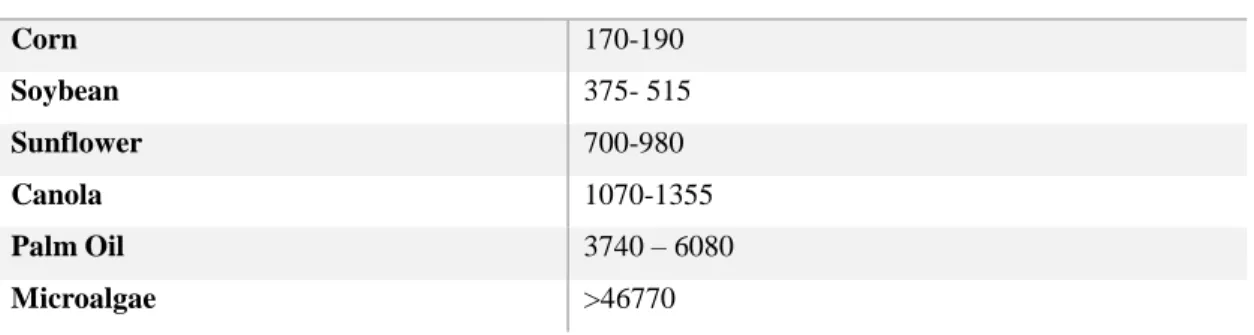
Furthermore, microalgae display several advantages, when compared to other potential sources of biodiesel, such as the crops represented in Table 1.1, which include the following:
• Present high oil yields (Table 1.1; Hoekman et al. 2012);
• Can be cultured in highly productive large-scale systems (Chisti, 2007); • Marine microalgae do not require arable land or freshwater (Chisti, 2007); • Have lower water consumption rates (Yen, 2012);
• Do not compete directly with the food industry (Singh et al. 2010);
• Manipulation of the culture conditions, namely specific stress conditions (e.g. nutrient depletion, salinity, pH and/or temperature) can increase the production and accumulation of target metabolites (Amaro, 2012);
4
• And can be exploited for high value compounds using a biorefinery approach (Yen, 2012).
Table 1.1 - Comparison of potential yields from different sources. Adapted from Hoekman et al. (2012).
Source Annual yield (L/ ha)
Corn 170-190 Soybean 375- 515 Sunflower 700-980 Canola 1070-1355 Palm Oil 3740 – 6080 Microalgae >46770
Although the production of biodiesel from microalgal biomass is technically feasible, the high costs of production are not competitive when compared to those of fossil fuels (Chisti, 2007). To overcome this problem of competiveness, several authors suggested the establishment of a biorefinery concept as promising route to lower the costs of production of microalgal-based biofuels through the enhancement of the final value of microalgal biomass.
1.3 Biorefinery
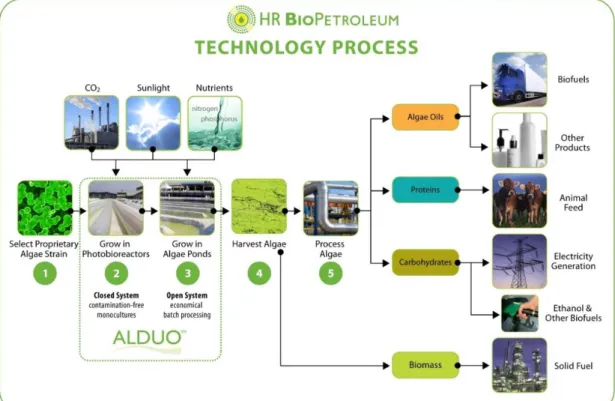
The biorefinery approach relies on the full exploitation of all biochemical components of microalgal biomass during the downstream processing of the biomass. In other words, all products (e.g. lipids, proteins, carbohydrates and bioactive compounds) that compose the biomass need to be exploited and used for different commercial purposes (Fig 1.3).
Currently, several downstream procedures have been proposed in the literature to implement an effective microalgal-based biorefinery, using different pipelines. For instance, after the extraction of the lipids and carbohydrates that are essentially used for the production of biofuels (biodiesel and bioethanol, respectively), the spent biomass can be used for human or animal nutrition, ultimately leading to lower final costs of produced biofuels (Chisti, 2007).
5
Figure 1.3 - Schematic representation of a biorefinery process. A strain of microalgae is selected and grown in a closed or open system depending on which will present a better costs-biomass yield relationship. The biomass is harvested and processed. The processing can entail different methods, depending on which algae constituents will better justify the cost of production. (Source: http://www.businesswire.com/news/home/20080715005538/en/HR-BioPetroleum-Alexander-Baldwin-Hawaiian-Electric-Maui).
Among other possibilities, previous studies have demonstrated that microalgae are a natural source of diverse high-value biological compounds (e.g. carotenoids, vitamins, polyunsaturated fatty acids) with different biological activities with potential application in the biomedical and pharmaceutical industries (Custódio et al. 2013; Li et
al. 2007). Therefore, these high-value compounds must be extracted during the
downstream processing as a source of added value compounds. This approach is currently considered as a promising research line to enhance the value of produced biomass under a biorefinery settling.
1.4 Bioactive Compounds
Bioactive compounds can be described as either primary or secondary metabolites, naturally produced by an organism, that display a given biological activity, which shows a positive effect on the recipient’s health (Biesalski et al. 2009). With the growing
6
occurrence of chronic diseases, such as cancer, and cardiovascular and neurodegenerative disorders, there is a need to implement new functional foods able to provide bioactive compounds capable of interference in the mechanisms that lead to these diseases (Ibañez et al. 2012).
As unicellular eukaryotes, microalgae display a set of features that combine the photosynthetic efficiency and simple nutritional needs of higher plants, as well as the fast growth rate and ability to accumulate bioactive metabolites of microbial cells (Custódio et al. 2012). Because of their high diversity and adaptation strategies, microalgae seem to be a viable source for these biomolecules that can act within the human body in order to counteract the causes of these diseases (Li et al. 2007).
Several microalgae strains are able to accumulate lipids that present a high market demand and commercial value (Martins et al. 2013). Strains rich in omega-3 fatty acids (e.g. eicosapentaenoic and docosahexaenoic acids) with known anti-inflammatory activity, as well as rich in carotenoids (e.g. lutein, astaxanthin and β-carotene) with antioxidant and anticancer properties were frequently reported. The accumulation of beta-glucans and phycobiliproteins with immuno-stimulatory properties by different microalgae strains has also gathered increasing attention over the years (Schulze et al. 2016). Moreover, recent reports demonstrated the antioxidant, metal chelating and neuroprotective capacity of different microalgae extracts for biomedical and pharmaceutical applications (Custódio et al., 2012, 2013; Li et al., 2007).
1.4.1 Antioxidant and Metal Chelating Activity
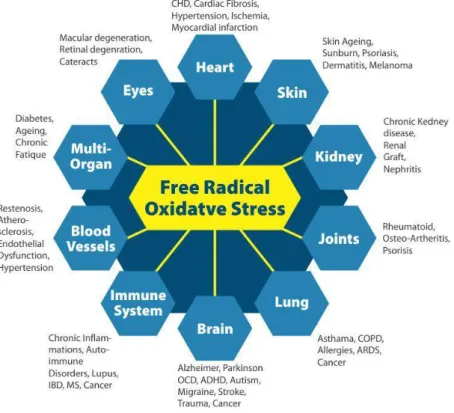
One of the most studied biological activities in microalgal biomass is the antioxidant potential, as natural sources of antioxidants are urgently needed to treat oxidative stress-related diseases (Fig 1.4).
Oxidative stress occurs when the balance between reactive oxygen species (ROS) and antioxidants, within the cell, is disrupted. This leads to the oxidation of an assortment of biomolecules, such as lipids, proteins and nucleic acids, eventually leading to severe cellular damage. Several diseases have been associated with oxidative stress, like coronary heart disease, cancer and neurodegenerative disorders (Li et al. 2006; Shieber & Chandel, 2014). ROS, including hydrogen peroxide (H2O2), radical
7
cellular metabolism. These molecules have chemical properties that confer them the ability to react with different biomolecules within the cell (Shieber & Chandel, 2014).
Figure 1.4 – Schematic representation of how free radical oxidative stress can affect several organs and systems of the human body. Even though multiple diseases have been associated with oxidative stress, such as diabetes, hypertension or cancer, here the main focus will be on neurological disorders, such as Alzheimer’s disease (Source: http://www.miltonchiropractic.com/protandim.html)
Different studies have shown an inverse correlation between fruit and vegetable intake, and the occurrence of chronic diseases associated with oxidative stress, which could be linked to the presence of antioxidant compounds in these foods (Li et al. 2007).
Antioxidants can be described as synthetic or natural compounds, which can interfere with oxidation reactions, either by full-on stop the initiation of the oxidizing chain or delaying the oxidation process (Velioglu et al. 1998). Commonly used synthetic antioxidants, such as butylated hydroxytoluene (BHT), were found to have carcinogenic potential in animal models, which reinforces the need to search for new sources of natural antioxidants that can be used safely and have low production costs (Velioglu et
al. 1998; Custódio et al. 2011). As previously stated, several natural antioxidants were
isolated from different microalgae strains, including phenolic compounds, carotenoids, fatty acids, vitamins, among others (Custódio et al. 2011; Plaza et al. 2009). The reactions depicted in Fig. 1.5 are an example of how the presence of transition metals, such as redox-active iron, can promote the formation of ROS. In the Fenton reaction
8
ferrous ion (Fe2+) reacts with H2O2, producing reactive hydroxyl radicals (•OH), which
enhances lipid peroxidation. This oxidative reaction takes place in the mitochondria (Liang et al. 2013). Because of the high concentration of lipids and unsaturated fatty acids, metal ions (Fe3+ and Cu2+) and low concentrations of antioxidant enzymes, the human brain becomes especially vulnerable to oxidative damage (Friedman et al. 2011).
Figure 1.5 - Hydroxyl radical formation through Fenton and Haber-Weiss reactions (Source: Liang et al 2013).
Transition metals, such as iron and copper, can act as catalysing agents in oxidative stress reactions. Therefore, metal chelating compounds are being considered as a possible course of therapy in neurodegenerative disorders (Custódio et al. 2011; Megías
et al. 2009).
1.4.2 Neuroprotective Activity
Degenerative neurological disorders are becoming a major concern health wise. More and more cases arise every day and there is still no clear path of action when it comes to prevention or treatment of these diseases. New sources of bioactive compounds are being studied worldwide in order to solve or even delay this problem.
Dementia can be described as a group of symptoms arising in association with a neurological disorder, which cause a decline in mental acuity that may interfere with daily actions. These symptoms include loss of cognitive function.
A common form of dementia in the elderly population is Alzheimer’s disease (AD). This disease is characterized by the formation of senile plaques, due to extracellular deposits of amyloid-β (Aβ) peptides; formation of intracellular neurofibrillary tangles, which are composed of paired helical filaments of hyperphosphorylated tau protein (Resende et al. 2008); and the loss of neuronal synapses and pyramidal neurons (Custódio et al. 2011).
9
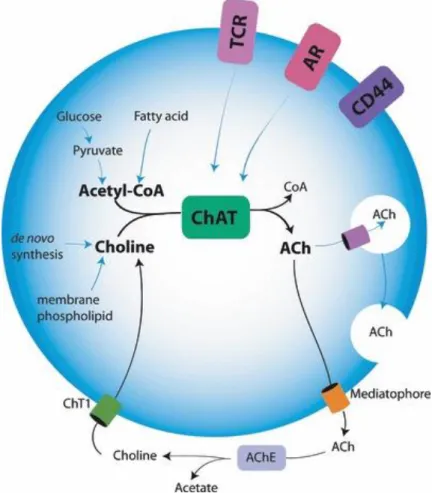
The relation between AD and the acetylcholine (ACh) metabolism is described by the “cholinergic hypothesis”, which states that the deposits of Aβ and tau protein have been connected to the loss of cholinergic neurons (Carvajal & Inestrosa, 2011). Therefore, if ACh levels are restored, the progression of AD might be delayed (Filho et
al. 2006).
Figure 1.6 - Schematic representation of acetylcholine (ACh) synthesis. The synthesis reaction is catalyzed by choline acetyltransferase (ChAT), using Acetyl CoA and choline as substrates. When present in the synaptic cleft ACh is hydrolyzed by acetylcholinesterase (AChE) and the resulting choline can be again used for ACh synthesis (Source: Olofsson et al.2012).
Acetylcholinesterase (AChE) has been regarded as the main enzyme responsible for the hydrolysis of the ACh neurotransmitter. This relatively selective enzyme can be found in all cholinergic structures and in a subpopulation of non-cholinergic neurons. Butyrylcholinesterase (BChE) enzyme is also capable of hydrolyzing ACh, although less substrate specific than AChE, and has been found in a subpopulation of cortical and subcortical neurons and in glia cells (Ciro et al. 2012).
Inhibition of both enzymes has demonstrated to be a viable course of action for the treatment of AD, delaying the loss of cognitive functions, through the interference in AD plaque maturation (Custódio et al. 2011; Giacobini 2003).
10 1.5 Tetraselmis sp. CTP4
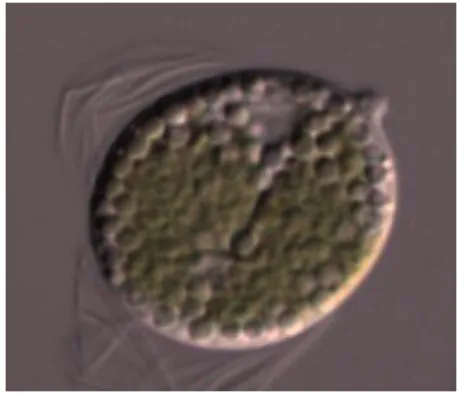
The microalgal strain used in this work was previously isolated by the MarBiotech group (CCMAR) from environmental water samples collected in the Ria Formosa (Algarve, Portugal), according to the method described in Pereira et al. (2011). This strain was named CTP4 (Fig 1.7) and classified as belonging to the Tetraselmis genus by means of 18S rDNA sequencing (Pereira et al. 2016).
Figure 1.7 - Tetraselmis CTP4.
Strain CTP4 has shown, in previous studies, potential features as a promising feedstock for the production of microalgae biomass and biodiesel. These studies demonstrated that CTP4 is a fast-growing and robust feedstock able to tolerate wide variations in the environmental culture conditions (e.g. temperature, light intensity and salinity), which is a key feature for commercial production using large-scale systems (Monteiro, 2014; Santos, 2014). Moreover, the capacity to accumulate up to 20% of its dry weight (DW) in lipids under non-inductive conditions, and up to 40% under stress conditions (induced by an increase in light intensity and nitrogen depletion), are highly desirable traits for biodiesel production (Santos, 2014)
11 2. Objectives
The main objective of this work plan is to develop an efficient downstream processing procedure for Tetraselmis sp. CTP4, comprising an efficient extraction procedure of lipids to be used as feedstock for biofuel production and of biomass fractions enriched in valuable bioactive compounds. The latter will be used to upgrade the final biomass value using a biorefinery approach.
To attain this major goal a series of specific objectives must be achieved: i) development of effective methods of lipid extraction from CTP4 wet biomass and conversion of the lipid fraction into biodiesel by transesterification; ii) evaluation of the biodiesel properties according to European standards (EN14214); iii) assessment of different bioactivities (antioxidant, metal chelating and neuroprotective activities) in raw biomass and in different streams of the established downstream process using in
12 3. Material and Methods
3.1 General Outlook
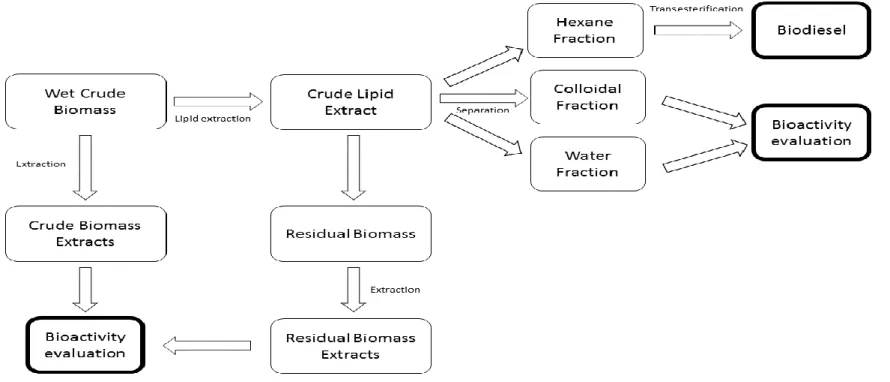
A workflow chart was created in order to determine how to reach a small scale biorefinery, so that the obtained biomass was used to a maximum, within the parameters of this work. As we can see in Fig. 3.1, both crude and spent biomass, along with two fractions of the lipidic extract (colloidal and aqueous), were used for several bioactivities screening, whereas the hexane fraction of the lipidic extract was transesterified to obtain biodiesel.
Figure 3.1. – Schematic representation of the work outlook. Extracts were obtained initially from the wet crude biomass. To extract lipids an ethanolic extraction was performed, whereas for bioactivity screening several solvents were used. The same solvents were used for extracts from the spent biomass. In bold are the final purposes of the processing.
13 3.2 Microalgae Growth
Microalgae cultures were grown in sterilized seawater (salinity 37) supplemented with a modified ALGAL culture medium (Pereira et al. 2011; Table 2.1). In order to inoculate 100-L plastic bags, a scale-up process was adopted. Cultures were transferred from a previously inoculated Petri dish with solid medium to a 100 mL Erlenmeyer with liquid medium, and were grown on an orbital shaker at room temperature under continuous lighting (100 μmol m-2 s-1) for 7 days.
Afterwards cultures were further transferred to 5 L plastic bottles, with similar culture conditions as before, the difference being that culture agitation was achieved through constant aeration. An initial concentration of 1.5 × 10⁴ cells mL-1 was used.
The microalgae were grown for another 10 days before the culture was transferred to the final setting in 100 L plastic bags, where the inoculum added had a concentration of 2 × 10⁴ cells mL-1.
Table 2.1 - Composition of stock modified [x1000 concentrated] ALGAL medium.
Reagents Concentration Units
Macronutrient solution NaNO3 2 M KH2PO4 100 mM Micronutrient solution EDTA-Na 6,4 mM ZnCl2 1 mM ZnSO4.H2O 1 mM MgCl2.4H2O 1 mM Na2MoO4.2H2O 0.1 mM CoCl2.6H2O 0.1 mM CuSO4.5H2O 0.1 mM MgSO4.7H2O 2 mM Iron Solution FeCL3.6H2O 20 mM EDTA-Na 20 mM
14
As the selected microalgal strain settles naturally, harvest was performed by shutting down the air source for 24 h to allow culture sedimentation. After biomass settling, the supernatant (culture medium) was removed (90%) and the remaining culture centrifuged at 2000 g for 20 minutes (Beckman Coulter Avanti J-25 High-Performance) and stored at -20 oC until further use.
Figure 3.2 - 100L plastic bags with Tetraselmis sp. CTP4 inoculate.
3.3 Growth Assessment
The growth performance of cultures was assessed every two days by the determination of optical density (OD) and dry weight (DW).
Using 2 mL of culture retrieved from the bags, the OD was measured at a wavelength of 540 nm and 750 nm using a 96-well microplate reader (Biotek Synergy 4). The results presented were determined by subtracting the OD value of the sample by the OD value of a blank containing sterilized seawater.
For DW determination, 0.7 μm microglass fiber filters (VWR) were previously washed with 5% ammonium formate (37 g/L) and weighed. Afterwards, 10 mL of
15
culture were filtered with the aforementioned filters using a Buchner funnel and further washed with ammonium formate, in order to remove the salt that could be retained in the filter, without causing cell disruption. The biomass retained in the filter was further dried for 48 h at 50°C until a constant weight was achieved.
3.4 Downstream Processing of Wet Biomass into Biodiesel 3.4.1 Lipid Extraction
Lipids were extracted using a modified protocol of the procedure described by Yang et al. (2014). Briefly, 300 g of wet microalgal paste were mixed with 500 mL of absolute ethanol at reflux temperature for 2 h (Fig. 3.1). Afterwards, the lipid fraction was separated from the spent algae cake by centrifugation at 2000 g for 5 min (Beckman Coulter Avanti J-25 High-Performance). The spent algae cake was further extracted under the aforementioned conditions twice for 30 and 15 minutes, respectively. Upon extraction the different fractions were pooled together and filtered under vacuum to remove any spent biomass from the mixture. The mixture of ethanol and water was removed using a rotatory evaporator (IKA, RV10 digital, Germany) at 40ºC under reduced pressure. The spent biomass was dried and used for bioactivities screening.
Figure 3.3 - Lipid extraction experimental setup. Wet microalgal biomass and ethanol were added to round bottom flasks, partially submerged in a paraffin bath, maintained at reflux temperature (~70 °C) and stirred for three different periods with the following durations: 2 h, 30 min and 15 min.
16 3.4.2 Separation of Lipid Fraction from Polar Compounds
To obtain different streams from the crude lipid extract, an effective downstream procedure was established. The dried crude lipids obtained in the previous section were dispersed in a mixture of hexane and water (1:1; v/v) and vortexed vigorously to enable a complete solubilisation of the compounds present in the crude extract. Afterwards, the mixture was transferred to 50 mL Falcon tubes and further vortexed for 1 minute. Phase separation was achieved by centrifugation at 5000g for 10 minutes (ThermoScientific Megafuge 16 R). At this stage, three distinct phases can be clearly observed (Fig. 3.2): i) hexane fraction, ii) colloidal fraction and iii) water fraction. The colloidal fraction was separated by filtration under vacuum using 1.2-μm high-rate fibre filters (VWR) and later dissolved in chloroform. The hexane and water fractions were separated using a separating funnel and collected to a clean Erlenmeyer. All fractions were evaporated until dryness, the yields were registered and, the colloidal and water fractions were further dissolved in DMSO for the evaluation of the bioactivities.
Figure 3.4 - Three phases were obtained, through liquid-liquid separation (hexane and water) of the crude lipid extract. Near the top of the Falcon tube, one can see the hexane fraction. The colloidal fraction and the water fraction can be observed in the middle and at the bottom, respectively.
17 3.4.3 Biodiesel preparation and purification
Biodiesel was prepared using a modified protocol of the procedure described in Lam & Lee (2013). Briefly, the dried hexane fraction was mixed with methanol and tetrahydrofuran (THF; 4:1, v/v). Upon homogenization, sulphuric acid (2% H2SO4 in
methanol) was added to the mixture in 1-L round bottom flasks and stirred at reflux temperature for 3 h. After the transesterification reaction was complete, the solvents were evaporated and the residue was extracted with hexane four sequential times. The acid was neutralized through the addition of water in a separating funnel (4x). Afterwards, anhydrous sodium sulphate was added to remove the water contents in the solution, and then removed through filtration. The filtered extract was evaporated, to remove the remaining solvent. The biodiesel obtained here is further referred as crude biodiesel.
Biodiesel purification was performed in accordance with the methods described in Peña et al. (2014), using bentonite for adsorption of free glycerine that might still be present. A ratio of 2:1 w/w bentonite/crude biodiesel was used in this method.
Briefly, 1g of crude biodiesel was dissolved in 10 mL of hexane-diethyl ether 99%, after which, 2g of bentonite were added. Upon a 24h-incubation at 40ºC, with stirring, the bentonite was separated from the biodiesel by centrifugation and the solid phase was washed with 5 mL of hexane-diethyl ether 99%. A second step of centrifugation was performed and the liquid phase was added to the biodiesel already separated, and further referred as purified biodiesel. This process was carried out in order to determine how purification affects the biodiesel properties.
3.4.4 Evaluation of Biodiesel Properties
In order to determine if the produced biodiesel was within the values described in the EN14124 and ASTM D6751 norms, several methods were performed. Fatty acids methyl esters (FAME) profile was obtained by means of gas chromatography coupled with mass spectrometry (GC-MS; Agilent 6890 Network GC System, 5973 Inert Mass Selective Detector), as described in Gangadhar et al. (2015). Separation of the compounds was achieved by using a temperature program set to maintain the oven temperature at 60 ºC for 1 minute, followed by a 30 ºC min-1 increase until 120 ºC, a 5 ºC min-1 increase to 250 ºC, and a 20 ºC min-1 increase to 300 ºC, which was maintained
18
for 2 min. Helium was used as a carrier gas and a 300ºC temperature was set for the injector and detector. Supelco 37 Component FAME Mix (Sigma-Aldrich) was used as a standard for retention time comparison.
From the data obtained, the following parameters were estimated: 1) FAME content (% m/m);
2) cetane number (CN);
3) iodine value (g iodine/100g); 4) linoleic acid (% m/m);
5) PUFA with 4 or more double bonds; and 6) cold filter plugging point (CFPP); 7) High heating value (HHV).
The CN number was calculated as described in Knothe (2014), using the following equation:
𝐶𝑁𝑚𝑖𝑥 = ∑ 𝐴𝑐×𝐶𝑁𝑐 ;
Where CNc is the cetane number of each fatty acid methyl ester constituent of the
mixture, and Ac their relative amount.
Long chain saturated factor (LCSF) was calculated in order to determine the CFPP, as proposed by Ramos et al. (2009), using the following equations:
𝐿𝐶𝑆𝐹 = (0.1×𝐶16) + (0.5×𝐶18) + (1×𝐶20) + (1.5×𝐶22) + (2×𝐶24) 𝐶𝐹𝑃𝑃 = 3.1417×𝐿𝐶𝑆𝐹 − 16.477
The iodine value was calculated as described in EN14214, being the sum of the individual contributions of each methyl ester obtained by multiplying the methyl ester percentage by its respective factor.
Biodiesel density was measured using a pycnometer and its kinematic viscosity was determined with a viscometer, following the EN14214 specifications.
The HHV was estimated through a group contribution method (GC), where the heat of combustion of an organic compound containing only carbon, hydrogen and oxygen is the energy released when the compound is completely converted into CO2 and H2O
19 3.5 Evaluation of Bioactivities
3.5.1 Preparation of the extracts
Extracts were obtained from 2 different sources: crude and spent biomass. Evaluation of bioactivities was also performed on extracts obtained during the lipid extraction described above, i.e., the colloidal (CP) and water phases (WL).
Two grams of wet biomass were added to 80 mL of the selected solvents with different polarities (hexane, ethyl acetate, acetone, ethanol and distilled water). Homogenization was achieved by means of a disperser IKA T10B Ultra-Turrax. Extraction occurred overnight at room temperature.
The resulting solutions were filtered using 0.7-μm pore glass fibre filters (VWR), and evaporated in a rotatory evaporator (IKA, RV10 digital, Germany) at 40ºC under reduced pressure. Extracts were resuspended in DMSO and stored at -20ºC.
The same procedure was used for lyophilized spent biomass, obtained after lipid extraction, changing only the initial quantities, i.e., 1 g of spent biomass for 40 mL of solvent.
3.5.2 Radical Scavenging Activity (RSA)
Radical scavenging activity (RSA) was evaluated by the 1,1-Diphenyl-2-picrylhydrazyl (DPPH) and 2,2′-Azino-bis (3-Ethylbenzothiazoline-6-sulphonic Acid) (ABTS) methods. The DPPH assay was determined using the method described by Moreno et al. (2006) with modifications. Extracts (22 μL) were mixed with 200 μL of methanolic DPPH solution (120 μM) in 96-well microplates. After a 30-min incubation period in the dark, the absorbance was measured at 515 nm (Biotek Synergy 4).
The ABTS assay was determined using the method described by Re et al. (1999). A stock solution of ABTS•+ (7.4 mM) was prepared in potassium persulfate (2.6 mM), and left in the dark for 12-16 h at room temperature. In order to obtain an absorbance of 0.7 at 734 nm, the ABTS•+ solution was then diluted with ethanol. The samples (10 μL) were mixed with 190 μL of ABTS•+ solution in 96-well microplates, and after a 6-min
incubation period the absorbance was measured at 734 nm (Biotek Synergy 4).
For both procedures, the RSA was calculated as the percentage inhibition relative to a blank containing DMSO in place of the samples, using the following equation:
20
% 𝑖𝑛ℎ𝑖𝑏𝑖𝑡𝑖𝑜𝑛 =𝐴𝑏𝑠𝑛𝑒𝑔.𝑐𝑜𝑛𝑡𝑟𝑜𝑙− 𝐴𝑏𝑠𝑡𝑒𝑠𝑡 𝑠𝑎𝑚𝑝𝑙𝑒
𝐴𝑏𝑠𝑛𝑒𝑔.𝑐𝑜𝑛𝑡𝑟𝑜𝑙 ×100,
Where
𝐴𝑏𝑠𝑡𝑒𝑠𝑡 𝑠𝑎𝑚𝑝𝑙𝑒 = 𝐴𝑏𝑠𝑡𝑒𝑠𝑡 𝑠𝑜𝑙𝑢𝑡𝑖𝑜𝑛− 𝐴𝑏𝑠𝑐𝑜𝑙𝑜𝑟 𝑐𝑜𝑛𝑡𝑟𝑜𝑙.
Butylated hydroxytoluene (BHT, 1 mg/mL) was used as a positive control in both assays.
3.5.3 Metal Chelating Activity
Two different metal chelating activities were tested, Fe and Cu, according to the method described in Megías et al. (2009). Cu chelating activity (CCA) was measured by mixing the samples (30 μL) with 200 μL of sodium acetate buffer (50 mM; pH 6,0), 6 μL of pyrocatechol violet (4 mM) and 100 μL of CuSO4 (50 μg/mL), in 96-well
microplates. The reaction was then measured spectrophotometrically in a microplate reader (Biotek Synergy 4) at 632 nm.
As for the Fe chelating activity (ICA), 30 μL of microalgal extract were mixed with 200 μL of destilled water (dH2O) and 30 μL of aqueous FeCl2 solution (0.1 mg/mL) in
96-well microplates. After a 30-min incubation period, 12.5 μL of ferrozine (40 mM) was added. The reaction was then measured by a microplate reader (Biotek Synergy 4) at 562 nm.
For both assays, the inhibition was determined relative to a blank containing DMSO, in place of the sample, using the same equation as the aforementioned assays.
Ethylenediamine tetraacetic acid (EDTA) was used as a positive control at a concentration of 1 mg/mL.
3.5.4 Acetylcholinesterase and Butyrylcholinesterase Inhibitory Activity Inhibition of AChE and BChE activity by microalgal extracts was measured by the colourimetric method described by Orhan et al. (2007). Extracts (20 μL) were mixed with 140 μL of sodium phosphate buffer (0.1 mM; pH 8), 20 μL of the selected cholinesterase (AChE/BChE; 0.28 U/mL) and incubated for 15 min at 25 oC.
Afterwards, 10 μL of acetylthiocholine iodine/ butyrylthiocholine chloride (4 mg/mL) and 20 μL of 5,5'-dithiobis-(2-nitrobenzoic acid) (1.2 mg/ml) were added.
21
The formation of the 5-thio-2-nitrobenzoate anion was detected at 412 nm using a microplate reader (Biotek Synergy 4). Results were expressed as the AChE/BChE inhibition percentage relative to a control containing the solvent used in the extraction. Eserine (0.1 mM solution in phosphate buffer) was chosen as a positive control due to its capacity to inhibit both cholinesterases equally (Orhan et al., 2009; Gholamhoseinian
et al., 2009; Vinutha et al., 2007).
3.5.5 Statistical Analysis
All the bioactivity assays were done thrice and the results were expressed as mean ± standard deviation, in both samples and controls. Significant differences between samples were assessed by analysis of variance (ANOVA) using Duncan’s new multiple range test (p < 0.05). STATISTICA10 (DELL Corporation).
IC50 values were estimated with GraphPad Prism v.5.0, by sigmoidal fitting of the
22 4. Results and Discussion
4.1 Culture growth
The first stage of this work encompassed the growth of the necessary biomass to carry out the desired experimental design. The OD was measured at two different wavelengths, 540 nm and 750 nm, both outside of the absorbance spectrum of the main chlorophyll pigments. The presence of these pigments can result in significant changes in the correlation between the OD and the biomass, due to possible fluctuations of concentration within the cell, as well as their presence increases the attenuation coefficients (Myers et al., 2013). Below are only represented the values obtained for 750 nm since it proved to correlate better with the DW values. The relationship between these two is species-dependent, since it can vary with characteristics such as the presence of different pigments and cell shape and size. Although DW is a viable procedure for growth monitoring, it takes time and resources that can be minimized by the use of OD measurements. Therefore, a calibration curve was established between both procedures.
Figure 4.1 - Correlation between dry weight (DW) and optical density (OD) measured at 750 nm. Two correlations were established: ● - Data obtained until day 18 (p<0.0001); ○ – Data obtained from day 20 until the end (p<0.0005).
23
Figure 4.1 demonstrates two linear relationships between the two growth parameters, which can be calculated through the following equations:
𝐷𝑊 (𝑔. 𝐿−1) = 𝑂𝐷750
0.53598− 0.0128 (1)
𝐷𝑊 (𝑔. 𝐿−1) = 𝑂𝐷750
0.0036− 0.0002 (2)
Equation (1) correlates the two parameters from the 3rd day, when the exponential phase started, until the 18th day of culture, when the DW started to increase at a rate that was not followed by the OD as before, probably due to the accumulation of fatty acids and secondary metabolites when the culture reached a stationary phase. Therefore a new calibration curve was estimated from the 20th day forward, represented by equation (2).
Looking at Fig. 4.2, we can observe a pattern of microalgal growth, starting with a lag phase, which was observed until the 3rd day. This phase is characterized by a drop
in the biomass concentration, probably due to adaptation to the new growth conditions. The exponential phase started at day 3, with a lower growth rate between the 8th and 14th days. At day 18 a drop in biomass was observed, possibly due to a bigger temperature fluctuation, since the culture room was not climate-controlled. The biomass recovered from each individual plastic bag was around 70 g.
Figure 4.2 - Growth curve obtained from dry weight (DW), using the data from one of the samples collected from one of the 100 L plastic bags..
24 4.2 Lipid extraction
The biomass from CTP4 obtained showed a lipid yield of 23.7% (m/m), which was determined through an ethanolic extraction of the lipids. However, not all lipids are desirable for biodiesel production. Biodiesel production through transesterification relies on the presence of triacylglycerols (TAG), which are neutral lipids.
In order to separate the neutral lipids from the polar ones, hexane (non-polar) and water (polar) were added to the crude lipid extract. Afterwards three phases were formed:
• Hexane phase (48.9%, m/m), which was further used for biodiesel purposes; • Colloidal phase (16.9%, m/m), which was screened for bioactivities;
• Water phase (34.1%, m/m), which was also screened for bioactivities. The hexane phase was transesterified to obtain crude biodiesel (CB). Afterwards, 1 g of CB was purified to determine the possible benefits in terms of the final properties.
4.3 Biochemical characterization of produced biodiesel 4.3.1 Fatty acid methyl esters (FAME) profile
Biodiesel samples were analysed through GC-MS in order to determine FAME composition in terms of total fatty acids (Table 4.1). Both crude (CB) and purified (PB) biodiesel had palmitic (C16:0), oleic (C18:1 Z) and linoleic (C18:2) acids as the main FAME detected. Palmitic acid usually represents the highest proportion in the fatty acid profile of several microalgae, as it was reported by Talebi (2010), including Dunaliella
salina, Chlorella vulgaris and Scenedesmus sp.. However, oleic and linoleic acids are
more commonly found in higher proportions in soy and canola oils (Talebi et al. 2013).
Regarding the saturation of the fatty acid profile, both samples showed a high content of polyunsaturated fatty acids (PUFA), 44.4% for CB and 50.2% for PB. The sum of saturated (SFA) and monounsaturated fatty acids (MUFA) accounted for the remaining 55.6 and 49.8%, respectively.
25
Table 4.1 - Fatty acid profile of crude (CB) and purified (BP) biodiesel synthetized from CTP4 biomass.
FAME Crude biodiesel (%) Purified biodiesel (%)
C16:0 14.1 15.9 ∑ (SFA) 14.1 15.9 C16:1 8.78 10.3 C18:1 32.7 23.6 ∑ (MUFA) 41.5 33.9 C16:2 5.01 4.90 C18:2 25.8 31.0 C16:3 9.33 10.7 C18:3 4.32 3.61 ∑ (PUFA) 44.4 50.2 4.3.2 Biodiesel Properties
The standard protocols described in the EN 14214 were used to determine biodiesel properties (Table 4.2). The total FAME contents were very similar between CB and PB (98.86 and 98.68%, respectively), both displaying values higher than the minimum established in the European regulation (≥96.5%).
The iodine value determines the level of fatty acid unsaturation in the biodiesel and is expressed in grams of iodine needed to react with 100 g of biodiesel, when iodine is added to the double bonds (Ramos et al., 2009). Unsaturated fatty acids are more prone to oxidation, especially those containing bis-allylic CH2 positions between two double
bonds (Knothe, 2013). Therefore, the higher the iodine value, the lower the oxidative stability of the fuel (Karpagam et al 2015). CB fatty acid composition had lower contents of PUFA (44.4%), which corresponded to a lower iodine value (113.81 g I/100 g). This
result is in accordance with the EN 14214 specification, which mandates an iodine value ≤ 120.0 g I/100 g. PB iodine value did not fall within the established limits (133.27 g I/100 g), although it was not far apart.
A linear correlation has been established between the level of unsaturation and the density of the biodiesel (Knothe, 2005). Since CB had a lower iodine value, the density of this sample was also lower than that determined for the PB sample (822 and 851
26
kg.m-3, respectively). Both samples were lower than the limit values stipulated in the EN14214 (860-900 kg.m-3).
Viscosity indicates the ability of the fuel to flow in the engine, hence determining whether deposits in the engine are formed (Gangadhar et al. 2015). The results for CB (1.8 cSt) were lower than those of both EN14214 and ASTM D6751 specifications. PB viscosity (2.6 cST) was closer to the minimum specified in the EN14241 regulation and within the limits defined by the ASTM D6751 regulation.However, a high viscosity presents more problems in terms of fuel atomization in the engine’s combustion chamber than a low viscosity, thus there is no apparent reason for the minimum value established, especially since this limit is above the one defined for most petrodiesel fuels (Knothe, 2013).
Cetane number (CN) is directly related to the combustion quality of the fuel and easy start of the engine, i.e, the higher the CN the higher the ignition quality of the biodiesel. CN is, as a concept, similar to the octane number in petrol, and therefore, an important property to be assessed in terms of diesel quality (Karpagam et al. 2015; Knothe 2005). CB showed a higher CN (49.3) and was close to the minimum defined in the European normative. PB was lower (46.0) and closer to the minimum defined by the American standard. This can be explained by the higher percentage of PUFA in the PB fatty acid profile, since the CN increases with chain length and saturation (Knothe 2005). Even though both biodiesel samples had a relatively low CN, additives, known as cetane number improvers, can be used in future works to solve this question as suggested in Ruina et al. (2014).
High PUFA content feedstock are more susceptible to oxidation, a detrimental property for the final quality of biodiesel, but show better low temperature properties, meaning that biodiesel rich in PUFA will present a better performance at ambient temperatures (Hu et al. 2008). Cold filter plugging point (CFPP) relates to the cold flow properties of the biodiesel, and represents the temperature at which the biodiesel plugs 0.45 μm filters. CB presented a higher CFPP value, most probably due to the lower percentage of SFAs. Short chain SFAs have lower melting points, and their presence accounts for lower CFPP values. Therefore, CFPP depends on the amount and chain length of SFAs (Gangadhar et al., 2015).
27
The high heating value (HHV) is the standard measure of the energy content of a fuel, which will determine its efficiency (Fassinou et al. 2011). It has been estimated that due to the oxygen content in its components, independently of the biomass chosen, the HHV of biodiesel is about 10% lower than that of petrodiesel, ranging between 39 and 41 MJ.kg-1 (Demirbas 2008; Gangadhar et al., 2015). HHV estimation was done using a group contribution model described in the literature as most accurate (Levine et
al., 2014). HHV values of both CB and PB were very similar to all the HHV of other
sources of biodiesel when the same method was applied, although somewhat different when compared to the values obtained through calorimetric determination.
From the data obtained it is possible to see that the purification process improved the density and viscosity of the biodiesel. However, properties such as CN and iodine value were made worse.
When compared to other sources of algal biodiesel, such as P. tricornutum, N.
oculata and Tetraselmis sp., whose properties were determined in Gangadhar et al.
2015, we can conclude that the main differences occur in terms of the density and viscosity, which were lower. The PB values for these properties came closer to those of
P. tricornutum (863 kg.m-3; 2.95 cST). However, the cetane number of CB was the highest of all the samples here mentioned.
Table 4.2 - Biodiesel properties analysed from the biodiesel produced. Limit values from EN 14214 and ASTM D6751 standards, also shown. a) country specific.
Biodiesel Properties Units CB PB EN 14214 ASTM
D6751
FAME content % mass 98.9 98.7 ≥96.5 -
Density (15ºC) kg.m-3 822 851 860 - 900 - Viscosity (40ºC) mm2.s-1 1.84 2.64 3.5 - 5.0 1.9 - 6.0
Cetane Number - 49.3 46.0 ≥51 ≥47
Iodine Value g I/100 g 114 133 ≤120.0 -
Linoleic acid % mass 3.73 3.61 ≤12.0 -
PUFA ≥4 db % mass 0.00 0.00 ≤1.0 -
CFPP oC -9.27 -11.5 a) -
28 4.4 Evaluation of Bioactivities
In order to improve the economic feasibility of biodiesel production, a screen for bioactive compounds was performed. Extracts from three stages of the process were analysed:
• Crude biomass, obtained directly from the microalgal culture; • Spent biomass, retrieved and dried after the lipid extraction;
• Colloidal and water phases, obtained during the separation of the lipid crude extract from the polar compounds, henceforth referred as streams when mentioned as a group.
The yields for the crude and spent biomass extracts are represented below in Table 4.3, as the yields for the streams extracts are presented in section 4.2.
Different compounds can be extracted with different solvents. Therefore, a total of five solvents were used, each with a different polarity. An increase in polarity resulted in a higher yield, i.e. higher yields were obtained using ethanol and distilled water.
Table 4.3 - Yields of the extracts from crude and spent biomass.
Source Extract Yield (%)
Crude Biomass Hexane HX1 5.48
Ethyl Acetate EA2 8.07
Acetone AC3 9.19 Ethanol ET4 19.9 dH2O DW5 36.2 Total 78.9
Spent Biomass Hexane HX6 1.42
Ethyl Acetate EA7 3.48
Acetone AC8 5.91 Ethanol ET9 7.51 dH2O DW10 11.3 Total 29.6
29 4.4.1 Antioxidant activity
The antioxidant capacities of the extracts were evaluated by two different assays, one measuring RSA on DPPH radical and the other on ABTS radical. Three different concentrations were tested (1, 5 and 10 mg/mL) and all extracts showed a dose- dependent response, except the aqueous extracts of both crude and spent biomass (Table 4.4).
Regarding the DPPH assay, the most promising extract from the crude biomass was ethyl acetate (EA2) with a RSA of 66.8% at a concentration of 5 mg/mL against a control using DMSO. This value was similar to that of the acetone (AC3; 65.1%) and ethanol (ET4; 51.5%) extracts at a concentration of 10 mg/mL, all significantly higher than all others at the same concentration (p < 0.05). Regarding the spent biomass extracts, although they followed the same pattern, in terms of solvent vis-à-vis activity, the general results were lower than those of crude biomass, excluding the ethyl acetate extract (EA7) which showed similarity with AC3 and ET4 at the concentration of 10 mg/mL (p > 0.05).
The extracts obtained from the streams showed lower activities than those obtained directly from the biomass. Specifically, the colloidal phase (CP) showed a maximum RSA of 37.6% at the highest concentration tested (10 mg/mL), comparable to the results observed for HX1 and ET9 (p > 0.05); whereas the water layer (WL) showed no activity at all. None of the aforementioned extracts showed a similar activity to that of the control compound BHT.
In the ABTS assay, the general activity of the different extracts was higher. The highest inhibition was obtained with the ethyl acetate and ethanol extracts. Both crude and spent biomass came closer together. EA2 and EA7 had RSAs of 94.5 and 94.7%, respectively, at a concentration of 5 mg/mL, whereas ET4 and ET9 had RSAs of 96.2 and 95.4%, at the same concentration. AC3 also showed a high RSA (95.1%) at the previously mentioned concentration. All the extracts mentioned above had statistical similarities. Although AC7 showed similar values (99.6%), it only did so at a concentration of 10 mg/mL. Hexane and water extracts showed little activity in both assays.
30
Table 4.4 - Radical Scavenging Activity (RSA) on DPPH and ABTS free radicals of Tetraselmis sp. CTP4 extracts, using different solvents, applied at three concentrations (1; 5; & 10 mg/mL). n.a – no activity detected. Different letters following the values represent significant differences at p < 0.05 (one-way ANOVA, Duncan’s Multiple Range Test).
Source/Extract DPPH ABTS 1 mg/ml 5 mg/ml 10 mg/ml 1 mg/ml 5 mg/ml 10 mg/ml Crude biomass Hexane n.a. 14.0 ± 1.23b 31.3 ± 2.19a 6.98 ± 2.85c 33.4 ± 7.43b 54.7 ± 5.08a Ethyl Acetate 4.43 ± 0.47b 66.8 ± 1.43a n.d 42.9 ± 4.16b 94.5 ± 2.79a n.d Acetone 10.1 ± 2.58c 43.7 ± 2.11b 65.1 ± 12.2a 44.0 ± 1.95b 95.1 ± 4.17a n.d Ethanol 13.3 ± 1.88c 35.2 ± 0.61b 51.5 ± 3.54a 32.0 ± 1.61b 96.2 ± 3.02a n.d dH2O n.a 8.26 ± 2.75b 20.3 ± 1.12a 10.8 ± 4.95c 19.5 ± 4.49b 45.4 ± 3.61a Spent biomass
Hexane n.a n.a 1.95 ± 0.72 n.a 5.48 ± 1.14a 9.58 ± 3.21a
Ethyl Acetate 9.68 ± 3.28c 27.3 ± 3.12b 55.6 ± 9.68a 35.6 ± 4.08b 94.7 ± 0.95a n.d Acetone 10.1 ± 4.0c 33.8 ± 1.86b 48.2 ± 7.06a 30.2 ± 5.38c 73.8 ± 3.29b 99.6 ± 2.61a Ethanol n.a 15.6 ± 2.32b 37.5 ± 3.9a 34.6 ± 3.25b 95.2 ± 2.02a n.d dH2O 3.54 ± 1.79 n.a 2.36 ± 0.45 7.39 ± 3.61a 10.1 ± 1.23a 10.8 ± 0.35a Streams Colloidal Phase 1.02 ± 5.67c 16.0 ± 4.48b 37.6 ± 8.42a 39.0 ± 1.21b 91.8 ± 5.04a n.d
Water Layer n.a n.a. n.a. 10.9 ± 1.09b 20.1 ± 1.51a 24.5 ± 0.75a

![Table 2.1 - Composition of stock modified [x1000 concentrated] ALGAL medium.](https://thumb-eu.123doks.com/thumbv2/123dok_br/18627359.910797/25.892.264.629.602.1026/table-composition-stock-modified-x-concentrated-algal-medium.webp)