Experiencing emotional and psychosocial support
during preparation for re-integration:
A study of street children under the care of
Retrak Uganda
Paria Eslaminejad
Erasmus Mundus Master’s Programme in Social Work
with Families and Children
Thesis Supervisor:
Dr. Eddy J. Walakira
Department of Social Work and Social Administration School of
Social Sciences
Makerere University- Kampala, Uganda
TABLE OF CONTENTS
ACRONYMS ... V ABSTRACT ... VI LIST OF TABLES ... VII LIST OF ILLUSTRATIONS ... VIII
CHAPTER I ... 1
INTRODUCTION ... 1
1.1 BACKGROUND TO THE STUDY ... 1
1.2 PROBLEM STATEMENT ... 2
1.3 GENERAL AND SPECIFIC OBJECTIVES ... 4
1.4 RESEARCH QUESTION ... 5
1.5 SCOPE OF THE STUDY ... 5
1.6 JUSTIFICATION ... 6
1.7 ISSUES OF THE STUDY ... 6
1.8 THEORETICAL FRAMEWORK ... 7
1.8.1 Humanistic Approach ... 7
1.8.2 Rogers Humanistic Theory of Personality ... 8
1.8.3 Attachment Theory ... 13
LITERATURE REVIEW ... 16
2.1. DEFINING ‘STREET CHILDREN’... 16
2.1.1. The controversial term “Street Children” ... 17
2.2. STREET CHILDREN IN UGANDA ... 17
2.2.1 Estimating the Numbers ... 17
2.2.2 Push & Pull factors ... 18
2.3 STREET LIFE ... 19
2.4. UGANDA’S NATIONAL QUALITY STANDARDS FOR VULNERABLE CHILDREN ... 20
2.4.1 National Framework for Alternative care ... 20
2.4.2 National orphans and other vulnerable children policy (NOP) ... 23
2.4.3 National strategic programme plan of interventions for orphans and other vulnerable children (NSPPI- 2)... 23
2.4.4 Family Reintegration Standard Operating Procedures (SOPs) ... 24
2.5 INTERVENTION PROGRAMS FOR STREET CHILDREN ... 25
2.5.1 Classification of programs for Street Children ... 25
2.5.2 Models of Intervention ... 26
2.6 REQUIREMENTS FOR A SUCCESSFUL INTERVENTION ... 27
2.6.1 Time ... 27
2.6.2 Trust relationship... 27
2.6.3 Therapeutic relationship ... 28
2.7 EMOTIONAL & PSYCHOSOCIAL DEVELOPMENT OF CHILDREN ... 29
2.7.1 Defining Emotions ... 29
2.7.2 Emotional Development of Children ... 30
2.7.3 Psychosocial Development of Children ... 31
iii
2.9.1 Emotional support ... 32
2.9.2 ‘Professional Relationship’ between Children and Caregiver... 33
2.9.3 Psychosocial Support ... 33
CHAPTER III ... 35
METHODOLOGY ... 35
3.1 DESCRIPTION OF THE STUDY ORGANIZATION ... 35
3.2 DESCRIPTION OF THE RESEARCH DESIGN ... 36
3.3 STUDY PARTICIPANTS AND SAMPLE SELECTION PROCEDURES ... 36
3.4 DATA COLLECTION (SOURCES, METHODS) ... 37
3.4.1. Focus Group Discussions ... 37
3.4.2 In-depth interviews... 39
3.4.3 Key-informant interviews ... 39
3.5 DATA MANAGEMENT AND ANALYSIS ... 40
3.6 ETHICAL ISSUES AND HOW THEY WERE DEALT WITH ... 42
CHAPTER IV ... 44
FINDINGS AND DISCUSSIONS ... 44
4.1 EMOTIONAL CHALLENGES ... 44
4.1.1 Domestic Physical Abuse / Physical Abuse on the Streets ... 44
4.1.2 Drastic life changes ... 46
4.1.3 Care for basic needs / Lack of education ... 46
4.1.4 Lack of emotional support... 47
4.2 ASPECTS IN WHICH EMOTIONAL SUPPORT IS TO BE PROVIDED ... 48
4.2.1 Introduction ... 48
4.2.2 Wish for an intact family life ... 49
4.2.3 Wish for intact social relationships ... 49
4.2.4 Wish for self-actualization ... 50
4.2.5 Wish for emotional support ... 51
4.2.6 Conclusion ... 51
4.3 TRUST, TIME & THERAPEUTIC RELATIONSHIP ... 52
4.3.1 Introduction ... 52
4.3.2 Time Factor ... 53
4.3.3 Trust ... 56
4.3.4 Therapeutic Relationship... 58
4.3.5 Conclusion ... 61
4.4 RETRAK’S EMOTIONAL AND PSYCHOSOCIAL SUPPORT ... 65
4.4.1 Introduction ... 65
4.4.2 Emotional and Psychosocial Support ... 65
4.4.3 Conclusion ... 72
4.5 EFFECTS OF RETRAK’S EMOTIONAL & PSYCHOSOCIAL SUPPORT ... 73
4.5.1 Introduction ... 73
4.5.2 Children’s current & former emotional states ... 73
4.5.3 Conclusion ... 78
4.6 CHALLENGES FOR SERVICE PROVIDERS ... 79
4.6.1 Management’s perspective ... 79
4.6.2 Social worker’s perspective ... 79
4.7 THE ROLE OF THE UGANDAN GOVERNMENT ... 82
4.7.1 Psychosocial support for street children ... 82
4.7.2 Development of the National OVC Policy ... 83
4.8.1 Introduction ... 83
4.8.2 Provison of emotional and psychosocial care ... 84
4.8.3 Methods of delivering skills to families ... 85
4.8.4 Trainings for social workers ... 86
4.8.5 REPSSI in the policy making process ... 86
4.8.6 After Retrak – Reintegration ... 87
CHAPTER V ... 88
CONCLUSIONS & RECOMMENDATIONS ... 88
5.1 CONCLUSIONS ... 88
5.1.1 General conclusions ... 88
5.1.2 Conclusions on the support of the Ugandan Government ... 90
5.2 RECOMMENDATIONS ... 90
5.2.1 Introduction ... 90
5.2.2 List of Recommendations for Social Workers ... 91
5.2.3 List of Recommendations for Retrak’s leading personnel ... 94
5.2.4 Conclusion ... 96
APPENDICES ... 105
APPENDIX A: TOOLS ... 105
Tool 1: Focus Group Discussion Guide – Children in Preparation for Reintegration .. 105
Tool 2: In-depth Interview Guide – Children in Preparation for Reintegration ... 110
Tool 3: In-depth Interview Guide –Service Providers at Retrak ... 113
Tool 4: Follow-up Interview Guide- Retrak’s Social Worker ... 117
Tool 5: Key Informant Interview Guide –Official of Ministry of Gender, Labor and Social Development ... 120
Tool 6: Key Informant Interview Guide –REPSSI Country Representative Uganda ... 123
APPENDIX B: CONSENT/ASSENT FORM FOR LEGAL GUARDIAN AND CHILD AGED 12-17 ... 126
APPENDIX C: INFORMED CONSENT ... 130
v
ACRONYMS
CCI Child Care Institutions
CEDC Children in Especially Difficult Circumstances DOVCU Deinstitutionalisation of Orphans and
Vulnerable Children
FGD Focus Group Discussion
IDI In-depth- Interviews
MGLSD Ministry of Gender, Labour and Social Development
NSPPI The National Strategic Programme Plan of Interventions
OVC Orphans and Vulnerable Children
SOP Standard Operating Procedures
UN United Nations
UNICEF United Nations International Children’s Emergency Fund
ABSTRACT
This thesis investigates children’s experience of psychosocial and emotional support of (non-parental) caregivers in residential facilities in preparation for their re-integration into family based care. The thesis urges that successful preparation of ‘street children’ for re-integration into family based care requires professional psychosocial and emotional support.The author uses Bowlby’s attachment theory as well as Rogers’ humanistic theory of a therapeutic relationship to articulate children’s needs for emotional care on account of their varied experiences from the street life and/ or life before the street – some of which are traumatic in nature. Key concepts in Rogers’ humanistic approach including congruence, empathy and unconditional positive regard are identified to be central in a caregiver-client relationship in order to achieve positive effects.
In order to study this preparation phase for children’s re-integration, interviews with (former) street children, caregivers, management personnel at the Uganda-based institution "Retrak" (which focuses on the work with highly vulnerable children) as well as administrative personnel of Uganda's Gender, Labour and Social Development Ministry have been conducted. The analysis of the interviews showed that the aspects of time, trust and therapeutic relationship are seen by the caregivers as well as by the former street children as relevant factor for preparation of successful re-integration. Only by sufficient inclusion of these aspects, children are enabled to overcome traumatic experiences and build a strong and open relationship with the caregivers. This again is the basis for the children's self-actualization and empowerment to overcome potential barriers, which hinder re-integration. However, the interviews have shown that several factors inhibit the full inclusion of the relevant factors time, trust and therapeutic relationship in the work with the children (e.g. lack of expert personnel to work with highly traumatized children, understaffing, underfinancing, problems in creating trust relationships with children who do not open up towards the social workers). Therefore, the thesis concludes with recommendations, how these obstacles could be overcome, providing for better re-integration results.
Title
Experiencing emotional and psychosocial support during preparation for re-integration: A study of street children under the care of Retrak Uganda
Key words
Former street children; Retrak’s service providers; emotional and psychosocial support;family
vii
LIST OF TABLES
Table 1: Classification of Levels of Intervention………..26
Table 2: Vulnerability vs. Resilience of Street Children………..32
Table 3: Study participants………...36
Table 4: Characteristics of Focus Group Discussions………..38
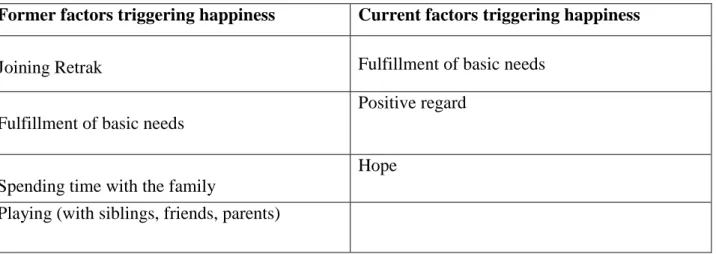
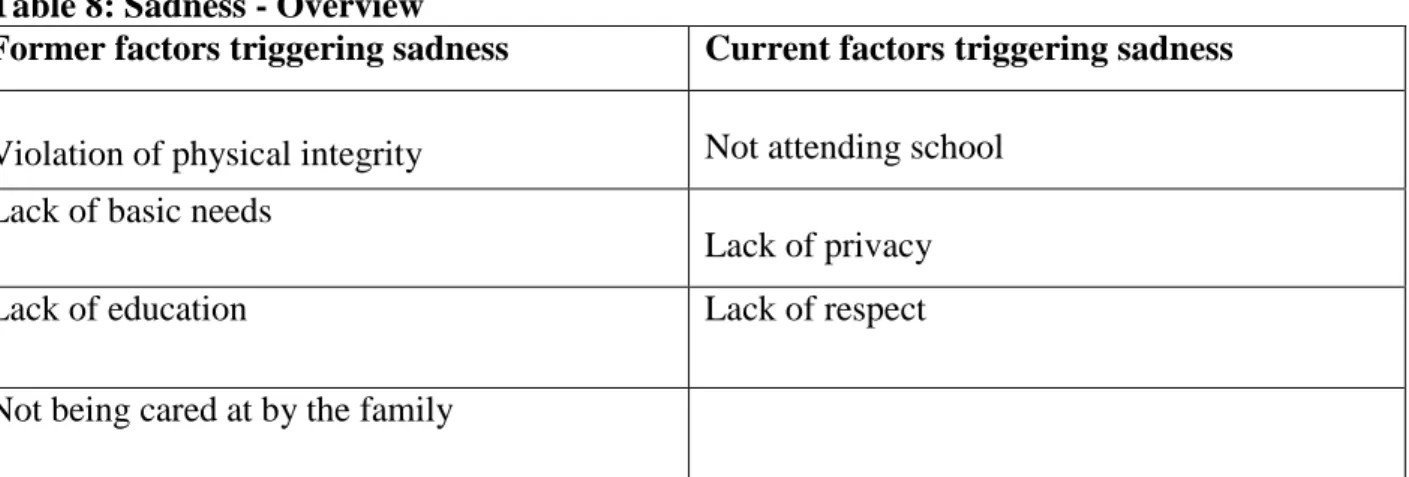
Table 5: Fear-Overview………74 Table 6: Anger-Overview……….75 Table 7: Anger-Overview……….75 Table 8: Anger-Overview……….76 Table 9: Anger-Overview……….77 Table 10: Anger-Overview………...77
LIST OF ILLUSTRATIONS
Illustration 1: The Phenomenal field………...9
Illustration 2: Maslow’s Hierarchy of Needs………13
Illustration 3: Alternative Care Framework………..22
Illustration 4: Scale of psychosocial support………84
Chapter I
Introduction
1.1 Background to the study
Even though the exact number of street children in Uganda is unknown, a study by the African Network for the Prevention and Protection against Child Abuse and Neglect (ANPPCAN) estimated in the year 2013 that over 10.000 street children, are living in Uganda, marking a 70% increase since 1993 (ANPPCAN 2013). Around 6.000 children live only on the streets of Kampala (UNICEF 2011).
The reasons for the presence of children on the streets are associated with the rapid urbanization of Uganda, which had led to an increase of urban poverty within the cities (Mukiibi 2011). Other common factors contributing to homelessness among children are mistreatment at home and the death of parent(s).
Street children rank among the most vulnerable groups of society as they are exposed to great risk of exploitation, physical, emotional and sexual abuse, violence and particularly marginalization (Anich et. al. 2011; Young 2003). In any case, it has to be noted that the situation and life circumstances the street children are living in, can vary significantly from one another.
As a result, it is required to differentiate between children who work and live independently on the streets (‘Full-time street children’/ children ‘of’ the streets) and children, who spend some of their time on the streets augmenting the household income of their families (‘part-time street children’ / children ‘on’ the streets) (Young 2004). While part-time street children have the possibility to return home after working on the streets during the day, full-time street children are forced to live on the streets permanently.
The presence of many children on the streets has culminated into the establishment of several programs that aim to have them re-integrated with their families. Moreover, evidence shows that majority of the children have a living parent or are connected to their extended families. In case of an absolute impossibility of reunification due to various reasons (e.g. abandonment, mistreatment at home, death of parent (s)) a reintegration into foster care and/or into society is pursued.
However, “reintegration does not mean just returning the children to the situations from which they may have escaped” (Coren et al. 2012, p. 8).
Commonly, reintegration is seen as an event while the process before and after the event of the reintegration fades into the background. The reintegration of street children is in fact a lengthy process, which requires an accurate preparation as well as follow up sessions.
For this reason, one of the Uganda’s Principles of the National Alternative Care Framework regulates that “…Staff should carefully plan each action towards a child’s return and case closure. The needs of the family must be addressed in order to enable the child to return home and to reintegrate into family life” (MGLSD 2013, p.22).
Furthermore, the National Alternative Care Framework states that special attention must be paid inter alia to the holistic needs of the child (i.e. health, education, social development, attachment and bonding) and particularly to the child’s physical and/psychosocial special needs (MGLSD 2013).
Indeed, the psychosocial distress the street children were exposed to might have caused severe emotional and psychological trauma. (Funk 2010) Hence, numerous (former) street children suffer inter alia from depression, spontaneous crying, despair and hopelessness, anxiety, panic attacks, fearfulness, compulsive and obsessive behaviours, irritability, anger, resentment and emotional numbness (Department of Health and Human Services of the Tasmanian Government 2005).
In order to make these emotional and psychosocial needs of children addressable, the Alternative Care Framework formulates that information about children’s mental health and current emotional state as well as concerns regarding the meeting of the child’s physical and emotional health, and developmental
needs, has to be captured and to be entered onto the Orphans and Other Vulnerable Children Management
Information System (OVC MIS System) (Uganda’s National Framework for Alternative Care 2013).
However, despite the efforts of the The National Strategic Programme Plan of Interventions (NSPPI-2)
for Orphans and Other Vulnerable Children in Uganda, reintegration and rehabilitation programs for
street children tend to fail on a regular basis. (Aptekar & Stoecklin 2014) The children find themselves unable to adapt to the new environment and they choose to go back to the damaging yet familiar environment they escaped from, the streets.
One of the most stated reasons to this phenomenon is the lack of support they receive, as their needs are not met in a holistic manner (Schimmel 2008).
1.2 Problem statement
Studies have ascertained the negative impact of street life on children’s psychosocial health i.e. their self-concept, life goals and expectations, cognitive capabilities and emotional wellbeing (Le Roux & Smith 1998). Other researchers have reported low self-esteem, apathy and fatalism among street youth (Lugalla & Mbwambo 1999).
Referring to Carl Rogers’ theory of humanistic psychology individuals are in the need of close, emotionally supportive and loving relationships for a healthy human development (Howe 2008). Rogers identified 3 components, which are relevant for a successful therapeutic relationship, namely (a)
unconditional positive regard (b) empathic understanding and (c) congruence.
By considering these three components an emotionally intimate and supportive relationship between the caregiver1 and the children can be built, necessary for an effective reintegration.
Furthermore, Rogers argues that unconditional positive regard, empathic understanding and congruence are particularly required in the recovery process from immense psychic stress and trauma (Rogers 2012). Hence, the necessity of therapeutic relationships providing unconditional positive regard, empathic understanding and congruence in the rehabilitation process are crucial in regards to the reintegration process into society. In order to successfully reintegrate into families or into community, street children need a source of sustained emotional support to gain self-respect, self-esteem, self-confidence, trust and faith in themselves and in society (Schimmel 2008). Rogers believed that individuals, who received
unconditional positive regard especially in their early years, are most likely to achieve self-actualization
i.e. the ability to fulfil the own potentials. (Sharf 2011)
In addition to a therapeutic relationship between caregivers and children, the aspects of time and trust are major factors, which can promote a successful rehabilitation and reintegration process (Coren et. al. 2016).
Due to the heavy workload caregivers often face, they might find it challenging to sufficiently engage with the children and to spend an adequate amount of time with every child individually in order to meet his/her needs in a holistic manner.
Furthermore, as former street children often have a deeply rooted mistrust against adults, it is of significance that caregivers seek to replace this mistrust with a trust relationship. Without the element of trust in a social work intervention, the offered assistance will not be fully accepted. (AFD 2012).
However, there exist numerous organisations providing outreach programs for assisting street children in the transition process from street life to a secure life in society. (Aptekar & Stoecklin 2014) The children’s visible needs in form of existential needs such as food, clothing, shelter and medical care are met before further essential needs such as education, rehabilitation and reintegration are incorporated. Yet, most of these programs emphasize to cover primarily the basic needs of the children, whereby the emotional and psychosocial state of the children tend to be neglected. (Schimmel 2008).
1
Caregiver= social workers or other professionals working with and caring for former street children within an organisation
Without recognizing the importance of psychosocial and emotional support for a successful rehabilitation of street children, rehabilitation programs covering only the “visible needs” of the children might not be successful in long-term.
It is of crucial importance, that caregivers working with street children recognize, that former street children need sustained intimate supportive relationships with adults in a guardian capacity for a healthy emotional and psychosocial development in order to achieve sustainable rehabilitation and reintegration (UN Rapid Situation Assessment Report on the Situation of Street Children in Cairo and Alexandria 2001).
The feelings and thoughts of the children in street situations are highly complex as the necessity to learn how to survive on the streets and the street experiences made by the children lead to peculiar ways of rationalizing and reasoning, which are little known by outsiders.
Psychological research has shown that street children are highly deprived of love, intimacy and supporting relationships (Mukherjee 2005).
The hostile environment in which street children are living in and the assaults towards them lead to the children’s belief that they are worthless and unwanted. Street children might have encountered traumatic experiences, which caused negative emotional states. In case the feelings of stress, fear and other negative emotions are not sufficiently tackled during the re-integration process, it is likely that children may find themselves again in the same environment as before i.e. on the streets.
The caregivers’ task is to empower the street children to direct their lives in a positive way. This is achieved mainly by letting the children know and feel that their lives and their individuality matter, by affirming their worth and dignity and by expressing that they deserve to be treated with love and respect. As pointed out by Schimmel (2008), such emotional support is a major component for a successful rehabilitation and reintegration, which in turn enables the children to be responsive to their unique life experiences, insecurities, as well as their personal strengths and capacities.
1.3 General and Specific Objectives
This thesis strives to analyse the perception of former full-time street children who are currently in the preparation process for re-integration at Retrak Uganda with regard to their perception on emotional and psychosocial support provided by their caregivers. Further, the mutual existence of trust relationships between the children and caregivers are examined through a humanistic approach. As a counter part also the caregivers’ views on how they consider these aspects shall be taken into consideration.
with the state of the art providing recommendations how the current rehabilitation approach can be enhanced.
Furthermore, the specific objectives are:
I. To identify which aspects of emotional and psychosocial support are of especial importance for children in the rehabilitation process.
II. To identify which role the aspects of trust, time and therapeutic relationship play in the process of preparing the children for re-integration.
III. To provide an overview on how the rehabilitation program of Retrak currently realizes the aspects of emotional and psychosocial support.
1.4 Research question
The thesis shall provide a conclusion to the following research questions:
“ How is the emotional and psychosocial support between children and caregivers considered in the process of preparation for re-integration from the perspective of former street children under the care of Retrak Uganda and their caregivers? “
“How are the elements of trust, time and therapeutic relationship between the caregivers and the children reflected in the social work practice of the caregivers?”
1.5 Scope of the study
The elaborations on the research questions will be more specifically made under the following terms:
The thesis will follow a solution-based approach rather than a problem-focused approach. This limitation shall contribute to the practical applicability for persons concerned with street children in the rehabilitation process.
The analysis of the collected data will be conducted from the perspective of social work and is limited to the preparatory phase of the re-integration process. Further, the thesis focuses on the service components of emotional support and its impact on the perperation for re-integration. Due to this
limitations additional aspects, which are to be considered in a holistic preparation for re-integreation such as formal education and training, medical support, economic strengthening, community engagement (NGLSD 2015) etc are explicity not included.
Following the case study approach of Merriam (1998) this research study is designed to gain an in-depth understanding of the situation of the persons involved. In particular, the interest of the thesis lies in the analyses of the process employed rather than their outcomes, in the given context rather than a specific variable and in the discovery of respective patterns rather than confirmation.
1.6 Justification
As far as can be seen little comprehensive studies exist how organizations specialized in rehabilitation programs in Kampala consider and employ strategies to create trust relationships and to support former full-time street children in their emotional and psychosocial development.
Respectively, also the effect of the emotional support on the success of the rehabilitation process has not been scrutinized. Therefore, the practical problem may exist that the success of rehabilitation processes is narrowed, as persons involved are not sufficiently aware of the crucial importance of providing emotional and psychosocial support. The thesis at hand strives to contribute to the scientific discourse and to draw attention to the respective issue among caregivers.
The results of the study seek to increase the rates of successful rehabilitation programs of former street children.
Furthermore, the results of the study may serve as a guideline for persons involved in street-children care and visualize the importance of creating emotional bonds with the children. Thus, caregivers will be enabled to enhance their current methods applied in the respective organisations.
Additionally, the study can serve as a base for further elaboration on the significance of a therapeutic approach with street children.
1.7 Issues of the study
Due to the width and complexity of the perperation for re-integration, not all factors, which might have an impact on the rehabilitation process can be taken into account.
The thesis at hand, including its methods of data collection, data analyses and its conclusions, applies methods of social science and/or methods of adjacent fields of science. As noted above, a comprehensive understanding of the significance of emotional support in the rehabilitation process requires the inclusion
of such factors, which are primarily subject of other fields of science. These include for example gender related aspects, socio-cultural or historical, legal factors or prevailing stereotypes etc.
However, this research study does neither intend to provide a comprehensive picture of all relevant factors which may have an impact on the rehabilitation nor does it apply methods which are not part of social science. Therefore, alterations may occur, if the respective topic is scrutinized from the standpoint of another field of science, other than social science.
Even though more valid results are to be expected if a holistic approach was applied, which takes into account all factors that might affect the rehabilitation process, due to time limitations and the limited extent of a master thesis as well as for the sake of a detailed analysis a restriction to a social science approach was made.
The author is not familiar with the native language of the children “Luganda”, whereas the majority of the children had limited conversation skills in the English language. Hence, a research assistant capable to conduct the interviews in Luganda and translate them from Luganda into English was engaged to conduct the interviews. For this purpose, the translator used an interview guide which was compiled by the author. However, it is a well-known fact, that specific terms from two different languages cannot always be translated precisely and exact meanings may be lost in thetranslation procedure.
To overcome this issue, the author liased with the translator in order to clarify the exact meaning of the answer in Luganda and the English translation, where the exact wording seemed essential and crucial for this study.
1.8 Theoretical Framework
1.8.1 Humanistic Approach
Humanistic social work is derived from the humanistic psychology's theory and methodology.
As a consequence, most values and principles of the humanistic social work practice directly originate from humanistic psychological theory and humanistic psychotherapy practice.
According to Payne, the main role of the humanistic social work is to empower clients to reach their fullest potential within the therapeutic relationship.
Hence, the humanistic approach focuses on assisting the client to achieve self-actualization and to promote human and social wellbeing by developing personal growth and human capacities.
As a matter of fact, human psychologists endorse the idea that people have a tendency towards growth and the fulfilment of their potential. (Payne 2011).
Though the humanistic approach based on the hypothesis of a free will, critics argued that, their position on free will is incoherent, because of the following reason: while it is assumed that individuals have the ability to feely choose their actions, it is on the other hand argued that the human behaviour is determined by other's treatment and inherent needs (Burger 2015).
In humanistic theory, the influence of experiences on a person’s ways of perceiving and understanding the world is acknowledged (favouring a nurture approach), which is enriched by the assumption of each individual’s uniqueness (being an ideographic psychology). Further they favour an explicitly holistic approach, as human behaviour is not reduced into more fundamental processes. Humanists therefore oppose a reductionist approach. Humanistic methods seek to study the subjective perception of every individual rather than taking an objective view of clients. Consequently, objective scientific methods are rejected, as the great individuality of people cannot be compressed under an objective model (Rogers 1965).
Critics of a humanistic theory have contested this approach, by claiming a lack of objectivity, alleging an unscientific methodology, which is biased, and the impossibility and irrelevance of attempting to track down people’s way of perceiving the world. In the light of the world's omnipresent misery, others have criticized the humanists' positive view of human nature. With this regard, critics even argued that humanistic egocentric focus on meeting the individuals' needs fulfilling its growth potential contributed to the problems of a world at stake rather than solving the problems (Friedman 2008).
Humanistic psychologists reject these criticisms by saying that only by trying to understand the individual on a subjective base can assist in overcoming difficulties. Further, only through the counselling approaches developed by Rogers many individuals have been successfully aided in coping with their problems (Stefaroi 2012).
1.8.2 Rogers Humanistic Theory of Personality
In the 1950s Carl Rogers and Abraham Maslow introduced the humanistic approach (or client-centred approach) to psychology and Rogers further applied it systematically to the personality (Eysenck 2004). Hence, Roger’s theories of personality development were developed through person-centred counselling and scientific therapy research and are based on humanistic psychology and theories of subjective experience.
In contrast to psychoanalysis and behaviourism, the humanistic psychology focuses on the active role of each individual in shaping their internal and external worlds (Payne 2011). Rogers believes that
stated: “As no one else can know how we perceive, we are the best experts on ourselves” (Gross 1992, p.905). Based on this humanistic approach, Rogers’ theories emphasizes on the growth potential of healthy individuals, whose path of lives depend on individual choices rather than deterministic biological factors.
Therefore, the theory of personality development stresses on the free will and the self-determination, with each individual desiring to succeed at his or her highest possible capacity (actualizing tendency) (Rogers 2012).
Snygg and Combs (1949) agreed to Roger’s humanistic approach and became proponents of the phenomenal field theory.
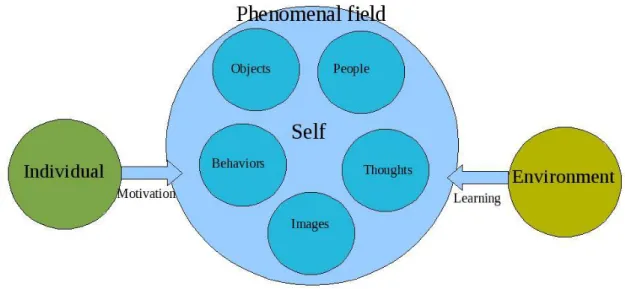
According to this theory, the phenomenal field (or self) is our subjective reality.
As the phenomenal field includes external objects, people, thoughts, emotions, images and behaviours, it can be described as the constantly changing world of experiences of every individual that he or she is the centre of. The person's motivations and environments both act on their phenomenal field. (see illustration 1 below)
Illustration 1: The Phenomenal field
(Source: Boundless 2016)
Further, Rogers claims that the behaviour of individuals depends on the way they perceive their personal situation they are living in as he believes that every person reacts according to his or her own subjective reality (Rogers 1965).
With regard to the phenomenal field theory, Snygg and Combs explain that motivation is "the basic need of everyone to preserve and enhance the phenomenal self, and the characteristics of all parts of the field are governed by this need" (Snygg & Combs 1949, p.15).
Snygg & Combs (1949) explain further that the environment influences the individuals learning processes, which in return has an impact on the phenomenal field and the self.
The “self-concept” is central to Carl Rogers’ personality theory, which is defined as “"the organized, consistent set of perceptions and beliefs about oneself" (Gross 2009, p. 225).
The self-concept is shaped by interactions with the environment and the experiences that follow from these interactions.
A positive self-concept serves as an indicator for a healthy self-esteem and a positive outlook on the future, while a negative self-concept leads to a low self-esteem and negative thoughts on life in general. It should be noted that, the self-concept is mainly influenced by the childhood experiences and evaluation by others (Hattie 2014).
The self-concept comprises the following three components:
1. Self-worth/ Self-esteem: The self-worth describes what individuals think about themselves. According to Rogers self-worth is developed in early childhood and is formed through the interaction with primary caregivers. Likewise, adults’ feelings of self-worth are affected by interactions with significant others.
2. Self-image: Self-image comprises how individuals see themselves. This component is decisive for good psychological health, as the self-image is strongly related to the human thoughts, feelings and behaviour in social environment.
3. Ideal self: The self defines the person an individual would like to be. As a result, the ideal-self comprises the personal goals and aspirations of every individual. The ideal ideal-self must be seen as a dynamic concept as it changes simultaneously in the course of the growth of the person (Rogers 1959).
According to Rogers (1951) the child has two basic needs, namely positive regard from other people and self-worth.
Feelings of self worth influence the psychological health and the likelihood of achieving life goals and self-actualization. An individual with high self-esteem is more likely to cope with difficult situations in life, to handle defeat and to face challenges. Likewise, a person with low self-esteem may struggle with coping with difficult life situations and may also avoid challenges in life (Rogers 1959).
development. Individuals need to be regarded positively by their surroundings, feel valued, respected and treated with affection.
Positive regard is mediated through positive evaluation and judgments of attachment figures.
Further, Rogers distinguishes between unconditional positive regard and conditional positive regard. The
unconditional positive regard describes the acceptance and support regardless of the individual’s personal
views and actions. The person itself will be accepted and loved for what he or she is. Positive regard is not withdrawn in case of “misbehaviour” i.e. acting in a not socially accepted way.
Whereby, conditional positive regard depends on praise and approval of others. The individual does only experience acceptance and love on condition that the person behaves in socially accepted ways. As a consequence, the individual is not accepted for the person he or she is, as human mistakes are not tolerated (Rogers 2012).
As mentioned above Rogers believes that all humans desire to fulfil their potential and to succeed at their highest possible capacity. In fact, this self-actualizing tendency refers to a person’s basic instinct (Rogers 1959).
Self-actualization takes place, when individuals reach their respective potential and achieve their life goals. In particular, in order to achieve self-actualization the person’s “ideal self” must be congruent with their “self-image”. In case of a high level of congruence between the ideal self and the self-image, the level of self-worth increases.
Incongruity occurs in case of incompatibility of the ideal-self and the self-image.
Rogers describes an individual, who has reached self-actualization, as a “fully functioning person”. Further, Rogers claims that all human beings have the potential to reach self-actualization as long as the environmental circumstances will allow this growth. Hence, the environment of each person is decisive for achieving self-actualization (Rogers 2012).
As a consequence, he identified the following 3 requirements for an ideal environment, in which an individual is able to achieve self-actualization.
I. Unconditional positive regard (Acceptance): When people, in particular children receive
unconditional positive regard or appreciation for their entire being including failings, their growth is promoted by feeling worthy to be loved for who they are. Hence, Rogers believes that individuals are only able to fulfil their potential of growth in case they have a positive view of themselves (positive self regard).
II. Empathy – Individuals’ growth is encouraged by other persons’ empathy. Sharing thoughts and
feelings with others and being understood and listened to in return can be described as a powerful force for positive change. Roger explains that when people are listened to with empathy “it
becomes possible for them to listen more accurately to the flow of inner experiences.”
III. Congruence (Genuineness) – Congruence comprises not only honesty towards others but also the ability to be “real” and “human” in the sense of being approachable to others and not hiding behind a façade. As a matter of fact, the growth of individuals is promoted when others are honest and trustworthy towards them. Resultantly, genuine behaviour of the individuals will be promoted in return. (Rogers 2012)
In line with this belief, Rogers argues that any successful therapeutic relationship between a professional and a client includes the aspects of unconditional positive regard, empathy and congruence.
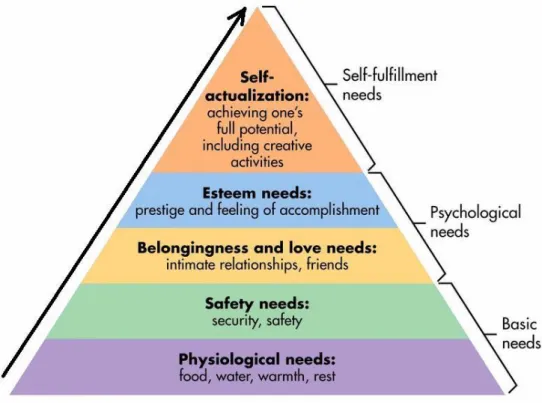
Rogers further reasons that the main determinant whether individuals will become self-actualized is childhood experience. Indeed, researchers found out that the people who have received unconditional positive regard in their early childhood are more likely to achieve self-actualization (Rogers 1965). Compared to Rogers, Abraham Maslow’s view of human needs is more multifarious. Maslow points out that people have a wide range of needs, which are ordered in a prepotent hierarchy. Accordingly, human needs differ in immediacy and need to be satisfied according to the hierarchical order, beginning with the basic needs at the bottom. Therefore, Maslow divided his hierarchy of needs in three different parts, namely basic needs, psychological needs and self-fulfilment needs (Maslow 1943) (see illustration 2 below).
Illustration 2: Maslow’s Hierarchy of Needs
(Source: PDP Notes 2013)
Maslow believes that only those who have all their subordinated needs (i.e. basic needs and psychological needs) covered may become self-actualisers i.e. people who have achieved self-actualization by fulfilling their potential completely (Maslow 1970).
Further, Maslow argues that prolonged periods, in which a particular need is not satisfied, can result in a so-called “fixation”- a state in which the individual is particularly concerned about satisfying one specific need that has been neglected over a long period of time even though this need has already been covered. (e.g. individuals who have suffered from hunger, will continue to be dominated by the anxiety of not receiving enough food in the future even though there might been no reason) (Maslow 1943).
1.8.3 Attachment Theory
The attachment theory developed by John Bowbly (1988) describes the dynamics of interpersonal relationships between humans.
According to Bowlby all human beings instinctively seek for proximity and intimacy. In particular, attachment can be seen as a motivational and behavioral system, which directs individuals to seek proximity with attachment, figures in order to receive emotional support or protection. (Landa & Duschinsky 2013)
With regard to infants, he argues that early relationships with primary caregivers are significant for the child development and influence social relationships later in life.
Regarding the attachment bonds between children and primary caregivers, Bowbly found out that children have especially the need to seek close proximity with their caregiver, in vulnerable situations. (Prior & Glaser, 2006).
When the needs of the child are met in a sensitive way, the children are skilled to develop a secure base, from which they can further set autonomous actions. As a result attachment can be seen from an evolutionary perspective as the caregiver ensures the safety and security, and therefore the survival of the child (Rutter 2008). As street children are torn out of intact family structures, the relationship with their former caregivers is shatterd. The children are therefore not able to turn to caregivers when they need it the most, namely during encounters of the hardships of street life. Children therefore lack the security and safety of integer family structures. As the children lack these social relationship to their former family structures, they may experience deficiencies in their later development (Lewis Wilson & Wilson 2015).
Along with the desire of proximity and intimacy, humans have a universal and intrinsic desire to be accepted by others. With regard to Maslow’s Hierarchy of Needs (see above), human beings seek to satisfy attachment needs, which are subcategorized under psychological needs (in particular belongingness and love needs), after fulfilling the basic needs. Due to the position of the attachment needs in the hierarchy, individuals will only strive to fulfill the higher-order self-fulfillment needs after achieving their attachment needs (e.g. family and friend affiliation (Bowlby, 1988).
Waters et al. (2005) point out that the attachment theory should not be understood as a general theory of relationships. According to Waters et al. (2005) the attachment theory only addresses a specific aspect. It describes how human beings react within relationships in vulnerable situations. Levy & Orlans (2014) argue that attachment depends on the children’s ability to build basic trust relationships towards caregivers. Children develop trust when they experience that their needs are met in a consistent nurturing relationship (secure relationship). Furthermore, infants need to develop an attachment bond with at least one primary caregiver in order to learn how to regulate feelings effectively. Therefore it is argued that the attachment bond towards primary caregivers is decisive for children’s successful social and emotional development.
In the 1960s Ainsworth found out that depending on early caregiving environment, children have different patterns of attachment. Ainsworth (1967) identified four styles of attachment, namely secure attachment, anxious-ambivalent attachment, anxious-avoidant attachment and disorganized attachment. Regarding secure attachment, Children feel that they can rely on their caregivers as they meet their needs
of protection, proximity and emotional support. Caregivers of secure children are accessible and sensitive to their needs.
Ainsworth describes the secure attachment as the best attachment style as it enhances the control of emotions and the development of interactive and social behaviours. A secure attachment can also reduce the effects of stress and trauma experienced later on in life.
Children with an anxious-ambivalent attachment feel separation anxiety when separated from the caregiver. Even when the caregivers return to the child, they do not feel reassured. Anxious-ambivalent children experienced caregivers who were mostly insensitive, unpredictable, and less accessible.
In case of anxious-avoidant attachment, children tend to avoid their caregivers. The caregivers of anxious-avoidant children were mostly rejecting and insensitive to their children’s needs.
Disorganized attachment occurs when the child suffered from a lack of attachment from the caregiver. Disorganized children had caregivers whose behaviours were unpredictable and abusive towards them (Ainsworth 1967; 1991).
Chapter II
Literature Review
2.1. Defining ‘Street children’
Depending on the perspective, numerous definitions of the term “street children” can be identified. The United Nations (UN) and UNICEF established the most commonly used definitions of street children. According to the United Nations, street children are ‘'boys and girls for whom 'the street' (including unoccupied dwellings, wasteland, etc.) has become their home and/or source of livelihood, and who are inadequately protected or supervised by responsible adults' (Panter-Brick 2002, p.4).
In order to define the term ‘street children’ appropriately UNICEF distinguishes between ‘children on the streets’ and ‘children of the streets’.
UNICEF states: ‘Children on the streets […] must share in the responsibility for family survival by working on city streets and marketplaces. […]. Nevertheless while the street becomes their daytime activity, most of these children will return home most nights. While their family situation may be deteriorating, they are still definitely in place, and these children continue to view life from the point of view of their families.’
Whereby ‘Children of the streets are a much smaller number of children who daily struggle for survival without family support, alone. While often called “abandoned”, they too might also have abandoned their families, tired of insecurity and rejection and aged up with violence... [Their] ties with home have now been broken... de facto [they] are without families.’ (Pare 2003, p. 4 & 5)
Similar to UNICEF’s distinction between ‘children on the streets’ and ‘children of the streets’, Young (2004) talks about ‘part-time’ and ‘full-time’ street children.
The definition of ‘part-time’ street children is equivalent to ‘children on the streets’ as both definitions refer to children who only spend some of their time on the streets.
Equally, ‘children of the streets’ are comparable to ‘full-time’ street children as these are children who are independently living and working on the streets. Ennew (2003) describes such ‘full-time’ children therefore as ‘real street children.’
2.1.1. The controversial term “Street Children”
In scholarly writings the term street children has been criticized as it may be seen as deregoratory, stigmatizing and not capturing the different dimensions o child vulnerability. Inter alia, under the following aspects have been pointed out:
Volpi points out, that the term "street children" does not sufficiently capture the different dimensions of child vulnerability: while the term suggests to capture children enduring the hardship of living on the streets, the interconnection with other aspects of child vulnerability, such as child labour, child prostitution are not sufficiently included (Volpi, 2002).
It has been pointed out that the term is deteriorating, labelling and stigmatising.
Ennew (2003) pointed out that the term refers to a group of children who are homeless, but does not comprise the children from urban regions without appropriate infrastructure, and who therefore experience similar living circumstances.
To underline these inconsistencies in regard to the wording, a large number of heterogeneous synonyms have developed, ranging from, "community children", "urban out-of school children" (used in Kampala) , ‘skadukinders’ (Afrikaans for shadow children), 'Children in Especially Difficult Circumstances' (Ennew 2003).
Despite this criticism the term "street children" has been used in the majority of scholarly writing. In order to align the wording of this thesis to the standard formulation, the author has chosen to refer to the respective group of children as "street children". It shall be pointed out, that no deteriorating connotation is intended.
2.2. Street children in Uganda
2.2.1 Estimating the Numbers
In 2005 UNICEF stated: ‘The exact number of street children is impossible to quantify, but the figure almost certainly runs into tens of millions across the world. It is likely that the numbers are increasing as the global population grows and as urbanization continues apace’ (UNICEF 2005: 40-41).
Even though no exact figures on the number of children living on the streets in Uganda are available, the following estimations have been made:
The number of street children in Uganda has increased by 70% since 1993 (ANPPCAN 2013). In the year 2013, the study by the African Network for the Prevention and Protection against Child Abuse and Neglect estimated that over 10.000 children live on the streets throughout Uganda.
2.2.2 Push & Pull factors
Factors which force children to live on the streets are divided into push factors and pull factors. Under push factors are circumstances subsumed which 'push' children away from their homes and onto the streets (e.g. Volpi, 2002).
A series of push factors exist which force children to live on the streets. Munene and Nambi have identified push factors for Ugandan children, which include extreme poverty broken families; hostile family structures (including domestic violence, abuse, neglect) and the parent's not able to cope with the burden of parenting (Munene & Nambi, 1996).Therefore poverty and internal conflict within the family are major push factors for children. These two factors often correlate, as poverty can lead to domestic conflicts. Young (2004) refined the studies on push factors. Young (2004)found out that most children are pushed on the street due to mistreatment (mistreated by guardian , mistreated by parent, fear of being beaten), poverty, shattering of family structures (especially death of a parent), behavioral problems (such as involvement in criminal activities).
Particularly for this thesis, family conflicts are of especial interest: Donald and Swart-Kruger (1994) noted that the lack of emotional support and a loving relationship is a major factor of influence for the child's decision of running away from home. Also Brendtro et. al., ( 1990) noted that harsh living situations, including harsh social conditions is a major pull factor . Children who do not experience loving warmth at home, often seek to find it in other places or persons: once run away from home other street people are seen as role models and attachment figures. Through these social relationships children seek to satisfy their cognitive and affective needs (Richter, 1988a). (Le Roux & Smith 2010)
Pull factors are the circumstances which 'pull' children toward the streets (e.g. Volpi, 2002).)
Young's study (2004) identified as major pull factors, peer pressure, the children's attraction of living in the city (including hope to use urban facilities, be offered varieties of food or entertainment) to; the hope of employment or to receive charitable donations given by NGO's. Also false information about city life pulled children on the streets, leaving children disappointed if they do not find the living situations the expected
2.3 Street Life
By leaving home and being forced to live on the streets, children are exposed to several risks Donald and Swart-Kruger (1994) pointed out, that the loss of the relationship with adult caregivers poses high risk for the child's emotional wellbeing, especially in regard to the child's psychological development, personality building and identification process. Therefore experiencing the hardships of street life and being forced to leave the acquainted environment, are highly destabilizing and traumatic experiences. After such a sudden breakage of relationships, children may find it extremely difficult to trust adults again.
Further, street children are particularly vulnerable to experience violence, inadequate access to food , health problems , sexual abuse, child labour, and child prostitution (Walakira 2012). The experience of violence in young ages, further contributes to an emotional trauma. By witnessing or by being exposed to such severe violations of the physical integrity the children most likely will suffer from traumas and stress disorders which need to be treated to succeed with re-integration. (Coren et. al. 2012)
To escape from the hardships of street life, children often resort to abuse addictive substances. Psychological violence (incl. verbal abuse, threats or forced labor) is one of the most prevalent type of violence experienced by street children in Uganda (Walakira 2012). The abuse of addictive substances further accelerates the downward spiral; drug abuse may affect not only the physical and mental health but requires treatment before the re-integration process can start. Therefore, the counselling of these children take significantly longer than with children who do not suffer from drug addiction. (Coren et. al 2016)
Conticini (2008) has defined four different phases of street life namely, acceptance, adaptation, accustomisation and dependence.
In the phase of acceptance the child gets familiar with the new environment, the street. It is probably the most challenging phase for the children- from a physical as well as from a psychological point of view. The child may feel isolated, desperate and abandoned, which may lead to depression and violence.
The child is already exposed to the community’s stigmatization and discrimination, which can destroy the child’s reputation. It should be noted that, girls are more likely to lose their reputation than boys.
Another gender difference is that girls tend to be less mobile than boys, who move easily from one place to another. (Shukla 2005) In this phase the child struggles to connect with other street dwellers as the relationships to other children living on the streets are mainly conflict-prone and competitive.
In the phase of adaptation the child begins to establish collaborative cooperative relationships with other children.
The child becomes a part of the street children’s network of social relationships, which can be protective as well as exploitative. In fact, the child has to learn soon to accept patron-client exploitative relationships. (Young 2003)
However, in this phase the child develops feelings of trust to other children thereby friendships and brotherhood may be established.
This social network plays now the main role in their life, with regard to livelihood development, emotional support and physical security. Thereby the child adapts increasingly the informal rules and norms of street living. As a result the child’s identity is reshaped and modified by the street environment. (Sale 2016)
Within the phase of accustomisation the child becomes a respected member within the street group. The child feels empowered and enjoys the absolute freedom. In this phase the child suppresses his past and focuses on the future. The child/ adolescent shares a feeling of solidarity with selected friends but becomes increasingly competitive against enemies or outsiders. Through daily routines such as alcohol and drug abuse, sex, stealing and fighting, the adolescent adapts new set of values. (Walakira 2012)
Moreover, the child/ adolescent gains access to a variety of profit making activities, whereby he is not only able to satisfy his needs but even his preferences.
In the phase of dependence the child/ adolescent becomes more and more dependent on the street environment, social networks and routine activities. Survival strategies such as emotional detachment from reality and substance abuse are common. The child loses gradually his self-confidence and the hope in the future. In fact, the child gains a fatalistic and depressed vision of the future. (Conticini 2008)
2.4. Uganda’s National Quality Standards for Vulnerable Children
2.4.1 National Framework for Alternative care
Uganda’s Ministry of Gender, Labour and Social Development (MGLSD) aims to ensure that all of Uganda’s children are provided with appropriate and adequate care.
In the attempt to ensure that children in need of alternative care are provided with standardized care options; the National Framework for Alternative care was developed.
The relevant laws, policies, strategies and guidelines of the Alternative Care Framework include United Nations Guidelines (A/Hrc/11/L.13 2009) For Alternative Care, The Children’s Act, National OVC Policy of Uganda, The National Strategic Programme Plan of Interventions (NSPPI) For Orphans and Other Vulnerable Children in Uganda and Operations Manual for Youth and Probation and Social Welfare Officers (2010).
This framework seeks to promote the de-institutionalization process for alternative care and to combat the numerous care institutions acting outside the national legal framework.
According to the 2010 OVC situation analysis, around 8 million children- more than half of Uganda’s child population- are vulnerable, whereof 10.000 children live on the streets. The 2010 OVC situation analysis further pointed out the lack of deliberate efforts to reach critically vulnerable children due to the weak government systems for providing social protection and child welfare services.
In this context, in order to strengthen Uganda’s child protection systems the National Alternative Care Framework has been developed with the aim of reducing the number of children in institutional (orphanage) care, providing guidance to government and non-governmental actors; and supporting existing government structures in overseeing the care of children in alternative care.
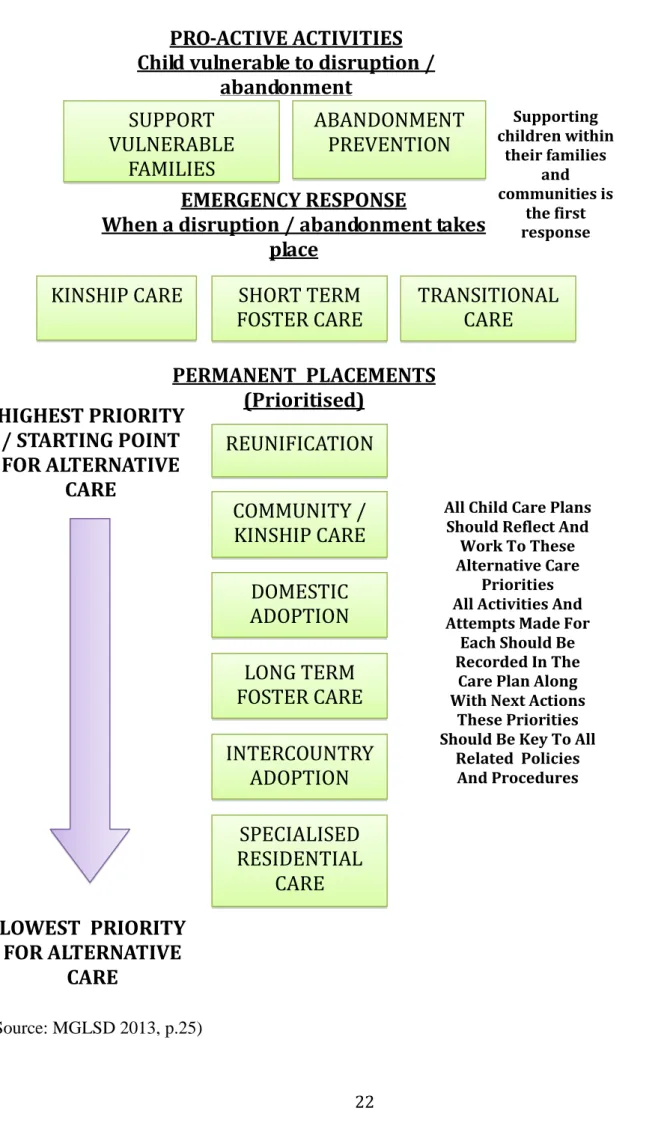
Along with clear guidelines for actors working with children in need of alternative care; the Framework developed a “continuum of care”-plan to ensure appropriate placement options for the children. As shown in the following graphic, the overall goal of the “continuum care”- plan is to reunify the children with their families and to avoid the option of residential care at any cost (MGLSD 2013) (see illustration 3 below).
Illustration 3: Alternative Care Framework
(Source: MGLSD 2013, p.25)
PRO-ACTIVE ACTIVITIES
Child vulnerable to disruption /
abandonment
ABANDONMENT
PREVENTION
KINSHIP CARE
EMERGENCY RESPONSE
When a disruption / abandonment takes
place
SUPPORT
VULNERABLE
FAMILIES
TRANSITIONAL
CARE
SHORT TERM
FOSTER CARE
DOMESTIC
ADOPTION
REUNIFICATION
COMMUNITY /
KINSHIP CARE
LONG TERM
FOSTER CARE
SPECIALISED
RESIDENTIAL
CARE
PERMANENT PLACEMENTS
(Prioritised)
HIGHEST PRIORITY
/ STARTING POINT
FOR ALTERNATIVE
CARE
INTERCOUNTRY
ADOPTION
LOWEST PRIORITY
FOR ALTERNATIVE
CARE
All Child Care Plans Should Reflect And
Work To These Alternative Care
Priorities All Activities And Attempts Made For
Each Should Be Recorded In The
Care Plan Along With Next Actions
These Priorities Should Be Key To All
Related Policies And Procedures Supporting children within their families and communities is the first response
2.4.2 National orphans and other vulnerable children policy (NOP)
The overall goal of the National OVC policy is to guarantee the full development of orphans and other vulnerable children as well as the realization of their rights. In particular, the policy aims to ensure that:
- The legal, policy, and institutional framework for child protection is developed and strengthened at
all levels
- Orphans, vulnerable children and their families access basic essential services package;
- Resources for interventions that benefit orphans and other vulnerable children are mobilized and
efficiently utilized; and
- The capacity of duty-bearers for orphans and other vulnerable children to provide essential services
is enhanced. (MGLSD 2013, p. 18)
According to the philosophy behind the OVC policy, all children need to live to their full potential and have their rights and aspirations fulfilled. As a matter of fact, the core values of the OVC policy are love, care and compassion.
Moreover, the policy framework provides the following guiding principles, which have to be respected by all OVC programs:
- Human rights-based approach to programming
- The family and the community as the first line of response - Facilitating community participation
- Promoting child participation - Promoting gender equality
- Designing age-sensitive programs - Reducing stigma and discrimination
- Delivering integrated, comprehensive and coordinated services - Decentralizing service delivery (MGLSD 2011, p.23)
2.4.3 National strategic programme plan of interventions for orphans and other vulnerable children (NSPPI- 2)
The Ministry of Gender, Labour and Social Development implemented alongside the National Framework for Alternative Care, a National strategic programme plan of interventions for orphans and other vulnerable children (NSPPI-2), which follows the above-mentioned OVC philosophy.
With the aim of providing a holistic child welfare approach and strengthening alternative care practices in Uganda, the major strategic objectives of the NSPPI-2 are to:
- Strengthen the capacity of families, caregivers and other service providers to protect and care for
orphans and other vulnerable children
- Expand access to essential services for orphans and other vulnerable children, their caregivers and
families/households
- Increase access to protection and legal services for orphans and other vulnerable children, their
caregivers and families/households
- Strengthen the institution, policy, legal and other mechanisms that provides supportive environment
for a coordinated OVC response (MGLSD 2011, p.20)
The goal of the NSPPI-2 is to achieve the 4 following major outcomes:
- Improved economic security for orphans and other vulnerable children, their caregivers and
families/households
- Improved access to and utilization of essential services for orphans and other vulnerable children,
their caregivers and families/households
- Improved child protection and access to justice for orphans and other vulnerable children, their
caregivers and families/households
- An effective policy, legal and other institutional mechanisms that delivers a coordinated OVC
response (MGLSD 2011, p.xiv)
2.4.4 Family Reintegration Standard Operating Procedures (SOPs)
The Ugandan Government puts efforts in implementing the United Nations Guidelines for Alternative Care of Children with the aim to foster re-integration and to reduce the time children spend sepereated from their birth families.
As a result, the Deinstitutionalisation of Orphans and Vulnerable Children (DOVCU) project the SOPs of Family Reintegration were developed with the aim of complementing already existing national legal and policy instruments for the care and protection of OVC in residential care.
The SOP’s are aligned to the Alternative Care Framework and seek to guide managers of Child Care Institutions (CCIs) as well as other stakeholders taking care of children outside their families. As a consequence, the Ministry of Gender, Labour and Social Development together with Retrak Uganda
application amongst both Retrak and non-Retrak partners.
The guiding principles of the Family Reintegration SOPs include: - Prioritization of family reintegration
- Child-centred intervention
- (Re)building positive attachments between the child and her/his caregivers - Involvement of the wider community
In particular, the Family reintegration procedure comprises the following five main steps: - Step 1: Child assessment and preparation
- Step 2: Family tracing, assessment & preparation - Step 3: Placement and support
- Step 4: Follow-up and support/ Removal of child - Step 5: Phase out (MGLSD 2015; Retrak 2013)
2.5 Intervention programs for Street Children
2.5.1 Classification of programs for Street Children
According to Aptekar & Stoecklin (2014) different classifications of programs can be made, according to their appraisal of their aims and qualities. Thomas de Benitez (2011) has established a system of classification of programs for children in street situations into three models:
1) The correctional, reactive or repression-oriented model: Children in street situations are seen as deviants
2) The rehabilitative or protection-oriented model: Children in street situations are identified as victims
3) The human rights- based approach: Children in street situations are seen as citizens whose rights have been violated
Programs can work with all or some of the three levels. They can work with the target groups that cause the problem (families, neighbourhoods, gangs, etc.), the recipients who experience the negative effects of the problem (children in street situations), and the political-administrative authorities who develop and implement a given policy (the State).
The following table of Thomas de Benitez (2011) illustrates a useful scheme, which synthesizes possible strategies how to work with street children at all the three levels.
Table 1: Classification of Levels of Intervention Classification of Levels of Intervention
Policy approach Conceptualization of
street children
Abstraction Target levels
Repression Deviants Public order Children in street situations (micro level)
Protection Victims Authentic Child Dysfunctional Families and communities (meso level) Rights-based Citizens Child Rights State, historical and economic
factors (macro level)
(Aptekar & Stoecklin 2014, p.171) 2.5.2 Models of Intervention
Intervention programmes believe that street children can be “helped to overcome the effects of their harsh environments”. (Ratele & Duncan, p. 351) Fighting against the negative impacts of street life on the children’s health is the first aim of these programs.
The World Health Orgaisation (2003) defines health in the following context as a state of complete physical, mental and social well-being, and not only as the absence of disease. Interventions may take the form of single projects, drop- in centres or peer education interventions, and many will be underpinned by the ‘children’s rights’ discourse, more recently taking a holistic approach to the needs of young people (Thomas de Benitez 2011). Interventions striving to improve the situations of street-connected children and young people include educational projects, vocational training, harm reduction HIV prevention, therapeutic intervention and multi-disciplinary programmes. (Shukla 2005)
According to Cockburn (1995) intervention programmes can be categorized into three broad approaches, namely:
1) Containment
The containment approach is applied in closed institutions, where correctional measures are used.
2) Cure
The cure approach aims to take the children off the streets and to reintegrate them into society. The cure approach is sometimes termed rehabilitation as it triggers the re-socialisation of the street children.