For Peer Review Only
Facing Polyamorous Lives: Translation and Validation of the Attitudes Towards Polyamory Scale in a Portuguese Sample
Journal: Sexual and Relationship Therapy Manuscript ID Draft
Manuscript Categories: Original Paper
Keywords: Couples Therapy, Gender Issues, Sexual Psychology
For Peer Review Only
Facing Polyamorous Lives: Translation and Validation of the Attitudes
Towards Polyamory Scale in a Portuguese Sample
Consensual Non-Monogamies (CNMs) have been receiving the attention of academics, however attitudes towards polyamory are still a new field of research. We aim at studying the reliability and validity of the Attitudes Towards
Polyamory (ATP) scale in a Portuguese sample. The present analysis utilized cross-sectional data from 609 volunteers that completed the online survey. After randomly splitting the sample (1:1) for cross-validation purposes, Exploratory (EFA) and Confirmatory factor analysis (CFA) were conducted using Principal Axis Factoring (PAF) and Maximum Likelihood Estimation, respectively. Cronbach's alpha and item-total correlations were used to determine the internal consistency of the scale. The convergent and discriminant validities of the scale were assessed using a correlation matrix. Feasibility and acceptability were examined in terms of missing values, floor and ceiling effects. The ATP proved to be reliable (Cronbach’s alpha > .80). In the current study the final structure of the scale, proved through CFA, included 6 items aggregated in a single factor. This final 6-item measure proved to have convergent validity with a measure of modern heterosexism, divergent validity with a measure on self-esteem and concurrent criterion validity with willingness to engage in consensual monogamy. Implications for research in polyamory and consensual non-monogamies are discussed.
Keywords: consensual non-monogamies; polyamory; psychometric scale; attitudes; discrimination; Attitudes Towards Polyamory Scale
Introduction
Attitudes tend to aggregate around themselves “beliefs, feelings and behavioral tendencies” (Hogg & Vaughan, 2005, p.150) towards highly salient things in an individual’s or society’s life. The understanding of attitudes towards a set of identities that are yet targeted for social discrimination might help us understand: 1) how to further the research on attitudes-based discrimination against said groups; 2) how to work with people whose negative attitudes might promote discriminatory behaviors; 3)
3 4 5 6 7 8 9 10 11 12 13 14 15 16 17 18 19 20 21 22 23 24 25 26 27 28 29 30 31 32 33 34 35 36 37 38 39 40 41 42 43 44 45 46 47 48 49 50 51 52 53 54 55 56 57
For Peer Review Only
how to help those who might feel discriminated to better cope, understand and respond to those experiences of discrimination. For any of this to be possible, empirical work demonstrating the (in)existence of positive and negative attitudes is fundamental. To achieve this, reliable and valid measures in different languages are necessary. In this paper, we will look at a measure of attitudes towards polyamory.
The concept
Polyamory is generally defined as “the assumption that it is possible, valid and
worthwhile to maintain intimate, sexual, and/or loving relationships with more than one person” (Haritaworn, Lin, & Klesse, 2006, p.518) at any given time, with the explicit and informed consent of all those involved, regardless of the existence of sexual intercourse. There is a definite focus on the emotional and interpersonal aspects of relating, with sex being considered as a non-central element, even though sexuality, as a dimension of human experience and as a practice, keeps being a fundamental marker of how relationships are made socially intelligible (Mint, 2008) this for the first paragraph in a section, or to continue after an extract.
Polyamory is considered to be a relationship orientation, meaning that many people feel particularly oriented towards being in polyamorous relationships, just as others feel oriented towards being in monogamous relationships. Far from being a monolithic concept, its vagueness makes it especially permeable to constant social and subjective reinterpretation, which opens up more potential for discrimination (Barker, 2005). Overall, polyamory is part of a wider group of sexualized identities and practices – Consensual Non-Monogamies (CNMs), or “Open Non-Monogamies” (Rambukkana, 2015, p. 236) which includes swingers or cuckolders, but not those who are involved in multiple relationships without the knowledge of all the persons – usually termed “cheaters” –, for example.
3 4 5 6 7 8 9 10 11 12 13 14 15 16 17 18 19 20 21 22 23 24 25 26 27 28 29 30 31 32 33 34 35 36 37 38 39 40 41 42 43 44 45 46 47 48 49 50 51 52 53 54 55 56 57
For Peer Review Only
Discrimination against polyamorous persons
Even though it is still a nascent field within research, there is mounting evidence, internationally, that polyamorous persons are targeted with specific discrimination, in different settings of their private lives, and also at a political level (Cardoso, 2014; Wandrei, 2018). Conley et al. (2012) speak about a “halo effect” surrounding
monogamy, since in their studies they found that people would associate more positive characteristics with monogamous persons than with non-monogamous persons, even when said characteristics were unrelated to partnering or sexuality. Other research has demonstrated that clients who are both polyamorous and bisexual require, in therapy settings, specific resources and care from their therapists, but are often advised to ‘return’ to monogamy (Weitzman, 2006). People engaged in CNMs are frequently assumed to have higher sexual infidelity rates by others (Barker, 2005). A recent literature review on several studies around CNMs has shown that several independent researchers demonstrated how “laypeople believe that monogamous relationships are considerably more trusting, committed, passionate, and more sexually satisfying but less likely to involve jealousy than other relational arrangements” (Conley et al., 2012, p. 206). Furthermore, other studies show that there are widely held assumptions about monogamy being a sound strategy to prevent STIs, to improve or maintain relationship satisfaction (Conley et al, 2012). Child-rearing and child welfare is another area where discrimination against polyamory prevails, with monogamous parents being seen as more competent or capable of providing a better child-rearing environment (Conley et al, 2012). This belief is not in line with research that points out that children raised by polyparents have more economic, time and cognitive resources available and that the emotional problems they face come mainly from societal discrimination (Sheff, 2014).
These studies indicate that lay people tend to perceive polyamory as linked to negative outcomes such as emotional instability, negative personal characteristics such
3 4 5 6 7 8 9 10 11 12 13 14 15 16 17 18 19 20 21 22 23 24 25 26 27 28 29 30 31 32 33 34 35 36 37 38 39 40 41 42 43 44 45 46 47 48 49 50 51 52 53 54 55 56 57
For Peer Review Only
as diminished trustworthiness, and less sexual health, and this may be sustaining discriminatory attitudes and behaviors towards polyamorous people.
Even though polyamory is a blooming area of research, there is a lack of measures that take in consideration the experience of polyamory, namely measures that can assess dimensions linked to knowledge, perception, and potential discrimination towards polyamory. Understanding attitudes towards minorities and the factors associated with it is the first step towards a better comprehension of laypeople’s perception of polyamory as well as the understanding of the societal challenges polyamorous people face.
There is a basis for interrogating the way these phenomena express themselves in Portugal (Cardoso & Ribeiro, 2016), which justifies our current research. Our review of the literature demonstrates that there are a few measures at the international level that assess attitudes towards relationship diversity, namely polyamory. We found two measures that assess attitudes towards polyamory, the 12-item Escala de Atitudes
Frente ao Poliamor (EAFP) (Freire, 2013) and the 7-item Attitudes Towards
Polyamory scale (ATP) (Johnson, Giuliano, Herselman, & Hutzler, 2015). Due to its
comparatively more extensive use in international research (with more than a dozen citations of the original paper in peer-reviewed journals), as well as its briefness, as compared to Freire’s scale, we decided to validate the ATP scale, rather than the EAFP, with a sample of Portuguese people.
The ATP was developed in the United States in 2015. The development and validation studies were conducted with 3 distinct samples of men and women: Sample 1 had 100 adult people (38 % women; 62% men; mean age 32.29, SD = 11.18); Sample 2 was developed in two waves with 134 college students (62% women; 37% men, 1% other; mean age 20.16, SD = 1.77); and Sample 3 had 196 people, (47% women, 52%
3 4 5 6 7 8 9 10 11 12 13 14 15 16 17 18 19 20 21 22 23 24 25 26 27 28 29 30 31 32 33 34 35 36 37 38 39 40 41 42 43 44 45 46 47 48 49 50 51 52 53 54 55 56 57
For Peer Review Only
Men, 1% other; mean age = 33.28, SD = 12.09). The final version is a unidimensional measure with7 items that assesses attitudes towards polyamory on a 7-point Likert scale from 1 (disagree strongly) to 7 (agree strongly) and has 3 reverse scored items. Higher total score reflects more positive attitudes towards positive. In these original studies the measure proved to be valid, explaining 54.8% of variance, with reliability values of Cronbach’s Alpha .86 and temporal stability of r(128) = 89. It proved to have
convergent validity, supported by strong correlations (r>.50) with measures of religious fundamentalism, attitudes towards monogamy, right wing authoritarianism and
erotophilia and divergent validity with self-esteem and social desirability (r =.05 and r =.07).
Aim of the current study
There are no validated psychometric scales in Portugal that evaluate attitudes towards polyamory. This study aims to overcome this flaw in the literature and assess the construct validity and reliability of the ATP scale with a sample of Portuguese people contributing to expand knowledge on the psychometric behavior of the measure and allow gathering of further empirical knowledge in the field.
Method
Participants
A total of 609 volunteers (195 male and 414 female), from the general population, answered the survey. After feasibility and acceptability analysis, cases with missing values were removed, resulting in a final sample of 519 participants. Of these, 358 were women (69%) and 161 men (31%) ranging from 18 to 66 years old (M= 32.80; DP = 10.36), participated in the present study. The sample was predominantly heterosexual
3 4 5 6 7 8 9 10 11 12 13 14 15 16 17 18 19 20 21 22 23 24 25 26 27 28 29 30 31 32 33 34 35 36 37 38 39 40 41 42 43 44 45 46 47 48 49 50 51 52 53 54 55 56 57
For Peer Review Only
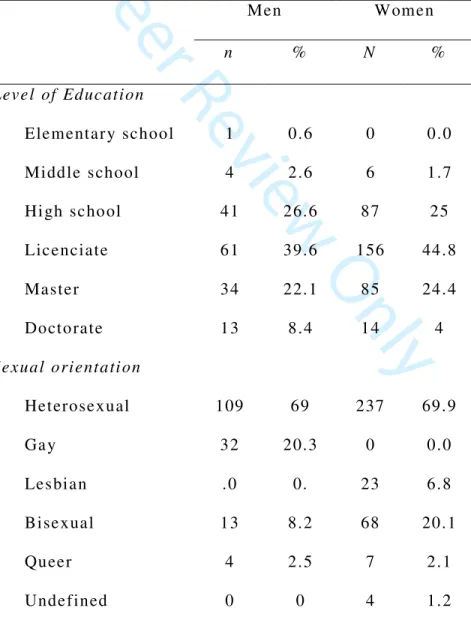
(69.6%; n = 346). Most participants mentioned they were in a monogamous relationship (58.5 %; n = 299). The main socio-demographic characteristics of the sample are shown in Table 1. To be included as a participant, respondents needed to be 18 years or older, they had to be living in Portugal, and to have Portuguese as their first language; these conditions were set to try to avoid any problems with question comprehension; respondents also had to identify as men or women (including trans people who identified as such), this condition was set to guarantee that no participants would be excluded due to lack of respondents in other gender categories.
Table 1. Socio-demographic characteristics of the sample (N = 519).
Men Women n % N % Level of Education Elementar y school 1 0. 6 0 0. 0 Middle school 4 2. 6 6 1. 7 Hi gh scho ol 41 26. 6 87 25 Licenciate 61 39. 6 156 44. 8 Master 34 22. 1 85 24. 4 Docto rate 13 8. 4 14 4 Sexual orientati on Heterosexual 109 69 237 69. 9 Ga y 32 20. 3 0 0. 0 Lesbian . 0 0. 23 6. 8 Bisexual 13 8. 2 68 20. 1 Queer 4 2. 5 7 2. 1 Undefined 0 0 4 1. 2 3 4 5 6 7 8 9 10 11 12 13 14 15 16 17 18 19 20 21 22 23 24 25 26 27 28 29 30 31 32 33 34 35 36 37 38 39 40 41 42 43 44 45 46 47 48 49 50 51 52 53 54 55 56 57
For Peer Review Only
Type of Relation ship
Monogam ous 91 58. 3 208 58. 6 None 31 19. 9 81 22. 8 Occasional 14 9 29 8. 2 Non-monogam ou s 20 12. 8 35 9. 9 Prefer not to answer 0 0 2 0. 6 M DP M DP Age 35. 93 10. 84 31. 40 9. 83 Instruments
Socio-demographic Questionnaire - Participants answered a brief socio-demographic form to collect general information such as gender, age, sexual orientation and gender identity.
Attitudes Towards Polyamory Scale - We used a translated and adapted Portuguese ATP scale which has been previously described (Johnson et al., 2015).
Modern Heterosexism - The Modern Heterosexism is a subscale of the
Multidimensional Scale of Attitudes Toward Lesbians and Gay Men (Gato, Fontaine, & Carneiro, 2012) - It assesses contemporary homonegativity and prejudice that is
associated with sexual minorities. The subscale comprises 7 items that can range from 1 (Completely Disagree) to 6 (Completely Agree) with higher total scores indicating higher levels of modern heterosexism. The original measure proved to be valid and reliable. In the current study it presents a Cronbach’s alpha of .79 in the validation sample. 3 4 5 6 7 8 9 10 11 12 13 14 15 16 17 18 19 20 21 22 23 24 25 26 27 28 29 30 31 32 33 34 35 36 37 38 39 40 41 42 43 44 45 46 47 48 49 50 51 52 53 54 55 56 57
For Peer Review Only
The Rosenberg’s Self Esteem Scale (RSES) (Rosenberg, 1965) - The RSES assess global self-esteem using 10 items that can be answered on a scale from 1 (Strong Disagree) to 4 (Strongly Agree). Higher scores indicate higher self-esteem. The measure has proven to be valid and reliable in Portuguese samples (Santos & Maia, 2003). In the current study it presents a Cronbach’s alpha of .92 in the validation sample.
The Willingness to Engage in Consensual Non-Monogamies Scale (WECNMS) (Sizemore & Olmstead, 2017) - It is a 6-item single factor measure. As its name
indicates the measure assess the willingness to engage in CNM. Respondents answer with a scale ranging from 1 (very unwilling) to 7 (very willing) with higher scores indicating greater willingness to engage in CNM. The measure has not been validated in Portuguese samples. For the current study we followed the procedures for scale
translation and adaptation previously described (page X, line X). In the current study the measure has proved to be reliable with a Cronbach’s alpha of .86. We have, in the meantime, become aware that another translation was made by a different Portuguese team (Lopes & Rodrigues, 2018), and preliminary results, as of yet unpublished, have demonstrated that the scale is reliable.
Procedure
First, the authors contacted the authors of the original or adapted versions of the
measures in order to ask for authorization to use the measures and pursue the translation and adaptation when applicable. After the approval by the original author, the research team developed the translation process following the World Health Organization
protocol of forward-backward translation technique to translating the scale from English to Portuguese (World Health Organization, 2016). There were two independent
translators of the English version into Portuguese. Some of the authors of the current study and another person fluent in the two languages evaluated the two versions and
3 4 5 6 7 8 9 10 11 12 13 14 15 16 17 18 19 20 21 22 23 24 25 26 27 28 29 30 31 32 33 34 35 36 37 38 39 40 41 42 43 44 45 46 47 48 49 50 51 52 53 54 55 56 57
For Peer Review Only
merged them based on semantic equivalence. After that, another bilingual person back translated the Portuguese version into English. The author verified the back translation was very similar to the original and therefore a final version was accepted to be validated.
After ethical approval by the XXXXX (Blinded for Review Purposes), the study was set up in a secure server using an online survey platform (LimeSurvey).
Participants were recruited with a snowball-like technique as the URL was disseminated in social and professional networks (e.g. LinkedIn, Facebook) for ten days starting in February 16th, 2017. Potential participants were directed to an informed consent page where information about the authors and aims of study was presented. Information about the voluntary nature of the study as well as confidentiality and
non-reimbursement was also provided. The survey included a definition of polyamory before the self-report measures were presented, to minimize the effect of knowledge or disinformation gaps that respondents might have. The definition presented was: “In the context of this study, ‘polyamory’ means the practice, desire or acceptance of being in more than one intimate relationship (sexual and/or amorous, not necessarily romantic) at the same time, with the informed consent of all involved (for instance, someone who has more than one romantic relationship at the same time, and where all people involved know about it and agree to it)”.
Procedure
The psychometric proprieties including feasibility, validity, and reliability of the Portuguese version of the Attitudes Towards Polyamory (ATP) scale were examined. The feasibility and acceptability were analysed on the entire sample (N = 609) through four indicators: overall response rate, floor effect, ceiling effect (i.e., high endorsement rates at the bottom and top ends of the response scale) and non-response rate. Items
3 4 5 6 7 8 9 10 11 12 13 14 15 16 17 18 19 20 21 22 23 24 25 26 27 28 29 30 31 32 33 34 35 36 37 38 39 40 41 42 43 44 45 46 47 48 49 50 51 52 53 54 55 56 57
For Peer Review Only
were considered unfeasible when missing values >.10% and floor and ceiling effects <80% (Hilari, Byng, Lamping, & Smith, 2003).
The validity was assessed using a two-stage process in the exploration and validation of the factorial structure of the Portuguese version of the ATP, as
recommended by Anderson and Gerbing (1988). Cases containing missing values on at least one item of the Portuguese version of the ATP were excluded, yielding a final sample size of 519 participants (out of 609). The analyses were performed with a split-sample approach by using the random split-sample selection procedure (1:1 ratio) in SPSS version 23.0. This provided a calibration sample (n = 260) for identifying and fine-tuning the factor structure through exploratory factor analysis (EFA) and a validation sample (n =259) for testing the stability of the final model via Confirmatory Factorial Analysis (CFA). Following the recommendations of Tabachnick and Fidell (2013), the calibration and validation data samples were checked for normality of data distribution and outliers, prior to analysis. Both samples were similar in terms of socio-demographic characteristics (all ps >.05). In the first stage of analysis, EFA was conducted using Principal Axis Factoring (PAF) in order to determine the underlying measurement model, following the standard factor extraction, rotation, and interpretation phases, as recommend by Sakaluk and Short (2017). Prior to EFA, a Parallel Analysis (PA) was conducted to determine the number of factors to retain. PA was used in conjunction with the Guttman-Kaiser criterion (i.e., eigenvalue >1.00). The use of PA relies on the fact solid evidence of its accuracy in determining the threshold for significant factors and variable loadings when decomposing a correlation matrix (e.g., Franklin, Gibson, Robertson, Pohlmann, & Fralish, 1995; R. Ledesma, 2007; Zwick, 2015). PA was performed with an IBM SPSS MACRO available from O’Connor (2000) and 5000 randomly generated datasets were used. Initially, a factor was retained if the obtained
3 4 5 6 7 8 9 10 11 12 13 14 15 16 17 18 19 20 21 22 23 24 25 26 27 28 29 30 31 32 33 34 35 36 37 38 39 40 41 42 43 44 45 46 47 48 49 50 51 52 53 54 55 56 57
For Peer Review Only
eigenvalue exceeded the 95th percentile of the random eigenvalue distribution and met the Guttman-Kaiser criterion. Once the number of factors that met these criteria were filled, factor solutions were examined. A varimax rotation was applied to transform the original principal components produced, to ease interpretation (Hair, Black, Babin, & Anderson, 2009). Factor loadings <.30 were considered non-substantive, loadings ≥.30 and <.40 were considered questionable, and loadings ≥.40 were considered substantive (Volker et al., 2016). Items with low communalities (h2 <0.3) were eliminated (Hair et al., 2009). Whenever the criteria of factor loading or communality values were not met, the item(s) were removed and the EFA was performed again until a final structural solution was found. The model derived from the EFA was subsequently evaluated using CFA at the second stage of validity analysis.
In CFA, the variances of the latent variable were set to unity in order to identify the structural model and maximum-likelihood estimation procedure was applied. Multiple criteria were employed to assess the goodness-of-fit of the model (Hair et al., 2009). The RMSEA was used as the main fit index. RMSEA values are interpreted as follows: RMSEA smaller than .05 indicates good fit, ranging from .05 to .08 reasonable fit, .08 to .10 medium fit, and larger than .10 poor fit (Byrne, 2009). Values of CFI, TLI, and GFI that exceed .9 were interpreted as indicating adequate model fit (Hu & Bentler, 1998). The modification index (MI) was used for inclusion of additional parameters. A larger MI (e.g., >50) between two items indicated that those two items measured the same thing, thus necessitating deletion of one of the items, according to the parsimony principle (Chang, 2011). The CFA structural model would be modified until most of the model fit indices meet the criteria. Convergent validity of the items and factor structure was determined through standardized factor loading (≥ 0.50 were considered acceptable) and average variance extraction (AVE; ≥ 0.50 was considered
3 4 5 6 7 8 9 10 11 12 13 14 15 16 17 18 19 20 21 22 23 24 25 26 27 28 29 30 31 32 33 34 35 36 37 38 39 40 41 42 43 44 45 46 47 48 49 50 51 52 53 54 55 56 57
For Peer Review Only
acceptable). Convergent reliability was also assessed through composite reliability (CR), estimated using a covariance structure modeling procedure with nonlinear constraints outlined by Raykov (1997) . CR; ≥.70 was considered adequate. AVE was manually computed following the guidelines of Hair et al. (2009).
The reliability of the Portuguese version of the ATP was assessed in both calibration and validation samples. Cronbach’s Alpha, inter-item correlation
coefficients, corrected item-total correlations and alpha if the item deleted were used to estimate internal consistency reliability. Alpha Cronbach values > 0.7, item correlation coefficients > 0.20, and inter-item correlations coefficients < 0.80 and higher than zero were regarded as acceptable. Alpha Cronbach value < 0.5 was regarded as unacceptable (Nunnally, 1978). When the corrected item-total correlation coefficient was < 0.3 or the deletion of which led to an increase of more than 0.1 in Cronbach’s coefficient alpha, the item would be removed (Kim & Stoel, 2004; Streiner, 2003).
Finally, convergent, divergent and criterion concurrent validity were assessed using the validation sample. Pearson’s correlation coefficient was used to assess the strength of association with related dimensions (Modern Heterosexism); as well as unrelated (Self-Esteem) and a possible outcome (Willingness to Engage in Consensual Non-Monogamy). Pearson r values of 0.10, 0.30 and 0.50 were considered small, medium and large in magnitude, respectively, as recommended by Cohen (1988).
Feasibility, validity (via EFA and Pearson’s correlation coefficient) and reliability were tested using IBM SPSS v. 23.0. CFA was performed with IBM SPSS Amos v.20 (SPSS Inc., Chicago, IL, USA). In all statistical procedures, a 5% level of significance was set (p<.05).
3 4 5 6 7 8 9 10 11 12 13 14 15 16 17 18 19 20 21 22 23 24 25 26 27 28 29 30 31 32 33 34 35 36 37 38 39 40 41 42 43 44 45 46 47 48 49 50 51 52 53 54 55 56 57
For Peer Review Only
ResultsFeasibility and Acceptability
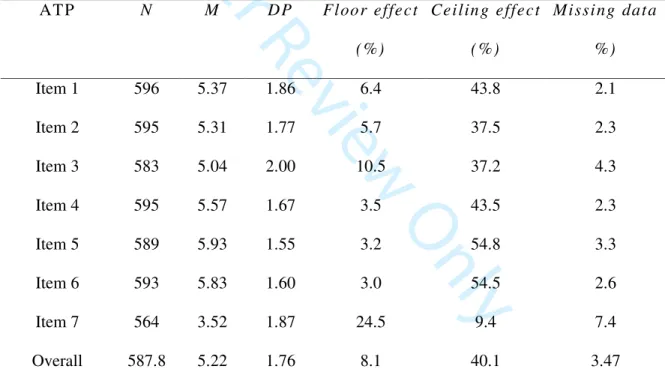
Missing data rates for the Portuguese version of the ATP items were low (Table 2), ranging from 2.1 % to 7.4% at an item level. The overall response rate was high (96.5%) with 85.2% participants (n = 519) answering all scale items. Both floor and ceiling effects for each item were below 80%, which is acceptable under the
recommendations of Hilari et al. (2003). Detailed data related to the feasibility are shown on Table 2.
Table 2. Feasibility and Acceptability results on items of the Portuguese version of the ATP using the entire sample (N = 609).
AT P N M DP Floor effect ( %) Ceiling effect ( %) Missi ng dat a %) Item 1 596 5.37 1.86 6.4 43.8 2.1 Item 2 595 5.31 1.77 5.7 37.5 2.3 Item 3 583 5.04 2.00 10.5 37.2 4.3 Item 4 595 5.57 1.67 3.5 43.5 2.3 Item 5 589 5.93 1.55 3.2 54.8 3.3 Item 6 593 5.83 1.60 3.0 54.5 2.6 Item 7 564 3.52 1.87 24.5 9.4 7.4 Overall 587.8 5.22 1.76 8.1 40.1 3.47 A final sample of 519 eligible participants was used for validity and reliability analysis. 3 4 5 6 7 8 9 10 11 12 13 14 15 16 17 18 19 20 21 22 23 24 25 26 27 28 29 30 31 32 33 34 35 36 37 38 39 40 41 42 43 44 45 46 47 48 49 50 51 52 53 54 55 56 57
For Peer Review Only
Validity
Exploratory Factor Analysis (EFA)
Following the recommendations of Tabachnick and Fidell (2013), calibration sample data (n = 260) were checked for normality distribution. Univariate normality was assumed, however, Mahalanobis distance values evidenced 3 multivariate outliers (critical value χ2 (7) = 24.32; α=.001), which were removed, resulting on a final
calibration sample of 257 participants. PA suggested that the optimal number of factors to retain was only one. This one-factor solution was further examined using PAF. The KMO value of .86 supported the adequacy of the sample. The significance of Bartlett’s test of sphericity [χ2 (7) = 512.37; p < .001] meant that correlations between items were large enough to conduct an EFA.
After conducting the first EFA, one factor was retained which accounted for nearly 50% of total variance. However, item 7 - “Religious forms of polyamory (such as polygamy) are acceptable” - showed a low communality value (.09) and a factor loading below .4 (.31), which was, therefore, excluded from the further analyses. When this item was removed, the EFA returned again a single factor solution accounting for 53.7 % of the explained variance, supporting the unidimensionality of the Portuguese version of the ATP (Table 3).
Table 3. Factor loadings and communalities for each item.
Item Factor h2
I TE M 1 Polyamory is harmful to children (R) .65 .42
I TE M 2 Polyamorous relationships can be
successful in the long term
.74 .57 3 4 5 6 7 8 9 10 11 12 13 14 15 16 17 18 19 20 21 22 23 24 25 26 27 28 29 30 31 32 33 34 35 36 37 38 39 40 41 42 43 44 45 46 47 48 49 50 51 52 53 54 55 56 57
For Peer Review Only
I TE M 3 I think that committed relationships with
more than two individuals should have the same legal rights as married couples
.74 .54
I TE M 4 People use polyamorous relationships as
a way to cheat on their partners without consequence (R)
.71 .50
I TE M 5 I would allow my children to spend time
with a peer who had polyamorous parents
.58 .32
I TE M 6 Polyamorous relationships spread STIs
(sexually transmitted infections) (R)
.58 .33
Eigenvalue 3.22
Total variance explained (%)
53.74
Note: (R) indicates item is reverse coded.
Confirmatory Factor Analysis (CFA)
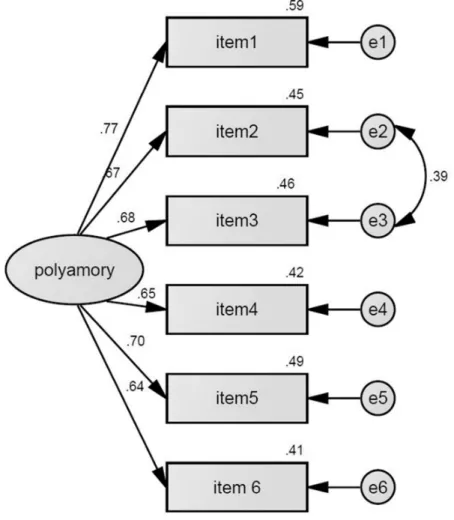
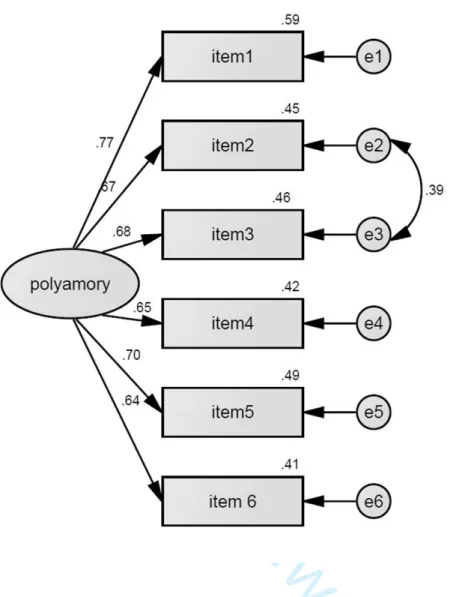
The validation sample was checked for multivariate outliers via Mahalanobis distance. No multivariate outliers were found (all p1 and p2 > .001) (Tabachnick & Fidell, 2013). Skewness and kurtosis values were within the recommended range values, indicating a normal distribution of each item (Kline, 2005). The results of the EFA were used as evidence of the underlying one-factor structure (6 items) of the Portuguese version of the ATP and CFA served to confirm this factor structure. The one-factor model showed a good fit TLI = .90, CFI = .94, GFI = .94, however, RMSEA = .122; 90% CI [.09, .16] was unsatisfactory. According to the MI, an improved model fit could be achieved through the addition of a covariance path between e2-e3 (MI = 19.35). Once the error
3 4 5 6 7 8 9 10 11 12 13 14 15 16 17 18 19 20 21 22 23 24 25 26 27 28 29 30 31 32 33 34 35 36 37 38 39 40 41 42 43 44 45 46 47 48 49 50 51 52 53 54 55 56 57
For Peer Review Only
covariance was added, CFA was reconducted. The new model with correlated errors resulted in better fit measures TLI = .98, CFI = .98, GFI = .98 and RMSEA = .059; 90% CI [.00, .10], indicative of a good fit. All standardized loadings were relatively high, ranging in absolute value from 0.64 to 0.77 and statistically significant, which confirmed the convergent validity of the Portuguese version of the ATP. (Hair et al., 2009). The value of CR was 0.82, indicating good construct reliability. The AVE for the construct was 0.60, suggesting adequate convergence (Hair et al., 2009).
Figure 1. Confirmatory Factor Analysis of the Portuguese version of the Attitudes Toward Polyamory Scale (ATP).
3 4 5 6 7 8 9 10 11 12 13 14 15 16 17 18 19 20 21 22 23 24 25 26 27 28 29 30 31 32 33 34 35 36 37 38 39 40 41 42 43 44 45 46 47 48 49 50 51 52 53 54 55 56 57
For Peer Review Only
Reliability
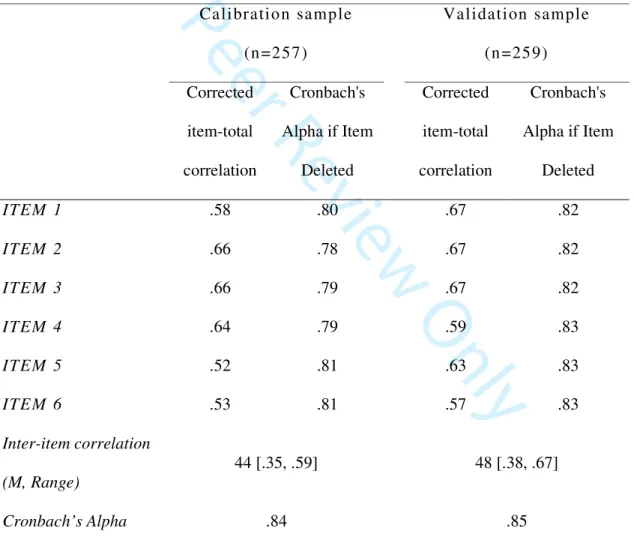
The analysis showed a very good internal consistency of the scale in the calibration sample (α = .83) and in the validation sample (α = .85). Similarly, inter-item
correlations and corrected item-total correlations were within the recommended range, indicating homogeneity of the measure (Table 4). Regarding Cronbach's alpha if item deleted, there was no evidence suggesting the removal of any item.
Table 4. Cronbach’s alpha coefficients and items correlations for Portuguese version of the Polyamory in the calibration sample and in the validation sample.
Calibratio n sample (n =257) Validation sample (n =25 9) Corrected item-total correlation Cronbach's Alpha if Item Deleted Corrected item-total correlation Cronbach's Alpha if Item Deleted ITE M 1 .58 .80 .67 .82 ITE M 2 .66 .78 .67 .82 ITE M 3 .66 .79 .67 .82 ITE M 4 .64 .79 .59 .83 ITE M 5 .52 .81 .63 .83 ITE M 6 .53 .81 .57 .83 Inter-item correlation (M, Range) 44 [.35, .59] 48 [.38, .67] Cronbach’s Alpha .84 .85
Note: M = mean; R = range 3 4 5 6 7 8 9 10 11 12 13 14 15 16 17 18 19 20 21 22 23 24 25 26 27 28 29 30 31 32 33 34 35 36 37 38 39 40 41 42 43 44 45 46 47 48 49 50 51 52 53 54 55 56 57
For Peer Review Only
Convergent, Divergent and Concurrent Criterion Validity
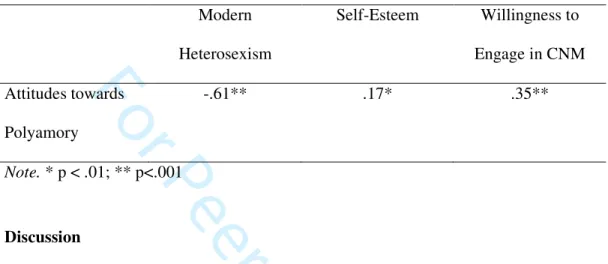
The associations among variables are presented in Table 5.
Table 5. Pearson’s Correlations between attitudes towards Polyamory, self-esteem and willingness to engage in consensual non-monogamies (n=259).
Modern Heterosexism Self-Esteem Willingness to Engage in CNM Attitudes towards Polyamory -.61** .17* .35** Note. * p < .01; ** p<.001 Discussion
The current study aimed to adapt and examine the reliability and validity of a measure of attitudes toward polyamory in a sample of Portuguese adults. We used two
subsamples from the same data set and determined that the measure was unidimensional, with a clear structure, and reliable.
The low non-response rate, as well the low floor and ceiling effects observed, suggest all together that Portuguese version of the ATP has good feasibility.
Regarding the results of the EFA, our data is consistent with the original studies of the ATP, with the items loading into a single factor (Johnson et al., 2015). However, in our study the item “Religious forms of polyamory (such as polygamy) are
acceptable” was removed as the assumptions for its preservation were not met. There are several aspects that may explain the fact that in our sample this particular item did not prove to load on the single factor. People could have difficulties understanding the concept of polygamy, or could be unfamiliar with the term. The most parsimonious would be that our sample did not recognize the concept of polygamy. Another
3 4 5 6 7 8 9 10 11 12 13 14 15 16 17 18 19 20 21 22 23 24 25 26 27 28 29 30 31 32 33 34 35 36 37 38 39 40 41 42 43 44 45 46 47 48 49 50 51 52 53 54 55 56 57
For Peer Review Only
explanation can be that due to lack of contact with polygamous religions, participants could not accurately place their own opinion on the response scale available; according to data from the Catholic Church, about 89% of Portugal’s residents are registered as Catholic, and other religions that are stereotypically associated with polygamy constitute only a fraction of the total population. Both explanations may also apply to the higher non-response rate found in this item. Considering that this item had the lower mean value (3.52 on a scale range from 1 to 7) it can also be a signal of low tolerance to religious diversity in our sample, or that respondents chose the central answer in the scale as a way to signal a ‘neutral’ response.
The inspection of the mean values of the other items that comprise the measure reveal that overall participants have a positive attitude towards polyamory. This can partially be explained by different factors. Firstly, the sample bias. Our sample is young, highly educated people self-defined with distinct identities, sexual and relationship orientations. These can be characteristics of people who are more open, aware and friendly towards sexual diversity, and thus towards non-normative relationship
configurations. Secondly, about 40% of our sample was not in a monogamous situation, and therefore these results can be indicative of the diversity found in the behaviors of the respondents themselves. A two-fold final explanation could relate to self-selection bias: respondents being more willing to complete the survey only when they felt that their attitudes aligned with the survey’s content, and the authors’ social and professional networks might have made the survey more readily available to those with a more positive outlook on relationship diversity.
The variance explained is within the acceptable range (Streiner, 1994). The CFA study with the final structured found with EFA showed a good fit. However, in order to achieve a good fit, a free parameter was needed between the error terms of item 2
3 4 5 6 7 8 9 10 11 12 13 14 15 16 17 18 19 20 21 22 23 24 25 26 27 28 29 30 31 32 33 34 35 36 37 38 39 40 41 42 43 44 45 46 47 48 49 50 51 52 53 54 55 56 57
For Peer Review Only
(“Polyamorous relationships can be successful in the long term”) and item 3 (“I think that committed relationships with more than two individuals should have the same legal rights as married couples”). In our view this covariance can be theoretically explained by an internalization of a norm that relationships should be term, and that long-term relationships are more worthy of institutional protection. As we can see from the phrasing above, the main construct of item 2 is temporality and the main construct of item 3 is legal recognition – but item 3 incorporates the idea of commitment, which is often stereotypically conflated with longer-lasting relationships. Thus, a part of item 3 can be understood as overlapping with item 2, and our results bear this out. In addition, the AVE was above 0.50, supporting the validity of the individual indicators in the Portuguese version of the ATP.
Our results based on Cronbach’s Alpha and CR demonstrated that reliability was good. Corrected item-total correlations were similarly high for all items (>.50),
indicating homogeneity of the scale. However, the mean inter-item correlation is slightly above the highest recommend value (.40) which indicates that the items are slightly redundant amongst themselves. In fact, there are some authors who claim that values between 0.2 and 0.4 are optimal (Clark & Watson, 1995), while others advocate that a mean inter-item correlation consistently above 0.70, may indicate redundancy (Ponterotto & Ruckdeschel, 2007). Therefore, due the fact that the largest inter-item correlation found in both samples (calibration sample and validation sample) was r=.67 we considered mean inter item correlations as satisfactory.
The measure is highly related with measure of modern heterosexism, which points towards an integrative approach of understanding discrimination and negative attitudes, linking homophobia to sexism (Pharr, 2002) and, we would argue, also connecting all of this to negative attitudes towards polyamory, since both monogamy
3 4 5 6 7 8 9 10 11 12 13 14 15 16 17 18 19 20 21 22 23 24 25 26 27 28 29 30 31 32 33 34 35 36 37 38 39 40 41 42 43 44 45 46 47 48 49 50 51 52 53 54 55 56 57
For Peer Review Only
(Pieper & Bauer, 2005) and heterosexuality (Rich, 2007) are part of the normative aspects of sexual and intimate relating in contemporary Western societies (Rubin, 2007). Though it is outside the scope of this study, connections between heterosexism and mononormativity should be further investigated.
There is a low association of ATP and self-esteem a result that is different to the one in the original study, where no significative association was found. The magnitude of the association is very weak which confirms that the measure is not relevantly related with constructs that are theoretically unrelated with polyamory.
Additionally, in the current study we explored the possibility that the measure would have concurrent criterion validity with a theoretically relevant future behavior. Our results support the theoretical hypothesis that more positive attitudes toward polyamory are related to willingness to engage in non-monogamy. This result raises the theoretical possibility that relationship practices can also be shaped by internalized levels of discrimination, and thus gives weight to the importance of combatting discrimination to allow for a more diverse society.
Overall our results support that this version of the ATP is fit to be used in Portuguese. However, this study has limits that cannot be overlooked. Firstly, this is a non-representative sample. Moreover, as stated above, there may be a sampling bias as people more favorable to relationship diversity and with an interest in polyamory may have more will to participate in this study. Furthermore, we did not develop a test-retest analysis that allows to evaluate temporal stability
Nevertheless, this study demonstrates that the Portuguese version of the ATP is a valid, reliable, feasible and well-accepted scale and can be used in future research in polyamory. We have demonstrated that one of the items may be culture sensitive, a result worth exploring in future adaptations of the measure in different cultural contexts.
3 4 5 6 7 8 9 10 11 12 13 14 15 16 17 18 19 20 21 22 23 24 25 26 27 28 29 30 31 32 33 34 35 36 37 38 39 40 41 42 43 44 45 46 47 48 49 50 51 52 53 54 55 56 57
For Peer Review Only
Furthermore, we have demonstrated that attitudes towards polyamory are strongly associated with attitudes towards other sexual minorities (in the current study, lesbian women and gay men) as well as with the will to engage in consensual non-monogamies. We have given an additional contribution to the literature in the field by briefly
assessing construct validation and reliability of the WECNMS in a Portuguese sample. Further studies need to be developed in order to better understand the behavior of this measure, especially its temporal evolution, and its connection to other attitudinal constructs and to potentially discriminatory self-reported behaviors.
References
Anderson, J. C. J. C., & Gerbing, D. W. D. W. (1988). Structural equation modeling in practice: A review and recommended two-step approach. Psychological Bulletin,
103(3), 411–423. http://doi.org/10.1037/0033-2909.103.3.411
Barker, M. (2005). This is my partner, and this is my … partner’s partner: Constructing a polyamorous identity in a monogamous world. Journal of Constructivist
Psychology, 18(1), 75–88.
http://doi.org/https://doi.org/10.1080/10720530590523107
Byrne, B. M. (2009). Structural equation modeling with AMOS: Basic concepts,
applications, and programming (2nd ed.). New York: Routledge/Taylor & Francis.
Cardoso, D. (2014). My Spivak is bigger than yours: (Mis-)representations of
polyamory in the Portuguese LGBT movement and mononormative rhetorics. LES
Online, 6(1), 45–64. Retrieved from
https://lesonlinesite.wordpress.com/vol-6-no-1-2014/
Cardoso, D., & Ribeiro, I. (2016). Polyamory as a gendered experience: Portuguese women talk about non-monogamies and discrimination. Coimbra: Paper presented at the 6o Congresso da Associação Portuguesa de Antropologia.
3 4 5 6 7 8 9 10 11 12 13 14 15 16 17 18 19 20 21 22 23 24 25 26 27 28 29 30 31 32 33 34 35 36 37 38 39 40 41 42 43 44 45 46 47 48 49 50 51 52 53 54 55 56 57
For Peer Review Only
Chang, W. H. (2011). How to Write and Submit an Academic Paper with SEM. Taichung, Taiwan: Tingmao.
Clark, L. A., & Watson, D. (1995). Constructing validity: Basic issues in objective scale development. Psychological Assessment, 7(3), 309–319.
http://doi.org/10.1037/1040-3590.7.3.309
Cohen, J. (1988). Statistical power analysis for the behavioral sciences. Statistical
Power Analysis for the Behavioral Sciences. http://doi.org/10.1234/12345678
Conley, T., Moors, A., Matsick, J., & Ziegler, A. (2012). The Fewer the merrier?: Assessing stigma surrounding consensually non‐monogamous romantic relationships. Analyses of Social Issues and Public Policy, 13(1), 1–30. http://doi.org/10.1111/j.1530-2415.2012.01286.x
Franklin, S. B., Gibson, D. J., Robertson, P. A., Pohlmann, J. T., & Fralish, J. S. (1995). Parallel Analysis: a Method for Determining Significant Principal Components Recommended Citation. Journal of Vegetation Science, 6(1), 99–106. Retrieved from http://opensiuc.lib.siu.edu/pb_pubs
Freire, S. E. de A. (2013). Poliamor, uma forma não exclusiva de amar: correlatos
valorativos e afetivos. Universidade Federal da Paraíba. Retrieved from
http://tede.biblioteca.ufpb.br:8080/handle/tede/6928
Gato, J., Fontaine, A. M., & Carneiro, N. (2012). Multidimensional scale of attitudes toward lesbians and gay men: Construction and preliminary validation. Paidéia,
22, 11–20. http://doi.org/10.1590/S0103-863X2012000100003
Hair, J., Black, W., Babin, B., & Anderson, R. (2009). Multivariate data analysis.
Prentice Hall. London.
Haritaworn, J., Lin, C., & Klesse, C. (2006). Poly/logue: A critical introduction to polyamory. Sexualities, 9(5), 515–529. http://doi.org/10.1177/1363460706069963
3 4 5 6 7 8 9 10 11 12 13 14 15 16 17 18 19 20 21 22 23 24 25 26 27 28 29 30 31 32 33 34 35 36 37 38 39 40 41 42 43 44 45 46 47 48 49 50 51 52 53 54 55 56 57
For Peer Review Only
Hilari, K., Byng, S., Lamping, D. L., & Smith, S. C. (2003). Stroke and aphasia quality of life scale-39 (SAQOL-39): Evaluation of acceptability, reliability, and validity.
Stroke, 34(8), 1944–1950. http://doi.org/10.1161/01.STR.0000081987.46660.ED
Hogg, M., & Vaughan, G. (2005). Social Psychology (4th ed.). London: Prentice-Hall. Hu, L., & Bentler, P. (1998). Fit indices in covariance structure modeling: Sensitivity to
underparameterized model misspecification. Psychological Methods, 3(4), 424– 453. http://doi.org/http://dx.doi.org/10.1037/1082-989X.3.4.424
Johnson, S. M., Giuliano, T. A., Herselman, J. R., & Hutzler, K. T. (2015).
Development of a brief measure of attitudes towards polyamory. Psychology &
Sexuality, 6(4), 325–339. http://doi.org/10.1080/19419899.2014.1001774
Kim, S., & Stoel, L. (2004). Dimensional hierarchy of retail website quality.
Information & Management, 41(5), 619–633.
http://doi.org/https://doi.org/10.1016/j.im.2003.07.002
Kline, R. B. (2005). Principles and Practice of Structural Equation Modelling (2nd ed.). New York: The Guilford Press.
Ledesma, R., & Valero-Mota, P. (2007). Determining the number of factors to retain in EFA: An easy-to-use computer program for carrying out Parallel Analysis.
Practical Assessment, Research & Evaluation, 12(2), 2–11.
http://doi.org/http://pareonline.net/getvn.asp?v=12&n=2
Lopes, D., & Rodrigues, D. (2018, May). Consensual non-monogamy: A scale adaptation
and validation, preliminary psychometric properties and associations with related
constructs. Conference Oral Presentation presented at the European Sexology
Conference 2018, Albufeira.
Mint, P. (2008). Polyamory is not about the sex, except when it is. Retrieved May 27, 2018, from https://freaksexual.com/2008/01/31/polyamory-is-not-about-the-sex-3 4 5 6 7 8 9 10 11 12 13 14 15 16 17 18 19 20 21 22 23 24 25 26 27 28 29 30 31 32 33 34 35 36 37 38 39 40 41 42 43 44 45 46 47 48 49 50 51 52 53 54 55 56 57
For Peer Review Only
except-when-it-is/
Nunnally, J. C. (1978). Psychometric theory (2nd ed.). New York: McGraw-Hill. O’Connor, B. P. (2000). SPSS and SAS programs for determining the number of
components using parallel analysis and Velicer’s MAP test. Behavior Research
Methods, Instruments, & Computers, 32(3), 396–402.
http://doi.org/10.3758/BF03200807
Pharr, S. (2002). Homophobia: a weapon of sexism. Berkeley, Calif.; Little Rock, AR: Chardon Press : Distributed by the Women’s Project.
Pieper, M., & Bauer, R. (2005). Polyamory und Mono-Normativität. Ergebnisse einer empirischen Studie über nicht-monogame Lebensformen. In L. Méritt (Ed.), Mehr
als eine Liebe: polyamouröse Beziehungen (pp. 59–69). Berlin: Orlanda.
Ponterotto, J. G., & Ruckdeschel, D. E. (2007). An overview of coefficient alpha and a reliability matrix for estimating adequacy of internal consistency coefficients with psychological research measures. Perceptual and Motor Skills, 105(3 Pt 1), 997– 1014. http://doi.org/10.2466/pms.105.3.997-1014
Rambukkana, N. (2015). Open Non-monogamies. In C. Richards & M. J. Barker (Eds.),
The Palgrave Handbook of the Psychology of Sexuality and Gender (pp. 236–260).
London: Palgrave Macmillan UK. http://doi.org/10.1057/9781137345899_15 Raykov, T. (1997). Scale reliability, Cronbach’s coefficient Alpha, and violations of
Essential Tau-Equivalence with Fixed Congeneric Components. Multivariate
Behavioral Research, 32(4), 329–353.
http://doi.org/10.1207/s15327906mbr3204_2
Rich, A. (2007). Compulsory heterosexuality and lesbian existence. In Culture, Society
and Sexuality: A Reader (2nd ed., pp. 209–236). Routledge.
Rosenberg, M. (1965). Society and the adolescent self-image. Princeton, NJ: Princeton
3 4 5 6 7 8 9 10 11 12 13 14 15 16 17 18 19 20 21 22 23 24 25 26 27 28 29 30 31 32 33 34 35 36 37 38 39 40 41 42 43 44 45 46 47 48 49 50 51 52 53 54 55 56 57
For Peer Review Only
University Press.
Rubin, G. (2007). Thinking Sex: Notes for a radical theory of the politics of sexuality. In R. Parker & P. Aggleton (Eds.), Culture, Society and Sexuality: A Reader (2nd ed.). New York: Routledge.
Sakaluk, J. K., & Short, S. D. (2017). A methodological review of Exploratory Factor Analysis in sexuality research: Used practices, best practices, and data analysis resources. The Journal of Sex Research, 54(1), 1–9.
http://doi.org/10.1080/00224499.2015.1137538
Santos, P. J., & Maia, J. (2003). Análise factorial confirmatória e validação preliminar de uma versão portuguesa da escala de auto-estima de Rosenberg. Psicologia:
Teoria, Investigaçäo E Prática, 2, 253–268.
Sheff, E. (2014). The Polyamorists Next Door: Inside Multiple-Partner Relationships
and Families. Lanham: Rowman & Littlefield Publishers, Inc.
Sizemore, K. M., & Olmstead, S. B. (2017). Testing the validity and factor structure of the Willingness to Engage in Consensual Non-Monogamy Scale among college men and women. Sexuality Research and Social Policy, 14(2), 182–191. http://doi.org/10.1007/s13178-016-0263-8
Streiner, D. L. (1994). Figuring out factors: The use and misuse of factor analysis. The
Canadian Journal of Psychiatry, 39(3), 135–140.
http://doi.org/10.1177/070674379403900303
Streiner, D. L. (2003). Starting at the beginning: an introduction to coefficient alpha and internal consistency. Journal of Personality Assessment, 80(1), 99–103.
http://doi.org/10.1207/S15327752JPA8001_18
Tabachnick, B. G., & Fidell, L. S. (2013). Using multivariate statistics. Using
multivariate statistics 6th ed. Harlow, United Kingdom: Pearson Education
3 4 5 6 7 8 9 10 11 12 13 14 15 16 17 18 19 20 21 22 23 24 25 26 27 28 29 30 31 32 33 34 35 36 37 38 39 40 41 42 43 44 45 46 47 48 49 50 51 52 53 54 55 56 57
For Peer Review Only
Limited.
Volker, M. A., Dua, E. H., Lopata, C., Thomeer, M. L., Toomey, J. A., Smerbeck, A. M., … Lee, G. K. (2016). Factor Structure, Internal Consistency, and Screening Sensitivity of the GARS-2 in a Developmental Disabilities Sample. Autism
Research and Treatment, 2016(8243079), 1–12.
http://doi.org/10.1155/2016/8243079
Wandrei, K. E. (2018). “Sleeping with the enemy”: Non-monogamy and 1970s lesbian-feminists. Sexualities. http://doi.org/10.1177/1363460717750074
Weitzman, G. (2006). Therapy with clients who are bisexual and polyamorous. Journal
of Bisexuality, 6(1–2), 137–164. http://doi.org/10.1300/J159v06n01_08
World Health Organization. (2016). Process of translation and adaptation of instruments. Retrieved from
http://www.who.int/substance_abuse/research_tools/translation/en/.
Zwick, W. R. (2015). Comparison of 5 rules for determining the number of components to retain, 99(3), 432–442. http://doi.org/10.1037//0033-2909.99.3.432 3 4 5 6 7 8 9 10 11 12 13 14 15 16 17 18 19 20 21 22 23 24 25 26 27 28 29 30 31 32 33 34 35 36 37 38 39 40 41 42 43 44 45 46 47 48 49 50 51 52 53 54 55 56 57
For Peer Review Only
Figure 1. Confirmatory Factor Analysis of the Portuguese version of the Attitudes Toward Polyamory Scale (ATP).
3 4 5 6 7 8 9 10 11 12 13 14 15 16 17 18 19 20 21 22 23 24 25 26 27 28 29 30 31 32 33 34 35 36 37 38 39 40 41 42 43 44 45 46 47 48 49 50 51 52 53 54 55 56 57