Repositório ISCTE-IUL
Deposited in Repositório ISCTE-IUL:
2018-07-12
Deposited version:
Publisher Version
Peer-review status of attached file:
Peer-reviewed
Citation for published item:
Ramos, J., Lopes, Rui J., Marques, P. & Araújo, D. (2017). Hypernetworks: capturing the multilayers of cooperative and competitive interactions in soccer. In Carlota Torrents, Pedro Passos, Francesc Cos (Ed.), International Congress Complex Systems in Sport. (pp. 150-153). Barcelona: Frontiers.
Further information on publisher's website:
--Publisher's copyright statement:
This is the peer reviewed version of the following article: Ramos, J., Lopes, Rui J., Marques, P. & Araújo, D. (2017). Hypernetworks: capturing the multilayers of cooperative and competitive
interactions in soccer. In Carlota Torrents, Pedro Passos, Francesc Cos (Ed.), International Congress Complex Systems in Sport. (pp. 150-153). Barcelona: Frontiers.. This article may be used for non-commercial purposes in accordance with the Publisher's Terms and Conditions for self-archiving.
Use policy
Creative Commons CC BY 4.0
The full-text may be used and/or reproduced, and given to third parties in any format or medium, without prior permission or charge, for personal research or study, educational, or not-for-profit purposes provided that:
• a full bibliographic reference is made to the original source • a link is made to the metadata record in the Repository • the full-text is not changed in any way
The full-text must not be sold in any format or medium without the formal permission of the copyright holders.
Hypernetworks: Capturing the Multilayers of
Cooperative and Competitive Interactions in
Soccer
João Ramos1,2, Rui J. Lopes1,3, Pedro Marques4, Duarte Araújo5
1ISCTE-Instituto Universitário de Lisboa, Lisbon, Portugal
2Universidade Europeia, Laureate International Universities, Estrada da Correia, Lisboa, Portugal 3Instituto de Telecomunicações, Lisbon, Portugal
4Football Performance, City Football Services, Manchester, United Kingdom
5CIPER, Faculdade de Motricidade Humana, Universidade de Lisboa, Cruz Quebrada Dafundo, Portugal [email protected]
Introduction: Hypernetwork theory brings together the micro–meso–macro levels of
analysis of interaction-based complex systems (Johnson, 2013; Boccaletti et al., 2014). This study considers team synergies (Araújo and Davids, 2016), where teams and athletes are co-evolving subsystems that self-organize into new structures and behav-iors. The emergent couplings of players’ movements have been studied, considering mostly the distance between a player and the immediate opponent (e.g., Headrick et al., 2012), and other interpersonal distance measures (Passos et al., 2011; Fonseca et al., 2013). Such emergent interpersonal behavior of soccer teams can be captured by multilevel hypernetworks approach that considers and represents simultaneously the minimal structure unit of a match (called simplex). More stable structures are called backcloth. The backcloth structure that represents soccer matches is not limited to the binary relations (2-ary) studied successfully by social networks analysis (SNA) but can consider also n-ary relations with n > 2. These simplices most of the times composed of players from both teams (e.g., 1 vs. 1, 2 vs. 1, 1 vs. 2, 2 vs. 2) and the goals. In a higher level of representation, it is also possible to represent the events associated, like the interactions between players and sets of players that could cause changes in the back-cloth structure (aggregations and disaggregation of simplices). The main goal of this study was to capture the dynamics of the interactions between team players at different scales of analysis (micro—meso—macro), either from the same team (cooperative) or from opponent team players (competitive).
Methods: To analyze the interactions of players, we used proximity criteria (closest
player) for defining the set of players in each simplex. The non-parametric feature of this method allows for the analysis of the sets (simplices) that emerge from spa-tiotemporal data of players and form simplices of different types. In this study, we first used the mathematical formalisms of hypernetworks to represent a multilevel team behavior dynamics, including micro (interactions between players established through interpersonal closest distance), meso (dynamics of a given critical event, e.g., goal scoring opportunity) and macro levels (dynamics of emerging local dominance).
We have applied hypernetworks analysis to soccer matches from the English premier league (season 2010–2011) by using two-dimensional player displacement coordinates obtained with a multiple-camera match analysis system provided by STATS (formerly Prozone).
Results: We studied different levels of analysis. At the micro level, we found:
i. The most common minimal simplices are 1 vs. 1 (25.0%), followed by 1 vs. 2 (10.31%), 2 vs. 1 (8.78%), and 2 vs. 2 (6.81%);
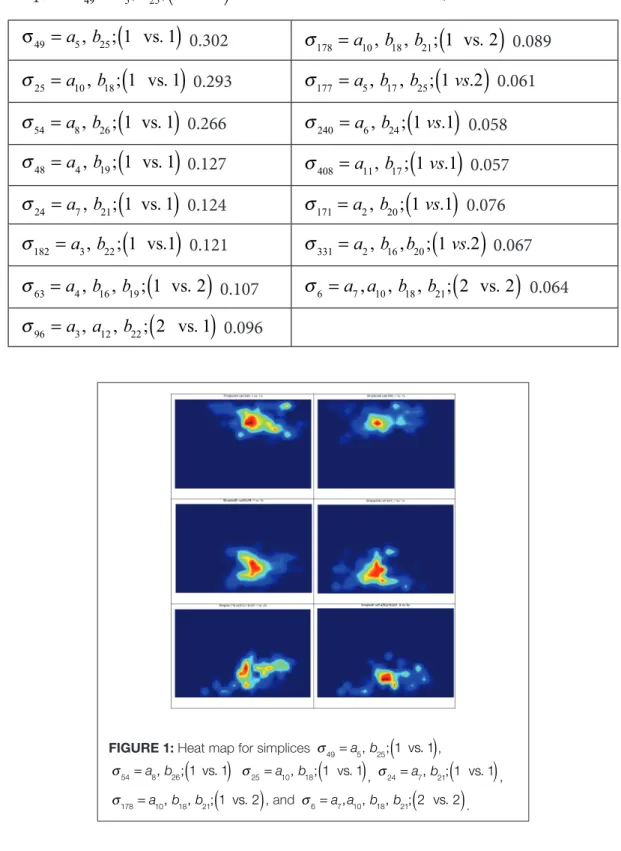
ii. Which players were more often connected forming the same simplices (see Table 1).
iii. Where did it take place (heat maps) in field game (Figure 1)? In the meso level, we identified critical events dynamics such as: i. Velocity of each player related to average velocity of the set;
ii. Changes of velocity and direction to break the symmetry of the set; iii. Which players are central to break or maintain these symmetries.
The dynamics of simplices transformations near the goal depended on, significant changes in the players’ speed and direction.
At macro level, we found how sets were related:
i. Emergent behavior analysis of players to promote local dominance analysis in critical events (see Figure 1);
Simplices are connected to one another, forming simplices of simplices including the goalkeeper and the goal.
Conclusion: The multilevel hypernetworks approach is a promising framework for
soccer performance analysis once it captures cooperative and competitive interactions between players and sets of players. The spatiotemporal feature of the interactions between two or more players and sets of players are captured through the multilevel analyses and allows a richer understanding of real-world complex systems. Notably, players’ moves can promote local dominance, i.e., moving to different directions from their closest players and increasing interpersonal distance; or moving to reduce inter-personal distances, either from their closest (typically) opponents or colleagues (local dominance). The identification of the most frequent simplices of players and their
specific interactions, regarding local dominance, during a match is specific relevant information not only for analyzing the matches but also for preparation for future matches with different opponents.
TABLE 1: Relative frequency for the top 15 simplices in the analyzed match. (e.g.,
simplex σ =49 a b5, ; 1 vs. 125
(
)
was found 30.2% of the time).(
)
σ =49 a b5, ; 1 vs. 125 0.302 σ178 = a b b10, , ; 1 vs. 218 21(
)
0.089 σ25 =a b10, ; 1 vs. 118(
)
0.293 σ177 =a b b5, , ; 1 .217 25(
vs)
0.061 σ54 =a b8, ; 1 vs. 126(
)
0.266 σ240 =a b6, ; 1 .124(
vs)
0.058 σ48 =a b4, ; 1 vs. 119(
)
0.127 σ408 =a b11, ; 1 .117(
vs)
0.057 σ24 =a b7, ; 1 vs. 121(
)
0.124 σ171 =a b2, ; 1 .120(
vs)
0.076 σ182 =a b3, ; 1 vs.122(
)
0.121 σ331= a b b2, , ; 1 .216 20(
vs)
0.067 σ63=a b b4, , ; 1 vs. 216 19(
)
0.107 σ6 =a a b b7, , , ; 2 vs. 210 18 21(
)
0.064 σ96 =a a b3, , ; 2 vs. 112 22(
)
0.096FIGURE 1: Heat map for simplices σ49 = a b5, 25; 1 vs. 1
(
)
,σ54= a b8, 26; 1 vs. 1
(
)
σ25= a b10, 18; 1 vs. 1(
)
, σ24= a b7, 21; 1 vs. 1(
)
, σ178= a b b10, 18, 21; 1 vs. 2(
)
, and σ6= a a b b7, 10, 18, 21; 2 vs. 2(
)
.REFERENCES
Araújo, D., and Davids, K. (2016). Team synergies in sport: theory and measures. Front. Psychol. 7:1449. doi: 10.3389/fpsyg.2016.01449 PMID:27708609
Boccaletti, S., Bianconi, G., Criado, R., Del Genio, C. I., Gómez-Gardenes, J., Romance, M., et al. (2014). The structure and dynamics of multilayer networks. Phys. Rep. 544, 1–122. doi: 10.1016/j.physrep.2014.07.001 Fonseca, S., Milho, J., Travassos, B., Araújo, D., and Lopes, A. (2013). Measuring spatial interaction behav-ior in team sports using superimposed Voronoi diagrams. Int. J. Perform. Anal. Sport 13, 179–189. doi: 10.1080/24748668.2013.11868640
Headrick, J., Davids, K., Renshaw, I., Araújo, D., Passos, P., and Fernandes, O. (2012). Proximity-to-goal as a constraint on patterns of behaviour in attacker–defender dyads in team games. J. Sports Sci. 30, 247–253. doi: 10.1080/02640414.2011.640706
Johnson, J. (2013). Hypernetworks in the Science of Complex Systems, Vol. 3. London: Imperial College Press. Passos, P., Milho, J., Fonseca, S., Borges, J., Araújo, D., and Davids, K. (2011). Interpersonal distance regulates func-tional grouping tendencies of agents in team sports. J. Mot. Behav. 43, 155–163. doi: 10.1080/00222895.2011.552078 PMID:21400329