Revista Gaúcha
de Enfermagem
The parental care partnership in the view of parents
of children with special health needs
A parceria de cuidados pelo olhar dos pais de crianças com necessidades especiais de saúde
La colaboración en cuidados según la mirada de padres de niños con necesidades especiales de salud
João Manuel Nunes de Oliveira Alvesa
José Joaquim Penedos Amendoeirab
Zaida Borges Charepec
ABSTRACT
Objective: To understand how the care partnership was experienced by parents of children with special healthcare needs.
Method: Qualitative, descriptive and exploratory study, carried out from December 2013 to February 2014. The method used was the narrative. The population corresponded to parents of children admitted to a medical service of a Pediatric Hospital in Portugal. The sample consisted of 10 parents. The data collection included the sociodemographic characterization and the etnobiografic orientation interview. Once transcribed, the interviews yielded 10 narratives of partnership experiences between the parents and the nursing team. Results: It was noted, as partnership opportunities, the training of parents and the collaborative decision-making, established in a dynamic, unique and ongoing relational process. Conclusion: The opportunities for partnership are key assumptions for the care delivery focusing on the child and on the parents as their resources.
Keywords: Child. Nursing. Chronic disease. Parents. Caregivers.
RESUMO
Objetivo: Compreender como foi experienciada a parceria de cuidados pelos pais de crianças com necessidades especiais de saúde. Método: Estudo qualitativo, descritivo e exploratório, realizado no período de dezembro de 2013 a fevereiro de 2014. O método utilizado foi a narrativa. A população correspondeu aos pais de crianças internadas num serviço de medicina de um Hospital Pediátrico em Portugal. A amostra foi constituída por 10 pais. A coleta de dados contemplou a caracterização sociodemográfica e a entrevista de orientação etnobiográfica. Depois de transcritas, as entrevistas originaram 10 narrativas de experiências de parceria dos pais com a equipe de enfermagem.
Resultados: Constatou-se, enquanto oportunidades de parceria, a capacitação dos pais e a tomada de decisão em parceria, estabe-lecidas num processo relacional dinâmico, singular e contínuo.
Conclusão: As oportunidades de parceria são pressupostos fundamentais para a prestação de cuidados com foco na criança e nos pais enquanto recursos da mesma.
Palavras-chave: Criança. Enfermagem. Doença crônica. Pais. Cuidadores.
RESUMEN
Objetivo: Comprender la percepción experimentada por padres de niños con necesidades especiales de salud sobre su colaboración en los cuidados de enfermería.
Método: Estudio cualitativo, descriptivo y exploratorio, realizado entre diciembre de 2013 y febrero de 2014. El método utilizado fué la narrativa. La muestra poblacional abarcó a padres de niños internados en servicio de medicina de un hospital pediátrico de Portugal. La muestra fue constituida por 10 padres. La recolección de datos incluyó la caracterización sociodemográfica y la entrevista de orientación etnobiográfica. Después de transcritas, las entrevistas se produjeron 10 historias de experiencias de colaboración de los padres con el equipo de enfermería.
Resultados: Se confirmó la existencia de oportunidades de asociación, la capacitación de los padres y la toma de decisiones en conjunto, las cualesson establecidas en un proceso relacional dinámico, único y permanente.
Conclusión: Las oportunidades de asociación son condiciones fundamentales para la prestación de cuidados de atención en los niños, siendo los padres los medios del niño para obtenerlos.
Palabras clave: Niño. Enfermería. Enfermedad crónica. Padres. Cuidadores. How to cite this article:
Alves JMNO, Amendoeira JJP, Charepe ZB. A parceria de cuidados pelo olhar dos pais de crianças com necessidades especiais de saúde. Rev Gaúcha Enferm. 2017;38(4):e2016-0070.
doi: http://dx.doi.org/10.1590/1983-1447.2017.04.2016-0070.
doi: http://dx.doi.org/10.1590/1983-1447.2017.04.2016-0070
a Hospital Distrital de Santarém, Departamento da
Mulher e da Criança, Serviço de Pediatria. Santarém, Portugal.
b Instituto Politécnico de Santarém, Escola Superior de
Saúde de Santarém. Santarém, Portugal.
c Universidade Católica Portuguesa, Instituto de
INTRODUCTION
In the current reality of child and youth healthcare organizations, parents are considered partners of health professionals. It is part of their parental role to take care of their child, in health and illness, which is as important as feeding, educating, distracting or facilitating their devel-opment. The exercise of the parental role in populations in need of special healthcare is a challenge for them and requires nurses to design the care processes based on evidence-based practices, where the research assumes a growing and fundamental preponderance.
Children with special health needs (SHN) have chron-ic physchron-ical, developmental, behavioral, or emotional dis-orders, such as chronic renal failure, asthma, congenital malformations, oncological diseases, autism, or cerebral palsy(1-2). Parents have to adapt in order to take care of the child at home, necessitating a broad network of family and social support, with the close involvement of health pro-fessionals(3). As mentioned above, pediatric nursing care based on the philosophy of family-centered care and the partnership model of care are considered ideal to help par-ents fulfill the role they will play(2).
International studies have shown that parents seem to value the interactions in which they felt that the nurse knows, understands and cares about the child and the family, namely in meeting the needs of care and develop-ment(3-4). Parents also value the sensitivity and attention shown by the nurse in adapting real-life circumstances to the potential of the child and his/her family, both at the most superficial and concrete level of clinical aspects and in meeting specific emotional needs(4).
In a systematic review of the literature(3), nurses’ atti-tudes, respect, trust, empathy, and advocacy were iden-tified. These attitudes are described in the literature as attributes of the partnership model. The relationships es-tablished between the parents and the health profession-als who meet these requirements were characterized as promoters of parents’ training.
Likewise, gaps have been reported in the transmission of complete information to parents about the clinical situation, treatment and care of the child with SHN(5). These gaps are extended to the communication and sharing of information between the different professionals of the institutions that provide healthcare to children with SHN, interfering with the appropriate coordination of the services, in order to respond adequately to the needs of the children and their families(3).
The nursing care partnership model highlights the cen-trality of the child and the family in the care process, by their full integration in decision making(3). “The partnership means
change, negotiation of the care to children shared with the family; support, teaching and involvement of the family as the result of a negotiation previously established”(3).
The negotiation is based on the value of equality be-tween parents and nurses; and once it is implemented, it values a collaborative dynamics in care planning(6).
Despite the above, the contemporary research pro-duced around this phenomenon points towards the deepening of the analysis of partnership experiences es-tablished between parents and nurses(2-3). For this reason, we have developed a broader research study on the care partnership, aiming to better understand the model in use in a given context of care, which was constituted as a mas-ter’s thesis(7). It was outlined as a research question: what partnership opportunities do parents of children with SHN identify? And as objective: to understand how the parent-ing partnership of children with SHN was experienced.
METHOD
This study is qualitative, descriptive and exploratory. We analyzed the material obtained through ethnobiographic orientation interviews, focusing on the experiential event(8). It was developed in a Pediatric Medical Service of a Pediat-ric Hospital in Portugal.
The population corresponded to the parents of chil-dren with SHN (father and mother), users of the research context. In continuity, we have used a non-probabilistic sample for convenience(9), consisting of 10 parents of chil-dren with SHN. The sampling technique used was the in-tentional sample.
The inclusion criteria in the sample were: parents of children/adolescents whose individual condition fits in the group of children with SHN; diagnosis for more than one year of the health condition of the child/adolescent; parents who experienced previous hospitalizations, due to prior knowledge and time of contact with the nursing team; parents of children with SHN identified by reference element of the nursing team of the research context as having good communication skills.
As exclusion criteria: parents whose children were in the inaugural episode of their health condition, although they were part of the population of children with SHN; parents of children with transient and acute health needs.
its contents. Essential process for the apprehension of the elements that stand out in the history experienced(10).
The constituent elements of the ethnobiographic orien-tation interview were the following: initial question (I would like you to tell me stories that mention experiences in which you have had the opportunity to work together with nurses to provide care for your child along the way you have expe-rienced); final phase of the interview, in which the content narrated was analyzed and new issues related to aspects that were not thoroughly explored or obscured, such as the theoretical aspects of the facts, related to the interviewees’ feelings about the experiences reported(10).
In the next step we resorted to content analysis. We performed the analysis of meanings, the codification, and the categorization of the data(11). Given the uniqueness of each story, the analysis of meanings allowed to identify the global components of the contents, the common pat-terns, as well as to interconnect all the narratives and to investigate the way in which they answered the research question(10). In continuity, the data obtained was coded. The coding is a process in which the data is systematically transformed and aggregated into units of analysis, which allow an accurate description of the relevant characteris-tics of the content. This transformation occurred by clip-ping, enumeration, classification, and aggregation(11). We assigned a code to the participants (P1, P2, P3, P4, P5, P6, P7, P8, P9, P10) that we maintained in the identification of narratives and registration units. In the organization of the coding, we used the clipping to select the registration units and the context units; the enumeration, in which we defined as frequency counting rule the frequency of each unit of record in the text; classification and aggregation of the data by selecting the respective categories.
Since the categorization is a classification operation of the constituent elements of a set(11), we performed the cat-egorical analysis, regrouping the data by themes, catego-ries, subcategocatego-ries, context units, and registration.
This study was approved by the Ethics Committee for Health of the Health Institution. The approval was signed in letter No. 0161 with CES reference, dated of October 21, 2013. The participants involved in the study signed a Free and Informed Consent Term at the stage prior to the data collection, being guaranteed the confidentiality of the data, anonymity and the right to free choice when partici-pating in the research.
RESULTS AND DISCUSSION
The health conditions of the children were related to Chronic Renal failure, which resulted in the need to
per-form peritoneal dialysis (4) and to have a bladder stoma (1); Hirschsprung Disease requiring gastrostomy (1); Cerebral Palsy (1); Short Bowel Syndrome (2) and Neuromuscular Disease requiring a tracheostomy (1). These conditions in-sert them in the group of children with SHN(1-2).
The participants in this study were the mothers of chil-dren with SHN, aged between 20 and 49 years old, pre-dominantly between 30 and 39 years old, whose educa-tion ranged from basic educaeduca-tion, secondary and tertiary education, married and integrated in a nuclear family.
The process of content analysis of the narratives allowed the establishment of two categories, these being the parent training and decision making in partnership and respective subcategories. the parents’ training category included par-ents’ involvement/participation subcategories (10); informa-tion/communication with parents (9); having a reference nurse (7); learning how to take care of the child (5); the nurs-es’ knowledge (4); nursnurs-es’ ways of acting (3). In turn, three subcategories emerged from the decision-making partner-ship category: negotiation of the decision to learn (4); shared care negotiation (4); support the parents’ decision (4).
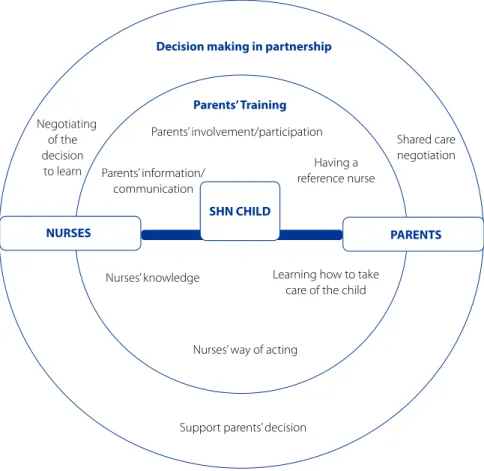
With the results obtained from the analysis of the nar-ratives, we built a schematic representation of partnership opportunities (figure 1).
The schematic representation shown in figure 1, set in circles, idealizes a human development system, which is open and dynamic. The background image was adapt-ed from the bioecological model of human development presented by Bronfenbrenner and Morris(12). These authors advocate models of human development that consider the diverse environments in which the person lives, relates, and develops. The subject/environment interaction is char-acterized by reciprocity, that is, one influences the other, it is a process of mutual interaction. The sharing of knowl-edge and experience results from processes that have con-texts of working in partnership as the “stage”.
The model is based on the premise that the human de-velopment is systemic, where no part makes sense without the vision of the whole. The whole can only be analyzed from its parts and the contexts are environments that in-fluence and are inin-fluenced by the person. It considers four essential elements: the person, the process, the context, and the time. The person is significantly influenced by the interactions between ecosystems (context/environment) that overlap each other.
Figure 1 – Schematic representation of partnership opportunities from the perspective of parents of children with SHN
Parents’ Training Decision making in partnership
Negotiating of the decision
to learn
NURSES
Parents’ involvement/participation
Parents’ information/ communication
Having a reference nurse
SHN CHILD
PARENTS
Nurses’ knowledge Learning how to take care of the child
Nurses’ way of acting
Support parents’ decision
Shared care negotiation
social, and symbolic characteristics that invite, allow, or in-hibit sustained involvement in progressively more complex activities in interaction with the environment. A mesosys-tem includes the interconnections and processes that take place between two or more environments that contain the developing person. It emphasizes development as being directly related to the number of contexts in which the per-son participates.
The names presented: the child, the parents, and the nurses, are understood as active, dynamic subjects, who create and recreate progressively the environment in which they find themselves. The Human Being acts taking into account the meanings built from the social interac-tions that he develops, influencing his/her attitudes, forms of organization, and interpersonal relationships that he/ she establishes(10,12).
The child was in the central position of the partnership care(3,13):
It was good “[…]” to have learned “[…]”for the child (P3). And then “[…]”there was a nice little room for the boys to play, “[…] it was the nurses who put the boys on the floor
for them to play “[…]” they “[…]” must be healthy (P6).” […]”I saw that everything she had done “[…]” was just for his good (P7).
The contexts in which the work in partnership was developed and the time it was spent were understood as resources for the mothers, who work together with the nurses to obtain gains in well-being, quality of life(1,14) and integral development of the children(5,13).
Since birth, she has lived the first 10 months inside the hos-pital and “[…]”the constancy was daily “[…]”to perform with the nurses, from knowing how to handle a baby with the wires attached to it, from the feeding (P6). This part-nership I established with them was, it was very good (P8).
Parents’ training and the establishment of a partnership relationship
In the data related to the category of parents’ training, the development/participation in the child’s care had as purpose their full capacitation. Over time, most partici-pants wished to have the opportunity to learn how to deal with the complexity of children’s health/illness situation(4), that is, to gradually qualify. The learning opportunity has led to the development of mothers’ knowledge and skills to care for their children(4,14).
“[...]” I had to do “[...]” as if I were the nurse (P1). And after that day “[...]” it was step by step. While I did not feel able to do everything alone in the hospital, they did not send me away. (P3) “[...]” from day to night or night to day, I woke up with that desire that it had to be and that it had to start and that was it, I had to get it “[...]” I was a teacher in the process (P4). When we were doing the parenteral nutrition “[...]” we first had to see how they did it once or twice and then we started doing it and it went well (P9).
The term parental involvement covers the caregiving and the decision making(6,15). In this perspective, the moth-ers felt totally involved in the care they gave their children. When they felt empowered to take care of the child, they became involved, assuming full care.
“[...]” I became the nurse of A “[...]” 24 hours, the father was the nurse’s assistant (P6). “... since I was there, it was me who cared for the child from beginning to end” [...] “they gave me this opportunity by being present (P8).
When parents feel involved as partners, they describe it as an interactive process that resembles a “dance” in which the “choreography changes over time” as well as the rhythm of involvement and participation(4).
The information/communication was valued in accor-dance with the results of studies in which parents were giv-en increased importance as they had a wide range of infor-mation on the child’s situation and the care to be given to the child(3,15). Parents become specialists in child care and their knowledge and skills must be respected by nurses(3).
In turn, having a reference nurse meant being able to enjoy the care of a person with extensive experience, which gave them peace of mind(16).
The first time I did it alone at home was on the phone with the “[...]” support nurse, to see if everything was fine and she said it was. I think it is important that we have
some-one to communicate with. It was a great opportunity and a great support that we had (P2). They are there “[...]” to inform us. They do not leave us worried, therefore, there is always, there is communication, in every sense, there is communication, they communicate and they listen to us “[...]” anything that happens at home, the first person I talk to “[...]” is always a nurse (P5). A nurse like her in the service “[...]” had a lot of experience and gave me a lot of peace of mind (P6).
They said that learning how to take care of the child was critical to their empowerment. In the different part-nership experiences established with nurses, in addition to valuing learning moments, they placed a special emphasis on nurses’ knowledge about the condition of these chil-dren(4,17) and their ways of acting. Nurses’ ways of action emerge with emphasis on the nature of the partnership based on interactive help processes(5), making the relation-ship real and useful for both parents and the child.
I had two nurses [X and Y] teaching me (P2). “[...]” I did an apprenticeship with each nurse “[...]” those details, those doubts that arise in the situation, that we do not know what to do with and ask the nurse [X] and she says: Look, this way is better “[...]” the ways in which each one works are different “[...]” to put together what each one knows “[...]” helped me “[...] “it is all positive experiences (P5). “[...]” they teach us as the book says “[...]” it was fun to see the techniques of those people “[...]” by doing new things “[...]” we learned a lot “(P6) “...” “they had knowledge” ... they have the necessary knowledge “[...]” they know the situations (P8). Each one has “[...]” in the end it’s all the same, but each one has its own ways of doing and we have been picking up a way from one part of another and we have made our method, right “ “And we do it at home (P9).
Parents value the nurse’s sensitivity and attention to working the real and potential life circumstances of the child and his/her family, both at the most superficial and concrete level of clinical aspects, and in meeting specific emotional needs(4).
The process of consolidating decision-making in partnership
Regarding the data obtained in the category of deci-sion-making in partnership, we are in agreement with the results of studies carried out in Portugal, which demon-strate that there is, in general, availability for the
the mothers valued the shared care negotiation as part of the work in partnership with nurses, contrary to what hap-pened in the previous subcategory.
“[...]” they also hear us, they also hear us. For example, wearing a nightdress and telling them no, it is easier to take them by the arm, they listen to us, they obey our opin-ion (P5). “... they were always open” [...] “if there was any-thing that would be harmful to him” [...] “they said” [...] and we understood “[...]” they gave us various alternatives to everything (P9).
We found that as mothers felt empowered, they want-ed to make the most decisions independently and/or in collaboration with the nurses, leading the decisions that in-volved managing the care for their children(4,14). In this way, nurses should support the parents’ decision, this being an-other subcategory to which man-others attributed value.
The first time I popped the bags I pierced a bag and filled the bed with liquid “[...]” it was time to care for my daugh-ter, but then I had another bag to warm “[...]” and do it only half an hour later “[...]” I then phoned the nurse [X] who is the reference nurse and she said it made no difference and that I could do it half an hour later. I think that “[…]”.it is a great opportunity and a great support that we have (P2). A decision I made, in which “[...]” I was supported by my nurse (P5).
The mothers felt comfortable with the support they received from nurses in relation to their decisions, in agree-ment with the conclusions of another study in which it is mentioned that despite the specific circumstances in which the partnership experiences occurred, it is import-ant to discuss the decisions with the nurses(15). However, “this care model requires a level of collaboration between parents and nurses, based on mutual respect and trust, im-pacting on self-confidence and the full capacity of parents to “live” with a child with SHN”(3-4). This assertion reflected the value of the participatory and relational aspect of the work in partnership with the parents, namely being heard, respected, and supported in their decisions.
FINAL CONSIDERATIONS
The parent empowerment and decision-making in partnership are opportunities valued by the mothers of children with SHN, since they have facilitated the fulfillment of their parental role. The elements of analysis, when
val-ued by parents, should be a reference for nurses, because they can facilitate the planning of the work in partnership.
Although the parents’ training and decision-making were already part of the terms used in the partnership models, they were not identified as opportunities for part-nership. New terms/expressions have been associated with the concept of partnership, denominated as constitutive elements: learning how to take care of the child, ways of acting of the nurses, having a reference nurse.
For the nursing care practice, the results of this par-ticular study will enable nurses to develop care processes for children with SHN that encompass opportunities for partnership, reflecting the need to empower parents and involve them in decision-making. The elements associated with partnership opportunities are fundamental assump-tions of the care partnership, with a focus on the child and parents as resources.
With implications in the management of the nursing care, the importance of the role of the reference nurse emerged, which was highly valued by the parents, namely in the support to the training and emotional support that the latter makes available to them. It was also clear that the use of the work method by the reference nurse is significant in the periods when the child and parents are hospitalized, but also when they are at home, because this profession-al constitutes an information/training support link, being able to articulate with other professionals and/or available resources. Nurses’ knowledge and ways of acting were sen-sitive to the training of mothers, so we deduced that they should be the most qualified nurses with cognitive, techni-cal-instrumental, and relational skills to play this role.
Finally, we highlight the possibility of continuity of this study in order to be able to answer the questions that de-rive from the discussion and interpretation of the obtained data, of which: which model of care partnership is signifi-cantly relevant for caring for children with SHN? What is the relationship between partnership opportunities to care for children with SHN and the quality of life of these children and their families?
Overall, the results of this study found a foundation in the theoretical frameworks of partnership models and in the practice of caring in partnership (model in use), for which it added a greater appropriation of the concept of partnership with implications for the nursing discipline and greater knowledge about the partnership opportunities.
REFERENCES
1. The Center for Children with Special Needs. 2014 [cited 2014 Oct 14]. Available from: http://www.cshcn.org/planning-record-keeping/guide-care-coordina-tors-wa.
2. Hughes D.A review of the literature: pertaining to family-centered care for children with special health care needs. Palo Alto: Lucile Park Foundation for Children’s Health; 2014 [cited 2017 Jun 14]. Available from: http://www.lpfch. org/sites/default/files/field/publications/review_of_the_literature_pertain-ing_to_family-centered_care_for_cshcn.pdf.
3. Alves JM, Charepe ZB, Amendoeira J. Oportunidades de parceria no cuidar de crianças com necessidades especiais de saúde: a perspetiva dos pais. Nursing. 2014 [cited 2014 Jul 21]; Available from: http://www.nursing.pt/ oportunidades-de-parceria-no-cuidar-de-criancas-com-necessidades-espe-ciais-de-saude-a-perspetiva-dos-pais/#.
4. Howe CJ, Ayala J, Dumser S, Buzby M, Murphy K. Parental expecta-tions in the care of their children and adolescents with Diabetes. J Pedi-atr Nurs. 2012 [cited 2013 Feb 05];27(2):119-26.Available from: http:// ac.els-cdn.com/S0882596310003222/1-s2.0-S0882596310003222- main.pdf?_tid=4a9dae48-6f8c-11e2-bca5-00000aab0f6c&acd-nat=1360066091_5066f8b78884bf8e8d98b48d1a97520e.
5. Mendes MG, Martins MM. Parceria nos cuidados de enfermagem em pediatria: do discurso à ação dos enfermeiros. Rev Enf Ref. 2012;III(6):113-21.
6. Smith L, Coleman V, Bradshaw M. Family-centered care: a practice continuum. In: Smith L, Coleman V. Child and family-centered healthcare: concept, theory and practice. New York: Palgrave Macmillan; 2010. p. 27-57.
7. Alves JMNO. Oportunidades de parceria no cuidar de crianças com necessidades especiais de saúde: a perspectiva dos pais [dissertação]. Lisboa: Universidade Católica Portuguesa; 2015 [cited 2017 Jul 30]. Available from: http://repositorio. ucp.pt/bitstream/10400.14/18056/1/Relat%C3%B3rio%20Jo%C3%A3o%20 Alves%20-%20final.pdf
8. Vieira R. Etnobiografias e descoberta de si: uma proposta da Antropologia da Ed-ucação para a formação de professores para a diversidade cultural. Pro-Posições. 2013 [cited 2016 Dec 30];24(2):109-23. Available from: http://www.scielo.br/ pdf/pp/v24n2/v24n2a09.pdf.
9. Polit DF, Beck CT. Fundamentos de pesquisa em enfermagem: avaliação de evi-dências para a prática de enfermagem. 7. ed. Porto Alegre: Artmed; 2011. 10. Angelo M. Ouvindo a voz da família: narrativas sobre sofrimento e
espiritual-idade. Mundo Saúde.2010 [citado 2016dez 30];34(4):437-43.Disponível em: http://www.saocamilo-sp.br/pdf/mundo_saude/79/437a443.pdf.
11. Bardin, L. Análise de conteúdo. Lisboa: Edições 70; 2011.
12. Cunningham BJ, Rosenbaum PL. A bioecological framework to evaluate com-municative participation outcomes for preschoolers receiving speech–language therapy interventions in Ontario, Canada. Int J Lang Commun Disord. 2015 [cited 2016 Dec 30];50(4):405-15. Available from: https://dx.doi.org/10.1111/1460-6984.12145.
13. Ordem dos Enfermeiros (PT). Colégio da Especialidade de Enfermagem de Saúde Infantil e Pediátrica. Regulamento dos padrões de qualidade dos cuida-dos especializacuida-dos em enfermagem de saúde da criança e do jovem. Lisboa: Ordem dos Enfermeiros; 2013.
14. Silva AF, Issi HB, Motta MG, Botene DZ. Palliative care in paediatric oncology: per-ceptions, expertise and practices from the perspective of the multidisciplinary team. Rev Gaúcha Enferm. 2015 [cited 2016 Dec 30];36(2):56-62. Available from: http://www.scielo.br/pdf/rgenf/v36n2/1983-1447-rgenf-36-02-00056. pdf.
15. Mak L, Hiebert-Murphy D, Walker JR, Altman G. Parents’ decision making and their information needs concerning treatments for child anxiety: implications for family-centered practice. J Fam Soc Work. 2014 [cited 2014 Aug 27];17(1):51-67 Available from: http://www.tandfonline.com/doi/pdf/10.1080/10522158. 2013.809671.
16. Peter S, Chaney G, Zappia T, Veldhuisen CV, Pereira S, Santamaria N. Care coordina-tion for children with complex care needs significantly reduces hospital utilizacoordina-tion. J Spec in Pediatr Nurs. 2011 [cited 2014 Aug 29];16(4):305-12. Available from: http://onlinelibrary.wiley.com/doi/10.1111/j.1744-6155.2011.00303.x/pdf. 17. Moraes JR,Cabral I. A rede social de crianças com necessidades especiais de saúde
na (in) visibilidade do cuidado de enfermagem. Rev Lat-Am Enfermagem. 2012 [cited 2014 Aug 13];20(2):282-8. Available from: http://www.scielo.br/scielo. php?pid=S0104-11692012000200010&script=sci_arttext&tlng=pt.
Corresponding author::
João Manuel Nunes de Oliveira Alves E-mail:[email protected]