Administrative Profiles Unit and
Multi-Sessions Management Scheme for
IPBrick Private Cloud
Anwaar Hussain
Mestrado Integrado em Engenharia Eletrotécnica e de Computadores Internal Supervisor: Prof. João Neves
External Supervisor: Engr. Miguel Ramalhão External Co-Supervisor: Mr. Helder Santos
IPBrick solution in the form of a Private Cloud has been well-received by its customers since its launch in the market. However, it has its own limitations in spite of having some distinct at-tributes. As a result, it can be challenged by its alternatives in the market present at the moment. Currently,the Private Cloud IPBrick is operated by a single user who manages every aspect of it by using the given set of privileges in his/her profile. With the growing demand of IPBrick solution in a circle of some mega-sized firms, it has become difficult for one administrator to handle the management load. Thus, there is a need of distributing the cloud’s access among the multiple administrators by allocating them a profile of their own which will simplify the administration process significantly. Other prominent limitation of IPBrick Saas based solution is its less effec-tiveness in an environment driven by the multi-sessions due to which any level of data conflict in the database can not be mitigated during the concurrent execution of the two or more transactions. For this purpose, a procedure should be implemented in the IPBrick system in-order to preserve the integrity and the consistency of data stored in the database.
This thesis provides the detailed description of implementations that had been carried out for the modules: Administrator Profiles Unit and Multi-Sessions Management Scheme. It also con-tains the literature review which had been covered in the beginning to make sure that the develop-ment phase could be conducted in a best possible fashion. The conceptualization stage along with the applied techniques has been discussed in this thesis that led to the successful accomplishment of all objectives. At the end, some limiting factors are also mentioned due to which the efficiency of both features got constrained to some extent.
Firstly, I would like to thank my thesis advisor Prof. João Neves of the Department of Electrical and Computer Engineering at Faculty of Engineering, University of Porto. I had an affiliation with Prof. Neves as a student even before performing my dissertation under his supervision and I always found him truly inspirational. Throughout this thesis, he had allowed me to work on my ideas and steered me in the right direction whenever it was required.
I would also like to thank my supervisor at IPBrick Engr. Miguel Ramalhão for trusting in my abilities and letting me work on this thesis. His intuitive inputs were really useful in bringing a more pragmatic approach to my research work. I am also grateful to co-supervisor Mr. Helder Santos at IPBrick for his technical assistance during the implementation phase of the dissertation. Finally, I must express my very profound gratitude to my family – especially, my father Engr. Ashiq Hussain and my brother Dr. Bilal Hussain – and friends for supporting me relentlessly throughout my years of studies. The accomplishment of writing this thesis would not have been possible without their presence around me. Thank you all!
Anwaar Hussain
Albert Einstein
1 Introduction 1
1.1 Background Context . . . 1
1.2 Objectives . . . 2
1.3 Contribution . . . 3
1.4 Structure of the Thesis Report . . . 4
2 Literature Review 5 2.1 Web Languages and Technology . . . 5
2.1.1 Static Web Pages . . . 5
2.1.2 Dynamic Web Pages . . . 6
2.1.3 Comparison Between Static and Dynamic Pages . . . 8
2.2 Concurrency Control Mechanisms in Databases . . . 8
2.2.1 Pessimistic Concurrency Control . . . 11
2.2.2 Optimistic Concurrency Control . . . 12
2.2.3 No check Concurrency Control . . . 13
2.2.4 Hybrid Concurrency Control . . . 13
2.2.5 Comparison between Optimistic and Pessimistic Approach . . . 14
2.3 Conclusion . . . 15
3 Refinement of IPBrick Solution 17 3.1 Introduction . . . 17
3.2 Administrative Profiles Unit . . . 17
3.2.1 Process of Profile Insertion . . . 18
3.2.2 Process of Profile Modification . . . 19
3.2.3 Process of Profile Deletion . . . 20
3.2.4 Process of Profile Allocation . . . 20
3.2.5 Process of Profile De-Allocation . . . 21
3.2.6 Process of Profile View . . . 21
3.3 Multi-Sessions Management . . . 22
3.3.1 Implications in Concurrency Control at Low Level . . . 22
3.3.2 Solution in the form of Concurrency Control at High Level . . . 23
3.4 Conclusion . . . 24
4 Implementation of Modules and Results 25 4.1 Introduction . . . 25
4.2 IPBrick System . . . 25
4.2.1 Database . . . 25
4.2.2 Web Interface . . . 26
4.3 Implementation of Administrative Profiles Unit . . . 27
4.3.1 Inclusion of new Tables . . . 27
4.3.2 Inclusion of new Web Pages . . . 30
4.3.3 Modification of existing Web Pages . . . 38
4.3.4 Inventory of new Web Pages in database . . . 43
4.4 Implementation of Multi-Sessions Management . . . 44
4.4.1 Tablesessao . . . 44
4.4.2 Tablealteracao . . . 44
4.4.3 Table transaction . . . 45
4.4.4 Scheme as a Final Solution . . . 46
4.5 Extra Work . . . 48
4.5.1 Renaming of Web Pages’ Names in the Database . . . 48
4.5.2 Run-Time Configurations . . . 49
4.6 Results . . . 53
4.6.1 Performance Analysis of Administrative Profiles Unit . . . 53
4.6.2 Performance Analysis of Multi-Sessions Management Scheme . . . 55
4.7 Conclusion . . . 56
5 Conclusion and Future Work 57 5.1 Accomplished Goals . . . 57
5.2 Future Work . . . 58
A Useful Code Snippets 61 A.1 Functions for Profile Insertion . . . 61
A.2 Function for the specification of Profile Permissions . . . 62
A.3 Funtions for Profile’s Allocation . . . 68
A.4 Funtions for applying permission on a web page . . . 69
B Relational Algebra 71 B.1 Administrative Profiles Unit . . . 71
B.1.1 Queries for the profile Table . . . 71
B.1.2 Queries for the profile_menu Table . . . 71
B.1.3 Queries for the profile_page Table . . . 72
B.2 Multi-Sessions Management Unit . . . 72
B.2.1 Queries for the transaction Table . . . 72
B.2.2 Queries for the sessao Table . . . 73
C Mock-ups of web pages 75 D Utility Stuff 79 D.1 Bash commands . . . 79
D.2 PHP Functions . . . 79
D.3 Structure of the SOAP Request/Response Message . . . 79
D.4 Structure of WSDL . . . 80
2.1 Typical Architecture of a Static Website . . . 6
2.2 Typical Architecture of a Dynamic Website . . . 7
2.3 Centralized Database System . . . 11
3.1 Flow chart of the Profile Insertion Process . . . 18
3.2 Flow chart of the Profile Modification Process . . . 19
3.3 Flow chart of the Profile Deletion Process . . . 20
3.4 Flow chart of the Profile Allocation Process . . . 21
3.5 Flow chart of the Process handling Multilple Transactions . . . 24
4.1 Index web page of IPBrick Web Interface . . . 26
4.2 profileTable along with its fields and entries . . . 28
4.3 profile_menuTable along with its fields and rows . . . 29
4.4 profile_pageTable along with its fields and rows . . . 29
4.5 Entries invalidaTable along with a new addition of idprofile column . . . 30
4.6 Web Page with a prompt for the Profile Definition . . . 32
4.7 Web Page with the Collapsed view of Profile’s Permissions . . . 32
4.8 Web Page with View of Profile’s Permissions . . . 34
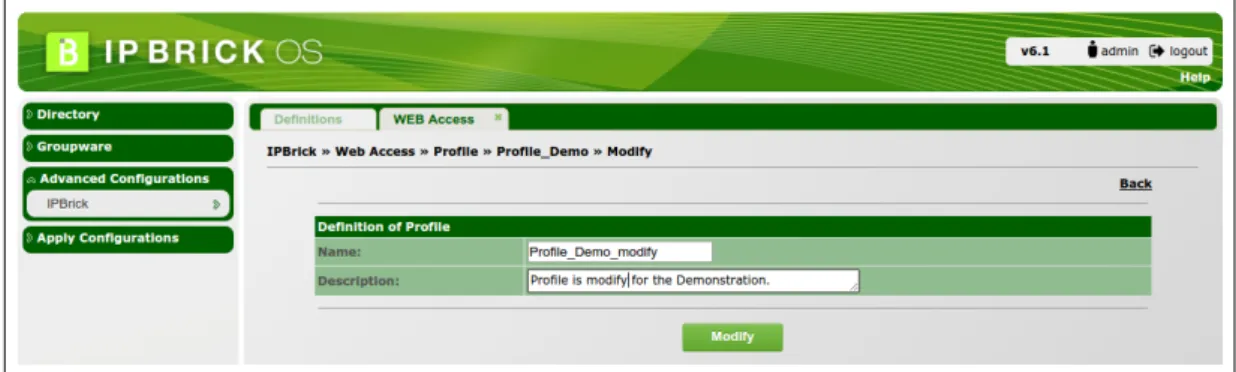
4.9 Web Page for the modification of an existing Profile . . . 35
4.10 Web Page for the deletion of a Profile . . . 35
4.11 Web Page for the selection of a profile from the list . . . 36
4.12 Web Page for the allocation of a user to an existing Profile . . . 37
4.13 Web Page for the removal of a user from accessing an existing Profile . . . 37
4.14 Page for viewing an existing Profile . . . 38
4.15 Web Page displaying the access details . . . 39
4.16 Possible access to the default web page before the modifications incorposcript 40 4.17 No access to the default web page after the modifications incorposcript . . . . 41
4.18 Default web page with All Menus and Sub Menus . . . 42
4.19 Default web page with Few Menus and Sub Menus . . . 42
4.20 Table pages entries along with the definition of its fields . . . 43
4.21 Table links entries along with the definition of its fields . . . 43
4.22 Tableliga_pages_linksentries along with the definition of its fields . . . . 44
4.23 Tablesessaorows along with the definition of its fields . . . 45
4.24 Tablealteracaorows along with the definition of its fields . . . 45
4.25 Table transaction entries for one session along with the definition of its attributes 46
4.26 Table transaction entries for two sessions along with the definition of its attributes 47
4.27 An alert for the second Admin if he wants to modify the same data as the first one 47
4.28 Table pages containing pages’ names based on a new nomenclature in page column 49
4.29 Sitemap of Administrative Profiles Unit . . . 53
C.1 Mock-up of the default web page of Administrative Profiles Unit . . . 75
C.2 Mock-up of the web page for Profile Insertion . . . 76
C.3 Mock-up of the web page for the selection of Profile’s Permissions . . . 76
C.4 Mock-up of the web page for the modification in the Profile’s Definitions . . . . 77
2.1 Pros and Cons of Static and Dynamic Web Pages . . . 8
2.2 Example of Pessimistic Concurrency Control . . . 12
2.3 Example of Optimistic Concurrency Control . . . 13
3.1 Pros and Cons of Optimistic and Pessimistic Concurrency Controls . . . 23
4.1 Facts about the databases Systemsoft and Systemconf . . . 26
4.2 Privileges of Administrators having Profiles of the different types . . . 40
4.3 Concurrency Control between N transactions related to the same entity’s data . . 48
4.4 Parameters of the function applyAddUserRuntime . . . 50
4.5 Data Set of Test Scenario for Administrative Profiles Unit . . . 54
4.6 Execution Time of the different Operations in the Administrative Profiles Unit . . 54
4.7 Data Set of Test Scenario for Multi-Sessions Management Scheme . . . 55
4.8 Execution Time of the different Operations in the Multi-Sessions Management Scheme . . . 56
2PL Two Phase Locking
Admin Administrator
BOCC Backward Oriented Concurrency Control
CMS Content Management System
CSS Cascading Style Sheets
DM Database Manager
DBMS Database Management System
DBS Database System
DHTML Dynamic HyperText Markup Language
FOCC Forward Oriented Concurrency Control
HTML HyperText Markup Language
PHP HyperText Preprocessor
Postgres PostgreSQL
RPC Remote Procedure Calls
SaaS Software as a Service
SOAP Simple Object Access Protocol
WSDL Web Services Description Language
XHTML Extensible Hyper-Text Markup Language
Introduction
This chapter covers the background context of the given topic comprehensively to make the ob-jectives of the thesis more understandable for the reader. It also exhibits the author’s motivation behind choosing this thesis’ theme and his sincere intentions toward producing a solid contribution in the field of Engineering along with some productive enhancements in IPBrick solution.
1.1
Background Context
“Science never solves a problem without creating ten more.” George Bernard Shaw
Since the advent of the concept SaaS in the field of Telecommunication Engineering, IPBrick has been one of few well-known firms to develop an efficient solution based on SaaS for the unified Communication Services and it has received an overwhelming response right from the very
beginning [1]. IPBrick solution is quite unique because it does not require any special hardware
as the slogan of IPBrick says "XXI century Software in a XIX century Hardware". In spite of having some distinctive attributes, it is never easy for any product of high quality pertaining to the ever-changing sector of Information Technology to envelope all of its paradigm shifts effectively. Such peculiar is the case of IPBrick solution in the form of Private Cloud that needs to overcome its limitations on an immediate basis to maintain its reputation among the customers. From the beginning till date, the administrative access to IPBrick Private Cloud is limited to only admin who carried all privileges because when the idea of this solution was conceived, no one thought that it will have a high demand among the customers base on some day. Today, IPBrick solution has got a very strong word of mouth in the market, many big companies and firms are interested in buying it with some definite enhancements. One of the improvements is an expansion in the range of its administrative access from one admin to multiple admins which in other words means that IPBrick solution should allow distributing a set of profiles among the multiple admins; so that they can practice the privileges defined in their respective Profiles in the cloud to make its
management process lot easier. IPBrick solution was under-estimated on one other front too and that is its development for a single-session based mode of operation persistently. It had tackled the challenges of the last decade but now it needs to be improved further and should be made compatible with the multi-sessions based operations. Here, it should be noted that IPBrick clients from the Hospital São João, Porto have already requested for this feature; but it’s not possible in the current scenario because the existing solution is not fully ready for it. In an environment driven by the multi-sessions, the consistency and the integrity of clients’ data stored in the database should not be taken for granted. For this purpose, it is essential to develop a mitigation scheme which can avoid any sort of data conflicts in the database without affecting much the operations during the execution of concurrent transactions. So, it’s high time for IPBrick to address the issues mentioned in this section in-order to prolong the viability of its solution
1.2
Objectives
“There is no achievement without goals.” Robert J. McKaine
The main aim of this thesis is to improve IPBrick Private Cloud based solution by simplifying its management process and also by making it highly compatible with the setup based on multi-sessions. Those improvements can be achieved by the accomplishment of two main objectives which are following:
• Develop a Profiles Management Unit that will allow the multiple admins to perform their managerial operations on the IPBrick private cloud by using the set of permissions offered in their respective profiles. Any admin with an access to IPBrick administrator will be able to visit only those Web Pages and Menus/Sub-Menus which will lie inside the domain of his/her profile and will not be permitted to perform any operation (Insert/Delete/Modify/All) on any service other than the specified one. A profile will only be created by an administra-tor assigned with such privileges and it will be available for the modification and deletion operations for the same admin. Those operations on a profile should also be applicable by any other admin with the same or higher level of permissions as its creator1.
• Implement a multi-sessions management2scheme which will ensure the concurrency
con-trol during the parallel execution of the multiple transactions. This scheme will mainly deal with the Update or Delete operations performed on the data stored in IPBrick database while the other operations such as Write and Read will be executed without any interruption/delay. Not all of the concurrently generated transactions by the different admins will result into the 1An admin with customized set of privileges can also create, edit and delete some profile but that permission will be
subject to the definition of his/her profile
2In this thesis, multi-sessions management module only deals with the concurrency control in database accessed by
modification/deletion of the same entity’s data3. But if by any chance that possibility occurs then the transaction with the first access to an entity’s data will be permitted to perform an operation on it while rest of other transactions will be rejected and notified accordingly to their respective admins.
1.3
Contribution
“It is the greatest of all mistakes to do nothing because you can only do little - do what you can.”
Sydney Smith
This thesis contributes to the area of web services and databases in quite a pragmatic way. It highlights two main points: Significance of the multiple administrators in a private cloud and the assurance of data consistency in a multi-sessions based environment, There are many firms like IPBrick all around the world providing their set of services in the form of a cloud. It is easy to handle the administrative operations when the domain of a cloud is limited in size. Otherwise, it gets cumbersome for one or two administrators to deal with all of the management related tasks and such extra-ordinary situations demand for some extra-ordinary measures. IPBrick R&D team has foreseen the managerial issues in their SaaS based solution which will appear more prominently soon due to the growing range of services in IPBrick Cloud. That’s why Administrative Profiles Unit was made part of this thesis to address many upcoming issues in advance. This module is not only specific to IPBrick solution, can be used in any Cloud based solution because of the simplistic approach that has been used for its implementation while keeping user’s ease of use in view. The second objective of this thesis provides a mechanism through which the data’s consistency and integrity can be assured in a setup handled by multi-sessions. Without its implementation, the adverse effects are beyond one’s imagination especially when two or more users are using the same program in their respective sessions. In a way, this particular goal has more significance than the other one because it deals with the concept of concurrency control in database which is usually discussed theoretically in the Databases’ courses without any intent of its actual implementation in the real/non-realtime applications. This thesis provides a different approach that is to implement the concurrency control mechanism at the abstract level. The conventional Concurrency Control at the low level(Database Layer) was not easily applicable in the IPBrick database due to its large size and formation. Within the given time frame, another approach was devised for the multi-sessions management that has its limitations but still quite effective enough to avoid some level of data conflicts in the database without any requirement of some intensive implementations. It is hoped that the methodology for concurrency control discussed in this thesis will become a reference point for some other research works dealing with the similar constraints and scenarios.
1.4
Structure of the Thesis Report
Besides the Introduction, this thesis contains 4 more chapters. The Chapter 2presents the
liter-ature covered relevant to the given topic. The devised solution for each objective of this thesis
along with its limitations is discussed in the Chapter 3. The Chapter4 explains the actual
im-plementations that had been performed along with the critical analysis of their results obtained
afterwards. Lastly, the Chapter5is the final conclusion of this thesis followed by some possible
Literature Review
This chapter describes the modern day practices relevant to the goals of thesis that were specified in the previous chapter. The Section 1 of this chapter presents the mechanisms used in the de-velopment of web pages along with the involved languages such as: HTML, PHP, JavaScript and jQuery. The Section 2 of this chapter exposes a set of mechanisms relevant to the development of concurrency control scheme in database for avoiding data conflicts in it.
2.1
Web Languages and Technology
The web pages are filled with information through two mechanisms: statically and dynamically. It is important to understand each of these mechanisms deeply in-order to use them according to the requirements. And also each of those types of web pages require different set of skills without which their implementation can not be carried out in a best possible way.
2.1.1 Static Web Pages
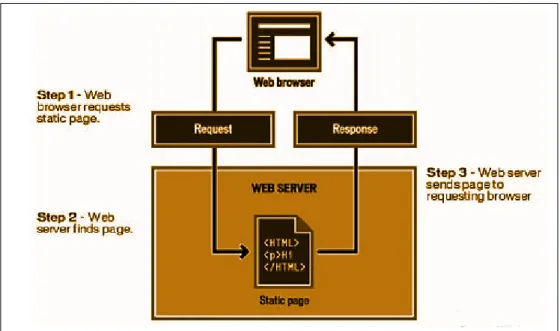
A static web page (sometimes called a oten/flat page/stationary page) is a web page that is de-livered to the user exactly as stored, in contrast to the web pages which are generated by a web application. HTML is the first tool used to develop web pages. It is a language to stylize the text, create paragraphs and line breaks etc. But the most important aspect of HTML is its link creation
ability between the different documents and which are made by using the HTML tags [2,3]. Web
pages created only with HTML are static pages because they remain same for all time to come until and unless these are changed manually. The retrieval of web pages from web server is done
through Request and Response technique as shown in the Figure2.1[4]. During the static mode
of operation, all of the code (HTML, CSS and Javascript) and other resources are downloaded in one go. Static web pages are suitable for the contents that never or rarely need to be updated. However, maintaining large numbers of static pages as files can be impractical without automated tools.
Figure 2.1: Typical Architecture of a Static Website
In-order to add few interactive features in static web pages, some scripting languages like JavaScript and Jquery can be used. These languages can add some dynamic elements in static web pages. For example, with JavaScript it is possible to display a random number every time a web page is reloaded in the browser, such pages are also called static pages. JavaScript is a
prototype-based, dynamic, object-oriented, imperative and functional language [5]. It is most
commonly used in web pages as a client-side scripting language1. To make the use of JavaScript
easier on web pages, jQuery can also be used. It is a lightweight, "write less, do more", JavaScript
library [6]. jQuery takes a lot of common tasks that require many lines of JavaScript code to
accomplish, and wraps them into methods that can be called with a single line of code. As a result, HTML document’s traversal and manipulation become simple and more manageable. jQuery also
provides some of its applications in the event handling and animations [7].
2.1.2 Dynamic Web Pages
As the need of creating the interactive web pages arose, the relevant means were developed to handle the demand. For instance, the product list in an on-line shopping website will be shown by the web pages with dynamic implementation. Such dynamic pages have two main components: Style of the web page and Information carried by the web page. As it is known that the style of web page is created by using the languages like HTML, CSS and JavaScript etc but they can not retrieve the content dynamically from the database. A dynamic mode of operation for web 1Languages such as DHTML, XHTML etc that are executed at Client-Side by the user’s web browser instead of
pages can be observed in the Figure2.2[4]2. When a web page loads in the browser, it makes a request to the linked database for furnishing some information depending upon the user’s input(s). In response, it receives the required data from the database and displays the resulting web page in the browser after applying the styling on it. For example, on an online shopping website, if the user wants to see only the mobile phones available in the store, the connected database will only send the required information related to the cell phones.
Figure 2.2: Typical Architecture of a Dynamic Website
Due to the inclusion of database in web architecture, a long list of technologies that can be used to make the web pages more dynamic in nature. Some of the important languages based on
Server-Side Scripts3that can interact with database and build the web pages at backend are: PHP,
ASP, ASP.net, JSP, Perl,Python, etc. PHP was originally known as Personal Home Page and now, it is known as "Hypertext Pre-Processor" which is a recursive acronym [8,9]. It is a dynamically typed programming language and usually used to create dynamic web pages but can also be used to create standalone programs. Besides interfacing with a database, PHP can perform all types of mathematical and scientific calculations for example: figuring out what day it is or what day of the week March 18, 2046 will be, performing all different types of mathematical equations and many others. It can also collect the user’s information by letting the user to interact with the developed script directly. PHP provides many applications pertaining to graphics that allow creating simple graphics on the fly [10].
2CMS is a computer application that supports the creation and modification of digital content using a common
user interface and thus usually supporting multiple users - also known as Contributors - working in a collaborative environment.
3Scripts on a web server which produce a customized response for each user/client’s request to the website are called
2.1.3 Comparison Between Static and Dynamic Pages
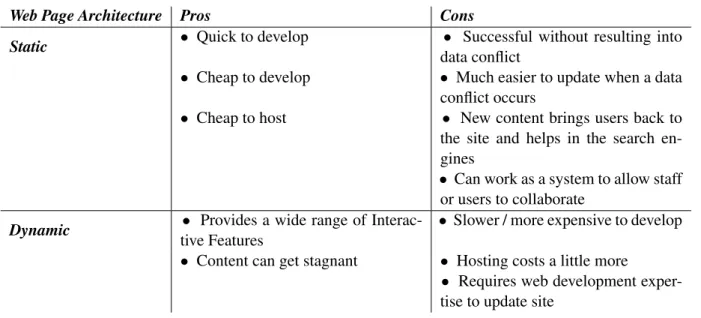
A brief comparison between Static and Dynamic Web Page in terms of their Pros and Cons is listed in the Table3.1.
Table 2.1: Pros and Cons of Static and Dynamic Web Pages
Web Page Architecture Pros Cons
Static • Quick to develop • Successful without resulting into
data conflict
• Cheap to develop • Much easier to update when a data
conflict occurs
• Cheap to host • New content brings users back to
the site and helps in the search en-gines
• Can work as a system to allow staff or users to collaborate
Dynamic • Provides a wide range of
Interac-tive Features
• Slower / more expensive to develop
• Content can get stagnant • Hosting costs a little more
• Requires web development exper-tise to update site
2.2
Concurrency Control Mechanisms in Databases
A database consists of a set of named data items. Each data item has a value. The values of the
data items at any one time comprise the state of the database [11]. In practice, a data item could
be a word of main memory, a page of a disk, a record of a file, or a field of a record. The size of the data contained in a data item is called the granularity of the data item [11]. In this work, it is assumed that data items are atomic i.e. a whole data item is accessed as one unit.
A DBS is a collection of hardware and software modules that support commands to access the
database, called database operations (or simply operations) [11]. The most important operations
are Read and Write. Read[x] returns the value stored in data item x without changing the state of x. Write[x] changes the value of x by overwriting the old value. Other operations have their own significance and will be brought under use from time to time.
The DBS4 executes each operation atomically which means that the DBS behaves as it is
executing operations sequentially i.e. one at a time [12]. The DBS also supports transaction
operations: begin, commit, and abort. A transaction program reports the DBS that it is about to begin executing a new transaction by issuing the operation begin. It marks the termination of the transaction by issuing either the operation commit or the operation abort. By issuing a commit, the transaction reports to the DBS that the transaction has terminated normally and all of
its effects should be permanent but abort shows the abnormal termination of the transaction and its effects should be destroyed. After the DBS executes a transaction’s commit /abort operation the transaction is called committed/aborted [11]. A transaction that has issued its begin operation but is not yet committed or aborted is called active. A transaction is uncommitted if it is aborted or active. If the transaction is aborted, it can be restarted. It is assumed that each transaction is self-contained, meaning that it performs its computation without any direct communication with other transactions or users [13].
A major aim of developing a database system is to allow the several users to access the shared
data concurrently [13]. Concurrent access is easy if all users are only reading data because there
is no way for them to interfere with one another. However, when two or more users are accessing the database concurrently and at least one is updating data, there may be interference that can
cause inconsistencies [14]. Although two transactions may be correct in themselves, the
interleav-ing operations may produce an incorrect result, thus riskinterleav-ing the integrity and consistency of the database [13,14,15]. The ACID properties of a transaction that all transactions should have are [15]:
• Atomicity — A transaction’s changes to the state are atoms: either all happen or none happen.
• Consistency — A transaction is a correct transformation of the state. The actions taken as a group do not violate any of the integrity constraints associated with the state. The formal transaction maintains the consistency.
• Isolation — Even though transactions execute concurrently, it appears to each transaction T that other executed either before T or after T but not both.
• Durability — Results of the committed transaction are persistent until another committed transaction possibly changes them.
The aim of concurrency control methods is to schedule transactions in such a way as to avoid
any interference [13]. One obvious solution would be to allow only one transaction to execute
at a time. However, the goal of a multi-user database system is also to maximize the degree of concurrency or parallelism in the system, so that transactions can execute without interfering with
one another and can run simultaneously [14]. When two or more transactions executes
concur-rently, their database operation execute in an interleaved way [13]. Therefore, operations from one transaction may execute between two operations from another transaction. This interleaving can cause transactions to behave incorrectly. Hence, an interleaved transaction execution can lead to an inconsistent database state. To avoid this and other problems the interleaving between
trans-actions must be controlled [14]. The order of some operations is of no importance for the final
result of executing the transactions, for example, it is possible to interchange the order of any two read operations without changing the behavior of the transaction(s) doing the reads but it can re-sult in conflict in another case. It is said that a conflict between two transactions occurs when two
transactions operate on the same data item and at least one of the operations is write. Execution interleaving can be modeled using a history(a prefix of complete history).
One method to avoid interference problems is not to allow transactions to be interleaved at all.
An execution in which no two transactions are interleaved is called serial [13]. A serial history
represents an execution in which there is no interleaving of operations of different transactions. Execution is serializable [13] if it produces the same output and has the same effect on the database state as some serial execution of the same transactions. Because serial executions are correct
and each serializable execution has the same effect as a serial execution that is correct too [14].
Serialization isolation can force applications to repeat a lot of work if a big transaction aborts or if some conflicts occur. It’s very useful for complex cases where attempting to use row locking might
just cause deadlocks, though [16]. To ensure correctness in the presence of failures, the execution
of transactions should not be only serializable but also recoverable, avoid cascading aborts, and
be strict [17]. An execution is recoverable if each transaction commits after the commitment of
all other transactions from which it reads. An execution avoids cascading aborts if the transaction read only those values that are written by committed transactions or by the transaction itself. An execution is strict if the transaction reads or overwrites a data item after the transaction that
previously wrote into it and terminates either by aborting or by committing [18].
In the study of concurrency control, a model of the internal structure of a DBS is shown in
Fig-ure 2.3. A transaction manager performs any required pre-processing on database or transaction
operations as demanded by the transactions. It is a program or collection of programs that controls the concurrent execution of transactions and makes use of this control by restricting the order in which data manager(operates directly on the database) executes the Reads, Writes, Commits and Aborts of different transactions. The goal of scheduler is to organize these operations so that the resulting execution is serializable and recoverable.
After receiving the operation, the scheduler can take one of three actions [19]:
• Execute — It can pass the operation to DM and wait for a result. When DM finishes the executing the operation, it informs the scheduler.
• Reject — It can refuse to process the operation, in which case it tells the transaction that its operation has been rejected. This causes the transaction to abort.
• Delay — It can delay the operation by placing it in a queue internal to the scheduler.
There are many ways in which the schedulers can be classified [16]. One obvious classification
criterion is the mode of database distribution. Some schedulers that have been proposed require a fully replicated database, while others can operate on partially replicated or partitioned databases. The schedulers can also be classified according to network topology. However, the most common classification criterion is the synchronization primitive, i.e. those methods which are based on mutually exclusive access to shared data and those that attempt to order the execution of the
trans-actions according to a set of rules [20,21]. There are two possible views: the pessimistic view
Figure 2.3: Centralized Database System
or the optimistic view (as discussed in the coming section2.2) that not too many transactions will
conflict with each other [22,20,23,24]. Pessimistic methods synchronize the concurrent execu-tion of transacexecu-tions early in their execuexecu-tion and optimistic methods delay the synchronizaexecu-tion of transactions until their terminations.5
2.2.1 Pessimistic Concurrency Control
Pessimistic concurrency control is also known as “locking”. Locks allow multiple users to safely share a database as long as all users are updating different data at the same time. When locks are used, the locks are placed as soon as any piece of the row is updated and released afterwards. Thus, it is impossible for two users to update a row at the same time. As soon as one user gets a lock, no one else can process that row. This is a safe, conceptually simple approach. The disadvantage is that it requires overhead for every operation, whether or not two or more users are actually trying to access the same record. This overhead is small but adds up because every row that is updated requires a lock. Furthermore, every time that a user tries to access a row, the system must also check whether the requested row(s) are already been locked by another user (or connection). Pessimistic concurrency control is called ”pessimistic” because the system assumes the worst – it assumes that two users will want to update the same record at the same time, and then prevents 5Some additional concurrency control mechanisms are also discussed briefly in this chapter but for this thesis,
that possibility by locking the record, no matter how unlikely conflicts actually are [15,25]. An
example of pessimistic concurrency control is presented in Table 2.2.
Table 2.2: Example of Pessimistic Concurrency Control
On T1, Entered the statements given below On T2, Entered the statements given below
create table t2(a int) engine=soliddb set autocommit = 0;
comment=’MODE=PESSIMISTIC’; update t2 set a = 7 where a = 1;
insert into t2 values (1),(2); commit;
set autocommit = 0;
update t2 set a = 5 where a = 1; Note: This query waits for T1 to release
locks on table t2
Following are the different types of locking [25,26]:
• Simple Object Locking — It locks each object before writing and unlocks when operation finished.
• Two Phase Locking (2PL) — In a transaction, all lock requests precede the unlock requests. • Strict Two Phase Locking — All locks are released when the transaction completes.
2.2.2 Optimistic Concurrency Control
An alternative approach to locking is called “optimistic” concurrency control. Optimistic con-currency control assumes that although conflicts are possible, they will be very rare. Instead of locking each record every time that it is used, the software merely looks for indications that two users actually did try to update the same record at the same time [15,25]. If that evidence is found, then one user’s updates are discarded (and of course the user is informed).
When using an optimistic concurrency control, each time that the server reads a record to try to update it, the server makes a copy of the ”version number” of the record and stores that copy for later reference. When it’s time to write the updated data back to the disk drive, the server compares the original version number with the version number that the disk drive currently contains. If the version numbers are the same then no one else has changed the record and the updated value can be written. However, if the new value and the current value on the disk are not the same then it means that someone has changed the data since it was read, and whatever operation was performed is probably out-of-date, so it discards the new version of the data and returns the user an error message. Naturally, each time that updating a record also updates the version number. An
example of optimistic concurrency control operation as shown in Table2.3.
Types of Optimistic Concurrency Control are mentioned below [25]:
• Backward Oriented Concurrency Control (BOCC) — This concurrency control mech-anism corresponds to the validation of preceding commit while the full-scale execution of the current one.
• Forward Oriented Concurrency Control (FOCC) — This mechanism checks whether its write set conflicts with the read set of transactions in their read phase “the writesets are only propagated if they do not conflict with current readsets of all other active transactions”.
Table 2.3: Example of Optimistic Concurrency Control
On T1, Entered the statements given below On T2, entered the statements given below
create table t2(a int) engine=soliddb set autocommit = 0;
comment=’MODE=OPTIMISTIC’; update t2 set a = 7 where a = 1;
insert into t2 values (1),(2); commit;
set autocommit = 0;
update t2 set a = 5 where a = 1; ERROR 1213 (40001): Deadlock found
when trying to get lock; try restarting trans-action
2.2.3 No check Concurrency Control
In this alternative approach, no concurrency control checking is done at all. However, normal con-sistency checking is done, i.e. primary key, foreign key and check constraints are checked6[7].In this mode, table needs to be designed carefully along with it use afterwards because the concurrent changes could cause unwanted results. When the application uses an update or an insert semantics the data in this table does not need always remain consistent this table. Still, this mode of op-eration provides a best possible concurrency between transactions and increases the performance because no concurrency checks are performed in almost all phases of the transaction execution. An example of creating no check concurrency is given below:
1
2 CREATE TABLE t 3 ( a i n t) e n g i n e = s o l i d d b comment=’MODE=NOCHECK ’;
2.2.4 Hybrid Concurrency Control
Another approach that is quite semi-optimistic in nature, blocks the operations in some situations where they might violate rules. In other cases, it does not block and the delaying rule keeps on
checking till the end of transaction [27,17,28]. An example of Hybrid Concurrency Control is
given below [16]:
Let’s assume that there are three tables A, B, and C. Furthermore, suppose the specification of each of those which is the table A uses pessimistic concurrency control, B uses optimistic concur-rency control and C has nocheck concurconcur-rency control. Now, transaction:
1
2 BEGIN ;
3 UPDATE A SET A . B = A . B + 1 WHERE A . ID BETWEEN 21 AND 5 6 ; 4 UPDATE B SET B . A = B . A − 1 WHERE B . ID BETWEEN 33 AND 9 9 ; 5 UPDATE C SET C . C = C . A WHERE C . ID BETWEEN 77 AND 2 1 2 ; 6 COMMIT;
Now this transaction will use pessimistic locking when accessing rows in Table A, optimistic method when accessing rows in the table B and no concurrency control while accessing rows in the table C. Thus, the transaction might wait for locks to be granted during the access of rows in the table A and the transaction might be rolled back at commit time if in the validation phase of rows accessed in Table B are not serialized.
2.2.5 Comparison between Optimistic and Pessimistic Approach
When optimistic concurrency control is used, the user does not find out that there’s a conflict until just before user writes the updated data. In pessimistic locking, the user finds out there’s a conflict as soon as he/she tries to read the data [22,12]. To use the analogy with banks, pessimistic locking is like having a guard at the bank door who checks customer’s account number when the new user tries to enter; if someone else (a spouse, or a merchant to whom user wrote a cheque) is already in the bank accessing user’s account, then the new user can not enter until that other person finishes his/her transaction and leaves. On other hand, optimistic concurrency control allows the user to walk into the bank at any time and try to do business but at the risk that as user is walking out the door the bank, the guard will tell that user’s transaction conflicted with someone else’s transaction. As a result, it may require to do the transaction again.
Optimistic and Pessimistic concurrency controls differ in another important way besides the time at which conflicts are detected and error messages are issued. Pessimistic locking allows one user to not only block another user from updating the same record but even from reading that record. If the user uses pessimistic locking and gets an exclusive lock then no other user can even read that record. With optimistic locking, however, it is not required to check for conflicts except at the time when it is important to write updated data to disk. If user1 updates a record and user2 only wants to read it, then user2 simply reads whatever data is on the disk and then proceeds, without checking whether the data is locked. User2 might see slightly out-of-date information if
user1 has read the data and updated it but has not yet”committed” the transaction [22].
Pessimistic locking gives the user an option that optimistic locking does not offer.It is said earlier that pessimistic locks fail immediately – that is, if the user tries to get an exclusive lock on a record and another user already has a lock (shared or exclusive) on that record then it will
be informed to the new user that he/she can’t get a lock [29]. User might get notified to wait for
30 seconds; this means that if the user initially tries to get the lock and cannot, the server will continue trying to get the lock until either it gets the lock or until the 30 seconds has elapsed. In
many cases, especially when transactions tend to be very short, the user may find that setting a brief wait allows him/her to continue activities that otherwise would have been blocked by locks.
This wait mechanism is applied only to pessimistic locking, not to optimistic concurrency control. There is no such thing as "waiting for an optimistic lock" [30]. If someone else changed the data since the time that other user read it, no amount of waiting will prevent a conflict that has already occurred. In fact, since optimistic concurrency methods do not place locks, there is literally no "optimistic lock” to wait on. Neither pessimistic nor optimistic concurrency con-trol is”right” or”wrong”. When properly implemented, both approaches ensure that user’s data is properly updated. In most scenarios, optimistic concurrency control is more efficient and offers higher performance, but in some scenarios pessimistic locking is more appropriate. In situations where there are a lot of updates and relatively high chances of users trying to update data at the same time, the user probably wants to use pessimistic locking. If the odds of conflict are very low (many records and relatively few users, or very few updates and mostly”read” operations) then optimistic concurrency control is usually the best choice. The decision will also be affected by
how many records each user updates at a time [9].
2.3
Conclusion
The features of Static and Dynamic Web Pages were deeply analyzed in the chapter and it was concluded that the performance of both of the mechanisms depend on the applications in which they are used. So it is hard to single out one mechanism better than the other. For the web environment with the basics of coding, PHP is probably the right choice to use with the help
of a good PHP editor to avoid the Exact Phrasing Problem7 (a feature in Perl) and also it has a
simpler syntax. With the strong foundations of coding language opens up many options of using complex languages with prototyping. In that case Python is recommended. For this thesis, the author had not this luxury of choosing any of the Server-Side Scripting Language because it was a requirement to use PHP. The appropriate choice of concurrency control procedure depends on the scalability requirements of a given database and how easy it is to write retry loops to re-run failed transactions, etc. So, there is no single right way of achieving concurrency control. However, a definitely wrong way is to ignore concurrency issues and expects that the database takes care of it for the users.
Refinement of IPBrick Solution
For each objective of this thesis, a given solution was adopted from a set of possible ones. This chapter explains why each one was selected, from the ones discussed in the last chapter. The chapter also concludes the presentation of conceptualization facets of the thesis. This makes easier the understanding of the implementation, which is explained in the next chapter.
3.1
Introduction
Literature review in any research work provides a platform to initiate the conceptualization process for a solution. But it stays incomplete if it does not consider the constraints which will be involved in the implementation of it. As this thesis was developed by using the facilities provided at IPBrick, it was important to recognize the factors which can affect the results in a given scenario. All of those factors are considered while modelling the solution for each of the goal of this thesis. The impact of such constraints on the results was predicted in advance so that more outcome should not be expected after the completion of the development phase.
3.2
Administrative Profiles Unit
This section displays the flow charts of the processes which enable an admin of IPBrick pri-vate cloud to apply operations on a profile such as: Insert, Delete, View, Modify, Allocate, and Del-Allocate. These flow diagrams led to the development of the mock-ups for the Web Pages
pertaining to the Profiles Management Module (See some of the mock-ups in appendix C) and
afterward, to their actual ultimate implementations.
Each Profile has two components: Profile Definition and Profile Permissions. The definition facet stores the profile’s name and description while the other one manages the information related to a profile’s access to various web pages and menus/sub-menus chosen by its creator.
3.2.1 Process of Profile Insertion
Keeping the basic units of a Profile in view mentioned above, the operation of profile insertion
will be similar to the one shown in Figure 3.1. At the beginning of Profile Insertion process,
Figure 3.1: Flow chart of the Profile Insertion Process
Profile’s name and its description are obtained from the Admin through a user prompt. After these two conditions are applied strictly on the Profile’s name must be a valid name(not carrying any non-printable characters) and does not exist in the database. If so, it is stored in database along with the description of the profile. In the proceeding step, Admin is required to specify the list of Menus/Sub-Menus that should be made accessible to this profile by choosing the options given in another prompt. If the Admin does not specify this particular piece of information, then it will not affect the insertion process of the profile. In such case, the user of this Profile will not be able to see any web page or menu of web interface after successfully logging in.
3.2.2 Process of Profile Modification
This process is quite similar to Profile Insertion as it can be seen in the flow diagram as shown
in the figure 3.2. In this case, the system has an existing profile data that the admin wants to
modify. In the first step, a prompt is shown with the existing definition of the Profile, it is up to the Admin modify it or not. After that the profile’s name is validated according to the conditions mentioned in the previous section. This procedure is performed regardless of the fact that it has been modified or not and the process proceeds or terminates beyond this point depends on the validity of the profile’s name. If the name is found valid then all of the previous allocation of web pages and menus to this profile will be deleted in the next step. Like the profile insertion process, It is the job of the Admin to specify the new list of web pages and menus/sub-menus should be made accessible to the profile under the operation of modification. If not then the admin of this profile will see a blank Web Page with some alert after logging into the system.
3.2.3 Process of Profile Deletion
In comparison to the previous two processes, this one is quite simple in operation as show in the figure3.3
Figure 3.3: Flow chart of the Profile Deletion Process
When this process initiates, it seeks for the administrator’s confirmation that he/she is willing to delete this Profile. If the response is no then process terminates without affecting the state of profile at all. Otherwise, all of the profile related information including its definition and permis-sions will be deleted permanently from the database and system.
3.2.4 Process of Profile Allocation
This process begins with a prompt to get a profile of administrator’s choice which he/she wants to
assign to some other system user as shown in the initial stage of the flow chart in figure3.4. In
the next step, the admin needs to respond to another prompt through which a user will be selected from the list of system users and subsequently, a profile is assigned to the selected user. If the selected user already contains a profile then the admin needs to confirm whether this user should have a new profile or not. Depending on the its response by the Admin, a corresponding action
Figure 3.4: Flow chart of the Profile Allocation Process
3.2.5 Process of Profile De-Allocation
This process is a lot more simple than the one for profile assignment, it just cancels the access of a given user to a particular profile. After the completion of this process, profile’s list of the allocated users gets updated, along with the one for system users’ without any assigned profile.
3.2.6 Process of Profile View
This process is just for displaying the data of any profile stored in the database which can comprise of the basic profile’s definition and the list of the users allocated to it. It should be noted that users shown in a view of a given profile have an access to the web interface.
3.3
Multi-Sessions Management
IPBrick cloud-based solution will become operable in the multiple simultaneous sessions very soon. It can give rise to some problems and one of them is the concurrency control in the database of IPBrick. Because operations like update and delete can result into the data conflict and can pose a serious threat to the integrity and the consistency of data in the database. This section discusses the feasibility of various conventional concurrency control schemes in IPBrick database. It also presents the critical analysis which was performed to decide whether any orthodox approach can provide a possible solution for multi-sessions management in a given scenario or not. In the second section, an unconventional approach is also discussed. It became the adopted solution.
3.3.1 Implications in Concurrency Control at Low Level
Concurrency Control is one of the main issues in the database systems as it can result into some severe adverse effects. Due to the strict consistency requirement defined by serializability [15], it can not be considered a viable option in the given system. That’s why most of the concurrency control schemes considered in the literature are based on either Optimistic or Pessimistic Con-currency Control. All of those mechanisms have their own pros and cons while considering the formation of IPBrick Database.
2PL with a pessimistic approach has some inherent problems such as the possibility of dead-locks as well as long and unpredictable blocking times. These problems appear too serious in transaction processing, in addition to consistency requirements [28].
Optimistic Concurrency Control methods [18, 30] are especially attractive for the
consis-tency of the data in database systems because they are non-blocking and deadlock-free. There-fore, in recent years, numerous optimistic concurrency control methods have been proposed for
databases [16,18,30]. Although optimistic approaches such as Time Stamping and Counter
Track-ing etc have shown to be better than lockTrack-ing methods for database systems in spite of their problem
of unnecessary restarts1 and heavy restart overhead2. However, because the conflict resolution
between the transactions is delayed until a transaction is near its completion, there will be more information available in making the conflict resolution.
The model of IPBrick database is not very suitable for the implementation of any orthodox concurrency control scheme. Other database systems provide storage for the fully committed data in the front and back ends of their databases, user first modifies the data at the front end and then the updates are passed to the back/server end if it satisfies all of the constraints. In this manner, the integrity and consistency of data is protected in those systems. IPBrick database system does not possess user-end and server-end due to which the user always modifies the original copy of the data stored in hard disks. To develop the user-end and server-end IPBrick database now will require lots of time and other resources because it is quite massive in size. Considering all of 1It occurs when a transaction fails its validation phase is restarted even when history is serializable. Transaction is
restarted only if has enough time remaining for meeting its deadline. Otherwise, all transactions are rolled back.
2It is due to the late conflict detection that increases the restart overhead since some near-to-complete transactions
the limitations of IPBrick Database, Table3.1shows some new pros and cons of Optimistic and Pessimistic concurrency control along with their inherited ones.
Table 3.1: Pros and Cons of Optimistic and Pessimistic Concurrency Controls
Mechanism Pros Cons
Optimistic Concurrency Control • Confirms concurrency control • Modification of All Tables
• Does not affect the Read oper-ation
Pessimistic Concurrency Control • Confirms concurrency control • Modification of All Tables
• Blocks Read Operation too • Affects the relationship be-tween entities in Schema
3.3.2 Solution in the form of Concurrency Control at High Level
Conventional concurrency control mechanisms can not provide a simple solution for Multi-Sessions Management required in the IPBrick system. As a result, an unconventional approach was devised for the accomplishment of this goal. This Multi-Sessions Management scheme works for the up-date and the delete operations only, which are applied on the data stored in IPBrick database
dur-ing many concurrent transactions. The process shown in Figure3.5begins with the update/delete
transaction on the existing data related to an entity stored in the database. This particular trans-action makes its entry in another table (Newly created for storing records of the transtrans-actions) if there is no other transaction(s) recorded for the same entity or the user with the same session ID as the current one who is willing to make a transaction on a given entity. Otherwise, the user will receive a warning for informing him/her that the desired entity’s data is not available for any of the operations except read and it will stay unavailable as long as the other user does not release the hold of it. If the condition is satisfied, the changes will be applied to the database and also the configuration logs of IPBrick updated, for future reference.
This approach is quite simplistic by nature and does not require too complex implementation. It is quite similar to the hybrid technique as it locks the entity’s data (already in the middle of some transaction) for other transactions, to ensure its integrity and consistency. Yet, it enables the other users to read the most recently updated entity’s data on which some modification operation is also under process simultaneously applied by another user. Not many techniques related to locking provides this option of reading data that is also involved in a write operation except exclusive locking (Complex procedure as it requires to keep a track of all Read and Write Locks along with their management). This newly devised approach can not be compared with the orthodox concur-rency control mechanisms in terms of performance because its efficiency has got a limitation and beyond which the performance should not be expected as it requires to store every transaction in the datbase. But it should not be discarded as it gives instant results without any serious changes in the existing formation of IPBrick database model. Write operation is not considered in this
solution because it is not a threat to the data’s consistency and integrity and can be carried without much of the trouble in a multi-sessions based environment.
Figure 3.5: Flow chart of the Process handling Multilple Transactions
3.4
Conclusion
In this chapter, the operations related to the Administrative Profiles Unit were discussed in detail with the aid of flowcharts. It had also provided a set of reasons based on which it was concluded that optimistic and pessimistic concurrency control mechanisms are not suitable for multi-sessions management in IPBrick database. An alternative approach was mentioned at the end of this chapter along with the performance detail that can be expected from its efficient implementation.
Implementation of Modules and Results
In this chapter, author has explained the implementation of the objectives of this thesis which were conceptualized in the previous chapter. It also contains the details of problems faced by the author during the development of each of the goals. Various figures are inserted along with the text to ease the understanding process for the reader. At the end, it concludes with a discussion on the results obtained after the completion of the development phase.4.1
Introduction
This chapter fully covers the details about the implementations done for the accomplishment of all objectives of the thesis. It explains why and how the solutions were modified during the course of implementation from the ones which were conceptualized in the previous chapter. The web devel-opment was mainly performed in PHP language along with some other languages like JavaScript, Jquery and HTML for the addition of interactive features. The software Netbeans was chosen for web development part because of its user-friendly interface. Database related implementation was performed in Postgres. Besides that some bash commands were also used for working in the
IP-Brick linux-based environment(See the important bash commands in SectionD.1of appendixD).
4.2
IPBrick System
The system of IPBrick operates in a linux-based environment. It is comprised of an overlay of virtual machines associated with various servers which in turn connected to each other via an intranet. Each VM has a web access fully supported by the Postgres-based databases working at the back end of it. The brief details about IPBrick Web Interface and Database are given in the subsequent sections.
4.2.1 Database
The IPBrick DBS contains various databases and the most relevant to this thesis are systemsoft
and systemconf. Some of the important facts related to these two schemas are listed in Table4.1.
Figure 4.1: Index web page of IPBrick Web Interface
Systemsoft is used to store the data about the web pages and menus related to the IPBrick Web
Interface that really helps in navigation between menus to web pages as well from web pages to web pages. Systemconf contains the core data of IPBrick relevant to services and different entities, it also stores the information about the defined relationship between the different entities and services such as: allotment of SIP phones to the specific users, the list of the users with email services, etc.
Table 4.1: Facts about the databases Systemsoft and Systemconf
Names of Databases Size of Database (MB) Number of Tables
systemsoft 7.6 161
systemconf 21.5 480
4.2.2 Web Interface
The web interface of IPBrick is comprised of the number of PHP based web pages that allows the admin to manage and utilize the services provided by IPBrick. class_init is the one of the most important PHP scripts in IPBrick system, as it can be considered ingress of IPBrick web interface. Important tasks like the inclusion of all PHP classes along with the initialization of their object are performed in the file class_init. Other PHP script with a pivotal significance in IPBrick web interface is corpo that is helpful in navigating from one web page to other by satisfying all of the conditions specified by the developer(s). menu is a PHP script used to display in the IPBrick Web Interface with the menus and sub-menus of all type of services as shown on the left side of Figure4.1.
4.3
Implementation of Administrative Profiles Unit
The implementation of this objective has been carried out by using the relevant concepts discussed
in the chapter2. This goal had required to make some developments on two fronts of IPBrick:
Database and Web Interface. Details for each of them are provided in the following sections.
4.3.1 Inclusion of new Tables
The information related to the following three facets of a profile should be stored in database: • Profile Definition (Name and Description)
• Profile’s access to Menus and their respective Sub-Menus • Profile’s access to Web Pages
As per the categorization of the profile’s data, it was considered appropriate to create three tables for each of these parts instead of a single one to store all information in it. It was turned out at the end that in this way, information related to profiles is easily managed.
4.3.1.1 Table to record Profile’s Definition
Keeping the operations of Database in view, a profile data should have more fields other than just name and description which can be found in a relational schema mentioned below:
profile(idprofile, profile_name, description, profile_type)
There is an ID field to serialize the data in the profile schema and it also acts as a primary key to avoid the duplication of data stored in Table rows. Attribute profile_type is used to easily characterize a profile among types: Read Only, Full Access and Custom. As it was told earlier that IPBrick core data is stored in the database systemconf. So Table for profile’s definition was made part of systemconf as it is shown in figure4.2.
Some of the important queries applied on this table are shown in Table B.1.1of appendixB
in the form of Relational Algebra.
4.3.1.2 Table to record Profile’s Access to Menus
IPBrick provides a variety of the services. For each service there is a menu/sub-menu on the IPBrick web interface and their information is stored in the database systemsoft. In order to provide the access of those menus to a profile, a following relational schema made of various fields is needed.
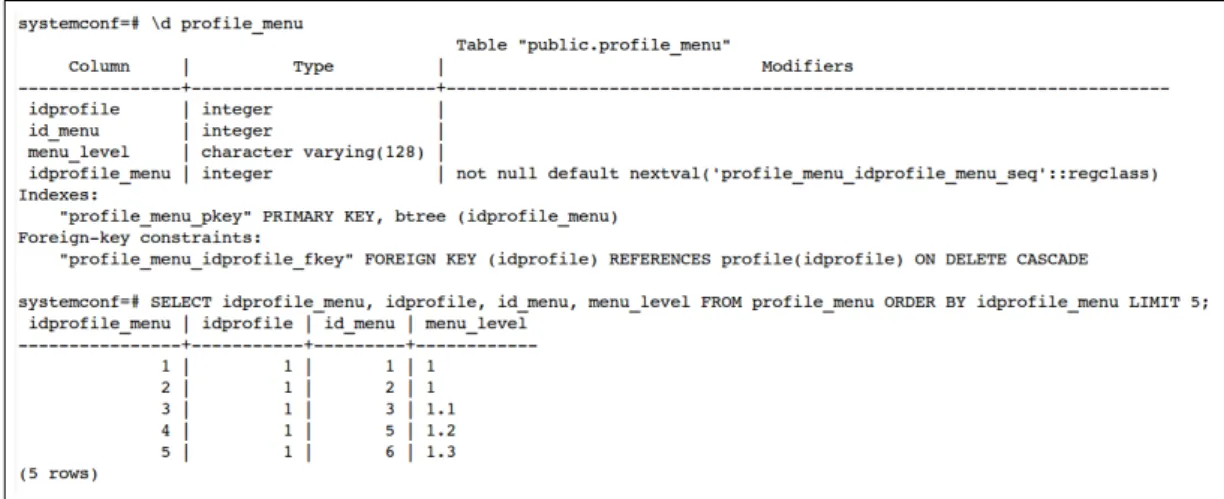
profile_menu(idprofile_menu, idprofile → profile, id_menu, menu_level)
Figure 4.2: profile Table along with its fields and entries
Table profile_menu shown in Figure4.3 is based on the relational schema mentioned above.
The field idprofile_menu is used to serialize the data entries and also to avoid their duplicate copies in this table, similar to the role of idprofile in profile table. The attribute id_menu as its name tells, represents the ID of the particular menu. The last field in Table profile_menu is menu_level which gives the information about any menu in the menu’s hierarchy tree for example, if the sub-menu
User Policies comes under User Aborts which in turns has a parent menu named Directory, so
the menu levels of the two sub-menus and one menu are denoted as 1.1.1, 1.1 and 1 respectively. As it was discussed earlier that the data related to menus of IPBrick web interface are stored in a table named menu of the database systemsoft that comprises of the fields id_menu and menu_level. It is important to note that for the default admin’s profile of IPBrick system, this table (stored in
systemconf) was filled manually and afterwards, it was done automatically for the new profiles.
There is another field called idprofile acting as a foreign key in Table profile_menu, which is used to bring synchronization with the profile table. The rows particular to some profile will remain stored in Table as long as the profile will exist in the profile table. Otherwise, they will get deleted automatically as CASCADE parameter is specified in the definition of idprofile.
Few relevant queries applied on this table are shown in Table B.1.2of appendix Bin the form
of Relational Algebra.
4.3.1.3 Table to record Profile’s Access to Web Pages
Web pages in IPBrick are associated with the menus/sub-menus (menu_levels to be precise). So there was a need of the following schema with a right combination of fields that can merge the information related to profile, menu levels and web pages into one body.
profile_page(idprofile_page, idprofile → profile, id_page, menu_level, page_permission)
Figure 4.3: profile_menu Table along with its fields and rows
Figure4.4shows a table derived from the schema mentioned above. Similar to the formation
of tables profile and profile_menu, Table profile_page has a field idprofile_page which serializes the data entries without any duplication. The second field idprofile acting as a foreign key syn-chronizes this table with profile. It is a mean of deleting the rows related to a specific profile automatically, if it is removed from the profile table. Third attribute id_page is for storing the web-pages’ IDs defined in the system. The attribute menu_level is used to show menu levels respective to the pages specified in the column id_page. The field page_permission is for the specification of operation which will be applicable to a particular page from a set of permissions1: insert, delete, modify, view (read all) and all(gives every possible permission on a web page).
Figure 4.4: profile_page Table along with its fields and rows
1Few of the page permissions are stored in the form of acronyms in profile_page table which are insert as ’ins’,
Figure 4.5: Entries invalidaTable along with a new addition of idprofile column
Some of the important queries applied on this table are shown in Table B.1.3of appendix B
in the form of Relational Algebra.
4.3.1.4 Table to record an Administrator’s Access to a Profile
Tablevalidaas shown in Figure4.5existed before the implementation of this thesis. The
pur-pose of this table was to store the credentials of the valid administrators having an access to the web interface of IPBrick. The fields login and pass are for storing the login-name and password (in the encrypted form) respectively of the users given access to the web interface. The rows in this table are organized on the basis of login column as it acts the primary key. Third column type maintains the record related the type of access user is having to web interface and at the moment, there are two types of access remote and local represented as 1 and 2 respectively in the database. Usually, only the default admin falls in the remote domain of access to the web interface. Fourth attribute iduser stores the users’ IDs associated with the corresponding login-name entry of Table. The column idprofile representing as a foreign key of profile table was a newly added in Table
validathat enables an administrator to use the IPBrick web interface according to the permissions
defined in the profile assigned to him/her.
4.3.2 Inclusion of new Web Pages
In the previous section, we have covered the modifications made in the IPBrick database for the Administrative Profiles unit. This section will discuss the updates made in the web interface of