doi:10.1152/ajpregu.00111.2007
293:R956-R960, 2007. First published 30 May 2007;
Am J Physiol Regul Integr Comp Physiol
Canario and Deborah M. Power
Juan Fuentes, Pedro M. Guerreiro, Teresa Modesto, Josep Rotllant, Adelino V. M.
β
hypercalcemic response to estradiol-17
A PTH/PTHrP receptor antagonist blocks the
You might find this additional info useful...
43 articles, 13 of which can be accessed free at:
This article cites
http://ajpregu.physiology.org/content/293/2/R956.full.html#ref-list-1 1 other HighWire hosted articles
This article has been cited by
[PDF] [Full Text] [Abstract]
, July , 2010; 299 (1): R150-R158.
Am J Physiol Regul Integr Comp Physiol
Juan Fuentes, Deborah M. Power and Adelino V. M. Canário
bicarbonate secretion and calcium precipitation in a marine fish intestine Parathyroid hormone-related protein-stanniocalcin antagonism in regulation of
including high resolution figures, can be found at:
Updated information and services
http://ajpregu.physiology.org/content/293/2/R956.full.html can be found at:
and Comparative Physiology
American Journal of Physiology - Regulatory, Integrative about
Additional material and information
http://www.the-aps.org/publications/ajpregu
This infomation is current as of February 29, 2012.
ISSN: 0363-6119, ESSN: 1522-1490. Visit our website at http://www.the-aps.org/.
Physiological Society, 9650 Rockville Pike, Bethesda MD 20814-3991. Copyright © 2007 by the American Physiological Society. ranging from molecules to humans, including clinical investigations. It is published 12 times a year (monthly) by the American illuminate normal or abnormal regulation and integration of physiological mechanisms at all levels of biological organization,
publishes original investigations that American Journal of Physiology - Regulatory, Integrative and Comparative Physiology
on February 29, 2012
ajpregu.physiology.org
A PTH/PTHrP receptor antagonist blocks the hypercalcemic response
to estradiol-17

Juan Fuentes, Pedro M. Guerreiro, Teresa Modesto, Josep Rotllant, Adelino V. M. Canario, and Deborah M. Power
Centro de Cieˆncias do Mar, CIMAR-Laborato´rio Associado, Universidade do Algarve, Campus de Gambelas, Faro, Portugal
Submitted 14 February 2007; accepted in final form 21 May 2007
Fuentes J, Guerreiro PM, Modesto T, Rotllant J, Canario AV, Power DM. A PTH/PTHrP receptor antagonist blocks the
hypercal-cemic response to estradiol-17.Am J Physiol Regul Integr Comp Physiol 293: R956–R960, 2007. First published May 30, 2007; doi:10.1152/ajpregu.00111.2007.—Estradiol (E2) increases
circulat-ing calcium and phosphate levels in fish, thus actcirculat-ing as a hypercal-cemic and hyperphosphatemic factor during periods of high calcium requirements, such as during vitellogenesis. Since parathyroid hor-mone (PTH)-related protein (PTHrP) has been shown to be calciotro-pic in fish, we hypothesized that the two hormones could be mediating the same process. Sea bream (Sparus auratus) juveniles receiving a single intraperitoneal injection of piscine PTHrP(1-34) showed an elevation in calcium plasma levels within 24 h. In contrast, injections of the PTH/PTHrP receptor antagonist PTHrP(7-34) decreased circu-lating levels of calcium in the same period. Intraperitoneal implants of estradiol-17 (E2; 10g/g) evoked significant increases of circulating
plasma levels of calcium and phosphorus and a sustained increases of circulating plasma levels of PTHrP. However, a combined treatment of E2and PTHrP(7-34) evoked a markedly lower calcium response
compared with E2alone. We conclude that PTHrP or a related peptide
that binds the PTH/PTHrP receptor mediates, at least in part, the hypercalcemic effect of E2in calcium and phosphate balance in fish.
fish; calcium; phosphate
PARATHYROID HORMONE(PTH)-related protein (PTHrP) is linked
to calcium metabolism in higher vertebrates and is associated with bone turnover (20). In preclinical trials, PTHrP has been shown to evoke increased bone mass (18). Moreover, recent reports show that the anabolic nature of PTHrP in the bone is achieved by altering osteoblast recruitment and survival in mice models for osteoporosis (21, 22). Estradiol-17 (E2) has been shown to upregulate PTH and PTH/PTHrP receptors in human U2OS osteosarcoma cells (42) and in MCF-7 breast carcinoma cells to upregulate PTHrP mRNA expression and induce PTHrP release in a dose-dependent manner (13). The action of E2 on renal calcium retention may be through its capacity to upregulate renal expression of PTHrP mRNA without changing PTHrP receptor expression and function (5). In contrast, E2decreased cell growth and PTHrP production in estrogen receptor (ER)-negative human breast cancer cells (MDA-MB-231) and cells transfected with full-length cDNA encoding ER(S-30) (37).
Vitellogenesis, or the production of nutrient-rich proteins in the liver and their accumulation in the oocytes of oviparous animals, is under the hormonal control of E2produced in the granulosa cells of the ovary and is accompanied by a marked
increase of plasma calcium and phosphate, which can reach blood plasma levels of 10 mM. Phosphate binds covalently to serine residues of the phosvitin moiety of vitellogenin to which Ca2⫹ is ionically bound (44). During vitellogenesis, plasma levels of E2, alkali labile phosphorus (phosphate bound to serine groups in proteins released by mild alkali solution), and total calcium are positively correlated, and the latter has been often used as an indirect measurement of vitellogenesis (7, 14, 26).
E2 administration to freshwater and seawater fish, such as killifish (Fundulus heteroclitus), sea bream (Sparus auratus), rainbow trout (Oncorhynchus mykiss), and goldfish (Carassius
auratus), increases plasma levels of calcium, phosphate, and
vitellogenin (14, 15, 26, 28, 31, 43). Although E2has also been shown to promote whole body calcium uptake in fish (15, 31), the recent discovery of PTH and PTHrP with hypercalcemic actions in fish (3, 10, 12, 16, 36) suggests that the action of the two hormones may be required for mineral mobilization during vitellogenesis. A recent in vitro study indicates that although PTHrP on its own does not affect vitellogenin production by sea bream hepatocytes, it synergizes the E2-induced synthesis of vitellogenin (2).
The objective of the present study was to test the hypothesis that PTHrP is involved in the E2-related hypercalcemia and to establish the relationship with E2 in this process. For these purposes we have administered E2, PTHrP(1-34), or a combi-nation of E2 and the PTHrP(7-34) antagonist to sea bream
Sparus auratus in vivo, and analyzed the hormonal and mineral
responses.
MATERIALS AND METHODS
Animals. Sea bream (Sparus auratus) juveniles were used from a stock raised at Ramalhete Marine Station (University of Algarve, Algarve, Portugal). Experiments were conducted in June in open-water circuits under natural conditions of open-water temperature (18 – 20°C), photoperiod, and salinity (37 ppt). Fish were fed once a day (10:00 –11:00 AM) at a ration of 2% of the estimated body weight with commercial dry pellets (Provimi) with the exception of the day of the experiments or sampling when food was withheld 24 h prior to the procedure. The experimental procedures comply with the Guide-lines of the European Union Council (86/609/EU) and Portuguese legislation for the use of laboratory animals.
Experiment 1: effect of PTHrP on plasma calcium in sea bream. The experiment was designed to test the effect of PTHrP(1-34) and PTHrP(7-34) on plasma calcium in sea bream. Eight groups of eight fish each (n⫽ 64, body mass 15 ⫾ 1 g; mean ⫾ SE) were created, each receiving a single intraperitoneal injection of 0.9% NaCl (2l/g
Address for reprint requests and other correspondence: Juan Fuentes, Centro de Cieˆncias do Mar, CIMAR-Laborato´rio Associado, Universidade do Al-garve, Campus de Gambelas, 8005-139 Faro, Portugal (e-mail: jfuentes @ualg.pt).
The costs of publication of this article were defrayed in part by the payment of page charges. The article must therefore be hereby marked “advertisement” in accordance with 18 U.S.C. Section 1734 solely to indicate this fact. First published May 30, 2007; doi:10.1152/ajpregu.00111.2007.
on February 29, 2012
ajpregu.physiology.org
wet weight) containing either 0, 0.2, 1, or 5g/g wet weight per sea bream PTHrP(1-34) (16) or similar doses of PTHrP(7-34) (38). All peptide solutions were prepared fresh. Fish were anesthetized with 2-phenoxyethanol (1:10,000; Sigma-Aldrich, Madrid, Spain) and weighed to the nearest gram before treatment and then placed in 600-liter tanks supplied with well-aerated seawater. The procedure took⬍3 min per group with two operators. Twenty-four hours after treatment, fish were anesthetized and 0.1 ml blood collected by caudal vessel puncture into heparinized (ammonium heparin, 30 U/ml; Sigma-Aldrich) 1-ml syringes fitted with 23-gauge needles. Plasma was obtained by centrifugation of whole blood (10,000 rpm for 5 min), aliquoted, snap-frozen in liquid N2, and stored at⫺80°C
for later analysis.
Experiment 2: interaction between E2 and PTHrP in calcium
metabolism. In this experiment, the effect of the PTH/PTHrP receptor antagonist PTHrP(7-34) on the calciotropic action of E2in sea bream
was studied. The load of peptide in the miniosmotic pumps was
established from a test in which 10,000 cpm125I-labeled PTHrP(1-34)
was injected intraperitoneally, and the amount of peptide transferred to the plasma, whole blood, and packed blood cells was counted after 1 h. The average transfer rate of labeled PTHrP from the peritoneal cavity to the bloodstream estimated by this method was of 1.5⫾ 0.1% of the injected hormone per milliliter of blood after 1 h. For the experiment, three groups of 25 fish each (n⫽ 75, mean body mass 70⫾ 1 g) received a miniosmotic pump (model 2001; Alza, Palo Alto, Ca) and a coconut oil implant in the following combination: pump with saline (0.9% NaCl) plus coconut oil alone (control group); pump with saline plus coconut oil implant with E2(10g/g; E2group); and
pump with piscine PTHrP(7-34) plus coconut oil implant with E2(10
g/g) [E2⫹ PTHrP(7-34) group]. Fish were anesthetized (1:10,000,
2-phenoxy ethanol), transferred to a humid operating table with the gills irrigated with aerated seawater containing anesthesia (1:20,000, 2-phenoxyethanol). A blood sample was immediately collected and processed as described above to obtain plasma. The fish were placed ventral side up and a lateral incision 1-cm long was opened in the peritoneum behind the pectoral fins with a scalpel. A prefilled min-iosmotic pump was fitted in the peritoneal cavity, and the incision was closed with three sutures with nonabsorbable line. The fish received an additional implant of coconut oil with or without E2(as described
earlier). Pumps were estimated to deliver 5 ng PTHrP(7-34)䡠ml plasma⫺1䡠h⫺1, taking into consideration the fish osmolarity (341⫾ 3 mOsmol/kg), water temperature (20°C), and the peritoneal/circulation transfer rate. After surgery, fish were distributed in 100-liter tanks (n⫽ 5 per tank). Fish were not fed during the experiments. At days 1, 4, and 8 after implantation, a blood sample was collected from each fish under anesthesia into heparin (30 U/ml, ammonium salt; Sigma-Aldrich) and EDTA-aprotinin (500 KIU/ml; Trasylol, Bayer)-treated tubes, taking care to avoid sample contamination with seawater. Plasma was separated by centrifugation, frozen in liquid nitrogen, and stored at⫺80°C for subsequent analysis.
Plasma analysis. Plasma E2was analyzed in duplicate by specific
radioimmunoassay following extraction with diethyl ether and resus-pension in assay buffer as previously described (15). Results are shown as nanograms per milliliter.
Plasma PTHrP was analyzed by a specific radioimmunoassay as previously described (40) with antisera against sea bream PTHrP(1-34), with the same peptide as standard curve ligand and125I-labeled
PTHrP(1-36) as label. Bound and free label was separated by immu-noprecipitation. The detection limit of the assay was 1.25 pg/tube. The intra- and interassay coefficients of variation were 3.9% and 8.8%, respectively (n ⫽ 6). The assay did not cross-react with related mammalian peptides (40) and cross-reaction to fugu PTH or PTH-L(1-34) peptides was⬍0.1%.
Total or ultrafiltered plasma calcium was measured in triplicate by colorimetric assay with the Arsenazo method (Sigma-Aldrich proce-dure no. 587). Plasma ultrafilterable fractions correspond to the ionized free calcium fraction and were measured in the fraction of
plasma obtained after centrifugation 12,000 rpm 10 min at 4°C through a 10-kDa cut-off filter (Millipore). Values are shown as mmol/l. Total plasma phosphorus was measured in triplicate in undi-luted plasma using an end point colorimetric assay (Sigma procedure No 360). Values are shown as millimole per liter.
Statistics. All values are shown as means⫾ SE, unless otherwise stated. Effects of treatment on plasma parameters were analyzed by one-way ANOVA in experiment 1 and two-way ANOVA in experi-ment 3, after testing for homogeneity and normality of variances. The Bonferroni multicomparison a posteriori test was applied to determine significantly different groups. The experiment-wise er-ror rate was 0.05.
RESULTS
Effect of PTHrP on plasma calcium. The effect of a single
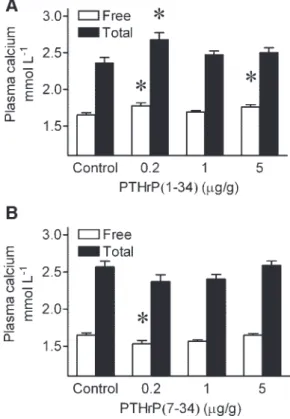
intraperitoneal injection of PTHrP(1-34) on plasma calcium 24 h later in sea bream juveniles is shown in Fig. 1A. At doses of 0.2 and 5g/g, a significant (P ⬍ 0.05, one-way ANOVA) increase of filtered plasma calcium was observed. Total cal-cium increased significantly (P ⬍ 0.05, one-way ANOVA) only in response to 0.2g/g PTHrP(1-34). In contrast, a single 0.2g/g injection of PTHrP(7-34) significantly decreased the filtered (free) calcium fraction without affecting total plasma calcium (P⬍ 0.05, one-way ANOVA; Fig. 1B). Higher doses of 1g/g and 5 g/g of PTHrP(7-34) did not have a significant effect on the total or filtered plasma calcium.
Effect of E2on plasma calcium, phosphate, and E2. Plasma
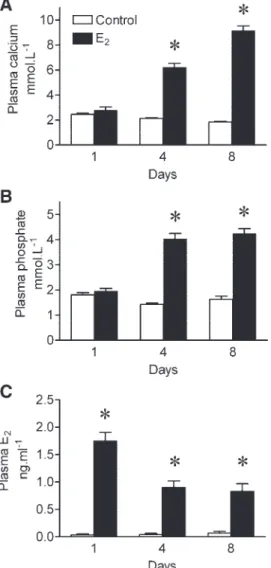
calcium increased significantly in response to E2at days 4 and
8 postimplantation (Fig. 2A) (P ⬍ 0.05, two-way ANOVA).
Fig. 1. Effect of single intraperitoneal injection of saline (control), 0.2, 1, and 5g/g PTHrP(1-34) (A) and PTHrP(7-34) (B) on blood plasma levels of free and total calcium in sea bream juveniles sampled 24 h after injection. PTHrP, parathyroid hormone-related protein. Results are shown as means⫾ SE (n⫽ 8). *Significant difference from controls (P ⬍ 0.05).
R957
PARATHYROID HORMONES AND ESTRADIOL IN SEA BREAM
AJP-Regul Integr Comp Physiol•VOL 293 • AUGUST 2007 •www.ajpregu.org
on February 29, 2012
ajpregu.physiology.org
Plasma levels of phosphate followed the same pattern as for calcium (Fig. 2B).
The changes in plasma E2as a result of administration of E2 implants to sea bream are shown in Fig. 2C. E2plasma levels were significantly greater than in controls at all sample points in E2-treated fish (P ⬍ 0.05, two-way ANOVA). A maximal concentration of plasma E2was observed 1 day postimplanta-tion, and then it declined slowly.
Effect of PTHrP antagonist on E2-induced
hypercalce-mia. E2treatment significantly increased circulating plasma levels of PTHrP over control at day 4 but not at any other times (Fig. 3A). No significant differences in plasma levels of PTHrP were found between E2and E2⫹ PTHrP groups.
While plasma total calcium levels in the control group were stable over time, E2treatment, as expected (see also, Fig. 2), significantly increased plasma levels of total calcium from day
4 onward (Fig. 3B). However, PTHrP(7-34) strongly inhibited
this calcium increase when administered in conjunction with E2(Fig. 3B). The pattern for plasma phosphate was similar to that of total plasma calcium but the inhibitory effect of PTHrP(7-34) was not statistically significant (Fig. 3C).
DISCUSSION
In this study, we have demonstrated that an antagonist of the PTH/PTHrP receptor strongly inhibits the hypercalcemic ac-tion of E2, indicating that PTHrP or a related peptide of the same family (3) mediates this inhibition.
One of the functions of E2is to promote protein synthesis in the liver, including vitellogenin and egg shell protein compo-nents (1, 8). Vitellogenin is highly phosphorylated and calcium binds to the ionized phosphate groups (23). Phosphate levels in the water are generally low and not a source for body func-tions. Thus, phosphate is obtained mostly from the food through the type II sodium-phosphate cotransporter in the intestinal brush border, and its excretion is regulated through the kidney (24, 25). The source of calcium for fish is largely
Fig. 3. The effect of E2implants (10g/g) alone or in combination with
PTHrP(7-34) (PTHrP antagonist) in sea bream juveniles (70 g) at different times (1, 4, and 8 days) in plasma PTHrP (A); plasma phosphate (B), and plasma total calcium (C). Each point represents means⫾ SE of 6–9 fish.
a,b,cDifferent letters indicate significant differences (P⬍ 0.05, Bonferroni test)
between treatments at a given time. Fig. 2. The effect of estradiol-17 (E2) implants (10 g/g) in sea bream
juveniles (30 g) at different times (1, 4, and 8 days) in total calcium (A), phosphate (B), and E2(C). Results are shown as means ⫾ SE (n ⫽ 7).
*Significant differences from controls at a given time (P⬍ 0.05).
on February 29, 2012
ajpregu.physiology.org
from the surrounding water, and E2 administration increases whole body net calcium uptake via intestine and gill (15, 31). If required, calcium and phosphate can also be obtained from the mobilization of internal stores, such as bone and scales (30). The fact that a PTH/PTHrP receptor antagonist can inhibit, at least to some extent, the hypercalcemic action of E2, indicates a role for PTH, PTHrP, or a related factor (see below) that binds to the PTH/PTHrP receptor. A recent in vitro study has also indicated a synergistic effect of PTHrP with E2 on vitellogenin synthesis (2).
The gill and intestine are the sites for calcium uptake in fish, although the gills are proposed to make the greatest contribu-tion (11). In the sea bream the hypercalcemic effects of E2are also achieved via both gill and intestine (15). Therefore, the hypercalcemic effect of E2 can be either mediated directly through its action in the gills or intestine, indirectly via another endocrine factor responsive to E2, or both. Support for direct estrogen effects come from the presence of ER mRNA in fish gills (9, 19) and intestine (4, 9, 45), including in the sea bream (33, 35, 41). However, in the present study we also show that a large part of the E2-induced hypercalcemia is largely indirect possibly via PTHrP or a related factor.
Inhibition of E2-induced hypercalcemia was achieved by using as antagonist the PTHrP(7-34) peptide, based on the sea bream sequence, which was shown earlier to bind to the PTH/PTHrP receptor and block PTHrP-induced second mes-senger cascades (3, 38, 39). The incomplete inhibition of calcium and phosphate increase in response to the combination of E2and PTHrP antagonist compared with E2alone is prob-ably related to the dose of antagonist delivered and the differ-ent release/uptake kinetics of the two hormones from the implants.
Previous studies in sea bream have demonstrated that PTHrP on its own is able to increase net whole body calcium uptake in larvae (16) and in vitro intestinal uptake (12). Here we show that treatment with a single injection of 0.2g/mg PTHrP(1-34) translates into an increase in free and bound plasma calcium levels 24 h later. Furthermore, the PTH/PTHrP recep-tor antagonist PTHrP(7-34) caused a reduction in free calcium at the same concentration. These results together with rela-tively high levels in fish plasma (40) support a role for PTHrP as a hypercalcemic hormone in the sea bream and possibly other teleosts. Despite the blocking effect of PTHrP(7-34) placing PTHrP downstream of E2 in the hypercalcemic re-sponse, the response to PTHrP alone was much lower than to E2. A likely explanation is that E2has a simultaneous inhibi-tory effect on counteracting hypocalcemic factors. Recently, 5 genes for PTH-related peptides, encoding at least a similar number of cDNAs, have been identified in teleosts fish (3, 6, 29). Four correspond to duplicated PTH and PTHrP genes and the fifth encodes a novel peptide (named PTH-L) with hybrid structural characteristics between PTH and PTHrP, sharing a highly similar NH2-terminal domain and strong calciotropic activity, suggesting action through common receptors (3). Considering the calciotropic actions of PTHrP and potential similar actions for PTH-L, we cannot decide whether E2 is acting via PTHrP or PTH-L. However, the fact that PTHrP is elevated in response to E2may indicate that it is the mediator. Only when an immunoassay for PTH-L becomes available can we address this question.
While in the sea bream E2 caused an elevation of PTHrP levels, and in mammalian breast cancer ER-negative cells transfected with ER, the secretion of PTHrP was substantially decreased (37). The difference could be explained either by differential regulation of gene expression in different tissues (34) and/or taking into account a possible contrasting physio-logical action of PTHrP in lower and higher vertebrates. In mammals PTHrP is essentially a paracrine/autocrine factor (32), while the effects in sea bream appear to be more of an endocrine nature with the pituitary as a possible glandular source (17, 40).
Perspectives
Although the facts that PTHrP(7-34) can effectively block E2-induced hypercalcemia and that E2administration to some extent elevates PTHrP plasma levels are strong evidence for PTHrP mediation of E2effects, it is intriguing that E2is able to induce higher levels of calcium, especially calcium bound to protein. This may be due to the fact that one of the effects of E2is to induce synthesis of calcium-binding proteins (such as vitellogenin). We suggest additionally, that E2, via its nuclear receptors, may be acting on the promoters of hypocalcemic hormones, such as stanniocalcin, to downregulate their produc-tion, thus reducing the counteracting effects of this hormone to maintain homeostatic levels of calcium. E2appears to upregu-late stanniocalcin in cancer cells (46) but to downreguupregu-late luteal cell stanniocalcin expression and secretion (27). Future studies will have to address regulation of calciotropic hormone genes in relation to calcium homeostatic mechanisms.
ACKNOWLEDGMENTS
The authors acknowledge Adriana Silva for fish care.
GRANTS
This research has been carried out with the financial support of the Commission of the European Union, Quality of Life and Management of Living Resources specific RTD program (Q5RS-Q5RS-2001-02904) and of the European Social Fund and National funds under Portuguese National Science Foundation Project POCTI/CVT/48946/2002. P. M. Guerreiro was funded by Grant BPD/9464/2002 from Portuguese National Science Founda-tion.
REFERENCES
1. Ansari AQ, Dolphin PJ, Lazier CB, Munday KA, Akhtar M. Chemical composition of an oestrogen-induced calcium-binding glycolipophospho-protein in Xenopus laevis. Biochem J 122: 107–113, 1971.
2. Bevelander G, Hang X, Abbink W, Spanings T, Canario A, Flik G. PTHrP potentiating estradiol-induced vitellogenesis in sea bream (Sparus
auratus, L.). Gen Comp Endocrinol 149: 159 –165, 2006.
3. Canario AVM, Rotllant J, Fuentes J, Guerreiro PM, Teodosio HR,
Power DM, Clark MS. Novel bioactive parathyroid hormone and related
peptides in teleost fish. FEBS Lett 580: 291–299, 2006.
4. Choi CY, Habibi HR. Molecular cloning of estrogen receptor alpha and expression pattern of estrogen receptor subtypes in male and female goldfish. Mol Cell Endocrinol 204: 169 –177, 2003.
5. Cros M, Silve C, Graulet AM, Morieux C, Urena P, de Vernejoul MC,
Bouizar Z. Estrogen stimulates PTHrP but not PTH/PTHrP receptor gene
expression in the kidney of ovariectomized rat. J Cell Biochem 70: 84 –93, 1998.
6. Danks JA, Ho PM, Notini AJ, Katsis F, Hoffmann P, Kemp BE,
Martin TJ, Zajac JD. Identification of a parathyroid hormone in the fish
Fugu rubripes. J Bone Miner Res 18: 1326 –1331, 2003.
7. de Vlaming V, Fitzgerald R, Delahunty G, Cech JJ, Selman K,
Barkley M. Dynamics of oocyte development and related changes in
serum estradiol-17, yolk precursor, and lipid-levels in the teleostean fish,
Leptocottus armatus. Comp Biochem Physiol A 77: 599 – 610, 1984.
R959
PARATHYROID HORMONES AND ESTRADIOL IN SEA BREAM
AJP-Regul Integr Comp Physiol•VOL 293 • AUGUST 2007 •www.ajpregu.org
on February 29, 2012
ajpregu.physiology.org
8. Dolphin PJ, Ansari AQ, Lazier CB, Munday KA, Akhtar M. Studies on induction and biosynthesis of vitellogenin, an oestrogen-induced gly-colipophosphoprotein. Biochem J 124: 751–758, 1971.
9. Filby AL, Tyler CR. Molecular characterization of estrogen receptors 1, 2a, and 2b and their tissue and ontogenic expression profiles in fathead minnow (Pimephales promelas). Biol Reprod 73: 648 – 662, 2005. 10. Flanagan JA, Power DM, Bendell LA, Guerreiro PM, Fuentes J,
Clark MS, Canario AVM, Danks JA, Brown BL, Ingleton PM.
Cloning of the cDNA for sea bream (Sparus aurata) parathyroid hormone-related protein. Gen Comp Endocrinol 118: 373–382, 2000.
11. Flik G, Klaren PHM, Schoenmakers TJM, Bijvelds MJC, Verbost
PM, Bonga SEW. Cellular calcium transport in fish: unique and universal
mechanisms. Physiol Zool 69: 403– 417, 1996.
12. Fuentes J, Figueiredo J, Power DM, Canario AVM. Parathyroid hor-mone-related protein regulates intestinal calcium transport in sea bream (Sparus auratus). Am J Physiol Regul Integr Comp Physiol 291: R1499 – R1506, 2006.
13. Funk JL, Wei HB. Regulation of parathyroid hormone-related protein expression in MCF-7 breast carcinoma cells by estrogen and antiestrogens.
Biochem Biophys Res Commun 251: 849 – 854, 1998.
14. Gillespie DK, de Peyster A. Plasma calcium as a surrogate measure for vitellogenin in fathead minnows (Pimephales promelas). Ecotoxicol
Environ Saf 58: 90 –95, 2004.
15. Guerreiro PM, Fuentes J, Canario AVM, Power DM. Calcium balance in sea bream (Sparus aurata): the effect of oestradiol-17. J Endocrinol 173: 377–385, 2002.
16. Guerreiro PM, Fuentes J, Power DM, Ingleton PM, Flik G, Canario
AVM. Parathyroid hormone-related protein: a calcium regulatory factor in
sea bream (Sparus aurata L.) larvae. Am J Physiol Regul Integr Comp
Physiol 281: R855–R860, 2001.
17. Guerreiro PM, Renfro JL, Power DM, Canario AVM. The parathyroid hormone family of peptides: structure, tissue distribution, regulation, and potential functional roles in calcium and phosphate balance in fish. Am J
Physiol Regul Integr Comp Physiol 292: R679 –R696, 2007.
18. Horwitz MJ, Tedesco MB, Gundberg C, Garcia-Ocana A, Stewart
AF. Short-term, high-dose parathyroid hormone-related protein as a
skel-etal anabolic agent for the treatment of postmenopausal osteoporosis.
J Clin Endocrinol Metab 88: 569 –575, 2003.
19. Luo Q, Ban M, Ando H, Kitahashi T, Bhandari RK, McCormick SD,
Urano C. Distinct effects of 4-nonylphenol and estrogen-17 on
expres-sion of estrogen receptor alpha gene in smolting sockeye salmon. Comp
Biochem Physiol C Pharmacol Toxicol Endocrinol 140: 123–130, 2005.
20. Martin TJ. Osteoblast-derived PTHrP is a physiological regulator of bone formation. J Clin Invest 115: 2322–2324, 2005.
21. Miao DS, He B, Jiang YB, Kobayashi T, Soroceanu MA, Zhao J, Su
HY, Tong XK, Amizuka N, Gupta A, Genant HK, Kronenberg HM, Goltzman D, Karaplis AC. Osteoblast-derived PTHrP is a potent
endog-enous bone anabolic agent that modifies the therapeutic efficacy of administered PTH 1-34. J Clin Invest 115: 2402–2411, 2005.
22. Miao DS, Li JR, Xue YB, Su HY, Karaplis AC, Goltzman D. Parathy-roid hormone-related peptide is required for increased trabecular bone volume in parathyroid hormone-null mice. Endocrinology 145: 3554 – 3562, 2004.
23. Mommsen TP, Walsh PJ. Vitellogenesis and oocyte assembly. In: The
Physiology of Developing Fish, edited by Hoar WS and Randall DJ. San
Diego, CA: Academic, 1988, p. 347– 406.
24. Mundy GR. Calcium Homeostasis: Hypercalcemia and Hypocalcemia. London: Oxford University Press, 1991.
25. Murer H, Hernando N, Forster I, Biber J. Regulation of the Na/Pi transporter in the proximal tubule. Annu Rev Physiol 65: 531–542, 2003. 26. Nagler JJ, Ruby SM, Idler DR, So YP. Serum phosphoprotein phos-phorus and calcium levels as reproductive indicators of vitellogenin in highly vitellogenic mature female and estradiol-injected immature rain-bow trout (Salmo gairdneri). Can J Zool 65: 2421–2425, 1987. 27. Paciga M, DiMattia GE, Wagner GF. Regulation of luteal cell big
stanniocalcin production and secretion. Endocrinology 145: 4204 – 4212, 2004.
28. Pang PKT, Balbontin F. Effects of sex steroids on plasma calcium levels in male killifish, Fundulus heteroclitus. Gen Comp Endocrinol 36: 317– 320, 1978.
29. Papasani MR, Gensure RC, Yan YL, Gunes Y, Postlethwait JH,
Ponugoti B, John MR, Juppner H, Rubin DA. Identification and
characterization of the zebrafish and fugu genes encoding tuberoinfun-dibular peptide 39. Endocrinology 145: 5294 –5304, 2004.
30. Persson P, Johannsson SH, Takagi Y, Bjornsson BT. Estradiol-17 and nutritional status affect calcium balance, scale and bone resorption, and bone formation in rainbow trout, Oncorhynchus mykiss. J Comp Physiol
[B] 167: 468 – 473, 1997.
31. Persson P, Sundell K, Bjornsson BT. Estradiol-17-induced calcium-uptake and resorption in juvenile rainbow trout, Oncorhynchus mykiss.
Fish Physiol Biochem 13: 379 –386, 1994.
32. Philbrick WM, Wysolmerski JJ, Galbraith S, Holt E, Orloff JJ, Yang
KH, Vasavada RC, Weir EC, Broadus AE, Stewart AF. Defining the
roles of parathyroid hormone-related protein in normal physiology.
Physiol Rev 76: 127–173, 1996.
33. Pinto P, Passos AL, Power DM, Canario AVM. Sea bream (Sparus
auratus) estrogen receptors: phylogeny and tissue distribution. Ann NY Acad Sci 1040: 436 – 438, 2005.
34. Pinto P, Singh P, Condeca J, Teodosio H, Power D, Canario A. ICI 182,780 has agonistic effects and synergizes with estradiol-17 in fish liver, but not in testis (Abstract). Reprod Biol Endocrinol 4: 67, 2006. 35. Pinto PIS, Passos AL, Martins RS, Power DM, Canario AVM.
Char-acterization of estrogen receptor b in sea bream (Sparus auratus): phylogeny, ligand-binding, and comparative analysis of expression. Gen
Comp Endocrinol 145: 197–207, 2006.
36. Power DM, Ingleton PM, Flanagan J, Canario AVM, Danks J, Elgar
G, Clark MS. Genomic structure and expression of parathyroid
hormone-related protein gene (PTHrP) in a teleost, Fugu rubripes. Gene 250: 67–76, 2000.
37. Rabbani SA, Khalili P, Arakelian A, Pizzi H, Chen G, Goltzman D. Regulation of parathyroid hormone-related peptide by estradiol: effect on tumor growth and metastasis in vitro and in vivo. Endocrinology 146: 2885–2894, 2005.
38. Rotllant J, Guerreiro PM, Anjos L, Redruello B, Canario AV, Power
DM. Stimulation of cortisol release by the N terminus of teleost
parathy-roid hormone-related protein in interrenal cells in vitro. Endocrinology 146: 71–76, 2005.
39. Rotllant J, Redruello B, Guerreiro PM, Fernandes H, Canario AV,
Power DM. Calcium mobilization from fish scales is mediated by
para-thyroid hormone related protein via the parapara-thyroid hormone type 1 receptor. Regul Pept 132: 33– 40, 2005.
40. Rotllant J, Worthington GP, Fuentes J, Guerreiro PM, Teitsma CA,
Ingleton PM, Balment RJ, Canario AVM, Power DM. Determination
of tissue and plasma concentrations of PTHrP in fish: development and validation of a radioimmunoassay using a teleost 1-34 N-terminal peptide.
Gen Comp Endocrinol 133: 146 –153, 2003.
41. Socorro S, Power DM, Olsson PE, Canario AVM. Two estrogen receptors expressed in the teleost fish, Sparus aurata: cDNA cloning, characterization and tissue distribution. J Endocrinol 166: 293–306, 2000. 42. Stossi F, Barnett DH, Frasor J, Komm B, Lyttle CR,
Katzenellenbo-gen BS. Transcriptional profiling of estroKatzenellenbo-gen-regulated Katzenellenbo-gene expression
via estrogen receptor (ER)␣ or ER in human osteosarcoma cells: distinct and common target genes for these receptors. Endocrinology 145: 3473– 3486, 2004.
43. Suzuki N, Yamamoto K, Sasayama Y, Suzuki T, Kurokawa T,
Kam-begawa A, Srivastav AK, Hayashi S, Kikuyama S. Possible direct
induction by estrogen of calcitonin secretion from ultimobranchial cells in the goldfish. Gen Comp Endocrinol 138: 121–127, 2004.
44. Wallace RA. Vitellogenesis and oocyte growth in non-mammalian ver-tebrates. In: Development Biology, edited by Browder LW. New York: Plenum, 1985, p. 127–177.
45. Wang DS, Senthilkumaran B, Sudhakumari CC, Sakai F, Matsuda M,
Kobayashi T, Yoshikuni M, Nagahama Y. Molecular cloning, gene
expression and characterization of the third estrogen receptor of the Nile tilapia, Oreochromis niloticus. Fish Physiol Biochem 31: 255–266, 2005. 46. Xiao LJ, Yuan JX, Song XX, Li YC, Hu ZY, Liu YX. Expression and regulation of stanniocalcin 1 and 2 in rat uterus during embryo implanta-tion and decidualizaimplanta-tion. Reproducimplanta-tion 131: 1137–1149, 2006.
on February 29, 2012
ajpregu.physiology.org