Legal Pluralism in Mozambique – Authority Boundaries between the Local State and Traditional Authorities in Mossurize District
Abstract
Mossurize is a Mozambican central-western district in the border with Zimbabwe. This border has always been porous since it was established in 1891. During the colonial period the population escaped through the border whenever they felt threatened. The same happened after independence, when the ruling party (FRELIMO) decided to remove the rule of traditional authorities. FRELIMO’s attempts to remove chiefs have proved to be useless, so it was decided to set chiefs as mediators between the government and the communities. Chiefs now have to “dispute” power at local level. In other parts of the country the boundary-marking in legal orders and domains of authority is set between the state (law/crime), chiefs (traditional cases) and the FRELIMO organizations (community rules and social cases). Is Mossurize any different? Does the border influence chiefs’ authority? This paper will look at these questions and relate them with the evolution of legal pluralism in Mozambique. It is part of an ongoing PhD research about the dynamics of legal pluralism in Mossurize district and it is mostly based in literature review in order to articulate the author’s preliminary empirical findings with works already produced on the same issue in Mozambique (Alexander, 1997; Florêncio, 2005; Kyed, 2007).
Introduction
Legal pluralism can be defined as the interrelation between the diversity of legal orders and dispute resolution forums in a given place. It seems to be present in every society, although with some specificities. In Mozambique we can find manifold legal orders and mechanisms of dispute resolution, which have interrelations between them. Since colonial times until nowadays the Mozambican state has been integrating and excluding this pluralism, according to different reasons.
This paper will look at these different periods and analyze how legal and administrative orders were configured in each of them. It argues that pre-colonial political organization and the bordering geographic localization of Mossurize has been contributing for the prominence of “traditional authorities” in that region.
This paper is organized in broad sections in order to understand the variables at stake when analyzing this district current situation. It starts with a brief characterization of the the Mozambique-Zimbabwe border and the district of Mossurize, followed by the origins and evolution of the ndau ethnic group. The next section will look at the roles “traditional authorities” have been playing in Mozambique since colonialism, their abolition and resilience, and their official recognition in 2000. This is followed by the analysis of the establishment of the local state and the articulation between it and “traditional authorities”.
Mozambique-Zimbabwe border
The Mozambique-Zimbabwe border is one of longests in Southern Africa. Running for about 1,231 km., it divides eastern Zimbabwe and central Mozambique. It has been the place of some research focusing on refugees (Hughes, 1999), on labour and migration (Neves, 1998; Allina-Pisano, 2003; Tornimbeni, 2005; Newitt & Tornimbeni, 2008), on agriculture and environmental conservation (Tornimbeni, 2007; Hughes, 2009), and on land politics and traditional authorities (Hammar, 2010; Tornimbeni, 2010).
The border between Mozambique and the then Southern Rhodesia was established after a series of disputes over the control of Manica’s gold mines in the late nineteenth
306-316). The alignment of the border resulted from the Anglo-Portuguese agreements of 1891 and 1893, together with the Arbitral Award of 1897 concerning the Manica Boundary, and gave rise to a prolonged sequel of demarcations and modifications that only ended in 1940 (Brownlie, 1979: 1219-1221).
The ndau are an African ethnic group straddling along that border and therefore an example of a ‘partitioned’ group that has been sharing common social and cultural traits for several centuries, despite the border.
This border is particularly porous from the point of view of the physical movements of migrants, and people living in borderland communities easily maintain transnational cultural and social networks (Tornimbeni, 2010: 39). Along more than 1,000 km., guards staff only seven check points in which vehicles must pass, whereas for pedestrians the border is ‘unsupervised, unfenced, and mostly unmarked’(Hughes, 2003: 4).
This border has a long history of border-crossings. Since colonial times people from Mozambique regularly crossed the border to work in Southern Rhodesia farms or to go to South Africa mines. The proximity to Southern Rhodesia was also used to escape taxes payment and forced labour recruitment during the Portuguese administration. In the independence war (1964-1975) and the civil war (1977-1992) this border represented the route to survival for people seeking refugee camps or a safe haven with their kinsmen. During FRELIMO’s harsh socialist policies, many ran away through it as well. And nowadays people and goods are still flowing.
District of Mossurize
Map 1: Manica Province (Nations Online Project) Map 2: Mossurize District
(http://www.macua.org/livros/olhar2man.html)
In the Mozambique-Zimbabwe borderland we can find Mossurize – a Mozambican district in Manica Province and in the southern part of the border with Zimbabwe. Mossurize’s borderline is about 140 km. Its capital is Espungabera and this district is limited by Sussundenga district in the north, Machaze district in the south, Chibabava district (Sofala province) in the east and Zimbabwe in the west. With an area of 5,038 km2, Mossurize is a rural inland district scarcely studied.
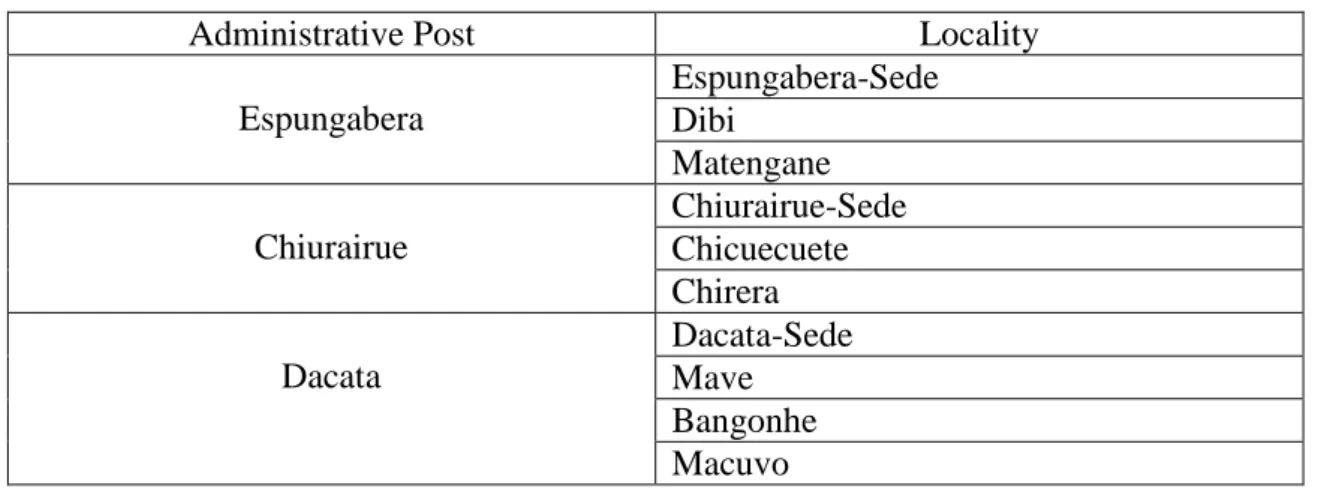
The district capital is Espungabera. It lacks piped water and electricity. People only speak the national language (portuguese) in Espungabera and the other two administrative posts (Dacata and Chiurairue). As far as we move from these villages one can only communicate in the local language (cindau). Agriculture is the main economic activity.
The history of this district reports it as having always been irrelevant for the interests of the Company of Mozambique, the Portuguese Colonial Administration or FRELIMO’s
(Frente de Libertação de Moçambique)1. In fact Mossurize has always remained in the periphery of the colonial economic system (considered as only labour-supply area), and post-colonial development plans and investments in market infrastructure has also systematically excluded this area (Newitt and Tornimbeni, 2008: 720). The long distance from Mossurize to the state’s capital, Maputo (around 1,100 km.), and the lack of proper roads and other communications kept the state’s penetration away from this
region2. It was also in this district that RENAMO (Resistência Nacional de
Moçambique)3 set its first military base in Mozambique, thus large numbers of the population escaped to Zimbabwe during the civil war and this region remained in the
“margins of the state”4
.
The state’s institutionalization and deconcentration process implied the local construction of symbols and infrastructures, such as the district administration building and the different district services buildings. Nowadays, as fieldwork as shown, Mossurize already has its local state buildings at the different administrative posts and at Espungabera one can find the headquarters of the District Administration: the Administrator’s Office, the Permanent Secretary, the District services of Education, Technology and Youth; Women and Social Action; Planning and Infrastructure; Civil Registration; District Command of the Republic of Mozambique’s Police. However not all state officials are from Mossurize.
The political decentralization process is referred ahead, but it seems to have not reached Mossurize yet since this district has no municipalities.
1
Mozambique’s National Front
2 The country’s size and shape alone difficult the effective control and these difficulties are exacerbated by the lack of north-south communications and by the existence of several natural regional centres, while all power is concentrated in the capital, 1,900 km. from Mozambique’s northernmost border (Hall and Young, 1997: 186).
3 Mozambique’s National Resistance
Table 1: Administrative Organization of Mossurize District
Administrative Post Locality
Espungabera Espungabera-Sede Dibi Matengane Chiurairue Chiurairue-Sede Chicuecuete Chirera Dacata Dacata-Sede Mave Bangonhe Macuvo
Mossurize’s population (around 158,000 inhabitants, according to the 2007 census) live in small groups of villages run by the village chief who is subordinated to the “traditional authority” (called mambo in the local language). Indeed in this region, as fieldwork actually confirmed, “traditional authorities” have an important weight. This region pre-colonial political organization much contributes for that and it will be analyzed in the next section.
The ndau
The origins and history of the ndau are related to the Zimbabwe plateau, to the fragmentation of the Monomotapa Empire and the Mbire kingdom and to the expansionary cycles of the rozvi. The rozvi were a shona-caranga lineage group who moved from the Zimbabwe hinterland highlands around the fifteenth century and successively occupied the central strip between the Búzi and Save rivers, dominating the tonga populations that lived there and settling in small political units (chieftaincies) that were relatively autonomous but related by kinship (Florêncio, 2005: 79).
In this expansion towards east, several kingdoms were founded. Among them it was Sanga kingdom, which aroused through successive occupation of the Espungabera mountain region, in today’s Mussorize district, and which derived from three different lineages of the Mutema chieftaincy in Mount Mbire: Nhacuímba-Musicanho, Garágua and Mapunguana (Florêncio, 2005: 82).
When the nguni invaders from the south arrived at Mossurize in the nineteenth century and settled their rule, Mapunguana was one of the main chieftaincies in the region,
together with Chaíva, Gogói and Macuo (Florêncio, 2005: 88). The nguni were later
defeated and in the end of the nineteenth century and the Companhia de Moçambique5
then started to rule over the region. In 1942 the Company’s concession ended and the Portuguese direct administration took control. The colonial rule began with territorial arrangements, most of them taking the chiefs’ land (called nyika in cindau) as reference for the new districts (regedorias). Some chiefs lost their lands, other chiefs were incorporated in a different regedoria and some chiefs were even replaced by others chosen by the Portuguese. All this interfered with “traditional” political hierarchies but not at the same level everywhere.
In a 1966 top-secret report of the Portuguese colonial government (Branquinho, 1966: 13-14), were mapped all the “traditional authorities” of the then district of Manica and Sofala (now two different provinces), as well as were identified the political and symbolic hierarchies between them. With it became clear that there were much interdependence between the chiefs of Mossurize (Mozambique) and the chiefs of Chipinge (then Southern Rhodesia). Mapunguana is clearly referred as being dependent of chief Mapunguana in Southern Rhodesia and both of them to chief Moribane of Southern Rhodesia too.
According to the ndau political organization, which developed through expansion from the Zimbabwe plateau towards the Indian Ocean, any new chieftaincy that was founded in this process, although conquering a certain degree of autonomy, still depended on the chieftaincy from which it has emerged (Florêncio, 2005: 87) – and this is the reason why even today there are strong relations between ndau chieftaincies in the Mozambique-Zimbabwe borderland: the ones in the Mozambican side are traditionally subordinated to those in Zimbabwe.
The establishment of the international border in 1891 was not enough to break the ties between the ndau that were now living in two different colonies. In fact, that separation was never effective. For instance, the political relations between ndau chieftaincies in Mozambique and Southern Rhodesia remained strong, as they had an important symbolic and religious aspect and a complex chain of political hierarchies and
5 Mozambique Chartered Company.
subordinations. These subordinations are based in three areas: political, juridical and religious. Political subordination implies that every new chief (mambo) in the Mozambican side must be confirmed by the Zimbabwe mambo, who sometimes is also the performer of the enthronement ceremony. Juridical subordination implies that Zimbabwe chiefs are considered superior to solve certain conflicts (milandos) and Mozambican chiefs can’t decide without consult them. Religious subordination implies that certain collective ceremonies, such as rain-making, which are crucial for collective social reproduction, can only be performed by the dominant Zimbabwe mambos (Florêncio, 2005: 131).
Despite the Portuguese colonial authorities’ and the post-colonial state efforts to sever them, these ties have been maintained and, even nowadays, Mozambique ndau chiefs are subordinated to ndau chiefs of Zimbabwe when it comes to symbolic and religious issues. Chiefs meet in a certain regular basis in order to solve political, juridical and ceremonial questions concerning their populations. These meetings have the local state acknowledgement and the chiefs' dislocations for that purpose are in the local state cars, which seem to represent some heterogeneity in the political and legal order.
In fact, the opposition between local state and ndau “traditional authorities” is based in two different models of government and social control, both with different legitimacies. Local state is based in “universal plebiscite” and consolidates its power in urban and semi-urban areas, mainly the provinces’ capital cities. On the other hand, “traditional authorities” legitimacy is based in a local cultural identity that people wish to preserve as a social reproduction model, and consolidates its power in deep rural zones, where they are truly the only respected and accepted authority.
Traditional Authorities
“Traditional authority” refers to individuals whose influence and/or power derives from positions held within institutions built upon the organizing principles of kinship. Their titles, geographical dimensions, functions and individual identities have been continuously transformed in the midst of a tremendous variety of local scenarios (West and Kloeck-Jenson, 1999: 457). Another definition sustains that the concept of ‘traditional authorities’ designates both the persons and the political power institutions
which regulate the organization of the social reproduction model of ‘traditional societies’ (Florêncio, 2005: 43). In the case of the African ‘traditional’ societies, these institutions existed before colonialism and have lasted during the colonial period and after the independences – mostly due to how their respective communities still seem them as legitimate.
The present day chief in Africa has become a “syncretic leader” because he forces a synthesis between antagonistic forces stemming from different state models, bureaucracies and world views (Rouveroy van Nieuwaal, 1999: 21). He is not just a subordinate local administrator controlled by bureaucratic exercise of power – in many cases he is also a person who aims to protect the welfare of his land and people through a widely divergent system of possibilities (Rouveroy van Nieuwaal, 1999: 22-23).
Mozambique Colonial Period
When European colonial powers started the ‘effective occupation’ of African territories and had to care about justice and administration, they acted twofold and choose to have a system for the European settlers and another system for the Africans. Hence every colony had two legal systems: one ‘modern’, the other customary. Customary law ‘was defined in the plural, as the law of the tribe, and not in the singular, as a law for all natives. Thus, there was not one customary law for all natives, but roughly as many sets of customary laws as there were said to be tribes’ (Mamdani, 1996: 22).
The Portuguese presence in Mozambique dates back to the sixteenth century but its effective occupation and administration has started only in the last years of the nineteenth century, following the model of indirect rule. The administration of the
African population took the name of regime do indigenato6 and was introduced in the
1920’s. It separated the citizens from the indígenas and was based in two administrations and two laws: the settlers’ areas followed the metropolitan administration model and the indigenous areas were organized in chieftaincies and managed by ‘traditional’ chiefs (régulos). The colonial administration created the ‘administrative districts’ and made them coincide with the chiefs’ territories. Some took the name of regedorias. When the Portuguese thought that the territories were too big,
6 Rule over the indigenous
they cut and shrinked them, or even joined two small territories in a new one. The biggest chieftaincies were divided to be less threatening to colonial rule and the régulos unwilling to collaborate were removed or killed and replaced by others (Araújo, 2008: 6).
From this moment on, the “traditional” authorities struggled to balance the colonial government demands with the need to keep their legitimacy in their communities.
Among these demands, and to fulfill the rules of the Código do Indigenato7 of 1928,
which embodied the principles of the Lei do Trabalho8of 1899, the régulos had to
control the population and recruit people for forced labour.
In the 1960’s, following international pressures against forced labour and in the aftermath of the first African independences, Portugal has changed the name of its colonies to “overseas provinces” and has formally abolished the regime do indigenato; but in practice, the differences between rules for settlers and rules for non-settler’s remained.
FRELIMO State and ‘traditional authorities’ dismissal
After independence, FRELIMO began to rule over Mozambique9. Its overall strategy of
development was based on state-led and socialist economy and at the political level FRELIMO became the one-party state. Its centralization and monopoly of political power limited the organized opposition from other political parties or from civil society. Because it called itself “modern”, there was no space for “traditional authorities” in it. These were seen as remnants of a “tribalist” rule that FRELIMO wanted to cut off, and also as collaborators of the colonial administration as tax collectors and forced labor recruiters. Hence in 1978 FRELIMO prohibited chiefs from participating in the new structures of state and party and condemned beliefs and practices deemed “traditional” or, in the discourse of FRELIMO, “obscurantist” or “feudal”. This exclusion and
7 Indigenous Code
8
Labour Law
9 In the independence war, FRELIMO fought the Portuguese and as such it became the representative of the populations officially recognized by the Portuguese. The rule of Mozambique was delivered to them without elections.
condemnation took little note of the wide variations in authority and popularity of chiefs or other holders of ritual power (Alexander, 1997: 2).
In 1978 it was approved the Lei Orgânica dos Tribunais Populares10 to establish a new
model of popular justice to replace the customary law of the chiefs and some of the administration tasks of the chiefs were transferred to a FRELIMO organization called grupos dinamizadores11. However, and despite the creation of these new mechanisms, “traditional authorities” didn’t vanish. On the one hand, they developed some strategies to keep in charge; on the other hand, the local state realized it needed the chiefs’ help because they were the only ones who could reach the population in remote rural areas and be mediators between the government and the communities, who were also suspicious of the new FRELIMO rule.
The new structures were often unaccepted by the population because they had neither the capacity nor the knowledge to confront a range of problems considered of extreme importance such as unexplained outbreaks of disease to witchcraft and drought (Alexander, 1997: 5). FRELIMO’s new “community leaders” were also unprepared for governing rural communities because they couldn’t administer other matters that were fundamental to rural life such as marriage, divorce, property inheritance, initiation rites and rain-making. So “traditional authorities”, despite being abolished, preserved their legitimacy and worked together with popular courts and grupos dinamizadores whenever needed (West and Kloeck-Jenson, 1999: 458-459).
In 1976-1977, almost two years after independence, Mozambique faced a new war – this time between the FRELIMO party-state and its opposition movement RENAMO. The civil war lasted until 1992 and in RENAMO controlled areas chiefs were reinstated as authorities and helped in the control and organization of the population. It is important to mention that FRELIMO’s previous banning of the chieftaincy was one of the main reasons for RENAMO’s rural support during this war.
10 Organic Law of the Popular Courts
Post-1992 State
The 1992 Peace Agreement put ended the civil war and has started a new age for the local and national state building process in Mozambique, namely for the consolidation of political power throughout the territory and for the arrival of FRELIMO to the areas controlled by RENAMO.
In the late 1970’s and early 1980’s has already grown the idea that the independent African states have ‘failed’ their task of creating an equal and sustainable development for their population, and in the 1990’s the international community demanded the fostering of democratization and political decentralization in Africa in order to repair that ‘fail’. Therefore, it urged to find whose social actors would respond efficiently to local needs and the “traditional authorities” seemed to be the perfect allies. However, FRELIMO had formally abolished them before the war, so a new legal framework and institutionalization was needed.
That didn’t happened before 1994, when legislation on decentralization and deconcentration started to be produced, including roles for “traditional authorities”. But while the central state couldn’t define a role model of integration for the “traditional authorities” or how the relationship between them and the local state should be, life went on in the districts and “traditional authorities” had no option but interact with local state by their own means whenever was needed. Likewise each district administrator acted as it seemed “right” and thus a plurality of interrelations between the state and the chiefs emerged.
Local State
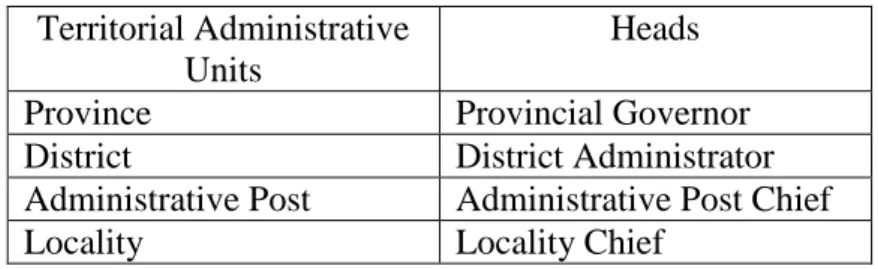
Mozambique is currently divided in ten provinces. The provinces are divided in one hundred twenty-eight districts, the districts are divided in administrative posts and the administrative posts are divided in localities. These are the local organs of the State.
During the Portuguese colonial administration local government structures already existed, with different names that the ones which are now used, and in the framework of indirect rule. After independence the FRELIMO-state decided to abolish them (as well as all the traces of colonialism) also to avoid uncontrolled concentrations of political
power outside core institutions. In 1978 FRELIMO then created new local institutions directly controlled by the party: the Provincial Government for each Province; the People’s Assembly and the District Executive Council both in each district, city and
locality of the country12. New local political actors appeared as well: the grupos
dinamizadores (already mentioned) and secretários de bairro13 who were responsible for the dissemination of the party and ideological framework of communities in the neighborhoods and villages (Fernandes, 2009: 99-107).
“Traditional authorities”, who during the colonial administration played an important role in assisting the Portuguese in the management of the populations, were abolished by FRELIMO. However, some chiefs continued to exercise their powers with their communities’ acknowledgment and afterwards, with the end of the civil war, FRELIMO ended up recognizing their legitimacy.
After the Peace Agreement, Mozambique started its political liberalization process. In the same year than the first multi-party elections (1994) the Government approved the Law 3/94 which created the county districts (distritos municipais). This Law granted the districts high political autonomy from the central state but it was revoked in 1997, in the eve of the first local elections. The new Law (Law 2/97, also called Municipalities Law)
established the municípios or autarquias14 as local institutions autonomous from the
state. Nevertheless, these municípios coexisted with the local state, created in 1978. Thus in the districts one can find a twofold administration: the municípios and the local State.
Municípios are an autonomous body, chosen by the citizens through elections, and do not represent the state neither are part of it (Chambule, 2000:153). The first local elections were held in 1998 and in that year only existed thirty three municípios. The creation of municípios in Mozambique is ongoing and as such not all districts have municípios in coexistence with the local state. Hence the decentralization process seems to be undermined by the deconcentration of state’s institutions, which appears to
12 These Local Structures of the State endured until the new Law was approved in 2003.
13
Secretaries of suburban quarters or villages.
prevail. Indeed, only fifty-three municípios have been established so far (most of them in 1998 and mainly in urban areas).
As for the local state, the territorial organization and administration was established by the Law 8/2003. From the biggest territorial unit to the smallest, it is as showed in the table below.
Table 2: Local State Organization
Territorial Administrative Units
Heads
Province Provincial Governor
District District Administrator
Administrative Post Administrative Post Chief
Locality Locality Chief
The local state organs’ designations and skills can be found in Law 8/2003 and their regulation in the Decree 11/2005. These new documents revoked the laws that were ruling the local state since 1978. As their own name implies, the local organs of the state are representations of the central government locally established: the members are appointed either by the Republic’s President or by the Ministers (in contrast with municípios’s members, which are elected).
Each of the ten provinces is headed by a Governor who is appointed by the President of Mozambique. Each province also has a Permanent Secretary, with administrative and human resources functions, who is appointed by the Prime-Minister. The Governor chairs the Provincial Executive Council which is composed by the Provincial Directors - representatives of the Ministries of the national government and appointed by each Minister. The Provincial Government has no legislative powers - it only executes rules, programs and procedures set by the central organs and assists local authorities in carrying out the policies set centrally.
The districts’ administration is a replication of the provinces: each district is led by an Administrator, appointed by the Minister of State’s Administration, who chairs the
District Executive Council. Each district has a Permanent Secretary, with the same function as in the province, who is appointed by the Governor. The District Council comprises the District Directors (matched to the respective Provincial Directors of each province), the District Court, a delegation from the Civil Registration and finally the District Command of the Republic of Mozambique’s Police. The district administration is in close liaison with stakeholders and the local community and has to coordinate its actions with the município, in locations where it exists.
In the Administrative Posts and Localities, the work is carried out by one chief (with the support of a secretary). Chiefs of Administrative Posts are appointed by the Minister of State’s Administration and Chiefs of Localities are appointed by the Governor of thet province.
“Traditional Authorities” recognition and articulation with the local state
A series of studies were conducted nationwide to assess if “traditional authorities”
should have a part in the decentralization process15. The conclusions were that they had
a legacy that justified the attribution of this new task.
The law 3/94 was the first to establish the legal framework for “traditional authorities” and the areas in which they could collaborate with the local district’s administration. However it was replaced by law 2/97 (the Municipalities Law), which established that municipal governments would listen to the opinions and suggestions of “traditional authorities” recognized as such by the communities. However it left unspecified how such authorities would be identified and how their opinions would be given force (West and Kloeck-Jenson, 1999: 462). Chiefs would play only an advisory role in local affairs and district administrators continued to have the final say in the rural areas of the country. Among chiefs’ duties were the management of land, tax collection, census, opening and maintaining secondary roads, preventing epidemics and infectious diseases, hunting and fishing control. This law also established a framework for the creation of
15 Project ‘Decentralization and Traditional Authority’ (DAT) was a donor funding project (Ford Foundation) carried by the Ministry of State Administration/Administrative Development Core that toured the country between September 1995 and October 1996 staging workshops to facilitate discussion on how ‘traditional authorities’ could be clearly identified within their communities and by government officials, on what functions they might serve and on how their mandate could be made more certain. West and Kloeck-Jenson, 1999: 463
democratically-elected local governments (municipalities) only in cities, towns and areas of urban concentration in rural districts.
The debate continued due to the Lei das Terras16 (law 19/1997). Here it can be read that
all land is the property of the state and that “local leaders” should work in the management of natural resources, conflict resolution, signaling unoccupied land and identifying occupied lands. But it doesn’t clarify who or what is a “local leader” – only refers vaguely that are those respected by all as such, which generated confusion at local level between all the social actors. Thus the law 19/97 changed “traditional authorities” to “community authorities” but the processes by which the communities recognize their leaders remain unspecified until now. At the same time chiefs were protesting for the re-establishment of the colonial model, which in the past granted them houses, uniforms, police and salaries as recognition for their tasks (Alexander, 1997: 18).
In June of 2000 it was finally promulgated the Decree 15/2000, considered the most important law in the institutionalization process of the “traditional authorities”. This law somehow restored the social status and the prestige that chiefs were claiming since 1994. The “local leaders” of the 1997 law are now called “community authorities”, but again is not clearly defined who is considered a community authority – chiefs, secretários de bairro, or other community legitimized leaders. Different social groups have now identical institutional legitimacy, which confuses the population that doesn’t see them as equally legitimized. This law again leaves these “community authorities” in a place of mere consultancy of the local state.
The following law was 8/2003 (Local State Organs Law), where one can find again a “special role” offered to “community authorities”. Though not giving them an official status and allowing local variations, it was considered that “community authorities” represent local interests in a good way and, as such, this law enables the collaboration between the local state and chiefs (Alexander, 1997: 17).
All these laws granted “traditional authorities” similar status, functions and benefits as those conceded by the Portuguese colonial rule. And like in the colonial period,
16
“traditional authorities” play a dual role of community representatives and assistants of the administrative action of the state. But the focus of these documents and especially the Decree 15/2000 is predominantly on what “community authorities” can do for the state in their execution of administrative tasks and in mobilizing rural communities for participation in government projects. Only scant attention is given to the role of community representation (Kyed, 2008: 171).
The weight of “traditional authorities” in local administration is variable according to the regions of the country. Anyway “traditional authorities” now have to directly dispute power at local level with the FRELIMO party structures (grupos dinamizadores and secretários de bairro) because all of them act upon the same political and social spaces that the central or local government never separated – despite the separation between party and state was consecrated in the 1990 Constitution.
At local level, political struggles are between “traditional authorities”, state authorities and organizations, national and foreign NGO’s, FRELIMO and its organizations, RENAMO and its organizations. They struggle for their jurisdiction and decision-making power in subjects of health, agriculture and justice. Yet another important issue is how to organize de facto the shared tasks of policing and justice enforcement laid down in decree 15/2000, since chiefs were obliged by the local tiers of the police to inspect and locate criminals or suspects and to forward this information to the PRM
(Polícia da República de Moçambique17). In this case the boundary-marking in legal
orders and domains of authority is set in three parts: state (law/crime), chiefs (tradition/traditional and social cases), community courts and secretários (community rules and social cases) (Kyed, 2007: 254).
All this evolution shows, as Alexander (1997:20) sustains, that Mozambique has been experiencing a ‘profound crisis of authority’ rooted in ‘practices and pressures of previous years’ that didn’t prepare the way for democratic demands, or for an independent ‘civil society’.
17 Mozambique’s Republic Police
Wraping up…
Focusing again in Mossurize, its geographic location, its pre-colonial practices and representations, it’s possible to say that “traditional authorities” still have a very important role in this region.
The history of this district reports it as having always been irrelevant for the interests of the Company of Mozambique, the Portuguese Colonial Administration or FRELIMO’s. It is a rural district, isolated from the closest urban centre (Chimoio - 240 km.), most of its population doesn’t speak the state’s official language (portuguese) and the “traditional” political and social organization has always prevailed. The physical presence of the state is very recent and the population has always lived in close relation with Zimbabwe, due to kinship relations, more than with Mozambique.
“Traditional authorities” are now officially recognized as community representatives and in Mossurize they are a “valuable asset” for the state, who has to rely on the chief’s administration in the inland areas since the state simply can’t reach the population. However the profusion of “community authorities” that the law recognizes (or that it doesn’t specify) contributes to some conflicts when it comes to resolve populations’ problems.
The ndau chieftaincies are located in the borderland, and their territory spreads across the border. The chiefs meet whenever they have administrative, juridical or ceremonial matters to solve, which contributes for them to ignore the border (at least psychologically) in their regular activities and, to a certain extent, to ignore the state’s territorial authority. Hence the border, in this specific ndau context, doesn’t diminish chiefs’ authority.
Conclusion
In this article it is argued that the legal pluralism in Mozambique is strongly related with the history of the country and is a result of the combination of local and national laws, legal or customary, that have endured through time, originating a dynamic reality that created a heterogeneous state.
From the mid-1990s onwards the state acknowledged the importance of “traditional authorities” and re-institutionalized them in several laws. The weight of “traditional authorities” in local administration is now variable according to the regions of the country. Nonetheless, and because these laws do not specify who are the “community leaders” and how they are designated by their communities, different people act upon the same political and social spaces and that might lead to conflicts.
It seems that chiefs and their respective local states are mutually dependent. This interrelation and heterogeneity of legal and political orders it’s probably the best way yet, even with all its weaknesses, to guarantee state’s authority and stability and to extent its grid to populations that so far haven’t been reached (Buur and Kyed, 2005: 22).
Further research will try to analyze more political decision-making processes in Mossurize and explore what power struggles often occur over authority boundaries.