1
THE BOM SANTO CAVE (LISBON, PORTUGAL): CATCHMENT, DIET AND PATTERNS OF MOBILITY OF A MIDDLE NEOLITHIC POPULATION
António Faustino Carvalho
Universidade do Algarve, F.C.H.S., Campus de Gambelas, 8000-117 Faro, Portugal. E-mail: [email protected] (corresponding author)
Francisca Alves-Cardoso
Universidade Nova de Lisboa, Av. de Berna, 26-C, 1069-061 Lisbon, Portugal. David Gonçalves
Research Centre for Anthropology and Health, Universidade de Coimbra, Cç Martins de Freitas,, 3000-456 Coimbra, Portugal.
Raquel Granja
Universidade do Algarve, Campus de Gambelas, 8000-117 Faro, Portugal. João Luís Cardoso
Universidade Aberta, Rua da Escola Politécnica, 141-147, 1269-001 Lisbon, Portugal. Rebecca M. Dean
University of Minnesota–Morris, 600E, 4th Street, Morris, MN 56267, USA. Juan Francisco Gibaja
C.S.I.C., C/ Egipciaques 15, 08001 Barcelona, Spain. Maria A. Masucci
Drew University, Madison, NJ 07940, USA. Eduardo Arroyo-Pardo
Universidad Complutense de Madrid, 28040-Madrid, Spain. Eva Fernández Domínguez
Liverpool John Moores University, Liverpool L3 3AF, UK. Fiona Petchey
University of Waikato, Gate 9, Hillcrest Road, Hamilton 3240, New Zealand. T. Douglas Price
University of Wisconsin–Madison, 1180 Observatory Drive, Madison, WI 53711, USA. José Eduardo Mateus
Terra Scenica, Largo Frei Heitor Pinto, 4, 2º Esq., 1700-204 Lisbon, Portugal. Paula Fernanda Queiroz
Terra Scenica, Largo Frei Heitor Pinto, 4, 2º Esq., 1700-204 Lisbon, Portugal. Pedro Callapez
Universidade de Coimbra, Largo Marquês de Pombal, 3001-401, Coimbra, Portugal. Carlos Pimenta
Direção-Geral do Património Cultural, Rua da Bica do Marquês, 2, 1300-087 Lisbon, Portugal. Frederico T. Regala
A.E.S.D.A., Av. Tenente Valadim, 17, 1º, 2564-909 Torres Vedras, Portugal. Manuscript
2 Abstract:
The study of the Bom Santo Cave (central Portugal), a Neolithic cemetery, indicated a complex social, palaeoeconomic and population scenario. With isotope, aDNA and provenience analyses of raw materials coupled with stylistic variability of material culture items and
palaeogeographical data light is shed on the territory and social organization of a population dated to 3800–3400 cal BC, i.e. the middle phase of the period. Results indicate an itinerant farming, segmentary society, where exogamic practices were the norm and patrilocality
probably predominated. Its lifeway may be that of the earliest megalithic builders of the region, but further research is needed to correctly evaluate the degree of participation in such
phenomenon.
Key-words:
Portugal; Neolithic; Burial-caves; Bioanthropology
Note:
AFC wrote the manuscript which was reviewed by DG, EAP, EFD, FAC, FP, RG and TDP.
1. Introduction
Along with dolmens and shell middens, caves have often attracted the attention of Portuguese archaeologists. Indeed, the first scientific studies of Mesolithic shell middens and megaliths were written by Pereira da Costa (1868) in the mid-19th century while karst research culminated about the same time with the excavations of the Furninha and Casa da Moura caves by Nery Delgado (e.g., 1884), in the limestone massifs of the Estremadura region of central Portugal (Fig. 1A–B). This initial effort was due to the then-recently founded (1857) Commisão Geologica de Portugal, which was aimed at the geological survey of the country. Many other caves were excavated and published, but the former would become particularly well known given Delgado’s (1884) claims for Neolithic cannibalism, as presented (and refuted) during the 9th Session of the Congrès International d’Anthropologie et d’Archéologie Préhistoriques that was held in Lisbon in 1880. Despite the rejection of such claims, what stands out today is the high quality of the field work carried out by Delgado, which included a critical evaluation of the processes involved in the formation of the archaeological deposits, around one century before this methodology became common practice.
Despite the fact that the history of Portuguese archaeology is still to be written comprehensively (see Cardoso [2002:21–30], for a summary of these early developments), it is well established
3
that after this “golden age”, as many call it, a sharp decrease in the quality of the research took place. This trend would characterize most of the 20th century. Many caves were excavated with inadequate methodologies. Stratigraphic and cultural sequences, burial structures, funerary practices and rituals or particular contexts were not usually recorded or were, at best, only briefly described. As evidenced by many publications, stratigraphic profiles exhibit a single layer from where all the materials were exhumed, with small pieces scarcely represented in inventories. Thus, materials from very distinct periods of occupation were merely published as the cave’s contents. This is the case, among many others, of the Eira Pedrinha (Correia & Teixeira, 1949) or Cova da Moura (Spindler, 1981) cave sites. Crucial aspects—such as palaeoenvironment, cultural sequences, site functions, identification of discrete human
populations—were very poorly discussed or simply absent from the authors’ cogitations. Broad generalizations and a posteriori cultural assignments based on type-fossils shaped cave research in Portugal for decades. Only from the 1970–80’s onwards major changes in methodologies and theoretical perspectives occurred. A discussion of the developments taking place in Portugal regarding cave research is beyond the scope of this paper, but it should be emphasized that evaluations of site formation processes, alongside interdisciplinary approaches—e.g. geoarchaeology, radiocarbon dating, zooarchaeology, human bioarchaeology, funerary practices, etc.—swiftly replaced previous practices.
The excavation of the Bom Santo Cave was part of this modern development. Discovered in June 1993 by a team of speleologists, the cave was clearly of exceptional scientific importance. Four seasons of excavations would take place in 1994, 1995, 1997 and 2001 under the direction of C. Duarte (co-directed with J.M. Arnaud in the first year). A preliminary synthesis was soon published (Duarte & Arnaud, 1996) but it was not until the onset of a research project that interdisciplinary studies could be put in place to analyse the enormous material exhumed during excavations (Carvalho et al., 2012).
The aim of this paper is to present and discuss the results obtained so far from this site, a typical example of Middle Neolithic cave cemeteries of Portugal. This particular use of the Bom Santo Cave must be understood in the framework of the uses given to caves throughout the Neolithic and Chalcolithic, as supported by our growing awareness on changing functionalities, material cultures, funerary practices, lengths of occupation, population dynamics and economic
behaviours during that time period (Carvalho & Cardoso, 2015). Bom Santo is thus a “snap-shot” of a Neolithic population, which has, in this particular case, the interesting coincidence of being coeval—and having been co-involved?—with the building of megalithic monuments.
4 2.1. Site description
Bom Santo is located at 330 m a.m.s.l., on the eastern mid-slope of Montejunto Mountain, overlooking the plains of the lower Tagus valley, ca. 50 km north of Lisbon (Figs. 1–2A). At the time of discovery, the cave’s existence was only deduced from a very narrow entrance on the mountain slope. The removal of a huge limestone boulder suggested that the cave entrance may have been intentionally closed after its last, prehistoric use. This is a large cave site, with a series of rooms, galleries and passages structured in three main overlapping, topographically differentiated “levels” inside the mountain’s flank. The Neolithic necropolis, which occupies the two upper “levels”, covers around 285 m2! Large quantities of human remains were present: an
estimation of the minimum number of individuals (MNI) ranges from 121 to 127, merely based on skeletal elements lying on the surface of sedimentary deposits (Duarte, 1998), thus not counting the remains that may be buried underneath. Funerary deposits showed no signs of having been subject to post-Neolithic anthropic generated disturbance.
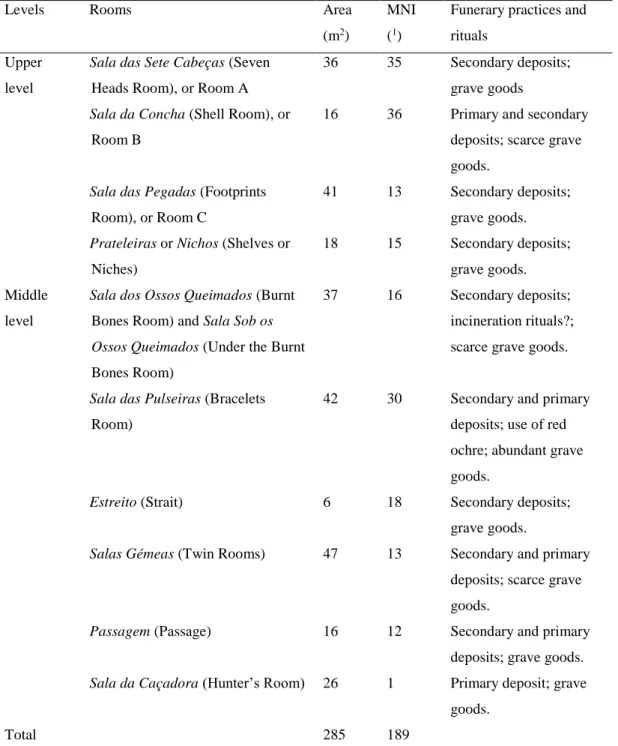
Systematic archaeological and topographical survey allowed the identification of 11 distinct funerary spaces, or rooms. Each was subjected to surface reconnaissance and an estimate of MNI in each room was made (Table 1); only Rooms A and B were subjected to archaeological excavation and had their human remains analysed, so this MNI is thus more accurate. Data from Table 1, albeit partial and preliminary, is an eloquent sketch of Bom Santo’s enormous
potential. It evidences deliberate spatial differentiation between funerary contexts, each with very different numbers of individuals, coexistent funerary practices, distinct grave offerings, etc.
The excavated rooms are located immediately below the steep slope that connects them to the entrance, in the cave’s upper level (Fig. 2B). Sediments can be described as forming a relatively thin (ca. 40 cm), homogeneous deposit. Only three main layers were recorded (Fig. 2C): a surficial, very thin one (3–4 cm) formed of silt and clay of brown-reddish colour; layer 1 (or A), composed of silt and humic brown sediments, probably from outside the cave, with hardened clay lumps, containing all the archaeological and anthropological remains and seeming to have been repeatedly trampled during the prehistoric occupation; and layer 2 (or B), an
archaeologically sterile clayish layer, of brown-greyish colour, covering the cave bedrock. Alongside a very homogeneous material culture, this stratigraphy suggested a relatively short period of use, which was confirmed by radiocarbon results.
5
The main objectives of the bioanthropological analysis were to reconstruct the funerary practices, the MNI and to characterize the demographic profile—i.e. age-at-death and sex—of the human remains present in Rooms A and B. This task was challenging due to the
commingled nature of the remains, which resulted from two different processes. Within the timeframe of Bom Santo use, skeletonised and disarticulated remains from primary surface depositions were mixed up with each other, mainly due to human activity, although other agents probably had a role in this process (e.g. faunal activity). In contrast with Room A, this is
particularly visible in Room B, where two skeletons still had a few preserved “first-rate links” (sensu Duday & Guillon, 2006), i.e., partial anatomical connections. No clear intention of bone re-arrangement can be inferred from most of the commingled remains but evidence of this in the form of deliberate secondary depositions (composed of clusters of long bones, skulls and others) was also found (Carvalho et al., 2012).
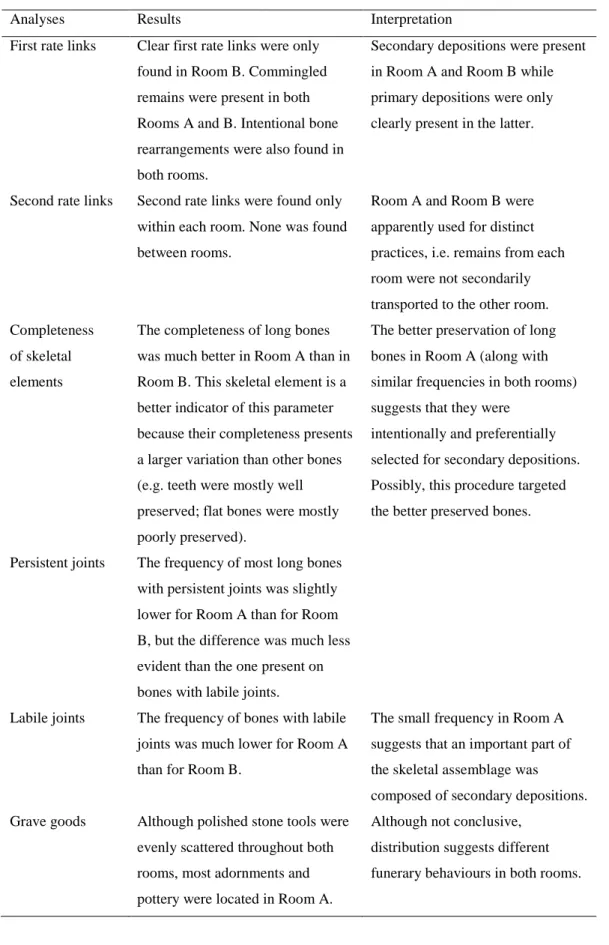
These evidences suggest that Rooms A and B were intended for distinct funerary practices, with the latter being used for both primary and secondary depositions, and Room A used mostly, if not exclusively, for secondary depositions. This conclusion is based on the absence of first-rate links, alongside the low frequency of small bones displaying labile joints and the significantly better skeletal preservation found in Room A (for detailed information on this subject, see Granja et al., 2014b). The interpretation of differential use of the rooms is also supported by the distribution of grave goods (Table 2). However, it should be noted that this explanation relies on the assumption that the two rooms were used separately after the collapse of the stone block which acts as a division between rooms. This hypothesis is supported by the presence of a path in Room B, almost without bones, that follows the contour of the block. In addition, no
“second-rate links” associated with the remains—in this case, bone pairing and linking joints— that connect the two rooms were found. Furthermore, the seemingly different funerary practices adopted in Rooms A and B—evidenced by both skeletal remains and grave goods—suggest that the division took place at an early stage and when funerary depositions were still few in this part of the cave. Also, even if a single room and a single funerary practice had been adopted in the beginning, the quantity of subsequent depositions was sufficient to distinguish the south-western area (Room B) and north-eastern area (Room A) in terms of funerary uses.
The provisional MNI present in both rooms is 73, based on the frequency of the permanent right first lower molar (Room A: n=35; Room B: n=36) and two of uncertain location. The remains found comprise individuals of various age groups, ranging from infancy through old age and both sexes – sample-specific sex estimation allowed us to estimate the sex of 38 individuals, 18 as males and 20 as females (Gonçalves et al., 2014), suggesting that the cave was used by all members of the community. The age-at-death estimation was carried out based on dental
6
mineralization and eruption, on epiphyseal union and fusion and on diaphyseal length of immature remains. Indicators of biological maturity for adults such as the auricular surface and the pubic symphysis on the hip bone were also used (Granja et al., 2014a). We found at least 20 non-adults with less than 14 years old and 21 individuals of adult appearance. Only about half of the individuals (n = 32) was age estimated and many of them were so based in somewhat wide age cohorts, so we refrain from inferring about the age structure and the mortality rate of this population, especially because only a small part of the cave has been excavated until now. Sex estimation was based on odontometrics, osteometrics and skeletal morphology (Gonçalves et al., 2014; Granja et al., 2014a). Although the space was used regardless of sex and age-at death a detailed analysis of the cave is indicative of a funerary spatial managing. This observation is evident if the cave is considered as a whole, taking into account its different sections (Table 1), suggesting that some regulation may be latent in the funerary structures and compartments that are present throughout the cave. This is evident also in the excavated rooms. For example, no immature remains were found in a small area in the eastern square units of Room A, although mature remains were quite numerous; also, sex distribution throughout Room A and B was apparently quite distinct: 2.3 females for every male in the former and 1.3 males for every female in the latter, although the estimated preliminary sex ratio in the pooled rooms was well balanced (1.1:1). These patterns may have resulted from random behaviour, but they may also be a consequence of a funerary space management according to specific social and gender rules.
2.3. Grave goods
Grave goods—which were found commingled with the human remains—are composed by a very narrow array of types (Figs. 3–4). These are knapped flint (39 blades and 30 microliths), polished axes (n=7), adzes (n=14) made of metamorphic rocks, and bone tools showing a variety of morphologies: mainly awls or points (n=11) made of sheep/goat or red deer bones, whenever the species was identifiable, and six other individual artefacts (an anvil, a “spatula-burnisher”, an unknown object nicknamed “the flute”), and three unidentifiable fragments. Besides schist beads (n=9), personal adornments are mostly made of shell (n=70). Among these are pendants and beads made of European cowrie (Trivia monacha) (n=62), tusk shell
(Dentalium sp.) (n=3), great scallop (Pecten maximus) (n=2) and dog whelk (Hinia [Nassarius] reticulatus) (n=1) shells, and bracelets (n=2) made of dog cockle shell (Glycimeris cf.
glycimeris). As for ceramics, only two complete bowls were found, both undecorated, which were associated to 11 loose sherds (including two rimsherds, one of them ornamented with impressed motifs).
7
Overall, this assemblage is typical of Middle Neolithic—i.e. 4000–3400 cal BC, according to Carvalho & Cardoso (2015); see also Boaventura (2011)—grave goods commonly found in all types of cemeteries (caves, dolmens, hypogea, burial-pits) known across the southern regions of Portugal (Cardoso, 2002; Valera, 2012). Finally, the absence of complex pottery shapes,
elaborate and exotic personal adornments, long flint blades or bifacially-retouched lithic implements (arrow heads, foliates, etc.), types that overall will become common in burial sites dated to the Late Neolithic (ca. 3400 cal BC) onwards, should be noted.
2.4. Genetic and isotopic evidence
From the exhumed human remains a sample of 15 individuals was selected for systematic genetic and chemical (diet and mobility) studies. In order to avoid repetition of results,
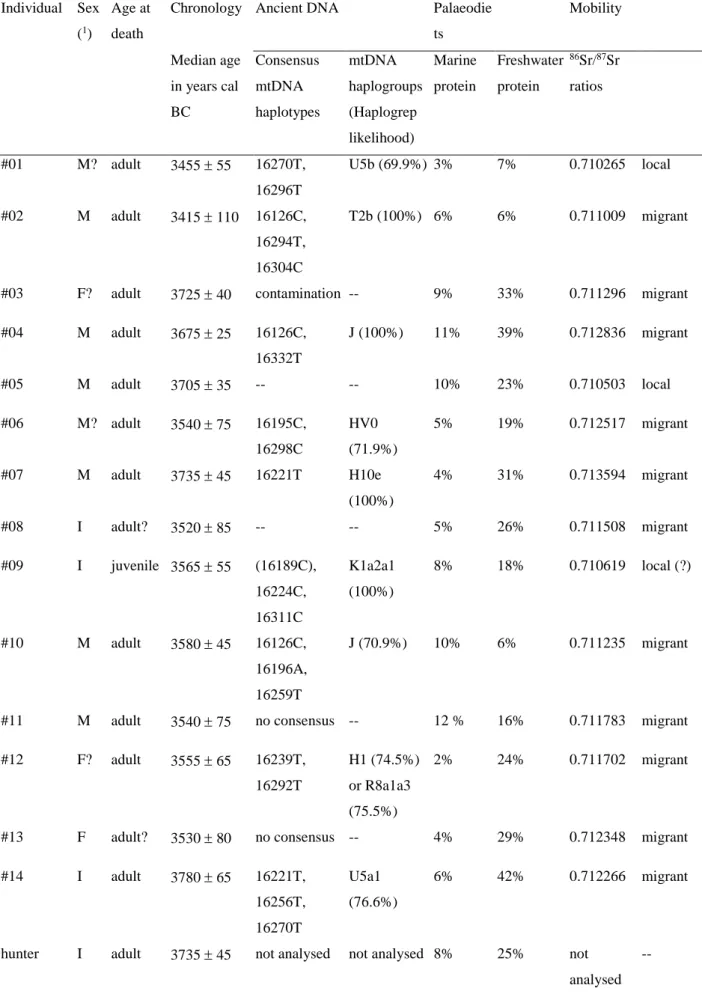
individuals #01 and #02 (both in partial anatomical connection) were chosen alongside 12 lower mandibles from Rooms A and B (individuals #03 to #14), plus a rib fragment from so-called the “hunter” (from the Hunter’s Room; see Table 1) for radiocarbon and palaeodiet only. Albeit a relatively small proportion of the overall population from those rooms (14 out of 71 individuals, i.e. 20%), this is the only example so far in Portugal where a sample of a chronologically well defined prehistoric population is fully characterized regarding basic bioanthropological traits (sex and age), direct dating (by AMS), ancient DNA (hereafter aDNA), palaeodiet (carbon and nitrogen isotopes) and mobility (oxygen and strontium isotopes) for each individual.
2.4.1. Ancient DNA
The aim of aDNA analyses was to retrieve relevant genetic information from nuclear and mitochondrial DNA to try to reconstruct the social organization of these societies.
Methodological procedures—sample cleaning and grinding, DNA extraction, mitochondrial and nuclear STR DNA analyses, criteria of authenticity, bacterial cloning, population and statistical analysis—can be found thoroughly described in Fernández & Arroyo-Pardo (2014:133–6).
Partial autosomal STR profiles could be obtained for two skeletons (individuals #02 and #6) only for 1 out of the 8 STR markers tested. Reproducible HVRI mitochondrial DNA sequences were however obtained for 9 of the 14 analysed skeletons (64%). In seven cases it was possible to reconstruct the complete HVRI haplotype (np 16,126-16,399) while in two cases only a short fragment could be retrieved (16,126-16,258). All the recovered haplotypes were different, with the exception of the partial profile of individual #07 and the profile of the first amplified HVRI fragment of individual #14 (Table 3). The reconstruction of the complete haplotype in sample #07 will be needed in order to assure the identity of both sequences.
8
In terms of distribution, the recovered haplotypes have not been previously documented in other ancient populations analysed so far in the Iberian Peninsula whereas their modern geographical distribution is also very scarce (Fernández & Arroyo-Pardo 2014:table 4.1.4). With the use of the information from the HVRI and the software Haplogrep it was possible to infer the mtDNA haplogroup in all the recovered profiles with likelihood scores higher than 69.9% (Table 3).
With the exception of individual #10, who was assigned with similar probabilities to both Asian haplogroup R8a (75.5%) and European haplogroup H1 (74.4%), all mitochondrial haplogroups are of European ancestry. Haplogroups U5, J and H were the more prevalent, followed by haplogroups T, HV0 and K, each represented in one individual. When sub-clusters within haplogroups were considered—with the exception of individuals #04 and #10 belonging to mitochondrial haplogroup J*—all the retrieved sub-haplogroups were also different.
2.4.2. Radiocarbon dating and palaeodiets
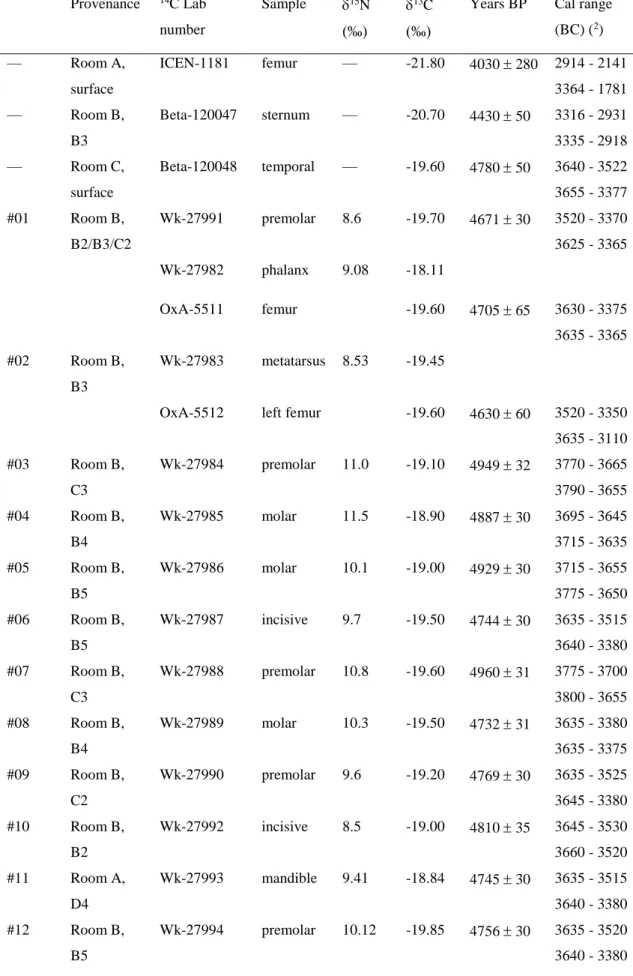
15 individuals were directly dated by AMS 14C (Table 4). In conjunction with this measurement
the remains were also isotopically analysed to provide insights into Middle Neolithic palaeodiet and subsistence strategies for this region. Despite the fact that the principles underlying isotopic analyses of this kind are well-established and used widely, specific methodological protocols had to be developed (Carvalho & Petchey, 2013) for two main reasons. First, the development of large European food source datasets in the last 25 years indicate that an earlier dietary assessment by Lubell et al. (1994) on Mesolithic and Neolithic Portuguese skeletons, using 13C
and 15N isotopic values, could overestimate the relative marine protein contribution; second,
there is currently no reference isotopic data from flora and fauna from the region and time period under study. To estimate the isotopic composition of the foods consumed by the Bom Santo individuals, therefore, we utilized data from the Danish Mesolithic and Neolithic compiled by Fischer et al. (2007). This dataset has the advantage of including isotopic
information from marine, terrestrial and freshwater animals, which can be adapted according to established isotopic relationships between northern and southern Europe (van Klinken et al., 2000).
This dietary information is vital for correction of an freshwater and/or marine 14C reservoir
offset that can shift the result by several hundred years. This was particularly problematic given the location of the cave near the Tagus estuary and within the limestone bedrock of the
Montejunto Mountain; factors that could result in the incorporation of marine foods with up to 400 years of offset and/or ancient 14C from groundwater CaCO
9
offset these foods may have introduced into the 14C age of the Bom Santo individuals is the
measurement of nitrogen and carbon stable isotopes. Using hypothetical isotopic endpoints for marine, freshwater and terrestrial diets we calculated a likely % marine or % freshwater value for each individual (see Carvalho & Petchey [2013] for methodology). Of note is that the 15N
of fish protein is, on average, enriched with respect to terrestrial sources of protein by 6‰ (Hedges & Reynard, 2007:1244) and is comparable to marine fish values. 13C of freshwater
fish is typically similar to terrestrial herbivores, but will vary depending on whether the fish come from lakes or rivers, as well as the size of the lakes, trophic level of the fish, and source of carbon in the freshwater system (Van Klinken et al., 2000:49; Fischer et al., 2007:2137–9).
All determinations are compiled and presented in Table 4, with details on sample type, isotopic results, radiocarbon determinations and calibration probability intervals. Dates were calibrated with the IntCal13 curve (Reimer et al., 2013) and plotted in Fig. 5 with version 4.2 of the OxCal program (Bronk-Ramsey, 2012).
These isotope results indicate the Bom Santo population had a preference for a predominantly terrestrial-based subsistence strategies, as have already been observed in many other Neolithic necropolises of the Estremadura by several authors (Lubell et al., 1994; Carvalho & Petchey, 2013; Waterman et al., 2014). However, some individuals also showed variable degrees of marine or freshwater wild resource consumption. Nine out of the 15 individuals (60%) had isotope values indicative of a diet composed of ≥20% of freshwater foods, which constitutes culturally a significant trend with no parallel in other coeval burial sites in the region. Unfortunately, until further investigation is done into isotopes of local flora and fauna it is difficult to distinguish isotopically between the consumption of larger amounts of
estuarine/riverine foods or herbivore flesh, but this assessment of higher freshwater input in the diet is in keeping with the landscape around Bom Santo during the mid-Holocene (see below). At around this time, the northern limit of the estuary’s brackish waters was to the north of Bom Santo and resulted in the formation of peat deposits in the Tagus main tributaries and on a very large estuary (Vis & Kasse, 2009), permitting therefore the economic exploitation of its presumably abundant wild resources.
2.4.3. Mobility
Strontium isotope analysis provides a robust means for examining human mobility in the past and tracing the first generations of migrants to an area. The principle is straightforward. The strontium isotope ratio of 87Sr/86Sr varies among different kinds of rocks. Because the 87Sr forms
10
with more rubidium have a higher 87Sr/86Sr ratio, while younger rocks with less rubidium are at
the opposite end of the range with low ratios (e.g., Montgomery et al., 2006). Sediments reflect the ratio of their parent material. The amount of 87S in nature varies but is roughly 7% of total
strontium and 86Sr is 10% (87Sr/86Sr roughly equals 0.7).
Strontium moves into humans from rocks and sediment through the food chain (Price 1989, Price et al. 2001, Sillen and Kavanagh 1982). The local ratio of 87Sr to 86Sr is depositd in tooth
enamel during its formation in early childhood and remains unchanged through life and after burial. Most measurements of human enamel fall in the range of 0.703 to 0.723. This ratio in enamel then reflects the underlying geology of the area where and individual was born. If an individual moved to a new location in a different geologic context, or was buried in a new place, the enamel isotopes will differ from those of the new location, allowing the designation of that individual as a non-local. There are several published summaries of the method (e.g., Bentley, 2006; Montgomery, 2010; Slovak and Paytan, 2011). Analytical methods are described in detail in a number of publications (e.g., Frei and Price, 2012; Price et al., 1994; Sjögren et al., 2009; Slovak and Paytan, 2011).
An essential issue in strontium isotope analysis involves determination of the local strontium isotope signal for the area in which a burial is found. In fact, levels of strontium isotopes in human tissue may vary from the actual geological background for a number of reasons (e.g., Maurer et al., 2012; Price et al., 2002; Sillen et al., 1998). Factors include differential
weathering of minerals in rock, atmospheric dust, the deposition of aeolian, alluvial, or glacial sediments on top of bedrock geology, and other forms of sediment transport. Bioavailable
87Sr/86Sr is the range of values actually available in the local food chain. This baseline
information on isotope values across an area needs to be obtained in order to make useful and reliable statements about the origins of the human remains under study (Price et al., 2002; Frei and Price, 2012).The local bioavailable isotopic signal of the place of burial can be determined in several ways: in human bone from the individuals whose teeth are analysed, from the bones of other humans or archaeological fauna at the site, or from modern fauna, water, soil extracts or vegetation in the vicinity (e.g., Maurer et al., 2012).
Most part of Estremadura region is dominated by Jurassic limestone massifs—such as Montejunto, where Bom Santo is located—interspersed with large areas of Cretaceous sandstones and conglomerates. The right banks of the Tagus Valley, in front of the cave, are dissected by a series of streams flowing across Pliocene, Miocene, and Pleistocene sediments (Fig. 1B–C). Marine sediments from the Jurassic and Cretaceous have predictable 87Sr/86Sr
11
ranging from ca. 0.707 to 0.7092. Modern seawater has a ratio of 0.7092. With the exception of the Sintra Mountain, at the southern tip of the region, Estremadura generally lacks the igneous granites and metamorphic schists found in the Portuguese interior—namely in the Alentejo plains, on the opposite banks of the Tagus—that exhibit elevated 87Sr/86Sr values.
Regional bioavailable levels of 87Sr/86Sr were obtained using the data provided by Waterman et
al. (2014), an unpublished project, and by analysing five samples of herbivores remains from Bom Santo (Price, 2014). The former study measured 87Sr/86Sr in fauna and human enamel from
a series of eight sites in coastal Estremadura, most of which—like Bom Santo—lie in natural limestone caves in geologically similar massifs. In general, the 87Sr/86Sr values are all very close
to 0.710 and are very consistent and slightly higher than the expected ratios for these limestone formations. As part of another project, we have measured modern land snails from the Muge shell middens, providing a general proxy for the Tagus river valley (results point to between 0.7092 and 0.7098). The faunal remains from Bom Santo come from two red deer and three sheep/goat bones. Three of the five samples—both red deer and one sheep/goat—exhibit values of 0.7099, 0.7096, and 0.7102, respectively, which likely define the local values for the area around the cave, with a mean value of 0.7098 0.0003.
We measured strontium, carbon and oxygen isotopes in the tooth enamel from 14 burials from Bom Santo. Information about these burials and the isotopic data are presented in Table 3 (for δ18O values, see Price, 2014:table 4.3.4). A bar graph of the ranked strontium isotope ratios for
the human samples (Fig. 6) shows a rather continuous range from 0.7103 to 0.7136. The mean value is of 0.7117 0.001 and the values have a generally normal distribution.
In this area of Estremadura there are no known sources of 87Sr/86Sr above 0.710. Thus, the
evidence is overwhelming that values above a cautious limit of ca. 0.7105 are non-local. These data very much suggest that the most of the individuals from Bom Santo (at least 11 out 14, i.e. 79%) are non-local or at least mobile for part of the year, obtaining foods from areas with higher local 87Sr/86Sr values. It should be stressed that two out of the three sheep/goat samples also
exhibit values compatible with a non-local origin (0.7122 and 0.7134, respectively); these animals likely have come from elsewhere.
The nearest regions with higher local 87Sr/86Sr values are the schist and granitic banks of the
Upper Tagus (to the north) or the plains of the Alentejo hinterland (to the east and southeast). Thus, our preliminary interpretation of the Bom Santo isotope data involves a mobile population associated with itinerant pastoralism.
12 3. Bom Santo in context: a first interpretative model
Portuguese Estremadura is the westernmost region of the Iberian Peninsula, located along its central Atlantic coast (Fig. 1A). It is an elongated territory on a North-South axis delimited by the ocean to the west and by the Tagus river valley to the east. With the exception of the granite Sintra Mountain, Estremadura is geomorphologically characterized by a series of successive Jurassic and Cretaceous limestone massifs that form its backbone. From these massifs a dense drainage system flows to the Atlantic or to the Tagus, crossing plains of sands, clays or sandstones. Immediate neighbouring regions display contrasting geologies and orographic features. To the north and north-east there are hilly regions of schists and other metamorphic rocks, such as the gneisses and metamorphic schists; the Alentejo province, on the other hand, is characterized mainly for its extensive plains of schist and granite (in the inner territories) or Quaternary terraces, sandstones and sands (along the Tagus and Sado river valleys). These geological features are essential to identify exchange networks and trace provenance areas of raw materials and people.
Mediterranean climate conditions and vegetation covers characterize Estremadura. However, palaeoecological datasets provide rather incomplete pictures. Wood charcoal analyses and results from the pollen diagrams available (see Carvalho [2014:209–10] for a synthesis) indicate a typically Mediterranean forest cover dominated by strawberry tree and wild olive during the Middle Holocene, a pattern also recognized at Bom Santo (Queiroz & Mateus, 2014),
suggesting overall a climate drier than today’s. Human-induced impacts—as a result of farming and/or the grazing of livestock—have been difficult to identify, either because pollen cores were made in coastal lagoons or marshlands, or because charcoal from single sites reflect the more immediate environments rather than the surrounding landscape. Inferences permitted by the microfauna (Pimenta, 2014) and terrestrial gastropod (Callapez, 2014) spectra from Bom Santo, although very limited in this regard, do not seem to contradict such conclusion. The most remarkable palaeogeographic feature of the region at the time was undoubtedly the large palaeoestuary of the Tagus, of fresh and brackish waters (Vis et al., 2008:fig.12), thus providing not only excellent navigation routes but also an ecologically rich environment—today filled with fluvial sediments (Fig. 1C)—, as will be discussed below.
The artefactual analyses that were carried out suggested a cultural integration of the Bom Santo population at several levels:
Pottery, scarce, is composed by undecorated vessels, of simple geometric shapes, repeating well-known typologies from Middle Neolithic funerary contexts, namely other burial-caves and dolmens that punctuate the landscape of the Alentejo. However, the
13
Bom Santo vessels showed rather distinct fabric recipes, though locally made (Carvalho & Masucci, 2014), and thus testifying a variability in technology that sharply contrasts with uniformity in typology and surface appearance. Only the recipe of one vessel seems typical of the Middle/Late Neolithic sites located in the Rio Maior area, 30–35 km North of the cave, thus suggesting an import.
Polished stone axes and adzes from Bom Santo are made of three main raw materials (Cardoso, 2014): amphibolite, meta-volcanic and sedimentary or meta-sedimentary rocks (but see Lillios [2000] for partially distinct petrographic classifications). With the
exception of the latter type of rocks, which are locally obtained in the Meso-Cenozoic formations of Estremadura, all others are exogenous: the closest sources of amphibolite can only be found along the western borders of the Hesperian Massif (90–100 km to the east) while meta-volcanic rocks are more widely distributed but can be found in the Lower Alentejo and the Alcácer do Sal area (respectively, 150 km and 80–90 km south). Cardoso (2003) has been able to classify bone awls according to two main types: those
obtained by longitudinal splitting of long bones—as at Bom Santo—or by diagonal sectioning. The former is typical of the Middle Neolithic whereas the latter is commonly found from the Late Neolithic onwards. At Escoural Cave (Araújo & Lejeune, 1995; Fig. 1B) a coexistence of both types is observed but those longitudinally sectioned present a remarkable technological difference, which is having been thinned not split into two approximately equal halves. This testifies different technical options aiming however the same end-product.
The personal adornments found at Bom Santo (Dean & Carvalho, 2014) are more diversified but all raw materials could have been obtained in relatively short distances from the cave, between the Tagus estuary and the nearby Atlantic coastline. Whenever taphonomic environments allowed their preservation, this is also the case, for example, of great scallop shells and dog cockle bracelets that have been recorded in several caves, burial-pits and hypogea of the Alentejo and Algarve provinces (Valera, 2012).
Overall, these observations suggests a scenario where distinct groups (with their own awl or pottery-making options and geological/geographical constraints) are incorporated in larger cultural or political units that share common stylistic behaviours (plain, spherical pots; thinly elongated awls; adornments and votive goods made of sea molluscs). However, the large and geologically heterogeneous geographical area where these phenomena are attested suggest highly variable strategies of acquisition and/or exchange of artefacts and raw materials—as eloquently evidenced by the polished stone tools—and thus different scales of interaction with the environment and between human communities. Long-distance, supra-regional exchange networks in central Portugal are known since the earliest Neolithic and comprise not only
14
amphibolite for stone tools but also other raw materials, such as variscite, muscovite and fibrolite (from still undetermined geological sources) or imitations of Alpine jade axe-heads made with Iberian rocks. This is the case of the perforated amphibolite axe found in the Óbidos Lagoon (Lillios et al., 2000), which was recently dated to the 5th–4th millennia BC transition after being ascribed to so-called Cangas type (an Iberian imitation of the Tumiac type from the Gulf of Morbihan). According to Pétrequin et al. (2012), it can be understood as result of the Carnac influence as redistribution centre of the Alpine jade.
But based on the Bom Santo evidence alone, we can propose three distinct distance radii, or geographical belts, to tentatively understand the way territories were occupied/exploited:
A Local Geographical Belt (≤30–40 km) is indicated by the natural habitats of the mollusc species and the presumed provenience of the only non-local vessel.
Geographically, this belt encompasses the lower Tagus valley (including its estuary and the tributaries on both banks), the Montejunto mountain, its surrounding plains and the corresponding Atlantic coastline.
An Intermediate Geographical Belt (30–40 to 90–100 km) is indicated by the various potential catchment areas of the amphibolite and the meta-volcanic rocks from the Alcácer do Sal area. A very heterogeneous territory is thus included in this belt, encompassing the whole Estremadura province and extending to Upper Alentejo region.
A Remote Geographical Belt (90–100 to c. 150 km) is suggested by the possibility that some of the Bom Santo’s meta-volcanic adzes may have been made from rocks collected in the easternmost and southerly sectors of the Alentejo. It may also be possible that some knapped tools known in megalithic graves and hypogea from these distant regions may have been made with flint imported from Estremadura.
In cultural terms, even the regions included in the remote geographical belt share strikingly similar traits visible in some material culture items (Cardoso, 2002). Among these, the pottery productions stand out, of course, as the most notable example of this scale of integration. Polished and knapped stone tools mimic this pattern. Taphonomic limitations prevent personal adornments and tools made of bone, antler or shell to be found in megalithic monuments but more favourable preservation conditions observed at the hypogea and the few known caves, however, indicate similarities at this level too (Valera, 2012). Detailed comparative
technological and stylistic analysis of material culture may reveal regionally discrete social entities, but approaches as these remain to be explored.
15
described geographical belts, and characterize its economy, social organization and interaction with other human groups.
Unfortunately, direct evidence of Middle Neolithic farming is very scarce: Bom Santo is located on the periphery of the most productive soils, settlements are completely unknown in the area, and only two sickle implements used as grave goods (Carvalho & Gibaja, 2014; Gibaja & Carvalho, 2014) suggest the presence of agriculture (for a discussion on the role played by agriculture and stock-keeping in the period, see Carvalho et al. [2013] and Valente & Carvalho [2014], respectively).
Carbon and nitrogen evidence from Bom Santo showed a heavy reliance on terrestrial food sources as well as marine and freshwater foods (Table 3). However, there is little material evidence to support a divergence from a dominantly terrestrial-based subsistence strategy in Middle Neolithic Estremadura (Carvalho & Petchey, 2013). Indeed, while these isotopic results suggest the Bom Santo population consumed foods from their close riverine/estuarine
environments in the rest of Estremadura these resources were not continuously exploited nor constituted a significant subsistence item; more likely, they played a seasonal/opportunistic role for some individuals or segment of a community only, not a year-round food source available to all.
Strontium isotopes from human bones indicate that mobility may have played a crucial role: eleven individuals (Fig. 6) may have lived most their lives away from the local geographical belt, as well as two of the sheep/goat. These results combined suggest herding practices embedded in a shifting agricultural strategy, though other possibilities can not be excluded to explain the non-local sheep/goat (exchange, marriage dowries).
If 87Sr/86Sr values from the Bom Santo population are compatible both with the Tagus upper
section and the plains of Alentejo, coinciding factors indicate, however, that the mobility of its population displayed a west–east rather than a south–north axis (Fig. 1B–C). Indeed, the former axis encompasses a geological succession from the Tertiary deposits of the Tagus to the
geochronologically older granitic and schistose formations of the inner Alentejo, where higher
87Sr/86Sr ratios are presumably found and may explain the observed values in humans and
sheep/goat. This axis was supported by the Sorraia River, a then-deeply penetrating water course (Vis et al., 2008:fig.12; see also the Holocene fluvial formations in Fig. 1C) that facilitated both human mobility between Estremadura and Alentejo and direct access to the freshwater food sources presumably present in diets. Such a trend sharply contrasts with isotope results from coeval individuals from central and northern Estremadura sites (Fig. 1B), where the
16
observed trend is that of a terrestrial-based subsistence strategy (Carvalho & Petchey, 2013).
Moreover, fitting the Sorraia Valley in the geographical belts, a coincidence with the
intermediate geographical belt becomes clear: its 100 km radius limit includes the westernmost fringes of the granitic and schistose geological formations of the Mora–Pavia area (Fig. 1C). The role of the Middle Holocene Sorraia is further enhanced by the surrounding densely irrigated sandstone plains, where recent surveys permitted the identification of a Middle Neolithic settlement system (Rocha, 2001) with Monte da Foz (Neves, 2013) and Moita do Ourives (Rodrigues, 2006) as the best known examples. Despite the complete absence of organic remains in both sites, their records indicate short-duration occupations (perishable domestic structures, low density of artefacts), suggesting temporary (seasonal?) camps occupied by a segment of a larger community. Furthermore, according to Rocha (1999), there are
amphibolite outcrops in the Mora–Pavia area from where this raw material may have reached Bom Santo. In sum, it is possible to conclude that the territory of the Bom Santo population may have been the lower Estremadura and the Sorraia Valley, within the local and the intermediate geographical belts. Thus, the remote belt probably was not directly frequented and belonged to another community.
One of the most striking aspects of the Bom Santo aDNA is its outstanding mitochondrial haplotype and haplogroup diversity, in contrast with other Iberian Neolithic necropolis (Table 5). Given the fact that most theoretical models on the Neolithic emphasise the role played by kinship as its basic social organizing feature, one possible explanation for the results obtained in Bom Santo could be admixture in the context of exogamic practices. This working hypothesis seems to fit expectations either from cross-cultural anthropological models (e.g. Zvelebil [2000] and references therein), aDNA results from Neolithic cemeteries elsewhere in Europe (e.g. Haak et al., 2008), and isotope evidence from human skeletons.
4. Conclusions
According to the model put forward in this paper, Bom Santo could have been used as cemetery by coeval human groups with complex funerary practices but sharing similar material cultures and belonging to a common political entity, most likely a “segmentary society”, occupying a large territory with practices of exogamy predominating. However, such diversity can also be expected in fully sedentary societies displaying some diversity in terms of funerary practices and able to include non-locals through mechanisms such as extensive, systematic exogamic practices. Thus, other scenarios may eventually also explain our data but only further projects of the kind, coupled with Y chromosome studies from human remains, can disentangle alternative
17 hypotheses.
Perhaps the most far-reaching prospect opened by the research carried out at Bom Santo is its acknowledged contemporaneity with the earliest megaliths of the southern regions of Portugal, namely from the Alentejo (Fig. 1B), which started to be built in the beginning of the 4th millennium cal BC (Cardoso, 2002; Boaventura, 2011; Carvalho, 2014; Carvalho & Cardoso, 2015:45–6). Thus, this study parallels analyses of other “megalithic populations” from Western Europe—from Sweden (Sjögren et al., 2009) to France (Deguilloux et al., 2011)—where strontium and aDNA approaches, respectively, were also attempted to characterize the mobility and population structure of the megalith builders. In the case of the Alentejo dolmens, the almost absence of human remains have been preventing not only solid chronologies from being obtained but also isotopic and genetic data supporting interpretative economic, territorial, social and populational models, as the one permitted by Bom Santo. Caves may thus complement dolmen evidence, if contemporaneity and common socioeconomic territories are demonstrated.
Acknowledgments
This study was funded by the Portuguese Foundation for Science and Technology in the framework of the project Bom Santo Cave and the Neolithic societies of Portuguese
Estremadura, 6th-4th millennia BC (PTDC/HIS-ARQ/098633/2008), directed by AFC in the 2010-2013 triennium, being the outcome of previous work at the site by Cidália Duarte, whom we thank for sharing her data. A reference must be made to the speleologists from the
Associação de Estudos Subterrâneos e Defesa do Ambiente that discovered the cave; if it were not for their ethics and responsibility at reclosing the cave until professional archaeological works could be started, the integrity of its scientific potential may had been compromised and this work would have been impossible. We also thank three anonymous reviewers for their encouraging comments and suggestions that helped improving a first version of our text.
References
Araújo, A.C. & Lejeune, M. 1995. Gruta do Escoural: necrópole neolítica e arte rupestre paleolítica. Lisboa: IPPAR.
Bentley, R.A. 2006. Strontium isotopes from the earth to the archaeological skeleton: a review. Journal of Archaeological Method and Theory, 13(3):135–87.
18
Wahl, J.; Francken, M.; Grupe, G.; Lenneis, E.; Tescher-Nicola, M.; Arbogast, R.-M.;
Hofmann, D. & Whittle, A. 2012. Community differentiation and kinship among Europe’s first farmers. Proceedings of the National Academy of Sciences, 109(24):9326–30.
Boaventura, R. 2011. Chronology of megalithism in South-Central Portugal. Menga, 1:159–90.
Bronk-Ramsey, C. 2012. OxCal Program V4.1.5. Oxford: University of Oxford.
Callapez, P.M. 2014. Terrestrial gastropods. In: A.F. Carvalho, ed. Bom Santo Cave (Lisbon) and the Middle Neolithic Societies of Southern Portugal. Faro: Universidade do Algarve, pp. 45–60.
Cardoso, J.L. 2002. Pré-História de Portugal. Lisboa: Universidade Aberta.
Cardoso, J.L. 2003. A utensilagem óssea de uso comum do povoado pré-histórico de Leceia (Oeiras). Estudos Arqueológicos de Oeiras, 11:25–84.
Cardoso, J.L. 2014. Polished stone tools. In: A.F. Carvalho, ed. Bom Santo Cave (Lisbon) and the Middle Neolithic Societies of Southern Portugal. Faro: Universidade do Algarve, pp. 185– 94.
Carvalho, A.F. 2014. Bom Santo Cave in context. A preliminary contribution to the study of the first megalith builders of Southern Portugal. In: A.F. Carvalho, ed. Bom Santo Cave (Lisbon) and the Middle Neolithic Societies of Southern Portugal. Faro: Universidade do Algarve, pp. 209–30.
Carvalho, A.F. & Cardoso, J.L. 2015. Insights on the changing dynamics of cemetery use in the Neolithic and Chalcolithic of Southern Portugal. Radiocarbon dating of Lugar do Canto Cave (Santarém). Spal, 24:35–53.
Carvalho, A.F. & Gibaja, J.F. 2014. Knapped stone tools. In: A.F. Carvalho, ed. Bom Santo Cave (Lisbon) and the Middle Neolithic Societies of Southern Portugal. Faro: Universidade do Algarve, pp. 173–84.
Carvalho, A.F.; Gibaja, J.F. & Cardoso, J.L. 2013. Insights into the earliest agriculture of Central Portugal: sickle implements from the Early Neolithic site of Cortiçóis (Santarém). Comptes Rendus Palevol, 12:31–43.
19
Carvalho, A.F.; Gonçalves, D.; Granja, R. & Petchey, F. 2012. Algar do Bom Santo: a Middle Neolithic necropolis in Portuguese Estremadura. In: J.F. Gibaja, A.F. Carvalho & P. Chambon, eds. Funerary practices in the Iberian Peninsula from the Mesolithic to the Chalcolithic. British Archaeological Reports (International Series, 2417), pp. 77–90.
Carvalho, A.F. & Masucci, M.A. 2014. Pottery. In: A.F. Carvalho, ed. Bom Santo Cave (Lisbon) and the Middle Neolithic Societies of Southern Portugal. Faro: Universidade do Algarve, pp. 161–72.
Carvalho, A.F. & Petchey, F. 2013. Stable isotope evidence of Neolithic palaeodiets in the coastal regions of Southern Portugal. Journal of Island & Coastal Archaeology, 8(3):361–83.
Correia, A.M. & Teixeira, C. 1949. A jazida pré-histórica de Eira Pedrinha (Condeixa). Lisbon: Serviços Geológicos de Portugal.
Costa, F.A.P. 1868. Noções sobre o estado prehistórico da Terra e do Homem seguidas da descripção de alguns dolmins ou antas de Portugal. Lisbon: Academia Real das Sciencias.
Dean, R.M. & Carvalho, A.F. 2014. Faunal remains, adornments and bone tools. In: A.F. Carvalho, ed. Bom Santo Cave (Lisbon) and the Middle Neolithic Societies of Southern Portugal. Faro: Universidade do Algarve, pp. 195–205.
Delgado, J.F.N. 1884. La Grotte de Furninha a Peniche. Congrès International d’Anthropologie et d’Archéologie Préhistoriques. Lisbon: Académie Royale des Sciences, pp. 17–278.
Deguilloux, M.-F.; Soler, L.; Pemonge, M.-H.; Scarre, C.; Joussaume, R. & Laporte, L. 2011. News from the West: ancient DNA from a French megalithic burial chamber. American Journal of Physical Anthropology, 144(1):108–18.
Duarte, C. 1998. Necrópole neolítica do Algar do Bom Santo: contexto cronológico e espaço funerário. Revista Portuguesa de Arqueologia, 1(2):107–18.
Duarte, C. & Arnaud, J.M. 1996. Algar do Bom Santo: une nécropole néolithique dans l'Estremadura Portugaise. I Congrès del Neolític a la Península Ibèrica, 2. Gavà: Museo de Gavà, pp. 505–8.
20
Duday, H. & Guillon, M. 2006. Understanding the circumstances of decomposition when the body is skeletonized. In: A. Schmitt, E. Cunha & J. Pinheiro, eds. Forensic Anthropology and Medicine. New Jersey: Humana Press, pp. 117–58.
Fernández, E. & Arroyo-Pardo, E. 2014. Palaeogenetic study of the human remains. In: A.F. Carvalho, ed. Bom Santo Cave (Lisbon) and the Middle Neolithic Societies of Southern Portugal. Faro: Universidade do Algarve, pp. 133–42.
Fischer, A.; Olsen, J.; Richards, M.; Heinemeier, J.; Sveinbjörnsdóttir, Á.E. & Bennike, P. 2007. Coast-inland mobility and diet in the Danish Mesolithic and Neolithic: evidence from stable isotope values of humans and dogs. Journal of Archaeological Science, 34:212550.
Frei, K.M. & Price, T.D. 2012. Strontium isotopes and human mobility in Prehistoric Denmark. Journal of Anthropological and Archaeological Sciences, 4:103–14.
Gamba, C., Fernández, E., Tirado, M., Deguilloux, M.F., Pemonge, M.H., Utrilla, P., Edo, M., Molist, M., Rasteiro, R., Chikhi, L., Arroyo-Pardo, E. 2012. Ancient DNA from an Early Neolithic Iberian population supports a pioneer colonization by first farmers. Molecular Ecology 21:45–56.
Gibaja, J.F. & Carvalho, A.F. 2014. Use-wear analysis of chipped stone assemblages from Neolithic burial caves in Portuguese Estremadura: the case of Bom Santo (Lisbon). In: J.
Marreiros, N.F. Bicho & J.F. Gibaja, eds. Use-wear 2012. International conference on use-wear analysis. Cambridge: Cambridge Scholars Publishing, pp. 597–606.
Gómez-Sánchez, D., Olalde, I., Pierini, F., Matas-Lalueza, L., Gigli, E., Lari, M., Civit, S., Lozano, M., Vergès, J.M., Caramelli, D., Ramírez, O., Lalueza-Fox, C. 2014. Mitochondrial DNA from El Mirador Cave (Atapuerca, Spain) reveals the heterogeneity of Chalcolithic populations. PLoS ONE 9, e105105.
Gonçalves, D.; Granja, R.; Alves-Cardoso, F. & Carvalho, A.F. 2014. Sample-specific sex estimation in archaeological contexts with commingled human remains: a case study from the Middle Neolithic cave of Bom Santo in Portugal. Journal of Archaeological Science, 49:185– 91.
21
A.F. Carvalho, ed. Bom Santo Cave (Lisbon) and the Middle Neolithic Societies of Southern Portugal. Faro: Universidade do Algarve, pp. 79–100.
Granja, R.; Gonçalves, D. & Alves-Cardoso, F. 2014b. Osteological sample profile. In: A.F. Carvalho, ed. Bom Santo Cave (Lisbon) and the Middle Neolithic Societies of Southern Portugal. Faro: Universidade do Algarve, pp. 101–20.
Haak, W.; Brandt, G.; De Jong, H.N.; Meyer, C.; Ganslmeier, R.; Heyd, V.; Hawkesworth, C.; Pike, A.W.G.; Meller, H. & Alt, K.W. 2008. Ancient DNA, strontium isotopes, and osteological analyses shed light on social and kinship organization of the Later Stone Age. Proceedings of the National Academy of Sciences, 105(47):18226–31.
Hervella, M.; Izagirre, N.; Alonso, S.; Fregel, R.; Alonso, A.; Cabrera, V.M.& de la Rúa, C. 2012. Ancient DNA from hunter-gatherer and farmer g roups from Northern Spain supports a random dispersion model for the Neolithic expansion into Europe. PLoS ONE, 7, e34417.
Hedges, R.E.M. & Reynard, L.M. 2007. Nitrogen isotopes and the trophic level of humans in archaeology. Journal of Archaeological Science, 34:121251.
Lacan, M.; Keyser, C.; Ricaut, F.-X.; Brucato, N.; Tarrús, J.; Bosch, A.; Guilaine, J.; Crubézy, E. & Ludes, B. 2011. Ancient DNA suggests the leading role played by men in the Neolithic dissemination. Proceedings of the National Academy of Sciences, 108:18255–9.
Lillios, K.T. 2000. A biographical approach to the ethnogeology of Late Prehistoric Portugal. Trabajos de Prehistoria, 57(1):19–28.
Lillios, K.T.; Read, C. & Alves, F. 2000. The axe of the Óbidos Lagoon (Portugal): an uncommon find recovered during an underwater archaeological survey (1999). Revista Portuguesa de Arqueologia, 1(3):5–14.
Lubell, D.; Jackes, M.; Schwarcz, H.; Knyf, M. & Meiklejohn, C. 1994. The Mesolithic-Neolithic transition in Portugal: isotopic and dental evidence of diet. Journal of Archaeological Science, 21:201–16.
Maurer, A.-F.; Stephen, J.G.; Galer, C.K.; Beierlein, L.; Nunn, E.V.; Peters, D.; Tutken, T.; Alt, K.W. & Schöne, B.R. 2012. Bioavailable 87Sr/86Sr in different environmental samples: effects of
22 of the Total Environment, 433:216–29.
Montgomery, J. 2010. Passports from the Past: investigating human dispersals using strontium isotope analysis of tooth enamel. Annals of Human Biology, 37:325–46.
Montgomery, J.; Evans, J.A. & Wildman, G. 2006. 87Sr/86Sr isotope composition of bottled
British mineral waters for environmental and forensic purposes. Applied Geochemistry, 21:1626–34.
Neves, C. 2013. A evolução do processo de neolitização numa paisagem estuarina: a ocupação do Monte da Foz 1 (Benavente, Portugal). In: J. Soares, ed. Pré-História das zonas húmidas. Paisagens de sal. Setúbal: MAEDS, pp. 123–44.
Pétrequin, P.; Errera, M.; Martin, A.; Fábregas, R. & Vaquer, J. 2012. Les haches en jades alpins pendant les Ve et IVe millénaires. L’exemple de l’Espagne et du Portugal dans une perspective européenne. In: M. Borrell, F. Borrell, J. Bosch, X. Clop & M. Molist, eds. Xarxes al Neolític. Circulació i intercanvi de matèries, productes i idees a la Mediterrània occidental (VII-III mil·lenni a.C.). Barcelona: Museu d’Arqueologia de Catalunya, pp. 213–22.
Pimenta, C. 2014. Microvertebrates. In: A.F. Carvalho, ed. Bom Santo Cave (Lisbon) and the Middle Neolithic Societies of Southern Portugal. Faro: Universidade do Algarve, pp. 81-76.
Price, T.D., ed. 1989. The chemistry of Prehistoric human Bone. Cambridge: Cambridge University Press.
Price, T.D. 2014. Isotope proveniencing. In: A.F. Carvalho, ed. Bom Santo Cave (Lisbon) and the Middle Neolithic Societies of Southern Portugal. Faro: Universidade do Algarve, pp. 151–8.
Price, T.D.; Bentley, R.A.; Lünning, J.; Gronenborg, D. & Wahl, J. 2001. Prehistoric human migration in the Linearbandkeramik of Central Europe. Antiquity, 75:593–603.
Price, T.D.; Burton, J.H. & Bentley, A.R. 2002. The characterisation of biologically available strontium isotope ratios for the study of prehistoric migration. Archaeometry, 44:117–35.
Price, T.D.; Grupe, G. & Schröter, P. 1994. Reconstruction of migration patterns in the Bell Beaker Period by stable strontium isotope analysis. Applied Geochemistry, 9:413–7.
23
Queiroz, P.F. & Mateus, J.E. 2014. Carbonized plant remains. In: A.F. Carvalho, ed. Bom Santo Cave (Lisbon) and the Middle Neolithic Societies of Southern Portugal. Faro: Universidade do Algarve, pp. 29–44.
Reimer, P.J.; Bard, E.; Bayliss, A.; Beck, J.W.; Blackwell, P.G.; Bronk-Ramsey, C.; Buck, C.E.; Cheng, H.; Edwards, R.L.; Friedrich, M.; Grootes, P.M.; Guilderson, T.P.; Haflidason, H.; Hajdas, I.; Hatté, C.; Heaton, T.J.; Hoffman, D.L.; Hogg, A.G.; Hughen, K.A.; Kaiser, K.F.; Kromer, B.; Manning, S.W.; Niu, M.; Reimer, R.W.; Richards. D.A.; Scott, E.M.; Southon, J.R.; Staff, R.A.; Turney, C.S.M. & van der Plicht, J. 2013. IntCal13 and Marine13 radiocarbon age calibration curves, 0-50,000 years cal BP. Radiocarbon, 55(4):1869–87.
Rocha, L. 1999. Povoamento megalítico de Pavia. Contributo para o conhecimento da Pré-História regional. Pavia: Câmara Municipal de Pavia.
Rocha, L. 2001. Povoamento pré-histórico da área de Pavia. Revista Portuguesa de Arqueologia, 4(1):17–44.
Rodrigues, F. 2006. Moita do Ourives: um habitat do Neolítico médio no Baixo Tejo. IV Congresso de Arqueologia Peninsular. Do Epipaleolítico ao Calcolítico na Península Ibérica. Faro: Universidade do Algarve, pp. 249–62.
Sampietro, M.L.; Lao, O. ; Caramelli, D. ; Lari, M. ; Pou, R. ; Martí, M. ; Bertranpetit, J. & Lalueza-Fox, C. 2007. Palaeogenetic evidence supports a dual model of Neolithic spreading into Europe. Proceedings of the Royal Society, 274:2161–7.
Sillen, A. & Kavanagh, M. 1982. Strontium and paleodietary research: a review. Yearbook of Physical Anthropology, 25:67–90.
Sillen, A.; Sealy, J.C. & Van Der Merwe, N.J. 1998. Chemistry and paleodietary research. No more easy answers. American Antiquity, 54:504–12.
Sjögren, K.-G.; Price, T.D. & Ahlström, T. 2009. Megaliths and mobility in south-western Sweden. Investigating relationships between a local society and its neighbours using strontium isotopes. Journal of Anthropological Archaeology, 28:85–101.
Slovak, N.M. & Paytan, A. 2011. Applications of Sr isotopes in Archaeology. Advances in Isotope Geochemistry, 5:743–68.
24
Spindler, K. 1981. Cova da Moura. Die besiedlung des atlantischen küstengebietes Miittelportugals vom Neolithikum bis an das Ende der Bronzezeit. Madrid: Deutsches Archäologisches Institut.
Valente, M.J. & Carvalho, A.F. 2014. Zooarchaeology in the Neolithic and Chalcolithic of Southern Portugal. Environmental Archaeology, 19(3):226–40.
Valera, A.C. 2012. Ditches, pits and hypogea: new data and new problems in south Portugal Late Neolithic and Chalcolithic funerary practices. In: J.F. Gibaja, A.F. Carvalho & P. Chambon, eds. Funerary practices in the Iberian Peninsula from the Mesolithic to the Chalcolithic. British Archaeological Reports (International Series, 2417), pp. 103-112.
Van Klinken, G.J.; Richards, M.P. & Hedges, R.E.M. 2000. An overview of causes for stable isotopic variations in past European human populations: environmental, ecophysiological and cultural effects. In: S.H. Ambrose & H.A. Katzenberg, eds. Biogeochemical approaches to paleodietary analysis. New York: Kluwer Academic/Plenum, pp. 3963.
Vis, G.-J. & Kasse, C. 2009. Late Quaternary valley-fill succession of the Lower Tagus Valley, Portugal. Sedimentary Geology, 221:19–39.
Vis, G.-J.; Kasse, C. & Vandenberghe, J. 2008. Late Pleistocene and Holocene palaeogeography of the Lower Tagus Valley (Portugal): effects of relative sea level, valley morphology and sediment supply. Quaternary Science Reviews, 27:1682–709.
Waterman, A.J.; Peate, D.W.; Silva, A.M. & Thomas, J.T. 2014. In search of homelands: using strontium isotopes to identify biological markers of mobility in late Prehistoric Portugal. Journal of Archaeological Science, 42:119–27.
Zvelebil, M. 2000. The social context of the agricultural transition in Europe. In: C. Renfrew & K. Boyle, eds. Archaeogenetics: DNA and the population prehistory of Europe. Cambridge: Cambridge University Press, pp. 57-79.
25
Table 1. Bom Santo Cave: Rooms with funerary deposits.
Levels Rooms Area
(m2)
MNI (1)
Funerary practices and rituals
Upper level
Sala das Sete Cabeças (Seven Heads Room), or Room A
36 35 Secondary deposits; grave goods Sala da Concha (Shell Room), or
Room B
16 36 Primary and secondary deposits; scarce grave goods.
Sala das Pegadas (Footprints Room), or Room C
41 13 Secondary deposits; grave goods. Prateleiras or Nichos (Shelves or
Niches)
18 15 Secondary deposits; grave goods. Middle
level
Sala dos Ossos Queimados (Burnt Bones Room) and Sala Sob os Ossos Queimados (Under the Burnt Bones Room)
37 16 Secondary deposits; incineration rituals?; scarce grave goods.
Sala das Pulseiras (Bracelets Room)
42 30 Secondary and primary deposits; use of red ochre; abundant grave goods.
Estreito (Strait) 6 18 Secondary deposits; grave goods.
Salas Gémeas (Twin Rooms) 47 13 Secondary and primary deposits; scarce grave goods.
Passagem (Passage) 16 12 Secondary and primary deposits; grave goods. Sala da Caçadora (Hunter’s Room) 26 1 Primary deposit; grave
goods.
Total 285 189
(1) Estimate MNI (Minimum Number of Individuals) lying on the surface after reconnaissance in all
rooms, except Rooms A and B, whose MNI was determinate based on the repetition of lower right first molar (tooth 46) after their excavation and bioanthropological analyses.
26
Table 2. Summary of results and interpretations of taphonomic, archaeothanatological and grave goods analyses of the Bom Santo Cave.
Analyses Results Interpretation
First rate links Clear first rate links were only found in Room B. Commingled remains were present in both Rooms A and B. Intentional bone rearrangements were also found in both rooms.
Secondary depositions were present in Room A and Room B while primary depositions were only clearly present in the latter.
Second rate links Second rate links were found only within each room. None was found between rooms.
Room A and Room B were apparently used for distinct practices, i.e. remains from each room were not secondarily transported to the other room. Completeness
of skeletal elements
The completeness of long bones was much better in Room A than in Room B. This skeletal element is a better indicator of this parameter because their completeness presents a larger variation than other bones (e.g. teeth were mostly well preserved; flat bones were mostly poorly preserved).
The better preservation of long bones in Room A (along with similar frequencies in both rooms) suggests that they were
intentionally and preferentially selected for secondary depositions. Possibly, this procedure targeted the better preserved bones.
Persistent joints The frequency of most long bones with persistent joints was slightly lower for Room A than for Room B, but the difference was much less evident than the one present on bones with labile joints.
Labile joints The frequency of bones with labile joints was much lower for Room A than for Room B.
The small frequency in Room A suggests that an important part of the skeletal assemblage was composed of secondary depositions. Grave goods Although polished stone tools were
evenly scattered throughout both rooms, most adornments and pottery were located in Room A.
Although not conclusive, distribution suggests different funerary behaviours in both rooms.
27
Table 3. Individual profiles of the Bom Santo population. Individual Sex
(1)
Age at death
Chronology Ancient DNA Palaeodie ts Mobility Median age in years cal BC Consensus mtDNA haplotypes mtDNA haplogroups (Haplogrep likelihood) Marine protein Freshwater protein 86Sr/87Sr ratios #01 M? adult 3455 55 16270T, 16296T U5b (69.9%) 3% 7% 0.710265 local #02 M adult 3415 110 16126C, 16294T, 16304C T2b (100%) 6% 6% 0.711009 migrant
#03 F? adult 3725 40 contamination -- 9% 33% 0.711296 migrant #04 M adult 3675 25 16126C, 16332T J (100%) 11% 39% 0.712836 migrant #05 M adult 3705 35 -- -- 10% 23% 0.710503 local #06 M? adult 3540 75 16195C, 16298C HV0 (71.9%) 5% 19% 0.712517 migrant #07 M adult 3735 45 16221T H10e (100%) 4% 31% 0.713594 migrant #08 I adult? 3520 85 -- -- 5% 26% 0.711508 migrant #09 I juvenile 3565 55 (16189C), 16224C, 16311C K1a2a1 (100%) 8% 18% 0.710619 local (?) #10 M adult 3580 45 16126C, 16196A, 16259T J (70.9%) 10% 6% 0.711235 migrant
#11 M adult 3540 75 no consensus -- 12 % 16% 0.711783 migrant #12 F? adult 3555 65 16239T, 16292T H1 (74.5%) or R8a1a3 (75.5%) 2% 24% 0.711702 migrant
#13 F adult? 3530 80 no consensus -- 4% 29% 0.712348 migrant #14 I adult 3780 65 16221T, 16256T, 16270T U5a1 (76.6%) 6% 42% 0.712266 migrant
hunter I adult 3735 45 not analysed not analysed 8% 25% not analysed
--
28
Table 4. Bom Santo Cave: Radiocarbon dates and isotopic determinations (1).
Provenance 14C Lab number Sample 15N (‰) 13C (‰)
Years BP Cal range (BC) (2) — Room A, surface ICEN-1181 femur — -21.80 4030 280 2914 - 2141 3364 - 1781 — Room B, B3 Beta-120047 sternum — -20.70 4430 50 3316 - 2931 3335 - 2918 — Room C, surface Beta-120048 temporal — -19.60 4780 50 3640 - 3522 3655 - 3377 #01 Room B, B2/B3/C2 Wk-27991 premolar 8.6 -19.70 4671 30 3520 - 3370 3625 - 3365 Wk-27982 phalanx 9.08 -18.11 OxA-5511 femur -19.60 4705 65 3630 - 3375 3635 - 3365 #02 Room B, B3 Wk-27983 metatarsus 8.53 -19.45
OxA-5512 left femur -19.60 4630 60 3520 - 3350 3635 - 3110 #03 Room B, C3 Wk-27984 premolar 11.0 -19.10 4949 32 3770 - 3665 3790 - 3655 #04 Room B, B4 Wk-27985 molar 11.5 -18.90 4887 30 3695 - 3645 3715 - 3635 #05 Room B, B5 Wk-27986 molar 10.1 -19.00 4929 30 3715 - 3655 3775 - 3650 #06 Room B, B5 Wk-27987 incisive 9.7 -19.50 4744 30 3635 - 3515 3640 - 3380 #07 Room B, C3 Wk-27988 premolar 10.8 -19.60 4960 31 3775 - 3700 3800 - 3655 #08 Room B, B4 Wk-27989 molar 10.3 -19.50 4732 31 3635 - 3380 3635 - 3375 #09 Room B, C2 Wk-27990 premolar 9.6 -19.20 4769 30 3635 - 3525 3645 - 3380 #10 Room B, B2 Wk-27992 incisive 8.5 -19.00 4810 35 3645 - 3530 3660 - 3520 #11 Room A, D4 Wk-27993 mandible 9.41 -18.84 4745 30 3635 - 3515 3640 - 3380 #12 Room B, B5 Wk-27994 premolar 10.12 -19.85 4756 30 3635 - 3520 3640 - 3380
29 #13 Room A, B4 Wk-27995 incisive 10.6 -19.60 4739 35 3635 - 3385 3640 - 3375 #14 Room B, B3 Wk-27996 molar 11.81 -19.39 4993 30 3795 - 3710 3940 - 3695 hunter Hunter’s Room Wk-25161 rib 10.22 -19.19 4960 30 3775 - 3700 3795 - 3655 (1) All determinations by AMS, except ICEN-1181. For percentages of marine and freshwater proteins,
see Table 3.
30
Table 5. Percentage of different haplotypes and haplogroups in Neolithic Iberian necropolises (1).
Site Period Region N % different
haplotypes % different haplogroups Reference Bom Santo Cave Middle Neolithic Estremadura (Portugal) 9 88.89 88.89 Present publication and Fernández & Arroyo-Pardo (2014) Can Sadurní Early
Neolithic Catalonia (Spain) 8 87.50 62.50 Gamba et al. (2012) Camí de Can Grau Middle Neolithic Catalonia (Spain) 11 81.82 54.55 Sampietro et al. (2007) Paternanbide a Early Neolithic
Navarre (Spain) 10 66.67 55.56 Hervella et al. (2012) L'Avellaner Cave Early Neolithic Catalonia (Spain) 7 57.14 57.14 Lacan et al. (2011) Fuente Hoz Middle
Neolithic
Castile and Leon (Spain) 6 50.00 50.00 Hervella et al. (2012) El Mirador Cave Late Neolithic
Castile and Leon (Spain)
20 43.33 30.00 Gomez et al. (2014) Los Cascajos Early
Neolithic
Navarre (Spain) 26 40.74 25.93 Hervella et al. (2012) (1) Only sites with N>5 are included. Percentages are calculated by dividing the number of different
Figure 1
Figure 2
Figure 3
Figure 4
Figure 5
0.708 0.709 0.710 0.711 0.712 0.713 0.714 CE CE OC OC OC #01 #05 #09 #02 #10 #03 #08 #12 #11 #14 #13 #06 #04 #07 Figure 6