Journal of Sports Science 6 (2018) 36-55 doi: 10.17265/2332-7839/2018.01.005
Assessing the Impact of Internet of Everything
Technologies in Football
Marcelo Pires and Vítor Santos
Department of Information Systems, NOVA Information Management School, Campolide, Lisbon 1070-312, Portugal
Abstract: Internet of Things has been one of the hottest technology concepts of recent years. It started with the wearable devices and
any digital device connected online, and evolved to a web connected network linking everything from devices, sensors, machines, people, processes, companies, and so on, creating the Internet of Everything concept. There are many application areas, but one stands out due to its popularization and importance to industry, Sports, and specifically Football. Football has been reinventing itself with the implementation of technology, recreating the formula used in the United States Major Sports, where technology helps to enhance the spectacle experience, expand game analysis by coaches, players, and media, provide live refereeing and improve health recoveries and detection of injuries. This research is a state-of-situation regarding technology in football, recognizing the presently used technologies and what could be implemented, and ultimately measuring the impact of these devices in Football.
Key words: Internet of things, internet of everything, sports, football, devices.
1. Introduction
At a time in which there are devices and apps for almost everything in a society’s daily activities, it becomes pivotal to assess the impact in user’s lives, as well as its growing development in a forecasted future even more advanced and connected than the present. Herein, we will approach the use of these monitoring devices in sports, more specifically, in football.
First, it is mandatory to explain what Internet of Everything really is and to distinguish it from a similar and better-known concept that is Internet of Things. These “things” are real and physical objects that can be used, such as a smartphone, smartwatch or a computer, but must have the ability to become online and connected to the world [1]. But as we know, there is much more beyond these devices, being only a portion of the Internet. For instance, we can consider Google, which has no physical space, instead, it is an intelligent network that enables all smart devices to be connected in only one place, but also, people, users, data, processes, machines, transportation, environment, etc.
Corresponding author: Marcelo Renato Cavaleiro Pires,
B.S., research field: information systems.
Ultimately, the “Everything” is a set of these interconnected elements, converging and designing a system able to create Internet of Everything. An example of this is to see “Internet of Things as a rail road line, including the tracks and the connections, whereas the Internet of Everything is all of that, and the trains, ticket machines, staff, customers, weather conditions, etc.” [2].
Sports Technology is in constant expansion and development, as we witness greater involvement of science and technology in sports, more than we have ever seen till now. Nowadays, the best sporting results often lie in the details that can be noticed and forearmed with the use of any kind of technology or device that can make the difference. In the Big Data era, sports are also included in it, because, increasingly, there are large amounts of data collected that can be applied for analysis, thereby creating competitive advantages to be used either in real-time during a competition or during practice, preparation, or recruitment.
Internet of Everything can already be seen in some fields of sports. For instance, technology is being used in live refereeing of an event through sensors and
D
high-definition cameras spread across the sports field (e.g. tennis, American football), monitoring each athlete’s movement through inertial sensors (e.g. football, ballet, golf, racewalking and swimming), simulating real competition using Virtual Reality Goggles/Helmets (e.g. boxing) and sensors in the balls for data analysis (e.g. basketball and tennis).
Currently, the United States is in the forefront of the inclusion of technology in sports, enhancing the experience of millions of viewers and helping every single intervenient with detailed images and statistics, all thanks to partnerships with software companies (e.g. Microsoft and SAP) or sports television networks that help the television and internet broadcast.
Sports, being the other concept, can be defined as a physical activity in a competitive way or only by leisure between people, teams, or organizations where the objective is to improve the physical and skills ability to exceed oneself or an opposition while enjoying oneself or entertaining an audience [3]. It can be practiced individually or in a group of people as a team, as a professional (being one’s daily job) following the rules of events, games, or championships involving, possibly, coaches and referees or as an amateur included in a person’s lifestyle for health purposes, entertainment or as a social purpose with friends and family.
The primary objective of this thesis is to measure the impact of Internet of Everything technologies in sports, specifically Football. This will be achieved by, first, getting to know technologies already being used by companies and/or clubs, how they are applied, by whom, and what conclusions can be drawn. We will also investigate new devices, methods, and technologies and whether they are feasible and have potential to be implemented in football. These technologies will now be called artifacts. Furthermore, we will talk about football and assess its problems/challenges and where technology can solve and answer them. Merging the two concepts, a proposal’s matrix will be designed, crossing the
artifacts with the problems/challenges, only where the artifact is a solution for the problem/challenge. Both for present artifacts and artifacts of the future. With the distribution of questionnaires with football actors, the results will be used to validate the two matrices, where the respondents will give their opinion about the artifacts and which one of them would solve the problems/challenges presented.
2. Motivation
Internet of Things technologies have the power to make an impact on any aspect of our daily lives. We can no longer live without certain mobile apps, devices, or even concepts, as they are changing our behavior with the world around us. In sports, it is changing the interactions between spectator and spectacle, in which they are soon faced with attractive technology around the stadiums, thematic mobile apps, social media, fantasy sports, and much more, making everything part of the spectacle or competition.
Nowadays on our planet, we have more devices than humans and they are multiplying five times faster than we are [4]. It is expected that by the year of 2020, Internet of Things industry will reach the trillion-dollar margin and have approximately 26 billion connected devices [5]. Sports will have its share, mainly football, by already being a billion-dollar industry through player transfers, advertising contracts, television audience, merchandising, infrastructures for events, and by the increase of technology implementation that is being invested in by international clubs.
Undoubtedly, football is a worldwide phenomenon and the most famous sport, as we can see by the higher number of members of FIFA (Fédération Internationale de Football Association) compared to the United Nations [6]. Football success is all about winning games and titles and a club history is fed by the number of championships won. Therefore, scouts and coaches are always looking for new rising prospects outside or within their club or trying to
Assessing the Impact of Internet of Everything Technologies in Football
38
develop young players inside their own football academies by watching hours and hours of tapes to compare and scrutinize new talent around the world. Monitoring players’ performance has become a routine to video analysts being very close to the coaching staff, sometimes with its own department in which they can identify weaknesses and strengths of their teams and of their opponents and then help to adjust specific training situations or in game real time decisions. In terms of health and physical aspects, players can also be monitored through data collected in players’ bodies to improve medical treatment in case of an injury or to even predict it or to improve any physical weakness such as endurance, speed, reaction capacity, strength, etc.
Technology in football cannot be discussed without mentioning refereeing. Referees are a vital piece of sports and their decision making, whether correct or incorrect, affects the game. With the rise of Information and Communication Technologies a lot has been said about the use of devices that can help referees do their job, helping to better officiate and bring more fairness to live events. Slowly, new equipment and methods are being introduced, audio communications between referees and goal line images, but even if there is more that can be done, ethical questions and impact discussions prevent this from being a reality.
It is undeniable that Internet of Things is present in Sports and in Football, but as we are in the beginning of its implementation, it becomes essential to consider if the future requires further use of these devices and to evaluate the impact that technology can have either as advantages or disadvantages regarding fairness of the game, manipulation of the human body and excessive mechanization of sports, in which from its foundation, the main focus was the athletes and their capabilities.
3. Technology in Football
Football is the world’s number one sport. It is the
sport with the most professional athletes or amateur players where, due to its simplicity of practice can be played anyplace anywhere, needing only a ball and if we want, two improvised goals in a reasonably flat area. These are some reasons to say Football is the world’s most famous sport, but also its large audiences at events and games in television broadcasts or in stadiums and by the importance that football holds as a business to countries, organizations, and clubs.
Football does not please everyone and it is understandable, as not everyone must like the same things. That is why other sports exist, so anyone can choose what they are most talented for and to exhibit their skills and talent where they like. Instead, football faces other problems and challenges.
3.1 Fairness
This is one of the major problems throughout the Sports world, and the main topics are Refereeing, including goal problems, illegal betting and the difference of opportunities between organizations. Money involved in football cannot be measured precisely, and where high stakes of money are involved there is always contestation around sports’ results. Referees are in the center of the most recent discussions around fairness. Their job is one of the most scrutinized in football, mostly in a bad way. Decisions made in a football match are crucial to the match’s outcome, specifically the football’s ultimate objective, scoring a goal, where one team may claim they were not treated in the same way as the other team, in the referee’s criterion or discussing an illegal play that resulted in a goal. The job of a referee, in usual conditions, is to be always fair to any team and not to have special treatments, as they study and practice to always seek to improve their judging and physical condition, just like a regular athlete [7]. One says “usual conditions” because, as the years passed, there were several scandals involved in football. From now and then, news comes out regarding match-fixing or bribes involving referees and sports judges leading to a
rigged match, and is a recurring practice in today’s sports. This, of course, leads to special investigations and trials, as is the case of the famous Italian club, Juventus, relegated from Serie A (first national division) in 2006 and stripped of two national championships [8] after the scandal known as Calciopoli was uncovered and made public, involving five top Italian teams in a match-fixing scheme and accused of rigging games by selecting favorable referees.
In the last few years, another bad trend for football has emerged. Sports betting is one of the reasons that contribute to the high amount of money being transacted in the football industry. People bet on live events and make predictions of the football matches, like any casino betting game. Consequently, this started to be used as a harmful practice as the punters influence and bribe some players of a team to have a bad game. Whenever high amounts of money are placed in a betting web site, it raises suspicions and so, all bets are revoked [9].
As we talk about money, one cannot stop addressing the issue of fairness in terms of comparison between clubs’ wealth. Fairness, and most specifically in football, presumes that everyone is at the same level and only the performance of both teams makes the difference and influences the final result of a game. But what if teams have different training conditions because of different levels of prosperity within the club? This disrupts the fairness concept and it is a present fact. As teams are successful, more money will be received. Money generates success and teams can now buy better players, coaches and scouts and offer their players better training, health and condition in their own infrastructures. Eventually, this will become a deciding factor when two teams clash, believing the team with higher budget and club’s wealth, will have more probability to win a game against a team with lower budget. In the top European national leagues, we know, at the start, which teams are the candidates to win it at the end. By the history and dimension of each club and knowing the squad value in monetary terms, we can
predict who will win [10].
There are some rules regulating financial status of football clubs, preventing them from overspending and getting into debt and jeopardizing the financial balance of the club. This is called financial fair play, where clubs get punished if they do not present a break-even in accounting. This rule does not fulfill all problems in fairness terms stated above but it is a start [11]. A regulation that contributes to more fairness in sports can be witnessed in the United States Major Sports Leagues (NBA, NFL, NHL and MLB). Sports teams follow a Contract Bargaining Agreement that states that each team has a fixed salary cap, meaning every team has ceiling on the amount of money they can spend on players’ salary which prevents wealthy teams from signing more top players than the rest of the league. This produces parity between teams and teams can control their costs and avoid overspending (entering a financial crisis putting at risk long term stability). By this, each team has roughly the same economic attractiveness to recruit new talented players which contributes to a more competitive league in which there are no dominant teams who consistently are contenders and win championships. With more tight games, the product becomes more valueable as more people are attracted to stadiums to support their team and more people follow games at home, increasing viewership and television revenues to the league [12].
3.2 Health
Health issues and concerns are directly related to sports and the topics addressed are injuries, resting, and vital signs monitorization. Professional athletes perform day in and day out hoping to be successful. Every practice matters in a process to develop old and new skills either physical or mental. Athletes live to compete, but setbacks might happen caused by physical harm or just misfortune during a competition or practice. Any player wishes that this does not happen. Some players are more injury prone than others and
Assessing the Impact of Internet of Everything Technologies in Football
40
some sports have higher probability of someone getting injured due to violent contact between players, for instance, rugby or American football, or poor physical preparation of a player by coaching staff, or just by past injuries, for instance, when a player severely sprains his/her ankle, there is high probability to happen again [13]. This is one of the apprehensions sports faces, as a team or player may not be in their best condition and this could negatively impact a match where the fans want to see both teams and players totally healthy and at full strength. Injuries will always happen, the human body is still not as strong as we would like. Nevertheless, people involved in sports must overcome these issues and work hard to prevent them and to develop new treatments to minimize these negative effects.
Competition in the last decades has become more demanding with the increase of games and events. Players are too exposed to injuries and resting plays an important factor between games, but also in games, as we have been witnessing star players sit out minor importance matches to be saved for bigger crucial games. In football, we have the example of teams like Real Madrid and Barcelona. These teams are involved in three trophies, Spanish La Liga, Copa Del Rey and Champions League and they play to win them all. However, it is not very likely that every top player performs in every game of the season. Coaching staff must prioritize games and develop a balanced squad, so they can rest star players and let other athletes do the job. This is more often in the last third of the season, when everything is on the line and a simple slip can jeopardize the final goal of winning the trophy. Therefore a minutes and games-played management is highly advisable [14]. Another example where we can see this is in the NBA, the American Basketball League, where in the regular season each team plays 82 games over six months with back to back games in two nights or even three games in four nights. Resting is a major practice especially in older and star players when a playoff spot (where the true championship contention
starts) is already secured or when a team thinks they can win a game without their best players. The importance of this for players and coaching staff is understandable, one wants to save the best for when it matters but for the fans it is regretable since tickets are expensive and fans just want to see their favorites perform [15]. Another perspective of resting embracing every human, but especially important in an athlete’s well-being is sleeping time and cycles. It is known that each individual has different sleeping habits due to different body functionality, but one cannot overlook the importance of quality rest and sleep as many studies indicate the increase of the risk of illness and the weakening of the immune system the fewer hours one sleeps per night. The players’ high body stress demands high quality of sleep because it not only affects the physical aspect of the athlete but also the mental, as the brain is the organ that sends movement messages to different parts of the body and also needs a break [16].
The last health concern is vital signs. These are the body measures by which one can monitor and obtain a health diagnosis; the more often it is extracted from the athletes’ bodies the more we are informed of the athletes’ condition for faster analysis. Many unfortunate past cases of on-field deaths or incidents make this an even more important topic, since sports organizations, athletes and their families, coaches and fans always keep in mind that health comes first. Past procedures, medical methods and technology only allow to check vital signs and overall body status every once in a while, but now we are able, through the decrease in price of these procedures, to execute medical inspections almost whenever one desires, benefiting everyone involved in sports and the football world [17].
3.3 Performance
The football performance challenges mentioned were about practices adaptation, post-game analysis, youth development and live coach decisions.
Performance is the key point of any sports, and it is the athlete’s or team’s performance that will be confronted against any other opposition. Many variables can affect an athlete’s performance, such as overall environment (weather and stadium’s atmosphere), psychological status of the player/team, recent injuries, or even health conditions and personal issues. An overall status formulates the player’s performance, and this is what will be tested in competition, this is what motivates fans to tune in to games of any kind, this is what motivates coaches to contribute to the player’s job and growth, and this is what motivates players to work hard and develop as much as possible.
Better life conditions for the modern world and specifically for the athletes, more money involved in the sports world, and more publicity around fans and media, are many of the reasons justifying the exponential growth of sports. Nowadays, professional athletes have everything at their service and the best conditions ever to succeed, which is why often the best results and performances depend on the simple details. We are in a time of Usain Bolt, Michael Phelps, Cristiano Ronaldo, Leonel Messi, Rafael Nadal, and Lebron James, all world class athletes and all-time greats who constantly broke or are breaking world, Olympic and all-time records in their corresponding sport. This is not just talent, their hard-working ethics since day one, enjoying the best training methods, and the existing sports technology are one of the major reasons. Practice adaption is one of the techniques that top athlete’s implement. In football, this is one challenge every successful team must consider; after every game or event, a critical analysis of the team’s and individual performance must be run through a post-game analysis done by the coaching staff as well as the sports analysis department (if there is any). Then one can show the final conclusions to the players with the explanation of what went wrong or according to the team’s strategy. This is already largely done throughout the football world, as teams have implemented these techniques even more sophisticated
with advanced software, analyses and data extraction. After these analyses, one must design practices according to what was concluded. Of course there already is a practice plan, but certain things and drills can be added in order to work on observed weaknesses or develop the strengths of the team or individual technique. With this they can have constant performance and health condition monitorization to put into practice revolutionary and specific practice methods to further development if possible (e.g., the prevention of injuries or even watching recordings already analyzed by the coaching staff of the last game).
Furthermore, if a football player desires to reach a world class level, the motivation of development must be created at a young age. All these techniques that professional teams implement in their staff, can also be applied in youthful players. Every team that wants to develop youths with the club’s culture and playstyle, so they can be promoted to professional status and feed the main team with players, must support the same techniques used in adult players. Recording of the games, post-game analysis, practice, adaptation, and discussion of the conclusion, should always be executed, especially in young teams, where they are eager and have so much to learn and they have the potential for exponential growth of the learning of the football game. Technology is only a tool to reach new heights, for instance the recording of personal analytics of the player, like statistics regarding physical condition and health, football technique, and mental aspect of sports. All of this can be used to create a historic report of every player and monitor the development.
Coaches can also take advantage of the data extracted from the players’ performance. In live games, coaches are always trying to communicate their feedback to players either in positioning, strategy, pace of the game, or overall decision-making. With the help of their assistant coaches, the decisions of substitutions or changes in the formation are made, discussing the
Assessing the Impact of Internet of Everything Technologies in Football
42
points of view and advice of each one. One only wishes that the thoughts and changes made will result in successful outcome as these are based on knowledge and experience through the years of coaching or perhaps playing. Nowadays, coaching decisions may use the help of technology to support and justify them. Coaches have access to live analytics of the players’ physical condition and overall performance made accessible by the analytics department that are also working in real-time in the stands. Imagine coaches with tablets with full reports made in real-time, so then they can give feedback and insights to the players on the field or the ones that are going in, they could also make team adjustments by these analysis and make a good impact on the game [18].
3.4 Fans’ Experience
Lastly, the challenge regarding the audience aspect of football that will be discussed are home spectatorship and live attendance. Sports, specifically football, is a worldwide phenomenon when one talks about fan appeal due to the rise of globalization, which allows national football matches to be broadcast all over the world even when time zones are a minor barrier. Fans from any part of the world tune in just to see their favorite team play even if they are far away, as national television broadcasters often acquire the most famous games and teams’ television rights. However, television channels face new challenges to keep attracting audiences since in the present social media era, the new generation of consumers are changing their habits [19]. Television is losing its strength and power and the Internet as a service is becoming more and more the most important video provider to the sports consumers [20]. Estimates are that Internet users in the United Kingdom and in the United States are watching, on average, 17 hours of online video per month [21]. Internet has the advantage of having the possibility to allow to choose whatever the user wants to see, since there is no scheduled programming and one can select what one wants to watch (with streaming
services such as Netflix and Amazon Prime). Fans are now watching live games on the Internet instead of the television, in large part because it is not worth having a subscription of a sports channel, as every game is accessible online freely at every time and place (though most of the times through illegal streams). Television faces the challenge of losing even more audience if it does not reinvent itself. Broadcasters should not be stuck in the past and try to provide the same product as in the last few decades, it must innovate in order to captivate the fans to tune in to sports events through the television. The same applies to live attendance, where the ticket price might not be affordable for everyone and in some cases not worth the money. Football event organizers must also innovate and modernize the spectacle. There are always new ways of contributing to the show, either with new technology to support and help the fan in the live attendance or new ideas to attract the attention of them. Smartphones and Internet might be major problems that modern society faces [22], because, generally, a clue that someone is bored or not having a good time is when she or he is checking the telephone, or when fans are obsessed with recording the live event instead of actually enjoying it, as often it is made public that some artist stopped a concert for having too many people staring at their phones [23].We see this in any kind of live show and the effort of events organizers to keep an audience into the show is getting harder.
Having described the main problems and challenges football faces and presented the Internet of Things/Everything concept and how it is fitting into sports and football, it is now time to explain what is the best way to answer those problems and challenges. This will be made through artifacts, which are no more than devices belonging to certain technologies and to the Internet of Things framework. There are four major technologies groups: Image Acquisition, Wearables, Video Refereeing and Simulation Technology. Image Acquisition has three artifacts: Video Cameras, Monitorization Tablets and Statistics Analysis
Software. Wearables is made up of four artifacts, Movement Sensors, Performance Monitoring Sensors, Wrist Bands and Vital Sign Sensors. With five artifacts, Video Refereeing has Video Cameras, Goal-Line Technology, Hawk-Eye Technology, Exact Stopwatch and Communication Hardware. Simulation Technology, as the name says, has 360º Simulators and Virtual Reality Goggles. Lastly, one has individually a Giant Screen artifact.
Additionally, artifacts for the future will also be presented. Devices, techniques or technologies that might be invented or implemented in football in the future, will be shown as ideas to revolutionize the game of football. Being them divided into three categories; Wearables: Microchips Inside/Outside the Skin, Eye Recording Chip, Aerodynamic Equipment and Reduced Fatigue Equipment; Video-Refereeing: Multiple Cameras creating 3D Simulation, No Referee (only Video-Referee), Artificial Intelligence in Refereeing, Virtual Reality Goggles for the Video-Referee/Referee; Simulation Technology: Artificial Intelligence for Coaches and Virtual Reality Goggles for Stadium’s Attendance.
4. Construction of the Matrices
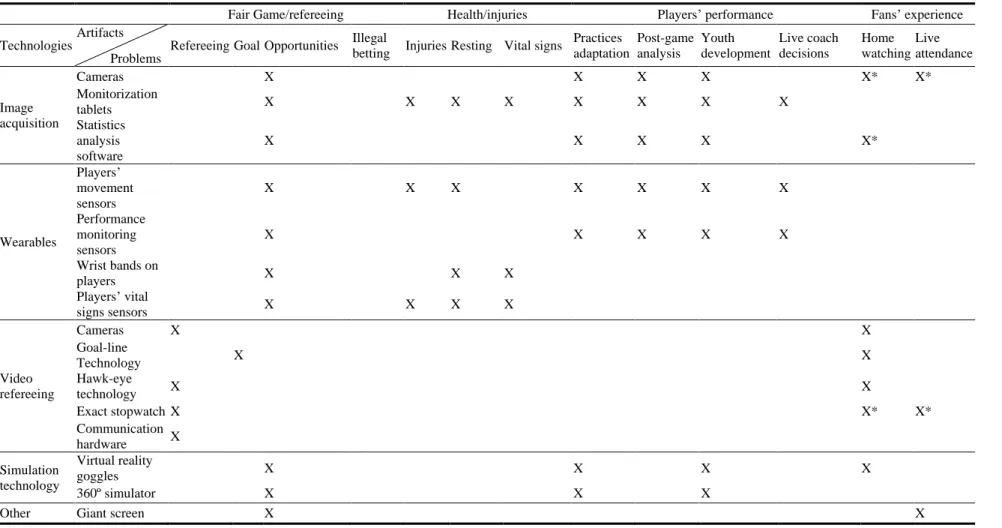
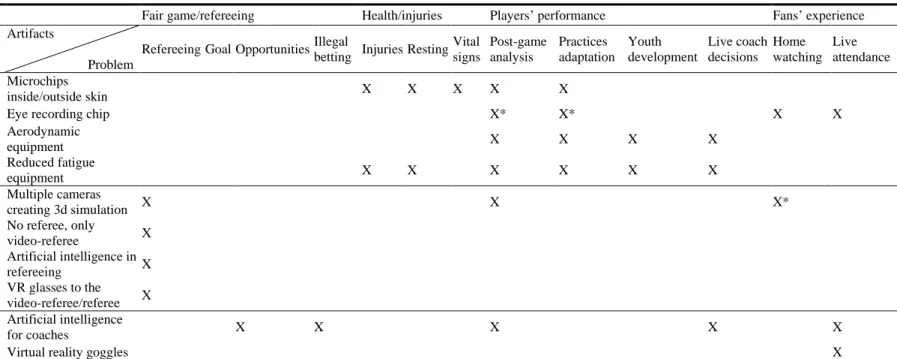
Presented the football’s problems/challenges and the studying artifacts, it is now time to design a recommendations proposal through a matrix. The matrices are the merging of the list of artifacts presented before and the problems/challenges associated with football, resulting in crossing points where the artifact answers the problem/challenge in a specific way studied by the researcher. This is represented by “X” in each cell where “X*”, are crossing points added after the conclusions of this work.
The crossing cells between rows and columns, problems/challenges and artifacts make the justification of its use, meaning, this match only makes sense when the device is, indeed, a solution to the problem/challenge presented. This resulted in 43
matching points, that is, there are 43 combinations of answers to the problems/challenges football faces in the perspective of this study, from now on called recommendations. The recommendations were a study itself, since after the study and search of the problems/challenges and artifacts, a search about the crossing of these two (problems/challenges and artifacts) was conducted, resulting in the inclusion of each artifact that could make sense to answer the problems/challenges of football.
Accordingly to Table 1, in the Fairness subject there is the refereeing/goal topic, which has a match with all the technology from video refereeing since these artifacts were directly invented and implemented in order to specifically answer the fairness side of football based on some other sports technology already used [24].
The subjects of Health and Performance cover the Wearables and Image Acquisition technologies, meaning that these problems/challenges are mostly fulfilled with the artifacts belonging to these groups of technologies. Wearables, officially called electronic performance and tracking systems, are the devices the players use to gather and collect data for further analysis that can be used either for Health concerns or Performance purposes, with more precision in data collection than any other technology or analysis. They are like a smartphone that can detect not only the location of a player at a certain point in time but also which direction he is facing, the velocity at which he is going, the impact of events such as jumps and tackles, and how quickly he accelerates and decelerates. Thus, with the combination of this data extraction, coaches can perform more in-depth analysis regarding the Performance subject and step up conclusions and justifications for practice adaptation, post-game analysis, youth development, and live coaching decisions, all problems/challenges presented [25].
Last there is the fans’ experience perspective, which faces new challenges regarding the improvement of it with new display technologies, specifically virtual reality.
Table 1 Present artifact matrix.
Fair Game/refereeing Health/injuries Players’ performance Fans’ experience Technologies
Artifacts Problems
Refereeing Goal Opportunities Illegal
betting Injuries Resting Vital signs
Practices adaptation Post-game analysis Youth development Live coach decisions Home watching Live attendance Image acquisition Cameras X X X X X* X* Monitorization tablets X X X X X X X X Statistics analysis software X X X X X* Wearables Players’ movement sensors X X X X X X X Performance monitoring sensors X X X X X Wrist bands on players X X X Players’ vital signs sensors X X X X Video refereeing Cameras X X Goal-line Technology X X Hawk-eye technology X X Exact stopwatch X X* X* Communication hardware X Simulation technology Virtual reality goggles X X X X 360º simulator X X X
This technology is aggregated in the Simulation Technology along with the 360° simulators that are presented in every problem/challenge except Health. The revolution of virtual reality not only can be seen in video games and movies but also has arrived in the football world, making this innovation the big factor for the Fans’ Experience problem/challenge [25].
Presented with a matrix of the time period we live in about the existing technologies and existing football problems/challenges, one must aim to the future of this topic. Mankind has always wondered and tried to predict what the future of the world and society will be, for instance, how is technology going to be, is the world going to be the same, what and how will it be the next generation of technology devices. The Sports world slightly crosses the predictions of society in the future in the sense that many ideas and inventions might also be applicable in sports. We have the example of Artificial Intelligence, a topic much discussed in recent years, mainly due to its ethical problems or the threats to humans, since many Hollywood movies have portrayed a futuristic scenario where Artificial Intelligence is in use [24, 26]. Artificial Intelligence could also have its application in sports, in health, helping diagnose injuries through data collected directly from the players’ body through sensors and microchips; in the broadcast of games, having an intelligent software to choose the best cameras for the television audience or in virtual reality broadcasting, also choosing the best cameras to better follow the game or in live refereeing, where some calls might be made by a software such as offside, goal confirmation, out of bounds or hand violation. Artificial Intelligence works as a background to all artifacts one might introduce, such as the body microchips, virtual reality goggles for the fans to follow the game, or the technology that allows to watch what the players are observing.
Wearables and monitoring devices are slowly being introduced in football and one can only imagine what the future will be, when the potential meets up with the
expectations since “according to analysts IHS Technology, global revenues for sports, fitness and activity monitors will grow from $1.9 billion in 2013 to $2.8 billion in 2019” [25]. Will all the problems/challenges be solved with the current technology or only with the next generation and new advances of the today’s technology?
That is why, a new matrix will be presented in Table 2, a matrix with future assumptions that one can only imagine being used in football years from now. Even if today’s technology might not even have the answers for the “how?”, the type of ideas suggested just by imagination or based in science fiction culture are included.
5. Evaluation and Discussion
Firstly, the target audience of the questionnaire must be someone with football experience either an element of the game or involved in any other way. By this, the answers will be by: Referees or former referees, coaches or former coaches, players or ex-players and academic or football officials in the field.
The questionnaire was designed to validate the recommendations’ proposal, and hence, the artifacts are the main focus. The questionnaire starts by asking personal information about the respondent: gender, age and what kind of relationship the person has with football and how many years it is/was. Next, the respondents are asked to fill a table if they know and/or use any artifact from the list presented, then, and using only the previous questions’ answers, the respondents must check the boxes with football’s problems/challenges that in their opinion might be solved by the artifacts they know and/or use. In the next section, it is presented the grade system used to score the ability of the artifact to contribute to the solution of the football’s problems/challenges that the respondent chose previously, with degree 1 meaning the artifact will bring little improvements to the problem/challenge, degree 2, the artifact will bring some improvements to the problem/challenge and 3, the artifact will solve the
Table 2 Future artifact matrix.
Fair game/refereeing Health/injuries Players’ performance Fans’ experience
Technologies
Artifacts
Problem
Refereeing Goal Opportunities Illegal
betting Injuries Resting Vital signs Post-game analysis Practices adaptation Youth development Live coach decisions Home watching Live attendance Wearables Microchips inside/outside skin X X X X X
Eye recording chip X* X* X X
Aerodynamic equipment X X X X Reduced fatigue equipment X X X X X X Video refereeing Multiple cameras creating 3d simulation X X X* No referee, only video-referee X Artificial intelligence in refereeing X VR glasses to the video-referee/referee X Simulation technology Artificial intelligence for coaches X X X X X
problem/challenge. Presented with a list of future artifacts, respondents again match the set of artifacts to the football’s problems/challenges.
The questionnaire was answered by 43 individuals, 40 men and 3 women. The respondents might have multiple relationships with football, and therefore, we have 7 referees (5 being solely referees, 1 being also a coach and the other an ex-player), 1 professional player, 3 academic sport persons, 21 exclusively coaches, 3 ex-players and 9 individuals both coaches and ex-players. The average tenure for each relation category goes from five years for referees, nine years for coaches, seventeen for the only player observation, thirteen years for ex-players and forty-eight for academics.
The average age of the 43 observations is 32 years old, with 22 for the only player observation, 24 for the referees, 30 for the ex-players, 33 for the coaches, and 47 for the academics. Regarding the standard deviation of the age, the highest belongs to the academic observation, with 14 years, following ex-players, with 12 years, coaches with 10 years and referees with 6 years.
Analyzing Table 3, one can observe the distribution of the knowledge and use of each artifact by the respondents. First, the artifacts most known among the universe of answers are the goal-line technology (43)
and cameras (43, since if the respondent uses the artifact off course it also knows it) in refereeing and cameras (42) in image acquisition. This does not come as a surprise of results, since in the last months and years these were the most spoken technologies by the media and general public, introducing debates and discussions about its implementation’s benefits and reluctance, largely because it is about the match’s refereeing, which has a high impact on the game. The less known artifacts presented in the table are the wrist bands on players (29), exact stopwatch (31) and the virtual reality goggles (31).
Regarding the use of the artifacts by the respondents, there are two artifacts that stand out from the rest, cameras from image acquisition (22) and the statistics analysis software (13). There are four artifacts that are not used by any of the respondents, goal-line technology, hawk-eye technology, virtual reality goggles and 360º simulator.
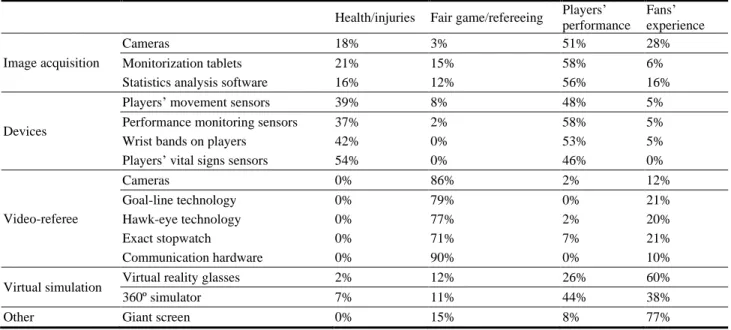
Using the answers given above, the respondent is presented with the same list of artifacts in the rows and the football’s problems/challenges, that were explained, in the columns. Table 4 represents the distribution of the answers by the respondents in each crossing between artifact and football problem/challenge. The results are presented in a relative way due to the different number of answers given in each artifact,
Table 3 Frequency of recognition of present artifacts.
Only knows Uses Does not know
Image acquisition
Cameras 20 22 1
Monitorization tablets 34 2 7
Statistics analysis software 26 13 4
Devices
Players’ movement sensors 33 2 8
Performance monitoring sensors 36 1 6
Wrist bands on players 27 2 14
Players’ vital signs sensors 32 5 6
Video-referee Cameras 41 2 0 Goal-line technology 43 0 0 Hawk-eye technology 34 0 9 Exact stopwatch 28 3 12 Communication hardware 31 6 6
Virtual simulation Virtual reality glasses 31 0 12
360º simulator 32 0 11
Assessing the Impact of Internet of Everything Technologies in Football
48
Table 4 Distribution of the overall answers for each problem/challenge.
Health/injuries Fair game/refereeing Players’ performance Fans’ experience Image acquisition Cameras 18% 3% 51% 28% Monitorization tablets 21% 15% 58% 6%
Statistics analysis software 16% 12% 56% 16%
Devices
Players’ movement sensors 39% 8% 48% 5%
Performance monitoring sensors 37% 2% 58% 5%
Wrist bands on players 42% 0% 53% 5%
Players’ vital signs sensors 54% 0% 46% 0%
Video-referee Cameras 0% 86% 2% 12% Goal-line technology 0% 79% 0% 21% Hawk-eye technology 0% 77% 2% 20% Exact stopwatch 0% 71% 7% 21% Communication hardware 0% 90% 0% 10%
Virtual simulation Virtual reality glasses 2% 12% 26% 60%
360º simulator 7% 11% 44% 38%
Other Giant screen 0% 15% 8% 77%
because it was allowed to choose more than one problem/challenge for each artifact. Each row has a total of 100% representing the distribution of the answers for each problem/challenge.
The overall answers of the whole universe of respondents go in line with each category of technology, meaning that the artifacts of the same category of technology have a similar distribution of answers in each problem/challenge. Starting in the Image Acquisition category, one can detect a pattern in the distribution; in all three artifacts the most dominant problem/challenge is “Players’ Performance” with more than 50%, in the second place, the artifacts: cameras and statistics analysis software, have “Fans’ Experience” with balanced distribution, and monitorization tablets have “Health/Injuries” balanced with “Fair Game /Refereeing”. These results can be concluded as expected, since these artifacts have the ability to fulfill a few tasks both in Players’ Performance and “Health/injuries”. It can also respond to the other two problems/challenges due to the kind of data it generates, which can help referees in their task and enrich the fans’ experience with football.
In Wearables category, a pattern can also be seen, as “Players’ Performance” gets the highest results in all first three artifacts and “Health/Injuries” the second
highest results. In the artifact players’ vital sign sensors, the roles are reversed, as “Health/injuries” has a higher distribution (54%) (even if balanced) than “Players’ Performance”, which obtains the second most distribution (46%). This role reversal makes sense, vital sign sensors do have more application in health and injuries concerns due to the kind of data generated, but also can be applied in players’ performance tasks.
All Video-Referee artifacts answers have the same logic, as expected. The main problem/challenge indicated by the respondents is “Fair Game/Refereeing”, with “Fans’ Experience” the second. This does not come as a surprise since the name of the technology category might bias the results and the artifacts are almost self-answered.
For the opinion of the respondents regarding the problems/challenges, Virtual Reality Goggles might have the best application in “Fans Experience” (60%), followed by “Players’ Performance” (26%) and “Fair Game/Refereeing” (12%). Although Virtual Reality Goggles have a high impact in Players’ Performance in practices, it is still not what it is best known for in the audience. The simulator 360º holds a balanced result with “Players’ Performance” (44%) and “Fans Experience” (38%).
problems/challenges a grade must have been given from 1 to 3 to previous given matches between artifacts and problems/challenges.
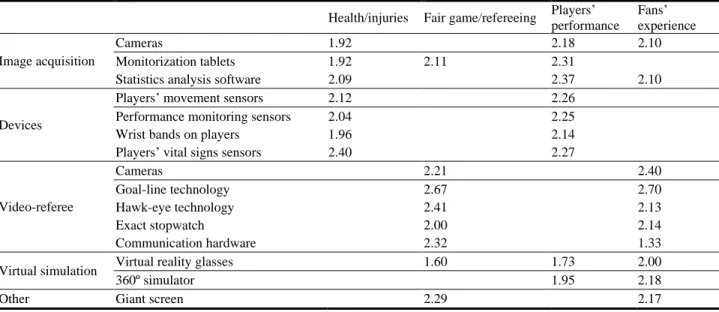
Table 5 shows the average score given by the respondents, only for the highest matches of Table 4.
Five of the 15 artifacts, in the respondents’ opinion, have the second most frequent chosen match to be best fit to answer the problem/challenge of that artifact. This happens to Cameras in Refereeing, Goal-Line Technology, Exact Stopwatch, 360º Simulator, and Giant Screens. There is one thing in common for the first four artifacts mentioned, the second highest problem/challenge chosen is Fans’ Experience, which means that even though it was only the second highest frequent problem/challenge in those artifacts, it received a higher amount of score 3 than the highest frequent problem/challenge. The fifth artifact was Giant Screens, with the second most frequent problem/challenge having a higher ranking than the most frequent problem/challenge. This kind of giant screens, currently, do not help referees in their task, so this might have happened due to misunderstanding of the artifact.
The rest of the artifacts’ average score, in the most frequent problem/challenges, is 2, which is “the artifact will bring some improvements to the problem/challenge”. This is a medium score in which
the respondents have their opinions not too high in the implementation of technology in football but not being too skeptical and against the use of technology in football. The artifacts with the highest score are Goal-Line Technology (2.67), Hawk-Eye Technology (2.41) and Statistics Analysis Software (2.37). The lowest average scoring artifacts are by the 360º Simulator (1.95), Virtual Reality Goggles (2) and Exact Stopwatch (2). Discussing the second most frequent matches between artifacts and problems/challenges, the average score is also 2, except for Virtual Reality Goggles with a score of 1.73 for “Players’ Performance”.
Giving a look at Table 6, in some artifacts, one can easily detect one major problem/challenge selected by the respondents, as the distribution is not balanced between problems/challenges, as it is the case of “Non-Existence of Referee” with 76% of the respondents choosing Fair Game/Refereeing; Artificial Intelligence Refereeing with 82% choosing Fair Game/Refereeing; Virtual Reality Goggles for Stadium’s Audience with 93% of the answers to Fans’ Experience; Artificial Intelligence for Coaches with 85% to Players’ Performance and Virtual Reality Goggles for Video-Referees with 80% to Fair Game/Refereeing.
Table 5 Scoring for each match between artifact and problem/challenge.
Health/injuries Fair game/refereeing Players’ performance Fans’ experience Image acquisition Cameras 1.92 2.18 2.10 Monitorization tablets 1.92 2.11 2.31
Statistics analysis software 2.09 2.37 2.10
Devices
Players’ movement sensors 2.12 2.26
Performance monitoring sensors 2.04 2.25
Wrist bands on players 1.96 2.14
Players’ vital signs sensors 2.40 2.27
Video-referee Cameras 2.21 2.40 Goal-line technology 2.67 2.70 Hawk-eye technology 2.41 2.13 Exact stopwatch 2.00 2.14 Communication hardware 2.32 1.33
Virtual simulation Virtual reality glasses 1.60 1.73 2.00
360º simulator 1.95 2.18
Assessing the Impact of Internet of Everything Technologies in Football
50
Table 6 Frequency of recognition of future artifacts.
Health/injuries Fair game/refereeing Players’ performance
Fans’ experience
Microchips inside/outside skin 55% 4% 39% 2%
Recording chip on players’ eyes 10% 10% 49% 31%
Aerodynamic equipment 21% 9% 58% 12%
Equipment for the reduction of physical fatigue 39% 6% 53% 2%
Multiple cameras allowing a 3D game simulation 0% 23% 23% 54%
Non-existence of referee, only video-referee 0% 76% 0% 24%
Artificial intelligence in refereeing 0% 82% 4% 14%
Virtual reality goggles for stadium’s audience 0% 4% 4% 93%
Artificial intelligence for coaches 4% 7% 85% 4%
Virtual reality goggles for video-referees 0% 80% 4% 16%
The remaining artifacts have a distribution of its problems/challenges more balanced, where one can be chosen as the most frequent, but the others might be worth mentioning. Microchips Inside/Outside Skin is distributed between Health/Injuries (55%) and Players’ Performance (39%); Recording Chips with a stake of 49% on Players’ Performance and 31% on Fans’ Experience; Aerodynamic Equipment has its frequency on Players’ Performance with 58% and Health/Injuries with 21%; Reduction Fatigue Equipment with 53% on Players’ Performance and 39% on Health/Injuries; Multiple Cameras has three problems/challenges worth mentioning: Fans’ Experience the most frequent with 54% and 23% for Fair Game/Refereeing and Players’ Performance.
The validation of the questionnaires’ results will be a comparison of the results from the recommendations proposal matrix to the results of the questionnaire, more specifically, the association of the present artifacts to the problems/challenges and its grading, Tables 1 and 5, respectively.
Starting by the Image Acquisition artifacts and in the matrix, Cameras were attributed mostly to Players’ Performance and a little to Fair Game/Refereeing. Checking Table 5, respondents mostly chose Players’ Performance with 51% and a score of 2.18, with 28% and 2.10 choosing Fans’ Experience and 18% and 1.92 Health/injuries. Cameras for Fans’ Experience was not included in the matrix, mostly because it is not a recent innovation and more a granted technology, but it is, obviously, used for television broadcasting and
visualization on stadium’s giant screens. For this reason and with a relatively high score of 2.10, two new matches in the matrix will be added with the number 44 and 45 for Fans’ Experience Home Watching and Live Attendance.
Monitorization tablets had the majority of answers attributed to Players’ Performance with 58% and a score of 2.31, 21% to Health/injuries with score 2.11, and 15% to Fair Game/Refereeing with 1.92. In the matrix, we had exactly the same matches, Monitorization Tablets were matched with Players’ Performance, Health/Injuries, and Fair Game/Refereeing and with this score order expectancy. Statistics Analysis Software had a distribution of 56% of the answers to Players’ Performance with 2.37 and 16% to both Health/Injuries (2.09) and Fans’ Experience (2.10). In the matrix, one has Players’ Performance and Fair Game/Refereeing. In fact, television football coverage presents statistics to the viewer, not as developed as coaching staff uses but as complementary information for the fans watching at home. For this purpose and with a relatively score of 2.10, a match with the number 46 will be created for Fans’ Experience Home Watching. As for Health/Injuries, statistics software using image acquisition is not the best technology for health and injuries in football nor the more viable and reliable.
Changing to Wearables, Players’ Performance with 48% and 2.26 is the most frequent problem for Players’ Movement Sensors and Health/injuries the runner-up with 39% and 2.12. In the matrix, these are exactly the
problems associated with Players’ Movement Sensors, plus Fair Game/Refereeing. The score order goes in line with what was expected, Players’ Performance with a higher score.
Performance Monitoring Sensors in the matrix are filled in by Players’ Performance and a little to Fair Game/Refereeing. In the questionnaire, the results gave us 58% to Players’ Performance with a score of 2.25 and 37% to Health/Injuries with 2.04 score. Since the exact name of the artifact is “Performance”, a little bias might be influencing the results, but, even so, the goal of this artifact is measuring and monitoring the performance of the athlete because for health concerns there are the previous artifact and the next two. The score of 2.25 is the fourth highest among artifacts for the solution of Players’ Performance problem/challenge, which means it is not the best artifact but still has a good score.
In the matrix, Wrist Bands were attributed to Health/Injuries and slightly Fair Game/Refereeing. In the results of the questionnaire, one has 53% to Players’ Performance with 2.14 and 42% to Health/injuries with 1.96. Wrist Bands do not have the ability to calculate the performance measures, such as passes and shooting, instead, it calculates heart rate, distance, sleep quality and calories burned. For the goal of performance, there are other sensors specifically for this regard. The score for Health/Injuries is lower than expected since the main goal of Wrist Bands is to help the user with Health issues. The same goes to Vital Sign Sensors, where the only problem/challenge in the matrix is Health/Injuries (and Fair Game/Refereeing) and in the results both Health/Injuries (54% with 2.40) and Players’ Performance (46% with 2.27) are chosen. The score for Health/Injuries for this artifact is the highest among artifacts, and is the best solution for this problem/challenge.
In the Video-Refereeing Technology, all artifacts were chosen by the respondents to solve both Fair Game/Refereeing and Fans’ Experience problems/challenges, but with different distributions.
Fair Game/Refereeing was always the top problem/challenge (From 71% to 90% and 2.00 to 2.67) and Fans’ Experience with little distribution (From 10% to 21% and 1.33 to 2.70). In the matrix, all artifacts were selected to Fair Game/Refereeing and, except for Exact Stopwatch and Communication Hardware, to Fans’ Experience. Exact Stopwatch might also be used by the whole audience watching the game for checking how much time is left in the match and with a score of 2.14, it is necessary to add a new number (47) for Fans’ Experience Home Watching and Live Attendance. Communication Hardware between referees to Fans’ Experience chosen by only 10% with a score of 1.33, which means there is little importance of this artifact for this problem/challenge.
Simulation Technology includes Virtual Reality Goggles and the 360º Simulator. Virtual Reality Goggles was chosen for Fans’ Experience with 60% and 2.00, Players’ Performance 26% with 1.73 and Fair Game/Refereeing with 12% and 1.60. In the matrix, one also has these problems/challenges but with a higher importance for Players’ Performance than the results given, since a higher score than 1.73 was expected. The score for Fans’ Experience was 2.00, which is a good result, meaning that this would improve the experience of watching a football game.
The 360º Simulator has 44% for Players’ Performance with 1.95, 38% for Fans’ Experience with 2.18, and 11% for Fair Game/Refereeing. In the matrix, there are only Players’ Performance and Fair Game/Refereeing. Even though the score for Fans’ Experience is higher than Players’ Performance, this artifact is built “merely” to improve the players’ skills and technique, so fans’ experience is not really a problem/challenge to be solved by it. The score of 1.95 was lower than the expected because it is a very expensive technology with high potential for players’ development.
Giant Screen had a distribution of 77% to Fans’ Experience and 2.17 score and 15% to Fair Game/Refereeing with 2.29. These are the problems
Assessing the Impact of Internet of Everything Technologies in Football
52
mentioned in the matrix, even though this artifact giant screen is more suitable for Fans’ Experience than Fair Game/Refereeing.
In the end, the analysis of the artifacts resulted in: (1) Eight of the 15 artifacts with an exact match of the results of the questionnaire and the proposal matrix (Monitorization Tablets, Players’ Movement Sensors, Cameras in Refereeing, Goal-Line Technology, Hawk-Eye Technology, Communication Hardware, Virtual Reality Goggles, and Giant Screen); (2) Three artifacts that resulted in the addition of a match between the artifact and Fans’ Experience problem/challenge that was not being considered in the proposal’s matrix, and (Cameras in Image Acquisition, Statistics Analysis Software and Exact Stopwatch); (3) Four artifacts for which the questionnaire gave us more problems/challenges than the matrix and the researcher agreed (Performance Monitoring Sensors, Wrist Bands, Vital Signs Sensors, and 360º Simulator).
Now for each problem/challenge and using Table 5, one will demonstrate which artifacts were the best suited to solve it. Vital Sign Sensors in Health/Injuries is the artifact with the highest score, with 2.40, also this problem/challenge is the most frequent choice to this artifact, as we can see by its green cell. In Fair Game/Refereeing with a score of 2.67, Goal-Line Technology is the artifact with the highest score, Hawk-Eye Technology with 2.41 the second highest, and Communication Hardware the third with 2.32. In Players’ Performance, 2.37 is the highest score, belonging to Statistics Analysis Software and 2.31 the second highest score, Monitorization Tablets. For Fans’ Experience, the highest scoring artifact is not the most frequent problem/challenge chosen. Goal-Line Technology with a score of 2.70 is the second most frequent artifact for this problem/challenge, meaning this is not the best suited problem/challenge of this artifact. Therefore one will look for the highest match between artifacts and Fans’ Experience problem/challenge, because these are the artifacts, according to the questionnaires’ results, more suited to
solve this problem. Giant Screen and Virtual Reality Goggles are the only ones with this behavior, with Giant Screen having the highest score, with 2.17, and 2.00 for Virtual Reality Goggles.
For a validation of the Future Artifacts’ Matrix, the comparison will be between the future artifacts matrix and the results of the last questionnaire answer (more specifically in Tables 2 and 6).
First, the artifact Microchips Inside/Outside the Skin in the matrix was attributed to Health/Injuries and Players’ Performance problems/challenges. In the questionnaire, the respondents distributed their answers 55% to Health/Injuries and 39% to Players’ Performance, meaning this confirms the solution of this artifact.
Recording Chip on the Players’ Eyes has 49% of the answers associated with Players’ Performance and 31% to Fans’ Experience. On the other hand, the matrix has this artifact only as a potential solution to Fans’ Experience problem/challenge. Video recorded by the vision of the players’ might be useful to a post-match analysis in which the coaches having the perspective of the player could apply insights regarding certain aspects of the game. A cross match will be added to this artifact with number 20 to Post-Game Analysis and Practices Adaption.
Aerodynamic Equipment, in the matrix, was associated with Players’ Performance and in the respondents’ opinion, 58% of the answers agree with the Players’ Performance and 21% also chose Health/Injuries. Aerodynamic Equipment might have an impact on the players’ health, maybe reducing his/her fatigue, but the real impact will be on the players’ performance.
Fatigue Reduction Equipment has 53% of the answers to Players’ Performance and 21% to Health/Injuries. The matrix had the same results with the artifact associated with both Health/Injuries and Players’ Performance.
Multiple Cameras creating a 3D Simulation has 54% of the answers to Fans’ Experience problem/challenge,
23% to both Fair Game/Refereeing and Players’ Performance. The matrix does not hold a cross match to Fans’ Experience, but agrees with the Fair Game/Refereeing and Players’ Performance. It does make sense for 3D simulations to be used by fans in television broadcasting, enhancing the perspective of certain replays and improving the understanding of the match at home. A number 21 will be added for this match between 3D simulation and Fans’ Experience Home Watching.
Non-existence of Referee answers mainly chose Fair Game/Refereeing with 76% and 24% to Fans’ Experience. The matrix contemplates only the Fair Game/Refereeing for this artifact because the non-existence of referee would have little impact on the fans’ experience.
Artificial Intelligence in Refereeing has 82% of the answers attributed to Fair Game/Refereeing and 14% to Fans’ Experience. The matrix appointed Fair Game/Refereeing as the only possible problem/challenge to be solved by this artifact and as the same as the previous artifact, this would not have an impact on the fans’ experience.
Virtual Reality Goggles for live audiences has a big majority (93%) of the answers to Fans’ Experience problem/challenge and in the matrix, one can observe the same as the only problem/challenge to be solved by this artifact.
Artificial Intelligence, this time, for coaches, has 85% of the answers to Players’ Performance. In the matrix, in addition to Players’ Performance, it was also chosen to Fair Game/Refereeing as Same Opportunities and Illegal Betting perspective.
Virtual Reality Goggles for Video-Refereeing had 80% of the answers to Fair Game/Refereeing and 16% to Fans’ Experience. The Fans’ Experience is not in the matrix, but Fair Game/Refereeing is.
As for the future artifacts, one will compare Table 2 and Table 6, and the conclusions are: (1) Four artifacts have the same problems/challenges associated both in the matrix and in the table results of the questionnaire
(Microchips; Fatigue Reduction Equipment; Virtual Reality Goggles for Audience, and Artificial Intelligence for Coaches); (2) Two artifacts had more problems/challenges in the questionnaire than the matrix, these were added to the matrix (Players’ Performance in Eye Recording Chip and Fans’ Experience in 3D Simulation); (3) Four artifacts had more problems/challenges in the questionnaire results than the matrix but were not added because the artifacts would not have any impact on the chosen problems/challenges (Aerodynamic Equipment, Non-Existence of Referee, Artificial Intelligence for Refereeing, and Virtual Reality Goggles for Video-Referee).
After these conclusions, new topics were added to the matrix, represented with “X*”, in both matrices.
6. Conclusions and Future Work
Being an academic work, this research had its limitations and the one doing it should develop a critical review, pointing out what could have gone better and improving aspects.
Therefore, one limitation concerns the disseminated of the questionnaire to the target audience. Since we had five observation categories—coaches, players, ex-players, referees, academic personas—there should be a balanced representability of these groups regarding the number of people answering the questionnaire, to have equal analysis of each group and, consequently, better conclusions about the opinion of each category.
The questionnaire was disseminated personally or via online through a word document and the data integration and analysis in Excel. This was viable due to the relatively modest amount of observations but having even more observations, it would not be possible to aggregate too many answers and do the data processing manually in Excel. This questionnaire should be made available online on a questionnaire platform for most of the people with access to internet, but not excluding the people with no access, who
Assessing the Impact of Internet of Everything Technologies in Football
54
should have a questionnaire delivered personally, decreasing the representation bias. Another observation balance that should be considered is about the age range. With the same procedure of the categories, one should have a balanced representability of the age ranges of the observations.
The answers of the questionnaire were not always perfect. There were observations missing crucial data; for example one artifact was used by a respondent, and attributed a problem/challenge but forgot to score it. In these cases, a score was manually attributed, in the data processing, with the average of the rest of the answers for that artifact and problem/challenge.
A possible bias reason was discovered in the questionnaire when presenting the list of the artifacts, with each one of them being aggregated in technologies (Image Acquisition, Wearables, Video-Referee, Virtual Simulation, and Other). Admittedly these, more specifically “Video-Referee”, could induce and influence the behavior of the respondents when answering the questionnaire as they are asked to choose a problem/challenge to the artifact and in the “Video-Referee” artifacts and with this technology label, the respondents might feel the need to choose the problem “Fair Game/Refereeing”. Another problem regarding the artifacts is the lack of an explanation of each artifact, letting the respondent have their own idea of it. An explanation would end any doubt of the respondents but would turn the questionnaire even longer. It could have asked to score the future artifacts in the problems/challenges, but then again, the questionnaire would turn out to be exhausting.
With a critical review of the work made, a researcher has the ability to improve future works with the limitations of past ones. If this research continues, these limitations should be taking into account for a more meticulous analysis and better results.
References
[1] Morgan, J. 2014. “A Simple Explanation of ‘The Internet of Things’.” Forbes. Accessed May 15, 2017. http://www.forbes.com/sites/jacobmorgan/2014/05/13/si
mple-explanation-internet-things-that-anyone-can-underst and/#4e716c656828.
[2] Simmons, L. 2015. “Internet of Everything vs Internet of Things: The Difference.” CloudRail. Accessed May 20, 2017. https://cloudrail.com/internet-of-everything-vs-internet-of -things/
[3] 2017. Oxford Dictionaries Online. Accessed May 12, 2017.
https://en.oxforddictionaries.com/?utm_source=od-panel &utm_campaign=en
[4] Boren, Z. D. 2014. “There Are Officially More Mobile Devices than People in the World.” The Independent.
Accessed June 1, 2017.
http://www.independent.co.uk/life-style/gadgets-and-tech /news/there-are-officially-more-mobile-devices-than-peo ple-in-the-world-9780518.html
[5] Macy, B. 2015. “Internet of Things in Sports.” The Blog, Huffington Post. Accessed May 21, 2017. http://www.huffingtonpost.com/beverly-macy/internet-of -things-in-spo_b_8242140.html
[6] Stein, M., Janetzko, H., Breitkreutz, T., Seebacher, D., Schreck, T., Grossniklaus, M., and Keim, D. A. 2016. “Director’s Cut: Analysis and Annotation of Soccer Matches.” IEEE Computer Graphics and Applications 36 (5): 50-60. Accessed May 25, 2017. https://doi.org/10.1109/MCG.2016.102
[7] Luz, N. 2014. “Elite Referee. Portugal: SIC News.”
Accessed May 13, 2017.
http://sicnoticias.sapo.pt/programas/reportagemsic/2014-03-20-Pedro-Proenca-na-Grande-Reportagem-SIC (in Portuguese)
[8] Dowley, C. 2016. “A Decade after Italy’s Match-Fixing Scandal, Serie A Is Worse than It Was Before.” SB Nation.
Accessed May 27, 2017.
http://www.sbnation.com/soccer/2016/7/15/12197194/cal ciopoli-scandal-anniversary-juventus-milan-fiorentina-na poli
[9] Singh, P. P. 2013. “How Does llegal Sports Betting Work and What Are the Fears?” BBC News, Singapore.
Accessed June 2, 2017.
http://www.bbc.com/news/business-21501858
[10] Hutton, W. 2015. “Football Is Just One Example of the Inequalities that Bedevil Us.” The Guardian. Accessed
May 21, 2017.
https://www.theguardian.com/commentisfree/2015/feb/15 /football-one-of-the-inequalities-that-bedevil-us-premier-l eague
[11] Uefa. 2015. “Financial Fair Play: All You Need to Know.” UEFA.com. Accessed June 12, 2017. http://www.uefa.com/community/news/newsid=2064391. html