I
IUL School of Social Sciences and Humanities Department of Social and Organizational Psychology
The relationship between significant other (in)validation responses and pain
experiences: The mediating role of emotional regulation
Dissertation submitted as partial requirement for the conferral of Master in Science on Emotions,
by
Joana Margarida dos Santos Alegrete
Supervisor:
Ph.D. Sónia Gomes da Costa Figueira Bernardes,
Assistant Professor at ISCTE – Instituto Universitário de Lisboa, Lisboa, Portugal
Co-supervisor:
Ph.D. Marta Alexandra Osório de Matos,
Invited Assistant Professor at ISCTE – Instituto Universitário de Lisboa, Lisboa, Portugal
October 31st, 2018
III
ACKNOWLEDGMENTS
During this process a lot of changes happened in my life, and if were not for the support of all of you, I would not be able to finish the dissertation. This section will be mainly written in Portuguese as, almost everyone that I would like to thank are Portuguese.
Primeiro gostaria de agradecer à Associação Força3P – Associação de Pessoas com
Dor, que me abriu as portas e os seus contactos para podermos abrir novos caminhos na
investigação da Dor.
Gostaria de agradecer à minha orientadora Professora Sónia Bernardes, por ter aceitado desde logo embarcar nesta aventura comigo, e à minha co-orientadora, Professor Marta Matos, por nos ter acompanhado. A vocês as duas, o meu grande bem-haja, sem vocês esta dissertação não existiria, vocês foram a bússola e o astrolábio que permitiram
reencontrar-me vezes sem contas, neste mar imenso que é o conhecimento. Muito Obrigada. I would like to thank Dr. Allan Fruzzetti for allow me to use VIRS-C and to Dr. Steven Linton that had me provide it.
Gostaria de agradecer ainda à Sara Dyer, ao Pedro Cordeiro e à Anabela Caetano por terem participado no processo de tradução do instrumento traduzido.
Não ajudando diretamente na dissertação, mas estando sempre presentes na minha vida, quero agradecer às pessoas mais importantes da minha vida: o meu pai João Alegrete, e a minha mãe Fernanda Alegrete. Mesmo sendo maior de idade e vacinada recorro a eles para me salvarem a vida no último instante, e o último dia da dissertação não foi exepção.
Obrigada por tudo o que me dão, de alma e coração.
Quero agradecer ao meu irmão João Alegrete que por muito que eu queira, não tenho sempre razão.
Não me posso esquecer de agradecer à minha amiga e colega de casa Tatiana Pavliuc, que se chateou umas quantas vezes , devido às tarefas que ficaram por fazer.
Por último, mas não menos importante, ao André Mendes, que apesar de só ter entrado a meio desta aventura, deu-me forças para recomeçar sempre que era necessário.
Fica o agridoce de ter terminado esta mini viagem num oceano cheio de cantos por descobrir. Fica a inspiração deixada por todos vós e fica este nosso contributo, que
esperemos, um dia possa contribuir para ajudar alguém nas dores. O meu grande bem-haja.
V
ABSTRACT
The main aim of this study is to investigate what is the mediating role of emotional regulation in the relationship between significant other (in)validation responses and pain experiences. As the lack of instruments to meausure significant other (in)validation responses emerge, a corollary aim emerges: To translate, adapt and validate a Portuguese Version of the Validating and Invalidating Response Scale for couples (PVIRS-C)(Fruzzetti & Shenk, n.d.). It was hypothesised that in/validation would be associated worse/better pain outcomes, and emotion regulation would mediate these relationships. Portuguese adults (N= 116) completed an online questionnaire assessing significant other (in)validation responses, emotion regulation, pain related outcomes and dyadic satisfaction. The results of PVIRS-C showed a 2 factor structure: validation and invalidation, both correlated (invalidation negatively) with Dyadic Satisfaction. Concerning the mediation analyses, findings revealed a negative indirect effect of validation on pain disability, through positive emotions sharing and a positive indirect effect for invalidation on pain disability, through the same pathway. These findings demonstrate that sharing positive emotions with a romantic partner, in part, account for the association between (in)validation and pain disability. This study not only contributes with a new Portuguese instrument with good internal consistency and concurrent validity, but also highlights factors that may be useful to focus on in psychosocial interventions addressing pain experiences.
Key-words: validation, invalidation, emotional regulation, pain
PsycINFO Codes:
2223 Personality Scales & Inventories 2360 Motivation & Emotion
2950 Marriage & Family
RESUMO
O objectivo principal é investigar qual o papel de mediação que a regulação emocional tem na relação entre percepções de respostas conjugais (in)validantes e as experiências de dor. Devido à falta de instrumentos para medir respostas conjugais (in)validantes, surgiu o
objectivo corolário de traduzir, adaptar e validar a versão portuguesa do Validating and
Invalidating Response Scale for couples (PVIRS-C)( Fruzzetti & Shenk, n.d.).
Foi hipotetizado que percepções (in)validantes estariam correlacionados melhor/pior com a experiência de dor, e que seriam mediadas pela regulação emocional.
Adultos Portugueses (N= 116) completaram um questionário online avaliando as percepções de respostas conjugais (in)validantes, regulação emocional, experiência da dor e satisfação diádica.
Resultados do PVIRS-C revelam uma estrutura com 2 fatores: validação e invalidação, ambas correlacionadas (a invalidação negativamente) com a satisfação diádica. Relativamente à mediação, análises revelaram um efeito negative indireto para a validação, e um efeito indireto positivo para a invalidação na incapacidade relacionada com a dor, através da partilha de emoções positivas.
As evidências demonstram que a partilha de emoções positivas com um(a) parceiro(a)
romântico(a) explicam, em parte, a associação entre (in)validação e incapacidade relacionada com a dor.
Este estudo contribui com um novo instrumento Português, que apresenta boa consistência interna e validade concorrente comprovada; e com evidências que podem ser uteis nas intervenções psicossociais nas àrea da dor.
Palavras Chave: validação, invalidação, regulação emocional, dor PsycINFO Codes:
2223 Escalas e Inventários de Personalidade 2360 Motivação e Emoção
2950 Casamento e Família
VII
TABLE OF CONTENTS
Acknowledgments ... III
Abstract ... V
Resumo ... VI
Table of Contents ... VII
Index of Figures ... XI
Index of Tables ... XII
CHAPTER 1 - BACKGROUND AND INTRODUCTION ... 1
Pain and Emotions ... 2
Emotion Regulation, and Pain ... 4
Romantic Partner, Social Support and Pain ... 5
Spouse Validation/Invalidation, Emotional Regulation and Pain ... 5
Current Study ... 6
CHAPTER 2 – VIRS-C PORTUGUESE VERSION TRANSLATION AND CROSS- CULTURAL ADAPTATION ... 8
Introduction ... 8
Method ... 10
Participants and Research Design ... 10
Measures ... 12
Significant other Validation and Invalidation responses to Pain Behaviors ... 12
Dyadic Satisfaction ... 12
Procedures ... 13
Data Analysis ... 13
Results ... 14
Item descriptive analyses and sensitivity ... 14
Exploratory factor analysis. ... 15
Factor and Variable’s descriptive analyses and sensitivity ... 16
Concurrent Validity ... 16
Discussion ... 17
CHAPTER 3 – THE influence of perceive (in) VALIDATION in pain experiences, through emotional regulation ... 19
Introduction ... 19
Method ... 21
Participants and Research Design ... 21
Measures ... 21
Acute Pain, Present and Past Chronic Pain ... 21
Significant other Validation and Invalidation responses to Pain Behaviors ... 21
Cognitive reappraisal and emotional suppression ... 22
Couples Emotions Sharing Index (CESI) ... 22
Pain Severity ... 23
Pain Disability ... 23
Depression, Anxiety and Stress ... 24
Procedures ... 24
Data Analysis ... 24
Results ... 25
Model’s Variable’s Descriptive Analyses and Distribution ... 25
Spearman Correlations ... 26
The influence of (in)validation on pain outcomes: through emotional regulation ... 26
Conclusions ... 28
CHAPTER 4 – GENERAL DISCUSSION ... 30
Limitations and directions for future research ... 30
IX
REFERENCES ... 33
APPENDICE ... 39
APPENDIX A - Dyadic Satisfaction: Scale USED ... 40
APPENDIX B - Couples Emotions Sharing Index (CESI) ... 42
XI
INDEX OF FIGURES
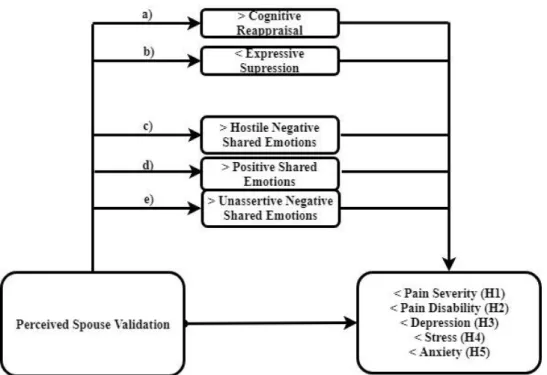
Figure 1 – Hypothesis 1 to 5 - Validation would be associated with/predicted lower Pain Disability (H1), Pain Severity (H2), Depression (H3), Stress (H4) and Anxiety (H5), by influencing higher levels of cognitive reappraisal (path a), lower levels of Expressive Suppression (path b), higher levels of Hostile Negative Emotional (path c), Positive
Emotional (path d) and Unassertive Negative Emotional Sharing (path e) ... 7 Figure 2- Hypothesis 6 to 7. Invalidation would be associated with/predicted higher Pain Disability (H6), Pain Severity (H7), Depression (H8), Stress (H9) and Anxiety (H10), by influencing lower levels of cognitive reappraisal (path a), higher levels of Expressive Suppression (path b), Lower levels of Hostile Negative Emotional (path c), Positive
INDEX OF TABLES
Table 1 - Participants’ Socio-demographic characteristics by Types of Pain Experiences:
Age, Years of Education, Relationship duration and pain duration ... 10
Table 2 - Participants’ Sociodemographic characteristics by Types of Pain Experiences: Sex, Occupation, Nationality, Type of Relationship, if they Lived Together, Partner Sex and if the Partner suffer from Chronic Pain ... 11
Table 3 - Descriptive analysis of VIRS-C items for the global sample and EFA Factor Loadings and internal reliability (n=115)... 14
Table 4 - Variable's Descriptive Statistics and Tests of Normality... 16
Table 5- Models Variable's Descriptive Statistics and Tests of Normality... 25
Table 6 - Spearman correlations between all variables in the models ... 26
1
CHAPTER 1 - BACKGROUND AND INTRODUCTION
Unless you have a very rare specific disorder, you had, have, or you are going to have pain during your lifespan. According to the International Association for the Study of the Pain (IASP, 1994), pain is “an unpleasant sensory and emotional experience associated with actual or potential tissue damage, or described in terms of such damage”. This experience can be adaptive as long as it works as a body alarm that helps to avoid and to prevent damage (Lumley et al., 2011), or maladaptive, when it persists longer than it is reasonably expected, even without the presence of nociceptive triggers. When pain persists longer than 3 months, it is designated chronic pain; when it is shorter, it is called acute pain (Merskey & Bogduk, 1994).
Worldwide, chronic pain has epidemic proportions (Dorner, 2017) and a massive impact on economic and social resources (Hadjistavropoulos & Craig, 2004). Global Pain Management Market Report points that more than 1.5 billion people suffer with chronic pain (Global Industry Analysts, 2011). Around the same percentage is verified in Europe, 20%. (Van Hecke, Torrance, & Smith, 2013). A Portuguese study indicated that chronic pain reaches 36,7% of the Portuguese population, with an average pain duration of around 10 years, (Azevedo, Costa-Pereira, Mendonça, Dias, & Castro-Lopes, 2012), higher than the 7 years European mean length (Breivik, Collett, Ventafridda, Cohen, & Gallacher, 2006). Chronic pain also bears a potential destructive impact in psychological and physical well-being and social functioning (Gatchel, Peng, Peters, Fuchs, & Turk, 2007) and has been associated with mood and emotional states, several comorbidities as anxiety and depression disorders (Azevedo et al., 2012; Rabiais, Nogueira, & Falcão, 2003; Sobral, 2014). A Cohort study with 1211483 adults, showed that, according to the pain conditions, the proportion of comorbidities could vary: 6% to 27% of the chronic pain participants had depression, 4% to 13% had anxiety 13% to 43% had other mental health comorbidities (Davis, Robinson, Le, & Xie, 2011). This relationship works both ways, since 65% of depressive patients had reported one or more pain complains (Bair, Robinson, Katon, & Kroenke, 2003). An epidemiologic Portuguese study by Azevedo et al.(2012) has shown that chronic pain had a high emotional impact on feeling sad/depressed or anxious/nervous, 13% of the participants had a medical depression/depressive disorder diagnose, and there was an evident impact on the mood and risk of anxiety.
Individually, people with chronic pain present major disabilities in personal, domestic and social activities, leading to a massive economic impact. Only in Portugal the absenteeism costs have reached 739,85€ million (Gouveia & Augusto, 2011) .
In sum, considering the high prevalence of chronic pain, the economic global burden and the tremendous impact in the quality of life (Phillips, 2009) of more than a fifth of all humanity, it is imperative to develop studies that help to minimize the impact of the chronic pain.
In such a complex scenario, the previously presented definition of pain, seems to fall short (Williams & Craig, 2016). Further below we will describe how pain perception is influenced by social, psychological and biological factors, the complex pain-emotion connection, how social factors influence emotional regulation and pain perception, and the importance of spouse dyads. This structure will give us the motto to our principal
investigation question: Which is the relationship between perceived partner
validation/invalidation and pain experiences, and whether emotional regulation mediates such relationship? We will finish this chapter presenting the specific aims of this study.
Pain and Emotions
Perpetuating the Cartesian tradition, the traditional biomedical model, the main Pain model used until the 1960’s, considered pain as a mere physical reaction to noxious receptors (Hadjistavropoulos & Craig, 2004). Around the 1960’s some researchers started to equate that other factors, as cognitive, emotional and social factors were able to influence the experience of the pain. (Hadjistavropoulos & Craig, 2004; Rainville, 2004). These factors explained why different individuals experience the same noxious stimulus in different ways ( Gatchel et al., 2007).
Nowadays, the Biopsychosocial Model (Engel, 1977) adapted and adopted by Turk, Meichenbaum, & Genest, (1983) is the most widely used model to the understanding and treatment of chronic pain (Hadjistavropoulos et al., 2011). This model acknowledges pain as being determined by biological, psychological and social factors that shape pain perception (Hadjistavropoulos & Craig, 2004).
One of the psychological factors that can influence pain perception are emotions. Pain
and emotions appear to be intimately related in several forms (Rainville, 2004). As seen before in the definition of pain, pain is often characterized by unpleasant emotional experiences. Emotions are so intrinsically related to pain that some researchers assert that “pain is an emotion” (Nesse & Ellsworth, 2009; Wells & Nown, 1998), supporting this
3
contention by the existence of a pain-specific facial expression as in other discrete emotions reported by Ekman and Izard (Price & Bushnell, 2004; Prkachin, 2009).
In fact, the connection between pain and emotions (especially the negative ones) is complex and intricate, once they share a lot of neurological pathways (Price & Bushnell, 2004). This may happen because pain and negative emotions have evolved with the same evolutionary goal, namely, keeping the homeostasis, and moving away from dangers to minimize uncomfortable situations (Price & Bushnell, 2004). Pain and negative emotions also share certain coping mechanisms: avoidance, catastrophizing and suppression, all of which seem to be adaptive in short term, but in long term can evolve to maladaptives outcomes, increasing physical disabilities and chronic pain (Linton, 2013).
As the emotional pain-related processes overlaps (Lumley et al., 2011), these processes can be explored using both perspectives used in emotion research: (1) using the dimensional perspective or (2) the discrete-emotions perspective.
The Dimensional Emotions Perspective conceptualized emotions as the sum of different irreducible structure dimensions (Gross, 2014). Using a two-dimensional structure the emotions can be conceptualized according to the valence (positive or negative) and the arousal (High or Low)(Gross, 2014). Following this line of reasoning, arousal works as an amplifier, negative valence emotions appear associated with exacerbating pain perception and positive valence emotions buffer pain perception (Rainville, 2004).
The Discrete Emotions Perspective advocates emotions as specific concepts in abstract hierarchical categories. Ekman & Cordaro, (2011), developed one of the most accepted models, which discriminates 7 discrete basic emotions: (1) Anger, (2) Fear, (3) Surprise, (4) Sadness, (5) Disgust, (6) Contempt, (7) Happiness. Concerning the discrete emotions and pain perception, the anger expression inhibits pain perception by decreasing physiological arousal, whereas anger suppression increases it. Another basic emotion that has a large impact in pain perception is fear, which combined with the derivate anxiety, an
emotional state, leads to an amplified pain perception and physical disabilities increase, leading to chronic pain (Lumley et al., 2011; Rainville, 2004). Unfortunately, this sensitive emotional state is not the only emotional comorbidity related with pain perception and chronic pain.
Edlund (2017) showed that there were benefits of the implementation of emotional regulation strategies in chronic pain patients and patients suffering from anxiety
disorders.Therefore, both emotion and emotional states may be changed by emotional regulation, leading to a change in the pain perception and related outcomes.
Emotion Regulation, and Pain
Emotion Regulation consists of a transactional, internal process, in that the
individuals change, consciously or unconsciously, one or more emotion components, through the change of self-behaviors/expressions/experiences or emotion elicitation (Diamond & Aspinwall, 2003; Gross, 1999). This happens, normally, in a social context with a specific aim (Diamond & Aspinwall, 2003). To understand the connection between emotional regulation, social context and pain, we are going to focus in two specific emotion regulation models: the Process Model of Emotion Regulation by Gross & John (2003), and the Social Sharing of Emotion Model by (Rimé, 2009).
The Process Model of Emotion Regulation by Gross & John (2003) is based in hedonistic assumptions. Humans try to avoid pain and seek pleasure, through the regulation of their emotions in order to achieve specific social goals and maintain good relationships with significant others (Gross & John, 2003). This model focuses on individual processes of emotional regulation and advocates that emotions can be regulated during 5 points of the emotion generative process: 4 response antecedent points (Situation Selection, Situation Modification, Attentional Deployment, and Cognitive Change), and 1 point during the response (Response Modulation). Gross & John (2003) identify two specific strategies in this process; an antecedent focused strategy considered adaptive - the cognitive reappraisal- and a longterm maladaptive response focused strategy: suppression.
Regarding pain, the use of these emotional strategies has been showing inconsistent results once that, only rarely, studies show impact of emotional regulation on pain outcomes (Koechlin, Schechter, Coakley, Werner, & Kossowsky, 2018). However, as previously
suggested, anger suppression leads to an increase in pain perception (Lumley et al., 2011), but emotional suppression may lead to decrease pain intensity too (Saskatchewan, 2014).
Concerning cognitive reappraisal, this strategy appears to be associated with pain intensity decreases (Saskatchewan, 2014). In some cases, emotional regulation does not impact direct pain outcomes, but plays an important role in depression, anxiety and stress (Saskatchewan, 2014).
The Social Sharing of Emotion Model by Rimé (2009) integrates social functions of emotional sharing elicitation, either in positive and negative emotional events. This model (Rimé, 2009) shows that social emotional sharing helps to achieve quickest negative emotion disclosure, as fear, that when related to pain leads to chronic pain and increased anxiety levels (Lumley et al., 2011; Rainville, 2004); and capitalizes positive emotions, boosting social
5
bonds, and individual’s positive affect, associated with a decreased pain perception (Gross, 2014). In order to understand these inconsistent results between emotional regulation and pain is necessary to frame this relationship through social relationships and context.
Romantic Partner, Social Support and Pain
People with chronic pain, in order to cope with pain and emotional distress (Cano, Corley, Clark, & Martinez, 2018) look for available help (Bernardes, Forgeron, Fournier, & Reszel, 2017) and type and quality of the relationship created, between the help provider and chronic pain person, impacts pain outcomes (Delongis, Capreol, Holtzman, Brien, &
Campbell, 2004). As married persons commonly have numerous psychological and social advantages over unmarried (Coyne & DeLongis, 1986), romantic partners are pointed as central social supporters (Bernardes et al., 2017), and from all functions of pain-related social support (Bernardes et al., 2017), spousal validation may play a major role on emotional regulation processes (Fruzzetti, Shenk, & Hoffman, 2005).
Spouse Validation/Invalidation, Emotional Regulation and Pain
Validation/Invalidation is a dyadic communication technique (Linehan, 1993). This technique that approves, empowers, allows and supports other’s communication and emotions (Linehan, 1997) was primarily used to help regulate emotions in obsessive-compulsive
disorder patients (Linehan, 1993), and was adopted to the pain context by Cano (Cano, Barterian, & Heller, 2008).
Validation, in couples, happens when the spouse provides feedback, acceptance and understanding of the pain/emotion. Invalidation consists on the transmission of disrespect, contempt or unacceptance of the other’ experiences (Cano et al., 2008). When there is a dismissal validation opportunity, it’s considered invalidation as well (Issner, Cano, Leonard, & Williams, 2012).
The Biopsychosocial Model describes that the validation of pain-related thoughts and feelings, in chronic pain patients, decrease negative affect, self-reported pain intensity and other pain behaviors (Edmond & Keefe, 2015). In other theoretical models, Couples Emotional Regulation Model by Fruzzetti et al., 2005, validation responses concedes emotional regulation skills, that promote the disclosure of emotional states, facilitating the emotional experience and regulation as in the Social Emotional Sharing Model. This strategy of emotional communication in couples dyads, if accountable for empathy transmission, communication increasing, emotions soothing and negative spouse reactions decreases,
building up couples trust (Fruzzetti, 2006). Shenk & Fruzzetti (2011) showed that validation responses promote emotional regulation by increasing positive affect and helped to cope with distress. Whereas invalidation increased the negative affect, hearth rate, skin conductance and emotion reactivity (Shenk & Fruzzetti, 2011), therefore had promoted emotional
dysregulation (Cano et al., 2008; Shenk & Fruzzetti, 2011).This underlines the importance of emotional regulation within the pain context, because spouse validation was positively correlated with distraction responses and emotional distress disclosure (emotional regulation techniques/pain coping techniques), negatively correlated with pain interference and severity, and showed several positive correlations with marital satisfaction indicators (Cano et al., 2008; Cano, Leong, Williams, May, & Lutz, 2012a; Cano, Leong, Heller, & Lutz, 2009; Edlund et al., 2017).
Current Study
There is a correlation between (in)validation and emotional (dys)regulation, but the influence of the (in)validation responses, in different emotional regulation strategies and social emotional sharing, in the context of pain, appears to be, so far unknown. This gap lead us to our main investigation questions: Is there a relationship between perceived spouse validation/invalidation responses and pain outcomes? Will emotion regulation strategies and social sharing mediate such relationship?
Having this as our main aim (Chapter 3), a starting corollary aim emerges: to translate, adapt and validate a Portuguese Version of the Validating and Invalidating Response Scale for couples (PVIRS-C) (on chapter 2).
Generally, it was expected that, as showed in figure 1: Validation would be associated with/predicted lower Pain Disability (H1), Pain Severity (H2), Depression (H3), Stress (H4) and Anxiety (H5), by influencing higher levels of cognitive reappraisal (path a), lower levels of Expressive Suppression (path b), higher levels of Hostile Negative Emotional (path c), Positive Emotional (path d) and Unassertive Negative Emotional Sharing (path e); and, as showed in figure 2, Invalidation would be associated with/predicted higher Pain Disability (H6), Pain Severity (H7), Depression (H8), Stress (H9) and Anxiety (H10), by influencing lower levels of cognitive reappraisal (path a), higher levels of Expressive Suppression (path b), Lower levels of Hostile Negative Emotional (path c), Positive Emotional (path d) and Unassertive Negative Emotional Sharing (path e).
7
Figure 1 – Hypothesis 1 to 5 - Validation would be associated with/predicted lower Pain Disability (H1), Pain Severity (H2), Depression (H3), Stress (H4) and Anxiety (H5), by influencing higher levels of cognitive reappraisal (path a), lower levels of Expressive Suppression (path b), higher levels of Hostile Negative Emotional (path c), Positive Emotional (path d) and Unassertive Negative Emotional Sharing (path e)
Figure 2- Hypothesis 6 to 10. Invalidation would be associated with/predicted higher Pain Disability (H6), Pain Severity (H7), Depression (H8), Stress (H9) and Anxiety (H10), by influencing lower levels of cognitive reappraisal (path a), higher levels of Expressive Suppression (path b), Lower levels of Hostile Negative Emotional (path c), Positive Emotional (path d) and Unassertive Negative Emotional Sharing (path e).
CHAPTER 2 – VIRS-C PORTUGUESE VERSION TRANSLATION AND CROSS- CULTURAL ADAPTATION
Introduction
As pointed before, chronic pain has achieved epidemic proportions (Dorner, 2017) affecting 1.5 billion people worldwide and 36,7% of the Portuguese population. Such
condition has high impact both on social and economic resources (Hadjistavropoulos & Craig, 2004), and personally, carrying a potential destructive impact in physical well-being, social and psychological functioning, (Gatchel et al., 2007), being associated with mood and emotional states, personal costs, and several comorbidities (Azevedo et al., 2012; Rabiais et al., 2003; Sobral, 2014).
Emotional regulation has been proven to be important for the pain perception (Dima, Gillanders, & Power, 2013; Linton, 2013; Lumley et al., 2011; Robinson & Riley, 1999). Romantic dyadic interaction and communication plays a major central role, both in emotional regulation (Kappas, 2013 ) and pain regulation (Badr & Acitelli, 2017) moderating, mediating and being correlated with several emotional states (Gross, 2014) and pain outcomes (Leong, Cano, & Johansen, 2011).
In romantic dyads, validation (e.g., being respectful, conveying and accepting the spouse emotions) is a communication strategy that influences emotional regulation (Linehan, 1997), promotes the disclosure of emotional states, facilitates emotional regulation and experiences (Fruzzetti et al., 2005). Whereas invalidation (ignore the spouse emotion, being hostile, disrespect,…) promotes emotional distance and emotional regulation difficulties (Leong et al., 2011).
The Validating and Invalidating Response Scale for couples (Fruzzetti & Shenk, n.d.)1 was created to bridge the gap of instruments measuring dysfunctional behaviors in couples interaction (Fruzzetti, 1996). This instrument measures the perceived validating/invalidating spouse responses, and was created based on the observational Validating & Invalidating Behavior Coding Scale (VIBCS) (A. E. Fruzzetti, 2001) that allowed to code
validation/invalidation behaviors while chronic pain patient interact with their partners. The VIBCS model was imported from the Dialectical Behavioral Therapy, a Cognitive Behavioral Therapy, created by Marsha Linehan (1993).
1 This instrument can not be in appendice since it has not been published, in order to obtain the instrument please contact the original author
9
As Lee and Fruzzetti are currently undergoing VIRS-C validation study in the United States, the psychometric measures are not available yet (Edlund, 2017; Lee, Hyun, &
Fruzzetti, 2012). VIRS-C, so far, was used, translated and adapted to other languages, originating 3 instruments: (1) Korean (K-VIRS) (Lee et al., 2012), (2) Swedish (VIRS-C)(Carlsson & Larsson, 2010) and (3) Swedish (VIRS-HCP)(Edlund et al., 2017).
The Korean version of VIRS was tested in a dating violence context, with 346 female’s college students in heterosexual relationships. The confirmatory factor analysis had revealed only a single factor with a high internal consistency (Cronbach α = .92) with one item removed due low total score. Convergence validity was also confirmed with a high correlation with a partner violence scale, and linear regression showed that this version significantly predicted 23% of emotional adjustment difficulties and 54% of respondent satisfaction (Lee et al., 2012).
The Swedish version of VIRS-C (Carlsson & Larsson, 2010) was tested with 20 couples in a within-group with pre- and post-intervention design. No convergent analysis verification, internal consistency or validity analyses were made, but two factors were used: (1) Validation (10 items), (2) Invalidation (5 items) and one item number was removed.
The Swedish VIRS-HCP was tested with 108 patients in a longitudinal design and as on the Swedish VIRS-C there were no convergent analysis verification or validity analyses. Innternal consistency of both scales was very good: Validation (9 items not specified; α = .92), and (2) Invalidation (5 items not specified; α = .92).
To cover the need of a Portuguese instrument to measure perceived spouse (in) validation we aimed to translate, adapt and validate a Portuguese Version for the Validating and Invalidating Response Scale for couples (PVIRS-C). We translated the instrument using a shorter process of translation and adaptation Beaton’s Guidelines, and, as the original
instrument was not published, so far, and were not present the original psychometric measures (Edlund, 2017; Lee et al., 2012), and assuming similar psychometric results with the ones in K-VIRS adaption and validation (Lee et al., 2012) we hypothized that: (1) the scale would present only one factor - validation, (2) with good internal consistency and (3) that this factor would be positively correlated with Dyadic Satisfaction.
Method
Participants and Research Design
Only one hundred and sixteen participants from the 263 surveys collected online were elected to participate in this correlational and cross-sectional study. The inclusion criteria were: (1) participants needed to be older than 18; (2) participants had experienced, recently, some kind of pain; (3) and in the moment of the survey, were in a romantic relationship. Moreover, 49.9% (n=133) were excluded due to the withdrawal of the survey before it was completed; thirteen surveys were excluded due to the absence of (acute and chronic) pain and one because of no current romantic relationship.
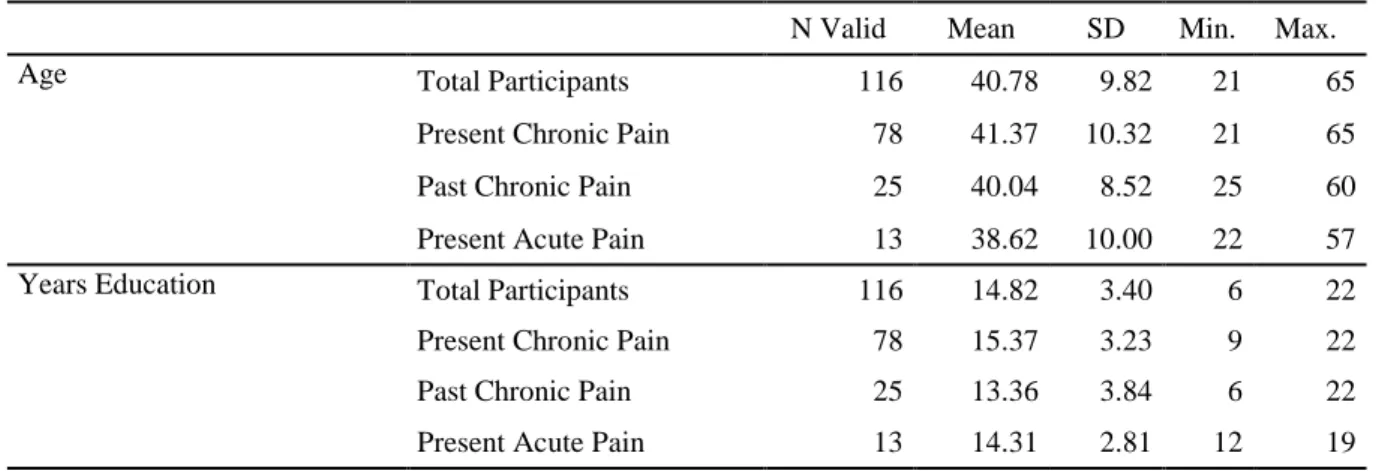
Concerning the socio-demographic characteristics, as show in table 1 and 2, most of the participants were Portuguese (90.5%), female (89.7%), aged between 21 and 65 years (Mage= 40.78 SD= 9.82). Participants’ years of formal education ranged from 6 to 22 (M= 14.82; SD=3.40) and most were employed (75.0%), 12.9% were unemployed, and 5.2% retired.
Most of the participants were in a heterosexual relationship (94.8%) for 1 to 45 years (M= 14.72; SD=11.27), and lived together (88.8%) with different relationship status: married (51.7%), civil union (29.3%), dating (17.2%) or others (0.9%) were engaged and 0.9% in an open relationship. Almost one quarter of the participants, (23.3%) reported that their partners were in chronic pain.
Regarding participants’ pain experiences, 11.2% reported experiencing current acute pain (11.2%) or chronic pain (67.2%), or having had past chronic pain experiences (21.6%). The presence of the present and past chronic pain ranged from 3 months to 40 years (MCP
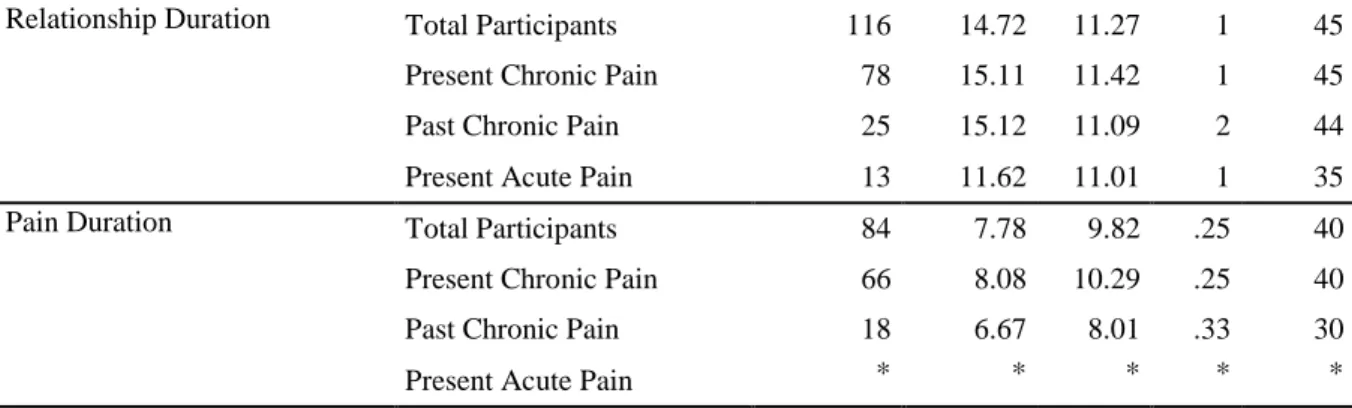
duration=7.8 SD=9.82), 16 participants were not able to specify the duration (but it was more than 3 months).
Table 1- Participants’ Socio-demographic characteristics by Types of Pain Experiences: Age, Years of
Education, Relationship duration and pain duration
N Valid Mean SD Min. Max.
Age Total Participants 116 40.78 9.82 21 65
Present Chronic Pain 78 41.37 10.32 21 65
Past Chronic Pain 25 40.04 8.52 25 60
Present Acute Pain 13 38.62 10.00 22 57
Years Education Total Participants 116 14.82 3.40 6 22
Present Chronic Pain 78 15.37 3.23 9 22
Past Chronic Pain 25 13.36 3.84 6 22
11
Relationship Duration Total Participants 116 14.72 11.27 1 45
Present Chronic Pain 78 15.11 11.42 1 45
Past Chronic Pain 25 15.12 11.09 2 44
Present Acute Pain 13 11.62 11.01 1 35
Pain Duration Total Participants 84 7.78 9.82 .25 40
Present Chronic Pain 66 8.08 10.29 .25 40
Past Chronic Pain 18 6.67 8.01 .33 30
Present Acute Pain * * * * *
* Acute Pain participants were not required to answer that question
Table 2 - Participants’ Sociodemographic characteristics by Types of Pain Experiences: Sex, Occupation, Nationality, Type of Relationship, if they Lived Together, Partner Sex and if the Partner suffer from Chronic Pain
Total Participants Pain Types Present Chronic Pain
Past Chronic Pain Acute Pain Count Row Valid N % Count Row Valid N % Count Row Valid N % Count Row Valid N % Total 116 100.0% 78 67.2% 25 21.6% 13 11.2% Sex: Male 12 10.3% 8 10.3% 3 12.0% 1 7.7% Female 104 89.7% 70 89.7% 22 88.0% 12 92.3% Other 0 0.0% 0 0.0% 0 0.0% 0 0.0% Ocupation Active 87 75.0% 61 78.2% 14 56.0% 12 92.3% Student 1 0.9% 1 1.3% 0 0.0% 0 0.0% Domestic 7 6.0% 3 3.8% 4 16.0% 0 0.0% Retired 6 5.2% 6 7.7% 0 0.0% 0 0.0% Unemployed 15 12.9% 7 9.0% 7 28.0% 1 7.7% Nationality: Portugal 105 90.5% 72 92.3% 23 92.0% 10 76.9% Other 11 9.5% 7 7.7% 2 8.0% 3 23.1%
Type of Relationship Marriage 60 51.7% 40 51.3% 16 64.0% 4 30.8%
Fact Union 34 29.3% 25 32.1% 6 24.0% 3 23.1%
Dating 20 17.2% 12 15.4% 2 8.0% 6 46.2%
Other 2 1.7% 1 1.3% 1 4.0% 0 0.0%
Lived Together Yes 103 88.8% 69 88.5% 24 96.0% 10 76.9%
No 13 11.2% 10 11.5% 1 4.0% 3 23.1%
Partner sex Same Sex 6 5.2% 5 6.4% 1 4.0% 0 0.0%
Other Sex 110 94.8% 74 93.6% 24 96.0% 13 100.0%
Partner Chronic Pain
Yes 27 23.3% 20 25.6% 4 16.0% 3 23.1%
Measures
Significant other Validation and Invalidation responses to Pain Behaviors
The Portuguese version of the Validating and Invalidating Response Scale2 was cross-culturally adapted and translated following a shorter process of the Beaton’s Guidelines (Beaton, Bombardier, Guillemin, & Ferraz, 2000). In this instrument participants were instructed to think about the moments when they felt pain. A new instruction was added in this study to condition the answer to a specific state, and they had to “rate how often your partner responds in these ways when you express what you are thinking, feeling, or wanting (from him/her, or in general)”. All items were answered on a likert scale ranging from 0
“Never” to 4 “Almost”.
The 16 items questionnaire was translated and adapted from English to Portuguese following a shorter process of the Beaton’s Guidelines for the process of cross-cultural adaptation of self-report measures (Beaton, Bombardier, Guillemin, & Ferraz, 2000). Two independent translations of the English VIRS-C into Portuguese were conducted with an informed and an uninformed translator, respectively and, after resolving translators’ discrepancies, the Portuguese versions was back translated to English again by two
uninformed English native speakers. Afterwards, the original and back-translated versions were compared and final adjustments were made to produce the final version of the PVIRS-C, the questionnaire was not pre-tested.
The PVIRS-C is composed by 2 subscales: (1) perceived partner invalidating responses/ behaviors (4 items; e.g., “My partner tells me that I should not feel what I am
feeling, think what I am thinking, or want what I am wanting – that my experiences are wrong or not legitimate.”) and (2) perceived partner validating responses/ behaviors (8 items;e.g.,
“My partner pays attention and listens carefully). The scores had been calculated as in the other VIRS-C versions, by summing the total items scores of each scale.
Dyadic Satisfaction
The Dyadic Satisfaction can be a predictor of the partner’s (in)validation and was measured through the Dyadic Adjustment Scale (DAS) (Spanier, 1976), translated and
adapted to the Portuguese Population (Gomez & Leal, 2008) and was used to confirm PVIRS-C concurrent validity.This scale was created to measure the relationship quality through four
2 This instrument can not be in appendice since the original instrument had not be published, in order to obtain the instrument please contact us
13
subscales Dyadic Consensus, Dyadic Satisfaction, Dyadic Cohesion and Affective Expression with acceptable internal consistency, once that reliability scores had ranged from .58 to .96 (Graham, Liu, & Jeziorski, 2006). From the Four scales, we only had used two for this study (Appendix A) : Dyadic Satisfaction (original items:16,17,inverted 18, inverted 19,20,21,22, inverted A, inverted B and inverted C ,this version items: 3,4,inverted 5, inverted 6,7,8,9, inverted A, inverted B and inverted C) and Affective Expression (same items as the original: inverted 1 and inverted 2).
This complex scale presents several instructions (e.g. the participants are requested to indicate the “approximate extent agreement or disagreement” or “How often would you say the following events occur between you and your mate?” ). The likert scales varied in number, according to the different instructions. These can be yes or no questions, 5-point likerst scales (e.g.: from 0- none of them to 4-all of them), 6-point likert scales (e.g.: 0-always disagree to 5 – always agree, or 0-all the time to 5 – never), among others. Scores are made with the sum of the every item of the scale. Higher items scores indicates higher Dyadic Satisfaction and Affective Expression. Our analyses revealed good internal consistency, as Dyadic Satisfaction split-half reliability was .71 and Affective Expression’s Cronbach alpha was .84.
Procedures
The study complied to the ethical principles suggested by ISCTE-IUL Ethics Committee and the Ethical Principles of Psychologists and Code of Conduct (American Psychological Association, 2017). The data collection protocol was composed by an initial informed consent form, the PVIRS-C, the Dyadic Adjustment Scale and Socio-demographic (in this order). The instrument had been distributed through an anonymous qualtrics survey link on Facebook, Linkedin, and through the members of the Portuguese chronic pain
association Força3P – Associação de Pessoas com Dor. All the data were collected between 17th of April and 28th of May.
Data Analysis
Data was analyzed using the IBM SPSS Statistics v22. First, we started with the analyses of the participants’ descriptive statistics (N=116). Second, we analyzed the PVIRS-C items descriptive statistics and normality. Third we ran an exploratory factor analysis with a principal axis factor (PAF) analysis, with Oblimin rotation; and after the items with lowest communalities (>.40) and high cross-loadings (difference lower than <.30) were eliminated,
we ran reliability analyses of the factors extracted. Fourth, we analyzed the descriptive statistics of DASS-21, ran t-tests and Spearman correlations between PVIRS-C and DAS.
Results
Item descriptive analyses and sensitivity
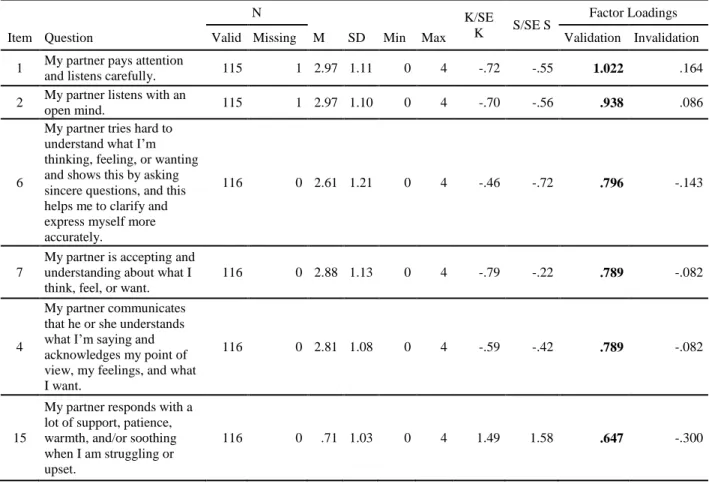
Table 3 shows the general participants (N=116) distribution of VIRS-C. As show in the same table, participants responses covered the scale range for every item (min=0 and max=4) except for the item number 12 (min=1). The calculated means varied between .71 and 3.40 and the standard deviations fluctuated between .82 and 1.28. (Table 3).
Most of the items distributions presented a normal kurtosis (kurtosis/SE kurtosis > |1.96|) values, except the items 13,14 and 15 but as only the item 13 does not as an abnormal skewness (skewness/SE skewness > |1.96|), none of the items present a normal distribution.
Table 3 - Descriptive analysis of VIRS-C items for the global sample and EFA Factor Loadings and internal reliability (n=115)
N K/SE
K S/SE S
Factor Loadings
Item Question Valid Missing M SD Min Max Validation Invalidation
1 My partner pays attention
and listens carefully. 115 1 2.97 1.11 0 4 -.72 -.55 1.022 .164
2 My partner listens with an
open mind. 115 1 2.97 1.10 0 4 -.70 -.56 .938 .086
6
My partner tries hard to understand what I’m thinking, feeling, or wanting and shows this by asking sincere questions, and this helps me to clarify and express myself more accurately.
116 0 2.61 1.21 0 4 -.46 -.72 .796 -.143
7
My partner is accepting and understanding about what I think, feel, or want.
116 0 2.88 1.13 0 4 -.79 -.22 .789 -.082
4
My partner communicates that he or she understands what I’m saying and acknowledges my point of view, my feelings, and what I want.
116 0 2.81 1.08 0 4 -.59 -.42 .789 -.082
15
My partner responds with a lot of support, patience, warmth, and/or soothing when I am struggling or upset.
15
16
My partner tries to help me or support me in solving whatever problem I might have rather than taking over and solving it for me.
116 0 2.94 1.14 0 4 -1.01 .31 .614 -.271
13
When I feel vulnerable with my partner, he or she reassures me and tells me how he or she feels the same way with me, or how he or she feels vulnerable, too.
116 0 2.43 1.20 0 4 -.308 -.899 .549 -.077
11
My partner is very critical or judgmental of my thoughts, feelings, or desires. 116 0 1.33 1.05 0 4 .58 -.19 .082 .832 14 My partner is patronizing, belittling, disrespectful, or condescending toward me, or blames me for even ordinary things that don’t go well. 116 0 .95 1.28 0 4 .76 -1.24 -.079 .767 8 My partner fails to understand me when I express myself. 116 0 1.39 1.12 0 4 .71 -.02 -.095 .560 5
My partner tells me that I should not feel what I am feeling, think what I am thinking, or want what I am wanting – that my
experiences are wrong or not legitimate.
116 0 .93 1.04 0 4 1.05 .55 -.085 .441
9 *
My partner does not make unnecessary excuses for me when I make mistakes and could do better, but is not judgmental of me when I do make mistakes.
116 0 2.90 1.13 0 4 -.82 -.18 - -
12**
My partner treats me with respect, like a valued and equal human being, and like I am capable and
worthwhile.
116 0 3.40 .82 1 4 -1.05 -.11 - -
3**
My partner does not listen to me, ignores me, or even changes the subject when I try to express myself.
116 0 1.04 1.07 0 4 .98 .38 - -
10**
My partner tells me that what I am feeling, thinking, or wanting makes sense, is legitimate, is
understandable, or is simply normal.
116 0 2.77 1.05 0 4 -.67 -.01 - -
Cronbach α .96 .79
* removed due low comunality ** removed due crossloadings
Construct Validity and Reliability Exploratory factor analysis.
After running several PAF’s with Oblimin rotation and removed 4 items sequentially: item 9 (low communality), and 12, 3 and 10 (due crossloadings), two factors were extracted with
64% of the variance explained with good adequate sampling (KMO = .930; Bartlett's χ2 (66) = 1084.856, p˂.001). The two factors extracted were consistent with the original scale, 1) Validation factor (composed by the sum of items number 1,2,6,7,4,15,16 and 13) and 2) Invalidation factor (sum of the items 11, 14, 8 and 5) and were negatively correlated (-.76). The factor loadings are present in Table 3 and the factors internal consistency showed good reliability levels for both factors (αvalidation =.96 ; αinvalidation =.76).
Factor and Variable’s descriptive analyses and sensitivity
Concerning the PVIRS-C subscales, participants showed (table 4) high levels of validation perception (M=17.83, SD=5.45), and low perceived invalidation values (M=3.65, SD=2.52). Regarding the distribution this factor showed a high negative skewness (-.773) but very low negative Kurtosis (-.217). Invalidation factor showed also a flatted (Kurtosis=-.118) with a left-modal skewness distribution (.630), and low mean values. (M=3.65, SD=2.52). On DAS, subscales participants revealed medium levels of Affective Expression and High levels of Dyadic Satisfaction, these variables present an non-normal distribution
(Kolmogorov-Smirnov<.05) through a normal skewness (skewness/SE skewness > |1.96|), and kurtosis (kurtosis/SE kurtosis > |1.96|).
With these results, non-parametric tests were used to test the correlations.
Concurrent Validity
Validation perception factor was positively correlated with DAS factors: moderate positive correlation with Dyadic Satisfaction (r=.533, p>.001, n=116), and weak positive correlation with Affective Expression (r=.289, p=.002, n=115). While Invalidation presented a moderate
Table 4 - Variable's Descriptive Statistics and Tests of Normality
Instrument Variable Min Max Mean SD S/SE S K/SE K K-S
a. PVIRS-C Validation 3 25 17.83 5.45 -.77 -.22 .000 Invalidation 0 11 3.65 2.52 .63 .12 .000 DAS Affective Expression 0 10 5.70 2.34 -.70 -.66 .005 Dyadic Satisfaction 11 48 35.98 7.52 -1.11 .68 .000
*This is a lower bound of the true significance. a.Lilliefors Significance Correction
17
negative correlation with the Dyadic Satisfaction (r=-.616, p>.001, n=116) and weak negative correlation with Affective Expression (r=-.190, p=.042, n=115)
Discussion
To achieve our dissertation main goal, we needed a Portuguese scale to measure perceived spouse (in) validation, so, we aimed to translate, adapt and validate a Portuguese Version of VIRS-C. Following a Korean adaption and validation of the same instrument (Lee et al., 2012) we hypothized that: (1) the scale would present only one factor - validation, (2) with good internal consistency and (3) that this factor would be positively correlated with Dyadic Satisfaction.
An initial item descriptive analyses sensitivity showed that, in this sample, none of the items had a normal distribution, so we used non-parametric test. Contrary to what we first hypothesized, an Exploratory Factor Analyses with Oblimin rotation revealed two factors: Validation and Invalidation. This finding supports the factorial structure used on the study with the Swedish VIRS-C and the Swedish VIRS-HCP (Carlsson & Larsson, 2010; Edlund, 2017), and supports the idea that validation and invalidation, even with a strong negative correlation, are not totally antagonic (Issner et al., 2012) given space to the same person be able to perceived both at the same time (Edlund et al., 2017).
Both perceptions present good levels of internal reliability, confirming hypothesis 2, which was not affected by the new conditioning instruction. However, participants reported validation perception levels skewed to the higher end of the scale (high perceived frequency), and reported invalidation perception levels skewed to the lower end of the scale (low
perceived frequency), where both factors distributions deviated from normality. This bias can be justified, once that saying that the partner is invalidating may been considered taboo and by the socially desirable responding, that had been showed to affect both self-reports and spouse ratings (Vésteinsdóttir, Steingrimsdottir, Joinson, Reips, & Thorsdottir, 2018). Even with the deviation, a good fit to the data was ensured by a non-parametric approach towards the factorial structure.
Also, was confirmed that, not only validation positively correlated with Dyadic Satisfaction, Hypothesis 3, and Affective Expression, as Invalidation correlated negatively with the same factors, supporting the concurrent validity, as KVIRS (Lee et al., 2012).Thus, this study, shows that PVIRS-C, so far, the only translated Portuguese measure of partner perceived (in)validation responses, present good levels of internal reliability and reasonable concurrent validity.
19
CHAPTER 3 – THE INFLUENCE OF PERCEIVE (IN) VALIDATION IN PAIN EXPERIENCES, THROUGH EMOTIONAL REGULATION
Introduction
The most widely used model (Hadjistavropoulos et al., 2011) to understand and treat chronic pain, the Biopsychosocial Model of Pain (Turk et al., 1983) acknowledges pain as a perception, shaped by biological, psychological and social factors (Hadjistavropoulos & Craig, 2004).
Psychologically, Pain and Emotions have a complex and intricate interaction (Price & Bushnell, 2004). Even if that connection is not linear, it is possible to see some connections looking through different emotional theoretical point of views. In a Dimensional Emotional Perspective, the negative valence of emotions/affect usually exacerbates pain perception, positive valence emotions/affect commonly buffers that perception and arousal amplifies working as an intensity regulator (Rainville, 2004). In an emotional discrete perspective anger expression inhibits pain perception, as anger suppression increases it, pain derived fear and anxiety amplifies pain perception leading to chronic pain (Lumley et al., 2011; Rainville, 2004).
Changing emotion is changing pain. Emotions can be change by switching, one or more of the follow components: self-behaviors, expressions, experiences, emotion elicitation (Diamond & Aspinwall, 2003; Gross, 1999); consciously or unconsciously, in a process called Emotion Regulation. (Diamond & Aspinwall, 2003).
As Gross Model of Emotion Regulation (Gross & John 2003) is focused in individual emotional regulation through 2 specific strategies: one adaptive the cognitive reappraisal, and one maladaptive the Expressive Suppression (Gross & John, 2003). The Social Sharing of Emotion Model by Rimé, (2009) is focused on emotional social sharing; when is negative emotion sharing accelerates emotional disclosure and in positive emotions boost individuals positive affect and social bonds (Rimé, 2009).
Socially, people with chronic pain, count on significant others (Bernardes et al., 2017) to help them to cope with pain and regulate emotions/emotional states (Cano, Corley, Clark, & Martinez, 2018). Spouses provide emotional support that other intervenients fail in compensate (Delongis et al., 2004).
Validation is a dyadic communication technique (Linehan, 1993), that has a social support function (Bernardes et al., 2017), and promotes emotional regulation ( . After an idea or emotion transmission, validation occurs when there is acceptance, approvement, empower and comprehension (Cano et al., 2008; Linehan, 1997) , and Invalidation occurs with it
disrespect, contempt or unacceptance or with the validation opportunity dismissal (Issner et al., 2012).
There is several results from this communication technique found in pain context. Spouse Validation was correlated with the decrease of reported negative emotions (Edlund, Carlsson, Linton, Fruzzetti, & Tillfors, 2015), marital satisfaction increase (Issner et al., 2012), perceived entitlement decrease (Cano et al., 2009) and negative affect decrease. While Spouse Invalidation was correlated increased levels of emotional reactivity (A. E. Fruzzetti & Shenk, n.d.), helplessness catastrophizing , affective pain distress, anxiety (Cano, Leong, Williams, May, & Lutz, 2012b), perceived support entitlement (Issner et al., 2012), pain severity, depressive symptoms (Leong et al., 2011). Pain interference was correlated with heightened Invalidation, not in a pain context but in a clinic context (Edlund et al., 2017).
With the results and with theoretical models start to emerge there’s a need to understand what’s the real mediation effect of the emotional regulation on the relationship between perceive spouse valtidation/invalidation and pain outcomes and related outcomes, a model, that so far, in the best of our knowledge, had not been tested.
Our main aim is to uncover the relationship between perceived spouse
validation/invalidation and pain outcomes and if emotion regulation is a mediating process. However, since there was no instrument to measure what emotions were shared between couples, we aimed to create one. In order to achieve our main aim, we exploredthe indirect effects of perceived spouse validation Pain Severity (H1), Pain Disability(H2),
Depression(H3), Stress (H4) and Anxiety(H5)) and perceived spouse invalidation on the same outcomes (Pain Severity (H6), Pain Disability(H7), Depression(H8), Stress (H9) and
Anxiety(H10)) using 5 different path. Two paths coming from the Emotional Regulation Model, by Gross (Cognitive Reappraisal (a) and Expressive Suppression(b)) and three paths using Rimé’s Model (Hostile Negative Emotion Sharing (c) , Positive Emotion (d) ,
Unassertive Negative Emotion (e)).
We hypothesized, as seen the Figure 1 in Chapter 1, that validation will diminish all the pain outcomes ( H1 to H5), through the increasing of emotional sharing, increasing cognitive reappraisal (paths a,c,d,e) and diminishing of expressive suppression (path b), and , as seen the Figure 2 in Chapter 1, that invalidation will increase all the pain outcomes(H6 to H10), through the diminishing of emotional sharing, diminishing cognitive reappraisal (paths a,c,d,e) and increasing of expressive suppression (path b).
21
Method
Participants and Research Design
As seen and described in chapter 2, in this cross-sectional and correlational study, due to the inclusion criteria: (1) being older than 18; (2) had experience, recently, of some kind of physical pain; (3) being in a romantic relationship, only 116 survey’s from the total answer surveys (N=263) were elected to general sample. As the sample is the same as the one used previously, the characteristics were present in Chapter 2.
Measures
Acute Pain, Present and Past Chronic Pain
Participants’ pain experiences were assessed by yes-or-no-questions (e.g., Matos & Bernardes, 2013): 1) ‘Have you ever had constant or intermittent pain for more than three consecutive months?’ (2) ‘Did you feel this pain during the last week?’ and (3) ‘Did you feel any pain in the last week?’ Participants were considered as having current chronic pain if they answered positively to questions 1 and 2; and having past chronic pain if they answered yes to 1 and no to 2. Participants who only answered positively to question 3 were considered as having current acute pain. Finally, all participants who answered negatively to questions 2 and 3 were considered as having no current pain.
Significant other Validation and Invalidation responses to Pain Behaviors
The Portuguese Validating and Invalidating Response Scale for couples (PVIRS-C) is
a 16 items instrument, translated and adapted from a not validated or published scale, the Validating and Invalidating Response Scale for couples ( Fruzzetti & Shenk, n.d.) that measures perceived spouses validating and invalidating responses/ behaviors.
In PVIRS-C, participants were instructed to rate, from a 5 likert scale points (from 0 “Never” to 4 “Almost all of the Time”), “how often your partner responds in these ways when you express what you are thinking, feeling, or wanting (from him/her, or in general)” when they feel pain.
Exploratory factor analyses (reported in Chapter 2), have shown, after 4 items being deleted (due to cross-loadings and low communalities), that this instrument contains two dimensions: (1) perceived spouse invalidating responses/ behaviors (4 items: 14, 11, 8 and 5); e.g., “My
partner does not listen to me, ignores me, or even changes the subject when I try to express myself.”) and (2) perceived spouse validating responses/ behaviors (8 items: 1, 2, 6, 7, 4, 15,
16, 13 and 11, e.g., “My partner listens with an open mind”) with good internal consistency (αvalidation =.96 ; αinvalidation =.76; Chapter 2).
The scores were calculated through the total factors items sums, and higher scores signified higher perceived spouse’s validation/invalidation.
Cognitive reappraisal and emotional suppression
In order to assess two individual emotional regulation strategies (Cognitive Reappraisal and Expressive Suppression) the translated and adapted Portuguese (Vaz & Martins, 2009) Emotion Regulation Questionnaire (Gross & John, 2003) was used.
To the original instruction (“We would like to ask you some questions about your emotional
life, in particular, how you control (that is, regulate and manage) your emotions”) we added
a condition (“When you are in pain”) and participants were request to rate on a 7-point likert scale that ranged from 1 (strongly disagree) to 7 (strongly agree).
Both subscales: (1) Cognitive Reappraisal (6-items e.g., “When I want to feel less negative
emotion, I change the way I’m thinking about the situation”) and (2) Expressive Suppression,
(4-items: e.g. “When I am feeling negative emotions, I make sure not to express them”) exhibited higher internal consistency: (αCognitive Reappraisal=.89 αExpressive Suppression=.84) than in
the Original Portuguese Version translation (αCognitive Reappraisal=.76 αExpressive Suppression=.65)
(Vaz & Martins, 2009).
To keep the total scores as the original instrument, they were calculated by the total of items sum, a higher value indicates a greater use of the specific strategy.
Couples Emotions Sharing Index (CESI)
We have developed an index of couple’s emotions sharing. This index (Appendix B) intends to measure how often people, in the past week, had shared the discrete basic emotions described by Ekman & Cordaro, (2011) (“Anger”, “Fear”, “Surprise”, “Sadness”,
“Disgust”, “Contempt”, “Happiness”) with their spouse. Participants could indicate the
frequency, in a 5-point likert scale, ranging from 0 to 4 (0-”Very Rarely”, 1-“Rarely”,
2-“Occasionally”, 3-“Frequently”, 4-“Very Frequently”). An Exploratory Principal Factor
Analysis, with an Oblimin Rotation, extracted three factors accounting for 71% of the variance and an adequate sampling (KMO = .666; Bartlett's χ2 (10) = 140.511, p˂.001). The first factor was composed by contempt, disgust and anger sharing and as a good internal consistency (α=.79), the second factor had poor reliability (rsb=.46) as it was composed by
23
happiness and surprise sharing and the third factor was composed by the fear and sadness sharing with an acceptable consistency (rsb=.57).
The factors were renamed Hostile Negative Emotions (items1, 5 and 6: Anger, Disgust and Contempt), Positive Emotions (items 3 and 7: Surprise and Happiness) and Unassertive Negative Emotions (items 2 and 4:Fear and Sadness). All the subscales were scored using the item’s sum, and the higher the valued more frequently the participant shared the emotions with the spouse.
Pain Severity
The pain severity sub-scale of the Brief Pain Inventory (BPI) (Cleeland, 1989) was used. The BPI is a multidimensional questionnaire to measure several pain dimensions. In this
questionnaire we used the Portuguese BPI Short Form Version translated, adapted and
validated for the Portuguese population (Azevedo et al., 2007). Participants were requested to indicate the maximum, the minimum, and the average pain during the last week and in the moment, they were doing the questionnaire, using a likert scale scored from 0, “No pain”, to 10 “pain as bad as you can imagine”.
The factor was calculated with the item weighted average, and a higher value represents a higher severity. In our study the scale showed a high internal consistency (α=.89).
Pain Disability
To measure which aspects of the participants life are disrupted by chronic pain we used the Portuguese (Azevedo et al., 2007) form of the Pain Disability Index (PDI) (Pollard, 1984). Participants were requested to rate, in a likert scale of 10 points, ranging from 0 (no
disability) to 10 (total disability), the level of disability that they typically experienced in 7 items activities (Family/Home Responsibilities, Recreation, Social Activity, Occupation, Sexual Behavior, Self-Care and Life-Support Activities), that can be interpreted all together, alone or grouped into two subscales: Voluntary and Mandatory.
To check for the psychometric qualities of this measure in our present sample we conducted a principal axis factoring analysis with oblimin rotation (KMOPDI= .87, Bartlett's χ2 (21) =
489.229, p˂.001) that extracted only 1 factor accounting for 67% of the total variance with good internal consistency (α=.909).
The total score was made by summing all the items, and the higher it is the higher is the disability associated with pain.
Depression, Anxiety and Stress
The Portuguese version (Pais-Ribeiro, Honrado, & Leal, 2004) of the short form of Depression Anxiety Stress Scales (DASS-21) by Lovibond and Lovibond (1995) was used. This clinical assessment measure presents 21 sentences to the participants, and requests them to select a number from 0 (“Did not apply to me at all”) to 3 (“Applied to me very much, or most of the time”) for each item. As the scale name indicates, it measures 3 factors:
depression (“I felt that I had nothing to look forward to.”), anxiety (“I was aware of dryness
of my mouth”) and stress (“I found it hard to wind down”), composed by 7 items each. All
the 3 factors, in this study, presented good internal consistency (αAnxiety=.719, αstress=.763,
αDepression=.778).The factor scores were made by summing all the items, as in the original
scale, and the higher they were the higher was participants’ depression, the anxiety and/or the stress symptoms.
Procedures
As explained in Chapter 2, this study followed the Ethical Principles of Psychologists and Code of Conduct (American Psychological Association, 2017) and ISCTE-IUL Ethics Guidelines (ISCTE-IUL, 2016).
The data collection protocol was composed by an initial consent form, pain-related questions, the PVIRS-C, the ERQ, the CESI, the BPI, the PDI, the DASS-21 and Socio-demographic questions (in this order).
The data collection occurred between 17th of April and 28th of May through an
anonymous qualtrics survey link on Facebook, Linkedin, and through the members of the Portuguese chronic pain association Força3P – Associação de Pessoas com Dor.
Data Analysis
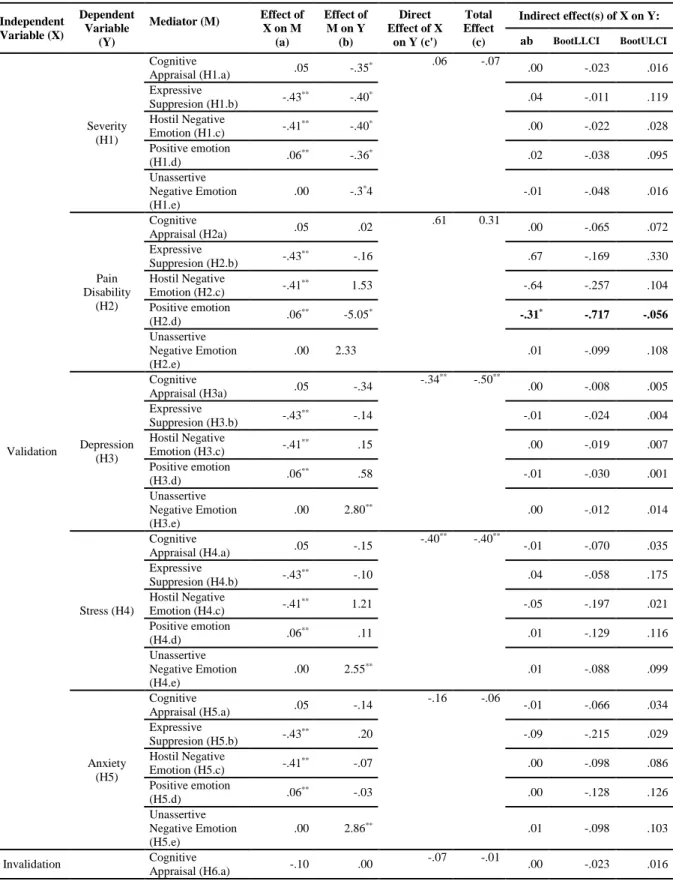
Data collection were made through Qualtrics software, and analyzed through IBM SPSS Statistics v22. First, we analyzed participant’s descriptive statistics (N=116). Second, we analyzed the Model’s variables descriptive statistics and ran tests of normality to ascertain the distribution. Third, as only one variable had a normal distribution, we used non-parametric test, and tested the Spearman Correlations. Fourth, to test mediation the Hayes Process’ model 4 (fig. 1, 3 and 4) was used, with perceived spouse validation/invalidation as predictor through different emotional regulation pathways and pain outcomes. Using a bootstrapping
25
approach, the indirect effects of the mediation paths, were considered significant, when a 5000 estimate (with 95% bias-corrected and 2.5% highest and lowest scores cutoffs of the empirical distribution) confidence intervals did not include zero (Hayes, 2018).
Results
Model’s Variable’s Descriptive Analyses and Distribution
Descriptive statistics and distribution of the study’s variables are presented in Table 5. Concerning the predictors, participants reported high levels of Validation and low levels of Invalidation. Regarding the mediators, participants reported high levels of Cognitive
Appraisal, moderate levels of Expressive Suppression, Positive Emotion Sharing, Unassertive Negative Emotion Sharing, and very low levels of Hostile Negative Emotion sharing.
Concerning the outcomes, the Pain Severity and Pain disability were moderate, and Depression, Stress and Anxiety presented low levels.
In the distribution analyses, only Pain Severity followed a normal distribution and Hostile Negative Emotion Sharing showed a leptokurtic distribution (kurtosis/SE of kurtosis > 1.96).
Table 5- Models Variable's Descriptive Statistics and Tests of Normality
Min Max Mean SD
Skewness/ SE skewness Kurtosis/S E kurtosis K-S a. Predictor Validation 3 25 17.83 5.45 -.77 -.22 .000 Invalidation 0 11 3.65 2.52 .63 .12 .000 Mediator Cognitive Appraisal 9 42 30.30 7.55 -.33 -.47 .043 Expressive Suppression 4 27 14.00 6.08 .24 -.72 .018 Mediator Hostile Negative Emotion 1 5 1.71 .83 1.47 2.12 .000 Positive Emotion 1 5 3.11 .83 -.01 .13 .000 Unassertive Negative Emotion 1 5 2.69 .99 .24 -.36 .000
Outcome Pain Severity .50 10 5.09 2.01 -.01 -.43 .200*
Outcome Pain Disability 0 55 26.13 16.51 -.08 -1.25 .001
Outcome Depression 0 26 8.82 7.33 .52 -.85 .000
Stress 0 35 13.35 8.26 .31 -.80 .000