MITO-NUCLEAR SEQUENCING IS PARAMOUNT TO CORRECTLY IDENTIFY SYMPATRIC HYBRIDIZING FISHES
Carla SOUSA-SANTOS
1*, Ana M. PEREIRA
1, Paulo BRANCO
2, Gonçalo J. COSTA
3,
José M. SANTOS
2, Maria T. FERREIRA
2, Cristina S. LIMA
1, Ignacio DOADRIO
4,
and Joana I. ROBALO
11 MARE—Marine and Environmental Sciences Centre, ISPA—Instituto Universitário, Lisboa, Portugal 2 CEF—Forest Research Centre, Instituto Superior de Agronomia, Universidade de Lisboa, Lisboa, Portugal 3 Computational Biology and Population Genomics Group (CoBiG2), Centre for Ecology, Evolution and Environmental
Changes (CE3C), Faculdade de Ciências, Universidade de Lisboa, Lisboa, Portugal
4 Department of Biodiversity and Evolutionary Biology, Museo Nacional de Ciencias Naturales, CSIC, Madrid, Spain
Sousa-Santos C., Pereira A.M., Branco P., Costa G.J., Santos J.M., Ferreira M.T., Lima C.S., Doadrio I., Robalo J.I. 2018. Mito-nuclear sequencing is paramount to correctly identify sympatric hybridizing fishes. Acta Ichthyol. Piscat. 48 (2): 123–141.
Background. Hybridization may drive speciation and erode species, especially when intrageneric sympatric species
are involved. Five sympatric Luciobarbus species—Luciobarbus sclateri (Günther, 1868), Luciobarbus comizo (Steindachner, 1864), Luciobarbus microcephalus (Almaça, 1967), Luciobarbus guiraonis (Steindachner, 1866), and
Luciobarbus steindachneri (Almaça, 1967)—are commonly identified in field surveys by diagnostic morphological
characters. Assuming that i) in loco identification is subjective and observer-dependent, ii) there is previous evidence of interspecific hybridization, and iii) the technical reports usually do not include molecular analyses, our main goal was to assess the concordance between in loco species identification based on phenotypic characters with identifications based on morphometric indices, mtDNA only, and a combination of mito-nuclear markers.
Materials and methods. Specimens of Luciobarbus from six Guadiana River sub-basins were collected and
sequenced for the cytochrome b and beta-actin genes. For comparative purposes, samples of Luciobarbus from other 12 river basins were also used. Four levels of taxonomical identification were conducted based on: identification made in the field (in loco identification), cytb gene only, beta-actin gene only, and mito-nuclear combined genomes.
Results. Results showed that interspecific hybridization seems to be high (around 41%) and likely favoured
by non-random mating and the loss of fluvial connectivity. About 34% of the hybrids showed mito-nuclear discordance. Misidentifications were frequent when only phenotypic characters are considered, and the use of a single mitochondrial gene is not sufficient: the use of two mito-nuclear markers showed that around 82% of the in
loco identifications based on the phenotype were not correct.
Conclusion. Incorrect species assignment likely generated biased results in previous studies on the biology and
ecology of Guadiana barbels and in the assignment of conservation status and, consequently, on the establishment of conservation management measures.
Keywords: mito-nuclear incongruence, introgression, hybridization, phenotypic traits, conservation
* Correspondence: Dr Carla Sousa Santos, ISPA – Instituto Universitário, Rua Jardim do Tabaco 34, 1149-041 Lisboa, Portugal, phone: +351 21 88 11 700, fax: +351 21 88 60 954, e-mail: (CSS) [email protected], (AMP) [email protected], (PB) [email protected], (GJC) [email protected], (JMS)
[email protected], (MTF) [email protected], (CSL) [email protected], (ID) [email protected], (JIR) [email protected]. INTRODUCTION
Since the 1930s, when the process of natural hybri-dization began to receive more attention from researchers, two divergent approaches emerged: botanists highlighted its potential for generating diversity (hybrids could occupy new habitats and originate new clades) and zoologists tended to see it as a reproductive mistake that
limits diversification and retards evolution (reviewed by Barton 2001, Mallet 2005). According to the latter view, hybridization is the converse of reproductive isolation and challenges the biological species concept, thus the study of hybrids would only be relevant as a tool to understand the development of reproductive isolation (Mallet 2005).
The emergence of molecular biology techniques exposed the important role of hybridization as a source of genetic variation, a way to generate functional novelty and adaptability, and an important mechanism in the formation of new species (Mallet 2005, Bohling 2016).
According to the literature, the production of viable and fertile hybrids may lead to at least three possible evolutionary scenarios:
If hybridization occurs repeatedly, the extensive gene flow may lead to the extinction of one of the hybridizing species through genetic assimilation (Costedoat et al. 2007) or to the merging of the hybridizing species (Taylor et al. 2006)
If hybrids show reduced fitness a hybrid zone may be established, where gene exchange may occur but merging of the parental taxa is prevented (Barton et al. 1985)
If reticulate evolution, when hybrids are at least partially reproductively isolated from the hybridizing species, and the formation of a new, allopolyploid or homoploid, hybrid species occurs (Schumer et al. 2014).
Once formed, fertile F1 hybrids may backcross with one or both the parental species, allowing the occurrence of gene flow and eventually leading to the incorporation of the genes of one species into the genome of the other species (introgressive hybridization) or to the complete merging of the previously isolated hybridizing species (“hybrid swarm”) (Scribner et al. 2000). If two hybridizing species are common in their habitats, even low rates of hybridization may have relevant evolutionary consequences. The introgression of genes through hybridization may contribute to adaptive evolution and diversification by enhancing genetic variability (Mallet 2005), but may also raise important concerns regarding species integrity and conservation (Costedoat et al. 2007, Bohling 2016). Evidence for the occurrence of introgression of genes has increased in the last decades, as more molecular techniques became available to the researchers (Arnold 2006). These techniques inclusively detect unsuspicious cases of introgression, namely when parental species and their hybrids are morphologically similar (Gerlach et al. 2016, Paterson et al. 2016).
The high incidence of hybridization in fish taxa seems to be a result of several contributing factors: external fertilization, weak behavioural isolating mechanisms, unequal abundance of the two parental species, competition for limited spawning habitat, decreasing habitat complexity, loss of fluvial connectivity, and susceptibility to secondary contact between recently evolved forms (reviewed by Scribner et al. 2000). The anthropogenic modification of river systems, namely through damming and habitat destruction, may thus be linked with higher levels of hybridization in fish (Hasselman et al. 2014).
Among European cyprinid fish, several cases of hybridization and introgression between native species belonging to the same (Machordom et al. 1990, Congiu et al. 2001, Almodóvar et al. 2008, Lajbner et al. 2009, Geiger et al. 2016) or to different genera (Bianco 1982, Hänfling et al. 2005, Ünver et al. 2005, Pereira et al. 2009, 2014, Aboim et al. 2010, Matondo et al. 2010, Kuparinen
et al. 2014, Witkowski et al. 2015) were reported in the last three decades. The hybridization between sympatric species of Luciobarbus inhabiting the Iberian Peninsula was suggested by the finding of morphological intermediates (Almaça 1967, 1972, Machordom et al. 1990, Geiger et al. 2016, Gante et al. 2015) and later corroborated by molecular data (Machordom et al. 1990, Callejas and Ochando 2002, Gante et al. 2015). Recently, a wide study on Iberian Barbus and Luciobarbus pointed to the existence of incomplete reproductive isolation between sympatric species with semi-permeable barriers to gene flow (Gante et al. 2015). This work also showed that, despite the homogenizing effects of hybridization, Iberian barbels might still be discriminated by the combined used of morphological and molecular tools (Gante et al. 2015).
The Guadiana River basin, located westwards from the Gibraltar Strait, harbours five sympatric species of
Luciobarbus: Luciobarbus sclateri (Günther, 1868), Luciobarbus comizo (Steindachner, 1864), Luciobarbus microcephalus (Almaça, 1967), Luciobarbus guiraonis
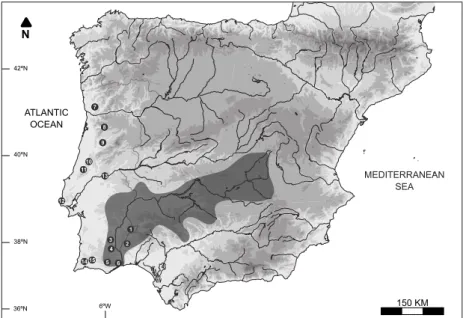
(Steindachner, 1866), and Luciobarbus steindachneri (Almaça, 1967) (Fig. 1). Luciobarbus guiraonis is highly
abundant in the upper Guadiana (Doadrio et al. 2011) but absent from the lower portion of this river basin, in Portugal. Luciobarbus steindachneri, a Portuguese endemism from the lower Guadiana River, has been taxonomically controversial: several authors considered it a valid species (Kottelat 1997, Bianco and Ketmaier 2001, Almaça and Banarescu 2003, Kottelat and Freyhof 2007) and their work supported its inclusion in FishBase (Froese and Pauly 2017); while other authors consider it an invalid species (Doadrio 1988) or an ecotype of hybrid origin (Gante et al. 2015). Consequently, and although this species was initially described as having a distribution area covering the whole Guadiana River, it was not included in the Spanish checklists of freshwater fishes (Doadrio et al. 1991, 2011, Doadrio 2001, Zamora and Almeida 2015), despite being still present in Portuguese checklists (Cabral et al. 2005).
There are a number of morphometric and meristic measures considered to be diagnostic features of the
Luciobarbus species inhabiting the Guadiana River
(Almaça 1967, Doadrio et al. 2011) (Fig. 1). Nevertheless, routine biological surveys and technical reports (e.g., for environmental impact studies), and also scientific papers on the biology and ecology of these barbels, rely only on the morphological identification of captured fish using user friendly and in loco traits such as the width of the head, the relative size of the eye, the length of the barbels or the profile of the head (Lobón-Cervia et al. 1984, Encina and Granado-Lorencio 1990, Pires et al. 2001, Morán-López et al. 2005). Conservation efforts are also dependent on an adequate knowledge of barbel populations, and the location of priority areas for protection.
Assuming that i) the use of morphological characters
in loco may be subjective and observer-dependent, ii)
there is previous evidence of interspecific hybridization between the sympatric Luciobarbus species in the Guadiana River, and iii) technical surveys conducted in
this river basin (for monitoring the ichthyofauna of the Guadiana National Park or for environmental impact studies, for instance) usually do not include taxonomical identification based on molecular tools, our main goal is to assess the reliability of in loco species identification using morphometric indices, mtDNA only, and a combination of mito-nuclear markers. Considerations about conservation and management studies on Portuguese Luciobarbus and implications for future taxonomical assignments of hybrid species will be drawn.
MATERIALS AND METHODS
A total of 378 Luciobarbus specimens were collected between 2011 and 2012 in six Guadiana River sub-basins (Fig. 2), using electrofishing (SAMUS725G portable device): Ardila (n = 75), Caia (n = 11), Chança (n = 66), Cobres (n = 35), Degebe (n = 33), Odeleite (n = 54),
Oeiras (n = 39), and Vascão (n = 65). Fish were identified in the field by two observers, according to practical guidelines followed by the technicians of the local Natural Park “Parque Natural do Vale do Guadiana” for more than two decades, based on the head dorsal profile and on the length of the second pair of barbels relative to the eye (Almaça 1967, Doadrio et al. 2011). Phenotypic traits used to identify Luciobarbus in the Guadiana River are summarized in Table 1.
Juveniles smaller than 10 cm (n = 72) were also sampled but were not identified using the above mentioned diagnostic characters (Table 1) nor used for morphometric analyses, as their identification in the field is considered to be unreliable (Godinho et al. 1997). They were, nevertheless, included in genetic analyses. Dorsal fin clips were taken from all the specimens and preserved in 96% ethanol as vouchers for the tissue collection of
Fig. 1. Sympatric Luciobarbus species in the Portuguese side of the Guadiana River basin: Luciobarbus sclateri (A), Luciobarbus comizo (B), Luciobarbus microcephalus (C)
MARE-ISPA (Lisbon, Portugal). Fish were photographed and immediately released to the water.
For comparative purposes and to allow for the validation of nuclear-specific tags (see below), 157 samples of additional Luciobarbus populations (Fig. 2), available from the same tissue collection, were used for genetic analyses: 20 L. comizo from the Tagus River, 26 L. sclateri from rivers Seixe and Arade, and 111
Luciobarbus bocagei (Steindachner, 1864) from nine river
basins located throughout the species distribution area (Table 2 and Fig. 2). These samples, except for the Tagus population (where L. bocagei is sympatric with L. comizo), were from populations where only one Luciobarbus species occurs, avoiding the potential noise of current interspecific hybridizations on the nuclear signal. The complete dataset of samples is presented in Table 2. Molecular data analyses. Total genomic DNA was ex-tracted from fin clips using REDExtract-N-Amp Tissue PCR kits (Sigma-Aldrich) following the manufacturer’s
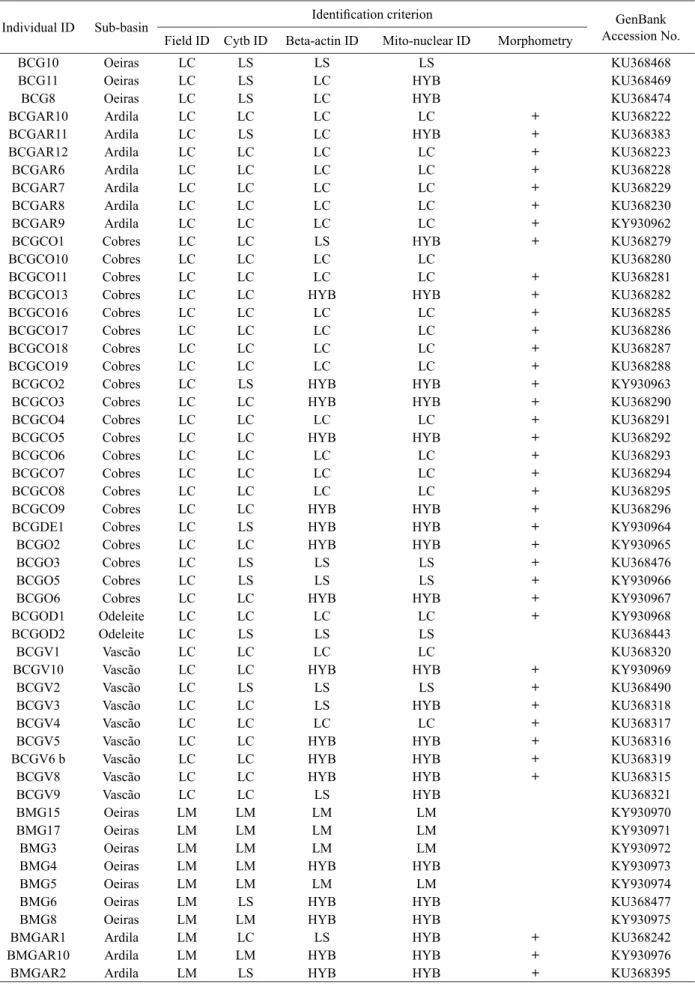
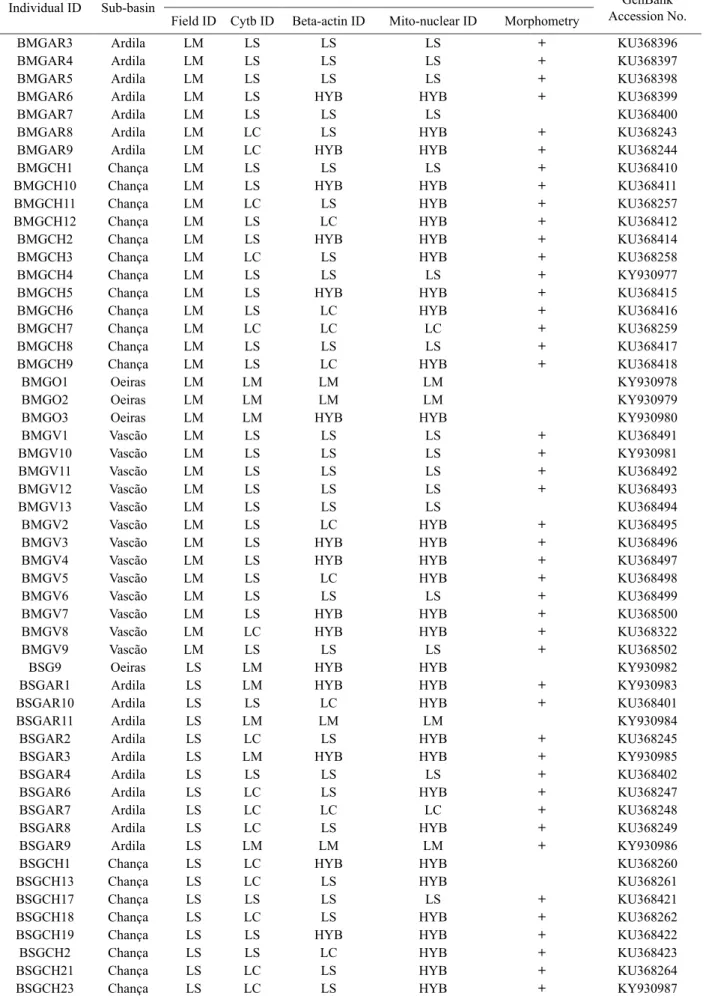
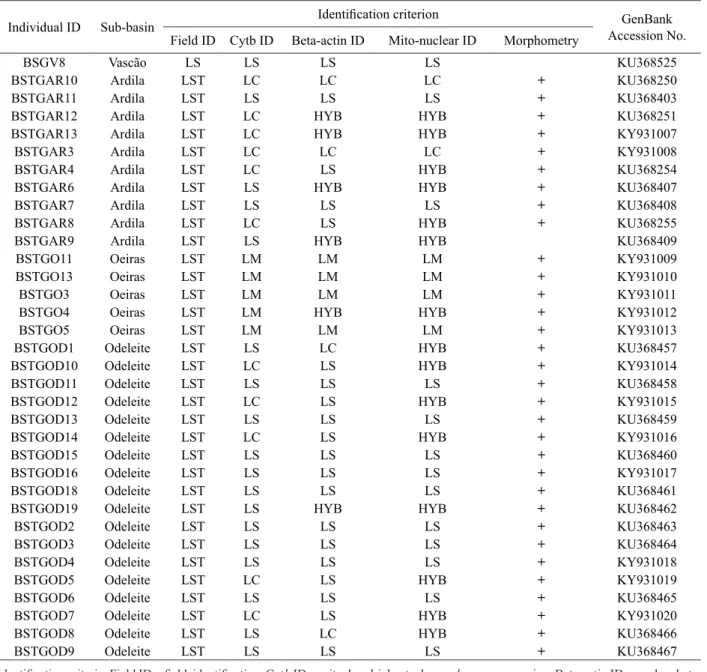
instructions. One mitochondrial (cytochrome b - cytb) and one nuclear gene (beta-actin) were amplified us-ing the primers LCB1new-ACTTGAAGAACCAC-CGTTG (newly designed, based on the LCB1 primer described by Brito et al. 1997) and HA-CAACGATCTC-CGGTTTACAAGAC (Schmidt and Gold 1993) for cytb, and BACTFOR-ATGGATGATGAAATTGCCGC and BACTREV-AGGATCTTCATGAGGTAGTC (Robalo et al. 2007) for beta-actin. PCR conditions followed the ones described in Sousa-Santos et al. (2014). Primers LCB1new and BACTFOR were used for forward sequencing reac-tions and the PCR products were purified and sequenced at the GATC company (Germany). Obtained sequenc-es were aligned and manually edited using CodonCode Aligner v4.0.4 (CodonCode Corp., USA). All beta-actin and some cytb (n = 60) sequences were newly obtained for this work whilst the remaining cytb sequences (n = 194) were previously obtained by the research team under the scope of the FISHATLAS project and were already available in GenBank (Table 3). GenBank accession num-ber of all cytb sequences are presented in Table 3. The obtained beta-actin sequences were not genotyped (and, thus, not deposited in GenBank) since it was our goal to detect specific tags among the superimposed double peaks (see below). Chromatograms are available to be sent by the authors upon request.
As Luciobarbus species are tetraploid (Ráb and Collares-Pereira 1995), the amplification of the nuclear beta-actin gene generates mixed PCR products and the consequent production of traces with multiple peaks for the majority of the loci. Indeed, if the four alleles exhibit the same nucleotide in a particular locus, a single peak will be read by the sequencer. Contrastingly, it is possible that four nucleotides, one from each allele, may appear superimposed at a given locus of the sequenced gene fragment. Several manual (Sousa-Santos et al. 2005)
150 KM MEDITERRANEAN SEA ATLANTIC OCEAN 40ºN 36ºN 6ºW 42ºN 38ºN N 1 2 3 4 5 17 19 1 10 1 11 1 12 1 13 1 15 18 16 1 14 4ºW 0º
Fig. 2. Sampling locations of Luciobarbus species in the Guadiana River basin (grey shaded): (1 = Caia, 2 = Degebe, 3 = Ardila, 4 = Chança, 5 = Cobres, 6 = Oeiras, 7 = Vascão, 8 = Odeleite) and other rivers (7 = Ave, 8 = Vouga, 9 = Mondego, 10 = Lis, 11 = Alcoa, 12 = Colares, 13 = Tagus, 14 = Seixe, 15 = Arade)
Table 1 Diagnostic phenotypic traits used for the in loco identification of Luciobarbus specimens sampled in the
Guadiana River
Species Phenotypic trait
L. sclateri Barbels extending beyond the posterior edge of the eye
L. steindachneri Barbels reaching the middle of the eye L. microcephalus Short barbels (not reaching the anterior edge
of the eye) and short head with concave dorsal profile
L. comizo Short barbels (not reaching the anterior edge of the eye) and long head with concave dorsal profile and duck-like snout
and automated/statistical approaches (Stephens et al. 2001, 2003, Bhangale et al. 2006, Scheet and Stephens 2006, Chen et al. 2007, Dmitriev and Rakitov 2008) have been developed in the past decade to disentangle both gene complements of diploid heterozygotes and hybrids. In some cases, these approaches benefit from the presence of diagnostic heterozygous insertions-deletions mutations (indels) which result in a phase shift in the trace, from the mutation point onwards (Sousa-Santos et al. 2005). For tetraploid individuals which are heterozygous for a given nuclear gene, however, the haplotype determination is not an easy task, especially if indels are present.
Iberian barbels exhibit four copies of the beta-actin gene, identical two by two, with several indels in conserved regions (Sousa-Santos unpublished data). These haplotypes may be recovered by using paralog-specific primers, as already described for the direct sequencing of the S7 and growth hormone genes of Barbus and
Luciobarbus (see Gante et al. 2011). However, in the
presently reported study, as our goal was to use the nuclear
beta-actin gene to validate the direct sequencing of the mitochondrial cytb gene (or, on the contrary, to refute the mtDNA-based classification when hybridization signals are detected), we opted for a less expensive and expedite methodology which may be easily replicated in future studies. Thus, traces obtained from the beta-actin gene sequencing of Luciobarbus from the Guadiana River were aligned with CodonCode Aligner v4.0.4 (CodonCode Corp., USA). Automated base calling using the nucleotide ambiguity code (IUPAC) was made by CodonCode Aligner (“calling secondary peaks” function) and each locus was posteriorly manually inspected to search for point mutations which can be used as diagnostic of the species sampled. Samples of L. bocagei, L. sclateri, and
L. comizo from other river basins (Table 2) were also
manually inspected for support to the former identification of diagnostic loci. Tags identified for L. comizo and
L. sclateri from Guadiana specimens were validated with
the sequencing results obtained for individuals of the same species from other river basins (respectively, Tagus and Arade/Seixe). Identical procedure was not possible to conduct for the validation of L. microcephalus and
L. steindachneri tags since these species only occurs in
the Guadiana River.
After the identification of the diagnostic loci for the beta-actin gene, each individual was assigned to one of four categories: L. sclateri, L. microcephalus, L. comizo, and hybrid (when the beta-actin sequence shows tags which are specific of two or more Luciobarbus species).
Finally, we built a matrix summarizing the four levels of taxonomical identification for all sampled individuals: identification made in the field (in loco identification) (four categories, corresponding to the four Luciobarbus species), cytb genome (three categories, corresponding to
L. sclateri, L. comizo and L. microcephalus), beta-actin
genome (four categories, above mentioned); and mito-nuclear combined genome (four categories: L. sclateri,
L. microcephalus, L. comizo, and hybrid).
Morphometric analyses. For each of the 276 collected adult specimens, individual images were taken with a PENTAX Optio E85 camera (available to be sent by the authors upon request). Each image was processed in Adobe Photoshop CS5 Extended with an X-Ray Filter to enhance general contrast, adjust brightness and contrast, cropped to reduce file size, and saved as a .tiff file with a traceable unknown ID label (Spec_nnn). Afterwards, each image was analysed using FIJI ImageJ v. 1.49 (Schindelin et al. 2012) with a multipoint tool to assign each point to up to 15 morphometric landmarks (Fig. 3). Image calibration was not possible in the field but instead, XY pixel coordinates were obtained for each point. The resulting matrix was transformed to .tps format and an EDMA (all distances between landmarks) matrix was calculated in PAST v. 2.16 (Hammer et al. 2001), from which 19 morphometric measures adapted from Armbruster (2012) were extracted (Table 4). These measures were selected since they were related with the main features used for the identification of Luciobarbus species, namely the morphology of the head and the relative Table 2
Luciobarbus specimens sampled in the Guadiana River sub-basins (n = 378) and in nine river basins located
outside the study area (n = 157)
Number of fish specimens (in loco identification)
River Basin L. sclateri L. micr
ocephalus
L. steindachneri L. comizo Hybrids L. bocagei Not identified
Guadiana River sub-basins
Caia 11 Degebe 33 Ardila 11 10 13 11 4 26 Chança 39 12 14 1 Cobres 2 32 1 Oeiras 9 11 15 3 1 Vascão 34 13 3 15 Odeleite 26 26 2
Other river basins
Ave 7 Vouga 29 Mondego 37 Lis 3 Alcoa 2 Colares 2 Tagus 20 31 Seixe 19 Arade 7 Total 147 46 71 84 4 111 72
In the river basins where more than one Luciobarbus species occur (Tagus and Guadiana), the field identification of the species was made according to the criteria described in the Materials and methods section. As occurred in the Guadiana, the L. comizo specimens from the Tagus were distinguishable from the sympatric L. bocagei due to the presence of short barbels (not reaching the anterior edge of the eye) and long head with concave dorsal profile and duck-like snout.
Table 3 Identification of the individuals sampled in the lower Guadiana River sub-basins (n = 194), based on different criteria
Individual ID Sub-basin Identification criterion Accession No.GenBank
Field ID Cytb ID Beta-actin ID Mito-nuclear ID Morphometry
BCG10 Oeiras LC LS LS LS KU368468
BCG11 Oeiras LC LS LC HYB KU368469
BCG8 Oeiras LC LS LC HYB KU368474
BCGAR10 Ardila LC LC LC LC + KU368222
BCGAR11 Ardila LC LS LC HYB + KU368383
BCGAR12 Ardila LC LC LC LC + KU368223
BCGAR6 Ardila LC LC LC LC + KU368228
BCGAR7 Ardila LC LC LC LC + KU368229
BCGAR8 Ardila LC LC LC LC + KU368230
BCGAR9 Ardila LC LC LC LC + KY930962
BCGCO1 Cobres LC LC LS HYB + KU368279
BCGCO10 Cobres LC LC LC LC KU368280
BCGCO11 Cobres LC LC LC LC + KU368281
BCGCO13 Cobres LC LC HYB HYB + KU368282
BCGCO16 Cobres LC LC LC LC + KU368285
BCGCO17 Cobres LC LC LC LC + KU368286
BCGCO18 Cobres LC LC LC LC + KU368287
BCGCO19 Cobres LC LC LC LC + KU368288
BCGCO2 Cobres LC LS HYB HYB + KY930963
BCGCO3 Cobres LC LC HYB HYB + KU368290
BCGCO4 Cobres LC LC LC LC + KU368291
BCGCO5 Cobres LC LC HYB HYB + KU368292
BCGCO6 Cobres LC LC LC LC + KU368293
BCGCO7 Cobres LC LC LC LC + KU368294
BCGCO8 Cobres LC LC LC LC + KU368295
BCGCO9 Cobres LC LC HYB HYB + KU368296
BCGDE1 Cobres LC LS HYB HYB + KY930964
BCGO2 Cobres LC LC HYB HYB + KY930965
BCGO3 Cobres LC LS LS LS + KU368476
BCGO5 Cobres LC LS LS LS + KY930966
BCGO6 Cobres LC LC HYB HYB + KY930967
BCGOD1 Odeleite LC LC LC LC + KY930968
BCGOD2 Odeleite LC LS LS LS KU368443
BCGV1 Vascão LC LC LC LC KU368320
BCGV10 Vascão LC LC HYB HYB + KY930969
BCGV2 Vascão LC LS LS LS + KU368490
BCGV3 Vascão LC LC LS HYB + KU368318
BCGV4 Vascão LC LC LC LC + KU368317
BCGV5 Vascão LC LC HYB HYB + KU368316
BCGV6 b Vascão LC LC HYB HYB + KU368319
BCGV8 Vascão LC LC HYB HYB + KU368315
BCGV9 Vascão LC LC LS HYB KU368321
BMG15 Oeiras LM LM LM LM KY930970
BMG17 Oeiras LM LM LM LM KY930971
BMG3 Oeiras LM LM LM LM KY930972
BMG4 Oeiras LM LM HYB HYB KY930973
BMG5 Oeiras LM LM LM LM KY930974
BMG6 Oeiras LM LS HYB HYB KU368477
BMG8 Oeiras LM LM HYB HYB KY930975
BMGAR1 Ardila LM LC LS HYB + KU368242
BMGAR10 Ardila LM LM HYB HYB + KY930976
BMGAR2 Ardila LM LS HYB HYB + KU368395
Individual ID Sub-basin Identification criterion Accession No.GenBank
Field ID Cytb ID Beta-actin ID Mito-nuclear ID Morphometry
BMGAR3 Ardila LM LS LS LS + KU368396
BMGAR4 Ardila LM LS LS LS + KU368397
BMGAR5 Ardila LM LS LS LS + KU368398
BMGAR6 Ardila LM LS HYB HYB + KU368399
BMGAR7 Ardila LM LS LS LS KU368400
BMGAR8 Ardila LM LC LS HYB + KU368243
BMGAR9 Ardila LM LC HYB HYB + KU368244
BMGCH1 Chança LM LS LS LS + KU368410
BMGCH10 Chança LM LS HYB HYB + KU368411
BMGCH11 Chança LM LC LS HYB + KU368257
BMGCH12 Chança LM LS LC HYB + KU368412
BMGCH2 Chança LM LS HYB HYB + KU368414
BMGCH3 Chança LM LC LS HYB + KU368258
BMGCH4 Chança LM LS LS LS + KY930977
BMGCH5 Chança LM LS HYB HYB + KU368415
BMGCH6 Chança LM LS LC HYB + KU368416
BMGCH7 Chança LM LC LC LC + KU368259
BMGCH8 Chança LM LS LS LS + KU368417
BMGCH9 Chança LM LS LC HYB + KU368418
BMGO1 Oeiras LM LM LM LM KY930978
BMGO2 Oeiras LM LM LM LM KY930979
BMGO3 Oeiras LM LM HYB HYB KY930980
BMGV1 Vascão LM LS LS LS + KU368491
BMGV10 Vascão LM LS LS LS + KY930981
BMGV11 Vascão LM LS LS LS + KU368492
BMGV12 Vascão LM LS LS LS + KU368493
BMGV13 Vascão LM LS LS LS KU368494
BMGV2 Vascão LM LS LC HYB + KU368495
BMGV3 Vascão LM LS HYB HYB + KU368496
BMGV4 Vascão LM LS HYB HYB + KU368497
BMGV5 Vascão LM LS LC HYB + KU368498
BMGV6 Vascão LM LS LS LS + KU368499
BMGV7 Vascão LM LS HYB HYB + KU368500
BMGV8 Vascão LM LC HYB HYB + KU368322
BMGV9 Vascão LM LS LS LS + KU368502
BSG9 Oeiras LS LM HYB HYB KY930982
BSGAR1 Ardila LS LM HYB HYB + KY930983
BSGAR10 Ardila LS LS LC HYB + KU368401
BSGAR11 Ardila LS LM LM LM KY930984
BSGAR2 Ardila LS LC LS HYB + KU368245
BSGAR3 Ardila LS LM HYB HYB + KY930985
BSGAR4 Ardila LS LS LS LS + KU368402
BSGAR6 Ardila LS LC LS HYB + KU368247
BSGAR7 Ardila LS LC LC LC + KU368248
BSGAR8 Ardila LS LC LS HYB + KU368249
BSGAR9 Ardila LS LM LM LM + KY930986
BSGCH1 Chança LS LC HYB HYB KU368260
BSGCH13 Chança LS LC LS HYB KU368261
BSGCH17 Chança LS LS LS LS + KU368421
BSGCH18 Chança LS LC LS HYB + KU368262
BSGCH19 Chança LS LS HYB HYB + KU368422
BSGCH2 Chança LS LS LC HYB + KU368423
BSGCH21 Chança LS LC LS HYB + KU368264
BSGCH23 Chança LS LC LS HYB + KY930987
Table continues on next page. Table 3 cont.
Individual ID Sub-basin Identification criterion Accession No.GenBank
Field ID Cytb ID Beta-actin ID Mito-nuclear ID Morphometry
BSGCH24 Chança LS LC LC LC + KU368267
BSGCH25 Chança LS LC LS HYB + KU368268
BSGCH26 Chança LS LS LS LS + KU368424
BSGCH27 Chança LS LM LS HYB + KY930988
BSGCH28 Chança LS LC LS HYB + KU368269
BSGCH29 Chança LS LM HYB HYB + KY930989
BSGCH30 Chança LS LM HYB HYB + KY930990
BSGCH31 Chança LS LS LC HYB + KU368425
BSGCH32 Chança LS LS LS LS + KU368426
BSGCH33 Chança LS LS LS LS + KU368427
BSGCH34 Chança LS LC HYB HYB + KU368270
BSGCH35 Chança LS LS LS LS + KU368428
BSGCH36 Chança LS LS LS LS + KU368429
BSGCH37 Chança LS LC HYB HYB + KU368271
BSGCH38 Chança LS LS HYB HYB + KU368430
BSGCH39 Chança LS LC HYB HYB + KU368272
BSGCH40 Chança LS LM HYB HYB + KY930991
BSGCH42 Chança LS LS LS LS + KU368433
BSGCH43 Chança LS LC HYB HYB + KU368273
BSGCH44 Chança LS LM LM LM + KY930992
BSGCH46 Chança LS LM LM LM KY930993
BSGCH9 Chança LS LS LS LS + KU368436
BSGCO1 Cobres LS LM HYB HYB + KY930994
BSGO1 Oeiras LS LM LM LM + KY930995
BSGO3 Oeiras LS LM LM LM + KY930996
BSGO4 Oeiras LS LC HYB HYB + KY930997
BSGO5 Oeiras LS LC LS HYB + KY930998
BSGO6 Oeiras LS LM LM LM + KY930999
BSGO8 Oeiras LS LC HYB HYB KY931000
BSGO9 Oeiras LS LM HYB HYB + KY931001
BSGOD1 Odeleite LS LC HYB HYB + KY931002
BSGOD14 Odeleite LS LS LS LS + KU368448
BSGOD15 Odeleite LS LS LS LS + KU368449
BSGOD16 Odeleite LS LS LS LS + KY931003
BSGOD20 Odeleite LS LM HYB HYB + KY931004
BSGOD6 Odeleite LS LM LC/LB HYB + KY931005
BSGV1 Vascão LS LC LS HYB + KU368323
BSGV19 Vascão LS LS LS LS + KU368514
BSGV3 Vascão LS LC LC LC KU368329
BSGV4 Vascão LS LS LC HYB + KU368524
BSGV5 Vascão LS LS LS LS + KU368519
BSGV53 Vascão LS LS HYB HYB + KY931006
BSGV54 Vascão LS LS LS LS + KU368510
BSGV56 Vascão LS LS HYB HYB + KU368508
BSGV57 Vascão LS LS LS LS + KU368507
BSGV58 Vascão LS LS LS LS + KU368523
BSGV59 Vascão LS LC HYB HYB + KU368333
BSGV60 Vascão LS LS LS LS + KU368506
BSGV61 Vascão LS LS HYB HYB + KU368505
BSGV62 Vascão LS LS HYB HYB + KU368522
BSGV64 Vascão LS LS LC HYB + KU368504
BSGV65 Vascão LS LC HYB HYB + KU368332
BSGV71 Vascão LS LC LS HYB KU368330
BSGV73 Vascão LS LS LS LS KU368518
Table continues on next page. Table 3 cont.
Individual ID Sub-basin Identification criterion Accession No.GenBank
Field ID Cytb ID Beta-actin ID Mito-nuclear ID Morphometry
BSGV8 Vascão LS LS LS LS KU368525
BSTGAR10 Ardila LST LC LC LC + KU368250
BSTGAR11 Ardila LST LS LS LS + KU368403
BSTGAR12 Ardila LST LC HYB HYB + KU368251
BSTGAR13 Ardila LST LC HYB HYB + KY931007
BSTGAR3 Ardila LST LC LC LC + KY931008
BSTGAR4 Ardila LST LC LS HYB + KU368254
BSTGAR6 Ardila LST LS HYB HYB + KU368407
BSTGAR7 Ardila LST LS LS LS + KU368408
BSTGAR8 Ardila LST LC LS HYB + KU368255
BSTGAR9 Ardila LST LS HYB HYB KU368409
BSTGO11 Oeiras LST LM LM LM + KY931009
BSTGO13 Oeiras LST LM LM LM + KY931010
BSTGO3 Oeiras LST LM LM LM + KY931011
BSTGO4 Oeiras LST LM HYB HYB + KY931012
BSTGO5 Oeiras LST LM LM LM + KY931013
BSTGOD1 Odeleite LST LS LC HYB + KU368457
BSTGOD10 Odeleite LST LC LS HYB + KY931014
BSTGOD11 Odeleite LST LS LS LS + KU368458
BSTGOD12 Odeleite LST LC LS HYB + KY931015
BSTGOD13 Odeleite LST LS LS LS + KU368459
BSTGOD14 Odeleite LST LC LS HYB + KY931016
BSTGOD15 Odeleite LST LS LS LS + KU368460
BSTGOD16 Odeleite LST LS LS LS + KY931017
BSTGOD18 Odeleite LST LS LS LS + KU368461
BSTGOD19 Odeleite LST LS HYB HYB + KU368462
BSTGOD2 Odeleite LST LS LS LS + KU368463
BSTGOD3 Odeleite LST LS LS LS + KU368464
BSTGOD4 Odeleite LST LS LS LS + KY931018
BSTGOD5 Odeleite LST LC LS HYB + KY931019
BSTGOD6 Odeleite LST LS LS LS + KU368465
BSTGOD7 Odeleite LST LC LS HYB + KY931020
BSTGOD8 Odeleite LST LS LC HYB + KU368466
BSTGOD9 Odeleite LST LS LS LS + KU368467
Identification criteria: Field ID = field identification, Cytb ID = mitochondrial cytochrome b gene sequencing, Beta-actin ID = nuclear beta-actin gene sequencing, Mito-nuclear ID = combined information retrieved from the sequencing of the cytb and beta-beta-actin genes; Individuals used in morphometric analyses are marked with a plus sign (+); GenBank accession numbers of cytb gene sequences are also included; Legend: LC = L. comizo, LS = L. sclateri, LM = L. microcephalus, LST = L. steindachneri, HYB = hybrid, LC/LB = a mixture of L. comizo and L. bocagei species-specific tags.
Table 3 cont.
position of the fins (Almaça 1967, Doadrio et al. 2011). The use of geometric morphometrics, which is proven to be reliable for the distinction of Barbus species (Geiger et al. 2016), was not possible due to the impossibility of adequately collect landmarks in the field, since sampling was directed to collect fin clips for population genetic studies under the scope of the FISHATLAS project (Sousa-Santos et al. 2016). Thus, and although the main goal of the present paper was to assess the reliability of in
loco species identification (commonly used in technical
reports and environmental impact studies), we decided to use photographs made in the field to take traditional morphometric measures and further test if a simple and expedite methodological procedure as such, which could be conducted by less experienced technicians, would be reliable for species differentiation.
Statistical analyses. To explore the relation between the genetic identity of the Guadiana barbels and the morphological variables studied we used raw data residuals of log-log regressions of the morphometric variables, using the head size (distance between the anterior limit of the head and the posterior limit of the operculum) as an independent variable. The variables SLLD (a meristic variable) and ANG (an angular measure) were not transformed. To perform a principal component analysis (PCA) and to maximize the number of individuals included (due to the high number of missing values), twelve variables were selected (the residuals concerning LDE, TDE, PEPO, MHD, TSAD, TSAP, TSAV, DP, DV, PV, DPO, and ANG). This later variable (ANG) was transformed by a logarithmic function to improve normality. Five extreme outliers were extracted from the
analysis, which was conducted with the remaining 152 individuals. Both graphic visual inspections and values of kurtosis and skewness (between -2 and 2) suggest that these variables have approximately a normal distribution. Kaiser-Meyer-Olkin measure of sampling adequacy and Bartlett’s test of Sphericity were used to evaluate the suitability of the PCA analysis to this dataset. A PCA analysis was performed using the correlation matrix. The relation between the mito-nuclear genetic identity of individuals and the morphological analysis was examined using scatterplot graphic concerning the PCA components, here treated as new variables. Additionally,
a discriminant analysis was performed using the same log-log residuals of the genetically pure L. sclateri and
L. comizo (for L. microcephalus the number of individuals
with morphological measures was very restricted). The discriminant function was then used to classify the genetically hybrid individuals. All statistical analyses were conducted using IBM SPSS Statistics, version 22.
The presently reported study was carried out in accordance with the Portuguese state regulations and necessary permits to conduct fieldwork were required to the National Institute for the Conservation of Nature and Forests, Portugal.
1
4
5
6
3 9
10
7
2
8
11
13
14
15
12
Fig. 3. Location of the 15 morphometric landmarks used for morphometric analyses; legend: 1 = tip of the snout, 2 = posterior edge of the operculum, 3 = posterior edge of the eye, 4 = anterior edge of the eye, 5 = superior edge of the eye, 6 = inferior edge of the eye, 7 = first scale of the lateral line, 8 = posterior end of the maxilla, 9 = anterior edge of the operculum, 10 = dorsal edge of the operculum, 11 = ventral edge of the operculum, 12 = anterior insertion of the dorsal fin, 13 = anterior insertion of the pectoral fin, 14 = posterior insertion of the pectoral fin, 15 = anterior insertion of the ventral fin
Table 4 Description of the 19 measures used as variables for morphometric analyses and the respective landmarks used to
extract them, when applicable; the numbers in the first column corresponding to the landmarks depicted in Fig. 3
Landmarks Variable
Acronym Description
1–2 TSPO Distance from tip of snout until posterior edge of operculum
1–3 TSPE Distance from tip of snout until posterior edge of eye
3–4 LDE Longitudinal diameter of eye
5–6 TDE Transversal diameter of eye
3–2 PEPO Distance from posterior edge of eye until posterior edge of operculum
1–8 ML Maxilla length
1–7 TSLL Distance from tip of snout until beginning of lateral line
1–9 TPAO Distance from tip of snout until anterior edge of operculum
10–11 MHO Maximum height between dorsal and ventral edges of operculum
1–12 TSAD Distance from tip of snout until anterior insertion of dorsal fin
1–13 TSAP Distance from tip of snout until anterior insertion of pectoral fin
1–15 TSAV Distance from tip of snout until anterior insertion of ventral fin
12–13 DP Distance between anterior insertions of dorsal and pectoral fins
12–15 DV Distance between anterior insertions of dorsal and ventral fins
13–15 PV Distance between anterior insertions of pectoral and ventral fins
— SLLD Number of scales, counted perpendicularly, from beginning of lateral line until
anterior insertion of dorsal fin
12–2 DPO Distance from anterior insertion of dorsal fin until posterior edge of operculum
10–11 and 10–9
ANG Angle formed by intersection between line drawn between dorsal and ventral edges
of operculum and line drawn between anterior and posterior edges of operculum
RESULTS
Mitochondrial and nuclear genotyping. A total of 320 and 226 Luciobarbus adult specimens from the Guadiana River were sequenced for the cytb and beta-actin genes, respectively. Provisional species identifications based only on mtDNA results retrieved 141 L. sclateri, 135 L. comizo, and 44 L. microcephalus while that based on the beta-actin gene sequences retrieved 81 L. sclateri, 53 L. comizo, 20
L. microcephalus, and 72 hybrids (Table 5).
Among nDNA sequences, 42 diagnostic single nucleotide polymorphisms (SNPs) were identified (Table 6). For the majority of the cases, instead of single peaks, two or three bases were found superimposed in each locus (represented in Table 6 by the respective ambiguity codes). The analysis of the SNPs patterns (Table 6), corroborated with the mtDNA results and the sequencing of specimens from other river basins (for L. comizo and L. sclateri), revealed that at least six loci of the studied beta-actin gene fragment may be used as species-specific tags (Table 7). All the L. sclateri specimens from Guadiana and from the rivers Arade and Seixe (where the species occurs allopatrically) show the exclusive R-C-G-Y-R-S/B combination of nucleotides (Tables 6 and 7). Luciobarbus comizo from Guadiana differ from L sclateri by a single diagnostic locus: a double peak of A and G nucleotides (R code of ambiguity) is found in locus 117, instead of the single G peak found in
L. sclateri specimens (Table 7). The L. comizo specific tag
(117 R) was validated by using specimens from the Tagus River (n = 51): although no pure L. comizo individuals were detected, it was possible to detect the L. comizo specific tag in 11 L. bocagei × L. comizo hybrids (these two species occur in sympatry in the Tagus). Moreover, these hybrids showed a triple peak (B ambiguity code) at locus 279, corresponding to the mixture of the typical GC (S) of
L. comizo with the typical GT (K) of L. bocagei (Table
6), reinforcing their identification as interspecific hybrids.
The SNP pattern of L. bocagei (R-C-R-Y-A-K) identified in specimens from the Tagus was validated by using 80 specimens of L. bocagei captured in six river basins where this species occurs allopatrically (Table 6). The beta-actin gene sequences of L. bocagei are extremely conserved: all these individuals, from the whole distribution area of the species, showed the same SNP pattern for the 42 analysed loci (Table 6). Interestingly, the typical L. bocagei SNP pattern was detected in one individual from the Guadiana bearing a L. microcephalus mtDNA (Table 6).
Regarding the target specimens from Guadiana, the majority of the individuals (n = 134, 59.3%) belonged to a given Luciobarbus species (61 L. sclateri, 49 L. comizo, and 24 L. microcephalus), confirmed by the analysis of their mtDNA and nDNA profiles, while the remaining individuals (n = 92; 40.7%) were interspecific hybrids. Among the hybrids, 51.1% (n = 47) had a mixture of species-specific tags of more than one Luciobarbus species in their nuclear sequences, and 48.9% (n = 45) exhibited mito-nuclear incongruence: the nDNA profile was typical of a Luciobarbus species which was distinct from that identified at the mtDNA level (Table 6). This latter group of interspecific hybrids (representing 33.6% of the total number of individuals sequenced) included 28 L. sclateri with L. comizo mtDNA, 15 L. comizo with L. sclateri mtDNA, one L. sclateri with L. microcephalus mtDNA and one individual with L. comizo and L. bocagei nuclear species-specific tags bearing mtDNA of L. microcephalus (Table 6).
When considering the percentage of hybrids in each basin, we found that in the majority of the sub-basins the percentage of hybrids was below 35% (25.0% in Degebe, 27.3% in Cobres, 29.6% in Oeiras, 34.2% in Vascão, and 34.6% in Odeleite), while in the other sub-basins these individuals were prevalent (50.0% in Ardila, 54.8% in Chança, and 60.0% in Caia).
Taxonomical identification based on phenotypic and genetic data. Individual results of the phenotypic-, mtDNA-, and mito-nuclear-based assignments are presented in Table 6. From the 194 individuals identified
in loco based on phenotypic traits (see Materials and
Methods), 74 (38.1%) were identified as L. sclateri (Table 8). The remaining three species, L. steindachneri,
L. comizo, and L. microcephalus, accounted for 17.0%–
23.2% of the total number of individuals (Table 8). No hybrids were phenotypically assigned (Table 8).
If only mtDNA data is considered for taxonomical identification, the most common species would still be
L. sclateri, although its relative frequency was higher than
the one obtained when phenotypic characters were used for in loco identification (44.3% vs. 38.1%) (Table 8). The relative frequency of L. comizo will also be higher (38.7% vs. 21.7%, respectively, for mtDNA-based and in loco identifications) but, contrastingly, the relative frequencies of L. microcephalus and L. steindachneri will be lower when using the identification based on mtDNA (17.0% vs. 23.2% and 0% vs. 17.0%, respectively) (Table 8).
If only nDNA is considered, a fourth taxonomical category emerged (“hybrids”, with a relative frequency of Table 5
Identification of Luciobarbus sampled in the Guadiana River sub-basins based on mtDNA only and on
nDNA only
River basin
mtDNA-based
identification nDNA-based identification
L. sclateri L. micr
ocephalus
L. comizo L. sclateri L. micr
ocephalus L. comizo Hybrid Caia 6 5 3 1 6 Degebe 4 15 7 6 Ardila 26 9 36 17 2 15 12 Chança 33 6 24 20 2 7 13 Cobres 4 1 22 1 10 6 Oeiras 9 20 7 4 13 2 12 Vascão 34 18 20 7 14 Odeleite 31 2 8 19 4 3 Total 141 44 135 81 20 53 72
Table 6
SNPs found in the analysed beta-actin gene fragment in the studied Luciobarbus fishes from Iberian rivers Parameter
River basin
Guadiana Arade and
Seixe LBR Tagus
n 49 24 61 28 1 1 15 20 14 13 26 80 24 16 7 4
mtDNA ID LC LM LS LC LM LM LS LC LM LS LS LB LB LC LB LC
nDNA ID LC LM LS LS CB LS LC Hybrid Hybrid Hybrid LS LB LB LB LBxLC LBxLC
mt-n GNT LC LM LS HB-M HYB LS LB LB HB-M HYB
Loci with
species-specific
tags
54 R A R R R R R R/A R R R R R R R R
60 C Y C C C C C C/Y C/Y C/Y C C C C C C
117 R R G G R G R R/G R/V/G R G R R R R R 126 Y T Y Y Y Y Y Y/T Y/H Y Y Y Y Y Y Y 245 R G R R A R R R R R R A A A R R 279 S K/D S/B S K S S S/B/K S/B S/B S(GC) K(GT) K(GT) K(GT) B(GCT) B(GCT) Other loci 181 R/D R R R W R R R/D R R/D R W W W D D 182 R/D R/D R R G R R R/D R R/D/A R G G G R R 183 K K K K R K K K K/R K/D K R R R D D 184 K/B K/X K/X K K K K K/B/D/X K/D K K K K K K K 185 T/K T T T T T T T/K T T/K T T T T T T 186 K K/B K/B K K K K K/B K/B K K K K K K K
187 Y/B Y Y Y T Y Y Y/B Y/C Y/S Y T T T Y Y
188 M/V/H M/H M/H M C M M M/H/V M/H M/X/H M C C C M M 189 R/V R/V R/V R A R R R/V/X/D R/X R/V R A A/R A/R R R 190 K/D K/D K/H K K K K K/D K/D K/D K K K K K K 191 G/R/K G G/S/K G G G G G/K G G/K G G G G G G 192 K/B K K/X K G K K K/B/G K K/D K G G G K K 193 K/D K/D K/B/D K T K K K/D/G/R K/D K/D/G K K T T K K 194 T T T T K T T T/B/K T T T K K K K K 195 S/B S/B S S K S S S/V/B/D S S/B S K K K B/S B/S 196 R R R R S R R R/B/D R R/V R S S S V V 205 A/M A A A W A A A/R A A A W W W W W 206 K/D/X K K/B K R K K K/D/B/X K/B D/K/B K R R R D D 210 R/D R/D R/D R G R R D/R R/D R/D R G G G R R 215 M/V M M M M M M M/H/V M M/V M M M M M M 216 K/B K K/B K W K K K/B K/B K/D/B K W W W D D 232 S/V S S S Y S S S S S S Y Y Y B B 233 W/H W W/H W K W W W/H W W/H W K K K D D 234 Y/H/B Y Y Y M Y Y Y/B Y Y Y M M M H H 235 R/V R R/D/K R W R R R/D/V R R/D/V R W W W D D 236 R/V R R/K R G R R R/A/V R R/A R G G G R R 237 R R R/K R A R R R/D/V R R/X R A A A R R 238 G/S/R G G G G G G G/R/S G G G G G G G G 239 C/S/V C C/M C S C C C/M/S C C/S C S S S S S 240 M/V M M/H M M M M M/H/V M M M M M M M M 241 M/H M M/H M M M M M/H M M M M M M M M 242 R R R/V R S R R R R R R S S S V V 243 R/M R R/D R A R R R/M R R R A A A R R 244 R R R/V R G R R R R R/V R G G G R R 246 S/V S S S G S S S/V S S/V S G G G S S 247 R R R R S R R R R R R S S S V V
Nucleotides or ambiguity codes (in the case of intra- and interspecific hybrids) are indicated for each loci. The first six loci listed were considered to be species-specific tags and are highlighted in different colours (blue for L. microcephalus, green for L. sclateri, orange for L. comizo from Guadiana, and purple for L. bocagei from Tagus). The provisional identification of individuals based on mtDNA is also indicated. mt-n GNT = mito-nuclear genotype, LC = L. comizo, LM = L. microcephalus, LS = L. sclateri, LB = L. bocagei, HYB = interspecific hybrids (individuals with a mixture of SNPs which are specific of two or more Luciobarbus species), HB-M = interspecific hybrids with mito-nuclear incongruence (individuals with mtDNA and nDNA of different Luciobarbus species), LBR = includes specimens from populations where only L. bocagei occurs (Ave, Vouga, Mondego, Lis, Alcoa, and Colares; see Fig. 2 for locations), CB = Individual with a mixture of L. comizo and L. bocagei nuclear species-specific tags although it was captured in the Guadiana, where L. bocagei is absent.
29.9%) but the ordination of the relative frequencies of the three species is identical to that described for mtDNA-based assignments, although with lower percentages of each species (Table 8).
Finally, when mtDNA and nDNA data are combined to assign a mito-nuclear genotype to the individuals identified in loco, the results showed that the relative frequencies of L. comizo, L. sclateri, and L. microcephalus were overestimated when the identification was merely based on phenotypic traits and that 40.7% (n = 79) of the individuals are in fact hybrids (Table 9), mothered mostly by L. comizo females (50.6%, n = 40) but also by females of L. sclateri (34.2%, n = 27) and of L. microcephalus (15.2%, n = 12) (Table 6).
Globally, regarding misidentifications, 62.4% (n = 121) of the in loco identifications were not concordant with the classifications based only on mtDNA. When the classifications are based on the mito-nuclear genotypes, the percentage of misidentifications increases to 82.0% (n = 159) (Table 9). More specifically, specimens phenotypically assigned to L. steindachneri were mostly pure individuals of one of the other three Luciobarbus species (13 L. sclateri, 4 L. microcephalus, and 2 L. comizo), while the remaining specimens were hybrids (n = 14) (Table 9). Contrastingly, concerning the other Luciobarbus species, the individuals wrongly identified in loco were mostly hybrids (Table 9).
L. steindachneri and L. microcephalus were the species
with the highest percentages of wrong classifications and
L. comizo with the lowest (Table 9).
Concordant results between in loco identifications and mito-nuclear genotypes varied with the sub-basin considered: 15.4% in Odeleite, 18.9% in Ardila, 21.9% in Chança, 26.1% in Oeiras, 39.0% in Vascão, and 63.6% in Cobres.
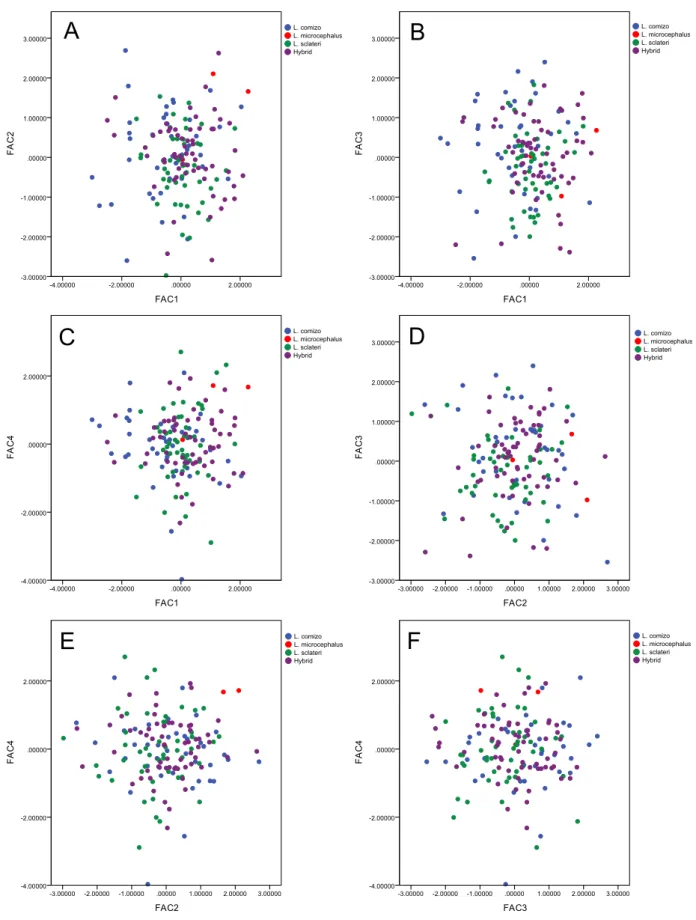
PCA on morphological analyses. The Principal Component Analysis (PCA) performed using the twelve variables for 152 individuals retained four components, all presenting eigenvalues higher than 1. These four new variables created explained 83.3% of the variance. The visual inspection of the scatterplots relating these variables shows no clear separation between genetic entities (Fig. 4). A discriminant analysis using two groups—L. sclateri and L. comizo—using the same variables selected above yielded highly significant results (Wilks’ Lambda = 0.600,
X2
(12) = 40.931, P < 0.001).83% of the individuals were correctly assigned to their species (85% of the L. sclateri and 80% of the L. comizo were correctly classified). The same
discriminant function applied to the hybrid individuals (n = 67) showed that they were mainly classified as L. sclateri (71.6%), while the remaining 28.4% were classified as
L. comizo. DISCUSSION
Species identification in the field, in particular concerning freshwater fish species with subtle morphological diagnostic features, may impose considerable difficulties even to experienced observers. The problem is aggravated when multiple intrageneric species are sympatric in the same river basin and, furthermore, when these species produce fertile hybrids which may backcross and generate a gradient of intermediate phenotypes. This seems to be the case of
Table 9 Relations between in loco identifications and mito-nuclear genotypes of Luciobarbus sampled
in the Guadiana River sub-basins
In loco identification Mito-nuclear genotype Misidentification[%]
L. comizo L. microcephalus L. sclateri Hybrids
L. comizo 26 0 5 11 38 L. microcephalus 1 8 17 19 82 L. sclateri 6 9 24 35 67.6 L. steindachneri 2 4 13 14 100 Total 35 21 59 79 Table 7 Loci of the analysed beta-actin gene fragment which are considered to be species-specific tags in the studied
Luciobarbus fishes from Iberian rivers;nucleotides or ambiguity codes are indicated for each loci
Species Loci with species-specific tags
54 60 117 126 245 279
L. comizo R C R Y R S
L. microcephalus A Y R T G K/D
L. sclateri R C G Y R S/B
Table 8 Identification of Luciobarbus sampled in the Guadiana River sub-basins based on phenotypic traits, mtDNA, nDNA, and the combination of mitochondrial
and nuclear sequencing
Species Phenotypic mtDNA nDNA
Mito-nuclear n [%] n [%] n [%] n [%] L. comizo 42 21.7 75 38.7 41 21.1 35 18.0 L. microcephalus 45 23.2 33 17.0 17 8.8 21 10.8 L. sclateri 74 38.1 86 44.3 78 40.2 59 30.4 L. steindachneri 33 17.0 0 0 0 Hybrids 0 0 58 29.9 79 40.7 Total 194 194 194 194
FAC1 2.00000 .00000 -2.00000 -4.00000 FA C2 3.00000 2.00000 1.00000 .00000 -1.00000 -2.00000 -3.00000 Hybrid L. sclateri L. microcephalus L. comizo ID_genetica
A
FAC1 2.00000 .00000 -2.00000 -4.00000 FA C3 3.00000 2.00000 1.00000 .00000 -1.00000 -2.00000 -3.00000 Hybrid L. sclateri L. microcephalus L. comizo ID_geneticaB
FAC1 2.00000 .00000 -2.00000 -4.00000 FA C4 2.00000 .00000 -2.00000 -4.00000 Hybrid L. sclateri L. microcephalus L. comizo ID_geneticaC
FAC2 0 0 0 0 0 . 2 3.00000 0 0 0 0 0 . 1.00000 0 0 0 0 0 . 2 - -1.00000 -3.00000 FA C3 3.00000 2.00000 1.00000 .00000 -1.00000 -2.00000 -3.00000 Hybrid L. sclateri L. microcephalus L. comizo ID_geneticaD
FAC2 0 0 0 0 0 . 2 3.00000 0 0 0 0 0 . 1.00000 0 0 0 0 0 . 2 - -1.00000 -3.00000 FA C4 2.00000 .00000 -2.00000 -4.00000 Hybrid L. sclateri L. microcephalus L. comizo ID_geneticaE
FAC3 0 0 0 0 0 . 2 3.00000 0 0 0 0 0 . 1.00000 0 0 0 0 0 . 2 - -1.00000 -3.00000 FA C4 2.00000 .00000 -2.00000 -4.00000 Hybrid L. sclateri L. microcephalus L. comizo ID_geneticaF
Fig. 4. Scatterplots of the principal component analyses of morphometric variables of Guadiana barbels (species
assigned by mito-nuclear analysis): (A) variables FAC1 and FAC2, (B) variables FAC1 and FAC3, (C) variables
FAC1 and FAC4, (D) variables FAC2 and FAC3, (E) variables FAC2 and FAC4, (F) variables FAC3 and FAC4; Note:
the Luciobarbus species occurring in the Guadiana basin, considered to configure an extremely interesting model of speciation-with-gene-flow due to weak constraints to hybridization in breeding grounds (Gante et al. 2015). In practical terms, however, this scenario results in the possibility of incorrect species identifications in the field and, consequently, calls into question all the surveys and published data made without molecular validation of the studied individuals. Indeed, our results clearly demonstrate that the in loco species identification based on phenotypic characters, which has been used for the last 30 years, is not reliable to distinguish Luciobarbus species in the lower Guadiana River and, consequently, their relative abundances were overestimated and hybrids, which represented approximately 41% of the individuals sequenced, were not detected nor considered. Simple morphological analyses using traditional morphometric measures, which could be an alternative to in loco phenotypic identification, are also not reliable since, according to our results, no clear separation between the genetic entities was found in the Guadiana River. More elaborate analyses or the use of geometric morphometrics might improve discrimination and clarify their eventual morphological distinctiveness, however, even if that was the case, the presence of a high percentage of hybrids justifies the use of molecular tools in all the studies conducted with Luciobarbus from the Guadiana River.
The implications of misidentifications might, in some cases, raise high levels of concern since important previously published data on the ecology and biology of the species (e.g., distribution areas, reproductive seasons, local abundance estimates, spawning behaviour, feeding ecology, or growth rates) may be questionable, as well as the conservation statuses assigned. Additionally, the establishment of conservation and management measures is usually made using data on population declines and fragmentation of populations, which may both be compromised by erroneous species identification in the field.
Along with species misidentification, our study also highlights the need to clarify the taxonomy of L. steindachneri since there is no evidence of a significant genetic divergence from the remaining Luciobarbus species that could support its specific status (Gante et al. 2009, 2015, presently reported study). Indeed, our results show that the individuals identified
in loco as L. steindachneri were instead interspecific hybrids
(with mtDNA of one of the other three Luciobarbus species, indicating that mothers of all the species are involved in hybrid crosses) or showed pure genotypes (mostly of
L. sclateri). The validity of this species, described almost 50
years ago based on morphological and meristic data (Almaça 1967), has been questioned (Doadrio 1988, Doadrio et al. 2002). Recently, in line with our findings, Gante et al. (2015) referred to this species as being the local product, in the Guadiana River, of the introgressive hybridization between
L. comizo and L. microcephalus or L. sclateri. These authors
suggest that L. steindachneri is an ecotype of hybrid origin, with intermediate molecular, morphological, trophic, and ecological characteristics. However, in our view, the maintenance of hybrids as an independent taxonomical
entity with a conservation status is questionable and may result in more disadvantages than advantages, so we suggest that L. steindachneri species name should be considered no longer valid. Also regarding taxonomy, the detection of an individual with L. microcephalus mtDNA and a mixture of nuclear species-specific tags of L. comizo and L. bocagei is worth further investigation. The presence of L. bocagei genes outside of the species distribution area may be due to a human introduction. Another hypothesis which cannot be discarded yet is that the specific-tags of L. bocagei at the beta-actin level may be identical to the ones of Luciobarbus
guiraonis, a species endemic to the Mediterranean slope of
the Iberian Peninsula but which also occurs in some rivers of the upper Guadiana River basin (Doadrio et al. 2011).
Concerning the presence of intrageneric hybrids, previous studies had already reported their occurrence among barbels from Guadiana based on the detection of intermediate phenotypes (Gante et al. 2015). However, our study ads an extra worrisome result by showing that even individuals undoubtedly assigned to a certain species were indeed hybrids when genotyped (cryptic hybrids).
The existence of phenotypically unidentifiable hybrids could also explain the failure to clearly discriminate all the Luciobarbus species occurring in the Guadiana using morphological indices, despite the obtained significant discrimination between L. sclateri and L. comizo. These results corroborate the view highlighted by Gante et al. (2015) that the genomes of Iberian sympatric barbels remain porous and allow for gene exchange, despite being sufficiently divergent species. Indeed, previous phylogenies based on two mitochondrial genes calibrated using fossil evidence, showed that the lineage which originated L. microcephalus diverged around 7 Mya, and the lineage which originated the other three species was split around 4 Mya, given rise to L. sclateri on one hand, and to L. bocagei and L. comizo on the other hand (these two species were differentiated from each other more recently, around 1.9 Mya) (Gante et al. 2011).
Our study also revealed the occurrence of mito-nuclear discordance in a considerable number of individuals (around 34% of the total number of individuals sequenced) suggesting the presence of, at least, second-generation hybrids. The presence of cryptic hybrids and mito-nuclear discordances were already reported for a wide variety of animals (Toews and Brelsford 2012), including freshwater fish (Gante et al. 2009, Choleva et al. 2014, Sousa-Santos et al. 2014, Geiger et al. 2016). Mito-nuclear discordance, in particular, likely stem from the loss of a species-specific signal due to lineage sorting and/or non-assortative mating, as already proposed for other cyprinids (Freyhof et al. 2005, Broughton et al. 2011, Sousa-Santos et al. 2014).
Although females of all species of sympatric
Luciobarbus (L. comizo, L. sclateri, and L. microcephalus)
were involved in interspecific crosses, the prevalence of L. comizo-mtDNA in cryptic hybrids points to an eventual sexually biased direction of hybridization, as already suggested for hybrids between sympatric species of European Barbus (see Lajbner et al. 2009, Meraner et al. 2013, Buonerba et al. 2015). Indeed, as these
authors suggest, females for the largest species (in our case, L. comizo) are more likely to attract smaller males from other species than vice versa, resulting in a higher percentage of interspecific hybrids carrying the mtDNA of the largest species that would be expected if mating was random. The local relative abundances of sympatric
Luciobarbus species might also explain the detected
differential contributions of females for interspecific crosses: females of the less common species will most likely produce hybrid progeny since finding a mate among conspecifics will be less probable than mating with congeners or with hybrids. Thus, as discussed by Wirtz (1999) and Rosenthal (2013), the absence of behavioural barriers to interspecific mating may promote hybridization and, furthermore, mate preferences and the scarcity of conspecific mates results in unidirectional hybridization processes. Massive mtDNA unidirectional introgressions attributed to demographical and/or behavioural reasons were already reported for a wide variety of taxa (Wirtz 1999, Ritz et al. 2008, Nevado et al. 2009, Sequeira et al. 2011). Future studies should be designed to allow the establishment of correlations between the type of mtDNA found in hybrid barbels from the Guadiana River and the local relative abundances of each parental species. Alongside distinct mtDNAs, cryptic hybrids also showed distinct frequencies according to the sub-basin considered, with a tendency to be more frequent in the ones with more dams (Ardila, Chança, and Caia). On the other hand, the higher percentages of concordance between in loco species identifications and mito-nuclear pure genotypes were detected in well preserved and dam free sub-basins (Vascão and Cobres). Thus, we suggest that hybridization may have been potentiated by the loss of river connectivity, which compromises the upstream migration of these potamodromous species and prevents the use of preferred spawning grounds, and by the lower availability of adequate habitats in more artificialized river systems. Positive correlations between damming and the occurrence of hybrids were already reported (Hasselman et al. 2014). This will undoubtedly lead to genetic homogenization, culminating in a loss of biodiversity.
The proven inadequate phenotypic diagnostic characters, the occurrence of cryptic hybrids in such an expressive percentage and the suggestion to fail to consider L. steindachneri as an independent taxonomical entity (and instead consider these individuals as interspecific hybrids) highlight the need to a careful review of the previously published data on biological and ecological features of Luciobarbus species. Furthermore, on-going conservation measures for threatened barbel populations should be reviewed in view of this hybrid puzzle scenario.
Several cases of hybridization between barbels were also reported elsewhere in Europe, based on the occurrence of morphologically intermediate hybrids and, less frequently, on inconsistencies between phenotypes and mitochondrial genotypes (reviewed by Geiger et al. 2016). Thus, the herein proposed use of a combination of
mitochondrial and nuclear markers as a reliable method to non-erroneously identify barbels in the Guadiana River should become widely used in those river systems where different intrageneric sympatric species with soft mechanisms of reproductive isolation that might potentially interbreed. Reliable taxonomical assignments are crucial for species preservation since successful conservation plans need to consider the genetic integrity of their conservation units. We thus suggest that mito-nuclear sequencing becomes a standard practice to correctly identify fish where sympatric hybridizing species occur. ACKNOWLEDGMENTS
We thank G. Lemos, C. Carrapato, and C. Cardoso for their help during sampling. Permits for field work were given by the National Institute for the Conservation of Nature and Forests (ICNF), Portugal. This study was financed by the European Fund for Economic and Regional Development (FEDER) through the Program Operational Factors of Competitiveness (COMPETE) and National Funds through the FCT - Portuguese Foundation of Science and Technology, under the PluriannualProgram UI&D 331/94; the strategic project UID/MAR/04292/2013 granted to MARE and UID/AGR/00239/2013 granted to CEF-ISA; the project PTDC/AAC-CLI/103110/2008; the projects PTDC/ AAC-CLI/103110/2008 and Pest-OE/AGR/UI0239/2014; and the grants awarded to C. Sousa-Santos (SFRH/ BPD/29774/2006 and MARE-ISPA/BPD/001/2015), C. Lima (MARE-ISPA/BI/004/2015), and P. Branco (SFRH/ BPD/94686/2013). José Maria Santos was funded by a post-doctoral grant (MARS/BI/2/2014) from the MARS project (http://www.mars-project.eu/) and is presently recipient of a FCT researcher contract (IF/00020/2015).
REFERENCES
Aboim M.A., Mavárez J., Bernatchez L., Coelho M.M. 2010. Introgressive hybridization between two Iberian endemic cyprinid fish: A comparison between two independent hybrid zones. Journal of Evolutionary Biology 23 (4): 817–828. DOI: 10.1111/j.1420-9101.2010.01953.x
Almaça C. 1967. Estudo das populações portuguesas do gén. Barbus Cuvier, 1817 (Pisces, Cyprinidae). [Study of the Portuguese populations of the genus
Barbus Cuvier, 1817 (Pisces, Cyprinidae).] Revista da
Faculdade de Ciências de Lisboa 2ª série, C 14 (2): 151–400. [In Portuguese.]
Almaça C. 1972. Sur la systématique des barbeaux (genre et sous-genre Barbus) de la Penínsule Ibérique et de l’Afrique du Nord. Arquivos do Museu Bocage 2ª série 3 (10): 319–346.
Almaça C., Bănărescu P.M. 2003. Barbus comizo Steindachner, 1865. Pp. 173–180. In: Bănărescu P.M., Bogutskaya N.G. (eds.) The freshwater fishes of Europe. Aula-Verlag, Wiesbaden, Germany.
Almodóvar A., Nicola G.G., Elvira B. 2008. Natural hybridization of Barbus bocagei × Barbus comizo (Cyprinidae) in Tagus River basin, central Spain. Cybium 32 (2): 99–102.