Genotypic Analysis of HIV-2 Infected Patients Failing a
Raltegravir-Containing Regimen
Joana Cavaco-Silva1*, Ana Abecasis2, Ana Cla´udia Miranda3, Jose´ Poc¸as4, Jorge Narciso5, Maria Joa˜o A´ guas6, Fernando Maltez7, Isabel Almeida8, Isabel Germano9, Anto´nio Diniz10, Maria de
Fa´tima Gonc¸alves11, Perpe´tua Gomes11,12,13, Celso Cunha1, Ricardo Jorge Camacho12,14, on behalf of the Portuguese HIV-2 Resistance Study Group
1 Centro de Mala´ria e Outras Doenc¸as Tropicais, Unidade de Microbiologia Me´dica, Instituto de Higiene e Medicina Tropical, Universidade Nova de Lisboa, Lisboa,
Portugal,2 Centro de Mala´ria e Outras Doenc¸as Tropicais, Unidade de Sau´de Pu´blica Internacional e Bioestatı´stica, Instituto de Higiene e Medicina Tropical, Universidade
Nova de Lisboa, Lisboa, Portugal,3 Servic¸o de Doenc¸as Infecciosas, Centro Hospitalar de Lisboa Ocidental, Lisboa, Portugal, 4 Hospital de Sa˜o Bernardo, Centro Hospitalar
de Setu´bal, Setu´bal, Portugal,5 Hospital dos SAMS, Lisboa, Portugal, 6 Hospital Garcia de Orta, Almada, Portugal, 7 Hospital Curry Cabral, Centro Hospitalar de Lisboa
Central, Lisboa, Portugal,8 Hospital de Santo Anto´nio, Centro Hospitalar do Porto, Porto, Portugal, 9 Hospital de Sa˜o Jose´, Centro Hospitalar de Lisboa Central, Lisboa,
Portugal,10 Hospital Pulido Valente, Centro Hospitalar de Lisboa Norte, Lisboa, Portugal, 11 Laborato´rio de Microbiologia Clı´nica e Biologia Molecular, Servic¸o de
Patologia Clı´nica (SPC), Centro Hospitalar de Lisboa Ocidental, Lisboa, Portugal,12 Centro de Mala´ria e Outras Doenc¸as Tropicais, Instituto de Higiene e Medicina Tropical,
Universidade Nova de Lisboa, Lisboa, Portugal,13 Centro de Investigac¸a˜o Interdisciplinar Egas Moniz (CiiEM), Instituto Superior de Cieˆncias da Sau´de Sul, Caparica,
Portugal,14 Rega Institute for Medical Research, Katholieke Universiteit Leuven (KU Leuven), Leuven, Belgium
Abstract
To characterize the HIV-2 integrase gene polymorphisms and the pathways to resistance of HIV-2 patients failing a raltegravir-containing regimen, we studied 63 integrase strand transfer inhibitors (INSTI)-naı¨ve patients, and 10 heavily pretreated patients exhibiting virological failure while receiving a salvage raltegravir-containing regimen. All patients were infected by HIV-2 group A. 61.4% of the integrase residues were conserved, including the catalytic motif residues. No INSTI-major resistance mutations were detected in the virus population from naı¨ve patients, but two amino acids that are secondary resistance mutations to INSTIs in HIV-1 were observed. The 10 raltegravir-experienced patients exhibited resistance mutations via three main genetic pathways: N155H, Q148R, and eventually E92Q - T97A. The 155 pathway was preferentially used (7/10 patients). Other mutations associated to raltegravir resistance in HIV-1 were also observed in our HIV-2 population (V151I and D232N), along with several novel mutations previously unreported. Data retrieved from this study should help build a more robust HIV-2-specific algorithm for the genotypic interpretation of raltegravir resistance, and contribute to improve the clinical monitoring of HIV-2-infected patients.
Citation: Cavaco-Silva J, Abecasis A, Miranda AC, Poc¸as J, Narciso J, et al. (2014) HIV-2 Integrase Polymorphisms and Longitudinal Genotypic Analysis of HIV-2 Infected Patients Failing a Raltegravir-Containing Regimen. PLoS ONE 9(3): e92747. doi:10.1371/journal.pone.0092747
Editor: Nicolas Sluis-Cremer, University of Pittsburgh, United States of America Received January 2, 2014; Accepted February 25, 2014; Published March 28, 2014
Copyright: ß 2014 Cavaco-Silva et al. This is an open-access article distributed under the terms of the Creative Commons Attribution License, which permits unrestricted use, distribution, and reproduction in any medium, provided the original author and source are credited.
Funding: This work was funded by a research grant from Merck & Co., Inc., Whitehouse Station, N.J., USA, and by the European Commission’s Seventh Framework Programme (FP7/2007–2013) under the project ‘‘Collaborative HIV and Anti-HIV Drug Resistance Network’’ (CHAIN, grant 223131). J.C.-S. was supported by Fundac¸a˜o para a Cieˆncia e Tecnologia (FCT) with a PhD grant no. SFRH/BD/61141/2009. The funders had no role in study design, data collection and analysis, decision to publish, or preparation of the manuscript.
Competing Interests: The authors have read the journal’s policy and have the following conflicts: This study was funded by an unrestricted research grant provided by Merck Sharp & Dohme Corp., a subsidiary of Merck & Co., Inc., Whitehouse Station, NJ, USA. Data collected and views expressed in this article are the independent responsibility of the authors, with no conflict of interest to declare with the sponsor company nor with related marketed or in development products. Ricardo Camacho has previously received honoraria from MSD, a subsidiary of Merck & Co., Inc., as a consultant. This does not alter the authors’ adherence to PLOS ONE policies on sharing data and materials. The remaining authors of this article do not have any financial or personal relationships with people or organizations that could inappropriately influence this work.
* E-mail: [email protected]
Introduction
The Human Immunodeficiency Virus Type 2 (HIV-2) infects 1–2 million people worldwide, most of which in West Africa, where it is endemic [1]. In Europe, Portugal is the country with the highest frequency of HIV-2 infection, accounting for 543 (3.1%) of all AIDS cases [2]. Despite a slow progression of disease in most infected people, 20–25% of HIV-2 patients progress to AIDS if untreated [3,4].
The therapeutic options for HIV-2 patients are still limited. The virus is naturally resistant to non-nucleoside reverse transcriptase
inhibitors (NNRTIs) [5,6] and to the fusion inhibitor enfuvirtide (T-20) [6–8]. Compared to HIV-1, HIV-2 has reduced sensitivity to some protease inhibitors (PIs) [9,10], a lower genetic barrier towards resistance for most drugs [11–13], along with a faster acquisition of resistance for some of them [12].
The recent pharmacological class of Integrase Strand Transfer Inhibitors (INSTIs) represents a promising therapeutic option for the treatment of HIV-2 infection. Integrase (IN) is a multi-domain protein consisting of the N-terminal domain (NTD, HIV residues 1–49), catalytic core domain (CCD, residues 50–212), and
C-terminal domain (CTD, residues 213–288). The NTD contains a conserved HHCC Zn-coordination motif, and Zn-binding con-tributes to IN multimerization and catalytic function [14,15]. The CCD contains an invariant triad of acidic residues (64, Asp-116, Glu-152 on HIV-1) that forms the enzyme active site [16– 18]. The CCD also contributes to IN multimerization [19] and engages viral [20–22] and chromosomal [23,24] DNAs during integration. The CTD, which is the least conserved of the domains among retroviruses [25], also contributes to specific [26] and non-specific [27–29] DNA interactions, as well as multimerization [30]. Despite a 40% difference in amino acid sequence between HIV-1 and HIV-2 integrases, phenotypic assays carried out with reference strains or clinical isolates have shown that all approved inhibitors [i.e. raltegravir (RAL), elvitegravir (EVG) and dolute-gravir (DTG)] are effective against HIV-2. In vitro studies have shown that the HIV-1 and HIV-2 wild-type integrases have a similar phenotypic susceptibility to INSTIs [31–34], probably due to the 100% conservation of the catalytic triad DDE and the HHCC and RKK motifs between the two viruses [33,35,36,36], and that INSTIs exert a potent inhibitory effect on HIV-2 replication [33,37]. In vivo data has also revealed promising results: raltegravir, the first INSTI to be licensed for clinical use, has been used on some HIV-2 infected patients as part of their salvage regimens with, at least, a good short term response concerning suppression of plasma viral load and CD4 cell recovery [34,38– 40]. However, as for other antiviral drugs, resistance to RAL emerges rapidly both in vitro and in vivo, greatly reducing the susceptibility of the virus to the inhibitor. The specific amino acid changes that are known to confer RAL resistance in HIV-1 have also been shown to develop in RAL-treated HIV-2 patients: N155H, Q148K/R and, to a lesser extent, Y143C [39,41–46]. Overall, three major resistance pathways have been identified and shown to elicit high-level raltegravir and elvitegravir resistance in HIV-2: i) N155H/E92Q, ii) Q148R/G140S, and iii) Y143C/ E92Q or Y143C/T97A [42,47,48]. On the other hand, the N155H-Y143C and N155H-Q148R replacements seem to define mutually exclusive pathways to RAL resistance in HIV-2 [32,42]. RAL and EVG show extensive cross-resistance in HIV-2, as in HIV-1 [43,46,49,50], but DTG retains activity against some RAL and EVG-resistant HIV-1 strains, both in vitro and in vivo [51–53]. Information on its efficiency against HIV-2 strains bearing integrase inhibitor resistance mutations is still limited, but phenotypic assays carried out with HIV-2 clinical isolates from patients treated with RAL showed that mutations T97A/Y143C, G140S/Q148R or G140T/Q148R/N155H conferred moderate resistance to DTG (7–18-fold increase of the EC50) [37]. As in
HIV-1 the association T97A/Y143C does not confer resistance to DTG, extreme caution must be taken when extrapolating HIV-1 knowledge to HIV-2. Corroborating this is the fact that, at this time, it is still unknown whether the combination H51Y/R263K, that confers some level of resistance to DTG in HIV-1 [54,55], could be relevant as a mutational pathway leading to HIV-2 resistance.
Overall, HIV-2 resistance pathways to INSTIs are still poorly characterized. So the aims of this study were i) to investigate the natural polymorphism of the HIV-2 integrase gene, and ii) to further characterize the genotypic resistance profiles of HIV-2 patients failing RAL-containing regimens.
Materials and Methods Study design and sequences
This study assessed 73 HIV-2 group A infected patients followed at different hospitals mainly in the central and southern areas of
Portugal. The HIV-2 group was determined using the Rega Subtyping Tool v2.0. 63 patients were RAL-naı¨ve, and constituted the control group. 23/63 had been previously exposed to antiretroviral (ARV) therapy: 21 had received nucleoside/nucle-otide reverse transcriptase inhibitors (NRTIs) and protease inhibitors (PIs), one had received NRTIs and non-nucleoside reverse transcriptase inhibitors (NNRTIs), and one had received NRTIs, NNRTIs and PIs. The remaining 40/63 patients had never been exposed to antiretroviral drugs at the time the sample was obtained. Ten patients were heavily pretreated and were on a salvage RAL-containing regimen. All the longitudinal genotypic resistance data available for these patients, pre- and during RAL exposure, was considered for analysis, in a total of 20 sequences. For statistical purposes, only one genotype, corresponding to the most recent isolate of each patient, was considered.
Mutations were defined as differences at the amino acid level from the wild-type reference sequence (HIV2_ROD_M15390), including those that were present as part of a nucleotide mixture. Despite not being a primary isolate, HIV-2_ROD can be considered a reference control isolate for this study because its susceptibility to INSTIs has been previously demonstrated [33].
The sequences obtained from RAL-naı¨ve patients were used to uncover natural polymorphisms, and to determine whether the critical amino acid substitutions associated with resistance to INSTIs in HIV-1 are naturally present in HIV-2. An amino acid position was considered polymorphic when at least two different amino acids were found [56]. Amino acids not mutated were defined as conserved. Amino acid variability at a given position was established by calculating the percentage of sequences harboring an amino acid different from the HIV2_ROD_M15390 reference sequence. The most polymorphic positions were considered to be those where more than 30% of sequences in the control group were variable, according to the criterion previously defined by others [56].
Mutations were considered as being selected by therapy if absent from RAL-naı¨ve sequences and present in $1 sequences from RAL-treated individuals. All the amino acid variants occurring at non-polymorphic HIV-2 integrase positions, i.e., occurring only in RAL-treated individuals, were analyzed. We also investigated the occurrence at such positions of major and compensatory drug resistance mutations already associated with in vivo or in vitro resistance to INSTIs in HIV-1 [according to Lataillade M et al. 2007 [35] and to the 2013 Update of the Drug Resistance Mutations in HIV-1 [57]] or in HIV-2 [according to the Algorithm for the Interpretation of Genotypic HIV-2 Resistance Data (http://regaweb.med.kuleuven.be/sites/default/ files/algorithms/Rega_HIV2_Rules_v8.0.2.pdf) [58]].
HIV-2 integrase sequencing
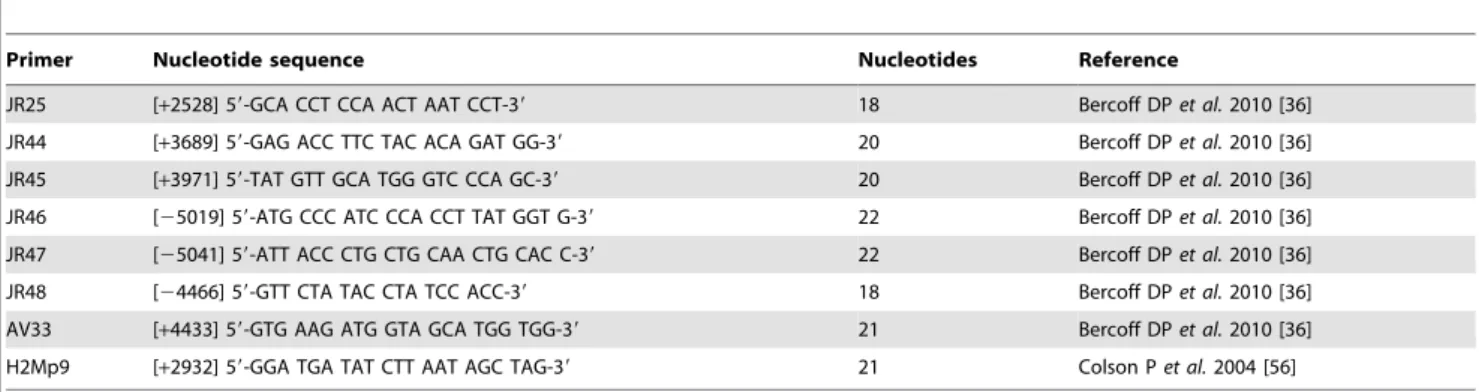
The integrase coding region of the pol gene was amplified and sequenced from plasma samples of the HIV-2 infected patients, in a total of 293 amino acids analyzed. Viral RNA was extracted from 1 ml of plasma according to Biome´rieux’s easyMAG automatic extraction procedure, and used to amplify and sequence the last domain of the pol gene, comprising the integrase. To do so, the protocol described at Bercoff DP et al. [36] was used, but some adjustments were made. 10–15ml of RNA were initially subjected to 5 min at 70uC followed by 5 min on ice to avoid the generation of possible intramolecular base-pairings in single-stranded RNAs. RNA was then retrotranscribed using Super SuperScript III One-Step RT-PCR System with Platinum Taq DNA Polymerase (Invitrogen Life Technologies) in a 50ml mix containing 10mM of each forward primer JR25 and reverse primer JR47 (Table 1). Cycling conditions consisted of reverse transcription at 45uC for 1 h,
denaturation at 94uC for 2 min followed by 40 amplification cycles of 94uC for 30 sec, 53uC for 45 sec and 72uC for 1 min 45 sec, and a final elongation step at 72uC for 3 min. A nested PCR was then performed with 2ml of the previously amplified cDNA, using AmpliTaq Gold DNA Polymerase (Applied Biosystems) with 10mM of each forward primer H2Mp9 and reverse primer JR46 (Table 1). Nested PCR conditions consisted of denaturation at 95uC for 10 min, 40 amplification cycles of 94uC for 30 sec, 50uC for 45 sec and 72uC for 1 min 30 sec, and a final elongation step at 72uC for 10 min. Amplification products were checked on a 2% agarose gel with ethidium bromide and 8mL of GeneRuler DNA Ladder Mix (Fermentas) for reference, and were subsequently purified through the YM-100 Microconcentrators Method ac-cording to the ViroSeq HIV-1 Genotyping System v2.0 Protocol (Abbott). Dilution adjustments of the PCR products were made when necessary. The sequencing reaction was then performed using the Big Dye Terminator v3.1 Cycle Sequencing Kit (Applied Biosystems) and primers H2Mp9, JR44, JR45, AV33 (forward), JR46 and JR48 (reverse) (Table 1). Cycling conditions consisted of 30 amplifica-tion cycles of 10 sec at 96uC, 5 sec at 50uC and 4 min at 60uC. Products were purified and run on an ABI PRISM 3100 Genetic Analyzer (Applied Biosystems). Nucleotide sequences were aligned against the HIV-2 ROD reference strain (GenBank accession # M15390), and edited with SeqScape Software Version 2.5 (Applied Biosystems).
GenBank accession numbers
All the newly determined nucleotide data were deposited in GenBank under the following accession numbers: KF859774 -KF859846, and KF951329-KF951338.
Statistical analysis
For the determination of which mutations are selected in HIV-2 as a response to RAL pressure, sequences of 63 RAL-naı¨ve and 10 RAL-experienced patients were used, and the prevalence of different amino acids at every codon position was estimated. To do so, the different amino acids occurring at each integrase position were weighted according to the following criterion: when the amino acid was different from that of the reference sequence, it was counted; when the amino acid was the same as the reference sequence, it was not. In case of double and triple populations, only the mutant amino acids were taken into account when counting: each was given the same weight so that the sum of all mutant amino acids at each position would be 1. This was computed by alignment of nucleotide sequences and HIV2_ROD strain with Muscle [59], manual edition with JalView version 2 [60], and writing of the scripts with Python Programming Language (http://
www.python.org/) [61]. All integrase positions were compared to the HIV2_ROD_M15390 sequence.
INSTI-naı¨ve patients were further subdivided into a group of ARVnaı¨ve patients and a group of previously ARV (NRTI/PI) -experienced patients, for the purpose of comparing the prevalence of mutated amino acids between both groups. To do so, a x2test (based on a 262 contingency table containing the numbers of isolates from untreated and treated persons, and the number of isolates with and without mutations) was computed in R v.2.15.2, and a p-value,0.05 was considered statistically significant.
Shannon’s entropy at each position of INSTI-naı¨ve sequences, a measure of the amount of information contained at that position, was calculated using the Los Alamos Database sequence Entropy website http://www.hiv.lanl.gov/content/sequence/ENTROPY/ entropy_one.html for group A strains.
Ethics Statement
Due to the fact that this is a retrospective study, and that all the procedures were standard of care – e.g., no extra blood collections were performed for study procedures, all the samples being surplus from collections taken for clinical monitoring – the Ethical Committee of Centro Hospitalar de Lisboa Ocidental did not consider to be necessary to obtain written informed consent from patients.
This study received ethical approval by the Ethical Committee of Centro Hospitalar de Lisboa Ocidental (Reference no. 96/ CES-2013).
Results
In the present study, we assessed a total of 83 HIV-2 integrase sequences, which, to our knowledge, represents the most extensive analysis performed to date of the integrase coding region of HIV-2. All the sequences belong to HIV-2 group A. 63 sequences belong to 63 RAL-naı¨ve patients, and 20 sequences belong to 10 heavily pretreated HIV-2 infected patients with virological failure while receiving a salvage raltegravir-containing regimen (Table 2).
Analysis of HIV-2 integrase gene polymorphisms
We analyzed 63 integrase sequences retrieved from RAL-naı¨ve patients. At the time of integrase genotyping, 40 patients were antiretroviral (ART)-naı¨ve, 22 patients were receiving NRTI+PI-based regimens, and one patient was receiving an NRTI+NNRTI-based regimen, despite the widely recognized inefficacy of NNRTIs on HIV-2. We report IN polymorphisms for this group of patients with respect to the reference sequence ROD (Table 2).
Table 1. HIV-2 integrase primers given with their positions in HIV-2 ROD indicated in parenthesis. (+, sense; 2, antisense).
Primer Nucleotide sequence Nucleotides Reference
JR25 [+2528] 59-GCA CCT CCA ACT AAT CCT-39 18 Bercoff DP et al. 2010 [36]
JR44 [+3689] 59-GAG ACC TTC TAC ACA GAT GG-39 20 Bercoff DP et al. 2010 [36]
JR45 [+3971] 59-TAT GTT GCA TGG GTC CCA GC-39 20 Bercoff DP et al. 2010 [36]
JR46 [25019] 59-ATG CCC ATC CCA CCT TAT GGT G-39 22 Bercoff DP et al. 2010 [36]
JR47 [25041] 59-ATT ACC CTG CTG CAA CTG CAC C-39 22 Bercoff DP et al. 2010 [36]
JR48 [24466] 59-GTT CTA TAC CTA TCC ACC-39 18 Bercoff DP et al. 2010 [36]
AV33 [+4433] 59-GTG AAG ATG GTA GCA TGG TGG-39 21 Bercoff DP et al. 2010 [36]
H2Mp9 [+2932] 59-GGA TGA TAT CTT AAT AGC TAG-39 21 Colson P et al. 2004 [56]
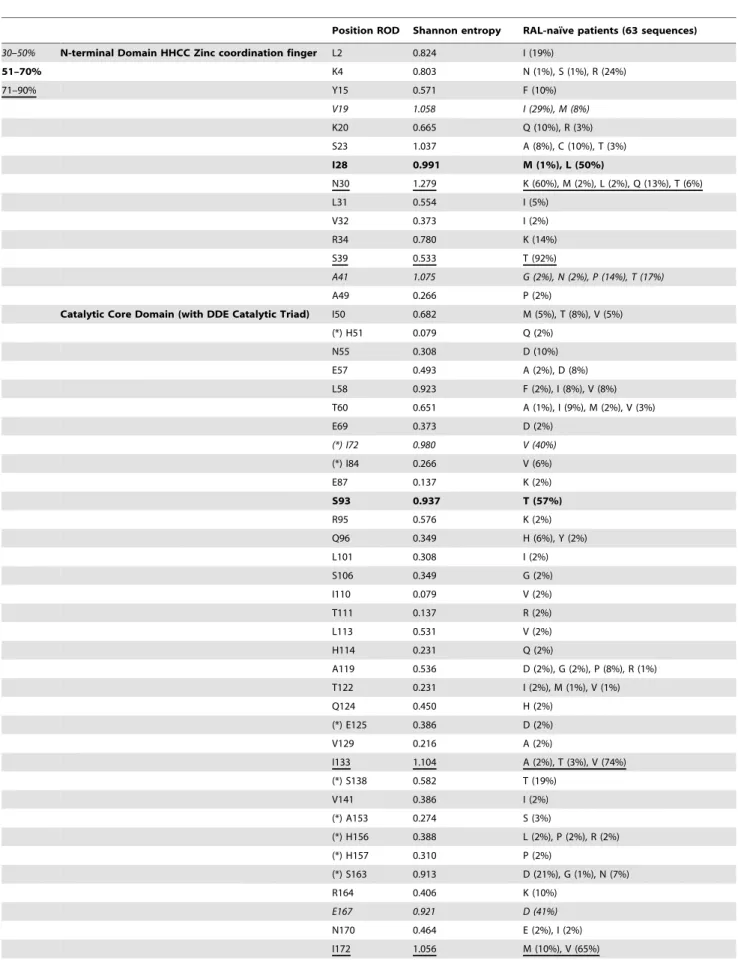
Table 2. HIV-2 group A IN polymorphisms.
Position ROD Shannon entropy RAL-naı¨ve patients (63 sequences)
30–50% N-terminal Domain HHCC Zinc coordination finger L2 0.824 I (19%)
51–70% K4 0.803 N (1%), S (1%), R (24%) 71–90% Y15 0.571 F (10%) V19 1.058 I (29%), M (8%) K20 0.665 Q (10%), R (3%) S23 1.037 A (8%), C (10%), T (3%) I28 0.991 M (1%), L (50%) N30 1.279 K (60%), M (2%), L (2%), Q (13%), T (6%) L31 0.554 I (5%) V32 0.373 I (2%) R34 0.780 K (14%) S39 0.533 T (92%) A41 1.075 G (2%), N (2%), P (14%), T (17%) A49 0.266 P (2%)
Catalytic Core Domain (with DDE Catalytic Triad) I50 0.682 M (5%), T (8%), V (5%)
(*) H51 0.079 Q (2%) N55 0.308 D (10%) E57 0.493 A (2%), D (8%) L58 0.923 F (2%), I (8%), V (8%) T60 0.651 A (1%), I (9%), M (2%), V (3%) E69 0.373 D (2%) (*) I72 0.980 V (40%) (*) I84 0.266 V (6%) E87 0.137 K (2%) S93 0.937 T (57%) R95 0.576 K (2%) Q96 0.349 H (6%), Y (2%) L101 0.308 I (2%) S106 0.349 G (2%) I110 0.079 V (2%) T111 0.137 R (2%) L113 0.531 V (2%) H114 0.231 Q (2%) A119 0.536 D (2%), G (2%), P (8%), R (1%) T122 0.231 I (2%), M (1%), V (1%) Q124 0.450 H (2%) (*) E125 0.386 D (2%) V129 0.216 A (2%) I133 1.104 A (2%), T (3%), V (74%) (*) S138 0.582 T (19%) V141 0.386 I (2%) (*) A153 0.274 S (3%) (*) H156 0.388 L (2%), P (2%), R (2%) (*) H157 0.310 P (2%) (*) S163 0.913 D (21%), G (1%), N (7%) R164 0.406 K (10%) E167 0.921 D (41%) N170 0.464 E (2%), I (2%) I172 1.056 M (10%), V (65%)
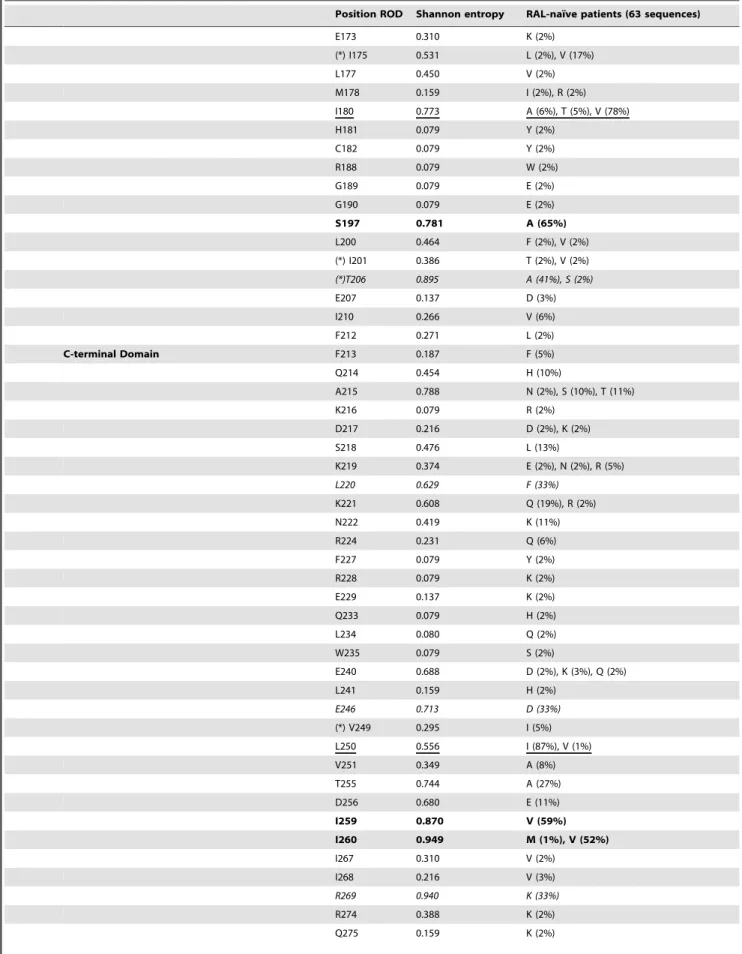
Table 2. Cont.
Position ROD Shannon entropy RAL-naı¨ve patients (63 sequences)
E173 0.310 K (2%) (*) I175 0.531 L (2%), V (17%) L177 0.450 V (2%) M178 0.159 I (2%), R (2%) I180 0.773 A (6%), T (5%), V (78%) H181 0.079 Y (2%) C182 0.079 Y (2%) R188 0.079 W (2%) G189 0.079 E (2%) G190 0.079 E (2%) S197 0.781 A (65%) L200 0.464 F (2%), V (2%) (*) I201 0.386 T (2%), V (2%) (*)T206 0.895 A (41%), S (2%) E207 0.137 D (3%) I210 0.266 V (6%) F212 0.271 L (2%) C-terminal Domain F213 0.187 F (5%) Q214 0.454 H (10%) A215 0.788 N (2%), S (10%), T (11%) K216 0.079 R (2%) D217 0.216 D (2%), K (2%) S218 0.476 L (13%) K219 0.374 E (2%), N (2%), R (5%) L220 0.629 F (33%) K221 0.608 Q (19%), R (2%) N222 0.419 K (11%) R224 0.231 Q (6%) F227 0.079 Y (2%) R228 0.079 K (2%) E229 0.137 K (2%) Q233 0.079 H (2%) L234 0.080 Q (2%) W235 0.079 S (2%) E240 0.688 D (2%), K (3%), Q (2%) L241 0.159 H (2%) E246 0.713 D (33%) (*) V249 0.295 I (5%) L250 0.556 I (87%), V (1%) V251 0.349 A (8%) T255 0.744 A (27%) D256 0.680 E (11%) I259 0.870 V (59%) I260 0.949 M (1%), V (52%) I267 0.310 V (2%) I268 0.216 V (3%) R269 0.940 K (33%) R274 0.388 K (2%) Q275 0.159 K (2%)
From a total of 293 integrase codons analyzed, 61.4% (180/ 293) were non-polymorphic and 38.6% (113/293) were naturally polymorphic. Of the 113 variable positions, 39 (34%) were mutated at least twice (Table 2). The catalytic triad DDE, the zinc coordination motif HHCC, and the RKK motif, at positions 64, 116 and 152 (DDE), 12, 16, 40 and 43 (HHCC), and 231, 258 and 264 (RKK), respectively, were completely conserved in our dataset, and the CTD was the least conserved of the three domains, as foreseeable. The most polymorphic positions were located at 23 HIV-2 group A IN positions: 19, 28, 30, 39, 41, 72, 93, 133, 167, 172, 180, 197, 206, 220, 246, 250, 259, 260, 269, 277, 281, 286 and 292 (Table 2).
Integrase sequences from RAL-naı¨ve patients were further examined to determine whether the critical amino acid substitu-tions associated with in vivo and in vitro INSTIs resistance in HIV-1 [35,57] occur as baseline polymorphisms in HIV-2. None of the primary mutations at positions 66, 92, 143, 147, 148 and 155 responsible for RAL or EVG resistance in HIV-1 were detected in sequences from HIV-2 RAL-naı¨ve patients. However, two secondary mutations corresponding to resistance-associated sub-stitutions in HIV-1 were observed: 206S and 249I. The most common resistance associated residue was 249I, present in 5% of sequences from the control group, while 206S was present in 2% of these sequences. In this group of patients we also detected polymorphisms at 8 additional positions associated with INSTIs resistance in HIV-1: 125D, 138T, 153S, 156L/P/R, 157P, 163D/ G/N, 201T/V and 280S. In these patients, we further observed two amino acid changes that were previously described as secondary mutations in the HIV-2 IN, I84V and S163G/D [44,45], and two polymorphisms at positions previously associated with HIV-2 INSTIs resistance: H51Q, I175L/V [36,44,46].
To evaluate whether specific drug pressure induced by antiviral drugs different from INSTIs, in particular NRTIs, may also select or induce mutations in the HIV-2 IN gene, the different prevalence of IN mutations between the two populations of INSTI-naı¨ve patients (drug naı¨ve and NRTI/PI treated) was investigated. Overall variability within IN was higher in
treatment-naı¨ve (34.5%) than in NRTI/PI-experienced patients (23.9%), and this difference reached statistical significance (x2= 7.43; p = 0.00641). When analyzing each polymorphism individually, we observed that two polymorphisms showed a significant increase in prevalence in HIV-2 NRTI/PI-treated patients compared with ARV naı¨ve patients: V19M (n = 4/23 vs. n = 1/40; p = 0.0353) and L58V (n = 4/23 vs. n = 1/40; p = 0.0353). Interestingly, and unlike the above-mentioned mutations, other two IN polymor-phisms showed a significant decrease in prevalence in isolates from NRTI/PI-treated patients, as compared with drug-naı¨ve patients, thus suggesting a negative association with NRTI/PI treatment: E246D (n = 11/23 vs. n = 31/40; p = 0.0162) and M277L (n = 6/ 23 vs. n = 21/40; p = 0.0412).
Analysis of HIV-2 integrase gene mutations potentially associated with RAL resistance
Ten heavily pretreated HIV-2 infected patients exhibiting incomplete viral suppression or virological rebound while receiv-ing a salvage raltegravir-containreceiv-ing regimen were investigated. Six patients had only one isolate for analysis, and the other four patients had longitudinal genotypic data. In these four patients, RAL was kept despite a detectable viral load, because there were no alternatives to the current regimen. The median time of exposure to RAL was 17 months (range: 8–35 months). When the drug resistance testing was performed, nine patients were receiving different combinations of NRTI+PI, and one patient was receiving only NRTI-based therapy, in addition to RAL. All had previously received several combinations of NRTIs and PIs (Table 3).
RAL resistance associated mutations were identified in the ten patients: one displayed the 148 pathway, seven displayed the 155 pathway, and two displayed none of the major RAL resistance mutations, but instead the E92Q - T97A motif (patients 9 and 10, Table 3). No switch of resistance pathway from the 155 to the 148 or 143 pathways was observed.
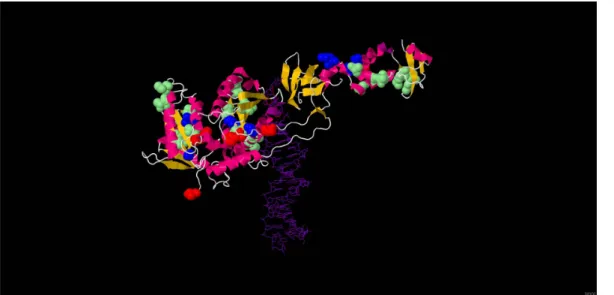
Our analysis identified 19 amino acid substitutions selected in RAL-treated patients at some time point during longitudinal follow-up, and potentially emerging as secondary response to RAL Table 2. Cont.
Position ROD Shannon entropy RAL-naı¨ve patients (63 sequences)
E276 0.344 G (2%) M277 1.090 L (43%), V (6%) D278 0.159 G (2%) S279 0.431 C (2%), N (5%) (*) G280 0.680 S (19%) S281 0.906 P (41%) H282 0.597 N (12%), R (2%) L283 0.630 V (8%) G285 0.431 D (2%), S (5%) A286 0.879 T (30%) D289 0.466 N (8%), T (2%) E291 0.349 G (2%) M292 0.791 V (73%)
Polymorphisms of the HIV-2 group A IN sequences from 63 treatment-naı¨ve patients are reported with respect to the ROD reference sequence. The three different domains of IN are indicated: the N-terminal domain (AA 1–49); the catalytic core domain (AA 50–212) containing the conserved catalytic triad (DDE motif); and the C-terminal domain (AA 213–288). Positions known to confer resistance to INSTIs in HIV-1 or HIV-2 are marked with a star (*). The frequency (percentage) of each of each of the polymorphisms is indicated in brackets. Only positions where variations were detected are reported. Shannon’s entropy at each variable position is indicated; an entropy value of 0 corresponds to an amino acid strictly conserved, and higher entropy values indicate more variability.
Table 3. Antiretroviral regimens, available genotypes and respective integrase mutations of the ten HIV-2-infected patients on a salvage RAL-containing regimen. Patient Therapeutic regimen Genotype Plasma HIV-2 RNA (copies/ml) Exposure time to RAL (months) HIV-2 integrase mutations Major Mutations Minor mutations previously reported in the HIV-2 integrase Minor mutations previously unreported in the HIV-2 integrase (observed in non-polymorphic sites of HIV-2 w ild-type, i.e., present only in RAL-treated patients) (b) 1 d4T + 3TC + IDV/r AZT + TDF + LPV/r ABC + TDF + LPV/r + SQV/r AZT/3TC + TDF + LPV/r + SQV/r TDF/FTC + DRV/r + RAL 1 2692 5 Q148R (a) __ 2 AZT/3TC + TDF TDF/FTC + SQV/r TDF/FTC + RAL 1 12989 14 N155H (a) I84V, E 92A, A153G Q44H 3 AZT/3TC + IDV/r AZT/3TC + NFV/r AZT/3TC + IDV/r AZT/3TC + NFV/r AZT/3TC + IDV/r AZT/3TC + LPV/r AZT + TDF + ATV/r 3TC + DRV/r + RAL 1 9896 8 N155H (a) I84V, A 153G _ 4 AZT ddI d4T + 3TC + SQV/r ABC + TDF + LPV/r ddI + DRV/r + RAL 1 88756 17 N155H (a) E92Q (a), T 97A (a) , S 163D Q44H, Q45H, K71R, K127R 5 AZT/3TC AZT/3TC + IDV/r ddI + NFV/r TDF + ABC + LPV/r TDF/FTC + DRV/r + RAL 1 8313 1 4 N 155H (a) I84V, E 92A, A153G D 232N (a) , K236T 6 AZT/3TC + IDV/r ABC + ddI + NFV/r d4T + 3TC + TDF + LPV/r + APV/r d4T + 3TC + TDF + LPV/r + SQV/r d4T + 3TC + TDF + ATV/r + SQV/r TDF/FTC + AZT + DRV/r + RAL 1 151 5 N 155H (a) I84V, E 92Q (a) _
Table 3. Cont. Patient Therapeutic regimen Genotype Plasma HIV-2 RNA (copies/ml) Exposure time to RAL (months) HIV-2 integrase mutations Major Mutations Minor mutations previously reported in the HIV-2 integrase Minor mutations previously unreported in the HIV-2 integrase (observed in non-polymorphic sites of HIV-2 w ild-type, i.e., present only in RAL-treated patients) (b) 2 1107 1 5 N 155H (a) I84V, E 92Q (a) _ 3 576 22 N155H (a) I84V, E 92Q (a), H157N/S/R K 46R TDF/FTC + d4T + DRV/r + RAL 4 1074 3 0 I84V, E92Q (a), H157S K 46R 7 AZT/3TC + IDV/r d4T + ddI + IDV/r AZT/3TC + LPV/r AZT + 3TC + TPV/r TDF + DRV/r + RAL 1 26898 12 N155H (a) _ L 242P 2 13809 14 N155H (a) Q91R K46R, D232N (a) 3 22692 23 N155H/N (a) E92E/Q (a) K46R 4 16035 35 _ E 92Q (a), T 97A (a) , N160K K46R 8 AZT ddI d4T + 3TC + RTV d4T + 3TC + IDV/r d4T + 3TC + LPV/r TDF/FTC + SQV/r + LPV/r ABC + TDF + TPV/r + RAL 1 10079 3 _ _ _ 2 5844 1 0 N 155H (a) E92G _ 3 3732 2 1 N 155H (a) E92G, N160K K 46R, V151I (a) 4 6715 2 2 N 155H (a) E92G, N160K K 46R 9 AZT/3TC d4T + ddI + IDV/r d4T + ddI + NFV/r d4T + ddI + LPV/r TDF + ABC + fAPV/r TDF/FTC + ABC + ATV/r + SQV/r TDF/FTC + DRV/r + RAL 1 N D 1 2 E 92Q (a), T 97A (a) E85K 10 AZT/3TC AZT/3TC + IDV/r ddI + NFV/r TDF + ABC + LPV/r
pressure (Table 3, Figure 1). Fifteen amino acid substitutions occurred at non-polymorphic positions of HIV-2 wild-type: Q44H (n = 2 patients), Q45H (n = 1), K46R (n = 3), K71R (n = 1), E85K (n = 1), Q91R (n = 1), E92A/G/Q (n = 8), T97A (n = 4), K127R (n = 1), Q148R (n = 1), V151I (n = 1), N155H (n = 7), N160K (n = 2), D232N (n = 1) and K236T (n = 1). Four amino acid substitutions occurred at naturally polymorphic HIV-2 positions, but were considered in our analysis because they were previously reported as resistance associated mutations in integrase sequences from RAL-treated HIV-2 patients: I84V (n = 4), A153G (n = 3), H157N/S/R (n = 1) and S163D (n = 1). Substitutions E92A/G/ Q, T97A, Q148R, A153G and N155H have been previously associated with some level of resistance to RAL on HIV-2. Substitutions E92Q, T97A, Q148R, V151I, N155H and D232N have been previously associated with INSTIs resistance in HIV-1. The ‘148 pathway’ was observed in the virus from one patient through the presence of Q148R (patient 1,Table 3). No accessory mutations were detected. Mutation Q148H, the most frequently observed in HIV-1 at this position, was not present in our dataset. The HIV-1 signature mutation N155H was observed in viruses from seven patients. Four of these patients had only one genotype available for analysis, and three patients had longitudinal genotypic data while still under RAL. Of the four patients with only one post-RAL genotype, two shared the same pattern of accessory mutations, I84V - E92A - A153G (patients 2 and 5, Table 3); one displayed only two of these mutations, I84V -A153G (patient 3,Table 3), probably due to the short exposure time to RAL; and the other displayed E92Q - T97A - S163D (patient 4,Table 3). Besides these accessory mutations previously described in HIV-2, viruses from these four patients also displayed amino acid substitutions in six HIV-2 non-polymorphic sites: Q44H (n = 2), Q45H (n = 1), K71R (n = 1), K127R (n = 1), D232N (n = 1) and K236T (n = 1), all previously unreported in HIV-2. The three patients with longitudinal genotypic data (patients 6, 7 and 8, Table 3) allowed us to investigate the evolution of HIV-2 integrase genotypic resistance profiles under continued RAL selective pressure. They all harbored the N155H mutation in association with E92Q in two cases (patients 6 and 7, Table 3), and with E92G in one other case (patient 8, Table 3). Viruses from these patients also selected the I84V substitution in one case (patient 6,Table 3), N160K in two cases (patients 7 and 8,Table 3), H157N/S/R in one case (patient 6, Table 3), and T97A in viruses from one of the patients who selected E92Q (patient 7,Table 3). In this last patient, we could see the initial selection of Q91R, its replacement by E92Q three months later, followed by the selection of T97A - N160K along with E92Q and the concurrent selection against mutation at position N155. Four substitutions at non-polymorphic HIV-2 positions were also observed in these patients’ genotypes at some point during RAL selective pressure: K46R (n = 3), V151I (n = 1), L242P (n = 1) and D232N (n = 1). From all the substitutions here reported for the first time, and whose impact on RAL resistance is still unknown, K46R was clearly selected and maintained over time in these patients’ viruses. The remaining substitutions were observed as single episodes in patients without longitudinal genotypic data, or were deselected over time in patients with longitudinal data (Table 3). Collectively, our data revealed three distinct patterns of mutations eliciting resistance to raltegravir in HIV-2: Q148R in one patient, E92Q - T97A in two patients, and N155H - E92A/ G/Q in six patients. The last patient (whose viruses selected N155H - I84V - A153G) was genotyped early in RAL failure, and we cannot exclude that that pattern of mutations will evolve to one of the previously referred patterns as the exposure time to RAL increases. Table 3. Cont. Patient Therapeutic regimen Genotype Plasma HIV-2 RNA (copies/ml) Exposure time to RAL (months) HIV-2 integrase mutations Major Mutations Minor mutations previously reported in the HIV-2 integrase Minor mutations previously unreported in the HIV-2 integrase (observed in non-polymorphic sites of HIV-2 w ild-type, i.e., present only in RAL-treated patients) (b) TDF/FTC + DRV/r + RAL 1 5012 2 1 _ _ 2 37119 32 E92Q (a), T 97A (a) _ (a) Mutations associated with INIs resistance in HIV-1. (b) Mutations of unknown impact on RAL resistance. d4T, stavudine; 3 TC, lamivudine; AZT, zidovudine; T DF, tenofovir; ABC, abacavir; FTC, emtricitabine; ddI, d idanosine; IDV/r, indinavir boosted w ith ritonavir; LPV/r, lopinavir boosted with ritonavir; DRV/r, darunavir boosted w ith ritonavir; SQV/r, saquinavir boosted w ith ritonavir; NFV/r, nelfinavir boosted with ritonavir; ATV/r, atazanavir boosted with ritonavir; APV/r, amprenavir boosted with ritonavir; TPV/r, tipranavir boosted with ritonavir; RTV, ritonavir; FPV/r, fosamprenavir boosted w ith ritonavir; RAL, raltegravir; ND, not done. doi:10.1371/journal.pone. 0092747.t003
Discussion
Studies assessing the development of resistance to raltegravir in HIV-2 infection are relatively scarce and limited in sample size. This is the first study to investigate the integrase genomic region of HIV-2 using a comprehensive number of HIV-2 clinical samples: 83 integrase sequences from 73 HIV-2 infected patients.
HIV-2 integrase gene polymorphism
The overall rate of amino acid variation was 38.6% relatively to the HIV-2 ROD reference strain, which is a value slightly higher than the one reported by other, smaller scale, studies, where values around 27% [31], 33.1% [36], and 38% [33] have been described. This is probably related to the largest size of our sample. This variability is similar to the one reported for the HIV-1 integrase, where 37.5% [62] and 38.2% [63] of sequence variability has been observed for IN residues. The catalytic motif residues were completely conserved in our dataset, in line with what was expected in face of their essential nature for IN function [64–66]. The low variability tolerated at such positions agrees with what other authors have previously described [31,33,36] and confirms the crucial role of these amino acids in IN efficacy and viral replication.
In our RAL-naı¨ve data we found no evidence of the primary mutations responsible for raltegravir or elvitegravir resistance in HIV-1 or HIV-2. However, two amino acid substitutions at positions implicated in HIV-1 secondary resistance to raltegravir or elvitegravir were naturally present in the sequences from these patients. Amino acid 249I had already been observed in the HIV-2 integrase by previous authors [33,36,67], but HIV-206S is here reported for the first time. Furthermore, at 8 HIV-1 resistance associated positions we observed atypical amino acid substitutions (125D, 138T, 153S, 156L/P/R, 157P, 163D/G/N, 201T/V and 280S), some of which had been previously referred by others [31]. However, their full impact on HIV-2 resistance remains to be elucidated.
In our sequences from INSTI-naı¨ve patients, we observed that some polymorphisms changed their prevalence according to prior ARV (NRTI/PI) exposure: V19M and L58V significantly increased their frequency in NRTI/PI-treated patients, while E246D and M277L significantly decreased their frequency in this group. Indeed, IN and RT are thought to interact [66]. In HIV-1, recent studies have shown that some IN polymorphisms change their prevalence according to prior NRTI exposure [63], and that there are some associations between IN mutations and RT resistance mutations in ARV-failing patients [68,69]. This supports the hypothesis of a tight physical interaction between the viral IN and RT, and/or a potential co-evolution of some of their mutations [70].
The mechanisms of this observed difference in the prevalence of some IN polymorphisms between drug-naı¨ve and ARV-treated patient populations, as well as the associations between specific IN and RT mutations, needs further investigation. Since the coding regions for PR, RT and IN are located in the same gene, and the three enzymes before maturation are folded together in a unique polyprotein precursor, it is conceivable that several structural interactions (also among the three different proteins) may occur at this level [63]. Furthermore, the end-product of the RT-catalysed reaction is the substrate for IN. It is also conceivable that IN mutations can appear under specific drug pressure induced by antiviral agents such as NRTIs, in order to rescue the correct binding between the RT and IN enzymes, impaired by emergence of drug resistance mutations. In addition, it is possible that IN
polymorphisms are co-selected with RT resistance mutations for viral fitness compensatory rescue, or vice versa.
HIV-2 integrase gene mutations potentially associated with RAL resistance
In the present study, of the HIV-1 RAL signature mutations already described in HIV-2, only N155H and Q148R were observed. Treatment failure of HIV-2 RAL regimens seems to be associated with the emergence of resistance mutations via two main resistance pathways, stemming from N155H and Q148R. In the two patients who did not select any of these, we only observed E92Q - T97A mutations. Since in one case we observed a de-selection of the N155H mutation under therapy in a compliant patient, we can speculate that this might be a late stage evolution of the N155H pathway. In our dataset, this pathway seems to be the preferential towards the development of RAL resistance in HIV-2 group A viruses, since N155H was the predominant mutation selected in these patients, clearly outnumbering Q148R which was observed only in one patient. This disagrees with what others have reported about the N155H pathway being observed only in patients infected with HIV-2 group B viruses [41].
In addition to these two major (Q148R and N155H) and two minor (E92Q and T97A) RAL resistance mutations, other minor mutations also associated with RAL resistance in HIV-1 were observed in HIV-2 patients failing RAL-containing regimens (V151I and D232N), along with several novel mutations previously unreported in HIV-1 or HIV-2.
In line with previous reports, the A153G substitution was always detected in the same genotype as N155H, indicating a preferential association with the 155 mutational pathway, and suggesting that this double mutation may confer higher levels of resistance to RAL than the N155H single mutant [44–46]. The Q91R substitution was detected in a N155H carrying genotype. To our knowledge, this is the first time that Q91R is associated with the 155 pathway in HIV-2. To date, this mutation has rarely been reported, and, when so, it was either associated with the 143 pathway, together with T97A [46], or associated with the recently described mutation I175M and conferring high levels of resistance to RAL in vitro [36]. Further studies are necessary to elucidate the individual impact of Q91R on HIV-2 resistance to RAL, and on the replicative capacity of the virus.
Several atypical amino acid substitutions were selected in the patients failing RAL. The majority was observed as single episodes in patients without longitudinal genotypic data, or deselected over time in patients with longitudinal follow-up. Mutation K46R, however, was selected in patients with longitudinal data and persisted, being apparently fixated in the virus genome. K46R was always selected in N155H-carrying genotypes, and may constitute a secondary mutation specific to the 155 resistance pathway in HIV-2.
For HIV-2 patients remaining on a failing RAL regimen, and for whom genotypic resistance follow-up was available, we could distinguish one of two patterns: either an accumulation of secondary RAL resistance mutations, or the replacement of pre-selected mutations by novel variants. The former was more common, being observed in two of the three patients with longitudinal follow-up (patients 6 and 8, Table 3). Such accumulation of mutations probably intends to overcome the fitness costs due to the acquisition of primary mutations. Patient 7, however, evidenced a different genotypic pattern of evolution, through the replacement of pre-selected variants by novel ones. In this patient, we could see the initial selection of N155H - Q91R, followed by the replacement of Q91R by E92Q and K46R, and later by the addition of T97A and N160K, with the simultaneous
selection against mutation at position N155. This patient constitutes an interesting case for several reasons: it was the only patient where we could observe the replacement of pre-existing mutations by new ones; it was the first time that Q91R, a mutation never reported in HIV-1, was associated with the 155 pathway; and it was the only case where we could see the selection against major mutation N155H, albeit still under RAL pressure, and its replacement with T97A - N160K. Viruses from the remaining patients that selected the N155H mutation maintained it over time, as previously described by others [44]. The patient in question is reported as adherent to the therapy (adherence evaluated by self-reporting and pill count), making unlikely the hypothesis that this de-selection could be the result of incomplete adherence. Furthermore, the de-selection of N155H occurs after the longest exposure to raltegravir (35 months) in our dataset, suggesting that despite the high level of RAL resistance conferred by this mutation [44], the impairment it causes in viral replication may lead to its replacement by other substitutions that allow a more efficient trade-off between acquisition of resistance and fitness costs. Therefore, we can speculate that the accumulation of mutations E92Q, T97A and, eventually, K46R and N160K in this patient may be sufficient to ensure resistance to RAL without the fitness costs incurred by mutation N155H [71].
In the patients with longitudinal follow-up, no switch of resistance profile from 155 to 148 or to 143 occurred. But disparate observations have been made on this matter by different HIV-2 study groups: one group agreed with our results and reported no switch of genotypic resistance profiles in the HIV-2 IN [41], but another group reported the switch from the N155H to the Y143C resistance pathway by both population and clonal sequencing [46]. This shift of resistance pathways is well documented in HIV-1 [72,73], but further studies are required to elucidate its occurrence in HIV-2. On the other hand, our data corroborate what has been described both in HIV-1 [35,73] and HIV-2 [32,42] reporting that the main pathways of RAL resistance are mutually exclusive, since two primary resistance changes were never observed in the same genotype.
Mutation Q148H, the most frequently observed in HIV-1 at this residue was not detected in our dataset. Instead, we found Q148R, which is sufficient to induce phenotypic HIV-2 RAL resistance by itself [32,42]. Mutation G140S, usually selected with Q148R to mitigate the fitness costs incurred by this primary mutation [37,41,42,74], was not observed in our study, probably due to the short exposure time of the patient to RAL (only 5 months).
E92Q was observed in our dataset either in association with N155H, or with T97A. It is known that this secondary mutation increases the level of resistance to RAL of HIV-2 mutants in a Y143C- or N155H-resistant background, playing a more impor-tant role in the HIV-2 than in the HIV-1 context [41,42,46]. In two other patients, viruses selected and maintained the E92Q -T97A pattern without any major mutation. One of these patients is reported to have good adherence to therapy, and no adherence data is available for the other patient. This seems to suggest that E92Q, coupled with T97A, may be sufficient to elicit resistance to RAL in HIV-2, albeit to a lesser extent than N155H or Q148R, as previously demonstrated in vitro in the HIV-1 IN [75]. But it may also be a late stage evolution of the N155H pathway. Also the possibility of an incomplete adherence to therapy cannot be formally excluded, since we cannot detect this bias with the self-reporting method used with these two patients.
Besides E92Q, we also found two other substitutions at residue E92: E92A, a mutation less frequently described at this residue [41,42], was observed at two of the N155H-mutated viruses but, similarly to what happens with T97A, apparently provides no additional resistance to the virus [42]; and the atypical substitution E92G was observed once in association with the N155H pathway, as previously documented [42,46]. Both E92A (GCA) and E92G (GGA) are not transitional amino acids from the wild-type E92 (GAA) to E92Q [CA(A/G)], as we confirmed through the analysis of their nucleotide sequences, so we can speculate that these can be true resistance mutations. However, phenotypic studies are required to confirm this hypothesis.
Figure 1. Positions selectedin vivounder RAL pressure in an HIV-2 integrase 3D model. 3D structure of HIV-2 integrase, modelled from
the Prototype Foamy Virus (PDB ID 3L2V), shown in complex with raltegravir (colored red) and DNA (colored purple). The 19 residues identified in this study as potentially associated with RAL resistance are highlighted: residues involved in major RAL resistance pathways are colored blue (92, 97, 148 and 155), and residues corresponding to minor RAL resistance mutations are colored green (44, 45, 46, 71, 84, 85, 91, 127, 151, 153, 157, 160, 163, 232 and 236). For comparison, HIV-1 active site codon positions are colored red (64, 116 and 152). The 3D structure was adapted from the pdf entry 3L2V using the JMol software (Available: http://www.jmol.org/).
T97A was always selected in E92Q-carrying viruses, once also with N155H. The T97A - N155H association has been previously reported in HIV-2 [41]. A recent study suggested that T97A provides no additional resistance to viruses carrying the N155H mutation, but may improve the fitness of enzymes that would otherwise be catalytically impaired [42]. Our results suggest that T97A may have the same role in viruses carrying the E92Q mutation, although further studies are necessary to confirm this hypothesis.
Conclusions
In conclusion, raltegravir is highly effective, but so far there is no data to allow a recommendation on when to use this compound in the context of HIV-2 infection, for a first-line or later regimen. Taken together, data retrieved from this study should help build a more robust HIV-2-specific algorithm for the genotypic interpre-tation of raltegravir resistance. Nevertheless, further studies are needed to elucidate the true impact of some of the mutational patterns we found in the efficacy of raltegravir.
Acknowledgments
The authors would like to acknowledge the Portuguese HIV-2 Resistance Study Group: Ana Cla´udia Miranda, Ana Mineiro, Anto´nio Diniz, Carlos Santos, Carlos Vasconcelos, Cristina Guerreiro, Domitı´lia Faria, Emı´lia Valadas, Euge´nio Teo´filo, Fa´tima Lampreia, Fausto Roxo, Fernando Maltez, Flora Gomes, Francisco Antunes, Grac¸a Amaro, Ineˆs Vaz Pinto, Isabel Almeida, Isabel Germano, Isabel Neves, Joana Sa´, Joa˜o Machado, Jorge Narciso, Jose´ Leon Bernardo, Jose´ Poc¸as, Jose´ Vera, Kamal Mansinho, Lino Rosado, Luı´s Duque, Luı´s Tavares, Margarida Bentes
Jesus, Maria Joa˜o A´ guas, Maria Joa˜o Aleixo, Nancy Faria, Nuno Janeiro,
Paula Brito, Paula Fonseca, Paula Proenc¸a, Ricardo Abreu, Telo Faria, Teresa Branco, Umbelina Caixas. The authors would also like to give a special acknowledgement to Kristof Theys (Rega Institute for Medical Research, Laboratory of Clinical and Epidemiological Virology) for his help with the submission of sequences to GenBank.
Author Contributions
Conceived and designed the experiments: JCS RJC. Performed the experiments: JCS MFG. Analyzed the data: JCS AA. Wrote the paper: JCS. Acquisition of data: ACM JP JN MJA FM IA IG AD. Critical revision of the manuscript: AA PG CC RJC.
References
1. UNAIDS (2006) AIDS epidemic update: December 2006. Available: http:// data.unaids.org/pub/epireport/2006/2006_epiupdate_en.pdf. Accessed 18 No-vember 2013.
2. Departamento de Doenc¸as Infecciosas do INSA. Unidade de Refereˆncia e Vigilaˆncia Laboratorial Epidemiolo´gica. Nu´cleo de Vigilaˆncia Laboratorial de Doenc¸as Infecciosas (2013) Infec¸a˜o VIH/SIDA: a situac¸a˜o em Portugal a 31 de Dezembro de 2012. Documento SIDA 144. Available: http://repositorio.insa. pt/bitstream/10400.18/1622/3/Relatorio_SIDA_2012_WEB.pdf. Accessed 18 November 2013.
3. Hansmann A, Schim van der Loeff MF, Kaye S, Awasana AA, Sarge-Njie R, et al. (2005) Baseline plasma viral load and CD4 cell percentage predict survival in HIV-1- and HIV-2-infected women in a community-based cohort in The Gambia. J Acquir Immune Defic Syndr 38: 335–341.
4. de Silva TI, Cotten M, Rowland-Jones SL (2008) HIV-2: the forgotten AIDS virus. Trends Microbiol 16: 588–595.
5. Tuaillon E, Gueudin M, Lemee V, Gueit I, Roques P, et al. (2004) Phenotypic susceptibility to nonnucleoside inhibitors of virion-associated reverse transcrip-tase from different HIV types and groups. J Acquir Immune Defic Syndr 37: 1543–1549.
6. Witvrouw M, Pannecouque C, Switzer WM, Folks TM, De Clercq E, et al. (2004) Susceptibility of HIV-2, SIV and SHIV to various anti-HIV-1 compounds: implications for treatment and postexposure prophylaxis. Antivir Ther 9: 57–65.
7. Poveda E, Rodes B, Toro C, Soriano V (2004) Are fusion inhibitors active against all HIV variants? AIDS Res Hum Retroviruses 20: 347–348. 8. Borrego P, Calado R, Marcelino JM, Bartolo I, Rocha C, et al. (2012) Baseline
susceptibility of primary HIV-2 to entry inhibitors. Antivir Ther 17: 565–570. 9. Desbois D, Roquebert B, Peytavin G, Damond F, Collin G, et al. (2008) In vitro phenotypic susceptibility of human immunodeficiency virus type 2 clinical isolates to protease inhibitors. Antimicrob Agents Chemother 52: 1545–1548. 10. Rodes B, Sheldon J, Toro C, Jimenez V, Alvarez MA, et al. (2006) Susceptibility
to protease inhibitors in HIV-2 primary isolates from patients failing antiretroviral therapy. J Antimicrob Chemother 57: 709–713.
11. Smith RA, Anderson DJ, Pyrak CL, Preston BD, Gottlieb GS (2009) Antiretroviral drug resistance in HIV-2: three amino acid changes are sufficient for classwide nucleoside analogue resistance. J Infect Dis 199: 1323–1326. 12. Ntemgwa M, Brenner BG, Oliveira M, Moisi D, Wainberg MA (2007) Natural
polymorphisms in the human immunodeficiency virus type 2 protease can accelerate time to development of resistance to protease inhibitors. Antimicrob Agents Chemother 51: 604–610.
13. Rodes B, Toro C, Sheldon JA, Jimenez V, Mansinho K, et al. (2006) High rate of proV47A selection in HIV-2 patients failing lopinavir-based HAART. AIDS 20: 127–129.
14. Lee SP, Xiao J, Knutson JR, Lewis MS, Han MK (1997) Zn2+ promotes the self-association of human immunodeficiency virus type-1 integrase in vitro. Biochemistry 36: 173–180.
15. Zheng R, Jenkins TM, Craigie R (1996) Zinc folds the N-terminal domain of HIV-1 integrase, promotes multimerization, and enhances catalytic activity. Proc Natl Acad Sci U S A 93: 13659–13664.
16. Drelich M, Wilhelm R, Mous J (1992) Identification of amino acid residues critical for endonuclease and integration activities of HIV-1 IN protein in vitro. Virology 188: 459–468.
17. Engelman A, Craigie R (1992) Identification of conserved amino acid residues critical for human immunodeficiency virus type 1 integrase function in vitro. J Virol 66: 6361–6369.
18. Kulkosky J, Jones KS, Katz RA, Mack JP, Skalka AM (1992) Residues critical for retroviral integrative recombination in a region that is highly conserved among retroviral/retrotransposon integrases and bacterial insertion sequence transposases. Mol Cell Biol 12: 2331–2338.
19. Hickman AB, Palmer I, Engelman A, Craigie R, Wingfield P (1994) Biophysical and enzymatic properties of the catalytic domain of HIV-1 integrase. J Biol Chem 269: 29279–29287.
20. Esposito D, Craigie R (1998) Sequence specificity of viral end DNA binding by HIV-1 integrase reveals critical regions for protein-DNA interaction. EMBO J 17: 5832–5843.
21. Gerton JL, Brown PO (1997) The core domain of HIV-1 integrase recognizes key features of its DNA substrates. J Biol Chem 272: 25809–25815. 22. Jenkins TM, Esposito D, Engelman A, Craigie R (1997) Critical contacts
between HIV-1 integrase and viral DNA identified by structure-based analysis and photo-crosslinking. EMBO J 16: 6849–6859.
23. Appa RS, Shin CG, Lee P, Chow SA (2001) Role of the nonspecific DNA-binding region and alpha helices within the core domain of retroviral integrase in selecting target DNA sites for integration. J Biol Chem 276: 45848–45855. 24. Harper AL, Skinner LM, Sudol M, Katzman M (2001) Use of patient-derived
human immunodeficiency virus type 1 integrases to identify a protein residue that affects target site selection. J Virol 75: 7756–7762.
25. Esposito D, Craigie R (1999) HIV integrase structure and function. Adv Virus Res 52: 319–333.
26. Gao K, Butler SL, Bushman F (2001) Human immunodeficiency virus type 1 integrase: arrangement of protein domains in active cDNA complexes. EMBO J 20: 3565–3576.
27. Engelman A, Hickman AB, Craigie R (1994) The core and carboxyl-terminal domains of the integrase protein of human immunodeficiency virus type 1 each contribute to nonspecific DNA binding. J Virol 68: 5911–5917.
28. Vink C, Oude Groeneger AM, Plasterk RH (1993) Identification of the catalytic and DNA-binding region of the human immunodeficiency virus type I integrase protein. Nucleic Acids Res 21: 1419–1425.
29. Woerner AM, Marcus-Sekura CJ (1993) Characterization of a DNA binding domain in the C-terminus of HIV-1 integrase by deletion mutagenesis. Nucleic Acids Res 21: 3507–3511.
30. Jenkins TM, Engelman A, Ghirlando R, Craigie R (1996) A soluble active mutant of HIV-1 integrase: involvement of both the core and carboxyl-terminal domains in multimerization. J Biol Chem 271: 7712–7718.
31. Xu L, Anderson J, Ferns B, Cook P, Wildfire A, et al. (2008) Genetic diversity of integrase (IN) sequences in antiretroviral naive and treatment-experienced HIV type 2 patients. AIDS Res Hum Retroviruses 24: 1003–1007. 32. Smith RA, Raugi DN, Kiviat NB, Hawes SE, Mullins JI, et al. (2011) Phenotypic Susceptibility of HIV-2 to Raltegravir: Integrase Mutations Q148R and N155H Confer Raltegravir Resistance. AIDS 25: 2235–2241.
33. Roquebert B, Damond F, Collin G, Matheron S, Peytavin G, et al. (2008) HIV-2 integrase gene polymorphism and phenotypic susceptibility of HIV-HIV-2 clinical isolates to the integrase inhibitors raltegravir and elvitegravir in vitro. J Antimicrob Chemother 62: 914–920.
34. Damond F, Lariven S, Roquebert B, Males S, Peytavin G, et al. (2008) Virological and immunological response to HAART regimen containing integrase inhibitors in HIV-2-infected patients. AIDS 22: 665–666.
35. Lataillade M, Chiarella J, Kozal MJ (2007) Natural polymorphism of the HIV-1 integrase gene and mutations associated with integrase inhibitor resistance. Antivir Ther 12: 563–570.
36. Bercoff DP, Triqueneaux P, Lambert C, Oumar AA, Ternes AM, et al. (2010) Polymorphisms of HIV-2 integrase and selection of resistance to raltegravir. Retrovirology 7: 98.
37. Charpentier C, Larrouy L, Collin G, Damond F, Matheron S, et al. (2010) In-vitro phenotypic susceptibility of HIV-2 clinical isolates to the integrase inhibitor S/GSK1349572. AIDS 24: 2753–2755.
38. Armstrong-James D, Stebbing J, Scourfield A, Smit E, Ferns B, et al. (2010) Clinical outcome in resistant HIV-2 infection treated with raltegravir and maraviroc. Antiviral Res 86: 224–226.
39. Garrett N, Xu L, Smit E, Ferns B, El Gadi S, et al. (2008) Raltegravir treatment response in an HIV-2 infected patient: a case report. AIDS 22: 1091–1092. 40. Wandeler G, Furrer H, Rauch A (2011) Sustained virological response to a
raltegravir-containing salvage therapy in an HIV-2-infected patient. AIDS 25: 2306–2308.
41. Charpentier C, Roquebert B, Delelis O, Larrouy L, Matheron S, et al. (2010) Hot spots of integrase genotypic changes leading to HIV-2 resistance to raltegravir. Antimicrob Agents Chemother 55(3):1293–1295.
42. Ni XJ, Delelis O, Charpentier C, Storto A, Collin G, et al. (2011) G140S/ Q148R and N155H mutations render HIV-2 Integrase resistant to Raltegravir whereas Y143C does not. Retrovirology 8: 68.
43. Roquebert B, Blum L, Collin G, Damond F, Peytavin G, et al. (2008) Selection of the Q148R integrase inhibitor resistance mutation in a failing raltegravir containing regimen. AIDS 22: 2045–2046.
44. Salgado M, Toro C, Simon A, Garrido C, Blanco F, et al. (2009) Mutation N155H in HIV-2 integrase confers high phenotypic resistance to raltegravir and impairs replication capacity. J Clin Virol 46: 173–175.
45. Trevino A, de Mendoza C, Caballero E, Rodriguez C, Parra P, et al. (2011) Drug resistance mutations in patients infected with HIV-2 living in Spain. J Antimicrob Chemother 66: 1484–1488.
46. Xu L, Anderson J, Garrett N, Ferns B, Wildfire A, et al. (2009) Dynamics of raltegravir resistance profile in an HIV type 2-infected patient. AIDS Res Hum Retroviruses 25: 843–847.
47. Matheron S, Damond F, Benard A, Taieb A, Campa P, et al. (2006) CD4 cell recovery in treated HIV-2-infected adults is lower than expected: results from the French ANRS CO5 HIV-2 cohort. AIDS 20: 459–462.
48. Smith RA, Raugi DN, Pan C, Coyne M, Hernandez A, et al. (2012) Three main mutational pathways in HIV-2 lead to high-level raltegravir and elvitegravir resistance: implications for emerging HIV-2 treatment regimens. PLoS One 7: e45372.
49. McColl DJ, Fransen S, Gupta S, Parkin N, Margot N, et al. (2007) Resistance and cross-resistance to first generation integrase inhibitors: insights from a Phase II study of elvitegravir (GS-9137). Antivir Ther 12:S11.
50. Abram ME, Hluhanich RM, Goodman DD, Andreatta KN, Margot NA, et al. (2013) Impact of primary elvitegravir resistance-associated mutations in HIV-1 integrase on drug susceptibility and viral replication fitness. Antimicrob Agents Chemother 57: 2654–2663.
51. DeAnda F, Hightower KE, Nolte RT, Hattori K, Yoshinaga T, et al. (2013) Dolutegravir interactions with HIV-1 integrase-DNA: structural rationale for drug resistance and dissociation kinetics. PLoS One 8: e77448.
52. Eron JJ, Clotet B, Durant J, Katlama C, Kumar P, et al. (2013) Safety and efficacy of dolutegravir in treatment-experienced subjects with raltegravir-resistant HIV type 1 infection: 24-week results of the VIKING Study. J Infect Dis 207: 740–748.
53. Kobayashi M, Yoshinaga T, Seki T, Wakasa-Morimoto C, Brown KW, et al. (2011) In Vitro antiretroviral properties of S/GSK1349572, a next-generation HIV integrase inhibitor. Antimicrob Agents Chemother 55: 813–821. 54. Mesplede T, Quashie PK, Osman N, Han Y, Singhroy DN, et al. (2013) Viral
fitness cost prevents HIV-1 from evading dolutegravir drug pressure. Retrovirology 10: 22.
55. Quashie PK, Mesplede T, Han YS, Oliveira M, Singhroy DN, et al. (2012) Characterization of the R263K mutation in HIV-1 integrase that confers
low-level resistance to the second-generation integrase strand transfer inhibitor dolutegravir. J Virol 86: 2696–2705.
56. Colson P, Henry M, Tourres C, Lozachmeur D, Gallais H, et al. (2004) Polymorphism and drug-selected mutations in the protease gene of human immunodeficiency virus type 2 from patients living in Southern France. J Clin Microbiol 42: 570–577.
57. Johnson VA, Calvez V, Gunthard HF, Paredes R, Pillay D, et al. (2013) Update of the drug resistance mutations in HIV-1: March 2013. Top Antivir Med 21: 6– 14.
58. Gomes P, Van Laethem K, Geretti AM, Camacho R, Vandamme AM (2009) Algorithm for the interpretation of genotypic HIV-2 resistance data - Rega v8.0.2. Available:http://rega.kuleuven.be/cev/avd/files/software/rega_ algorithm/Rega_HIV2_Rules_v8.0.2.pdf. Accessed 18 November 2013. 59. Edgar RC (2004) MUSCLE: multiple sequence alignment with high accuracy
and high throughput. Nucleic Acids Res 32: 1792–1797.
60. Waterhouse AM, Procter JB, Martin DM, Clamp M, Barton GJ (2009) Jalview Version 2–a multiple sequence alignment editor and analysis workbench. Bioinformatics 25: 1189–1191.
61. Guido van Rossum (2011) Python Language Website. Available: http://www. python.org/. Accessed 18 November 2013.
62. Ceccherini-Silberstein F, Malet I, D’Arrigo R, Antinori A, Marcelin AG, et al. (2009) Characterization and structural analysis of HIV-1 integrase conservation. AIDS Rev 11: 17–29.
63. Ceccherini-Silberstein F, Malet I, Fabeni L, Dimonte S, Svicher V, et al. (2010) Specific HIV-1 integrase polymorphisms change their prevalence in untreated versus antiretroviral-treated HIV-1-infected patients, all naive to integrase inhibitors. J Antimicrob Chemother 65: 2305–2318.
64. van Gent DC, Groeneger AA, Plasterk RH (1992) Mutational analysis of the integrase protein of human immunodeficiency virus type 2. Proc Natl Acad Sci U S A 89: 9598–9602.
65. Bushman FD, Engelman A, Palmer I, Wingfield P, Craigie R (1993) Domains of the integrase protein of human immunodeficiency virus type 1 responsible for polynucleotidyl transfer and zinc binding. Proc Natl Acad Sci U S A 90: 3428– 3432.
66. Dar MJ, Monel B, Krishnan L, Shun MC, Di Nunzio F, et al. (2009) Biochemical and virological analysis of the 18-residue C-terminal tail of HIV-1 integrase. Retrovirology 6: 94.
67. Gottlieb GS, Smith RA, Dia Badiane NM, Ba S, Hawes SE, et al. (2011) HIV-2 integrase variation in integrase inhibitor-naive adults in Senegal, West Africa. PLoS One 6: e22204.
68. Low A, Prada N, Topper M, Vaida F, Castor D, et al. (2009) Natural polymorphisms of human immunodeficiency virus type 1 integrase and inherent susceptibilities to a panel of integrase inhibitors. Antimicrob Agents Chemother 53: 4275–4282.
69. Buzon MJ, Dalmau J, Puertas MC, Puig J, Clotet B, et al. (2010) The HIV-1 integrase genotype strongly predicts raltegravir susceptibility but not viral fitness of primary virus isolates. AIDS 24: 17–25.
70. Buzon MJ, Marfil S, Puertas MC, Garcia E, Clotet B, et al. (2008) Raltegravir susceptibility and fitness progression of HIV type-1 integrase in patients on long-term antiretroviral therapy. Antivir Ther 13: 881–893.
71. Hu Z, Kuritzkes DR (2010) Effect of raltegravir resistance mutations in HIV-1 integrase on viral fitness. J Acquir Immune Defic Syndr 55: 148–155. 72. Fransen S, Karmochkine M, Huang W, Weiss L, Petropoulos CJ, et al. (2009)
Longitudinal analysis of raltegravir susceptibility and integrase replication capacity of human immunodeficiency virus type 1 during virologic failure. Antimicrob Agents Chemother 53: 4522–4524.
73. Malet I, Delelis O, Soulie C, Wirden M, Tchertanov L, et al. (2009) Quasispecies variant dynamics during emergence of resistance to raltegravir in HIV-1-infected patients. J Antimicrob Chemother 63: 795–804.
74. Charpentier C, Larrouy L, Matheron S, Damond F, Delelis O, et al. (2011) Long-lasting persistence of integrase resistance mutations in HIV-2-infected patients after raltegravir withdrawal. Antivir Ther 16: 937–940.
75. Malet I, Delelis O, Valantin MA, Montes B, Soulie C, et al. (2008) Mutations associated with failure of raltegravir treatment affect integrase sensitivity to the inhibitor in vitro. Antimicrob Agents Chemother 52: 1351–1358.