INSTITUTO UNIVERSITÁRIO DA MAIA
Ana Cristina Sousa Santos Nº de aluno 24352
Designing and Testing an Intellectual
Capital Management Model within an
Organization
Dissertação de Mestrado emGestão Estratégica de Recursos Humanos
Trabalho realizado sob a orientação do
Professor Doutor Ricardo Vergueiro Fernandes Costa Instituto Universitário da Maia
ACKNOWLEDGMENTS
I would like first of all to thank my thesis advisor Dr. Ricardo Costa for all hours spent and for his excellent dedication in revising all data and material. This thesis has undoubtedly, a lot of his commitment and effort. Thanks to his support in all stages of the thesis development with accuracy and professionalism.
This thesis was conducted in a specific company and I would like to thank in particular the company’s head and HR head. Both were determined to deliver all data and were enthusiastic in all the interviews conducted, giving me their hints and ideas for the study.
I would like to take the opportunity as well to thank all the teachers of the Strategic Human Resources Master’s degree and all colleagues that took part of it; they allowed me to be part of such a successful master. It was really an amazing experience and all of them contributed to my development and learning of Human Resources management.
To my closest friends, my colleagues from work and my loved family, especially my sister Patricia and my parents, thank for all incentives given during these 2 years, looking always to the optimistic side.
To finalize a special thanks to my dear husband Rui that supported me, as always, in all stages of my life: permanently giving me the precise incentive, the precious smile and rejoicing with my achievements. Likewise, even if he is still not with us (yet), this thesis is dedicated to my son Bernardo, who will be born in December this year and is providing me the greatest moments of my life.
This master’s degree and specifically this thesis helped me to develop my knowledge and my deep interest in Human Resources management. My choice for this thesis was very conscious as part of my individual goals which makes me quite proud of myself being able to build up such study.
ABSTRACT
Purpose – The aim of this research is to design and test an intellectual capital (IC) management model in practice.
Design/methodology – This thesis is based on a case study developed in a particular company.
Findings – This thesis showed that the process of constructing and designing an IC model is perhaps the most significant feature of the whole project of implementing an IC management strategy. This means that even if there are some interesting results/values that the company can take into consideration, consequence of the KPI’s measurement, the process of designing and testing the model was really central. The joint identification and definition of IC, as a result of multiple IC-centered discussions, allowed for its general concept and particular components to be recognized and embraced by the company’s management, and easily associated to the specific situation of the company and its dynamics. The case study also showed that the contribution of IC to the value creation process is dependent on the specific organizational context and on the capacity of the management to convert “potential” value into “real” value.
Research limitations – The limitation that can be acknowledged at this research is related to the methodology embraced, a single case study, which does not allow the extrapolation of the conclusions to other companies.
Originality/value – To the best of our knowledge, this is the first published research detailing the construction of an IC management model in a company located in Portugal. Even in the international IC literature there are only a very limited number of case studies that describe the entire process of construction an IC management model.
RESUMO
Objetivo – O objetivo desta investigação é projetar e testar um modelo de gestão de capital intelectual (CI) na prática.
Design/metodologia – Esta tese é baseada num estudo de caso desenvolvido numa empresa em particular.
Conclusões – Esta tese mostra que o processo de desenho e construção de um modelo de CI é talvez a parte mais importante de todo o projecto de implementação de uma estratégia de gestão do capital intelectual. Isto significa que mesmo existindo alguns resultados de interesse que a empresa pode tomar em consideração, consequência da medição dos indicadores de desempenho, o processo de criação de um modelo de teste foi realmente central. A identificação e definição do CI está diretamente relacionada com a gestão que tomou parte nas reuniões e com a situação específica da dinâmica da empresa. O estudo de caso mostra que a contribuição do CI para o processo de criação de valor é dependente do contexto organizacional específico e da capacidade de gestão para converter o valor de "potencial" em valor "real".
Limitações de pesquisa – A limitação desta tese está relacionada com a metodologia utilizada, um estudo de caso. O foco do estudo é uma empresa em particular, e sendo assim, as conclusões não podem ser extrapoladas para outras empresas.
Originalidade/valor – Que seja do nosso conhecimento, esta é a primeira investigação publicada que detalha a construção e teste de um modelo de gestão do CI numa empresa localizada em Portugal. Na literatura, há apenas um número muito limitado de estudos de caso que descrevem todo o processo de construção de um modelo de gestão de CI.
Palavras-chave – Capital intelectual, ativos intangíveis, indicadores de desempenho, medição, valor.
GENERAL INDEX
ACKNOWLEDGMENTS ... II
ABSTRACT ... III
RESUMO ... IV
INTRODUCTION ... 8
PART I: LITERATURE REVIEW ... 10
CHAPTER 1: INTELLECTUAL CAPITAL ... 10
1.1. Intangible assets and tangible assets ... 10
1.2. First references to Intellectual Capital ... 11
1.3. Main components of IC ... 13
1.4. Intellectual capital Measurement Models ... 15
1.5. Benefits of an IC management and reporting model ... 17
1.6. Different approaches to IC ... 18
1.7. New ways of looking into intellectual capital ... 21
CHAPTER 2: INTELLECTUAL CAPITAL MANAGEMENT METHODOLOGIES ... 23
2.1. Initiatives and milestones in the development of IC reporting... 23
2.2. A closer look at some intellectual capital guidelines ... 29
CHAPTER 3: IC MEASUREMENT AND REPORTING SYSTEMS IN PRACTICE ... 32
PART II: METHODOLOGICAL AND EMPIRICAL ASPECTS ... 34
CHAPTER 4: METHODOLOGY ... 34
4.1. Case study methodology ... 34
CHAPTER 5: EMPIRICAL WORK ... 35
5.1. Introduction to empirical work ... 35
5.3. Company description ... 36
5.4. Building an intellectual capital model in practice ... 36
5.5. KPI’s selection and testing ... 43
5.6. Results ... 46
PART III: CONCLUSIONS ... 57
CHAPTER 6: CONCLUSIONS ... 57
6.1. Introduction ... 57
6.2. Conclusions and research contributions ... 58
6.3. Limitations and future research guides ... 61
BIBLIOGRAPHY... 62
TABLES INDEX Table 1: Selection of ic guidelines ... 28
Table 2: Definition of existing and future initiatives, existing objetives and strategies . 41 Table 3: IC management model ... 42
Table 4: Relational capital - customer relationship ... 46
Table 5: Human capital - human resource structure ... 47
Table 6: Human capital – professional competence ... 48
Table 7: Human capital – employee motivation ... 50
Table 8: Human capital – leadership culture ... 51
Table 9: Structural capital – corporate culture, compliance, business processes... 53
FIGURES INDEX
Figure 1: The ic roots of the enterprise ... 11
Figure 2: IC components and elements ... 14
Figure 3: Help questions to obtain coherence in intellectual capital statements ... 37
INTRODUCTION
In recent decades, some gradual changes are taking place in global societies, culminating in a process of world globalization. The constant mutation of technologies, information and telecommunication, as well as other changes that suggest new perceptions and interpretations of society as a whole, have been mentioned by many scholars as representing a transition period from an Industrial Society to a Knowledge Society (Antunes, 2000). This concept mainly touches the economic structure of nations, and especially how to value the human being.
It has been understood over the years that the statements provided by Financial Accounting do not give a clear picture of certain company’s realities. “The strategic role of intangibles in value creation is established at the academic level, but not so in the corporate world. Empirical studies confirm the existence of strong links between investment in intangibles and company’s performance” (Demartini, et al., 2013, p.69). In fact, many aspects of the management and measurement of intangibles at the firm level are still debatable, due to the insufficiency of reliable tools to conduct it.
The terms ‘Intangibles’ and ‘Intellectual Capital’ are often used to refer to the same concept. Both are applied to non-physical sources of future economic benefits that may or may not appear in corporate financial reports. One problem with the plethora of views about measuring the components of Intellectual Capital (IC) is that no one view, other than the concept of intangibility, has consensus among practitioners and researchers (Dumay, 2009).
In this thesis, a lengthwise case study, a German multinational company will be illustrated. The aim of the case is to design and test an IC framework in practice and to show that IC measurement cannot be simply considered an accounting fact but one that promotes managerial and cultural changes within a company. The thesis will be proceeding as follows: in Part I it will be presented the literature review of the state of the art, IC management methodologies and IC measurement and reporting systems in
practice. In Part II, methodological and empirical aspect will be presented. Finally, conclusions and limitations of the study will follow in Part III.
This case study aims to analyze how the company deals with the design and implementation of the proposed IC framework. Remarks relative to the effectiveness of the implementation process and of the tools suggested will be drawn.
PART I: LITERATURE REVIEW
CHAPTER 1: INTELLECTUAL CAPITAL
1.1. Intangible assets and tangible assets
Most of the information provided by companies to their stakeholders relies on international accounting standards. As such, its focus is primarily based on traditional tangible investments in fixed assets. However, value creation is more and more dependent on investments in intangibles. The inexistent or insufficient information regarding intangibles can be a cause of important economic losses for companies and individuals, who make their decisions based on the financial information that companies report periodically.
The terms ‘Intangibles’ and ‘Intellectual Capital’ are often used to refer to the same concept. Both are applied to non-physical sources of future economic benefits that may or may not appear in corporate financial reports. Nevertheless, these two terms are likely to be used differently: Intangibles is an accounting term, whereas the Intellectual Capital was created in the human resources and strategic management literature and is mostly used in this field (Vickery, 1999). Still, it is convenient to take into account that when the term Asset is associated to Intangible, it should only refer to intangible investments that, according to accounting standards, may be recognized and reflected in the firm’s balance sheet (MERITUM, 2002).
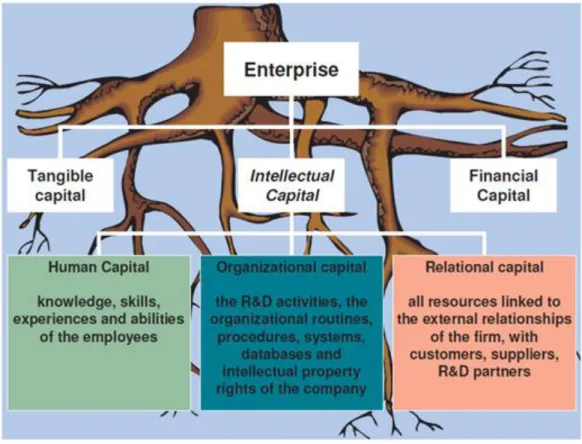
Intellectual Capital has been defined as the mixture of an organization’s Human, Organizational and Relational resources and activities (MERITUM, 2002). The following figure shows the configuration of the Intellectual Capital in conjunction with Tangible Capital and Financial Capital.
Figure 1: The IC roots of the enterprise
Source: RICARDIS (European Commission, 2006)
This picture represents the 3 main pillars that interact across the organization: Tangible capital, Intellectual capital and Financial capital. The focus of this thesis goes in the direction of the intellectual capital and its important role in organizations. The 3 main elements of IC will be addressed in the next sections.
1.2. First references to Intellectual Capital
The first references to intellectual capital are from John Kenneth Galbraith who in a letter to economist Michael Kalecki in 1969 wrote: “I wonder if you realize how much those of us in the world around have owed to the intellectual capital you have provided over these past decades.” What we see here is the IC associated to the
dynamic effects of the individual’s intellect, meaning more than intellect just for the intellect but also incorporating a level of intellectual action.
It is Tom Stewart who in his June 1991 article “Brain Power – How intellectual capital is Becoming America's Most Valuable Asset”, brings IC firmly on to the management agenda. He defines IC in his article as every company depends increasingly on knowledge such as patents, processes, management skills, technologies, information about customers and suppliers, and old-fashioned experience and this knowledge added together is intellectual capital (Stewart, 1991).
Leif Edvinsson also introduced in this decade the concept of the “tree of knowledge” that suggested that a company is like a tree. There is one part that is visible, leaves, twigs, and fruits and the other part that is hidden, the roots. If we only care in reaping the fruits and maintain the twigs and leaves in good condition, forgetting the roots, the tree can die. In order to continue to grow and bear fruits, the roots needs to be treated. This is also applicable to companies: if we are only concerned with the financial results and ignore the hidden values, companies may not survive for long time (Edvinsson, 1997).
The generic concept of intellectual capital has been described as the combination of an organization’s human, organizational and relational resources and activities that allow the organization to transform a bundle of material, financial and human resources into a system capable of creating stakeholder value (European Commission, 2006).
It is generally agreed that the main elements of IC can be structured in 3 components: Human capital, Relational capital and Structural capital (Martín de Castro et al., 2011).
1.3. Main components of IC
IC is a combination of the Human capital, Structural capital and Relational capital of an organization. It is efficient if this combination is seen as a sum of the 3 resources in a company, but not only this, it is also about how to let the knowledge of a firm work for it and have it create value. It can be accomplished by creating the right connectivity between those resources through the appropriate intangible activities (MERITUM, 2002).
Human Capital
It is the accumulated value of the principles, knowledge, capacities and abilities of the people within the organization (Bueno et al., 2002). The capacity to solve problems, creative competences and leadership is also mentioned by Brooking (1996). For Martín de Castro et al. (2011) human capital can be structured into 3 main components: (i) knowledge, embedded in the organization’s employees that may include education and training; (ii) experience and abilities, or the employee’s know-how; and (iii) personal behaviors, willingness or attitudes, towards its task, jobs and organizations.
Relational Capital
This concept is based on the assumption that companies are not isolated systems. On the contrary, they are actively and permanently connected to multiple external entities. This includes not only the relations with customers, suppliers and shareholders, but also with all internal and external stakeholders (Roos et al., 1997). Relational Capital refers to the value to the organization of the relationships it maintains with the main agents connected with its basic business processes – customers, suppliers, etc., as well as the value to the organization of the relationships it maintains with other social agents and its surroundings (Martín de Castro et al., 2011).
Structural Capital
This IC component represents the systematic and explicit knowledge that the company has managed to internalize, such as values, culture, routines, protocols, procedures, systems, technology development and intellectual property, known as the firm’s intelligence (Bueno et al., 2002). Martín de Castro et al. (2011) refers to structural capital as a combination of technological capital (including efforts in research and development, technological infrastructure and intellectual and industrial property), and organizational capital (including organizational culture, values and attitudes and organizational structure).
Structural Capital belongs to and stays at the organization - in its structure, its processes or its culture, even when the employees leave the company (Bontis et al., 2000).
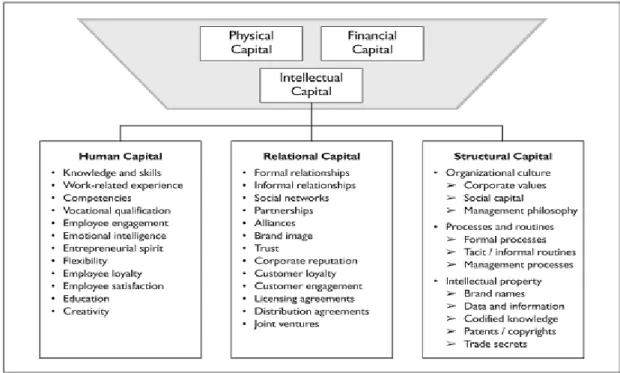
Figure 2 presents a practical example of several intellectual capital elements, distributed by its three components.
Figure 2: IC components and elements Source: Marr (2008)
1.4. Intellectual capital Measurement Models
The growing awareness of the impact and importance of intangibles in making business decisions, disputing the pervasiveness of traditional financial data, is so obvious that we can bring to question whether we are facing a paradigm shift (Bontis, 2001). In this process, the creation (and increasing use in business) of models to measure and manage IC has played a key role, contributing decisively for the concept of IC to evolve from a "metaphysical truth", or something we believe in but cannot prove, into something whose practical utility is provable and almost unanimous.
For this reason, in the context of a review of concepts of IC, it seems inevitable to mention some of the most representative IC models.
Creating an IC model will very much depend on the objectives and corporate strategy of the company that intends to implement it, which will inevitably be reflected in the assets and indicators to consider (Bontis, 2001). Furthermore, the type of model used will also depend on the purpose of the company when developing the model (to assess IC by estimating its monetary value, to manage IC by measuring indicators that are comparable over time, etc...). For this reason, it is not possible to identify a standard or universal IC model, but rather a multiplicity of alternatives created by companies or suggested by academics. The purpose of this section is to review some of the most important IC models, in order to understand how intangible resources began to be incorporated into business decisions. Some examples of pioneer models are mentioned below:
1- Skandia Navigator (Leif Edvinsson, 1997) - in order to evaluate its market value Skandia proposed to split market value into financial capital and IC. The Skandia approach, therefore, splits IC into the following four categories: human capital, customer capital, process capital and innovation capital.
2- Balanced Scorecard (Kaplan and Norton, 1996) – this model is based on a “scorecard” approach, which generates indicators and indexes for identified intangible assets. As defined by (Kaplan and Norton 1996, p.3), “The Balanced
Scorecard translates an organization’s mission and strategy into a comprehensive set of performance measures that provides the framework for a strategic measurement and management system”. This strategic management system measures organizational performance in four ‘balanced’ perspectives: Financial, Customer, Internal Business Process, Learning & Growth.
3- Intangible Asset Monitor (Sveiby, 1997) - IC is mainly approached as a stock, as something that can be identified, located, measured and valued, just as any other resource, and is useful to visualize and understand the gap between market value and book value.
4- The Technology Broker (Brooking, 1996) - attempts to calculate a Dollar value for the non-tangible part of the organization called IC. Brooking interprets IC as containing the following components: market assets, human-centered assets, intellectual property assets and infrastructure assets.
5- Intellectual Capital Services IC Index (Goran and Johan Roos, 1997) - an approach that consolidates IC indicators into a single index in order to provide a more comprehensive visualization of the company’s IC. The IC-Index approach is based on an IC distinction tree which splits IC into human capital and structural capital, separating “thinking” and “non-thinking” knowledge assets.
Recent literature has probed the evolutionary trail of IC research and practices with a critical approach, particularly in what concerns the creation and use of IC models. In fact, some authors argue that IC research and practices need to shift from the measuring paradigm to a learning paradigm. “The measuring paradigm is known for its two severe limitations: first, it treats IC as an asset that is placed under parsimonious conditions within a reporting system; and second, it also accepts the managerial adage of “what gets measured gets managed” uncritically, at the risk of reinforcing management control in organizations“ (Yu, et al., 2013, p. 39 ). Therefore, much more
important than the mere measurement of IC assets in organizations, the understanding and management of IC flows gains particular relevance, as it can activate a firm’s future earnings potential by allowing for value-added activities and by developing a strong learning culture.
1.5. Benefits of an IC management and reporting model
In recent years a surprisingly high number of models have been proposed to measure knowledge assets. They can be considered as an indicator of the ineffectiveness of traditional measurement frameworks in capturing the knowledge dimensions within an organization (Marr, 2004).
The assessment of knowledge in organizations is thus a difficult, even controversial matter. However, since knowledge is of significant importance for a company’s competitiveness, many authors argue that its assessment is indeed a fundamental issue. Leif Edvinsson, ex-corporate director of intellectual capital at Skandia, highlights this: a company grows, because it has hidden values, to continue growing the company must surface them, care for them, and transfer them through the business - if managers can measure it, they will value it (Stewart, 1994).
The benefits to the companies in the construction of an IC model for management and reporting, which goes far beyond the plain measurement and/or valuation of IC assets, are recognizable. Knowledge is today’s driver of company life (Bontis et al., 1999) and the wealth-creating capacity of the company is based on the knowledge and capabilities of its people (Savage, 1990).
Today, many companies see themselves as learning organizations chasing the objective of continuous improvement in their knowledge assets (Senge, 1990). This means that knowledge assets are essential strategic controls in order to manage business performance and the continuous innovations of a company (Boisot, 1998). Measuring intangibles positively affects managerial competences; in fact, the analysis of company drivers and cause and effect relationships not only increases the
understanding of the business but it also improves the quality of company management, making it more rational and professional. Additionally, publishing an IC report can help reduce the doubts of investors and banks and consequently, helps the company to have greater access to funds. In this way the dialogue with investors, banks and capital market is improved (Chiucchi, 2008).
In the RICARDIS report (European Commission, 2006), it is emphasized that communicating information on company IC through an IC statement can also improve communication with other actual and potential stakeholders, such as employees, customers, partners, citizens and also the political system.
Concluding then, it can be said that an IC statement produces confidence effects on the company’s external as well as internal reputation, which increases the trust from all stakeholders in the firm’s management. “Making visible what is usually invisible, it reduces the uncertainties and the risks for all the stakeholders” (Chiucchi, 2008, p.3).
1.6. Different approaches to IC
Different approaches have been developed over the years regarding the role of IC within organizations. In this section an overview of those approaches will be conducted, in order to understand which approach better fits the general research goal of this thesis.
Strategic approach
From a strategic perspective, IC is the starting point to the optimization of intangible resources, as a means to create and enhance value and contribute to the company's effort to achieve its strategic objective. IC is more closely associated with value creation (management perspective), rather than with valuation (financial perspective). Many authors are more interested in visualizing, controlling and managing value creation, than in valuing the assets themselves (Alcaniz, 2010). Marr and Roos (2005) emphasize the strategic importance of intellectual capital resources,
in a context where corporate strategy is developing from a market-based to a resource-based paradigm.
Accounting approach
The accounting perspective focuses on the effort to create new accounting mechanisms allowing that non-financial, qualitative aspects are measured and reported in parallel with traditional financial data (Alcaniz, 2010).
The accounting approach aims to measure the intangible assets of a company. For Brooking (1997) the development of an IC monetary unit of measurement is necessary, in order to calculate the success and the growth of stocks of intellectual capital. This reflects the traditional (monetary) valuation perspective that has served financial accounting and reporting so well for generations. When confronted with contemporary examples of intellectual capital such as corporate reputation, that is, how customers, investors, employees, suppliers, analysts, the public, the media or regulatory bodies see the company, the capacity to be in a position to provide credible, reliable information has a potentially deep impact in the business opportunities and in the ability to attract the resources to finance those opportunities (Alcaniz, 2010). However, to this day, the accounting standards have been unable to incorporate a comprehensive valuation of intangible assets into corporate financial reports.
Rodríguez Antón (2005) argues that we should not simply talk about intangible assets. The other side of the balance sheet (the liabilities side) must also be taken into account. As such, he defines intellectual capital as the difference between the intangible assets and the intangible liabilities of a business. He provides a number of examples of intangible liabilities; for instance, to have a deficit of employees with entrepreneurial spirit or a largely inflexible organizational model that does not strengthen learning. In order to account them as liabilities, a company requires knowing the average for the sector. If a business is below average, that part would be accounted as a liability and if it is above average it would be accounted for as an asset, because in principle the business would only achieve a competitive advantage if it is above average (Caddy, 2000).
Lev, Canibano and Marr (2005) pointed out that the uncertainty of the future economic benefits, the lack of full control, and the absence of markets to measure and value intangibles reliably, has made accounting regulators reluctant to adopt more liberal measures. Academic research supports the capitalization alternative and a fair value approach. Both approaches have advantages and disadvantages. Nevertheless, regulators are still cautious and prefer to devote efforts to harmonize current practices and develop a framework of voluntary disclosure for intangibles.
Reporting approach
The traditional accounting model is based on the principle of historic cost and that’s why just a few intangibles are included within financial statements. There is no doubt that historic cost accounts provide a useful starting point in assessing the performance of a business. Nevertheless, without advancing-looking information, the picture that they provide is incomplete.
A new approach was needed to help companies report their intangible assets, and thus provide a forward-looking perspective of their business. IC Statements are mainly about internal reporting, management and control of the business. This internal focus is an essential prerequisite for management to develop the ability to communicate what they are doing to external audiences; this is of particular importance when the organization needs to seek finance from banks, or equity from investors (European Commission, 2006).
In RICARDIS (European Commission, 2006), research concludes that IC Reporting is the process of creating a story that shows how an enterprise creates value for its customers by developing and using its intellectual capital. This involves identifying, measuring, and reporting its intellectual capital, as well as constructing a coherent presentation of how the enterprise uses its knowledge resources. Often this process leads to the writing of an IC Statement, a report on the organization’s intellectual capital that combines numbers with narratives and visualizations, which can have two functions:
1- Complement management information (internal management function); 2- Complement the financial statement (external reporting function).
National approach
Ann-Liang Chew et al. (2014) concluded that other than the traditional focus on tangible outcomes, nations should also focus on the effects of innovation to their growth and development. Having a critical mass of knowledge assets that is spread across Human Capital, Structural Capital and Relational Capital is considered essential for long-term sustainability. It is also important to track the use and growth of such assets. The essence of the IC national approach is thus to apply the IC logic to a whole nation.
National intellectual capital performance is a constructive process that includes input, process, output and outcome perspectives. The national intellectual capital is seen as a combination of processes and direct outputs. However, some authors argue that a more comprehensive approach should be integrated into this perspective: without relating national intellectual capital to national strategy (values, objectives, assumptions) and to national performance (social, economic, ecological), it is impossible to recognize in detail whether the national intellectual capital is in progress or decline; or whether it contributes to knowledge-based development or to knowledge-based deterioration (Jonna Käpylä et al., 2012).
In fact, looking to the most recent literature, research on national intellectual capital has largely neglected the strategic perspective by focusing solely on international rankings and comparisons for their own sake (Jonna Käpylä et al., 2012).
1.7. New ways of looking into intellectual capital
Some authors argue that IC research is now entering a third stage (Dumay and Garanina, 2013). The first stage consisted in developing a framework of intellectual capital, basically raising awareness of why intellectual capital is important. On the second stage of IC research, approaches to measuring, managing and reporting IC came to the forefront and efforts were focused on gathering evidence in support of its further development. These first and second stages of IC research contributed to ascertain that intangible assets are driving value creation in today’s global economy.
The emerging third stage of IC research is mainly focused on examining IC in practice, devoted to the managerial implications of how to use IC in managing a company (Guthrie et al., 2012).
In a recent empirical paper, Oliver (2013) comes up with an innovative idea that IC theory can be applied to address and resolve many practical issues we face regardless of the context. This notion emphasizes the educational part, contrarily to the creating of monetary value. It also stresses that a collaborative approach can be effective from a bottom up perspective, rather than the typical top down approach.
It also highlights Dumay’s (2013) new found view that one of the problems we face with spreading the word of IC is that we do too much preaching, and not enough educating. He refers that it is possible to educate so that “IC is created without the students being formally aware of its extent”. Dumay’s view is that most of the involved in researching IC often preach about IC rather than help develop its practice.
CHAPTER 2: INTELLECTUAL CAPITAL MANAGEMENT METHODOLOGIES
2.1. Initiatives and milestones in the development of IC reporting
The importance of IC management has grown over the years and more companies nowadays understand the need of having such methodology in place.
Several national and supranational institutions have produced guidelines and frameworks for externally reporting IC. In many cases regulators, the accounting profession and accounting scholars have driven these initiatives. Although IC reporting has been identified as an important aspect of reporting not only in large corporations but also in small and medium enterprises and in the not-for-profit sector, the existing guidelines for reporting of IC have not been embraced by organizations (Abhayawansa, 2014).
One of the original proposals to incorporate non-financial information within the annual report was put forth by the Konrad Group (Sveiby, 1989) – a group of accounting practitioners from Sweden. They argued that the existing annual report did not provide information required by shareholders of know-how companies.
Later in the 90’s some practitioners such as Stewart, Edvinsson, Malone and Sulivan strengthened the case for IC measurement and reporting from a practitioner point of view. This work highlighted how important IC measurement and reporting is for an economy, which was increasingly being recognized as knowledge intensive. It also further developed and clarified the concept of IC, its various subcategories/elements and interrelationships (Abhayawansa, 2014).
In 1991 a study commissioned by the American Institute of Certified Public Accountants (AICPA) was conducted in order to “determine the information needs of users to identify the types of information most useful in predicting earnings and cash flows for the purpose of valuing equity securities and assessing the prospect of repayment of debt securities or loans” (American Institute of Certified Public Accountants [AICPA], 1994, Chapter 1). AICPA formed a special committee on financial reporting under the chairmanship of Edmund L. Jenkins (hereafter Jenkins committee).
Jenkins Committee commissioned research into the information needs of sell-side and buy-side analysts and creditors and made recommendations on types of non-financial information that companies should provide in external reports.
The first IC statement was published in 1995 by Skandia AFS, an insurance and financial services company in Sweden, in which Edvinsson was the Director of intellectual capital (Edvinsson, 1997).
Over the years a number of conferences were held under the sponsorship of the OECD, the most notable being the International Symposium for Measuring and Reporting intellectual capital: Experience, Issues, and Prospects held in Amsterdam in 1999.
In 1995 the Danish Trade and Industry Development Council (1997) commenced work on analyzing and synthesizing IC accounting practices of selected Scandinavian companies which prepared IC accounts. The purpose of this work was to establish why and how companies actually prepared intellectual capital accounts. A memorandum was published presenting the findings of this study with examples of how the selected companies reported and accounted for their IC.
About the same time as the Danish Agency for Trade and Industry (DATI) commissioned its project on preparing IC reporting guidelines, the European Union too boarded on a similar project. It organized the Measuring Intangibles to Understand and Improve Innovation Management (MERITUM) project in 1998 with the participation of Denmark, Finland, France, Norway, Spain and Sweden to develop a set of guidelines to measure, manage and disclose information on intangibles (MERITUM, 2002).
Another European initiative on IC reporting was the ‘The Intellectus Model’ (in Spanish, Modelo Intellectus) developed by academics and practitioners in Spain based on the “Intellect One” model introduced by Euroforum (1998). In 2000 the IC reporting movement had spread beyond the West. In 2002, the Japanese government issued a policy document entitled the Intellectual Property Policy Outline with the intention of promoting the creation, protection and exploitation of intellectual property to make
Japan a ‘nation built on intellectual property’ (Japan Ministry of Economy, Trade and Industry [JMETI], 2004).
In 2004, Germany started a project called Wissensbilanz Made in Germany, under the leadership of BMWA – BundesMinisterium fur Wirtschaft unt Arbeit (www.wissensbilanz.org). It has now evolved to incorporate small as well as large German enterprises, both public and private. It has resulted in open software to download from their web sites, which now distributed more than 100,000 copies to enterprises in Germany (Edvinsson, 2013).
A number of other significant IC prototyping projects on an enterprise level have been launched, including: RICARDIS – Reporting on intellectual capital to Augment Research, Development and Innovation in SMEs, a European Commission project finished in 2006: ( http://ec.europa.eu/invest-in-research/policy/capital_report_en.htm); EFFAS – European Federation of Financial Analysts, officially published in March 2008, the Principles for Effective Communication of intellectual capital (www.effas.net); WICI – World intellectual capital Initiative, a public/private sector consortium researching and developing IC accounting and integrated reporting, with the backing of leading accounting firms and leading IC scholars (www.wici-global.com) (Edvinsson, 2013).
A significant European Commission project was launched in 2007 called intellectual capital Statements (InCaS). It was focused on expanding the learning from the German Wissensbilanz project and includes five countries (see www.incas-europe.org). InCaS was then followed by another European Commission project called CADIC – Cross Organizational Assessment and Development of IC, with a strong focus on IC flows (see www.cadic-europe.org).
In Asia, both Japan (with METI) and China have leveraged this IC work and launched research and application work. Another related unique global group for refined reporting is International Integrated Reporting Council (see www.theiirc.org). In Hong Kong, the Intellectual Property Department has successfully prototyped a project on ICR with about 600 SMEs (see www.ipd.gov.hk/eng/icm.htm) (Edvinsson, 2013).
The IIRC (International Integrated Reporting) issued the Prototype Framework in November 2012, followed by a Consultation Draft in April 2013. The final International Integrated Reporting Framework was issued in December 2013 after a period of consultation. The Integrated Reporting Framework establishes guiding principles for the preparation of an integrated report and recommends content elements that should form part of an integrated report. IIRC is working towards aligning its framework with the International Accounting Standard Board (IASB) framework for corporate reporting. Recently, a Memorandum of Understanding was signed by the IASB Chairman and IIRC Chief Executive Officer that will enable the two organizations to improve cooperation on the IIRC’s work to develop an integrated corporate reporting framework (International Financial Reporting Standards Foundation, 2013).
In order to compile the most relevant IC guidelines, a grid was created to help understand their main features (Table 1).
2.2. A closer look at some intellectual capital guidelines
As presented in Table 1, there are several studies and guides to help monitor IC management. In this thesis three of those guides will be analyzed in detail:
“RICARDIS”, “Danish Guidelines” and “InCaS”. These 3 guides will serve as the main
inspiration for the construction of our measurement and reporting model. The main reason for this choice was that these three guides share the same basic assumptions: looking for IC inside the company; managing IC with planning purposes; reporting IC.
Regarding RICARDIS, five dimensions are established in preparing an IC Statement:
Dimension 1 – Taking Stock of intellectual capital - Piloting the preparation of an IC Report;
- Linking intellectual capital to companies’ objectives;
- Producing a Knowledge Narrative (the narrative articulates connections between activities and provides the logic for what needs to be done and why it is important); - Where to look for intellectual capital?
Dimension 2 – Planning Investments in intellectual capital - Management challenges and initiatives;
- Investing in intellectual capital; - Project appraisal.
Dimension 3 – Internal Communication of intellectual capital - Internal reporting on intellectual capital;
- Selecting indicators;
- IC Reporting as a means to work on the business.
Dimension 4 – Internal Management using intellectual capital - Role of the Board and intellectual capital;
- Benefits to internal management; - The role of audit in IC Reporting.
Dimension 5 – External Reporting of intellectual capital
- Disclosure to attract resources to support innovation & value creation; - Selective disclosure.
The Danish guideline for intellectual capital statements is a revised version of the 2000 edition. It is the result of extensive co-operation between researchers, companies, industry organizations, consultants and civil servants and has been coordinated by the Danish Ministry of Science, Technology and Innovation.
The Danish guideline consists of the following four parts:
Part 1 briefly describes the 4 elements of the intellectual capital statement and gives two examples of how they can look. This part focuses on the intellectual capital statement as a knowledge management tool and is a short introduction on how to prepare intellectual capital statements.
Part 2 describes in detail how to prepare intellectual capital statements, through going through each phase of the work to identify, build up, develop and anchor a company’s knowledge resources.
Part 3 gives a number of directions on how to communicate and how to write external intellectual capital statements. It is often very challenging to draw the many strings generated by analysis together in an easily accessible publication.
Part 4 gives practical suggestions as to how the intellectual capital statement work can be organized.
In regards to each element some relevant questions must be asked to the management. According to Danish Guidelines, the critical questions in each topic are:
*Knowledge narrative *Management challenges *Initiatives
*Indicators
The InCaS methodology is a practical guide to a comprehensive and trustworthy report and is based on the individual experiences of 25 European organizations. This InCaS management tool has been elaborated with the strong support of the European Commission over the last years and is ready to support companies throughout the EU. The InCaS approach is used in this thesis in order to better illustrate the KPI’s split, specifically into Human Capital, Structural Capital and Relational Capital.
CHAPTER 3: IC MEASUREMENT AND REPORTING SYSTEMS IN PRACTICE
The experience of introducing an IC measurement and reporting system in practice is surprisingly absent from the IC literature. To the best of our knowledge, few researches actually describe such process in detail. Two notorious exceptions are case studies from Giuliani (2011) and Chiucchi (2008), which we will now analyze in some detail.
On Giuliani’s case study the aim was to reflect on how the specific nature of intellectual capital influences its own valuation process, in practice, and how it impacts on some of the qualities of its value. This study was based on a case study developed by adopting a modest interventionist approach.
It highlights the relevance of the intellectual capital valuation process in spite of the intellectual capital value itself. In fact, while intellectual capital value seems to present a limited level of objectivity, consistency, comparability and understandability, its valuation process can be considered an opportunity to visualize and understand intellectual capital and its influence on financial performance. In other words, intellectual capital valuation can be considered as useful practice to attract the attention of the managers on intellectual capital in action (Giuliani, 2011).
The case study at “Aimag”, an Italian company (Chiucchi, 2008) was aimed at analyzing how the company has dealt with the design and implementation of the IC measurement and reporting system (ICMRS) proposed by the author. Observations relative to the effectiveness of the implementation process and of the tools suggested were drawn, also shedding light on the actual benefits and the drawbacks that were observed.
The case shows that an ICMRS cannot be simply considered an accounting phenomenon but one that promotes managerial and cultural changes within a company. It also highlights that for IC measuring and reporting to give the maximum benefits it must be considered an “internal issue”. So it has to be viewed, first of all, as a process that permits planning and managing intangible resources consistently with the company strategy for creating value. Only afterwards can it lead to IC disclosure. It
is the process that makes it possible, for the personnel involved, to understand what the company’s intellectual capital is, how it works, how it creates value. Thus, the organizational capital and especially the relationships with employees and other stakeholders become the focus of managerial attention and are improved, since their understanding, their management and their integration into the company strategy are adopted. Basically the value is created also for them. Consequently, the most important benefit gained from the ICMRS is the spread of the “intellectual capital culture” within a company (Chiucchi, 2008).
Going forward, the aim of this research will be somewhat similar to the cases presented. The idea is to go through the process of creating an IC management model on a real firm, regardless of the IC value itself.
PART II: METHODOLOGICAL AND EMPIRICAL ASPECTS
CHAPTER 4: METHODOLOGY
4.1. Case study methodology
The methodology to apply in this research consists on a single Case Study, based in an intensive method (using qualitative and quantitative data, documents and databases analysis). This decision has been made due to the fact that the case study is an empirical study that allows in depth research of contemporary phenomena in a real-life context, especially when the boundaries between the phenomenon and the context are not evident. Focusing on a single case will force this thesis to devote careful attention to that specific case.
This case study is an experience that will be applied into an organization, with the purpose of designing and testing an IC management model that currently does not exist. It will be conducted through systematic research, analysis and reporting.
Case study-based research is becoming increasingly popular and is cited on many professional and scientific sources. Case studies are designed to ask the questions "how" and "why" of an event, procedure or phenomena. Compared to other methods, the strength of the case study method is its ability to examine, in-depth, a “case” within its “real-life” context (Yin, 2004).
The case study will go through the complete cycle of case study research: design, selection, analysis, and reporting. An important phase of this methodology is to use theory development to help to select the case, develop data collection protocols, and organize initial data analysis strategies.
Case study research is not limited to a single source of data and this particular case will not be an exception to this rule. A questionnaire and interviews will be used to assess the management’s perspective on different areas of IC within the company. Additionally, the case will benefit from having multiple sources of evidence such as the access to quantitative data, dashboards, data base analysis, documentation, etc.
CHAPTER 5: EMPIRICAL WORK
5.1. Introduction to empirical work
In this thesis the design and the implementation of an IC measurement system will definitely not consist on a copy paste of one of the guides presented in the literature review section.
Contrariwise, the challenge will be to develop a process and create a “model” that fits one particular company and its unique environment. The guidelines proposed by the literature offer different advantages and disadvantages, so their study will lead to a better perspective of what should be the right approach and what kind of framework can be designed to this precise company.
Taking in consideration the concepts shown, this thesis aims to develop an IC management system that is able to support the identification, measurement and management of the company's intangibles value - referred to as IC - which might be crucial for a successful development of its strategic vision.
5.2. Research questions
Initial research goal
How can IC identification, measurement and management be improved within a particular company?
Building on our general research goal, our aim is to answer the following research questions:
1- How to identify the most relevant IC variables to a particular company? 2- How to build a model that allows the dynamic measurement of the most relevant IC variables within a particular company?
3- How can the design and implementation of an IC model impact IC management within a particular company?
5.3. Company description
The case study will be developed in a German organization, located in Portugal since 2003, that renders services to its international subsidiaries companies within a Corporate Group. Over the years, several functions were incorporated. The initial concept of European Accounting Shared Service Center developed to a European and North American Multifunctional Shared Service Center. As of FY 2010, the majority of the new incorporated activities are non-accounting related. The team has 142 employees at September 2014, is young, dynamic and qualified, providing Accounting Services and other Business Services on the basis of Service Level Agreements with customers. The main goal and company’s strategy is to continue the development and integration of other areas apart from Accounting and Finance area such as Purchasing, Legal, Audit and HR services, amongst others to serve different locations within Europe and America.
5.4. Building an intellectual capital model in practice
According to our research questions, we will now try to address the following: How to identify the most relevant IC variables to a particular company?
How to build a model that allows the dynamic measurement of the most relevant IC variables within a particular company?
In order to evaluate the current situation at the company in what concerns intellectual capital management, a plan was designed based on the different existing guidelines. To start this process the analysis were based in the Danish guidelines, RICARDIS and InCaS methodology.
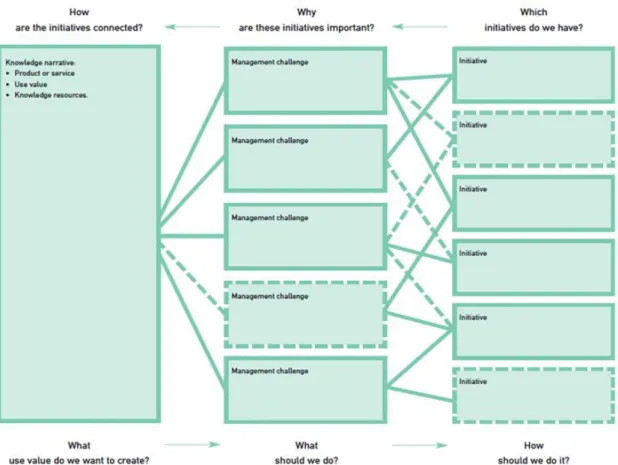
A- Help questions to obtain coherence in intellectual capital statements
The following figure illustrates the 3 critical elements to kick start the development of an IC statement, as per the Danish Guidelines. These 3 elements are divided in knowledge narrative, management challenges and initiatives.
Figure 3: Help questions to obtain coherence in intellectual capital statements Source Danish Guidelines
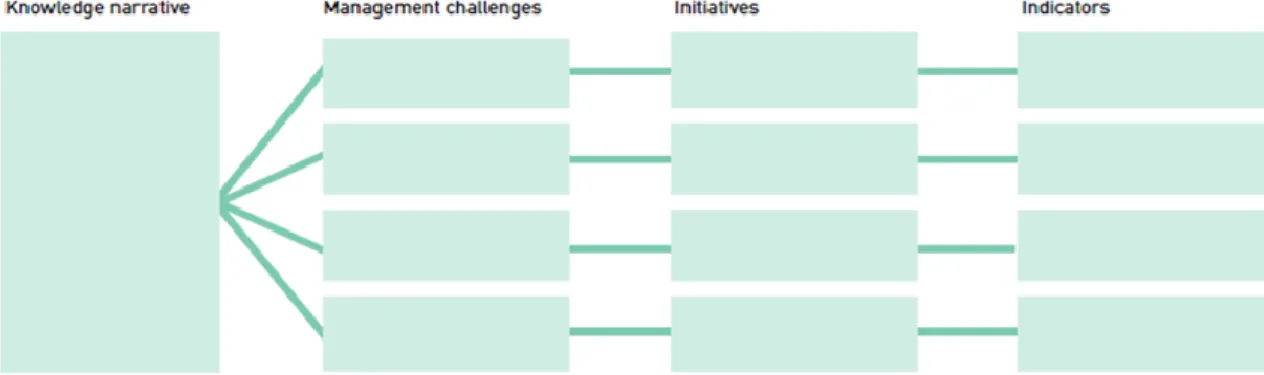
And the following figure illustrates the same as above plus the indicators which are representative of the IC model from Danish Guidelines. The right selection of the KPI’s is based on the 2 previous questions “What use value do we want to create? What should we do? How should we do it?” The KPI’s battery is the consequence of the analysis of the 3 elements of IC.
Figure 4: The intellectual capital statement model Source Danish Guidelines
The study conducted in the company followed the same approach of the model seen above. Some interviews to the management of the company were done in order to get answers to the questions of the 3 elements of IC. The questionnaire used is explained below and it was the base for the initial analysis.
B- Different steps for the analysis:
B1- First the analysis of the company’s current situation – the company’s top management perspective:
The company is expanding the business, focusing on its internal customers that are mainly other entities from the same group. This company is a shared service center (SSC) that incorporated over the years different functions - these areas are under Finance, Controlling and Tax, Purchasing services, Human resources administrative activities, Recruiting, Legal and patent services, Audit, amongst others. The vision is to continue investing in a multifunctional shared service center, which operates looking for quality and excellence for its customers.
All actions are taken in accordance to the three focus areas aligned for the SSC: quality, expansion, automation. The value that is created to the customer is in these areas: services are delivered with higher quality (e.g. accurate, reduced error rate, employees are more knowledgeable and act with ownership, higher alignment of expectations and closer communication with customers); center is prepared to expand the SSC concept to other areas and Business Administration team is supporting this
change (adaptability of SSC concept, management of different reporting lines, alignment of different functional managers into one similar code of conduct); services are continuously revised and improved (employees initiate actions that challenge the status quo, tools are upgraded not only to speed up the process but to turn it more compliant and easier for customer usage, productivity is supposed to increase in parallel to improved quality of data).
B2- Secondly the analysis of the IC statement knowledge narrative
*Knowledge narrative:
• What services does the company provide?
The company provides Audit, Accounting, Controlling, HR, legal, purchasing services and HR to the group in Europe and America.
• What makes a difference for the customers?
The users are internal customers which are mainly the consolidated companies within Europe and US. The services are used on a daily basis and it works as a support center to the local teams.
The users benefit from these services due to the fact that they can better focus on strategic matters of the company instead of focusing on transactional and administrative work and activities.
• What knowledge resources are necessary to be able to supply the services? The company requires qualified people in different technical areas, in some cases experienced people in order to face the needs. Additionally it requires language skills, specially English and German natives or proficient, to communicate in the different areas. This company also requires people with leadership skills, due to the fact that is increasing dramatically its dimension and it involves teams with responsible managers and team leaders that can manage the HR and the processes.
B3- On a third point some help questions to identify the management challenges, company’s initiatives and current indicators:
*Management challenges:
• Which existing knowledge resources should be strengthened? • What new knowledge resources are needed?
*Initiatives:
• What initiatives can be launched? • What initiatives should be prioritized? *Indicators:
• Which indicators can be associated to each initiative (new or already in place)?
The table below (Table 2) was used to assess the company’s view. The goal was to capture the perspectives of the management concerning the challenges for the future, which initiatives have been launched and others that need to be launched, and which indicators are being measured or can be in the future.
In order to capture the management feedback some open interviews were done to the Shared Service Center Head and Human Resources Director. The collection of the material was done during those open interviews and questionnaire completion.
Table 2: Definition of existing and future initiatives, existing objetives and strategies
After the collection of the material above illustrated, it is time to connect KPI’s with the management feedback, developing new ones or analyzing the past ones used on the company. The goal is to assess which are the core issues for the top management in what concerns the company’s current situation and company’s future, and to represent them in a KPI’s structure.
For that purpose, the main inspiration was the InCaS reporting model, which is represented below in the form of a base framework. The challenge to build up the base framework was to understand the main concerns of the company’s management.
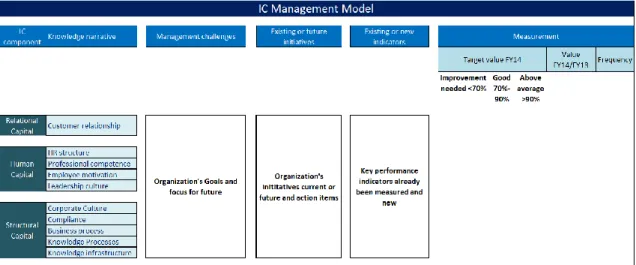
Table 3: IC Management Model
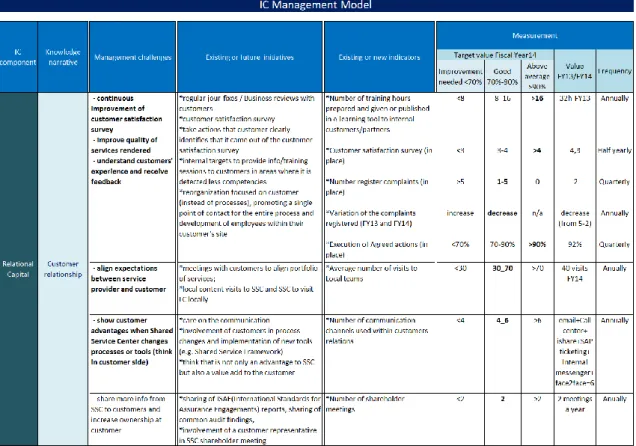
On the IC component Relational Capital, where the Knowledge narrative identified was Customer relationship, some management challenges were acknowledged and some important initiatives, either existing or new ones, were recognized.
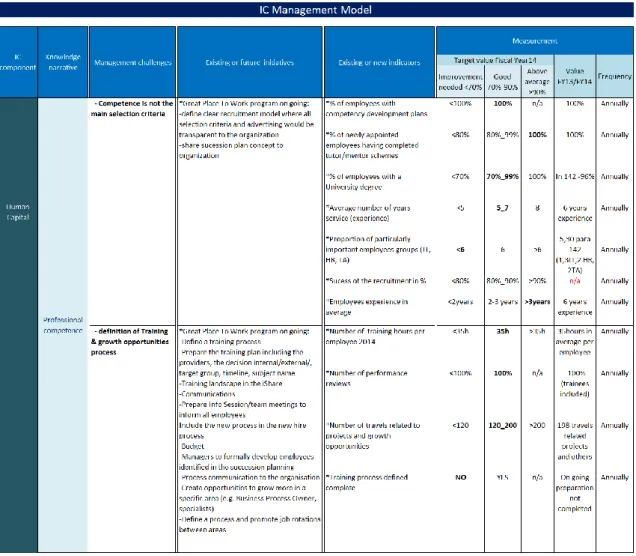
The same happens at the Human Capital component where the Knowledge narrative identified was HR structure, Professional competence, Employee motivation and Leadership culture. This company recently started a program called “Great Place to Work” (http://www.greatplacetowork.com/), which is known worldwide. This is a global human resources consulting, research and training firm specializing in organizational trust. The Great Place to Work Model is built on 25 years of research and data collected through Trust Index Employee Survey, which is taken by over 10 million employees annually worldwide. It provides leadership coaching and culture consulting services to businesses, non-profits and government agencies in 45 countries on all six continents. The aim of this program is to develop the satisfaction of the employees and to create really a great workplace.
Regarding Structural capital the approach was the same and the Knowledge narrative identified was corporate culture, Compliance, Business Process, Knowledge Processes and Knowledge Infrastructural.
This proposal for an IC Management Model comprises a similar structure as the one suggested in InCaS - Relational Capital, Human Capital and Structural Capital but with knowledge narratives newly created and adapted to the company’s reality. This framework was built as a result of the management feedback and the identification of several challenges in different areas. At the end two columns were created with existing and new key performance indicators.
5.5. KPI’s selection and testing
In order to test the proposed KPI’s (both the new ones and the ones that the company already measured and were preserved), it was decided to take an entity as pilot (basically the pilot entity that the company is already using on a so called “Quality Dashboard”). This decision has been taken due to the restrict KPI’s calculation that are already available and also because the company’s strategy is to apply the quality dashboard to all entities within the scope of its services. We chose not to use the “Quality Dashboard” structure, as its general logic and goals are totally distinct from those of the IC framework we are trying to develop on this research.
All the KPI’s already measured in the company are identified in Table 4 below as “in place”. Regarding the new ones an intensive research was done, in order to find and define the best KPI’s that fits management challenges and initiatives in this particular organization. The main inspiration sources for KPI’s selection were the “Modelo Intellectus: medición y gestión del capital intelectual” (IADE, 2003), InCaS and Danish Guidelines.
Regarding the existing KPI’s all company’s data bases were analyzed and the measurement was done accordingly with what the company defined in past. If the management challenges and initiatives for any reason mentioned elements that can be evaluated through those KPI’s, meaning that can be linked to the existing KPI’s, the selection was done. Some examples in order to illustrate this are:
Management challenge on customer relationship
*continuous improvement of customer satisfaction survey – existing KPI selected: customer satisfaction survey; improve quality of services rendered – existing KPI selected: number of registered complaints.
Management challenge on employee motivation
*employee satisfaction – existing KPI selected: employee satisfaction survey.
Management challenge on compliance
*reduce audit findings – existing KPI selected: number of audit findings.
Management challenge on business process
*increase of harmonization of processes – existing KPI selected: % harmonization level.
Management challenge on knowledge processes
*sharing process knowledge – existing KPI selected: knowledge sharing in days.
The new KPI’s selection was done in the same way. Basically the selection was done taking in consideration the feedback from management. Some examples in order to illustrate the selection and definition are:
Management challenge on customer relationship
*align expectations between service provider and customer – new KPI selected: average number of visits to Local teams.
Management challenge on human resources structure
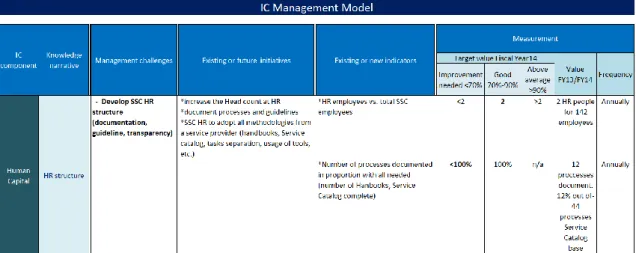
*increase of the head count in Human resources department – new KPI selected: HR employees vs. total SSC employees.
Management challenge on employee motivation
*maintain good physical/psychological working conditions – new KPI selected: employee’s satisfaction feedback on social activities promoted by the company (result from GPTW survey).
Management challenge on corporate culture
*ensure cultural alignment across different functions specially areas that reports functionally outside SSC – new KPI selected: number of harmonized processes taking in consideration the SSC model.
Management challenge on business process
*create Global Shared Service Center concept in Finance integrating Asia in this model – new KPI selected: existence of common Service portfolio worldwide.
Management challenge on Knowledge processes
*sharing Process knowledge – new KPI selected: number of process descriptions published.
Management challenge on Knowledge infrastructure
*increase communication between parts – new KPI selected: recurrent usage of communication channels.
On the following table the bold management challenges are the ones that the company’s management showed as the most important and critical for the future. This means that the strategy of the company will be more focused on these challenges and initiatives. Nevertheless all of them are still part of the day to day goals.
Finally, the model architecture included a few last columns where the KPI’s would actually be quantified. This included three categories: “target value fiscal year 14” (from October 2013 to September 2014); “value achieved FY13” (from October 2012 to September 2014) and “frequency of the measurement”. The company measures all targets in fiscal years, so the same approach was adopted.
On the target value columns, values in bold correspond to the actual achievement. Possible outcomes are “improvement needed”, “good” or “above average”.
It is also important to mention that for all targets defined, especially on the new ones, the feedback from management was essential. On the Human Capital category, for instance, some of the Global company guides were taken into
consideration for the selection. This means that all targets were defined according to the management vision and expectations.
Additionally, the calculation of the new KPI’s was particularly methodical and thorough, in order to reproduce as much as possible the reality of the company.
5.6. Results
The final results, displayed in Table 4, were based on the company’s performance during fiscal year 2013 and 2014. Most of the KPI’s show the calculation in regards to fiscal year 2014. As previously mentioned, in some cases this was not possible, so values from FY2013 were used.
The next tables shows the final model outcome, following the base framework presented before, including all the KPI’s values that could be calculated at this stage.
Starting on Relational Capital component - customer relationship the following conclusions can be taken:
1- All KPI’s calculated set forth an achievement of “Good” or “Above average” result. This means that considering this restrict analysis, which involves only one category of Relational Capital - customer relationship, the company shows an intensive focus on the customer cooperation and a continuous working on the increase of the customer ownership. Most of the initiatives are in place already, even if they are not being measured in KPI’s format.
Table 5: Human Capital - Human Resource structure
On Human Capital – Human Resource structure the following conclusions can be drawn:
1- In order to develop the shared service center HR structure, the management identified some initiatives. One additional head count for the HR team was recently hired, in order to improve the processes and to face the growth of employees in the whole organization. In order to assess the ratio of HR employees versus total SSC employees, a new KPI was built. This KPI will allow the management to understand if that ratio is within the recommended values. As a reference, the suggestion from the Human Capital Benchmarking Study