DEEPENING THE CONCEPT OF CONTEXTUAL
AMBIDEXTERITY AND ASSESSING ITS INFLUENCE ON
PUBLIC ORGANIZATIONS’ PERFORMANCE
André Salgado Paiva Calado
Dissertation submitted as partial requirement for the conferral of
Master in Human Resources Management and Organizational Consultancy
Supervisor:
Prof. Doutor Francisco Guilherme Nunes, Prof. Auxiliar, ISCTE Business School, Departamento de Recursos Humanos e Comportamento Organizacional
Abstract
Contextual ambidexterity has caught the interest of researchers for the recent years. However, the concept itself has not evolved since its creation in 2004 by the work of Gibson and Birkinshaw and, to this time, it is seen as a combination of the capacities for alignment and adaptability in a business unit. In this dissertation, some modifications to the model are proposed in order to strengthen it. These are to transform alignment and adaptability into a set of sub-dimensions each and to add a third variable, autonomy norm. Additionally, the new model was tested in organizations from the public sector because, given the particular pressures that these organizations face, it would be logical that this organizational capacity would help to balance them.
Confirmatory factor analyses and hierarchical regression analysis were used to examine the responses from 199 public workers and their results were satisfactory, since alignment and adaptability were better represented as multiple factors, autonomy norm showed to reinforce contextual ambidexterity and, at last, all three variables displayed some effect on performance. These results will have both implications for the existing and future literature on ambidexterity and for the practices of managers in public organizations.
Keywords: Human Resources Management, Contextual Ambidexterity, Organizational
Performance, Public Organizations Management
Resumo
A ambidextria contextual chamou a atenção dos investigadores nos anos recentes. No entanto, o conceito em si não foi evoluído desde a sua criação em 2004 pelo trabalho de Gibson e Birkinshaw e, até ao presente, é vista como uma combinação entre as capacidades de alinhamento e adaptabilidade numa unidade de negócio. Nesta dissertação são propostas algumas modificações ao modelo, de forma a reforçá-lo. Estas são a transformação de alinhamento e adaptabilidade para um conjunto de sub-dimensões cada e acrescentar uma terceira variável, norma de autonomia. Adicionalmente, o novo modelo foi testado em organizações do setor público uma vez que, dado as pressões específicas que estas organizações enfrentam, seria lógico que esta capacidade organizacional as ajudasse a equilibrá-las.
Análises fatoriais confirmatórias e uma análise de regressão hierárquica foram usadas para examinar as respostas de 199 funcionários públicos e os resultados foram satisfatórios, uma vez que alinhamento e adaptabilidade ficaram melhor representados por múltiplos fatores, norma de autonomia demonstrou que reforça a ambidextria contextual e, por fim, as três variáveis demonstraram algum efeito na performance. Estes resultados têm implicações tanto para a existente e futura literatura sobre ambidextria, como para a prática de gestão em organizações públicas.
Palavras-chave: Gestão de Recursos Humanos, Ambidextria Contextual, Performance
Organizacional, Gestão de Organizações Públicas
Acknowledgements
The elaboration of this thesis has been, without any doubt, one of the most demanding challenges in my academic path. However, overcoming it would not be possible without the help of the following people, to whom I am truly thankful.
To my supervisor, Professor Francisco Nunes, for introducing me to such an interesting topic and for all the time and help provided. This dissertation would not have been possible without your guidance.
To my family and Catarina, for the relentless support and encouragement and, when necessary, for pointing me to the right direction. Your unconditional trust gave me strength and motivation when it was most needed.
To my colleagues in the same situation as me, for showing me that it was possible and that we were all together in this journey. To my other friends, for understanding my lack of availability and free time for the past months.
To everyone that has participated in this research by answering the questionnaire.
Finally, to ISCTE-IUL for the amazing experience it provided me and for all the wonderful people it enabled me to meet. I will never forget the past five years.
I
Index of Contents
Index of Figures ... 2 Index of Tables ... 2 1. Introduction... 1 2. Organizational Ambidexterity ... 3 2.1 Organizational Environment ... 32.2 The Exploitation-Exploration Tension ... 4
2.3 The Development of Organizational Ambidexterity as a Concept ... 5
2.4 Different Approaches to Ambidexterity ... 7
2.5 Contextual Ambidexterity ... 8
3. Assessing the Concept of Contextual Ambidexterity ... 10
3.1 The 4I Framework of Organizational Learning ... 12
3.2 Management Control Systems ... 14
3.3 Expanding the Concepts of Alignment and Adaptability ... 15
3.4 Autonomy Norm ... 17
4. Contextual Ambidexterity and Public Organizations’ Performance ... 19
4.1 Contextual Ambidexterity and Performance ... 19
4.2 Contextual Ambidexterity on Public Organizations ... 20
5. Methods ... 23 5.1 Sample ... 23 5.2 Measures ... 24 5.2.1 Alignment ... 24 5.2.2 Adaptability ... 25 5.2.3 Autonomy Norm ... 25 5.2.4. Performance ... 26 6. Results ... 27
6.1 Confirmatory Factor Analysis ... 27
6.2 Hierarchical Linear Regression ... 28
7. Discussion ... 31 7.1 Theoretical Implications ... 31 7.2 Practical Implications ... 34 7.3 Limitations ... 35 7.4 Future Research ... 36 8. References ... 38
II
9. Annexes ... 42
9.1 Annex 1 - Scales for alignment ... 42
9.2 Annex 2 – Scales for adaptability ... 43
9.3 Annex 3 – Scale for autonomy norm ... 44
9.4 Annex 4 – Scale for performance ... 44
Index of Figures
Figure 1: Proposed model for contextual ambidexterity ... 11Index of Tables
Table 1: Means, standard deviations and correlation matrix ... 291
1. Introduction
One concept that has been gaining influence for the past decades on Organizational literature is organizational ambidexterity. Similar to the capacity to control both hands, an ambidextrous organization is able to display different, seemingly contradictory activities. For example, an ambidextrous organization can balance the tension between having to exploit its’ current assets to be profitable while also remaining explorative and adaptable for changes in the environment, in order to ensure its future sustainability. There has been a proliferation of interest in this subject for the past years, and many different theories on how to achieve ambidexterity have come up.
This dissertation will revolve around a specific type of ambidexterity, which is contextual ambidexterity, and it will target two main goals: To deepen the concept and to apply it to organizations in the public sector.
The reason why the concept needs to be revised lies in the way it was first designed by Gibson and Birkinshaw in 2004. These authors, contrarily to previous theories, argued that although ambidexterity is an organizational capacity, it can be displayed on the individual level. In other words, if the right organizational context is nurtured, individuals can engage in activities towards alignment (coherence across the organization) and adaptability (the ability to respond to changes in the environment). Contextual ambidexterity is then represented in their model as a combination of alignment and adaptability.
In this project it will be argued that, despite the undeniable value that their contribution added to the literature, their conceptualization of contextual ambidexterity lacks some important explanations. First, the initial definition from Gibson and Birkinshaw (2004) may be considered vague and not easily understandable and that has implications on its practicality by managers and other entities. This arises from the meanings behind alignment and adaptability not being clear, and so new sub-dimensions to constitute them will be suggested, based on the framework of Crossan et al. (1999) on organizational learning and Simmons (1996) study of management control systems.
2
Another shortcoming from the original model was the lack of a variable that explained the individual action in this process. According to the authors, this approach to ambidexterity differs from the previous in the sense that instead of having structural or temporal separation between alignment and adaptability, here individuals decide on how to divide their time between activities towards each. Yet, their initial model does not comprehend any variable that represents individual’s ability to make this decision. In order to overcome this deficiency, the proposal will be to add a third dimension to contextual ambidexterity named “autonomy norm”, which represents how recurrent it is for individuals in the business unit to make their own decision.
The second goal of this dissertation will be to extrapolate the concept of contextual ambidexterity to public organizations because, although having been traditionally designed for private firms, it can be expected to be valuable for the understanding of performance in these organizations.
In fact, it is the very differences between public and private organizations that make it logical to use this approach. Public organizations face a number of specific tensions such as, for example, between providing good, adjusted services for each of its clients while also maintaining its principles of equality of treatment. Therefore, these organizations and their individuals have a lot to balance, thus in this dissertation it will be argued that a contextually ambidextrous public organization is expected to perform better, since it will provide its individuals the tools to make these decisions.
3
2. Organizational Ambidexterity
2.1 Organizational Environment
The initial concept of organizational ambidexterity has its foundations on the literature about how organizations are affected by their surrounding environment. In the past decades of organizational study, researchers have noted that the presence in different markets and environments, and different organizational strategies and goals, force organizations to adapt their structures and culture in accordance to their needs. Burns and Stalker (1961) observed that organizations belonging to steady environments built up “mechanistic systems”, defined by high levels of hierarchy and bureaucracy, standardization of processes and products and clear roles and job descriptions, while firms in volatile environments developed structures with less formalization and more lateral coordination mechanisms, what they named “organic systems”. This was named “contingency theory”.
Public organizations, which are at the center of this dissertation, exemplify this occurrence since they are subject to specific environments that influence the way they are structured (Boyne, 2002). The environments that surround these organizations are, according to Boyne (2002), characterized by high levels of complexity, permeability, given that they are especially affected by outside events, instability due to the frequent political change and, finally, absence of competition. In the view of Boyne (2002), this results in structures with much bureaucracy and “an unnecessary and counter-productive obsession with rules rather than results” (Boyne, 2002: 101) and low managerial autonomy. There have been different trends and recent tendency has been to decentralize (Walker and Andrews, 2013), although the outcomes from this approach are not yet clear (Boyne, 2002; de Waal, 2010).
4
2.2 The Exploitation-Exploration Tension
This necessity for organizations to conceive their structures in accordance to their goals and needs exacerbates the tension related to the decision organizations need to make on designing a strategy of exploration and/or exploitation. Firms can choose to focus on exploiting their current assets by, as March (1991: 72) stated, “using the information currently available to improve present returns” or, on the other hand, choose to be explorative and continuously remain flexible and in active search for innovations, by “gaining new information about alternatives and thus improving future returns” (March, 1991: 72).
Naturally, these strategies will show positive outcomes in different time-frames. The benefits from a strategy of exploitation will become visible in the short-term, since the firms’ efforts will be put in order to augment current efficiency and, on the contrary, a strategy of exploration aims for more timely distant results. Consequently, these strategies have different benefits and there are risks associated with choosing only one of them. March (1991) noted that exploitation is necessary to ensure a firm’s current viability and, therefore, those that focus only on exploration will never receive the benefits from what they invested in. On the other hand, exploration is necessary for the long run, since firms that don’t allocate some amount of resources to these activities will not be able to adapt to environmental changes and will eventually become outdated. According to March (1991: 71), these firms would find themselves in a “suboptimal state of equilibria”, where they have not reached the maximum of efficiency in their business but lack the will and tools to improve it. Therefore, firms face what Thompson (1967) named a “paradox of administration”.
5
2.3 The Development of Organizational Ambidexterity as a Concept
For the past decades, researchers have begun to understand that reconciling these disparities was not only possible, as it was also necessary for companies that desired to be sustainable and to survive on the long term (Gibson and Birkinshaw, 2004). One reason behind this point of view is that in any market or environment, if the time frame of observation is wide enough, there will be periods of stability and periods of revolutionary change (Tushman and O’Reilly, 1996) and for each of them, different strategies should be used. Furthermore, researchers have argued that organizations even need to face this duality simultaneously and have searched for solutions, as will be later seen in greater detail (Tushman and O’Reilly, 1996; Gibson and Birkinshaw, 2004).
Based on these propositions, researchers begun to focus on the concept of organizational ambidexterity. The first use of the term goes back to Robert Duncan (1976) who noted that organizations needed to display different structures between moments of initiation of innovations and, eventually, their execution. Since then, many different studies on the subject have been designed and the definition of the concept that has been most broadly accepted is from Tushman and O’Reilly (1996: 24), who defined it as “The ability to simultaneously pursue both incremental and discontinuous innovation… from hosting multiple contradictory structures, processes, and cultures within the same firm”. An effective way to understand this concept is to imagine a spectrum where exploration lies in one extreme while exploitation lies at the opposite. While in classical literature the optimal point would be in one of the extremes, for the theorists of organizational ambidexterity it is located somewhere in the middle (March, 1991). Yet, it is also important to note that there is no consensus on how to best achieve ambidexterity. Some authors consider organizations as being ambidextrous if they reach the highest possible level of both exploration and exploitation (combined ambidexterity), while others see it as finding the optimal balance between both components (balanced ambidexterity) (Cao, Gedajlovic, & Zhan, 2009).
Mostly for the past three decades there has been a proliferation of interest in this subject which has caused a significant number of studies to be performed. This interest has been valuable in the sense that it has brought deepening and reliable evidence for the subject but it also resulted in an unsustainable broadening of the concept and, consequently, in its weakening (O’Reilly and Tushman, 2013). For example, there is a wide discrepancy
6
in the definition of the contradictory elements that ambidexterity aims to balance. While in primordial studies of this subject the focus was on exploration and exploitation, as different theories have been designed, different contradictions have been assessed, such as efficiency and flexibility (Adler et al., 1999), global integration and local responsiveness (Bartlett and Ghoshal, 1989), differentiation and low-cost positioning (Porter, 1996). Gibson and Birkinshaw (2004) broadly used the terms alignment and adaptability.
Despite the differences between the paths that the studies have followed, a clear association can be observed between ambidexterity and firm performance (O’Reilly and Tushman, 2013). In their review of the existing literature at the time about organizational ambidexterity, these authors found that many studies displayed a positive influence by this capacity on sales growth, subjective performance, innovation, market valuation and firm survival. On a similar tone, Junni et al. (2013) conducted a meta-analysis on the empirical evidence of the previous studies regarding the relationship between organizational ambidexterity and performance. The results went in accordance, since these authors found that it carries a positive relationship with performance in general, although it shows a more significant effect in certain elements, such as growth, than others, such as profit. Additionally, other insights from this meta-analysis were that “combined measures of OA [organizational ambidexterity] capture the performance effects better than balanced measures” (Junni et al., 2013: 308), that the higher the level of analysis, the higher the effect on performance, and that the influence is greater in services and high technology sectors than in manufacturing. These are easily explained by the fact that these environments are especially volatile and dynamic.
7
2.4 Different Approaches to Ambidexterity
Another matter that has caught the interest of researchers and which is at the center of the study of organizational ambidexterity are its antecedents or, in other words, how it is best achieved. There has not been any consensus as of this moment, yet there can be observed three main lines of approaching: sequential, structural and contextual ambidexterity, here placed in chronological order of appearance.
Sequential ambidexterity, although not being initially named as such, goes back to the development of the concept of ambidexterity in itself. Duncan (1967) in the research that initiated the study of this subject, affirmed that organizations needed to realign their structures in accordance to their environmental and strategic demands. This line of thought rests on the idea that firms will face moments when exploration is needed and others when the focus should be on exploitation and, therefore, their structures should adjust to remain suitable, since it is easier to do so than to modify the culture of the firm (Boumgarden et al., 2012). Evidence from different studies shows that this type of ambidexterity carries higher benefits for firms operating in steady markets and for firms that do not possess the means necessary for either structural or contextual ambidexterity (O’Reilly and Tushman, 2013). Yet, the costs and time consumption of re-structuring an entire organization make it less effective in adapting to rapid changes in the environment. The approach of structural ambidexterity is significantly different from the previous. Here, ambidexterity is not achieved through transformations during periods of time, it is simultaneous. Organizations are divided in different subunits and this can be used to achieve ambidexterity since they can each pursue different objectives: While some units focus on exploratory activities, others focus on exploitation of the current assets. (O’Reilly and Tushman, 2013). This separation focuses not only on different structures but also on “different competencies, systems, incentives, processes and cultures – each internally aligned” (O’Reilly and Tushman, 2008: 192). This discrepancies between subunits can create many tensions, thus the necessity to have a shared vision and a strong leadership that is capable of ensuring coherence across the organization (O’Reilly and Tushman, 2008). This approach becomes more effective in organizations that have the necessity to invest strongly on R&D activities, such as technology firms, for example.
8
2.5 Contextual Ambidexterity
The third and most recent approach to this subject is contextual ambidexterity, a term that was proposed by Gibson and Birkinshaw (2004) and that lies at the center of this research. Unlike previous approaches, this theory suggests that ambidexterity can be performed at the individual level and that it should arise from the organizational context and not from structural or temporal separation. The authors argue that although separation may augment efficiency, since business units are designed to meet their specific needs, it carries costs related to the coordination of different subunits or to the continuous re-shaping of the organization through time.
Gibson and Birkinshaw (2004) defined the concept of contextual ambidexterity as “the behavioral capacity to simultaneously demonstrate alignment and adaptability across an entire business unit” (Gibson and Birkinshaw 2004: 209). The main difference to the previous concepts is the idea that ambidexterity can be present in a single business unit and that it is best achieved by creating an organizational context that enables and promotes employees to decide how to best divide their time between activities of alignment and adaptability. These authors decided to approach the typical trade-off between exploitation and exploration with two broader, but still related, concepts: Alignment is defined as the “coherence among all the patterns of activities in the business unit” (Gibson and Birkinshaw, 2004: 209), that is, if all activities in the unit are consistent between themselves and are all reaching towards the same objectives. There is a clear connection between alignment and exploitation, since the higher the level of coherence in a certain unit, the more efficient it will be in exploiting its assets.
Adaptability, on the other hand, represents an opposed concept and can be defined as “the capacity to reconfigure activities in the business unit quickly to meet changing demands in the task environment”. It is related to exploration and the search for innovation and the ability to respond to changes in the environment.
Gibson and Birkinshaw (2004) argue that although being seemingly contradictory, these two capacities can be simultaneously shown in the same business unit and the key to overcome the inherent paradox is through a favorable organizational context. Organizational context can be defined as “the systems, processes, and beliefs that shape individual-level behaviors in an organization” (Gibson and Birkinshaw, 2004: 212).
9
In order to design what this favorable organizational context is, the authors used as foundation the definition of organizational context by Ghoshal and Bartlett (1994), who divided the concept in four “behavior framing attributes”, which were discipline, stretch, support and trust. Discipline incites individuals to meet expectations and commitments. Stretch encourages individuals to set higher objectives and more ambitious goals. Support stimulates individuals to cooperate and aid each other. Finally, trust induces individuals to count on their colleagues and to rely on them. These attributes can be divided in “hard elements” (discipline and stretch) and “soft elements” (support and trust) and are interdependent (Ghoshal and Bartlett, 1994), or in other words, all need to be fostered in order to have a balanced organization.
Another relevant point from Ghoshal and Bartlett’s theory is that organizational context does not impose behaviors on individuals, yet it will enable or even inspire individuals to take certain actions. Building on this, Gibson and Birkinshaw (2004: 213) argued that when “a supportive organization context is created, individuals engage in both exploitation-oriented actions (geared toward alignment) and exploration-oriented actions (geared toward adaptability), and this results in contextual ambidexterity”.
Additionally, they believed contextual ambidexterity to be the mediator between the contextual attributes and organizational performance. This means that developing a favorable context, with the right levels of both hard and soft elements, will not necessarily improve performance by itself. Yet, it is through the development of the organization’s capacity of contextual ambidexterity that will, in turn, have a positive impact on performance. Furthermore, “attributes of context themselves can create and amplify internal tensions if they do not contribute to the simultaneous capacities for alignment and adaptability” (Gibson and Birkinshaw, 2004: 213), thus having the opposite result.
10
3. Assessing the Concept of Contextual Ambidexterity
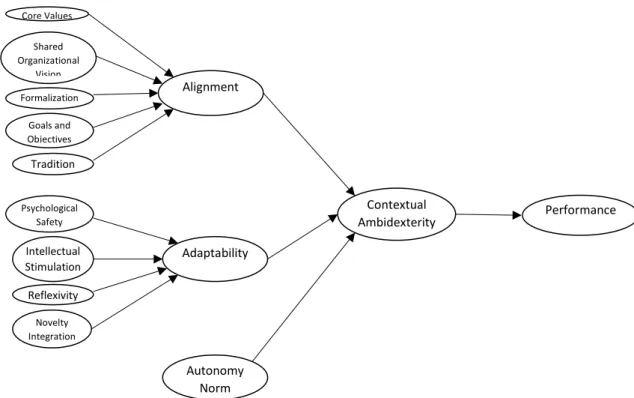
Contextual ambidexterity is a well-constructed concept, with high potential to take a relevant role in organizational theory literature. Although there have been some studies conducted in the past years regarding the matter, they tend to focus on the role of leadership and HRM in achieving contextual ambidexterity (Havermans et al., 2015; Malik et al., 2019), in what environments it is more beneficial (Wang and Rafiq, 2014; Ikhsan and Rangga, 2017; Khan and Mir, 2019) and its relationship with different factors of performance (Meglio et al., 2015; Ikhsan & Rangga, 2017; De Clercq et al., 2013). Yet, the initial conceptualization proposed by Gibson and Birkinshaw (2004) has not been put to much discussion and, consequently, the notion of contextual ambidexterity could be more refined, given that it has not been deepened significantly since it emerged in 2004. Therefore, during this dissertation two main short-comings of the concept will be attempted to overcome. The resulting altered model can be seen in Figure 1.
The first is the lack of depth of the two components of contextual ambidexterity: alignment and adaptability. The definition provided by the original authors is rather vague and it is not made clear what constitutes these concepts. This problem is clearly visible on the measures that Gibson and Birkinshaw (2004) used in their study of contextual ambidexterity. Here they systematically used the term “management systems” for measuring both alignment and adaptability, for example in the items “The management systems in this organization work coherently to support the overall objectives of this organization” (Gibson and Birkinshaw, 2004: 217) for measuring alignment and “The management systems in this organization are flexible enough to allow us to respond quickly to changes in our markets” (Gibson and Birkinshaw, 2004: 217), which measures adaptability. First, by using the term “management systems” their research gravitates around the analysis of management and how it affects ambidexterity, which does not entirely represent the definitions provided by the authors for alignment (“coherence among all the patterns of activities in the business unit”) (Gibson and Birkinshaw, 2004: 219) and adaptability (“the capacity to reconfigure activities in the business unit quickly to meet changing demands in the task environment”) (Gibson and Birkinshaw, 2004: 219). Additionally, the meaning of the term “management systems” may be considered ambiguous and thus being rather confusing for respondents of the questionnaire, who may
11 Alignment Adaptability Autonomy Norm Contextual Ambidexterity Performance Core Values Shared Organizational Vision Goals and Objectives Formalization Tradition Psychological Safety Intellectual Stimulation Reflexivity Novelty Integration
interpret it as management actions, procedures or other types of systems, which can threaten the validity of their empirical results.
The use of this term illustrates the lack of clarity of the description of alignment and adaptability, and thus of contextual ambidexterity. Consequently, this will affect the practicality of this concept, since business managers will have difficulties in achieving contextual ambidexterity if it is not itself well defined. Therefore, using the literature on organizational learning (Crossan et al., 1999) and management control systems (Simons, 1994), the proposal will be to expand alignment and adaptability into a set of sub-dimensions which hopefully will facilitate its use in the business world.
The second shortcoming that will be assessed is the lack of measurement and even clarification on what is the role of individuals in a contextually ambidextrous unit. This approach, apart from other types of ambidexterity, relies on the individual decision on when to perform alignment activities and adaptability activities. Yet, in its related model, there is no variable concerning this issue. One can argue that having high levels of both alignment and adaptability is not enough to be considered a contextually ambidextrous unit, since it is also necessary that individuals have the means and motivation to make the decision on how to divide their time and resources. Therefore, autonomy norm will be introduced in the model alongside alignment and adaptability.
12
3.1 The 4I Framework of Organizational Learning
As stated previously, the deepening of the variables of alignment and adaptability was built upon the framework designed by Crossan et al. (1999) related to organizational learning. Although, as these authors state, there has not been yet a consensus on the definition of organizational learning, the authors focused their study on the “strategic renewal” of organizations. They stated that renewal, the main focus of their research, “requires that organizations explore and learn new ways while concurrently exploiting what they have already learned” Crossan et al., 1999: 522). Then, it becomes clear that despite one focusing on business demands and economic performance and the other on organizational learning, both this study and the literature on ambidexterity simultaneously target the difficulty of managing the tension between exploration and exploitation. The framework presented by these authors is based on the assumption that innovation and new ideas are developed on the individual level but, naturally, it cannot be considered organizational learning at this stage (Crossan et al., 1999). Therefore, knowledge must migrate from the individual to the organizational level and in reverse. The authors define these motions as feed-forward and feedback, respectively. Feed-forward is the transference of new knowledge from individuals to groups and to the organization. It is related to exploration in the sense that individuals have new ideas and these are shared to larger scales, until eventually becoming embedded in the organization and feedback is the opposite movement. It is the transference of knowledge that has been institutionalized in the form of systems, structures, strategies and procedures and the way it affects individuals and groups (Crossan et al, 2011). These processes are interactive between themselves.
In addition to these transference channels, the framework designed by the authors contains four learning processes, which they define as the 4 I’s, hence the title “The 4I framework of organizational learning”. In their view, intuiting and interpreting happen on the individual level, interpreting and integrating on the group level and institutionalizing on the organizational level.
13
Intuiting is a preconscious process and occurs solemnly on the individual level. It is the recognition of patterns or possibilities in a personal view or experience. It can be divided in “expert intuiting” and “entrepreneurial intuiting”. The first is conducted by individuals with some degree of expertise in the organizations, who more easily understand situations due to the recognition of past patterns, and so they exploit what has been previously learned. The second is more related to novices, whose intuition is less biased and who tend to more easily find possibilities for new exploration. Another relevant point is that intuiting is only the beginning of new learning and only when it is embedded at all levels it can result in commercial success. By interpreting the insights collected during intuiting, individuals begin to develop cognitive maps, thus this being a cognitive process, contrarily to the previous. It can be developed at the individual or group level since, at some point, it carries out some kind of communication, even if within oneself (Crossan
et al., 1999). Next, integrating represents the process of finding a shared understanding
between a group of individuals. The goal is to transform the new knowledge from the previous points in coherent, collective action and this is achieved through dialogue and shared practice. The final stage is institutionalizing, which represents the implementation of the new learning in the systems, structures and culture of the organization. Through this process, what was once learning from individuals and groups becomes organizational knowledge and an asset that is sustainable in time, since it will not be lost when individuals leave the organization.
When paralleling the previously referred feed-forward and feedback processes with the 4I framework, feed-forward is the transference from intuiting towards institutionalizing. It is then related to exploration, since it is the process of creating, developing and embedding innovation. On the other hand, the feedback process directly represents the exploitation of what has been previously learnt and may be seen as the influence that the institutionalized knowledge has on innovation.
14
3.2 Management Control Systems
The other literature used as ground for the deepening of the concept was Simons (1994) research on management control systems. This author studied how recently appointed top managers in firms used control systems in their organizations. He begun to define control systems as “the formal information-based routines and procedures used by managers to maintain or alter patterns in organizational activities” (Simons, 1994: 170). There is an emphasis on the fact that these are formal and explicit, so informal systems are not taken into account in the analyses, and are also information-based, thus the exclusion of systems that do not convey information. These systems were defined as beliefs systems, boundary systems, diagnostic control systems and interactive control systems.
Beliefs systems are the “formal systems used by top managers to define, communicate, and reinforce the basic values, purpose, and direction for the organization.” (Simons, 1994: 170). It is through the clear definition of these systems that top managers create a shared vision among the organization.
Boundary systems are, in their turn, the “formal systems used by top managers to establish explicit limits and rules which must be respected.” (Simons, 1994: 170). It is the definition of unambiguous rules that delineate the boundaries between what is acceptable and what is prohibited. Freedom to explore and innovate is then confined between these limits. In a different manner, diagnostic control systems are the “formal feedback systems used to monitor organizational outcomes and correct deviations from preset standards of performance.” (Simons, 1994: 170). These systems are used to find variances from previously set objectives and to correct them.
Finally, interactive control systems are the “formal systems used by top managers to regularly and personally involve themselves in the decision activities of subordinates” (Simons, 1994: 171). These are the clear systems that promote communication along the organization and between top managers and their subordinates. Its goal is to focus attention on “strategic uncertainties” and thus promote innovation and the sharing of insights from individuals.
15
3.3 Expanding the Concepts of Alignment and Adaptability
As it was previously stated, both Crossan et al., 1999 organizational learning framework and Simons’ (1994) study of management control systems will be used to deepen the concepts of alignment and adaptability. It is then proposed that alignment should be composed by the sub-dimensions of core values, shared organizational vision, formalization, goals and objectives and tradition. On the other hand, adaptability should comprehend psychological safety, intellectual stimulation, reflexivity and novelty integration.
“Core values” and “shared organizational vision” both derive from Simons’ (1994) beliefs systems. They represent the existence of clearly defined organizational values and vision, and that these are shared across the organization and everyone acts in accordance to them, particularly managers. “Formalization” is the existence of rules and formal procedures and the level of rigidity in which individuals must follow them, as in Simons’ (1994) boundaries systems and diagnostic control systems. “Goals and objectives” also stems from Simons’ (1994) boundaries systems and diagnostic control systems. It comprises both the transparent definition of explicit objectives and tracking them. “Tradition” is the level of attachment to the past or, in other words, how the institutionalized learning (Crossan et al., 1999) influences current procedures. There is also a strong relationship with expert intuiting, since the previous learning from individuals that have been in the organization for some time will to some degree be similar, due to their shared past experiences, and therefore result in some consistency between their actions. These sub-dimensions altogether will enhance the level of alignment in the organization and its business units, ensuring that there is coherence inside and across units, and also with past procedures and with what has already proven to have positive outcomes.
In terms of the new sub-dimensions of adaptability, “psychological safety” relates to how risk taking is perceived in the unit and, consequently, how individuals will feel protected in trying new methods or innovating. While intuiting is an unconscious process and thus not being possible to restrain, interpreting is a conscious, and many times communicative process, and it needs to be enabled by showing individuals that they can innovate and present new ideas. Both these processes can be more or less encouraged and thus the necessity for “intellectual stimulation”. “Reflexivity” measures the openness to changes
16
and the reaction to changes in the environment. It also comprises discussions about the necessity to change and areas of improvement, which can be related to the interactive control systems by Simons (1994), which allow and encourage different hierarchical levels to focus discussion on “strategic uncertainties”. Finally, “novelty integration” directly relates to Crossan’s et al. (1999) integrating, since it is the level to which innovations are adopted and the velocity at which this happens. Such as in the framework from Crossan et al. (1999), only when these sub-dimensions are fostered individual learning and innovation is created and shifted to integrated knowledge of the organization. According to the formerly proposed new sub-dimensions, the two first hypotheses that will be tested in this study are:
H1: Alignment is a multidimensional construct composed by the variables “core values”,
“shared organizational vision”, “formalization”, “goals and objectives” and “tradition”.
H2: Adaptability is a multidimensional construct composed by the variables
“psychological safety”, “intellectual stimulation”, “reflexivity” and “novelty integration”.
17
3.4 Autonomy Norm
My proposal, apart from the deepening of alignment and ambidexterity, will be to add a third component to the initial conceptualization by Gibson and Birkinshaw (2004). The necessity for this addition begins with the fact that contextual ambidexterity differs from other ambidexterity models, namely sequential and structural ambidexterity, on the way it approaches the tension between exploration and exploitation. While all these models share the similarity of trying to find a balance in this tension, contextual ambidexterity aims to do so simultaneously and without any separation, being it physical or temporal. In other words, in the contextual ambidexterity model, one business unit can display evidences of exploration and exploitation at the same time, by performing activities towards alignment and adaptability.
As Gibson and Birkinshaw (2004) argued in their approach, it would be individuals who would make the decision between alignment and adaptability activities, and not managers. The role of managers in the seek for ambidexterity would be to create a supportive context which will enable individuals to decide how to best divide their times. Therefore, although being a “meta-level capacity (for alignment and adaptability) that permeates all functions and levels in a unit” (Gibson and Birkinshaw, 2004: 211), contextual ambidexterity is displayed on the individual level.
The problem lies in the fact that despite this being the main differentiator between contextual and previous approaches to ambidexterity, and where the distinctive value of this concept lies, the original authors don’t include any reference to how individuals make this decision in their model. Then, while being successful in the acknowledgment of individuals performing both activities towards alignment and adaptability, it is arguable that the model designed by these authors lacks an explanation on how they make the judgement on which actions to perform at different times. A unit with high levels of alignment and adaptability does not necessarily exhibit contextual ambidexterity if individuals do not have the capacity, confidence and authority to decide on how to divide their time.
18
As an example of where their model might be unsuccessful, one business unit can have people working simultaneously towards both dimensions, while management is deciding on who and when should be performing different activities. If this unit was evaluated using the model from Gibson and Birkinshaw (2004) it would show high levels of contextual ambidexterity, however, it goes against what the authors have theorized when creating the concept, since individuals are not making this choice by themselves. Furthermore, it raises the coordination costs that their model aimed to remove.
Therefore, to assess if a certain unit displays contextual ambidexterity, measuring the levels of alignment and adaptability is not enough and the proposal to overcome this will be to add a third variable named “autonomy norm”, which represents how recurring it is in the business unit for individuals to have the necessary independence to decide which activities to perform. This new variable will measure if the management pushes daily decisions to the lowest hierarchical levels, if workers have the necessity to ask for authorization or consulting the management before taking decisions and other indicators of the overall autonomy of subordinates. This is reflected in the new hypothesis:
H3: Contextual ambidexterity is composed by “alignment”, “adaptability” and
19
4. Contextual Ambidexterity and Public Organizations’
Performance
4.1 Contextual Ambidexterity and Performance
As it was stated previously, there has been a significant amount of interest and empirical research on organizational ambidexterity for the past decades. Yet, the large majority of these studies focus on structural or sequential ambidexterity, rather than on contextual ambidexterity. This results on a lack of empirical robustness to support the concept and one of the ambitions of this study is to provide additional evidence to the subject.
Despite the fact that there has been some evidence that supported the inexistence of a relationship between ambidexterity and performance, most studies show that ambidexterity has a positive influence on business performance (Junni et al., 2013). In their meta-analysis on the relationship between ambidexterity and performance, these researchers found that its influence became more significant in the services and technology sectors and argued that “a possible explanation is linked to the elevated level of environmental dynamism” in these markets, and these firms “need to continuously be on the lookout for new opportunities (exploration), in addition to exploiting existing resources, because the duration of an existing competitive advantage is very uncertain.” (Junni et al., 2013: 308). Due to the high dynamism that characterizes public service, as will be seen in detail in the next section, contextual ambidexterity could be expected to have some influence in performance.
20
4.2 Contextual Ambidexterity on Public Organizations
To understand the impact contextual ambidexterity can have on public organizations, it is important to first analyze how these have evolved until the state at which they are today. To do so, it is relevant to observe the work of Boukamel and Emery (2017), who studied the evolution of ambidexterity on public organizations and were able to divide its history into three main periods. The first, which they named “Bureaucratic Period” lasted until the 1970’s. During this time, the focus on innovation was almost inexistent in public organizations, given that the aim was on exploration and short-term results. The punctual innovations that could be observed were led by politicians and were transferred in a “top-down” manner. Afterwards, the second period took place between the 1980’s and 1990’s and was characterized by the rise of the New Public Management (Hood, 1991). During those decades, which Boukamel and Emery (2017) titled “Managerial Period”, there was a development in the understanding of the necessity for innovation in public organizations and this innovation was guided by managers in a top-down fashion, while civil servants had almost no interference in the process. During this time, some separation could be observable between structures that performed exploitation and exploration activities, or in other words, public organizations were beginning to display some level of Structural ambidexterity (Boukamel and Emery, 2017). The last period appeared in the beginning of the 21st century and is taking place until the present and was named “Post-NPM [New Public Management] Period”. The authors claim that during the first decades of the new millennium there has been a shift in the paradigm of public organizations: the goal went from having innovation in public organizations to having innovative public organizations. The emergence and development of the New Public Management, previously referred to as the “Managerial Period”, has shifted the emphasis for managers to make public organizations become more “market and businesslike” (Walker and Andrews, 2013: 102). This trend towards importing private sector’s procedures and management styles has been visible in the public sector for the past decades and it is still recurrent in present times. Although some criticism has arisen towards this approach, claiming that these sectors have fundamental differences that imped the successful transfer of their methods (Sayre, 1953; Ranson and Stewart, 1994; Savoie, 2005), different studies and meta-analyses have concluded that there are no clear evidences to support it (Boyne, 2002; de Waal, 2010; Walker and Andrews, 2013). Therefore, in this dissertation, one concept will be
21
extrapolated from the private sector literature because it is considered to connect to the particularities of public organizations.
These particularities emerge from the fact that public organizations face a largely higher number of stakeholders than their private counterparts do. Public organizations are mostly designed to provide services to society (Nunes et al. 2018) and so, their goal is to work towards its best interest and subsequently need to attend different, and sometimes contradictory, demands and expectations from the public (Nunes et al. 2018). Contradictorily, there is a strong pressure on these organizations and their servants to be efficient and to respect their “core values of equality of treatment” which rely on “standardized and well-monitored processes and structures” (Boukamel and Emery, 2017: 03), or in other words, alignment.
In addition to the previous, other peculiarities displayed by public organizations that deepen the exploration/exploitation tension are the lack of competitive pressure, which is replaced by an increased political pressure (Choi and Chandler (2015). While the first results in a lack of concern with renewal, the second results in a strong urge for short-term results and ultimately both culminate in a strong focus on exploitation. Despite this traditional (and still current) preference towards exploitation in disregard of exploration in public organizations, it is clear that in order to be sustainable and to provide the best service to society, these organizations have difficult tensions to balance. This is, perhaps, one of the reasons why there has not been yet a consensus on the best management practices to foster good performance (Boyne, 2002).
Yet, there is a clear need for improvement of performance in public organizations (de Waal, 2010) and so researchers have continuously tried to solve this problem. One relevant theory about public management is O’Toole and Meyer’s (1999) model, which comprises four “M’s” that represent the activities behind decision-making of managers in these organizations. M1 is associated with the maintenance and adaptation of existing systems, M2 comprises a strategy for managing the environment that surrounds the organization and M3 and M4 represent the needed balance between taking advantage of environment changes and to defend the organization from these changes. Walker and Andrews (2013) found in their meta-analysis that evidence from previous studies suggest that M1, M3 and M4 have a higher relationship with performance.
22
Another relevant study regarding this matter is de Waal’s (2010) research on high performance organizations [HPO]. By applying the HPO framework to the public sector, the author proposed some improvement areas for public organizations. Most of these have a theoretical connection with contextual ambidexterity, such as improving the “aura” of managers by being effective and encouraging everybody to do so while letting their staff experiment and make mistakes, to be innovative in order to improve their service to clients, to improve management processes and make them known by everybody in the organization and to increase the quality of the workforce by training them and encourage knowledge sharing between employees.
Both the results from these studies and the specific tensions that these organizations must balance lead to the suggestion that contextual ambidexterity can be expected to have a positive impact on public organizations’ performance. The reason why contextual ambidexterity would be a more suitable approach is that, due to the high dynamism and multiple stakeholders that these organizations simultaneously face, decisions must be taken in the fastest way possible and it will be helped by providing individuals the right context. Therefore, the impact of contextual ambidexterity on public organization’s performance, hence the fourth hypothesis:
23
5.
Methods
For the purpose of testing the presented hypotheses, data from different organizations belonging to the public sector was gathered. These organizations were widespread in different sectors of activity, with many disparities. Additionally, respondents also ranged from various hierarchical levels, from subordinates to people in management positions. This data was collected in the form of questionnaires which were delivered to respondents who answered to them anonymously.
5.1 Sample
The collected sample was composed of 200 respondents who worked on the public sector, from which 1 respondent was deleted due to missing values in several items, resulting in a total of 199 valid responses. From this total, 55% were females while 45% were males. The mean age was of approximately 48 years (SD = 8.4), although minimum and maximum ages were, respectively, 20 and 65 years. In terms of educational level, 46% had a Medium or Higher Education degree, 31.5% had the Secondary Education level, 16.5% had a degree above a Bachelor and 5% had the Basic Education level.
Despite all belonging to the public sector, respondents worked for different organizations with disparate purposes. The highest represented group was of those working in the Education Sector, with 42.5% of respondents, followed by 20% that worked in the Security/Law Enforcement Sector. Next, the Public Administration/ Local Governance Sector was represented by 12.5% of respondents and the Healthcare Sector by 9.5%. The remaining 15.5% of respondents either worked for dispersed organizations or did not specify what was the goal of their organization. Regarding the size of these organizations, the values vary from 6 to 26.000 people. From the total, 26% of respondents worked for small organizations with less than 100 collaborators, 38,5% belonged to organizations with a number of employees between 100 and 500. There were 19% belonging to entities with between 500 and 3.000 members and, finally, 13% belonging to organizations with over 3.000 collaborators. Seven respondents did not provide this information.
24
In terms of the specific business unit where respondents worked and that were the subject of the questionnaire, there was also a great variation in size, being the minimum 2 people and the highest with a reported number of 25.000 people.
Finally, regarding management, from the total of 199 respondents, 18% are in some type of managing positions. The time of tenure in the organization varies a lot amongst individuals, from just 1 year to a maximum of 44 years, while the average time is approximately 17 (SD = 9.64) years. Similarly, the time for which respondents have been in the current position varied from 1 year to 40 years, with an average of approximately 18 (SD = 9.45) years.
5.2 Measures
The questionnaire consisted of various Likert-type scale items, where respondents assessed their level of agreement with presented phrases from 1 (entirely disagree) to 7 (entirely agree). These scales were based on researches from different authors and, to test if the items appropriately represented their latent constructs, confirmatory factor analyses were performed, using the SPSS AMOS 26 software. Next, the various scales and results from the analysis will be explained in greater detail and the final scales that were used to measure the variables can be seen in Annexes 1 to 4.
5.2.1 Alignment
As seen in previous points, the alignment variable was divided into a set of sub-dimensions and, for each, different scales were used. Scales from Denison et al. (2006) were used to assess “core values” and “goals and objectives”. For assessing “formalization” and “tradition”, scales from Patterson et al (2005) were used. Finally, the “shared organizational vision” scale was taken from Burgers et al. (2009). After conducting the Confirmatory Factor Analysis, some items were deleted by using the Modification Indices to assess their collinearity. subsequently, “core values”, “shared organizational vision” and “formalization” were each assessed by three items, while “goals and objectives” and “tradition” by four items each.
25
5.2.2 Adaptability
Similarly to the previous, this variable was divided into new sub-dimensions which were assessed differently. “Psychological Safety” was assessed with the scale from Edmonson (1999), while scales from Patterson et al. (2005) were used for “intellectual stimulation” and “reflexivity”. A new scale was used for “novelty integration”, with items such as “New ways of working are rapidly adopted” and “People are encouraged to support the implementation of ideas or new projects” (Annex 2.4), it aimed to measure how new ideas and procedures are easily adopted in the business unit. Again, the confirmatory factor analysis was performed and items with high collinearity levels were deleted. Consequently, “psychological safety”, “intellectual stimulation” and “novelty integration” were reflected by four items each, while the scale used to measure “reflexivity” consisted of five items. After this reduction of items, the scores from the confirmatory factor analysis were satisfactory.
5.2.3 Autonomy Norm
For the new component of contextual ambidexterity, “autonomy norm”, a scale by Patterson et al. (2005) was used to assess the level of autonomy managers granted their subordinates in the units that were subject to the investigation. The confirmatory factor analysis showed unsatisfactory results regarding these items. One possible explanation for this was the presence of reverse worded items since, as researchers have found out, carelessness from respondents in this type of items may influence model fit when performing a confirmatory factor analysis. According to Wood (2016), for latent variables with approximately 40% of reverse worded items, it can be expected that if at least 10% of respondents answer carelessly to these items, the impact on the analysis results will be significant. In this study, reverse worded items represented 50% of the measure of “autonomy norm”, so it is likely that carelessness from respondents resulted in these poor results. Therefore, three items were removed from the initial scale and four items were added. These four items belonged to Gibson and Birkinshaw’s (2004) original scale for measuring contextual ambidexterity and were chosen due to their conceptual resemblance to this new variable.
26
5.2.4. Performance
As it was stated in the initial review of the existing literature, organizations in the public sector face a number of peculiarities which must be necessarily taken into account when analyzing their performance. For example, they need to respond to multiple stakeholders in many different dimensions and thus, indicators solemnly focused on economic or overall performance may be too short-sighted for these organizations. As Loon (2016) argued, “The performance of a work-unit in a public organization can be defined as that work-unit’s contribution to achieving the organization’s public mission” (Loon, 2016: 84). Therefore, a multi-dimensional scale created by this author specifically for public organizations was used to assess this dependent variable. After performing a confirmatory factor analysis, from the initial 15 items six were removed thus remaining 9 items.
27
6. Results
6.1 Confirmatory Factor Analysis
In order to assess the validity of H1 and H2, different confirmatory factor analyses were carried out. For each dimension (alignment and adaptability) two confirmatory factor analyses were done to compare the results between a one-factor model, where alignment and adaptability each represented one dimension, and a multi-factor model, where alignment represented the proposed five sub-dimensions and adaptability represented the proposed four sub-dimensions.
For alignment, the proposed five-factor model showed favorable absolute fit indexes: chi-square = 212.918; df = 109; p < 0.001; GFI = 0.0888; CFI=0.918; TLI=0.898; RMSEA=0.069; SRMR = 0.08. Although these results may not be excellent, they are adequate and superior to the one-factor model absolute fit indexes (chi-square = 844.768; df = 252; p < 0.001; GFI = 0.666; CFI = 0.739; TLI = 0.714; RMSEA = 0.109; SMRM = 0.110).
The results for adaptability were similarly positive, since the proposed four-factor model displayed satisfactory analysis results, with the following absolute fit indexes: chi-square = 223.298; df = 113; p < 0.001; GFI = 0.887; CFI = 0.919; TLI = 0.903; RMSEA = 0.07; SMRM = 0.0535. Again, these results were preferable to those of the one-model factor analysis (chi-square = 477.542; df = 189; p < 0.001; GFI = 0,812; CFI = 0.835; TLI = 0.817; RMSEA = 0.088; SMRM = 0.067).
These results from the confirmatory factor analysis go in accordance with H1 and H2, since the models with the new proposed sub-dimensions chosen for alignment and adaptability showed to have a better fit than those that treated them as a one-factor variable. Nonetheless, it is important to note that although being higher than the one-factor model, the results for the multi-one-factor models were not excellent, which might indicate that the factors used were not the best.
28
6.2 Hierarchical Linear Regression
Prior to performing the hierarchical regression, collinearity diagnoses were performed to assess if any independent variables were redundant in the sense that they were measuring the same as others. The dimensions “goals and objectives” and “reflexivity” showed a high VIF of 4.2 and 4.26 respectively. Therefore, these variables were removed from the model when performing the regression.
Despite the evidence displayed in the previous section that supported H1 and H2, the fact that these sub-dimensions have been removed from the model due to being redundant results in the rejection of these hypotheses, since not all proposed variables have proven to be fitting. Nonetheless, they were partially correct, given that evidence showed that alignment and adaptability function better as groups of distinct elements.
In Table 1 are displayed the means, standard deviations and correlations between the measured variables. As can be seen in this table, the values of the means are similar, overall, and do not variate extremely from the median of the 1-7 scale. The lowest mean is that of “shared organizational vision”, while the highest belongs to the assessment of organizational performance. By analyzing the correlations between the variables, some preliminary evidence for the proposed hypotheses can be withdrawn. There is a strong correlation between most components of alignment and adaptability and performance, which suggests that these have an impact on performance. Additionally, the new proposed variable autonomy norm also displays a significant correlation with performance. On the other hand, one of the sub-dimensions of alignment, “tradition”, unexpectedly endures a negative correlation with performance and with almost every other sub-dimension, being “core values” and “formalization” the only exceptions.
Another noticeable insight from Table 1 is the high correlation between most alignment dimensions, adaptability dimensions and the autonomy norm variable. From this, one can take the conclusion that although being distinct and expectably opposing constructs, all can exist simultaneously in the same business unit or, at least, such is the perception from respondents. Although not being one of the objectives of this dissertation, these results by themselves provide additional evidence to the fact that contextual ambidexterity is possible inside the same business unit.
29
Table 1: Means, standard deviations and correlation matrix
(Source: own processing; N = 199; *p<0.05; **p<0.01)
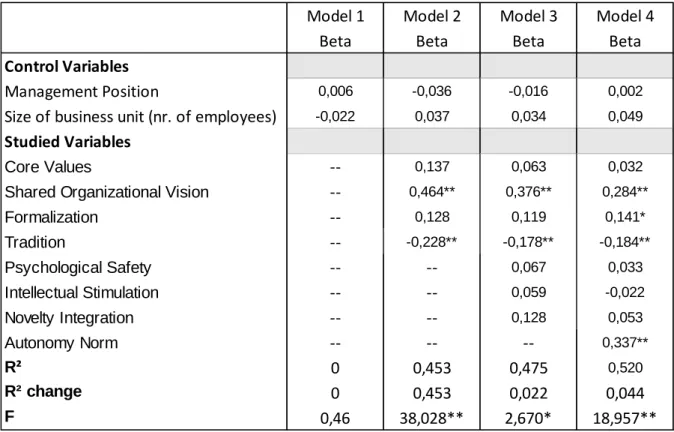
Furthermore, Table 2 shows the results from the hierarchical regression analysis that was performed to analyze the impact the studied dimensions have on performance. The first model was used to assess the influence of control variables on performance. Since performance is being measured by the perception of individuals, control variables were specifically chosen by the logic influence they could have on the understanding they have on their units’ performance. As can be seen in Table 2, these variables had no significant impact on performance, as the “management position” β was 0.011 and the “size of business unit” β was -0.03.
In Model 2, independent variables related to alignment were added to the regression, which resulted in a significant R² change of 0.442, p < 0.001. Next, in Model 3 the measured sub-dimensions for adaptability were added, leading to a R² change of 0.023 with p < 0.05, which showed to be of little significance and neither of these variables showed to have a relevant influence on performance. Finally, in Model 4 “autonomy norm” was added to the regression, which led to a significant R² change of 0.049, with p< 0.001.
Mean S.D. 1 2 3 4 5 6 7 8 9 10
1. Core Values
4,631 1,131 1
2. Shared Organizational Vision
3,997 1,238 ,600** 1
3. Formalization
4,623 1,078 ,508** ,266** 1
4. Goals and Objectives
4,441 1,223 ,693** ,777** ,402** 1 5. Tradition 4,366 1,091 ,015 -,172* ,296** -,154* 1 6. Psychological Safety 4,207 0,897 ,369** ,301** ,199** ,399** -,155* 1 7. Intellectual Stimulation 4,057 1,170 ,584** ,596** ,224** ,708** -,213** ,464** 1 8. Reflexivity 4,173 1,059 ,609** ,615** ,324** ,722** -,228** ,415** ,802** 1 9. Novelty Integration 4,156 1,131 ,562** ,687** ,237** ,730** -,282** ,543** ,755** ,808** 1 10. Autonomy Norm 4,140 1,083 ,527** ,634** ,187** ,674** -,173* ,433** ,658** ,622** ,683** 1 11. Organizational Performance 4,832 1,050 ,475** ,616** ,256** ,664** -,262** ,353** ,512** ,513** ,577** ,623**
30
These results mean that when adding the variable of “autonomy norm” to the original model, the impact of contextual ambidexterity on performance will be higher. Therefore, it can be concluded that this variable strengthens the concept of contextual ambidexterity and H3 can be considered valid.
Additionally, these results also suggest that H4 is incorrect since not all three components of contextual ambidexterity showed an acceptable degree of significance in predicting the value of performance, since none of the proposed sub-dimensions of adaptability has proven to be relevant in predicting the dependent variable. Therefore, only alignment and autonomy norm have displayed influence on performance.
Additionally, the independent variables that proved to be of considerable significance were “shared organizational vision” (β = 0.284; p < 0.001), “formalization” (β = 0.141; p < 0.5), “tradition” (β = -0.184; p < 0.01), all of them sub-dimensions of alignment, and “autonomy norm” (β = 0.337; p < 0.001).
Table 2: Hierarchical Regression Results
(Source: own processing; N = 199; *p<0.05; **p<0.01;)
Model 1 Model 2 Model 3 Model 4
Beta Beta Beta Beta
Control Variables
Management Position 0,006 -0,036 -0,016 0,002
Size of business unit (nr. of employees) -0,022 0,037 0,034 0,049
Studied Variables
Core Values -- 0,137 0,063 0,032
Shared Organizational Vision -- 0,464** 0,376** 0,284**
Formalization -- 0,128 0,119 0,141* Tradition -- -0,228** -0,178** -0,184** Psychological Safety -- -- 0,067 0,033 Intellectual Stimulation -- -- 0,059 -0,022 Novelty Integration -- -- 0,128 0,053 Autonomy Norm -- -- -- 0,337** R² 0 0,453 0,475 0,520 R² change 0 0,453 0,022 0,044 F 0,46 38,028** 2,670* 18,957**