DISTRIBUTION
MANAGEMENT
IN
THE
HEALTH
CLUB
INDUSTRY
The impact of a company’s image and environment when choosing a
point of sale (POS)
MÓNICA SOFIA DE FREITAS
Thesis submitted as a partial requisite to obtain the Masters degree in MARKETING
Supervisor:
Acknowledgements
Several people played an important role in the accomplishing of this dissertation and I would like to take this opportunity to thank each one of them for all their support and expertise.
First and foremost, I begin by thanking my dissertation advisor, PhD Susana Cunha for all her helpful comments and guidelines throughout the process of this investigation. I would also like to acknowledge my thanks to PhD Reinaldo Proença for giving me the initial boost for this project.
I would like to also express my gratitude to Universalbodies Health and Adventure Club, Lda for giving me the green card to proceed with this study and allowing me to collect all the required information and put it to use.
Lastly, and most importantly, I want to thank my family for their unconditional support, patience and love. To my parents, thank you for all the wisdom and guidance. To Eddie, for always being there for me and always encouraging me, giving me the needed inspiration to complete this project. I’d also like to express my gratitude to my siblings Richard, Sandra and José Manuel and my uncle Luis for never letting me down and to the rest of my family, for always believing in me. I love you all and am truly blessed to have you in my life.
Abstract
The objective of this investigation is to study how a store’s environment influences consumers when choosing a point of sale (POS). The POS that is taken into account is part of the tertiary industry: Health Clubs. This project is set on identifying the principle characteristics of Health Clubs in Portugal that are taken in consideration when clients or potential clients are considering joining a club of this nature.
Store environment, in theory, consists of three factors: ambient, design and service provided by employees, which in this investigation will be identified as the social factor. On the other hand, the store choice criteria that will be analysed are: service quality, price and store image. The research done in this investigation also includes a study on consumer behaviour, in order to comprehend the link between the store environment and the consumers store choice criteria.
The conclusions of this project are based on 121 questionnaires which were distributed by means of two channels: the internet (mailing) and physical distribution (personal interview). The target population are the members of a private Health Club situated in Torres Vedras and the respondents were selected by using convenience sampling. This investigation proposes a conceptual model that analyzes the consumer’s perception of the store’s atmospherics and how these influence the consumer’s store choice.
Keywords: Consumer Behaviour, Store Environment, Image of a Point of Sale, Store Choice Criteria
Resumo
O objectivo desta investigação é estudar como o meio ambiente das lojas influencia os consumidores na escolha de um ponto de venda. O ponto de venda que é tomado neste estudo faz parte do sector terciário: Centros de Saúde e Lazer. Este projecto baseia-se na identificação das principais características dos Centros de Saúde e Lazer em Portugal que são tomadas em consideração quando os clientes ou potenciais clientes pretendem frequentar um clube desta natureza.
O envolvente da loja, na teoria, consiste em três factores: ambiente, design e serviço providenciado pelos empregados, o qual nesta investigação será identificado como factor social. Por outro lado, os critérios de escolha da loja que serão analisados são: qualidade do serviço, preço e imagem da loja. A pesquisa feita na investigação também inclui um estudo do comportamento do consumidor, de modo a compreender a ligação entre o meio ambiente da loja e os critérios de escolha da loja por parte dos consumidores.
As conclusões deste projecto são baseadas em 121 questionários, os quais foram distribuídos por dois principais canais: a internet (email) e a distribuição física (entrevistas pessoais). A população-alvo são membros de um Centro de Saúde e Lazer privado situado em Torres Vedras e os entrevistados foram seleccionados utilizando o método de amostragem por conveniência.
Esta investigação apresenta um modelo conceptual que analisa a percepção dos consumidores sobre a envolvente da loja e como isso influencia a escolha dos consumidores por essa loja.
Palavras-Chave: Comportamento do Consumidor, O Envolvente da Loja, Imagem do
Ponto de Venda, Critérios de Escolha de Loja
Executive Summary
The theme of this dissertation is Distributions Management in the Health Club industry in Portugal. The purpose of this investigation is to analyze whether a Health Club’s image and environment can influence clients in their decision making process, i.e. whether or not to join a club of this nature.
The environmental cues used in this investigation are: (1) Design, (2) Ambient and (3) Social. As for the Health Club choice criteria we studied: (1) Service Quality, (2) Price and lastly (3) Health Club image. The conceptual model proposed in this investigation is based on the research done by Baker’s et al (2002) conceptual model of the prepurchase process of assessing a retail outlet on the basis of environmental perceptions. We adapted this model to a service outlet point of view, more specifically, a Health Club.
In order to obtain our objectives, we collected data using structured questionnaires to personal interview as well as mail surveys. The target population were members of a Health Club in Torres Vedras called Universalbodies, Lda., aged from 18 years and above. The sample consists of 121 members who were selected using the method convenience sampling. The Health Club used to draw the sample is a private organisation and was founded in 2005 and to date counts with 600 members. It offers its members cardio fitness training, body building, group activities and aquatic activities (swimming pool).
The questionnaire allowed us to identify the principal characteristics of Health Clubs that a member (or potential member) gives more emphasis to. According to the descriptive analysis we were able to indicate that the design cues given most importance to by the respondents are: material quality (88.6%), facility comfort (88.4%) and layout (57%). In terms of the ambient cues, the cues hygiene (98.4%), scent (88.4%) and temperature (78.5%) are given most importance. Last, but not least, in reference to the social cues of a Health Club, employee friendliness (95.6%) and the service the employees provided (91.8%) were regarded as the factors of most importance.
Using the conceptual model proposed, 12 hypotheses were formulated of which the principal objective was to study the relationship between the 7 latent variables:
“Design”; “Ambient”; “Social”; “Service Quality”; “Price”; “Image” and “Joining Intentions”. Some of the hypotheses that were studied are:
− H1a - The consumer’s perception of the Health Club’s design positively influences the consumer’s perception of the service quality.
− H2b- The consumer’s perception of the Health Club’s ambient positively influences the consumer’s perception of the price range.
− H3c - The consumer’s perception of the Health Club’s social factors positively influences the consumer’s perception of the price range.
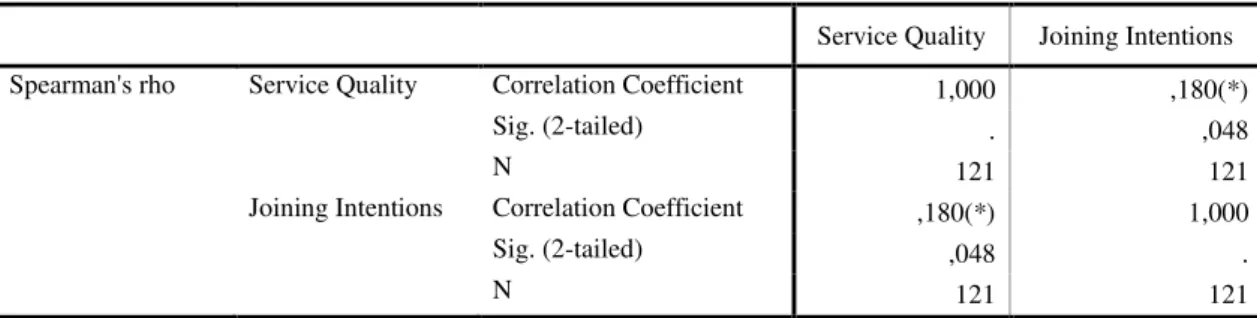
− H4 - The consumer’s perception of the service quality positively influences the consumer’s intention to join the club.
− H5 - The consumer’s perception of the price range positively influences the consumer’s intention to join the club.
− H6 - The consumer’s perception of the Health Club’s image positively influences the consumer’s intention to join the club.
This investigation is based on research done on retail outlets and was adapted to the service outlet under investigation. We were able to conclude that factors other than price, service quality and image influence a member, or potential member’s joining intentions.
Table of Contents
ABSTRACT RESUMO EXECUTIVE SUMMARY TABLE OF CONTENTS LIST OF FIGURES LIST OF TABLES 1 INTRODUCTION 11.1 Theme and Importance 1
1.2 Investigation Topic 2 1.3 Investigation Objectives 2 1.4 Methodology 3 1.5 Dissertation Structure 3 2 LITERATURE REVIEW 4 2.1 Consumer Behaviour 4 2.2 Store Environment 10 2.2.1 Design 13 2.2.2 Ambient 14 2.2.3 Social 17
2.3 Image of a Point of Sale 18
3 METHODOLOGY 19
3.1 Conceptual Framework and Investigation Hypotheses 19
3.1.1 Service Quality Perceptions 20
3.1.2 Price Perceptions 22
3.1.3 Health Club Image Perceptions 23
3.3 Construction of the Questionnaire 27
3.4 Sample 29
3.5 Data Analysis Techniques 30
4 RESULTS 31
4.1 Demographic Characteristics 31
4.2 Descriptive Analysis of the Data Acquired 33
4.3 Latent Variable Measurement Models 59
4.3.1 Design Variable 60
4.3.2 Ambient Variable 63
4.3.3 SocialVariable 66
4.3.4 Service QualityVariable 70
4.3.5 PriceVariable 73
4.3.6 ImageVariable 75
4.3.7 Joining IntentionsVariable 78
4.4 Hypotheses Testing 80
5 CONCLUSION 91
5.1 Summary of Major Findings 91
5.2 Findings Implications 94
5.3 Limitations of the Study 95
5.4 Suggestions for Further Research 96
6 BIBLIOGRAPHIC REFERENCES 97
7 APPENDICES 100
7.1 Appendix A. – Questionnaire in English 100
7.2 Appendix B. – Questionnaire in Portuguese 107
List of Figures
Figure 1 A Structure of Consumer Behaviour: Summary Flow Chart (Nicosia, 1968)
7
Figure 2 A Simple Model of Consumer Decision Making (Schiffman and Kanuk, 2007)
9
Figure 3 A Conceptual Model of the Prepurchase Process of Assessing a Retail Outlet on the Basis of Environmental Perceptions (Baker et al, 2002)
12
Figure 4 Conceptual Model 20
List of Tables
Table 1 Hypotheses 24
Table 2 Gender Distribution 32
Table 3 Age Group Distribution 32
Table 4 Income Distribution 33
Table 5.1 Space Perceptions 34
Table 5.2 Nº of Employee Perception 49
Table 5.3 Importance Given to the No. of Employees 49
Table 5.4 Investment Evaluation 56
Table 5.5 Contract Renewal 56
Table 5.6 Composition of Latent Variables 58
Table 6.1 - Table 6.8 Factorial Analysis and Reliabilty Test Output of the Variable “Design”
60
Table 6.9 - Table 6.16 Factorial Analysis and Reliabilty Test Output of the Variable “Ambient”
64
Table 6.17 - Table 6.24 Factorial Analysis and Reliabilty Test Output of the Variable “Social”
67
Table 6.25 - Table 6.32 Factorial Analysis and Reliabilty Test Output of the Variable “Service Quality”
70
Table 6.33 - Table 6.39 Factorial Analysis and Reliabilty Test Output of the Variable “Price”
Table 6.40 - Table 6.47 Factorial Analysis and Reliabilty Test Output of the Variable “Image”
75
Table 6.48 - Table 6.54 Factorial Analysis and Reliabilty Test Output of the Variable “Joining Intentions”
78
Table 6.55 General Hypotheses 80
Table 6.56 Tests of Normality 82
Table 6.57 Spearman Correlation Output of H1a 83
Table 6.58 Spearman Correlation Output of H15 83
Table 6.59 Spearman Correlation Output of H1c 84
Table 6.60 Spearman Correlation Output of H2a 84
Table 6.61 Spearman Correlation Output of H2b 85
Table 6.62 Spearman Correlation Output of H2c 86
Table 6.63 Spearman Correlation Output of H3a 86
Table 6.64 Spearman Correlation Output of H3b 87
Table 6.65 Spearman Correlation Output of H3c 87
Table 6.66 Spearman Correlation Output of H4 88
Table 6.67 Spearman Correlation Output of H5 89
Table 6.68 Spearman Correlation Output of H6 89
1 Introduction
1.1 Theme and Importance
Confronted with new life-styles, consumers today have grown in more ways than one. The “New Consumer” (Correia, 2004) is more informed, cultured, sophisticated, independent and much less loyal in comparison with his ancestors due to the new technologies that have emerged over time. Now information is acquired at a click of a button allowing consumers all over the world to be more demanding, informed and alert.
Today, people in general, are more concerned with the environment, their health and well being (Leeflang and Van Raaij, 1995) among other aspects. This being said, the evolution of the world has provoked a change in the purchase patterns which obligates companies to be even more attentive and dedicated to their clients. Therefore, the understanding of how the client’s mind works is crucial for the survival of any organization. The client is a company’s number one asset, especially in the Health Club industry.
Currently Portugal holds the title for the highest sedentary rate in Europe, i.e. 66% of the Portuguese population does not perform any type of exercise. The country is in second place regarding overweight conditions, childhood obesity and diseases associated with inactivity (diabetes, cardiovascular diseases, hypertension, certain cancers, etc.). The government is implementing plans to combat these problems, of which one strategy was to reduce the VAT weight on health from 21% to 5% with the objective of reducing the Health Club’s monthly fee and therefore allowing more people to gain access to a healthier life style.
Recent studies show that the wellness and fitness market will increase by 500% by the end of the year 2010 and the Baby Boomers will be the main generation responsible for this rapid increase (Mauro, 2008). This being said, Health Clubs need to know how to attract their clients today as well as how to retain them, seeing that the Health Club industry is one of the industries with the highest growth potential. To allow this to
happen, it is essential to know what the client wants and expects and therefore being important to know what drives the consumer’s motivation.
The intention of this investigation is to expand the scientific knowledge regarding the motivations of consumers and provide knowledge to the owners and/ or managers of Health Clubs in Portugal. This analysis will be focused on how the ambient and design of a Health Club as well as the service provided by its employees, can influence the consumer’s store choice criteria. The factors that are most valued by customers of such establishments will be identified and can be used for future reflection by entrepreneurs of this industry.
1.2 Investigation Topic
The theme of this investigation is Distribution Management, more specifically in the Health Club Industry in Portugal. This study will be essentially focused on how a store’s image and environment can influence consumers when choosing a point of sale. In other words, the intention of this study is to evaluate the impact of a company’s image when choosing a POS.
1.3 Investigation Objectives
The purpose of this study is essentially to analyze whether or not consumers are influenced by a store’s environment and the impact of this environment when it comes to the store choice criteria. This investigation is set on identifying the principle characteristics of Health Clubs in Portugal that are taken into consideration when clients or potential clients are considering joining a club of this nature.
In theory, the store’s environment consists of three elements: ambient, design and service provided by employees (Baker et al, 2002).
In traditional Marketing, the Marketing Mix (4 P's) facilitate marketing decisions making use of the following four controllable categories: (1) Product; (2) Price; (3) Place (distribution) and; (4) Promotion. The term "marketing mix" was first used by Neil H. Borden in 1964 in the article entitled “The Concept of the Marketing Mix”. Borden considered that the elements included: product planning, pricing, branding, distribution channels, personal selling, advertising, promotions, packaging, display,
grouped these ingredients into the four categories that today are known as the 4 P's of marketing.
Seeing that Health Clubs are considered to be part of the service industry, another three categories need to be added to the 4 P’s for the analysis to be complete. These categories are: People; Process and Physical Evidence (Booms and Bitner, 1981).
This thesis took into consideration the 7 P’s of Marketing when selecting the store choice criteria for this study. Using the P’s ‘People’, ‘Price’ and ‘Physical Evidence’, the chosen criteria that will be analyzed are: (1) Service Quality; (2) Price and lastly (3) Store Image.
The central objective of this analysis is the construction of a conceptual model that analyzes the influence over consumer’s perception on the ambient, design and service provided by employees and how these three elements influence the client in their Health Club choice decision.
1.4 Methodology
The methodology used in this investigation is based on structured questionnaires to personal interview as well as mail surveys. The target population are members of a Health Club in Torres Vedras, aged from 18 years and above and were chosen by convenience. A conceptual model will be constructed, hypotheses will be formulated and the tools and methods will be identified.
1.5 Dissertation Structure
This dissertation is composed of five distinctive parts: (I) Introduction; (II) Literature Review; (III) Methodology; (IV) Results; and (V) Conclusion.
Part I – Introduction, is a general presentation of this thesis and consists of five subdivisions: (1) Theme and importance of the investigation; (2) Investigation Topic; (3) Objectives; (4) Methodology; and (5) Dissertation structure.
Part II – Literature review, is where the theoretical part of this investigation is explored. In this section a special emphasis is given to the consumer’s behaviour and we study how this behaviour is influenced by a store’s atmospherics. Topics such as store choice criteria, store environment and image of a POS are studied in this section.
Part III – Methodology, is focused mainly on putting theory into a practical application by constructing a conceptual model that analyzes the influence over consumer’s perception of a Health Club’s environment and how it influences the choice criteria. It also includes a description of the sample that will be used as well as the procedures, data analysis, instruments and techniques.
Part IV – Results, is where the results of the quantitative study are presented.
Part V – Conclusion, is where the results that were presented in the previous chapter are analyzed and discussed. This section is dedicated to presenting the main conclusions that derived from the study as well as the limitations that occurred during this investigation, finalizing with recommendations for future studies.
2 Literature Review
In this section of the investigation, topics related to consumer behaviour, store environment and the point of sale image are studied. The purpose of these studies is to allow a better understanding of the impact of a company’s image and environment when choosing a point of sale (POS).
2.1 Consumer Behaviour
According to Schiffman and Kanuk (2007), the term Consumer Behaviour is described to be “the behaviour that consumers display in searching for, purchasing, using, evaluating and disposing of products and services that they expect will satisfy their needs.”
Consumer Behaviour can also be defined as an interaction of cognition and affect, behavioural and environmental events where humans conduct the exchange aspects of their lives. Generically speaking, it is safe to assume that consumer behaviour is created by combining psychology and marketing, seeing that Consumer Behaviour is the psychology behind marketing and the behaviour of consumers in the marketing environment (American Marketing Association).
study of consumer behaviour, many authors have developed models that allow a better comprehension of this subject. Through these models, it is possible to identify the importance of the variables: (1) the environment and (2) the company’s image in the consumer decision-making process.
Schiffman and Kanuk (2007), before studying how consumer decisions are made, noted that it is necessary to look at models of consumers. According to these authors, the expression models of consumers refers to a “general view or perspective as to how (…) individuals behave as they do”. These models consist of four views: an economic view, a passive view, a cognitive view and an emotional view.
The economic view consists of assuming a world of perfect competition where the consumer often is characterized as a rational decision maker. This model has been criticized by various authors. The reason being that for a consumer do behave rationally, he would have to: “(1) be aware of all available product alternatives, (2) be capable of correctly ranking each alterative in terms of its benefits and disadvantages, and (3) be able to identify the one best alternative.” This being said, it’s obvious that consumers rarely have enough information or even a sufficient level of involvement and motivation to allow them to make a “perfect decision”.
The passive view is the contrary to the economic view. The passive view assumes “that consumers are perceived as impulsive and irrational purchasers, ready to yield to the aims and into the arms of the marketers”. The main disadvantage of this model is that it doesn’t acknowledge the fact that the consumer plays a very important role in many buying situations. A simple fact like searching for information about alternatives, choosing a product that at that moment best pleases their mood, finding an emotion offering them satisfaction, etc. allows us to state that not all buying decisions are impulsive and irrational.
Up until now, we have discussed the consumer as a “rational decision maker” and an “impulsive and irrational purchaser”. The following model assumes the consumer as a “thinking problem solver”. The cognitive view “focuses on the process by which consumers seek and evaluate information about selected brands and retail outlets.” Consumers process information and therefore are referred to as information processors. According to this model, consumers will acquire information until they feel that they have a sufficient level of information about an alternative or alternatives allowing him
to make satisfactory decisions. As a result, we can easily state that the “problem solver” lies somewhere between the “rational decision maker” and the “impulsive and irrational purchaser”.
The last model, the emotional view, defends that each consumer frequently associates profound feelings and emotions such as happiness, fear, love, faith, fantasy, and so forth with several purchases. When this happens, less emphasis is given to gathering prepurchase information, giving more importance to the mood and emotions that the consumer is experiencing when purchasing an item. Note that this does not mean that an emotional decision is 100% irrational. If the product purchased satisfies the emotional necessity, we can call it a rational decision. A consumer’s mood is considered to be an important factor to consumer decision making. “It impacts on when consumers shop,
where they shop and whether they shop alone or with others.”
Francesco Nicosia (1968) was the first author to introduce a model that focuses on the consumer’s decision making process. In this model, all the variables are interdependent allowing a circular flow of influences in which each component supplies inputs for the next. According to this author, the consumer’s decision is composed of four fields as illustrated in Figure 1, presented on the following page.
According to Nicosia (1968)
which the consumer decision process should work. “By stating specific variables and their general interdependencies, it offers the necessary guidelines for data collection, and the technical bases for experimental simulations of the psychological, soci
economic processes it describes and of the possible reactions of these processes to different advertising policies.”
Subfield One Firm’s Attributes
FIGURE 1–ASTRUCTURE OF
FIELD ONE: From the Source of a Message to the Consumer’s Attitude
FIELD FOUR: The Feedback Message Exposure Consumption Storage
(1968), the flow chart illustrated above shows the
which the consumer decision process should work. “By stating specific variables and their general interdependencies, it offers the necessary guidelines for data collection, and the technical bases for experimental simulations of the psychological, soci
economic processes it describes and of the possible reactions of these processes to different advertising policies.”
Decision (action) Search Evaluation Subfield Two Consumer’s Attributes (especially predispositions) FONT:NICOSIA,1968 Motivation
TRUCTURE OF CONSUMER BEHAVIOUR:SUMMARY
Purchasing Behaviour
FIELD ONE: From the Source of a Message to the Consumer’s Attitude
Experience
Attitude
Message Exposure
, the flow chart illustrated above shows the direction in which the consumer decision process should work. “By stating specific variables and their general interdependencies, it offers the necessary guidelines for data collection, and the technical bases for experimental simulations of the psychological, social, and economic processes it describes and of the possible reactions of these processes to
Decision Evaluation
Motivation
UMMARY FLOW CHART
FIELD TWO: Search for, and Evaluation of, Means-End(s) Relation(s) (Pre-action Field)
FIELD THREE:
The flow chart indicates the following: Field One is responsible to pass the message from a firm to a consumer. Subfield one consists of the firm’s attributes. The interaction between these attributes creates a message directed to a “homogeneous market segment”. On the other hand, subfield two consists of the consumer’s space which includes all the consumer’s attributes. Once the message has reached the consumer targeted, it becomes an input into the consumer’s space.
Once the output of Subfield two is established, an attitude may or not be formed toward the product and brand. If the formation of the attitude is successful, then we pass to Field two. At this time, the consumer may do an internal or external search. Field two consists of “a search for, and evaluation of, means-ends relations between the attitude toward the advertised product and brand and the number of brands perceived as available”. The output resulting from this field may or not form a motivation toward the advertised brand.
If the formation was a success, it will become the input into Field three. This field consists of the possibility of conversion of the motivation into an act of purchase. The output developed, may or not be the purchase of the brand in question. Once a purchase is made, Field four receives its input.
“Field Four consists of operations such as storage and consumption (or use) that lead to experience with the brand”. The resulting output is then an experience that ends up becoming the input into Field one, thus closing the cycle.
Schiffman and Kanuk (2007) have put together a model that links the consumer decision making process with consumption behaviour. This simple model, designed to synthesize and provide a global picture of the decision making process, has three components: (1) input, (2) process, and (3) output. Input is mainly a result of external influences (marketing and sociocultural environment). Process is where the consumer makes his decision, evaluating alternatives. Last, but not least, Output consists of the consumers postdecision behaviour.
By analysing Figure 2, presented on the following page, we can conclude that Marketing as well as the environment in which the consumer finds himself, plays a great role in the consumer decision making process. When well done, it can influence a
An individual's mood can apparently influence behaviour without interfering with other cognitive processes (Clark, 1982; Clark & Isen, 1982) (
can be defined as an affective or emotional state, i.e. as a state of mind or emotion. The ambient and surroundings in which consumer’s find themselves normally influences
Input
External Influences
Postdecision Behavior
Output Process
Consumer Decision Making
FIGURE 2–A
FONT
Firm’s Marketing Efforts
1. Product 2. Promotion 3. Price 4. Channels of distribution Need Recognition Prepurchase Search Evaluation of alternatives Purchase 1. Trial 2. Repeat purchase Postpurchase Evaluation
An individual's mood can apparently influence behaviour without interfering with other cognitive processes (Clark, 1982; Clark & Isen, 1982) (in Mathur et al, 1997). A mood can be defined as an affective or emotional state, i.e. as a state of mind or emotion. The ambient and surroundings in which consumer’s find themselves normally influences
External Influences
Postdecision Behavior Consumer Decision Making
ASIMPLE MODEL OF CONSUMER DECISION M
ONT:SCHIFFMAN andKANUK,2007
Firm’s Marketing Efforts
2. Promotion
4. Channels of distribution
Sociocultural Environment 1. Family
2. Informal sources
3. Other noncommercial sources 4. Social class
5. Subculture and culture
Need Recognition Prepurchase Search Evaluation of alternatives Psychological Field 1. Motivation 2. Perception 3. Learning 4. Personality 5. Attitudes Experience 2. Repeat purchase Postpurchase Evaluation
An individual's mood can apparently influence behaviour without interfering with other , 1997). A mood can be defined as an affective or emotional state, i.e. as a state of mind or emotion. The ambient and surroundings in which consumer’s find themselves normally influences
MAKING
Sociocultural Environment
3. Other noncommercial sources 5. Subculture and culture
Psychological Field
their mood and therefore influencing their decision. This being said, the store environment plays an important role in the consumer’s decision process. Next we shall study what the store environment consists of and analyze each of its components independently.
2.2 Store Environment
The store environment may be defined as a set of attributes of a point of sale expressed by the exterior and interior of a store (Cunha, 2006).
Prior store environment case studies have shown that a number of environmental elements, which include music, colour, scent and crowding, when tested individually, affect consumer response (Baker et al, 2002). Spas are good examples of how these elements, when used correctly, influence the consumer’s behaviour. The soothing background music, the soft scent in the air, the neutral and earthy colours, the lighting placed at just the right intensity, among other Spa characteristics, gives the consumer all he needs to feel relaxed.
The term atmospherics was first used by Kotler (1973), in which it is defined as “the conscious designing of space to create certain effects in buyers”. The author states that atmospherics is an attempt to design an environment that produces specific emotional effects in the buyer, creating a greater probability of purchase.
Similarly, Roy and Tai (2003) affirm that “atmospherics are often designed to create a buying environment that produces specific emotional and experience effects that will enhance a consumer’s likelihood of purchase.”
According to Tai and Fung (1997), “stores and store design in the form of atmosphere, project massive amounts of information to shoppers with cues such as display, colour, lighting, layout and departmentalization”. These elements form a sensory stimulation and their purpose is to create a high level of sensory involvement by consumers.
Atmospherics, in the consumer’s perspective, may be experienced through sensory channels, i.e. sight, sound, scent and touch. To be more precise, these sensory channels can be divided into 4 main dimensions: (1) visual (colour, brightness, size and shapes), (2) aural (volume, pitch), (3) olfactory (scent, freshness) and (4) tactile (softness,
Researchers have come to the conclusion that sensory information from environmental cues influence cognitive or emotional states which can change shopping behaviours, store atmospherics and affect customers’ product perception (Gardner and Soimkos, 1986)(in Tai and Fung, 1997).
Store atmosphere effects are emotional states that (1) are difficult to verbalize, (2) are difficult to recall and (3) influence behaviours within the store (Donovan and Rossiter, 1982). Kotler (1973) goes as far as saying that “atmospheres are a silent language in communication”.
Mattila and Wirtz (2001) have concluded from their research that adding pleasant environmental cues enhances the shopping experience. The authors also found that such environmental stimuli should not be considered individually, seeing that the global effect is what influences the consumer response.
After intensive literature reviews, it is possible to state that the store’s environment has three distinct cues: design, ambient, and social (Baker et al, 2002).
The design of a POS includes the layout, architecture, decoration, materials and styles used in the construction of the point of sale (Baker, 1987). The ambient of a store’s environment consists in the music, scent, noise, temperature, air quality, among other aspects (Bitner, 1992).
The difference between these two elements (i.e. design and ambient) is that “ambient cues tend to affect non-visual senses whereas design cues are more visual in nature”. Another point of dissimilarity would be in terms of the level in which they are processed seeing that “ambient cues tend to be processed at a more subconscious level than are design cues” (Baker et al, 2002).
The social cues, according to Baker et al (2002), are linked to the store employee perception.
Due to several studies in this field, authors have found empirical evidence that confirm the fact that the information gathered from environmental cues “influences consumers’ perceptions of service providers (Baumgarten and Hensel 1987) and helps consumers categorize service firms (Ward, Bitner, and Barnes 1992)” (in Baker et al , 2002).
Store Environment Store employee perceptions Store design perceptions Store music perceptions According to Baker et al
assessing a retail outlet on the basis of environmental perceptions can be schemed as illustrated in Figure 3: H1d (+) H1e (+) H1c (+) H1a (-) H1b (-) H3d (+) H3e (+) H3c (+) H3a (-) H3b (-) H2d (+) H2e (+) H2c (+) H2a (-) H2b (-) Social Factors Design Factors Ambient Factors FIGURE 3–ACONCEPTUAL M OUTLET ON THE
Store Choice Criteria
Interpersonal service quality perceptions Merchandise quality perceptions Monetary price perceptions Time/effort cost perceptions Psychic cost perceptions
(2002) the conceptual model of the prepurchase process of assessing a retail outlet on the basis of environmental perceptions can be schemed as
Merchandise value perceptions
Indicates a hypothesized structural path.
Indicates a correlation path, specific by
diagonal parameters in the phi and psi matrices for exogenous and endogenous variables,
respectively. Shopping Experience Costs H6 (+) H4 (+) H5a (-) H5b (-) H5c (-)
MODEL OF THE PREPURCHASE PROCESS OF A UTLET ON THE BASIS OF ENVIRONMENTAL PERCEPTIONS
(2002) the conceptual model of the prepurchase process of assessing a retail outlet on the basis of environmental perceptions can be schemed as
Store Patronage Intentions Store patronage intentions Merchandise
Indicates a hypothesized structural path.
Indicates a correlation path, specific by freeing off-diagonal parameters in the phi and psi matrices for exogenous and endogenous variables,
H7 (+)
H8a (-)
H8b (-)
ASSESSING A RETAIL ERCEPTIONS
Bitner (1992) argues that consumers turn to design, ambient, and social environmental cues when evaluating stores, since they believe that these cues offer reliable information about product-related attributes such as quality, price, and the overall shopping experience.
In order to comprehend these environmental cues, we shall study each one of them individually.
2.2.1 Design
One of the most important features of the total product is the place where it is bought or consumed (Kotler, 1973). According to the author, a store’s image (interior and exterior) can be designed to stimulate specific feelings that end up influencing the purchase.
The design of a point of sale is visual in nature. It is how the point of sale is displayed (Philips and Bradshaw, 1990) (in Tai and Fung, 1997). This includes the store’s layout, display, architecture, decoration, materials and styles, among other visual elements. As we have already discussed, the main sensory channels for atmosphere are sound, scent, sight and touch. The fifth sense, taste, does not apply to these studies. According to Tai and Fung (1997), “atmosphere design is particularly important for the retailer when the number of competitive outlets increases; or when product and price differences are small; or when product entries are aimed at distinct social classes or lifestyle buyer groups”. In other words, atmosphere design helps the store to differentiate itself from its competitors.
Service design research is also said to be multi-disciplinary, including disciplines such as operations management, marketing, human resources, information technology, organizational behaviour, functional strategy, economics and so forth (Hill et al, 2001). This being said, managers should combine information from these departments in order to identify the consumer’s preferences so that they can develop a design that is most appropriate for their target market.(Sirgy et al, 2000)(in Cunha, 2006).The stores design should be flexible (Cunha, 2006).
Researchers have studied design in many outlets, in which most research has been concentrated on retail outlets. Designs such as “grid” (mostly used in hypermarkets,
supermarkets), “racetrack” (commonly used in department stores), and “free-form” (used in smaller speciality stores) are very well known and commonly used in the retail industry (Cunha, 2006).
In what refers to service outlets, very little research has been done. This lack of attention is of great concern, since service design has been identified as ‘perhaps the most crucial factor for quality’ (Gummesson, 1993) (in Tax and Stuart, 1997).
Although there is very little information on this subject, one can state that the positive points in a retail outlet design should be taken into consideration so that an adaptation can be made to a service outlet. The store space should be optimized and should be appropriate to the type of business.
When considering a layout, one should take into account three principles: circulation, coordination and convenience (Levy and Weitz, 2004) (in Cunha, 2006). In other words, a layout should allow control of the flux of clients in the store, products should be strategically placed according to the type of consumer targeted and lastly, products should be easy to find.
When referring specifically to Health Clubs, the ambient and design cues are related to hygienic issues in the facility, equipment conditions, and the design of the facility; where as the social dimension refers to the attitude and behaviour of other members within the facility, especially in social situations (Alexandris et al, 2004).
The design cue consists of elements such as the facility’s attractiveness, the use of up-to-date equipment, whether or not it is spacious and so forth (Alexandris et al, 2004). All these elements may influence the consumer’s perspective of the Health club as well as their psychological commitment. However, as previously stated the environmental cues do not and should not act individually. Next, we shall study the ambient and social cues.
2.2.2 Ambient
As Herbert George Wells (1866 – 1946) once said, “beauty lies in the eyes of the beholder”. In other words, beauty is perceived differently by each person. It exists in
The store environment is being more and more recognized for the influence it has upon sales (Milliman 1982, 1986; Smith and Cumow 1966), product evaluations (Bitner 1986; Rappoport 1982; Wheatley and Chiu 1977), and satisfaction (Bitner 1990; Harrell, Hutt, and Anderson 1980) (in Spangenberg et al, 1996). Attitudes that consumers have toward the environmental cues have shown to play a greater role in the consumer choice criteria than the merchandise. One of the environmental cues that have been recently more explored by authors is the ambient. After long and extensive research, we have come to the conclusion that the ambient consists of music (Milliman, 1986), colour (Bitner, 1992), cleanliness, lighting (Summers and Hebert, 2001), temperature, visual communication (Grewal et al, 2003), scent (Spangenberg et al, 1996) and so forth.
Mattila et al (2001) state that “improving a store’s ambient conditions enhances consumers’ evaluations of and behaviours in the shopping experience”. The authors highlight that when one strategically manipulates the store environment via elements such as scents and music, it is necessary to insure that the elements used to improve the environment’s arousing do not clash.
In fact, many authors have tested these variables individually as well as together in order to examine the effects that they have upon the store’s environment in the consumer’s perspective. Mattila et al (2001) state that elements such as ambient, scent and music, when congruent with each other in terms of their arousing qualities, have a specific reaction upon consumers. They “rate the environment significantly more positive, exhibit higher levels of approach and impulse buying behaviours, and experience enhanced satisfaction than when these environmental cues were at odds with each other.”
With the competitiveness that exists at present, service outlets are not only diffusing scents into their stores to create more positive environments but also using it to create a competitive advantage (Spangenberg et al, 1996). Distinctive scents are used to differentiate stores and therefore we can state that scents are used as a method to increase positive evaluations of the store's environment.
Another element in which the ambient cue consists of is colour. According to Bellizzi, Crowley, and Hasty 1983; Crowley 1993 (in Spangenberg et al, 1996), “colour has been shown to affect liking of the store and perceptions of merchandise”. According to Lin
(2004), different colours stimulate different personal moods and emotions. Children, for example, often have a positive response to light colours and negative response to dark colours (Boyatzis and Varghese, 1994) (in Lin, 2004).
Music has also been studied as an element of the ambient cue. Studies have shown that by increasing the tempo and intensity of in-store music, one can influence the time spent by consumers in the store (Milliman, 1986). In other words, “environmental music regards consumers' perceptions of time; different types of environmental music have been shown to shorten or lengthen the perceived amount of time spent” (Spangenberg et
al, 1996).
Lighting has said to be an important element of store atmospherics (Summers and Hebert, 2001). The authors state that “a more appealing store with better-illuminated merchandise may entice shoppers to visit the store, linger, and hopefully make a purchase”. Further more, their studies allowed them to conclude that “increased levels of lighting will produce arousal and pleasure and increase the approach behaviours of consumers”.
As previously discussed, temperature is also known as an element of the store’s ambient cue. Every ambient has its “comfort zone” when relating to temperature. According to Baker and Cameron (1996), temperatures that exceed or do not reach this border (too hot or too cold) may affect negatively the emotional state of a person (in Cunha, 2006). One tends to feel uncomfortable and irritated, feeling the need to leave the store as quick as possible.
On the other hand, one can enhance the store’s environmental cues through visual communications, which include signs and graphics (Grewal et al, 2003).
In the Health Club industry, ambient cues include elements such as facility cleanliness and whether or not the equipment is in good condition among other aspects (Alexandris
et al, 2004).
Nevertheless, the store’s atmospherics does not only rely on its visual and non visual elements. A third component is also needed to enhance the store environment. This element includes the human part of an organization – the stores personnel – which in this investigation we classify as the “social cue”.
2.2.3 Social
“Physical or social stimuli affect directly the emotional state of a person, which in turn influences their behaviours”. (Hightower et al, 2002)
According to Milliman and Turley (2000), the store’s “human variables” include: (1) employee characteristics, (2) employee uniforms, (3) crowding, (4) customer characteristics and, (5) privacy.
Bitner (1992) argues that the servicescape “influences the nature and quality of customer and employee interactions, most directly in interpersonal services”. Interpersonal services include Hotels, Restaurants, and Health clinics among others, where both customer and employee perform actions in the servicescape. According to the author, “in interpersonal servicescapes, special consideration must be given to the effects of the physical environment on the nature and quality of the social interaction between and among customers and employees”. The servicescape not only influences the consumers but also the employees in service organizations.
It is important to understand how consumers perceive the service provided to them while shopping. The service quality, just like the other environmental cues, can influence the consumer’s decision to revisit the store.
Researchers have found evidence that consumers use specific attributes or cues to deduce quality. This being said, it is crucial for managers to identify these attributes with the aim of optimising consumers' general perception of quality and value (Olshavsky, 1985; Olson and Jacoby, 19721) (in Gould-Williams, 1999).
The perception that clients have of service quality, is influenced by: (1) consumers interaction with employees, (2) the perceived outcome of the service encounter, and (3) the service firm’s physical environment (Grönroos, 1982; Lehtinen and Lehtinen, 1982; Rust and Oliver, 1994) (in Hightower et al, 2002).
According to Bitner (1990), “the performance of customer contact employees is reported as forming a dominant quality cue” (in Gould-Williams, 1999).
In a Health Club, social conditions consist of the interaction among the customers and employees. It includes elements such as the ‘niceness’ of the facility’s atmosphere, whether or not employees respond quickly to member’s requirements, whether the
employees are able to make members feel comfortable, whether they work with enthusiasm, whether they are polite, whether they respect members’ needs, their reliability, knowledge, trustfulness, and so forth. (Alexandris et al, 2004).
2.3 Image of a Point of Sale
A store’s image (or personality) can be defined as store layout, architecture, symbols, colours and sales personnel. According to Martineau (1958), the image of a POS is the deciding factor that attracts consumers. The author believes in the existence of “a force operative in the determination of a store's customer body besides the obvious functional factors of location, price ranges, and merchandise offerings” and calls this “force” the store image. Martineau (1958) states that “the shopper seeks the store whose image is most congruent with the image she has of herself”. The image that she portrays for herself includes variables such as: attitude, expectations, motivations, habits, and so forth. The author also highlights the importance of a company image in the success of service organizations.
Houston and Nevin (1981) define the store image as “the complex aggregate of a customer’s perceptions of a store on salient attributes” (in O’ Cass et al, 2008).
Zimmer (1988) states that “a store's image is the way it is perceived by consumers” and that “it can ultimately influence patronage behaviour”. The author affirms that the consumer's perception of image derives from both objective and subjective store characteristics and also emphasizes other types of image descriptors such as “global image perceptions that summarize the consumer's gestalt impression of a store; store-type labels that represent institutional categories; prototypic and exemplar image descriptors, which are comparative-based impressions utilizing other stores as anchors in the image description; product-related image descriptors that link the store's image to the consumer's evaluation of the merchandise carried; and finally, behavioural image descriptors, which categorize a store according to its inclusion or exclusion from a choice set”.
According to Baker et al (1994), the “store environment indirectly influences store image through merchandise and service quality inferences”. These authors define store image as a “cognition/affect that is inferred from a set of perceptions” and also suggest
that “the relationship between store environment and store image is mediated by consumer inferences”.
Stanley and Sewall (1976), Nevin and Houston (1980) and Malhotra (1983) state that a store’s image plays an important role in the store choice decision (in Baker et al, 1994). The store image has various components which vary from author to author. Berman and Evans (1995) identify components such as: target characteristics; location, price levels, installation attributes, service provided to clients, community service, publicity, sales promotion, and so forth. Ghosh (1994), on the other hand, classifies as store image components the following: prices, goods, service provided, physical characteristics, convenience, types of publicity and promotion, ambient, consumer characteristics and employee characteristics. Although the components vary, the over-all idea is very similar.
3 Methodology
In order to fully understand the relationship between the three environmental cues under investigation and its influence on the consumers choice criteria, it is wise to highlight the necessity to construct a conceptual model not only to explain the link that these two subjects have with one another but also, using the intensive research done in the literature review, to come to a conclusion.
3.1 Conceptual Framework and Investigation Hypotheses
The conceptual model proposed in this investigation is based on the research done by Baker’s et al (2002) conceptual model of the prepurchase process of assessing a retail outlet on the basis of environmental perceptions and has been adapted to a service outlet point of view, more specifically, a Health Club. The task of identifying the hypotheses is easier once the model is represented. As previously stated, the Health Club choice criteria under investigation are (1) Service Quality; (2) Price; and lastly; (3) Health Club Image.
Health Club Enivronment
Design perceptions
Ambient perceptions
Social perceptions
The reasons for constructing the model in this manner, using these specific variables are explained next.
3.1.1 Service Quality Perceptions
Service quality can be defined by using merely two words: “consistent performance”. Researchers are more and more interested in the subject ‘service quality’ because of its influence on customer satisfaction and customer loyalty (Alexandris
Nowadays, the market being as competitive as it is, “service quality is now considered as an essential strategy” (Gould
conceptualised as the gap between consumers' expectations about a service and their subsequent perception of service performance
H1a (+) H1b (+) H1c (+) H2a (+) H2b (+) H2c (+) H3a (+) H3b (+) H3c (+)
Health Club Choice Criteria
Service quality perceptions
Price perceptions
Health Club image perceptions
The reasons for constructing the model in this manner, using these specific variables
Quality Perceptions
Service quality can be defined by using merely two words: “consistent performance”. Researchers are more and more interested in the subject ‘service quality’ because of its influence on customer satisfaction and customer loyalty (Alexandris
owadays, the market being as competitive as it is, “service quality is now considered an essential strategy” (Gould-Williams, 1999). In theory, service quality is conceptualised as the gap between consumers' expectations about a service and their uent perception of service performance (Grijnroos, 1984; Lehtinen and Lehtinen,
FIGURE 4–CONCEPTUAL MODEL
H4 (+)
H5 (+)
H6 (+)
The reasons for constructing the model in this manner, using these specific variables,
Service quality can be defined by using merely two words: “consistent performance”. Researchers are more and more interested in the subject ‘service quality’ because of its influence on customer satisfaction and customer loyalty (Alexandris et al, 2004). owadays, the market being as competitive as it is, “service quality is now considered In theory, service quality is conceptualised as the gap between consumers' expectations about a service and their Grijnroos, 1984; Lehtinen and Lehtinen,
Health Club Joining Intentions
Seeing that service quality is intangible and subjective, many researchers have created frameworks for measuring service quality, for example Parasuraman et al (1985). In fact, these authors (Parasuraman, Zeithaml & Berry, 1985) developed a model called SERVQUAL, which includes five factors (originally ten): (1) reliability, (2) assurance, (3) tangibles, (4) empathy and (5) responsiveness. Other researchers, such as Grönroos (1984, 1990) proposed a three-dimensional model and Dabholkar, Thorpe & Rentz (1996) proposed a multi-level service quality-model (in Alexandris et al, 2004). All these were attempts to find a way to measure service quality.
According to Hutcheson et al (1998), “merchandise and service quality inferences mediate the relationship between store environment and store image”. This being said, including service quality as a factor in the conceptual model presented in this investigation was an obligation.
The objective is to be able to include factors that influence the consumer’s perception about the service quality of a Health Club. As a result, using the conceptual model presented in Figure 4, four hypotheses arise. The first three are related to the three environmental cues: design, ambient and social and the last one is related to studying whether or not consumer’s perception of the service quality influences the consumer’s intention to join the club in a positive manner. The hypotheses that are formulated are the following:
H1a – The consumer’s perception of the Health Club’s design positively influences
the consumer’s perception of the service quality.
H2a – The consumer’s perception of the Health Club’s ambient positively
influences the consumer’s perception of the service quality.
H3a – The consumer’s perception of the Health Club’s social factors positively
influences the consumer’s perception of the service quality.
The aim of this section is to acknowledge whether or not the consumer’s perception of the service quality influences his intention to join the Health Club. Therefore, H4 is
formulated as the following:
H4 – The consumer’s perception of the service quality positively influences the
3.1.2 Price Perceptions
Including “price” as one of the Health Club choice criteria in this investigation isn’t by any means random. In this section we aim to study how the consumer perceives the price range of the services provided by the Health Club.
In the past years, an increasing awareness of the complexity of price as a determinant of a purchase decision is evident (Monroe, 1973). The same author states that “according to the economic theory, price is assumed to influence buyer choice because price serves as an indicator of purchase cost”.
Jacoby and Olson (1977) explain the consumer’s price perception in their own terms through the S-O-R system. The symbols S, O and R stand for: (S) Stimulus variables, (O) Organismic variables and (R) Response variables. “Stimulus variables (S) represent the actual price and other relevant input variables. Organismic variables (O) include the acquisition, encoding, storage, and retrieval of price information. The Response variables (R) include overt consumer behaviours of various types” (in Berkowitz et al, 1980).
According to Nagle (1987), “an important determinant of consumers' responses to price is their perception of the entire purchase situation, which includes store environment” (in Baker et al, 2002).
In-store atmospherics may generate price belief's independent of the actual prices (Kotler, 1973) (in Baker et al, 2002). This being said, this investigation proposes the following hypotheses regarding store atmospherics:
H1b – The consumer’s perception of the Health Club’s design positively influences
the consumer’s perception of the price range.
H2b – The consumer’s perception of the Health Club’s ambient positively
influences the consumer’s perception of the price range.
H3b – The consumer’s perception of the Health Club’s social factors positively
The overall intention of this part of the investigation is to study how the consumer’s price perception influences his decision to join a Health Club. With this is mind, the following hypothesis is formulated:
H5 – The consumer’s perception of the price range positively influences the
consumer’s intention to join the club.
3.1.3 Health Club Image Perceptions
To Martineau (1985), it isn’t just the price, quality nor service that make consumers buy where they do. It’s the stores personality that counts. According to the author, the consumers should be able to identify themselves with the store.
O’ Cass (2008) states that an “image is expressed as a function of the salient attributes of a particular store that are evaluated and weighted against each other”. Consequently and as previously stated, “Store image is defined as the complex aggregate of a customer’s perception of a store on salient attributes (Houston & Nevin, 1981)”.
It is necessary to understand how to rate a store image. Questions such as “is the store image portraying a positive vibe?” or “is this appealing to my target market?” are essential. According to Martineau (1985), “the image plays an increasingly vital part in the fortunes of business”.
This being said and in the context of this investigation, the aim of this section is to study the factors that influence the consumer’s perception of the image of a Health Club. In order to understand the influences that the consumer’s perception of design has upon the store image, the following hypothesis is formulated:
H1c – The consumer’s perception of the Health Club’s design positively influences
the consumer’s perception of the Health Club’s image.
The same applies to the consumer’s perception of the ambient and social cues, bringing together another two hypotheses: H2c and H3c as stated as follows:
H2c – The consumer’s perception of the Health Club’s ambient positively
H3c – The consumer’s perception of the Health Club’s social factors positively
influences the consumer’s perception of the Health Club’s image.
Martineau (1985) affirms that “perhaps the biggest single factor in the store image is the character of the sales personnel” therefore including H3c in this study is a must.
Ultimately, the objective of this section is to be able to explain whether or not the consumer’s perception of the Health Club’s image has any influence on his intention to join the club. This being said, the hypothesis formulated is the following:
H6 – The consumer’s perception of the Health Club’s image positively influences the
consumer’s intention to join the club.
Using the conceptual model presented, the hypotheses that will be taken into account in this investigation are listed below:
TABLE 1–HYPOTHESES
H1a The consumer’s perception of the Health Club’s design positively influences the
consumer’s perception of the service quality.
H1b The consumer’s perception of the Health Club’s design positively influences the
consumer’s perception of the price range.
H1c The consumer’s perception of the Health Club’s design positively influences the
consumer’s perception of the Health Club’s image.
H2a The consumer’s perception of the Health Club’s ambient positively influences
the consumer’s perception of the service quality.
H2b The consumer’s perception of the Health Club’s ambient positively influences
the consumer’s perception of the price range.
H2c The consumer’s perception of the Health Club’s ambient positively influences
the consumer’s perception of the Health Club’s image.
H3a The consumer’s perception of the Health Club’s social factors positively
H3b The consumer’s perception of the Health Club’s social factors positively
influences the consumer’s perception of the price range.
H3c The consumer’s perception of the Health Club’s social factors positively
influences the consumer’s perception of the Health Club’s image.
H4 The consumer’s perception of the service quality positively influences the
consumer’s intention to join the club.
H5 The consumer’s perception of the price range positively influences the
consumer’s intention to join the club.
H6 The consumer’s perception of the Health Club’s image positively influences the
consumer’s intention to join the club.
3.2 Health Club Description (in an objective view)
The Health Club is part of a condominium and therefore is limited in terms of parking lots. The total area of the installations is 1300 m2. It has two floors: ground floor and basement.
The ground floor is 270 m2 and has been divided into the following sections: reception; snack bar; restrooms for visitors and two studios which are used to give group classes (maximum 18 people in each studio per class). The colour scheme is simple. It includes dark blue for the floors, white for the walls and furniture is based on wood. The studios are fully equipped with all the equipment required for the specific group activities and have mirrors on three of the four walls which enable the members to correct their posture during their workout.
The basement is 1030m2 and has been divided into five sections: cardio-fitness; body building; swimming pool; two restrooms (for each gender) and a studio. The colour scheme continues very cohesive with the Health Club’s logo: dark blue, gold and white. Each of these sections is fully equipped with the required materials. Mirrors and glass are used to separate sections and also give the illusion that the space is bigger than it actually is. In general, one can state that the architecture of this fitness centre is current and that it has functional layout.