PATRICIA ALEXANDRA CAVALEIRO DIOGO
Cryopreservation of zebrafish germ cells:
technological improvements and
methodological standardization for gene
banking and management
Faculdade de Ciências e Tecnologia
PATRICIA ALEXANDRA CAVALEIRO DIOGO
Cryopreservation of zebrafish germ cells:
technological improvements and
methodological standardization for gene
banking and management
Doutoramento em Ciências do mar, da terra e do ambiente, Ramo: Ciências biológicas, Especialidade: Fisiologia Animal
Trabalho efectuado sob a orientação de:
Doutor Paulo Gavaia Professora Doutora Elsa Cabrita
Faculdade de Ciências e Tecnologia
Cryopreservation of zebrafish germ cells:
technological improvements and methodological
standardization for gene banking and management
Declaração de autoria do trabalho
Declaro ser o autor deste trabalho, que é inédito e original. Autores e trabalhos consultados encontram-se devidamente citados no texto e constam da listagem de referências incluida.
Copyright Patricia Alexandra Cavaleiro Diogo. A Universidade do Algarve reserva para si o direito, em conformidade com o disposto no Código do Direito de Autor e dos Direitos Conexos, de arquivar, reproduzir e publicar a obra, independentemente do meio utilizado, bem como de a divulgar através de repositórios científicos e de admitir a sua cópia e distribuição para fins meramente educacionais ou de investigação e não comerciais, conquanto seja dado o devido crédito ao autor e editor respetivos.
Dedicated to my son Duarte
and my grandmother Hirminia
ACKNOWLEDGMENTS
For as long as I remember I wanted to do a valuable Ph.D., since I love science; and I wanted to have a child, since I love life. The existence of both, started in the same unforgettable week. This journey of 4 years was one of the most transformational moments of my life where both dreams came true at the same time. It was a learning experience in development. Development of my son, of zebrafish (my sons in science), development as an individual and researcher. It was no doubt one of the most challenging times of my life and the accomplishment of my dreams was not possible without the support of my supervisors, colleagues, students, volunteers, friends and family to whom I would like to express my gratitude.
I would like to express my sincere appreciation for my supervisors Dr. Elsa Cabrita and Dr. Paulo Gavaia since 12 and 8 years ago respectively, accepted me in their teams. They gave me the opportunity to acquire expertise in different areas. Thank you for accepting this project with me where I joined the knowledge gathered with both of you and for embarking in this adventure which was my Ph.D.
A very special thanks to Gil Martins, he was no doubt the pillar that supported this project. In every way, he supported me and this investigation through the most challenging storms and sailed steadily this enterprise with me. Even trying, I cannot thank enough to my partner in science.
I would like to express my most sincere gratitude for the students and volunteers that worked with me very hard, with amazing passion and always, always working with a smile. I would like to thank Rita Nogueira for great volunteer and Isa Quizico, Ana Domingos, Filipa Beça, Ana Luisa Santos, Flóra Kerekes. Special thanks to Ana Eufrásio for an amazing year of hard volunteer work and warm friendship. For manuscripts revision and cheering up Mathew Castaldi and for the support in thesis formating Leonardo Silva.
Thanks to Wilson Pinto and Jorge Dias for the valuable contributions and coauthorship in this thesis and for the valuable lessons in fish nutrition. Thanks to Tomé Silva for the statistical support and positive thoughts. Thanks to Ana Marreiros for the statistical support and for the laughter and friendship when I needed the most.
I would like to express my gratitude for Professor Maria Teresa Dinis for her example and wise recommendations; she was my teacher and inspiration through 15 years in the University of Algarve. A note of appreciation to Dr. Leonor Saúde for the wise recommendations and encouragement during my thesis.
I would like to thank Elisabete Matos for all the years of friendship, soul sharing, and support in difficult times and…for manuscript revision of my entire thesis.
My acknowledgments to Fundação para a Ciência e Tecnologia (FCT) for the financial support provided during this thesis through the doctoral grant SFRH/BD/97466/2019.
To Mauricia Vinhas for the support in flow cytometry and understanding as a mother in science. To Tiago Magalhães, for the support in CCMAR seminars organization, advisement and stimulation of the vision of my future. To Hugo Galvão for sharing enthusiasm in CCMAR seminars organization with me. To Godefroy for the kind counseling, positiveness and hope in my career. To Marco Campinho and Jacques Paysan for the support in amazing imaging experience. To João Cardeira and Márcio Simão for the great brainstorming at lunch and for teaching me new tools and methods. To Victor Gallego the last moment savior of the thesis formatting with calm and laughter.
It was a privilege to work in two high outstanding laboratories in CCMAR namely Bioskel and Aquagroup. All the members supported this thesis working side by side with me, exchanging ideas, posing and solving questions.
To Ana Catarina Certal and Sandra Martins from Champaulimoud Foundation for the brainstorming and casper mutant line.
To my friends that are my treasure and happiness, for giving me strength and hope in this journey and in life: Rita Morais, Ricardo Franco, André Henriques, David Roberts, Gérgeley Bernath, Violeta Ferreira, Filipa Rocha.
To my son who makes even my darker days shine with bright happy light and teaches me life every day. To my grandmother, a pilar in my life that finished her journey at the end of this project and now lives in my heart. To my parents that support all my decisions and pains, bare them with me, always put a smile on my face and take my worries away. To my brother, Hugo with whom I always share my deepest thoughts and is always ready to help the younger sister… and of course their super girls Isabel, Margarida and Sofia. To my amazing and great family for all the love and care that make me and Duarte feel always loved even at distance Dite, Babá, Maria João Pinto, Moura, André, Nônô, Madalena, Joaninha, Luis, Ricardo, João Pedro, Tó, Tio Luis, João, João Bernardes, Fernanda, Mário, Rita.
FUNDING
Patricia Diogo was the recipient of a doctoral grant SFRH/BD/97466/2013 from the FCT. This work was partly founded by the FCT and the European Commission (ERDF-COMPETE) through PEst-C/MAR/LA0015/2011 project and by the FCT through UID/Multi/04326/2019, and by project LARVAMIX-17925 funded by Portugal and by the European Union through FEDER, COMPETE 2020 and CRESC Algarve 2020, in the framework of Portugal 2020.
i
ABSTRACT
Due to the increasing number of zebrafish (Danio rerio) mutant and transgenic lines, there is a high demand for assisted reproductive techniques to support facility management. Efficient zebrafish sperm cryopreservation is a pressing necessity to manage and preserve the valuable zebrafish genetic resources. Although zebrafish sperm cryopreservation was first attempted more than 30 years ago, protocols still lack standardization, which translates into high variability in post-thaw sperm quality and in vitro fertilization success. Therefore, the present thesis aims to improve the current methodologies used for zebrafish sperm cryopreservation and broodstock management towards the standardization of procedures in this species.
The introductory context of the present thesis is approached in chapter 1. In this chapter the relevance of zebrafish model is discussed as well as this species sperm cryopreservation usefulness. The main factors affecting sperm quality and the application of reliable quality analysis are discussed in this chapter. The final objective of sperm cryopreservation is to obtain high quality offspring and therefore in vitro fertilization, early development and offspring quality analysis are important tools for the optimization of sperm cryopreservation methodologies. The current knowledge in sperm cryopreservation fundamentals is approached in this chapter, as well as the main advances and bottlenecks in zebrafish sperm cryopreservation.
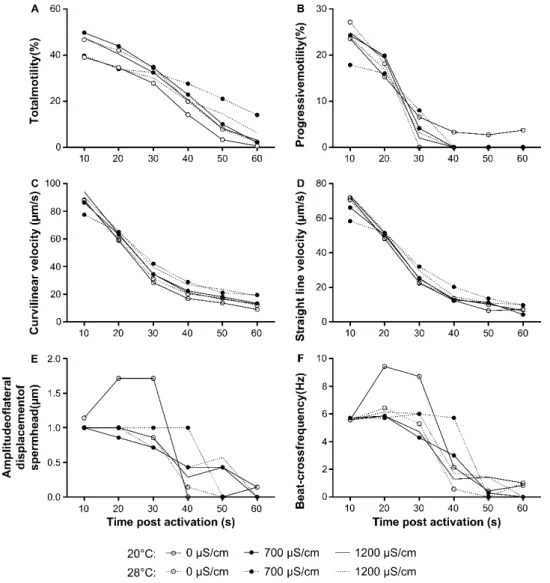
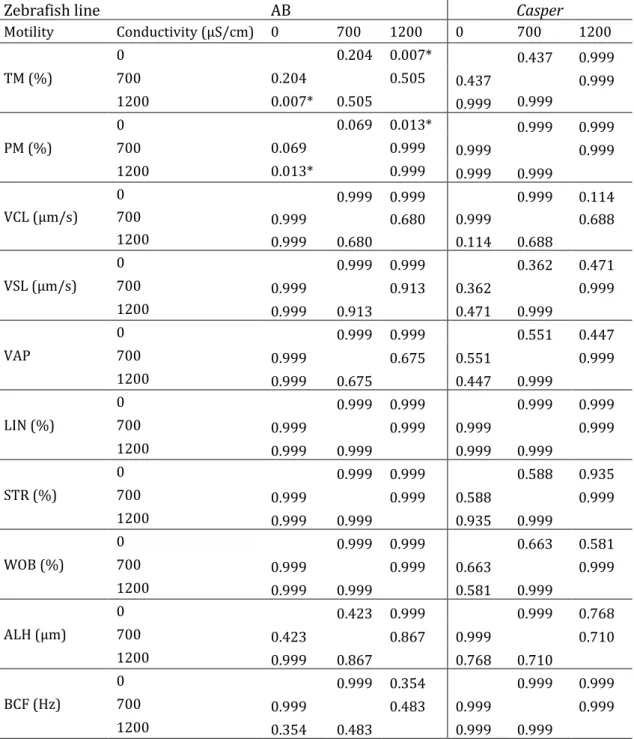
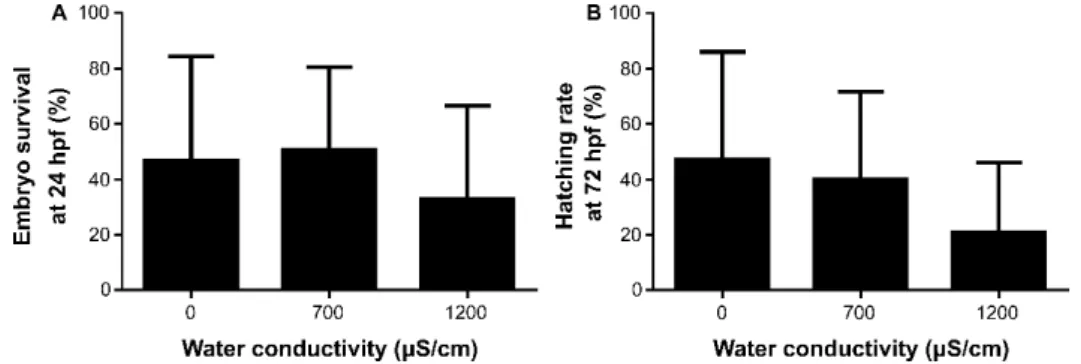
In chapter 2, the zebrafish sperm motility activation was assessed under different conditions of water temperature and conductivity. The environmental conditions present in the fertilization microenvironment are responsible for the mechanism of spermatozoa motility activation and metabolic modulation that influence the probability of fertilization success. Zebrafish is commonly reared at 28°C, but with variable water conductivity conditions among facilities. However, sperm motility analysis is routinely performed with distilled water at room temperature. We aimed to understand the effect of water temperature and conductivity on sperm motility and fertilization ability. Water at 28°C with lower water conductivity (0 and 700 µS/cm) improve sperm motility parameters. Standardization of the water conditions (of system water and activation medium
ii
used for motility analysis) among facilities is highly relevant to improve the reproducibility of sperm quality analysis and thus, to predict with higher accuracy fertilization ability.
Successful cryopreservation depends on high quality sperm, which depends on the quality of breeders. Consequently, broodstock selection and management is a priority to improve sperm cryopreservation. The broodstock diet has a preponderant effect on gamete quality, particularly in phospholipids and antioxidants content which are known to promote spermatogenesis. Therefore, in
chapter 3 we aimed to determine the effects of a tailor-made purified diet
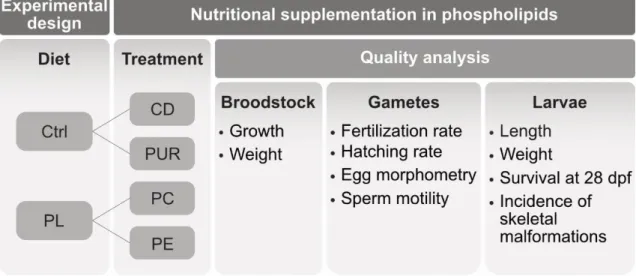
supplemented with phosphatidylcholine (PC) or phosphatidylethanolamine (PE) on the zebrafish reproductive performance, gamete quality and larval skeletal malformations. Both dietary supplementations with phospholipids improved sperm motility and eggs quality, however PC increased the incidence of skeletal malformations on the offspring, as previously observed in other teleosts. Although dietary phospholipids classes have a role in the ossification process of the vertebral column in teleosts, its mechanisms are still to be understood. Therefore, the development and use of a standardized diet for zebrafish broodstock is essential to reduce the variability of the reproductive performance among facilities. In chapter
4, the selection of optimal age and minimum sperm collection frequency was
evaluated, since these factors are essential to obtain high quality samples. Our results indicate that young males (6-8 months) showed higher sperm quality and require a minimum of 14 days between sperm collections to recover sperm plasma membrane viability.
An important bottleneck in cryopreservation is the liquid nitrogen requirement for storage. Therefore, it was established in chapter 5 a new cryopreservation method using an electric ultrafreezer (-150°C) as an alternative to liquid nitrogen, for the first time in a teleost species. This protocol reaches a fast cooling rate (-66°C/min) in one single step and yields higher sperm viability and DNA integrity in comparison to the traditional methods (-20°C/min in liquid nitrogen). The synergy obtained by the combination of cryoprotectants is a successful cryopreservation strategy that can be beneficial in the optimization of zebrafish sperm cryopreservation. Therefore, it was selected the most adequate
iii cryoprotectant combination that generates offspring with normal skeletogenesis. Data show that 15% of DMF with 50 mM of bicine or 10% of egg yolk is beneficial for the quality of zebrafish offspring sired by cryopreserved sperm. To the best of our knowledge, this is the first report on skeletal development of zebrafish offspring sired by cryopreserved sperm performed with different extender compositions.
Zebrafish is especially useful to investigate some of the most prominent human diseases such as diabetes. Among other consequences, diabetes (type I and II) causes disturbances in the male reproductive system, since glucose metabolism is an important event not only in spermatogenesis but also in mature spermatozoa metabolism. In chapter 6 we aimed to validate zebrafish as a useful model organism to investigate male reproductive dysfunctions mechanisms caused by type I diabetes. In this chapter, sperm cryopreservation was applied to a relevant zebrafish model of type I diabetes. The transgenic zebrafish under diabetic conditions shows higher levels of insulin a (insa), insulin receptor a (inra) and glucose carrier 2 (slc2a2) transcripts in spermatozoa when compared to the controls. This is because gametogenesis occurred under diabetic conditions, changing transcription in the germline. Consequently, spermatozoa carry the imprinted transcripts that will be transmitted during fertilization. Sperm quality (motility, viability and DNA integrity) was lower in the transgenic fish under (transient) diabetic state as observed in human and mouse model. Sperm cryopreservation affects sperm quality of fish both under diabetic and non-diabetic conditions. However, diabetic conditions were detrimental in sperm freezability, which can be explained by the lower initial sperm quality. In this chapter zebrafish was validated as a useful model organism to investigate male reproductive dysfunctions mechanisms caused by type I diabetes.
Relevant differences between different zebrafish lines are evidenced in terms of sperm quality and susceptibility to damage, which suggests that it is an important factor to consider while establishing sperm cryopreservation protocols. This thesis offers new insights and a set of guidelines on breeder’s management and sperm cryopreservation to improve zebrafish husbandry practices.
Keywords: Zebrafish, sperm quality, cryopreservation, ultrafreezer, sperm
v
RESUMO
O peixe zebra (Danio rerio) tornou-se inquestionavelmente num dos organismos modelo mais proeminentes da atualidade, devido às suas características favoráveis para investigação. O desenvolvimento de técnicas de edição genética e a sequenciação do genoma desta espécie possibilitou o desenvolvimento de milhares de linhas transgénicas e mutantes. Consequentemente, a gestão dos numerosos genótipos trouxe desafios na manutenção de espaço e gestão destes recursos genéticos. A criopreservação de sémen é uma ferramenta valiosa para a gestão destes valiosos recursos genéticos, que pode solucionar este problema. No entanto, apesar do primeiro protocolo de criopreservação de sémen de peixe zebra ter sido desenvolvido há mais de 30 anos, ainda requer otimização e estandardização. Consequentemente, existe elevada variabilidade na qualidade do sémen e sucesso da fertilização in vitro entre biotérios. O desenvolvimento de uma técnica de criopreservação de sémen eficiente é atualmente um dos maiores desafios da comunidade de peixe zebra. O objetivo principal da presente tese foi a otimização das técnicas de gestão de reprodutores e criopreservação de sémen de peixe zebra, no sentido da estandardização das práticas e maior reprodutibilidade dos resultados científicos nesta espécie.
A introdução ao contexto da presente tese é abordada no capítulo 1. Neste capitulo a importância do peixe zebra como organismo modelo é abordado assim como a utilidade da criopreservação do sémen nesta espécie. Os factores que afetam a qualidade do sémen assim como a aplicação de análises de qualidade robustas são discutidos neste capítulo. O objetivo final da criopreservação de sémen é a produção de progenia com elevada qualidade. Consequentemente, neste capítulo a fertilização
in vitro, o desenvolvimento emb rionário e a análise da qualidade da progenia é discutida. Neste capítulo são
explorados os fundamentos de criobiologia, principais avanços e dificuldades no desenvolvimento de protocolos de criopreservação de sémen de peixe zebra.
As condições do ambiente de fertilização são responsáveis pela ativação da mobilidade dos espermatozóides e pela modulação do seu metabolismo, afetando consequentemente o sucesso da fertilização. O peixe zebra é estabulado a 28°C com
vi
parâmetros de condutividade da água variáveis entre biotérios. No entanto, as análises de mobilidade espermática são realizadas rotineiramente com água destilada a temperatura ambiente. Consequentemente, no capítulo 2 o objetivo do nosso trabalho foi caracterizar o efeito da temperatura e condutividade da água na mobilidade de sémen de peixe zebra. Adicionalmente, foi estudado o efeito da condutividade da água no sucesso da fertilização. A água a 28°C e com baixa condutividade (0 e 700 µS/cm) melhorou os parâmetros de mobilidade. A estandardização das condições da água (dos sistemas de cultivo e do meio de ativação usado na análise da mobilidade) entre biotérios é essencial para a otimização das análises de qualidade, reprodutibilidade científica e maior precisão na estimação do potencial de sucesso de fertilização de uma amostra de sémen.
O sucesso da criopreservação depende da qualidade do sémen que, por sua vez, depende da qualidade dos reprodutores. Consequentemente, a seleção e gestão de reprodutores é uma prioridade, de forma a assegurar o sucesso do método de criopreservação. Um dos factores mais importantes na gestão de reprodutores é a sua dieta. A nutrição dos reprodutores tem um importante efeito na qualidade dos gametas já que afeta a gametogénese, particularmente a composição da dieta em fosfolípidos e antioxidantes. O objetivo do capítulo 3 foi determinar o efeito de dietas purificadas suplementadas com fosfatidilcolina (PC) e fosfatidiletanolamina (PE). A suplementação em fosfolípidos melhorou a mobilidade do sémen; no entanto, a suplementação em PC provocou um aumento da incidência de malformações esqueléticas na progenia. Estes resultados estão de acordo com estudos de nutrição anteriores em teleosteos. O desenvolvimento e utilização de dietas estandardizadas nos reprodutores de peixe zebra é essencial para optimizar a performance reprodutiva e reduzir a variabilidade entre biotérios.
A seleção da idade ótima dos machos e a frequência mínima adequada para recolha de sémen é essencial para obter amostras com elevada qualidade. No
capítulo 4 foi determinado o efeito da idade e da frequência de extração na
qualidade do sémen. O nosso estudo mostrou que machos jovens (6-8 meses) de peixe zebra revelam maior qualidade de sémen e necessitam de um mínimo de 14 dias de repouso para recuperarem a viabilidade da membrana plasmática dos espermatozóides.
vii Uma das maiores desvantagens da criopreservação é a necessidade de azoto líquido para armazenamento de amostras. Considerando esta questão, foi desenvolvido no capítulo 5 o primeiro protocolo de criopreservação de sémen de teleósteos utilizando um ultracongelador (-150°C). Este protocolo é realizado num só passo, sem a utilização de azoto líquido, sendo as amostras criopreservadas a -66°C/min. Este protocolo melhorou a viabilidade e integridade do ADN dos espermatozóides em comparação com o método convencional (-20°C/min armazenado em azoto líquido). A combinação de diferentes crioprotetores é uma estratégia de criopreservação com elevado sucesso. Consequentemente, um dos objetivos do nosso trabalho foi selecionar a combinação de crioprotetores mais adequada para o protocolo de criopreservação estabelecido anteriormente. Os resultados deste trabalho indicam que a utilização de 15% de DMF com 50 mM de bicina ou 10% de gema de ovo produzem sémen de elevada qualidade do sémen e maior sucesso em fertilizações in vitro, assegurando também o adequado desenvolvimento esquelético da progenia. Este foi o primeiro estudo de caracterização de malformações esqueléticas desenvolvidas na progenia de peixe zebra produzido com sémen criopreservado com diferentes composições de crioprotetores.
O peixe zebra é particularmente útil na investigação de doenças humanas com elevada prevalência na população mundial tal como a diabetes. Entre outras complicações geradas por esta patologia, a diabetes tipo I e II afeta o sistema reprodutor masculino. Estas perturbações ocorrem devido à alteração do metabolismo da glucose, essencial durante a espermatogénese e no metabolismo dos espermatozóides. Comparando com outros modelos, o peixe zebra tem gerações mais curtas, consequentemente seria uma ferramenta útil para esta investigação. O objetivo do capítulo 6 foi validar o peixe zebra como organismo modelo para o estudo dos mecanismos de ação da diabetes tipo I pelos quais afetam o sistema reprodutor masculino. Tal como observado em humanos e no organismo modelo de diabetes roedor, a qualidade do sémen (mobilidade, viabilidade, integridade do ADN) é reduzida na estirpe transgénica sob estado transiente de diabetes tipo I em relação ao controlo. O sémen do modelo transgénico em estado diabético revela aumento dos níveis de transcriptos de insulina a (insa), receptor de insulina a (inra) assim como de um transportador especifico de glucose GLUT 2 (slc2a2). Este facto é
viii
devido a uma alteração dos níveis de transcrição destes genes na linha germinal durante a gametogénese. O sémen criopreservado de ambos os tratamentos (controlo e diabético) revelou um decréscimo na qualidade, tal como esperado. O tratamento diabético aumentou a susceptibilidade das células à criopreservação, o que se pode dever à sua qualidade seminal inicial inferior. Assim, evidenciamos neste modelo transgénico para a diabetes tipo I os mesmos efeitos na qualidade seminal observados em humanos e em rato, validando desta forma esta linha para a investigação dos efeitos desta doença no sistema reprodutor masculino.
A presente tese propõe o estabelecimento de medidas de seleção e maneio de reprodutores e análise de qualidade seminal. Adicionalmente propomos um método inovador de criopreservação de sémen, prático e económico, através do uso de um ultracongelador. Verificou-se o impacto de diferentes combinações de crioprotectores na qualidade e na esqueletogénese da progénie gerada com sémen criopreservado. Resumindo, esta tese propõe procedimentos e metodologias para a gestão de reprodutores de peixe zebra relevantes para o estabelecimento de medidas de estandardização, promovendo desta forma a reprodutibilidade de metodologias científicas.
Palavras chave: Peixe zebra, qualidade de sémen, criopreservação,
ix
TABLE OF CONTENTS
AKNOWLEDGEMENTS ... FUNDING ... ABSTRACT ... I RESUMO ... V TABLE OF CONTENTS ... IX LIST OF ABREVIATIONS AND ACRONYMS... XIII LIST OF TABLES ... XVII LIST OF FIGURES ... XIX PREAMBLE ... XXVIICHAPTER 1. GENERAL INTRODUCTION ... 1
1.1. Zebrafish model in research ...3
1.1.1. Zebrafish (Danio rerio) domestication ...3
1.1.2. History of Danio rerio model species ...4
1.2. Fish reproduction principles ...8
1.2.1. Factors affecting sperm quality ...9
1.2.2. Sperm motility activation and metabolism ... 15
1.2.3. Sperm quality evaluation... 18
1.3. Fundamentals of sperm cryopreservation ... 22
1.3.1. Cryoprotectants ... 24
1.3.2. Cooling and thawing rate ... 25
1.4. Zebrafish sperm cryopreservation ... 27
1.4.1. Zebrafish in vitro fertilization and offspring quality ... 31
1.5. Objectives ... 37
CHAPTER 2. SPERM MOTILITY ACTIVATION ... 39
2.1. TEMPERATURE AND CONDUCTIVITY OF FERTILIZATION MICROENVIRONMENT IMPACTS ZEBRAFISH SPERMATOZOA METABOLISM AND EXPERIMENTAL REPLICABILITY ... 43
2.1.1. Abstract ... 44
2.1.2. Introduction... 44
2.1.3. Methods ... 47
2.1.3.1. Fish husbandry ... 47
2.1.3.2. Sperm collection and motility analysis ... 48
2.1.3.3. Experiment 1 – Effect water temperature and conductivity on sperm motility activation and metabolism ... 49
x
2.1.3.4. Experiment 2 – Effect of the water conductivity on in vitro fertilization ... 50 2.1.3.5. Data analysis ... 52
2.1.4. Results ... 53
2.1.4.1. Experiment 1 – Effect water temperature and conductivity on sperm motility activation and metabolism ... 53
2.1.4.2. Experiment 2 – Effect of the water conductivity on in vitro fertilization ... 59
2.1.5. Discussion ... 61
CHAPTER 3. BROODSTOCK NUTRITION ... 67
3.1. ASSESSMENT OF NUTRITIONAL SUPPLEMENTATION IN PHOSPHOLIPIDS ON THE REPRODUCTIVE PERFORMANCE OF ZEBRAFISH, Danio rerio (Hamilton, 1822) ... 71
3.1.1. Abstract ... 72 3.1.2. Introduction... 72 3.1.3. Methods ... 74
3.1.3.1. Experimental diets... 74 3.1.3.2. Fish rearing and sampling ... 75 3.1.3.3. Data analysis ... 77
3.1.4. Results ... 77 3.1.5. Discussion ... 82
CHAPTER 4. MALE SELECTION CRITERIA ... 87
4.1. SELECTION CRITERIA OF ZEBRAFISH MALE DONORS FOR SPERM CRYOPRESERVATION ... 91
4.1.1. Abstract ... 92 4.1.2. Introduction... 92 4.1.3. Methods ... 95
4.1.3.1. Zebrafish maintenance ... 95 4.1.3.2. Sperm collection and quality analysis ... 95 4.1.3.3. Effect of zebrafish line, age and sperm collection frequency on sperm quality…… 96 4.1.3.4. Data analysis ... 98
4.1.4. Results ... 99 4.1.5. Discussion ... 104
CHAPTER 5. SPERM CRYOPRESERVATION AND STORAGE ... 109
5.1. ELECTRIC ULTRAFREEZER (-150°C) AS AN ALTERNATIVE FOR ZEBRAFISH SPERM CRYOPRESERVATION AND STORAGE ... 113
5.1.1. Abstract ... 114 5.1.2. Introduction... 114 5.1.3. Methods ... 116
5.1.3.1. Fish rearing and sperm collection... 116 5.1.3.2. Experiment 1 — effect of zebrafish sperm storage throughout time in an ultrafreezer − 5 °C and in liquid nitrogen ... 117
xi
5.1.3.3. Experiment 2 — effect of a fast cooling rate on post-thaw sperm quality ... 117 5.1.3.4. Sperm concentration and motility ... 118 5.1.3.5. Membrane integrity ... 119 5.1.3.6. Cell apoptosis ... 120 5.1.3.7. DNA fragmentation ... 121 5.1.3.8. In vitro fertilization ... 122 5.1.3.9. Data analysis ... 122 5.1.4. Results ... 123
5.1.4.1. Experiment 1. effect of sperm storage throughout time in ultrafreezer and in…..123 5.1.4.2. Experiment 2. effect of a fast cooling rate on post-thaw sperm quality………. 5
5.1.5. Discussion ... 129
5.2. CRYOPROTECTANTS SYNERGY IMPROVE ZEBRAFISH SPERM
CRYOPRESERVATION AND OFFSPRING SKELETOGENESIS ... 135 5.2.1. Abstract ... 136 5.2.2. Introduction... 136 5.2.3. Methods ... 139
5.2.3.1. Fish rearing ... 139 5.2.3.2. Sperm collection ... 140 5.2.3.3. Experiment 1. Permeating cryoprotectant: DMF concentration ... 141 5.2.3.4. Experiment 2. Non-permeating cryoprotectants: BSA, egg yolk, glyc and bici …..142 5.2.3.5. Sperm concentration and motility analysis ... 143 5.2.3.6. Membrane integrity ... 143 5.2.3.7. In vitro fertilization ... 144 5.2.3.8. Skeletal development analysis of the offspring obtained from both experiences 144 5.2.3.9. Data analysis ... 145
5.2.4. Results ... 146
5.2.4.1. Permeating cryoprotectant: DMF concentration ... 148 5.2.4.2. Non-Permeating cryoprotectants: BSA, egg yolk, glycine and bicine ... 149 5.2.4.3. Axial Skeleton malformations ... 152
5.2.5. Discussion ... 157
CHAPTER 6. APLICATION OF SPERM QUALITY ANALYSIS AND CRYOPRESERVATION METHODOLOGIES IN A TRANSGENIC ZEBRAFISH LINE ... 163
6.1. TYPE I DIABETES IN ZEBRAFISH REDUCES SPERM QUALITY AND INCREASES INSULIN AND GLUCOSE TRANSPORTER IN SPERMATOZOA ... 167
6.1.1. Abstract ... 168 6.1.2. Introduction... 168 6.1.3. Methods ... 171
6.1.3.1. Fish husbandry ... 171 6.1.3.1. Induction of diabetes on Tg(ins:nfsb-mCherry) zebrafish model ... 174 6.1.3.2. Experimental design ... 174 6.1.3.3. Sperm collection ... 174 6.1.3.4. Blood glucose determination and pancreas fluorescence observation ... 175
xii
6.1.3.5. RNA extraction and complementary DNA synthesis ... 176 6.1.3.6. Quantitative real-time polymerase chain reaction (qPCR)………..176 6.1.3.7. Sperm cryopreservation and thawing ... 178 6.1.3.8. Sperm plasma membrane viability analysis ... 178 6.1.3.9. Sperm motility analysis ... 179 6.1.3.10. DNA integrity evaluation through comet assay ... 179 6.1.3.11. Data analysis ... 180
6.1.4. Results ... 181 6.1.5. Discussion ... 189
CHAPTER 7. GENERAL DISCUSSION ... 193
7.1. Main conclusions and perspectives ... 207
CHAPTER 8. APPENDIX ... 209 CHAPTER 9. REFERENCES ... 217
xiii
LIST OF ABBREVIATIONS AND ACRONYMS
µl Microliter µWs/cm2 UV radiation
a.m. ante meridiem
ALH Amplitude of lateral displacement ANOVA Analysis of variance
ARA Arachidonic acid BCF Beat cross frequency Bici Bicine
BSA Bovine Serum Albumin CART Classification and regression CASA Computed assisted sperm analysis CD Commercial diet
Ct Cycle threshold Ctrl Control
CWL Central wavelength
D Dark
DHA Docosahexaenoic acid DMSO Dimethyl sulfoxide DNA Deoxyribonucleic acid dpf Days post fertilization e.g. exempli gratia
EPA Eicosapentaenoic acid EY Egg yolk
FSC Forward-scattered light g Gram
GFP Green fluorescent protein Gly Glycine
h Hour
HBSS Hank´s balanced salt solution hpf Hours post fertilization Hz Hertz
Ins Insulin
ISAS Integrated System for Semen Analysis Kg Kilogram
L Light l Liter LIN Linearity
xiv LL Lower left LN Liquid nitrogen LR Lower right M Meter M Molar Min Minute ml Millilitre Mm Millimeter mOsm Miliosmolar MS-222 Tricaine methanesulfonate OF Ovarian fluid
PBS Phosphate buffer solution PC Phosphatidylcholine
PCA Principal component analysis PCR Polymerase chain reaction PE Phosphatidylethanolamine PI Propidium iodide
PM Progressive motility PS Phosphatidylserine
PUFA Polyunsaturated fatty acids PUR Purified diet;
qPCR Quantitative real-time PCR RNA Ribonucleic acid
Runx Runt-related transcription factor
S Second S Siemens SD Standard deviation SNK Student–Newman–Keuls SSC Side-scattered light STR Straightness Tg Transgenic TM Total motility UF Ultrafreezer UL Upper left UR Upper right
VAP Velocity according to smoothed path VCL Curvilinear velocity
VSL Straight-line velocity WOB Curvilinear path wobble
xv
LIST OF TABLES
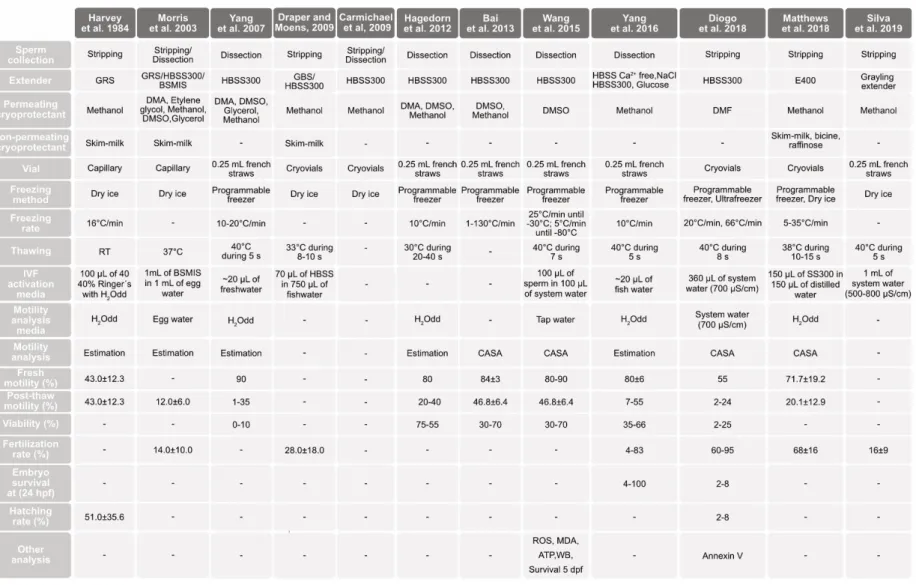
TABLE 1.1SUMMARY OF SPERM CRYOPRESERVATION PROTOCOLS IN ZEBRAFISH AND BRIEF DESCRIPTION OF THE
METHODOLOGIES USED IN THIS SPECIES. ... 30 TABLE 2.1ZEBRAFISH SPERM MOTILITY ANALYSIS (RECORDED FOR 1 MINUTE EACH 10 S POST ACTIVATION) OF AB AND CASPER LINE WHEN ACTIVATED WITH DIFFERENT WATER TEMPERATURES (20°C AND 28°C) AND CONDUCTIVITIES (0,700 AND
1200 µS/CM) AND THEIR INTERACTIONS (P VALUES). ... 55 TABLE 2.2STATISTICAL DIFFERENCES (P VALUES) OF AB AND CASPER ZEBRAFISH LINES SPERM MOTILITY WHEN ACTIVATED
WITH DIFFERENT WATER TEMPERATURES THROUGHOUT POST-ACTIVATION TIME. ... 58 TABLE 2.3STATISTICAL DIFFERENCES (P VALUES) OF WATER CONDUCTIVITY ON ZEBRAFISH SPERM MOTILITY PARAMETERS. .. 59 TABLE 2.4BIOLOGICAL PERFORMANCE OF LARVAE SIRED BY SPERM OF AB(N=8) ZEBRAFISH LINE, ACTIVATED WITH DIFFERENT WATER CONDUCTIVITIES. ... 61 TABLE 3.1DIETARY AND CHEMICAL COMPOSITION OF PURIFIED DIET (PUR) FED TO ZEBRAFISH BROODSTOCK AND LARVAE... 75 TABLE 3.2ZEBRAFISH BROODSTOCK MEAN STANDARD LENGTH AND MEAN WET WEIGHT FOR DIETARY TREATMENTS (CD,PUR, PC,PE) AT EXPERIMENT DAYS 1,25, AND 68.DATA EXPRESSED AS MEANS±SD(N=16 BROODFISH, INCLUDING MALES AND FEMALES). ... 78 TABLE 3.3TOTAL NUMBER OF FERTILIZED EGGS, HATCHED LARVAE, LARVAE HATCHING RATE, LARVAE STANDARD LENGTH (5,
15 AND 28 DPF) AND SURVIVAL FOR DIETARY TREATMENTS (CD,PUR,PC,PE). ... 78 TABLE 4.1ZEBRAFISH SPERM MOTILITY ANALYSIS OF PRINCIPAL COMPONENT RELATED TO AGE, STRIPPING FREQUENCIES AND
THEIR INTERACTIONS IN AB AND TG(RUNX2:EGFP) LINE... 100 TABLE 4.2ZEBRAFISH SPERM MEMBRANE VIABILITY ANALYSIS RELATED TO AGE, STRIPPING FREQUENCIES AND THEIR
INTERACTIONS IN AB AND TG(RUNX2:EGFP) LINE. ... 103 TABLE 5.1POST-THAW SPERM QUALITY ANALYSIS RELATED TO THE EFFECT OF PERMEATING CRYOPROTECTANT
CONCENTRATION, NON-PERMEATING CRYOPROTECTANTS AND THEIR INTERACTIONS IN POST-THAW SPERM. ... 150 TABLE 6.1FORWARD AND REVERSE PRIMERS USED FOR TARGET GENES ANALYSIS THROUGH REAL-TIME PCR. ... 178 TABLE 6.2STATISTICAL ANALYSIS OF SPERM MOTILITY PARAMETERS (DATA FOR 1 MINUTE, EACH 10 S POST ACTIVATION) OF
TG(INS:NFSB-MCHERRY) ZEBRAFISH LINE UNDER CONTROL AND DIABETIC CONDITIONS AND THEIR INTERACTIONS (P
xvii
LIST OF FIGURES
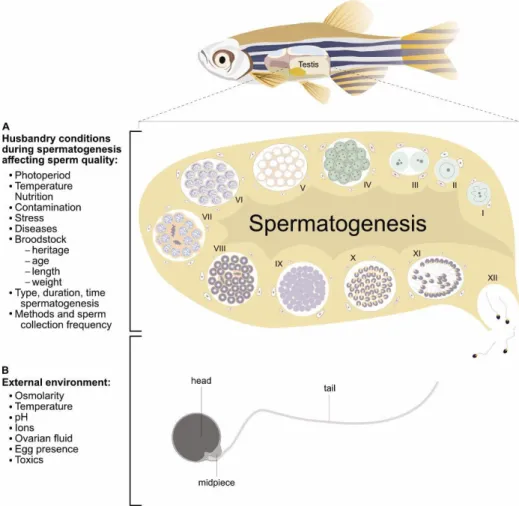
FIGURE 1.1FACTORS AFFECTING ZEBRAFISH SPERM SPERM QUALITY.SCHEMATIC REPRESENTATION THE TWO MAIN FACTORS AFFECTING SPERM QUALITY:A) THE HUSBANDRY CONDITIONS AFFECTING SPERM QUALITY DURING SPERMATOGENESIS AND B) EXTERNAL ENVIRONMENT CONDITIONS INTO WHICH SPERMATOZOA ARE RELEASED AND SCHEMATIC REPRESENTATION OF ZEBRAFISH SPERMATOZOON. THE ZEBRAFISH TESTIS WITH CYSTIC SPERMATOGENESIS IS REPRESENTED ACCORDING TO THE DESCRIPTION OF (SCHULZ ET AL.,2010) NAMELY:(I)TYPE A UNDIFFERENTIATED SPERMATOGONIA GERM CELL (II) TYPE A UNDIFFERENTIATED SPERMATOGONIA, (III) TYPE A DIFFERENTIATED SPERMATOGONIA, (IV) SPERMATOGONIA TYPE B, (V) LEPTOTENIC/ZYGOTENIC PRIMARY SPERMATOCYTES, (VI)
PACHYTENIC PRIMARY SPERMATOCYTES, (VII) DIPLOTENIC SPERMATOCYTES/METAPHASE I, (VIII) SECONDARY SPERMATOCYTES/METAPHASE II,(IX) EARLY SPERMATID,(X) INTERMEDIATE SPERMATID,(XI) FINAL SPERMATIDS AND
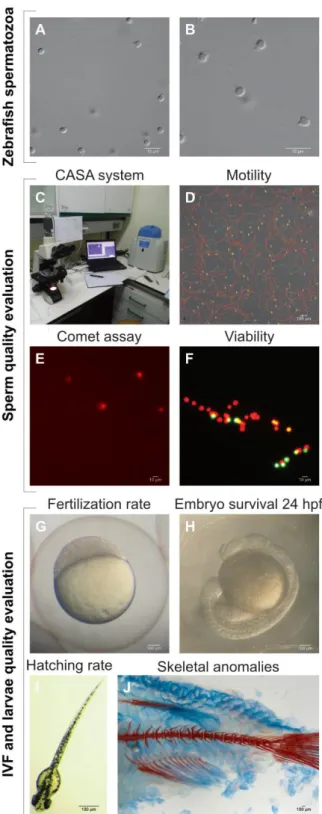
(XII) SPERMATOZOA. ... 15 FIGURE 1.2ZEBRAFISH SPERM QUALITY EVALUATION.A) ZEBRAFISH SPERMATOZOA,B) SPERMATOZOON TAIL, MID PIECE AND
HEAD,C) CASA SYSTEM AND PROGRAMABLE BIOFREEZER FOR CRYOPRESERVATION,D) SPERM MOTILITY ANALYSIS THROUGH CASA SYSTEM,E) DNA FRAGMENTATION ANALYSIS THROUGH COMET ASSAY, F) PLASMA MEMBRANE VIABILITY THROUGH PI(RED CELLS) AND SYBR GREEN (GREEN CELLS) LABELLING,G) FERTILIZATION RATE ANALYSIS AT 3
HPF, H) EMBRYO SURVIVAL ANALYSIS 48 HPF, I) HATCHING RATE EVALUATION AT 78 HPF AND I) SKELETAL MALFORMATION ANALYSIS OF THE OFFSPRING THOUGH ALCIAN BLUE AND ALIZARIN S STAINING. ... 21 FIGURE 1.3ZEBRAFISH SPERM-EGG BINDING AND FERTILIZATION.SCHEMATIC REPRESENTATION OF ZEBRAFISH FERTILIZATION
WITH I) SPERM-EGG BINDING, II) FERTILIZATION CONE INITIAL UPWARD PROTRUSION, III) FERTILIZATION CONE FORMATION AND VI) DISAPPEARANCE OF FERTILIZATION CONE. ... 35 FIGURE 1.4ZEBRAFISH EMBRYOGENESIS.A) OOCYTE,B) OOCYTE ACTIVATION,C) FERTILIZATION MOMENT WITH FERTILIZING
SPERMATOZOON ON THE MICROPYLE,D) PERIVITELLINE SPACE AND CORTICAL GRANULES EXOCYTOSIS ON EARLY ZYGOTE, E),F),G),H),I) EIGHT CELL EMBRYO STAGE,J) BLASTULA STAGE,K) GASTRULA STAGE,L) EMBRYO SOMITOGENESIS STAGE,M) EMBRYO PRIM-25 STAGE N) EMBRYO HIGH-PEC STAGE,O) EARLY HATCHED LARVAE……….35
FIGURE 2.1EXPERIMENTAL DESIGN TO EVALUATE THE EFFECT OF WATER CONDUCTIVITY AND TEMPERATURE ON SPERM MOTILITY OF AB AND CASPER ZEBRAFISH LINES ... 50 FIGURE 2.2EXPERIMENTAL DESIGN TO EVALUATE THE EFFECT OF WATER CONDUCTIVITY ON IN VITRO FERTILIZATION SUCCESS OF
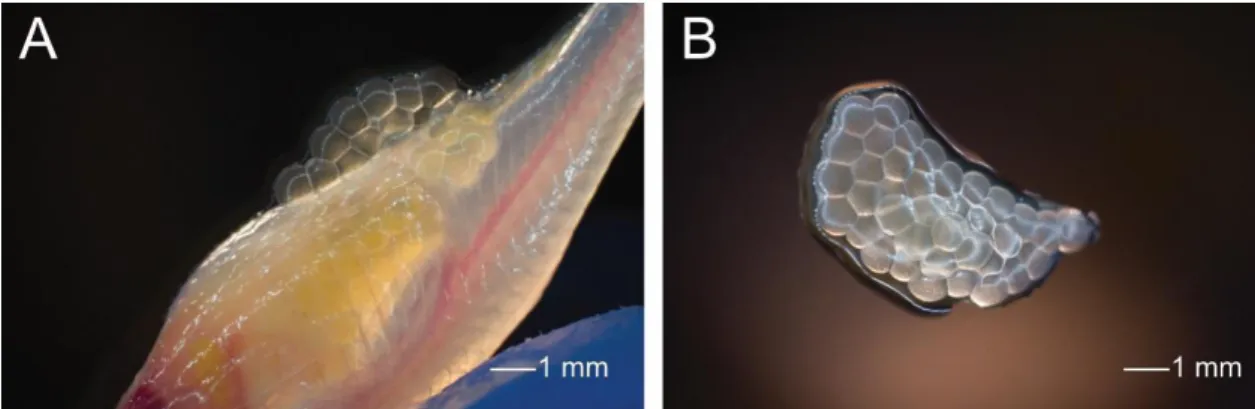
AB ZEBRAFISH LINE. ... 52 FIGURE 2.3REPRESENTATION OF OOCYTE COLLECTION WITH CASPER ZEBRAFISH.A) OOCYTE COLLECTION,B) GOOD QUALITY
CLUTCH EXAMPLE TO USE IN IN VITRO FERTILIZATION. ... 52 FIGURE 2.4EFFECT OF WATER TEMPERATURE (20°C AND 28°C) AND WATER CONDUCTIVITY (0,700 AND 1200 µS/CM) ON
SPERM MOTILITY PARAMETERS OF ZEBRAFISH AB LINE (N=8).SPERM WAS ACTIVATED, AND MOTILITY PARAMETERS WERE RECORDED EACH 10 S FOR 1 MIN IN TERMS OF:A)TM,B)PM,C)VCL,D)VSL,E)ALH AND F)BCF.THE VALUES PLOTTED REPRESENT MEAN, CONTINUOUS LINE REPRESENT 20°C AND DASHED LINE REPRESENT 28°C OF THE ACTIVATION MEDIUM.ACTIVATION MEDIUM WITH 0 µS/CM IS REPRESENTED WITH WHITE CIRCLE,700 µS/CM WITH A DARK CIRCLE AND 1200 µS/CM WITHOUT SYMBOL. ... 56
xviii
FIGURE 2.5EFFECT OF WATER TEMPERATURE (20°C AND 28°C) AND WATER CONDUCTIVITY (0,700 AND 1200 µS/CM) ON SPERM MOTILITY PARAMETERS OF ZEBRAFISH CASPER LINE (N=8).SPERM WAS ACTIVATED, AND MOTILITY PARAMETERS WERE RECORDED EACH 10 S FOR 1 MIN IN TERMS OF:A)TM,B)PM,C)VCL,D)VSL,E)ALH AND F)BCF.THE VALUES PLOTTED REPRESENT MEAN, CONTINUOUS LINE REPRESENT 20°C AND DASHED LINE REPRESENT 28°C OF THE ACTIVATION MEDIUM.ACTIVATION MEDIUM WITH 0 µS/CM IS REPRESENTED WITH WHITE CIRCLE,700 µS/CM WITH A DARK CIRCLE AND 1200 µS/CM WITHOUT SYMBOL. ... 57 FIGURE 2.6EFFECT OF WATER CONDUCTIVITY (0,700 AND 1200 µS/CM) ON SPERM MOTILITY PARAMETERS OF ZEBRAFISH AB
LINE POOLS OF SPERM (N=5 CONTAINING SPERM OF 7 MALES).SPERM WAS ACTIVATED, AND MOTILITY PARAMETERS WERE RECORDED EACH 10 S FOR 1 MIN IN TERMS OF:A)TM,B)PM,C)VCL AND D)VSL.THE VALUES PLOTTED REPRESENT MEAN.ACTIVATION MEDIUM WITH 0 µS/CM IS REPRESENTED WITH WHITE CIRCLE,700 µS/CM WITH A DARK CIRCLE AND 1200 µS/CM WITHOUT SYMBOL.DIFFERENT LETTERS REPRESENT STATISTICAL DIFFERENCES (ONE-WAY
ANOVA, POST HOC SNKP<0.05). ... 60 FIGURE 2.7IN VITRO FERTILIZATION PERFORMED WITH SPERM POOLS (N=5 POOLS) OF AB ZEBRAFISH LINE ACTIVATED WITH
WATER CONDUCTIVITIES 0(N=11 CLUTCHES)700(N=13 CLUTCHES) AND 1200 µS/CM (N=11 CLUTCHES). THE FERTILIZATION SUCCESS WAS MEASURED THROUGH:A) EMBRYO SURVIVAL AT 24 HPF,B) HATCHING RATE AT 48 HPF,C) TOTAL HATCHING RATE AT 72 HPF.ADDITIONALLY, IT WAS EVALUATED D) MALFORMED LARVAE AT HATCHING AND LARVAE STANDARD LENGTH (5 DPF).THE VALUES PLOTTED REPRESENT MEANS±SD……….61 FIGURE 3.1 EXPERIMENTAL DESIGN TO EVALUATE THE EFFECT OF CONTROL DIETS (CD, PUR) AND PHOSPHOLIPID (PL)
SUPPLEMENTED DIETS (PC AND PE) ON ZEBRAFISH GROWTH, REPRODUCTION, GAMETES QUALITY AND SKELETAL DEVELOPMENT. ... 77 FIGURE 3.2EFFECT OF DIETARY TREATMENTS (CD,PUR,PC,PE) ON ZEBRAFISH (64 CELL STAGE)A) EGG DIAMETER AND B)
PERIVITELLINE SPACE.COLUMNS REPRESENT MEANS±SD DEVIATION (N=20 EGGS).DIFFERENT LETTERS REPRESENT SIGNIFICANT DIFFERENCES (ONE-WAY ANOVA-TUKEY,P<0.05). ... 79 FIGURE 3.3ZEBRAFISH BREEDERS: EFFECT OF DIETARY TREATMENTS (CD,PUR,PC,PE) ON SPERM QUALITY AFTER 68 DAYS OF
FEEDING.FIGURES REPRESENT AVERAGE SPERM MOTILITY PARAMETERS:A)TM,B)PM,C)VSL,D)VCL, AND E)LIN. COLUMNS REPRESENT MEANS±SD BARS (N=6 MALES).DIFFERENT LETTERS REPRESENT SIGNIFICANT DIFFERENCES (ONE
-WAY ANOVA-TUKEY,P<0.05). ... 80 FIGURE 3.4ZEBRAFISH LARVAE: DRY WEIGHT AT 5,15 AND 28 DPF FOR DIETARY TREATMENTS (CD,PUR,PC,PE).COLUMNS
REPRESENT MEANS±SD(N=20).DIFFERENT LETTERS REPRESENT SIGNIFICANT DIFFERENCES (ONE-WAY ANOVA-TUKEY, P<0.05). ... 81 FIGURE 3.5EFFECT OF DIETARY TREATMENTS (CD,PUR,PC,PE) ON ZEBRAFISH LARVAE SKELETAL DEFORMITIES (28 DPF). COLUMNS REPRESENT MEANS±SD (N=20). DIFFERENT LETTERS REPRESENT SIGNIFICANT DIFFERENCES (ONE-WAY
ANOVA-TUKEY,P<0.05) BETWEEN TREATMENTS... 81 FIGURE 3.6DEFORMITIES AFFECTING THE VERTEBRAL COLUMN OF ZEBRAFISH AT 28 DPF A) FUSED AND COMPRESSED CAUDAL
FIN VERTEBRAE 28-29(ARROW), WITH MALFORMED NEURAL AND HAEMAL ARCHES.B)FUSED CAUDAL AND CAUDAL FIN VERTEBRAE (ARROW), WITH MALFORMED NEURAL AND HAEMAL ARCHES.C)PRESENCE OF AN ECTOPIC ELEMENT IN THE CAUDAL FIN (ARROWHEAD) AND ECTOPIC ARCHES OVER UROSTILE (ARROW). ... 82
xix
FIGURE 4.1EXPERIMENTAL DESIGN TO EVALUATE THE EFFECT OF MALE AGE AND SPERM COLLECTION FREQUENCY ON SPERM MOTILITY AND VIABILITY OF AB AND RUNX2 ZEBRAFISH LINES. ... 98 FIGURE 4.2ZEBRAFISH SPERM MOTILITY INDEX ACCORDING TO AGE OF:A)AB LINE AT 6(N=26),8(N=13),12(N=27) AND
14(N=24) MONTHS OF AGE.B)TG(RUNX2:EGFP) LINE AT 6(N=23),8(N=17),12(N=18) AND 14(N=27) MONTHS OF AGE. THE ANALYSIS WAS PERFORMED WITH THE BASELINE DATA OF THE FIRST SAMPLING. BARS REPRESENT MEANS±95% OF CONFIDENCE INTERVAL AND STATISTICAL DIFFERENCES (TWO-WAY ANOVA-SNK,P<0.05) BETWEEN FISH AGE ARE REPRESENTED WITH LETTERS. ... 100 FIGURE 4.3ZEBRAFISH SPERM MOTILITY INDEX AFTER DIFFERENT SPERM STRIPPING FREQUENCIES.THE NUMBER OF THE
STRIPPING FREQUENCY IS RELATED TO THE TIME OF REST BETWEEN SPERM COLLECTIONS.AFTER THE FIRST SAMPLING SPERM WAS COLLECTED AFTER 2,7 AND 14 DAYS OF REST BETWEEN SAMPLINGS. THE ANALYSIS WAS PERFORMED IN:A) AB LINE AT FIRST STRIPPING (N=26) AND AFTER 2 (N=13), 7 (N=27) AND 14 (N=24) DAYS OF REST, B)
TG(RUNX2:EGFP) LINE AT FIRST SAMPLING (N=23) AND AFTER 2(N=17),7(N=18) AND 14(N=27) DAYS OF REST. THE ANALYSIS WAS PERFORMED WITH MALES WITH 6 MONTHS OF AGE. BARS REPRESENT MEANS±95% OF CONFIDENCE INTERVAL AND STATISTICAL DIFFERENCES (TWO-WAY ANOVA-SNK, P<0.05) BETWEEN SPERM COLLECTION FREQUENCIES ARE REPRESENTED WITH LETTERS. ... 101
FIGURE 4.4EFFECT OF THE INTERACTION IN ZEBRAFISH SPERM MOTILITY INDEX BETWEEN MALES AGE AND SPERM STRIPPING FREQUENCY IN (A)AB WILD-TYPE LINE AND (B)TG(RUNX2:EGFP) LINE.THE NUMBER OF THE STRIPPING FREQUENCY IS RELATED TO THE TIME OF REST BETWEEN SPERM COLLECTIONS.ANALYSIS WAS PERFORMED IN THE FIRST SAMPLING [AB
N=24;TG(RUNX2:EGFP) N=27] AND AFTER 2[AB N=14;TG(RUNX2:EGFP) N=23],7[AB N=33;TG(RUNX2:EGFP)
N=22], AND 14[AB N=19;TG(RUNX2:EGFP) N=13] DAYS OF REST BETWEEN SAMPLINGS.THIS ANALYSIS IS RELATED TO MALES WITH 6–8 MONTHS [AB N=39; TG(RUNX2:EGFP) N=40] AND 12–14 MONTHS [AB N=51; TG(RUNX2:EGFP) N=45] OF AGE.BARS REPRESENT 95% OF CONFIDENCE INTERVAL. ... 102 FIGURE 4.5ZEBRAFISH SPERM VIABILITY (%) ACCORDING TO AGE OF:A)AB LINE AT 6(N=20),8(N=13),12(N=27) AND 14 (N=21) MONTHS OF AGE AND B) SPERM VIABILITY (%) OF TG(RUNX2:EGFP) LINE AT 6(N=23),8(N=12),12(N=18)
AND 14(N=27) MONTHS OF AGE.THE ANALYSIS WAS PERFORMED WITH THE BASELINE DATA OF THE FIRST SAMPLING. BARS REPRESENT 95% OF CONFIDENCE INTERVAL AND STATISTICAL DIFFERENCES (TWO-WAY ANOVA-SNK,P<0.05)
BETWEEN FISH AGE ARE REPRESENTED WITH LETTERS. ... 103 FIGURE 4.6ZEBRAFISH SPERM VIABILITY AFTER DIFFERENT SPERM STRIPPING FREQUENCIES.THE NUMBER OF THE STRIPPING
FREQUENCY IS RELATED TO THE TIME OF REST BETWEEN SPERM COLLECTIONS.AFTER THE FIRST SAMPLING SPERM WAS COLLECTED AFTER 2,7 AND 14 DAYS OF REST BETWEEN SAMPLINGS.THE ANALYSIS WAS PERFORMED IN:A)AB LINE AT THE FIRST SAMPLING (N=23) AND 2(N=18),7(N=29) AND 14(N=11) DAYS OF REST,B)TG(RUNX2:EGFP) LINE AT THE FIRST SAMPLING (N=22) AND 2(N=13),7(N=22) AND 14(N=23) DAYS OF REST.THE ANALYSIS WAS PERFORMED WITH MALES WITH 6 MONTHS OF AGE. BARS REPRESENT 95% OF CONFIDENCE INTERVAL AND STATISTICAL DIFFERENCES
(TWO-WAY ANOVA-SNK,P<0.05) BETWEEN SPERM COLLECTION FREQUENCIES ARE REPRESENTED WITH LETTERS. ... 104 FIGURE 5.1EXPERIMENTAL DESIGN TO EVALUATE THE EFFECT OF THE STORAGE TYPE (LN,UF) OF CRYOPRESERVED ZEBRAFISH
xx
FIGURE 5.2EXPERIMENTAL DESIGN TO EVALUATE THE EFFECT OF COOLING RATE (-20°C/MIN AND -66°C/MIN) AND STORAGE METHOD (LN,UF) ON ZEBRAFISH CRYOPRESERVED SPERM MOTILITY, VIABILITY,DNA FRAGMENTATION AND APOPTOSIS. ... 118 FIGURE 5.3FLOW CYTOMETRY ANALYSIS OF ANNEXIN V OF POST-THAW ZEBRAFISH SPERM. A)SPERM CELL POPULATION GATING
(R1)B) SPERM CELL SUBPOPULATIONS CORRESPONDING TO VIABLE CELLS (LOWER LEFT,LL), CELL IN EARLY APOPTOSIS
(LOWER RIGHT,LR), CELLS IN LATE APOPTOSIS (UPPER RIGHT,UR) AND NECROTIC/DEAD CELLS BY OTHER MECHANISM
(UPPER LEFT,UL). ... 121 FIGURE 5.4MOTILITY OF ZEBRAFISH SPERM (N=3 POOLS) CRYOPRESERVED AT -20°C/MIN AND STORED IN LIQUID NITROGEN
(LN) OR IN ULTRAFREEZER (UF).THE SAMPLES WERE THAWED 1 WEEK,1 MONTH AND 3 MONTHS AFTER STORAGE AND CHARACTERIZED IN TERMS OF A)TM,B)VCL,C)VSL AND D)LIN.DATA IS EXPRESSED AS MEANS±SD.STATISTICAL DIFFERENCES (T-TEST,P˂ . ) BETWEEN FRESH AND CRYOPRESERVED SPERM ARE REPRESENTED WITH ASTERISC. .. 124
FIGURE 5.5PLASMA MEMBRANE INTEGRITY OF ZEBRAFISH SPERM (N=3 POOLS).SAMPLES WERE CRYOPRESERVED WITH A -20°C/MIN AND STORED IN LIQUID NITROGEN (LN) OR IN A ULTRAFREEZER (UF) AND THAWED 1 WEEK,1 MONTH AND 3
MONTHS AFTER STORAGE.DATA IS EXPRESSED AS MEANS±SD.STATISTICAL DIFFERENCES WITHIN PERIODS OF STORAGE
(TWO-WAY ANOVA WITH POST HOC SNK,P˂ . ) ARE REPRESENTED WITH DIFFERENT LETTERS.NO DIFFERENCES WERE FOUND BETWEEN THE TWO STORAGE METHODS. ... 124 FIGURE 5.6IN VITRO FERTILIZATIONS PERFORMED WITH ZEBRAFISH SPERM (N=3 POOLS) CRYOPRESERVED AT -20°C/MIN AND
STORED IN LIQUID NITROGEN OR IN A ULTRAFREEZER.THE SAMPLES WERE THAWED 1 WEEK,1 MONTH AND 3 MONTHS AFTER STORAGE AND THE FERTILIZATION SUCCESS WAS EVALUATED ACCORDING TO A)FERTILIZATION RATE AT 3 HPF,B) EMBRYO SURVIVAL AT 24 HPF,C)HATCHING RATE AT 72 HPF.DATA IS EXPRESSED AS MEAN VALUES±SD.STATISTICAL DIFFERENCES WITHIN PERIODS OF STORAGE (ONE-WAY ANOVA WITH POST HOC SNK,P˂ . ) ARE REPRESENTED WITH DIFFERENT LETTERS.NO DIFFERENCES WERE FOUND BETWEEN THE TWO STORAGE METHODS. ... 126 FIGURE 5.7POST-THAW ZEBRAFISH SPERM MOTILITY (N=7 POOLS) OBTAINED FROM SAMPLES CRYOPRESERVED AND STORED
DIRECTLY IN A ULTRAFREEZER (-66°C/MIN,UF) AND WITH A -20°C/MIN COOLING RATE WITH STORAGE IN ULTRAFREEZER
(-20°C/MIN,UF) AND LIQUID NITROGEN (-20°C/MIN,LN).THE SAMPLES WERE CHARACTERIZED IN TERMS OF A)TM, B)PM,C)VCL,D)VSL AND E)LIN.DATA IS EXPRESSED AS MEAN VALUES±SD.STATISTICAL DIFFERENCES BETWEEN TREATMENTS (TWO-WAY ANOVA WITH POST HOC SNK,P˂ . ) ARE REPRESENTED WITH DIFFERENT LETTERS. ... 127 FIGURE 5.8POST-THAW ZEBRAFISH SPERM ANALYSIS (N=7 POOLS) OF A)PLASMA MEMBRANE INTEGRITY ANALYZED WITH FLOW
CYTOMETRY,B)DNA FRAGMENTATION DETECTED THROUGH COMET ASSAY.THE SPERM WAS CRYOPRESERVED DIRECTLY IN A ULTRAFREEZER (-66°C/MIN,UF) OR WITH A -20°C/MIN COOLING RATE WITH STORAGE IN ULTRAFREEZER (-20°C/MIN,UF) AND LIQUID NITROGEN (-20°C/MIN,LN).DATA IS EXPRESSED AS MEAN VALUES±SD.STATISTICAL DIFFERENCES BETWEEN TREATMENTS (TWO-WAY ANOVA WITH POST HOC SNK,P˂ . ) ARE REPRESENTED WITH DIFFERENT LETTERS. ... 128 FIGURE 5.9 POST-THAW ZEBRAFISH SPERM (N=7 POOLS) APOPTOSIS DETECTION THROUGH ANNEXIN V PATHWAY OF
CRYOPRESERVED SPERM DIRECTLY IN ULTRAFREEZER (-66°C/MIN,UF) OR WITH A -20°C/MIN COOLING RATE WITH STORAGE IN ULTRAFREEZER (-20°C/MIN,UF) AND LIQUID NITROGEN (-20°C/MIN,LN).THE SPERM SUBPOPULATION WERE ANALYSED IN TERMS OF A)VIABLE CELLS AND CELLS IN EARLY APOPTOSIS,B)CELLS IN LATE APOPTOSIS AND NECROTIC OR DEAD BY OTHER MECHANISMS.DATA IS EXPRESSED AS MEAN VALUES±SD.STATISTICAL DIFFERENCES
xxi
BETWEEN TREATMENTS (TWO-WAY ANOVA WITH POST HOC SNK,P˂ . ) ARE REPRESENTED WITH DIFFERENT LETTERS... 129 FIGURE 5.10EXPERIMENTAL DESIGN TO EVALUATE THE EFFECT OF THE STORAGE TYPE OF CRYOPRESERVED ZEBRAFISH SPERM
THROUGHOUT STORAGE TIME ON SPERM MOTILITY, VIABILITY AND IN VITRO FERTILIZATION SUCCESS ……….
FIGURE 5.11EXPERIMENTAL DESIGN TO EVALUATE THE EFFECT OF COOLING RATE (-20°C/MIN AND -66°C/MIN) AND STORAGE METHOD (LN,UF) ON ZEBRAFISH CRYOPRESERVED SPERM MOTILITY, VIABILITY,DNA FRAGMENTATION AND APOPTOSIS. ... 142 FIGURE 5.12EFFECT OF DIFFERENT CONCENTRATIONS OF PERMEATING CRYOPROTECTANT (DMF) ON ZEBRAFISH SPERM (N=6
POOLS CONTAINING SPERM OF 10 MALES)A)TM,B)PM,C)VCL,D)VSL,E)LIN AND F) VIABILITY OF THE PLASMA MEMBRANE.FOR THE SAME POOLS OF SPERM, THE SUCCESS OF IN VITRO FERTILIZATIONS PERFORMED WITH FRESH (N=4)
AND CRYOPRESERVED SPERM WITH 5% (N=5), 7.5%(N=4), 10% (N=5), 12.5% (N=5) AND 15%(N=4) WAS EVALUATED THROUGH G) EMBRYO SURVIVAL 24 HPF AND H) HATCHING RATE AT 72 HPF.THE VALUES PLOTTED IN WHITE
(FRESH SPERM) AND BLACK (CRYOPRESERVED SPERM) BARS REPRESENT MEANS±SD.DIFFERENT LETTERS ON THE BARS INDICATE SIGNIFICANT DIFFERENCES (ONE-WAY ANOVA, POST HOC SNKP<0.05)………..148 FIGURE 5.13 AND 15%(GREY BARS) OF DMF WITHOUT NON-PERMEATING CRYOPROTECTANT (CTRL) AND WITH 10 MG/ML OF BSA(BSA),10% EGG YOLK (EY),30 MM GLYCINE (GLY) AND 50 MM OF BICINE (BICI).SPERM QUALITY WAS EVALUATED ACCORDING TO A)TM,B)PM,C)VCL,D)VSL,E)LIN AND F) VIABILITY OF THE PLASMA MEMBRANE.FOR THE SAME SPERM POOLS IN VITRO FERTILIZATIONS WERE PERFORMED AND THEIR SUCCESS WAS MEASURED THROUGH G)
EMBRYO SURVIVAL 24 HPF AND H) HATCHING RATE AT 72 HPF.WHITE BARS REPRESENT FRESH SPERM, BLACK BARS REPRESENT SPERM CRYOPRESERVED WITH 12.5% OF DMF AND GREY BARS REPRESENT SPERM CRYOPRESERVED WITH
15% OF DMF.VALUES PLOTTED REPRESENT MEANS±SD, ASTERISK INDICATE SIGNIFICANT DIFFERENCES BETWEEN FRESH AND CRYOPRESERVED SPERM (INDEPENDENT SAMPLES T-TEST,P<0.05).UPPERCASE LETTERS REPRESENT SIGNIFICANT DIFFERENCES BETWEEN PERMEATING CRYOPROTECTANT CONCENTRATION AND LOWERCASE LETTERS SIGNIFICANT DIFFERENCES BETWEEN NON-PERMEATING CRYOPROTECTANTS (TWO-WAY ANOVA, POST HOC SNKP<0.05). ... 151 FIGURE 5.14 OFFSPRING AXIAL SKELETON MALFORMATIONS (30 DPF) ANALYSIS THROUGH ALCINAN BLUE ALIZARIN RED
STAINING IN TERMS OF A) MALFORMED FISH,B) SEVERE SKELETAL MALFORMATIONS.WHITE BARS REPRESENT FRESH SPERM (43 FISH RESULTING FROM 3 SPERM POOLS).BLACK BARS REPRESENT ZEBRAFISH THAT RESULTED FROM IN VITRO FERTILIZATION WITH CRYOPRESERVED SPERM WITH 12.5% OF DMF WITHOUT NON-PERMEATING CRYOPROTECTANT
(CTRL,233 FISH THAT RESULTED FROM 8 SPERM POOLS) AND WITH 10 MG/ML OF BSA(BSA,37 FISH THAT RESULTED FROM OF 2 SPERM POOLS),10% EGG YOLK (EY,14 FISH THAT RESULTED FROM OF 1 SPERM POOL),30 MM GLYCINE
(GLY,10 FISH THAT RESULTED FROM 2 SPERM POOLS) AND 50 MM OF BICINE (BICIL,90 FISH THAT RESULTED FROM 4
SPERM POOLS).GREY BARS REPRESENT ZEBRAFISH THAT RESULTED FROM IN VITRO FERTILIZATION WITH CRYOPRESERVED SPERM WITH 15% OF DMF WITHOUT NON-PERMEATING CRYOPROTECTANT (CTRL,59 FISH THAT RESULTED FROM 3
SPERM POOLS) AND WITH 10% EGG YOLK (EY,168 FISH THAT RESULTED FROM OF 7 SPERM POOLS),30 MM GLYCINE
(GLY,37 FISH THAT RESULTED FROM 2 SPERM POOLS) AND 50 MM OF BICINE (BICI,73 FISH THAT RESULTED FROM 3
SPERM POOLS).VALUES PLOTTED REPRESENT MEANS±SD. ... 153 FIGURE 5.15 OFFSPRING AXIAL SKELETON MALFORMATIONS (30 DPF) ANALYSIS THROUGH ALCINAN BLUE ALIZARIN RED
xxii
OFFSPRING GENERATED FROM SPERM CRYOPRESERVED WITH A)12.5% OF DMF AND B)15% OF DMF.LOWER GRAPHICS REPRESENT THE CHARGE OF MALFORMATIONS ON THE OFFSPRING GENERATED FROM SPERM CRYOPRESERVED WITH C)12.5% OF DMF AND D)15% OF DMF.FOR EACH PERMEATING CRYOPROTECTANT CONCENTRATION WAS TESTED A CONTROL WITHOUT NON-PERMEATING CRYOPROTECTANT (CTRL,233 FISH THAT RESULTED FROM 8 SPERM POOLS) AND THE ADDITION OF 10 MG/ML OF BSA(BSA,37 FISH THAT RESULTED FROM OF 2 SPERM POOLS),10% EGG YOLK (EY,14 FISH THAT RESULTED FROM OF 1 SPERM POOL),30 MM GLYCINE (GLY,10 FISH THAT RESULTED FROM 2
SPERM POOLS) AND 50 MM OF BICINE (BICI,90 FISH THAT RESULTED FROM 4 SPERM POOLS).VALUES PLOTTED REPRESENT MEAN±SD (STANDARD DEVIATION) AND DIFFERENT SHADES OF GREY REPRESENT ZEBRAFISH SKELETON LOCATION (A AND B) OR NUMBER OF ANOMALIES (C AND D). ... ¡ERROR!MARCADOR NO DEFINIDO.
FIGURE 5.16REPRESENTATION OF THE MOST ABUNDANT AXIAL SKELETON MALFORMATIONS (30 DPF) OF ZEBRAFISH SIRED BY CRYOPRESERVED SPERM A)FUSION IN PRECAUDAL VERTEBRA ASSOCIATED TO COMPRESSIVE FORCES (BLACK ARROW),B) ENLARGE VERTEBRAL BODIES (WHITE ARROWS) WITH ECTOPIC CALCIFICATIONS (BLACK ARROWS), C) ABSENCE OF HYPURAL 1 CONNECTION TO THE UROSTYLE (BLACK ARROW),D) SECONDARY HAEMAL ARCH ON VERTEBRAE NO.29 (WHITE ARROW); DEMINERALIZED HYPURAL 1(BLACK ARROW); BROKEN NEURAL ARCH ON UROSTYLE (ASTERISK),E)
ABNORMAL NEURAL ARCHES (WHITE ARROWS); ECTOPIC CALCIFICATION ON PARHYPURAL (BLACK ARROW); DEMINERALIZED REGIONS IN HYPURALS 1 AND 2(BLACK ARROWS); BROKEN NEURAL ARCH ON UROSTYLE (ASTERISK)F) SEVERE SCOLIOSIS ASSOCIATED TO COMPRESSIVE FORCES (WHITE ARROW). ... 155 FIGURE 5.17DECISION TREE OBTAINED THROUGH CART METHOD WITH HIGH SIGNIFICANCE FOR THE MALFORMED ZEBRAFISH
SIRED BY CRYOPRESERVED SPERM WITH DIFFERENT EXTENDER COMPOSITIONS.THE SKELETAL MALFORMATIONS ANALYSIS DETAILS THE OCCURRENCE OF COMPRESSIONS, FUSIONS, OPENED ARCHES, DEFORMED ARCHES, DEFORMED CENTRA
(VERTEBRAE).THE ZEBRAFISH ANALYZED WERE OBTAINED FROM SPERM CRYOPRESERVED WITH 12.5% AND 15% OF
DMF WITHOUT NON-PERMEATING CRYOPROTECTANT (CTRL,233 FISH THAT RESULTED FROM 8 SPERM POOLS) OR WITH THE ADDITION OF 10 MG/ML OF BSA(BSA,37 FISH THAT RESULTED FROM OF 2 SPERM POOLS),10% EGG YOLK (EY, 14 FISH THAT RESULTED FROM OF 1 SPERM POOL),30 MM GLYCINE (GLY,10 FISH THAT RESULTED FROM 2 SPERM POOLS) AND 50 MM OF BICINE (BICI,90 FISH THAT RESULTED FROM 4 SPERM POOLS).STATISTICAL SIGNIFICANCE IS REPRESENTED IN EACH TREE NODE, WHEN RAMIFICATION STOPS NO SIGNIFICANT DIFFERENCES ARE OBSERVED WITHIN THE GROUP. ... 156 FIGURE 6.1EXPERIMENTAL DESIGN TO EVALUATE THE EFFECT OF A TRANSIENT TYPE I DIABETES STATE ON ZEBRAFISH INS2 LINE
OF FRESH AND POST-THAW SPERM MOTILITY, VIABILITY AND DNA FRAGMENTATION………...173
FIGURE 6.2EXPERIMENTAL DESIGN TO EVALUATE THE EFFECT OF A TRANSIENT TYPE I DIABETES STATE ON ZEBRAFISH INS2 LINE ON ZEBRAFISH SPERM RNA TRANSCRIPTS. ... 174 FIGURE 6.3CONFIRMATION OF PANCREATIC Β CELLS ABLATION AND ONSET OF DIABETES IN ZEBRAFISH MALES.A) GRAPHIC
REPRESENTATION OF THE CONSTRUCT INSERTED IN TG(INS:NFSB-MCHERRY) GENOME;B) BLOOD GLUCOSE ANALYSIS OF STRESS-FREE AB MALES (N=7), AB MALES IN CONTROL (=7) AND MET TREATMENT (N=24), AND TG(INS:NFSB
-MCHERRY) IN CONTROL (N=8) AND MET TREATMENT (N=21); C) OBSERVATION OF PANCREAS FLUORESCENCE IN
TG(INS:NFSB-MCHERRY) CONTROL MALES AFTER DISSECTION;D) OBSERVATION OF PANCREAS LACK OF FLUORESCENCE IN
TG(INS:NFSB-MCHERRY) DIABETIC MALES.THE VALUES PLOTTED REPRESENT MEANS±SD.DIFFERENT LETTERS REPRESENT STATISTICAL DIFFERENCES (ONE-WAY ANOVA, POST HOC TUKEY,P<0.05). ... 184
xxiii
FIGURE 6.4GENES RELATIVE EXPRESSION TO EF1Α IN ZEBRAFISH SPERM POOLS USING 2−ΔΔCT METHOD:A) INSA IN SPERMATOZOA
POOLS OF AB MALES IN CONTROL (N=4) AND MET TREATMENT (N=4), AND TG(INS:NFSB-MCHERRY) IN CONTROL (N=5)
AND MET TREATMENT (N=7);B) INSRA IN SPERMATOZOA POOLS OF AB MALES IN CONTROL (N=4) AND MET TREATMENT
(N=4), AND TG(INS:NFSB-MCHERRY) IN CONTROL (N=7) AND MET TREATMENT (N=7);C) SLC2A2 IN SPERMATOZOA POOLS OF AB MALES IN CONTROL (N=4) AND MET TREATMENT (N=4), AND TG(INS:NFSB-MCHERRY) IN CONTROL (N=5)
AND MET TREATMENT (N=6).THE VALUES PLOTTED REPRESENT MEANS±SD.DIFFERENT LETTERS REPRESENT STATISTICAL DIFFERENCES (ONE-WAY ANOVA, POST HOC SNK,P<0.05). ... 185 FIGURE 6.5 SPERMATOZOA PLASMA MEMBRANE VIABILITY OF FRESH AND CRYOPRESERVED SPERM FROM UNTREATED
TG(INS:NFSB-MCHERRY) MALES (N=5) AND MET TREATED MALES (N=6).THE VALUES PLOTTED REPRESENT MEANS±SD.
ASTERISK REPRESENT STATISTICAL DIFFERENCES (INDEPENDENT SAMPLES T-TEST,P<0.05). ... 186 FIGURE 6.6SPERM MOTILITY PARAMETERS OF FRESH SPERM OBTAINED FROM UNTREATED TG(INS:NFSB-MCHERRY) MALES
(N=5) AND METRONIDAZOLE (MET) TREATED MALES (N=8), AND CRYOPRESERVED SPERM FROM UNTREATED (N=5) AND
MET TREATED MALES (N=10).SPERM WAS ACTIVATED, AND MOTILITY PARAMETERS WERE RECORDED EVERY 10 S FOR 1
MINUTE IN TERMS OF:A) TOTAL MOTILITY (%);B) PROGRESSIVE MOTILITY (%);C) CURVILINEAR VELOCITY (µM/S);D)
STRAIGHT LINE VELOCITY (µM/S) AND E) LINEARITY (%). THE VALUES PLOTTED REPRESENT MEANS.DASHED LINE REPRESENTS FRESH SPERM AND CONTINUOUS LINE REPRESENT CRYOPRESERVED SPERM.SPERM FROM UNTREATED MALES IS REPRESENTED WITH WHITE CIRCLE AND SPERM FROM MET TREATED MALES WITH DARK CIRCLE. ... 187 FIGURE 6.7DNA INTEGRITY IN ZEBRAFISH SPERM:A) COMET WITH HIGH DNA FRAGMENTATION;B) COMET WITH LOW DNA
FRAGMENTATION;C)DNA FRAGMENTATION OF FRESH SPERM OBTAINED FROM UNTREATED TG(INS:NFSB-MCHERRY)
MALES (N=4) AND METRONIDAZOLE (MET) TREATED MALES (N=8), AND CRYOPRESERVED SPERM FROM UNTREATED MALES (N=5) AND MET TREATED MALES (N=6).THE VALUES PLOTTED REPRESENT MEANS±SD.DIFFERENT LETTERS REPRESENT STATISTICAL DIFFERENCES BETWEEN TREATMENTS AND ASTERISK REPRESENT STATISTICAL DIFFERENCES BETWEEN FRESH AND CRYOPRESERVED SPERM (INDEPENDENT SAMPLES T-TEST,P<0.05). ... 188 FIGURE 6.8DENDOGRAM OF WARD´S HIERARCHICAL CLUSTER ANALYSIS FOR FRESH AND CRYOPRESERVED SPERM (OF PRINCIPAL
COMPONENTS RESULTING FROM MOTILITY AND DNA FRAGMENTATION DATA) OF ZEBRAFISH SPERM CRYOPRESERVED WITH A -10°C/MIN COOLING RATE. RECTANGLES DISCRIMINATE CLUSTERS OF SAMPLES WITHIN FRESH AND CRYOPRESERVED SPERM FROM UNTREATED AND MET TREATED TG(INS:NFSB-MCHERRY) MALES.188
xxvii
PREAMBLE
This thesis is organized into eight main chapters where chapter 4 is divided into two sub-chapters. All chapters and sub-chapters, except chapter 1 and 7, are organized according to the format of scientific articles and at the beginning of each chapter, a preamble will describe the main objectives of the work that it precedes, to improve the comprehension of this dissertation. Chapter 1 is a general introduction to fish reproduction, spermatology and cryopreservation. Chapter 2 focus on the optimization of zebrafish sperm motility activation conditions to improve the standardization of sperm motility analysis. Chapter 3 addresses the effect of breeders diet on reproduction, gametes quality and cryopreservation. In
chapter 4 a study on the effect of age and sperm collection frequency on sperm
quality is performed, to select high quality male breeders for cryopreservation through repeated non-invasive samplings. Chapter 5 approaches a teleosts novel method for sperm cryopreservation and storage in an ultrafreezer, which is an advantageous alternative to liquid nitrogen. In addition to this cryopreservation method, a study was conducted on the optimization of the extender through the modulation of cryoprotectant concentration and the use of protein-based additives.
Chapter 6 focus on the application of sperm quality analysis and cryopreservation
on a diabetes type I zebrafish model, to apply the know-how gathered during this thesis on a relevant biomedical research model. Finally, in chapter 7 the discussion of the results and final conclusions of this dissertation are organized in an integrative way, in order to propose guidelines for the standardization of zebrafish sperm quality analysis and cryopreservation procedures.
The author conceived, designed and performed the experiments and analytical procedures, and wrote all the manuscripts included in this dissertation. Throughout this thesis, the experiments were supported and enriched through collaborations with students and colleagues.
1
3
1.1.
Zebrafish model in research
1.1.1.
Zebrafish (Danio rerio) domestication
Zebrafish is a member of teleost infraclasses, a monophyletic group that is estimated to have diverged approximately 340 million years ago from a common ancestor (Amores et al., 2011). This ancestor underwent an additional round of whole genome duplication denominated teleost-specific genome duplication (Meyer and Schartl, 1999). Zebrafish was first described by Hamilton (1822) as a small freshwater species found naturally in rivers, small streams, channels and paddy fields from Myanmar, Pakistan, India, Bangladesh and Nepal (Arunachalam et al., 2013). Zebrafish is a species tolerant to a wide range of environmental conditions and food resources. Its natural habitat has a wide range of temperatures from 12.3-28.4 ˚C, pH 6.2-9.8 (Arunachalam et al., 2013) and water conductivity 10-280 µS/cm (Engeszer et al., 2007). This species feeds naturally on allochthonous materials such as ants and other insects falling into streams, secondary channels and pools (Arunachalam et al., 2013).
Zebrafish colonies in research facilities are maintained in recirculation systems with controlled environmental parameters such as photoperiod, water temperature, pH and conductivity. Although this species is established in research centers worldwide, the rearing procedures still lack methodological standardization (Lawrence, 2016). As a consequence, high variability is observed on biological and reproductive performances (Lawrence, 2016; Robles et al., 2009; Torres and Tiersch, 2018; Torres et al., 2017; Tsang et al., 2017). Due to its high tolerance and robustness, different protocols and methodologies have been employed between facilities, according to each laboratory specific needs, influenced by personal biases and traditions of specific laboratories (Tsang et al., 2017).
The domestication of wild species requires the ability to control the organism´s husbandry and the comprehension of its specific nutritional and reproductive requirements (Duarte et al., 2007; T. Gjedrem, 2005). This control enables the closure of the species life cycle under captivity. Aquacultured species have high commercial value, therefore requiring high efficiency of fish production to improve the profit (Duarte et al., 2007). Since most aquaculture species breed in
4
specific times of the year and are much more vulnerable when compared to zebrafish, the efforts in the optimization and standardization of procedures by the scientific community were very efficient (Martínez-Páramo et al., 2017). There are several zebrafish strains considered domesticated such as AB, TU, SJA or TM1, that reveal genomic variations in relation to wild populations, which are typically observed in domesticated species (Whiteley et al., 2011). Therefore, the zebrafish scientific community would benefit greatly by investing in the optimization and standardization of procedures for this species to obtain higher biological efficiency and scientific replicability.
1.1.2.
History of Danio rerio model species
Zebrafish (Danio rerio) have become a widely used model species established in research centres worldwide to study vertebrate mechanisms on areas such as development, regeneration, toxicology and pathologies (Driever et al., 1996; Gemberling et al., 2013; Haffter et al., 1996; Meyers, 2018; Patton and Tobin, 2019; Sieber et al., 2019; Tanguay, 2018). Zebrafish is a robust small bodied vertebrate, cheap to maintain, with high fecundity and year-round reproduction, external fertilization, rapid development, transparency of embryos and ease of experimental manipulation (Lieschke and Currie, 2007; Ribas and Piferrer, 2013). In addition to all these advantageous characteristics, it is a species with the genome fully sequenced and there are feasible genome editing technologies established for this species (Howe et al., 2013; Liu et al., 2017). Altogether, these characteristics make zebrafish a particularly useful model species.
During the s at the University of Oregon USA , George Streissinger chose for the first time zebrafish as a vertebrate model organism, since it is easy to genetically manipulate and have several advantages over mouse such as a shorter life cycle (Varga, 2018). During the s zebrafish was first characterized as a genetically tractable organism. In the s two large scale screenings for mutants were carried out, one by the Nobel prize winner Christiane Nüsslein-Volhard in Tübingen (Germany) and the other by Wolfgang Driever and Mark Fishman in Boston (USA). Thousands of zebrafish families were investigated to detect
5 mutations affecting early development. In 1996, around 4000 mutants were identified (Driever et al., 1996; Haffter et al., 1996; Meyers, 2018). Those mutations, when driven to homozygoty, can produce defects and generate pathologies similar to human diseases (Howe et al., 2013). The identification of mutants is a highly relevant strategy for biological research because they can provide the first insight into the role of a gene during normal development. Moreover, it was possible to observe the effect of the mutations, but at that time it was not easy to attribute the mutation to a given gene or to know which gene was affected (Driever et al., 1996; Haffter et al., 1996). Therefore, the scientific community joined efforts to start the zebrafish genome sequencing project in 2001 at the Wellcome Trust Sanger Institute in Cambridge (UK) (Meyers, 2018). The earliest assembly became public in 2002 and the zebrafish genome sequencing is now complete (Howe et al., 2013). The zebrafish genome sequencing was performed according to two strategies: 1) whole genome shotgun (WGS) assembly (Mullikin and Ning, 2003), with subsequent automated annotation in EnsEMBL (Clamp et al., 2003; Hubbard et al., 2002); 2) classical clone mapping and clone-by-clone sequencing with subsequent manual annotation (Potter et al., 2004), which is displayed by the Vega Web browser. The sequencing was also obtained by a hierarchical mapping and clone-by-clone sequencing (Lander et al., 2001; Waterston et al., 2002), therefore validating the sequencing with the highest genome sequence quality (Jekosch, 2004). In 2013, Howe et al. (2013) evidenced more than 26 000 protein-coding genes annotated in zebrafish, where approximately 74% are orthologues to human genes (Howe et al., 2013; Vilella et al., 2009), therefore increasing the validation of zebrafish as a useful model.
The methodological tools to generate zebrafish lines are continuously expanding. There are two main methods namely forward and reverse genetics. Forward genetics are the tools that use mutagenesis screenings either from the random induction of mutations in the genome and subsequent screening for individuals displaying mutant phenotypes, through the induction of chemical mutagenesis using N-ethyl-N-nitrosourea (ENU) treatment in spermatogonia or through insertional mutagenesis (e.g. transposons, retroviruses). After zebrafish genome sequencing, reverse genetics techniques have been developed successfully. The reverse genetics methods use specific knock-out or knock-down of genes of
6
interest, allowing a rapid understanding of the functions of the predicted/known genes. The main reverse genetics techniques employed are morpholino knock-down, TILLING (targeting induced local lesions in genomes), transgenesis gene‑ editing technology [zinc-finger nucleases (ZFNs), CRISPR/Cas9 system and transcription activator-like effector nucleases (TALENs)] (Dahm and Geisler, 2006; Housden et al., 2016).
The research performed with zebrafish contributes to the understanding of basic vertebrate biology and development as well as to the understanding of factors controlling the specification of cell types, organ systems and body axis (Lleras Forero et al., 2018; Resende et al., 2014; Talbot et al., 1995). As a consequence, zebrafish is now considered a valuable model organism to investigate human diseases (Lieschke and Currie, 2007) and aging (Gerhard, 2003a; Gerhard, 2003b). Additionally, zebrafish is relevant in research areas such as aquatic toxicology (Hill et al., 2005; Laizé et al., 2014), drug screenings (Vaz et al., 2018), regenerative medicine (Azevedo et al., 2012; Cardeira et al., 2016; Goessling and North, 2014), neuroscience and behaviour (Oliveira et al., 2016).
The practical applicability of zebrafish as a model is more evidently demonstrated through the use of established transgenic and mutant lines that model prominent human diseases such as diabetes (Pisharath et al., 2007; Zang et al., 2017), osteoporosis (Barrett et al., 2006) or cancer (Fior et al., 2017). A transgenic zebrafish model has additional information on its genome due to the artificial insertion of DNA. Through this method, the inserted DNA can produce an overexpression of a gene or it can be associated with a fluorochrome, thus allowing the visualization of cells and organs where the gene is being expressed (Lieschke and Currie, 2007). With the establishment of these lines, it is possible to investigate the disease onset, development and progression, followed by pharmacological methodologies for its control, treatment and cure. A model of chemo-genetically inducible ablation was developed in zebrafish, to address developmental and regeneration processes, involving the targeted expression of a bacterial nitroreductase (NTR) under a cell-specific promoter, when exposed to a prodrug (e.g. metronidazole). The prodrug becomes reduced by NTR into cytotoxic products leading to the ablation of targeted cell types (Bergemann et al., 2018). An example