Available online at www.revistaromaneasca.ro
e-ISSN: 2067 – 9270 ISSN–L: 2066 – 7329
Revista Rom
âneaŢcă penţru
Educa ie
MulţidimenŢională
2015, Volume 7, Issue 2, December, pp. 97-109
Performance Measurement in Social
Care Services for Older People
Mihaela GHENŢA
Aniela MATEI
Luise MLADEN
Doi:
http://dx.doi.org/10.18662/rrem/2015.0702.09
Covered in:
Performance Measurement in Social Care Services
for Older People
Mihaela GHENŢA1
Aniela MATEI2
Luise MLADEN3
Abstract
Taking into account the current social and economic environment, managers of social organizations are under a constant pressure to get results and to optimize costs with an efficient allocation of resources. Performance management allows measuring the results of public and private organizations which provide social care for the elderly. The potential of social services to respond to current challenges is linked not only to financial resources, but also to the ability of social managers to develop methods, techniques and innovative practices. Since innovation requires change, the providers should promote management practices and structures that favour the expression of new ideas. The article presents the results of a mixed-type research methodology based on qualitative and quantitative methods, such as the in-depth semi-structured interview, focus-group, and questionnaire with public policymakers, as well as with private and public providers of social services for older people. Research was conducted during October – November 2014 and the instruments were developed by the team members. The aim of the research has been to find out the importance of performance and performance measurement among public and private managers of social services for older people, and also from the perspective of policymakers. Conclusions reveal that the managers of social services for elderly should be aware that measurement alone is not sufficient, as long as the information obtained is not used in other decision-making processes like: strategic planning, quality management, budgeting activities, increased productivity. The findings have implications for practitioners, researchers and policymakers.
Keywords: Performance; Performance measurement; Social care;
Qualitative and quantitative research.
1 Researcher 3rd Rank, National Scientific Research Institute for Labour and Social Protection,
Romania, [email protected].
2 Researcher 3rd Rank, National Scientific Research Institute for Labour and Social Protection,
Romania, [email protected].
3 Researcher 3nd Rank, National Scientific Research Institute for Labour and Social Protection,
Measuring performance in social organisations
Considering the current social and economic environment, managers of social organizations are subject to a constant pressure to achieve results and to optimize costs using an efficient allotment of resources. Despite this reality, a low level of development still exists in the field of current performance measurement practices, not only in the commercial sector, but also in the non-profit one (Abdel-Kader, Billy, 7-8, 2011).
Performance management is understood as a set of activities carried on with the purpose to achieve organizational objectives in a way that is both effective and efficient. (Suk Kim, 2, 2011) The main components of the performance management system are: performance indicators (which allow performance measurement), data collection, analysis and the consequent process of computing indicators based on raw data, and performance management, through which, based upon the previously developed data and processes, managers set objectives, measure the results over the time, take necessary actions for improvements.
Performance management involves (Radnor, McGuire, 2004): an adequate training of human resources, an effective teamwork, a constant
dialogue, a viŢion, employeeŢ‟ engagemenţ, an adequaţe compenŢaţionŢ‟ and benefiţŢ‟ ŢyŢţem. The ŢţageŢ of implemenţing a performance managemenţ
system are (Suk Kim, 3, 2011): planning (identifying goals, responsibilities, and performance indicators); implementing performance objectives (achievement of chosen objectives, an accurate record of results and a periodic review of performance indicators); performance evaluation (assessment and communication of the results towards employees); a feed-back from managers and employees.
Incorporating performance indicators into the performance management system
A performance measurement system highlights the changes that would lead to the desired performance level (Fryer et all, 480, 2009), and the general purpose of a performance measurement system is to generate better
reŢulţŢ aţ all ţhe organizaţion‟Ţ levelŢ (PoiŢţer, 19, 2003).
and external results and outcomes simultaneously. The indicators are
required ţo meaŢure whaţ haŢ been achieved (in ţermŢ of objecţiveŢ‟
fulfilment) and to provide the necessary information to plan the strategic development of the organization. Starting from these aspects, a performance management system should establish what should be measured, how should this be done, what should be the purpose of such an action (Bourne & Neely, 3, 2003), how the data should be processed, analysed and reported, as well as how the results should be furthered communicated (Fryer et all, 481, 2009).
Performance measurement involves collecting information regarding financial, non-financial and organisational performance. The purpose of the performance measurement indicators is to get objective and relevant information about the performance of a program, project or organisation, information which could be further used in decision-making processes. (Poister 4, 2003; Poister et all, 3-4, 2014)
The main features of performance measurement indicators are (Poister, 86-89, 100, 2003): validity (the indicator is related to and representative for the performance dimension); reliability; appropriateness for the objectives, the mission and the aim of the social organisation, but also for managers, policymakers, employees, beneficiaries and other stakeholders; comprehensiveness; ability to detect change; availability; time horizon for which the indicator is calculated.
The system of performance indicators is able to produce the following benefits: a better understanding of the activities undertaken in the process of social and healthcare services provision; a support brought to the decision-making processes using objective and quantitative data; identifying
weakneŢŢeŢ, operaţing proceŢŢeŢ‟ improvemenţŢ; aŢŢeŢŢing ţhe ŢaţiŢfacţion
occurred among beneficiaries; improving communication with suppliers and other partners.
Setting the Romanian context
indicators (ageing index and potential support rate) highlight changes in the
populaţion‟Ţ profile aţ naţional level, wiţh a negaţive impacţ upon ţhe abiliţy of fuţure generaţionŢ ţo Ţupporţ older people. (Ghen a eţ all, 2012)
The economic crisis has affected the ability of public institutions to provide the financial support for social programs, and this fact has become visible in terms of government expenditure for the development and provision of social protection measures (sickness and disability, old age, family, children, unemployment insurance schemes, housing, social exclusion, research and development on social protection). Since 2009 (the
firŢţ year of economic criŢiŢ) ţhe level of governmenţ„Ţ expenŢeŢ haŢ reduced
from 14.6% in 2009 to 13.6% in 2012 (Eurostat, 2015a). Overall, 2009-2012 was marked by a decline in social protection expenditure as a percentage of GDP by about 2 percentage points, from 17% in 2009 to 15.4% in 2012 (Eurostat, 2015b) The reducing has affected the possibility of providing social services by non-governmental organizations based on contracting procedure. Expenditure on social protection for the elderly (social benefits in cash or in-kind, administrative costs, transfers to other social protection schemes and other expenses) was maintained at a low level (7.5% of GDP in 2012). However, the changes occurring in the national social assistance system during the last decades have led to a continuous diversifying of social
and healţhcare ŢerviceŢ for older perŢonŢ. (Ghen a eţ all, 2014)
To provide high quality social services requires an appropriate allotment of public funds. Until now, both statistics and empirical research show that, in Romania, social providers are limited in respect to their management capacity of copying with the problems of older persons.
(Ghen a eţ all, 2014; Ghen a eţ all, 2012)
Research design
Performance measurement within providers of social and healthcare services in Bucharest-Ilfov region
Participants and research techniques for data collection
In order to answer to these research questions, the study has used both quantitative and qualitative research instruments. The qualitative part has collected data relying upon in-depth interviews and focus-groups discussions, while for the quantitative part, a questionnaire has been applied to managers. All participants to this study have been selected based on the list of accredited social and healthcare services providers for older persons (available for August 2014), which has been made available by the General Directorate of Social Assistance from The Ministry of Labour, Family, Social Protection and Elderly. The initial sample has consisted of 80 accredited public and private providers of social and healthcare services for older persons.
A total of 5 in-depth interviews have been conducted: 3 in-depth interviews with local authorities in the field of social and healthcare services and 2 in-depth interviews with central authorities from the same field. We have conducted 2 focus-groups discussions with managers from public and private organisations providing social and healthcare services for older persons: 8 managers from public organisations and 7 from private organisations have participated. Interviews and focus-groups discussions were held in October 2014. The interviews were audio recorded, while the focus-groups were video recorded for back-up. Data have been analysed using Nvivo software. The quantitative research was completed between October-November 2014. From the total number of accredited organisations, 40 have agreed to participate to the study - a response rate of 50%. The questionnaire has been designed using the opinions expressed during the focus-groups discussions by local and central public policymakers and managers of public and private organizations that provide social and healthcare services.
Data collection has been made through face-to-face discussions and analysed using SPSS 20. All the participants to focus-groups and field survey had been selected based on their managerial position within organisation.
Objectives of the research
The research had the following objectives:
- To highlight the understanding of the concept of performance in social and healthcare services for elderly;
- To identify the performance indicators used to measure performance by managers of social and healthcare services.
The theme of the interviews presented in this study is performance measurement, while the themes for the focus-groups discussions are performance determinants, performance measurement, indicators, organisational growth and development. The questionnaire for managers has been structured as follows: general identification data, finance, determinants of organizational performance, performance measurement, financial indicators, non-financial indicators, relationship with beneficiaries and other stakeholders.
Research results and data analysis
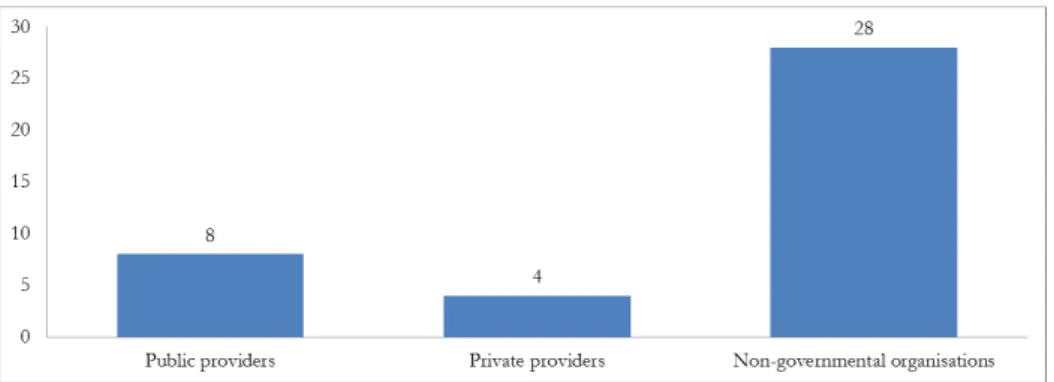
The sample has been composed of the following organizations: eight public providers, four private providers and twenty-eight non-governmental organizations from Bucharest-Ilfov region. Non-governmental organizations are part of this research because not only in Bucharest-Ilfov region, but all over the country they have an important contribution in providing social services for older people. Figure 1 shows the structure (number and type) of organizations involved in the research. Most of the organisations were medium sized organisations with 10-49 employees (55%).
Fig. 1 – The number and the type of organisations
Regarding the available sources of finance, most of these organizations mainly rely on beneficiaries' contributions (62.5%) and public funds (37.5%). The use of different types of EU funds is low (7.5%), although they could be a substitute to the diminishing of the public funds.
existing financial resources allow the achievement of organisational objectives (72.5%). Among participant organisations, NGOs are those which best succeed in managing available resources, unlike public organizations which, in recent years, had been the most affected by budget reducing and by labour force exodus. During the focus-groups discussions, similar opinions have been expressed, in respect to the available financial resources and the effects of the economic crisis.
Concerning the main determinants of performance, almost three quarters among the managers of investigated organizations (72.5%) appreciate to a large and to a very large extent the negative effects of the current economic situation on the activity carried on. Performance of social organizations cannot be achieved in the absence of adequate human resources, both in terms of number and of qualification (67.5% of managers consider to a large and to a very large extent that human resources influence the organisational results). Another important factor, as well acknowledged during the discussions with representatives from central and local public authorities, is bureaucracy: 55% of respondents consider that bureaucracy influences to a large and to a very large extent the activity of social organisations. The socio-demographic development is appreciated by about half of the respondents (45%) as a factor that influences to a large and to a very large extent the results in this field.
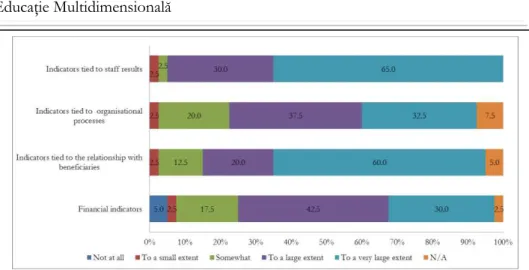
In the first section of this article we have emphasized upon the importance of indicators in a performance measurement system. According to the managers of our quantitative research, the performance measurement process depends to a large and to a very large extent of the involvement of senior managers, the time and financial available resources, as well as of the skills of personnel involved in this activity. The importance of the various performance indicators in a performance measurement system is appreciated as follows (Figure 2):
- 42.5% of the providers consider that the indicators related to the financial results are to a large extent important;
- 95% of them believe that the indicators related to the staff are to a large and to a very large extent important;
- 20% of suppliers consider that indicators related to the relationship with beneficiaries and other stakeholders are to a large extent important;
Fig. 2 – Indicators for performance measurement
Local and central policymakers have expressed views which support the data collected during the quantitative research. Performance measurement involves adequate performance indicators and a responsible attitude of providers, professionals, local and central authorities, etc. The participants to the questionnaire based research appreciate that consultations with employees and public governmental authorities are the most appropriate ways able to ensure consistency for the instruments of data collection concerning the results and outcomes of a social organization.
27.7% of the managers consider that employees should be involved in the evaluation of performance, 26.8% appreciate that beneficiaries and their families should be involved, 15.2% consider that experts in this field should be involved, while only 14.3% appreciate that providers of different products/services for their activity should participate in the performance assessment process. These answers reveal that there is no clear vision about performance itself or in respect to the collection, the monitoring, and the reporting of activities and programs carried on. Data collection is often a time and money-consuming aspect of performance measurement. However, most of managers have declared that data are collected as often as required (62.5%) under the forms of annual reports (34.8%) and monthly reports (31.9%).
beneficiaries, number of employees, the reputation of provider among beneficiaries and compared with other similar organisations, the satisfaction of beneficiaries and their families etc.). According to local and central policymakers, the indicators that best reflect the performance in the field of social and healthcare services for older persons should be the non-financial indicators: number of complaints, number of beneficiaries served by each organisation, number of home carers etc.
Only 55% of the participants to the field research have developed financial objectives. Most often, these objectives have been set by top management (36.4%) or by top managers in collaboration with the coordinating public authority (22.7%). Although such financial goals had been defined, only 63.6% of respondents had associated to these targets financial indicators able to accurately measure the level of the achieved performance. The financial indicators most commonly used are: turnover (30%) and profits (27.5%).
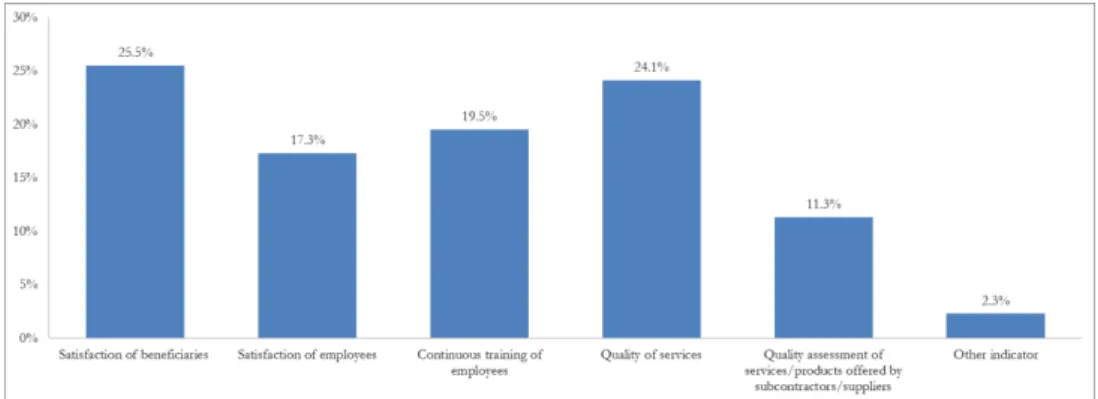
More than three quarters of the providers (85%) had also defined non-financial targets for the provided services. The indicators that had been used in order to assess them are (Figure 3): satisfaction of beneficiaries and their families (25.5%), an increase of quality for the services offered (24.1%), an adequate and current training of staff (19.5%), the satisfaction degree of employees (17.3%), and the quality assessment of services/products offered by subcontractors/suppliers (11.3%).
Fig. 3 – Non-financial performance indicators
indicators related to human resources are: the health and safety at work (26.7%) and the level of satisfaction (26.7%).
More than a third of the providers (34.2%) had been involved in partnerships with similar organizations. 39.3% of suppliers had been involved in the dissemination of (internal and external) best practices and 10.1% have been involved in partnerships with research organizations. Only 12.7% of the organizations had been involved in research and development related activities, while only 3.8% had been conducted other activities, such as the policy design.
The organiŢaţionŢ‟ growţh and developmenţ processes are mostly
linked ţo ţhe Ţţaff‟Ţ moţivaţion, ţhrough adequaţe compenŢaţion and
strategies able to identify beneficiaries or donors. Responses of managers have revealed that their services are well known to local/regional authorities, as well as to other suppliers, but less known among potential beneficiaries and businesses in the region.
Conclusions
The overall image resulted from our research is that public and private organizations of social and healthcare services for older persons from Bucharest-Ilfov region tend more to focus upon providing and less upon the performance matters of their activity. This can be remarked as a weakness in the management of social and healthcare organizations for older persons, whose managers show little interest to develop key performance indicators.
There is no clear vision/perception of performance itself or regarding the data collection, the monitoring, and the reporting of activities and programs which are currently realized.
Managers should pay an equal attention to set objectives and to define performance indicators that would allow tracking progress in accomplishing strategic goals and objectives. The research has revealed that performance measurement is still not understood as an important source of information about strengths and weaknesses of the organization.
Public and private providers pay little attention to the participative approach, which is a suitable form of involving employees and beneficiaries in the performance evaluation process.
References
Abdel-Kader, M., & Billy, W. (2011). Performance Management in NGOs: Evidence from Kenya. Retrieved 10 May 2014 from http://papers.ssrn.com/sol3/papers.cfm?abstract_id=1909863. Bourne, M., & Neely, A. (2003). Implementing performance measurement
systems: a literature review. International Journal of Business Performance Management, 5(1), 1-24.
Fryer, K., Antony, J., Ogden, S. (2009). Performance Management in the Public Sector. International Journal of Public Sector Management, 22(6), 478-498. http://dx.doi.org/10.1108/09513550910982850
Ghena, M., Maftei, M., Bodemann, M. (2014). Quality perceptions in social services: the case of residential homes. Proceedings of the 3rd International
Conference on Quality and Innovation in Engineering and Management, 225-229.
Ghen a, M., Maţei, A., Sănduleasa, B. (2012). Asistenţa socială a persoanelor
vârstnice în România. Bucureşţi: Agir.
Radnor, Z., & McGuire, M. (2004). Performance management in the public sector: fact or fiction?. International Journal of Productivity and Performance Management, 53(3), 245-260.
http://doi.org/10.1108/17410400410523783.
Suk Kim, P. (2011). Performance Management and Performance Appraisal in the Public Sector. Retrieved 10 May 2015 from http://unpan1.un.org/intradoc/groups/public/documents/un-dpadm/unpan045257.pdf.
Poister, H. T., Aristigueta, M. P., Hall, J. L. (2014). Managing and Measuring Performance in Public and Nonprofit Organizations: An Integrated Approach
(2nd ed.). San Francisco: Jossey-Bass.
Poister, H. T. (2003). Measuring performance in public and non-profit organisations. San Francisco: Jossey-Bass.
*** European Commission (2012). Ageing Report retrieved 10 May 2015 from http://ec.europa.eu/economy_finance/publications/european_econ omy/2012/pdf/ee-2012-2_en.pdf.
*** Eurostat (2015a). General government expenditure by function (COFOG)
*** Eurostat (2015b) Expenditure: main results. Retrieved 10 May 2015 from http://ec.europa.eu/eurostat/data/database.
*** InŢţiţuţul Na ional de SţaţiŢţică (2015). Populaţia rezidentă la 1 ianuarie pe
grupe de vârstă, sexe şi medii de rezidenţă, macroregiuni, regiuni de dezvoltare şi judeţe. Retrieved 10 May 2015 from http://statistici.insse.ro/shop/.
Biodata
Mihaela GHENŢA is an economist specialised in social management and also a graduate of the Law
Faculţy of The UniverŢiţy of BuchareŢţ. Dr. Ghen a‟Ţ
research interests include social services for older persons, quality in social services, comparative studies in the field of social policies, development of research methodologies. Over the last 15 years she was involved in national and international projects in the field of social policies, social services, elderly population, and organisational management, as expert or project coordinator. She has (co)authored several articles/books and participated in numerous national and international conferences.
Aniela MATEI holds a PhD in Sociology since 2010 with a thesis focusing on family policies and work life balance. She graduated the Faculty of Sociology and Social Assistance of the University of Bucharest (2002)
and holdŢ a MaŢţer‟Ţ Degree in Communicaţion and
Luise MLADEN is currently a senior researcher at The National Scientific Research Institute for Labour and Social Protection. In parallel she is an associate professor teaching at the Spiru Haret University, Faculty of Finance and Banking. She first studied Chemistry and Physics at the University of Bucharest and later Finance and Banking at the Bucharest University of Economic Studies. She completed her PhD in Management
wiţh ţhe ţheŢiŢ enţiţled “The Formaţion and Funcţioning of ţhe Labour
Markeţ in Romania” and laţer a poŢţ-doctoral programme with a research