EFFECT OF PRETREATMENT OF
ALGAL BIOMASS ON BIOADSORPTION
OF MANGANESE
Mane P. C - Bhosle A. B – Vishwakarma C. V – Tupkar L. G.
School of Earth Sciences, Swami Ramanand Teerth Marathwada University, Nanded, (MH) 431606. India.
Abstract
The presence of heavy metals in aquatic environment is known to cause severe damage to aquatic life. Most of the heavy metals are soluble in water and form aqueous solutions and consequently cannot be separated by ordinary physical and chemical means of separation. Biological methods such as biosorption/ bioaccumulation for the removal of heavy metal ions may provide an attractive alternative to physico-chemical methods. The biomass is capable of absorbing and adsorbing metal ions from aqueous solution. In this study the effect of pretreatment of Algal biomasses like Spirogyra on the Mn biosorption capacity were investigated under laboratory conditions. For this purpose, the biomasses were subjected to physical treatments such as heat and autoclaving and chemical treatments such as sodium hydroxide and acetic acid. Under laboratory condition, all the pretreated biomass increased biosorption of Mn in comparison with live biomass (spirogyra - 37.75%; Nostoc – 41.73%). The maximum metal removal efficiency was observed under autoclaved biomass (spirogyra - 89.91%; Nostoc – 91.73%) followed by acetic acid treatment (spirogyra - 82.90%; Nostoc – 87.83%). Among the pretreatments the oven dried biomass (spirogyra - 57.23%; Nostoc – 61.81%) and NaOH treated cells (spirogyra - 49.90%; Nostoc – 51.54%) adsorbed least amount of metal.
Key words: Biosorption, Algae, dead biomass, Manganese.
INTRODUCTION
The waste waters discharged from chemical industries which may contain heavy metal ions have toxic effect on all living organisms. Because of this, disposal of them to the environment is a major threat to both human health and ecosystem (Azab and Peterson, 1989). So the development of new technologies is required to treat waste waters as an alternative to traditional physichochemical processes. Biosorption, the process of passive cation binding by dead or living biomass, represents a potantially cost- effective way of eliminating toxic heavy metals from industrial waste waters.
The uptake of heavy metals by biomass is usually classified into three categories: (1) cell surface binding, (2) intracellular accumulation and (3) extracellular accumulation. Being metabolism independent, the cell surface binding can occur in either living or inactivated microorganisms, whereas the intracellular and extracellular accumulation of metals are usually energy-driven processes, and thus can take place only in living cells (Gadd, 1990; Volesky, 1990a; Macaskie, 1990; Sağ and Kutsal, 2000). Non-viable microbial biomass frequently exhibits a higher affinity for metal ions compared with viable biomass probably due to the absence of competing protons produced during metabolism. To avoid the problems of toxicity of metals for microbial growth, or inhibition of metal accumulation by nutrient or excreted metabolites, the decoupling of the growth of the biomass from its function as a metal-sorbing material is seen as one of the major advantages of biosorption (Fourest and Roux, 1992; Sağ and Kutsal, 2000).
Blue green algae can accumulate heavy metals from their external environment by means of physico-chemical and biological mechanisms. Biosorption is a process that utilizes inexpensive dead biomass to sequester toxic heavy metals and particularly useful for the removal of contaminants from industrial effluents. Biosorbents are prepared from the naturally abundant and/or waste biomass of algae, moss, fungi or bacteria that have been killed while the biomass is pretreated by washing with acids and/or bases before final drying and granulation (Kratchovil and Volesky, 1998).
is no requirement for growth media and nutrients, the biosorbed metal ions can be easily desorbed and biomass can be reused and dead biomass-based treatment systems can be subjected to traditional adsorption models in use. As a result, the use of dead fungal biomass has been preferred in numerous studies on biosorption of toxic metal ions from aqueous solutions (Kapoor and Viraraghavan, 1998). The aim of this study was to investigate the effect of physical and chemical pretreatment of different algal biomass on biosorption of Mn from aqueous solution.
MATERIALS AND METHODS Algae culture conditions:
The algae isolates Viz., Spirogyra sp and Nostoc commune were used for this experiment. The method developed by Cabuk et al. (2005) was followed for the biosorption experiments. The Spirogyra sp isolates were inoculated in BG-11 broth and Nostoc commune in Chu’s 10 (modified) medium, for mass multiplication and incubated under fluorescent light (3000 lux) at a temperature of 25
1°C for 18 days. Biomass was then harvested by filtration, washed with generous amounts of deionized water, resuspended and washed again.Pretreatment of biomass:
Thirty grams of wet biomass (algae) was then pretreated in 4 different ways. The treatment details are, T1- Live biomass (Type A); T2 - Dried at 600C for 12 h in an incubator (Type B); T3 - Autoclaved for 15 min at 121 0C at 15 psi (Type C); T4 - Boiled for 15 min in 500 ml of 0.5 N sodium hydroxide solution (Type D); T5- Boiled for 15 min in 200 ml of 10% (v/v) acetic acid solution (Type E). After each pretreatment with chemicals, the biomass were washed with generous amounts of deionized water and then dried at 600C for 12 hrs. The sodium hydroxide pretreated biomass was washed with deionized water until the pH of the solution was in a near neutral range (pH 6.8-7.2).
Adsorption experiment:
All adsorption properties for pretreated biomass were measured with standard equilibrium experiment. A series of vials contained 5g of biomass and 100ml of heavy metal solutions of know concentration and the contents were shaken at 20ºC for 4hr in a rotating shaker (100rpm). After experiment, mycelial pellets were filtered through gauze, and the supernatant liquid was used for metal analysis, by atomic absorption spectrometer.
Experimental parameters:
In order to evaluate the effect of pH, temperature and speed of shaker bed on metal uptake, pH of the solution was adjusted to be in the range between 2.5 and 7.5 before mixing biomass. pH was adjusted to the required value with 0.1M HNO3 or 0.1M NaOH. Experiments were performed at 20ºC-40ºC. The speed of shaker bed ranged between 50rpm to 250rpm.
RESULTS AND DISCUSSION
Effect of biomass pretreatment:
Pretreated algal biomass showed promising results for biosorption of Mn from aqueous solution. The findings related to Mn biosorption by live and pretreated biomasses of Spirogyra sp and Nostoc commune are presented in Table.1.
Table.1: Adsorption capacity of native and pretreated Spirogyra sp and Nostoc commune
Pretreated methods Biosorption capacity (mg/g)
Spirogyra sp. Nostoc commune
No pretreatment 4.11 4.24
Physical methods
0.5 N sodium hydroxide solution Boiled for 15 min in 200 ml of 10% (v/v) acetic acid solution
11.39 12.83
The comparisons for Mn adsorption capacities of native Spirogyra sp and Nostoc commune with Spirogyra sp and
Nostoc commune were shown in Table 1. It showed that all kinds of physical and chemical pretreatment to algae were beneficial to increase the adsorption ability on Mn. Nonviable microbial biomass frequently displays a higher affinity for metal ions compared with viable biomass that might probably due to the absence of competing protons produced during metabolism. It avoids the problem of metal toxicity for microbial growth and inhibition of metal accumulation by nutrient or excreted metabolites (Fourest and Roux, 1992). Among the pretreatment methods, autoclaved biomass of Spirogyra sp and Nostoc commune had the highest biosorption of Mn metal. The sequestration of metallic species by algal biomasses which constitutes the basis of its biosorbent behavior has mainly been traced to the cell wall. The cell wall is not necessarily the only site where the sequestered metals are located. They may also be found within the cell, associated with various organelles, or may crystallize in the cytoplasm (Volesky, 1990). The drying and then grinding of blue green algal biomass reveals the sites where metal ions could be sequestered and so increase the probability of encountering metal ions. The order of biosorption was autoclaved cells > acetic acid treated > oven dried cells > NAOH treated > live cells. The maximum metal removal efficiency was observed under autoclaved biomass (spirogyra - 89.91%; Nostoc – 91.73%).
0 2 4 6 8 10 12 14 16 18
2 3 4 5 6 7
p H
Spirogyra sp. Nost oc commune
Fig. 1: Effect of pH on Mn uptake by pretreated Spirogyra sp and Nostoc commune.
Effect of solution pH on Mn biosorption:
0 2 4 6 8 10 12 14 16
20 25 30 35 40
T emp er at ur e oC
Spirogyra sp. Nostoc commune
Fig. 2: Effect of temperature on Mn uptake by pretreated Spirogyra sp and Nostoc commune.
Effect of temperature on heavy metal uptake:
The effect of changes in the temperature on the metal uptake was shown in Fig. 2. When temperature was lower than 35ºC, Mn uptake increased with increasing temperature, but when temperature was over 35ºC, the results were on the contrary. This response suggested a different interaction between the ligands on the cell wall and the metal. Below 35ºC, chemical adsorption mechanisms played a dominant role in the whole adsorption process, adsorption was expected to increase by increase in the temperature (Sag et al., 1995), while at higher temperature, the algae were in a nonliving state, and physical adsorption became the main process. Physical adsorption reactions were normally exothermic, thus the extent of adsorption generally decreased with further increasing temperature.
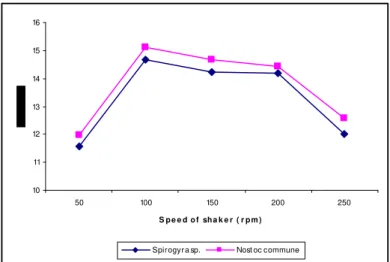
10 11 12 13 14 15 16
50 100 150 200 250
S p e e d o f sh a k e r ( r p m )
Spirogyr a sp. Nost oc commune
Fig. 3: Effect of speed of shaker bed on Mn uptake by pretreated Spirogyra sp and Nostoc commune.
Effect of speed of shaker on heavy metal uptake:
CONCLUSION
The bioadsorption efficiency of algal biomass are greater than that of live cells. The differences in bioadsorption of heavy metals after a specific pretreatment might be attributed to the state of biomass and the nature of metal ions. When non-viable biomass is to be used in the removal of heavy metals, autoclaving is an effective method to improve the bioadsorption capacity. More information on biosorption is required to determine the best combination of metals, biomass types and other conditions. Moreover, further detailed studies should be conducted in order to clarify the causes of enhancement or decrease in adsorption capacity for blue green algal biomasses.
REFERENCES
[1] AZAB MS, PETERSON PJ. (1989): The removal of cadmium from water by the use of biological sorbents. - Water Science and
Technology, 21: 1705-1706.
[2] Cabuk,A., S.Ilhan., C.Filik and F.Caliskan. 2005: Pb2+ biosorption by pretreated fungal biomass.Turk. J. Biol., 29: 23-28.
[3] Fourest, E and J.C.Roux. (1992): Heavy metal biosorption by fungal mycelial by-products: Mechanisms and influence of pH. - Appl.
Microbiol. Biotechnol. 37:399-403.
[4] GADD GM.(1992): Heavy metal accumulation by bacteria and other microorganisms. - Experientia. 46: 834-840.
[5] Kapoor, A and T. Viraraghavan. (1998): Biosorption of heavy metals on Aspergillus niger: Effect of pretreatment. - Bioresour. Technol.
63: 109-113.
[6] Kratchovil D and Volesky B. (1998): Advances in the biosorption of heavy metals. - TIBTECH, 16: 291-300.
[7] MACASKIE LE. (1990): An immobilized cell bioprocess for the removal of heavy metals from aqueous flows. - J. Chem. Tech.
Biotechnol, 49: 357-379.
[8] SAĞ Y, KUTSAL T. (2000): Determination of the biosorption activation energies of heavy metal ions on Zooglea ramigera and Rhizopus
arrhizus. - Process Biochem. 35: 801-807.
[9] Volesky B. (1990): Biosorption by Fungal Biomass. In: Biosorption of Heavy Metals. - (Ed.,)B. Volesky. CRC Press, Boca Raton, Florida.
pp. 139-171.
[10] VOLESKY B. (1990a): Removal and recovery of heavy metals by biosorption. P. 7-43, , [Editor: B Volesky Biosorption of Heavy Metals.
396 P. Publications of CRC Press, Boca Raton].
[11] Sag, Y., D. Ozer and T. Kutsal. (1995): A comparative study of the biosorption of lead(II) ions to Z. ramigera and R. arrhizus. Process
Biochem., 30(2), 169-174.
[12] Matheickal, J.T. and Q. Yu. (1996): Biosorption of lead from aqueous solutions by marine algae Ecklonia radiata. Water Sci. Technol., 34,
1-7.