Epidemiological profile of work-related accidents with biological
Epidemiological profile of work-related accidents with biological
Epidemiological profile of work-related accidents with biological
Epidemiological profile of work-related accidents with biological
Epidemiological profile of work-related accidents with biological
exposure among medical students in a surgical emergency room
exposure among medical students in a surgical emergency room
exposure among medical students in a surgical emergency room
exposure among medical students in a surgical emergency room
exposure among medical students in a surgical emergency room
Perfil epidemiológico de acidentes com material biológico entre estudantes de
Perfil epidemiológico de acidentes com material biológico entre estudantes de
Perfil epidemiológico de acidentes com material biológico entre estudantes de
Perfil epidemiológico de acidentes com material biológico entre estudantes de
Perfil epidemiológico de acidentes com material biológico entre estudantes de
medicina em um pronto-socorro cirúrgico
medicina em um pronto-socorro cirúrgico
medicina em um pronto-socorro cirúrgico
medicina em um pronto-socorro cirúrgico
medicina em um pronto-socorro cirúrgico
P
HILLIPEG
ERALDOT
EIXEIRADEA
BREUR
EIS, A
SCBC-PR
1; A
NNAL
UIZAD
RIESSEN, A
CCBC
2; A
NAC
LAUDIAB
RENNERA
FFONSODAC
OSTA3;
A
DONISN
ASR, TCBC-PR
4; I
WANA
UGUSTOC
OLLAÇO, TCBC-PR
4; F
LÁVIOD
ANIELS
AAVEDRAT
OMASICH, TCBC-PR
4A B S T R A C T
A B S T R A C T
A B S T R A C T
A B S T R A C T
A B S T R A C T
Objective Objective Objective Objective
Objective: To evaluate the accidents with biological material among medical interns interning in a trauma emergency room and identify key related situations, attributed causes and prevention. MethodsMethodsMethodsMethods: we conducted a study with a quantitative approach.Methods Data were collected through a questionnaire applied via internet, with closed, multiple-choice questions regarding accidents with biological material. The sample comprised 100 interns. ResultsResultsResultsResultsResults: thirty-two had accidents with biological material. Higher-risk activities were local anesthesia (39.47%), suture (18.42%) and needle recapping (15.79%). The main routes of exposure to biological material were the eyes or mucosa, with 34%, and syringe needle puncture, with 45%. After contamination, only 52% reported the accident to the responsible department. ConclusionConclusionConclusionConclusionConclusion: The main causes of accidents and routes of exposure found may be attributed to several factors, such as lack of training and failure to use personal protective equipment. Educational and preventive actions are extremely important to reduce the incidence of accidents with biological materials and improve the conduct of post-exposure. It is important to understand the main causes attributed and situations related, so as general and effective measures can be applied.
Key words: Key words: Key words: Key words:
Key words: Health profile. Accidents, occupational. Students. Biohazard release. Risk.
Study conducted at the Emergency Room and General Surgery Service of Workers Hospital, Federal University of Paraná – UFPR, Curitiba, Paraná State – PR, Brazil.
1. Resident, General Surgery, Júlio de Mesquita Filho São Paulo State University; 2. Medical School Graduate, Positivo University; 3. Medical School Graduate, Federal University of Paraná; 4. Assistant Professor, Trauma, Federal University of Paraná.
INTRODUCTION
INTRODUCTION
INTRODUCTION
INTRODUCTION
INTRODUCTION
S
ince the first occupational contamination by the HIV
virus in 1984
1, occupational accidents involving biological
material have been a prominent issue in public health.
Exposure to biological material in professional healthcare
can occur either by percutaneous inoculation or by direct
contact through skin and mucosa. Accidental
percutaneous inoculation through sharp-edged material
are considered at higher risk because they can transmit
more than 20 different pathogens, AIDS (HIV), hepatitis
B (HBV) and hepatitis C (HCV) virus being the most
frequent
2. The transmission of these pathogens between
patients and members of the health team is related to
the frequency of exposures with potential transmission,
to the prevalence of disease in the population, to the
risk of transmission given the exposure to a source of
infection, and to the effectiveness of post-exposure
management
3.
The risk of HIV infection through needlestick
in-juries with contaminated blood is estimated to range from
0.3% to 0.4%; in mucocutaneous accidents, the risk is
0.09%
4. The risk of contamination by HBV varies from 6%
to 30%, according to the serologic status of the source of
contamination and the vaccination status of the member
of the healthcare team. The combination of gamma
globulin and vaccine can reduce the risk by 90% to 95%.
Moreover, the average risk of acquiring hepatitis C after
sharp-edged injury is 1.8%
2.
preventing the infection, or by prophylaxis with antiretroviral
agents in the case of HIV
7.
Despite prevention recommendations, the
incidence of occupational accidents involving biological
material is alarming and members of the nursing staff are
most involved
3,8. However, there is an emphasis on the
growing number of accidents among healthcare interns.
According to data from SINABIO
9, of the 14,096 accidents
with biological material recorded between January 1999
and September 2006, 1067 (7.6%) occurred among
students
7.
The present study aimed to evaluate accidents
with biological material among medical interns who work
as interns at an emergency room trauma, thereby identifying
the key related situations, attributed causes and prevention
control. We also assessed the preventive measures to avoid
exposure to biological materials, as well as action to be
taken after an accident.
METHODS
METHODS
METHODS
METHODS
METHODS
We carried out a quantitative research approach
in order to collect data relating to accidents with biological
material involving medical interns interning in an emergency
room trauma during the month of March 2012.
Data were collected through a questionnaire
(Appendix 1) with closed multiple choice questions in which
addressed issues related to student involvement in accidents
with biological material, type of accident, procedure being
performed, use of protective equipment, prior immunization
and conduct after an accident. The questionnaire was
administered through the software tool Google Docs®,
which offers the questionnaire over the internet. The data
were automatically archived and made available to the
research team.
The study included all medical interns from the
fourth period (second year) on, who were interns in the
emergency room of the Workers Hospital. The sample
comprised 100 interns. All received instructions on the proper
use of personal protection equipment before starting the
internship through a class taught by the internship
coordination.
The collected data were analyzed by Descriptive
analysis and the chi-square test.
The study was approved by the Ethics in Research
Committee of the Workers Hospital - Emergency and
Ge-neral Surgery Department of the Federal University of Paraná
under CEP-SESA/HT number 508/2012.
RESULTS
RESULTS
RESULTS
RESULTS
RESULTS
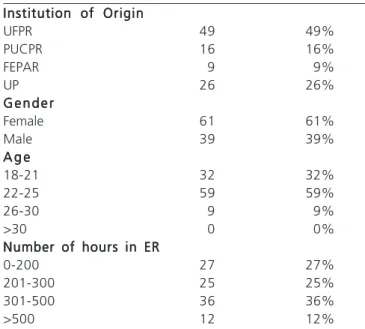
Epidemiological data regarding the
questionnaire answered by 100 medical interns are
summarized in table 1.
Of the 100 respondents, 32 have had accidents
with biological materials, of whom 66% were exposed only
once, and the remaining 34%, two or three times.
The activities of greatest risk for contamination
were the procedures local anesthesia (39.47%), suture
(18.42%) and needle recapping (15.79%) (Figure 1). The
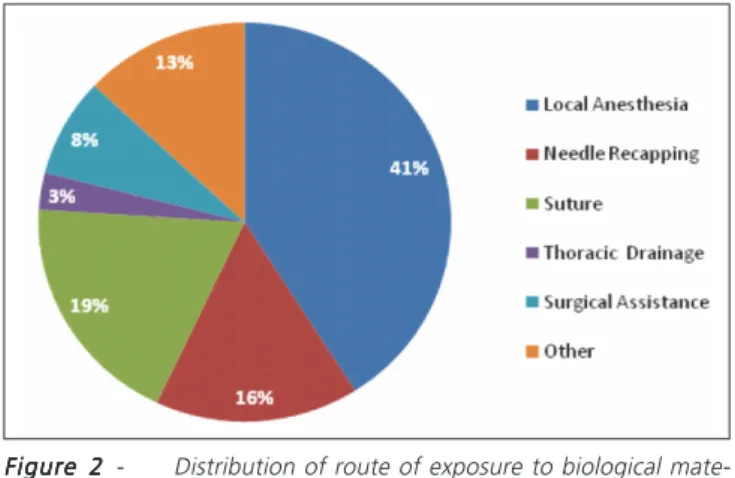
main routes of contamination, corresponding to 79%, were
the syringe needle and direct contact with eye or mucosa
(Figure 2). After contamination, 70% of interns performed
the proper cleaning of the site, but only 52% reported the
accident to the responsible department.
The PPE were often dismissed by interns, and
the lack of use of goggles and mask were the most reported
related to hospital accidents.
From the interns who sustained accidents, 82%
had prior immunization against hepatitis B, 47% with
serological confirmation. After the accidents, 24% of the
interns had access to the serological status of the patient.
No patient had positive serology.
DISCUSSION
DISCUSSION
DISCUSSION
DISCUSSION
DISCUSSION
In this study, 32% of the interns have experienced
some kind of accident with biological material during their
internship period, a value comparable to those described
in the literature
3,10,11. The use of young labor force
contributes to the high number of accidents
12.
The ratio between the number of accidents and
number of hours of training provided in the emergency
room, which shows a difference of 9% when comparing
interns with over 500 hours of training to those with up to
200 hours, probably reflects the longer time of internship
Table 1 Table 1Table 1
Table 1Table 1 - Epidemiological data collected from the questionnaire.
Institution of Origin Institution of OriginInstitution of Origin Institution of OriginInstitution of Origin
UFPR 49 49%
PUCPR 16 16%
FEPAR 9 9%
UP 26 26%
G e n d e r G e n d e rG e n d e r G e n d e rG e n d e r
Female 61 61%
Male 39 39%
A g e A g eA g e A g eA g e
18-21 32 32%
22-25 59 59%
26-30 9 9%
>30 0 0%
Number of hours in ER Number of hours in ERNumber of hours in ER Number of hours in ERNumber of hours in ER
0-200 27 27%
201-300 25 25%
301-500 36 36%
and exposure to biological materials, since it is believed
in the possibility of achieving greater dexterity and technical
skill during the training period
1,7,13. Negligence,
recklessness, inadequate lighting, pace of work, long
journey, lack of PPE, anxiety, nervousness and lack of
training are considered determining factors
8,13-15. The type
of activity, however, appears to be more important than
the level of training
16.
The main causes of accidents found were local
anesthesia, recapping of needles and suture, adding nearly
80%, and the most common routes of exposure were direct
contact with eyes and mucous and manipulation of needles,
equivalent to data from other hospitals
12,16-18. Some PPE,
such as goggles and mask, are little used, probably due to
non-availability and no incentive
10-12.
According to the literature, the risk of exposure
to HBV after an accident with biological material ranges
from 6% to 30%, depending on the conditions of infection,
disease activity in the host and prophylactic measures
adopted. For HCV, the risk is 1.8%, and for HIV, from 0.1%
to 0.3%. Vaccination against hepatitis B is one of the main
measures to prevent accidents with biological material
2,5and it is expected around 95% of professionals
8,19. Of the
interns assessed, 82% had prior immunization against
hepatitis B, which reflects the non-obligation and lack of
incentive to the vaccine at internship start.
Underreporting of hospital accidents occurs in
most medical centers, the Workers Hospital not being an
exception, since the responsible sector was notified in
52.63% of the accidents
12. Medical interns do not seek
specialized medical care possibly because they do not
perceive the work environment as a potential place of
contamination
13,14, since their daily practice involves
manu-al handling of perforating-cutting objects and secretions
such as blood and other bodily fluids
8.
The main causes of accidents and routes of
exposure found may be attributed to several factors, such
as lack of training and failure to use personal protective
equipment. Educational and preventive actions are
extremely important to reduce the incidence of accidents
with biological materials and improve the post-exposure
conduct. Isolated care is considered ineffective. Therefore,
we must seek to understand the main attributed causes
and related situations in order to general apply effective
measures
7,10-12,17,18.
Figure 1 Figure 1 Figure 1 Figure 1
Figure 1 - Distribution of the procedure in which there was the first contamination with biological material.
Figure 2 Figure 2 Figure 2 Figure 2
Figure 2 - Distribution of route of exposure to biological mate-rial.
R E S U M O
R E S U M O
R E S U M O
R E S U M O
R E S U M O
Objetivo: Objetivo: Objetivo: Objetivo:
Objetivo: avaliar os acidentes com material biológico entre estudantes de medicina estagiando em um pronto-socorro de trauma e identificar as principais situações relacionadas, causas atribuídas e prevenção. Métodos: Métodos: Métodos: Métodos: estudo com abordagem quantitativa. OsMétodos: dados foram coletados através de um questionário, aplicado via internet, contendo perguntas fechadas de escolha múltipla, referentes a acidentes com material biológico. A amostra obtida foi 100 estudantes. Resultados: Resultados: Resultados: Resultados: Resultados: trinta e dois se acidentaram com materiais biológicos. As atividades de maior risco foram anestesia local (39,47%), sutura (18,42%) e recapeamento de agulha (15,79%). As principais vias de exposição ao material biológico foram contato com olho ou mucosa, com 34%, através de seringa com agulha com 45%. Após a contaminação, apenas 52% notificaram o acidente ao setor responsável. Conclusão: Conclusão: Conclusão: Conclusão: Conclusão: as principais causas de acidente encontradas e vias de exposição podem ser atribuídas a diversos fatores, como falta de treinamento e ao não uso de equipamentos de proteção individual. Ações preventivas e educativas são de extrema importância para diminuir a incidência dos acidentes com materiais biológicos e melhorar a conduta pós-exposição. É preciso entender as principais causas atribuídas e situações relacionadas a fim de implantar medidas gerais e eficazes.
Descritores: Descritores: Descritores: Descritores:
REFERENCES
REFERENCES
REFERENCES
REFERENCES
REFERENCES
1. Grande Gimenez Marino C, El-Far F, Barsanti Wey S, Servolo Medeiros EA; Hospital Epidemiology Committee, Federal University at Sao Paulo, SP, Brazil. Cut and puncture accidents involving health care workers exposed to biological materials. Braz J Infect Dis. 2001;5(5): 235-42.
2. Destra AS, Angelieri DB, Bakowski E, Sassi SJG. Módulo 5 – Risco ocupacional e medidas de precauções e isolamento. Curso Infec-ção relacionada à Assistência à Saúde – IrAS – Brasília: Agência Nacional de Vigilância Sanitária, 2004. Disponível em: http:// w w w . a n v i s a . g o v . b r / s e r v i c o s a u d e / m a n u a i s / i r a s /
M % F 3 d u l o % 2 0 5 % 2 0
-%20Risco%20Ocupacional%20e%20Medidas%20de%20Precau%E7%F5es%20e%20Isolamento.pdf 3. Moloughney BW. Transmission and postexposure management of bloodborne virus infections in the health care setting: where are we now? CMAJ. 2001;165(4):445-51.
4. Brasil. Ministério da Saúde. Secretaria de Políticas de Saúde. Co-ordenação Nacional de DST e Aids. Manual de Condutas: exposi-ção ocupacional a material biológico: hepatite e HIV. Brasília:Ministério da Saúde; 1999.
5. Garner JS. Guideline for isolation precautions in hospitals. The Hospital Infection Control Practices Advisory Committee. Infect Control Hosp Epidemiol. 1996;17(1):53-80. Erratum in: Infect Control Hosp Epidemiol. 1996;17(4):214.
6. Brasil. Ministério da Saúde. Secretaria de Vigilância em Saúde. Departamento de Vigilância Epidemiológica. Manual dos centros de referência para imunobiológicos especiais/Ministério da Saúde. Secretaria de Vigilância em Saúde. Departamento de Vigilância Epidemiológica. Brasília: Ministério da Saúde, 2006.
7. Gir E, Netto JC, Malaguti SE, Canini Silvia RMS, Hayashida M, Machado AA. Acidente com material biológico e vacinação contra hepatite B entre graduandos da área da saúde. Rev Latino-Am Enfermagem. 2008;16(3):401-6.
8. Reis RK, Gir E, Canini SRMS. Accidents with biological material among undergraduate nursing students in a public Brazilian university. Braz J Infect Dis. 2004;8(1):18-24.
9. Secretaria de Estado da Saúde de São Paulo. Programa Estadual de DST/AIDS. Divisão de Vigilância Eídemiológica. SINABIO. Aci-dentes biológicos: mudanças em vigilância, assistência e preven-ção. Bol Epidemiol CRT-DST/AIDS CVE. 2007;IV(1):3-20. 10. Lee CH, Carter WA, Chiang WK, Williams CM, Asimos AW,
Goldfrank LR. Occupational exposures to blood among emergency medicine residents. Acad Emerg Med. 1999;6(10):1036-43. 11. Toledo Júnior ACC, Ribeiro FA, Ferreira FGF, Ferraz RM, Greco DB.
Conhecimento, atitudes e comportamentos frente ao risco
ocupacional de exposição ao HIV entre estudantes de Medicina da Faculdade de Medicina da Universidade Federal de Minas Ge-rais. Rev Soc Bras Med Trop. 1999;32(5):509-15.
12. Vieira M, Padilha MI, Pinheiro RDC. Analysis of accidents with organic material in health workers. Rev Latino-Am. Enfermagem. 2011;19(2): 332-9.
13. Murofuse NT, Marziale MHP, Gemelli LMG. Acidentes com mate-rial biológico em hospital universitário do oeste do Paraná. Rev Gaúcha Enferm. 2005;26(2):168-79.
14. Magagnini MAM, Rocha SA, Ayres JA. O significado do acidente de trabalho com material biológico para os profissionais de enfer-magem. Rev Gaúcha Enferm. 2011;32(2):302-8.
15. Almeida CB, Pagliuca LMF, Leite ALAS. Acidentes de trabalho envolvendo os olhos: avaliação de riscos ocupacionais com traba-lhadores de enfermagem. Rev Latino-Am Enfermagem. 2005;13(5):708-16.
16. Secco IAO, Robazzi MLCC, Shimizu DS, Rubio MMS. Typical occupational acidentes with employees of a university hospital in the south of Brazil: epidemiology and prevention. Rev Latino-Am Enfermagem. 2008;16(5):824-31.
17. Chiodi MB, Marziale MHP, Robazzi MLCC. Occupational acidentes involving biological material among public health workers. Rev Latino-Am Enfermagem. 2007;15(4):632-8.
18. Garcia de Codes Ilario A, Pardo JRJ, Martínez MPA. Accidentes con exposición a material biológico contaminado por VIH en trabajadores de un hospital de tercer nível de Madrid. Rev Esp Salud Pública. 2004;78(1):41-51.
19. Patterson JM, Novak CB, Mackinnon SE, Patterson GA. Surgeons’ concern and practices of protection against bloodborne pathogens. Ann Surg. 1998;228(2):266-72.
Received on 29/07/2012
Accepted for publication 06/09/2012 Conflict of interest: none
Source of funding: none
How to cite this article: How to cite this article:How to cite this article: How to cite this article:How to cite this article:
Reis PGTA, Driessen AL, Costa ACBA, Cerchiari N, Nasr S, Collaço IA, Tomasich FDS. Epidemiological profile of work-related accidents with biological exposure among medical interns in a surgical emergency room. Rev Col Bras Cir. [periódico na Internet] 2013;40(4). Disponível em URL: http://www.scielo.br/rcbc
APPENDIX 1 APPENDIX 1 APPENDIX 1 APPENDIX 1 APPENDIX 1
Analysis of accidents with biological material in the Emergency Room of the Workers Hospital – ER-WH Name : __________________________________ Team: __________
Gender : ( ) Male ( ) Female
1. age: 1. age: 1. age: 1. age: 1. age:
( 1) ( ) 18-21 ( 2) ( ) 22-25 ( 3) ( ) 25-30
( 4) ( ) aged> 30 years
2. Ever had an accident with biological material during the internship at the ER-WH? 2. Ever had an accident with biological material during the internship at the ER-WH? 2. Ever had an accident with biological material during the internship at the ER-WH? 2. Ever had an accident with biological material during the internship at the ER-WH? 2. Ever had an accident with biological material during the internship at the ER-WH?
Biological fluids that must be considered risky are the following materials: blood, organic liquid containing blood and potentially infectious body fluids (semen, vaginal secretions, cerebrospinal, synovial, peritoneal, pericardial and amniotic fluids.
( 1 ) ( ) Yes ( 2 ) ( ) No
3. If yes, how often: 3. If yes, how often: 3. If yes, how often: 3. If yes, how often: 3. If yes, how often: ( 1) ( ) once . (2) ( ) 2 to 3 times . ( 3 ) ( ) More than 3 times . ( 9 ) ( ) Ignored
( 0 ) ( ) Not applicable
4. What was the route of exposure to biological material? 4. What was the route of exposure to biological material? 4. What was the route of exposure to biological material? 4. What was the route of exposure to biological material? 4. What was the route of exposure to biological material? ( 1 ) ( ) Direct contact with eye or mucosa
( 2 ) ( ) Syringe with needle
( 3 ) ( ) scalpel in the operating room ( 4 ) ( ) scalpel in the ER
( 5 ) ( ) Broken Glass
( 0 ) ( ) Other sharp-edged material : ___________________ ( 9 ) ( ) Ignored
5. What procedure was being performed in the first exposure? 5. What procedure was being performed in the first exposure? 5. What procedure was being performed in the first exposure? 5. What procedure was being performed in the first exposure? 5. What procedure was being performed in the first exposure? ( 1 ) ( ) Local anesthesia
( 2 ) ( ) Needle Recapping ( 3 ) ( ) Suture
( 4 ) ( ) Injection
( 5 ) ( ) peripheral venous access ( 6 ) ( ) Central Venous Access ( 7 ) ( ) Oro- tracheal intubation ( 8 ) ( ) Thoracic Drainage
( 9) ( ) Surgical instrumentation (scrub) ( 10 ) ( ) Surgical Assistance
(0) ( ) Other ( 9 ) ( ) Ignored
6. What protective equipment was NOT being used? 6. What protective equipment was NOT being used? 6. What protective equipment was NOT being used? 6. What protective equipment was NOT being used? 6. What protective equipment was NOT being used? ( 1 ) ( ) Gloves
( 2 ) ( ) Mask ( 3 ) ( ) Glasses ( 4 ) ( ) White Coat ( 5 ) ( ) Closed Shoe
7. Did you have complete vaccine schedule for hepatitis B before the accident? 7. Did you have complete vaccine schedule for hepatitis B before the accident?7. Did you have complete vaccine schedule for hepatitis B before the accident? 7. Did you have complete vaccine schedule for hepatitis B before the accident? 7. Did you have complete vaccine schedule for hepatitis B before the accident? (1) ( ) Yes
(2) ( ) No ( 9 ) ( ) Ignored
8. Do you have a confirmed immunization status against hepatitis B? 8. Do you have a confirmed immunization status against hepatitis B?8. Do you have a confirmed immunization status against hepatitis B? 8. Do you have a confirmed immunization status against hepatitis B? 8. Do you have a confirmed immunization status against hepatitis B? (1) ( ) Yes
(2) ( ) No ( 9 ) ( ) Ignored
9. After exposure, did you wash the site with soap and water or antiseptic solution (povidone, Chlorhexidine)? 9. After exposure, did you wash the site with soap and water or antiseptic solution (povidone, Chlorhexidine)?9. After exposure, did you wash the site with soap and water or antiseptic solution (povidone, Chlorhexidine)? 9. After exposure, did you wash the site with soap and water or antiseptic solution (povidone, Chlorhexidine)? 9. After exposure, did you wash the site with soap and water or antiseptic solution (povidone, Chlorhexidine)? (1) ( ) Yes
(2) ( ) No ( 9 ) ( ) Ignored
10. Did you report the accident to the responsible department? 10. Did you report the accident to the responsible department?10. Did you report the accident to the responsible department? 10. Did you report the accident to the responsible department? 10. Did you report the accident to the responsible department? (1) ( ) Yes
(2) ( ) No ( 9 ) ( ) Ignored
11. Did you have access to the results of serological tests for HIV, HBV and HCV of the patient? 11. Did you have access to the results of serological tests for HIV, HBV and HCV of the patient?11. Did you have access to the results of serological tests for HIV, HBV and HCV of the patient? 11. Did you have access to the results of serological tests for HIV, HBV and HCV of the patient? 11. Did you have access to the results of serological tests for HIV, HBV and HCV of the patient? (1) ( ) Yes
(2) ( ) No
12. If so, did the patient had some positive serology for HIV, HBV or HCV? 12. If so, did the patient had some positive serology for HIV, HBV or HCV?12. If so, did the patient had some positive serology for HIV, HBV or HCV? 12. If so, did the patient had some positive serology for HIV, HBV or HCV? 12. If so, did the patient had some positive serology for HIV, HBV or HCV? (1) ( ) Yes
(2) ( ) No
( 0 ) ( ) Not applicable
13. If yes, which virus was the serum positive for? 13. If yes, which virus was the serum positive for?13. If yes, which virus was the serum positive for? 13. If yes, which virus was the serum positive for? 13. If yes, which virus was the serum positive for? (1) ( ) HIV
( 2) ( ) HBV ( 3) ( ) HCV
( 0 ) ( ) Not applicable
14. If HIV was positive, was prophylaxis with antiretrovirals carried out? 14. If HIV was positive, was prophylaxis with antiretrovirals carried out?14. If HIV was positive, was prophylaxis with antiretrovirals carried out? 14. If HIV was positive, was prophylaxis with antiretrovirals carried out? 14. If HIV was positive, was prophylaxis with antiretrovirals carried out? (1) ( ) Yes
(2) ( ) No
( 0 ) ( ) Not applicable
15. If HBV was positive, was hyperimmune globulin administered? 15. If HBV was positive, was hyperimmune globulin administered?15. If HBV was positive, was hyperimmune globulin administered? 15. If HBV was positive, was hyperimmune globulin administered? 15. If HBV was positive, was hyperimmune globulin administered? (1) ( ) Yes
(2) ( ) No