- 1214 - Experiment Reports
GIVING (NEW) MEANING TO MENTAL HEALTH CARE CENTERS:
AN EXPERIENCE REPORT
1Amanda Nathale Soares2, Belisa Vieira da Silveira3, Fernanda Batista Oliveira Santos4, Patrícia Natália Medeiros Alves5, Francisco Carlos Félix Lana6
1 This study was developed based on the discipline - Health, Disease and Space, from the Nursing Graduate Program of the Nursing School of the Federal University of Minas Gerais (UFMG), 2012.
2 Master’s student of the Nursing Graduate Program of the Nursing School of UFMG. Belo Horizonte, Minas Gerais, Brazil. E-mail: [email protected]
3 Master in Nursing. RN. at the Care and Protection Center for Young Users of Toxic Substances. Belo Horizonte, Minas Gerais, Brazil. E-mail: [email protected]
4 Master’s student of the Nursing Graduate Program of the Nursing School of UFMG. Belo Horizonte, Minas Gerais, Brazil. E-mail: [email protected]
5 RN. at the Risoleta Tolentino Neves Hospital. Belo Horizonte, Minas Gerais, Brazil. E-mail: [email protected] 6 Ph.D. in Nursing. Associate Professor at the Public Health and Mother-Child Nursing Department of the Nursing School of
UFMG. Belo Horizonte, Minas Gerais, Brazil E-mail: [email protected]
ABSTRACT: This article is the report of an experience of graduate students from the School of Nursing of the Federal University of Minas Gerais, as part of the subject “Health, disease, and space”. The article aims to report the discussion regarding the link between mental health and care centers, based on the experience in that subject. Dynamic resources have been used, such as music, letters and
exploration of the physical space in order to raise awareness and relection on the topic. Results are presented by means of letters that express the relective dialogues on mental health from each perspective. We conclude that the experience contributed to the construction
of knowledge and the awareness regarding this subject. These contributions are essential for the training of new teachers who should be able to foster the training of nurses who would be co-responsible for the construction of new ways to understand the individual experiencing psychological suffering and the care provided to them.
DESCRIPTORS: Service structure. Medical geography. Mental health care. Nursing.
(RE)SIGNIFICANDO OS ESPAÇOS ASSISTENCIAIS EM SAÚDE MENTAL:
RELATO DE EXPERIÊNCIA
RESUMO: Relato de experiência de pós-graduandas da Escola de Enfermagem da Universidade Federal de Minas Gerais, na disciplina “Saúde, doença e espaço”. O artigo objetivou relatar a discussão sobre a relação entre saúde mental e espaços assistenciais, a partir da vivência na disciplina. Utilizaram-se recursos dinâmicos, como música, leitura de cartas e exploração do espaço físico da sala de aula,
com o intuito de favorecer a sensibilização e a relexão acerca do tema. São apresentadas, como resultados, cartas que traduzem os diálogos relexivos sobre os espaços assistenciais em saúde mental em cada recorte paradigmático. Conclui-se que a vivência contribuiu
para a construção de conhecimentos e para a sensibilização sobre a temática. Essas contribuições colocam-se como essenciais à formação
de futuros professores, que devem ser capazes de incitar a formação de enfermeiros, corresponsáveis pela construção de novas formas de perceber o sujeito em sofrimento psíquico e a assistência a ele dirigida.
DESCRITORES: Estrutura dos serviços. Geograia médica. Assistência em saúde mental. Enfermagem.
(RE)SIGNIFICANDO LOS ESPACIOS ASISTENCIALES EN SALUD
MENTAL: RELATO DE EXPERIENCIA
RESUMEN: Se trata de un relato de experiencia de posgraduandas de la Escuela de Enfermería de la Universidad Federal de Minas Gerais en la asignatura “Salud, Enfermedad, espacio”. El artículo objetiva relatar la discussion acerca de la relación entre la salud mental y los espacios asistenciales desde la vivencia en la asignatura referida. Se utilizó de recursos dinámicos, como música, lectura de cartas
y exploración del espacio físico de la sala de classe, con el objetivo de favorecer la sensibilización y la relexión acerca del tema. Son presentadas como resultados cartas que traducen los diálogos relexivos acerca de los espacios asistenciales en salud mental en cada recorte paradigmático. Se conclui que la vivencia contribuyo para la construcción de conocimientos y para la sensiblización acerca del tema. Esas contibuiciones se ponen como esenciales a la formación de futuros profesores que deban ser capables de incitar la formación de
INTRODUCTION
Spatial conigurations, not considering their
symbolic variations, are an element that has been related to western medicine and public health for over two thousand years, and that is also
impor-tant in the ield of epidemiology.1 Over the course of time, different conceptions regarding the effects of space on health and Disease have appeared,
which usually deine space as a place referred to
by geographic coordinates and characterized by both a physical and an environmental structure.2 Thus, we can say that the concept of space is syn-onymous with landscape.3
Although they are often considered to be synonymous, the concepts of space and landscape have different meanings, given the properties of time and materiality. Landscape is related to the relationship established between man and nature, a material system of concrete forms spread across the planet. Space is replete with features of time, and may be thought of as the moment when men and social relationships converge with landscape forms. Broadly speak-ing, space is an essence, an abstraction, or a net-work of symbols that is impossible to express in concrete shapes but that paradoxically interacts with the landscape.
This interaction between space and land-scape leads us to the concept of topophilia, a neolo-gism that relates the emotional bonds of human beings to their material environment.4 The reaction to the environment may include different connota-tions, but the most permanent expressions of this relationship are supported by the contemplation of space elements, which are built from affection, feelings and values organized in a system of sym-bols based on individual experience.2
In the ield of health, particularly in psychia -try, the approach to space is mainly approached from a landscape point of view, where the contri-butions of technological and geographic resources prevail in terms of early diagnosis, clinical man-agement, availability and access to mental health services. The concept of space is understood in a structural and traditional manner where the terri-tory and the population are concerned.5-6
In terms of the distinction made between landscape and space, some authors maintain a symbolic and humanistic distinction between ‘place’ and ‘space’ in terms of mental health. The ‘place’ refers to a geometric conception of distance between objects, while ‘space’ is related to a social
feature, linked to the individuals’ experiences within the social structures.7
The interaction between space and place/ landscape holds special importance when con-sidering the architecture of care centers for indi-viduals experiencing psychic suffering, since its inception is an important element in the imple-mentation of care models.8 The well-grounded places in psychiatric landscapes are driven by a superior logic, founded on conceptions of mental health-Disease processes and also on conceptions of the individuals who are suffering.
This article aims to report on the discussion surrounding the link between mental health care and care centers. This discussion derives from the experience report of two students, the authors of this article, regarding their participation in the subject “Health, disease and space” from the stricto sensu graduate program of the School of Nursing of the Federal University of Minas Gerais. This experience was the result of the pre-sentation of a term paper on the subject, in which the link between mental health care and care centers used as a therapeutic environment was
discussed. We believe that this study, because it
comes from a graduate program, can contribute
to knowledge development in the ields of health
and nursing.
It is believed that the topic of this article its
into three important mainstreams within the
cur-rent context of health: the irst refers to the increase of studies that regard spatial matters in the ield
of health and focus on the temporal and relational concept of space;3 the second addresses Psychiat-ric Reform, which approaches the principle and practice changes in mental health care spanning the structural and relational re-organization of therapeutic loci;9-10 and the third refers to the cur-rent need for higher education docents in health11 and nursing,12who would have a new proile and would be in line with the socio-economic, political and technological demands and be able to mediate
a teaching-learning process that fosters question
-ing, relection, critical analysis and a sensitive
interaction with the world.
METHODS
The subject “Health, disease and space”
the School of Nursing of the Federal University of Minas Gerais. One of its goals is to analyze the concept of space and its application to the study of the health-disease process. The total subject
workload is 30 hours, and in the irst semester of
2012, which is the period when the focused work was carried out, 23 students were registered.
As a requirement for obtaining credit for
this subject, it was proposed that the students complete a project that involved spatial dimen-sion within any context of health. Following the previous experience of two students in the theoretical-practical scope of mental health, and the importance of landscapes and care centers to the implementation of care strategies, we chose to carry out a study focusing on the link between mental health care and care centers employed as therapeutic environments. Thanks to readings and discussions about space, we
realized that the subject fostered relection and
awoke the students’ desire to consider space as a component of health.
Presentation of the work: a metalinguistic
approach to space
To spatially represent the ideas that were developed, the students’ experiences approached a different way to manage physical space in the classroom, so they used the audience layout to pro-mote a better view and put the topic into context.
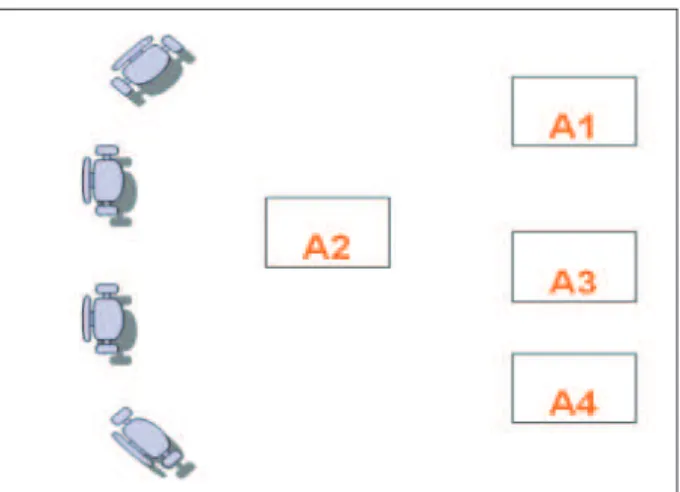
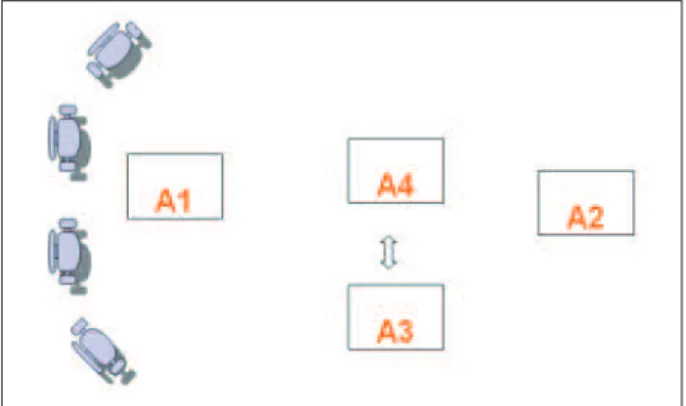
To better describe this experience, we de-cided to use Figures in order to represent the students’ layout at the time of each presentation. Thus, the students are represented in the Figures and in the text by A1, A2, A3 and A4. The other students, that is, the audience, are represented by “chairs”.
The experience is represented at ive dif
-ferent times. The irst time represents the jarring
presence of the “insane” in society (Figure 1); the second represents the introduction of the concept of topophilia and the purpose of the work (Figure 2); the third represents the beginning of the “dia-logue” between Foucault, Goffman, Tenório and comtemporary society, introduced by Foucault and Goffman’s ideas, expressed in letters that were read (Figure 3); the fourth represents the reading, also from letters, of Tenorio’s ideas about
Psychi-atric Reform (Figure 4); and the ifth represents the
coexistence of the asylum model and psychiatric reform, and the actual care model intended by comtemporary society (Figure 5).
Figure 2 - The jarring presence of the “insane” in society
Firstly, in igure 1, the aim was to surprise the
classroom students and raise awareness regarding the stigma faced by individuals with mental disor-ders within society. To illustrate this, the students used a musical feature to present the topic; student A1 sang the song “Balada do Louco” a cappella.13 This student was sitting on one of the chairs in the semi-circle and suddenly began singing the song, surprising all of the participants. The insertion of a member with differing behavior was shocking in this context and represented the “insane” indi-vidual within the social context.
Figure 2 - The introduction of the concept of topophilia and the purpose of the work
Secondly, the aim was to put the topic into context. Figure 2 represents the placement of stu-dent A1 with the remaining parties of the work group (A3 and A4). Student A2, placed in the center, began a formal discussion about Psychiatric Reform by explaining the concept of topophilia. The central position of A2 and the speech delivered in a formal tone represent the rigid and traditional concepts of the hospital-oriented logic that is
characteristic of this model. Afterwards, A2 briely
that began in Brazil in the late 1970’s and explained the proposal for a paradigmatic change in regards to mental health. The students then emitted a sud-den and high-pitched sound, with synchronized clapping of their hands and repeating of the word topocide, representing a break provided by the concept of this word itself.
Topocide is the elimination of the cultural meaning of a particular landscape by a particular society. It is a point of no return for the annihila-tion of a culture, as it shows its fragility related to topocidal forces.4 Psychiatric reform offers a proposal for a break with the hospital-oriented logic and with mental health care founded on domination, obscurity and subjugation, aiming at new psychosocial and care centers models.
Figure 3 - Foucault and Goffman’s point of view in their dialogues with Tenório and comtemporary society
The third step, represented by figure 3, aimed to show the dichotomy between mental health care models – the asylum and its
substitu-tion - and to carry out a relecsubstitu-tion regarding space.
The layout shown represents the beginning of a critical discussion about the evolution of Brazilian mental health, based on the dialogues between Foucault, Goffman, Tenório and comtemporary society, which exposed the dichotomous rela-tionship between the asylum model and the care
model intended. The discussion and relection
regarding space raised by the subject allowed the achievement of results which are presented by means of letters in the results section.
In the step represented by igure 3, the results
were presented by the reading of Letter 1, called “Revisiting Foucault and Goffman to understand Tenório’s misunderstanding”. For this stage of the presentation, student A3 stood in the center of the
circle and relected on the main concepts related
to the topic that were developed in Foucault and Goffman’s works. The central position of A3 rep-resents the features of a traditionalist logic that is
still present today, despite the fact that lexibility
has already been presented at this stage.
Figure 4 - Tenório’s point of view in his dialogues with Goffman, Foucault and comtemporary society
The fourth stage aimed to present Psychiatric Reform and the mobility featured in its therapeu-tic proposal. Figure 4 shows the beginning of the reading of Letter 2, entitled “Our reports evoke Tenório and call for freedom”, which led to a
relection on Tenório’s ideas. This letter, read by
A4, discusses Psychiatric Reform proposals and substitution services in mental health.
When A4 began to read the letter, she made
a sudden movement towards A3, reader of the
previous letter, forcing her to sit on the loor, as a
way to represent the proposed paradigm
transi-tion. While A4 was reading the second letter, she
walked around the classroom, indicating the spa-tial mobility of the reformist proposal. Mobility is represented in Figure 4 by the surrounding line.
Figure 5 represents the coexistence of the asylum alongside substitutionary models and the actual mental health care provided in comtempo-rary society. A1 read Letter 3, called “Foucault, Goffman, Tenório and Comtemporary Society: intersecting parallels”, which critically appraises the dialectic between these models.
At the beginning of the reading, A4 (reader of
Letter 2) sat on the loor facing A3 (reader of Letter
1), which represented the opposition between both
concepts, as shown in igure 5. It was noted that,
even though the chronological evolution presented represents a major progress in the use of spaces where comtemporary society is represented, dif-ferent models still coexist, albeit on a smaller scale than previously.
At this inal stage, previous steps of the expe -rience are revisited and new perceptions of space in terms of mental health are brought to light by
the students, based on relections fostered by the
subject which led to the creation of the concept of “self-space”.
RESULTS: THE LETTERS
A letter is a free composition model where a message is transmitted from a sender to a receiver; its characteristics are determined by these two par-ties and by the content of the message exchanged. The use of letters in this presentation aimed to bring these parties closer in understanding the paradigm, focusing on the content and on the language employed.
As mentioned previously, the letters are presented below, where the thoughtful dialogues regarding mental health are approached from every angle: asylum, substitute services and cur-rent care models.
Letter 1 - Revisiting Foucault and Goffman
to understand Tenório’s misunderstanding
To address psychiatric care during the 20th century up until now, we must revisit the “history of insanity” and view it from the perspective of that time, but with contemporary eyes.
When, how and why did society begin to
examine insanity? Is it possible that a process that started 400 or 500 years ago is still occurring
today? Where did the concept of the alienated and
violent individual come from, for whom the only way to live is to be isolated and segregated from social coexistence?
The sixteenth and seventeenth centuries were a time of great religiosity and control in so-ciety, in which the search for control of the patho-logical or the abnormal was completely acceptable. It was thought that the best way to normalize the ‘abnormals’ of society was to control them by keeping watch over them constantly, adjusting their behaviors and thoughts. But how can we do this within society if everyone is supposedly
free? Nothing is more convenient and eficient than coninement, where it is possible to watch
the inmates and normalize them in accordance with social and societal rules. Almost a work of art, the “Panopticon” was created, a pleasant and respectable architectural landscape, a symbol of order and control, an imposing building.14-15
This building was ring-shaped, with a court-yard and an imposing central tower strategically
placed to isolate and tame its inmates. The ield
of vision was unilateral: the watchman had com-plete control of the inmates, but the reverse was not true. It is worth mentioning that punishment was connected to vigilance: punishment of body and soul, enforced by this oppressive landscape.14 Similarities with 21st century psychiatric institu-tions are not a mere coincidence.
Panopticism is characterized by the complete and total surveillance of people, by discipline and control, thus being a true institution. As in a madhouse or prison, the daily routine in a true institution such as the psychiatric hospital occurs entirely within its premises, collectively, with a strict schedule and no interaction between the watchmen and the inmates.14-16
Given this scenario of restriction and
inad-equacy, mental health professionals, users of the service and their relatives began to question this “treatment” within the insanity model. Was it re -ally necessary for inmates to sleep on bunks, to be fed behind bars, to be naked and die of exposure? How many individuals would suffer neglect and how many lives would be taken by this punish-ing system?
In Brazil, reports of physical and psychologi-cal abuse began to appear in the end of the 1970s,
following the Mental Health Workers’ Movement.
Abuse cases were made public and there were
This paradigm and shift in care practices later became known as the Psychiatric Reform. The intervention of public health in Santa Casa de Anchieta was a milestone; cells were removed, electroshock therapy was forbidden, visiting hours were permitted and, most importantly, the doors were opened to the public.17
Thus a new vision of insanity was created, with a new approach. The initial concept of com-munity care for individuals with mental health disorders began with the conversion of a human stockroom into a care center.
The evolution of psychiatry/mental health presented in this letter helps to illuminate the proposal for transforming psychiatric landscapes/ care centers for the “insane”/individuals expe-riencing psychic suffering. A break with these places is suggested, as they regulate, limit, control, normalize, watch and punish.
Letter 2 - Our reports evoke Tenório and call
for freedom
Today, our reports are permeated by new views; we foresee new goals and describe a new era. This is a time of enlightenment, of
overthrow-ing, of breaking with tradition. We break with
an obscure and normative history, one that takes away from the individual what is most valued and intimate, that takes them away from themselves. This new era highlights the embodiment of the individual; their own insight and the acknowledg-ment of themselves and of others.
The liberation of the other, of the rigid, of the cold and of the obscure is underlined so they are found in a new place, a place of their own. A place as a moment to be lived and lived again within social relationships, inside an open and dynamic landscape, where they can exploit instead of being exploited; where they can handle instead of being handled; where they can live instead of living ac-cording to others.
The crisis of the classic asylum model began
after the War, resulting from a need for revision of rules and a redeinition of psychiatry as a source
of knowledge and as an institution. The mechani-zation that exists between a psychiatric diagnosis and chronicity, exclusion and condemnation gave way to a new psychiatric order, both in ideology and practice.18
The Italian experience began a process of paradigmatic and practice overhaul in mental
health, as it suggested caring for individuals with mental health disorders within society. In this way, alternative community services were born
which were opposed to compulsory coninement
and changed the logic of categorization of disor-ders, favoring treatment and follow-up of these individuals.18
In Brazil, this opening began in the 1970s, in a political and economic climate marked by the end of the “Brazilian economic miracle”, when mental health professionals and other members of civil society spoke up against the appalling conditions in which individuals with mental health disorders were being treated at the time.19
As this movement grew, national mental health conferences were held, which led to the
creation of deinitions of Psychiatric Reform pro -posals, as well as proposals for substitutive care instead of the hospital-oriented model,19 focusing on comprehensive efforts and respect of citizen-ship and following the health-Disease pattern
closely related to quality of life.
On a legislative level, this era began in 1989 when then-congressman Paulo Delgado sponsored a bill that was passed in 2001. The bill prevented the creation or allocation of new psychiatric hos-pital beds.17 Therefore, it was a legal break with an obscure and dominating landscape which, although it was static, had a harsh impact on inmates’ lives.
The withdrawal of the individual from these places led to the need for the creation of new en-vironments. These new places would be part of a network in which the individuals could move freely, being a part of these therapeutic spaces that used to be social spaces.
In 2011, according to Law n. 10.216 and resolution n. 339, resolution n. 3.088 established the Psychosocial Care Network (RAPS, as per its acronym in Portuguese) to provide care for indi-viduals experiencing psychic suffering, whether they abuse psychoactive substances or not. RAPS is a strategy of creation and coordination of health services, as per the Psychiatric Reform.20
RAPS represents humanized care in men-tal health. It also stands for the diversity of care strategies that are based on individual therapeutic care and on community services, such as CAPS, companionship centers, therapeutic centers and street clinics, among others.20
space, whether they require intensive, semi-inten -sive or regular care. According to the number of
individuals listed and their proile (adult/child, addict or not), CAPS can be classiied as follows:
CAPS I, CAPS II, CAPS III, CAPS ad, CAPS ad III and CAPSI.20
CAPS is an outpatient care center that can
only operate in a speciic physical space during
the day and must be separate from other hospital facilities. This service must provide the individual with a mental disorder with a new routine, made up of individual and group activities which in-clude psychotherapy, operative groups, therapeu-tic workshops, sociotherapeutherapeu-tic activities, home visits, family care and community activities.20
Operating only during the day is a semi-intensive strategy which is an intermediate and transitory asset, falling somewhere in between intensive care (continuous care provided around the clock) and regular care (outpatient follow-up). It aims to assist in acute cases as a temporary mea-sure in postoperative cases or as a way to avoid hospitalization.21
Another type of substitutive care which can help to avoid hospitalization is the Home Therapeutic Service (SRT, as per its acronym in Portuguese), which is a home located in an urban area designed to meet the needs of individuals with severe mental disorders who may have been inpatients in a psychiatric hospital. The goal is to help them reintegrate into their community.20
The Companionship Center is also a sub-stitutive space providing care to individuals with mental disorders, founded on the creation of therapeutics aimed at sociability, productiv-ity and intervention. In these places, workshops and activities are carried out aimed at developing relationships, respecting differences and creating social bonds.20
This approach, afforded by a treatment that keeps the individual within the community, sug-gests that the individuals experiencing psychic suffering are deserving of the opportunity to live
socially and not be conined in an institution.
The acceptance of these particularities and differ-ences supported on the social network is built as a relevant strategy against the therapeutic space centered in asylums and against the segregation of these individuals from the social environment.17
These substitutive spaces embody freedom, social integration and subjective motion.
This letter expresses the timeline of rebirth, reinvention and the restructuring of mental health
care. It is about creating lexible spaces that favor
freedom and autonomy, as well as social, family and community interaction of individuals expe-riencing psychic distress. However, the idea of
lexible spaces often brings to mind vestiges of the panopticon, represented by social inlexibility; ri -gidity in professionals’ education and practice and in the nursing staff and human standardization.
Letter 3 - Foucault, Goffman, Tenório
and Comtemporary Society: “intersecting
parallels”
Is it possible to interact with the past?
Angst... What about when this past still remains
in the form of institutions, in the wide-open/ veiled prejudice that lies within every member of comtemporary society?
Oh, Foucault... Oh, Goffman... how can we not remember both of you when we see places such as substitutive services that are supposedly open and dialectic but in truth are still close to the panopticon of old? Should they be spaces or landscapes? Vigilance or autonomy? Punishment or freedom?
We confess our concern. We belong to com
-temporary society and, as health professionals, as nurses, we shall think about those who view space in mental health as a relational moment... Are there still traces deeply ingrained in our care
routine? We can see Foucault and Goffman alive
in the frames of these institutional buildings.
We look at the central tower and the full
institutions and we shout loudly in the search for
a dialogue with Tenório. We are frightened by this reality! We search for a new way to understand
and deal with psychic suffering in which care cen-ters are also places of construction of relationships, of others and of oneself. Don’t we?
We want open physical facilities where the
individuals can move freely, so they can build and rebuild relationships with others and with the environment, bringing together their own move-ments. Our conscience is a burden. Do we want that? And what have we done to make it happen?
We are a comtemporary society. Do we un
-derstand our self-space enough so as to request
search for it? We want to ind, live, feel the space that is illed with ourselves in the relationship with
others and the world; the space where wishes, angst, interests and determination dwell. This is the space that we underscore and that discloses the
signiicance of life, for us and for the individual
experiencing psychic suffering! Self-space!
FINAL CONSIDERATIONS
The irst advance, made possible because
of this work, is the distinction made between the concepts of landscape and space. This is related to psychiatric care and goes beyond the notion that mental health services, according to asylum logic, are simply facilities intended to implement treatment technologies.
The strategy chosen to present this study permitted a dynamic and interactive approach due to the metalinguistic use of space, and also due to the use of audio-visual aids. The speeches and facial expressions of the participants showed that the work aroused different emotions, gave rise to
different perceptions and stimulated relection and
awareness regarding the topic. These potentials of the developed strategy are essential to future teachers’ training, as teachers must be capable of encouraging an education in nursing founded
on questioning, relection, critical analysis and a
sensitive interaction with the world.
We believe that an actual paradigm shift in
mental health requires awareness about the dif
-ferent aspects related to care, among which care centers and the attitude of care givers, that is, nursing professionals’ space, approached here in its macro and micro senses, is an essential element that allows the individual experiencing psychic suffering to exercise the rights and opportunities offered by Psychiatric Reform.
REFERENCES
1. Gazzinelli A, Kloos H. The use of spatial tools in the study of Schistosoma mansoni and its intermediate host snails in Brazil: a brief review. Geospatial Health. 2007 Nov; 2(1):51-8.
2. Nossa P. A (des)construção do conceito de espaço e de saúde à luz da abordagem humanista e cultural. Revista da FLUP: Geografia – Universidade do Porto. 2008; 2(2):83-102.
3. Bousquat A, Cohn A. A dimensão espacial nos estudos sobre saúde: uma trajetória histórica. Hist Cienc Saude-Manguinhos. 2004 Set-Dez; 11(3):549-68.
4. Tuan YF. Topofilia: um estudo da percepção, atitudes e valores do meio ambiente. São Paulo (SP): Difel; 1980.
5. Priebe S, Saidi M, Kennedy J, Glover G. How to select representative geographical areas in mental health service research: a method to combine different selection criteria. Soc Psychiatry Psichiatr Epidemiol. 2008 Set-Dez; 43(12):1004-7.
6. Nascimento AF, Galvanese ATC. Avaliação da estrutura dos Centros de Atenção Psicossocial do município de São Paulo, SP. Rev Saude Publica. 2009 Ago; 43(1):8-15.
7. Kearns RA, Joseph AE. Space in its place: developing that link in medical geography. Soc Sci Med. 1993 Set; 37(6):711-7.
8. Soares NA, Silveira BV, Reinaldo AMS. Serviços de Saúde Mental e sua relação com a formação do enfermeiro. Rev Rene. 2010 Jul-Set; 11(3):47-56. 9. Vecchia MD, Martins STF. Desinstitucionalização
dos cuidados a pessoas com transtornos mentais na atenção básica: aportes para a implementação de ações. Interface – Comunic Saúde Educ. 2009 Jan-Mar; 13(28):151-64.
10. Guimarães NA, Fogaça MM, Borba LO, Paes MR, Larocca LM, Maftum MA. O tratamento ao portador de transtorno mental: um diálogo com a legislação federal brasileira (1935-2001). Texto Contexto Enferm. 2010 Abr-Jun; 19(2):274-82.
11. Machado JLM, Machado VM, Vieira JE. Formação e seleção de docentes para currículos inovadores na graduação em saúde. Rev Bras Educ Med. 2011 Jul-Set; 35(3):326-33.
12. Terra FS, Secco IAO, Robazzi MLCC. Peril dos docentes de cursos de graduação em Enfermagem de universidades públicas e privadas. Rev Enferm UERJ. 2011 Jan-Mar; 19(1):26-33.
13. Baptista A, Lee R. Rita Lee Acústico MTV [ DVD]. São Paulo (SP): Universal Music; 1998.
14. Foucault M. Microfísica do poder. Rio de Janeiro (RJ): Graal; 1979.
15. Foucault M. Vigiar e punir: a história da violência nas prisões. Rio de Janeiro (RJ): Vozes; 1999. 16. Goffman E. Manicômios, prisões e conventos. São
Paulo (SP): Editora Perspectiva; 2001.
17. Tenório F. A reforma psiquiátrica brasileira, da
década de 1980 aos dias atuais: histórias e conceitos.
Hist Cienc Saude-Manguinhos. 2002 Jan-Mar; 9(1):25-59.
18. Basaglia F. Escritos selecionados em saúde
mental e reforma psiquiátrica. Rio de Janeiro (RJ):
Garamound; 2005.
20. Ministério da Saúde (BR)l. Portaria n. 3.088, de 23 de dezembro de 2011: institui a Rede de Atenção Psicossocial para pessoas com sofrimento ou transtorno mental e com necessidades decorrentes do uso de crack, álcool e outras drogas, no âmbito do
Sistema Único de Saúde. Brasília (DF): Diário Oicial
da República Federativa do Brasil, 24 dez 2011. 21. Ministério da Saúde (BR), Secretaria de Atenção
à Saúde, Departamento de Ações Programáticas
Estratégicas. Saúde Mental no SUS: os centros de
atenção psicossocial. Brasília (DF): MS; 2004.
Correspondence: Francisco Carlos Félix Lana
Av. Alfredo Balena, 190
Campus Saúde, 4º andar, Sala 402
30130-100 – Santa Eigênia, Belo Horizonte, MG, Brazil
E-mail: [email protected]