Profile of the violence committed against
women assisted at Pousada de Maria
lodging
PERFIL DA VIOLÊNCIA CONTRA MULHERES ATENDIDAS NA POUSADA DE MARIA
PERFIL DE LA VIOLENCIA SUFRIDA POR MUJERES ATENDIDAS EN LA POSADA DE MARÍA
1 PhD, Faculty, Undergraduate and Graduate Nursing Program Master's Course at Universidade Federal do Paraná. Member of Adult Health Research Group
-GEMSA. Curitiba, PR, Brazil. [email protected] 2 RN. Master's student in Nursing at Universidade Federal do Paraná. Member of Adult Health Research
Group (GEMSA). Faculty at Universidade Estadual do Centro-Oeste UNICENTRO. Guarapuava, PR, Brazil. [email protected] 3 Undergraduate Nursing
Student, Universidade Federal do Paraná. Member of Adult Health Research Group - GEMSA. Curitiba, PR, Brazil. [email protected] 4 RN. Master's student
O
RIGINAL
A
R
TICLE
RESUMO
Pesquisa exploratória, retrospectiva, reali-zada na Pousada de Maria, em Curitiba, em 2007. Teve como objetivo caracterizar o perfil da violência praticada contra mulhe-res mulhe-residentes na Pousada de Maria, duran-te os anos de 1993 à 2007. Os dados foram obtidos através da análise de 886 fichas de registro das vítimas, transcritos para um instrumento construído para a pesquisa. As vítimas tinham idade entre 18 e 88 anos, baixa escolaridade, e sofreram violência fí-sica, psicológica, sexual e estrutural, prin-cipalmente pelos companheiros e pessoas conhecidas. Convivem com a violência para manter a união familiar, e rompem com ela na existência de programas sociais e abri-gos. A violência é um fenômeno frequente entre mulheres solteiras, com ensino fun-damental incompleto: 24,6% delas sofre-ram violência física, 24,15%, psicológica, 14,22%, violência estrutural. As solteiras, amasiadas e casadas devem ser inseridas como grupo de risco e objeto de atenção, pelos profissionais de saúde no planeja-mento de ações preventivas.
DESCRITORES
Violência doméstica. Violência contra a mulher. Saúde pública.
Liliana Maria Labronici1, Maria Isabel Raimondo Ferraz2, Tatiane Herreira Trigueiro3, Débora Fegadoli4
ABSTRACT
This exploratory, retrospective study was performed at the Pousada de Maria lodg-ing in Curitiba, Brazil in 2007, with the ob-jective of characterizing the profile of the violence practiced against women staying at Pousada de Maria from 1993 to 2007. Data collection was performed by analyz-ing 886 records of the victims’ registration and transcribed to an instrument formu-lated for the study. The victims were be-tween 18 and 88 years old, with low edu-cation; they suffered physical, psychologi-cal, sexual and structural violence, mainly by their partners and acquaintances. They lived with violence to maintain their family union and decided to resolve the situation when they had access to social programs and shelters. Violence is a common phe-nomenon among single women with in-complete primary education; 24.6% suf-fered physical violence, 24.15% psychologi-cal, and 14.22% structural violence. Single women, whether in a common-law rela-tionship or married, should be considered as an at-risk group and worthy subjects of attention by health professionals when planning preventive actions.
KEY WORDS
Domestic violence. Violence against woman. Public health.
RESUMEN
Investigación exploratoria retrospectiva, rea-lizada en la Posada de María en Curitiba, Bra-sil, en el año 2007, con el fin de caracterizar el perfil de la violencia ejercida contra mu-jeres que residieron en dicha institución en el período comprendido entre 1993 a 2007. Los datos fueron obtenidos a través del aná-lisis de 886 fichas de registro de las víctimas y transcriptos para un instrumento formula-do para la investigación. Las víctimas tenían entre 18 y 88 años, bajo índice de escolari-dad; fueron víctimas de violencia física, psi-cológica, sexual y estructural, inflingida prin-cipalmente por sus compañeros y personas conocidas. Convivieron con la violencia para mantener la unión familiar, se libraron de ella cuando tuvieron acceso a programas socia-les y amparos. La violencia es un fenómeno frecuente entre mujeres solteras con ense-ñanza primaria incompleta, 24,6% de ellas sufrieron violencia física, 24,15% psicológi-ca, 14,22% violencia estructural. Las muje-res solteras, en concubinato y casadas de-ben ser insertadas como grupo de riesgo y objeto de atención por parte de los profe-sionales de la salud, en la planificación de acciones preventivas.
DESCRIPTORES
INTRODUCTION
Over the last years, Public Health in Brazil has been in-corporating the aspect of violence as an issue of broad com-plexity, as it is a social phenomenon triggered by multiple factors and affects not only the victims themselves but also their families and the society. Violence is currently present in several settings, either public or private, affecting chil-dren, adolescents, men, women, older adults and people with disabilities of various social and economic classes, thus making it a global issue.
The theme of violence against women generates inter-est and a need for further debate and analysis. This results from the work of researchers over the last decades to re-port and transform historical conflicts between men and
women into democratic relationships(1).
A study performed by the Inter-American Development Bank showed that violence against women is responsible for 25% of work absences worldwide, thus reducing these women’s income in 3% to 20%, besides increasing their and their children’s chances of falling ill(2).
Another current issue is the scarcity of data to precise the rates of domestic violence against women. It is estimated that one out of every four women in the world has been abused by their domestic partner at least once in their lives. In Brazil, every minute one woman is abused inside their own home by people who they are close to. Today, 23% of the female population in Brazil are at risk for
domestic violence(3).
To better understand this study, it is
nec-essary to have a clear understanding of the concept of do-mestic violence, intrafamily violence and structural vio-lence, as they are present in the everyday lives of many women but often go on unnoticed, thus characterizing their invisibility and silent character.
In Brazil 1980’s, violence became part of the issues ad-dressed in health area studies as it implies psychological, physi-cal behavioral, sexual and/or spiritual harms. Violence against women can occur in several contexts, but the family
environ-ment is, without doubt, the most common and relevant(4).
Intrafamily violence is committed by people from the family that maintains a power relationship over the victim, affecting women, fathers, mothers, children, youth, older people or people with disabilities, regardless of their age. These people can be beaten, humiliated, and offended. Women are the main target and aggressors take advantage
over their vulnerability to beat and humiliate them(1).
It is important to emphasize that domestic violence ag-gressors also include members of the non-parental group living in the same domestic environment; it can be com-mitted by employees, close ones and people who know the
victims, but visit the household sporadically(2). Therefore,
there is not one cause alone for violence, and many factors may contribute to its occurrence (individual, relational and social), regardless of the gender, age, race, ethnicity, edu-cation, culture, socio-economic situation, profession, reli-gion, physical or mental abilities and personality. This means that many individuals may be vulnerable to it at any mo-ment of their lives(5).
In this context, structural violence is addressed as the distortions, diseases of the society, of an economic system capable of accumulating wealth, but that does not distrib-ute justly among citizens. It is capable of keep essential goods from a great part of the population, who have the right to live with dignity, creating a condition of violence. This
speci-ficity can also include the lack of job, housing and health(6).
To ponder about strategies that aim at reducing and preventing violence against women, it is mandatory to know the profile of that violence. In this sense, the inexistence of data in a supporting network such as the Pousada de Maria lodging motivated the development of the present study, which is justified by the need to learn about the profile of the violence committed against the women living
tempo-rarily in that shelter.
The Pousada de Maria lodging is a shelter home, an official unit of the Social Action Foun-dation (FAS, abbreviation in Portuguese for
Fundação de Ação Social) of the Curitiba city administration (Curitiba is the capital of Paraná state). Pousada de Maria cares for women over 18 years of age, accompanied or not of their children of minor age, in a protective and tran-sitory character, to guarantee comprehensive support to women living a situation of personal risk. The objective of the lodging is to help women return to family and social living, with their life partner or not, rewrit-ing their history with their children, and participatrewrit-ing and interacting with the community.
The shelter home was established 13 years ago and from 1993 to 2001 its administration was performed by a social association: Lar Batista Esperança (Batista Esperança Home). As of 2002, the FAS became responsible for coordi-nating and reorganizing the work. Women victims of vio-lence have access to the Pousada de Maria through the judiciary, the police, Family Court, Municipal Committee for Women’s Conditions, Guardianship Council, Regional Health Units and Centers and through the Social Rescue Central. For a woman to be referred to the shelter home it is indispensible that she reports to the police at the Women’s Protection Services, filing a formal report. This procedure helps to put Law 11.340 (Law Maria da Penha) into action, which creates mechanisms to restrain and pre-vent domestic and family violence against women.
Victims at the Pousada are currently assisted by a multi-professional team that consists of a coordinator, social worker, occupational therapist, psychologist, social
educa-To ponder about strategies that aim at
tors and an administrative team. When victims need the services of health professionals, they are forwarded to the referral units through the Unique Health System (the Bra-zilian national public health system: Sistema Único de Saúde). The casa has the capacity to shelter approximately 40 people, because it has an area of 350 m² with a laundry, bathrooms, kitchen, cafeteria, living room, dorms and an administrative area.
OBJECTIVES
General
To characterize the profile of the violence committed against women living at Pousada de Maria from 1993 to 2007.
Specific
To identify the number of women sheltered at Pousada de Maria from 1993 to 2007; To identify the ages of the victims, their level of education, marital status, type of vio-lence they suffered, the use of licit or illicit drugs; to iden-tify the service they seek after being abused; to ideniden-tify the aggressors; to describe the treatment they received; investigate the victims’ time of permanence at the shelter home, the reasons for living with violence or breaking free from it and their life expectations after leaving the shelter home.
LITERATURE REVIEW
The vulgarization of domestic violence has given invis-ibility to the crime of highest incidence in Brazil. The se-quelae of violence are not exclusively restricted to its vic-tims, rather they compromise every family member, espe-cially children, who will have the tendency to repeat the same behaviors lived at home and perpetuate them. Vio-lence can involve physical, psychological, sexual,
patrimo-nial, and moral aspects of victims(7). Therefore, knowing
what violence is and understanding the concepts of its many types is fundamental to recognize it. In this sense, physical violence is understood as any behavior that can offend an individual’s integrity or health(8).
Psychological violence refers to that which is caused by any behavior that generates emotional harms, reduced self-esteem, harms to one’s full development or that degrades or controls actions and behaviors, beliefs and decisions, through threats, constraint, humiliation, manipulation, iso-lation, stalking, insults, intimidation, ridiculing, exploitation and kept from their right of locomotion, or any other means that causes harms to an individual’s psychological health
and self-determination(7).
Sexual violence is understood as any behavior forcing one to presence, have or participate in undesired sexual relationship, through intimidation, threats, coercion or
us-ing force, which induce to trade or use one’s sexuality, im-pedes the use of contraceptive methods or forces matri-mony, pregnancy, abortion or prostitution, through
coer-cion, blackmailing, bribery or manipulation(8).
Patrimonial violence refers to each and every behavior that configures retention, subtraction, total or partial de-struction of object, work instruments, personal documents, goods, values, rights or economical resources. Moral vio-lence comprises any behavior that configures calumny, abuse or defamation. They are referred to as crimes that protect one’s honor, but, when committed because of the family and affective involvement, characterize moral vio-lence(7).
Any discussion on violence against women will always involve the gender violence issue, hence the term facili-tates the perception of the social and economical inequali-ties existing between men and women. It can be under-stood as that which is perpetuated against women simply
because of their condition of being a woman(3), it is
com-mitted in specific conditions, in an incoherent manner, marked by the male influence in a relationship of power,
men’s domination and women’s submission(9). In this sense,
violence against women is that which is committed against female individuals with a purpose of intimidation so the
aggressor can play a dominating and disciplinary role(1).
With the purpose of changing the behavior or aggres-sors and reducing the rates of violence against women, in August 7 2006 the Law Maria da Penha was promulgated, which states a series of measures to create victim support networks with the purpose of helping, orienting and strengthening them when making decisions. There is also the possibility of working with aggressors to help them
re-construct a healthy family relationship(10).
METHOD
This explorative, retrospective study was performed at Pousada de Maria in Curitiba, capital of Paraná state, se-lected for being the referral location for temporarily shel-tering abused women who need protection.
The data were obtained by analyzing all the register forms filled out from August 1993 to August 2007. Data collection was performed from June to August 2007, and the informa-tion from the forms were transcribed to an instrument for-mulated for the study that permitted to analyze the infor-mation. The following were used as inclusion criteria: all forms containing all notes that addressed the established objec-tives; all forms filled out from 1993 to 2007. Based on the registers, a careful analysis was performed on the notes taken by the team from the shelter home.
The study was analyzed and approved by the Research Ethics Committee of the Health Sciences Sector at Univer-sidade Federal do Paraná (CAAE: 1083.0.000.091-07). The victims’ identification data remained classified.
RESULTS
The total number of forms obtained from 1993 to 2007 was 886, and none were excluded since all were completed accordingly. An average 63 women were assisted per year. This small number of cases assisted over 14 years can be due to underreporting, since a higher incidence has been estimated for violence.
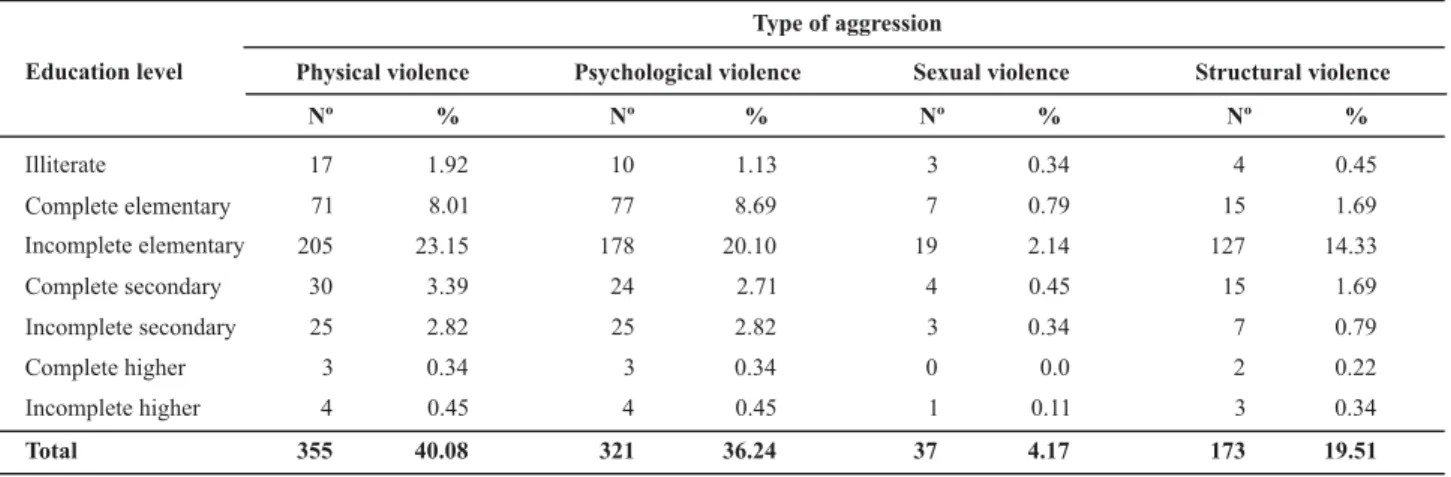
The women’s ages ranged between 18 and 88 years, most (54.75%) were in the age group between 19 and 49 years. As for education, most (59.72%) had incomplete elementary education. Regarding their marital status, 47.98% were single and 41.63% were married or living in common-law.
Before they were forwarded to the shelter, 58.8% sought the health service for physical or psychological treatment; 34.2% sought security sectors and another 7% sought other support networks. During their stay at the Pousada, 65% of the population was referred to therapy with a psycholo-gist; 7.5% to hospital treatment, due to the severity of the physical injuries they had suffered; 27.5% to occupational therapy and social educators. All women were evaluated by the social worker from the multi-professional team at the shelter home. The victims stayed lodged at the Pousada,
with their children of minor age, for a period that ranged between one day and one year and three months until they were able to return to their family or social living.
Aggressors were the women’s life partners in 71.41% of the cases of violence. Physical aggressions prevailed with 57.97%, followed by psychological violence, with 16.96%.
Women who claimed being single, with partner, pre-dominated as victims of physical violence (24.60%), and were also more exposed to psychological violence (24.15%), as well as structural violence (14.22%).
Physical violence predominated in 30.02% of house-keepers, who were abused by their partners, in their own homes. There were no specific spaces on the form for tak-ing notes on the variable moral and patrimonial violence.
As for drug use, it was found that 80.47% of the popu-lation claimed they did not use any licit or illicit drugs. It was important to identify that 11.17% were users of co-caine, marijuana, crack, alcohol or tobacco. At the time of admission to the shelter, 8.25% of the women did not want to make any statements about their using drugs, thus this data was missing in 0.11% of the files.
The following tables make a correlation between socio-demographic characteristics and the type of violence, the reasons why victims lived and broke with that violence. The purpose is to present groups at risk, and provide support for the multi-professional team plan goals and meet the victims’ life expectations.
Table 1 - Women, victims of violence, according to their level of education and the type of violence they had suffered - Curitiba - 2007
Education level
Type of aggression
Illiterate
Complete elementary
Incomplete elementary Complete secondary Incomplete secondary Complete higher Incomplete higher
Total
Physical violence
Nº %
17 1.92
71 8.01
205 23.15
30 3.39
25 2.82
3 0.34
4 0.45
355 40.08
Psychological violence
Nº %
10 1.13
77 8.69
178 20.10
24 2.71
25 2.82
3 0.34
4 0.45
321 36.24
Sexual violence
Nº %
3 0.34
7 0.79
19 2.14
4 0.45
3 0.34
0 0.0
1 0.11
37 4.17
Structural violence
%
0.45 1.69 14.33 1.69 0.79 0.22 0.34
Nº
4 15 127 15 7 2 3
173 19.51
Women with incomplete elementary education (59.7%) had suffered more cases of all types of violence, that is, 23.15% suffered physical violence; 20.10% were victims of
Table 2 - Women, victims of violence, according to their marital status and the reasons for living with violence - Curitiba - 2007
Marital status
Reason for living with violence
Common-law Married Divorced Single Widow Total
Staying with the family
Nº 124 78 5 347 17 571 % 14.00 8.80 0.56 39.17 1.92 64.45 Financial dependence Nº 47 35 16 22 1 121 % 5.30 3.95 1.81 2.48 0.11 13.65 Insecurity/fear toward aggressor Nº 46 29 7 37 0 119 % 5.19 3.27 0.79 4.19 0.0 13.44 Structural violence Lack of shelter/job
Nº 5 5 2 19 0 31 % 0.56 0.56 0.23 2.14 0.0 3.49
The wish to keep their family together with their chil-dren was the main reason for their living with violence. Most single women (39.17%) lived with violence to keep their family together. Women who were married or living in com-mon law (22.8%) also lived with their aggressor for the same reason. In the variables, financial dependence, insecurity
and the fear toward the aggressor, most were living in com-mon-law, with 5.3% and 5.9% respectively; 2.14% of single women were victims of structural violence by unemploy-ment and having no place to live. For the variables described on this table, there was missing data in 4.97%.
Table 3 - Women who have suffered violence according to the education level and the reasons for their living with violence - Curitiba - 2007
Education level
Reason for living with violence
Staying with the family
Nº % Financial dependence Nº % Insecurity/fear toward aggressor Nº % Structural violence Lack of shelter/job
Nº % Illiterate Complete elementary Incomplete elementary Complete secondary Incomplete secondary Complete higher Incomplete higher Total 14 125 401 13 11 2 5 571 1.58 14.11 45.26 1.47 1.24 0.23 0.56 64.45 8 22 62 15 12 0 2 121 0.90 2.48 7.00 1.69 1.35 0.0 0.23 13.65 7 20 69 10 13 0 0 119 0.79 2.26 7.79 1.13 1.47 0.0 0.0 13.44 5 4 16 4 2 0 0 31 0.56 0.45 1.80 0.45 0.23 0.0 0.0 3.49
Most women with incomplete elementary education (45.26%) lived with violence to keep their family together; 7.00% due to financial dependence; and 7.79% because of insecurity and fear towards the aggressor. Structural
vio-lence was also prevalent (1.8%) in women with this level of education. For the variables described in this table, data was missing in 4.97%.
Table 4 - Women who have suffered violence according to their marital status and the reason for breaking from violence - Curitiba - 2007
Marital status
Reason for breaking from violence
Lodging Family support Social programs Job
Results show that for single women (47.87%), the exist-ence of the lodging and social support programs, which, in this contexts, are understood as the lodging itself, other shelters, the services and programs of the Social Action Foundation (FAS), hospitals and other health units, were the main reasons that encouraged them to break from the
Table 5 - Women who had suffered violence according to their marital status and life expectations - Curitiba - 2007
violence. Only one woman living in common-law (0.11%) received family support. Social support groups also moti-vated women who were married or living in common-law (38.48%) to break from violence. For the variables described in this table, data was missing in 4.97%.
Estado civil
Life expectations
Return to family living
Return to living
with husband Return to society
Other expectations
Common-law
Married
Divorced
Single
Widow
Total
Nº %
53 5.98
28 3.16
13 1.47
88 9.93
8 0.90
190 21.44
Nº %
31 3.50
44 4.97
11 1.24
75 8.47
1 0.11
162 18.29
Nº %
137 15.46
66 7.45
5 0.56
261 29.46
9 1.02
478 53.95
Nº %
1 0.11
9 1.02
1 0.11
1 0.11
0 0.0
12 1.35
In terms of life expectations, most women who were single (29.6%), living in common-law (15.46%) and married (7.45%) hoped to return to society with a job and having a home, after leaving the Pousada.
It was observed that 4.97% of the married women wished for a reconciliation with their husbands; and 5.98% of those living in common-law intended to recover family living without their partners. For the variables described in this table, data was missing in 4.97%.
DISCUSSION
Violence against women is a worldwide issue. In the United States, it is the main cause for injuries in women with ages ranging between 15 and 44 years, and those in-juries are more common than any inin-juries caused by traffic
accidents, robbery or rape(11). The data are in agreement
with the findings of the present study, which revealed that 54.75% of victims had ages between 19 and 40 years, and justifies why they should be the focus when planning and implementing preventive actions for this age group.
Most victims first sought health services or psychologi-cal support before being referred to Pousada de Maria. Women in a situation of gender violence often sought these health service locations to be heard and comforted. In this sense, it is recommended that these places have skilled teams and an appropriate environment for listening,
un-derstanding and helping the victims to face the problem(12).
Aggressors were husbands or partners in 71.41% of the cases of violence. Physical and psychological aggressions were the most common. These findings differ from previ-ous studies that presented psychological violence as the one with highest incidence, and ranking physical violence
second and sexual violence as third (13).
Women who were divorced or widow had more chances of suffering aggressions than those who were
married or single(14). The present study results revealed that
single women were most affected by physical, psychologi-cal and structural violence, and should be considered a risk group, as well as the object of further studies by health professionals.
In the present study, housekeepers are also considered a group at risk for violence. They were victims mainly of physical violence by their partners in their own homes. Most women with incomplete primary education also suffered physical, psychological, sexual and structural violence. These results reinforce the study data that found that domina-tion and exploitadomina-tion constituted by gender violence, so-cial classes and ethnic groups are factors that leave scars on women who belong to poor classes, with low educa-tional level, involving especially physical and psychological violence(12).
The results show that 11.17% of the population con-sumed alcohol and other drugs. Using these substances can generate emotional stress or a financial burden for the
fam-ily, raising conflicts among family members(15). These
con-flicts are usually associated with external or internal fac-tors, directly related with the use of alcohol or drugs, and
can cause many sequelae, resentment or regrets(16).
In less favored social classes, violence can be the result of a low educational level associated with a regrettable cultural tradition, unemployment, and drugs use and alco-holism. Even in social classes with greater purchasing power, some of these factors are also the cause of violence. The concept of female fragility originates from a historical elabo-ration, which placed it in a submissive position toward men,
vulnerable to him and to his hostile behaviors(17). In
sup-port, fear toward the aggressor and insecurity that will cer-tainly demand courage to move from the rupture to facing the situation.
In Brazil, as of 1989 structural violence has been no-ticed in statistics involving external causes, and it comprises
the second cause of death in all age groups(18). Women who
are cared for at the lodging are classified as victims of struc-tural violence if they were in a situation of having no place to live, and no means of survival, which is the reason why they stayed at the lodging until they could return to soci-ety being able to provide for themselves.
It was found that there were no records of moral and patrimonial violence made by the team at the lodging. This fact could be related to its invisibility, because this was not thoroughly addressed before the Maria da Penha law was put into action. It is important to know that the profession-als who work in the health service network should be pre-pared to notice, recognize and make correct registers of these types of violence, so they become visible by means of new studies that are further published.
The results showed that many women, though having been assaulted, still had the intention to return to their partners. This may occur because they do not wish to pun-ish their aggressors, rather, they need help to rescue their home, their dream of happiness they put on their marriage, in having children, a husband, a life filled with love, respect,
and harmony(7). The teams that provide care to the victims
should be prepared to understand, implement actions and try to recover these relationships.
The team at Pousada de Maria should seek to meet the needs of the victims whether it means to return to family living with or without their husbands, or to return to soci-ety being able to provide for themselves. Furthermore, ef-forts should be made to establish partnerships with other sectors in society and develop joint actions with the judi-ciary, public prosecution service, social workers, health sys-tem, work and education since they suggest a possibility of making the obtained results effective.
The State should guarantee women’s rights by imple-menting specialized services to provide care to victims of violence, in public or private organization facilities, lodg-ings, services to provide family guidance and institutions that provide child and adolescent care as means for
pro-tection. They should guarantee the accessibility to reha-bilitation and development programs, which would permit
women to participate actively of life in society(19).
Women victims often do not wish to simply punish their aggressors, but to recover their family relationship and live without violence, with respect and harmony. If the State was unable to universalize service to help women victims, it is expected that the Maria da Penha Law is used to create the necessary network and effectively dignify women as a whole, meeting their real expectations, especially concern-ing their wish of havconcern-ing a healthy family, a cure for all evil that currently affect us(10).
CONCLUSIONS
Most women assisted at Pousada de Maria from 1993 to 2007, were single, with low educational level, victims of physical violence mainly committed by their partners.
The wish to keep the family together was one of the main reasons that the women stated as why they lived with violence. The social programs had a strong influence for the women who were able to break with this situation. Nevertheless, the rupture was possible thanks to the social support networks, which referred them to Pousada de Maria. It was also found that the women had an expecta-tion to return to society with a new job and housing after leaving the Pousada.
The data about the profile of the violence committed against women assisted at Pousada de Maria should be used as support to plan health actions and other services in the many areas of society, aiming at meeting the real needs of those victims. Making this profile visible to public authori-ties, health professionals, security departments, judiciary, and society in general is the first step to prevention.
It is essential to prepare the professionals that provide care to victims of violence by means of continuing educa-tion programs, to notice, recognize and know how to inter-vene in this situation. Recognizing and addressing this situ-ation with responsibility is one of the ways to guarantee women their right to live without violence, guarantee their citizenship and preserve their health. Hence, it is neces-sary to think about including this theme in the curricula of undergraduate and graduate courses.
REFERENCES
1. Teles MAA, Melo M. O que é violência contra a mulher. São Paulo: Brasiliense; 2003.
2. Brasil. Ministério da Saúde. Violência intrafamiliar: orientações para a prática em serviço. Brasília; 2002.
3. Oliveira CC, Fonseca RMGS. Práticas dos profissionais das equi-pes de saúde da família voltadas para as mulheres em situação de violência sexual. Rev Esc Enferm USP. 2007;41(4):605-12.
5. Brasil. Ministério da saúde. Política Nacional de Atenção Inte-gral à Saúde da Mulher. Princípios e diretrizes. Brasília; 2004.
6. Aranha MLA. Temas de filosofia. São Paulo: Moderna; 2005.
7. Dias MB. A Lei Maria da Penha na justiça: a efetividade da Lei 11.340/2006 de combate à violência doméstica e familiar con-tra a mulher. São Paulo: Revista dos Tribunais; 2007.
8. Hermann LM. Maria da Penha: Lei com nome de mulher. São Paulo: Servanda; 2007.
9. Bourdieu P. A dominação masculina. 5ª ed. Rio de Janeiro: Bertrand; 2007.
10. Reale Júnior M, Paschoal J. Mulher e direito penal.Rio de
Janeiro: Forense; 2007.
11. Almeida SS, Soares BM, Gaspary M. Violência doméstica: ba-ses para formulação de políticas públicas. Rio de Janeiro: Revinter; 2003.
12. Kronbauer JFD, Meneghel SN. Perfil da violência de gênero perpe-trada por companheiro. Rev Saúde Pública. 2005;39(5):695-701.
13. Schraiber LB, D’Oliveira AFPL, França Junior I, Diniz S, Portella AP, Ludermir AB, et al. Prevalência da violência contra a mu-lher por parceiro íntimo em regiões do Brasil. Rev Saúde Pú-blica. 2007;41(5):797-807.
14. Marinheiro ALV, Vieira EM, Souza L. Prevalência da violência contra a mulher usuária de serviço de saúde. Rev Saúde Pú-blica. 2006;40(4): 604-10.
15. Reinaldo AMS, Pillon SC. Alcohol effects on family relations: a case study. Rev Lat Am Enferm. 2008;16(n.esp):529-34.
16. Silva LL, Coelho EBS, Caponi SNC. Violência silenciosa:
vio-lência psicológica como condição da viovio-lência física domésti-ca. Interface Comun Saúde Educ. 2007;11(21):93-103.
17. Porto PRF. Violência doméstica e familiar contra a mulher:
Lei 11.340/06: análise crítica e sistêmica.Porto Alegre:
Livra-ria do Advogado; 2007.
18. Tuesta A, Jesús A. Gênero e violência no âmbito doméstico: a perspectiva dos profissionais de saúde [tese na Internet]. Rio de Janeiro: Escola Nacional de Saúde Pública, Fundação Os-valdo Cruz; 1997 [citado 2007 ago. 10]. Disponível em: http:/ /portalteses.cict.fiocruz.br/transf.php?script=thes_cover&id= 000008&lng=pt&nrm=iso
19. Brasil. Ministério da Saúde. Saúde das mulheres em situação