* Extracted from the dissertation “Complicações relacionadas ao uso de cateteres intravenosos periféricos em pacientes adultos internados em um hospital de ensino na Amazônia Ocidental Brasileira”, Programa de Pós-graduação em Enfermagem, Universidade Federal de São Paulo, 2014.
1 Universidade Federal do Acre, Rio Branco, AC, Brazil.
2 Universidade Federal de São Paulo, Escola Paulista de Enfermagem, Departamento de Enfermagem Pediátrica, São Paulo, SP, Brazil.
abstract
Objective: To identify the presence of phlebitis and the factors that inluence the development of this complication in adult patients admitted to hospital in the western Brazilian Amazon. Method: Exploratory study with a sample of 122 peripheral intravenous catheters inserted in 122 patients in a medical unit. Variables related to the patient and intravenous therapy were analyzed. For the analysis, we used chi-square tests of Pearson and Fisher exact test, with 5% signiicance level. Results: Complication was the main reason for catheter removal (67.2%), phlebitis was the most frequent complication (31.1%). he mean duration of intravenous therapy use was 8.81 days in continuous and intermittent infusion (61.5%), in 20G catheter (39.3%), inserted in the dorsal hand vein arc (36.9 %), with mean time of usage of 68.4 hours. he type of infusion (p=0.044) and the presence of chronic disease (p=0.005) and infection (p=0.007) afected the development of phlebitis. Conclusion: here was a high frequency of phlebitis in the sample, being inluenced by concomitant use of continuous and intermittent infusion of drugs and solutions, and more frequent in patients with chronic diseases and infection.
descriPtOrs
Phlebitis; Catheterization, Peripheral; Infusions, Intravenous; Inpatients; Nursing Care.
Phlebitis associated with peripheral intravenous catheters in
adults admitted to hospital in the Western Brazilian Amazon*
Flebite associada a cateteres intravenosos periféricos em adultos internados em hospital da Amazônia Ocidental Brasileira
Flebitis asociadas con catéteres intravenosos periféricos en adultos ingresados en hospital de la Amazonía Occidental Brasileña
Sandra Maria Sampaio Enes1, Simone Perufo Opitz1, André Ricardo Maia da Costa de Faro1, Mavilde da Luz Gonçalves
Pedreira2
How to cite this article:
Enes SMS, Opitz SP, Faro ARMC, Pedreira MLG. Phlebitis associated with peripheral intravenous catheters in adults admitted to hospital in the Western Brazilian Amazon. Rev Esc Enferm USP. 2016;50(2):261-269. DOI: http://dx.doi.org/10.1590/S0080-623420160000200012
Received: 03/27/2015 Approved: 03/09/2016
Original article DOI: http://dx.doi.org/10.1590/S0080-623420160000200012
Corresponding author:
Phlebitis associated with peripheral intravenous catheters in adults admitted to hospital in the Western Brazilian Amazon
INTRODUCTION
Intravenous therapy (IVT) is an essential intervention, frequently performed in health institutions (1). he aim is to
promote the distribution of luids in the circulatory system, blood components, parenteral nutrition and intravenous action of drugs and others with low bioavailability when administered by other routes, in situations of intensive, emergency, perioperative and clinical care(2).
To perform the IVT, a catheter needs to be inserted into a vein. here are several types of catheters used in clini-cal practice, peripheral intravenous catheters (PIC) are the most frequently used, since they provide access to the vas-cular system faster, are less invasive and less complex, esti-mated to be inserted in approximately one third of patients admitted to hospitals(3-5).
Although the use of PIC is associated with many thera-peutic beneits, it may be related to the development of local and systemic complications such as extravasation, iniltra-tion, hematoma, infection and phlebitis (6-8). he incidence
of systemic infections related to PIC is low, and is rarely described, but is frequently associated with phlebitis(3, 9).
Phlebitis is one of the most frequent and severe local complications related to PIC use, characterized by inlam-mation of the vein wall with symptoms in variables degrees of edema, pain and erythema around the catheter insertion site or along the blood vessels, with the possible prognostic towards a palpable ibrous cord, and intense redness, tender-ness and fever. It may be classiied, in accordance with the predisposing factors of complication in mechanical phlebi-tis, resulting from the trauma caused by PIC in the vessel wall during the puncturing movement or during PIC use; chemical phlebitis, when there are relationship with infu-sion luids or solutions with low solubility, extreme pH or high osmolarity, or due to the presence of small particles in the solution; and infectious-related phlebitis contamina-tion of solucontamina-tions and aseptic technique misconduct during insertion and PIC handling devices and solutions(1,5-6,10-12).
Several studies describe the risk factors related to the development of phlebitis, but the results are conlicting de-pending on the population studied and the research meth-ods. Some authors(3,13) veriied as risk factors: being female,
the catheter size, anatomical location, catheter used for lon-ger than 48 hours and the performance of rapid infusions of drugs with high osmolarity. However, another study(14) did
not identify the factors: being female and the catheter size as risk factors. A research(15) showed no inluence on the size
and PIC insertion time in phlebitis, however, there was a relationship with the need for PIC reinsertion and use of certain substances such as potassium chloride, antibiotics, amiodarone hydrochloride, and diltiazem hydrochloride.
Regarding the frequency of complications, researches show very diferent rates, ranging from zero to over 50%. A research that assessed 952 PIC in adults showed that 18.9% of PIC had been removed due to the occurrence of phle-bitis(16). In a study conducted in Turkey, with 439 catheters
inserted in 103 adult patients, the occurrence of phlebitis was 41.2%(6); similar study in Brazil analyzed 234 insertions
of catheters and identiied presence of phlebitis in 55.6% of the PIC analyzed(17).
When developing phlebitis during IVT infusion, the patient can require an early withdrawal of the PIC and reinsertion elsewhere. his situation leads to discontinua-tion of therapy and imposes stress for patients, due to the need for multiple intravenous punctures and cause rising cost of care(1,7).
Like other health outcomes, the occurrence of phlebitis may be related to the care environment and the quality of nursing practice, thus the aim of this study is to identify the presence of phlebitis in patients with PIC admitted to a medical clinic of a hospital in the Western Brazilian Amazon, analyzing patient characteristics and the IVT that contribute to the occurrence of complications.
METHOD
his is an exploratory study conducted in the medical unit, with a capacity of 43 beds, in a teaching hospital lo-cated in the city of Rio Branco, Acre State. Patients were included in the research from the need for PIC insertion occurred in the study period, from September 2013 to February 2014, and this period determined by staf avail-ability involved to collect daily data on a 24-hour period. he sample consisted of adult patients who required PIC insertion in the study period, aged equal to or greater than 18 years, level of guidance preserved according to clinical assessment (temporal and spatial orientation), length of hospital stay less than 30 days and who agreed to partici-pate in the study by signing the Informed consent form. he study excluded patients who already had a PIC inserted in other units at the time of admission to the studied unit. hus, at the end of the data collection, a convenience sample of 122 patients was studied, emphasizing that it was de-cided not to include patients more than once in research.
he study met the ethical issues according to Resolution CNS No.466/2012 and was approved at the study site by the Research Ethics Committee of the Universidade Federal de São Paulo, under the Protocol No.296912.
he dependent variable was characterized as the pres-ence of phlebitis, considered the outcome for the analysis of variables related to the patient, the IVT characteristics and related to the description of peripheral venipuncture (PVP) and use of PIC.
Phlebitis was measured from the daily clinical evalu-ation of PIC insertion sites, by applying the rating scale proposed by Infusion Nursing Society (INS)(11), according
to the categories: Grade 0 when there are no clinical signs of phlebitis; Grade 1 if there is erythema, with or without local pain; Grade 2 if there is erythema, with local pain and or swelling; Grade 3 is characterized by the presence of erythema, local pain and/or swelling with hardening and palpable ibrous cord; Grade 4 if there is presence of pain with erythema and edema, with hardening and palpable i-brous cord greater than 2.5cm in length and purulent drain-age(11). It is noteworthy that the identiication of Grade 0
he variables selected for demographic characteristics were: age, gender, self-reported skin color and the presence of predisposing condition for complications, the latter vari-able being measured into categories that express situations related to patient that could be characterized as predispos-ing to the occurrence of complications related to use of PIC, identiied from the medical, nursing diagnoses and nursing evolution, such as chronic disease, vascular disease, edema, hypovolemia, obesity, infection, and others.
Regarding the variables related to IVT characteristics, we sought to describe: Time of use of IVT (variable catego-rized retrospectively, according to the period of use of IVT, for which it was considered the time of initiation of intra-venous therapy, it could be earlier than the PIC use start studied), IVT infusion type (categorized as continuous and intermittent) IVT infusion method (bolus, gravitational and/or infusion pump) type of luid administered (solutions and/or drugs), number of solutions, number of drugs, pres-ence and type of current risk treatment for complications in order to identify aspects related to current IVT that could be related to the occurrence of phlebitis, such as: use of pro-longed IVT (more than 14 days), use of high infusion rate (greater than 150ml/h) of vesicant drugs with extreme pH (less than four or greater than nine) and osmolarity (greater than 400 mOsm/L), or described by the manufacturer as being at risk for complications.
he following variables were selected to describe the PVP: type of catheter (on needle or needled) catheter cali-ber (24 gauge [G], 22G, 20G, 18G, etc.), anatomical loca-tion (hand, forearm, antecubital fossa, arm, etc.), catheter insertion site (dorsal venous arch of hand, basilic vein, ce-phalic vein, forearm median vein, median elbow vein, oth-ers), catheter ixation (microporous tape or tape), PVP pro-fessional performing (nurse or nursing technician) and PIC nursing care level (grade 0, grade 1 or grade 2). he level of nursing care refers to the scale proposed by Lundgren, Jorfeldt and Ek(18), describing the care provided during the
insertion of PIC, as follows: Grade 0 – Satisfactory nursing care: good ixation and cleaning, and the patient did not report pain. Grade 1 – Unsatisfactory nursing care: inad-equate ixation; loose or dirty and the patient reported pain. Grade 2 – Very poor nursing care: very inadequate ixation, patient reported pain and the device in situ for more than ive days. It is noteworthy that the PIC insertion procedure adopted in the institution consists of skin antisepsis with 70% alcohol and the catheter ixation with hypoallergenic microporous tape or tape. he technique is, therefore, the ixation and stabilization of PIC, not performing bandage over the site of insertion into the PIC in the investigated institution. Regarding institutional protocol implemented at the study site, the PIC insertion was carried out by nurses and nursing technicians. he administration of IVT is also performed on a shared basis among the nursing team, fol-lowing standardization of reconstitution, dilution, time and method of infusion of drugs and solutions advocated in the institution. In the study unit, the exchange of the PIC every 72 hours is recommended, however, it was identiied that such a protocol was not consistently implemented.
he PIC insertion was considered the starting point for the follow-up and observation of the patient sample. he monitoring and follow-up time was diferent, as the usage time of the catheter was considered.
Data collection was performed through observation of patients with PIC, driven by a research instrument contain-ing information relatcontain-ing to the measurement of the vari-ables. he data collection instrument was previously tested. he observation of patients was performed daily, in the morning between 8:00a.m. and 12:00p.m. in the afternoon between 2:00p.m. and 6:00p.m. and in the evening between 8:00p.m. and 00:00a.m., and during the dawn between 02:00a.m. and 06:00a.m., including weekends and holidays.
he collected data were typed, a double check was per-formed, in a Microsoft Excel® spreadsheet 2007. Later,
they were submitted to descriptive and inferential statisti-cal analysis by using SPSS 13.0. For analysis of categoristatisti-cal variables, absolute and relative frequencies were calculated, median, irst and third quartiles, means and standard de-viations numeric variables, which are presented in tables. For categorical variables correlation analysis, we used the chi-square tests of Pearson and Fisher exact test, choosing signiicance levels ≤0.05.
RESULTS
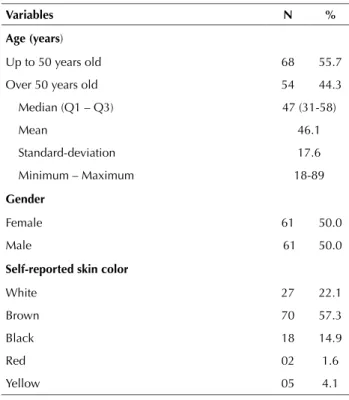
A total of 122 PIC were studied, inserted in 122 patients, 50% female and 50% male, with a mean age of 46.1 (±17.6) years, ranging from 18 to 89 years old. he most often self-reported color of skin was brown (57.3%), followed by white and black. Regarding the predisposing condition for com-plications, the presence of chronic diseases was highlighted (60.7%), followed by infection (26.2%) (Table 1).
Table 1 – Characteristics of patients with PIC – Rio Branco, Acre, Brazil, 2014.
Variables n %
age (years)
Up to 50 years old 68 55.7
Over 50 years old 54 44.3
Median (Q1 – Q3) 47 (31-58)
Mean 46.1
Standard-deviation 17.6
Minimum – Maximum 18-89
gender
Female 61 50.0
Male 61 50.0
self-reported skin color
White 27 22.1
Brown 70 57.3
Black 18 14.9
Red 02 1.6
Yellow 05 4.1
Phlebitis associated with peripheral intravenous catheters in adults admitted to hospital in the Western Brazilian Amazon
he mean time of IVT use was 8.81 (±6.89) days, and 58.2% of patients used them for up to seven days, a number that corresponds to the median of days of IVT. Regarding infusion, the majority (61.5%) had the combination of continuous and intermittent type, through bolus and gravi-tational infusion methods (74.6%), for administration of solutions and drugs (82.0%), one solution was predomi-nantly used (68.0%) and more than two drugs (81.1%). It was found that out of the 122 patients studied, 80 (65.6%) had some type of treatment at risk for complications, we highlight the use of drugs with extreme pH (62.5%) and vesicant (62.5%) as well as the use of IVT for a prolonged time (42.5%) (Table 2).
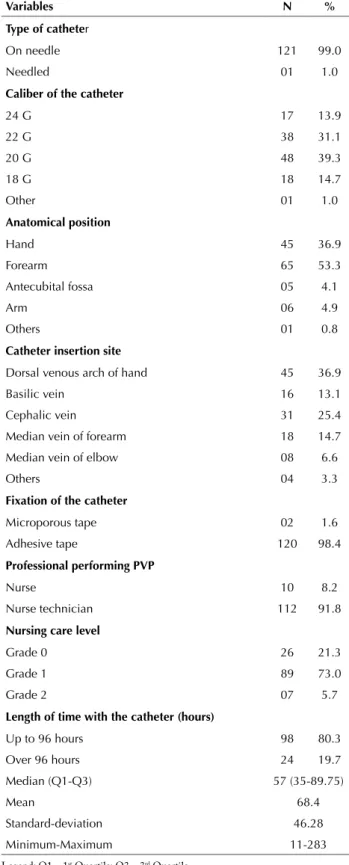
he most used type of catheter was on needle (99.0%) and 20G caliber (39.3%), which were mainly placed on the forearm (53.3%) and the veins of the dorsal venous arch of the hand (36,9%), cephalic (25.4%), median forearm (14.7%) and basilic (13.1%). he catheters were ixed with a tape (98.4%) and nursing technicians were responsible for almost all (91.8%) of PVP. he level of nursing care was Grade 1 (73.0%), which represents nursing care judged as
Table 2 – Characteristics of intravenous therapy of patients with PIC– Rio Branco, Acre, Brazil, 2014.
Variables n %
time of iVt use (days)
Up t 7 days 71 58.2
Over 7 days 51 41.8
Median (Q1-Q3) 7 (4-11.25)
Mean 8.81
Standard-deviation 6.89
Minimum-Maximum 0-32
continued...
...continuation ...continuation
Variables n %
Predisposing condition for complications
Yes 104 85.2
No 18 14.8
type of predisposing condition (122) infection
Yes 32 26.2
No 90 73.8
edema
Yes 12 9.9
No 110 90.1
Hypovolemia
Yes 01 0.8
No 121 99.2
Obesity
Yes 05 4.1
No 117 95.9
chronic disease
Yes 74 60.7
No 48 39.3
Vascular disease
Yes 07 5.7
No 115 94.3
Other
Yes 10 8.2
No 112 91.8
Legend: Q1 – 1st Quartile; Q3 – 3st Quartile.
Variables n %
iVt type of infusion
Continuous 03 2.5
Intermitent 44 36.0
Continuous and intermitent 75 61.5
iVt infusion method
Bolus 22 18.0
Gravitational 08 6.6
Infusion pump 01 0.8
Bolus and Gravitational 91 74.6
Type of luid administered
Solution 03 2.5
Drugs 19 15.5
Solutions and drugs 100 82.0
number of solutions
One solution 83 68.0
More than one solution 39 32.0
number of drugs
Up to two drugs 23 18.9
More than two drugs 99 81.1
current treatment of risk for complications
Yes 80 65.6
No 42 34.4
type of current risk treatment = (80) Prolonged intravenous therapy
Yes 34 42.5
No 46 57.5
Use of vesicant drugs
Yes 50 62.5
No 30 37.5
drugs with extreme pH
Yes 50 62.5
No 30 37.5
drugs with high osmolarity
Yes 15 18.7
No 65 81.3
High rate of infusion
Yes 26 32.5
No 54 67.5
inadequate. he mean time of admission of PIC was nearly three days (68.4 hours) with 80.3% remaining inserted for up to 96 hours and 19.7% for more than 96 hours (Table 3).
Table 3 – Characteristics of peripheral venous puncture of pa-tients with PIC – Rio Branco, Acre, Brazil, 2014.
Variables n %
type of catheter
On needle 121 99.0
Needled 01 1.0
caliber of the catheter
24 G 17 13.9
22 G 38 31.1
20 G 48 39.3
18 G 18 14.7
Other 01 1.0
anatomical position
Hand 45 36.9
Forearm 65 53.3
Antecubital fossa 05 4.1
Arm 06 4.9
Others 01 0.8
catheter insertion site
Dorsal venous arch of hand 45 36.9
Basilic vein 16 13.1
Cephalic vein 31 25.4
Median vein of forearm 18 14.7
Median vein of elbow 08 6.6
Others 04 3.3
Fixation of the catheter
Microporous tape 02 1.6
Adhesive tape 120 98.4
Professional performing PVP
Nurse 10 8.2
Nurse technician 112 91.8
nursing care level
Grade 0 26 21.3
Grade 1 89 73.0
Grade 2 07 5.7
length of time with the catheter (hours)
Up to 96 hours 98 80.3
Over 96 hours 24 19.7
Median (Q1-Q3) 57 (35-89.75)
Mean 68.4
Standard-deviation 46.28
Minimum-Maximum 11-283
Legend: Q1 – 1st Quartile; Q3 – 3rd Quartile.
Phlebitis was responsible for 38 complications (31.1%), and Grade 1 had highest proportion (65.8%). It was ob-served that 34.2% of patients developed more severe cases of
this complication, 23.7% from Grade 2; 7.9% from Grade 3; and 2.6% from Grade 4.
Table 4 shows the presence of phlebitis associated with the use of PIC and current characteristics of IVT, with in-luence on complications related to catheter.
In Table 4, we present signiicant relationship between phlebitis and type of infusion (p=0.044), and the combined use of continuous and intermittent infusion had greater occurrence compared with phlebitis. Infection and chronic disease had a signiicant association with the development of phlebitis (p=0.007 and 0.005, respectively).
Table 4 – Presence of phlebitis associated with the use of pe-ripheral intravenous catheters and characteristics of intravenous therapy with influence on complications related to PIC – Rio Branco, Acre, Brazil, 2014.
Variables
Phlebitis Yes no total
P n % n % n % time of use of iVt 0.964a
Up to 7 days 22 18.0 49 40.2 71 58.2
Over 7 days 16 13.1 35 28.7 51 41.8
infusion type 0.044b
Continuous 01 0.8 02 1.7 03 2.5
Intermitent 08 6.6 36 29.4 44 36.0
Continuous and
intermitent 29 23.8 46 37.7 75 61.5
infusion method 0.269b
Infusion pump 01 8.0 0 - 01 0.8
Bolus 04 3.3 18 14.7 22 18.0
Gravitational 02 1.7 06 4.9 08 6.6
Bolus and
gravitational 31 24.4 60 50.2 91 74.6
Fluid types 0.239b
Solution 01 8.0 02 1.7 03 2.5
Drugs 03 2.5 16 13.0 19 15.5
Solution and
drugs 34 27.9 66 54.1 100 82.0
number of drugs 0.279a
Up to two drugs 05 4.1 18 14.8 23 18.9
Over two drugs 33 27.1 66 54.0 99 81.1
current treatment risk 0.392a
Yes 27 22.1 53 43.5 80 65.6
No 11 9.0 31 25.4 42 34.4
nursing level of care 0.054b
Grade 0 04 3.3 22 18.0 26 21.3
Grade 1 31 25.4 58 47.6 89 73.0
Grade 2 03 2.4 04 3.3 07 5.7
length of hospital stay 0.796b
Up to 96 hours 30 24.5 68 55.7 98 80.3
Over 96 hours 08 6.6 16 13.1 24 19.7
Phlebitis associated with peripheral intravenous catheters in adults admitted to hospital in the Western Brazilian Amazon
Variables
Phlebitis Yes no total
P n % n % n % infection 0.007a
Yes 16 13.1 16 13.2 32 26.2
No 22 18.0 68 55.7 90 73.8
chronic disease 0.005a
Yes 16 13.1 58 47.6 74 60.7
No 22 18.0 26 21.3 48 39.3
aChi-square test; bFisher’s exact test.
DISCUSSION
We found higher frequency of phlebitis 31.1%, well above the 5% ratio considered as the standard accepted by the recommendations of the INS, for both adults and chil-dren(11). Some studies point out that the occurrence of
phle-bitis can be very diferent in each case, depending on the deinition of phlebitis, method, variables and studied popu-lation, ranging from 1.7% to 55.6%(17,19). he reasons may be
related to the diferent frequencies described by the difer-ent sample sizes and types of study. It may also be compared to the methods used to analyze the presence of phlebitis, as well as the diiculty of standardizing the diagnosis and the severity, which implies observing and considering associ-ated signs and symptoms. Furthermore, the inlammatory response, mainly in frail elderly, may be impaired and make the signs and symptoms subtler.
he frequency of phlebitis found in this study shows some similarity to the rates found in other studies with the adult population, between 17.6% and 24.7%(12,20), and
proved to be lower than the values of 43% and 54.5% found in other studies(4,14).
he evaluation of the degree of phlebitis showed that in 2.6% of the studied sites, hardening of the vein, palpable ibrous cord and purulent drainage, as well as more advanced degree of this complication were observed. he other evalua-tions indicated less severe forms, especially Grade 1 (65.8%) over Grade 2 (23.7%). hese indings are consistent with those obtained in other studies that also used the INS scale(11)
to assess the severity of phlebitis. A study in a neurosurgical unit in the city of São Paulo, showed greater frequency of Grade 1 (50%) and Grade 2 (43.7%)(21). Investigating
occur-rence of phlebitis in a medical unit of a hospital in Brasilia, researchers found that the presence of phlebitis in Grade 1 (46.2%) and Grade 2 (40%) were predominant(17).
Results of research conducted in other countries also show increased less severe phlebitis frequency. In a cohort study with 967 adult patients in Barcelona, it was observed a higher frequency of phlebitis Grade 1 (77.6%) and Grade 2 (22%). A quasi-experimental research type, held in a private hospital in Barcelona, found higher incidence of phlebitis Grade 1 (50%) and Grade 2 (35%)(3,22).
A review study conducted with a sample of 679 adults with PIC described 25 (3.7%) occurrences of phlebitis,
...continuation most were considered as Grade 1(23). A descriptive research
conducted in Turkey found 54.5% occurrences of phlebitis and Grade 1 was also the most frequently observed(14).
In this investigation, complications were more frequent-ly in female patients, who self-reported brown skin color and who were under the age of 50 years. Among the char-acteristics related to the patient, none showed signiicant inluence on the occurrence of complications associated with the use of PIC, a result that corroborates other studies in the area(14,15,24).
Regarding the characteristics of PVP, there was no sig-niicant inluence of most of the variables studied, a preva-lence of complications was identiied in catheters inserted in the forearm (34.4%), followed by the back of the hand (23.8%) in veins of the dorsal venous arch (23.8%), cephalic vein (16.4%) and median of the forearm (10.6%), inserted by nursing staf with catheters on needle 20G, ixed with tape. A cohort study also showed no statistical relation-ships between anatomical location, catheter size and oc-currence of phlebitis(24).
From the variables associated to IVT, there were no sig-niicant associations with the development of phlebitis, al-though other studies show that the administration of drugs with extremes pH and osmolarity may feature higher risk for the development of phlebitis(8,25). Some authors claim
that several drugs, such as antibiotics, phenytoin and man-nitol may predispose the occurrence of phlebitis, reducing PIC time of use(14,25-26).
We identiied shorter length of use of the device in pa-tients with phlebitis, when compared to those who did not have this problem, however, there were no signiicant as-sociations between phlebitis and longer PIC use. A cohort study showed a higher risk for phlebitis in patients who re-mained with PIC for more than 72 hours(17). Another study
revealed that the PIC use for more than 72 hours increased by up to four times the chance of developing phlebitis com-pared to the catheters use for less than 72 hours(4). However,
another investigation showed that there was no signiicant result in the development of phlebitis in patients with PIC inserted for a period greater than 96 hours when compared to those that remained with the catheter for equal to or less than 72 hours(20). Recent studies have reported no beneits
for the exchange of catheters every 72 or 96 hours when compared to the clinically indicated exchange(16,27-28). he
Centers for Disease Control and Prevention(7) suggests that
PIC must not be changed more than once every 72 to 96 hours in adult patients, so this is an unresolved question about the exchange of PIC only in the presence of signs of complications, understanding that we lack evidences to refute the correlation between time of PIC use and occur-rence of phlebitis.
of continuous infusion type inluencing the development of PIC complications(4,29). he use of intermittent infusion may
increase the chances of complications related to PIC, as a result of greater manipulation of the catheter(14).
It was not found statistically signiicant diference be-tween the condition of the patient and the occurrence of complications (p>0.05) in this study except for the pres-ence of chronic disease (p=0.005) and infection (p=0.007). Patients with these health conditions showed 13.1% of the phlebitis occurrences. his inding corroborates another study conducted in adults and children, in which it was found that patients with infectious diseases, burns or dia-betes mellitus have up to seven times more risk of develop-ing phlebitis(30).
It is noteworthy that this study presents phlebitis occur-rence associated to PIC use, in a region of Brazil where we can ind extreme weather conditions of humidity and high temperatures. he equatorial climate can be a predisposing factor for complications related to PIC use, especially by ob-serving, more often, the loss of PIC stability by displacement of ixing materials, due to the sweating of the skin and high humidity, as well the fact that it can contribute to higher bacterial colonization. hus, we describe again that health institutions in this region, nurses usually do not adopt the performance of sterile dressings on the PIC insertion site. hey use non-sterile tape in order to keep the catheter ixed for a longer period, due to dressings maintenance diiculty with semipermeable transparent tape, which is quickly de-tached. his may be a factor related to the high proportion of phlebitis identiied in the patients studied.
his study has limitations resulting from the conve-nience sample which did not allow us to reach the power of the study, which can lead to identiication of risk factors for the occurrence of phlebitis. Another aspect which makes comparisons diicult refers to the use of ixation technique,
which makes diicult early identiication of complications, as well as special work of nurses in performing the insertion of PIC. Despite being recommended, the implementation of aseptic technique in catheter insertion with subsequent completion of dressing over the insertion site, we identiied site misconduct of aseptic technique in the study, in which the ixing use was done with contaminated tapes, reality also identiied in other health institutions in the country, and that may be related to the results identiied in this research. It also highlights the lack of periodic assessment protocols of insertion sites of catheters, to promote the maintenance of devices and early identiication of signs of complica-tions. It is evident, therefore, the need to apply knowledge to practice, and the development of intervention research to enable testing new nursing care to be implemented at the study site in order to change the unfavorable results, which may be related to the diiculty of maintaining dress-ings and ixation on the catheter insertion site for the spe-cial characteristics of humid climate of the region studied. Nevertheless, this research has the potential to contribute to advances in knowledge, by presenting ITV results, con-ducted in the country region that lacks research in nursing, providing grants for further studies aimed at improving the quality of nursing care, as well as the search for new forms of intervention in order to reduce the occurrence of com-plications and promote patient safety.
CONCLUSION
Complication was the main reason for PIC removal, phlebitis was the most frequent. Patients with systemic in-fection, patients with chronic diseases and those requiring continuous and intermittent infusion concomitant with the catheter had signiicantly higher frequency of phlebitis as-sociated to PIC compared to those who did not have such characteristics.
resUMO
Objetivo: Identiicar a presença de lebite e os fatores que inluenciam o desenvolvimento desta complicação em pacientes adultos internados em hospital da Amazônia Ocidental Brasileira. Método: Estudo exploratório, com amostra de 122 cateteres intravenosos periféricos instalados em 122 pacientes de uma unidade de clínica médica. Foram analisadas variáveis relacionadas ao paciente e à terapia intravenosa. Para a análise utilizaram-se os testes de Qui-quadrado de Pearson e Exato de Fisher, com nível de signiicância de 5%. Resultados: A complicação foi o principal motivo da retirada do cateter (67,2%), e a lebite a complicação mais frequente (31,1%). O tempo médio de uso de terapia intravenosa foi de 8,81 dias, em infusão contínua e intermitente (61,5%), em cateter calibre 20G (39,3%), inseridos nas veias do arco dorsal da mão (36,9%), com média de tempo de permanência de 68,4 horas. O tipo de infusão (p=0,044) e a presença de doença crônica (p=0,005) e de infecção (p=0,007) inluenciaram o desenvolvimento de lebite. Conclusão: Houve alta frequência de lebite na amostra estudada, sendo inluenciada pelo emprego concomitante de infusão contínua e intermitente de fármacos e soluções, e mais frequente em pacientes com doenças crônicas e infecção.
descritOres
Flebite; Cateterismo Periférico; Infusões Intravenosas; Pacientes Internados; Cuidados de Enfermagem.
resUMen
Phlebitis associated with peripheral intravenous catheters in adults admitted to hospital in the Western Brazilian Amazon
Conclusión: Hubo alta frecuencia de lebitis en la muestra estudiada, siendo inluenciada por el empleo concomitante de infusión continua e intermitente de fármacos y soluciones, y más frecuente en pacientes con enfermedades crónicas e infección.
descriPtOres
Flebitis; Cateterismo Periférico; Infusiones Intravenosas; Pacientes Internos; Atención de Enfermería.
REFERENCES
1. Ho KHM, Cheung DSK. Guidelines on timing in replacing peripheral intravenous catheters. J Clin Nurs. 2012;21(11-12):1499-506.
2. Dychter SS, Gold DA, Carson D, Haller M. Intravenous therapy: a review of complications and economic considerations of peripheral access. J Infus Nurs.2012; 35(2):84-91.
3. Roca GM, Bertolo CB, Lopez PT, Samaranch GG, Ramirez MCA, Buqueras, JC et al. Assessing the inluence of risk factors on rates and
dynamics of peripheral vein phlebitis: an observational cohort study. Med Clin. 2012;139(5):185-91.
4. Furtado LCR. Maintenance of peripheral venous access and its impact on the development of phlebitis: a survey of 186 catheters in a general surgery department in Portugal. J Infus Nurs. 2011;34(6):382-90.
5. Jacinto AKL, Avelar AFM, Wilson AMMM, Pedreira MLG. Flebite associada a cateteres intravenosos periféricos em crianças: estudo de
fatores predisponentes. Esc Anna Nery [Internet]. 2014 [citado 2015 maio 25];18(2):220-6. Disponível em: http://www.scielo.br/pdf/ean/
v18n2/1414-8145-ean-18-02-0220.pdf
6. Pasalioglu KB, Kaya H. Catheter indwell time and phlebitis development during peripheral intravenous catheter administration. Pakistan J Med Sci. 2014;30(4):725-30.
7. O’Grady NP, Alexander M, Burns LA, Dellinger EP, Garland J, Heard SO, et al. Guidelines for the preven tion of intravascular catheter-related infections. Clin Infect Dis [Internet]. 2011 [cited 2012 May 1];52(9):162-93. Available from: http://www.ncbi.nlm.nih.gov/pmc/ articles/PMC3106269/
8. Martins TS, Silvino ZR, Dias SL. Peril da terapia intravenosa pediátrica em um hospital universitário e associação com a ocorrência de falhas infusionais: estudo quantitativo. Online Braz J Nurs [Internet]. 2010 [citado 2012 mao 10];9(2). Disponível em: http://www.
objnursing.uff.br/index.php/nursing/article/view/3067/684
9. Cicolini G, Manzoli L, Simonetti V, Flacco ME, Comparcini D, Capasso L, et al. Phlebitis risk varies by peripheral venous catheter site and increases after 96 hours: a large multi-centre prospective study. J Adv Nurs. 2014;70(11):2539-49.
10. Silva GA, Priebe S, Dias FN. Beneits of establishing an intravenous team and the standardization of peripheral intravenous catheters. J
Infus Nurs.2010;33(3):156-60.
11. Infusion Nurses Society. Infusion nursing standards of practice. J Infus Nurs. 2006;29(1 Suppl):S1-92.
12. Urbanetto JS, Rodrigues AB, Oliveira DJ, Dornelles FF, Rosa Filho JM, Gustavo AS, et al. Prevalência de lebites em pacientes adultos com
cateter venoso periférico. Rev Enferm UFSM. 2011;1(3):440-8.
13. Maki DG, Ringer M. Risk factors for infusion-related phlebitis with small peripheral venous catheters: a randomized controlled trial. Ann Intern Med. 1991;114(10):845-54.
14. Uslusoy E, Mete S. Predisposing factors to phlebitis in patients with peripheral intravenous catheters: a descriptive study. J Am Acad Nurs Pract. 2008;20(4):172-80.
15. Gallant P, Schultz AA. Evaluation of a visual phlebitis scale for determining appropriate discontinuation of peripheral intravenous catheters. J Infus Nurs. 2006; 29(6):338-45.
16. Gonzales Lopes JL, Arribi VA, Fernadez del Palacio E, Olivares Corral J, Benedicto Martí C, Herrera Portal P.
Indwell times, complications and costs of open vs closed safety peripheral intravenous catheters: a randomized study. J Hosp Infect. 2014;86(2):117-26.
17. Abdul-Hak CKl, Barros AF. Incidência de lebite em uma Unidade de Clínica Médica. Texto Contexto Enferm [Internet]. 2014 [citado 2015 maio 31];23(3):633-8. Disponível em: http://www.scielo.br/pdf/tce/v23n3/pt_0104-0707-tce-23-03-00639.pdf
18. Lundgren A, Jorfeldt L, Ek AC. The care and handling of peripheral intravenous cannulae on 60 surgery and internal medicice patients: an observation study. J Adv Nurs. 1993;18(6):963-97.
19. Batalha LMC, Costa LPS, Almeida DMG, Lourenço PAA, Gonçalves AMFM, Teixeira ACG. Fixação de cateteres venosos periféricos em crianças: estudo comparativo. Esc Anna Nery. 2010;14(3):511-8.
20. Abolfotouh MA, Salam M, Bani-Mustafa A, White D, Balkhy HH. Prospective study of incidence and predictors of peripheral intravenous catheter-induced complications. Ther Clin Risk Manag. 2014;8(10):993-1001.
21. Ferreira LR, Pedreira MLG, Diccini S. Flebite no pré e pós-operatório de pacientes neurocirúrgicos. Acta Paul Enferm. 2007;20(1):30-6.
22. Mestre G, Berbel C, Tortajada P, Alarcia M, Coca R, Fernández MM, et al. Successful multifaceted intervention aimed to reduce short peripheral venous catheter-related adverse events: a quasiexperimental cohort study. Am J Infect Control. 2013; 41(6):520-6.
23. Powell J, Tarnow KG, Perucca R. The relationship between peripheral intravenous catheter indwell time and the incidence of phlebitis. J Infus Nurs. 2008;31(1):39-45.
24. Fang L, Fang SH, Chung YH. Factors affecting the unplanned peripheral reinsertion in pediatric patiernts from a teaching hospital in Taiwan. J Infus Nurs. 2011;34(6):366-72.
26. Shenoy S, Karunakar BP. Factors inluencing the peripheral venous catheter survival in critically Ill children in a pediatric intensive care
unit. Indian J Pediatr. 2014; 81(12):1293-6.
27. Rickard CM, Webster J, Wallis MC, Marsh N, McGrail MR, French V, et al. Routine versus clinically indicated replacement of peripheral intravenous catheters: a randomised controlled equivalence trial. Lancet. 2012;380(9847):1066-74.
28. Webster J, Osborne S, Rickard C, Hall J. Clinically-indicated replacement versus routine replacement of peripheral venous catheters. Cochrane Database Syst Rev. 2010;(3):CD007798.
29. Lee WL, Chen HL, Tsai TY, Lai IC, Chang WC, Huang CH, et al. Risk factors for peripheral intravenous catheter infection in hospitalized patients: a prospective study of 3165 patients. Am J Infect Control. 2009;37(8):683-6.