ISSN online: 1807-1775
DOI: 10.4301/S1807-17752014000300001
___________________________________________________________________________________________
Manuscript first received/Recebido em: 23/03/2014 Manuscript accepted/Aprovado em: 17/09/2014 Address for correspondence / Endereço para correspondência
Mazen Kamal Qteishat, Assistant Professor, Department of Business, Albalqa Applied University, P.O. Box 1705, Amman 11118, Jordan,Tel: 962-79-705-1054 E-mail:[email protected]
Haitham Hmoud Alshibly, Associate Professor, Department of Business, Albalqa Applied University, P.O. Box, Amman 11118, Jordan,Tel: 962-79-705-1054 E-mail:[email protected]
Mohammad Atwah Al-ma'aitah,Assistant Professor, Department of MIS, Albalqa Applied University, P.O. Box, Amman 11118, Jordan,Tel: 962-79-705-1054 E-mail:[email protected]
Published by/ Publicado por: TECSI FEA USP – 2014 All rights reserved.
THE IMPACT OF E-TICKETING TECHNIQUE ON CUSTOMER
SATISFACTION: AN EMPIRICAL ANALYSIS
Mazen Kamal Qteishat Haitham Hmoud Alshibly Mohammad Atwah Al-ma'aitah
Albalqa Applied University, Amman, Jordan
___________________________________________________________________________________________
ABSTRACT
Recently, internet technology is considered to be the most used information and communication technology by organizations: it can ease the process of transactions and reinforce the relation between companies and customers. This investigation empirically examines the impact of e-ticketing technique on customer satisfaction; a convenience sample of Jordanian airline passengers that had booked flights in the last 12 months through companies offering e-ticketing services was acquired. The findings indicate that customer satisfaction with e-ticketing services was influenced by all of the independent variables measured (Data security, Customer and Technical Support, and User-Friendliness) were noted to have significant impact on customer satisfaction with e-ticketing services.
Keywords: E-ticketing, Customer Technical Support, Infrastructure, Security, User-Friendliness
1. INTRODUCTION
JISTEM, Brazil Vol. 11, No. 3, Sept/Dec., 2014 pp. 519-532 www.jistem.fea.usp.br
Although it is not fair to argue that e-tickets have become ubiquitous, it is evident that the proliferation of e-tickets represents a change in the way that traditional ticket purchasing occurs (Bukhari, Ghoneim, Dennis & Jamjoom, 2013). E-tickets appear to offer a number of advantages to organizations, including lower costs and increased operational efficiency (Boyer, Hallowell & Roth, 2002). As such, it is projected that the use of e-tickets will only continue to increase over time (Bukhari, et al., 2013). Even though e-ticketing services appear to be the future of operations for many organizations seeking to streamline operations and improve customer service, research regarding e-ticketing and e-service indicates that these processes have not been without their challenges (Hallowell, 2001). Curbera, et al. (2002) contend that e-ticketing services, much like many internet and mobile applications, developed in an ad hoc manner. This has created a situation in which the function and utilization of e-tickets has not been actively integrated into the strategy of the organization (Curbera, et al., 2002). Other scholars examining the adoption of e-ticketing contend that a host of cognitive variables impact consumer decision-making, leading positive or negative perceptions regarding e-ticketing as a principle method for acquiring service within an organization (Sulaiman, Ng & Mohezar, 2008).
In addition, the cognitive elements of e-ticketing have become such an important issue of concern for organizations in recent years as efforts to expand e-ticketing progress (Lopez-Bonilla & Lopez-Bonilla, 2013). Specifically, the issue of customer satisfaction in e-ticketing has become a central issue of focus, prompting organizations to investigate the specific variables that shape customer outcomes when choosing e-ticketing options (Wei & Ozok, 2005). Using this as a foundation for investigation, the current research utilizes customer satisfaction as the dependent variable to assess what specific independent variables (customer technical support, infrastructure, data security and/or user-friendliness) shape customer satisfaction in decision-making when it comes to purchasing an e-ticket. By correlating independent variables with customer satisfaction, it will be possible to acquire a deeper understanding of how customer satisfaction is developed when it comes to e-ticket purchasing and use by consumers.
2. LITERATURE REVIEW
A review of the literature examining the definitions of e-ticketing that have been reported demonstrates efforts to explicate the full spectrum of e-ticketing for both the consumer and the organization. For instance, Alfawaer, Awni and Al-Zoubi (2011) define an e-ticket as “a paperless electronic document used for ticketing travelers,
mainly in the commercial airline industry” (p. 858). Sorooshian, Onn and Yeen (2072)
further define e-ticketing as “a procedure of keeping record of sales, usage tracking and accounting for a passenger’s transport with no requirement for a paper ‘value
document’” (p. 62). This definition clearly indicates that the e-ticket includes more
than just a paperless document for the passenger: rather the e-ticket represents an extensive architecture within the organization that provides a wealth of information about the consumer.
JISTEM, Brazil Vol. 11, No. 3, Sept/Dec., 2014 pp. 519-532 www.jistem.fea.usp.br
information management and control of operations” (p. 78). E-tickets, as noted by
Lubeck and co-workers, require the creation of a comprehensive technological platform that controls almost every aspect of the customer relationship within the organization. As such, the roots of e-ticketing go much further than the interface with the customer.
3. THEORETICAL FRAMEWORK
Customer satisfaction with e-ticketing services was selected as the dependent variable for this investigation. A review of the literature regarding customer satisfaction with e-ticketing indicates that satisfaction has been measured through two components: customer satisfaction and customer retention. Patterns of loyalty in e-ticketing and e-service have been reviewed by Chang, Wang and Yang (2009). These authors argue that patterns of customer satisfaction in e-service are similar to those that develop in face-to-face transactions and interactions. Specifically, these authors assert
that: “When perceived value is low, the customer will be inclined to switch to
competing businesses in order to increase perceived value, thus contributing to a
decline in loyalty” (p. 525). Satisfaction develops over time as a response to the way in
which customers are treated by the organization.
In the context of e-ticketing, satisfaction is thus influenced by a wide range of variables focused on the quality of service provided to the customer. Bernardo, Llach, Marimon and Alonso-Almeida (2013) illustrate this point by noting the loyalty in e-services is shaped by e-services provided to customers before and after a sale, as well as the general environment in which the transaction takes place. If the environment meets customer expectations for security and support, loyalty with the customer will often be established, leading to the ability of the organization to retain the customer over the long-term. Thus, loyalty and customer retention are integrally related when it comes to the development of e-services (Enzmann & Schneider, 2005).
The relationship between loyalty and customer retention for services and e-ticketing appears to stem from commitment, trust, involvement of the organization, and the perceived value of the service provided (Chen, 2012). As such, companies offering e-ticketing services must carefully consider elements of customer support and service to build strong relationships with consumers. Noor and Azila (2012) argue that in order to achieve this outcome, companies offering any type of e-service must be able to build comprehensive relationships with customers. This insight effectively supports what Kolsaker, et al. (2004) note about the need for customer support and service in e-ticketing. Even though many organizations believe that customer service and support is not needed with e-ticketing, in actuality there is a definitive impetus to develop customer service and support that targets customer needs for e-ticketing to ensure the development of commitment and trust leading to increased loyalty and customer retention.
3.1 E-ticketing factors influencing customer satisfaction
JISTEM, Brazil Vol. 11, No. 3, Sept/Dec., 2014 pp. 519-532 www.jistem.fea.usp.br 3.1.1 Customer Technical Support
Evaluation of the factors which contribute to customer adoption of e-ticketing clearly indicates that customer and technical support are critical issues of concern (Buhalis, 2004). Lau, Kwek and Tan (2011) assert that customer perceptions of service quality will play a significant role in shaping decision-making for the individual to utilize e-ticketing services. As argued by these authors, customer perception influenced by the level of support provided to the customer, especially when problems arise in e-ticketing service. Sureshkumar and Palanivelu (2011) delve further into this issue arguing that perceptions of the customer regarding customer service have direct ramifications for customer behavior. If the customer believes that the organization will provide customer service and support through the purchase of e-tickets, customers will be more likely to purchase these products (Sureshkumar & Palanivelu, 2011).
Furthermore, the true impact of customer perceptions regarding customer service and technical support is illustrated by Haewoon (2007) who contends that many airlines have alienated customers as a result of a failure to provide customer support in e-ticketing services. Viewing e-ticketing as a panacea for reducing costs and increasing efficiency in operations, Haewoon argues that airlines quickly adopted e-ticketing without establishing protocols for customer and technical support. Research regarding this issue suggests that while many companies employing e-ticketing believe that this service should preclude the need for extensive customer service - thus reducing costs - in actuality, this is not the case (Kolsaker, Lee-Kelley & Choy, 2004). Kolsaker and co-workers report that many organizations have found that the implementation of e-ticketing often requires the development of targeted customer service practices that address specific customer needs related to e-ticketing and e-service. Without these supports in place, customers will view the e-ticketing process as cumbersome and will not gravitate to e-service to meet their needs (Kolsaker, et al., 2004).
3.1.2 Infrastructure
Infrastructure to support e-ticketing operations may also play a role in developing customer satisfaction for these services. As noted in the introduction of this investigation, e-ticketing services typically developed in an ad hoc manner within the organization (Curbera, et al., 2002). As a result, e-ticketing was not initially integrated with other operations, leading to problems when customers required additional service or support (Curbera, et al., 2002). Jakubauskas (2006) considers these issues, noting that e-ticketing systems have undergone notable changes since their inception. In order to ensure effective and efficient use of e-tickets, Jakubauskas maintains that organizations have had to establish network architectures to support e-ticketing services. These infrastructures have been essential to creating a comprehensive system that simultaneously addresses customer needs while creating the supports needed to streamline operations within the organization (Jakubauskas, 2006). Without the infrastructure to support e-ticketing, organizations would not be able to utilize these services to achieve cost reductions and enhanced customer satisfaction.
JISTEM, Brazil Vol. 11, No. 3, Sept/Dec., 2014 pp. 519-532 www.jistem.fea.usp.br
customer to use the system and to ensure accuracy when purchasing a ticket. For organizations, infrastructure can provide business continuity and offer the ability to minimize risks and improve operational functionality (Zambon, et al., 2011). Thus, when developing e-ticketing services, infrastructure issues must be carefully considered.
3.1.3 Data Security
Data security is also an issue of concern impacting consumer behavior and decision-making with regard to e-ticketing. Mut-Puigserver, Payeras-Capellà, Ferrer-Gomila, Vives-Guasch and Castellà-Roca (2012) consider the security concerns associated with e-ticketing, noting that security breaches remain a significant barrier for the adoption of e-ticketing services in many transportation organizations and agencies. The scope and extent of security issues related to e-ticketing is highlighted by Mut-Puigserver and co-workers who argue that “the use of ET systems enables various privacy abuses both in real-time and retrospect since the anonymity of users is not always guaranteed and, therefore, users can be traced and their profiles of usual
movements can be created” (p. 226).
Smith and Smith (2012) further examine security issues that can arise in the use of e-ticketing services. As acknowledged by these authors, security issues have been reported with tickets as a result of efforts on the part of organizations to integrate e-services with other customer relationship management (CRM) programs. CRM programs have long been part of operations to track customer preferences and behaviors. The integration of e-ticketing with these systems has resulted in significant security issues utilization of CRM systems in this capacity has been shown to compromise these infrastructures (Smith & Smith, 2012). This problem appears to relate back to the ad hoc nature in which e-ticketing services have been established within the organization (Curbera, et al., 2002).
Security issues in online services including e-ticketing have been noted to be a significant problem for many consumers (Zhang, Prybutok & Huang, 2006). Yang and Jun (2008) argue that if customers perceive problems with security in e-services, they will be less likely to make purchases via the internet. Perceptions of security impact the level of trust for the consumer (Yang & Jun, 2008). If trust is not present in the relationship between the customer and the e-service provider, there is less likelihood that the consumer will conduct business with the organization (Yang & Jun, 2008). Zhang and co-workers further argue that security issues affect customer satisfaction with e-services, making it necessary for organizations to ensure that customer data is protected.
3.1.4 User Friendliness
JISTEM, Brazil Vol. 11, No. 3, Sept/Dec., 2014 pp. 519-532 www.jistem.fea.usp.br
Lei, Quintero and Pierre (2009) further review usage patterns of e-ticketing systems examining those that are integrated and those that require two different processes for use: authentication and payment. Analysis provided by these authors indicates that integrated e-ticketing systems that require fewer steps for customers were typically utilized more frequently, suggesting the need to streamline these systems in order to increase customer adoption. In short, system interfaces will influence customer adoption of e-ticketing to some degree. However, as reported by Dekkers and Rietveld (2007), user characteristics, including technological capabilities and frequency of system use, will also impact outcomes. According to the previous literature research, model-1 was developed and applied as the theoretical framework for understanding the impact of e-ticketing techniques as (independent variable) on customer satisfaction (dependant variable).
Model-1: e-ticketing technique on customer satisfaction
4. MAIN RESEARCH QUESTION
To what extent does the proposed model, and in particular the role of components: Customer Technical Support, Infrastructure, Security and User-Friendliness play in Customer Satisfaction?
4.1 Sub-research Questions
Is there a significant effect of e-ticketing factors (customer/technical support) on customer satisfaction?
Is there a significant effect of e-ticketing factors (infrastructure) on customer satisfaction?
Is there a significant effect of e-ticketing factors (Data Security) on customer satisfaction?
Is there a significant effect of e-ticketing factors (User-Friendliness) on customer satisfaction?
Customer/Tech Support
Infrastructure
Data Security
User-Friendliness
Customer/ Satisfaction h2
h3
JISTEM, Brazil Vol. 11, No. 3, Sept/Dec., 2014 pp. 519-532 www.jistem.fea.usp.br
5. THE RESEARCH METHODOLOGY
Population and Sample
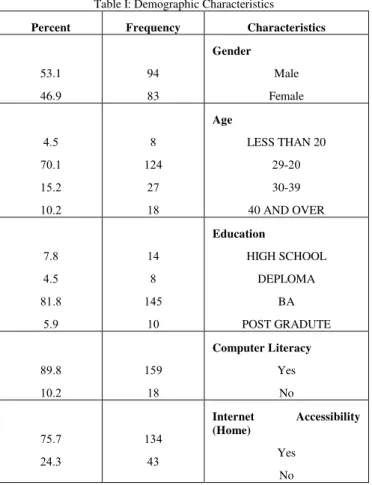
The population for this investigation was drawn from a local group of airline customers that had utilized airline services that offer e-ticketing in the last 12 months. Customer names and addresses were obtained from marketing information collected by airlines. Customers on the list had agreed to have their personal information shared for marketing purposes. A total of 250 surveys were mailed to potential respondents for the survey. Of these surveys, 177 were completed and returned for a 71 percent response rate. Although respondents were initially identified for mailing of the surveys, return responses did not include any identifying information about the customer ensuring the ability of the researcher to protect the anonymity of respondents.
Table I: Demographic Characteristics
Percent Frequency Characteristics
53.1 46.9 94 83 Gender Male Female 5.4 70.7 74.2 70.2 8 725 27 78 Age
LESS THAN 20
20 -22
30-39
40 AND OVER
7.8 5.4 87.8 4.2 75 8 754 70 Education HIGH SCHOOL DEPLOMA BA POST GRADUTE 82.8 70.2 742 78 Computer Literacy Yes No 74.7 25.2 725 52
Internet Accessibility
(Home)
Yes
No
JISTEM, Brazil Vol. 11, No. 3, Sept/Dec., 2014 pp. 519-532 www.jistem.fea.usp.br
reported computer literacy (89.9 percent, n = 159) and internet accessibility in the home (75.7 percent, n = 134).
5.2 Data Collection and Analysis
For the purpose of this investigation, reliability coefficients of scales (Cronbach’s Alpha), multiple regression modeling and simple regression was used to evaluate the relationships between variables. The questionnaire used for the research was designed based on an analysis of the empirical literature - see table-2. Pilot-testing was utilized on a small sample of airline passengers that had used e-ticketing services in the past three months. Based on the feedback provided by these participants, the questions were revised. Components of e-ticketing on customer satisfaction were measured using a 5-point Likert scale with 5 = strongly agree and 1 = strongly disagree. Respondents were asked to evaluate their reaction to each of the assessments, identifying areas for agreement and disagreement.
The reliability for the instrument was established using Cronbach’s alpha, which
is a measure of the internal consistency of the instrument. Cronbach’s alpha estimates
the true score variance captured by the items in the scale by comparing the sum of the item variance with the variance of the sum of the scale (Hill & Lewicki, 2006, p. 461).
A Cronbach’s alpha result of 0.70 or higher is generally considered to show adequate
JISTEM, Brazil Vol. 11, No. 3, Sept/Dec., 2014 pp. 519-532 www.jistem.fea.usp.br Table II: Reliability coefficients of scales (Cronbach’s Alpha)
Scales Questionnaire instrument Cronbach
Alpha
N. of Items
Customer Technical Support
1. E-ticketing provides good personal sales assistance by e-mail or SMS.
2. E-ticketing provides FAQ (frequently asked questions and answers) links to the relevant information.
3. E-ticketing technical support terms and conditions of sales are easy to find through the web.
4. E-ticketing provides an easy access to the
company’s policy for shipping and handling
of their products.
5. E-ticketing provides full details of pricing and taxes for product and service.
0.791 5
Infrastructure 6. E-ticketing infrastructure allows information to be readily accessible to you.
7. E-ticketing Infrastructure helps new users with an easy access to all applications. 8. E-ticketing Infrastructure can be integrated
with other e-things.
9. E-ticketing Infrastructure flexibly adjusts to new job demands
10. E-ticketing Infrastructure provides sufficient information.
11. I’m satisfied with the accuracy that E -ticketing website provides.
0.837 6
Data security 12. E-ticketing Websites check online customers’ identity for security purposes
13. E-ticketing websites ensure that information about electronic transactions is protected from being altered or destroyed.
14. I felt secure in providing personal information for purchasing airline tickets online
15. Airline companies have adequate website security features.
16. Airline companies protect my privacy when purchasing tickets online.
17. Airline companies websites provide high protection on my credit card information
0.866 6
User-Friendliness
18. I find it easy to get E-ticketing Websites to do what I want them to do
19. It is easy for me to become skilful at using E-ticketing Websites.
20. Using E-ticketing Websites enables me to accomplish my purchasing.
21. I find E-ticketing Websites easy to use. 22. Learning to operate E-ticketing Websites is
easy for me.
0.877 5
Customer Satisfaction
23. Overall, as a customer, are you satisfied with this website?
24. How effective is this websites in supporting your purchase from your perspective as a customer?
25. How satisfied are you with the technical quality of these websites?
26. How satisfied are you with the information provided through these websites?
27. How satisfied are you with the quality of the service available through these websites? 28. How satisfied are you with the way these
websites adjust to your particular needs?
0.901 6
Scoring for the questionnaire included an overall review of the total scores for all independent variables (customer and technical support, infrastructure, data security and user-friendliness). Data is provided by Table 2 which supports the main hypothesis:
JISTEM, Brazil Vol. 11, No. 3, Sept/Dec., 2014 pp. 519-532 www.jistem.fea.usp.br Table III: E-Ticketing Technique and Customer Satisfaction
E-Ticketing Factors
B Beta t-value Sig R 2 Adjusted R2 F Sig hypothesis
E-Ticketing Factors
.63 7
.712 13.409 .000 .763 .577 121.2 .000 Accepted
To answer the main research question “to what extent does the proposed model, and in particular the role of components: Customer Technical Support, Infrastructure, Security and User-Friendliness, play in Customer Satisfaction?” Multiple linear regression analysis was used to explore the impact of the independent variables (customer and technical support, infrastructure, data security and user-friendliness) on the dependent variable customer satisfaction. The total R2 value includes a unique results support and accepting hypotheses H1 with (R2 = .763) shown in Table 3, which indicates that the hypothesis was accepted.
The remainder of the tables (Tables 4, 5, 6 and 7) focus on the sub-hypotheses examining each of the independent variables separately using simple linear regression to understand their influence on the dependent variable: customer satisfaction.
h2: Is there a significant effect of e-ticketing factors (customer technical support) on customer satisfaction?
Table IV: Customer Tech Support and Customer Satisfaction
E-Ticketing Factors B Beta t-value Sig R 2 Adjusted R2 F Sig hypothesis
Customer Tech Support .431 .474 7.125 .000 .474 .220 50.76 .000 Accepted
The results from the single linear regression analysis as shown in Table 4 provide support for accepting hypotheses h2. The coefficient of determination (R2 = .758) indicates that a strong effect exists between Customers/Tech Support and Customer Satisfaction.
h3: Is there a significant effect of e-ticketing factors (infrastructure) on customer satisfaction?
TableV: Infrastructure and Customer Satisfaction
E-Ticketing Factors B Beta t-value Sig R 2 Adjusted R2 F Sig
hypothesis
Infrastructure .486 .553 8.789 .000 .306 .302 77.2 .000 Accepted
The results from the single linear regression, as shown in Table 5, provide support for accepting hypotheses h3 by showing that there is a positive correlation between the independent variable of Infrastructure and the dependent variable of Customer Satisfaction, which indicates that Infrastructure accounts for a larger amount of the variance in customer satisfaction with R = .306.
h4: Is there a significant effect of e-ticketing factors (data security) on customer satisfaction?
TableVI: Data Security and Customer Satisfaction
JISTEM, Brazil Vol. 11, No. 3, Sept/Dec., 2014 pp. 519-532 www.jistem.fea.usp.br
Data Security .637 .712 13.409 .000 .507 .504 179.8 .000 Accepted
The results from the single linear regression, as shown in Table 5, provide support for accepting hypotheses h4 by showing that there is a positive correlation between the independent variable of data security and the dependent variable of Customer Satisfaction, which indicates that Infrastructure accounts for a larger amount of the variance in customer satisfaction with R = .507.
h5: Is there a significant effect of e-ticketing factors (user-friendliness) on customer satisfaction?
Table VII: Customer Satisfaction and Data Security
E-Ticketing Factors B Beta t-value Sig R 2 Adjusted R2 F Sig hypothesis
User-Friendliness .487 .665 11.792 .000 .443 .440 139.056 .000 Accepted
The results from the single linear regression, as shown in Table 6, provide support for accepting hypotheses h5 by showing that there is a positive correlation between the independent variable of user-friendliness and the dependent variable of Customer Satisfaction, which indicates that Infrastructure accounts for a larger amount of the variance in customer satisfaction with R2 = .443.
6. RESULTS AND DISCUSSION
Model testing is necessary to address the main research question of the study, which is: To what extent does the proposed model, and in particular the role of components: Customer/Technical Support, Infrastructure, Security and User-Friendliness play in Customer Satisfaction? Examining the adjusted R2 value (0.763) for the main hypothesis (Table 3), it is evident that the four independent variables evaluated in this investigation account for over 76 percent of the variance in customer satisfaction with e-ticketing. Statistical analysis using a significance level of p < 0.05 employed when looking at each independent variable separately supports the significance of each variable in the development of customer satisfaction as it relates to e-ticketing. Thus, the research supports the inclusion of customer and technical support, infrastructure, data security and user-friendliness as integral components of e-ticketing services to ensure that customer satisfaction is achieved.
JISTEM, Brazil Vol. 11, No. 3, Sept/Dec., 2014 pp. 519-532 www.jistem.fea.usp.br
integrated as part of the organization’s system for customer service, the end result is a fully functioning system that can provide elements of data security, customer and technical support as well as user-friendliness (Curbera, et al., 2002). As in the literature, the need for creating a comprehensive and integrated infrastructure for the development of e-ticketing systems is emphasized (Curbera, et al., 2002).
7. IMPLICATIONS
The implications of the research lie in the recognition of the need for organizations to consider a wide range of variables when developing e-ticketing services for customers. Although ad hoc systems have been widely used in the past, it is evident that in order to achieve high levels of customer satisfaction, integrated systems that offer a number of different supports for the end user are needed (Curbera, et al., 2002). When developing e-ticketing services, organizations must be aware of the need for: customer service (Sureshkumar & Palanivelu, 2011), data security (Mut-Puigserver, et al., 2012), and the development of systems that are easy to use from the point of view of the customer (Lei, et al., 2009). The development of user-friendliness in e-ticketing can be tricky and may require the organization to garner an integral understanding of its customer base (Dekkers & Rietveld, 2007).
The implications of this research are quite significant as they require the organization to comprehensively and holistically develop and implement e-ticketing services. By addressing e-ticketing in this manner, organizations will be able to effectively cover most of the pertinent concerns that will impact customer satisfaction with e-ticketing. Although the process is one that will require the organization to engage in more extensive planning and development for e-ticketing, it is also one that should improve the ability of the organization to establish effective and efficient e-ticketing services without the need for continual change and improvement to the systems over time.
8. CONCLUSION
Customer satisfaction in e-ticketing is a complex phenomenon that is shaped by a wide range of variables including customer technical support, infrastructure, data security and user-friendliness. Understanding these issues is critical for organizations to create e-ticketing systems that initially meet customer needs and generate a high level of satisfaction. E-ticketing systems that meet these requirements will provide the organization with satisfied customers who will express their satisfaction through loyalty and by remaining with the organization over the long-term. High levels of
customer retention will form the foundation to maintaining the organization’s bottom
JISTEM, Brazil Vol. 11, No. 3, Sept/Dec., 2014 pp. 519-532 www.jistem.fea.usp.br
REFERENCES
Alfawaer, Z.M., Awni, M., & Al-Zoubi, S. (2011). Mobile e-ticketing reservation system for Amman International Stadium in Jordan. International Journal of Academic
Research, 3(1), 848-852.
Bernardo, M., Llach, J., Marimon, F., & Alonso-Almeida, M.M. (2013). The balance of the impact of quality and recovery on satisfaction: The case of e-travel. Total
Quality Management & Business Excellence, 24(11/12), 1390-1404.
Borthick, A.F., & Kiger, J.E. (2003). Designing audit procedures when evidence is electronic: The case of e-ticket travel revenue. Issues in Accounting Education, 18(3), 275-290.
Boyer, K.K., Hallowell, R., & Roth, A.V. (2002). E-services: Operating strategy—A case study and a method for analyzing operational benefits. Journal of Operations
Management, 20, 175-188.
Buhalis, D. (2004). eAirlines: Strategic and tactical use of ICTs in the airline industry.
Information & Management, 41(7), 805-825.
Bukhari, S.M.F., Ghoneim, A., Dennis, C., & Jamjoom, B. (2013). The antecedents of
travellers’ e-satisfaction and intention to buy airline tickets online: A conceptual
model. Journal of Enterprise Information Management, 26(6), 624-641.
Chang, H.H., Wang, Y., & Yang, W. (2009). The impact of e-service quality, customer satisfaction and loyalty on e-marketing: Moderating effect of perceived value. Total
Quality Management & Business Excellence, 20(4), 423-443.
Chen, S. (2012). The customer satisfaction-loyalty relation in an interactive e-service setting: The mediators. Journal of Retailing & Consumer Services, 19(2), 202-210. Curbera, F., Duftler, M., Khalaf, W., Nagy, W., Mukhi, N., & Weerawarana, S. (2002). Unraveling the web services web: An introduction to SOAP, WSDL and UDDI. IEEE Internet Computing, 3(4), 86-93.
Dekkers, J., & Rietveld, P. (2007). Electronic ticketing in public transport: A field study in a rural area. Journal of Intelligence Transportation Systems, 11(2), 69-78. Dunn-Rankin, P., 2004. Scaling methods. Lawrence Erlbaum.
Enzmann, M., & Schneider, M. (2005). Improving customer retention in e-commerce through a secure and privacy-enhanced loyalty system. Information Systems Frontiers, 7(4/5), 359-370.
Haewoon, Y. (2007). Airlines’ futures. Journal of Revenue & Pricing Management,
6(4), 309-311.
Hallowell, R. (2000). Scalability: The paradox of human resources in e-commerce.
International Journal of Service Industry Management, 12(1), 34-43.
Hill, T. & Lewicki, P., 2006. Statistics: methods and applications: a comprehensive reference for science, industry, and data mining. StatSoft, Inc.
JISTEM, Brazil Vol. 11, No. 3, Sept/Dec., 2014 pp. 519-532 www.jistem.fea.usp.br
Kolsaker, A., Lee-Kelley, L., & Choy, P.C. (2004). The reluctant Hong Kong consumer: Purchasing travel online. International Journal of Consumer Studies, 28(2), 295-304.
Lau, T., Kwek, C., & Tan, H. (2011). Airline e-ticketing service: How e-service quality and customer satisfaction impacted purchase intention. International Business
Management, 5(4), 200-208.
Lei, T., Quintero, A., & Pierre, S. (2009). Mobile services access and payment through reusable tickets. Computer Communications, 32(4), 602-610.
Lopez-Bonilla, J.M., & Lopez-Bonilla, L.M. (2013). Self-service technology versus traditional service: Examining cognitive factors in the purchase of the airline ticket.
Journal of Travel & Tourism Marketing, 30(5), 497-513.
Lubeck, T.M., Wittmann, M.L., & Battistella, L.F. (2012). Electronic ticketing system as a process of innovation. Journal of Technology Management & Innovation, 7(1), 17-29.
Mut-Puigserver, M., Payeras-Capellà, M.M., Ferrer-Gomila, J., Vives-Guasch, A., & Castellà-Roca, J. (2012). A survey of electronic ticketing applied to transport.
Computers & Security, 31(8), 925-939.
Noor, M., & Azila, N. (2012). Trust and commitment: Do they influence e-customer relationship performance? International Journal of Electronic Commerce Studies, 3(2), 281-295.
Smith, A.A., & Smith, S.D. (2012). CRM and identity theft issues associated with e-ticketing of sports and entertainment. Electronic Government: An International
Journal, 9(1), 1-26.
Sorooshian, S., Onn, C.W., & Yeen, C.W. (2013). Malaysian-based analysis on e-service. International Journal of Academic Research, 5(4), 62-64.
Sulaiman, A., Ng, J., & Mohezar, S. (2008). E-ticketing as a new way of buying tickets: Malaysian perceptions. Journal of Social Science, 17(2), 149-157.
Sureshkumar, D., & Palanivelu, P. (2011). Perceptions of value: E-CRM features.
SCMS Journal of Indian Management, 8(2), 106-111.
Tripathi, A., Reddy, S.K., Madria, S., Mohanty, H., & Ghosh, R.K. (2009). Algorithms for validating e-tickets in mobile computing environment. Information Sciences, 197(11), 1678-1693.
Wei, J., & Ozok, A. (2005). Development of a web-based mobile airline ticketing model with usability features. Industrial Management & Data Systems, 105(9), 1261-1277.
Yang, Z., & Jun, M. (2008). Consumer perception of e-service quality: From internet purchaser to non-purchaser perspectives. Journal of Business Strategies, 25(2), 59-84. Zambon, E., Etalle, S., Wieringa, R., & Hartel, P. (2011). Model-based qualitative risk assessment for availability of IT infrastructures. Software & Systems Modeling, 10(4), 533-580.