TRANSLATION PERFORMANCE:
INSIGHT FROM EYE-TRACKING TECHNOLOGY
Aline Ferreira* University of California, Santa Barbara
John Wayne Schwieter** Wilfrid Laurier University
Alexandra Gottardo*** Wilfrid Laurier University
Jefferey Jones**** Wilfrid Laurier University
* Possui graduação em Língua e Literatura Espanhola e mestrado em Linguística
Aplicada – Estudos da Tradução pela Universidade Federal de Minas Gerais, Brasil. Doutorou-se em Linguística Aplicada – Estudos da Tradução pela mesma universidade, em 2013. Realizou o pós-doutoramento em Psicolinguística na Wil-frid Laurier University, no Canadá. Atualmente é professora no Departamento de Espanhol e Português da Universidade da Califórnia Santa Barbara (UCSB). Santa Barbara, California, USA. Email: [email protected]
**John W. Schwieter is an Associate Professor of Spanish and Linguistics and Faculty of Arts Teaching Scholar at Wilfrid Laurier University in Canada and a Visiting Professor of Applied Linguistics in the Centre for Applied Research and Outreach in Language Education at the University of Greenwich in England. Waterloo, Ontario, Canada. Email: [email protected]
*** Dr. Alexandra Gottardo is a Full Professor in Psychology at Wilfrid Laurier
in-Abstract: This case study examined the translation performance of four professional translators with the aim of exploring the cognitive effort involved in direct and inverse translation. Four professional translators translated two comparable texts from English into Spanish and from Spa-nish into English. Eye-tracking technology was used to analyze the total time spent in each task, fixation time, and average fixation time. Fixation count in three areas of interest was measured including: source text, target text, and browser, used as an external support. Results suggested that although total time and fixation count were indicators of cognitive effort during the tasks, fixation count in the areas of interest data showed that more effort was directed toward the source text in both tasks. Overall, this study demonstrates that while more traditional measures for translation difficulty (e.g., total time) indicate more effort in the inverse translation task, eye-tracking data indicate that differences in the effort applied in both directions must be carefully analyzed, mostly regarding the areas of interest.
Keywords: Directionality in translation. Cognitive effort. Bilingual dominance
clude examining factors related to the development of reading, both word reading and reading comprehension, in second language learners. As a developmental psychologist she studies development across a wide range of ages, from prescho-olers to adolescents. Although her focus is on cognitive-linguistic variables with and across languages, she has recently become more interested in socio-cultural variables as additional explanatory variables. Waterloo, Ontario, Canada. Email: [email protected]
**** Jeffery Jones is a professor at the Department of Psychology at Wilfrid Laurier
ESFORÇO COGNITIVO NO DESEMPENHO EM TRADUÇÃO DIRETA E INVERSA: UMA PERCEPÇÃO
A PARTIR DA TECNOLOGIA DE RASTREAMENTO OCULAR
Resumo: O presente estudo de caso analisou o desempenho tradução de quatro tradutores profissionais com o objetivo de explorar o esforço cog-nitivo envolvido durante a tradução direta e a inversa. Quatro tradutores profissionais traduziram dois textos comparáveis do inglês para o espanhol e do espanhol para o inglês. A tecnologia de rastreamento ocular foi usada para analisar o tempo total gasto em cada tarefa, o tempo de fixação, e o tempo médio de fixação. A contagem de fixação em três áreas de interesse foi medida e inclui: a) o texto de partida, b) o texto de chegada e c) o nave-gador de internet, usado como apoio externo. Os resultados sugerem que, embora o tempo total e contagem de fixação sejam indicadores de esforço cognitivo durante as tarefas, os dados da contagem de fixação nas áreas de interesse mostram que mais esforço foi alocado ao texto de partida em ambas as tarefas. De maneira geral, este estudo demonstra que, enquan-to as variáveis tradicionalmente usadas para aferir níveis de dificuldades durante uma tradução (e.g., o tempo total) indicam um maior esforço na tarefa de tradução inversa, os dados de rastreamento ocular sugerem que as diferenças no esforço aplicado em ambas as direções devem ser cuida-dosamente analisadas, sobretudo em relação às áreas de interesse. Palavras-chave: Direcionalidade em tradução. Esforço cognitivo. Domí-nio bilíngue.
1. Introduction
Hubscher-Davidson, and Norberg 2013) and book volumes (e.g., Ferreira and Schwieter 2015; Schwieter and Ferreira 2014a; Shreve and Angelone 2010). Directionality in translation has offered important contributions in understanding the translation process and in studying how translation performance may be dependent on a variety of variables involved in the process (Buchweitz and Alves
2006; Ferreira and Schwieter 2017; Pavlović and Jensen 2009).
Different levels of cognitive effort are applied depending on the task at hand (Ferreira 2014) and the amount of attention that is directed towards the source text (ST) and target text (TT) depends on how the translator understands and processes the task. We hope this analysis can contribute to the still incipient body of work on TPR that uses eye-tracking data, a rather complex field, not only because of the number of participants in this sort of experiment but also because eye fixations tend to vary among subjects.
2. Background
2.1. Directionality in translation
Despite the taboo against IT practice (Feltrin-Morris 2008), IT translation is performed on a regular basis by professionals and novices alike. Globalization in our modern world demands translators and interpreters (Ordoñez López, 2010), leading to more studies on translation processing and a better understanding of the intervention of translation and interpreting services, in both directions of translation. In this sense, directionality in translation has recently resulted in an increase in the number of studies that contribute to understanding the cognitive mechanisms that are involved in the translation process (e.g., Alves and Gonçalves 2013; Ferreira 2012, 2014; PACTE
2011; Pavlović and Jensen 2009). There remain several gaps in what
In a study investigating directionality in translation processes by
means of eye tracking, Pavlović and Jensen (2009) looked at the
effects of directionality on gaze time, average fixation duration, total task length, and pupil dilation, all of which were interpreted as indicators of cognitive effort. Students and professionals translated two comparable texts from Danish into English (DT) and from English into Danish (IT). The results showed that for both groups inverse translation tasks on average lasted longer than DT tasks. Furthermore, pupil dilation values, previously shown to be positively related to cognitive effort, were higher in the inverse tasks. In terms of average fixation duration, results showed that professional translators had higher average fixation durations in IT, but students had lower average fixation durations in the IT in comparison to DT. Interestingly, when comparing the data of students with professionals on both tasks, it was found that professionals do not always present higher cognitive effort than students. Results of average fixation duration, for instance, showed higher cognitive effort-related values for professionals, which would “challenge traditional assumptions” (p.108) about DT and IT.
By analyzing keystrokes and retrospective protocols, Ferreira (2014) carried out a study with professional translators that investigated recursiveness patterns and the production of retrospective protocols. Participants translated two sets of comparable STs, with each set comprising a text to be translated from English into Portuguese (DT) and another text to be translated from Portuguese into English (IT). The first set was comprised of texts on the same topic, whereas the second set was composed of STs on different topics. Analyses on time spent, recursiveness, and retrospective protocols, more specifically related to lexical problems
and spontaneous solutions versus solutions from external resources,
(2012) investigated the effects of directionality on the segmentation product of the same group of professional translators, and the results indicated that translators produced smaller segments in the IT, resulting in more segments in the IT task. As a consequence of a higher number of segments in the IT task, they produced more segments at the word level—the lower level—in the IT task in comparison to the DT task. Thus, smaller segments produced by the translators in the IT can be interpreted as an indicative of more cognitive effort in the inverse direction of translation.
Ferreira’s (2013) carried out a study with eight professional translators who translated two comparable texts on the same topic and two comparable texts on different topics, from English into Portuguese and from Portuguese into English. By analyzing time, pause, recursiveness and segmentation patterns as indicators of cognitive effort, the study showed that a translator’s performance is strongly related to the task at hand, when translators have to apply more effort to a specific task depending on the ST type (texts on the same topic vs. texts on different topics), as well as the task order. The results also showed that lexical solutions are more effortful during IT compared to DT. However, questions remained regarding the extent to which bilingual linguistic competence affects the task at hand, mostly in terms of lexical decisions. As studies on directionality increases, more questions arise regarding how translation is conducted in both directions and whether translation processing is affected depending on the direction of the translation.
2.2. Attention and cognitive effort during translation tasks
reading-for-translation task with silent reading and reading-for comprehension tasks, Dragsted showed that “professional translators load their cognitive capacity with something that is not only merely reading for comprehension indicating that a pre-translation takes place” (p. 47). The researcher explained that different fixation data (e.g., gaze data) can be combined with other variables (e.g., total reading-for-translation task time) to indicate different levels of cognitive “load” during a task at hand. Some variables are commonly used in TPR studies, such as total gaze time, average fixation duration, total task length, pupil dilation, among others (for a review see Hvelplund 2014).
The present study examined cognitive effort in DT and IT tasks. We investigated the coordination of attention in three areas of interest (AoI): total dwell time of fixation on the source text, on the target text, and on the external support area (available for the translators via browser). In addition, we examined time spent in each task, total fixation count and average fixation count.
3. Present study
3.1. Participants
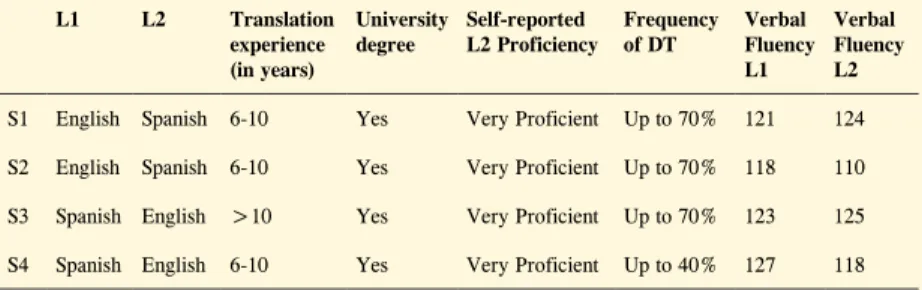
Table 1. Participant characteristics.
L1 L2 Translation experience (in years)
University
degree Self-reportedL2 Proficiency Frequency of DT Verbal Fluency L1
Verbal Fluency L2
S1 English Spanish 6-10 Yes Very Proficient Up to 70% 121 124
S2 English Spanish 6-10 Yes Very Proficient Up to 70% 118 110
S3 Spanish English >10 Yes Very Proficient Up to 70% 123 125
S4 Spanish English 6-10 Yes Very Proficient Up to 40% 127 118
Because there are specific aspects related to each direction (e.g., editing by means of recursiveness; time; pause patterns; segmentation) that can be measured, quantitative analyses of total time spent in each task, as well as fixation time and fixation count were carried out in order to investigate whether translators applied more cognitive effort in DT or IT.
3.2. Procedure and design
how one text span has a specific role relative to another text span) (Taboada and Mann 2006).1 Translation process data was recorded with eye-tracking technology (EyeLink II) and Translog. The eye tracking data provides insight on attention directed to each of the tasks–fixation count and fixation duration. The amount of attention directed to three different parts of the screen in the same task was also analyzed. Therefore, the following variables were explored:
1. Total task length (i.e., the total time a translator spent in each task);
2. Fixation count (i.e., the total number of fixations in each task); 3. Average fixation duration (i.e., the average time that the
fovea is directed at some location); and
4. Gaze time (i.e., the dwell time spent in each area of interest: ST, TT, and browser).
3.2.1. Eye-tracking technology and Translog
The translation tasks were recorded with EyeLink II, a head-mounted eye-tracking device which consists of three miniature cameras situated on a comfortable padded headband2. Translation tasks were also recorded with Translog (Jakobsen and Schou 1999), a computational tool that logs keystrokes and mouse clicks during translation. Due to the space constraints, in the present paper, we will only report the results from the eye-tracking technology. EyeLink II allowed for us to calculate the total time spent on
1For comparable reasons, original texts had to be adapted. The text in English
was originally published at “A New Report Explains the Physics of Crumpled Paper,” Scientific America, accessed on February 5th, 2002: http://www. scientificamerican.com/article/a-new-report-explains-the. The original text in Spanish was entitled, “Desarrollan una lengua electrónica para producir mejor vino,” accessed on September 3rd, 2014: http://www.bbc.co.uk/mundo/ noticias/2014/01/140108_tecnologia_lengua_electronica_fabricacion_vino.
2 More information about the system can be found in http://www.sr-research.
each task, total fixation count, and average fixation duration. Furthermore, fixation count in each area of interest (ST, TT, and Browser) is also analyzed to verify whether these measures can be used as indicators of different cognitive effort applied based on the direction of translation. The mean fixation duration threshold
for the analysis was based on Pavlović and Jensen’s (2009) study
which specifies that the lower fixation threshold to discriminate fixation from non-fixation is set to a temporal resolution of 100 ms and a spatial resolution of 40 pixels, to include maximum gaze data directly related to the translation task. The EyeLink Data Viewer tool was used to display, filter, and report output of the data files.
We focused on defining three AoIs: ST, TT, and Browser. The inclusion of these AoIs was based on the idea that the potential gaze area can be the area related to ST, TT, or browser.
In order to verify fixation in each AoI, the computer screen was divided into two parts: On the left half, the Translog screen was displayed with TT and ST and, on the right half, browser was displayed so that translators could use it for external support at their convenience, such as online dictionaries, search tools, etc. Total time spent on each task was calculated with Translog. Total gaze time, fixation count, and average fixation duration were calculated for each AoI using the EyeLink II’s Data Viewer tool.
3.2.2. Verbal fluency measure
Spanish, then in English.3 When adding together the total number of exemplars verbalized for each language, we are left with an arbitrary verbal fluency score. In this case study, we will investigate whether verbal fluency in either language can be used as an indicative of fluency in both languages, which might endorse information found in the prospective questionnaire on their proficiency level in both languages. As described in Table 1, overall, it seems that participants have almost the same vocabulary size in each language. Indeed, a t-test confirmed no significant difference between English and Spanish verbal fluency (t = .941, p = 0.416).
3.3. Hypotheses
The following predictions guided the research objectives of the present study:
H1. Translators will spend more time and present higher fixation count during the IT task compared to the DT task; H2. Translators will present higher average fixation duration in
the IT task than in the DT task;
H3. Translators will invest more attention in processing the ST than the TT in the DT task. Conversely, in the IT task, they will invest more attention processing the TT than the ST; and
H4. Translators will direct more attention to the browser during the IT task in comparison to the DT task.
4. Results
4.1. General patterns in translation performance
results of the present study simply because small samples may not fully provide an accurate representation of a general population. Thus, we cannot assume that the data are normally distributed. We also consider the general context of translation directionality: all variables analyzed are considered to be indicative of cognitive effort, depending on the translation direction (DT or IT).
4.1.1. Total time
The total time spent in each task appears in Table 2. The results show that all translators spent more time in the IT task. A t-test showed that the difference was significant (t = -2.799, p < .05).
Table 2.
Total time spent (in seconds) in each task.
Direct Translation Inverse Translation
S1 1,014 1,397
S2 1,034 1,268
S3 1,020 1,036
S4 1,356 1,600
Mean 1,106 1,325
4.1.2. Total fixation count and time spent in each task
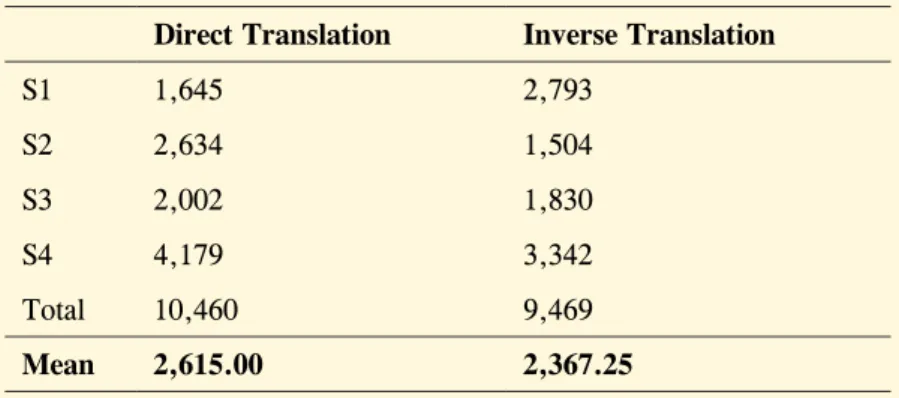
The results from total fixation showed that fixation count varied considerably among participants, in both tasks (refer to Table 3). A
Table 3. Total fixations in DT and IT.
Direct Translation Inverse Translation
S1 1,645 2,793
S2 2,634 1,504
S3 2,002 1,830
S4 4,179 3,342
Total 10,460 9,469
Mean 2,615.00 2,367.25
4.1.3. Average fixation duration
In terms of average fixation duration, results in Table 4 show that all participants produced longer average fixation duration in IT. Therefore, our second hypothesis was confirmed.
Table 4. Average fixation duration (in milliseconds) in each task.
Direct Translation Inverse Translation
S1 283 338
S2 272 258
S3 338 343
S4 223 271
Mean 279.00 302.50
4.1.4. Areas of interest
The third hypothesis was that translators would invest more attention processing the ST than the TT in DT, which was partially confirmed by the data. Only S3 presented longer dwell time in the target text than in the source text area during DT. We had also hypothesized that they would invest more effort in the TT processing than the ST processing in IT, which was not confirmed. Total dwell time spent in Table 5 shows that participants tended to present longer dwell time in the ST area in both tasks.
Table 5. Dwell time spent (in milliseconds) for source text, target text, and browser.
Direct Translation Inverse Translation
ST TT Browser ST TT Browser
S1 327060 102432 36436 442712 235220 199120
S2 253328 201172 246572 217500 115180 55688
S3 257660 329252 115004 103276 27836 11376
S4 556748 188296 205196 511296 306408 89100
Total 1170012 746556 603208 1274784 684644 355284
Mean 292503 186639 150802 318696 171161 88821
4.1.4.1 Source text and target text
to ST comprehension than to the TT reformulation in the IT. Regardless the source language, results indicate that translators made more effort to decode the source language than to encode the meaning in the target language, assuming that the time spent in each AoI is an indicative of effort in translation.
We had also hypothesized that translators would invest more attention in processing the ST than the TT in the DT task. This hypothesis was partially confirmed because only S3 presented higher dwell time in the source text area in comparison to the target text area. If translators present similar patterns in both directions (e.g., focusing in the ST area more than in the TT area), it might indicate that translators attempt to make sense of the sentences and text as a whole and understanding the meaning of that ST in the original culture demands more thinking than conveying the information in the target language, as the target text, regardless the direction of the translation.
4.1.4.2 Browser
Table 6.Total dwell time (in seconds) in the browser for direct and inverse translation.
Direct
Translation InverseTranslation
S1 36.436 199.120
S2 246.572 55.688
Total 283.008 254.808
S3 115.004 11.376
S4 205.196 89.100
Total 320.200 100.476
Grand Total 603.208 355.284
Results showed that most translators spent higher dwell time in the browser during their DT task, which was the opposite of what we had expected. It might be the case that vocabulary search in the DT was more demanding because translators are more critical of lexical decisions in their first language
5. Discussion
thinking of the target text, or simply understanding the source text. The fourth hypothesis which predicted that translators would direct more attention to the browser during IT was not confirmed. Only S1 presented higher fixation in the browser during the IT translation task in comparison to the DT. It is important to highlight that the translators did not dedicate similar time to the external support in the tasks and that S3’s fixation during DT was 10 times higher in the browser area of interest than during IT.
References
Alves, Fabio, and José Luiz Gonçalves. “Investigating the Conceptual-Procedural Distinction in the Translation Process: A Relevance-Theoretic Analysis of Micro and Macro Translation Units.” Target 25.1 (2013): 107-124.
Buchweitz, Augusto, and Fabio Alves. “Cognitive Adaptation in Translation: An Interface between Language Direction, Time, and Recursiveness in Target Text Production.” Letras de Hoje 41 (2006): 241– 272.
Carl, Michael, and Barbara Dragsted. Inside the Monitor Model: Processes of Default and Challenged Translation Production. TC3, Translation: Computation, Corpora, Cognition, 2.1 (2012): 127-145.
Dragsted, Barbara. “Coordination of reading and writing processes in translation: An eye on uncharted territory.” Translation and Cognition. Ed. Gregory M. Shreve and Erik Angelone. Amsterdam/Philadephia: John Benjamins Publishing. 2010. 41-62.
Ehrensberger-Dow, Maureen, Birgitta Englund Dimitrova, Séverine Hubscher--Davidson, and Norberg, Ulf. Describing Cognitive Processes in Translation: Acts and events. Special Issue of Translation and Interpreting Studies, 8. 2 (2012): 151-153.
Feltrin-Morris, Marella. Into forbidden territory: The audacity to translate into a second language. Diss. State University of New York, 2008. Ferreira, Aline. “Investigando o Processamento Cognitivo de Tradutores Profissionais em Tradu-ção Direta e Inversa no Par Linguístico Inglês-Português.” Cadernos de Tradução
1 (2012): 73–92.
Ferreira, Aline. Analyzing recursiveness patterns and retrospective protocols of professional translators in L1 and L2 translation tasks. Translation and Inter-preting Studies, 9.1 (2014) 109-127. Amsterdam/Philadelphia: John Benjamins Publishing.
Psycholinguistic and cognitive inquiries into translation and interpreting. Ed. Aline Ferreira and John W. Schwieter. Amsterdam: John Benjamins Publishing, 2015. 3.15.
Ferreira, Aline, and John W. Schwieter. Directionality in translation. The Hand-book of Translation and Cognition. Ed. John W. Schwieter and Aline Ferreira.
Malden, MA/Oxford, England:Wiley-Blackwell.
Gollan, Tamar, Rosa I. Montoya, and Werner, Grace A. Semantic and letter fluency in Spanish-English bilinguals. Neuropsychology, 16.4 (2002): 562–576.
Hvelplund, Kristian T. Allocation of cognitive resources in translation: An eyetra-cking and key-logging study. Diss. Copenhagen Business School, 2011.
Hvelplund, Kristian T. Eye tracking and the translation process: Reflections on the analysis and interpretation of eye-tracking data. MonTI - Special Issue on Cognitivism and Translation. Ed. Ricardo Muñoz Martín. Alicante: Universidad de Alicante, 2014. 201-223.
Isacoff, Nora M., and Stromswold, Karin. “Not All Verbal Fluency Tasks Are Created Equal: Lexical Access development between three and five.” First Lan-guage 34.1 (2014): 43-57.
Jakobsen, Arnt Lykke, and Lasse Schou. “Translog Documentation.” Probing the Process in Translation. Methods and Results. Ed. Gyde Hansen. Copenhagen: Samfundslitteratur. 1999. Appendix, 1-6.
Just, Marcel A., and Patricia A. Carpenter. “A theory of reading: From eye fixa-tions to comprehension.” Psychological Review 87.4 (1980): 329-354.
Ordoñez López, Maria del Pilar. 2010. “De mayor quiero ser traductor. Estudio de las preconcepciones de los alumnos de primer curso del Grado en Traducción e Interpretación.” Intralinea, 2010. Web. 21 May 2016. <http://www.intrali-nea.org/archive/article/1659>
Pavlović, Nataša, and Kristian Tangsgaard Hvelplund Jensen. “Eye tracking trans -lation directionality.” Translation Research Projects. Ed. Anthony Pym and Ale-xander Perekrestenko.Tarragona: Universitat Rovira i Virgili. 2009. 101-119.
Schwieter, John W., and Aline Ferreira, Eds). The development of translation competence: Theories and methodologies from psycholinguistics and cognitive science. Newcastle, England: Cambridge Scholars, 2014.
Shreve, Gregory, and Erik Angelone. (eds). Translation and cognition. Amster-dam: John Benjamins, 2010.
Taboada, Maite, and William C. Mann. “Rhetorical Structure Theory: Looking Back and Moving Ahead.” Discourse Studies 8. 3 (2006): 423-459.