COMUNICAÇÃOSAÚDE EDUCAÇÃO 2015; 19(54):503-14 DOI: 10.1590/1807-57622014.0593
Use of disaster risk communication technologies as a preventive healthcare practice
Mário Henrique da Mata Martins(a) Mary Jane Paris Spink(b)
(a,b) Programa de Estudos Pós-Graduados em Psicologia Social, Faculdade de Ciências Humanas e da Saúde, Pontifícia Universidade Católica de São
Paulo. Rua Monte Alegre, 984, Perdizes. São Paulo, SP, Brasil. 05014-901. martins.mariodamata@ uol.com.br; mjspink@ pucsp.br
Use of communication technologies for disaster risk management has brought players together with the aim of avoiding the effects
of these phenomena on global public health. This paper analyzes discursive explanations about the use of these technologies in São
Paulo, Brazil, given by specialists, managers and volunteers. The results show that informal actions reduce the time taken to issue
warnings in chaotic situations; risk communication, although polarized, may operate jointly as a multiple network; and flexible
technologies may be adapted to adverse situations and transported to different locations, to meet the demands from the
government and civil society. However, are these communication practices based on prevention? To answer the question, we
propose that disaster prevention based on harm reduction strategies may be an alternative for those engaged in preventive
practices.
Keywords: Risk communication. Disasters. Prevention. Technology.
Introduction
The increase in harms, injuries and deaths resulting from environmental disasters suggests that these
phenomena are global public health problems1. The determining factors used by management systems in disaster
situations are how exposed to risk is the population affected, how vulnerable are their conditions, and whether or not
there is a lack of responsiveness. Health policies, services and practitioners could also take these factors into account in
disaster situations2.
For a long time, studies on environmental disasters followed the same logic used by government bodies,
investing in disaster recovery strategies, with emphasis on relief measures for those affected, reconstruction of
damaged sites and accounting for financial, human and social losses3. Although essential, these strategies have
gradually become insufficient, as the frequency of these events has increased. As a result, prevention and preparedness
practices are now central to most global disaster reduction policies in order to avoid risks, prepare the population for
crises and minimize the impact of these events4.
In Brazil, the need for disaster management practices was first documented in 1824 through the first National
COMUNICAÇÃOSAÚDE EDUCAÇÃO 2015; 19(54):503-14 Defence National Policy6. This policy, which gained prominence in 2000, emphasized the need for action at different
stages of a disaster situation, although it had no specific focus on prevention. The Civil Protection and Defence
National Policy, presented in 2012, has defined prevention as a cross-sectional axis and encouraged intersectional
articulation between public health policies, the education sector, social services, land use and occupation, sanitation7.
Within this context, preventive action based on risk communication focusing on obtaining and spreading
information about potential events has become pivotal to disaster risk management policies. Since the communication
technology revolution, the possibility of extending the access to information to the wider population has become real
and it has influenced the way in which risk is communicated8. Despite the fact that not everyone has access to certain
types of communication technologies, and that their participation in the manufacturing of technological products is
restricted9, communication technologies have enabled authorities to create greater and faster public awareness of risk
situations, thus requiring public control measures. Risk is no longer a strictly scientific and technical element, but an
object of collective responsibility10.
Furthermore, communication technologies for disaster risk management are more than informative vehicles:
they not only gather and disseminate information about potential risks, but also engage actors in preventive measures.
Few empirical studies have been done with focus on disaster risk communication, such as those related to floods, the
most frequent natural disaster in the world 11. We believe that the use of risk communication technologies may be
crucial for the success of those disaster preventive practices which aim to reduce the health impact of such events.
This article is presented in a theoretical framework based on the constructionist movement, which assumes that
language is action and the assemblage of heterogeneous social elements through discursive acts enact versions of the
world12. These assumptions are shared by scholars of the strand of studies on Science, Technology and Society (STS).
STS scholars have added to the constructionist debate the assumption that division between nature and society is
unnatural. According to these authors, nature and society are not separated a priori, but instead coordinated as a
complex system and organized into collective processes in which different participants, actions and objects of the world
are assembled. These collective assemblages form base of various practices, including communication and decision
making about risks and controversial issues such as disasters13-14.
One of the consequences of working with collectives is that there are elements associated with the disaster
prevention system that are nonhuman. Technological apparatus are the product of a system and, therefore, reflect,
internalize and transform power relations and cultural assumptions15. Therefore, this article assumes that technological
apparatus for disaster prevention and the practices associated with them enact effects in our ways of living as a
collective, making it necessary to understand the effects that these technologies have produced in the contemporary
world in order to deepen the discussion on disaster prevention and, in particular, on risk communication. To achieve
this, we conducted three case studies in the city of São Paulo, focusing on risk communication practices, technologies
for monitoring risk areas, and the ways in which the authorities issue warnings to inform the population about possible
disasters. The main objective was to understand the effects of these technologies on the current paradigm of
prevention.
COMUNICAÇÃOSAÚDE EDUCAÇÃO 2015; 19(54):503-14 This is a qualitative research based on descriptive and analytical cases studies. The fundamental characteristics
of this method are the specific and contextual approach to large and complex themes, the definition of cases that serve
as objects of study, phenomena description, and critical evaluation from analytical frameworks16.
Each case study had one or more participants: five members of an operation team of the National Center for
Monitoring and Warning of Natural Disasters (CEMADEN); one manager responsible for preventive and recovery
action in the São Paulo Civil Protection and Defence Coordination Department (COMPDEC); three amateur radio
volunteers in exercise of their activities at the National Radio Amateurs Emergency Network (RENER).
These cases present different versions of risk communication in specific collectives: the technicians, the
manager and the volunteers. These actors deal, respectively, with documents for risk warning, pluviometers and radios.
Participants provided detailed information regarding each of these technologies, as well as the effects of their uses for
preventive purposes.
Participant observation and interview were techniques employed for data production. Participant observation
was used to understand the institutional functioning, monitoring and warning practices, and technology uses.
Information was recorded on field notes17. When field notes were not sufficient for case definition, additional
information was gathered via interviews, which provided a more comprehensive view of the issues identified in the
field notes, in order to understand the participants positioning, their arguments and the way these related to and
sustained their practices18. The field notes produced after monitoring the operator‟s practices in CEMADEN were
sufficient for case definition, whilst interviews were used with the manager at COMPDEC and the radio amateurs at
RENER. Permission to record the information in field notes, interviewing the participants and subsequent transcription
were obtained.
Case 1: Risk communication protocols and warning drafts: spatial relations
This case study discusses the strategies used by operators in the CEMADEN to inform the authorities and the
population of the risk of a disaster occurring. The operators used two risk communication technologies, namely: the
warning protocol and the warning draft. Both were designed to make the risk communication process run smoothly,
but in different manners.
Protocols are made to enact objects, people, situations and institutions, and to establish guidelines for decision
making in disaster risk situations. One of these instruments is the warning protocol signed by the CEMADEN, located in
Cachoeira Paulista, São Paulo; and the National Center for Natural Disaster Risk Management (CENAD), located in
Brasília, Distrito Federal. According to this protocol:
͞All risk warning for natural disaster issued by CEMADEN should be sent to CENAD to
support preventive actions for civil protection. (...). The warning issued by CEMADEN will be sent systematically by email in pdf format. In the case of warnings involving high risk ratings, it will also be communicated to CENAD verbally by teleconference and/or telephone. In situations prior to risk classified as VERY high, teleconference
COMUNICAÇÃOSAÚDE EDUCAÇÃO 2015; 19(54):503-14
of CEMADEN and CENAD. As a result of these discussions, CEMADEN will send a
document summarizing risky situations for hydrological and geological natural disasters. In exceptional situations of imminent risk or rapid development of natural disasters, the warning communication by phone or teleconference can happen before sending the pdf file containing the aforementioned warning19͟.
The protocol determines that warnings produced by CEMADEN, based on local meteorological data from
satellites, radar and pluviometers, should be forwarded to CENAD to support preventive and preparative actions. Both
institutions share the warning as an object of attention and intervention, and the implementation of the protocol seeks
to avoid management conflicts. The protocol operates twofold: distributing roles and responsibilities as well as
integrating joint actions.
With respect to role assignments, CEMADEN produces and sends a warning sign to CENAD, which in turn,
receives, evaluates and issues the warning to states and municipalities. This organization produces regions, a metaphor
that refers to versions of the world in which spaces are separate to one another20. This generates a sharp division in
which there is no field overlapping: CEMADEN attributions and roles differ from those of CENAD and vice-versa, and
are not shareable between both institutions: what is applicable to one is not applicable to the other.
However, this protocol does not operate only by distributing roles and responsibilities. Communication
between CEMADEN and CENAD is established through instruments and communication equipment, and is categorized
according to disaster risk levels. Warnings of VERY high risk situations are communicated by teleconference and/or
telephone, with uninterrupted communication being established by these means prior to risk being classified as very
high19. At this point, a similar set of elements and relationships emerges, enabling interfaces to be created, irrespective
of location: similar elements tend to be nearby and different elements farther apart, which characterizes a network
logic20.
A specific spatial organization is required in order to integrate these centres, as they have distinct geographical
locations. This integration is possible because telephony and videoconference equipment, power lines, and technicians
who share a common language are all available in both institutions. This enables the network to put elements of
different regions together. As long as power cables are properly maintained and functioning, phones are operational,
technicians are present in the meeting rooms and they work with such instruments, communication is able to occur.
However, this communication is restricted by the same elements that support it. It exists, whether the elements exist.
Otherwise, in unpredictable situations, it may fail.
Exceptional situations of unpredictability are considered within the protocol, which is of paramount
importance. There are some problems, however, because what is called “exceptional” may occur more frequently than
anticipated and the protocol incorporates these events in an old-fashioned way: by associating the unpredictable to the
rule. To say that an action can be anticipated does not mean the protocol is being made flexible and open to the
unpredictable. It means that in situations not framed in the definitions of exceptionality; this anticipation will not be,
under any circumstances, possible. The unpredictable is incorporated into ordering and ceases to be unpredictable.
This does not mean that protocols are not useful. They serve as guidelines that need to be continuously
COMUNICAÇÃOSAÚDE EDUCAÇÃO 2015; 19(54):503-14 scope to deal with real unpredictable situations, which is something addressed by another technology, according to the
following excerpt from the field notes:
“During my stay in CEMADEN, an operator talked to me about a very interesting strategy
used by the operators: making warning drafts. To illustrate this practice, the operator uses
the possibility of disaster events happening, affecting simultaneously Minas Gerais, Rio de
Janeiro and Bahia within the next few hours. The objective is to reduce the time between
risk assessment and the issuing and receipt of warnings. „We make warning drafts, for
example, now, because we are concerned that everything may happen suddenly at the same
time. With the warning draft ready, we are able to change some of the information quickly,
as required, and keep the warning ready to be sent out at any time, within moments'. 'How
long would it take for you to write the entire warning document without a draft previously
made? ' 'Well ... fifteen minutes at most '”.
The operators worry about the time between sending a warning sign and the arrival of the warning in the
affected community. Therefore, when they identify a situation that may worsen in the future, to the point where they
may not be able to cope with all the variables at the same time, they write a warning draft and file it for later use. The
operators use the draft when the situation begins to unfold, and are able to produce data promptly before the situation
becomes too chaotic. Otherwise, the draft remains in stand-by.
The warning draft is a result of operators‟ routine practices in CEMADEN, although it does not form part of
any written procedures. Similarly, it is not a strategy generally employed in monitoring networks. It is rather a
consequence of the need to ensure faster risk communication, as well as an informal and creative strategy to deal with
data in complex simultaneous intertwined situations. It is a fluid emerging from informal situations to deal with
complex situations20.
It is important to note that the distinction made between the forms of risk communication produced between
regions, networks and fluids is merely didactic. There are variations between these forms of organizing practices in
relation to space and combinations of these elements. Risk communication is a multiple practice on CEMADEN, and the
way in which spaces are organized determines how effective sending a warning sign is: when to apply the protocol and
when to use informal practices.
Case 2: Pluviometers and risk communication between the population and the government
This case study discusses the use of three types of pluviometers by the São Paulo administration to inform and
prepare the community in case of an imminent disaster. The information here presented was obtained during an
interview with a manager responsible for prevention and recovery actions. The focus of the discussion and the analysis
was on risk communication.
A pluviometer, or rain gauge, is an instrument that measures the amount of rainwater that falls in a specific
place for a certain period. CEMADEN provided automatic and semi-automatic pluviometers to residents of the São
COMUNICAÇÃOSAÚDE EDUCAÇÃO 2015; 19(54):503-14 of Science, Technology and Innovation. The following excerpt from an interview with the person responsible for
managing the project in the city offers further information on these instruments:
“The automatic [pluviometers] will be part of a monitoring network, a joint effort between
the Emergency Management Centre (CGE) and the Civil Defence Office. They are intended
to be an institutional tool to support the operation of [preventive] planning and warning
systems. The semi-automatic [pluviometers], will not only act as gauging device, but they
will also help to mobilize the population when needed. This use of the devices has a dual
aspect that will bring two key elements together: the provision of critical information and,
most importantly, the deployment of the community”.
The interviewed manager also referred to pluviometers made of plastic bottles, which work in the actual
system associated with older automatic ones. The use of plastic bottle pluviometers in monitoring and warning systems
for risk communication was another creative idea to deal with scarce resources. In contrast, population engagement
was low: "The plastic bottle pluviometers have to be looked after, you have to measure the water inside it, you have to
pump the water and you should not leave the water inside it because it can contain larvae of dengue mosquito".
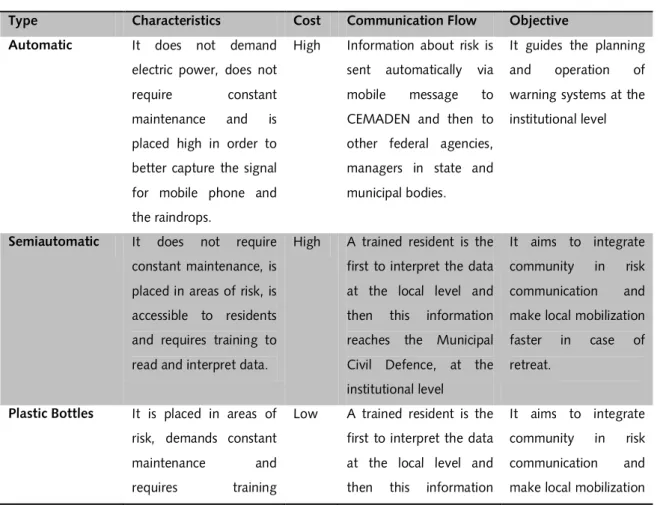
Similarities and differences between these pluviometers are shown in Table 1.
Table I. Similarities and differences between automatic pluviometers, semi-automatic pluviometers, and pluviometers made of plastic
bottles.
Type Characteristics Cost Communication Flow Objective
Automatic It does not demand
electric power, does not
require constant
maintenance and is
placed high in order to
better capture the signal
for mobile phone and
the raindrops.
High Information about risk is
sent automatically via
mobile message to
CEMADEN and then to
other federal agencies,
managers in state and
municipal bodies.
It guides the planning
and operation of
warning systems at the
institutional level
Semiautomatic It does not require
constant maintenance, is
placed in areas of risk, is
accessible to residents
and requires training to
read and interpret data.
High A trained resident is the
first to interpret the data
at the local level and
then this information
reaches the Municipal
Civil Defence, at the
institutional level
It aims to integrate
community in risk
communication and
make local mobilization
faster in case of
retreat.
Plastic Bottles It is placed in areas of
risk, demands constant
maintenance and
requires training
Low A trained resident is the
first to interpret the data
at the local level and
then this information
It aims to integrate
community in risk
communication and
COMUNICAÇÃOSAÚDE EDUCAÇÃO 2015; 19(54):503-14 residents to read and
interpret data.
reaches the Municipal
Civil Defence, at the
institutional level
faster in case of
retreat.
Sources: Information on automatic and semi-automatic pluviometers was adapted from http://www.cemaden.gov.br/. Information
on pluviometers made of plastic bottles was adapted from the interview with the responsible manager.
The three types of pluviometers serve different management purposes. The automatic pluviometers, placed on
top of water tanks at Unified Education Centers (CEUs) in the outskirts of São Paulo, provide data for governmental
actions. Information about rainfall levels obtained in these instruments is sent to CEMADEN, and is then transmitted to
CENAD, which issues the warning to the municipality and local authorities. The semi-automatic pluviometers are placed
in areas of risk. Residents of such areas receive training on how to read the devices and record the information,
effective ways of mobilizing other residents to retreat in case of disaster risk, and on how to subsequently report the
recorded information to managers. The use of automatic pluviometers delegates the responsibility for risk management
and the deployment of prevention measures, preparedness and responsiveness to managers and technicians, while the
use of semi-automatic pluviometers and plastic bottle pluviometers delegates these responsibilities almost entirely to
residents 21.
The flow of risk communication replicates this polarity. In the use of automatic pluviometers, risk
communication takes longer to reach and mobilize communities, as it passes through institutions and gives priority to
the knowledge and decision-making of authorities and technicians. It is a traditional model of communication, which
excludes the population as an active agent in the process. Those who make the rules also determine the appropriate
actions to be taken given the information received.
Conversely, semi-automatic pluviometers and pluviometers made of plastic bottles follow a much shorter route
of risk communication. Information is spread to residents by people within the community, who are perceived as
reliable sources, making this a more efficient strategy of dissemination and community mobilization than the one
carried out by unknown people, such as public authorities‟ officers22. Moreover, public engagement during the
planning process and contingency plans testing allows the population to identify public authorities‟ limitations in
dealing with disaster risks situation, thus avoiding the feeling of false security created by delegating responsibilities
exclusively to managers and technicians23.
This apparent polarity does not exclude the simultaneous application of automatic or semi-automatic
pluviometers, as they can operate within a network for multiple risk communication purposes. It is therefore
imperative that services and devices are installed appropriately, processes are implemented and followed properly, and
that all components work effectively, i.e. mobile telephony networks, the availability of residents to participate in
training courses, and equipment maintenance. Without an effective operational infrastructure in place, the risk
communication network based on pluviometers tends to fail. So what to do in situations where instruments are subject
to failure? The next case study proposes another type of risk communication technology that requires fewer elements
in order to operate effectively: flexible technologies.
COMUNICAÇÃOSAÚDE EDUCAÇÃO 2015; 19(54):503-14 This case study discusses the amateur radio service provided in disaster situations and the characteristics that
allow operators to adapt their technologies in the face of crisis. Radio amateurs perform non-profit worldwide
communication experiments with electromagnetic waves24. In disaster situations, they provide a service that could
potentially complement or even replace existing communication systems. They collect, receive and report information
about risks, victims, shelter, food and first aid in disaster situations that require immediate response. In addition to
these actions, radio amateurs may be invited to provide their services on a voluntary basis in times of stability, in order
to promote readiness in the event of disaster situations 25.
In Brazil, their role as volunteers in disaster situations goes a long way back. On March 18, 1967, during the
Serra do Mar landslides in São Paulo, an amateur radio volunteer was responsible for resuming communication
between government agencies following the collapse of all communication networks within the region of
Caraguatatuba: "the city lost power and communication, was isolated from the world, suffocated by mud and water.
Only on March 19 the amateur radio operator Thomas Camanis Filho was ablr to re-establish communication with the
city of Santos"26. RENER was established in 2001, and has since been responsible for the registration and provision of
amateur radio volunteers in times of disaster. Many of the volunteers contributed to re-establishing communication
after floods and landslides in the mountainous region of Rio de Janeiro in 2011.
The more recent Civil Protection and Defence National Policy acknowledges the importance of these actors in
disaster situations, and has assigned to municipalities the responsibility for their training and qualification to work in
disaster situations. This represents an important step forward for amateur radio operators in gaining recognition for
their contributions7. Nonetheless, whilst this new policy enables the official participation of radio amateur operators in
emergencies, it also restricts their access to rescue operations.
In practice, radio amateurs are not restricted to response actions. According to the interviews conducted with
radio amateurs from RENER, they are prepared for unforeseeable situations. During a disaster preparedness simulation,
a real event happened: a pregnant woman was taken sick to hospital by an ambulance, and her husband was not
informed of it. Amateur radio operators identified a failure on the official communication procedure and intervened:
“People at the Simulation Center of Operations [COS] had no information about the
ambulance and they had no communication with the hospital as well. Aware of this failure,
we setup two local amateur radio stations, one at COS and another at the hospital. The
purpose of the station at the hospital was to collect information about hospital admissions,
sort them according to relevance, and return the information to the station at COS. This
enabled us to keep the simulation centre managers up to date”.
This solution was possible because amateur radio operators consider all possibilities of system failure and adapt
their technologies accordingly. In communication systems, it is rare that the flaw is incorporated as a possibility. It is
usually something to be avoided. However, these possibilities, exemplified by the real situation of the pregnant woman
in the simulation, are frequently present, irrespective of the competence of those involved. Despite all efforts, the
engagement of all actors and the correct functioning of all technologies, an accident or even a disaster can still occur.
To handle such situations, it is necessary to adapt practices and technologies available at the time.
“Amateur radio operators are able to use their radios by plugging them into car batteries,
COMUNICAÇÃOSAÚDE EDUCAÇÃO 2015; 19(54):503-14 This means operators are equipped to communicate with a wide range of people within a
vast geographical area by using a portable resource with long lasting power supply: while
there is fuel in the car tank, operators can speak!”
This case study demonstrates how amateur radio can work as a flexible technology, incorporating the
possibility of failure whilst continuing to work to some extent despite changes in circumstances27. Amateur radio
operators have flexibility because they make use of what is available and are able to travel to different locations. They
are able to go to the scene of an event and communicate real-time occurrences as they unfold, consequently
instigating timely response actions to reduce the damage caused by such incidents.
Amateur radio operators have shown us that it is essential to be prepared for the unpredictable in preventive
practices such as disaster risk communication. Unfortunately, there are times when everything fails, including amateur
radio. Before that, however, much can be done to improve communication networks and their maintenance.
Disaster as a continuous process and prevention as harm reduction
Despite their different uses, the three communication technologies here presented share two common
features: they are subject to equipment failure and have the goal of preventing people from being affected by disaster.
Whether technologies are subject to failure, are preventive practices to avoid disasters really possible? This is the main
issue faced by the current forms of disaster prevention. "Because if it is necessary to prevent a catastrophe, one must
believe in its possibility before it occurs. However, if you can prevent it, the catastrophe remains in the field of the
impossible, turning preventive efforts impractical” 28.
Thus, the assumption that it is possible to avoid environmental disasters through preventive strategies is
paradoxical: we are not able to ensure that a disaster can be avoided, nor can we validate this inability through our
current technical and scientific devices. The preventive actor, based on the precautionary principle, is as flawed as the
prophet that heralds a potential catastrophe. If the catastrophe happens, the preventive actor, as well as the prophet,
failed in their task of avoiding it. When the catastrophe does not happen, it remains under the field of the impossible,
the unlikely, and the preventive actor cannot provide evidence that may show the legitimacy of his or her actions.
How to solve this paradox? How to think of another form of prevention that is not marked by paralyzing
caution? What can be done when a catastrophe that was first confirmed as a tragedy, is absent as an irony? We
propose to perform a short circuit in the system: it is necessary to include the failure as a systems contingency and
assume that the place of the disaster is not in the future but in the present.
To people in large cities like Sao Paulo, who live in modern conditions of vulnerability and inability to respond
to crises, a disaster is not an event, but a continuum. Disordered growth, lack of basic sanitation, lack of urban
infrastructure and precarious garbage collection, absence or low quality of housing and services that improve living
standards are elements that indicate the social and environmental vulnerability of the population and the chronic harms
to which people are exposed29.
For this reason, the stages of disaster management must not be interpreted as linear systems. If the
catastrophic effects of disasters are happening simultaneously, in the present, the actions to manage them must
COMUNICAÇÃOSAÚDE EDUCAÇÃO 2015; 19(54):503-14 more as a fluid20. This implies thinking about preventive strategies such as risk communication, less as a way to avoid
disasters and more as an integrated harm reduction strategy.
Harm reduction is a proposal that aims to minimize the social and health damage resulting from specific
chronic situations. Currently, great political importance has been placed in the context of mental health, opposed to the
former emphasis on the logic of abstinence and war against drugs30. The principle of minimizing chronic damage is
what we propose to solve the disaster prevention paradox: the social ills that produce catastrophic situations in Brazil
are the disaster that we seek to avoid.
For example, as it would be significantly difficult to reverse immediately the appalling situation of precarious
housing, harm reduction strategies would focus on cementing the slopes to prevent landslides or creating dikes to
retain rainwater that could lead to flooding. Although houses are still precarious and adequate sanitation is still an
issue, these can be minimized over time through integrated actions. Structural interventions on the other hand have an
instantaneous impact as they reduce the chances of houses being destroyed or flooded making it possible to deploy
other long-term interventions for improvements in the quality of life of this population.
Implications of the effective deployment of harm reduction strategies in the context of communicative
processes are more efficient information gathering, decision making and response action. The more time is spent
obtaining information, the less time remains to save lives. Warning drafts and semiautomatic pluviometers, for
instance, increase the time available to withdraw and respond to emergencies. The economic damage from a flood or
landslide may not vary with the use of these technologies, but the minutes saved may be crucial for the protection of
the people living in the affected communities. Reducing time is reducing damage: a way to deal preventively with the
chronicity of everyday disaster.
Final Considerations
Environmental disasters have increased in number and frequency in recent years causing large-scale public
health problems, making it is necessary to rethink prevention practices, in particular, risk communication. This article
presented three case studies, which aimed to understand the use of three specific technologies, and the flow of
communication in preventive, preparative and response practices in disaster situations in the city of Sao Paulo.
We initially discussed warning drafts as creative solutions that were not created by a hierarchical order, but
were a product of local practices among operators. They work by reducing the time taken to issue a warning in
situations in which incidents emerge simultaneously without harming the basic principles of the institutional protocols
between CEMADEN and CENAD. This study enabled us to understand that in these institutions risk communication
may work according to protocol or informal practices.
Then, we discussed how pluviometers used by the Civil Protection and Defence network in Sao Paulo can
produce distinct risk communication strategies, depending on their assembled elements: risk communication may be
endorsed by local authorities and technicians or by the population living in areas of risk, which polarizes responsibilities.
This case study showed that risk communication, though polarized, operate jointly as a multiple network.
Lastly, we discussed the flexible approach of amateur radio operators, whereby equipment is adapted to
adverse situations and transported to different locations, and how they meet governmental and civil society demands
in times of crisis. This case study suggests the need to invest in flexible technologies for risk communication and to
COMUNICAÇÃOSAÚDE EDUCAÇÃO 2015; 19(54):503-14 As previously mentioned, the three risk communication technologies presented in this article share common
features: they are subject to equipment failure and have the goal of preventing people from being affected by disaster.
We have seen that, in the context of Sao Paulo, prevention based on the logic of avoiding disasters can be considered
an utopia, and its logic is paradoxical: either disaster happens and so prevention fails, or it does not happen and so it
remains fictional. For this reason, thinking about disaster prevention based on harm reduction strategies can be an
alternative to those engaged in preventive practices. Disasters are interwoven to vulnerabilities in large cities like Sao
Paulo, turning harm reduction strategies pivotal in the attempt to minimize the effects of such vulnerabilities through
continuous actions, ensuring access to fundamental rights is available whilst promoting health among population
members. When specifying this logic for risk communication we see that reducing time between information and
action increases the chances of guaranteeing a basic right: life itself.
Finally, communication technologies and practices discussed in this work are mainly produced by governmental
initiatives targeting community safety. Other studies on this theme may address risk communication strategies
produced by residents living in areas of environmental risk with the aim of promoting health.
Acknowledgements
The authors acknowledge the contributions made by professionals and volunteers of the National Center for Monitoring
and Warning of Natural Disasters (CEMADEN), the São Paulo Civil Protection and Defence Coordination Department (COMPDEC)
and the National Radio Amateurs Emergency Network (RENER). They also acknowledge the financial support given by the National
Council of Technologic and Scientific Development (CNPq).
References
1. Noji EK. The public health consequences of disasters. Prehosp Disaster Med 2000; 15: 147–57.
2. Kleim M. Preventing disasters: public health vulnerability reduction as a sustainable adaptation to climate change. Prehosp and
Disaster Medicine 2011; 28 (1): 45-45.
3. Alexander D. The study of natural disasters (1977–97) - some reflections on a changing field of knowledge. Disasters 1997;
21(4): 284–304.
4. United Nations. Final report of the scientific and technical committee of the International Decade for Natural Disaster Reduction
[internet]. Genebra: SW; 1999 [acessado 2014 Jan 20]. Disponível em
http://www.un.org/documents/ecosoc/docs/1999/e1999-80add1.htm.
5. Constituição (1824). Constituição da República Federativa do Brasil. Brasília, DF: Senado Federal; 1984.
6. Brasil. Política Nacional de Defesa Civil. Brasília, DF: Diário Oficial da União; 1995.
7. Brasil. Política Nacional de Proteção e Defesa Civil. Brasília, DF: Diário Oficial da União; 2012.
8. Beck U. Risk society revisited: theory, politics and research programmes. In: Adam B, Beck U, Van Loon J, organizadores. The risk
society and beyond: critical issues for social theory. Londres, UK: SAGE Publications; 2000. p. 211-230.
9. Pereira Junior A.Uma discussão do papel da tecnologia na práxis.Interface (Botucatu) 2000; 4(6): 41-48.
10. Fischhoff B. Risk perception and communication unplugged: twenty years of process. Risk Anal 1995; 15: 137–45.
11. Kellens W, Tempstra T, De Mayer P. Perception and communication of flood risks: a systematic review of empirical research.
Risk Anal 2013; 33(1): 24-49.
12. Gergen K. The social constructionist movement in modern psychology. Am Psychol 1985; 40(3): 266-275.
COMUNICAÇÃOSAÚDE EDUCAÇÃO 2015; 19(54):503-14 14. Law J. Heterogeneous Engineering and Tinkering. HETEROGENEITIES.NET Publications 2011. [acessado 2014 Jan 20] Disponível
em http://www.heterogeneities.net/publications/Law2011HeterogeneousEngineeringAndTinkering.pdf.
15. Allenby B, Sarewitiz D. The Techno-Human Condition. Cambridge, MA, Londres, UK: The MIT Press; 2011.
16. Yin RK. Estudo de caso: planejamento e métodos. Porto Alegre, RS: Bookman; 2001.
17. Browne BC. Recording the personal: the benefits in maintaining research diaries for documenting the emotional and practical
challenges of fieldwork in unfamiliar settings. Int J Qual Methods 2013; 12(1): 420-435.
18. Pinheiro O. Entrevista: uma prática discursiva. In: Spink MJ, organizadora. Práticas
Discursivas e Produção de Sentidos no Cotidiano: aproximações teóricas e metodológicas. Rio de Janeiro, RJ: Editora Centro
Edelstein de Pesquisas Sociais 2013. p. 156-187.
19. Portaria nº 314 de 19 de outubro de 2012. Cria e estabelece o Protocolo de Ação entre o Centro Nacional de Gerenciamento de
Riscos e Desastres (CENAD/MI) e o Centro Nacional de Monitoramento a Alertas de Desastres Naturais (CEMADEN/MCTI). Diário
Oficial da União, 19 outubro 2012.
20. Mol A, Law J. Regions, networks and fluids: anaemia and social topology. Soc Stud Sci 1994; 24(4): 641-671.
21. Martins MHM; Spink MJ. Performances tecnológicas na gestão para prevenção de desastres: o caso dos pluviômetros em
comunidades paulistanas. In: Ribeiro MAT, Spink MJP, Bomfim ZAC, organizadoras. Políticas Públicas como práticas sociais: a
contribuição da Psicologia no enfrentamento das vulnerabilidades associadas às questões ambientais. (Práticas sociais, políticas
públicas e direitos humanos). Editora ABRAPSO, no prelo 2015.
22. Breakwell G. Psychology of risk. Cambridge, UK: Cambridge University Press; 2007.
23. Wachinger G, Renn O, Begg C, Kuhlicke C. The risk perception paradox - implications for governance and communication of
natural hazards. Risk Anal 2013; 33(6): 1049-1065.
24. Halász IT. Handbook do radioamador. São Paulo, SP: Edusp; 1993.
25. Coile RC. The role of amateur radio in providing emergency electronic communication for disaster management. Disaster
Prevention and Management 1997; 6(3): 176-185.
26 Prefeitura de Caraguatatuba. Catástrofe de 1967 [Internet]. São Paulo, SP: Governo Municipal; [citado em 2013 jul 15]
Disponível em http://www.portal.caraguatatuba.sp.gov.br/caragua_conteudo.php?id=89.
27 Laet M, Mol A. The zimbabwe bush pump: Mechanics of a fluid technology. Soc Stud Sci 2000; 30(2): 225–263.
28 Dupuy JP. O tempo das catástrofes: quando o impossível é uma certeza. São Paulo, SP: É realizações; 2011.
29 Alves HPF. Vulnerabilidade socioambiental na metrópole paulistana: uma análise sociodemográfica das situações de sobreposição
espacial de problemas e riscos sociais e ambientais.Rev bras estud Popul 2006; 23(1): pp. 43-59.
30. Passos EH, Souza TP. Redução de danos e saúde pública: construções alternativas à política global de "guerra às drogas".Psicol
Soc 2011; 23(1): pp. 154-162.