CHARACTERIZATION OF THE ASSISTANCE PRACTICES
IN MENTAL HEALTH CARE NETWORKING: AN INTEGRATIVE REVIEW
a An undergraduate Nursing student in the 6th term at the School of Nursing of the Federal University of Rio Grande do Sul (UFRGS).
A PIBIC (Institutional Program of Scientific Initiation Scholarships) scholarship student. Porto Alegre, Rio Grande do Sul, Brazil. b A nurse. She holds a Doctorate in Nursing from the Graduate Program in Nursing of the School of Nursing – Federal University of Rio
Grande do Sul (UFRGS). She is also a Professor of the Nursing Department in the Federal University of Health Sciences of Porto Alegre. Porto Alegre, Rio Grande do Sul, Brazil.
c A nurse. He holds a Doctorate in Nursing from the Graduate Program in Nursing of the School of Nursing – Federal University of Rio Grande do Sul (UFRGS). He is a professor of the Nursing Department in the Federal University of Health Sciences of Porto Alegre. Porto Alegre, Rio Grande do Sul, Brazil
d A nurse. A professor of the department of professional assistance and guidance and the Graduate Program in Nursing of the School of Nursing – Federal University of Rio Grande do Sul (UFRGS, Porto Alegre, Rio Grande do Sul, Brazil).
Eduardo Oliveira Salinas DUARTEa, Cintia NASIb,
Marcio Wagner CAMATTAc, Jacó Fernando SCHNEIDERd
ABSTRACT
This study is an integrative literature review that aims to identify and analyze the characteristics of assistance practices in mental health Primary Health Care in Brazil. The sample consisted in nine articles, from databases consulted in the period between 2001 and 2009. In data analyses, results were grouped in two themes: activities and principles of psychiatric reform. Results show that even when the substitute services adopt some activities/ principles from psychiatric reform, yet there is a valorization of physician-focused activities, which lead to a per-sistence of the old paradigms and practices. The multidisciplinary team of mental health, needs to restructure its assistance and its knowledge, so that practices focused on the principles of psychiatric reform can be permanent.
Descriptors: Mental health. Health care reform. Nursing.
RESUMO
Este estudo é uma revisão integrativa, com objetivo de identificar e analisar as características das práticas de assistência na rede de atenção em saúde mental no Brasil. Com as bases de dados utilizadas, no período de 2001 a 2009, foram obtidos nove artigos. Na análise dos dados, agruparam-se os resultados em duas temáticas: atividades realizadas e princípios da reforma psiquiátrica. Os resultados apontam que, mesmo tendo algumas atividades/princípios da reforma psiquiátrica nos serviços substitutivos, ainda ocorre uma valorização das atividades médico-centradas, acarretando permanência de antigos paradigmas e práticas. A equipe multidisciplinar de saúde mental necessita reestruturar a sua assistência e o seu saber, para que se efetivem práticas voltadas para os princípios da reforma psiquiátrica.
Descritores: Saúde mental. Reforma dos serviços de saúde. Enfermagem.
Título: Caracterização das práticas de assistência na rede de atenção em saúde mental: revisão integrativa.
RESUMEN
Este estudio es una revisión integrativa con el objetivo de identificar y analizar las características de las prácticas de asistencia en la red de atención en salud mental en Brasil. Con las bases de datos, en el periodo del 2001 al 2009, se obtuvo un muestreo de nueve artículos. En el análisis de los datos, los resultados fueron agrupados en dos temas: actividades realizadas y principios la reforma psiquiátrica. Los resultados señalan que aunque haya algunas actividades/principios de la reforma psiquiátrica en los servicios sustitutivos, todavía existe una valorización de las actividades médico-centradas, lo que genera una permanencia de los antiguos paradigmas y prácticas. El equipo multidisciplinario de salud mental, necesita reestructurar su asistencia y su saber, para tener prácticas basadas en los principios de la reforma psiquiátrica.
Descriptores: Salud mental. Reforma de la atención de salud. Enfermería.
INTRODUCTION
Transformation on the treatment of “mad-ness” began in France with Philippe Pinel in the end of the eighteenth century. It set free the mentally ill patients from chains, where they lived, constantly,
arrested and in subhuman conditions(1). He aimed
to renew the psychiatric treatment, embracing a classification to mental ill people (2).
From Second World War, the society began to reflect about the treatments that were taking place in hospices, once cruelty acts to the mentally ill were practiced in them. Thus, in diverse coun-tries from Europe, several questionings about the asylum practices, the role of the shelter institu-tion, and the psychiatric knowledge were raised. This period was marked by movements, such as the Community Therapy, in England; the Institu-tional Psychotherapy and the Sector Psychiatric Therapeutic System, in France; the Preventive Psychiatric, in the United States of America; and the Italian Democratic Psychiatry. This last one was led by Franco Basaglia, in 1960s-70s, when he promoted the deinstitutionalization, which means, he was trying to transform the relations between the users and the institutions, aiming to produce mental health’s structures that completely replaced hospitalization in hospices(3).
This movement was implemented in Italy with the approval of Law 180/1978 (Psychiatric Reform Law), which prohibits the construction of new psychiatric hospitals and new psychiatric us-ers hospitalizations, it states territorial services as responsible for the population’s mental health, and ceases the social dangerousness statute of users under psychological distress(3).
In the end of 1970s, there were diverse com-plaints of human rights violations, mistreatment and deaths of users in psychiatric hospitals in Bra-zil. Especially inspired in Italian Democratic Psy-chiatric, the Brazilian psychiatric reform movement was took place, in order to substitute the traditional asylum model for one called psychosocial model.
This new model takes into account the user’s political, bio-psychosocial and cultural factors, utilizing the means of psychotherapies, socio-therapies and other means of socio-cultural reinte-gration. So, this model consider users as the major participant of his/her own treatment, and he/she must also include his/her family and social group(4).
In 2001, it the Federal Law No 10.216 was ap-proved, known as the Brazilian psychiatric reform
law(5). Supported on it, National Mental Health
Policy recommends, among other things, that treat-ment must preferably be made in community treat-mental health services, aiming the individual’s social re-integration in his environment through a Mental
Health Care Networking(6). This network may be
set by Centers of Psychosocial Care, Therapeutic Residences, hospitalizations in general hospitals, ambulatories, treatment in basic health service, and others. It is important that there must be interrela-tion and complementarity between these services.
Eleven years after the approval of the Federal Law No 10.2162001, it emerges the interest of knowing how the assistance practices are running in the mental health care network considering the transformations on this assistance field. This literature’s integrative review (IR) is relevant in order to reveal the scenery of care practices in the mental health care network, with some reflection and critical discussion on these practices.
This study aims to identify and analyze the assistance practice in the mental health care net-work in Brazil.
METHODOLOGICAL PROCEDURES
This research consists in an Integrative Review. Such review modality is defined as a method which groups the results obtained in primary researches regarding the same issue, with the aim to synthesize and analyze data, in order to develop a more com-prehensive explanation of an specific phenomenon(7). Thus, our study was developed in five steps(7): problem formulation, data collection, data evalua-tion, analysis and interpretation of the collected data and results’ presentation. Considering the goal of such integrative review, the research’s problem was formulated through the following question: how are assistance practices character-ized in the mental health care network, after the psychiatric reform?
The inclusion criteria held to form samples for this study were: had been published from 2001 to 2009, original papers (produced with practice of empirical research); written in Portuguese lan-guage; published in Brazilian journals; with quali-tative, quantitative and quanti/quali approaches, and with free online access to the complete text. About the exclusion criteria, they were: papers that constitute children and adolescents (10 to 19 years) as population; research findings about alcohol and other drugs; forensic psychiatry; teaching thematic in mental health; anti-asylum movements and/or psychiatric reform, and experience reports.
The information record obtained from the se-lected papers was made on a structured instrument. This one was filled after a complete papers’ reading, in view of the guiding question of this study.
We identified one hundred nine papers in LI-LACS database, twenty four in BDENF database (but all of them were also in LILACS’, so they were excluded) and forty six in MEDLINE database (but eight of them were also in LILACS’, so they were also excluded), remaining one hundred forty seven papers to be submitted to inclusion and exclusion criteria. Firstly, seventy seven papers were excluded because they were not available in their complete format online. After this phase, the papers in foreign language (five in English, two in Spanish and one in Hebraic), and eight more studies which were out of the proposed period were also excluded. So, fifty four papers remained.
After that, we read the fifty four abstracts from these papers, excluding more forty five of them, because they did not answer the guiding question (thirty were reflection papers, three were about teaching, six talked about psychiatric reform, two presented experience reports and four were about forensic Psychiatry). Thus, nine papers remained to be completely read.
In relation to ethical aspects, authors ideas were respected, as well as their definitions and concepts presented in the analyzed papers. Once this research is an integrative review of existent and available production about the issue, we believe it is permissible to dispense its submission to the Ethics in Research Committee.
RESULTS AND DISCUSSION
For the construction of results in this integra-tive research, nine scientific papers were analyzed,
intending to identify and analyze the assistance prac-tices from the mental health care network in Brazil.
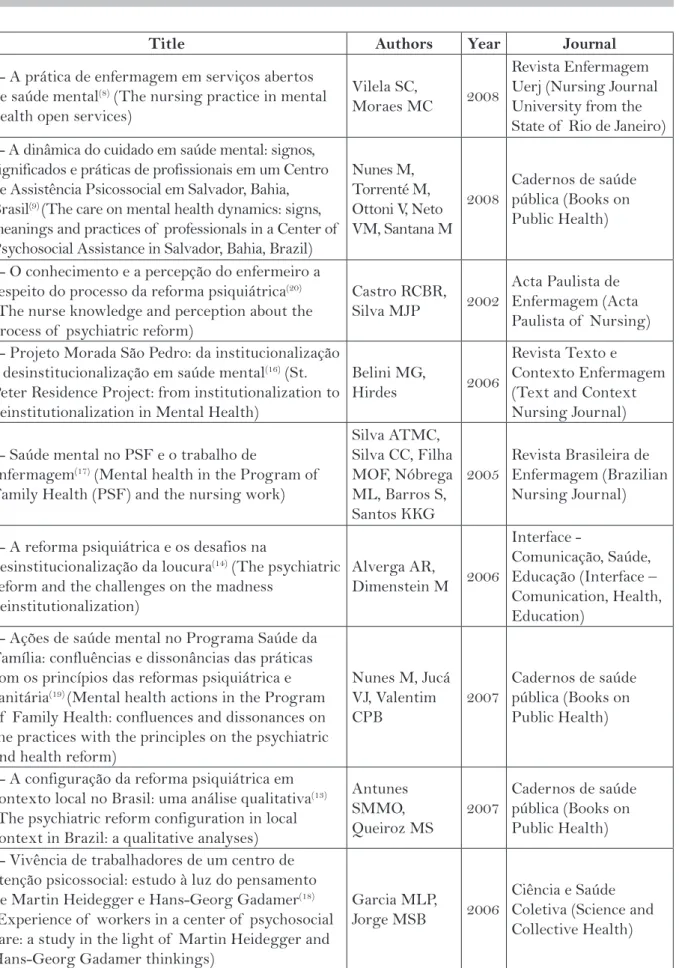
Based on the analysis of the selected papers, Table 1 shows the results related to the paper’s tittle, name of the author, year and journal where it was published.
In regards of the paper’s authors’ professions, 46,15% are nurses, 7,69% are psychologists and 46,15% did not inform it, totaling 26 professionals.
Most part of the selected papers were pro-duced in the Northeast of Brazil, totaling five scientific productions, followed by the Southeast, with three studies, and the southern region with one study.
Three of the nine papers in the sample were published on the journal Cadernos de Saúde Pública (Books on Public Health)(9,14,15) and the other ones on the: Revista de Enfermagem da Universidade do Es-tado do Rio de Janeiro (Nursing Journal University from the State of Rio de Janeiro)(8), Acta Paulista de Enfermagem (Acta Paulista of Nursing) (10), Revista Brasileira de Enfermagem (Brazilian Nursing
Jour-nal) (12), Interface – Comunicação, Saúde e Educação
(Interface – Comunication, Health, Education) (13),
Revista Texto e Contexto Enfermagem (Text and
Context on Nursing Journal) (11), Ciência e Saúde
Coletiva (Science and Collective Health) (16), listing one paper in each journal.
The places studied by scientific papers in the sample were concentrated in Centers of Psycho-social Care with five (55,5%) publications(8,9,13,15,16),
in Family Health Strategy (ESF) with two(12,14)
(22,2%), one (11,1%) in therapeutic residence(11),
one (11%) in ambulatory which also had as study
scenery the Centers of Psychosocial Care(8), and
one paper in diverse services, including Centers of Psychosocial Care, ambulatory, closed hospital, units in general hospitals and day/hospitals(10).
Title Authors Year Journal
1- A prática de enfermagem em serviços abertos
de saúde mental(8) (The nursing practice in mental
health open services)
Vilela SC,
Moraes MC 2008
Revista Enfermagem Uerj (Nursing Journal University from the State of Rio de Janeiro) 2- A dinâmica do cuidado em saúde mental: signos,
significados e práticas de profissionais em um Centro de Assistência Psicossocial em Salvador, Bahia, Brasil(9) (The care on mental health dynamics: signs, meanings and practices of professionals in a Center of Psychosocial Assistance in Salvador, Bahia, Brazil)
Nunes M, Torrenté M, Ottoni V, Neto VM, Santana M
2008
Cadernos de saúde pública (Books on Public Health)
3- O conhecimento e a percepção do enfermeiro a
respeito do processo da reforma psiquiátrica(20)
(The nurse knowledge and perception about the process of psychiatric reform)
Castro RCBR,
Silva MJP 2002
Acta Paulista de Enfermagem (Acta Paulista of Nursing)
4- Projeto Morada São Pedro: da institucionalização à desinstitucionalização em saúde mental(16) (St. Peter Residence Project: from institutionalization to deinstitutionalization in Mental Health)
Belini MG,
Hirdes 2006
Revista Texto e Contexto Enfermagem (Text and Context Nursing Journal)
5- Saúde mental no PSF e o trabalho de
enfermagem(17) (Mental health in the Program of
Family Health (PSF) and the nursing work)
Silva ATMC, Silva CC, Filha MOF, Nóbrega ML, Barros S, Santos KKG
2005
Revista Brasileira de Enfermagem (Brazilian Nursing Journal)
6- A reforma psiquiátrica e os desafios na
desinstitucionalização da loucura(14) (The psychiatric
reform and the challenges on the madness deinstitutionalization)
Alverga AR,
Dimenstein M 2006
Interface -
Comunicação, Saúde, Educação (Interface – Comunication, Health, Education)
7- Ações de saúde mental no Programa Saúde da Família: confluências e dissonâncias das práticas com os princípios das reformas psiquiátrica e
sanitária(19) (Mental health actions in the Program
of Family Health: confluences and dissonances on the practices with the principles on the psychiatric and health reform)
Nunes M, Jucá VJ, Valentim CPB
2007
Cadernos de saúde pública (Books on Public Health)
8- A configuração da reforma psiquiátrica em contexto local no Brasil: uma análise qualitativa(13) (The psychiatric reform configuration in local context in Brazil: a qualitative analyses)
Antunes SMMO, Queiroz MS
2007
Cadernos de saúde pública (Books on Public Health)
9- Vivência de trabalhadores de um centro de atenção psicossocial: estudo à luz do pensamento
de Martin Heidegger e Hans-Georg Gadamer(18)
(Experience of workers in a center of psychosocial care: a study in the light of Martin Heidegger and Hans-Georg Gadamer thinkings)
Garcia MLP,
Jorge MSB 2006
Ciência e Saúde Coletiva (Science and Collective Health)
health actions to users under psychological distress, besides making a better treatment possible(18).
From Law No 10.216/01 and Ordinance No. 336/2002 that regulate the Centers of Psychosocial Care, it increased considerably their the number in Brazil, something like 424 in 2002 to 1541 in 2010, and, simultaneously, a progressive reduction of beds in psychiatric clinics is happening, from 51.393 in 2002 to 35.426 in 2009(19).
Regarding these papers methodology, we noted that eight (88,8%) studies are qualitative researches(8,9,11-16) that use diversified methods, as ethnography, cartographic drafting, signs sys-tem, meanings and practices in mental health, descriptive-analytical, historical and dialectical materialism, hermeneutics, the semiological model, pragmatic and contextual model. Only one work
uses the quantitative approach(10), utilizing the
transversal descriptive-exploratory model. About the publications dates on the papers that composed the study sample, we may observe an increase, in the last six years, on papers production that answer the guiding question from this integra-tive review; such fact might due to the increased amount of substitute services in Brazil. 2006 con-centrates the largest number of scientific papers published, presenting a frequency of three (33.3%) studies. Two papers (22.2%) from the years 2007 and 2008 would fit the current study. In the years 2002 and 2005, we found only one paper per year.
The nine papers analyzed enabled featur-ing the assistance practices in the Mental Health Care Network in Brazil, synthesizing them into two thematic categories: developed activities and
principles of psychiatric reform. In the developed
activities in mental health category there are therapeutic groups, home care, screening, refer-rals, medications, psychiatric consultations, and
nursing consultations. In the psychiatric reform
principles category interpersonal and humanized relation emerged, also a concern about self-esteem, and an inter-professional dialogue.
Developed Activities in Mental health
Performing practices focused on psychiatric reform, therapies must leave the exclusive or pre-dominant drug scope, and highlight individuals as the main participant in the treatment, family and, eventu-ally, a more expanded group must also be included as
fundamental care agents. Institutions should go from an interpersonal nature, overcoming the “assembly line” format, to classical multi-professional teams. Regarding institutions’ means of organization, or-ganizational charts cease to be horizontal, changing to decentralization and with a popular participation proposal emphasizing not only the practices’ techni-cal dimension, but also its ethitechni-cal scope. Relationship models with customers should prioritize a dialogue with the population, expanding listening processes to a vaster territory, getting out of the action lines undertaken, only, by skilled workers(14).
Nurses in extra-hospital service attend groups and workshops, once they are in charge of their coordination(8,10), and in some cases these groups are held in occasional terms and under non-systematic
ways(8). However, when some professionals perform
therapeutic workshops, they do not feel confident enough with these alternative treatments, resulting, sometimes, in a subordinate behavior, dependent on the psychiatric consultation(15).
Such group activities should be done in an organized manner, with predefined aims, themed in accordance to the community’s reality and with high frequency, once they are closely linked to one of the main goals of the psychiatric reform, which is the bio psychosocial rehabilitation. Workshops, occupational works and art, must act as a catalyst for the individual’s reintegration success after a long history of psychiatric hospitalization(20).
Another activity developed in mental health which appeared throughout the current studies was the domiciliary visit(8, 12,15). Home visiting is a practice in which professionals face the possibility to work in an attached territory with the user, establishing a connection between the health team and the com-munity, besides allowing professionals to identify these individuals’ risks and vulnerabilities (21).
Home visits are performed by nurses and aim to achieve an active search of users and an interaction with family members, besides providing relevant information to all(8).
About individual attendance, there are as-sumptions stating that they are performed by means of consultations, basically medical ones, followed by drug treatment, which refers to a “centered
medi-cation” model(8). Psychiatric consultation is very
important for the user’s care, but it is not enough to promote psycho-social rehabilitation and it must not be highlighted as the only therapeutic possibil-ity regarding mental health services.
Considering the Family Health scenario, is evidential, in some studies that not all professionals in the team feel themselves prepared to deal with mental health needs such as: community health agents and dentists. Nursing technicians and com-munity workers show preconceptions towards this population, referring the patient to the doctors(14). Another study points out that pharmacologi-cal treatment remains the most prized action by nursing professionals who carry out administration and medicines delivery, besides giving advices about
its proper use(8). We highlight the importance of
psychoactive drug using, which must be carried out with the necessary follow-up and allied with other therapeutic modalities.
However, in some studies it was noticed that users’ handling happens through traditional and biomedical models, using medication, only(14). Drugs help cannot be dismissed when talking about mental health assistance, however, there must be, at the same time, activities that preserve and encourage users’ autonomy and independence of to avoid social isolation.
In regards of psychoactive drugs use, ESF’s clinical doctors do not present enough confidence to prescribe anti-anxiety drugs taking into account the risk of chemical addiction of these medicines,
preferring to lead users to CAPS(14). Aiming to
lessen ESF professionals insecurity due to users ‘ attendance, the strategy of matrix support between the two services could be held.
Matrix support in health aims to ensure a specialized back care to teams and professionals in charge of attention paying on health problems. Such care management methodology can be used in men-tal health services, primary care and hospimen-tal areas. Matrix support looks forward to provide assistance and techno- pedagogical support, by means of a group construction on clinical practice guidelines and health conditions among attendees from a refer-ence staff and experts who offer matrix support(23).
Another activity which had emerged in the studies was the performance of a screenplay list-ing questions to determine whether users will be subscribed or not in CAPS, and it is performed
only by a health care professional(9). According to
the current study’s authors, professionals cannot see a holistic form, as advocates the psychosocial model, just using this screening model. Some of the reasons attributed by professionals for the use of such dynamic performance during service hours are salary dissatisfaction and personal interests(9). The term “screening” appears in another study to reinforce the reception of a new user to the service, in which it is used an interview guided by questions’ script, however, in this particular case, it is held by two professionals from different academic backgrounds, aiming to provide an integral attendance(13).
The receipt or acceptance is not a mere inter-view using a script set, but it is actually the first professional approach towards the user, it is a way to listen, to meet their needs and create a confident relationship. Hosting can be understood as a way to reorganize health services, ensuring good quality service, problems resolvability and the guarantee of a humanized care(24).
Nursing consultation mentioned in one
study(8) refers only to physical examination and
ananmesis, failing to perform the other steps of the nursing procedures, which can end up harming the user’s psychosocial rehabilitation process, since the assistance is not being done in an organized way, making it difficult to go on with medical care(25).
The nursing process model recommended by Wanda Horta is a methodological tool which aims the encouragement and organization of such needs to provide care. It is compromised by six steps of dynamics and sequences, as follows: Nursing background and physical examination, diagnosis, assistance plan, daily care plan or nursing prescrip-tion, evolution and prognosis(25).
Principles of the Psychiatric Reform
individual action to a group action act regarding patient’s crises with their contexts(3).
In regards to health mental contexts it was found that there is an interpersonal relationship based on active listening, orientation, guidance, pro-fessional’s availability and information exchange,
in humanization(8-10,12,16). These actions approach
Health Family professionals to user, also causing his/her participation on his/her care, turning them responsible of their health, enabling their autonomy. Autonomy should be understood as an individual capability and community ability of deal-ing with their difficulties, gettdeal-ing their remove or
receiving support to minimize harmful effects(26).
Professionals in family health teams work with listening and dialoguing procedures when user take their problems home, such as crises and stresses they face on daily basis and that affect their quality of life
(8,9). Listening happens through face to face meetings
between professional and user, which means that both communicate by sharing the same time and
the same space(27). These practices are performed
by professional in a conscious way, in which he/she helps the user to increase and find new ways to deal with the problem they have been facing(28).
Listening and talking procedures, performed by nurses and the users, helps them to perceive, in a different focus, their difficulties, helping in the reflection process and taking the best decisions to solve them. Such practice, particularly in the mental health field, is a tool that is used to improve care, because values and motivates users to speak, in ad-dition to the centered attendance which values the citizen, respecting him/her as a bio-psychosocial individual, giving support to the actions found in the psychiatric reform(29).
Another psychiatric reform’s proposal, which arises in mental health services, is the humaniza-tion on users attendance, focusing on assistance to immediate needs of acute user, providing a worthy and ethical care(10,16).
Regarding assistance, in accordance to the psychiatric reform principles, even nurses from family health teams perform actions of listening, of talking about violence themes, alcoholism and drugs, they do not recognize it as being mental health activities(12). It can be a result of the pro-fessional training which takes place in “hospital-centered” way, valuing activities and technical procedures.
Professionals from a CAPS consider the fact that users being able to move up to the CAPS and then return to their homes, as a stimulus to
exer-cise their autonomy(9). ESF’s nurses also realize
the influence of the psychiatric reform in their as-sistance, one of them is the conquest of the user’s autonomy, since he/she has a higher participation in their care, making options in their treatment(10). In a study carried by therapeutic residential mental health professionals it is reported a seek for a everyday’s life skills rescue and thus the users’ autonomy through education and relearning of daily activities(11).
The substitutive asylum services model, look forward to preserve and increase users’ autonomy, so they can freely circulate in their community, regaining new interpersonal rela-tions. Substitute services can promote education and stimulate the activities focused on users’ ev-eryday life actions. These activities can facilitate their rehabilitation, as they will be taking care of themselves, practicing their citizenship and organizing their everyday life. Working with user’s everyday actions is an important tool for psychosocial rehabilitation(27).
Professionals of various expertise share their experiences and exchange information, by inter-professional dialogue, seeking solutions to emerg-ing problems. Such professionals long for an ideal psychiatric reform, but in some cases, traditional medical model in predominant, since they face po-litical, social and economic difficulties(15).
The dialogue between professionals from dif-ferent areas is very important once it allow a holistic look over the user, expanding the care, besides overcoming the asylum model. It is crucial that the substitute services work with an interdisciplinary team and seek their interaction, exchanging and producing of knowledge, ensuring integrity over user’s attendance (18).
FI NAL CONSIDERATIONS
The psychiatric reform has been changing the concepts and practices of social assistance available to users under psychic distress. Nowadays, we look for the development of a territorial service turning professional, user and his/her family responsible for the treatment, constantly interacting and searching for psychosocial rehabilitation.
In this integrative revision, we aimed to identify and analyze the characteristics assistance practices’ characteristics in health care’s network. It was noticed that the actions that stand out are activities in therapeutic groups and home visits. However, such actions do not constant and sys-tematically occur, some activities such as listening still unrecognized.
Regarding psychiatric reform principles, in-terpersonal relationship had relevance in articles from the current integrative revision. The “centered doctor” model still has a clear appreciation in most articles, when treatment focuses on the disease’s symptoms, and not in the user’s distress.
Only the development of substitute services is not enough to achieve the psychosocial rehabilita-tion of users under distress. Thus, the importance of continuous education in institutions like that comes up, actions can be taken towards a psycho-social model.
It is a general hoped that the current study can contribute to the reflection and critical discussion about nowadays assistance to users of the mental health networks. It stresses the need to broaden the investigations focused on the investigated topic, contributing to strengthen psycho-social practices in extra-hospital institutions.
REFERENCES
1 Tenório F. A reforma psiquiátrica, da década de 1980 aos dias atuais: história e conceito. Hist. cienc. saude - Manguinhos. 2002;9(1):25-59.
2 Queiroz IS. Os programas de redução de danos como espaços de exercício da cidadania dos usuários de drogas. Psicol. cienc. prof. 2001;21(4):2-15.
3 Rotelli F, De Leonardis O, Mauri D. Desistituciona-lização, uma outra via: a reforma psiquiátrica italiana no contexto da Europa ocidental e dos “países avan-çados”. In: NICÁCIO, F, organizador .Desinstitucio-nalização. 2ª ed. São Paulo: Hucitec; 2001. p. 17-59.
4 Costa-Rosa A. O modo psicossocial: um paradigma das práticas substitutivas ao modo asilar. In: Ama-rante P, organizador. Ensaios: subjetividade, saúde mental, sociedade. Rio de Janeiro: Fiocruz; 2000. p. 141-68.
5 Ministério da Saúde (BR). Lei federal n° 10.216 de 06 de abril de 2001: dispõe sobre a proteção e os direitos das pessoas portadoras de transtornos mentais e redireciona o modelo assistencial em saúde mental. Brasília(DF): Ministério da Saúde; 2001.
6 Brasil. Ministério da Saúde. Secretaria Executiva. Subsecretaria de Assuntos Administrativos. Coorde-nação-Geral de Documentação e Informação. Legis-lação em Saúde Mental 1990-2001. 2ª ed. revisada e atualizada. Brasília(DF): Ministério da Saúde; 2002.
7 Cooper H. The integrative research review: a syste-matic approach. Newbury Park, CA: Sage; 1989.
8 Vilela SC, Moraes MC. A prática de enfermagem em serviços abertos de saúde mental. Rev. enferm. UERJ. 2008;16(4):501-6.
9 Nunes M, Torrenté M, Ottoni V, Neto VM. Santana, M. A dinâmica do cuidado em saúde mental: signos, significados e práticas de profissionais em um Cen-tro de Assistência Psicossocial em Salvador, Bahia, Brasil. Cad. Saude Publica. 2008;24(1):188-196.
10 Castro RCBR, Silva MJP. O conhecimento e a percep-ção do enfermeiro a respeito do processo da reforma psiquiátrica. Acta Paul Enferm. 2002;15(2):55-64.
11 Belini MG, Hirdes A. Projeto Morada São Pedro: da institucionalização à desisntitucionalização em saúde mental. Texto & contexto enferm. 2006;15(4):562-9.
12 Silva ATMC, Silva CC, Filha MOF, Nóbrega ML, Barros S, Santos KKG. A saúde mental no PSF e o trabalho de enfermagem. Rev. Bras. enferm. 2005;58(4):411-415.
13 Alverga AR, Dimenstein M. A reforma psiqui-átrica e os desafios na desinstitucionalização da loucura. Interface - comunicacao, saude, educacao. 2006;10(20):299-316.
Author’s address / Endereço do autor / Dirección del autor
Eduardo Oliveira Salines Duarte Av. Capivarí, 557, ap. 202, Cristal 90810-070, Porto Alegre, RS E-mail: [email protected]
Received: 12.03.2011 Approved: 13.11.2012 15 Antunes SMMO, Queiroz MS. A configuração da
refor-ma psiquiátrica em contexto local no Brasil: urefor-ma análise qualitativa. Cad. Saude Publica. 2007;3(1):207-15.
16 Garcia MLP, Jorge MSB. Vivência de trabalhadores de um centro de atenção psicossocial: estudo à luz do pensamento de Martin Heidegger e Hans-Georg Gadamer. Cienc. saude colet. 2006;11(3):765-774.
17 Nasi C, Schneider JF. Relacionamentos sociais no cotidiano de usuários de um centro de atenção psicossocial: um estudo fenomenológico. Onli-ne Braz J Nurs [InterOnli-net] 2010 [quoted 2010 nov 10];9(1):1-11. Available in: http://www. objnursing.uff.br/index.php/nursing/article/ view/j.1676-4285.2010.2745/620.
18 Nasi C, Cardoso ASF, Schneider JF, Olschowsky A, Wetzel C. Conceito de integralidade na atenção em saúde mental no contexto da reforma psiquiátrica. REME: rev. min. enferm. 2009;13(1):139-146.
19 Ministério da Saúde (BR). Saúde Mental em Dados - 7, ano V, nº 7. Informativo eletrônico. Brasília: 2010, june. Available in: http://portal.saude.gov.br/portal/ arquivos/pdf/smdados.pdf. Accessed 28/08/2012.
20 Rauter C. Oficinas para quê? Uma proposta ético-es-tético-política para oficinas terapêuticas. In: Amarante P, organizador. Ensaios: subjetividade, saúde mental, sociedade. Rio de Janeiro: Fiocruz; 2000. p. 267-77.
21 Campos GWS. Manual de prática de atenção básica: saúde ampliada e compartilhada. São Paulo: Hucitec; 2008.
22 Wetzel C, Kantorski LP. A inserção da família na as-sistência em saúde mental. Texto & contexto enferm. 2005;29(69):5-16.
23 Campos GW, Domitti AC. Apoio matricial e equipe de referência: uma metodologia para gestão do tra-balho interdisciplinar em saúde. Cad Saude Publica. 2007;23(2):399-407.
24 Franco TB, Bueno WS, Merhy EE. O acolhimen-to e os processos de trabalho em saúde: o caso de Betim, Minas Gerais, Brasil. Cad Saude Publica. 1999;15(2):345-53.
25 Longaray VK, Almeida MA, Cezaro P. Processo de enfermagem: reflexões de auxiliares e técnicos. Texto & contexto enferm. 2008;17(1):150-7.
26 Campos GWS. Considerações sobre a arte e a ciência da mudança: revolução das coisas e reforma das pes-soas: o caso da saúde. In: Cecilio LCO, organizador. Inventando a mudança na saúde. São Paulo: Hucitec; 1994. p. 29-87.
27 Schneider JF, Camata MW, Nasi C. O trabalho em um Centro de Atenção Psicossocial: uma análise em Alfred Schutz. Rev. gauch. enferm. 2007;28(4):520-6.
28 Wetzel C, Kantorski LP, Souza J. Centro de Atenção Psicossocial: trajetória, organização e funcionamento. Rev. enferm. UERJ. 2008;16(1):39-45.