www.eerp.usp.br/rlae
Corresponding Author: Tadeu Lessa da Costa
Universidade Federal do Rio de Janeiro - Campus Macaé Curso de graduação em enfermagem e obstetrícia Av. Aloísio da Silva Gomes, 50
Granja dos Cavaleiros
CEP 27930-560, Macaé, RJ, Brasil E-mail: [email protected]
Persons living with AIDS in nurses’ social representations: analysis of
central, contranormative and attitudinal elements
Tadeu Lessa da Costa
1Denize Cristina de Oliveira
2Gláucia Alexandre Formozo
3Antonio Marcos Tosoli Gomes
4Objectives: to describe and analyze the centrality, the mute zone and the attitudes expressed
in nurses’ social representations of people with Human Immunodeficiency Virus. Method: the
subjects were 30 nurses from a university hospital in Rio de Janeiro. The data was collected
using a Likert scale. Results: the data pointed to a process of representational change regarding
Human Immunodeficiency Virus / Acquired Immunodeficiency Syndrome, with the assumption of
a more positive attitude regarding living with this health issue. The hypothesis of the existence of
a mute zone in the representation, comprising elements with a contranormative character, was
strengthened. Conclusion: the influence of the dynamics of social normativity on how the social
representations studied are expressed may contribute to a better understanding of its structuring
process. It also helps in the analysis of possible gaps among the nurses’ discourses and practices
in relation to Human Immunodeficiency Virus / Acquired Immunodeficiency Syndrome.
Descriptors: Acquired Immunodeficiency Syndrome; Professional Practice; Attitude of Health
Personnel; Nursing; Social Psychology.
1 PhD, Professor, Universidade Federal do Rio de Janeiro - Campus Macaé, Brazil.
2 PhD, Full Professor, Faculdade de Enfermagem, Universidade do Estado do Rio de Janeiro, Brazil.
Pessoas com HIV/Aids nas representações sociais de enfermeiros: análise dos elementos centrais, contranormativos e atitudinais
Objetivos: descrever e analisar a centralidade, a zona muda e as atitudes expressas nas
representações sociais de enfermeiros, acerca da pessoa com vírus da imunodeiciência
humana. Método: os sujeitos foram 30 enfermeiros de um hospital universitário do Rio de Janeiro. Os dados foram coletados utilizando escala tipo Likert. Resultados: os resultados
indicaram um processo de mudança representacional sobre o vírus da imunodeiciência humana/síndrome da imunodeiciência adquirida, com a assunção de atitude mais positiva sobre a convivência com esse agravo. Foi reforçada a hipótese da existência de zona muda na representação composta por elementos de caráter contranormativo. Conclusão: a inluência
da dinâmica de normatividade social sobre o modo de expressão das representações sociais estudadas pode contribuir para melhor compreensão do seu processo de estruturação. Auxilia, também, na análise de eventuais defasagens entre os discursos e as práticas dos enfermeiros
em relação ao vírus da imunodeiciência humana/síndrome da imunodeiciência adquirida.
Descritores: Síndrome de Imunodeiciência Adquirida; Prática Proissional; Atitude do Pessoal
de Saúde; Enfermagem; Psicologia Social.
Personas con HIV/SIDA en las representaciones sociales de enfermeros: análisis de los elementos centrales, contra normativos y actitudinales
Objetivos: describir y analizar la centralidad, la zona muda y las actitudes expresas en las
representaciones sociales de enfermeros acerca de la persona con Virus de la Inmunodeiciencia
Humana. Método: los sujetos fueron 30 enfermeros de un hospital universitario de Rio de Janeiro. Los datos fueron colectados utilizando escala tipo likert. Resultados: indicaron un
proceso de cambio representacional sobre el Virus de la Inmunodeiciencia Humana/Síndrome da Inmunodeiciencia Adquirida, con la Asunción de actitud más positiva sobre la convivencia con éste agravo. Fue reforzada hipótesis de existencia de zona muda en la representación compuesta por elementos de carácter contra normativo. Conclusión: la inluencia de la dinámica de normatividad social sobre el modo de expresión de las representaciones sociales estudiadas puede aportar para una mejor comprensión de su proceso de estructuración. Auxilia, también,
en el análisis de eventuales desfases entre los discursos y las prácticas de los enfermeros con
relación al Virus de la Inmunodeiciencia Humana/Síndrome da Inmunodeiciencia Adquirida.
Descriptores: Síndrome de Inmunodeiciencia Adquirida; Práctica Profesional; Actitud del Personal de Salud; Enfermería; Psicología Social.
Introduction
The epidemic of Human Immunodeiciency
Virus (HIV) and the disease it causes, Acquired
Immunodeiciency Syndrome (AIDS) are a major concern
for public health. There are, approximately, 33.3 million
people infected with the virus in the world, with 2.6
million new cases in 2009(1). In Brazil, in 2009, 11,815
deaths from this were calculated, with an estimate of
592,914 cases of AIDS by June 2010(2).
The question of HIV/AIDS consists, essentially, in
an exceptional social fact in Western societies. This is
because it has triggered a worldwide process around
a disease: it has brought highly archaic categories of
social thinking, such as contagion, back to the public
space, with vigor; and it has driven the development
of research on the issue in speciic and socially labeled
circles(3).
Thus, over the evolution of this epidemic, various
metaphors have arisen, associated with AIDS, such
as: death; horror; crime; punishment; a disease
which affects others; war; shame; and pollution(4). The
epidemic and its respective meanings have also affected
the health services and health professionals, among
whom the nurses stand out. This is because nursing’s
ields of knowledge and care practices have speciic
characteristics, relating to the physical and relational
which impresses on the profession particular tensions
expressed in approximation to or distancing from the
subjects of care depending on the context in which this
care takes place(5).
From this it may be understood that the social
representations elaborated by nurses on the illness
and its carriers may inluence the development of the
care relationships. Thus, some studies describe the
contradictions in the representations of the care given to
these clients, care described by the health professionals
as identical to that given in the case of other pathologies
– but with a concern about contamination in technical
procedures and the adoption, sometimes to an excessive
degree, of measures of self-protection upon discovery of
the patients’ seropositive status(6).
The social representations may be deined as a form of knowledge, socially deined and shared,
with a practical objective, and which contribute to the
construction of a reality common to a social set(7),
embracing three spheres: subjective; inter-subjective
and transubjective(8). They entail taking symbolic
positions, organized in different ways, in opinions,
attitudes and stereotypes, according to their overlap in
distinct social relationships(9).
Interwoven in this concept is the dimension
of attitudes, conceived of as dispositions inscribed
in the subject, resulting from the objectivization of
a social representation. At the same time, there is
greater emphasis on the process of anchoring of the
representation, through the association between the
psychological and social dimensions. In this way,
studying the anchoring of the attitudes in the social
relationships which create them means studying them
as social representations(9).
From this perspective, this study has the
following as its guiding questions: for nurses, which
representational elements are probably central or of the
mute zone in the social representations of the person
living with HIV/AIDS? Which aspects are expressed in
the attitudinal dimension, in such representations held
by these professionals? The following are deined as
objectives: to describe and analyze the centrality, the
mute zone and the attitudes expressed in nurses’ social
representations concerning the person living with HIV/
AIDS.
Method
This is a quantitative, descriptive study based
in the structural approach of the theory of social
representations(10-11). The study was undertaken in 2007
in two phases, considering the pluri-methodological
approach. It was submitted to the Research Ethics
Committee and approved under protocol nº1.650-CEP/
HUPE.
In the irst phase, which had an exploratory
character, 150 nurses employed at a university hospital in
the municipality of Rio de Janeiro were included, in a
non-probabilistic manner for convenience, which consisted of
a convenience sample of 83.3% of the universe. These
subjects responded to a socio-economic questionnaire
and to the technique of free word association with the
inductive cue “HIV/AIDS carrier”, in relation to which
they produced spontaneously a maximum of ive words
or expressions. Afterwards, the terms produced were
hierarchized by the deponents(12). This application was
termed the normal situation of collection.
Next, the technique of substitution was applied, in
which the nurses were invited to produce, again, ive
words/expressions with hierarchization for the same
inductive cue, but as if they were “people in general”,
in an attempt to reduce the normative pressures on the
deponents and allow the evocation of elements which
might be considered contranormative or politically
incorrect. Such elements constitute a mute or concealed
zone in a speciied social representation(12). This application was termed the proxy or contranormative
situation of collection.
In the analysis of the free associations using the
technique of the Four Quadrant technique, arising from
the irst phase, it was possible to identify as probable
elements of the central system in the representation
in question in the normal situation: care with
professional caution; health education; and treatment. In addition to this, the following peripheral elements
stood out because of the importance attributed to
them by the subjects: help; control of the illness;
hope; family; medications; prevention; and solidarity. Also emphasized on the periphery were: prejudice;
suffering; fear; discrimination; and (biological) effects
of AIDS(12-13).
For the proxy situation, in which the contranormative
content has a greater chance of appearing, the
following were identiied as probable central elements: fear; prejudice; and homosexuality. Because of the importance attributed to them by the deponents, the
following cognitions may be indicated: contamination;
contagion; disease; sexual practices. Considering the possible mute zone in the representation in question,
Rev. Latino-Am. Enfermagem 2012 Nov.-Dec.;20(6):1091-9.
potential for contranormativity: homosexuality, fear,
sexual practices: and, with less emphasis, promiscuity,
death and drug use(12-13).
The second stage of the research, with 20% of the
initial sample, that is, 30 nurses, was started based
on these results. This last sample’s deinition was,
equally, of the non-probabilistic type, for convenience.
The second stage’s procedures, therefore, were the
base for the present study. Thus, instruments for
examining centrality in a speciied social representation
were constructed based on the analysis of the free
associations. In the light of studies on the mute zone
in social representations, these instruments included a
Likert scale(14).
The above-mentioned scale permitted the more
speciic exploration of the attitudinal dimension in the
representations. Thus, it had: 21 items, distributed
among neutral (descriptive), with positive and negative
values for the object studied; and six points, with the
following possibilities for positioning: totally disagree;
disagree; partially disagree; partially agree; agree; and totally agree. The responses, initially, made up a
database and tables, with distribution of simple and
relative frequencies.
For the analysis, it was sought to organize the data
so as to permit interpretation according to the logic
of a Characterization Questionnaire(10,13). For this, the
following grouping of responses was created: disagree
totally and disagree, considered the least characteristic aspect of the representation; partially disagree and
partially agree, understood as intermediate; and agree and totally agree, denoting the item considered the
most characteristic for the representation of the object
in question.
The criteria used for the interpretation of the
results consisted of the classiication of the statements
presented among the three categories: most
characteristic, intermediate and least characteristic, according to the concentration of the positions in the
responses of the majority of the subjects. For the
strengthening of the centrality of a speciied element of
the social representation in question, it was considered
necessary for it to be deined as most characteristic by 50% or more of the subjects(10,13). To this end, tables
with absolute and relative frequencies were constructed,
with the help of the SPSS v17.0 software.
Results
In relation to the socio-professional characterization
of the subjects, 86.7% were female; 63.3% were living
with a partner; the average monthly income was R$
4,500.00 (sd±1,500); the predominant age range
was 40 to 49 years (70%); the average time since
qualiication was 20 years (sd±5); 90% had completed
specialization and 10% had done this in infectious/
parasitic diseases; the majority (70%) stated that when
they cared for clients with HIV/AIDS, there was physical
and verbal contact in the activities performed; and
76.7% stated that they had not participated in courses/
training on HIV/AIDS.
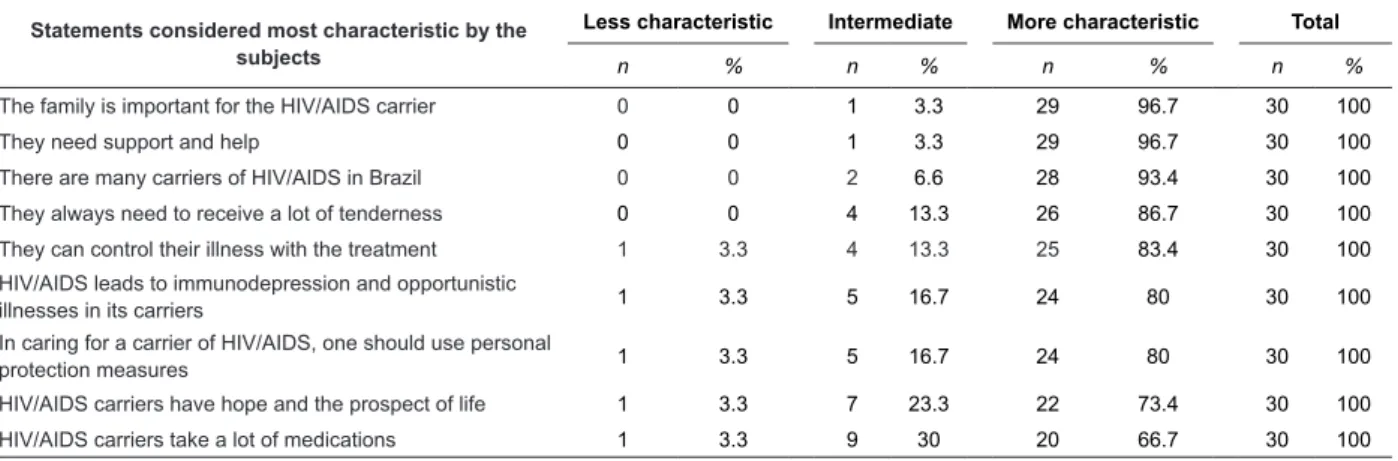
Among the statements made, nine were considered
by the study’s subjects to be characteristic of the person
living with HIV/AIDS. These are shown in Table 1.
Table 1 – Statements considered to be “most characteristic” of the social representation of the HIV/AIDS carrier. Rio
de Janeiro, Brazil, 2007
Statements considered most characteristic by the subjects
Less characteristic Intermediate More characteristic Total
n % n % n % n %
The family is important for the HIV/AIDS carrier 0 0 1 3.3 29 96.7 30 100
They need support and help 0 0 1 3.3 29 96.7 30 100
There are many carriers of HIV/AIDS in Brazil 0 0 2 6.6 28 93.4 30 100
They always need to receive a lot of tenderness 0 0 4 13.3 26 86.7 30 100
They can control their illness with the treatment 1 3.3 4 13.3 25 83.4 30 100
HIV/AIDS leads to immunodepression and opportunistic
illnesses in its carriers 1 3.3 5 16.7 24 80 30 100
In caring for a carrier of HIV/AIDS, one should use personal
protection measures 1 3.3 5 16.7 24 80 30 100
HIV/AIDS carriers have hope and the prospect of life 1 3.3 7 23.3 22 73.4 30 100
HIV/AIDS carriers take a lot of medications 1 3.3 9 30 20 66.7 30 100
It may be noted that, in a general way, that the
statements with the highest degree of agreement from
the subjects are those originated based on the elements
of data collection. Thus, the importance of the family
and of the need for support and help for the HIV/AIDS
carrier, characterized in descending order through the
analysis of the associations for the normal situation,
were the aspects which, in the present scale, presented
the highest degree of agreement among the nurses
(96.7%).
In addition to the two elements mentioned, one
may add the meaning brought by the statement on
tenderness in relation to the person living with HIV/ AIDS, with high agreement among the subjects (86.7%).
This aspect is also present in the analysis of the free
associations in the normal situation of collection of the
free associations in the irst phase of the research,
although with less emphasis.
The element of treatment, associated with the
statement they can control their illness with the treatment
obtained agreement from 83.4% of the deponents, also
being shown, therefore, as a characteristic of the HIV/
AIDS carrier for the same. This cognition was presented
as a probable central element in the representation,
equally, through the application of the technique of free
association in the normal situation, strengthening the
possibility of its centrality.
Reinforcing the dimension of treatment, the
majority of the deponents (66.7%) were shown to be in
agreement with the idea that HIV/AIDS carriers take a
lot of medications. This aspect was least associated by
the research subjects in the irst phase, although it was
considered important by those who made it.
In a similar way to that found by the result of the
free associations in the normal conditions of collection,
the statement on use of measures of personal protection
in caring for patients with HIV/AIDS, obtained the agreement of 80% of the nurses. In this way, it also
seems to be a prominent aspect in these professionals’
representations.
Another dimension to be emphasized refers to
hope and prospect of life for the person living with HIV/ AIDS, with the recording of 73.4% of agreement. Along
with the terms help and family appears in the contrast
zone of the structure of the Four Quadrants Grid for the
normal situation of collection, suggesting the existence
of a subgroup of nurses with a representation whose
nucleus is formed of such cognitions.
The statements there are many carriers of HIV/
AIDS in Brazil and HIV/AIDS leads to immunodepression
and opportunistic illnesses in its carriers, inally, denote the incorporation of information relative to the reiied
universe in the analyzed representation, and point to
the neutrality of the positionings.
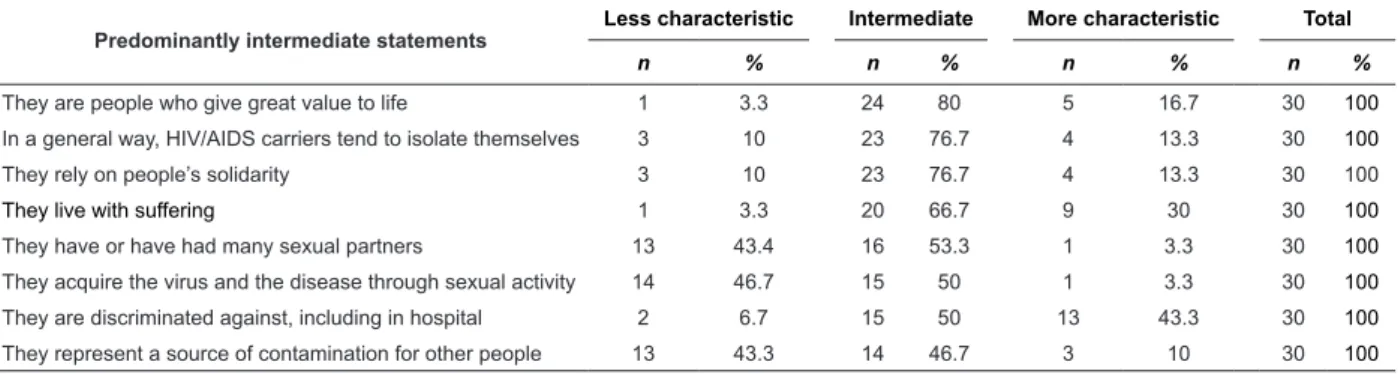
Below, in Table 2, the statements characterized
as intermediate are presented, consisting of elements
which are peripheral, and, therefore, of less importance
for the determination of the meaning and internal
organization of the social representation.
Table 2 – Statements of the social representation of HIV/AIDS carriers considered as “intermediate”. Rio de Janeiro,
Brazil, 2007
Predominantly intermediate statements
Less characteristic Intermediate More characteristic Total
n % n % n % n %
They are people who give great value to life 1 3.3 24 80 5 16.7 30 100
In a general way, HIV/AIDS carriers tend to isolate themselves 3 10 23 76.7 4 13.3 30 100
They rely on people’s solidarity 3 10 23 76.7 4 13.3 30 100
They live with suffering 1 3.3 20 66.7 9 30 30 100
They have or have had many sexual partners 13 43.4 16 53.3 1 3.3 30 100
They acquire the virus and the disease through sexual activity 14 46.7 15 50 1 3.3 30 100
They are discriminated against, including in hospital 2 6.7 15 50 13 43.3 30 100
They represent a source of contamination for other people 13 43.3 14 46.7 3 10 30 100
The statement with the highest concentration of
responses from the deponents in the intermediate mode
refers to the presentation of carriers of HIV/AIDS as
people who give great value to life, with 80%. Although
this aspect has not featured in the Four Quadrants Grid
of the irst phase of the research, it was included for a
better understanding of the subjects’ conception of the
relationship between the person with HIV/AIDS and the
experience of living with the disease.
The association between people with HIV/AIDS
and social isolation, which emerged on the periphery
of the representation through the analysis of the
associations in a proxy situation, was shown to be in an
Rev. Latino-Am. Enfermagem 2012 Nov.-Dec.;20(6):1091-9.
highlighting that this aspect consists in the conception
that the carriers of the disease avoid social contact,
and, therefore, in a meaning which is inverse to that of
people’s distancing themselves from the carriers, that
is, of discrimination. A considerable proportion of the
subjects (43.3%) showed a tendency to agree with the
statement in question. In its turn, solidarity in relation to
seropositive people also presented a lower importance
for determining the meaning of the representation,
given its intermediate position (76.7%).
The statement relating to the experience of
people with HIV/AIDS of living with suffering showed
localization in the structure of the representation similar
to that found through the technique of free association
for the normal and proxy situations, that is, in the irst periphery for the irst case and in the second for the last.
In relation to discrimination, identiied in the irst
periphery, most important in the analysis of associations
for both the normative situations the subjects’
perception of the occurrence in the loci of attendance –
more speciically, in hospital – was also investigated. In
this way, a strengthening for the peripheral position was
evidenced, indicated by 50% of the subjects. However,
the presence of a subgroup a little smaller (43.3%),
for which this aspect was indicated as characteristic of
carriers of HIV/AIDS, was also observed.
On the other hand, the statements about the
acquisition of HIV through sexual practices and
regarding the involvement of people with HIV/AIDS
with many sexual partners presented, respectively,
50% and 53% of the deponents as having an
intermediate positioning. In addition, for these two
statements, subgroups of nurses (46.7% and 43.4%)
who expressed disagreement on this aspect were
recorded.
It is thought that this data, added to that from the
analysis of the free association for the proxy situation
and to the aspects of the sexual practices and of
homosexuality, present the possibility of strengthening the hypothesis of a mute zone regarding such elements.
This may be corroborated by the fact that a prominent
subgroup (50%) of subjects expressed an intermediate
position on discrimination in the hospital setting; 43.3%
of the deponents did this in a direct form. However, the
forms of stigmatization most associated with the person
living with AIDS are not conirmed by these same
subjects in their responses to the other items (Table
3), being, in consequence, attributed to the “other”
health professionals with whom a close relationship is
maintained and with whom the work space is divided.
In relation to the statement that carriers of HIV/
AIDS represent a source of contamination for other
people (back check) two subgroups stand out, one corresponding to 46.7% of the subjects, which assumes,
characteristically, an intermediate position; the other,
with 43.3% of the same, expresses its disagreement
in respect to the statement. Thus, one may say that
the assuming a position of less emphasis and, even,
of refutation by the deponents, indicates a more
positive representation of the person with HIV/AIDS,
or the possibility of strengthening the hypothesis of
contamination as an additional constituent of this
representation’s mute zone.
Table 3, below, presents the statements considered
by the majority of the study’s subjects as less
characteristic of the person with HIV/AIDS.
Table 3 – Statements considered “less characteristic” of the social representation of the HIV/AIDS carrier. Rio de
Janeiro, Brasil, 2007
Statements considered less characteristic
Less characteristic Intermediate More characteristic Total
n % n % n % n %
He is close to death 25 83.4 4 13.3 1 3.3 30 100
They have, or have had, homosexual relationships 19 63.4 9 30 2 6.6 30 100
Dealing with carriers of HIV/AIDS creates a feeling
of fear 13 43.3 12 40 5 16.7 30 100
The idea that the person with HIV/AIDS is close to
death was considered less characteristic by 83.4% of the deponents. This aspect emerged in the representation’s
second periphery in the analysis of the free associations
for the normal situation – and also in the representation’s
irst periphery for the proxy situation.
Another dimension evaluated as less characteristic
of people with HIV/AIDS refers to their association with
homosexuality (63.4%), which is also present in the free associations as a central element for the proxy situation.
In relation to fear in dealing with HIV/AIDS carriers,
free associations in the proxy situation, it was observed
that it was considered less characteristic for this study’s
subjects (43.3%) and intermediate for a subgroup a
little smaller (40%). Only 16.7% of the nurses agreed
with this statement, which retains a certain similarity
with the indings for the normal situation.
The results mentioned regarding fear of the person
with HIV/AIDS strengthen, equally, the possibility of
its iguration among the elements of the mute zone.
This is the case, bearing in mind its contranormative
character, above all when it is expressed by health care
professionals.
The positionings in the face of the statement in
a general way, they provoke a feeling of pity, have a largely homogenous distribution in the three subgroups,
with 36.7% of the subjects showing agreement, 33.3%,
in an intermediate situation and 30%, in disagreement.
By such a pattern of distribution, it cannot be classiied
in any of the tables referring to the possibilities of
structuring of cognitions in the representational
structure and attitudinal disposition of the group of
subjects studied.
Discussion
Regarding the subjects’ position on the role of
the family for people with HIV/AIDS, this represents
an important space for overcoming emotional and/or
social shortcomings for the same. Sometimes, however,
there are obstacles to the improving of these people’s
quality of life, whether from the prejudice itself from
their families or from the social isolation related to
the stigmatization of the illness and other
socially-unacceptable behaviors which preceded it, such as the
sexual orientation experienced(15).
Regarding measures for personal protection,
bearing in mind the normative pressures in play at the
time of data collection (hospital setting, presence of the
researcher, academic work), the responses’ distribution
may indicate the expression of a politically correct
discourse on biosafety. Moreover, some recent studies
have described a negligence in the use of personal
protective equipment in the routine of attending clients,
even though the worker refers to their existence and
importance. This, above all, in spaces with lower
technological complexity(16).
The subjects’ perceptions on the hope and prospect
of life among carriers of HIV/AIDS as important elements
deserve emphasis, considering that the symbolic
construction around HIV/AIDS are associated with the
idea of fatal disease. In addition, there is the aspect
of social death, caused by the discrimination, with less
symbolic deconstruction than physical death, concerning
which the representation of the possibility of coexisting
with the disease has developed(17).
Regarding social coexistence with people with
HIV/AIDS, it relects a perception that the process of
stigmatization which people suffered leads them, in
speciic circumstances, to their reducing or even avoiding
certain types of social environments, represented as
potentially discriminatory(18). Some authors(19) include
the health sector among such circles, suggesting the
need to measure and intervene in this phenomenon, as it
can cause harmful consequences for clients and society,
with the increase of individual and social vulnerabilities
to the health issue. In any case, it becomes necessary
to emphasize that this element was only revealed as
signiicant in the proxy situation, possibly because of its
negative character or its association with the thinking
of “others”.
Taking into account nurses’ perception about the
occurrence of discrimination in the hospital environment,
a bridge is established with the discussions of a study
about the mute zone in the social representation of
Roma among the French, in research carried out with
the structural approach of social representations. In
that investigation, where the interviewees attributed the
negative aspects of the representation to “French people
in general”, who comprised “others” in the technique of
substitution, it was reasonable for the authors to suppose
the existence of an effect of attempt at transference or
projection. That is to say, a hidden aspect of that social
representation did not emerge when the subjects spoke
for themselves, but was evidenced by the change of
the normative situation, there being, moreover, a link
with the representational content expressed. This was
because the study’s subjects, despite having given the
views of the group “French people in general”, in the
proxy situation, being French themselves, in principle
share with that group the hidden aspects of the
representation(20).
From this perspective, the responses’ distribution
in the light of HIV/AIDS carriers’ association with
homosexuality may relect the change of the epidemiological proile of the epidemic, in which male
homosexuals have been progressively more affected(2).
On the other hand, bearing in mind the association which
may still be observed between AIDS and homosexuality,
and the latter’s association with sexual deviance
Rev. Latino-Am. Enfermagem 2012 Nov.-Dec.;20(6):1091-9.
of the hypothesis as a part of the representation in
question’s mute zone, brought up by the technique of
substitution(10-11).
The dimension of suffering in the representation
about AIDS was demonstrated by studies in the process
of the social representations. Thus, the same tends to
emerge in the daily life of the seropositive person as
a result of: stigma, with people distancing themselves
because of lack of information and fear of contagion;
confrontation with the reality of the irreversibility of the
disease and the anguish in the face of the possibility of
death, especially in the initial period of awareness of the
serological status(17).
From a perspective of temporal collation, regarding
the deponents’ position regarding the representational
content of death, this emerged as a central and
organizing element of the representation of AIDS for a
similar group, in 2002(21). Given the present research’s
indings, which support previous works which employed
a distinct method(12-13,17), one can detect the possibility
of an effective process of representational change, with
the reduction of the symbolical importance of death and
a more positive assimilation of co-existence with the
disease.
In relation to the present research’s indings
regarding the dimension of fear, the nursing care for clients
with HIV/AIDS takes on peculiar characteristics, either
because of its consequences linked to stigmatization or
because of fear of contagion. One analysis of proxemic
communication between the nursing team and these
clients in the hospital setting determined that the
presence of touch occurred markedly due to technical
interventions, with greater distancing predominating on
other occasions(22).
Thus, understanding of the process of discursive
production in social representation on AIDS would also
be possible through the lens of the dynamic of the
unveiling/masking of images, information and attitudes
in the representations linked to social normativity. It
would consist therefore of an additional analytical plan
for dealing with the issue indicated by studies addressing
the dichotomy of information/knowledge and social
practices: whether in the area of care for clients with
HIV/AIDS, so as to make it more empathic(6) or in the
attempt to inluence positively the coexistence with the
health issue and compliance with drug treatment(17,23);
or in the ield of prevention of infection with HIV in
professional actions through rational use of protective
equipment(6,16), or, even, through condom use during
sexual relations(24-25).
Conclusions
This study was centered on the social representations
among nurses about people with HIV/AIDS, based on
the perspective of a structural approach. Among the
elements identiied as probably central in the nurses’ social representations in the irst phase of the research
using free association, treatment for the disease and
concern about biosafety in the care of people with HIV/
AIDS presented additional indication for the centrality.
It was observed that, generally speaking, the
statements organized on the scale with more positive connotations about people with HIV/AIDS were assumed
by the study’s subjects to be more characteristic,
and there was an attribution of lesser importance or
refutation of those with a more negative character.
These aspects permit the nurses included in the study
to think in a social representation with a coniguration
of more positive attitudes about carriers of HIV/AIDS or, on the other hand, with the possibility of establishing a
link with the process of management of impressions, in
the social desirability.
The results evidenced for the elements with more
markedly contranormative characters, such as the
association of carriers of the disease with homosexuality
and with the sensation of fear, permit thinking about the constitution of a process of masking in the social
representation studied. In this way, it was possible to
understand some lags observed among the subjects’
discourses and their care practices in relation to the
health issue, often grounded in the logic of the concept
of risk and not vulnerability, which presupposes more complex articulations in the process of prevention of the
disease and care for the persons who have it.
Finally, it is stressed that the concept of mute zone
is too recent to be completely controlled and veriied. In this way, it contributed to this ield of research, showing
later deepening of the area to be necessary. This, above
all, for the ield of psychosocial studies of HIV/AIDS, with wide inluence of social normativity.
References
1. Joint United Nations Programme on HIV/AIDS
(UNAIDS). Global report: UNAIDS report on the global
AIDS epidemic - 2010. 2010. [acesso 10 jul 2011].
Disponível em: http://www.unaids.org/globalreport/
documents/20101123_GlobalReport_full_en.pdf
2. Ministério da Saúde (BR). Secretaria de Vigilância em
Saúde. Departamento de DST, Aids e Hepatites Virais.
Received: Oct. 20th 2011
Accepted: Nov. 6th 2012 [acesso 9 jul 2011]. Disponível em: http://www.aids.gov.
br/sites/default/files/anexos/publicacao/2010/45974/
boletim_2010_pdf_14544.pdf
3. Apostolidis T, Dany L. Représentations sociales et
risques sanitaires: perspectives sociognitives. R Tempus
Actas Saúde Col. 2012;6(3):35-50.
4. Sontag S. Doença como metáfora, AIDS e suas
metáforas. São Paulo: Companhia das Letras; 2007.
168 p.
5. Oliveira DC, Erdman AL, Giami A, Vargens OMC,
Oliveira SA, Gomes AMT, et al. Representações e
memória profissional da AIDS de enfermeiras no Brasil: estudo bicêntrico Rio de Janeiro/Florianópolis. Psicol
Teor Prat. 2007;9(1):114-8.
6. Formozo GA, Oliveira, DC. Auto-proteção profissional
e cuidado de enfermagem ao paciente soropositivo ao
HIV: duas facetas de uma representação. Acta Paul
Enferm. 2009;22(4):392-8.
7. Jodelet D. Representações Sociais: um domínio em
expansão. In: Jodelet D, organizador. As representações
sociais. Rio de Janeiro (RJ): EdUERJ; 2001. p. 17-44.
8. Jodelet D. Le mouvement de retour vers le sujet et
l’approche des représentations sociales. Connexions.
2008;89:25-46.
9. Doise W. Atitudes e representações sociais. In:
Jodelet D, organizador. As representações sociais. Rio
de Janeiro (RJ): EdUERJ; 2001. p. 187-203.
10. Abric J-C. La recherche du noyau central et la zone
muette des représentations sociales. In: Abric J-C,
organizador. Méthodes d’études des représentations
sociales. Paris (FR): Érès; 2003. p. 60-80.
11. Pianelli C, Abric J-C, Saad F. Rôle des représentations
sociales préexistantes dans les processus d’ancrage et
de structuration d’une nouvelle représentation. CIPS.
2010;86:241-74.
12. Oliveira DC, Costa TL. A zona muda das
representações sociais sobre o portador de HIV/
AIDS: elementos normativos e contranormativos do
pensamento social. Psicol Teor Prat. 2007;9(2):73-91.
13. Costa TL, Oliveira DC, Formozo GA. Representações
sociais sobre pessoas com HIV/Aids entre enfermeiros:
uma análise estrutural e de zona muda. Estudos Pesqui
Psicol. 2012;12(1):242-59.
14. Flament C, Milland L. La substitution dans les études
des représentations sociales: quel processus impliqué?
Psychol Fr. 2010;55(3):195-210.
15. Silveira EAA, Carvalho AMP. Suporte relacionado
ao cuidado em saúde ao doente com aids: o modelo
de comboio e a enfermagem. Rev Esc Enferm USP.
2011;45(3):645-50.
16. Souza MCMR, Freitas MIF. Representações de
profissionais da atenção primária sobre o risco
ocupacional de infecção pelo HIV. Rev. Latino-Am.
Enfermagem. 2010;18(4):748-54.
17. Gomes AMT, Silva EMP, Oliveira DC. Social
representations of AIDS and their quotidian interfaces
for people living with HIV. Rev. Latino-Am. Enfermagem.
2011;19(3):485-92.
18. Goffman E. Estigma: notas sobre manipulação de
identidade deteriorada. 4.ed. Rio de Janeiro: LTC; 2008.
158 p.
19. Rutledge SE, Whyte J, Abell N, Brown KM, Cesnales NI.
Measuring stigma among health care and social service
providers: the HIV/Aids provider stigma inventory. AIDS
Patient Care STDs. 2011;25(11):673-82.
20. Rateau P. Les representations sociales. In: Pétard
J-P. Psychologie sociale. 2.ed. Paris: Editions Bréal;
2007. p. 164-219.
21. Marques SC, Oliveira DC, Francisco MTR. Abordagem
estrutural das representações sociais sobre a aids entre
os servidores de um hospital universitário. Esc Anna
Nery. 2003;7(2):186-95.
22. Galvão MTG, Paiva SS, Sawada NO, Pagliuca LMF.
Analysis of proxemic communication with HIV/AIDS
patients. Rev. Latino-Am. Enfermagem. 2006;14(4):491-6.
23. Kourrouski MFC, Lima RAG. Treatment adherence: the
experience of adolescents with HIV/AIDS. Rev.
Latino-Am. Enfermagem. 2009;17(6):947-52.
24. Ministério da Saúde (BR). Pesquisa de Conhecimentos,
Atitudes e Práticas da População Brasileira de 15 a 64
anos de idade. [Internet]. Brasília (Brasil): Programa
Nacional de DST e Aids; 2009. [acesso 2 out 2012].
Disponível em: http://www.aids.gov.br/sites/default/
files/anexos/publicacao/2009/40352/pcap_2008_f_
pdf_13227.pdf
25. Guedes HM, Cabral LOC, Costa MVB, Reis AF, Pereira
SG, Oliveira-Ferreira F. Risk behavior for the Human
Immunodeficiency virus among motel clients. Rev.