Original Article
Rev. Latino-Am. Enfermagem2010 Nov-Dec;18(6):1084-91 www.eerp.usp.br/rlae
Corresponding Author: Vera Regina Lorenz
Universidade Estadual de Campinas. Faculdade de Ciências Médicas. Av. Tessália Vieira de Camargo, 126 – Cidade Universitária “Zeferino Vaz” Distrito de Barão Geraldo
CEP: 13083-887 Campinas, SP, Brasil E-mail: [email protected]
Burnout and Stress Among Nurses in a University Tertiary Hospital
1Vera Regina Lorenz
2Maria Cecília Cardoso Benatti
3Marcos Oliveira Sabino
4This cross-sectional, analytical and correlational study investigated the existence of Burnout
based on a sample of 149 nurses of a university tertiary hospital from October to December
2008 and correlate Burnout with stressors in the hospital work environment. The Maslach
Burnout Inventory, the Nurses’ Stress Inventory and a questionnaire to characterize the
subjects were applied. The results indicated the presence of Burnout in 7.3% of nurses
(quartile) and 10.22% (tercile), and also a correlation among the inventories’ domains.
Vulnerability to this type of illness among nurses was increased by stress experienced in
the work environment.
Descriptors: Public Health; Occupational Health; Mental Health; Nursing; Burnout,
Professional.
1 Article extracted from Master’s Dissertation “A Síndrome do Esgotamento Profissional e os Fatores de Estresse em Enfermeiros de
um Hospital Universitário” presented to Programa de Pós-graduação em Enfermagem, Faculdade de Ciências Médicas, Universidade Estadual de Campinas, SP, Brazil. Supported by Fundação de Amparo à Pesquisa do Estado de São Paulo, under process n. 2007/57528-6.
2 RN, M.Sc. in Nursing, Doctoral Student, Programa de Pós-Graduação em Enfermagem, Universidade Estadual de Campinas, SP,
Brazil. E-mail: [email protected].
3 RN, Ph.D. in Nursing, Associate Professor, Faculdade de Ciências Médicas, Universidade Estadual de Campinas, SP, Brazil.
E-mail: [email protected].
4 Physician, M.Sc. in Public Health, Centro de Referência em Saúde do Trabalhador, Secretaria Municipal de Saúde, Prefeitura Municipal
Burnout e estresse em enfermeiros de um hospital universitário de
alta complexidade
Estudo transversal, analítico e correlacional que objetivou investigar a existência de
Burnout em amostra de 149 enfermeiros de um hospital universitário de alta complexidade,
no período de outubro a dezembro de 2008, correlacionando-o com estressores do
ambiente de trabalho hospitalar. Foram aplicados o inventário de Burnout de Maslach, o inventário de estresse em enfermeiros e uma icha de caracterização dos sujeitos. Os resultados indicaram a presença das três dimensões sugestivas de Burnout em 7,3%
dos enfermeiros (quartil) e 10,22% (tercil), bem como a correlação entre domínios
dos inventários. A vulnerabilidade para esse tipo de adoecimento em enfermeiros foi
potencializada pela vivência de estresse no ambiente de trabalho.
Descritores: Saúde Pública; Saúde do Trabalhador; Saúde Mental; Enfermagem; Esgotamento Proissional.
Burnout y estrés en enfermeros de un hospital universitario de alta
complejidad
Se trata de un estudio transversal, analítico y de correlación que tuvo por objetivo
investigar la existencia de Burnout en una muestra de 149 enfermeros de un hospital
universitario de alta complejidad, en el período de octubre a diciembre de 2008,
correlacionándolo con factores de estrés del ambiente de trabajo hospitalario. Fueron
aplicados el Inventario de Burnout de Maslach, el Inventario de Estrés en Enfermeros y una icha de caracterización de los sujetos. Los resultados indicaron la presencia de las tres dimensiones indicativas de Burnout en 7,3% de los enfermeros (cuartil) y 10,22%
(tercil), así como la correlación entre dominios de los inventarios. La vulnerabilidad para
ese tipo de enfermedad, en enfermeros, fue potencializada por la existencia de factores
de estrés en el ambiente de trabajo.
Descriptores: Salud Pública; Salud Laboral; Salud Mental; Enfermería; Agotamiento
Profesional.
Introduction
The focus of this study emerges from the context
of relations between psychological load and work,
acknowledged by the Psychodynamics of Work(1). Lack
of adaptation between the needs that accrue from the
mental structure and the tasks’ ergonomic content in
the workers’ experience lead to dissatisfaction, suffering
or anxiety, feelings rarely expressed in words or clearly
manifested by workers(2). That is why this study assumes
that nurses are especially vulnerable to mental disorders
related to work such as Burnout, since their objects of
work such as care, education, management, research
and political participation are actions that depend on
intense interpersonal relationships that occur in dynamic
and overloaded work contexts.
In terms of profession, it is acknowledged that
an expressive number of nurses with Burnout not
characterized as a consequence of their occupation, can
contribute to belittling their activity as these workers
may be seen by clients and colleagues as bad and cold
professionals, indifferent to human suffering, disease
and death. Burnout in nursing workers is harmful in
the individual and professional spheres because it can
negatively affect the quality of nursing care delivered to
patients and family members in health services in a time
when humanization in health care is a priority.
Burnout, also called Professional Burnout
Syndrome or Burnout Syndrome, is a process in which
the work context and interpersonal aspects contribute
to the development of burnout and a condition of
psychological suffering related to work organization
characterized by three dimensions: Emotional
Rev. Latino-Am. Enfermagem 2010 Nov-Dec;18(6):1084-91.
Professional Incompetence (PI) (Reduced Professional
Accomplishment), which can be independent or
associated(3).
Emotional exhaustion is the irst response to chronic occupational stress, accompanied by physical
exhaustion and depleted emotional resources to deal
with the stressing situation(4). Depersonalization, in the
sense of dehumanization, refers to the perception of
deteriorated problem-solving capacity and diminished
satisfaction with work accomplishments, leading to
emotional insensitivity, at which point the professional
starts to treat the recipients of health care, colleagues
and the organization in a dehumanized manner(4).
Manifestations such as anxiety, increased irritability,
lack of motivation, reduced work goals and commitment
to results, reduced idealism, alienation and egoistic
attitudes(5) are common at this point. Professional
incompetence or reduced professional accomplishment
is characterized by a tendency of workers to negatively
self-evaluate themselves, thus becoming unhappy and dissatisied with their professional performance, which as a further consequence, leads to a diminished sense
of competence, success and ability to interact. Burnout is the inal phase of an ongoing process, with feelings of inadequacy in relation to the job, lack of resources to tackle the job, insuficient education, and diminished problem-solving capacity.
The literature discusses the limits between stress
and Burnout: the exposure to work factors perceived as
dissatisfaction by workers leads to physical and emotional
exhaustion, which initially appears under the form of stress accompanied by eficient coping mechanisms(6). If exposure to stress factors is perceived by the worker as dissatisfaction without eficient and suficient coping strategies, Burnout sets in. While stress can present
both positive and negative aspects, Burnout always has
a negative character(3).
In terms of recognition of workers’ health
protection and promotion arising in the Constitution
of the Federative Republic of Brazil(7) and the Organic
Health Law(8), the Regulation of Social Security(9) was
approved, which acknowledges Burnout as a disease
related to the special condition of work, associating
it with risk factors of an occupational nature such as
“laborious work pace” and “other physical and mental dificulties related to work”. The Social Security Protocol on Medical-Expert Procedures on Burnout states that
in the face of the syndrome’s epidemiological evidence
in certain occupational groups, its occurrence in these
groups can be classiied as “occupational disease”(10).
It is important to stress that for a condition to be
characterized as Burnout Syndrome, a relationship with
occupation must exist(10).
The levels of Burnout differ according to culture,
professional category and occupational characteristics, evidencing the importance of speciic studies for each population(3). Despite the academic and legal
acknowledgement of Burnout, its diagnosis and report
as an occupational-related disease is still a challenge
for Worker Health. Hence, this study investigates the
existence of Burnout in a group of nurses in a tertiary
university hospital and its relation with occupational
stress.
From this perspective, this study can support the
understanding of this condition and provide suggestions
to cope with occupational problems such as professional
dissatisfaction, absenteeism, job turnover, occupational
accidents, occupation-related diseases and abandonment
of profession, and also allow the comparison of results
among studies, demonstrating its social relevance.
Method
This is a cross-sectional, exploratory, analytical
and correlational study. Data collection was carried out
between October and December 2008 in clinical, medical
and surgical inpatient units, intensive therapy units,
Emergency Department, Pediatric Nursing Service,
Nephrology Integrated Center, and Day Hospital for
AIDS treatment, all linked to the Nursing Department
of a large tertiary university hospital, that solely cares
for patients within the Brazilian Single Health System
(SUS).
The simple random sample was composed of 149
nurses (care, support, supervision and management)
of the morning, afternoon, and night shifts and administrative ofice hours, proportionally drawn
according to the workplace, obtained from a population
of 267 nurses. The following inclusion criteria were used: being a nurse, working in the places previously deined in the study, and returning appropriately completed
instruments. The exclusion criterion was being on leave
or vacation during data collection. In order to meet
the study’s objectives the following instruments were
used: a form developed by the researchers to collect
characterization data of participants, the Maslach
Burnout Inventory (MBI)(11), and the Nurses’ Stress
Lorenz VR, Benatti MCC, Sabino MO.
www.eerp.usp.br/rlae
According to the MBI’s authors, it was constructed
with 22 items scored on a Likert scale from 0 to 4
according to the frequency with which stressors are
perceived. The 22 items are composed by the subscales
Emotional Exhaustion (9 items), Depersonalization (5
items) and Incompetence (8 items). The subscales’
scores are summed into a global score; the higher
the Emotional Exhaustion and Depersonalization, the higher the inal score. In the case of Incompetence, the higher the score the lower is for Competence,
generating Incompetence(11).
There is no consensus in studies investigating the prevalence of Burnout in speciic groups of workers regarding the cutoff point to classify subscales in low,
moderate and high according to the original version
of the Maslach Burnout Inventory(13-14). Therefore, this
study established cutoff points by quartiles (25% and
75%)(11) and terciles (33.3% and 66.6%)(15) to classify
the studied sample in low, moderate or high levels of
Burnout.
The Nurses’ Stress Inventory (NSI) was developed
to measure the frequency with which the strongest
stressors in the workplace are perceived by nurses(12).
It has 38 valid statements on a 5 points Likert
scale where the highest scores are attributed to the
highest level of stress. Scores are computed by factor
(domain) and global score. The NSI has three domains:
Interpersonal Relationships (IR) with 17 items, related
to interpersonal relationships with other professionals,
patients, family members, students, workgroup, and
also updated and repetitive work; Role Stressors in Career (RSC) with 11 items related to non-deined roles, lack of acknowledgment, lack of a recognition,
lack of autonomy in the profession, impossibility of
performing certain tasks, organizational aspects and
physical environment; and Intrinsic Work Factors (IWF)
with 10 items related to functions performed, work
hours, and inadequate resources(12,16). Similar to the
MBI, cutoff points in quartiles and terciles were used to
classify scores as high, average and low.
Data were stored in an electronic spreadsheet in
the Excel for Windows, version 2007, checked, corrected
and transferred to the Statistical Analysis System (SAS)
version 9.1.3 to perform the statistical analysis.
Cronbach’s alphas of 0.504; 0.669 and 0.769 were
obtained for the dimensions Emotional Exhaustion,
Depersonalization and Incompetence of BMI respectively,
which varied from 0.898 to 0.909 per question. For the
NSI, alphas were 0.840; 0.687 and 0.768 for the domains
Interpersonal Relationships, Role Stressors in Career
and Intrinsic Work Factors respectively and varied by
question from 0.941 to 0.945. Considering that an alpha
above 0.50 is acceptable(17), the obtained values were
accepted and allowed the study to proceed.
To identify and ordinate the magnitude of
correlations between stress (NSI) and Burnout (MBI),
correlation values below 0.30 were considered weak,
between 0.30 and 0.50 moderate and above 0.50
strong(18). Level of signiicance was set at 5.0%.
The guidelines of the resolution 196/96, National
Council of Health, which were applicable to the study,
were fully complied with and the research project was
submitted to and approved by the Research Ethics
Committee at the Faculty of Medical Sciences, State
University of Campinas (N. 190/2008).
Results
A total of 84.6% were women and 15.4% were
men in the total sample (n=149). Age varied between
23 (minimum) to 59 years old (maximum), an average
of 40.5 years, standard deviation 8.4 and median 42
years; 52.7% of the nurses had children (from 1 to 4)
and 47.3% had no children.
The average of time since graduation was 14.6
years, the average time working at the hospital was
13.7 years and average time working at the hospital as
nurses was 13.3 years; 8.7% of nurses had more than
one bachelor’s degree (general administration, social
communication, law, pharmacy, letters, medicine,
veterinary and dentistry); the highest degree reported
by 52.0% of nurses was specialization and MBA and
4.0% Master’s degree and doctorate.
A total of 87.3% of the nurses delivered care
and 12.7% were directors, supervisors or supporters,
positions directly linked to management; 24.2% of
nurses had more than a paid nursing job, especially
that of professor. Paid jobs other than in the nursing ield were reported by 3.4% of the nurses such as: surgical instrumentist, on-call physician and dentist.
Occupational health problems in the last six months
were reported by of 49.2% nurses.
The results of the MBI and NSI are presented in
Rev. Latino-Am. Enfermagem 2010 Nov-Dec;18(6):1084-91.
Table 1 – Distribution of nurses by domains of the MBI according to the categories low, moderate and high, Brazil,
2008
Domain Category
Quartile Tercile
Score n % Score n %
Emotional Exhaustion
Low 0 to 11 37 25.2 0 to 14 58 39.5
Moderate 12 to 24 77 52.4 15 to 21 40 27.2
High 25 to 36 33 22.4 22 to 36 49 33.3
Depersonalization Low 0 to 3 38 26.4 0 to 4 51 35.4
Moderate 4 to 9 75 52.1 5 to 8 55 38.2
High 10 to 20 31 21.5 9 to 20 38 26.4
Competence Low 9 to 19 40 27.8 9 to 19 40 27.8
Moderate 20 to 27 74 51.4 20 to 25 58 40.3
High 28 to 32 30 20.8 26 to 32 46 31.9
Emotional Exhaustion: average 17.5; standard deviation 8.1; median 17.0 Depersonalization: average 6.4; standard deviation 4.3; median 6.0 Competence: average 22.7; standard deviation 5.1; median 22.5
A total of 22.4% (quartile) and 33.3% (tercile) it in the category Emotional Exhaustion; 21.5% (quartile)
and 26.4% (tercile) in the category Depersonalization;
and 27.8% (quartile and tercile) in the category Reduced
Competence (Incompetence).
High scores were found for Emotional Exhaustion
and Depersonalization and low scores were found for
Competence (generating Incompetence) and 7.30%
(quartile) and 10.22% (tercile) of nurses obtained high
scores in the three domains.
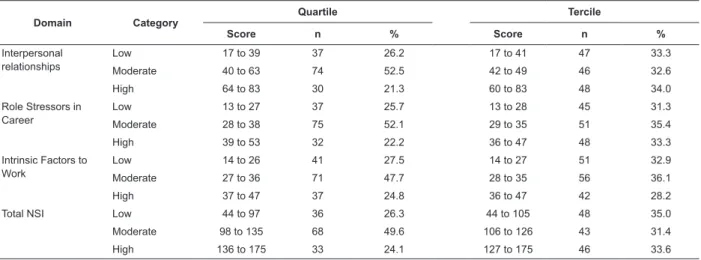
Table 2 – Distribution of nurses by domain of the NSI according to the categories low, moderate and high, Brazil,
2008
Domain Category
Quartile Tercile
Score n % Score n %
Interpersonal relationships
Low 17 to 39 37 26.2 17 to 41 47 33.3
Moderate 40 to 63 74 52.5 42 to 49 46 32.6
High 64 to 83 30 21.3 60 to 83 48 34.0
Role Stressors in Career
Low 13 to 27 37 25.7 13 to 28 45 31.3
Moderate 28 to 38 75 52.1 29 to 35 51 35.4
High 39 to 53 32 22.2 36 to 47 48 33.3
Intrinsic Factors to Work
Low 14 to 26 41 27.5 14 to 27 51 32.9
Moderate 27 to 36 71 47.7 28 to 35 56 36.1
High 37 to 47 37 24.8 36 to 47 42 28.2
Total NSI Low 44 to 97 36 26.3 44 to 105 48 35.0
Moderate 98 to 135 68 49.6 106 to 126 43 31.4
High 136 to 175 33 24.1 127 to 175 46 33.6
Interpersonal relationships: average 50.7; standard deviation 15.7 and median 50.0 Role Stressors in Career: average 32.5; standard deviation 8.2 and median 31.0 Intrinsic factors to career: average 31.2; standard deviation 6.8 and median 31.0 NSI total: average 114.8; standard deviation 26.6 and median 114.0
A total of 21.4% (quartile) and 34.0% (tercile)
scored high in the category Interpersonal Relationships;
22% (quartile) and 33.3% (tercile) scored high in the
category Role Stressors in Career; and 24.8% (quartile)
and 28.2% (tercile) scored high in the category Intrinsic
Factors to Work; 24.1% (quartile) and 33.6% (tercile)
of nurses in the studied sample scored high in the global
score (total NSI). The number of dimensions with high
scores for the categories Interpersonal Relationships,
Role Stressor in Career and Intrinsic Factors to Work was
computed and 8.03% (quartile) and 13.14% (tercile) of the nurses were identiied with high levels of stress in the three domains.
The intra and inter correlations among the
instruments’ domains (MBI and NSI) were tested and
Lorenz VR, Benatti MCC, Sabino MO.
Table 3 – Intra-domains correlations of the BMI, Brazil, 2008
Depersonalization Incompetence
n p r n P r
Emotional Exhaustion 142 <0.0001 0,60 142 <0.0001 - 0.47
Depersonalization - - - 139 <0.0001 - 0.36
n: nurses p: p-value
r: Spearman’s correlation coeficient
The MBI application indicated that the correlation
between Emotional Exhaustion and Depersonalization
was strong (0.60); the correlation between Emotional
Exhaustion and Incompetence was moderate and
inverse (-0.47); and between Depersonalization and
Incompetence, the correlation was also moderate and
inverse (-0.36).
Table 4 – Intra domains of the NSI, Brazil, 2008
Domains
Stressor Role in Career Intrinsic Factors to Work Total NSI
n p r n p r n p r
Interpersonal Relations 137 <0.0001 0.58 141 <0.0001 0.50 137 <0.0001 0.91
Stressor Role in Career - - - 144 <0.0001 0.72 137 <0.0001 0.86
Intrinsic Factors to Work - - - 137 <0.0001 0.78
n: nurses p: p-value
r: Spearman or Pearson correlation coeficient
The NSI application evidenced that the correlation
between the Role Stressors in Career and Intrinsic
Factors to Work was strong (0.72); between the Role
Stressors in Career and Interpersonal Relations was also
strong (0.58); and the correlation between Interpersonal
Relations and Intrinsic Factors to Work was moderate
(0.50). The correlations between total NSI and each of
the domains were strong.
Table 5 – Correlations between the inventories NSI and the MBI applied in nurses, Brazil, 2008
Domains
Interpersonal Relations
Role Stressors in Career
Intrinsic Factors to
work Total NSI
n p r n p R n p r n p r
Emotional Exhaustion 139 <0.0001 0.50 144 <0.0001 0.57 147 <0.0001 0.65 137 <0.0001 0.60
Depersonalization 136 0.0013 0.27 140 <0.0001 0.46 144 <0.0001 0.38 133 <0.0001 0.40
Incompetence 137 0.0410 -0.17 140 0.0005 -0.29 144 0.0025 -0.25 133 0.0014 -0.27
n: nurses p: p-value
r: Spearman or Pearson correlation coeficient
The correlations between the do mains MBI and NSI
were strong between Emotional Exhaustion and Intrinsic
Factors to Work (0.65), and moderate between Emotional
Exhaustion and the Stressor Role in Career (0.57) and
between Emotional Exhaustion and total NSI (0.60).
Moderate correlations were found between Emotional
Exhaustion and Interpersonal Relations (0.50); between
Depersonalization and the Role Stressors in Career
(0.46); between Depersonalization and Intrinsic Factors
to Work (0.38); and between Depersonalization and
total NSI (0.40).
Discussion
The MBI analysis compared this study’s averages
to those of the original(6,11), and increased Emotional
Exhaustion and Depersonalization as well as diminished
Competence were observed in the studied sample.
The MBI application evidenced three dimensions that
suggested Burnout in 7.3% (quartile) and 10.2% (tercile)
of the sample. The application of the NSI revealed high
levels of stress in the three domains 8.03% (quartile)
Rev. Latino-Am. Enfermagem 2010 Nov-Dec;18(6):1084-91.
www.eerp.usp.br/rlae
service management and the Worker Health service to
investigate epidemiological evidence(10). The obtained
results reinforce the assertion that psychosocial stressors
are as potent as microorganisms and insalubrities in the
onset of diseases. Hence, a tense and unsatisfactory
work atmosphere coupled with long work hours result in
stress factors(19), which reinforce the view that nursing
is a very stressful profession, given the results obtained
in this study(16).
Strong and positive MBI intra-domains correlations were veriied between Emotional Exhaustion and Depersonalization, suggesting that nurses who obtain
high scores in one of these domains will likely obtain
high scores in the other(6). Testing the NSI
intra-domain correlations revealed positive correlations in all the factors, which conirm the existence of a global factor(12).
Suffering experienced by nurses in intensive care
units is related to the care these professionals provide
to critical patients, problems they take home, the need
to deal with patients’ family members, teamwork, lack
of acknowledgment and work-related technology(20),
which may explain the strong correlations found in
this study among the MBI (EE, D and I) and NSI
(RSC and IWF) domains. These correlations refer us
to the psychodynamics and Psychopathology of labor,
analytical aspects of which encompass the dynamics of
psychological processes mobilized by the confrontation
of the individual with the reality of work based on the
categories of the analysis of work organization and
mental suffering(21). It highlights the importance of
deeply investigating nursing work organization in the
context of hospitals to diminish Burnout levels.
Qualities in the environment of health facilities
such as autonomy, control over the environment, and
work relationships among physicians and nurses favor
good nursing practices(22). In this context, the strong
correlations found in this study between the MBI (EE,
D, I) and NSI (RSC and IWF) domains demonstrate the
importance of managing issues related to Role Stressors
in Career and Intrinsic Factors to Work to minimize
suffering that accrues from Burnout in nurses. Nursing
management can, through knowledge concerning its
team, promote organizational and educational actions
to improve the workers’ quality of life(23).
Emotional Exhaustion displayed a moderate
correlation with Interpersonal Relations in this study. A
recent study carried out with workers from the Family
Health Strategy revealed that interpersonal relationships
were determining factors for non-exhausted workers
to cope with occupational stress, develop motivation
at work, and deal with problems. For the exhausted
workers, on the other hand, interpersonal relationships
were a source of suffering and exhaustion at work(24). As veriied in this study, hospital nurses experience
high levels of stress and as perceived stress increased,
the MBI dimensions also increased. When the stressing
event is of a long duration, the consequences on the
body can also be more intense and lead to progressive
weariness and exhaustion(25). While stress can present
positive and negative aspects, Burnout always has a
negative character(3), which harms the worker, manager
and citizen, hence the importance of acknowledging,
preventing, treating and reporting Burnout.
Conclusion
The collective approach, within the limits of the
Maslach Burnout Inventory and the Nurses’ Stress
Inventory, indicated Burnout (work related) in 7.30%
(quartile) and 10.22% (tercile) of the nurses, whose
scores were high in all the BMI domains. High levels of
stress were also seen in 8.03% (quartile) and 13.14%
(tercile) of nurses, whose scores were high in all the NSI
domains.
The conclusion is that nurses are vulnerable to
being affected by Burnout due to stress experienced
in the hospital environment. In this study, Emotional
Exhaustion showed a strong correlation with Intrinsic
Factors to Work (0.65), as with the Role Stressors
in Career (0.57); and a moderate correlation with
Interpersonal Relations (0.50). Depersonalization showed
a moderate correlation with the Stressor Role in Career
(0.46) and with Intrinsic Factors to Work (0.38) and a
weak correlation with Interpersonal Relations (0.27).
Incompetence presented an inverse weak correlation
with Stressor Role in Career (-0.29), Intrinsic Factors to
work (-0.27) and Interpersonal Relations (-0.17).
Finally, psychological and cognitive overload should
be taken into account in the evaluation of workload in
the work environment of health facilities, which would
represent a leap forward in the investigation of risk in
nursing practice, especially in highly complex university
Lorenz VR, Benatti MCC, Sabino MO.
References
1. Dejours C, Abdoucheli E, Jayet C. Psicodinâmica do Trabalho: Contribuições da Escola Dejouriana à Análise da Relação Prazer, Sofrimento e Trabalho. São Paulo: Atlas; 2009.145 p.
2. Dejours C. A loucura do trabalho: estudo de psicopatologia do trabalho. São Paulo (SP): Cortez-Oboré; 1988.
3. Benevides-Pereira AMT, organizador. Burnout: Quando o trabalho ameaça o bem estar do trabalhador. São Paulo (SP): Casa do Psicólogo; 2002.
4. Carlotto MS, Palazzo LS. Síndrome de burnout e fatores associados: um estudo epidemiológico com professores. Cad Saúde Pública. 2006; 22(5):1017-26.
5. Murofuse NT, Abranches SS, Napoleão AA. Reflections on stress and burnout and their relayionship with nursing. Rev. Latino-Am. Enfermagem. 2005;13(2):255-61.
6. Lautert L. O desgaste profissional do enfermeiro [tese de doutorado]. Salamanca: Universidad Pontificia de Salamanca; 1995.
7. Assembléia Nacional Constituinte (BR). 05/10/1988. Constituição da República Federativa do Brasil. Brasília; 1988. 8. Lei nº 8.080/90 (BR). Dispõe sobre as condições para a promoção, proteção e recuperação da saúde, a organização e o funcionamento dos serviços correspondentes e dá outras providências. Brasília: Congresso-Nacional; 1990.
9. Brasil. Presidência da República. Decreto nº 3.048, de 06 de maio de 1999. Aprova o Regulamento da Previdência Social, e dá outras providências. Anexo II. Lista B. Grupo V da CID-10. [internet]. Página eletrônica da Presidência da República. [acesso; 12 abril 2009]. Disponível em: http://www.planalto. gov.br/ccivil_03/decreto/d3048compilado.htm; 1999.
10. Ministério da Previdência e Assistência Social (BR). Instituto Nacional do Seguro Social. Diretoria Colegiada. Resolução nº 10, de 23/12/1999. Aprova os Protocolos Médicos, com alterações realizadas pela Coordenação Geral de Benefícios por Incapacidade da Diretoria de Benefícios e dá outras providências. Protocolo de Procedimentos Médico-Periciais nº 5. XII. Doença: Sensação de estar acabado (“Síndrome de Burn-Out”, Síndrome do Esgotamento Profissional”). Código CID-10: Z73.0. Diário Oficial da União, 20 abril 2000, Seção 1; 1999. p. 60-1. 11. Lautert L. O desgaste profissional: estudo empírico com enfermeiras que trabalham em hospitais. Rev Gaúch Enferm. 1997;18(2):133-44.
12. Stacciarini JMR, Tróccoli BT. An instrument to measure occupational stress: a nurses’ stress inventory. Rev. Latino-Am. Enfermagem. 2000; 8(6):40-9.
13. Schaufeli WB, Van Dierendonck D. A cautionary note about the cross-national and clinical validity of cut-off points for the Maslach Burnout Inventory. Psychol Rep. 1995; 76(3 Pt 2):1083-90.
14. Schaufeli WB, Bakker AB, Hoogduin K, Schaap C, Kladler A. On the clinical validity of the maslach burnout inventory and the burnout measure. Psychol Health. 2001; 16(5):565-82. 15. Pera G, Serra-Prat M. Prevalencia del síndrome del quemado y estudio de los factores asociados en los trabajadores de un hospital comarcal. Gaceta Sanit. 2002; 16:480-6.
16. Stacciarini JMR, Tróccoli BT. The stress in nursing profession. Rev. Latino-Am. Enfermagem. 2001; 9(2):17-25.
17. Bowling A. Measuring disease: a review of disease specific quality of life measurements scales. Philadelphia: Open University Press; 1977.
18. Ajzen I, Fishbein M. Understanding Attitudes and Predicting Social Behaviour. Englewood Cliffs, New Jersey: Prentice Hall; 1980.
19. Fonseca AM, Soares E. Desgaste emocional: depoimentos de enfermeiros que atuam em ambiente de hospital. Rev Rede Enferm Nordeste. 2006; 7:91-7.
20. Martins JT, Robazzi MLCC. Nurses’ work in intensive care units: feelings of suffering. Rev. Latino-Am. Enfermagem [serial on the Internet]. 2009 Feb [acesso: 22 ago 2010];17(1):52-8. Disponível em: http://www.scielo.br/scielo.php?script=sci_ arttext&pid=S0104-11692009000100009&lng=en. doi: 10.1590/S0104-11692009000100009.
21. Fernandes JD, Melo CMM, Gusmão MCCM, Fernandes J, Guimarães A. Saúde mental e trabalho: significados e limites de modelos teóricos. Rev. Latino-Am. Enfermagem. [seriado na Internet]. 2006 Oct [acesso: 22 ago 2010];14(5):803-11. Disponível em: http://www.scielo.br/scielo.php?script=sci_ arttext&pid=S0104-11692006000500024&lng=en. doi: 10.1590/S0104-11692006000500024.
22. Aiken LH, Patrician PA. Measuring organization traits of hospitals: the Revised Nursing Work Index. Nurs Res. 2000; 49(3):146-53.
23. Batista JM, CMCM, Ayres JA. Retraining due to illness ant its implications in nursing management. Rev. Latino-Am. Enfermagem. [online]. jan-fev 2010 [acesso: 13 ago. 2010]; 18(1):[7 telas]. Disponível em: http://www.scielo.br/pdf/rlae/ v18n1/14.pdf.
24. Trindade LL, Lautert L, Beck CLC. Coping mechanisms used by non-burned out and burned out workers in the family health strategy. Rev. Latino-Am. Enfermagem. [seriado na Internet]. 2009 Oct [acesso: 22 ago 2010];17(5):607-12. Disponível em: http://www.scielo.br/scielo.php?script=sci_arttext&pid=S0104-11692009000500002&lng=en. doi: 10.1590/S0104-11692009000500002.
25. Camelo SHH, Angerami ELS. Riscos psicossociais no trabalho que podem levar ao estresse: uma análise da literatura. Cienc Cuidado Saude. 2008; 7(2): 232-40.