www.reumatologia.com.br
REVISTA BRASILEIRA DE
REUMATOLOGIA
Original article
Periodontitis exposure within one year before anti-diabetic
treatment and the risk of rheumatoid arthritis in
diabetes
mellitus
patients: a population-based cohort study
Hsin-Hua Chen
a,b,c,d,e, Der-Yuan Chen
a,b,c,e,f, Shih-Yi Lin
b,g, Kuo-Lung Lai
a,b, Yi-Ming Chen
a,b,
Yiing-Jenq Chou
b,d, Pesus Chou
b,d,
Ching-Heng Lin
f,
Nicole Huang
b,d,h,i,*
a Division of Allergy, Immunology and Rheumatology, Department of Internal Medicine, Taichung Veterans General Hospital, Taichung, Taiwan b School of Medicine, National Yang-Ming University, Taipei, Taiwan
c School of Medicine, Chung-Shan Medical University, Taichung, Taiwan
d Institute of Public Health and Community Medicine Research Center, National Yang-Ming University, Taiwan e Institute of Biomedical Science, Chung-Hsing University, Taichung, Taiwan
f Department of Medical Education and Research, Taichung Veterans General Hospital, Taichung, Taiwan
g Division of Endocrinology and Metabolism, Department of Internal Medicine, Taichung Veterans General Hospital, Taichung, Taiwan h Institute of Hospital and Health Care Administration, National Yang Ming University, Taipei, Taiwan
i Department of Education and Research, Taipei City Hospital, Taipei, Taiwan
a r t i c l e i n f o
Article history:
Received 15 August 2013 Accepted 7 October 2013
Keywords:
Diabetes mellitus
Periodontitis Rheumatoid arthritis Risk
Administrative database
a b s t r a c t
Objective: To examine whether a history of periodontitis (PD) before anti-diabetic treatment
is associated with risk of rheumatoid arthritis (RA) development in newly-treated diabetes
mellitus (DM) patients.
Methods: We conducted a population-based retrospective cohort study using the 1997-2009
National Health Insurance (NHI) claims data of one million representative individuals from all NHI enrollees. Adults with DM (aged ≥20 years) starting anti-diabetic treatment during 2001–2009 were classiied as newly-treated DM patients. We identiied 7097 DM subjects with PD history within one year before initiating anti-diabetes treatment (index date). By matching these 7097 subjects for age on the index date, sex, and year of the index date, we randomly extracted 14,194 DM subjects without PD history within one year before anti-diabetic treatment. Adjusted hazard ratios (aHRs) with a 95% conidence interval (CI) were calculated by applying Cox proportional hazards models to quantify the association be-tween PD history and RA risk.
Results: Compared with DM patients without PD exposure within one year before anti-diabetic
treatment, crude HR and adjusted HR of RA among DM patients with PD exposure within one year before anti-diabetic treatment were 4.51 (95% CI, 1.39–14.64) and 3.77 (95% CI, 1.48–9.60).
Conclusion: PD exposure within one year before anti-diabetic treatment was associated with
increased RA risk in newly treated DM patients. The lack of knowledge about individual smoking status is a major limitation of this study.
© 2014 Elsevier Editora Ltda. All rights reserved.
* Corresponding author.
E-mail: [email protected] (N. Huang).
Exposição à periodontite no intervalo de um ano antes do tratamento antidiabético e risco de artrite reumatoide em pacientes com diabete mellitus: estudo de coorte populacional
Palavras-chave:
Diabetes melittus
Periodontite Artrite reumatoide Risco
Banco de dados administrativos
r e s u m o
Objetivo: Examinar se uma história de periodontite (PD) antes do tratamento antidiabético
está associada a risco de ocorrência de artrite reumatoide (AR) em pacientes com diabetes
melittus (DM) tratados de novo.
Métodos: Fizemos um estudo retrospectivo populacional com os dados de reivindicações do
National Health Insurance (NHI) de 1997-2009 referentes a um milhão de indivíduos
represen-tativos da totalidade de matriculados. Adultos com DM (≥ 20 anos) que iniciaram o trata-mento antidiabético durante 2001-2009 foram classiicados como pacientes DM tratados de novo. Identiicamos 7.097 indivíduos DM com história de PD em um intervalo de um ano an-tes do tratamento antidiabético (data-índice). Na equiparação desses 7.097 indivíduos para idade por ocasião da data-índice, gênero e ano da data-índice, extraímos aleatoriamente 14.194 pacientes DM sem história de PD em um intervalo de um ano antes do tratamento antidiabético. As razões de risco ajustadas (aRR) com um intervalo de coniança (IC) de 95% foram calculadas mediante a aplicação do modelo de riscos proporcionais de Cox com o objetivo de quantiicar a associação entre história de PD e risco de AR.
Resultados: Em comparação com pacientes DM sem exposição à PD no intervalo de um ano
antes do tratamento antidiabético, RR bruta e RR ajustada para AR entre pacientes DM e com exposição à PD no intervalo de um ano antes do tratamento antidiabético foram, res-pectivamente, 4,51 (IC 95%, 1,39-14,64) e 3,77 (IC 95%, 1,48-9,60).
Conclusão: A exposição à PD no intervalo de um ano antes do tratamento antidiabético foi
associada a maior risco de AR em pacientes DM tratados de novo. A ausência do status de tabagismo em nível individual é importante limitação desse estudo.
© 2014 Elsevier Editora Ltda. Todos os direitos reservados.
Introduction
Rheumatoid arthritis (RA) is a systemic inlammatory dis-ease characterized by chronic synovial inlammation with periarticular osteoporosis and bone erosion, associated with an increased risk of cardiovascular disease comparable to that of diabetes mellitus (DM).1 Although the exact etiology
is still unknown, the interaction between environmental fac-tors and genetic facfac-tors has been found to play a role in RA pathogenesis.2 Smoking is a well-known risk factor,3-10 and
recently periodontitis (PD) has emerged as another environ-mental risk factor for RA.11,12 PD is a common chronic,
mi-crobially triggered an inlammatory disorder that causes an irreversible loss of the supporting tooth structures, and may ultimately lead to tooth loss.13 It affects approximately half of
the population aged ≥ 30 years in the United States.14,15 One
of the major PD-related pathogens, Porphyromonas gingivalis (P.
gingivalis), is the only microorganism that produces
peptidy-larginine deiminase, which may cause citrullination.16 In
ge-netically susceptible individuals, the breakdown of immune tolerance to citrullinated peptides may lead to the production of anti-cyclic citrullinated peptide (anti-CCP) antibodies, as-sociated with RA development.17 The presence of P. gingivalis
DNA in the serum and synovial luid and a strong correlation between the presence of anti-CCP antibodies and the pres-ence of PD in RA patients support this hypothesis.18-20
In recent years, increasing evidence has indicated a bidi-rectional association between DM and PD.21,22 PD is associated
with increased incident DM risk, poor glycemic control, and DM complications,23-26 probably due to the higher levels of
systemic proinlammatory mediators that exacerbate insu-lin resistance.22 A number of observational studies also show
a greater prevalence, severity, extent, or progression of one or more PD indicators in DM patients, with type 1, type 2, or gestational diabetes, as compared to those in non-DM sub-jects.27-35
Hyperglycemia has been found to modify PD expression,36
by interfering with the host response and causing an exces-sive inlammatory response to infection,37,38 as well as by the
interaction of the receptor for advanced glycation end prod-ucts (RAGE) with its ligands in gingiva.22,36,39 Several previous
studies have shown that DM patients have defective neutro-phil function,40-42 which may lead to impaired clearance of
P. gingivalis, the major periodontal bacterium related to RA
pathogenesis.17 In diabetic mice, inoculation with P.
gingiva-lis leads to prolonged and exaggerated systemic cytokine ex-pression and inlammatory iniltrates in a model of calvarial infection.37,38 Hence, we hypothesize that the prolonged
chal-lenge presented by the oral bacteria as a result of the defective host response, together with the exaggerated and sustained inlammatory response to the bacteria, may cause more se-vere PD in DM subjects than in non-DM subjects with PD. Re-cent studies show a dose-dependent association between PD exposure and RA risk.11,12 Because hyperglycemia is present
for some time before commencing anti-diabetic treatment in DM patients,43 we hypothesize that among newly-treated DM
anti-diabetic treatment may have a higher risk of RA develop-ment than those without PD exposure within one year before anti-diabetic treatment.
To the best of our knowledge, no population-based co-hort study has examined whether RA risk differs between newly-treated adults with and without a history of PD before anti-diabetic treatment. Recently, the Taiwanese National Health Insurance Research Database (NHIRD) had facilitated population-based longitudinal studies. We therefore took advantage of this resource to conduct this cohort study to estimate the hazard ratios (HRs) for the as-sociation between PD history and RA development in new-ly-treated DM patients.
Methods
Data source
The source of data was the NHIRD, which covered claims of ambulatory care, inpatient services and dental services, and prescriptions during 1997-2009. In March 1995, the National Health Insurance (NHI) program was implemented, and it has since covered more than 98% of the population. The National Health Research Institute, which manages the NHIRD, has released comprehensive NHI-related administrative claims data for research. In 2000, the NHIRD randomly selected one million participants to form a representative database for study purposes. Here we used one million representative subjects from the multiple datasets of the NHIRD: ambula-tory and inpatient claims iles, enrollment iles, and the NHI catastrophic illness iles, all from 1997-2009. The NHI cata-strophic illness iles were established to track patients with major or catastrophic illnesses, including cancer, end-stage renal disease, mental illness, congenital illness, and several autoimmune diseases, including RA. The Bureau of National Health Insurance (BNHI) routinely reviews the original medi-cal charts of all patients who applied for catastrophic illness registration to validate the diagnoses. The American College of Rheumatology classiication criteria for RA (1987) was used to validate RA diagnosis for the period 1997–2009.44 The
ambulatory and inpatient iles include information on date of visit/admission, diagnoses, examinations, procedures, and medical expenses. The enrollment iles provide enroll-ment and demographic information. Although the dataset lacked laboratory and radiographic data, the BNHI periodi-cally audited the accuracy of diagnoses by randomly sam-pling patient charts to check claims.45 The Ethics Committee
of Clinical Research at Taichung Veterans General Hospital approved this study.
Study samples
DM subjects
In this retrospective cohort study, we identiied patients who had at least one diagnosis of DM [International Classiication of Diseases, 9th Revision, Clinical Modiication (ICD9-CM) code
250×] with concurrent prescription of any anti-diabetes medi-cation for more than 28 days after January 1, 2001 and classi-ied these as DM subjects.
Subjects with and without PD history
In Taiwan, BNHI covers the cost of dental scaling a maximum of twice per year for each individual, with the aim of improv-ing dental health. For these patients, dentists may perform scaling for these people with a concurrent PD coding (ICD9-CM codes 523.3–5). Therefore, we deined PD exposure as hav-ing a diagnosis of PD (ICD9-CM codes 523.3–5) together with concurrent antibiotic therapy, or with periodontal treatment other than dental scaling by certiied dentists. PD history was deined as having PD during the one year before the index date. Patients who had not been diagnosed with periodontal disease (ICD9-CM Codes 523×) within one year before the in-dex date were classiied as patients with no PD history.
Exclusion criteria
All individuals diagnosed with RA (ICD9-CM code 714.0) be-fore the index date or aged younger than 20 years on the in-dex date were excluded.
Matched study subjects
The irst date of anti-diabetic treatment was deined as the index date. First, we identiied a total of 7097 DM subjects with PD history. To match these DM subjects with PD history in terms of age on the index date (i.e., 20–34, 35–49, 50–64, ≥ 65 years), sex, and the year of the index date, we randomly selected 14,194 DM subjects with no PD history.
Outcome variable
Patients who had ambulatory visits coded for RA (ICD9-CM Code 714.0) and certiicates of the catastrophic illness for RA were classiied as RA cases. The outcome variable was the time (in years) from the index date to the date of their irst ambulatory care visit with a concurrent RA diagnosis. If the study subjects withdrew from the Taiwanese NHI system for any reason, such as death or moving away, the date of with-drawal was selected as the censored date, otherwise the last date of the dataset (December 31, 2009) was used.
Potential confounders
The study included the insurable wage and urbanization level of the study subjects as potential confounders. In Taiwan, the insurable wage was calculated from the average monthly in-come of the participants, which served as an economic index. If the insurable earnings of the subject was zero, the insur-able wage was treated as dependence. The insurinsur-able wage was converted from new Taiwan dollars (TWD) to USD using a conversion rate of 30 TWD to 1 USD. The insurable wage was transferred to ordinal variables (i.e., dependence, 1–700 USD and > 700 USD). We selected 700 USD as the cut-off value for insurable wage because it was the median of the insurable wages among subjects whose insurable earnings were not zero. Based on the previously stratiied seven clusters [from level 1 (most urbanized) to level 7 (least urbanized), in Tai-wan,46 the urbanization level was converted into 3 levels:
ur-ban (levels 1–2), suburur-ban (levels 3–4), and rural (levels 5–7).
Statistical analysis
Fisher’s exact test for categorical variables. Adjusting for age, sex, insurable wage and urbanization level of subjects, Cox proportional regression analysis was used to estimate inci-dent RA risk associated with PD history, as shown by adjusted hazard ratios (HRs) with 95% conidence intervals (CIs). A two-tailed P-value of < 0.05 was considered statistically signiicant. All statistical calculations were performed using SPSS version 18.0 for Windows (SPSS, Inc., Chicago, IL).
Sensitivity analysis
We conducted lag analyses by advancing the RA diagnosis date by 3 months, 6 months, and 1 year and examined the potential impact of insidious RA onset. We then repeated the Cox proportional regression analyses after exclud-ing those whose follow-up time was less than 3 months, 6 months, or 1 year, and subtracting the follow-up time by 3 months, 6 months and 1 year respectively, as the revised follow-up time.
Results
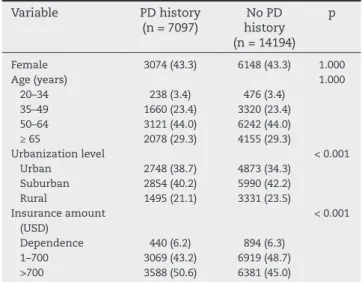
A total of 21,291 DM subjects were followed for a median (interquartile range) of 3.4 (1.5, 5.9) years; of these, 19 sub-jects developed incident RA. The demographic and clinical data according to PD history are shown in Table 1. The mean patient age ± SD was 57.5 ± 12.8 years and women comprised 43.3% of all study subjects.
Among the 7,097 DM subjects with a history of PD ex-posure within one year before the index date, 12 subjects developed RA after 26,910 person/years of follow-up and the incidence was 44.6 cases per 105 person/years. Among
the 14,194 DM subjects without PD history, 7 subjects de-veloped RA after. From 54,002 person/years of follow-up, the incidence was 13 cases per 100,000 person/years. Com-pared with subjects without PD history, the crude HR of in-cident RA among those with PD history was 4.51 (95% CI 1.39–14.64). As shown in Table 2, after adjusting for age, sex, insurable wage, and urbanization level of the subjects, the adjusted HR (aHR) of RA associated PD history remained statistically signiicant (aHR, 3.77; 95% CI 1.48–9.60). The survival curve for incident RA among DM individuals is shown in Figure 1.
Table 3 shows the results of sensitivity analyses conduct-ed by varying the lag time of RA diagnosis considering the insidious RA onset. The association between PD history and RA risk remained statistically signiicant after varying the lag time.
Discussion
This study is the irst population-based cohort study to use administrative data to examine the strength of the associa-tion between PD history within one year before anti-diabetic treatment and RA risk in newly-treated DM patients. This study focuses on PD exposure history within one year before anti-diabetic treatment because we hypothesize that hy-perglycemia may exist during this period, and thus interact
Table 1 – Comparison of demographic data for patients based on periodontitis (PD) history within one year before the index date in newly-treated diabetic patients.
Variable PD history (n = 7097)
No PD history (n = 14194)
p
Female 3074 (43.3) 6148 (43.3) 1.000
Age (years) 1.000
20–34 238 (3.4) 476 (3.4)
35–49 1660 (23.4) 3320 (23.4)
50–64 3121 (44.0) 6242 (44.0)
≥ 65 2078 (29.3) 4155 (29.3)
Urbanization level < 0.001
Urban 2748 (38.7) 4873 (34.3)
Suburban 2854 (40.2) 5990 (42.2)
Rural 1495 (21.1) 3331 (23.5)
Insurance amount (USD)
< 0.001
Dependence 440 (6.2) 894 (6.3)
1–700 3069 (43.2) 6919 (48.7)
>700 3588 (50.6) 6381 (45.0)
RA, rheumatoid arthritis; DM, diabetes mellitus; PD history, a history of periodontitis within one year before anti-diabetic treatment.
Table 2 – Adjusted hazard ratios (HRs) with 95% conidence intervals (CIs) of RA risk associated with variables in newly-treated DM patients.
Variável HR (95% CI) p value
A history of PD 3.77 (1.48–9.60) 0.006
Female 6.04 (1.73–21.05) 0.005
Age, incremental year 1.04 (1.00–1.08) 0.085 Urbanization level
Urban Reference
-Suburban 1.34 (0.44–4.14) 0.608
Rural 1.67 (0.50–5.54) 0.405
Insurable wage (USD)
Dependence Reference
-1–700 3.35 (0.43–26.00) 0.248
> 700 1.43 (0.13–15.33) 0.767
RA, rheumatoid arthritis; DM, dabetes mellitus; PD, periodontitis; USD, United States dollar.
with PD to drive an increased RA risk. The main inding of our study is that the association between PD history and RA development is statistically signiicant among newly treated DM individuals. In addition, if the lag time of RA diagnosis is considered, this association became stronger.
The results of this cohort study further supports the the-ory that PD histthe-ory is associated to RA development, which was also suggested by the results of two recent case–con-trol studies.11,12 However, the results of another large cohort
study on American women indicated that PD was not asso-ciated with RA risk.47 Of note, DM status was not taken into
account in this previous cohort study, and no male subjects were included.47
internal validity, this study matched study subjects with re-garding age, sex, and the year of the index date, and fur-ther adjusted potential confounders including the insurable wage and urbanization level of subjects. However, a num-ber of limitations must be considered. First, the accuracy of diagnoses in administrative data is an area of concern. Bias due to misclassii cation or miscoding of PD and RA can still occur despite regular audit of the quality of claims car-ried out by periodically sampling patient charts, which is randomly performed by the BNHI. However, the accuracy of RA diagnosis is of less concern, because the issue of a cata-strophic illness certii cate for RA diagnosis requires valida-tion by at least two qualii ed rheumatologists and involves checking the medical charts, radiographic i ndings, and lab-oratory data. In addition, the inclusion of periodontal treat-ment in the diagnostic criteria of PD also helps increase
the accuracy of diagnoses. Moreover, the non-differential misclassii cation of RA and PD diagnoses would have bi-ased the results towards the null. Second, use of the NHIRD precluded further adjustment of unmeasured potential con-founders, such as serum glucose level, glycated hemoglobin, anti-CCP antibodies, HLA-DRB1, and smoking status of sub-jects. Third, the small number of incident RA cases limits the number of covariates for adjustment. Finally, the results of this population-based study in Taiwan might not be used to generalize other ethnic populations.
Conclusion
This nonselective, population-based cohort study indicates that PD history within one year before anti-diabetic treat-ment is associated with increased RA risk in newly treated DM patients. Further clinical and basic studies need to be performed to elucidate whether the degree of hyperglycemia interacts with RA risk associated with PD exposure.
Authors' contributions
Dr Hsin-Hua Chen had full access to all data in the study and takes responsibility for the integrity of the data and the ac-curacy of the data analysis.
Study concept and design: Hsin-Hua Chen, Der-Yuan Chen, Nicole Huang, Pesus Chou.
Data acquisition: Hsin-Hua Chen, Ching-Heng Lin. Data analysis and interpretation: Hsin-Hua Chen, Der-Yu-an Chen, Shih-Yi Lin, Nicole HuDer-Yu-ang, Pesus Chou.
Drafting of the manuscript: Hsin-Hua Chen, Yi-Ming Chen, Kuo-Lung Lai.
Critical revision of the manuscript for important intellec-tual content: Der-Yuan Chen, Nicole Huang, Shih-Yi Lin.
Statistical analysis: Hsin-Hua Chen, Ching-Heng Lin.
Funding
This study was supported by grant TCVGH-1023805C from Tai-chung Veterans General Hospital, Taiwan.
Confl icts of interests
The authors declare no conl ict of interest.
Acknowledgements
We would like to thank the Biostatistics Task Force of Taichung Veterans General Hospital, Taichung, Taiwan, ROC, for assis-tance with statistical analysis. We thank the members of the Bureau of National Health Insurance, Department of Health, and the National Health Research Institutes for providing and managing the National Health Insurance Research Database. This study was supported by grant TCVGH-1023805C from Tai-chung Veterans General Hospital, Taiwan.
Fig. 1 – Free of incident rheumatoid arthritis rates among subjects with diabetes mellitus stratii ed by periodontitis history.
F
re
e
o
f
rh
e
u
m
a
to
id
a
rth
ri
ti
s
r
a
te
Time (year)
History of periodontitis
No 1.0000
0.9995
0.9990
0.9985
0.9980
0 2 4 6 8
Yes
Table 3 – Sensitivity analyses for RA risk associated with PD history by varying the lag time of RA diagnosis, as shown by adjusted hazard ratios (HRs) with 95% (CIs).
Lag time PD history No PD history
HR (95% CI)
n, RA/total (%)
n, RA/total (%)
No lag time 12/7097 (0.17) 7/14194 (0.05) 3.77 (1.48–9.60) 3 months 12/6801 (0.18) 5/13654 (0.04) 5.31 (1.86–15.14) 6 months 11/6529 (0.17) 5/13034 (0.04) 4.86 (1.68–14.08) 1 year 9/5918 (0.15) 4/11835 (0.03) 5.12 (1.57–16.74)
RA, rheumatoid arthritis; DM, diabetes mellitus; PD, periodontitis; PD history, a history of periodontitis within one year before anti-diabetic treatment.
R E F E R E N C E S
1. Lindhardsen J, Ahlehoff O, Gislason GH, Madsen OR, Olesen JB, Torp-Pedersen C et al. The risk of myocardial infarction in rheumatoid arthritis and diabetes mellitus: a Danish nationwide cohort study. Ann Rheum Dis. 2011;70:929-34. 2. Klareskog L, Padyukov L, Lorentzen J, Alfredsson L.
Mechanisms of disease: Genetic susceptibility and environmental triggers in the development of rheumatoid arthritis. Nat Clin Prac Rheumatol. 2006;2:425-33.
3. Vessey MP, Villard-Mackintosh L, Yeates D. Oral contraceptives, cigarette smoking and other factors in relation to arthritis. Contraception. 1987;35:457-64. 4. Silman AJ, Newman J, MacGregor AJ. Cigarette smoking
increases the risk of rheumatoid arthritis. Results from a nationwide study of disease-discordant twins. Arthritis Rheum 1996;39:732-5.
5. Karlson EW, Lee IM, Cook NR, Manson JE, Buring JE, Hennekens CH. A retrospective cohort study of cigarette smoking and risk of rheumatoid arthritis in female health professionals. Arthritis Rheum 1999;42:910-7.
6. Stolt P, Bengtsson C, Nordmark B, Lindblad S, Lundberg I, Klareskog L et al. Quantiication of the inluence of cigarette smoking on rheumatoid arthritis: results from a population based case-control study, using incident cases. Ann Rheum Dis 2003;62:835-41.
7. Costenbader KH, Feskanich D, Mandl LA, Karlson EW. Smoking intensity, duration, and cessation, and the risk of rheumatoid arthritis in women. Am J Med. 2006;119:503e1-9.
8. Criswell LA, Saag KG, Mikuls TR, Cerhan JR, Merlino LA, Lum RF, et al. Smoking interacts with genetic risk factors in the development of rheumatoid arthritis among older Caucasian women. Ann Rheum Dis. 2006;65:1163-7. 9. Majka DS, Holers VM. Cigarette smoking and the risk of
systemic lupus erythematosus and rheumatoid arthritis. Ann Rheum Dis. 2006;65:561-3.
10. Christensen AF, Lindegaard HM, Junker P. [Smoking--a risk factor for rheumatoid arthritis development]. Ugeskr Laeger. 2008;170:2864-9.
11. Potikuri D, Dannana KC, Kanchinadam S, Agrawal S, Kancharla A, Rajasekhar L, et al. Periodontal disease is signiicantly higher in non-smoking treatment-naive rheumatoid arthritis patients: results from a case-control study. Ann Rheum Dis. 2012;71:1541-4.
12. Chen HH, Huang N, Chen YM, Chen TJ, Chou P, Lee YL, et al. Association between a history of periodontitis and the risk of rheumatoid arthritis: a nationwide, population-based, case-control study. Ann Rheum Dis. 2013;72:1206-11. 13. Pihlstrom BL, Michalowicz BS, Johnson NW. Periodontal
diseases. Lancet. 2005;366:1809-20.
14. Eke PI, Dye BA, Wei L, Thornton-Evans GO, Genco RJ. Prevalence of periodontitis in adults in the United States: 2009 and 2010. J Dent Res. 2012;91:914-20.
15. Albandar JM. Underestimation of periodontitis in NHANES surveys. J Periodontol. 2011;82:337-41.
16. McGraw WT, Potempa J, Farley D, Travis J. Puriication, characterization, and sequence analysis of a potential virulence factor from Porphyromonas gingivalis,
peptidylarginine deiminase. Infect Immun. 1999;67:3248-56. 17. Rosenstein ED, Greenwald RA, Kushner LJ, Weissmann G.
Hypothesis: the humoral immune response to oral bacteria provides a stimulus for the development of rheumatoid arthritis. Inlammation. 2004;28:311-8.
18. Martinez-Martinez RE, Abud-Mendoza C, Patino-Marin N, Rizo-Rodriguez JC, Little JW, Loyola-Rodriguez JP. Detection of periodontal bacterial DNA in serum and synovial luid
in refractory rheumatoid arthritis patients. J Clin Periodontol. 2009;36:1004-10.
19. Moen K, Brun JG, Valen M, Skartveit L, Eribe EK, Olsen I, et al. Synovial inlammation in active rheumatoid arthritis and psoriatic arthritis facilitates trapping of a variety of oral bacterial DNAs. Clin Exp Rheumatol. 2006;24:656-63. 20. Molitor JA, Alonso A, Wener MH, Michalowicz BS, Beck J,
Gersuk VH, et al. Moderate to severe adult periodontitis increases risk of rheumatoid arthritis in non-smokers and is associated with elevated ACPA titers: The ARIC study. Arthritis Rheum. 2009;60(Suppl10):S433.
21. Hampton T. Studies probe oral health-diabetes link. JAMA 2008; 300(21):2471-3.
22. Lalla E, Papapanou PN. Diabetes mellitus and periodontitis: a tale of two common interrelated diseases. Nat Rev Endocrinol. 2011;7:738-48.
23. Demmer RT, Jacobs DR, Jr., Desvarieux M. Periodontal disease and incident type 2 diabetes: results from the First National Health and Nutrition Examination Survey and its epidemiologic follow-up study. Diabetes care. 2008;31:1373-1379.
24. Thorstensson H, Kuylenstierna J, Hugoson A. Medical status and complications in relation to periodontal disease experience in insulin-dependent diabetics. J Clin Periodontol. 1996;23(3 Pt 1):194-202.
25. Saremi A, Nelson RG, Tulloch-Reid M, Hanson RL, Sievers ML, Taylor GW et al. Periodontal disease and mortality in type 2 diabetes. Diabetes Care. 2005;28:27-32.
26. Taylor GW, Burt BA, Becker MP, Genco RJ, Shlossman M, Knowler WC et al. Severe periodontitis and risk for poor glycemic control in patients with non-insulin-dependent diabetes mellitus. J Periodontol. 1996;67(10 Suppl):1085-93. 27. Sandberg GE, Sundberg HE, Fjellstrom CA, Wikblad KF. Type 2
diabetes and oral health: a comparison between diabetic and non-diabetic subjects. Diabetes Res Clin Pract. 2000;50:27-34. 28. Lu HK, Yang PC. Cross-sectional analysis of different variables
of patients with non-insulin dependent diabetes and their periodontal status. Int J Periodontics Restorative Dent. 2004;24:71-9.
29. Arrieta-Blanco JJ, Bartolome-Villar B, Jimenez-Martinez E, Saavedra-Vallejo P, Arrieta-Blanco FJ. Dental problems in patients with diabetes mellitus (II): gingival index and periodontal disease. Med Oral. 2003;8:233-47.
30. Abdo JA, Cirano FR, Casati MZ, Ribeiro FV, Giampaoli V, Viana Casarin RC et al. Inluence of Dyslipidemia and Diabetes Mellitus on Chronic Periodontal Disease. J Periodontol 2012. Available from: http://www.joponline.org/doi/pdf/10.1902/ jop.2012.120366. [Assessed in August 14, 2013].
31. Kaur G, Holtfreter B, Rathmann W, Schwahn C, Wallaschofski H, Schipf S et al. Association between type 1 and type 2 diabetes with periodontal disease and tooth loss. J Clin Periodontol. 2009;36:765-74.
32. Chokwiriyachit A, Dasanayake AP, Suwannarong W, Hormdee D, Sumanonta G, Prasertchareonsuk W et al. Periodontitis and Gestational Diabetes Mellitus in Non-Smoking Women. J Periodontol 2012. Available from: http://www.joponline. org/doi/pdf/10.1902/jop.2012.120344. [Assessed in August 14, 2013.]
33. Campus G, Salem A, Uzzau S, Baldoni E, Tonolo G. Diabetes and periodontal disease: a case-control study. J Periodontol. 2005;76:418-25.
34. Mattout C, Bourgeois D, Bouchard P. Type 2 diabetes and periodontal indicators: epidemiology in France 2002-2003. J Periodontal Res. 2006;41:253-8.
36. Verma S, Bhat KM. Diabetes mellitus--a modiier of periodontal disease expression. J Int Acad Periodontol. 2004;6:13-20.
37. Nishihara R, Sugano N, Takano M, Shimada T, Tanaka H, Oka S et al. The effect of Porphyromonas gingivalis infection on cytokine levels in type 2 diabetic mice. J Periodontal Res. 2009;44:305-10.
38. Naguib G, Al-Mashat H, Desta T, Graves DT. Diabetes prolongs the inlammatory response to a bacterial stimulus through cytokine dysregulation. J Invest Dermatol. 2004;123:87-92. 39. Mealey BL. Periodontal disease and diabetes. A two-way
street. J Am Dent Assoc. 2006;137(Suppl):26S-31S. 40. McMullen JA, Van Dyke TE, Horoszewicz HU, Genco RJ.
Neutrophil chemotaxis in individuals with advanced periodontal disease and a genetic predisposition to diabetes mellitus. J Periodontol. 1981;52:167-73.
41. Bissada NF, Manouchehr-Pour M, Haddow M, Spagnuolo PJ. Neutrophil functional activity in juvenile and adult onset diabetic patients with mild and severe periodontitis. J Periodontal Res. 1982;17:500-2.
42. Andersen B, Goldsmith GH, Spagnuolo PJ. Neutrophil adhesive dysfunction in diabetes mellitus; the role of cellular and plasma factors. J Lab Clin Med. 1988;111:275-85.
43. Harris MI, Klein R, Welborn TA, Knuiman MW. Onset of NIDDM occurs at least 4-7 yr before clinical diagnosis. Diabetes Care. 1992;15:815-9.
44. Arnett FC, Edworthy SM, Bloch DA, McShane DJ, Fries JF, Cooper NS, et al. The American Rheumatism Association 1987 revised criteria for the classiication of rheumatoid arthritis. Arthritis Rheum. 1988;31:315-24.
45. Cheng TM. Taiwan’s new national health insurance program: genesis and experience so far. Health Aff (Millwood). 2003;22:61-76.
46. Liu CY, Hung YT, Chuang YL, Chen YJ, Weng WS, Liu JS et al. Incorporating development stratiication of Taiwan townships into sampling design of large scale health interview survey. J Health Manage. 2006;4:1-22.