public
Adilson Ribeiro dos Santos 1,Rose Manuela Marta Santos 2,Marcos Lopes de Souza 3, Rita Narriman Silva de Oliveira Boery 4, Edite Lago da Silva Sena 5, Sérgio Donha Yarid 6
Abstract
The aim of this study was to analyze academic publicaions regarding acions of health care for lesbians, gays, bisexuals, transvesites and the trans gender (LGBTT), in a focus of principialist bioethics. The methodology employed was trial design, in which the data gathered were divided into two sets: academic producions, and documents standardizing LGBTT health policy in the Single Health System (SUS). The studies showed that be
-yond the the acions aimed at the health of LGBTT, there exist prejudice and discriminaion, requiring a new examinaion of ethical and bioethical interacion between the professional and the user. Thus professional performance based on principialist bioethics may be considered a way of overcoming values judgments on the part of health professionals, helping beter pursue the integral nature of care.
Keywords: Bioethics. Minority health. Public policies. Gender idenity. Transgendered persons. Homosexuality. Homophobia.
Resumo
Implicações bioéicas no atendimento de saúde ao público LGBTT
Este estudo tem como objeivo a análise das publicações acadêmicas quanto às ações de atenção à saúde de lésbicas, gays, bissexuais, travesis e transgêneros (LGBTT), mediante o enfoque da bioéica principialista. A metodologia uilizada foi o desenho de ensaio, no qual os dados coletados foram divididos em dois conjun
-tos: produções acadêmicas e documentos normaizadores das políicas de saúde de LGBTT no Sistema Único de Saúde (SUS). Os estudos indicaram que, além de ações voltadas para a saúde de LGBTT, há necessidade de um novo olhar diante da atuação éica e bioéica entre o proissional e o usuário, haja vista a existência de preconceitos e discriminação para com esse público. Assim, pode-se considerar a atuação proissional baseada na bioéica principialista como forma de superação de juízos de valor por parte dos proissionais da saúde, contribuindo para ações que propiciem um desempenho voltado para a obtenção da integralidade da assistência.
Palavras-chave: Bioéica. Saúde de minorias. Políicas públicas. Idenidade de gênero. Pessoas transgênero. Homossexualidade. Homofobia.
Resumen
Implicaciones bioéicas en la atención de la salud al público LGBTT
Este estudio iene como objeivo analizar las publicaciones académicas relacionadas a las acciones de atención de la salud de lesbianas, gays, bisexuales, travesis y transexuales (LGBTT) bajo el enfoque de la bioéica prin
-cipialista. La metodología uilizada fue el diseño de ensayo, en la cual los datos recolectados fueron divididos en dos conjuntos: producciones académicas y documentos que normaivizan las políicas de salud de LGBTT en el Sistema Único de Salud – SUS. Los estudios señalaron que además de acciones dedicadas a la salud de LGBTT, existe una presencia de prejuicios/discriminación, requiriendo de una nueva mirada frente a la actuación éica y bioéica entre el profesional y el usuario. Así, la actuación profesional basada en la bioéica principialista puede ser considerada como una forma de superación de juicios de valor por parte de profe
-sionales de la salud, contribuyendo con acciones que proporcionen una actuación abocada al alcance de la integralidad de la asistencia.
Palabras-clave: Bioéica. Salud de minorías. Políicas públicas. Idenidad de género. Personas transgénero. Homosexualidad. Homofobia.
1. Especialista [email protected] 2. Especialista [email protected]3. Doutor [email protected] 4. Doutora [email protected] 5. Doutora [email protected] 6. Doutor [email protected] – Universidade Estadual do Sudoeste da Bahia, Jequié/BA, Brasil.
Correspondência
Adilson Ribeiro dos Santos – Rua M, 55, Bairro Novo CEP 45630-000. Itajuípe/BA, Brasil.
Declaram não haver conlito de interesse.
R
esear
Homosexuality is a quesion that is oten dis
-cussed these days, but its socio-historic context springs from concepts and debates that date back to aniquity. The main focus of this discussion al
-ways fell upon masculine homosexuality, the reason being, perhaps, of the greatest social importance of the sex in ancient socieies.
With the advent of Chrisianity, religion im
-pregnated with Jewish-Hellenisic inheritance, sexual intercourse between two men was called “sodomy,” coming to be understood as one of the
sins contra naturam, in that it was against the nature
ixed by God, along with masturbaion and sexual intercourse with animals. In this classiicaion, sod
-omy was the nefarious sin, the most serious of all 1. In the 19th century, with the discourse of psychology and psychiatry, the term “sodomy” is subsituted for the name “homosexuality”, which came to be seen as a psychiatric deviaion, patholog
-ic, mental disturbance or, in the words of Foucalt, a kind of interior androgyny, a hermaphrodiism of the soulthat should be treated 2. It was only on the 17th of May of 1990, that the World Health Organizaion (Organização Mundial da Saúde – OMS) removed homosexuality from the Internaional Classiicaion of Diseases (Catálogo Internacional de Doenças), reducing the pathological nature of homosexuality and adoping the nomenclature “homosexuality” 3.
In contemporary imes, homosexuality is many imes thought of as an opion, that is, of individu
-al choice, whereas heterosexu-ality is an-alyzed as something innate and natural. Destabilizing such ideas requires a challenge capable of breaking with the heteronormaive culture, to which the preroga
-ive is g-iven to establish the label of what is “certain” and “wrong” in the exteriorizaion of sexuality 4. That is, such a challenge implies deconstrucing the noions of “normal” and “abnormal”, those which persist as elements of anchoring of the social im
-agery that ataches this new classiicaion 2, having seen that, at all imes, and probably in every culture, sexuality was part of a constraints system [...] in consequence and degradaion, between health and illness, normal and abnormal 5.
In Brazil, one of the irst organized movements that has been registered in the ight against preju
-dice in relaion to homosexuals was the Homosexual We Are Airmaion Group (Grupo de Airmação Ho
-mossexual Somos – SP),which had its irst social paricipaion in 1979 6. In 1983, theGay Group of Ba -hia (Grupo Gay da Bahia – GGB) was registered as a non-proit civil society7; a decade later, in Rio de Janeiro, the Rainbow Group (Grupo Arco-Íris) 8, was
oicially founded, and in 1985, the Support and Pre
-venion of Aids Group (Grupo de Apoio e Prevenção à Aids – Gapa) 9, was created in São Paulo, just to cite some very acive groups in the period. Today there are 12 eniies registered which act at the naional level in the defense of human rights of les
-bians, gays, bisexuals, transvesites and transgender (lésbicas, gays, bissexuais, travesis e transexuais – LGBTT), as well as another 92 regional insituions spread across the country 10.
In these litle over 30 years, the movements of the LGBTT populaion has been concentrated in the combat against discriminaion and prejudice, espe
-cially homophobia, as well as the prevenion of the incidence of Human Immunodeiciency Virus (vírus da imunodeiciência humana – HIV) and Acquired Immunodeiciency Syndrome (síndrome da imun
-odeiciência adquirida – AIDS) as much in the gay community as the in the general populaion. Apart from the combat against homophobia, also contribut
-ing to the consolidaion of these groups was the rise of the HIV/AIDS epidemic, which in the 1980’s struck this segment of the populaion in an accentuated manner.
Lately, such movements have intensiied, in search of speciic strategies for the promoion of health and prevenion of grievances among these groups. Gradually, the claims of LGBTT concerning violence, civil union, sexual and reproducive rights, among others, are advancing and making history, so far as to be included in the set of acions of govern
-ment agendas. In 2004, the program Brazil without Homophobia (Brasil sem Homofobia) was launched by the Ministry of Health, by the Naional Council on the Combat of Discriminaion and by the Spe
-cial Secretary of Human Rights (Conselho Nacional de Combate à Discriminação e pela Secretaria Es
-pecial dos Direitos Humanos – SEDH), the combat of violence and discriminaion against GLTB and the promoion of homosexual ciizenship 11. Subse -quently, the federal government signed the Decree
of the 4th of June of 2010, insituing the 17th of May
as the Naional Day against Homophobia (Dia Nacio
-nal de Combate à Homofobia) 12.
In the recogniion of these struggles for rights and acceptance of peculiariies in serving the LGBTT public speciically with regard to the health-disease process, there are the proposiions of the 12th and
13th naional health conferences, taking place in 2003 and 2007, respecively, which brought to the agenda issues related to the rights of the LGBTT populaion, in presening sexual orientaion and gender idenity as themes for analysis of the social determinaion of health. It is worth noing the in
-R
esear
troducion of the transexualizaion process, by the Ministry of Health, in the framework of the Single Health System (Sistema Único de Saúde – SUS) 13.
In the year 2010, in line with the agendas of these conferences, the Ministry of Health present
-ed the Naional Policy of Integral Health of Lesbian, Gay, Bisexual and Transgender (Políica Nacional de Saúde Integral de Lésbicas, Gays, Bissexuais, Traves
-is e Transexua-is – LGBTT), laying down guidelines for integral care for these populaion groups 14. Among these guidelines, it is worth menioning the awareness of professionals in the process of con
-inuing educaion regarding the rights of LGBTT; the guarantee of sexual and reproducive rights, and the establishment of the norms and protocols of speciic services for lesbians and transvesites 15.
In this context the struggles and achievements of the LGBTT groups – more precisely in relaion to what was reached in the area of health -, an import
-ant issue emerges, which concerns the conduct of health professionals facing sexual diversity. Despite the inluence of various secular philosophies on the exercise of health science professionals, a major part of their behavior is sill based on values ied to their socio-historic context of socializaion, which molds thinking and acion in society. Just as with other forms of social discriminaion, homophobia does not occur in an isolated manner; it walks along
-side and is reinforced by machismo, by racism, by misogyny and by all related forms of intolerance 15.
In contrast to these acivist standards, profes
-sional codes of ethics prescribe that, in the exercise of his funcion, the professional must refrain from any kind of value judgment of the relaionship be
-tween himself and the user 16. Considering this maximum from the principlist bioethics model 17, making evident the importance of training the health professional to introduce, in everyday pracice, the four fundamental principles – beneicence, jusice, non-maliicence and respect for autonomy -, by mak
-ing them indispensable in the encounter between those who provide service and those who use it 16.
The literature review undertaken for the preparaion of this aricle has demonstrated the scarcity of academic producion concerning health care issues of the LGBTT universe, especially when taking into account its ethical aspects. It is neces
-sary, thus, to deepen the knowledge of this line of relecion, as well as disseminate within the pro
-fessional environment the instruments used to promote the guarantee of rights of this populaion, once this public is considered priority in the poliical strategies of the Ministry of Health. In this context
of bioethical commitment to health care of the so
-ciety and, speciically, the LGBTT populaion, this study aims to analyze the academic publicaions about the health care aciviies of LGBTT with a fo
-cus on principalist bioethics 17.
Method
As a methodological resource, it was anchored in form of an essay, given the understanding that this methodology of academic work makes it possible to scruinize and examine the issue at hand, in order to analyze it in depth and propose quesions. Thus, it can characterize the test as a well-developed study, formal, discursive and conclusive, consising of logical and relecive exposure and rigorous reasoning with a high level of interpretaion and personal judgment18.
The issue that gave rise to this study grew out of discussions, experiences and involvement of the authors with the subject mater in the Study and Research Group on Gender and Sexualiies of the Southwestern State University of Bahia (Grupo de Estudo e Pesquisa em Gênero e Sexualidades da Universidade Estadual do Sudoeste Bahia – Uesb), as well as the relecions within a Bioethics course in Graduate studies in Nursing and Health, of the same insituion. For the development of the argument, it was necessary to address and analyze as much the ac
-ademic producion related to health care services for LGBTT, during the period from 2008-2012, as the Min
-istry of Health documents containing the prerogaives of the law and access to the health of this populaion. As a irst set of data (Table 1), 119 aricles available in the Virtual Health Library (Biblioteca Virtual em Saúde – BVS) were selected. As criteria for inclusion, full texts were adopted in Portuguese, available in their enirety, published in the period of 2008-2012 and whose descriptors were “homosex
-uality”, “health policies”, “Naional Health System”, “ethics” and “health” and combinaions thereof. Ater the irst assessment, which took into account the itle and its relaion to the theme, there were 50 aricles remaining. In a second iltering process, by reading of the abstracts, there were 21 aricles re
-maining, of which ater a thorough reading of each text – guided, once again, by the proposed objecive –, seven works were selected, which made up the body of this study.
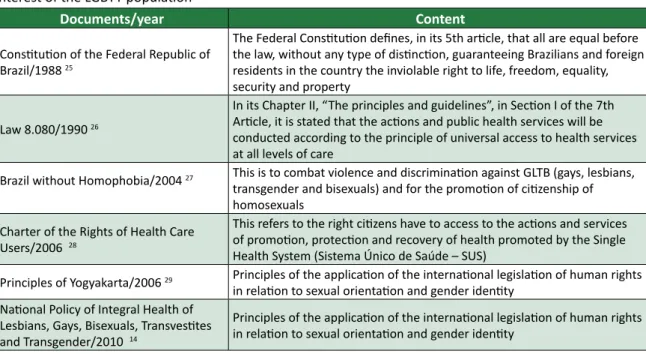
The second set of documents (Table 2) was composed of standardizing instruments of public policies for the LGBTT public, and other legal frame
-works that address the rights of the SUS users.
R
esear
Table 1. Descripion of aricles by author, year of publicaion, objecive and research method.
Author/year Research objecive Method
Lionço/2008 19 To quesion the relevance of a speciic health care policy for the gays, lesbians, bisexuals, transvesites and transgender
(GLBTT) populaion Theoreical essay
Andrade & Ferrari/2009 20 To analyze the changes that enabled the recepion of requests from gay men to achieve recogniion of their relaionships and
family consituion from adopion to assisted procreaion Bibliographic research
Valadão & Gomes/2011 21
To discuss the elements that could explain the invisibility of lesbians and bisexual women in the area of integral care to
women’s health Bibliographic research
Silva & Nardi/2011 22
To indicate and understand, in the Brazilian context, the construcion of a social, poliical and legal network to combat
discriminaion based on sexual orientaion Documentary research
Naividade & Oliveira/2011 1 To debate about the challenge of developing an integral health
care policy for lesbian women Ethnographic research
Toledo & Pinai/2012 23 To propose an ethical discussion about the vicissitudes of
clinical psychology with the LGBTT populaion Bibliographic search
Cardoso & Ferro/2012 24 To contribute to the analysis of some elements that interfere
with the health process of the LGBTT populaion Bibliographic search
Table 2. Descripion of standard-seing documents, by name, year of publicaion and feature by level of interest of the LGBTT populaion
Documents/year Content
Consituion of the Federal Republic of Brazil/1988 25
The Federal Consituion deines, in its 5th aricle, that all are equal before the law, without any type of disincion, guaranteeing Brazilians and foreign residents in the country the inviolable right to life, freedom, equality, security and property
Law 8.080/1990 26
In its Chapter II, “The principles and guidelines”, in Secion I of the 7th Aricle, it is stated that the acions and public health services will be conducted according to the principle of universal access to health services at all levels of care
Brazil without Homophobia/2004 27 This is to combat violence and discriminaion against GLTB (gays, lesbians,
transgender and bisexuals) and for the promoion of ciizenship of homosexuals
Charter of the Rights of Health Care Users/2006 28
This refers to the right ciizens have to access to the acions and services of promoion, protecion and recovery of health promoted by the Single Health System (Sistema Único de Saúde – SUS)
Principles of Yogyakarta/2006 29 Principles of the applicaion of the internaional legislaion of human rights
in relaion to sexual orientaion and gender idenity Naional Policy of Integral Health of
Lesbians, Gays, Bisexuals, Transvesites and Transgender/2010 14
Principles of the applicaion of the internaional legislaion of human rights in relaion to sexual orientaion and gender idenity
Results and Discussion
As it is known, we live in a patriarchal social structure, marked by values grounded in moral prin
-ciples that do not take into account the autonomy of the human being. Among these values are those based on the exclusive acceptance of sexual inter
-course that allows afecive expression between people of the opposite sex. In this context, the ho
-mosexual appears to be destabilizing the current standard, occupying, in diferent scenarios, a mar
-ginal posiion in society, a place of abject, that is, that which is not subject: The abject designates here precisely those areas “inhospitable” and
“uninhab-R
esear
itable” of social life, which are, however, heavily populated by those who do not enjoy the status of subject, but whose dwelling under the sign of “unin-habitable” is necessary so that the subject domain is circumscribed30.
For centuries, the Western world saw ho
-mosexuality as an abominable sin, perversion, deviance and crime, which subjected homosexuals to cruel and inhumane treatment 20. Some recent historical facts contributed so that the pracice of homosexuality would acquire yet more unfavorable connotaions. Many imes the world scene corrob
-orated to consolidate the negaive social imagery with regard to homosexuality and/or homosexual behavior. As an example relevant to this construc
-ion, is taken from the Second World War, in which the acion that Hitler incited, among other things, the look of disgust upon homosexuals. Proof of this is that in the fall of 1933, many homosexuals were sent to Nazi concentraion camps and, there, castrated and kept in the regime of forced labor 31. As reported by Fry and MacRae, they were marked with a pink triangle sewn on their uniforms, they not only sufered persecuion and violence of their cap -tors, but also from other prisoners, and to this day, when talking about the vicims of the concentraion camps, they are systemaically excluded 32.
Decades later, already in the 1980s, the genesis of the emergence of HIV/aids, negaively associat
-ed with homosexuals, further contribut-ed to the mistaken percepion of homosexuality and health issues of this populaion. The “Guide to prevenion of STD/AIDS and ciizenship for homosexuals”, from the Ministry of Health (“Guia de prevenção das DST/ aids e cidadania para homossexuais”, do Ministério da Saúde), informs that since the emergence of AIDS in the early 1980s, homosexuals were the popula
-ion group most afected by the epidemic around the world 33.
Associaing diferent factors, ranging from be
-havioral characterisics to lifestyle, the risk and the vulnerability of male and female homosexuals in the face of HIV infecion were signiicantly accentuat
-ed by the lack of informaion, sigma and prejudice
of society 34, giving rise to a number of violaions,
including extra-judicial killings, torture and ill-treat-ment, sexual assault and rape, invasions of privacy, arbitrary detenion, denial of employment and edu -caion ... and serious discriminaion in relaion to the enjoyment of other human rights35.
In this sense, it is worth noing the formulaion, in 2006, of The Yogyakarta Principles, represening a milestone of the LGBTT populaion’s rights inter
-naionally. In this document, which deals with the applicaion of internaional legislaion of human rights relaing to sexual orientaion and gender idenity, it is stated that all human beings are born free and equal in dignity and rights, that all human rights are universal, interdependent, indivisible in
-ter-related 29.
The recogniion of the right to sexual orienta
-ion and gender idenity is essenial to the dignity and humanity of every person, and no diference should be the cause for discriminaion or abuse. Based on the principle of autonomy – understood as the ability of a person to decide to do or to look for that which is judged to be best for himself –, all forms of discriminaion can be seen as a violaion of a person’s rights (or the ciizen/user) of making his
choices 29,36.
The Federal Consituion of 1988 states, in its 5th aricle, that all are equal before the law, without disincion of any kind, guaranteeing to Brazilians and foreign residents in the country the inviolable right to life, liberty, equality, security, and prop
-erty 25. Similarly, Law 8,080, or the Organic Health Law of 1990, subscribes that public health acions and services will be conducted in accordance with the principle of universal access to these services at all levels of care. Thus, both documents ensure non-discriminaion of any nature in public health services 26.
Silva e Nardi 22 draw up a counterpoint to the provisions of the Federal Consituion, when they airm that there are people who, in provid
-ing and adop-ing a certain condiion of existence and expression of sexuality, as in the case of sexual orientaion, are treated unequally, if compared to others in the same situaions and locaions – mak
-ing them vicims of discriminaion. This analysis leads to relecion on the principle of jusice, which, according to the authors, is guided by fairness and the sharing of common goods and resources. Such a concepion of jusice implies the guarantee of the same opportuniies for access to public goods such as health services, for example 25,26.
In an atempt to broaden and strengthen the exercise of ciizenship in Brazil, the federal govern
-ment, through the Ministry of Health, launched in 2004 the aforemenioned program Brazil without Homophobia 11, recognizing the trajectory of thou -sands of Brazilians who, since the late 1970s have dedicated themselves to the struggle to ensure the guarantee of human rights for homosexuals. This program can be considered a milestone in the ight for the right to dignity and respect for difer
-R
esear
ence. Two years later, in 2006, another instrument which prohibits and/or inhibits various forms of dis
-criminaion, including sexual orientaion, in health services was approved: the Charter of SUS User’s Rights (Carta dos Direitos dos Usuários do SUS), which in its third principle ensures the ciizen friend
-ly service, free from discriminaion, aiming at equal treatment and for a more personal and healthy professional-user relaionship 28. Subsequently, in 2008, in discussing care for the LGBTT populaion, the Ministry of Health stressed the importance of addressing the factors that act negaively on the de
-terminants of health 15.
According to this last document, the country’s populaion will only reach adequate levels of health through the ariculaion of all sectors commited to the fostering and promoion of social policies, in such a way as to generate an efecive interfer
-ence on the determinants of the health-disease process. Facing the complexiies of these factors of life and health of people and communiies requires intervenion in situaions like social exclusion, un
-employment and access to housing and food. For this, it is also necessary to recognize the factors that intersect, maximizing the vulnerability and sufering of speciic groups 15.
Considering this perspecive, in 2010, the Brazilian government created the Naional Integral Health Care Policy of LGBTT (Políica Nacional de Saúde Integral de LGBTT), which, in addiion to seek
-ing to transcend the paradigm of non-acceptance of inequaliies in health care services, intended to ad
-dress SUS principles, that is, promote integral health care for lesbians, gays, bisexuals, transvesites and transgender, eliminaing discriminaion and insi
-tuional bias, and contribuing to the reducion of inequaliies and the consolidaion of SUS as a univer
-sal system, integral and equitable 14. This proposal, proved as admiing the existence of prejudices and limitaions in the treatment of SUS professionals in dealing with their relaions with the LGBTT public, simulates changes in all levels of care services.
Based on the analysis of this government pol
-icy, it seems that its genesis lies beyond the issues that guide health acions or services to this popu
-laion. It can be airmed that its most signiicant consequence is in the transformaion of social im
-age, in the overcoming of prejudices that permeate life and social relaions and markedly befall this pub
-lic. According to Lionço, comprehensive health care for this populaion requires the redimensioning of sexual and reproducive rights, demanding the de-naturalizaion of sexuality and its manifestaions, as
well as the refusal of the medicalizaion of sexual -ity that tends to regulate the expression of human sexuality according to heteronormaive logic and lin-earity in the determinaion of sex on gender 37.
This perspecive assumes that any form of discriminaion is a limiing factor of health and promoter of disease, including homophobia itself. Borrilo 38 airms that homophobia is understood as contempt for and rejecion of not only people who idenify themselves as homosexuals, but also homosexuality itself and other expressions of sexual and gender diversity (such as bisexuality, transvesi
-ism, and transgender) which lee from the so-called norm and “natural order” (heterosexuality), hence seen as threatened or destabilizing. In contrast, het
-eronormality is considered as a principle comprising heterosexuality as a legiimate, true and natural ex
-pression of sexuality.
Miskolci 39 and Valadão and Gomes 21 claim that these prejudices, historically widespread in Western socieies, contribute to consolidaing the unpreparedness of health care professionals to deal with sexual diversity, since, throughout their train
-ing, they are not taught how to deal with the subject in an open and unbiased way. This deiciency im
-pairs the professional-user relaionship, because it inhibits free expression of gays and lesbians when talking with these specialists about their sexual ori
-entaion and, with that, ulimately creates barriers in care producion relaionships 21,39.
Thus, producing the change proposed by the Naional Integral Health Care Policy of LGBTT requires a rereading of the thoughts and ethical at
-itudes of the health care professional, with the aim of guaranteeing proper health care to the popula
-ion, among which is the LGBTT community 33. In this sense, taking discriminaion as an illness factor, the acing of health care professionals should be guid
-ed by the principle of non-violence, in other words, not causing intenional prejudice against users, even considering the presupposiion that, in any diagnos
-ic or therapeu-ic acion, there is a risk of generaing some harm 36,40.
When analyzing the professional acion from the principle of autonomy, it is possible to under
-stand that this noion contradicts forms of coercion and repression. Such a principle is ethically based on the dignity of the human being 16, in such a way that disrespecing the autonomy of the people means to disregard their judgments, denying them the freedom to act according to their principles 40. Thus, the imposiion of heterosexuality as a social standard of sexual behavioral can hurt the autono
-R
esear
my of the other, as it already impedes the person from acing according to what he judges as best for himself, even when what it is about an aspect of his life considered inimate, obligaing him to adopt the standard that the culture and society understand as “correct”.
In this regard, it should be noted that any change in the symbolic structures of society involves the percepion, by understanding and acceptance of otherness. Understanding is a crucial factor in the relaions between human beings. Morin 41highlights the importance of working on the ethics of under
-standing as a way of broadening the possibiliies of understanding among men. For the author, under-standing necessarily includes a process of empathy, ideniicaion and projecion. It is always inter-sub -jecive and demands openness, sympathy and generosity 42. With the informaion broadcasing devices for the media, it was never as easy as today to have available so many channels of promoion of dialogues. It is necessary, therefore, to take advan
-tage of these means to foster changes, rather than consolidate stereotypical and discriminatory views.
The analysis of the Charter of Rights of the Users of SUS makes evident the guarantee for all ciizens the right to health care in the network of health services. This implies providing humanized assistance, free from any discriminaion, restricion or negaion in relaion to age, race, color, ethnicity, sexual orientaion, gender idenity, geneic charac
-terisics, socio-economic condiions, health status, being a carrier of an infecious disease or a person living with a disability 28. The document also indi -cates the need to promote transformaions in the way of thinking and acing of health care profession
-als, which, given their importance and funcion in all levels of the healthcare network, are a natural mul
-iplier of these noions for society.
Considering that the reformulaions of the health care networks for beter service to the LGBTT populaion depend on the transformaions of the aitude of the professionals that act on them, Cardoso and Ferro 24 claim that one of the ways to promote such changes in health care services is the quesioning of heterosexuality as standard sexual orientaion. According to the authors, the SUS, is in its search for universality, embraces new speciicaions of populaion segments every day. It is in facing this diversity that the principle of be
-neicence is rendered by the acions of health care professionals, once its adopion implies contribut
-ing to the well-be-ing of the paient, ac-ing on behalf of the user 36.
From an ethical point of view, it is known that health care professionals must refrain from express
-ing any form value judgment in their relaionship with the user. In this sense, moral and religious character of judgments, as well as being counterpro -ducive in clinical work, especially (but not only) with the LGBT populaion (...) generally inciing sigmai -zaion and discriminaion, thus consituing another form of prejudice; with the diference that come masked behind a pseudo-scieniic-neutrality43.
Homosexuality, in breaking with that which is taken as normal and socially acceptable always raises quesions, not only in academia, in search of understanding of its genesis, but also in the relaion of this realm to society in general. Perceiving and ac
-ceping the diferent causes some destabilizaion in people’s ideas, especially when it is cast by cultural and social paterns without the worry of launching a new examinaion of what is simply considered diferent. Thus, service to the LGBTT community in health services is permeated by socio-cultural dilemmas, given the relaionship between the pro
-fessional and the user represents – a meeing of two diferent worlds – a fact that would be miigated by a professional pracice based on ethical principles.
Final Consideraions
The studies analyzed warn about the existence of situaions in which the LGBTT populaion does not ind the due care, which is veriied by the judg
-ments and value judg-ments expressed by health care service professionals. They also signaled that discriminaion by sexual orientaion is a fact that is manifested in various spaces in society, co-exising insituionally in places of the producion of care. These prejudices can be seen as triggers for ethical conlicts in relaionship between the professional and the user. The professional pracice based on pat
-terns of heteronormaivity is presented as a limiing factor in the quality of care, and even associated with illness, the reason for which also it should be considered as the staring point of ethical dilemmas. Consequently, professional performance based on principalist bioethics can be interpreted as a strategy for the overcoming of value judgments in the conduct of health care professionals, which will contribute to the acions that enable a targeted acion for achieving integrality of care for the LGBTT public.
In the present study, while there are aricles and legal milestones that address the health of the
R
esear
LGBTT populaion in the Brazilian context, domesic producion of experiences that would analyze the quesions and/or ethical conlicts in the pracice of professionals with regard to the manifestaions
of sexual diversity could not be found. Thus, it re
-airms the necessity to employ more academic studies about behavioral ethics before the demands of this public in public health services.
Work produced within the framework of the Studies and Research Studies in Gender and Sexualiies of the State University
of the Southwest of Bahia, Jequié/BA, Brazil. (Universidade Estadual do Sudoeste da Bahia –UESB).
Referências
1. Naividade M, Oliveira L. Sexualidades ameaçadoras: religião e homofobia(s) em discursos evangélicos conservadores. Sexualidad, Salud y Sociedad: Revista Lainoamericana. 2011;2:121-61.
2. Foucault M. História da sexualidade: a vontade de saber. 16ª ed. Rio de Janeiro: Graal; 2005. 3. Terto Jr V. Homossexualidade e saúde: desaios para a terceira década de epidemia de HIV/Aids.
Horiz Antropol. 2002;8(17):147-58.
4. Sousa Filho A. Teorias sobre a gênese da homossexualidade: ideologia, preconceito e fraude. In: Junqueira RD, organizador. Diversidade sexual na educação: problemaizações sobre a homofobia nas escolas. Brasília: Ministério da Educação; 2009. v. 32. p. 95-123. (Coleção Educação para Todos).
5. Foucault M. Op. cit. p. 67.
6. Fry P, MacRae E. O que é homossexualidade. São Paulo: Brasiliense; 1985.
7. Grupo Gay da Bahia. O que é o GGB. [Internet]. 2003 [acesso 28 jan 2015]. Disponível: htp:// www.ggb.org.br/ggb.html
8. Grupo Arco-Íris. Apresentação do Grupo Arco-Íris. [Internet]. [acesso 28 jan 2015]. Disponível: htp://www.arco-iris.org.br
9. Brasil. Departamento de DST, Aids e Hepaites Virais. Grupo de Apoio à Prevenção da Aids – Gapa/SP. [Internet]. [acesso 28 jan 2015]. Disponível: htp://www.aids.gov.br/endereco/grupo-de-apoio-prevencao-da-aids-gapasp
10. Wikipédia. Lista de enidades brasileiras de defesa dos GLBT. [Internet]. [acesso 28 jan 2015]. Disponível: htp://pt.wikipedia.org/wiki/Lista_de_enidades_brasileiras_de_defesa_dos_GLBT 11. Brasil. Conselho Nacional de Combate à Discriminação. Brasil sem homofobia: programa de
combate à violência e à discriminação contra GLTB e de promoção da cidadania homossexual. [Internet]. Brasília: Ministério da Saúde; 2004 [acesso 31 maio 2015]. Disponível: htp://bvsms. saude.gov.br/bvs/publicacoes/brasil_sem_homofobia.pdf
12. Brasil. Presidência da República. Decreto de 4 de junho de 2010. Insitui o Dia Nacional de Combate à Homofobia. [Internet]. 2010 [acesso 23 maio 2014]. Disponível: htp://www.planalto. gov.br/ccivil_03/_ato2007-2010/2010/Dnn/Dnn12635.htm
13. Brasil. Ministério da Saúde. Portaria nº 2803, de 19 de novembro de 2013. Redeine e amplia o Processo Transexualizador no Sistema Único de Saúde (SUS). [Internet]. 2013 [acesso 28 jan 2015]. Disponível: htp://bvsms.saude.gov.br/bvs/saudelegis/gm/2013/prt2803_19_11_2013.html 14. Brasil. Ministério da Saúde. Políica Nacional de Saúde Integral de Lésbicas, Gays, Bissexuais,
Travesis e Transexuais. Brasília: Ministério da Saúde; 2013.
15. Brasil. Ministério da Saúde. Saúde da população de gays, lésbicas, bissexuais, travesis e transexuais. Rev Saúde Pública. 2008;42(3):570-3.
16. Reis HTS. A éica principialista como modelo na atenção à saúde humana [dissertação]. Florianópolis: Universidade Federal de Santa Catarina; 2006.
17. Beauchamp TL, Childress JF. Princípios de éica biomédica. São Paulo: Loyola; 2002. 18. Severino AJ. Metodologia do trabalho cieníico. 22ª ed. São Paulo: Cortez; 2002. p. 152-53. 19. Lionço T. Que direito à saúde para a população GLBT? Considerando direitos humanos, sexuais e
reproduivos em busca da integralidade e da equidade. Saúde Soc. 2008;17(2):11-21.
20. Andrade MRM, Ferrari IF. Legiimação do laço homossexual: um acolhimento possível na realidade social da hipermodernidade. Rev Mal-Estar e Subj. 2009;9(4):1145-72.
21. Valadão RC, Gomes R. Homossexualidade feminina no campo da saúde: da invisibilidade à violência. Physis. 2011;21(4):1451-67.
22. Silva FR, Nardi HC. A construção social e políica pela não discriminação por orientação sexual. Physis. 2011;21(1):251-65.
23. Toledo LG, Pinai T. A clínica psicológica e o público LGBT. Psicol Clin. 2012;24(1):137-63. 24. Cardoso MR, Ferro LF. Saúde e população LGBT: demandas e especiicidades em questão.
Psicologia: Ciência e Proissão. 2012;32(3):552-63.
25. Brasil. Presidência da República. Consituição da República Federaiva do Brasil. Brasília: Senado Federal; 1988.
R
esear
26. Brasil. Presidência da República. Lei nº 8.080, de 19 de setembro de 1990. Dispõe sobre as condições para a promoção, proteção e recuperação da saúde, a organização e o funcionamento dos serviços correspondentes e dá outras providências. Brasília: Ministério da Saúde; 1990. 27. Brasil. Conselho Nacional de Combate à Discriminação. Brasil sem homofobia: programa de
combate à violência e à discriminação contra GLTB e promoção da cidadania homossexual. Brasília: Ministério da Saúde; 2004.
28. Brasil. Ministério da Saúde. Carta dos Direitos dos Usuários da Saúde. Brasília: Ministério da Saúde; 2006. (Série F. Comunicação e Educação em Saúde).
29. Centro Laino-Americano em Sexualidade e Direitos humanos. Princípios de Yogyakarta: princípios sobre a aplicação da legislação internacional de direitos humanos em relação à orientação sexual e idenidade de gênero. [Internet]. Indonésia: CLAM; 2006 [acesso 23 maio 2014]. Disponível: htp://www.clam.org.br/pdf/principios_de_yogyakarta.pdf
30. Butler J. Corpos que pesam: sobre os limites discursivos do sexo. In: Louro GL, organizador. O corpo educado: pedagogias da sexualidade. 2ª ed. Belo Horizonte: Autênica; 2000. p. 151-65. 31. Lima CC. A história da homossexualidade e a luta pela dignidade. [Internet]. Guia do Estudante.
13 nov 2011 [acesso 1º jun 2015]. Disponível: htp://guiadoestudante.abril.com.br/aventuras-historia/historia-homossexualidade-luta-pela-dignidade-718218.shtml
32. Fry P, MacRae E. Op. cit. p. 91.
33. Brasil. Ministério da Saúde. Guia de prevenção das DST/Aids e cidadania para homossexuais. Brasília: Ministério da Saúde; 2002. (Série Manuais).
34. Brasil. Ministério da Saúde. Proissionais do sexo: documento referencial para ações de prevenção das DST e da Aids. Brasília: Ministério da Saúde; 2002. (Série Manuais).
35. Centro Laino-Americano em Sexualidade e Direitos humanos. Op. cit. p. 7.
36. Loch JA. Princípios da bioéica. In: Kipper DJ, organizador. Uma introdução à bioéica. São Paulo: Nestlé Nutriion Insitute; 2002. p. 12-9.
37. Lionço T. Op. cit. p. 18.
38. Borrillo D. Homofobia: história e críica de um preconceito. Belo Horizonte: Autênica; 2010. 39. Miskolci R. A teoria Queer e a sociologia: o desaio de uma analíica da normalização. Sociologias.
2009;11(21):150-82.
40. Goldim JR. Modelo de princípios: principialismo. [Internet]. 1999 [acesso 19 maio 2014]. Disponível: htp://www.ufrgs.br/bioeica/modprin.htm
41. Morin E. Os sete saberes necessários à educação do futuro. 8ª ed. São Paulo: Cortez; 2003. 42. Morin E. Op. cit. p. 95.
43. Toledo LG, Pinai T. Op. cit. p. 155.
Paricipaion of the authors
Adilson Ribeiro dos Santos and Rose Manuela Marta Santos elaborated the problem of the study, of the data and contributed to the wriing and discussion of the aricle. Rita Narriman Silva de Oliveira Boery, Edite Lago da Silva Sena and Sérgio Donha Yarid were responsible for the orientaion of the construcion and inal revision of the aricle. Marcos Lopes de Souza contributed with the inal drat and did the criical reading of the aricle.
Recebido: 13.1.2015
Revisado: 2.5.2015
Aprovado: 7.5.2015