ABSTRACT: Excessive daytime sleepiness (EDS) imposes a wide range of adverse health-related outcomes in older people, such as disability, which impair everyday activities and may increase the risk of fall. Few studies have explored EDS in Brazilian older people living in the community who are typically cared in primary health services. This study aims to investigate the prevalence of EDS and its sociodemographic, physical and mental health correlates among community-dwelling older adults. This is an exploratory, population-based study derived from Frailty in Brazilian Older Adults (FIBRA) study including adults aged 65 years and older. Participants with a score ≥ 11 points on the Epworth Sleepiness Scale were considered as having excessive daytime sleepiness. A structured, multidimensional questionnaire was used to investigate sociodemographic, physical and mental health, and self-rated health variables. The sample was composed of 776 older adults, of whom 21% (n = 162) presented excessive daytime sleepiness. Multivariate regression analysis revealed that EDS is associated with obesity (OR = 1.50; 95%CI 1.02 – 2.20), urinary incontinence (OR = 1.53; 95%CI 1.01 – 2.31), poor self-rated health (OR = 1.54; 95%CI 1.06 – 2.24), and depression symptoms (OR = 1.49; 95%CI 1.00 – 2.20). Our results suggest that healthcare professionals should identify older adults with EDS and implement intervention strategies to minimize the negative impact of the co-occurrence of this condition with obesity, depression and urinary incontinence over health and quality of life.
Keywords: Sleep disorders. Health of the elderly. Health status. Epworth scale. Cross-sectional studies. Population-based study.
Correlates of excessive daytime
sleepiness in community-dwelling
older adults: an exploratory study
Fatores relacionados à sonolência diurna excessiva
em idosos da comunidade: um estudo exploratório
Camila Astolphi LimaI, Wuber Jeferson de Souza SoaresI, Tereza Lofredo BiltonII, Rosângela Corrêa DiasIII, Eduardo FerriollIV, Monica Rodrigues PerraciniI
IGraduate program in Physical Therapy, Universidade Cidade de Sao Paulo – São Paulo (SP), Brazil.
IIHuman Science and Health College, Pontiicia Universidade Catolica – São Paulo, Brazil.
IIIDepartment of Physical Therapy/ Program of Rehabilitation Sciences, Universidade Federal de Minas Gerais –
Belo Horizonte (MG), Brazil.
IVSchool of Medicine, Universidade de São Paulo – Ribeirão Preto (SP), Brazil.
Corresponding author: Camila Astolphi Lima. Rua Cesáreo Galeno, 448, Tatuapé, CEP: 03071-000, São Paulo, SP, Brasil. E-mail: [email protected]
INTRODUCTION
Sleep disorders are common among the older adult population1. More than half of the
people aged 65 and over presented at least one chronic sleep disorder1,2 causing insuicient
sleep3 that may lead to excessive daytime sleepiness1.
Excessive daytime sleepiness (EDS) is commonly a secondary symptom of sleep disorders and it is characterized by the diicult in maintaining awake in the wake period4.
The severity of sleepiness is based on frequency and degree of impairment on daily activities3. The prevalence of excessive daytime sleepiness varies between 11 and 25% for
the general population5,6 and may reach up to 30%3 in the older adult population. In Brazil,
studies with older adults have shown a prevalence varying between 13 and 18%7,8,
EDS is a symptom typically related to sleep disturbances, such as obstructive sleep apnea, narcolepsy and idiopathic hypersomnia9. In addition, it is also related to poor health
status10, low physical activity levels, disability in daily activities10 and an increased number
of depression symptoms11. Among older people, napping for long periods during the day
is related to an increased risk of falling12.
Some methods used for objective assessment of excessive sleepiness are polysomnography and multiple sleep latency. These assessments are time-consuming, require high inancial investment and speciics sleep laboratories, preventing their use in epidemiological studies. Subjective measurements include some scales as Stanford Sleepiness13 and Karolinska
Sleepiness14 that assesses EDS in the moment of application. To determine subjectively
as EDS may inluence daily activities, the most appropriate scale is Epworth15 that assess
the probability of sleep in activities.
RESUMO: A Sonolência Diurna Excessiva (SDE) está relacionada a vários efeitos adversos na saúde de pessoas idosas, como a incapacidade funcional, que compromete as atividades do cotidiano e aumenta o risco de quedas. Poucos estudos têm explorado a SDE em idosos brasileiros que vivem na comunidade, que são tipicamente cuidados em serviços de atenção primária em saúde. Este estudo tem como objetivo investigar a prevalência da SDE e sua correlação com dados sociodemográicos, físicos e sobre a saúde mental de idosos que vivem na comunidade. Este é um estudo exploratório de base populacional, derivado da Rede de Estudos de Fragilidade de Idosos Brasileiros (FIBRA) com idosos com de 65 anos ou mais. Participantes com um escore ≥ 11 pontos na Escala de Sonolência de Epworth foram considerados como tendo SDE. Um questionário estruturado, multidimensional foi usado para investigar as variáveis sociodemográicas, físicas, saúde mental, e qualidade de vida. A amostra foi composta por 776 idosos, dos quais 21% (n = 162) apresentavam SDE. A análise de regressão múltipla revelou que a SDE está associada à obesidade (OR = 1.50; IC95% 1.02 – 2.20), incontinência urinária (OR = 1.53; IC95% 1.01 – 2.31), má qualidade de vida (OR = 1.54; IC95% 1.06 – 2.24) e sintomas depressivos (OR = 1.49; IC95% 1.00 – 2.20). Nossos resultados sugerem que proissionais da saúde devem identiicar os idosos com SDE e implementar intervenções para minimizar o impacto negativo da coocorrência dessas condições com obesidade, depressão e incontinência urinária sobre a saúde e qualidade de vida.
A substantial rise in the proportion of older adults in the Brazilian population is predicted to come within the next decades, reaching 30% of the population in 205016,
demanding integrated, systemic, and comprehensive interventions to minimize the negative impact on health and quality of life imposed by the cumulative and multifactorial nature of comorbidities and clinical conditions in later life. The aim of this study is to estimate the prevalence and to investigate sociodemographic, physical and mental health correlates of EDS in community-dwelling older adults.
METHOD
This is a cross-sectional exploratory, population-based study derived from a Frailty in Brazilian Older Adults (FIBRA) network study. The sample for this study was composed of older adults aged 65 or older, living in the municipalities of Barueri, São Paulo (Human Development Index – HDI of 0.786) and Cuiabá, Mato Grosso (HDI: 0.785), both in Brazil. The study was carried out from March 2009 to April 2010.
Participants’ exclusion criteria were
1. cognitive impairment according the Mini–Mental State Examination, adjusted for educational level17;
2. inability to walk temporarily or permanently, even with a walking device;
3. localized strength loss and aphasia caused by stroke;
4. Parkinson’s disease (either severe or unstable state);
5. severe hearing or visual impairment that impairs communication; or
6. terminal illness.
The evaluation was carried out by trained researchers in two phases, the irst consisting of a semi-structured interview carried out at home in sessions that lasted from 40 to 120 minutes. The second phase consisted of a data-gathering session using physical-functioning tests that lasted from 20 to 30 minutes that was carried out in public schools, community centers, and health centers close to the older adults’ homes.
The Epworth Sleepiness Scale18 was used to determine the degree of excessive
sleepiness. It is a scale composed of eight items, in which the subject marks the possibility of napping in routine situations, such as watching television, lying down to rest, and while being a passenger in a vehicle. The scoring for each item varies from 0 (no chance of napping) to 3 (great probability of napping). A score of ≥ 11 points indicates excessive daytime sleepiness.
The eight-item scale has a reliability coeicient (Cronbach’s α) of 0.83. The scale has been validated for older American women and has an adequate internal consistency (α = 0.76)19,
In Brazil it has been validated for adults18 and its feasibility was tested in institutionalized
older people20, demonstrating that is possible use this instrument. Despite the limitations,
Sociodemographic variables analyzed were: gender, age (grouped 65 – 69, 70 – 74, 75 – 79 and 80 years and older), education level (0 – 1, 1 – 4, 5 – 8, 9 years or more), and gross monthly family income (0 – 1, 1 – 3, 3 – 5, 5 minimum wages and above).
Self-rated health was assessed by asking the participant to evaluate the general status of his or her health (very good, good, regular, bad, or very bad).
The presence of diseases diagnosed by a physician in the last year was identiied by self-report13. The following diseases were considered: hypertension, arthritis, heart diseases, diabetes
mellitus, stroke, depression, osteoporosis, bronchitis/emphysema. Participants were considered obese if they had a Body Mass Index (BMI) ≥ 30 kg/m2. The health conditions evaluated were
urinary incontinence, sleeping problems, and single falls (only one fall) and recurrent falls (two or more falls) in the last 12 months. The presence of depression symptoms was assessed by the 15-item Geriatric Depression Scale23. Participants were also questioned about the regular use
of medications. The number of medications was counted and the presence of polypharmacy (use of four or more regular medications in the last three months14) was ascertained.
Frailty was established accordingly to the phenotype proposed by Fried et al.24 Older
adults who presented three or more of the following criteria were rated as frail:
1. unintentional weight loss within the last year (over 4,5 kg or 5% of body weight);
2. exhaustion or fatigue, based on answers to the Center for Epidemiologic Studies Depression Scale (CES-D);
3. low handgrip strength measured with a dynamometer (SAEHANW – SH 5001), indicated by values below the irst quintile of the sample, adjusted by gender and BMI;
4. low gait speed, indicated by values above the 80th percentile of time needed to walk
a distance of 4.6 meters, adjusted by height and gender;
5. low energy expenditure in kilocalories per week, which was indicated by values below the irst quintile of the sample, adjusted by gender, measured by a summarized version of the Minnesota Leisure Time Activities Questionnaire (Q-MLTPA)25.
The Pontifícia Universidade Católica (PUCSP) and the Ethics in Research Committee of the Hospital das Clínicas de Ribeirão Preto of the Universidade de São Paulo (HCRP-USP) Ethics Committees approved this study. All participants gave written informed consent before data collection began.
A descriptive analysis of the variables was made using simple frequency. The comparison between groups with or without excessive daytime sleepiness was carried out using the χ2 or
Fisher’s exact test for categorical variables, while the t-test was used for quantitative variables. The level of signiicance was maintained at α < 0.05. Afterwards, we performed a multivariate logistic regression analysis. Items with p< 0.05 were excluded from the analysis one by one, following the sequence of the value of p. In case an item was eliminated, that variable was considered as a confusion factor if there was a change in the rest of the parameter that exceeded 20% (coeicient
goodness-of-it test. Discrimination was quantiied using area under the curve (ROC curve) with 95%CI. The statistics package used for data analysis was SPSS 19.0 for Windows.
RESULTS
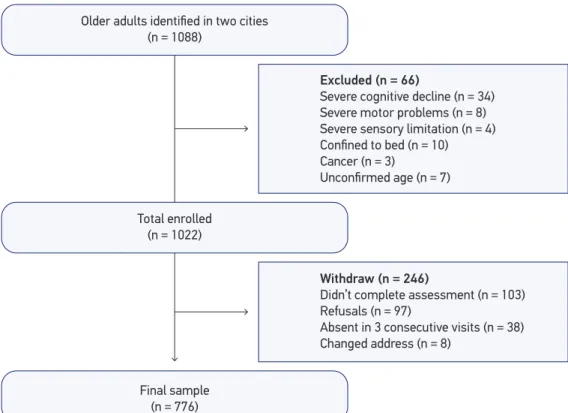
Were enrolled 1,088 older people in the homes belonging to assorted census regions and 776 of these were included in this study, 391 of them from the city of Cuiabá, Mato Grosso, Brazil, and 385 from the city of Barueri, São Paulo, Brazil. The study lowchart is presented in Figure 1.
The average age of the participants in this study was 71.9 years (± 5.9), 496 of them (64%) being female. Of all the participants, 333 (43%) reported trouble sleeping and 162 (21%) presented excessive daytime sleepiness. Considering only those older people who reported sleeping problems, 70 (21%) had excessive daytime sleepiness.
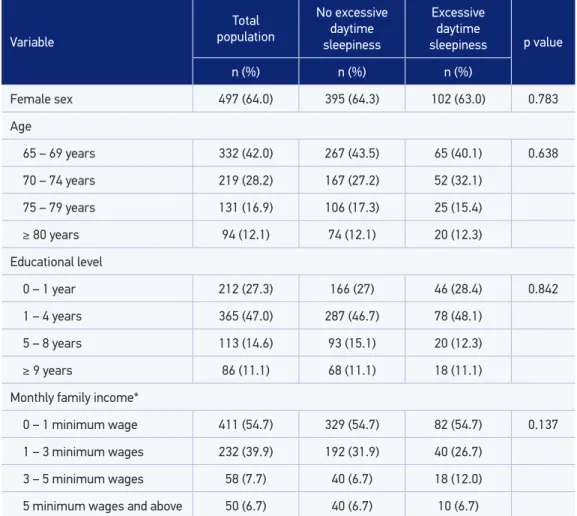
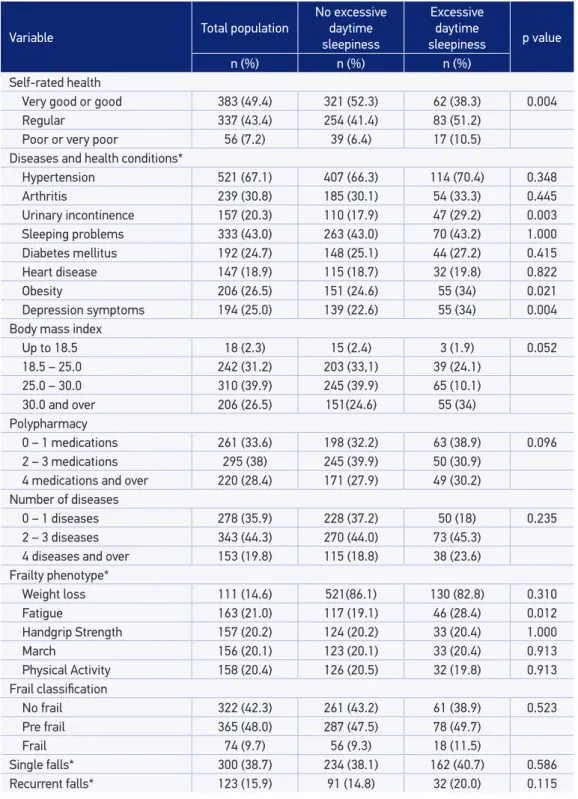
Sociodemographic characteristics, physical and mental health and self-rated health characteristics among older adults with and without EDS are presented in Table 1 and Table 2, respectively. The inal multivariate logistic regression model pointed out that excessive daytime sleepiness is associated with obesity, urinary incontinence, depressive symptoms, and poor self-rated health (Table 3).
Figure 1. Flowchart of the study participants. Older adults identified in two cities
(n = 1088)
Total enrolled (n = 1022)
Excluded (n = 66)
Severe cognitive decline (n = 34) Severe motor problems (n = 8) Severe sensory limitation (n = 4) Confined to bed (n = 10) Cancer (n = 3)
Unconfirmed age (n = 7)
Withdraw (n = 246)
Didn’t complete assessment (n = 103) Refusals (n = 97)
Absent in 3 consecutive visits (n = 38) Changed address (n = 8)
DISCUSSION
About 20% of the older adults presented excessive daytime sleepiness, which was not associated with sociodemographic factors (gender, age, schooling, and income), but with clinical factors (urinary incontinence, obesity and depression symptoms) and also with poor self-rated health among community-dwelling older adults.
The prevalence of excessive daytime sleepiness observed in our study is greater when compared to studies carried out with similar populations9,26,27, including a study conducted
in Brazil, in which the prevalence was 13%7. According to Hara et al.7, a possible explanation
for this disagreement observed in the literature may rely on the distinct deinitions used for sleepiness. In addition, diferent scales with diferent cut-of points have been
Table 1. Sociodemographics characteristics for the total population, the no sleepiness and the excessive daytime sleepiness groups.
Variable
Total
population
No excessive daytime sleepiness
Excessive daytime
sleepiness p value
n (%) n (%) n (%)
Female sex 497 (64.0) 395 (64.3) 102 (63.0) 0.783
Age
65 – 69 years 332 (42.0) 267 (43.5) 65 (40.1) 0.638
70 – 74 years 219 (28.2) 167 (27.2) 52 (32.1)
75 – 79 years 131 (16.9) 106 (17.3) 25 (15.4)
≥ 80 years 94 (12.1) 74 (12.1) 20 (12.3)
Educational level
0 – 1 year 212 (27.3) 166 (27) 46 (28.4) 0.842
1 – 4 years 365 (47.0) 287 (46.7) 78 (48.1)
5 – 8 years 113 (14.6) 93 (15.1) 20 (12.3)
≥ 9 years 86 (11.1) 68 (11.1) 18 (11.1)
Monthly family income*
0 – 1 minimum wage 411 (54.7) 329 (54.7) 82 (54.7) 0.137
1 – 3 minimum wages 232 (39.9) 192 (31.9) 40 (26.7)
3 – 5 minimum wages 58 (7.7) 40 (6.7) 18 (12.0)
5 minimum wages and above 50 (6.7) 40 (6.7) 10 (6.7)
Table 2. Clinical data for the total population, the no sleepiness and the excessive daytime sleepiness groups.
Variable Total population
No excessive daytime sleepiness
Excessive daytime
sleepiness p value
n (%) n (%) n (%)
Self-rated health
Very good or good 383 (49.4) 321 (52.3) 62 (38.3) 0.004
Regular 337 (43.4) 254 (41.4) 83 (51.2)
Poor or very poor 56 (7.2) 39 (6.4) 17 (10.5)
Diseases and health conditions*
Hypertension 521 (67.1) 407 (66.3) 114 (70.4) 0.348
Arthritis 239 (30.8) 185 (30.1) 54 (33.3) 0.445
Urinary incontinence 157 (20.3) 110 (17.9) 47 (29.2) 0.003
Sleeping problems 333 (43.0) 263 (43.0) 70 (43.2) 1.000
Diabetes mellitus 192 (24.7) 148 (25.1) 44 (27.2) 0.415
Heart disease 147 (18.9) 115 (18.7) 32 (19.8) 0.822
Obesity 206 (26.5) 151 (24.6) 55 (34) 0.021
Depression symptoms 194 (25.0) 139 (22.6) 55 (34) 0.004
Body mass index
Up to 18.5 18 (2.3) 15 (2.4) 3 (1.9) 0.052
18.5 – 25.0 242 (31.2) 203 (33,1) 39 (24.1)
25.0 – 30.0 310 (39.9) 245 (39.9) 65 (10.1)
30.0 and over 206 (26.5) 151(24.6) 55 (34)
Polypharmacy
0 – 1 medications 261 (33.6) 198 (32.2) 63 (38.9) 0.096
2 – 3 medications 295 (38) 245 (39.9) 50 (30.9)
4 medications and over 220 (28.4) 171 (27.9) 49 (30.2)
Number of diseases
0 – 1 diseases 278 (35.9) 228 (37.2) 50 (18) 0.235
2 – 3 diseases 343 (44.3) 270 (44.0) 73 (45.3)
4 diseases and over 153 (19.8) 115 (18.8) 38 (23.6)
Frailty phenotype*
Weight loss 111 (14.6) 521(86.1) 130 (82.8) 0.310
Fatigue 163 (21.0) 117 (19.1) 46 (28.4) 0.012
Handgrip Strength 157 (20.2) 124 (20.2) 33 (20.4) 1.000
March 156 (20.1) 123 (20.1) 33 (20.4) 0.913
Physical Activity 158 (20.4) 126 (20.5) 32 (19.8) 0.913
Frail classiication
No frail 322 (42.3) 261 (43.2) 61 (38.9) 0.523
Pre frail 365 (48.0) 287 (47.5) 78 (49.7)
Frail 74 (9.7) 56 (9.3) 18 (11.5)
Single falls* 300 (38.7) 234 (38.1) 162 (40.7) 0.586
Recurrent falls* 123 (15.9) 91 (14.8) 32 (20.0) 0.115
*missing values: Urinary Incontinence (n = 1); Diseases and Health Conditions (n = 2); Weight loss (n = 14);
used to identify EDS, which may also justify, at least in part the observed diference in prevalence. For example, similarly to our study, Souza et al.8 used the Epworth Sleepiness
Scale and observed a prevalence of EDS close to the proportion observed in our study (18%). However, in the study of Hara et al.7, which used a diferent questionnaire, the
prevalence was smaller (13%), possibly because they questioned about the presence of sleepiness occurring three or more times per week.
The assessment of EDS in population-based studies commonly uses questionnaires for measurement, as Epworth Scale. In Brazil, this scale was validated only for adults18 but is
widely use in older population8,9. The use of the gold standard of sleep disorders, such as
polysomnography and multiple sleep latency, are time-consuming, expensive and needing of speciic laboratories, making it impossible to use in studies realized in the community.
We did not ind an association with gender. The results concerning gender are contradictory; whereas some authors indicate that sleepiness is related to the male gender8,9,26, others say
that it prevails within the female gender28,29. Speciically within the Brazilian population,
a greater prevalence of EDS was observed among women7. The authors suggested that it
may be explained by the presence of some clinical conditions, such as depression, insomnia and restless legs syndrome among women7 Hormonal and body composition diferences
among men and women could also play a role in the rate of EDS28.
In this study participants were not submitted to medical assessment, so the presence of disease was identiied by self-report. To minimize this inluence in the results, the interviewer enquired if the participant had some medical diagnosis in the last year and about recent exams, for example.
Studies carried out with the older adult population show a substantial relationship between depressive symptoms and excessive daytime sleepiness11, as does our study, in which
older adults with depression symptoms had a higher probability of presenting EDS when compared with older adults without depressive symptoms. Hayley et al.22 discussed that
sleepiness is commonly associated with anxiety in older women, suggesting that one must be careful when evaluating the mental state of patients who present daytime sleepiness.
Table 3. Final model of multivariate regression analysis for excessive daytime sleepiness in community-dwelling older adults, a Frailty in Brazilian Older Adults study (n = 776).
Variable β coeicient Odds ratio 95%CI p-value
Obesity 0.408 1.50 1.02 – 2.20 0.036
Urinary incontinence 0.425 1.53 1.01 – 2.31 0.044
Poor self-rated health 0.434 1.54 1.06 – 2.24 0.023
Depressive symptoms 0.399 1.49 1.00 – 2.20 0.047
Evidences have associated EDS with the use of medications that act in the Central Nervous System inluencing in regulation of neurotransmitters responsible for modulation of sleep and wakefulness12,30, In this study was not observed any relation between
polypharmacy and EDS, maybe due the fact that we did not ask about the use of psychotropic, for example, just for the number of medications in use.
Urinary incontinence was found to be related to sleep problems27. In our study,
participants who presented urinary incontinence also presented 1.5 times greater probability of presenting EDS when compared with those who didn’t report having urinary incontinence. Teo et al.27pointed out that female older adults presenting
urinary urgency and excessive sleepiness were almost two times more prone to fall when compared with other females who did not present that clinical condition. We have not observed in our study any association between excessive daytime sleepiness and falling or recurrent falling. It is possible that we didn’t observe any association with falls due to the fact that we did not discriminate incontinence type, once the urinary urgency requires older people to take more risky behaviors, especially during night time to get up and go to the bathroom31 In addition, nocturia may cause difficult to
initiating and maintaining sleep at night31, with a negative impact on motor and cognitive
performance, mainly because of reduced awareness levels during the day32. Sleepiness
may hamper the ability to process and integrate information (visual, tactile, auditory, and proprioceptive), compromising reaction time and balance anticipatory adjustments, resulting in stumbles and falls27.
Another health condition that has been shown to be associated with excessive sleepiness is obesity. In this study 34% of EDS population were obese. Evidences shows that obese older people has fragmented sleep at night and an increased nap during the day33. The causes of EDS in obese people is still uncertain4,34 but some studies frequent
suggests that EDS is a secondary symptom of other sleep disorders, as Obstrutive Sleep Apnea (OSA), snoring and narcolepsy4. It is important to note that in this research was
assessed the EDS.
The association between self-rated health and EDS in our study is noteworthy, since self-rated health is considered a signiicant and powerful indication of overall health19 and
is related to increased mortality and poorer quality of life among older adults15.
The results of this study allow healthcare professionals, especially those who are primary health care practitioners, to identify older adult proiles with higher odds of presenting excessive daytime sleepiness. The early identiication of EDS and its correlates may help to prevent the well-known negative consequences of this condition for community-dwelling older adults’ health and quality of life20,35,36.
CONCLUSION
Excessive daytime sleepiness in community-dwelling older adults is related with depression, obesity, urinary incontinence, and poor perceived health. Our results suggest that healthcare professionals should identify older adults with EDS and implement intervention strategies to minimize the negative impact of the co-occurrence of this condition with obesity, depression and urinary incontinence on health and quality of life.
1. Foley DJ, Monjan AA, Brown SL, Simonsick EM, Wallace RB, Blazer DG. Sleep complaints among elderly persons: an epidemiologic study of three communities. Sleep 1995; 18(6): 425-32.
2. Maggi S, Langlois JA, Minicuci N, Grigoletto F, Pavan M, Foley DJ, et al. Sleep complaints in community-dwelling older persons: prevalence, associated factors, and reported causes. J Am Geriatr Soc 1998; 46(2): 161-8.
3. Young TB. Epidemiology of daytime sleepiness: deinitions, symptomatology, and prevalence. J Clin Psychiatry 2004; 65 Suppl 16: 12-6.
4. ICSD-3. The International Classification of Sleep Disorders. Darien, IL: American Academy of Sleep Medicine; 2014.
5. Hublin C, Kaprio J, Partinen M, Heikkila K, Koskenvuo M. Daytime sleepiness in an adult, Finnish population. J Intern Med 1996; 239(5): 417-23.
6. Walsleben JA, Kapur VK, Newman AB, Shahar E, Bootzin RR, Rosenberg CE, et al. Sleep and reported daytime sleepiness in normal subjects: the Sleep Heart Health Study. Sleep 2004; 27(2): 293-8.
7. Hara C, Rocha FL, Costa ÉC, Fuzikawa C, Uchoa E, Lima-Costa MF. Prevalence of excessive daytime sleepiness in Brazilian community-dwelling older adults with very low levels of schooling, and its association with sociodemographic characteristics and lifestyle: the Bambuí Health and Ageing Study (BHAS). J Bras Psiquiatr 2008; 57(2): 91-7.
8. Souza JC, Magna LA, Reimão R. Excessive daytime sleepiness in Campo Grande general population, Brazil. Arqu Neuropsiquiatr 2002; 60(3-A): 558-62. 9. Vashum KP, McEvoy MA, Hancock SJ, Islam MR, Peel
R, Attia JR, et al. Prevalence of and Associations With Excessive Daytime Sleepiness in an Australian Older Population. Asia Pac J Public Health 2013.
10. Spira AP, Covinsky K, Rebok GW, Punjabi NM, Stone KL, Hillier TA, et al. Poor sleep quality and functional decline in older women. J Am Geriatr Soc 2012; 60(6): 1092-8. 11. Maglione JE, Ancoli-Israel S, Peters KW, Paudel ML,
Yafe K, Ensrud KE, et al. Depressive symptoms and subjective and objective sleep in community-dwelling older women. J Am Geriatr Soc 2012; 60(4): 635-43. 12. St George RJ, Delbaere K, Williams P, Lord SR. Sleep
quality and falls in older people living in self- and assisted-care villages. Gerontology 2009; 55(2): 162-8. 13. Hoddes E, Zarcone V, Smythe H, Phillips R, Dement W. Quantification of sleepiness: a new approach. Psychophysiology 1973; 10(4): 431-6.
14. Åkerstedt T, Gillberg M. Subjective and objective sleepiness in the active individual. Int J Neurosc 1990; 52(1-2): 29-37.
15. Johns MW. A new method for measuring daytime sleepiness: the Epworth sleepiness scale. Sleep 1991; 14(6): 540-5.
16. Gragnolati M, Jorgensen OH, Rocha R, Fruttero A. Growing Old in an Older Brazil: Implications of Population Aging on Growth, Poverty, Public Finance, and Service Delivery. Washington, D.C.: The Word Bank; 2011.
17. Bertolucci PHF, Brucki SMD, Campacci SR, Juliano Y. O Mini-Exame do Estado Mental em uma população geral: Impacto da escolaridade. Arqu Neuropsiquiatr 1994; 52(1): 1-7.
18. Bertolazi AN, Fagondes SC, Hoff LS, Pedro VD, Menna Barreto SS, Johns MW. Validação da escala de sonolência de Epworth em português para uso no Brasil. J Bras Pneumol 2009; 35(9): 877-83.
20. Frohnhofen H, Popp R, Willmann V, Heuer H, Firat A. Feasibility of the Epworth Sleepiness Scale in a sample of geriatric in-hospital patients. J Physiol Pharmacol 2009; 60 Suppl 5: 45-9.
21. Lopes JM, Dantas FG, Medeiros JL. Excessive daytime sleepiness in the elderly: association with cardiovascular risk, obesity and depression. Rev Bras Epidemiol 2013; 16(4): 872-9.
22. Hayley AC, Williams LJ, Berk M, Kennedy GA, Jacka FN, Pasco JA. The relationship between excessive daytime sleepiness and depressive and anxiety disorders in women. Aust N Z J Psychiatry 2013; 47(8): 772-8. 23. Paradela EM, Lourenco RA, Veras RP. [Validation
of geriatric depression scale in a general outpatient clinic]. Rev Saude Publica 2005; 39(6): 918-23. [Article in Portuguese]
24. Fried LP, Tangen CM, Walston J, Newman AB, Hirsch C, Gottdiener J, et al. Frailty in older adults: evidence for a phenotype. J Gerontol A Biol Sci Med Sci 2001; 56(3): M146-56.
25. Lustosa LP, Pereira DS, Dias RC, Britto RR, Parentoni AN, Pereira LSM. Tradução e adaptação transcultural do Minnesota Leisure Time Activities Questionnaire em idosos. Geriatria & Gerontologia 2011; 5: 57-65. 26. Baldwin CM, Griffith KA, Nieto FJ, O’Connor GT,
Walsleben JA, Redline S. The association of sleep-disordered breathing and sleep symptoms with quality of life in the Sleep Heart Health Study. Sleep 2001; 24(1): 96-105. 27. Teo JS, Brifa NK, Devine A, Dhaliwal SS, Prince RL.
Do sleep problems or urinary incontinence predict falls in elderly women? Aust J Physiother 2006; 52(1): 19-24. 28. Krishnan V, Collop NA. Gender diferences in sleep
disorders. Curr Opin Pulm Med 2006; 12(6): 383-9.
29. Rockwood K, Davis HS, Merry HR, MacKnight C, McDowell I. Sleep disturbances and mortality: results from the Canadian Study of Health and Aging. J Am Geriatr Soc 2001; 49(5): 639-41.
30. Pagel J. Excessive daytime sleepiness. Am Fam Physician 2009; 79(5): 391-6.
31. Foley DJ, Vitiello MV, Bliwise DL, Ancoli-Israel S, Monjan AA, Walsh JK. Frequent napping is associated with excessive daytime sleepiness, depression, pain, and nocturia in older adults: indings from the National Sleep Foundation ‘2003 Sleep in America’Poll. Am J Geriatr Psychiatry 2007; 15(4): 344-50.
32. Pilcher JJ, Hufcutt AI. Efects of sleep deprivation on performance: a meta-analysis. Sleep 1996; 19(4): 318-26.
33. Patel SR, Blackwell T, Redline S, Ancoli-Israel S, Cauley JA, Hillier TA, et al. The association between sleep duration and obesity in older adults. Int J Obesity 2008; 32(12): 1825-34.
34. Akinnusi ME, Saliba R, Porhomayon J, El-Solh AA. Sleep disorders in morbid obesity. Eur J Intern Med 2012; 23(3): 219-26.
35. Blumenthal JA, Babyak MA, Moore KA, Craighead WE, Herman S, Khatri P, et al. Efects of exercise training on older patients with major depression. Arch Intern Med 1999; 159(19): 2349-56.
36. Clinical Practice Guidelines for the Management of Patients with Insomnia in Primary Care. Community of Madrid: Ministry of Science and Innovation; 2009.
Received on: 04/24/2014