w ww.e l s e v i e r . c o m / l o c a t e / b j p
Original
Article
Chemical
characterization
of
two
morphologically
related
Espeletia
(Asteraceae)
species
and
chemometric
analysis
based
on
essential
oil
components
Guillermo
F.
Padilla-González,
Jennyfer
A.
Aldana,
Fernando
B.
Da
Costa
∗LaboratóriodeFarmacognosia,FaculdadedeCiênciasFarmacêuticas,UniversidadedeSãoPaulo,RibeirãoPreto,SP,Brazil
a
r
t
i
c
l
e
i
n
f
o
Articlehistory:
Received3February2016
Accepted5May2016
Availableonline25June2016
Keywords:
Asteraceae Chemotaxonomy
Essentialoils
Espeletia
Chemometricanalysis
a
b
s
t
r
a
c
t
Inthisstudy,acomprehensivephytochemicalcharacterizationoftwomorphologicallyrelatedspecies fromthegenusEspeletiaMutisexBonpl.,namely,EspeletiagrandifloraHumb.&Bonpl.andEspeletiakillipii Cuatrec.,Asteraceae,hasbeenperformedbygaschromatographycoupledtoflameionizationdetection, gaschromatographycoupledtomassspectrometryandultra-highperformanceliquidchromatography coupledtoultravioletandhigh-resolutionmassspectrometry.Analysisofethanolextracts(70%,v/v) fromleavesandconcomitantcompounddereplicationallowedtheidentificationofmajorpeaks,most ofthemnewreportsforthegenusEspeletiaorthesubtribeEspeletiinae.Chemicalcharacterizationof resinsessentialoilsindicatedseveralsimilaritiesanddifferencesbetweenbothspeciesandfromother membersofthesubtribe.Chemometricanalysis(hierarchicalclusteringanalysisandorthogonalpartial least-squaresdiscriminantanalysis)appliedtotheessentialoilcompositionof31speciesfrom Espeleti-inaefurthermoreallowedtheidentificationofthreeprimaryclusterscorrelatedwiththetaxonomy. Hence,thisstudyunderscoredqualitativeandsemiquantitativedifferencesbetweenthechemical com-positionofleavesandresinsofE.grandifloraandE.killipii,providedinformationonchemotaxonomyand describedthepresenceofdifferenttrendsintheessentialoilcompositionfromspeciesofEspeletiinae.
©2016SociedadeBrasileiradeFarmacognosia.PublishedbyElsevierEditoraLtda.Thisisanopen accessarticleundertheCCBY-NC-NDlicense(http://creativecommons.org/licenses/by-nc-nd/4.0/).
Introduction
The genusEspeletia Mutis ex Bonpl., Asteraceae, constitutes
aneotropicalgroupendemictothenorthernAndeanregionsof
Venezuela, Colombia,and Ecuador. With ca. 71 species,
Espele-tiais themost diverse genus withinthe subtribe Espeletiinae,
whichalsocomprisesthegeneraEspeletiopsisCuatrec.,Coespeletia
Cuatrec.,RuilopeziaCuatrec.,LibanothamnusErnst,Carramboa
Cua-trec.,TamaniaCuatrec.,andParamiflosCuatrec.(Cuatrecasas,2013;
Diazgranados,2012a).
EspeletiagrandifloraHumb. &Bonpl. wasthefirst species in
Espeletiinaetobedescribedandcontinuestobefrequentlystudied
intermsofitsmorphology,ecophysiology,distribution,and
tax-onomy(FaguaandGonzalez,2007;Cuatrecasas,2013).However,
gapsremaininthetaxonomicdelimitationofthisspecies,which
couldpossiblyincludedifferenttaxonomicentities,givenitshigh
polymorphism and broad geographic distribution (Cuatrecasas,
2013). Its shared morphological characteristics with Espeletia
∗ Correspondingauthor.
E-mail:[email protected](F.B.DaCosta).
killipiiCuatrec.(e.g.,leafshape,plantheight,andoverall
appear-ance)moreoverhinderitsunequivocalidentification.Accordingto
Cuatrecasas(2013),twoprimarymorphologicalcharacteristicsthat
distinguishE.grandiflorafromE.killipiiincludethepresenceofat
leastonepairofsterileoppositeleavesintheproximalpartofthe
synflorescencesintheformerspecies—bycontrast,E.killipiilacks
suchsterileleaves—andthelengthofthesynflorescences,whichare
longerinE.grandiflora.However,thefrequenthybridizationofthe
twospeciesinzoneswhereoverlappingpopulationsoccur(e.g.,La
ChisacápáramoinColombia)furthercomplicatestheir
unambigu-oustaxonomicdelimitation(Cuatrecasas,2013).
The secondary metabolite chemistry of E.grandiflora and E.
killipii hasbeen poorly investigated. Nevertheless, classic
phy-tochemical studies of E. grandiflora resins have reported the
presenceofsixent-kauranediterpenes—kaur-16-ene,
kaur-16-en-19-al,kaur-16-en-19-ol, kaurenoicacid, grandiflorolic acid, and
grandiflorenicacid(Piozzietal.,1968,1971,1972)—whereasother
chemicalclasses(e.g.flavonoids,sesquiterpenelactones,and
triter-penes)havebeenreportedfromtheleavesofE.killipii(Torrenegra
etal.,1994;TorrenegraandTellez,1995,1996).However,no
com-prehensivephytochemicalcharacterizationthatincludestheleaves
andresinsofbothspecieshasbeenperformed,andthesimilarities
http://dx.doi.org/10.1016/j.bjp.2016.05.009
0102-695X/©2016SociedadeBrasileiradeFarmacognosia.PublishedbyElsevierEditoraLtda.ThisisanopenaccessarticleundertheCCBY-NC-NDlicense(http://
anddifferencesbetweenthemetabolicfingerprintsofE.grandiflora
andE.killipiiremainunknown.
Consequently,this studyaimedtoperformacomprehensive
phytochemical characterization of E. grandiflora and E. killipii
leavesand resinsbyusingmodernandcomplementary
analyti-caltechniquessuchasGC–FID,GC–MSandUHPLC–UV-HRMS,all
todeterminesimilaritiesanddifferencesbetweenthespecies,as
wellasamongEOfrom31speciesofEspeletiinae,asperformedby
chemometricmethodsinvolvingmultivariatestatisticalanalysis.
Materialsandmethods
Plantmaterial
LeavesandresinsofEspeletiagrandifloraHumb.&Bonpl.and
E.killipii Cuatrec.,Asteraceae, werecollectedin theCruzVerde
(N4◦34′48.5′′W73◦59′45.3′′–3328m.)andSumapazpáramos
(N4◦ 17′ 24′′W74◦ 12′ 24.2′′–3717m.),respectively,in
Cundi-namarca,Colombia,bySandraL.Casta˜nedaandCarlosI.Suárezin
January2015.PlantidentificationwasperformedbyDr.Mauricio
DiazgranadosandCarlosI.SuarezfromJardínBotánicodeBogotá
(JBB),andavouchersampleofeachspecieswasdepositedatJBB’s
herbariumunder thecollectionnumbers SLC-192and SLC-207,
respectively.PlantcollectionsweremadewithJBBcollection
per-mits.
LeavesextractionandUHPLC–UV-HRMSanalysis
Fromeachspecies,20mgofdryleaveswerepowderedwith
liq-uidnitrogenandextractedwith2mlofEtOH:H2O(7:3,v/v,HPLC
grade)inanultrasonicbathfor15minat25◦C.Plantextractswere
centrifugedat19,975×gfor10minandpartitionedwith0.5ml
ofhexane.Theaqueouslayerwasfilteredthrougha0.2mPTFE
membraneandanalyzedbyUHPLC-UV-HRMSinanAccelaUHPLC
apparatus(ThermoScientific,Carlsbad,CA,USA)coupledtoan
80-Hz photodiodearraydetector (PDA)(Thermo Scientific)and an
ExactiveTMPlusOrbitrapmassspectrometer(MS)(Thermo
Scien-tific).
Aheatedelectrosprayprobewasusedasanionizationsource
inMSanalysesalongwiththefollowingparameters:positiveand
negativeionizationmodes(fullscanmethod)overamassrange
of150–2000Da,resolutionof70,000fullwidthathalfmaximum
(FWHM) (m/z200), mass accuracy <3ppm, scan time of about
2.5scans/s,sprayvoltagesof+3.6kVand−3.2kVforthepositive
andnegativeionizationmodes,respectively,capillaryandheater
temperatureof300◦C,sheathgasof30arbitraryunits,andS-lens
of55arbitraryunits.
Subsequently, 10lof each plant extractwere injected and
chromatographed in a C18 column (Hypersil Gold, 1.9m,
50mm×2.1mm, Thermo Scientific) connected to a C18
Secu-rity GuardTM Ultracartridge (Phenomenex, Torrance, CA,USA).
Themobilephaseinvolvedpurifiedwaterwith0.1%formic acid
and acetonitrile, and separation was performed at a flow rate
of300l/min.Thegradientprogramstartedwith5%acetonitrile
forthefirst3minandincreasedtheamountlinearlyto100%in
30min.Acetonitrileremainedconstantfor5minbeforeultimately
decreasingto5%after40min.Thecolumntemperaturewas
main-tainedat30◦C,thetraytemperaturewasfixedto10◦C,andthe
PDAdetectorwassettorecordintherangeof200–600nm.
Dereplicationofleafextracts
Extractsdereplicationwasperformedbasedonspectral(UVand
accuratemass)and retentiontime(Rt)comparisonswith
refer-encecompoundspreviously isolatedin ourlaboratory—namely,
3-O-(E)-caffeoylquinic acid, protocatechuic acid, 3,5-di-O-(E
)-caffeoylquinic acid, 4,5-di-O-(E)-caffeoylquinic acid, quercetin,
3-methoxyquercetin,andent-kaurenoicacid.Compoundswhose
reference standard was unavailable were tentatively identified
by accuratemass and UV spectracomparisons with data from
theliterature,includingtheDictionaryofNaturalProducts(DNP)
and the Asteraceae Database (AsterDB), the latter of which
correspondstoanin-housedatabase(www.asterbiochem.org)
con-taininghundredsofchemicalcompoundspreviouslyreportedin
theAsteraceaefamily,includingofthesubtribeEspeletiinae.
In-sourcefragmentationintheUHPLC–UV-HRMS(Orbitrap)(MS/MS)
wasadditionallyconsideredtoproposesomeofthepeak
assign-ments.
Essentialoilextraction
TheresinsofE.grandiflora(2.1g)andE.killipii(16.8g),both
col-lectedduringanthesis,werehydrodistilledusingaClevenger-type
apparatusfor3handstoredat−20◦Cforfurtheranalysis.Before
gaschromatographyanalysisEOsweredissolved(1%,v/v)inethyl
acetate.
Essentialoilanalyses
EOfromE.grandifloraandE.killipiiresinswereanalyzedusing
a Hewlett–Packard 6890N Plus GC–FID(USA) apparatus where
thepercentagecompositionofindividualcomponentswas
deter-mined.Identificationofcompoundswasperformedbycomparison
oftheretentionindicesofeachcomponentrelativetoaseriesofn
-alkanes,andbymassspectracomparisonswithNIST08andWilley
7databasesbasedonGC–MSanalysesonaShimadzuQP-2010
sys-tem(Tokyo,Japan).Toconfirmidentifications,themassspectrum
andretentionindexofeachcompoundwasfurthercomparedwith
publisheddata(Adams,2007).
DuringGC-FIDanalyses,1lofeach samplewasinjected(in
triplicate) using a split ratio of 1:20 and separated ona HP-5
fusedsilicacolumn(30m;0.32mmI.D.;0.25mfilmthickness).
Thecarriergaswashydrogenat1.3ml/min,theoventemperature
wasprogrammedfrom60to240◦Cat3◦C/min,andtheinjector
temperaturewas240◦C.Retentionindiceswerecalculated
rela-tivetoC8–C40n-alkanes.ForGC–MSanalyses,anEN5MScolumn
wasemployed(30m;0.25mmI.D.;0.25mfilmthickness)with
asourcetemperatureof250◦C,carriergasadjustedto41.6cm/s,
anionizationenergyof70eV,andascanrangeof40–500Da.The
temperatureprogramandremainingparameterswereidenticalto
thoseinGC–FIDanalyses.
Chemometricanalyses
TherelativeamountoftheEOcomponentsof31speciesfromthe
subtribeEspeletiinaereportedintheliteratureandinthepresent
study(Table1)wereusedtoperformmultivariatestatistical
meth-odsinthesoftwareR3.0.3(RFoundationforStatisticalComputing,
Vienna,Austria)andSIMCAP13.0.3.0(UmetricsAB,Malmö,
Swe-den).Priortoanalyses, thedatamatrixwasscaledbyusingthe
arcsinemethod,whichisappropriateandcommonlyusedfordata
expressed as percentages. Hierarchical clustering analysis with
bootstrapresampling (HCAbp)wasperformedintheRpackage
pvclust(SuzukiandShimodaira,2006),usingWard’smethodasthe
clusteringalgorithmandEuclidiandistance.Togeneratea
quanti-tativemeasureofaccuracyintheclustersobtained,approximately
unbiased(AU)pvalueswereconsideredintheanalysis,calculated
bymultiscalebootstrap,whichismoreaccuratethantraditional
bootstrapping,asSuzukiandShimodaira(2006)haveconfirmed.
Inmultiscalebootstrapping,sincethesizeofthebootstrapsample
G.F.Padilla-Gonzálezetal./RevistaBrasileiradeFarmacognosia26(2016)694–700
Table1
SpeciesfromsubtribeEspeletiinaeusedtoperformchemometricanalysesbasedonessentialoilcompositions;speciesorganizedaccordingtothethreeclustersidentified
byhierarchicalclusteringanalysiswithbootstrapresampling.
Cluster Species Localityofcollection
(Country)
Altitude m.a.s.l.
Dateof collection
Plant stage
Plant part
Reference
1 Co.moritziana1 LaCulata(VEN) 3750 9/2/1998 Anthesis Leaves Aparicioetal.(2002)
1 Co.moritziana2 Pi˜nago(VEN) 3800 12/9/1999 Anthesis Leaves Aparicioetal.(2002)
1 Co.moritziana3 LosOsos(VEN) 3700 5/25/2004 Anthesis Leaves Ibá˜nezandUsubillaga(2006a)
1 Co.moritziana4 PicodelÁguila(VEN) 4100 9/22/2002 Anthesis Leaves Ibá˜nezandUsubillaga(2006a)
1 Co.spicata1 LaCulata(VEN) 3500 11/22/1998 Anthesis Leaves Aparicioetal.(2002)
1 Co.spicata2 LasCruces(VEN) 3850 12/9/1999 Anthesis Leaves Aparicioetal.(2002)
1 Co.timotensis PicodelÁguila(VEN) 4000 n.r. Anthesis Aerialparts Rojasetal.(1999)
1 E.nana ParamodeOrtiz(VEN) 3085 5/1/2010 n.r. Leaves Pe˜naetal.(2012)
1 E.batata PiedrasBlancas(VEN) 4200 11/1/1998 n.r. Leaves Usubillagaetal.(2001b)
1 E.grandiflora ParamodeCruzverde(COL) 3328 1/22/2015 Anthesis Resin Presentstudy
1 E.killipii ParamodeSumapaz(COL) 3717 1/26/2015 Anthesis Resin Presentstudy
1 L.occultusssphumbertii LagunaNegra(VEN) 3200 12/2/1999 Anthesis Leaves Usubillagaetal.(2001a)
2 L.neriifolius ElBatallón(VEN) 2800 11/6/1998 Anthesis Leaves Usubillagaetal.(2001a)
2 L.occultus ElBatallón(VEN) 2800 11/6/1998 Anthesis Leaves Usubillagaetal.(2001a)
2 L.lucidus LaAguada(VEN) 3400 11/24/1999 Anthesis Leaves Usubillagaetal.(2001a)
2 E.schultzii1 LaCulata(VEN) 2800 9/12/2002 Anthesis Leaves Ibá˜nezandUsubillaga(2006b)
2 E.schultzii2 LosOsos(VEN) 3700 9/22/2002 Anthesis Leaves Ibá˜nezandUsubillaga(2006b)
2 E.schultzii3 PicodelÁguila(VEN) 4100 10/22/2002 Anthesis Leaves Ibá˜nezandUsubillaga(2006b)
2 E.weddellii LasCruces(VEN) 4080 n.r. Anthesis Leaves Khourietal.(2000)
2 E.semiglobulata PicodelÁguila(VEN) 3800 n.r. n.r. Leaves Usubillagaetal.(1999)
2 E.xaurantia PicodelÁguila(VEN) n.r. 11/15/2003 Anthesis Leaves Ibá˜nezandUsubillaga(2008)
3 R.marcescens1 ElBatallón(VEN) 3000 6/22/1999 Anthesis Leaves Aparicioetal.(2001)
3 R.marcescens2 ElBatallón(VEN) 3000 1/27/2000 Anthesis Leaves Aparicioetal.(2001)
3 R.atropurpurea1 ElBatallón(VEN) 3400 11/6/1998 Anthesis Leaves Aparicioetal.(2001)
3 R.atropurpurea2 ElBatallón(VEN) 3400 6/22/1999 Anthesis Leaves Aparicioetal.(2001)
3 R.lindenii SanJosé(VEN) 3100 8/10/1999 Anthesis Leaves Aparicioetal.(2001)
3 R.floccosa PicodelÁguila(VEN) 3800 5/25/1999 Anthesis Leaves Aparicioetal.(2001)
3 Ca.badilloi LaAzulita(VEN) 1700 n.r. n.r. Leaves Corderoetal.(2011)
3 Ca.badilloivar.pittieri Bailadores(VEN) 1800 n.r. n.r. Leaves Rojasetal.(2008)
3 Co.thyrsiformis Lanegra(VEN) 3000 6/22/1999 Anthesis Leaves Aparicioetal.(2002)
3 Es.angustifolia SanJosé(VEN) 2870 6/1/2006 n.r. Leaves Mecciaetal.(2007)
n.r.,notreported.Generaabbreviations:Co.,Coespeletia;E.,Espeletia;L.,Libanothamnus;R.,Ruilopezia;C.,Carramboa;Es.,Espeletiopsis.
VEN,Venezuela;COL,Colombia.
traditionalbootstrappingvaluecausedbytheconstantsamplesize
(SuzukiandShimodaira,2006).
Toidentifythecompoundsresponsiblefor speciesclustering
inthethreeprimary clustersobservedin theHCAbp,an
ortho-gonalpartialleast-squaresdiscriminantanalysis(OPLS-DA)was
performed with SIMCA P. This method separates the
system-aticvariationin X intocorrelated (predictive)anduncorrelated
(orthogonal)variablestoY(Eriksson etal.,2012).Thevariables
responsiblefor theclustering pattern observed were identified
accordingtoavariableimportanceintheprojection(VIP)value
>1.0,a significantcontributiontothe loadingsplot, anda high
magnitude and high reliability confidence intervals in the
coefficientsplot.
Resultsanddiscussion
LeavescharacterizationbyUHPLC–UV-HRMS
Themetabolicfingerprintingofcrudeethanol(70%v/v)extracts
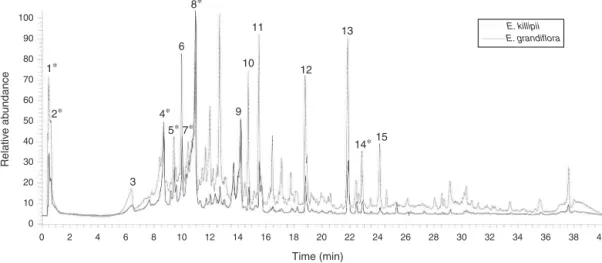
from E. grandiflora and E. killipii leaves by using
UHPLC–UV-HRMS (Fig. 1) and concomitant dereplication allowed the
identificationofseveralsimilaritiesanddifferencesbetweenthe
100
90
80
70
60
50
40
30
20
10
0
0 2 4 6 8 10 12 14 16 18 20
Time (min)
Relativ
e ab
undance
14∗
7∗
5∗
4∗
3 2∗
1∗
8∗
15 13
12 11
10
9 6
22 24 26 28 30
E. killipii E. grandiflora
32 34 36 38 40
Fig.1.Totalioncurrent(TIC)chromatogramsofE.grandifloraandE.killipiileavesextractsobtainedinnegativemode.(1)3-O-(E)-caffeoylquinicacid,(2)protocatechuicacid,
(3)di-caffeoylquinicacidisomer,(4)3,5-di-O-(E)-caffeoylquinicacid,(5)4,5-di-O-(E)-caffeoylquinicacid,(6)tri-caffeoylaltraricacidisomer,(7)quercetin,(8)3-methoxy
quercetin,(9)8,8′′-methylene-bisquercetin,(10)ent-12-oxo-kaura-9(11),16-dien-18-oicacid,(11)ent-12-hydroxy-kaura-9(11),16-dien-18-oicacid,(12)ent-15␣
species.Asobservedintotalioncurrentchromatograms(Fig.1),
bothspecieshavehighlysimilarfingerprintswithgreater
semi-quantitative instead of qualitative differences. All dereplicated
compounds (Fig. 1) were detected in both species, though E.
killipii showed a greater relative abundance of peaks 6 and
10–15(Fig.1).Fourmainchemicalclassesofsecondary
metabo-lites were identified in the leaves extracts of both species:
trans-cinnamicacidderivatives, flavonoids, diterpenes,and one triterpene.
Amongflavonoids,bothspeciesproducehighquantitiesof
3-methoxyquercetin(peak8,Fig.1).Thisflavonoid,identifiedby
itsRt,UV,andaccuratemasscomparisonwithareference
com-pound,hasbeenpreviouslyreportedonlyintheleavesofE.killipii
(Torrenegraetal.,1994)andE.barclayana(Gutierrezetal.,1998).Its
presenceinE.grandiflorathereforeconstitutesanewreportforthis
species.Quercetin(peak7,Fig.1),alsoidentifiedinbothspeciesby
itscomparisonwithareferencesubstance,constitutesanewreport
forE.grandifloraaswell.Peak9(Fig.1)wastentativelyproposed
to be 8,8′′-methylene-bisquercetin (flavonoid). This compound
showedadeprotonatedmoleculeat615.07815m/zanda
proton-atedoneat617.09174m/zforC31H20O14.Themassspectrumin
thenegativemodealsoshowedanintensepeakat299.01935m/z,
originatedbyin-sourcefragmentationofaquercetinunitand a
methylgroupin accordancewiththeliterature(Martuccietal.,
2014).Althoughthiscompoundhasnotbeenpreviouslyreported
inthesubtribeEspeletiinae,Martuccietal.(2014)reporteditinthe
genusVernonia(Asteraceae).
Six trans-cinnamic acid derivatives were identified (Fig. 1).
Amongthem,3-O-(E)-caffeoylquinicacid(peak1,Fig.1),
protoca-techuicacid(peak2,Fig.1),3,5-di-O-(E)-caffeoylquinicacid(peak
4,Fig.1),and4,5-di-O-(E)-caffeoylquinicacid(peak5,Fig.1)were
identifiedbasedonspectral(UVandaccuratemass)andRt
com-parisonswithreferencesubstances.Peak3(Fig.1)wastentatively
proposedtobeanotherdicaffeoylquinicacidisomer.This
com-poundshowedadeprotonatedmoleculeat515.11884m/zanda
protonatedone at 517.13385m/z forC25H24O12.Its mass
spec-truminthepositivemodeshowedin-sourcefragmentationwith
twomainpeaks:oneat499.12311m/z,which correspondswith
thelossofawatermolecule,andanotherat163.03882m/z,which
correspondswithanionizedresidueofcaffeicacid(Santosetal.,
2008).TheUVspectrumof thispeakexhibited twoabsorptions
atapproximately300and325nm,whichsuggestchlorogenicacid
derivatives.
By contrast, peak 6 (Fig. 1) was proposedto be a possible
tricaffeoylaltraric acidisomer based onaccurate mass
compar-isons with compounds reported in AsterDB and maximum UV
absorptions.Thiscompounddisplayedadeprotonatedmoleculeat
695.12531m/zforC33H28O17andtwoUVmaximaatapproximately
300and329nm.Thepresenceofthepreviouslyreportedtrans
-cinnamicacidderivativesinE.grandifloraandE.killipiiconstitutes
thefirstreportforthischemicalclassinthesubtribeEspeletiinae.
However,theirpresenceisunsurprising,fortheyconstituteahighly
commonclassofsecondarymetaboliteswidespreadinAsteraceae
(Chagas-Paulaetal.,2011).
IntheleavesofE.grandifloraandE.killipii,fiveent-kaurane
diter-peneswerealsoidentified,amongwhichent-kaurenoicacid(peak
14,Fig.1)wasunambiguouslyidentifiedbyRtandaccuratemass
comparisonwithareferencesubstance.Theidentitiesoftheother
four(peaks10–13,Fig.1)weretentativelyproposedbasedonlyon
accuratemassandchemotaxonomicinformation.Allofthese
diter-peneshave beenpreviouslyreportedinEspeletiinae (Bohlmann
etal.,1980;Usubillagaetal.,2003).
Lastly, the identity of an oleane-type triterpene (peak 15,
Fig. 1) was tentatively proposed based on accurate mass and
databasesearch.Thiscompoundshowedadeprotonatedmolecule
at 655.42114m/z and a protonated one at 657.43524m/z for
C39H60O8. An accurate mass search in DNP afforded three
possiblecompounds:brevenal(CAS:776331-34-1),
olean-12-ene-3,16,21,22,28-pentol,16,28-diacetate22-(2-methyl-2-butenoate)
(CAS: 124641-09-4), and olean-12-ene-3,16,21,22,28-pentol,
22,28-diacetate 21-[2(or 3)-methyl-2-butenoate] (CAS:
55949-26-3). Amongthem, onlythe two oleane-typetriterpenes have
previously been isolatedfrom species belongingto plant
fami-lies (Apiaceaeand Polemoniaceae),whereas brevenal has been
reportedonlyin themarinedinoflagellate Kareniabrevis(DNP).
Further analyses are therefore necessary to unambiguously
identifythiscompoundinEspeletiinae.
ResincharacterizationbyGC–FIDandGC–MS
ThehydrodistillationofE.grandifloraandE.killipiiresins
pro-vided yellowish EOs with yields of 14.29% and 14.88% (v/w),
respectively,basedontheirfreshweight.Inbothspecies,the
iden-tifiedsubstances constitute95–97%ofthetotaloilcomposition
(Table2).
AcomparisonoftheEOcompositionofE.grandifloraandE.
kil-lipiiresinsrevealednosignificantdifferences;bothspecieswere
characterizedbya predominanceofmonoterpene hydrocarbons
with ␣-pinene as the major component (Table 2), which
rep-resented morethan 61% of thetotal oil composition (Table 2).
However,importantdifferenceswereobserved.Forexample,
-pinene represented the second major compound (3.4%) in E.
grandiflora resin EO, whereas sabinene constituted the second
major peak in E. killipii (6.5%), as Table 2 shows. E.
grandi-florapossessesagreaterproportionofoxygenatedmonoterpenes
(18.1%)thanE.killipii(12.5%),butalesserproportionof
sesquiter-penehydrocarbons(Table2).Remarkably,onlyonesesquiterpene
hydrocarbon was detected in E. grandiflora resin EO—namely,
␦-cadinene—whereas several others, including ␣-copaene, 
-bourbonene, ␦-selinene, and ␥-muurolene, were detectedin E.
killipii resin EO (Table 2).In general,E. killipii presentsa more
complex EO composition than E. grandiflora, since more
com-poundsanddifferentchemicalclassesweredetectedinthisspecies
(Table2).
Monoterpene hydrocarbons constitute the main EO
compo-nentsfromallspeciesofEspeletiinaeinvestigatedthusfar(Table1).
Amongthem,␣-pineneusuallyconstitutesthechiefEOcomponent
innumerousspecies(Aparicioetal.,2002;Ibá˜nezandUsubillaga,
2006a, 2008; Meccia et al., 2007; Pe˜naet al., 2012). However,
some species produceother compounds suchas limonene and
␣-phellandreneasthemajorpeaks(Aparicioetal.,2001;Ibá˜nez
and Usubillaga, 2006b). Based on this observation of different
terpenoidspredominanceinEOsfromEspeletiinae,chemometric
analysesusingGCdatahasbeenperformedtoidentifytrendsin
theEOcompositionof31speciesfromEspeletiinae,asdiscussed
below.
Chemometricanalysesofessentialoils
Percentage EOcompositions of 31 species fromEspeletiinae
wereusedasinputdatatoperformchemometricanalyses(HCAbp
andOPLS-DA).Table1showsthespeciesnamesandtheirlocality,
altitudeanddateofcollection,aswellastheplantpartand
repro-ductivestage.Inthisstudy,weconsideredonlyspeciescollectedin
theanthesisperiod,includingafewcasesinwhichthatinformation
wasnotspecified(Table1).
Results from HCAbp (Fig. 2) demonstrated trends in EO
composition of species from Espeletiinae, and three primary
clusters were determined based on chemical similarities and
high support values (≥83%). As Fig. 2 also shows, intraspecies
G.F.Padilla-Gonzálezetal./RevistaBrasileiradeFarmacognosia26(2016)694–700
Table2
PercentageofessentialoilcomponentsidentifiedinE.grandifloraandE.killipiiresins.
# Compoundname RI RI-lit E.grandiflora E.killipii
1 Santolinatriene 908 906 0.3 0.9
2 ␣-Thujene 927 924 – 0.3
3 ␣-Pinene 937 932 69.7 61.8
4 Camphene 950 946 0.4 0.3
5 Thuja-2,4(10)-diene 955 953 1.2 0.5
6 Sabinene 975 969 0.6 6.5
7 -Pinene 979 974 3.4 4.0
8 o-Cymene 1026 1022 2.1 0.6
9 Limonene 1029 1024 1.0 1.4
10 1,8-Cineole 1033 1026 0.8 2.1
11 ␥-Terpinene 1058 1054 t 0.2
12 Fencholenicaldehydea 1092 – 0.6 t
13 Linalool 1101 1095 t 0.1
14 ␣-Campholenal 1128 1122 2.8 1.2
15 trans-Pinocarveol 1141 1135 2.3 1.2
16 cis-Verbenol 1143 1137 0.8 0.3
17 trans-Verbenol 1147 1140 2.9 1.1
18 trans-Pinocamphone 1162 1158 0.2 t
19 Pinocarvone 1164 1160 0.6 0.2
20 p-Mentha-1,5-dien-8-ol 1169 1166 2.9 2.3
21 Terpinen-4-ol 1178 1174 t 0.8
22 p-Cymen-8-ol 1186 1179 – 0.2
23 ␣-Terpineol 1187 1186 t 0.4
24 Myrtenal 1188 1193 0.2 t
25 Myrtenol 1199 1194 1.6 1.0
26 Verbenone 1212 1204 1.4 1.2
27 trans-Carveol 1221 1215 0.8 0.2
28 Carvone 1246 1239 0.1 t
29 Linaloolacetate 1253 1254 t 0.2
30 Lavandulylacetate 1293 1288 0.1 t
31 ␣-Copaene 1376 1374 t 1.7
32 -Bourbonene 1385 1387 t 0.7
33 ␥-Muurolene 1477 1478 t 1.0
34 ␦-selinene 1491 1492 t 0.2
35 ␣-Muurolene 1500 1500 – 0.3
36 ␦-Cadinene 1524 1522 0.2 1.5
37 Spathulenol 1577 1577 t 0.3
38 Copaborneol 1604 1613 – 0.9
39 kauranediterpeneb 1981 t 0.3
40 kauranediterpeneb 1988 t 0.7
Monoterpenehydrocarbons 78.7 76.5
Oxygenatedmonoterpenes 18.1 12.5
Sesquiterpenehydrocarbons 0.2 5.4
Oxygenatedsesquiterpenes – 1.2
Totalidentified 97.0 95.6
–notdetected;t,traces.
aIdentificationbasedonlyonmassspectracomparisonwithWilley7database.
b TentativeidentificationbasedonfragmentationpatterncomparisonwithAdams(2007)andUsubillagaandNakano(1979);ThetwomostabundantcompoundsinE.
grandifloraandE.killipiiareemphasizedinbold.
different localities (e.g., Coespeletia moritziana and Espeletia
schultzii)wasnotsignificantenoughtopromote species
group-inginadifferentcluster,whichprovidessupportfortheproposed
groups.
Notably,thethreeclustersidentifiedshouldnotbeconsidered
tobedifferentchemotypes,sinceweanalyzeddifferentspecies,and
bydefinition,achemotypecorrespondsto“organismscategorized
undersamespecies,subspeciesorvarietieshavingdifferencesin
quantityandqualityoftheircomponentsintheirwholechemical
fingerprintthatisrelatedtogeneticorgeneticexpression
differ-ences”(Polatoglu,2013).
Supervised OPLS-DA displayed a good separation
(R2Ycum=0.985; Q2cum=0.789), in which 22% of the
varia-tioninXrelatestotheseparationbetweenthethreeclusters(Fig.
3)and afforded the identificationof discriminating substances.
Cluster 1 was characterized by high ␣-pinene, -pinene, and
-phellandrene contents, cluster 2 by high␣-phellandrene, ␣
-thujene,p-cymene,andsabinenecontents,andcluster3mainly
byhighgermacreneD,limonene,and-caryophyllene contents
(Fig.3).
AdditionalOPLS-DAanalysesconsideringspecieslocalityor
ele-vationrangeasYvariables(Table1)revealednocorrelationwith
EOcompositions(datanotshown,butareevidentfromTable1).
Thisresultsuggeststhatintraspeciesvariationduetogeography
orelevation,asreportedbyAparicioetal.(2002)andIbá˜nezand
Usubillaga(2006b),islessthaninterspeciesvariationin
Espeleti-inae.Therefore,whenconsideringseveralspeciesfromdifferent
generainasingleanalysis,evenspeciescollectedatdifferent
local-itiesclusteraccordingtotheirtaxonomicrelatednessratherthan
theirgeographicorigin(Fig.2).AsshowninTable1,acertain
cor-relationbetweenspeciesEOsandtheirgenericclassificationswas
evident.Forexample,cluster1iscomposedprimarilyofspecies
belongingtothegenusCoespeletiaandafewspeciesofEspeletia,
whereascluster2presentsspeciesmostlyofEspeletiaandafew
ofLibanothamnus.Bycontrast,cluster3isprimarilycomposedof
speciesofRuilopeziaandafewofCarramboa(Table1).Nevertheless,
theclusteringofEspeletiinaespeciesbasedontheirEOcomponents
doesnotfollowstrictgenericboundaries(basedonmorphology),
sincenoevidentcorrelationwasobservedwhenconsideringthe
0.0
Cluster 1 Cluster 2 Cluster 3
91 92 Co . timotensis Co . mor itziana 2 Co . mor itziana 4 E. g randiflor a E. killipii L. occultus ssp . humber tii Co . mor itziana 1 Co . mor itziana 3 E. nana E. batata Co
. spicata 1
Co
. spicata 2 E.
semiglob ulata L. ner iif olius L. lucidus L. occultus E. schultzii 1 E. schultzii 2 E. w eddellii E. schultzii 3 E. x aur antia Ca. badilloi Ca. badilloi v ar . pittier i R. atropur purea 1 R. atropur purea 2 R. marcescens 1 R. marcescens 2 Co . th yrsif or mis R. floccosa Es . angustif olia R. lindenii 100 96 92 83 94 87 84 72 98 85 86 86 84 94 81 100 99 83 86 88 85 80 96 81 100 94 0.5 1.0 1.5 2.0 2.5 3.0
Fig.2. Hierarchicalclusteringanalysiswithbootstrapresamplingof31speciesofthesubtribeEspeletiinaebasedonpercentageofessentialoilcompositions;dottedboxes
correspondtothethreeprimaryclusters.
1.5 1 0.5 0 –0.5 –1 –1.5 –2
–2.5 –2 –1.5
R. marcesc R. floccos Co. thyrsi
R. lindeni
Ca. badillR. marcesc Es. angust
R. atropur Ca. badill
R. atropur Co. moritz E. nanaCo. moritz Co. moritz Co. moritz Cluster 1 Cluster 2 Cluster 3 Co. spicat Co. timote E. grandif E. batata Co. spicat L. occultu E. x auran
L. lucidus L. neriifo E. schultz E. schultz E. schultz E. semiglo L. occultu E. weddell E. killipi
–1 –0.5 0
1.0036 ∗ t[1]
R2X[1]=0.117 R2X[2]=0.102 Ellipse: Hotelling’s T2 (95%)
1.00371
∗ t[2]
0.5 1 1.5 2
Fig.3.Orthogonalpartialleast-squaresdiscriminantanalysisscoreplotof31speciesofthesubtribeEspeletiinaebasedonpercentageofessentialoilcompositions;Clusters
1–3,determinedbyhierarchicalclusteringanalysiswithbootstrapresampling,astheYvariable.Discriminatingvariablesofeachclusterinorderofrelevanceasfollows,
Cluster1:␣-pinene,-pinene,-phellandrene;cluster2:␣-phellandrene␣-thujene,p-cymene,andsabinene;cluster3:germacreneDlimonene,-caryophylleneand
ent-kaur-16-en-al.
Conclusions
This research represents the first comprehensive study to
reportthechemical compositionof aEspeletiaspecies by
mod-ernandcomplementaryanalyticaltechniques,followedbyproper
chemometric analyses. The similarities observed between the
chemicalfingerprintsofE.grandifloraandE.killipiiagreewiththeir
morphologicalandphylogeneticrelatedness.However,important
qualitative and quantitative differences were identified in the
leavesand resins of both species, which suggest that chemical
markers can be potentially used to assist in their taxonomy.
Among the fifteen dereplicated compounds, ten correspond to
newreportsforeitherorbothspecies,whereaseightcorrespond
to new reports for the genus Espeletia and subtribe
Espeleti-inae,indicating thatthesecondarymetabolitechemistry ofthis
groupofplantsremainslargelyunexplored.Thisstudymoreover
afforded the identification of different trends in the
accumu-lation of EOs from 31 species of Espeletiinae, which seem to
correlate withtheirtaxonomy and thusoffer abasis for future
G.F.Padilla-Gonzálezetal./RevistaBrasileiradeFarmacognosia26(2016)694–700
Authorscontributions
GFPG(Ph.D.student)contributedin collectingplantsamples
andidentification,runningthelaboratoryexperiments,analysis
ofthedataanddraftedthepaper.JAAMcontributedtolaboratory
workandcriticalreadingofthemanuscriptandFBDCdesignedthe
experiments,supervisedthelaboratoryworkandcontributedto
criticalreadingofthemanuscript.Alltheauthorshavereadthe
finalmanuscriptandapprovedthesubmission.
Conflictsofinterest
Theauthorsdeclarenoconflictsofinterest.
Acknowledgments
TheauthorsgratefullyacknowledgeCAPESandFAPESP(grant
#2014/17702-0)forfinancialsupport.GFPGthanksDr.Mauricio
Diazgranados,M.Sc.SandraL.Casta˜nedaandMr.CarlosI.Suarez
fromJBBfortheirvaluablehelpcollectingplantmaterialand
dur-ingbotanicalidentificationsandMrs.NubiaParraforhertechnical
assistanceinconfectionofherbariumvouchers.Specialthanksto
Prof.Dr.NorbertoP.Lopes(FCFRP-USP),forexperimental
labora-toryfacilitiestoperformGC-MSanalyseswithtechnicalsupportof
Mrs.IzabelC.C.Turatti,andtoM.Sc.GariCcana-Ccapatinta
(Aster-BioChem,FCFRP-USP)forenlighteningdiscussions.
References
Adams,R.,2007.Identification of Essential Oil Components by Gas
Chromatogra-phy/Mass Spectrometry, 4th ed. Allured Business Media.
Aparicio,R.,Romero,M.,Khouri,N.,Rojas,L.B.,Usubillaga,A.,2002.Volatile
con-stituentsfromtheleavesofthreeCoespeletiaspeciesfromtheVenezuelanAndes. J.Essent.OilRes.14,37–39.
Aparicio,R.,Romero,M.,Rojas,L.B.,Khouri,N.,Usubillaga,A.,2001.Compositionof
theessentialoiloffourspeciesofRuilopeziafromtheVenezuelanAndes.Flavour Fragr.J.16,172–174.
Bohlmann,F.,Suding,H.,Cuatrecasas,J.,Robinson,H.,King,R.M.,1980.Tricyclic
sesquiterpenesandfurtherditerpenesfromEspeletiopsisspecies. Phytochem-istry19,2399–2403.
Chagas-Paula,D.A.,DeOliveira,R.B.,daSilva,V.C.,Gobbo-Neto,L.,Gasparoto,T.H.,
Campanelli,A.P.,Faccioli,L.H.,DaCosta,F.B.,2011.Chlorogenicacidsfrom
Titho-niadiversifoliademonstratebetteranti-inflammatoryeffectthanindomethacin anditssesquiterpenelactones.J.Ethnopharmacol.136,355–362.
Cordero,Y.R.,Rojas,L.B.,Usubillaga,A.,2011.Chemicalcompositionoftheessential
oilfromCarramboalittlei(Asteraceae).Nat.Prod.Commun.6,127–128.
Cuatrecasas,J.,2013.A Systematic Study of the Subtribe Espeletiinae: Heliantheae,
Asteraceae. The New York Botanical Garden Press, New York, USA.
Diazgranados,M.,2012a.A nomenclator for the frailejones (Espeletiinae Cuatrec.,
Asteraceae). PhytoKeys 16, 1–52.
Eriksson,L.,Rosén,J.,Johansson,E.,Trygg,J.,2012.Orthogonal PLS (OPLS)
model-ing for improved analysis and interpretation in drug design. Mol. Inform. 31, 414–419.
Fagua,J.C.,Gonzalez,V.H.,2007.Growthrates,reproductivephenology,and
polli-nationecologyofEspeletiagrandiflora(Asteraceae),agiantAndeancaulescent rosette.PlantBiol.9,127–135.
Gutierrez,S.R.,Fuentes,O.,Tellez,A.N.,Torrenegra,R.,1998.Activeantibacterial
principlefromEspeletiabarclayana.Rev.Latinoam.Química26,71–74.
Ibá˜nez,J.,Usubillaga,A.,2006a.Analysisoftheessentialoiloftwodifferent
altitu-dinalpopulationsofCoespeletiamoritziana(SchBip.exWedd)Cuatrec.Flavour Fragr.J.21,760–763.
Ibá˜nez,J.,Usubillaga,A.,2006b.TheessentialoilofEspeletiaschultziiofdifferent
altitudinalpopulations.FlavourFragr.J.21,286–289.
Ibá˜nez,J.,Usubillaga,A.,2008.Estudiodelacomposicióndelaceiteesencialdeun
frailejón híbrido entre Espeletiaschultziiy Coespeletiamoritziana(Espeletiinae). Rev. Fac. Farm. Univ. Los Andes 50, 16–19.
Khouri,N.,Usubillaga,A.,Rojas,L.B.,Galarraga,F.,2000.The essential oil of Espeletia
weddelliiSch Bip. ex Wedd. Flavour Fragr. J. 15, 263–265.
Martucci,M.E.P.,DeVos,R.C.H.,Carollo,C.A.,Gobbo-Neto,L.,2014.Metabolomics as
a potential chemotaxonomical tool: application in the genus VernoniaSchreb. PLoS ONE 9, e93149.
Meccia,G.,Rojas,L.B.,Velasco,J.,Diaz,T.,Usubillaga,A.,2007.Composition and
antibacterial screening of the essential oils of leaves and roots of Espeletiopsis angustifoliaCuatrec.Nat.Prod.Commun.2,1221–1224.
Pe˜na,A.,Rojas,L.,Aparicio,R.,Alarcon,L.,Baptista,J.G.,Velasco,J.,Carmona,J.,
Usubil-laga,A.,2012.Chemicalcompositionandantibacterialactivityoftheessential
oilofEspeletianana.Nat.Prod.Commun.7,661–662.
Piozzi,F.,Passanna,S.,Paternos,M.P.,Sprio,V.,1971.Kauranoidditerpenesin
Espele-tiagrandiflora.Phytochemistry10,1164–1166.
Piozzi,F.,Passannanti,S.,Marino,M.L.,Sprio,V.,1972.Structureofgrandiflorenic
acid.Can.J.Chem.50,109–112.
Piozzi,F.,Sprio,V.,Passannanti,S.,Mondelli,R.,1968.Structureofgrandiflorolic
acid.Gazz.Chim.Ital.98,907–910.
Polatoglu,K.,2013.Chemotypes–afactthatshouldnotbeignoredinnaturalproduct
studies.Nat.Prod.J.3,10–14.
Rojas,L.B.,Gutierrez,R.,deRojas,Y.C.,Usubillaga,A.,2008.Chemicalcomposition
of the essential oil from Carramboapittieri(Cuatrec.) Cuatrec. (Asteraceae). Nat. Prod. Commun. 3, 1739–1740.
Rojas,L.B.,Usubillaga,A.,Galarraga,F.,1999.Essential oil of Coespeletiatimotensis
Cuatrec. Phytochemistry 52, 1483–1484.
Santos,M.D.,Lopes,N.P.,Iamamoto,Y.,2008.HPLC–ESI–MS/MS analysis of oxidized
di-caffeoylquinic acids generated by metalloporphyrin-catalyzed reactions. Quim. Nova 31, 767–770.
Suzuki,R.,Shimodaira,H.,2006.Pvclust: an R package for assessing the uncertainty
in hierarchical clustering. Bioinformatics 22, 1540–1542.
Torrenegra,R.D.,Tellez,A.N.,1995.Chemotaxonomicvalueofmelampolidesin
Espeletiaspecies(Asteraceae).Biochem.Syst.Ecol.23,449–450.
Torrenegra,R.D.,Tellez,A.N.,1996.PhytochemistryofEspeletiakillipiiCuatr.and
gibberellicactivityofsomeoftheisolatedcompounds.Rev.Latinoam.Química 24,2–6.
Torrenegra,R.D.,Tellez,A.N.,Garcia,G.,1994.Chemicalinvestigationofthespecies
ofthegenusEspeletia.PartI.ChemistryofEspeletiakilipii–Espeletiatunjana.Rev. Colomb.Química23,29–35.
Usubillaga,A.,Aparicio,R.,Romero,M.,Rojas,L.B.,Khouri,N.,2001a.Volatile
con-stituentsfromtheleavesoffourLibanothamusspeciesfromtheVenezuelan Andes.FlavourFragr.J.16,209–211.
Usubillaga,A.,Khouri,N.,Rojas,L.B.,Morillo,M.,2001b.Essentialoiloftheleaves
fromEspeletiabatataCuatrec.J.Essent.OilRes.13,450–451.
Usubillaga,A.,Khouri,N.,Visbal,T.,1999.Volatileconstituentsfromtheleavesof
EspeletiasemiglobulataCuatrec. J. Essent. Oil Res. 11, 757–758.
Usubillaga,A.,Nakano,T.,1979.Kauranoid diterpenes in Ruilopeziamargarita. Planta
Med. 35, 331–338.
Usubillaga,A.,Romero,M.,Aparicio,R.,2003.Kaurenic acids in Espeletiinae. Acta