Original article (short paper)
Comparing postural balance among older adults
and Parkinson’s disease patients
Isabela Andrelino de Almeida Marcelle Brandão Terra
Universidade Estadual de Londrina, Londrina, PR, Brasil
Marcio Rogério de Oliveira Rubens Alexandre da Silva Júnior
Universidade Norte do Paraná, Londrina, PR, Brasil
Henrique Ballalai Ferraz
Universidade Federal de São Paulo, São Paulo, SP, Brasil
Suhaila Mahmoud Smaili Santos
Universidade Estadual de Londrina, Londrina, PR, Brasil
Abstract — The objective of this study was to compare postural balance among healthy older adults and Parkinson’s disease (PD) patients during one-legged stance balance. We recruited 36 individuals of both sexes and divided them into two groups: healthy older adults (HG), and individuals with PD (PG). All the participants were assessed through a single-leg balance test, with eyes open, during 30 seconds (30 seconds of rest across trials) on a force platform. Balance parameters were computed from mean across trials to quantify postural control: center of pressure (COP) area and mean
velocity in both directions of movement, anterior-posterior and medial-lateral. Signiicant differences between-group
were reported for area of COP (P = 0.002) and mean velocity in anterior-posterior direction (P = 0.037), where poor postural control was related to PD patients rather than to healthy individuals. One-legged stance balance was a sensitive task used to discriminate poor postural control in Parkinson individuals.
Keywords: Parkinson’s disease, postural balance, physical therapy modalities
Introduction
The neuromuscular system suffers physiological and morpho-logical changes during the aging process, leading to decreased muscular performance and functional capacity1. Postural control
also deteriorates during this process and the central nervous
system experiences decreased capacity to respond eficiently
to vestibular, visual and proprioceptive commands, which are responsible for maintaining postural balance2,3.
Well-documented morphological changes, such as functional, biochemical, and psychological changes, occur during the aging process and determine the progressive loss of an individual’s ability to adapt. These changes are associated with a greater prevalence of disorders and decreased functional capacity, which together lead to loss of independence and autonomy for older adults, rendering these individuals vulnerable to disease and leaving them dependent on others for the performance of tasks of daily life4,5.
Some diseases occur more frequently in this age group and are associated with the aging process, such as Parkinson’s disease (PD). PD is the most common movement disorder affecting the central nervous system and presents the highest incidence among older adults, affecting between 1% and 3% of this population. Clinically, this disease is marked by the presence of resting
tremors, rigidity, bradykinesia, postural instability, and gait abnormality6,7.
It is believed that postural instability, a component of the signs and symptoms characteristic of the disease, occurs due to postural changes associated with loss of the ability to control the intentional movements of the body’s center of mass over the support base during activities involving weight transfer8. Additionally, difi
-culty in maintaining postural stability in PD involves a change in movement ordination in its subcortical origin and not in the muscle per se9. In this line of thought, studies indicate the need to assess
how changes caused by PD interfere in postural balance and the functionality of individuals in order to select the most appropriate therapeutic approach to rehabilitation10.
For a reliable assessment, postural balance can be quantiied
by directly measuring postural control, such as through the use of parameters of the center of pressure (COP) under the feet, recorded by a force plate with different positions, including the single-leg stance11,12. This method is valid and reliable for the
measurement of postural balance parameters concerning COP associated with the neuromuscular and biomechanical mecha-nisms of both young and older adults13,14.
The results reported in the literature in the ield often refer
challenging tasks, e.g., single-leg stances, which are more chal-lenging in the motor tasks of daily activities such as spinning, climbing stairs, walking, and dressing. This more demanding position while standing may predict the incidence of falls and be a variable that presents greater responsiveness to the effects of interventions involving physical exercise directed to the postural balance of this population2.
We hypothesize that individuals with PD have more dificulty maintaining the single-leg stance, relecting a higher ellipse area
of COP, as well as velocity of COP oscillations recorded by the balance platform, when compared to healthy elderly.
This study’s objective was to compare the postural balance of healthy older adults with that of individuals with a diagnosis of Parkinson’s disease (PD) when in a single-leg stance.
Method
Sample
This cross-sectional study includes a convenience sample of 36 individuals divided into two groups: 18 healthy older adults (HG) consisting of 11 men and seven women; and 18 individuals diagnosed with Parkinson’s disease (PG), also consisting of 11 men and seven women. The healthy individuals were recruited in the community and those with PD originated from the Medical Clinic at the Hospital de Clinicas at the State University of Londrina. This study was took enrollments between 2014 and 2015.
We included patients with idiopathic PD according to criteria from UK Brain Bank15, classiied in stages 1.5–3 according to the
Hoehn & Yahr staging scale, and non-institutionalized elderly individuals. The selection of participants with PD was conducted in a balanced way in reference to the akinetic-rigid and hyperki-netic disorders, and they were all taking dopaminergic agonist and/or dopaminergic medication. Those who consented signed free and informed consent forms in accordance with the criteria established by the Institutional Review Board (CEP-UEL No. 066/2011) and by the National Council of Health No. 466/12.
Individuals were excluded from the study if they presented other forms of parkinsonism, other associated neurological pa-thologies, vestibular, cardiovascular, musculoskeletal, cognitive (cutoff points 24 in the Mini-Mental State Examination), visual or auditory disorders that affected motor performance, or if they were using orthoses or walking aids.
All study participants did not perform any physical activity for at least 3 months prior to the evaluation.
The procedures, performed always at the same time by the same evaluator in the stage “on” of the medication, were com-posed of the following:
• Body mass index (BMI): BMI was measured using an elec-tronic scale (Filizzola PL150, Filizzola Ltda), precise to 0.1 kg, and height was measured using a wall stadiometer precise to 0.1cm (Sanny®, São Paulo, Brazil). BMI was computed using the equation: body mass (kg) / height2 (m).
• Modiied Hoehn & Yahr Scale (HY): This was used to as -sess the staging of the disease and impairment of individuals
with PD. The modiied version comprises seven classifying
stages of the severity of the disease. Patients classiied be -tween stages 1.5 and 3 (mild to moderate impairment) were selected for the study (16).
• Uniied Parkinson’s Disease Rating Scale (UPDRS): This
assesses the progression of the disease according to its clinical characteristics. It is composed of 42 items divided into four domains. The scores for items range from 0 to 4; the higher the score, the more severe the impairment caused by the disease. Only domains related to activities of daily living (part II) and the motor exam (part III), were used17.
• Mini-Mental State Examination (MMSE) and Montreal Cognitive Assessment (MOCA): These are used to assess cognitive functions, and are composed of questions grouped
into seven categories, each designed to assess speciic cogni -tive functions, such as orientation in time and space, recording and recalling words, language, attention and calculus, and visual constructive capacity. The scores range from 0 to 30, and the cutoff point is 24. This scale has excellent sensitivity
and speciicity for the diagnosis of dementia18,19.
Experimental protocol
Each participant was allowed to practice the one-leg stance before testing and choose which leg they preferred to stand on as only one leg was tested. All subjects performed three trials of one-leg stance for 30 s maximum, with a rest period of ap-proximately 30 s between each trial20. The mean across three
trials for each balance measure was analyzed.
The participants were instructed to stand on one leg while barefoot, with eyes opened and looking at a target at eye-level (target size: 15×15 cm) on a wall 2 m away, with their arms along the side of their body. An investigator stood close to the participants during testing to prevent falls and injuries.
Vertical ground reaction force data from a force platform (BIOMEC400, EMG System do Brasil, Ltda, SP) was sampled
at 100 Hz. All force signals were iltered with a 35 Hz low-pass second-order Butterworth ilter and converted into COP
data using MATLAB routines (The Mathworks, Natick, MA). Stabilographic analysis of COP data was used to calculate the
following balance parameters: 95% conidence ellipse area of
COP (A-COP in cm2) and mean velocity (VEL in cm/s) of COP
for both anteroposterior (A/P) and mediolateral (M/L) directions. These measure were calculated over the entire 30 s, and have been found to be valid and reliable (ICC > .80) in both healthy young and elderly subjects20.
Statistical analysis
Statistical analysis was conducted using the software SPSS 20. Data are presented according to a normal distribution and tested using the Shapiro-Wilk test (mean and standard devia-tion or median and quartiles). The Student’s t-test for independent samples was used to compare between groups. Effect size was
analyzed using Cohen’s formula: (M1-M2)̐ / σpolled where M1
M2 is the mean of the control group and σpolled is the groups’ grouped standard deviation. The magnitude of effect is assessed by Cohen21 according to the following: small 0.20–0.49, moderate
0.50–0.79 and large 0.80–1.29. A P-value of 5% was adopted
for data to be considered statistically signiicant.
Results
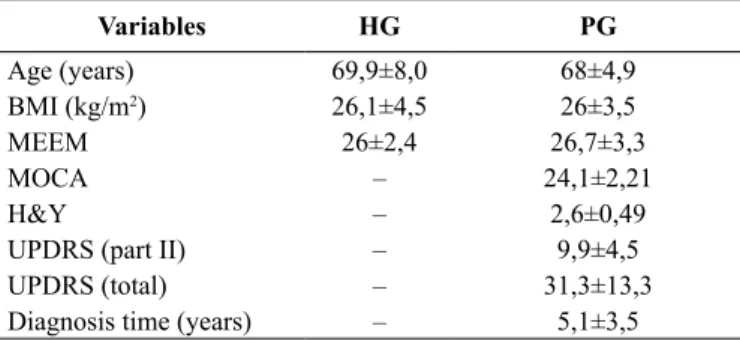
The baseline data is presented in Table 1 and the similarity of the groups is demonstrated.
Signiicant differences between the groups were reported
for A-COP sway (P = 0.002, with large effect size d = 1.20, HG < PG) and mean velocity (VEL) for anterior-posterior (A/P) direction of movement (P = 0.037, with medium effect size d = 0.70, HG < PG). Overall, the Parkinson’s group presented poor postural control compared with healthy individuals, with
signiicance exception only for the VEL M/L variable (P = 0.487). These results are reported in Table 2.
Table 1. Subject characteristics.
Variables HG PG
Age (years) 69,9±8,0 68±4,9
BMI (kg/m2) 26,1±4,5 26±3,5
MEEM 26±2,4 26,7±3,3
MOCA – 24,1±2,21
H&Y – 2,6±0,49
UPDRS (part II) – 9,9±4,5
UPDRS (total) – 31,3±13,3
Diagnosis time (years) – 5,1±3,5
BMI, body mass index; H&Y, modiied Hoehn & Yahr Scale; UPDRS, Uniied Parkinson’s Disease Rating Scale; MEEM, Mini-Mental State
Examination; MOCA, Montreal Cognitive Assessment; kg, body mass; m2,
square meters.
P > 0,05 for age, BMI and MEEM.
Table 2. Postural sway variables in healthy older adults (HG) and Parkinson’s disease individuals (PG).
Variables HG PG P
A-COP (cm2) 10,1±2.9 16,5±7,7 0,002* Vel A/P (cm/s) 3,0±0.8 3,6±0,9 0,03* Vel M/L (cm/s) 3,7±1.0 3,9±0,9 0,48
Time (s) 20,0±5,0 17,8±7,4 0,36
Data are presented as mean and standard deviation (±).
COP, Area of Center of Pressure; VEL A/P, velocity anterior-posterior; VEL M/L, velocity medial-lateral; cm2, squared centimeters; cm/s, centimeters per
second.
*data statistically signiicant (P-value of 5%).
Discussion
Maintenance of balance and body orientation while in an upright posture is critical for performing activities of daily living. Therefore, investigation into how body balance and orienta-tion are controlled has raised the interest of professionals from
diverse ields. In each new posture adopted by an individual,
neuromuscular responses are required to keep the body bal-anced and this maintenance is attributed to the postural control system, which includes the nervous, sensory, and motor systems responsible for this role22.
Information regarding the development of two-legged bal-ance is more abundant in the literature as opposed to studies addressing a single-legged stance. Performing only two-legged
tests limits the clinical use of data to document balance deicits.
Thus, studies addressing single-leg tests are important and necessary because individuals need to control their center of mass on one leg in order to perform various motor activities in daily living. Additionally, single-legged support may be more appropriate to provide additional information when assessing balance and determining potential disorders, as individuals may
not be challenged suficiently when performing two-legged
tests2,23,24. In this context, Chomiak and collaborators veriied in
their study that not being able to remain in a single-leg stance for at least 10 seconds is related to an increased risk of falling among individuals with PD25.
This study’s main indings reveal that the PG presented a
worse performance in the COP area represented by an oscilla-tion of more than 60% when compared to the group of healthy individuals (P = 0.002). The speed of A/P oscillation was higher in the PG (P = 0.03) but not in the M/L direction (P = 0.42).
COP anterior-posterior and medial-lateral variation, such as ankle reactions, are perceptible in normal conditions and are
characterized by small contractions of dorsilexor, plantar-lexor,
inverter and evertor muscles to regulate postural adjustments in response to small stimuli that occur in the sagittal or coronal planes.
The results also show that individuals with PD more fre-quently require anterior-posterior adjustments instead of medial-lateral adjustments and possibly use them in a less developed
form, that is, without a level of ine control to ensure greater
stability, which culminates in greater oscillation. This fact may
be explained by the fact that the plantar and dorsilexor muscles
are stronger, more resilient to fatigue and, thus, compensate for the poor work of the inverter and evertor muscles26. As is known,
automatic movements in PD are compromised and responses to postural adjustments, which vary according to demand, are automatically performed with very delicate adjustments27. In
addition to these factors, older adults with PD present marked postural changes in the anterior-posterior direction, along with rigidity and bradykinesia, which further hampers the participants’ responses and consequently, interferes in postural balance28.
Trunk lexion posture in these individuals is related to gait abnor -malities, postural instability and greater vulnerability to falls29.
The presence of postural instability is well established in individuals with PD8; the literature, however, clariies that
healthy older individuals present a greater decline in balance when compared to young adults. Parreira et al.13 veriied that
differences in balance between young adults and older adults are
signiicant and time-dependent. The participants in their study
remained in the one-leg stance for 30 seconds and that analysis was performed at 5, 10, 15 and 30 seconds. COP area in the
irst 5 seconds was signiicantly lower than in the remaining
10, 15, and 30 seconds13. This fact characterizes the detrimental
effect of the aging process on postural control.
Ickeinstein et al. (2012) veriied balance by using a force
platform with PD and healthy older adults in the Romberg position (feet together in parallel) during 30 seconds, with open and closed eyes. The COP area of individuals with PD
was signiicantly larger, which corresponds to greater postural instability. These results are in agreement with our study’s ind -ings in regard to balance among PD individuals30.
We emphasize that we use the single-leg stance in our research in order to provide more appropriate information about balance, as individuals cannot be challenged enough when subjected to tests in bipedal stance25. Moreover, there are few studies that
evaluated individuals with PD under single-leg stance condi-tions31,32,33 and these studies did not use similar methodology,
making it dificult to compare our data.
Tsutiya and collaborators, conversely, report no statistically
signiicant difference in the balance outcome between PD and
healthy individuals. However, COP average speed values were greater in the PD group compared to healthy adults. The groups were assessed using a force plate in the two-leg position with eyes open for 20 seconds34. These indings contribute to our hypoth
-esis that the two-leg position can be very stable, may not detect
balance deicits, and also that 20 seconds may be insuficient to record oscillations, which agrees with the indings reported by
Scoppa, Capraa, Gallaminia, Shiffera35, suggesting that postural
assessments aimed at better stratifying COP parameters should last at least 30 seconds35.
Beretta, Gobbi, Lirani-Silva , Simieli, Orcioli-Silva, Barbieri36 conducted one study to verify asymmetry in
ap-pendicular weight transfer among healthy and PD older adults. Two plates were used, on which participants placed one leg each, to perform two-legged, tandem and single-legged stance tests in three attempts of 30 seconds each. The conclusion was that participants with PD presented greater asymmetry than healthy individuals, especially in challenging tasks such as tandem and single-legged stance36.
It is possible that a speciic exercise program, focusing on deicits that become increasingly frequent as PD progress, can
delay the process of degeneration among individuals who have not yet presented such changes or whose changes are mild. Some authors note that aspects such as mobility and postural instability, as well as balance disorders, do not respond well to medication or surgery, so prevention is an important Alternative37.
An accurate assessment is essential for these deicits to be
detected, reversed or minimized by proper and early therapeu-tic intervention. As posturography assesses postural control and is based on the determination of variables associated with displacement of the COP, which is the point of application of the resultant of vertical force components where they intersect with the support surface, balance measures acquired with the
use of a force plate enable the identiication of small changes
in posture and have been described as highly sensitive, used as a reference to determine changes in postural control38.
Therefore, it is suggested that the treatment plan includes, with an emphasis on improving the balance of these individuals, exercises that follow an evolutionary course and explore the
following: 1) different bases of support, such as the Romberg position, Tandem and single-leg stance; 2) changing the center of gravity and the limits of body stability, with activities that stimulate the postural transitions; 3) activities of the arms and rotational movements of the trunk; 4) using different thera-peutic resources that stimulate the reactions anticipatory and compensatory balance such as foams, balls, step bench, bosu, trampolines; 5) sensory integration exercises with open eyes and closed eyes.
Among this study’s limitations, we note that results cannot be generalized to individuals in the more advanced stages of PD or to other postures, such as two-leg, Romberg or tandem, which also have functional importance.
Although, these data refer to the assessment of individuals in stage “on” of the medication. Assessments in stage “off” should be performed to compare these values.
Conclusion
Older adults with PD presented greater postural balance
deicits in the single-leg stance when compared to healthy in -dividuals. These results suggest that PD may negatively impact postural balance, leading to greater postural oscillations and, as a consequence, greater instability. The discussion previously presented consolidates the importance of introducing exercises to explore the single-leg stance in rehabilitation programs directed to participants with PD.
References
1. Jiang X, Cooper J, Porter MM, Ready AE. Adaptation of Canada’s physical activity guide and handbook for older adults: impact on functional itness and energy expenditure. Can J Appl Physiol. 2004; 29:395-410.
2. Victor LGV(incluir os outros cinco autores) et al. Postural control during one-leg stance in active and sedentary older people. Revista de Educação Física. 2014; 20(3): 339-345.
3. Viswanathan A, Sudarsky L. Balance and gait problems in the elderly. Handb Clin Neurol. 2012; 103: 623-34.
4. Figliolino JA, Morais TB, Berbel AM, Corso SD. Análise da inluência do exercício físico em idosos com relação a equilí -brio, marcha e atividade de vida diária. Rev Bras Geriatr Geront. 2009;12(2):227-38.
5. Freitas EV, Py L Cançado FA, Doll J, Gorzone ML. Tratado de geria-tria e gerontologia. 2 ed. Rio de Janeiro: Guanabara Koogan; 2006. 6. Scalzo PL, Flores CR, Marques JR, Robini SCO, Teixeira AL.
Impact of changes in balance and walking capacity on the quality of life in patients with Parkinson’s disease. Arq Neuropsiquiatr. 2012; 70(2): 119-124.
7. Duncan RP, Leddy ALL, Earhart GM. Five tives sit-to-stand test performance in Parkinson’s disease. Arch Phys Med Rehabil. 2011; 92.
9. Jacobs JV, Dimitrova DM, Nutt JG, Horak FB. Can stooped posture explain multidirectional postural instability in patients with Parkison’s disease? Exp Brain Res. 2005; 166(1): 77-88. 10. Horak FB, Wrisley DM, Frank J. The Balance Evaluation
Systems Test (BESTest) to Differentiate Balance Deicits. Phys Ther. 2009; 89(5): 484-498.
11. Lin D, Seol H, Nussbaum MA, Madigan ML. Reliability of COP-based postural sway measures and age-related differences. Gait Posture. 2008; 28(2): 337–342.
12. Jonsson E, Seiger A, Hirschfeld H. One-leg stance in healthy young and elderly adults: a measure of postural steadiness? Clin Biomech. 2004; 19(7): 688–694.
13. Parreira RB, Boer MC, Rabello L, Costa VDSP, De Oliveira Jr E, Da Silva RA. Age-related differences in center of pressure measures during one-leg stance are time dependent. J Appl Biomech. 2013; 29(3): 312-316.
14. Nardone A, Schieppati M. The role of instrumental assessment of balance in clinical decision making. Eur J Phys Rehabil Med. 2010; 46(2): 221–237.
15. Hughes AJ(incluir os outros cinco primeiros autores) et al. Accuracy of clinical diagnosis of idiopathic Parkinson's disease: a clinico-pathological study of 100 cases. J Neurol Neurosurg Psychiatry. 1992: 181-184.
16. Hoehn MM, Yahr MD. Parkinsonism: onset, progression and morbidity. Neurology. 1967; 427-242.
17. Fahn S, Elton RL, Members of the UPDRS Development Committee. In: Fahn S, Marsden CD, Calne DB, Goldstein M. eds. Recent developments in Parkinsons disease, Vol 2. Florham Park, NJ. Macmillan Healthcare Information 1987, 153-163, 293-304.
18. Folstein MF, Folstein SE, Mchugh PR. MiniMental State: a practical method for grading the cognitive state of patients for clinician. J Psychiat Res. 1975; 12: 189-198.
19. Nasreddine ZS. The Montreal Cognitive Assessment, MoCA: a brief screening tool for mild cognitive impairment. Jour of Amer Geriat Soc 2005; 53(4): 695-99.
20. da Silva RA, Martin B, Parreira RB, Teixeira DC, Amorim CF. Age-related differences in time-limit performance and force platform-based balance measures during one-leg stance. J Electromyogr Kines. 2013; 23: 634–639.
21. Cohen J. Statistical Power Analysis for the Behavioral Sciences, second ed. Lawrence Earlbaum Associates, Hillsdale. 1988. 22. Duarte M, Freitas SMSF. Revisão sobre posturograia baseada
em plataforma de força para avaliação do equilíbrio. Rev Bras Fisioter. 2010;14:183-92.
23. Moraes AG, David AC, Castro OG, Marques BL, Carolino MS, Maia EM. Comparação do equilíbrio postural unipodal entre cri-anças e adultos. Rev Bras Educ Fís Esporte. 2014;28(4):571-577. 24. Gil AWO, Oliveira MR, Coelho VA, Carvalho CE, Teixeira
DC, Silva RA. Relationship between force platform and two functional tests for measuring balance in the elderly. Braz J Phys Ther. 2011;15(6):429-435.
25. Chomiak T, Pereira FV, Hu B. The Single-Leg-Stance Test in Parkinson’s Disease. J Clin Med Res. 2015;7(3):182-185. 26. Batista M, Roschel H, Barroso R, Ugrinowitsch C, Tricoli V.
Potencialização pós-ativação: possíveis mecanismos isiológicos e sua aplicação no aquecimento de atletas de modalidades de potência. Rev Educ Fís. 2010;21(1):161-174.
27. Carpenter MG, Allum JHJ, Honegger F, Adkin AL, Bloem BR. Postural abnormalities to multidirectional stance perturba-tions in Parkinson’s disease. J Neurol Neurosurg Psychiatry. 2004;75:1245-1254.
28. Nanhoe-Mahabier W, Allum JHJ, Overeem S, Borm GF, Oude Nijhuis LB, Bloem BR. First Trial Reactions And Habituation Rates Over Successive Balance Perturbations In Parkinson’s Disease. Neuroscience. 2012;217:123–129.
29. Nair P, Bohannon RW, Devaney L, Livingston J. Measurement of anteriorly lexed trunk posture in Parkinson’s disease (PD): a systematic review. Phys Ther Rev. 2015;20:225-232.
30. Ickenstein GW, Ambach H, Klöditz A, Koch H, Isenmann S, Reichmann H, Ziemssen T. Static posturography in aging and Parkinson’s disease. Front Hum Neurosci. 2012;4:1-7.
31. Mak MKY, Pang MYC. Balance confidence and functional mobility are independently associated with falls in people with Parkinson’s disease. J Neurol. 2009; 256: 742–749.
32. Falvo MJ, Earhart GM. Reference Equation for the Six-Minute Walk in Individuals with Parkinson Disease. J Rehabil Res Dev. 2009; 46(9):1121–1126.
33. Hackney ME, Earhart GM. Tai Chi Improves Balance and Mobility in People with Parkinson Disease. Gait Posture. 2008;28(3):456–460.
34. Tsutiya N, Christovão TCL, Grecco LAC, Costa RV, Monteiro FF, Oliveira. CS. Comparative Analysis of Postural Balance in Elderly Individuals With and Without Parkinson’s Disease. UNOPAR Cient Ciênc Biol Saúde. 2011;13(3):181-5.
35. Scoppa F, Capraa R, Gallaminia M, Shiffera R. Clinical stabi-lometry standardization: basic deinitions acquisition interval sampling frequency. Gait Posture. 2013;37(2):290–292. 36. Beretta VS, Gobbi LTB, Lirani-Silva E, Simieli L, Orcioli-Silva
D, Barbieri FA. Challenging Postural Tasks Increase Asymmetry in Patients with Parkinson’s Disease. PLoS ONE. 2015; 10(9). 37. Dereli EE, Yaliman A. Comparison of the effects of a
physiothera-pist supervised exercise programme and a self-supervised exercise programme on quality of life in patients with Parkinson’s disease. Clin Rehabil. 2010;24(4):352-62.
38. Sabchuk RAC, Bento PCB, Rodacki ALF. Comparação entre testes de equilíbrio de campo e plataforma de força. Rev Bras Med Esporte. 2012;18(6).
Corresponding author
Suhaila Mahmoud Smaili Santos
Department of Physiotherapy, State University of Londrina, Londrina, Paraná, Brazil Email: [email protected]
Manuscript received on May 14, 2016 Manuscript accepted on June 12, 2016