Safety and efficacy of hypertonic saline versus
isotonic saline solution in off-pump coronary artery
bypass grafting
Ricardo de Mola,IJorge Flo´rio,II Vanessa R. Pescioto,IDouglas Humberto Lovatti,I
Luis Alberto Oliveira Dallan,III Roberto Rocha-e-Silva,I,II,IIIdedicated to Luiz Poli de Figueiredo.
IPitangueiras Hospital Jundiaı´–Brazil, Cardiovascular Surgery;IIJundiai School of Medicine, Jundiaı´ – Brazil, Department of Thoracic Surgery;IIISa˜o Paulo University, Faculdade de Medicina - Heart Institute
OBJECTIVES: Off-pump coronary artery bypass grafting occurrence increases constantly. However transient low cardiac output events occur during this procedure requiring aggressive volume replacement, which may lead to hypervolemia and its complications.
METHOD: This study evaluates the safety and efficacy of a hypertonic-hyperoncotic NaCl solution (6% hydroxyethyl-amide + 7.5% sodium chloride) versus isotonic saline during the creation of anastomosis in the lateral wall of the left ventricle. In each case, 250 ml of solution was administered from coded bags at the start of the grafting procedure. All staff directly connected with the surgical procedure and post-operative management of patients was blinded to the coding. The primary objective was the determination of post-surgery complications. Secondary objectives were the determination of mean arterial blood pressure and central venous pressure during anastomotic grafting.
RESULTS: Primary objectives showed no difference between hypertonic versus isotonic saline in post-operatory surgery complication. Significant increases of mean arterial pressure and central venous pressure in the Hypertonic Saline group versus normal saline patients during grafting were observed.
CONCLUSION: The use of hypertonic saline during off-pump coronary artery bypass grafting on the lateral posterior wall of the left ventricle led to no complications and improved arterial and central venous pressure, favoring the creation of anastomosis in this wall.
KEYWORDS: cardiac surgery; hypertonic-hyperoncotic solution; cardiopulmonary bypass; off-pump; beating heart.
Mola R, Flório J, Pescioto VR, Lovatti DH, Dallan LAO, Rocha e Silva R.. Safetyandefficacyofhypertonicsalineversusisotonicsalinesolution inoff-pumpcoronaryarterybypassgrafting.MEDICALEXPRESS.2014;1(1):27-30.
Received for publication onDecember 12 2013;First review completed onDecember 18 2013;Accepted for publication onJanuary 22 2014 E-mail: [email protected]
’ INTRODUCTION
In on-pump cardiovascular surgery, priming composed of isotonic crystalloid solution leads to a leakage of fluid into the extra vascular space;1hemodilution below 20% becomes a risk factor for morbimortality.2 Studies have shown that hypertonic solutions whether combined with colloids such as dextran or 6% hydroxyethyl starch or not promote a negative water balance, improved cardiac output, decreased systemic vascular resistance and reduce the need for blood products.3-9 These benefits have also been shown for volume replacement with hypertonic solutions during the postoperative period following off-pump coronary artery bypass grafting.10
Off-pump coronary artery bypass grafting reduces blood losses, myocardial infarction, acute renal failure,
mediastinitis, stroke and prolonged orotracheal intubation particularly in subgroups of higher-risk patients.11
During the creation of anastomosis in off-pump surgery, especially in the lateral wall, there is a lowering of cardiac output due to the required rotation of the heart.12 The combination of cardiac rotation with transient ischemia to create the anastomosis also promotes transient mitral regurgitation.13 The standard correction for this condition consists of the administration of vasopressors combined with volume expansion using saline solution. This expansion promotes a positive water balance because most of the fluid is lost into the interstitium.14
Hypertonic saline solution promotes a faster and more efficient volume expansion than does saline solution because it transfers water into the extracellular compartment through its osmotic power; the hyperoncotic component of the solution enhances this effect by shifting fluid from the interstitium to the intravascular compartment. Such effects last for, approximately one hour.15 Therefore, we hypo-thesized that these characteristics of hypertonic-hyperoncotic
RAPID COMMUNICATION
There was no financial support for the project.
DOI:
27
w w
N : 3 w
1 .59 /MedicalExpress.2014.01.060 35
Copyright © 2014 MEDICALEXPRESS. This is an open access article distributed under the terms of the creative commons attribution
Non-Commercial License (creativecommons.org/licenses/by-nc/4.0/) which permits unrestricted non commercial use, distribution
saline solutions represent an ideal expander for the creation of left wall ventricular anastomosis requiring the most intense cardiac rotation.
To the best of our knowledge, there are no studies on the use of a hypertonic saline solution during the creation of anastomosis in off-pump coronary artery bypasses grafting. The primary objective of this study was to compare the occurrence of complications during and after off-pump coronary artery bypass grafting. Comparisons were made between patients treated with hypertonic-hyperoncotic versus treated with normal saline.
As a secondary objective we evaluated the hemodynamic effect of using the hypertonic-hyperoncotic treatment versus normal saline during the creation of anastomosis of the lateral posterior wall of the left ventricle. This evaluation was performed through measurements of mean arterial pressure and central venous pressure at one, five and ten minutes after the start of anastomosis.
’ MATERIALS AND METHODS
This study was approved by the research ethics commit-tee (Comiteˆ de E´tica em Pesquisa # 298/2011) of the School of Medicine of Jundiaı´. Free and informed written consent form was obtained from all participants prior to their inclusion in the study.
This is a prospective study of 20 consecutive patients with coronary artery disease subjected to coronary artery bypass grafting at Pitangueiras Hospital Jundiaı´ – Sa˜o Paulo (SP) in the period from 09/27/2011 to 02/28/2012. In this hospital, the off-pump coronary artery bypass grafting method is used in all patients, unless complications required reversion to on-pump. No reversion occurred in the period 2011-2012. Exclusion criteria were patients with no need for lateral wall revascularization or with any prior procedure associated with coronary artery bypass grafting. Patients were rando-mized into two groups as follows: groupHS(n = 11), where in patients received hypertonic-hyperoncotic solution (6% hydroxyethylamide + 7.5% sodium chloride) and group
SS. (n = 9) where in patients received normal saline solution (0.9% sodium chloride). The vials were randomized and coded and the surgical team was blinded to treatment assignments until the end of the study.
Patients were prepared in the operating room with continuous electrocardiographic monitoring, pulse oxime-try, peripheral and central venous access, invasive arterial pressure, urine output via Foley catheter and capnography after orotracheal intubation. Brain activity was monitored using the BISs(Bispectral index). Temperature control was performed using an esophageal thermometer and a thermal mattress.
Anesthesia was induced with midazolam (0.05 to 0.1 mg/ Kg) and with the hypnotic agent etomidate (0.2 to 0.3 mg/ Kg), muscle relaxants rocuronium (0.6 to 1.2 mg/Kg) oratracurium (0.5 mg/Kg) and the opioids sufentanil (1.0 to 5.0mg/Kg) or remifentanil (1 to 3mg/Kg).
The continuation of the anesthetic plan aimed to maintain a BISs
level below 60 using inhalational anesthetics (isoflurane) and intravenous anesthetics propofol (50 to 150 mg/Kg/min), sufentanil (0.01 to 0.05 mg/Kg/min) or remifentanil (0.1 to 0.25mg/Kg/min). All patients used the ‘‘Cell Saver’’s device according to the hospital’s routine procedure.
All distal anastomosis were created using the Octopus tissue stabilizer (Medtronics) and, whenever possible, using an Intracoronary Shunt (Medtronics
).
The revascularization procedure began by anastomosis of the anterior descending and diagonal arteries using small cardiac rotation. After that, cardiac rotation increased to access lateral posterior wall of left ventricle. During this procedure, the administration ofHS orSSwas initiated according to a double-blind randomization at a dose of 250 ml (regardless of weight) for at least 10 minutes and, in simultaneity, anastomosis of lateral posterior wall was started.
The primary objective was the occurrence of postopera-tive complication.
Mean arterial pressure and central venous pressure were collected at time-points T1, T5 and T10 (at 1, 5 and 10 minutes), respectively, after the start of the anastomosis in the left lateral posterior wall. Whenever anastomosis was completed in less than 10 minutes, T10 was considered the time at anastomosis completion. Mean arterial pressure and central venous pressure, which are the secondary objectives of this study, were measured at these time-points.
The comparison of qualitative variables was performed using Fisher’s exact test because the assumptions of chi-square test were not satisfied. The comparison of quantita-tive variables between the two groups was performed using nonparametric Mann-Whitney test because, in many cases, the assumption of data normality was rejected. Repeated-measures analysis of variance was performed to detect differences between groups regarding arterial and central venous pressure at the three time-points because the assumption of normality for these variables was fulfilled according to the Shapiro-Wilk test. The significance level adopted for all statistical tests was 5%.
’ RESULTS
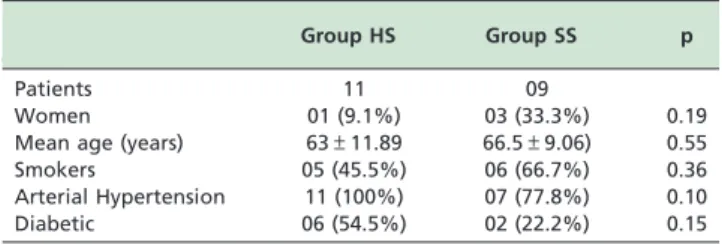
The groups’ demographic and medical comorbidities data are shown in Table 1. Statistical analysis showed revealed no significant differences between the groups for baseline parameters.
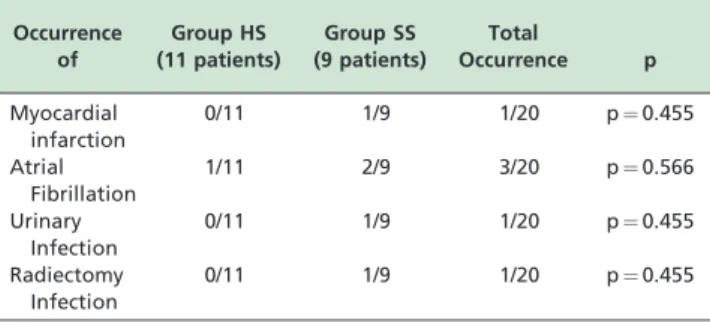
Table 2 displays the analysis of the primary objectives. No significant differences were found in the occurrence of myocardial infarction, atrial fibrillation, urinary infection or radiectomy infection. No other complications were recorded. There were no cases of switch from off-pump to on-pump surgery.
Analysis of the secondary objectives showed a significant increase in the MAP in groupHSrelative to groupSS(p = 0.021) at time-point T1; There was a borderline significance for the average MAP through the three measurements (Table 3).
A significant increase in the CVP of group HS relative to group SS (p = 0.007) was detected at time-point T5;
Table 1 -Distribution of numbers, sex, age and cardiovascular risk factors in Groups HS and SS
Group HS Group SS p
Patients 11 09
Women 01 (9.1%) 03 (33.3%) 0.19
Mean age (years) 63±11.89 66.5±9.06) 0.55
Smokers 05 (45.5%) 06 (66.7%) 0.36
Arterial Hypertension 11 (100%) 07 (77.8%) 0.10
Diabetic 06 (54.5%) 02 (22.2%) 0.15
28
Hypertonic saline for off-pump coronary grafting
The average CVP throughout the measurement period was also significantly greater for theHSgroup relative to group
SS(p = 0.034) at time-points T1, T5 and T10 (Table 4).
’ DISCUSSION
Patient randomization resulted in two similar groups, and the primary objective analysis showed that the use of hypertonic-hyperoncotic solutions in off-pump coronary artery bypass surgery is a safe procedure, because it did not increase the occurrence of postoperative complication betweenHSandSS.
The secondary objective analysis showed that the off-pump use of HS during surgery on the lateral posterior cardiac wall provides superior hemodynamic conditions as indicated by the significant increase in arterial pressure, especially at the beginning of anastomosis. This increase must result from the transient expansion provided by the
HS as shown by the significant increase in CVP. In the experience of the team handling this study, the use ofHS
facilitated the handling of these grafts by maintaining a higher systemic pressure with adequate blood volume.
This transient expansion has no subsequent effects because water balance and diuresis were similar in both groups. Therefore,HSappears to be an ideal expander for this procedure. Patients not treated in this manner exhibit a transient drop in mean arterial pressure when the heart is rotated for exposure of left lateral wall arteries.
Limitation. This study has two interconnected limitations. The total population is not sufficiently large to warrant conclusions with respect to the secondary objective. The study may not be expanded because the Brazilian National Health Agency (ANVISA) has removed this particular HS formulation from the list of approved formulations.
The authors therefore consider this as a preliminary indication that further studies, either with hypertonic saline or with an eventually acceptable hypertonic-hyperoncotic solution should be pursued.
’ CONCLUSIONS
We conclude that HS (a) is safe because no difference was found between both solutions in occurrence of post-operatory complications and (b) that the use of a HSduring off-pump coronary artery bypass grafting on the lateral posterior wall results in improved MAP and CVP compared to the use ofSS, favoring the creation of anastomosis in this wall.
’ RESUMO
OBJETIVO:A frequeˆncia de revascularizac¸a˜o do mioca´rdio sem circulac¸a˜o extracorpo´rea aumenta continuamente. No entanto eventos transito´rios de baixo de´bito cardı´aco podem ocorrer durante este procedimento; requerem reposic¸a˜o de volume agressiva, o que pode levar a hipervolemia e suas complicac¸o˜es.
ME´ TODOS: Este estudo avalia a efica´cia e seguranc¸a de uma soluc¸a˜o hiperto´nica - hiperonco´tica NaCl (cloreto de so´dio a 7,5 % + hidroxietilamida 6%) versus soluc¸a˜o salina isotoˆnica durante a criac¸a˜o de anastomose na parede lateral do ventrı´culo esquerdo. Em cada caso, 250 ml de soluc¸a˜o foram administrados no inı´cio do procedimento de enxerto a partir de bolsas codificadas. Todos os agentes ligados ao procedimento ciru´rgico e a` gesta˜o po´s-operato´ria dos pacientes foram mantidos cegos em relac¸a˜o a` codificac¸a˜o. O objetivo principal foi a determinac¸a˜o de complicac¸o˜es po´s-operato´rias. Os objetivos secunda´rios foram a determinac¸a˜o da pressa˜o arterial me´dia e da pressa˜o venosa central durante procedimento de anastomose.
RESULTADOS: Os objetivos prima´rios na˜o mostraram diferenc¸a entre hipertoˆnica salina isotoˆnica em relac¸a˜o complicac¸a˜o da cirurgia no po´s-operato´rio. Em relac¸a˜o ao objetivo secunda´rio, observamos um aumento significativo da pressa˜o arterial me´dia e da pressa˜o venosa central no grupo soluc¸a˜o hipertoˆnica vs. grupo soro fisiolo´gico durante a criac¸a˜o da anastomose.
CONCLUSA˜ O: O uso de soluc¸a˜o salina hipertoˆnica durante cirurgia de revascularizac¸a˜o da parede posterior lateral do ventrı´culo esquerdo do mioca´rdio sem circulac¸a˜o extracorpo´rea na˜o apresentou complicac¸o˜es e resultou em melhor arterial e da pressa˜o venosa central, favorecendo a criac¸a˜o de anastomose nesta parede.
’ REFERENCES
1. Rex S, Scholz M, Weyland A, Busch T, Schorn B, Buhre W. Intra- and extravascular volume status in patients undergoing mitral valve repla-cement: crystalloid vs. colloid priming of cardiopulmonary bypass.Eur J Anaesthesiol. 2006;23(1):1-9.
2. De Foe GR, Ross CS, Olmstead EM, Fillinger MP, Groom RC, Forest RJ, et al. Lowest hematocrit on bypass and adverse outcomes associated with coronary artery bypass grafting.Ann Thorac Surg. 2001;71(3):769-76. Table 4 -Central Venous Pressures at time-points T1. T5 and T10 in groups HS and SS
CVP Group HS Group SS p
T1 9.3±2.6 8.0±1.8 0.236
T5 9.5±1.9 7.2±1.3 0.007
T10 10.1±3.6 7.7±2.0 0.095
Average 9.6 7.6 0.034
CVP: Central venous pressure; Group HS: hypertonic –hyperoncotic solution; Group SS: saline solution; T1: CVP at starting anastomosis time-point; T5: at five minutes after starting anastomosis time-time-point; T10: at ten minutes after starting anastomosis time-point; Average: CVP of group HS and Group SS at time-point T1, T5 and T10.
Table 2 -Occurrence of complications in groups HS and SS
Occurrence of
Group HS (11 patients)
Group SS (9 patients)
Total
Occurrence p
Myocardial infarction
0/11 1/9 1/20 p¼0.455
Atrial Fibrillation
1/11 2/9 3/20 p¼0.566
Urinary Infection
0/11 1/9 1/20 p¼0.455
Radiectomy Infection
0/11 1/9 1/20 p¼0.455
Table 3 -Mean arterial pressure at time-points T1. T5 and T10 in groups HS and SS
MAP Group HS Group SS p
T1 69.9±6.4 60.9±9.4 0.021
T5 67.6±8.7 62.4±5.8 0.102
T10 65.4±8.8 62.0±5.8 0.297
Average 67.9 61.4 0.057
MAP: Mean arterial pressure; Group HS: hypertonic-hyperoncotic solu-tion; Group SS: saline solusolu-tion; T1: MAP at starting anastomosis time-point; T5: at five minutes after starting anastomosis time-time-point; T10: at ten minutes after starting anastomosis time-point; Average: MAP of group HS and Group SS at time-point T1, T5 and T10.
29
MEDICALEXPRESS 2014;1(1):27-30 Hypertonic saline for off-pump coronary grafting
3. Oliveira AS, Bueno RM, Souza JM, Senra DF, Rocha e Silva M. Effects of hypertonic saline dextran on the postoperative evolution of Jehovah’s Witness patients submitted to cardiac surgery with cardiopulmonary bypass.Shock. 1995;3(6):391-4.
4. Sirieix D, Hongnat JM, Delayance S, D’Attellis N, Vicaut E, Berrebi A, et al. Comparison of the acute hemodynamic effects of hypertonic or colloid infusions immediately after mitral valve repair.CritCare Med. 1999;27(10):2159-65.
5. Rocha-e-Silva R, Caneˆo LF, Lourenc¸o Filho DD, Jatene MB, Barbeiro-Marcial M, Oliveira AS,et al. First use of Hypertonic Saline Dextran in children. A study in atrial septal defect surgery. Shock. 2003;20(5):427-30.
6. Boldt J, Zickmann B, Ballesteros M, Herold C, Dapper F, Hempelmann G. Cardiorespiratory responses to hypertonic saline solution in cardiac operations.Ann Thorac Surg. 1991;51(4):610-5.
7. Boldt J, Zickmann B, Herold C, Ballesteros M, Dapper F, Hempelmann G. Influence of hypertonic volume replacement on the microcirculation in cardiac surgery.Br J Anaesth. 1991;67(5):595-602.
8. Tollofsrud S, Noddeland H. Hypertonic saline and dextran after cor-onary artery surgery mobilizes fluid excess and improves cardior-espiratory functions.Acta Anaesthesiol Scand. 1998;42(2):154-61. 9. Kvalheim VL, Farstad M, Steien E, Mongstad A, Borge BA, Kvitting PM,
et al. Infusion of hypertonic saline/starch during cardiopulmonary
bypass reduces fluid overload and may impact cardiac function.Acta Anaesthesiol Scand. 2010;54(4):485-93.
10. Mustafa I, Leverve XM. Metabolic and hemodynamic effects of hyper-tonic solutions: sodium-lactate versus sodium chloride infusion in postoperative patients.Shock. 2002;18(4):306-10.
11. Bottio T, Rizzoli G, Caprili L, Nesseris G, Thiene G, Gerosa G. Full-sternotomy off-pump versus on-pump coronary artery bypass proce-dures: in-hospital outcomes and complications during one year in a single center.Texas Heart Inst J. 2003;30(4):261-7.
12. Chang WI, Kim KB, Kim JH, Ham BM, Kim YL. Hemodynamic changes during posterior vessel off-pump coronary artery bypass: comparison between deep pericardial sutures and vacuum-assisted apical suction device.Ann Thorac Surg. 2004;78(6):2057-62.
13. Ozay B, Sargin M, Abay G, Ketenci B, Kut S, Enc Y,et al. The Severity of Positional Mitral Regurgitation during Off-Pump Coronary Artery Bypass Grafting.Heart Surg Forum. 2008;11(3):E145-51.
14. Mishra M, Malhotra R, Mishra A, Meharwal ZS, Trehan N. Hemody-namic changes during displacement of the beating heart using epicardial stabilization for off-pump coronary artery bypass graft surgery. J Cardiothorac Vasc Anesth. 2002;16(6):685-90.
15. Rocha e Silva M, Negraes GA, Soares AM, Pontieri V, Loppnow L. Hypertonic resuscitation from severe hemorrhagic shock: patterns of regional circulation.Circ Shock. 1986;19(2):165-75.
30
Hypertonic saline for off-pump coronary grafting