338
Bleeding and the complications related to hemotransfusion continue to be 1 of the major factors of morbidity and mortality in cardiac surgery. Knowledge about the risk factors 1 for this com-plication is fundamental for the adoption of therapeutic and pre-ventive measures.
However, the multifactorial nature of the problem requires the implementation of universal protocols 2, invariably implying alterations in coagulation caused by extracorporeal circulation. The methods proposed to minimize blood loss in cardiac surgery include the use of cell saver3, autotransfusion4, heparin-bonded circuits 5, leukocyte filters 6, and antifibrinolytic drugs 7. The di-sadvantages of these methods reside in their elevated costs for routine, wide implementation.
The advent of myocardial revascularization without extracor-poreal circulation has renewed interest in this field due to incor-poration of new technology and knowledge of its results, confirming its feasibility in a large group of patients 8. Recent studies 9,10 have suggested that this technique reduces postoperative bleeding, the need for transfusion, and hospital costs. Few studies specifically analyze smaller blood loss as an advantage of myocardial revascu-larization without extracorporeal circulation, with relevant impli-cations in terms of postoperative morbidity.
This study aimed at comparing myocardial revascularization with and without extracorporeal circulation in regard to postope-rative bleeding and the need for blood and hemoderivate transfusion.
Methods
From November 2001 to February 2002, 186 consecutive patients with coronary heart disease indicated for surgical treatment were assessed in a prospective nonrandomized study. Patients undergoing associated surgical procedures were excluded. The patients were divided into 2 groups according to the type of myocardial revascularization performed, which was decided by the clinicosurgical staff responsible for each case. The authors did not participate in the selection of the type of surgical treatment adopted. Group A comprised 116 patients undergoing myocardial re-vascularization with extracorporeal circulation, and group B com-prised 69 patients undergoing MR without extracorporeal circula-tion. The male sex predominated in both groups, 93 (80.2%) male patients in group A and 47 (68.1%) in group B. The ages ranged from 37 to 84 (mean of 62.5 ± 10.4) years in group A, and from 43 to 84 (mean of 64.9 ± 10.8) years in group B. No
Original Article
Myocardial Revascularization Surgery without
Extracorporeal Circulation Minimizes Postoperative
Bleeding and the Need for Transfusion
Fernando Antibas Atik, Leonardo Augusto Miana, Fábio B. Jatene,
José Otávio C. Auler Júnior, Sérgio Almeida de Oliveira
São Paulo, SP - Brazil
Instituto do Coração do Hospital das Clínicas - FMUSP Correspondência: Fernando A. Atik - Av. Chibaras, 626/101 Cep 04076-003- São Paulo, SP - E-mail: [email protected] Recebido para Publicação em 17/8/03
Aceito em 3/12/03
Objective
To compare myocardial revascularization (MR) with and wi-thout extracorporeal circulation (ECC) in regard to postoperative bleeding and the need for blood and hemoderivate transfusion.
Methods
From November 2001 to February 2002, 186 patients un-dergoing myocardial revascularization were assessed, excluding those who underwent associated procedures. The patients were divided into 2 groups as follows: group A – comprising 116 pa-tients undergoing MR with ECC; and group B – comprising 69 patients undergoing MR without ECC. Both groups were compa-rable in regard to pre- and intraoperative characteristics, except for the greater number of distal anastomoses (P=0.0004) in group A, and greater prothrombin activity (P=0.04) and INR (P=0.03) in group B. To avoid discrepancies between the groups, 140 patients with statistically similar characteristics were selected.
Results
Studying the paired groups, both the total bleeding volume in 24 hours (P=0.001) and the bleeding volume indexed for body surface (P=0.004) were greater in group A (609.6 ± 395.8 mL; 331.8 ± 225.8 mL/m2, respectively) than in group B (437.2 ±
315 mL; 241 ± 173.9 mL/m2, respectively). Although the need for
transfusion was not significantly different between the groups (P=0.1), the amount of erythrocyte concentrate transfused was greater in group A (P=0.01). No statistical difference was observed in regard to transfusion of other hemocomponents and the need for surgical review of hemostasis.
Conclusion
Myocardial revascularization without ECC was more advan-tageous than MR with ECC in regard to smaller postoperative blood loss and a lesser need for transfusion of erythrocyte con-centrate. The repercussions of this finding may be innumerable, particularly in regard to minimization of morbid factors and hos-pital costs.
Key words
339
patient required, due to technical difficulties, the conversion of myocardial revascularization without extracorporeal circulation to MR with extracorporeal circulation.
Group A patients were conventionally anesthetized and prepa-red. The access route was a median sternotomy, followed by a longitudinal pericardiotomy. Extracorporeal circulation was institu-ted after administration of 4 mg/kg of heparin to obtain an activa-ted clotting time (ACT) > 480 seconds. In our institution, cannula-tion of the ascending aorta is performed in sites with no atheroma-tous processes, and double venous cannulation or a 2-stage cannu-la is used in the right atrium according to the surgeon’s preference. The arterial flow is kept around 2.4 L/m2/min-1, to maintain mean arterial blood pressure between 50 and 70 mm Hg. Most surgeons in our institution adopt mild systemic hypothermia, but some prefer normothermia. The myocardial protection chosen was cold blood or normothermic cardioplegia, or even intermittent aortic clam-ping, depending on the preference of the surgical team. After leaving extracorporeal circulation and replacing the priming volume, circulating heparin was neutralized by the administration of pro-tamine in the proportion of 1:1 in regard to heparin.
Group B patients were anesthetized and prepared as were group A patients, ensuring that adequate blood volume was main-tained (preferential administration of colloid solutions) and that heart rate was controlled with the administration of intravenous metoprolol. All patients underwent conventional median sternoto-my, with reduced cutaneous extension for esthetic purposes. After opening the pericardium and dissecting the grafts to be used for myocardial revascularization, heparin was administered at the dosage of 2 mg/kg to maintain the activated clotting time 2 times its baseline value. Tying off of the coronary artery to be revascula-rized was routinely performed in the proximal portion of the vessel. A 4-0 polypropylene thread or a Silastic thread (Quest Medical, Inc., Dallas, TX) was used anchored in delicate silicone tubes and carefully pulled prior to arteriotomy due to the risk of vascular lesion 11. Distal anastomoses were performed with the aid of an Octopus III stabilizer (Medtronic, Minneapolis, MN). Intracoronary shunt was used in most cases, especially in large-caliber arteries and those responsible for the blood supply in a significant myocardial area in the absence of collateral circulation. Proximal anastomosis of the venous grafts was performed by use of partial clamping of the aorta, or in Y anastomoses with the internal thoracic artery. After performing the last anastomosis, circulating heparin was neutralized with the administration of protamine in a ratio of 0.5:1 in regard to heparin.
Postoperative bleeding was determined through the addition of the 24-hour output of all thoracic drains from the moment of thoracic closure onwards. Postoperative management was performed by a multidisciplinary team, including a cardiologist, an intensive care professional, a cardiovascular surgeon, and a hematologist. The latter was responsible for indicating transfusion of the hemocom-ponents. The authors of this study did not interfere with the cor-rection of postoperative coagulation disorders, indication of blood or hemoderivate transfusion, or both, and surgical revision of he-mostasis. Each case was individually analyzed in regard to the need for hemotransfusion, considering the hemodynamic conditions, the bleeding volume, the patient’s age, and the history of he-morrhagic disorders. The professionals involved in postoperative care knew nothing about this study and its objectives.
Some criteria for the transfusion of hemocomponents were adopted. Any bleeding considered significant (150 mL/h) in the immediate postoperative period was treated according to the result of the coagulogram. Alterations in laboratory tests in the absence of bleeding did not indicate any type of treatment. The use of protamine was indicated in the enlargement of activated partial thromboplastin time (APTT) or activated clotting time, when avai-lable, or when recirculation of heparin was suspected. When al-terations in prothrombin activity (PA) or in international normalized ratio (INR) occurred, transfusion of fresh frozen plasma was indi-cated. Platelet count below 100,000 per microliter in the presence of bleeding indicated the need for transfusion of that hemocom-ponent. Hematocrit below 28% was corrected by transfusion of erythrocyte concentrate. However, in young patients with myo-cardial reserve, a hematocrit as low as 20% was tolerated without the need for transfusion. The indication of surgical revision of hemostasia took some individual variations into consideration, but was usually established when blood loss was greater than 500 mL in the first hour, greater than 300 mL for 2 consecutive hours, or greater than 1 liter in the first 8 hours.
To determine the homogeneity between the groups, they were compared in regard to several preoperative (tab. I) and intraoperative (tab. II) characteristics. The preoperative characteristics assessed were as follows: age, sex, weight, height, presence of arterial hypertension, ejection fraction below 50% estimated using 2-dimensional echocardiography, Canadian Cardiology Society func-tional class, dialysis-dependent chronic renal failure, coagulogram with platelet count, and use of aspirin, heparin, thrombolytic agents, and IIb/IIIa protein inhibitors. The intraoperative charac-teristics analyzed were as follows: emergency surgery, reoperations, use of e-aminocaproic acid, and number of internal thoracic arteries and bypass grafts used for myocardial revascularization.
The statistical analysis was performed using Statview software (Berkeley, CA). The data were expressed as means and standard deviations or as percentages. The statistical significance level adopted was P < 0.05. The Fisher exact test and chi-square test were used for the analysis of categorical variables, and the Student t test and Wilcoxon test were used for the analysis of continuous variables.
Results
Table I shows the comparison between groups A and B in regard to the pre- and intraoperative characteristics. Both groups were considered comparable in regard to all characteristics, except for the greater number of distal anastomoses (P=0.0004) in group A, and the greater prothrombin activity (P=0.04) and international normalized ratio (P=0.03) in group B, although these values were within the normal range in both groups.
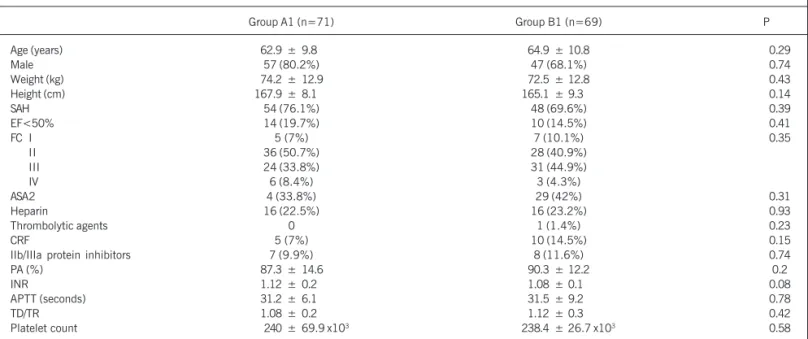
Aiming at ruling out these differences between the groups, both underwent selection using the method of the probabilities, and a subgroup of 140 patients was selected. Group A1 comprised 71 patients and group B1 comprised 69 patients. The pre- and intraoperative characteristics were statistically similar, as shown in tables II and III.
340
greater in group A1 (609.6 ± 395.8 mL; 331.8 ± 225.8 mL/m2, respectively) as compared with those in group B1 (437.2 ± 315 mL; 241 ± 173.9 mL/m2, respectively). Although the need for transfusion did not significantly differ between the groups (P= 0.1), the volume of erythrocyte concentrate transfused was greater in group A1 (P= 0.01). No statistically significant difference was observed in regard to the volumes of fresh frozen plasma, cryoprecipitate, and platelet concentrates transfused, and the need for surgical revision of hemostasia (tab. IV).
Figure 1 shows the greater need for transfusion of erythrocyte
concentrate in group A1 as compared with that in group B1. This difference was more pronounced when 3 or more units of erythro-cyte concentrate were used per patient.
Discussion
Bleeding in the postoperative period of cardiac surgery continues to be a problem, particularly with the appearance of more complex procedures with prolonged extracorporeal circulation and inter-ventions in acutely decompensated patients. Bleeding and the
Table I - Pre- and intraoperative characteristics of the groups of myocardial revascularization with ECC (A) and without ECC (B)
Group A (n=116) Group B (n=69) P
Age (years) 62.5 ± 10.4 64.9 ± 10.8 0.15
Male 93 (80.2%) 47 (68.1%) 0.90
Weight (kg) 74 ± 12.7 72.5 ± 12.8 0.46
Height (cm) 167.1 ± 8.8 165.1 ± 9.3 0.20
SAH 91 (78.4%) 48 (69.6%) 0.22
EF<50% 23 (19.8%) 10 (14.5%) 0.43
FC 2.12 2.23 0.9
ASA 39 (33.6%) 29 (42%) 0.27
Heparin 29 (25%) 16 (23.2%) 0.86
Thrombolytic agents 1 (0.9%) 1 (1.4%) 0.99
CRF 11 (9.5%) 10 (14.5%) 0.34
IIb/IIIa protein inhibitors 13 (11.2%) 8 (11.6%) 0.99
PA (%) 86.2 ± 13.1 90.3 ± 12.2 0.04*
INR 1.13 ± 0.1 1.08 ± 0.1 0.03*
APTT (seconds) 32.5 ± 13.2 31.5 ± 9.2 0.57
TD/TR 1.13 ± 0.4 1.12 ± 0.3 0.68
Platelet count 236.1 ± 39.2 x10³ 238.4 ± 26.7 x10³ 0.80
Previous MR 5 (4.3%) 4 (5.8%) 0.73
Emergency 10 (8.6%) 3 (4.3%) 0.38
EACA 16 (13.8%) 4 (5.8%) 0.14
1 ITA 84 (72.4%) 56 (81.2%) 0.24
2 ITA 16 (13.8%) 7 (10.1%) 0.65
Number of bypass grafts 3.1 ± 0.8 2.5 ± 0.9 0.0004*
* Statistically significant; ECC - extracorporeal circulation; SAH - systemic arterial hypertension; EF - ejection fraction on 2-dimensional echocardiogram; FC - functional class; ASA - use of aspirin up to 5 days prior to surgery; CRF - dialysis-dependent chronic renal failure; PA - prothrombin activity; INR - international normalized ratio; APTT - activated partial thromboplastin time; TD/TR - activated partial thromboplastin times ratio; MR - myocardial revascularization; EACA - epsilon aminocaproic acid; ITA - internal thoracic artery.
Table II - Preoperative characteristics of 140 patients undergoing myocardial revascularization with ECC (A1) and without ECC (B1)
Group A1 (n=71) Group B1 (n=69) P
Age (years) 62.9 ± 9.8 64.9 ± 10.8 0.29
Male 57 (80.2%) 47 (68.1%) 0.74
Weight (kg) 74.2 ± 12.9 72.5 ± 12.8 0.43
Height (cm) 167.9 ± 8.1 165.1 ± 9.3 0.14
SAH 54 (76.1%) 48 (69.6%) 0.39
EF<50% 14 (19.7%) 10 (14.5%) 0.41
FC I 5 (7%) 7 (10.1%) 0.35
II 36 (50.7%) 28 (40.9%)
III 24 (33.8%) 31 (44.9%)
IV 6 (8.4%) 3 (4.3%)
ASA2 4 (33.8%) 29 (42%) 0.31
Heparin 16 (22.5%) 16 (23.2%) 0.93
Thrombolytic agents 0 1 (1.4%) 0.23
CRF 5 (7%) 10 (14.5%) 0.15
IIb/IIIa protein inhibitors 7 (9.9%) 8 (11.6%) 0.74
PA (%) 87.3 ± 14.6 90.3 ± 12.2 0.2
INR 1.12 ± 0.2 1.08 ± 0.1 0.08
APTT (seconds) 31.2 ± 6.1 31.5 ± 9.2 0.78
TD/TR 1.08 ± 0.2 1.12 ± 0.3 0.42
Platelet count 240 ± 69.9 x10³ 238.4 ± 26.7 x10³ 0.58
341
consequent surgical reexploration, with frequently associated po-lytransfusion, account for an elevation in the morbidity and mortality indices in cardiac surgery 12,13.
Despite improvement in the methods of selection of donors, a risk related to transfusion of blood and its components, such as viral infections, induction of transfusional reactions of immunolo-gical origin, and suppression of the immune system, exists 14.
Perioperative bleeding is related to the surgical damage of blood vessels and defects in the hemostatic mechanisms. Most of the latter relate to exposure of the nonsuspended, formed elements of the blood to the extracorporeal circuit. Extracorporeal circulation has been proven to cause alterations in hemostasia, such as a reduction in the level of clotting factors, stimulation of fibrinolysis, induction of a reduction in the number of platelets, disseminated intravascular coagulation, and platelet dysfunction, in addition to effects on circulating heparin and protamine 15.
Table III - Intraoperative characteristics of 140 patients undergoing myocardial revascularization with ECC (A1)
and without ECC (B1)
Group A1 (n=71) Group B1 (n=69) P
Previous MR 5 (7%) 4(5.8%) 0.76
Emergency 6(8.5%) 3(4.3%) 0.31
EACA 10(14.1%) 4(5.8%) 0.1
1 ITA 52(73.2%) 56(81.2%) 0.26
2 ITA 8(11.3%) 7(10.1%) 0.83
Number of bypass grafts 2.6 ± 0.5 2.5 ± 0.9 0.13 MR - myocardial revascularization; EACA - epsilon aminocaproic acid; ITA- internal thoracic artery.
Table IV - Bleeding volume, transfusional need, and surgical revision of the hemostasia in the subgroups of myocardial revascularization with
ECC (A1) and without ECC (B1)
Group A1 (n=71) Group B1 (n=69) P Bleeding** (mL) 609.6 ± 395.8 437.2 ± 315 0.001* Indexed bleeding† 331.8 ± 225.8 241 ± 173.9 0.004*
(mL/m2)
Transfusion 30 (42.3%) 21 (30.4%) 0.1 EC (units) 0.99 ± 1.54 0.54 ± 0.99 0.01* FFP (units) 0.53 ± 0.99 0.39 ± 1.01 0.1 Cryoprecipitate 0.15 ± 0.92 0.09 ± 0.72 0.58 (units)
Platelet 0.08 ± 0.71 0 0.32
concentrate (units)
Revision of hemostasia 0 0
-* Statistically significant; -*-* Total bleeding volume through the thoracic drains during 24 hours (milliliters); † Total bleeding volume in milliliters
divided by body surface in m2; EC - erythrocyte concentrate; FFP - fresh
frozen plasma.
25
20
15
10
5
0
1 2 3 or +
A B
Fig. 1 - Number of patients receiving transfusion of erythrocyte concentrate (units) in both groups.
Thus, avoiding the use of extracorporeal circulation would theoretically be advantageous in regard to postoperative bleeding. Recent studies 9,10 have confirmed this hypothesis.
Myocardial revascularization surgery without extracorporeal cir-culation has progressively stood out in the treatment of coronary artery disease with excellent results 8,16,17. In the mid 1990s, bo-osted by the advantages of minimally invasive surgery 18, with more rapid recovery and esthetic superiority, the applicability of myocardial revascularization surgery without extracorporeal circulation was restric-ted to the treatment of single-vessel lesions limirestric-ted to the anterior interventricular branch of the left coronary artery. Technological deve-lopment, especially the use of stabilizers 19, in addition to surgical experience 20, allowed the safe treatment of the posterior arteries of the heart 21, spreading the acceptance of the technique among surgeons and cardiologists. Recently, due to the suggestion that myo-cardial revascularization without extracorporeal circulation reduces morbidity in the surgical treatment of coronary artery disease, its indications expanded to the following patients: those with multi-vessel disease 22, high-risk patients 23, patients with chronic renal diseases 24, the elderly 25, and those with ventricular dysfunction 26. Although most authors support the hypothesis that myocardial revascularization without extracorporeal circulation is associated with lower morbidity, this is still controversial 27,28. The impact in regard to hospital costs is evident, stimulating even more the compa-rative studies between the techniques. In recent years, the literature has been enriched with several case series of different national and international centers, analyzing the issue. However, the methodo-logical limitations of these studies hinder definitive conclusions, and prospective, randomized studies with careful methodology are required. Such studies should include patients with similar clinical characteristics, who could be treated according to both techniques. Because the indications of myocardial revascularization without extracorporeal circulation have been expanded, inclusion criteria have been difficult to establish. On the other hand, if the exclusion criteria were very broad, because of the low incidence of postoperative complications, thousands of patients would be required in each group to obtain statistical significance.
The expansion in the indications of myocardial revascularization without extracorporeal circulation has been reflected in the treat-ment. Comparative studies at the end of the 1990s 23 showed that patients referred for myocardial revascularization with extra-corporeal circulation were traditionally more severely ill in regard to the number of risk factors and extension of coronary and systemic atherosclerosis, were older, more symptomatic, and more prone to urgent operations. The current scenario has changed drastically, and our case series reflects this tendency very well. Both groups were considered comparable, except for the greater number of bypass grafts in the group with extracorporeal circulation, which may indirectly indicate a greater extension of coronary artery disease, because we have adopted the concept of complete myocardial revascularization. No differences were observed in regard to the presence of ventricular dysfunction, coronary artery reoperations, emergency surgeries, and the use of the internal thoracic artery, reflecting the reproducibility of myocardial revascularization without extracorporeal circulation in several clinical situations.
342
case series. Thus, a greater incidence of bleeding and transfusion of erythrocyte concentrate occurred in the group with extracorporeal circulation. The repercussions of these findings in regard to mor-bidity and mortality were not assessed. Nader et al 9, retrospectively studying 2 similar groups of patients, found a lower incidence of bleeding and transfusions in the group of myocardial revasculari-zation without extracorporeal circulation. Those authors attribute that finding to the partial heparinization of that group. In our opinion, the determining factor for this difference may be the clotting alterations triggered by extracorporeal circulation. Although we did not assess the activated clotting time in the postoperative period, the comparison between both groups showed that the group without extracorporeal circulation received partial neutrali-zation of heparin, having, therefore, a greater tendency to bleed, if only this factor was considered.
Ascione et al 10, in a prospective randomized study in groups with low preoperative risk, found a 1.6 times greater incidence of bleeding in the group with extracorporeal circulation than in that without extracorporeal circulation. Less than 20% of the patients in the latter group required a blood transfusion as compared with more than half in the former group. The repercussions of these findings in regard to hospital costs were significant, in agreement with that in other studies 16. Although, Sabik et al 28 reported a
lower incidence of transfusions in the group without extracorporeal circulation, they also reported 13% greater direct costs in that group, attributed to expenses for equipment and a longer duration of surgery.
The limitations of our study include the lack of randomization in the groups, with defined criteria of patient selection. Variation in the surgical teams also occurred, reflected in the perfusion surgical technique, and mainly in the experience of the health aides, with a direct effect on the revision of hemostasia prior to thoracic closure. In addition, the dosages of heparin and protamine were not uniform in both groups, which may have directly in-fluenced the results.
In conclusion, myocardial revascularization without extracor-poreal circulation has advantages as compared with myocardial revascularization with extracorporeal circulation, in regard to the lower incidence of bleeding in the postoperative period and lesser need for transfusion of erythrocyte concentrate. The repercussions of this finding may be innumerable, mainly in regard to minimizing morbid factors and hospital costs. Other factors of morbidity should be analyzed in prospective, randomized studies, aiming at defining the actual role played by myocardial revascularization without extracorporeal circulation in the surgical treatment of coronary artery disease.
1. Despotis GJ, Filos KS, Zoys TN et al. Factors associated with excessive postope-rative blood loss and hemostatic transfusion requirements: A multivariate analysis in cardiac surgical patients. Anesth Analg 1996; 82: 13-21.
2. Helm RE, Rosengart TK, Gomez M et al. Comprehensive multimodality blood con-servation: 100 consecutive CABG operations without transfusion: Ann Thorac Surg 1998; 65: 125-36.
3. Sakert T, Gil W, Rosemberg I et al. Cell saver efficacy for routine coronary artery bypass surgery. Perfusion 1996; 11: 71-7.
4. Schaff HV, Haver J, Gardner TJ et al. Routine use of autotransfusion following cardiac surgery: Experience in 700 patients. Ann Thorac Surg 1979; 27: 493-9. 5. Aldea GS, Zhang X, Memmolo CA et al. Enhanced blood conservation in primary
coronary artery bypass surgery using heparin-bonded circuits with lower anticoa-gulation. J Card Surg 1996; 11: 85-95.
6. Van de Watering LM, Hermans J, Houbiers JG et al. Beneficial effects of leukocyte depletion of transfused blood on postoperative complications in patients under-going cardiac surgery: A randomized trial. Circulation 1998; 97: 562-8. 7. Lemmer Jr JH, Stanford W, Bonney SL et al. Aprotinin for coronary bypass
opera-tions: efficacy, safety, and influence on early saphenous vein graft patency. A mul-ticenter, randomized, double-blind, placebo-controlled study. J Thorac Cardiovasc Surg 1994; 107: 543-51.
8. Tasdemir O, Vural KM, Bayazit K. Coronary artery bypass on the beating heart wi-thout the use of extracorporeal circulation: review of 2052 cases. J Thorac Car-diovasc Surg 1998; 116: 68-73.
9. Nader ND, Khadra WZ, Reich NT, Bacon DR, Salerno TA, Panos AL. Blood pro-duct use in cardiac revascularization: comparison of on- and off-pump techni-ques. Ann Thorac Surg 1999; 68: 1640-3.
10. Ascione R, Williams S, Lloyd CT, Sundaramoorthi T, Pitsis AA, Angelini G D. Reduced postoperative blood loss and transfusion requirement after beating-heart coronary operations: a prospective randomized study. J Thorac Cardiovasc Surg 2001; 121: 689-96.
11. Gerola LR, Moura LA, Leão LE, Soares HC, Branco JN, Buffolo E. Arterial wall damage caused by snaring of the coronary arteries during off-pump revasculariza-tion. Heart Surg Forum 2000; 3: 103-6.
12. Moulton MJ, Creswell LL, Mackey ME, Cox JL, Rosenbloom M. Reexploration for bleeding is a risk factor for adverse outcomes after cardiac operations. J Thorac Cardiovasc Surg 1996; 111: 1037-46.
13. Unsworth-White MJ, Herriot A, Valencia O et al. Resternotomy for bleeding after cardiac operation: a marker for increased morbidity and mortality. Ann Thorac Surg 1995; 59: 664-7.
14. Consten ECJ, Henny CP, Eijsman L, Dongelmans DA, van Oers MHJ. The routine use of fresh frozen plasma in operations with cardiopulmonary bypass is not justified. J Thorac Cardiovasc Surg 1996; 112: 162-7.
References
15. Milas BL, Jobes DR, Gorman RC. Management of bleeding and coagulopathy after heart surgery. Semin Thorac Cardiovasc Surg 2000; 12: 326-36.
16. Buffolo E, Andrade JCS, Branco JN, Teles CA, Aguiar LF, Gomes WJ. Coronary artery bypass grafting without cardiopulmonary bypass. Ann Thorac Surg 1996; 61: 63-6.
17. Oliveira SA, Lisboa LAF, Dallan LAO, Rojas SO, Poli de Figueiredo LF. Minimally invasive single-vessel coronary artery bypass with the internal thoracic artery and early postoperative angiography: midterm results of a prospective study in 120 consecutive patients. Ann Thorac Surg 2002; 73: 505-10.
18. Jatene FB, Pêgo-Fernandes PM, Hueb AC et al. Revascularização do miocárdio por técnica minimamente invasiva: o que aprendemos após 3 anos com seu emprego. Rev Bras Cir Cardiovasc 1999; 14: 6-13.
19. Jatene FB, Pêgo-Fernandes PM, Hueb AC et al. Angiographic evaluation of graft pa-tency in minimally invasive direct coronary artery bypass grafting. Ann Thorac Surg 2000; 70: 1066-9.
20. Rivetti LA, Gandra SMA, Pinto e Silva AMR, Campagnucci VP. Revascularização do miocárdio sem circulação extra-corpórea com uso de shunt intracardíaco: 12 anos de experiência. Rev Bras Cir Cardiovasc 1997; 12: 226-32.
21. Lobo Filho JG, Leitao MC, de Oliveira FM et al. Total myocardial revascularization without cardiopulmonary bypass: a reality. Heart Surg Forum 2002; 5: 173-6. 22. Magee MJ, Jablonski KA, Stamon SC et al. Elimination of cardiopulmonary
bypass improves early survival for multivessel coronary artery bypass patients. Ann Thorac Surg 2002; 73: 1196-203.
23. Chamberlain MH, Ascione R, Reeves BC, Angelini GD. Evaluation of the effective-ness of off-pump coronary artery bypass grafting in high-risk patients: an obser-vational study. Ann Thorac Surg 2002; 73: 1866-73.
24. Ascione R, Nason G, Al-Ruzzeh S, Ko C, Ciulli F, Angelini GD. Coronary revascula-rization with or without cardiopulmonary bypass in patients with preoperative nondialysis-dependent renal insufficiency. Ann Thorac Surg 2001; 72: 2020-5. 25. Buffolo E, Summo H, Aguiar LF, Teles CA, Branco JN. Myocardial
revasculariza-tion in patients 70 years of age and older without the use of extracorporeal circu-lation. Am J Geriatr Cardiol 1997; 6: 7-15.
26. Shennib H, Endo M, Benhamed O, Morin JF. Surgical revascularization in patients with poor left ventricular function: on- or off-pump? Ann Thorac Surg 2002; 74: S1344-7.
27. Bull DA, Neumayer LA, Stringham JC, Meldrum P, Affleck DG, Karwande SV. Coro-nary artery bypass grafting with cardiopulmoCoro-nary bypass versus off-pump cardio-pulmonary bypass grafting: does eliminating the pump reduce morbidity and costs? Ann Thorac Surg 2001; 71: 170-5.