M a i l i n g A d d r e s s : C e l s o K i y o c h i T a k i m u r a • R u a B o t e l h o , 1 5 5 a p t o 1 6 2 – 0 4 3 1 3 - 2 0 0 – S ã o P a u l o , S P - B r a z i l
E-mail: [email protected] Received on 08/19/05 • Accepted on 11/11/05
Angiographic Geometric Predictors of Myocardial
Infarction Are Not Associated with Ultrasonographic
Markers of Plaque Vulnerability
Celso Kiyochi Takimura, Pedro Alves Lemos, Marco Antonio Perin, Expedito Eustáquio Ribeiro da Silva, John Ambrose, José Antonio Franchini Ramires, Eulógio Emílio Martinez Filho
Instituto do Coração do Hospital das Clínicas – FMUSP - São Paulo, SP - Brazil
O
BJECTIVESome angiographic geometric features of coronary lesions have recently been described as independent predictors of myocardial infarction. The purpose of this study was to correlate these geometric markers with intravascular ultrasound fi ndings known to be associated with greater vulnerability to plaque rupture.
M
ETHODSA total of 30 patients with stable coronary syndromes and de novo lesions (31 lesions) underwent coronary angiography and intravascular ultrasound (IVUS). For each lesion, angiographic geometric features (degree of symmetry, degree of stenosis, lesion length, and outfl ow angle) were correlated with the following ultrasound variables: type of plaque (soft, fi brous, mixed, or calcifi ed), plaque burden and remodeling index.
R
ESULTSMean lesion length was 9.2 ± 4.4 mm, percent stenosis was 50.0% to 89.0% (mean 67.7 ± 12.1%), infl ow angles ranged from 8.48o to 48.78o (mean 24.0 ±
11.4o), outfl ow angles ranged from 8.30o to 53.03o (mean
23.8 ± 11.7o), and the symmetry index ranged from 0
to 1 (mean 0.56 ± 0.32). On ultrasound evaluation, frequency of soft or calcifi ed plaques, positive remodeling, and magnitude of plaque burden were not associated with any angiographic geometric feature (p > 0.05 for all analysis).
C
ONCLUSIONAngiographic geometric features that predispose to acute occlusion do not correlate with IVUS morphologic and quantitative findings associated with plaque vulnerability.
K
EY WORDSAcute coronary syndromes represented by unstable angina, acute myocardial infarction (AMI), and sudden death have been extensively associated with coronary atherothrombosis1. Plaque rupture or erosion with
endothelial denudation seems to be a fi nal common pathway, resulting in local thrombus formation and acute lumen obstruction2. However, the specifi c mechanisms
involved in triggering this process are still unknown.
Postmortem studies have shown that “culprit” atherosclerotic plaques of patients with acute coronary syndromes have distinct characteristics when compared to “nonculprit” plaques or plaques of patients with stable chronic disease. These fi ndings led to the concept that some plaque characteristics may render it more prone to disruption, such as large plaque burden, positive remodeling, and high lipid content, typical of the so-called vulnerable plaque3. Likewise, in clinical trials that studied
the artery wall by intravascular ultrasound, increased frequency of plaques with those characteristics has been described in patients with unstable angina or myocardial infarction4,5,6.
Identifi cation of vulnerable plaques in patients with atherosclerotic disease has emerged as a fi eld of growing interest in clinical research7. Although still considered
a gold standard for diagnosing coronary disease, conventional angiography has not been commonly listed as a potential method for detecting vulnerable plaques. Nevertheless, previous studies have shown that certain geometric characteristics of the lesion derived from angiographic “lumenogram” have a high predictive value for future myocardial infarction8,9. In
angiograms performed within 36 months preceding an acute myocardial infarction, culprit lesions were found to be longer, more symmetrical, more severely stenotic, and with steeper outfl ow angle than control lesions. Arterial wall and plaque characteristics related to these morphological risk factors are yet to be described. The present study was designed to evaluate IVUS characteristics associated with angiographic risk factors for acute myocardial infarction.
M
ETHODSThe study population consisted of 30 consecutive patients (31 lesions) with stable coronary syndromes referred for percutaneous treatment of de novo lesions in native vessels owing to symptoms or evidence of myocardial ischemia and who underwent intravascular ultrasound before any therapeutic intervention between December 1997 and January 1999.
Exclusion criteria were recent episode of acute coronary syndrome, angiographic evidence of thrombus or plaque rupture, and ostial or bifurcation lesion. The study protocol was approved by the institution’s Ethics Committee and is in accordance with the Helsinki Declaration. All patients signed an informed consent before entering the trial.
Angiographic analysis - Quantitative coronary angiography: Angiograms were analyzed in the view that showed the coronary lesion with higher degree of stenosis and after intracoronary administration of isosorbide mononitrate 10 mg. Quantitative coronary angiography (QCA) was performed off-line using an automated edge-detection algorithm (CAAS II system, Pie Medical, Maastricht, The Netherlands), and the catheter tip was used for calibration. Minimal luminal diameter (MLD), interpolated reference diameter (IRD), percent stenosis, and lesion length were measured10.
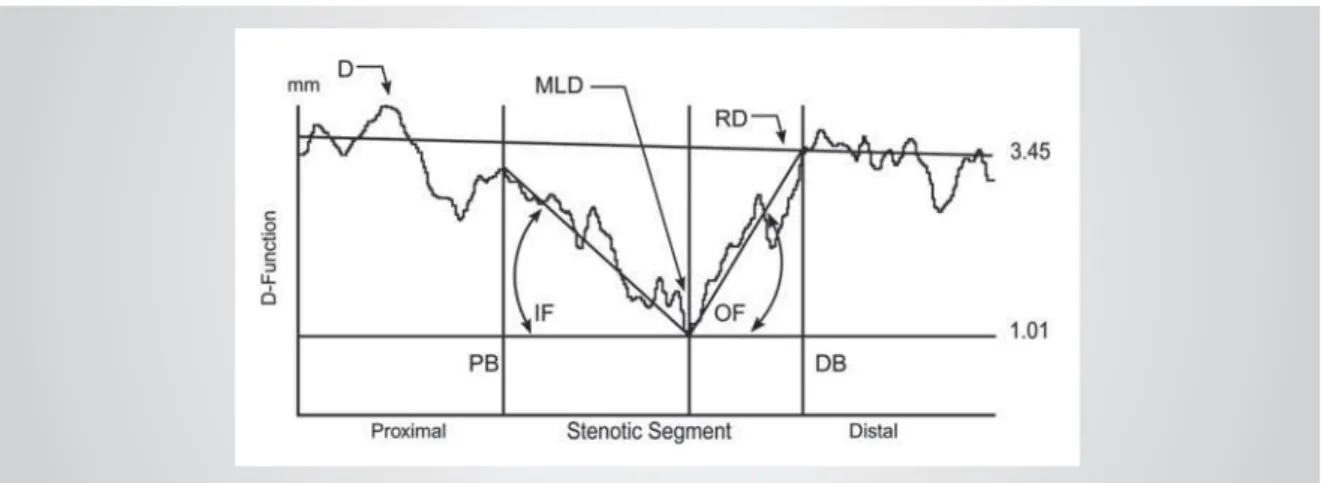
Angiographic geometric analysis - Infl ow and outfl ow angles were measured from the luminal diameter function curve of quantitative coronary angiography measurement. Mean lesion infl ow angle was defi ned as average slope of the luminal diameter function curve between the most stenotic point (i.e. MLD) and proximal boundary of the stenotic segment. Likewise, mean outfl ow angle was defi ned as average slope of the luminal diameter curve between the MLD and distal boundary of the lesion (Figure 1)11. Vessel wall contours estimated by angiographic
lumenogram were used to evaluate the plaque symmetry index, calculated as percent ratio between plaque areas on both sides of stenosis. Lesions with symmetry index between 0 and 0.5 were classifi ed as eccentric, and those greater than 0.5, as concentric.
IVUS imaging - All ultrasound examinations were performed before any therapeutic intervention. A commercially available IVUS system equipped with a 30 to 40 MHz transducer (Boston Scientifi c Corporation/ SciMed) was used, and images were acquired during automatic pullback at 0.5 mm/s. Qualitative analyses were performed according to previously established criteria12,13. Calcifi c plaques were brighter than the adventitia and resulted in acoustic shadowing. Fibrous plaques (hyperechoic) were as bright as or brighter than the adventitia, but with no acoustic shadowing. Soft plaques (hypoechoic) were less bright than the adventitia. When there was no dominance, the plaque was classifi ed as mixed. Quantitative IVUS evaluations were performed at the most stenotic site and at the proximal and distal reference sites, selected as the cross-sections within 5 mm from the lesion, but before a major side branch.
The following measurements were obtained by planimetry: external elastic membrane (EEM) cross-sectional area and lumen cross-cross-sectional area. Plaque area was calculated as the EEM area minus lumen area. Plaque burden was calculated as percent ratio between the plaque area and EEM area. The remodeling index was calculated as the ratio between EEM area at the proximal reference site and EEM area at the lesion site. Positive remodeling was defi ned as remodeling index greater than 1.0514.
mean ± standard deviation and compared by ANOVA. Measurement distribution of lesion length, percent stenosis, symmetry index, plus infl ow and outfl ow angles versus plaque burden and remodeling index were studied using linear regression analysis. Geometric angiographic variables with prognostic value for acute events (infl ow and outfl ow angles, symmetry index, lesion length, and percent stenosis) were divided into three groups, according to terciles. IVUS fi ndings in each group were analyzed and compared. All statistical tests were two-tailed, and p values < 0.05 were considered signifi cant.
R
ESULTSClinical characteristics of the thirty patients included in the study (31 lesions) are shown in table 1. Most patients were male (70%), with a relatively high prevalence of diabetes mellitus (30%). Half of the cases had multivessel disease, and 23% had a history of myocardial infarction (in all these patients, infarct location was not related to the coronary lesion under study). The left anterior descending artery was the most frequently treated vessel, and approximately one-third of the patients had type B2 or C lesions. All procedures achieved angiographic success and were followed by good in-hospital clinical outcomes.
Quantitative coronary angiography and morphologic angiographic fi ndings of the 31 lesions studied are shown in Table 2. On average, lesions were relatively short (9.2 ± 4.4 mm in length), located in large vessels (reference diameter 2.90 ± 0.45 mm), and with percent stenosis ranging from 50.0% to 89.0% (mean 67.7 ± 12.1%). Infl ow angles ranged from 8.48o to 48.78o (mean 24.0 ±
11.4o), and outfl ow angles, from 8.30o to 53.03o (mean
23.8 ± 11.7o). Symmetry evaluation showed extremely
eccentric (symmetry index 0) and maximal concentric lesions (symmetry index 1), with mean symmetry index of 0.56 ± 0.32.
Geometric variables (lesion length, percent stenosis,
Table 1 – Clinical characteristics
Number of patients/lesions 30 / 31
Age, years ± SD 59 ± 9
Masculine gender, n (%) 21 (70)
Systemic arterial hypertension, n (%) 18 (60)
Diabetes mellitus, n (%) 9 (30)
Smoking, n (%), 10 (33)
Previous myocardial infarction, n (%) 7 (23)
Previous CABG n (%) 1 (3)
Extent of coronary artery disease
Single-vessel disease, n (%) 15 (50)
Two-vessel disease, n (%) 11 (37)
Three-vessel disease, n (%) 4 (13)
Clinical presentation
Silent ischemia, n (%) 7 (23)
Stable angina, n (%) 23 (77)
Lipid profi le
Total cholesterol, mg/dL± SD 210 ± 34
HDL-C, mg/dL ± SD 39 ± 12
LDL-C, mg/dL ± SD 139 ± 30,4
Triglycerides, mg/dL ± SD 149 ± 65
Target vessel
Right coronary artery, n (%) 7 (23)
Left anterior descending artery, n (%) 18 (58)
Left circumfl ex artery, n (%) 6 (19)
Type B2/C lesion, n (%) 9 (29)
SD- standard deviation.
Table 2 – Quantitative coronary angiography and geometric angiographic variables (n = 31 lesions)
Minimal luminal diameter, mm ± SD 0.93 ± 0.38
Reference diameter, mm ± SD 2.90 ± 0.45
Percent stenosis, % ± SD 67.7 ± 12.1
Lesion length, mm ± SD 9.2 ± 4.4
Infl ow angle, degree ± SD 24.0 ± 11.4
Outfl ow angle, degree ± SD 23.8 ± 11.7
Symmetry index, mean ± SD 0.56 ± 0.32
ST- standard deviation.
symmetry index, infl ow and outfl ow angles) were divided into terciles. Table 3 shows IVUS fi ndings analyzed separately for each tercile. Frequency of soft or calcifi c plaques, positive remodeling, and magnitude of plaque burden were not associated with any geometric feature, and no signifi cant difference was found between tercile subgroups (P > 0.05 for all analysis). As a matter of illustration, scatterplots of individual measurements of lesion length, percent stenosis, symmetry index, infl ow and outfl ow angles versus plaque burden and remodeling index are shown in Figures 2 and 3, respectively (P > 0.05 for all analysis).
D
ISCUSSIONIn this study, angiographic factors shown to be predictive of future myocardial infarction were not associated with IVUS markers of plaque instability. Specifi cally, angiographic features such as percent stenosis, symmetry index, lesion length, and infl ow and outfl ow angles were not associated with IVUS detection of soft plaque, positive remodeling or greater plaque burden.
There are many possible explanations for the lack of correlation between angiographic predictors of future events and IVUS markers of vulnerability: 1) most properties currently associated with increased plaque vulnerability, such as plaque infl ammation15, thin fi brous
cap16, plaque deformability17 and shear stress18, are not
identifi able by conventional intravascular ultrasound; 2) the correlation between soft plaque and lipid content is weak and, in addition, IVUS image of the “soft plaque” may correspond to thrombus, lipid, necrotic tissue, or none of these; 3) in our series, mean percent stenosis was 67%, unlike those of 46% and 47% reported in
previous studies that have shown the prognostic value of angiographic variables8,9. It seems reasonable to assume
that, in theory, our patients might have been in a more advanced stage of coronary artery disease, which may invalidate a direct extrapolation of previous results from patients with milder coronary lesions.
Hypothetically, angiographic morphology may be affected by plaque structure and composition8. However,
our fi ndings do not support this hypothesis. Even though conventional IVUS imaging allows only a relatively rough estimate of vessel wall structure, no association was noted between geometric angiographic variables and plaque characteristics on IVUS. Despite the relatively small number of lesions included in this study, it is unlikely that a greater number of lesions would have changed these fi ndings, because no trend towards signifi cant correlations was found when different variables were analyzed.
Study limitations lie in the small number of patients and lesions studied. However, both patients and lesions had well-defi ned characteristics (de novo lesions in native vessels in patients with stable coronary syndromes and no history of infarction related to the artery studied); and were judiciously studied using two methods (coronary angiography and IVUS). Any extrapolation of our fi ndings to other lesion and patient groups should be done cautiously.
We conclude that geometric features of coronary lesions favoring acute occlusion and myocardial infarction are not correlated with ultrasound markers of plaque vulnerability. Whether angiographic predictors of future coronary events - which are independent of IVUS markers of plaque vulnerability - are associated with other local parameters, such as flow pattern and shear stress, remains unknown and warrant further study.
Table 3 – Ultrasound fi ndings in each tercile subgroup of geometric angiographic variables (n = 31 lesions)*
Percent stenosis Lesion length Symmetry index Infl ow angle Outfl ow angle
Lower tercile
Middle tercile
Upper tercile
Lower tercile
Middle tercile
Upper tercile
Lower tercile
Middle tercile
Upper tercile
Lower tercile
Middle tercile
Upper tercile
Lower tercile
Middle tercile
Upper tercile
Soft plaque, n 6 8 7 7 5 7 6 6 7 6 8 5 5 7 7
Calcifi c plaque,
n 2 2 2 2 0 1 2 0 2 1 1 2 2 2 0
Plaque burden, %
± SD 84±10 86±8 91±7 84±10 88±10 89±9 87±11 87±11 88±7 87±10 89±10 86±10 86±10 87±10 89±9
Positive remodeling,
n 3 2 3 1 2 5 4 0 4 4 1 3 4 2 2
Fig. 2 – Distribution of geometric angiographic variables (infl ow angle, outfl ow angle, lesion length, symmetry index, and percent stenosis) and plaque burden on intravascular ultrasound (p > 0.05 for all correlations).
Inflow angle (°)
50 40 30 20 10 0
Pla
q
ue burden
(%
)
100
90
80
70
60
r = 0,006
Outflow angle (°)
60 50 40 30 20 10 0
Pla
q
ue burden
(%
)
100
90
80
70
60
r = 0,060
Lesion length (mm)
30 20
10 0
Pla
q
ue burden
(%
)
100
90
80
70
60
r = 0,131
Symmetry index
1,0 ,8 ,6 ,4 ,2 0,0
Plaque burden (%)
100
90
80
70
60
r = 0,002
Percent stenosis (%)
.9 .8 .7 .6 .5 .4
Plaque burden (%)
100
90
80
70
60
r = 0,290
r=0.006 r=0.060
r=0.131 r=0.002
Fig. 3 – Distribution of geometric angiographic variables (infl ow angle, outfl ow angle, lesion length, symmetry index, and percent stenosis) and remodeling index on intravascular ultrasound (p > 0.05 for all correlations).
Inflow angle (°)
50 40 30 20 10 0
Remodelin
g
index
1,6
1,4
1,2
1,0
,8
,6
,4
r = 0,024
Outflow angle (°)
60 50 40 30 20 10 0
Remodeling index
1,6
1,4
1,2
1,0
,8
,6
,4
r = 0,063
Lesion length (mm)
30 20
10 0
Remodeling index
1,6
1,4
1,2
1,0
,8
,6
,4
r = 0,017
Simmetry index
1,0 ,8 ,6 ,4 ,2 0,0
Remodeling index
1,6
1,4
1,2
1,0
,8
,6
,4
r = 0,126
Percent stenosis (%)
,9 ,8 ,7 ,6 ,5 ,4
Remodeling index
1,6
1,4
1,2
1,0
,8
,6
,4
r = 0,043
Potencial Confl ict of Interest
No potential confl ict of interest relevant to this article was reported.
Infl ow angle (o)
r=0.024
Remodeling index Remodeling index
Outfl ow angle (o)
r=0.063
Remodeling index
Lesion length (mm) r=0.017
Remodeling index
Simmetry index r=0.126
Remodeling index
r=0.043
R
EFERENCES1. Falk E. Unstable angina with fatal outcome: dynamic coronary thrombosis leading to infarction and/or sudden death. Circulation. 1985; 71: 699-708.
2. Davies MJ, Thomas AC. Plaque fissuring – the cause of acute myocardial infarction, sudden ischaemic death, and crescendo angina. Brit Heart J. 1985; 53: 363-73.
3. Bezerra HG, Higuchi ML, Gutierrez PS, et al. Atheromas that cause fatal thrombosis are usually large and frequently accompanied by vessel enlargement. Cardiovasc Pathol. 2001; 10: 189-96.
4. Filardo SD, Schwarzacher SP, Lo ST, et al. Acute myocardial infarction and vascular remodeling. Am J Cardiol. 2000; 85: 760-2.
5. Schoenhangen P, Ziada KM, Kapadia SR, et al. Extent and direction of arterial remodeling in stable versus unstable coronary syndromes. Circulation. 2000; 101: 598-603.
6. Kotani J, Mintz GS, Castagna MT, et al. Intravascular ultrasound analysis of infarct-related and non-infarct-related arteries in patients who presented with an acute myocardial infarction. Circulation. 2003; 107: 2889-93.
7. Naghavi M, Libby P, Falk E, et al. From vulnerable plaque to vulnerable patient. A call for new defi nitions and risk assessment strategies: Part I. Circulation. 2003; 108: 1664-72.
8. Ledru F, Théroux P, Lespérance J, et al. Geometric features of coronary artery lesions favoring acute occlusion and myocardial infarction: a quantitative angiographic study. J Am Coll Cardiol. 1999; 33: 1353-61.
9. Taeymans Y, Théroux P, Lespérance J, Waters D. Quantitative angiographic morphology of the coronary artery lesions at risk of thrombotic occlusion. Circulation. 1992; 85: 78-85.
10. Gronenschild E, Janssen J, Tijdens F. CASS II: A second generation
system for off-line and on-line quantitative coronary angiography. Cathet Cardiovasc Diagn. 1994; 33: 61-75.
11. Haase J, Escaned J, Swijndregt EM, et al. Experimental validation of geometric and densitometric coronary measurements on the new generation cardiovascular angiography analysis system (CAAS II). Cathet Cardiovasc Diagn. 1993; 30: 104-14.
12. Mintz GS, Nissen SE, Anderson WD, et al. Clinical expert consensus document on standards for acquisition, measurement and reporting of intravascular ultrasound studies (IVUS). J Am Coll Cardiol. 2001; 37: 1478-92.
13. Hodgson JM, Reddy KG, Suneja R, et al. Intracoronary ultrasound imaging: correlation of plaque morphology with angiography, clinical syndrome and procedural results in patients undergoing coronary angioplasty. J Am Coll Cardiol. 1993; 21: 35-44.
14. Schoenhagen P, Ziada KM, Vince G, et al. Arterial remodeling and coronary artery disease: the concept of “dilated” versus “obstructive” coronary atherosclerosis. J Am Coll Cardiol. 2001; 38: 297-306.
15. Stefanadis C, Diamantopoulos L, Vlachopoulos C, et al. Thermal heterogeneity within human atherosclerotic coronary arteries detected in vivo: a new method of detection by application of a special thermography catheter. Circulation. 1999; 99: 1965-71.
16. Loree HM, Kamm RD, Stringfellow RG, Lee RT. Effects of fi brous cap thickness on peak circumferential stress in model atherosclerotic vessels. Circ Res. 1992; 71: 850-8.
17. Loree HM, Kamm RD, Atkinson CM, et al. Turbulent pressure fl uctuations on surface of model vascular stenoses. Am J Physiol. 1991; 261: H644-H650.