Variation of ecological factors may influence behavioral patterns of individuals, social groups or a population that in-habits an area (KREBS & DAVIES 1993). This influence is largely documented for species of terrestrial mammals, such as primates, whose behavior may be influenced by availability of food re-sources in a variety of ways (OATES 1987). Food resources in the
marine environment may present a complex pattern of distri-bution and abundance in space and time (e.g. LAEVASTU & HAYES
1981), and we should expect that marine predators may also respond, behaving in different manners, according to
availabil-ity of food resources. In fact, the behavior of small cetaceans has been linked to diverse environment cycles and variation (e.g. WÜRSIG & WÜRSIG 1979, 1980, WELLSetal. 1980, SHANEetal. 1986, BRÄGER 1993, BALLANCE & PITMAN 1998). A great part of these
envi-ronment cycles and variations are indirect factors that may in-fluence prey abundance and/or distribution.
According to SHANE (1990b), behavioral flexibility of ce-taceans can be studied from at least three viewpoints: (1) indi-viduals from the same population with differences in behav-ior; (2) diverse behaviors with a common function; and (3)
Bénéden) (Cetacea,
Bénéden) (Cetacea,
Bénéden) (Cetacea,
Bénéden) (Cetacea,
Bénéden) (Cetacea, Delphinidae) in tw
Delphinidae) in tw
Delphinidae) in tw
Delphinidae) in tw
Delphinidae) in two dif
o dif
o dif
o diffffffer
o dif
er
erent ar
er
er
ent ar
ent ar
ent areas on the Br
ent ar
eas on the Br
eas on the Br
eas on the Brazilian coast
eas on the Br
azilian coast
azilian coast
azilian coast
azilian coast
Fábio G. Daura-Jorge
1; Marcos R. Rossi-Santos
2; Leonardo L. Wedekin
1& Paulo C. Simões-Lopes
11 Departamento de Ecologia e Zoologia, Universidade Federal de Santa Catarina. Campus Universitário, 88040-970 Florianópolis, Santa Catarina, Brasil. E-mail: [email protected]
2 Projeto Boto Sotalia do Sul da Bahia, Instituto Baleia Jubarte. Rua Barão do Rio Branco 26, 45900-000 Caravelas, Bahia, Brasil.
ABSTRACT. The behavioral patterns of the estuarine dolphin, Sotalia guianensis (P. J. van Bénéden, 1864), were compared between two populations along the Brazilian coast: Caravelas (Bahia), along the eastern coast, and Norte Bay (Santa Catarina), along the southern coast. Applying the focal-group sampling in both areas, informa-tion such as the geographic posiinforma-tion (UTM) of groups and predominant behavioral patterns were obtained. Geographic positions were used to calculate the total distance traveled by estuarine dolphin groups on each observation day. Since the distance traveled varies with time, the daily mean speed of the dolphin’s group was used as an index of movement intensity. Two comparable and easily recognizable behavioral patterns were considered: travelling and foraging. Overall movement intensity and behavioral pattern frequency were similar between both areas. However, a seasonal variation was observed in both parameters in Norte Bay, while in Caravelas these parameters were homogeneous throughout the year. Variation in the behavior of the estuarine dolphin was consistent with variations in environmental factors, such as water temperature.
KEY WORDS. Behavior; estuarine dolphin; Caravelas estuary; Norte Bay; spatial requirements.
RESUMO. Padrões comportamentais e intensidade de movimentos de Padrões comportamentais e intensidade de movimentos de Padrões comportamentais e intensidade de movimentos de Padrões comportamentais e intensidade de movimentos de Padrões comportamentais e intensidade de movimentos de SotaliaSotaliaSotaliaSotaliaSotalia guianensisguianensisguianensisguianensisguianensis (P (P... J (P (P (P J J J J... v v v v van Bénéden)an Bénéden)an Bénéden)an Bénéden)an Bénéden) (Cetacea,
(Cetacea, (Cetacea, (Cetacea,
(Cetacea, Delphinidae) em duas dif Delphinidae) em duas dif Delphinidae) em duas difer Delphinidae) em duas dif Delphinidae) em duas difererererentes árentes árentes áreas da costa brentes árentes áreas da costa breas da costa breas da costa breas da costa brasileirasileirasileirasileirasileira.a.a.a.a. Os padrões comportamentais do boto-cinza, Sotalia guianensis (P. J. van Bénéden, 1864), foram comparados entre duas populações da costa brasileira: Caravelas (Bahia), na costa leste, e Baía Norte (Santa Catarina), na costa sul. Utilizando o método de grupo-focal em ambas as áreas, informações como posições geográficas (UTM) do grupo e padrão comportamental predo-minante foram coletadas. A posição geográfica foi utilizada para o cálculo da distância total percorrida por um grupo de botos-cinza em cada área de observação. Como a distância é uma medida que varia com o tempo, a velocidade média diária do grupo de botos foi usada como um índice de intensidade de movimento. Dois padrões comportamentais comparáveis e facilmente reconhecíveis foram considerados: deslocamento e forrageamento. A intensidade de movimentos e a freqüência dos padrões comportamentais foram similares entre as duas áreas. No entanto, foi observada uma variação sazonal dos dois parâmetros para a Baía Norte, enquanto em Caravelas estes parâmetros foram homogêneos ao longo do ano. A variação no comportamento do boto-cinza acompanhou a variação de fatores ambientais como a temperatura.
different behaviors for the same function developed by sepa-rated populations in distinct habitats. The present work ap-proaches the last perspective comparing the behavior charac-teristics of two populations of the estuarine dolphins, Sotalia guianensis (P. J. van Bénéden, 1864), on the Brazilian coast: one off the eastern coast of Brazil, in a typical tropical environ-ment; and the other off the southern coast of Brazil, in a sub-tropical environment, at the southern limit of distribution of this species (SIMÕES-LOPES 1988).
The estuarine dolphin has a wide distribution along the Brazilian coast, inhabiting mainly protected coastal waters such as bays and estuaries (BOROBIAetal. 1991). Studies on the be-havior and ecology of S.guianensis along the Brazilian coast are fragmented and focused on single populations (e.g. MONTEIRO-FILHO 1995, GEISEetal. 1999, FLORES 1999, SANTOSetal.
2000, ARAÚJOetal. 2001, CREMERetal. 2004, DAURA-JORGEetal. 2004, 2005). Where the species is studied, the use of different methods in each area along its distribution, limits the poten-tial for comparative approaches and its testability. Therefore, this species’ responses to environment variation remain un-known.
The aim of the present work is to compare the behavior patterns and movement intensity of two Sotaliaguianensis popu-lations in different areas of the Brazilian coast, in order to test if the species has different behavior strategies to cope with dif-ferent environmental conditions related to both the space and time axis.
MATERIAL AND METHODS
Study areas
Norte Bay is located between Santa Catarina Island and the mainland, southern Brazil (27°30’S, 48°32’W). It is a coastal bay delimited by rocky shores, sandy beaches, and small patches of mangrove forests, which are probably responsible for increasing the marine productivity of the area. It presents a mean depth of 3.5 m, rarely exceeding 10 m (in both south and north channels) and the temperature varies markedly throughout the seasons (Laboratório de Cultivo de Moluscos Marinhos, Universidade Federal de Santa Catarina – data gath-ered in 2000 and not published, Fig. 1). Caravelas Estuary (17°00’S, 39°30’W), eastern Brazil, is located in the coastal waters of the Abrolhos Bank, an enlargement of the Brazilian continental shelf. This region is characterized by an open coast protected by banks of coral reefs and with a predominance of sandy beaches and large mangroves. Influenced exclusively by the Brazil Current, this coast is a typical tropical ecosys-tem with a high diversity of species (NONAKAet al. 2000) and
low production (EKAU & KNOPPERS 1999). The Caravelas
Estu-ary system is the second largest mangrove forest of Brazil’s northeast region, with an area of approximately 66 km2 (HERZ
1991). It presents a low temperature variation throughout the seasons (Instituto Baleia Jubarte – data gathered since 2002 and not published, Fig. 1).
Data gathering and analysis
Using the focal-group sampling (LEHNER 1996) in both study areas, data such as geographic position (GPS) and pre-dominant activity sampling (see MANN 1999) – denoted here as
predominant behavioral patterns, or simply behavior – of the groups were registered at every five-minute interval, totalling 155 hours of direct observation for Norte Bay, and 133 hours for Caravelas Estuary (Tab. I). Experienced researchers per-formed the observations. Although different in each area, they had the same training during preliminary observations and were always the same in the whole period of study.
The behavioral patterns considered in the present work were adapted from SHANEet al. (1986), as follows: foraging (FO) – short and asynchronic dives, abundant aerial events, move-ments in varying directions (except for cooperative feeding) and, many times, the presence of seabirds; the dolphins could be either in the same area, or moving in a defined direction; and travelling (T) – moving steadily in one direction, with synchronised dives. Other behavioral patterns, such as resting and socializing, were excluded from our analyses due to small frequency of occurrence.
of estuarine dolphin groups for each area. Then, using the ArcView extension “Animal Movement Analyst Extension” (HOOGE & EICHENLAUB 1997), the total distance travelled by the
group for each day of observation was calculated. As the dis-tance travelled by dolphin groups is a variable that may change with time, the daily mean speed of the groups was used as an index of movement intensity (IMI). Only the sequential data without sampling interruption were considered, thus avoiding distortions of the index.
Frequency variation of behavioral patterns and IMI were compared between areas and within the same area in different seasons. The overall IMI analyses were tested using the Mann-Whitney test, whereas the relative frequency of the behavioral patterns were analysed through the Chi-square test (5%, SOKAL
& ROHLF 1995). The seasons were grouped in hot season (Norte
Bay – spring 2001/2002 and summer 2002/Caravelas – spring 2002/2003 and summer 2003) and cold season (Norte Bay – fall 2002/2003 and winter 2002/Caravelas – fall 2002/2003 and winter 2002/2003).
RESULTS
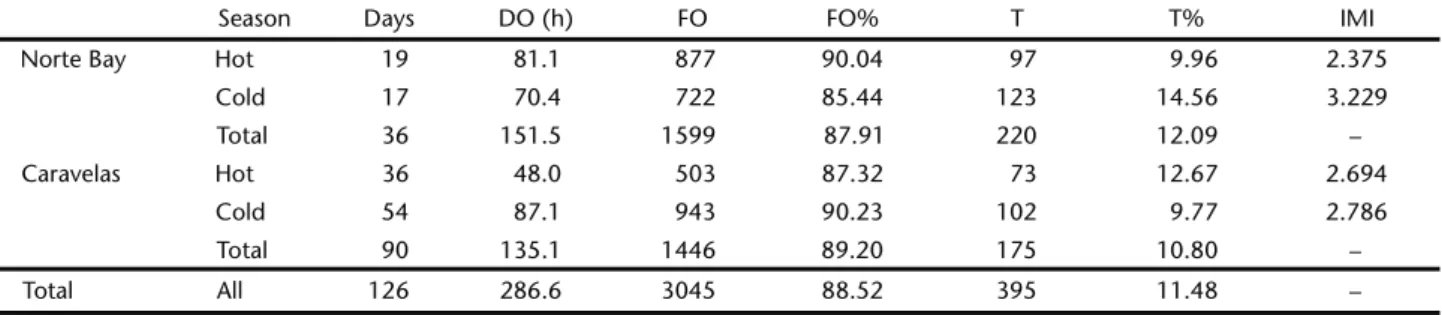
The frequencies of behaviors were similar between Norte Bay and Caravelas (2 = 1.298; df = 1; p = 0.254), and foraging
was the most common behavior in both areas. However, in Norte Bay the frequencies of behaviors were different between cold and hot seasons (2 = 8.573; df = 1; p = 0.003). Travelling
frequency was higher in cold season than in hot season, while foraging frequency was higher in hot season than in cold sea-son. Contrasting the seasonal pattern verified in Norte Bay, the frequencies of behaviors were constant throughout the year in Caravelas (2 = 2.976; df = 1; p = 0.084; Tab. I and Fig. 2).
The overall index of movement intensity was similar be-tween the two areas (Mann-Whitney: U = 1692.00; Z (U) = 0.3614; p = 0.717; Fig. 3). As the results about behavioral pat-terns indicated, a seasonal variation on movement intensity was detected only in Norte Bay (Mann-Whitney: U = 85.00; Z (U) = 2.424; p = 0.015), while in Caravelas this variation was not observed (Mann-Whitney: U = 1101.00; Z (U) = 0.1105; p = 0.911). The IMI of Norte Bay was significantly higher in cold
seasons (mean = 3.23km/h) than in the hot season (mean = 2.37km/h). This seasonal variation was not observed in Caravelas, where the index was similar between hot (mean = 2.69) and cold seasons (mean = 2.78) (Tab. I and Fig. 4).
DISCUSSION
Both populations of Sotaliaguianensis presented distinct seasonal patterns of movement intensity and behavioral fre-quencies. As it had been observed in previous studies of move-ment intensity (DAURA-JORGEetal. 2004), behavior (DAURA-JORGE
et al. 2005) and spatial use (WEDEKINetal. 2007), our results
show that the Norte Bay population has higher spatial require-ments during cold seasons, moving more intensively and fre-quently. This pattern was not observed for Caravelas, where estuarine dolphins have the same behavior frequencies and movement intensity throughout the year.
Distinct ecological conditions between Norte Bay and Caravelas may account for the observed variations in the be-havioral responses of the two populations studied. Ecological differences between two habitats are usually the result of sev-eral interacting factors, such as water temperature, transpar-ency, salinity, tides, currents, light, depth and habitat
struc-Table I. Sampling characteristics, total frequency of each behavior and mean of the index of movement intensity in both study areas between hot and cold seasons. (DO) Direct observation, (FO) foraging behavior, (T) travelling behavior, (IMI) index of movement intensity.
Season Days DO (h) FO FO% T T% IMI
Norte Bay Hot 19 81.1 877 90.04 97 9.96 2.375
Cold 17 70.4 722 85.44 123 14.56 3.229
Total 36 151.5 1599 87.91 220 12.09 –
Caravelas Hot 36 48.0 503 87.32 73 12.67 2.694
Cold 54 87.1 943 90.23 102 9.77 2.786
Total 90 135.1 1446 89.20 175 10.80 –
Total All 126 286.6 3045 88.52 395 11.48 –
ture. In the absence of available data on these factors, the use of temperature as a surrogate for environment variability is quite common. Water temperature is an easily measurable pa-rameter and an excellent indicator of changes in ecological and environmental conditions (LAEVASTU & HAYES 1981). The
temperature range of an area is also correlated with latitude, increasing from lower to middle and high latitudes, tropical to sub-tropical and temperate environments (STEVENS 1989).
More-over, the temperature is positively correlated with species di-versity of a habitat, indicating a latitudinal gradient of species diversity, well documented for marine and terrestrial assem-blages of animals (see STEVENS 1989). Comparing the diversity of fish species in different estuaries along the north-south coast of the Western Atlantic, VIEIRA & MUSICK (1993) observed that
lower latitudes (tropical estuaries) tend to have more species and more equitability among them than temperate and sub-tropical areas.
In Norte Bay, the annual range in the temperature may promote (through distinct processes depending on the species involved) a strong seasonality of dominant prey items of the estuarine dolphin. For example, the low temperatures occur-ring duoccur-ring the fall trigger the reproductive migration of mul-let (Mugilplatanus; Günter, 1880) northward along the south-ern Westsouth-ern Atlantic (VIEIRA & SCALABRINI 1991). The presence of
this important fishing resource in certain periods of the year, a potential prey item of the estuarine dolphin in Norte Bay, may influence the behavior of this species, which responds by mov-ing more intensively and frequently in order to capture this highly mobile prey. The influence of mullets on the behavior of the estuarine dolphin has already been suggested (e.g. ARAÚJO
etal. 2001, FLORES & BAZZALO 2004). Other fish species from the
family Engraulidae (such as Cetengraulisedentulus; Cuvier, 1828 – see DAURA-JORGEetal. 2004), Clupeidae and/or Scianidae, all potential prey items of the estuarine dolphin, may also play a major role in determining the seasonal patterns observed in Norte Bay. The same may not be the case of Caravelas, which is
located at a lower latitude and influenced by a wider range of ecosystems, such as mangroves, coral reefs and open waters, presenting a higher diversity of fish species but without a marked dominance of one single species in certain periods (NONAKAet al. 2000).
Comparing different populations of Tursiopstruncatus, WÜRSIGetal. (1991) suggested that in habitats with well-de-fined local abundance of some prey, the behavior patterns and habitat use by dolphins also tend to be well defined. On the other hand, when the habitat shows a higher species diversity without a specific dominant prey, these behavioral patterns become diffused or non-existent. Comparatively, the tropical waters of Caravelas may be characterized as a more diverse and uniform habitat in terms of prey, while Norte Bay presents a predictable and well-defined pattern, caused by dominance of certain species in specific periods of the year.
Associations between temperature and behavior patterns of cetacean have already been observed (e.g. SHANE 1990a, BRÄGER
1993). SHANE (1990a) noted that Tursiopstruncatus increases the
time spent in feeding activity when the temperature falls. BRÄGER
(1993) registered a similar pattern with the same species, sug-gesting the necessity of higher energetic requirements due to the decrease of the water temperature. Another explanation suggested by the author was that the time that dolphins spend feeding increases in the fall in response to the decreasing prey abundance due to fish emigration during that season. This re-lation between behavioral responses of small cetaceans and the dynamic of its prey is also well documented by other authors (e.g. WELLSetal. 1980, SHANEetal. 1986, SELZER & PAYNE 1988,
REILLY 1990, JAQUET & WHITEHEAD 1996, FIEDLERetal. 1998, ACEVEDO
-GUTIERREZ & PARKER 2000).
A better knowledge on the diet of the estuarine dolphin (including seasonal variations of prey ingested by different populations), the dynamics of prey abundance and distribu-tion and, finally, the influence of the diverse physical-chemi-cal parameters of the water in the biotic components would Figures 3-4. Index of movement intensity (IMI) of Sotalia guianensis for both study areas (3) and in hot and cold seasons of Norte Bay and Caravelas. (SD) standard deviation.
help to unravel and explain processes involving the complex associations between the physical environment, prey and preda-tors in these coastal areas. The standardization of methodolo-gies used in different areas would help future comparisons in dolphin studies.
ACKNOWLEDGMENTS
The Brazilian Research Bureau (Conselho Nacional de Desenvolvimento Científico e Tecnológico) funded P.C. Simões-Lopes (Proc: 304698/2006-7), L.L. Wedekin and F.G. Daura-Jorge; M. Rossi-Santos (Projeto Boto Sotalia/Instituto Baleia Jubarte) thanks the financial support provided by Petrobrás and Aracruz Celulose, besides all the IBJ team, specially Marcia Engel and Uilson “Lixinha” Farias. We also thank Vitor Piacentini, Roberto Fusco and Karim H. Lüchmann for the review and sug-gestions.
REFERENCES
ACEVEDO-GUTIERREZ, A. & N. PARKER. 2000. Surface behavior of
bottlenose dolphins is related to spatial arrangement of prey. MarineMammalScience16 (2): 287-298.
ARAÚJO, J.P.; J.Z.O. PASSAVANTE & A.S. SOUTO. 2001. Behavior of the estuarine dolphin, Sotaliaguianensis, at Dolphin Bay – Pipa – Rio Grande do Norte – Brazil. TropicalOceanography 29: 13-23.
BALLANCE, L.T. & R.L. PITMAN. 1998. Cetaceans of the Western
Tropical Indian Ocean: distribution, relative abundance, and comparisons with cetacean communities of two other tro-pical ecosystems. MarineMammalScience14 (3): 429-459. BOROBIA, M.; S. SICILIANO; L. LODI & W. HOEK. 1991. Distribution
of the South American dolphin Sotaliafluviatilis. Canadian JournalofZoology69: 1025-1039.
BRÄGER, S. 1993. Diurnal and seasonal behavior patterns of bottlenose dolphins (Tursiopstruncatus). MarineMammal Science9 (4): 434-438.
CREMER, M.J.; F.A.S. HARDT.; A.J.T. JUNIOR.; P.C.A. SIMÕES-LOPES &
J.S.R. PIRES. 2004. Core area changes in Sotaliaguianensis (Cetacea, Delphinidae) population in Babitonga Bay, Santa Catarina. RevistaUniville9: 130-134.
DAURA-JORGE, F.G.; L.L. WEDEKIN & P.C. SIMÕES-LOPES. 2004.
Varia-ção sazonal na intensidade dos deslocamentos do boto-cin-za, Sotaliaguianensis (Cetacea: Delphinidae), na Baía Norte da Ilha de Santa Catarina. Biotemas17: 203-216.
DAURA-JORGE, F.G.; L.L. WEDEKIN;V. Q. PIACENTINI & P.C. SIMÕES -LOPES. 2005. Seasonal and daily patterns of group size,
cohesion and activity of the estuarine dolphin, Sotalia guianensis (P. J. van Bénéden) (Cetacea, Delphinidae), in southern Brazil. RevistaBrasileiradeZoologia22 (4): 1014-1021.
EKAU, W. & B. KNOPPERS. 1999. An introduction to the pelagic
system of the North-East and East Brazilian shelf. Archive ofFisheryandMarineResearch47: 113-132.
FIEDLER, P.C.; J. BARLOW & T. GERRODETTE. 1998. Dolphin prey abundance determined from acoustic backscatter data in eastern Pacific surveys. FisheryBulletin96: 237-247. FLORES, P.A.C. 1999. Preliminary results of a photo-identification
study of the marine tucuxi, Sotaliafluviatilis, in Southern Brazil. MarineMammalScience15: 840-847.
FLORES, P.A.C. & M. BAZZALO. 2004. Home range and movement patterns of the marine tucuxi dolphin, Sotaiafluviatilis, in Baía Norte, southern Brazil. Latin AmericanJournal of AquaticMammals3: 37-52.
GEISE, L.; N. GOMES & R. CERQUEIRA. 1999. Behavior, habitat use
and population size of Sotaliafluviatilis (Gervais, 1853) in the Cananéia estuary region, São Paulo, Brazil. Brazilian JournalofBiology59: 183-194.
HERZ, R. 1991. ManguezaisdoBrasil. São Paulo, Universidade
de São Paulo, 227p.
HOOGE, P. N. & B. EICHENLAUB, 1997. Animal movement extension to ArcView (version 1.1). Anchorage, Alaska Biological Science Center, United States Geological Survey.
JAQUET, N. & H. WHITEHEAD. 1996. Scale-dependent correlation of
sperm whale distribution with environmental features and productivity in South Pacific. MarineEcologyProgressSeries 135: 1-9.
KREBS, J.R. & N.B. DAVIES. 1993. Anintroductiontobehavioral
ecology. London, Blackwell Science, 420p.
LAEVASTU, T. & M. L. HAYES. 1981. Fisheriesoceanographyand
ecology. Farnham, Fishing News Books, 199p.
LEHNER, P.N. 1996. Handbook of ethological methods.
Cambridge, University Press, 672p.
MANN, J. 1999. Behavioral sampling methods for cetaceans: a
review and critique. MarineMammalScience15: 102-122. MONTEIRO-FILHO, E.L.A. 1995. Pesca interativa entre o golfinho Sotalia fluviatilisguianensis e a comunidade pesqueira da região de Cananéia. BoletimdoInstitutodePesca22 (2): 15-23.
NONAKA, R.H.; Y. MATSUURA, Y. & K. SUZUKI. 2000. Seasonal variation in larval fish assemblages in relation to oceanographic conditions in the Abrolhos Bank region off eastern Brazil. FisheryBulletin98: 767-784.
OATES, J.F. 1987. Food distribution and foraging behavior, p.
197-209. In: B.B. SMUTS; D.L. CHENEY; R.M. SEYFARTH; R.W.
WRANGHAM & T.T. STRUHSAKER (Eds). Primatesocieties. Chi-cago, The University of Chicago Press, 578p.
REILLY, S.B. 1990. Seasonal changes in distribution and habitat
differences among dolphins in the eastern tropical Pacific. MarineEcologyProgressSeries66: 1-11.
SANTOS, M.C. DE O.; S. ROSSO; S. SICILIANO; A. N. ZERBINI; E. ZAMPIROLLI; A. VICENTE & F. ALVERENGA. 2000. Behavioral
observations of the marine tucuxi dolphin (Sotaliafluviatilis) in São Paulo estuarine waters, Southeastern Brazil. Aquatic Mammals26 (3): 260-267.
delphis) vs. environmental features of the continental shelf of the northeastern United States. MarineMammalScience 4: 141-153.
SHANE, S.H. 1990a. Behavior and ecology of the bottlenose
dolphins at Sanibel Island, Florida, p. 245-265. In: S. LEATHER -WOOD & R.R. REEVES (Eds). TheBottlenoseDolphin. San Diego, Academic Press, 643p.
SHANE, S.H. 1990b. Comparison of bottlenose dolphin behavior
in Texas and Florida, with a critique of methods for studying dolphin behavior, p. 541-558. In: S. LEATHERWOOD & R.R. REEVES
(Eds). Thebottlenosedolphin. San Diego, Academic Press, 643p.
SHANE, S.H.; R.S. WELLS & B. WÜRSIG. 1986. Ecology, behavior
and social organization of the bottlenose dolphin: a review. MarineMammalScience2: 34-63.
SIMÕES-LOPES, P.C. 1988. Ocorrência de uma população de Sotalia fluviatilis (Gervais), 1853, (Cetacea, Delphinidae) no limite sul de sua distribuição, Santa Catarina, Brasil. Biotemas1: 57-62. SOKAL, R.R. & F.J. ROHLF. 1995. Biometry. New York, W.H.
Freeman, 887p.
STEVENS, G.C. 1989. The latitudinal gradient in geographical range: how so many species coexist in the tropics. American Naturalist133: 240-256.
VIEIRA, J.P. & C. SCALABRIN. 1991. Migração reprodutiva da tainha
(Mugilplatanus: Günter, 1880) no sul do Brasil. Atlântica 13: 131-141.
VIEIRA, J.P. & J.A. MUSICK. 1993. Latitudinal patterns in diversity
of fishes in warm-temperate and tropical estuarine waters of western Atlantic. Atlântica, Rio Grande, 15: 115-113. WEDEKIN, L.L.; F.G. DAURA-JORGE; V.Q. PIACENTINI & P.C. SIMÕES
-LOPES. 2007. Seasonal variation on the spatial use of the
estuarine dolphin, Sotaliaguianensis (Cetacea, Delphinidae) in its southern limit of distribution. Brazilian Journalof Biology67 (1): 1-8.
WELLS, R.S.; A.B. IRVINE & M.D. SCOTT. 1980. The social ecology
of inshore odontocetes, p. 263-317. In: L.M. HERMAN (Ed.). Cetacean behavior, mechanisms and functions. New York, John Wiley, 463p.
WÜRSIG, B. & M. WÜRSIG. 1979. Behavior and ecology of the
bottlenose dolphin, Tursiopstruncatus, in the South Atlantic. FisheryBulletin77: 399-412.
WÜRSIG, B. & M. WÜRSIG. 1980. Behavior and ecology of the
dusky dolphin, Lagenorhynchus obscurus, in the South Atlantic. FisheryBulletin77: 871-890.
WÜRSIG, B.; F. CIPRIANO & M. WÜRSIG. 1991. Information from radio and theodolite tracking studies, p. 79-111. In: K.A. PRYOR & K.S. NORRIS (Eds). Dolphin societies: discoveries and puzzles. Berkeley, University of California Press, 397p.