527 527 527 527 527 Mem Inst Oswaldo Cruz, Rio de Janeiro, Vol. 95(4): 527-534, Jul./Aug. 2000
Genomic Rearrangements in Trypanosomatids: an
Alternative to the One Gene Evolutionary Hypotheses?
JC Dujardin/
+, J Henriksson*, K Victoir, S Brisse**, D Gamboa/***,
J Arevalo***, D Le Ray
“Prins Leopold” Instituut voor Tropische Geneeskunde, Protozoology 155 Nationalestraat, B-2000 Antwerpen, Belgium *Department of Medical Genetics, Uppsala University, Biomedical Center, Box 589, S-751 23 Uppsala, Sweden **Eijkman-Winkler Institute, Utrecht University, Academic Hospital Utrecht, Heidelberglaan 100, 3584
CX Utrecht, The Netherlands ***Instituto de Medicina Tropical “Alexander von Humboldt”, Departamento de Ciencias Fisiológicas, Universidad Peruana Cayetano Heredia, Lima, Peru
Most molecular trees of trypanosomatids are based on point mutations within DNA sequences. In contrast, there are very few evolutionary studies considering DNA (re) arrangement as genetic charac-ters. Waiting for the completion of the various parasite genome projects, first information may already be obtained from chromosome size-polymorphism, using the appropriate algorithms for data process-ing. Three illustrative models are presented here. First, the case of Leishmania (Viannia) braziliensis/L. (V.) peruviana is described. Thanks to a fast evolution rate (due essentially to amplification/deletion of tandemly repeated genes), molecular karyotyping seems particularly appropriate for studying recent evolutionary divergence, including eco-geographical diversification. Secondly, karyotype evolution is considered at the level of whole genus Leishmania. Despite the fast chromosome evolution rate, there is qualitative congruence with MLEE- and RAPD-based evolutionary hypotheses. Significant differ-ences may be observed between major lineages, likely corresponding to major and less frequent rear-rangements (fusion/fission, translocation). Thirdly, comparison is made with Trypanosoma cruzi. Again congruence is observed with other hypotheses and major lineages are delineated by significant chro-mosome rearrangements. The level of karyotype polymorphism within that “species” is similar to the one observed in “genus” Leishmania. The relativity of the species concept among these two groups of parasites is discussed.
Key words: Leishmania - Trypanosoma cruzi - chromosome evolution
The DNA sequence and its variation – essen-tially by point mutations – underlie the discipline of molecular evolution. Methods of analysis and evolutionary models are robust and, according to the grade of conservation of the gene or intergenic region considered, studies at different evolution-ary scales can be performed. Nevertheless, the ad-equacy between “one gene” trees, and “species” trees might be questioned. Indeed, only orthologous genes (homology resulting from
spe-Financial support from the Flemish Fund for Scientific Research (FWO, Grants 346/1990 and 9.0024.90), the Swedish Agency for Research Co-operation with Devel-oping Countries (SAREC), the Economical Union (TS2-CT90-0315, TS3-CT92-0155, TS3-CT92-0129, IC18-CT96-0123 and IC18-CT98-0256) and FONDECYT-Chile (193/1043).
+Corresponding author. Fax: 32.3.2476362 or 2476359.
E-mail: [email protected] Received 13 April 2000 Accepted 15 May 2000
ciation; Wiley 1981) should be used and several genes should be sequenced to confirm orthology and discard paralogous (homology resulting from gene duplication) and xenologous (result of gene transfer) genes (Larson 1994, MacIntyre 1994). An other advantage of multiple gene analysis is the possibility of exploring different metabolic path-ways and thus getting a more global insight on evolution. This concept has been extensively – albeit indirectly – explored by multi-locus enzyme Electrophoresis (MLEE, Bañuls et al. 1999).
528 528 528 528
528 Genomic Rearrangements in Trypanosomatids JC Dujardin et al.
protozoa, despite their primordial phylogenetic po-sition between prokaryotes and eukaryotes.
MECHANISMS OF GENE REARRANGEMENT AND APPROACHES FOR THEIR ANALYSIS
A first, direct approach to gene rearrangements can be considered, in which the organisation of specific genes is compared in different taxa. This concept has been applied to the study of a large genomic region containing glucose transporter genes in Trypanosoma brucei, T. congolense, T. vivax, T. cruzi and Leishmania donovani (Bringaud et al. 1998). Gene organisation was shown to be identical in the three Salivarian trypanosomes, but in T. cruzi and Leishmania, insertion of additional genes was observed. Phylogenetic reconstruction based on glucose transporters was in agreement with the monophyly of genus Trypanosoma and the early separation of T. vivax from the other Salivarian trypanosomes. Another example con-cerns the α- and β-tubulin genes which are linked and organised in alternated tandem repeats in T. cruzi (Maingon et al. 1988, Cano et al. 1995) and T. brucei (Tomashow et al. 1983), while they are un-linked in Leishmania and Sauroleishmania (Dujardin 1995, Wincker et al. 1996, Britto et al. 1998). Furthermore, within Leishmania, three types of β -tubulin gene organisation have been encountered, with gene copies on (i) 3 chromosomes (8/29, 21 and 32 in New World subgenus Leishmania, or NWL and, 8, 21 and 32 in Old World subgenus Leishmania, or OWL; Wincker et al. 1996, Britto et al. 1998), and (ii) 4 chromosomes (1, 8, 21, and 32 in subgenus Viannia, or NWV; Dujardin 1995, Britto et al. 1998). As globins in mammals (Dover et al. 1982, Jeffreys 1982), it is likely that tubulin genes arose from a single copy gene that duplicated, di-verged towards α- and β-tubulin genes, and then began to spread differentially among the genome of the different trypanosomatids. The tracking of this spread among key trypanosomatid taxa would pave the way to new evolutionary hypotheses. However, as for DNA sequence analysis, “one gene rearrangement” trees might also be questioned, and rearrangement of different genes should be stud-ied. This should be feasible in a near future through completion of the different projects of parasite ge-nome sequencing.
A second, indirect approach to gene rearrange-ment is provided by molecular karyotyping and analysis of chromosome-size variability. This ap-proach infers that chromosome size-polymorphism is reflecting gene rearrangements and it allows to explore the whole nuclear genome. Within genus Leishmania and within T. cruzi, there is conserva-tion of most linkage groups (Henriksson et al. 1995, Wincker et al. 1996, Britto et al. 1998), and
chromo-some-specific probes are available for identifying homologous chromosomes. This allowed to visualise chromosome-size differences, the extent of which varies according to the underlying mecha-nisms, their frequency and possibly their functional consequences. As such, three distinct molecular mechanisms have been described so far as being responsible for chromosome size-variation in trypanosomatids: (1) expansion/contraction of telomeric repeats are responsible for small size-variations (up to 35 kb) and they are reported to happen at a very high frequency, reaching an am-plitude of 10 bp/division in T. brucei (Bernards et al. 1983). Functional significance of these phenom-ena is unknown, but in African trypanosomes, te-lomere exchange, does play a role in VSG gene switching (Rudenko et al. 1996); (2) amplification-deletions among tandemly repeated genes cause larger size-differences (up to 400 kb) as illustrated in Leishmania (Victoir et al. 1995, Inga et al. 1998, Kebede et al. 1999) and T. cruzi (Wagner & So 1990, Campetella et al. 1992, Aslund et al. 1994, Henriksson et al. 1995). As for telomeric sequences, size-varia-tion is progressive, but its frequency is lower. In Leishmania, we found rearrangement among the gp63 gene locus (leading to chromosome size-poly-morphism) in a strain cultivated over four years (Victoir et al. 1995), while in Sacharomyces cerevisiae the frequency of amplification of rDNA was evaluated at about 5x10⁻³ copies/generation (Szostak & Wu 1980). Considering the importance of the rearranged genes, functional consequences might be expected through (i) gene dosage (Ashburner 1989), (ii) deletion of unique inter-spersed genes (Bourke et al. 1996), and (iii) effect on intergenic regulatory sequences (Ramamoorthy et al. 1995); (3) fusion/fission events are respon-sible for the most significant size-differences. For instance in Leishmania, there is a difference of about 1,200 kb between the 8/29 fused chromosome of NWL and the individual chromosome 8 of OWL and NWV (as calculated from data of Britto et al. 1998). In contrast to previous mechanisms, fusion/ fission is not characterised by stepwise size-varia-tion. Functional consequences are unknown, but considering their low frequency (three in the whole genus Leishmania; Britto et al. 1998), they most probably reflect major evolutionary events.
A NEW METHOD FOR THE ANALYSIS OF CHROMOSOME-SIZE VARIATION: aCSDI
529 529529 529 529 Mem Inst Oswaldo Cruz, Rio de Janeiro, Vol. 95(4), Jul./Aug. 2000
by phenetic or cladistic analyses (Gower 1984). By doing so, any chromosome size-difference has the same weight in the analysis. However, as a conse-quence of the different mechanisms described above, the evolutionary importance of genomic re-arrangements seems to vary proportionally to the extent of chromosome-size differences. The only theoretical exception is size-conservative rearrange-ments such as inversions, which – to our knowl-edge – are not described so far in trypanosomatids. We may thus assume that phenetic analysis of chro-mosome size-polymorphism should be based best on the weighing of size-difference, rather than on the disjunctive encoding. Therefore, we developed the measure of the absolute chromosome size dif-ference index (aCSDI; Dujardin et al. 1995), in which the genomic distance between two organisms is simply the sum of the absolute size-differences between their homologous chromosomes. The for-mulation fits with the diploid state assumed for most chromosomes of trypanosomatids (Henriksson et al. 1990, Bogliolo et al. 1996, Britto et al. 1998), and is very close to the ‘absolute genetic distance’ of Gregorius (1984), which is considered as having one of the best mathematical properties (Katz 1988). After calculation of aCSDI, agglomeration may be performed by any algorithm like UPGMA (Sneath & Sokal 1973) or Fitch-Margoliash (Felsenstein 1984). This leads to significantly structured den-drograms in contrast to the ones built-up from dis-junctively encoded data (Dujardin et al. 1998). We present hereafter the application of the aCSDI method to three evolutionary models.
INFRA-SPECIFIC EVOLUTION
The first application of aCSDI concerns analy-sis at low level of evolutionary divergence, in par-ticular at inter- and intra-specific levels. L. (V.) braziliensis, one of the most aggressive species of Latin America, is endemic in the whole Amazonian basin (Guerra 1988). L. (V.) peruviana is a rather benign species, endemic only on the Pacific slopes of the Peruvian Andes and in some inter-Andean valleys, mostly in xerophytic environments (Guerra 1988). Despite these extensive phenotypic differ-ences, the two parasites were shown to differ by only one out of 16 enzymatic loci (Bañuls et al. 2000), an indication of recent divergence (less than 1.5 Myrs, the estimated divergence time between L. (L.) infantum and L. (L.) donovani, two species differing by two enzymatic loci; Moreno et al. 1986). This even led some authors to question the valid-ity of the distinction of the two species (Chouicha et al. 1997).
In order to better understand the evolutionary relationships between both parasites, an allopatric sampling was performed in their territory of
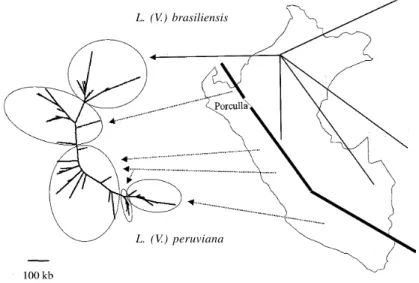
ende-mism. Our sampling key was the bio-geographical units (BGUs) described in Peru on the basis of the endemism of butterfly species (Lamas 1982). Our working hypothesis was that eco-geographical fac-tors responsible for structuring of butterfly spe-cies were also responsible for structuring among sand fly vectors and their parasites. Our assump-tion was supported by the known relaassump-tionships existing between sand fly and environment (Cameron & Davies 1993). Five chromosomes (out of 35 in subgenus Viannia, Britto et al. 1998) were selected for their significant size-polymorphism and, analysed using the aCSDI method (Dujardin et al. 1995). All L. (V.) braziliensis isolates grouped to-gether in a small cluster, at distance from L. (V.) peruviana (Fig. 1). The latter displayed a much higher chromosome size-polymorphism and its populations were structured according to their BGU of origin along a north-south cline. Northern L. (V.) peruviana isolates presented a higher karyotype similarity with L. (V.) braziliensis than with south-ern L. (V.) peruviana. Interestingly, the BGU where the northern L. (V.) peruviana isolates were col-lected is close to the pass of Porculla, the only natural pass in the Peruvian Andes between the Amazonian forest and the Pacific slopes. Consid-ering a divergence time of L. (V.) peruviana and L. (V.) braziliensis inferior to 1.5 Myrs (see above), both species likely diverged after uplifting of the Andes (achieved 3 Myrs ago, Van der Hammen 1982). Accordingly, we think that this dynamic pic-ture of karyotype variation reflects the evolution of L. (V.) peruviana from L. (V.) braziliensis, in the course of its colonisation of the Pacific slopes of the Andes, through the Porculla pass. Through North-South migration and isolation, L. (V.) peruviana would have increased its genetic and genomic differentiation during its journey through the various Pacific BGUs and their respective sand fly species (Davies et al. 1993, Villaseca et al. 1993, Caceres et al. submitted). This trend is corrobo-rated by an important eco-epidemiological argu-ment: evolution from sylvatic (reservoir: rodents and edentates for L. (V.) braziliensis; Guerra 1988) to domestic transmission (reservoir: dog for L. (V.) peruviana; Llanos-Cuentas et al. 1999). Further-more, this trend was supported recently by genomic evidences: a set of L. (V.) braziliensis-specific genes (gp63, Victoir et al. 1998) was found to lack in L. (V.) peruviana. Considering the phylogenetic proximity of both species (Chouicha et al. 1997), deletion in L. (V.) peruviana is easier to explain than acquisition by sequence divergence in L. (V.) braziliensis.
530 530 530 530
530 Genomic Rearrangements in Trypanosomatids JC Dujardin et al.
least in four out five chromosomes studied) among important tandemly repeated genes. First, halving of gp63 gene copy number and deletion of a specific isogene were found to discriminate L. (V.) peruviana from L. (V.) braziliensis (Victoir et al. 1995). Secondly, decrease in copy number of rDNA (Inga et al. 1998), mini-exon (Kebede et al. 1999) and cystein proteinase b (Polet 1999) was shown to be involved in the North-South chromo-some-size decrease observed within L. (V.) peruviana.
Our results thus clearly advocate at inter- and infra-specific levels that chromosome size-polymor-phism (i) is reflecting gene rearrangements with a potential adaptive significance, (ii) allows a sensi-tive monitoring of genetic variation (if weighed by aCSDI), and (iii) may be used for inferring novel evolutionary hypotheses.
EVOLUTION WITHIN THE GENUS LEISHMANIA
In the L. (V.) braziliensis-L. (V.) peruviana model, species divergence is thought to be recent and consequences of gene rearrangements are still visible. Next question was to evaluate if this might still be valid at higher evolutionary level, or if the signal would become buried in the evolutionary noise. Therefore, we processed the data from the karyotypes of major Leishmania species published by Wincker et al. (1996) and Britto et al. (1998), and we calculated the size of each chromosome. It had been shown that, out of 36 chromosomes, 31 link-age groups were preserved across the genus, while five were the object of fusion/fission events (Britto et al. 1998).
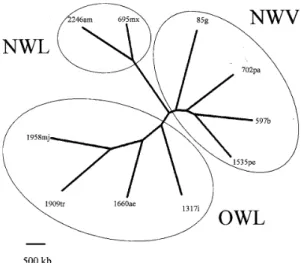
We calculated aCSDI between each species, for the 31 “conserved ” chromosomes. The ensuing dendrogram (Fig. 2) clearly showed a structuring into three clusters, corresponding to the three ma-jor taxonomical categories described by MLEE analysis within genus Leishmania: OWL, NWL and NWV. Interestingly, the genomic distance separat-ing NWL from the two other clusters was quite high (about 1,400 kb). After analysis of individual chromosomes, it appeared that this distance corre-sponds essentially to a significantly lower size for 11 NWL chromosomes. Such a result should be confirmed by the analysis of additional stocks but, like in the L. (V.) braziliensis-L. (V.) peruviana model described above, it obviously raises the ques-tion about the nature of the sequences implicated in these size-differences. Considering the higher divergence time between NWL and OWL/NWV than between L. (V.) braziliensis and L. (V.) peruviana, a larger number of significant gene re-arrangements might be expected. Accordingly, a specific attention should be paid on the gene con-tent of these 11 chromosomes, as it might give fur-ther clues to the functional differences existing between the three major groups of Leishmania. This illustrates the feedback contribution of chromosome evolutionary studies for comparative genomics.
Thus, there is a good qualitative agreement between major evolutionary groups as defined by chromosome size-polymorphism and sequence polymorphism (as inferred by MLEE analysis). Quantitatively, however, relative distances between the three groups are not similar. Indeed, chromo-some size analysis positioned NWL as the most Fig. 1: size-polymorphism of chromosomes 2, 10, 11, 27 and 134Sg in Peruvian Leishmania (V.) braziliensis and L. (V.) peruviana isolates. Agglomeration by the Fitch-Margoliash method after aCSDI calculation. Porculla: natural pass between forest and Pacific slopes of the Andes (thick line)
L. (V.) brasiliensis
531 531531 531 531 Mem Inst Oswaldo Cruz, Rio de Janeiro, Vol. 95(4), Jul./Aug. 2000
remote group within genus Leishmania, while MLEE analysis situated NWL and OWL close to each other (Thomaz-Soccol et al. 1993). This re-mote position of NWL was reinforced by counting the minimal number of fusion/fission events among the five chromosomes not considered by aCSDI analysis. While one event only was separating NWV and OWL, two and three events did separate NWL from OWL and NWV respectively (Britto et al. 1998). Two factors, inconstant mutation rates and/or selection might explain this relative incon-gruence. The Fitch-Margoliash dendrograms here presented do not consider a molecular clock hy-pothesis, but even when considering it (Kitch op-tion in Phylip package), the remote posiop-tion of NWL remained. Unfortunately, the test for molecular clock hypothesis as described by Felsenstein (1984) could not be performed because distances are not independent (on a same gel, chromosome sizes are evaluated from the same molecular marker). Selec-tion was previously shown to play an important role in the modulation of chromosome size-varia-tion in the L. (V.) braziliensis-L. (V.) peruviana model (Dujardin et al. 1998), and this hypothesis should be further explored at genus level by analy-sis of chromosome size-variants genetic content.
Our results thus show that, despite an exten-sive karyotype plasticity, chromosome size analy-sis does allow long range evolutionary studies at
genus level. Potential outgroups such as Sauroleishmania, Endotrypanum or Crithidia should now be added, in order to better understand the evolutionary relationships within genus Leish-mania; among others, this might allow to further document the Paleotropical (Kerr 2000) or Neotro-pical (Noyes 1998) origin of this genus. Further work is also required to understand the significance of the large genomic differences existing between major groups and to test their eventual adaptive value.
EVOLUTION WITHIN T. CRUZI
In the next step, our approach was applied to another organism, T. cruzi. This species has been extensively studied by MLEE, RAPD, and natural populations were found to be heterogeneous and highly structured (Brisse et al. 2000). Two major lineages were described, both being very hetero-geneous. First lineage (clade 1) was relatively less heterogeneous, and the second one was further subdivided into five smaller lineages (designated clades 2a to 2e). Our aim was thus to evaluate whether chromosome size-polymorphism would also reflect this structuring. Therefore, seven chro-mosomes recognised by specific probes were analysed in representative stocks of the six T. cruzi major clades, and data were processed by aCSDI (Henriksson et al. in preparation). On the Fitch-Margoliash dendrogram (Fig. 3), all isolates (with-out exception) clustered according to their clade of origin. Furthermore, like with MLEE/RAPD, clade 1 was more homogeneous and, consistently with RAPD, quite distant from the other ones. Chromo-some discrimination of the six clades lineages might have important biological or medical significance. Fig. 2: size-polymorphism of 31 conserved chromosomes
in genus Leishmania (from data of Britto et al. 1998and Wincker et al. 1996) Agglomeration by the Fitch-Margoliash method after aCSDI calculation. NWV, subge-nus Viannia (g, L. (V.) guyanensis ; pa, L. (V.) panamensis; b, L. (V.) braziliensis; pe, L. (V.) peruviana); NWL, New World subgenus Leishmania (am, L. (L.) amzonensis ; mx, L. (L.) mexicana); OWL, Old World Leishmania (mj, L. (L.) major; tr, L. (L.)tropica; ae, L. (L.) aethiopica; i, L. (L.) infantum); numbers correspond to LEM codes of Montpellier.
532 532 532 532
532 Genomic Rearrangements in Trypanosomatids JC Dujardin et al.
Indeed, significant differences in clinically relevant biological parameters have been reported between isolates belonging to some of these clades (Montamat et al. 1996, Laurent et al. 1997, Revollo et al. 1998, De Lana et al. 1998). Identification of the genes involved in respective chromosome rear-rangements will help exploring the molecular bases of these phenotypic differences.
Analysis of individual chromosomes showed a particular size-distribution. Indeed, in most chro-mosomes, a bi-modal distribution was observed, with important size-differences between the respec-tive modes (Fig. 4). The stepwise size-variation ob-served within each mode is suggestive of amplifi-cation/deletion among tandemly repeated genes, as shown for Leishmania. In contrast, the transi-tion from one mode to the other was not stepwise, and should correspond to discrete but less frequent evolutionary events, like translocation or deletion of large chromosome arms. The occurrence of such mechanisms was supported by the linkage of two markers (CA7.12 and 7.32) on a same chromosome in clade 1, but not in the other clades (Henriksson et al. 1995).
Chromosome analysis of T. cruzi allowed to highlight the relativity of taxonomical subdivisions in trypanosomatids. Indeed, in T. cruzi, the maximal aCSDI value measured (for seven chromosomes) between the two major lineages was 3,500 kb (aver-age of 500 kb/chromosome). In the whole genus Leishmania, the maximal aCSDI value (for 31 chro-mosomes) was of 4,750 kb (average of 150 kb/chro-mosome). This result can be accounted for by ei-ther a higher mutation rate or a higher frequency of large rearrangements in the species T. cruzi, than in genus Leishmania. However, when other genetic characters were considered, like RAPD and MLEE, the same picture was encountered (Bañuls et al. 1999). It appears thus more likely that species defi-nition should be questioned in both cases. In the absence of strict applicability of the sexual exchange criterion (Mayr 1969) to trypanosomatids because of their essentially clonal structure (Tibayrenc et
al. 1990), species definition is basically operational only. Our results clearly show that chromosome analysis contributes significantly to the definition of the major evolutionary groups among trypanosomatids, and thus could contribute with other genetic characters for re-definition of corre-sponding taxonomic units.
CONCLUSIONS AND PROSPECTS
Trypanosomatids are characterised by exten-sive genomic plasticity. With the appropriate algo-rithm (aCSDI), it is possible to rely on chromosome size-polymorphism to infer hypotheses at different evolutionary levels. Qualitative congruence with hypotheses built-up from DNA sequence polymor-phism (as inferred here from MLEE and RAPD data) contributed to validate our approach. At low evo-lutionary level chromosome size-polymorphism in-volves rearrangement of key genes, with important adaptive value. The same is occurring likely at higher evolutionary levels, where dramatic chromosome size-variations are observed. This should stimu-late interaction between evolutionary studies like here presented and parasite genome sequencing projects. On one hand, identification of major evo-lutionary groups should call for peculiar attention to the genic content of chromosomes responsible for major structuring, and to their potential rela-tionship with biological (including medical) differ-ences. This might be one of the major application of evolutionary studies. On the other hand, defini-tion of linkage groups should be used for perform-ing direct gene rearrangement studies. This is im-portant for further validating indirect studies based on chromosome size-polymorphism, but also for inferring hypotheses at higher evolutionary levels, where chromosome size might not be applicable anymore. It is too early to propose – like in prokary-otes – that the map of trypanosomatid cells is in their chromosomal organisation. However, our re-sults clearly demonstrate that chromosomes to-gether with gene sequences offer useful maps for finding our way in trypanosomatids’ evolution.
533 533533 533 533 Mem Inst Oswaldo Cruz, Rio de Janeiro, Vol. 95(4), Jul./Aug. 2000
ACKNOWLEDGEMENTS
To Dr Jamie Stevens who organised The Trypano-some Evolution Workshop and stimulated the writing of present review.
REFERENCES
Ashburner M 1989. Drosophila. A Laboratory Hand-book, Cold Spring Harbor Laboratory Press, New York.
Åslund L, Carlsson L, Henriksson J, Rydåker M, Toro GC, Galanti N, Pettersson U 1994. A gene family encoding heterogeneous histone H1 proteins in Try-panosoma cruzi. Mol Biochem Parasitol 65: 317-330. Bañuls AL, Hide M, Tibayrenc M 1999. Molecular epi-demiology and evolutionary genetics of Leishmania parasites. Int J Parasitol 29:1137-1147.
Bañuls AL, Dujardin JC, Guerrini F, De Doncker S, Jacquet D, Arevalo J, Noël S, Le Ray D, Tibayrenc M 2000. Is Leishmania (Viannia) Peruviana a dis-tinct species? J Eukaryot Microbiol in press. Bogliolo AR, Lauria-Pires L, Gibson WC 1996.
Poly-morphisms in Trypanosoma cruzi: evidence of ge-netic recombination. Acta Trop 61:31-40.
Bourke PF, Holt DC, Sutherland CJ, Kemp DJ 1996. Disruption of a novel open reading frame of Plasmo-dium falciparum chromosome 9 by subtelomeric and internal deletions can lead to loss or maintenance of cytoadherence. Mol Biochem Parasitol 82: 25-36. Bringaud F, Vedrenne C, Cuvillier A, Parzy D, Baltz D,
Tetaud E, Pays E, Venegas J, Merlin G, Baltz T 1998. Conserved organisation of genes in trypano-somatids. Mol Biochem Parasitol 94: 249-264. Brisse S, Barnabé C, Tibayrenc M 2000. Identification
of six Trypanosoma cruzi phylogenetic lineages by random amplified polymorphic DNA and multilocus electrophoresis. Int J Parasitol 30: 35-44.
Britto C, Ravel C, Bastien P, Blaineau C, Pagès M, Dedet JP, Wincker P 1998. Conserved linkage groups asso-ciated with large-scale chromosomal rearrangements between Old World and New World Leishmania ge-nomes. Gene 222: 107-117.
Caceres AG, Villaseca P, Dujardin JC, Bañuls AL, Inga R, Lopez M, Arana M, Le Ray D, Arevalo J. Geo-graphic insulation of Andean cutaneous leishmania-sis: Lutzomyia ayacuchensis (Diptera: Psychodidae) vector of Uta. Paper submitted to Am J Trop Med Hyg.
Cameron MM, Davies CR 1993. Ecological studies sup-port a key role for aphid honeydew as a nutrient source for sandflies. Trans R Soc Trop Med Hyg 87: 363. Campetella O, Henriksson J, Åslund L, Frasch ACC,
Pettersson U, Cazzulo JJ 1992. The major cysteine proteinase (cruzipain) from Trypanosoma cruzi is encoded by multiple polymorphic tandemly orga-nized genes located on different chromosomes. Mol Biochem Parasitol 50: 225-234.
Cano MI, Gruber A, Vazquez M, Cortes A, Levin MJ, Gonzalez A, Degrave W, Rondinelli E, Zingales B, Ramirez JL, Alonso C, Requena JM, Da Silveira JF 1995. Molecular karyotype of clone CL Brener cho-sen for the Trypanosoma cruzi genome project. Mol Biochem Parasitol 71: 273-278.
Chouicha N, Lanotte G, Pratlong F, Cuba Cuba CA, Velez ID, Dedet JP 1997. Phylogenetic taxonomy of Leish-mania (Viannia) braziliensis based on isoenzymatic study of 137 isolates. Parasitology 115: 343-348. Danchin A 1998. The Delphic boat or what the genomic
text tell us. Bioinformatics 14: 383.
Danchin A, Hénaut A 1997. The map of the cell is in the chromosome. Curr Opin Genet Dev 7: 852-854. Davies CR, Fernandez M, Paz L, Roncal N,
Llanos-Cuentas A 1993. Lutzomyia verrucarum can trans-mit Leishmania peruviana, the aetiological agent of Andean cutaneous leishmaniasis. Trans R Soc Trop Med Hyg 87: 603-606.
De Lana M, da Silveira Pinto A, Barnabe C, Quesney V, Noel S, Tibayrenc M 1998.Trypanosoma cruzi: com-pared vectorial transmissibility of three major clonal genotypes by Triatoma infestans. Exp Parasitol 90: 20-25.
Dover G, Brown S, Coen E, Dallas J, Strachan T, Trick M 1982. The dynamics of genome evolution and species differentiation. In Dover & Flavell (eds), Genome Evolution, Academic Press, London, p. 343-374. Dujardin JC 1995. Significations de la Variabilité
Caryotypique dans les Populations Naturelles de Leishmanies Néotropicales, PhD Thesis, Vrije Universiteit, Brussel.
Dujardin JC, Dujardin JP, Tibayrenc M, Timperman G, De Doncker S, Jacquet D, Arevalo J, Llanos-Cuentas A, Guerra H, Bermudez H, Hamers R, Le Ray D 1995. Karyotype plasticity in Neotropical Leish-mania: an index for measuring genomic distance among L. (V.) peruviana and L. (V.) braziliensis popu-lations. Parasitology 110: 21-30.
Dujardin JC, Bañuls AL, Arevalo J, Tibayrenc M, Le Ray D 1998. Comparison of chromosomal and isoen-zymatic variation in eco-geographical populations of Leishmania (Viannia) peruviana. Parasitology 117: 547-554.
Felsenstein J 1984. Distance methods for inferring phy-logenies: a justification. Evolution 38: 16-24. Gower JC 1984. Numerical methods of classification. In
JA Rioux, Leishmania. Taxonomie et Phylogenèse. Applications Éco-épidémiologiques, IMEEE, Montpellier, p. 13-20.
Guerra H 1988. Distribution of Leishmania in Peru. In Walton,Wijeyaratne & Modabber (eds), Research on Control Strategies for the Leishmaniases, IDRC-MR 184e, Ottawa, p. 135-145.
Gregorius HR 1984. A unique genetic distance. Biomet-rics J 26: 13-18.
Henriksson J, Åslund L, Macina RA, Franke de Cazzulo BM, Cazzulo JJ, Frasch AC, Pettersson U 1990. Chromosomal localization of seven cloned antigen genes provides evidence of diploidy and further dem-onstration of karyotype variability in Trypanosoma cruzi. Mol Biochem Parasitol 42: 213-223. Henriksson J, Porcel BM, Rydåker M, Sabaj V, Galanti
534 534 534 534
534 Genomic Rearrangements in Trypanosomatids JC Dujardin et al.
Inga R, De Doncker S, Gomez J, Lopez M, Garcia R, Le Ray D, Arevalo J, Dujardin JC 1998. Relation be-tween variation in copy number of ribosomal RNA encoding genes and size of harbouring chromosomes in Leishmania of subgenus Viannia. Mol Biochem Parasitol 92: 219-228.
Jeffreys AJ 1982. Evolution of globin genes. In Dover & Flavell (eds), Genome Evolution, Academic Press, London UK, p.157-176.
Katz M 1988. A comparative statistical analysis of ge-netic distances. I - Estimation of distances and their variances; distribution of the estimators. Biometrics J 30: 571-587.
Kebede A, De Doncker S, Arevalo J, Le Ray D, Dujardin JC 1999. Leishmania of subgenus Viannia: size poly-morphism of chromosomes bearing mini-exon genes in natural populations is due to rearrangement of the mini-exon gene array. Int J Parasitol 29: 549-557. Kerr SF 2000. Palaearctic origin of Leishmania. Mem
Inst Oswaldo Cruz 95: 75-80.
Lamas G 1982. A preliminary zoogeographical division of Peru, based on butterfly distributions (Lepi-doptera, Papilionoidea). In Prance (ed.), Biological Diversification in the Tropics, Columbia University Press, New York, p. 336-357.
Larson A 1994. The comparison of morphological and molecular data in phylogenetic systematics. In Schierwater, Streit, Wagner & DeSalle (eds), Mo-lecular Ecology and Evolution: Approaches and Ap-plications, Birkhäuser Verlag, Basel, p. 371-390. Laurent JP, Barnabe C, Quesney V, Noel S, Tibayrenc M
1997. Impact of clonal evolution on the biological diversity of Trypanosoma cruzi. Parasitology 114: 213-218.
Llanos-Cuentas EA, Roncal N, Villaseca P, Paz L, Ogusuku E, Perez JE, Caceres A, Davies CR 1999. Natural infections of Leishmania peruviana in ani-mals in the Peruvian Andes. Trans R Soc Trop Med Hyg 93: 15-20.
MacIntyre RJ 1994. Molecular evolution: codes, clocks, genes and genomes. BioEssays 16: 699-703. Maingon R, Gerke R, Rodriguez M, Urbina J, Hoenicka
J, Negri S, Aguirre T, Nehlin J, Knapp T, Crampton J 1988. The tubulin genes of Trypanosoma cruzi. Eur J Biochem 171: 285-291.
Mayr E 1969. Principles of Systematic Zoology, McGraw-Hill, New York, 428 pp.
Montamat EE, De Luca D’Oro GM, Gallerano RH, Sosa R, Blanco A. 1996. Characterization of Trypanosoma cruzi populations by zymodemes: correlation with clinical picture. Am J Trop Med Hyg 55: 625-628. Moreno G, Rioux JA, Lanotte G, Pratlong F, Serres E
1986. Le complexe Leishmania donovani s.l. Analyse enzymatique et traitement numérique. Indivi-dualisation du complexe L. infantum. Corollaires biogéographiques et phylétiques à propos de 146 souches originaires de l’Ancien et du Nouveau Monde. In JA Rioux, Leishmania. Taxonomie et Phylogenèse. Applications Éco-épidémiologiques, IMEEE, Montpellier, p. 105-117.
Noyes H 1998. Implications of a Neotropical origin of the Genus Leishmania. Mem Inst Oswaldo Cruz 93: 657-662.
Polet S 1999. Etude du Dosage des Gènes Cystéine Protéinase dans les Populations Naturelles de Leishmanies Péruviennes, L.Sc.Thesis, Namur, Bel-gium, 59 pp.
Ramamoorthy R, Swihart KG, McCoy JJ, Wilson ME, Donelson JE 1995. Intergenic regions between tan-dem gp63 genes influence differential expression of gp63 RNAs in Leishmania chagasi promastigotes. J Biol Chem 270: 12133-12139.
Revollo S, Oury B, Laurent JP, Barnabe C, Quesney V, Carriere V, Noel S, Tibayrenc M 1998. Trypano-soma cruzi: impact of clonal evolution of the para-site on its biological and medical properties. Exp Parasitol 89: 30-39.
Rudenko G, McCulloch R, Dirks-Mulder A, Borst P 1996. Telomere exchange can be an important mechanism of variant surface glycoprotein gene switching in Trypa-nosoma brucei. Mol Biochem Parasitol 80: 65-75. Sneath PHA, Sokal RR 1973. Numerical Taxonomy,
Freeman, San Fransico, 573 pp.
Szostak JW, Wu R 1980. Unequal crossing over in the ribosomal DNA of Saccharomyces cerevisiae. Na-ture 284: 426-430.
Thomaz-Soccol V, Lanotte G, Rioux JA, Pratlong F, Martini-Dumas A, Serres E 1993. Monophyletic origin of the genus Leishmania Ross, 1903. Ann Parasitol Hum Comp 68:107-108.
Tibayrenc M, Kjelleberg F, Ayala FJ 1990. A clonal theory of parasitic protozoa: the population struc-tures of Entamoeba, Giardia, Leishmania, Naegleria, Plasmodium, Trichomonas and Trypanosoma and their medical and taxonomical consequences. Proc Natl Acad Sci USA 87: 2414-2418.
Tomashow LS, Milhausen M, Rutter W, Agabian N 1983. Tubulin genes are tandemly linked and clustered in the genome of Trypanosoma brucei. Cell 32: 35-43. Van der Hammen T 1982. Paleoecology of Tropical South America. In Prance (ed.), Biological Diversification in the Tropics, Columbia University Press, New York, p. 60-66.
Victoir K, Dujardin JC, De Doncker S, Barker DC, Arevalo J, Hamers R, Le Ray D 1995. Plasticity of gp63 gene organisation in Leishmania (Viannia) braziliensis and Leishmania(Viannia) peruviana. Parasitology 111: 265-273.
Villaseca P, Llanos-Cuentas A, Perez E, Davies CR 1993. A comparative study of the relative importance of Lutzomyia peruensis and Lutzomyia verrucarum as vectors of cutaneous leishmaniasis in the Peruvian Andes. Am J Trop Med Hyg 49: 260-269.
Wagner W, So M 1990. Genomic variation of Trypano-soma cruzi: involvement of multicopy genes. Infect Immun 58: 3217-3224.
Wilson AC, Sarich VM, Maxson LR 1974. The impor-tance of gene rearrangement in evolution: evidence from studies on rates of chromosomal, protein and anatomical evolution. Proc Natl Acad Sci USA 71: 3028-3030.