Série Zoologia
Fundação Zoobotânica do Rio Grande do Sul Museu de Ciências Naturais
www.scielo.br/isz e-ISSN 1678-4766
Iheringia
Iheringia
Phyllostomidae assemblage (Chiroptera: Mammalia) in altitudinal
forests at the Parque Estadual do Ibitipoca,
Southeast of Minas Gerais, Brazil
Rodrigo M. Mello
1, Pedro H. Nobre
2, Marco A. Manhães
3& Alexmar S. Rodrigues
31. Programa de Pós-graduação em Ecologia – PGECOL, Instituto de Ciências Biológicas, Universidade Federal de Juiz de Fora – UFJF, Rua José Lourenço Kelmer, s/n, 36036-900 Juiz de Fora, MG, Brazil. ([email protected])
2. Departamento de Ciências Naturais, Universidade Federal de Juiz de Fora - UFJF, Rua Visconde de Mauá, 300, 36015-260 Juiz de Fora, MG, Brazil. ([email protected])
3. Instituto de Ciências Biológicas, Universidade Federal de Juiz de Fora – UFJF, Rua José Lourenço Kelmer, s/n, 36036-900, Juiz de Fora, MG, Brazil. ([email protected]; [email protected])
Received 26 May 2015. Accepted 24 August 2016.
DOI: 10.1590/1678-4766e2016021
ABSTRACT. Many studies have demonstrated the ecological relevance and great biodiversity of bats in Brazil. However, mountainous areas have been disproportionately less sampled, mainly in the Southeast. The aim of this study was to identify and compare the richness and diversity of Phyllostomidae,
the most diverse bat family, in diff erent forest types in Parque Estadual do Ibitipoca, trying to understand the causes of possible diff erences. The Parque Estadual do Ibitipoca is inserted in the Serra da Mantiqueira’s domain, in an Atlantic Forest region known as “Zona da Mata”, state of Minas Gerais, with an altitudinal range between 1200-1784 meters. The study was conducted in two forest types, classifi ed as “Nanofl oresta Nebular” and “Floresta Nebular”, whose respective data on richness and diversity were compared. The bats were captured with 8-10 mist nets for 14 months (April 2011 to May
2012) and four nights per month totaling 62,171.25 m2h of capture eff ort. A total of 392 captures (12 species) belonging to the Phyllostomidae family were
obtained. The most abundant species were Sturnira lilium (59.9%), Platyrrhinus lineatus (11.3%), Artibeus lituratus (8.7%) and Carollia perspicillata (7.6%). The two sampled areas presented diff erences in bat richness, diversity and species composition, and this diff erence was predominantly infl uenced
by S. lilium. It is likely that the observed diff erence in the assembly of bats between the two study sites depends on the variation in fl oristic composition.
The records of A. lituratus and P. lineatus in a few months of the year and close to Ficus mexiae bearing ripe fruits suggests that at least these species
move to the park for a few periods of the year in search of food resources, possibly moving through the altitudinal landscapes.
KEYWORDS: Atlantic Forest, bats, Serra da Mantiqueira.
RESUMO. Assembleia de Phyllostomidae (Chiroptera: Mammalia) em fl orestas altitudinais no Parque Estadual do Ibitipoca, sudeste de Minas Gerais, Brasil. Muitos trabalhos têm demonstrado a relevância ecológica e a grande diversidade de morcegos no Brasil. Contudo, áreas montanhosas têm
sido desproporcionalmente menos amostradas, principalmente na Região Sudeste. O objetivo principal deste estudo foi inventariar e comparar a riqueza e diversidade de morcegos Phyllostomidae, a mais diversa família de morcegos, em diferentes formações fl orestais no Parque Estadual do Ibitipoca, buscando compreender as causas das possíveis diferenças encontradas. O Parque Estadual do Ibitipoca está inserido nos domínios da Serra da Mantiqueira, em área de Mata Atlântica, na Zona da Mata do estado de Minas Gerais, cujas altitudes variam de 1.200 a 1.784 metros. O estudo foi conduzido em dois tipos de fl orestas, classifi cadas como “Nanofl oresta Nebular” e “Floresta Nebular”, cujos respectivos dados sobre riqueza e diversidade foram comparados. Os morcegos foram capturados com 8-10 redes de neblina por 14 meses (entre abril de 2011 a maio de 2012) e 4 noites por mês, totalizando 62.171,25 m2h de esforço de captura. Foram obtidas um total de 392 capturas (12 espécies) pertencentes à família Phyllostomidae. As espécies mais abundantes foram Sturnira lilium (59,9%), Platyrrhinus lineatus (11,3%), Artibeus lituratus (8,7%) e Carollia perspicillata (7,6%). As duas áreas amostradas apresentaram diferenças relacionadas à riqueza, diversidade e composição de espécies de morcegos, sendo esta diferença infl uenciada predominantemente por S. lilium. É provável que as diferenças observadas na assembleia de morcegos entre as duas áreas amostradas apresentem alguma relação com a variação na composição fl orística. O registro de A. lituratus e P. lineatus em poucos meses do ano e próximo a Ficus mexiae em frutifi cação sugere que pelo menos estas espécies se deslocam para o parque durante alguns períodos do ano em busca de recursos alimentares, possivelmente movendo-se através
das variações altitudinais da paisagem.
PALAVRAS-CHAVE: Mata Atlântica, morcegos, Serra da Mantiqueira.
The Chiroptera Order is represented by 1,120 species
(Reis
et al
., 2007), the greatest diversity found along the
Neotropical region, with about 83 genera and 288 species
(Mickleburgh
et al
., 2002). In Brazil, 178 species are
recorded (Nogueira
et al
., 2014), of which 1 is considered
vulnerable, 4 near-threatened and 24 are data defi cient,
according to IUCN (IUCN, 2015). Among the Chiroptera,
Phyllostomidae family is the most diverse in the Neotropics
(Fenton
et al
., 1992), and represent 52.9% of the recorded
species in Brazil (Peracchi
et al
., 2011).
Brazil. Such species are distributed in seven out of the nine
families registered in the Neotropics. Among these, the
Phyllostomidae family represents about 53% of the species
(Tavares
et al
., 2010). Despite having the greatest richness
of bats in the southeast region of Brazil, the state of Minas
Gerais has many areas that remain unknown regarding the
composition of Chiroptera fauna (Tavares
et al
., 2010). In
this state, the Atlantic Forest, a biome that is considered
a global hotspot with priority for conservation (Myers
et
al
., 2000), occupies 46% of the territory and is currently
restricted to forest fragments of various sizes and levels
of degradation. Of these, only about 10% of the original
Atlantic Forest range has forest remnants (Fundação SOS
Mata Atlântica
&
Inpe
, 2011), and an important part of
this vegetation cover is in mountainous areas.
In southeastern Brazil, few studies have focused on
the diversity of bats at high altitude sites (e.g., Falcão
et al
.,
2003; Dias
&
Peracchi, 2008; Mello
et al.
, 2008; Moras
et al.
, 2013; Nobre
et al
., 2013). In these environments,
the availability of food, as well as the environmental
variables, may differ from the lower areas, creating different
environmental conditions that in particular reflect fauna
along the altitudinal gradients (Giannini, 1999; Mello
et
al.
, 2008). Thus, in order to contribute to the knowledge of
the ecology of phyllostomid bats at high altitude sites, this
study aimed to determine the richness and diversity of this
group in two areas of montane forests of Parque Estadual do
Ibitipoca, in the Atlantic Forest domains, trying to understand
the causes of possible differences.
MATERIALS AND METHODS
Study areas.
The Parque Estadual do Ibitipoca
(PEIB) is inserted in the Atlantic Forest domains, Serra da
Mantiqueira region, state of Minas Gerais (21°42’S and
43°54’W). The park has an area of 1488 ha with altitudes
ranging between 1,200 and 1,784 m.a.s.l. The climate is
mesothermal highland tropical, with dry cold winters and
rainy summers. Areas with grassland occupy about 50% of
the Park and the forest physiognomies correspond to about
32% (Herrmann, 2006). The forests of the Park belong to the
Atlantic Forest biome and are classified as Floresta Nebular,
Nanofloresta Nebular and Arbustal Nebular according to
Oliveira-Filho
et al
. (2013).
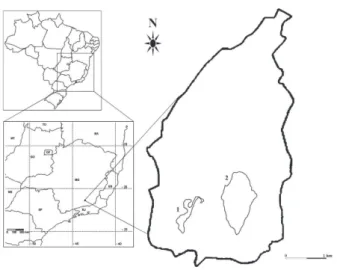
Two forest areas were selected for sampling (Fig.
1): one of Floresta Nebular and the other of Nanofloresta
Nebular. The two areas are interspersed with savannahs and
grasslands located about 600 meters apart. The Nanofloresta
Nebular is known locally as Mata de Grota, and is 1300
m.a.s.l., with an area of approximately 15 ha. These forest
types have developed failures in rocks, which accumulates
products of decomposition from the higher places inside
the Park, resulting in taller vegetation development (Dias
et
al
., 2002). This forest formation is closer to several caves,
and has a connection with semi-deciduous forests located
outside the limits of the Park.
The second selected area, a patch of Floresta Nebular,
known locally as Mata Grande, has an area of about 94
ha and altitudes around 1400 m.a.s.l.; it is the main forest
fragment in the Park. In this sampling site, the canopy has
many gaps and an average height of 17 meters, with emergent
trees reaching 25 meters (Rodela, 1998; Oliveira-Filho
et al.
, 2013).
During the samplings, the monthly average
temperature was 19.9°C. The minimum temperature was
5.3°C, recorded in July, and the maximum was 36.8°C,
in September. The months with the highest precipitation
indices were October 2011 to May 2012. December 2011
was the month with the highest rainfall (726.9 mm). The
lowest rainfall (7.5 mm) was recorded in September 2011
(Mello
et al
., 2014).
Samplings.
Captures were carried out for 14 months
from April 2011 to May 2012. Each area was sampled for
two nights each month, except in April 2011 (three nights in
each area) and January 2012 (two nights in Mata de Grota
and one in Mata Grande), due to intense rainfall and logistical
problems. Thus, 57 nights of sampling were conducted, of
which 26 occurred in the Mata Grande and 31 in Mata de
Grota, prioritizing night with the moon in the dark phase.
Intervals between sampling periods were approximately 15
days. For captures, 8 to 10 mist nets (2.5 x 9 meters) per
night were used, which were installed 30 cm from the ground,
reaching 337 hours of mist net exposure and 2785 mist net/
hour. The total capture effort was 62171.25 m
2h, calculated
according to the methodology proposed by
Straube
&
Bianconi (2002).
The mist nets were opened at dusk, after approximately
18 hours, and stayed open for six hours, with monitoring
every 15 minutes. Captured bats were held in cloth bags
for later identification and marked with color-coded collars
for as proposed by
Esbérard
&
Daemon (1999). After this
procedure, bats were released near the same place of capture.
Identifications followed the criteria of Vizotto
&
Taddei
(1973), Reis
et al
. (2007) and Miranda
et al
. (2011).
sacrificed and fixed in 10% formalin and then preserved
in 70% alcohol. The voucher material was incorporated in
the Mammal Collection of Mammals of the Department of
Natural Sciences, Universidade Federal de Juiz de Fora.
Data analysis.
The methodology with mist nets
installed at ground level favors the capture of species of
the Phyllostomidae family (Fenton
et al.
, 1992; Passos
et
al.
, 2003). Thus, only species belonging to this family were
analyzed, disregarding the recaptures.
The diversity of bats was calculated by the inverse of
Simpson’s index (1-D). These values were recorded for the
total area of the study, as well as for each area individually,
and the difference between two areas was tested by the
bootstrap method. Simpson’s index (1-D) was chosen because
it is less sensitive to sample size and provides a good estimate
for small population sizes (Magurran
, 2004).
The difference in richness observed between the
areas was analyzed by means of rarefaction curves, the
result of which was also compared to bootstrap analysis.
Analysis of Similarity (ANOSIM) was used to verify
differences in species composition, based on Bray-Curtis
distance. The contribution of each taxon for the difference
observed between the areas was performed by the Similarity
Percentages analysis (SIMPER).
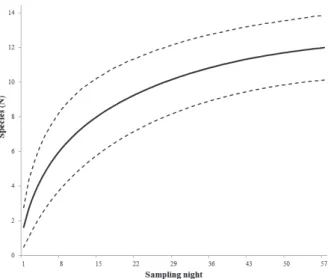
Species accumulation curves, along with their
respective confidence intervals, were generated by the Mao
Tau method to verify the occurrence of stabilization of the
species richness. The richness estimates were calculated
based on the first-order Jackknife index. Here, 1000
randomizations were adopted to perform bootstrap analysis,
similarity (ANOSIM) and richness estimators.
Analysis were performed using the PAST software
version 2.15 (Hammer
et al
., 2001) and EstimateS version
9.1 (Colwell, 2009).
RESULTS
A total of 392 captures of 12 species were obtained, of
which 48 correspond to recaptures (Tab. I). The most common
species were
Sturnira lilium
(E. Geoffroy, 1810) with 59.9%
(N = 206), followed by
Platyrrhinus lineatus
(E. Geoffroy,
1810) with 11.3% (N = 39),
Artibeus lituratus
(Olfers, 1818)
with 8.7% (N = 30) and
Carollia perspicillata
(Linnaeus,
1758) with 7.6% (N = 26); the remaining species totaled 43
captures, representing 12.5% of the total. The occurrence
of phyllostomid varied between the two areas. In Mata de
Grota, 305 captures were obtained, of which 44 correspond
to recaptures. At this site, 11 species of phyllostomid bats
were recorded, and the most common were
S. lilium
(53.6%)
and
P. lineatus
(14.6%). In the Mata Grande, 87 captures
of five species, four of which correspond to recaptures. The
most abundant species in the Mata Grande were
S. lilium
(79.5%), followed by
A. lituratus
(8.4%) (Fig. 2).
The species accumulation curve did not reach an
asymptote, however, from the twenty-eighth sampled night,
about 83% of the species in this study had been captured.
In the remaining nights only two species were added (Fig.
3). Rarefaction curves for phyllostomid species showed
differences in richness between the two areas, with the
largest number of species in the Mata de Grota (Fig. 4).
Such difference was confirmed by the Bootstrap analysis
(p = 0.003). According to the first-order Jackknife index,
Tab. I. Total captures of phyllostomid bat species in Parque Estadual do Ibitipoca, MG, Brazil (including recaptures). *, Number of recaptures: Anoura caudifer: 1 (Mata de Grota); Carollia perspicillata: 9 (8 [Mata de Grota]/1[Mata Grande]); Platyrrhinus lineatus: 2 (Mata de Grota); Sturnira lilium:
36, (33[Mata de Grota]/3 [Mata Grande]).
Mata de Grota
N(%) Mata GrandeN(%) N(%)Total
PHYLLOSTOMIDAE
Phyllostominae
Chrotopterus auritus (Peters, 1856) - 3 (3.3) 3 (0.8)
Glossophaginae
Anoura caudifer (E. Geoffroy, 1818) 12 (3.9) - 12* (3)
Carolliinae
Carollia perspicillata (Linnaeus, 1758) 28 (9.1) 7 (7.7) 35* (8.8)
Stenodermatinae
Artibeus fimbriatus Gray, 1838 2 (0.6) - 2 (0.5)
Artibeus lituratus (Olfers, 1818) 23 (7,4) 7 (7.7) 30 (7.5)
Chiroderma doriae Thomas 1891 3 (1) - 3 (0.8)
Pygoderma bilabiatum (Wagner, 1843) 1 (0.3) - 1 (0.3)
Platyrrhinus lineatus (E. Geoffroy 1810) 40 (12.9) 1 (1.1) 41* (10.3)
Platyrrhinus recifinus (Thomas, 1901) 8 (2.6) - 8 (2)
Sturnira lilium (E. Geoffroy, 1810) 173 (56) 69 (75.8) 242* (60.5)
Vampyressa pusilla (Wagner, 1843) 11 (3.6) - 11 (2.8)
Desmodontinae
Desmodus rotundus (E. Geoffroy, 1810) 4 (1.3) - 4 (1)
85.9% of the phyllostomid species present in studied forest
sites of PEIB were captured. Estimates of species point
out that, for Mata de Grota, 85.1% were recorded species,
while for Mata Grande, 83.9% of the species were present
in this environment.
The diversity of phyllostomid in Ibitipoca was 1-D
= 0.6126, while analyzing each area separately, Mata de
Grota showed greater diversity than Mata Grande (0.6725
and 0.3539, respectively; p = 0.001). The areas were also
different with regard to species composition (R = 0.2673,
p = 0.0012), mainly due to the contribution of
S. lilium
,
C.
perspicillata
and
Anoura caudifer
(E. Geoffroy, 1818) to
dissimilarity (Tab.II).
DISCUSSION
Altitudinal changes are an important factor that
influences the structure of mammalian communities (Owen
,
1990). Montane environments can present bat communities
that are structurally different from low areas, and some studies
have revealed reduction of phyllostomid bats richness with
increasing altitude (Navarro
&
Leon-Paniagua, 1995; M.
A. Martins, unpubl. data). This reduction may be related to
the distribution of resources, because highland forests have
a higher proportion of plant species dispersed by birds (S.
Campassi, unpubl. data). In fact, the phyllostomid species
richness observed in PEIB was lower than that recorded in
lowland areas, as in places of Atlantic Forest from Rio de
Janeiro, where Esbérard (2003) recorded 24 species of
phyllostomid, and to the Ilha Grande, municipality of Angra
dos Reis, where
Esbérard
et al.
(2006) found 26 species.
Some bat species can present an increased abundance
with increasing altitude (Giannini, 1999). Studying a bat
assemblage in Caraça at altitudes between 850-2070 m,
Falcão
et al
. (2003) observed that
S. lilium
accounted for
about 64% of the captures. According to these authors, this
Fig. 4. Rarefaction curves with confidence intervals representing two areas of forest types in Parque Estadual do Ibitipoca, MG, Brazil. The largest curve refers to Mata de Grota, and the smaller curve to the Mata Grande. Fig. 3. Species accumulation curve of phyllostomid bats captures based onsampling nights in the Parque Estadual do Ibitipoca, MG, Brazil. Dotted lines correspond to the 95% confidence interval obtained by the Mao Tau method.
abundance may be related to the increase of food resources
close to the capture sites. However,
Mello
et al.
(2008),
studying in a mountainous area, 850 meters high in the state
of São Paulo, found that the abundance of
S. lilium
was more
related to the variation in temperature than the supply of
Solanaceae fruits. Other studies in highland regions, such
as
Nobre
et al
. (2009), and Nobre
et al
. (2013) in Minas
Gerais and M. A.
Martins
(unpubl. data) have demonstrated
the high abundance of
S. lilium
in altitudes around 1000m.
Sturnira lilium
also prevailed in Ibitipoca (60.5%)
with smaller representativeness in the Mata de Grota (56%)
and highest in the Mata Grande (75.8%). In addition,
S.
lilium
was the species with the highest contribution to the
differences in species composition between the sampled
areas. This difference, which shows the representativeness
of this species in the bat fauna of their area, may be related
to vegetation structure, since in the Mata de Grota there are
edges and clearings, which provide a proper environment
for the development of pioneer plants, such as the
Solanum
,
widely consumed by
S. lilium
, attracting the species in this
area.
The occurrence of frugivores in a given place may be
associated with spatial and temporal distribution of feeding
resources (Fleming
et al
., 1977). Thus, captures of
P. lineatus
and
A. lituratus
in Ibitipoca suggested a strong association
with the occurrence of
Ficus mexiae
Standl. (Moraceae) in
Mata de Grota. Both species have feeding habits usually
related with plants of the genus
Ficus
(Muller
&
Reis
,
1992; Sartore
&
Reis, 2012; Passos
&
Graciolli, 2004). In
Ibitipoca, most of the captures of these bat species occurred
in the months where
F. mexiae
was observed bearing fruits
in the Mata de Grota.
In PEIB,
C. perspicillata
was the second most
important species to the dissimilarity in species composition
between Mata de Grota and the Mata Grande (13.8%). By
studying the movement of bats in the Atlantic forest in Paraná,
Bianconi
et al
. (2006) suggest that
C. perspicillata
has
small feeding area as possibly due to the availability of fruits
of
Piper
. However, in the absence of plants of this genus,
this species can consume predominantly other genres such
as
Solanum
(Mello
et al
., 2004). Thus, the presence of
pioneer plant families can contribute to the occurrence of
C. perspicillata
in Ibitipoca, especially in Mata de Grota,
where these plants occur more frequently.
In studies performed in Serra Negra, near to Ibitipoca,
Nobre
et al.
(2013) compared two mountain slopes, and
found that the abundance of
C. perspicillata
represented
13.6% in the south and 38.1% in the north. The authors
considered the spatial and temporal distribution of food
resources as a possible factor to explain this pattern, since
Piper
was regularly found at the capture sites on the north
slope. Thus, it is plausible that the low occurrence of
C.
perspicillata
in PEIB compared to the Serra Negra, can
also be associated with the availability of food resources,
as this species has preference for fruits of the genus
Piper
(Fleming
et al
., 1977; Heithaus
&
Fleming, 1978) which,
despite being found in PEIB, is more common below 1,000
m.a.s.l. (Bornstein, 1989).
Rarefaction curves revealed differences in species
richness of phyllostomid bats between the Mata de Grota and
the Mata Grande. As well as the difference in diversity, this
can be related to phytophysionomic characteristics peculiar
to each area. In Mata de Grota, the Solanaceae, Piperaceae,
Moraceae and Urticaceae families are over-represented in
relation to the Mata Grande. These families provide food
resources to the bats and probably favor the greater diversity
of phyllostomids. However, the absence of more consistent
information regarding the floristic composition of Mata
de Grota hinders comparisons with other areas. Another
factor that may contribute to the increased occurrence of
bats in Mata de Grota is its proximity to semi-deciduous
forests located around the park, offering a connection with
several forest fragments, including fragments located in lower
altitudinal areas. This connection can generate conditions that
allow the movement of bats through the landscape, favoring
phyllostomid fauna in Mata de Grota. On the other hand,
the Mata Grande, besides not being connected by forest
remnants to Mata de Grota, is regarded as a mature forest,
dominated by Lauraceae, Melastomataceae and Rubiaceae
families (Carvalho
et al
., 2000). Such families have few
species whose fruits are used by the bat community as a
feeding resource (Lobova
et al
., 2009), possibly causing
Tab. II. Similarity Percentages (SIMPER) of the species composition of phyllostomid bats between two forest areas (Mata de Grota and Mata Grande) in Parque Estadual do Ibitipoca, MG, Brazil based on the distance of Bray-Curtis (Aver. Diss., Average Dissimilarity).
Species Aver. Diss. Contribution %
Sturnira lilium (E. Geoffroy, 1810) 44.87 53.58
Carollia perspicillata (Linnaeus, 1758) 11.59 13.84
Anoura caudifer (E. Geoffroy, 1818) 9.19 10.89
Platyrrhinus lineatus (E. Geoffroy 1810) 5.27 6.29
Artibeus lituratus (Olfers, 1818) 4.50 5.37
Vampyressa pusilla (Wagner, 1843) 3.94 4.71
Chrotopterus auritus (Peters, 1856) 1.55 1.85
Platyrrhinus recifinus (Thomas, 1901) 1.54 1.84
Desmodus rotundus (E. Geoffroy, 1810 0.69 0.82
Pygoderma bilabiatum (Wagner, 1843) 0.29 0.34
Chiroderma doriae Thomas 1891 0.26 0.31
the low richness and diversity of frugivorous bats observed
in this site.
The only species of the Phyllostominae subfamily
captured in this study was
Chrotopterus auritus
(Peters,
1856), also observed in the Serra Negra region, near the
PEIB (Nobre
et al
., 2013). The records of this species
occurred only near to the stream within the Mata Grande.
Chrotopterus auritus
has carnivorous habits, feeding mainly
on small mammals (Bonato
et al
., 2004). The presence
of species belonging to the subfamily Phyllostominae has
been considered an indicator of the degree of preservation
for some areas (Fenton
et al
., 1992). The presence of
C.
auritus
suggests that Mata Grande has the trophic structure
necessary for the maintenance of its population, which may
be associated with a good state of preservation of this area.
According to Mello
et al
. (2008), the preservation of
altitudinal gradients is of extreme importance for migratory
species. In PEIB, the occurrence of some bats in only a few
months of the year suggests that some species are moving
in the landscape partly because of the demand for feeding
resources. Thus, the connection between the forests of PEIB
and forests preserved in the lower areas becomes highly
important for the continuing existence of bat populations
through the landscape.
Acknowledgements.We thank the Fundação de Amparo à
Pesquisa do Estado de Minas Gerais (FAPEMIG) for the Master’s Degree scholarship granted; We also thanks to Instituto Brasileiro do Meio Ambiente e dos Recursos Naturais Renováveis (IBAMA) for the research license (275281-1) and to the Instituto Estadual de Florestas (IEF), for the authorization to perform this study at the Ibitipoca State Park (78/11), as
well as for logistical support.
REFERENCES
Bianconi, G. V.; Mikich, S. B. & Pedro, W. A. 2006. Movements of bats
(Mammalia, Chiroptera) in Atlantic Forest remnants in southern Brazil.
Revista Brasileira de Zoologia 23(4):1199-1206.
Bonato, V.; Facure, K. G. & Uieda, W. 2004. Food habitats of bats of subfamily Vampyrinae in Brazil. Journal of Mammalogy 85
(4):708-713.
Bornstein, A. J. 1989. Taxonomy studies in the Piperaceae – I. The pedicellate pipers of Mexico and Central America (Piper subg. Arctottonia). Journal of the Arnold Arboreutum 70(1):1-55. Carvalho, L. M. T.; Fontes, M. A. L. & Oliveira-Filho, A. T. 2000.
Tree species distribution in canopy gaps and mature forest in an area
of cloud forest of the Ibitipoca Range, south-eastern Brazil. Plant Ecology 149:9-22.
Colwell, R. K. 2009. EstimateS: Statistical estimation of species richness and shared species from samples. Version 9.1. Available at <http:// viceroy.eeb.uconn.edu/estimates/>. Accessed on March 2015. Dias, D. & Peracchi, A. L. 2008. Quirópteros da Reserva Biológica
do Tinguá, estado do Rio de Janeiro, sudeste do Brasil (Mammalia:
Chiroptera). Revista Brasileira de Zoologia 25(2):333-369.
Dias, H. C. T.; Fernandes Filho, E. I.; Schaefer, C. E. G. R.; Fontes, L. E. F. & Ventorim, L. B. 2002. Geoambientes do Parque Estadual
do Ibitipoca, Município de Limas Duarte – MG. Revista Árvore
26(6):777-786.
Esbérard, C. E. L. 2003. Diversidade de morcegos em área de Mata Atlântica regenerada no sudeste do Brasil. Revista Brasileira de Zoociências 5(2):189-204.
Esbérard, C. E. L. & Daemon, C. 1999. Um novo método para marcação de morcegos. Chiroptera Neotropical 5(1-2):116-117.
Esbérard, C. E. L.; Jordão-Nogueira.; Luz, J. L.; Melo, G. G. S.; Mangolin, R.; Jucá, N.; Raíces, D. S. L.; Enrici, M. C. & Bergallo, H. 2006. Morcegos da Ilha Grande, Angra dos Reis, RJ, sudeste do Brasil. Revista Brasileira de Zoociências 8(2):147-153.
Falcão, F. C.; Rebêlo, V. F. & Talamoni, S. A. 2003. Structure of a bat
assemblage (Mammalia, Chiroptera) in Serra do Caraça Reserve,
South-east Brazil. Revista Brasileira de Zoologia 20(2):347-350.
Fenton, M. B.; Acharya, L.; Audet, D.; Hickey, M. B. C.; Merriman, C.; Obrist, M. K.; Syme, D. M. & Adkins, B. 1992. Phyllostomid bats
(Chiroptera: Phyllostomidae) as indicators of habitat disruption in the Neotropics. Biotropica 24(3):440-446.
Fleming, T. H.; Heithaus, E. R. & Sawyer, W. 1977. An experimental
analysis of the food location behavior of frugivorous bats. Ecology
55(3):619-627.
Fundação SOS Mata Atlântica & Inpe. 2011. Atlas dos remanescentes florestais da Mata Atlântica / Período 2008-2010. São Paulo, Fundação SOS Mata Atlântica & Instituto Nacional de Pesquisas espaciais. 120p. Giannini, N. P. 1999. Selection of diet and elevation by sympatric species of
Sturnira in an Andean Rainforest. Journal of Mammalogy 80 (4):1186-1195.
Hammer, Ø.; Harper, D. A. T. & Ryan, P. D. 2001. PAST: Paleontological
statistics software package for education and data analysis.
Palaeontologia Electronica 4(1):1-9. Available at <http:// palaeolectronica.org/2001_1/past/issue1_01.htm>. Accessed on 12
May 2012.
Heithaus, E. R. & Fleming, T. H. 1978. Foraging movements of a frugivorous bat, Carollia perspicillata (Phyllostomatidae). Ecological
Monographs 48(2):127-143.
Herrmann, G. 2006. Plano de Manejo do Parque Estadual do Ibitipoca.
Belo Horizonte, Valor Natural. 70p.
IUCN 2015. The IUCN Red list of Threatened Species. Version 2015-4.
Available at <http:\\www.iucnredlist.org>. Downloaded on 28 June
2016.
Lobova, T. A.; Geiselman, C. K. & Mori, S. A. 2009. Seed dispersal by bats in the Neotropics. New York, The New York Botanical Garden
Press. 465p.
Magurran, A. E. 2004. Measuring Biological Diversity. Oxford,
Blackwell. 256p.
Mello, M. A. R.; Kalko, E. K. V. & Silva, W. R. 2008. Diet and abundance of the bat Sturnira lilium (Chiroptera) in a Brazilian montane Atlantic Forest. Journal of Mammalogy 89(2):485-492.
Mello, M. A. R.; Schittini, G. M.; Selig, P. & Bergallo, H. G. 2004. A
test of the effects of climate and fruiting of Piper species (Piperaceae) on
reproductive patterns of the bat Carollia perspicillata (Phyllostomidae).
Acta Chiropterologica 6(2):309-318.
Mello, R. M.; Nobre, P. H.; Manhães, M. A. & Pereira, C. P. 2014.
Frugivory by Phyllostomidae bats in a montane Atlantic Forest, southeastern Minas Gerais, Brazil. Ecotropica 20:65-74.
Mickleburgh, S. P.; Hutson, A. M. & Racey, P. A. 2002. A review of the global conservation status of bats. Oryx 36(1):18-34.
Miranda, J. M. D.; Bernardi, I. P. & Passos, F. C. 2011. Chave ilustrada para a determinação dos morcegos da Região Sul do Brasil. Curitiba,
João M. D. Miranda. 51p.
Moras, L. M.; Bernard, E. & Gregorin, R. 2013. Bat assemblages
at a high-altitude area in the Atlantic Forest of southeastern Brazil.
Mastozoología Neotropical 20(2):269-278.
Muller, M. F. & Reis, N. R. 1992. Partição de recursos alimentares entre
quatro espécies de morcegos frugívoros (Chiroptera, Phyllostomidae).
Revista Brasileira de Zoologia 9(3-4):345-355.
Myers, N.; Mittermeyer, R. A.; Mittermeyer, C. G.; Fonseca G. A. B.
& Kent, J. 2000. Biodiversity hotspots for conservation priorities. Nature 403:853-858.
Navarro, D. L. & León-Paniagua, Y. L. 1995. Community structure of bats along an altitudinal gradient in tropical eastern Mexico. Revista
Mexicana de Mastozoología 1:9-21.
Nobre, P. H.; Manhães, M. A.; Bastos-Neto, O. J.; Rezende, A. C.
& Rodrigues, A. S. 2013. Bat assemblages from mountain forest
areas in the Serra Negra region, southeastern Brazil. Mastozoología Neotropical 20(2):279-287.
Nobre, P. H.; Rodrigues, A. S.; Costa, I. A.; Moreira, A. E. S. & Moreira,
Negra, municípios de Rio Preto e Santa Bárbara do Monte Verde, Minas Gerais, com outras localidades da Mata Atlântica. Biota Neotropica 9(3):151-156.
Nogueira, M. R.; Lima, I. P.; Moratelli, R.; Tavares, V. C.; Gregorin, R. & Peracchi, A. L. 2014. Checklist of Brazilian bats, with comments on original records. Check List10(4):808-821.
Oliveira-Filho, A. T.; Fontes, M. A. L.; Viana, P. L.; Valente, A. S. M.; Salimena, F. R. G. & Ferreira, F. M. 2013. O Mosaico de
Fitofisionomias do Parque Estadual do Ibitipoca. In: Forzza, R. C.;
Menini Neto, L.; Salimena, F. R. G. & Zappi, D. orgs. Flora do
Parque Estadual do Ibitipoca e seu entorno. Juiz de Fora, Editora UFJF, p. 53-92.
Owen, J. G. 1990. Patterns of mammalian species richness in relation
to temperature, productivity, and variance in elevation. Journal of Mammalogy 71(1):1-13.
Passos F. C. & Graciolli, G. 2004. Observações da dieta de Artibeus lituratus (Olfers) (Chiroptera, Phyllostomidae) em duas áreas do sul
do Brasil. Revista Brasileira de Zoologia21(3):487-489.
Passos F. C.; Silva, W. R.; Pedro, W. A. & Bonin, M. R. 2003. Frugivoria
em morcegos (Chiroptera) do Parque Estadual Intervales, sudeste do
Brasil. Revista Brasileira de Zoologia 20(3):511-517.
Peracchi, A. L.; Lima, I. P.; Reis, N. R.; Nogueira, N. R. &
Ortêncio-Filho, H. 2011. Ordem Chiroptera. In: Reis, N. R.; Peracchi, A. L.;
Pedro, W. A. & Lima, I. P. eds. Mamíferos do Brasil, 2ed. Londrina, N. R. Reis. 439p.
Reis, N. R.; Peracchi A. L.; Pedro, W. A. & Lima, I. P. eds. 2007. Morcegos do Brasil. Londrina, N. R. Reis. 253p.
Rodela, L. G. 1998. Cerrados de altitude e campos rupestres do Parque Estadual do Ibitipoca, sudeste de Minas Gerais: Distribuição e florística por subfisionomias da vegetação. Revista do Departamento de Geografia 12:163-189.
Sartore, E. R. & Reis, N. R. 2012. Relacionando dieta e horário de captura
entre duas espécies de morcegos frugívoros (Chiroptera, Phyllostomidae,
Stenodermatinae). Semina: Ciências Biológicas e da Saúde 33 (1):65-76.
Straube, F. C. & Bianconi, G. V. 2002. Sobre a grandeza e a unidade utilizada para estimar esforço de captura com utilização de redes-de-neblina. Chiroptera Neotropical 8(1-2)150-152.
Tavares, V. C.; Aguiar, L. M. S.; Perini, F. A.; Falcão, F. C. & Gregorin, R. 2010. Bats of the state of Minas Gerais, southeastern Brasil. Chiroptera Neotropical 16(1):675-705.
Vizotto, L. D. & Taddei, V. A. 1973. Chave para identificação de