Pre vale nce and risk facto rs fo r
HBV, HCV and HDV infe ctio ns
am o ng inje cting drug use rs
fro m Rio de Jane iro , Brazil
1Laboratório de Hepatites Virais, Departamento de Virologia, and
2Departamento de Informações para a Saúde, Centro de Informação em Ciência e
Tecnologia, Instituto O swaldo Cruz, FIO CRUZ, Rio de Janeiro, RJ, Brasil
3Núcleo de Estudos e Pesquisas em Atenção ao Uso de Drogas (NEPAD),
Universidade Estadual do Rio de Janeiro, Rio de Janeiro, RJ, Brasil
4Department of Virology, Robert Koch Institute, Berlin, Germany
M.L.A. O liveira1, F.I. Bastos2,
P.R. Telles3, C.F.T. Yoshida1,
H.G. Schatzmayr1,
U. Paetzold4, G. Pauli4
and E. Schreier4
Abstract
Viral hepatitis constitutes a major health issue, with high prevalence among injecting drug users (IDUs). The present study assessed the prevalence and risk determinants for hepatitis B, C and D viruses (HBV, HCV and HDV) infections among 102 IDUs from Rio de Janeiro, Brazil. Serological markers and HCV-RNA were detected by enzyme immunoassay and nested PCR, respectively. HCV genotyping was determined by restriction fragment length polymorphism analysis (RFLP). HBsAg, anti-HBc and anti-HBs were found in 7.8, 55.8 and 24.7% of IDUs, respectively. In the final logistic regression, HBV infection was independently associated with male homosexual inter-course within the last 5 years (odds ratio (OR) 3.1; 95% confidence interval (CI) 1.1-8.8). No subject presented anti-delta (anti-HD). Anti-HCV was detected in 69.6% of subjects, and was found to be inde-pendently associated with needle sharing in the last 6 months (OR 3.4; 95% CI 1.3-9.2) and with longer duration of iv drug use (OR 3.1; 95%
CI 1.1-8.7). These data demonstrate that this population is at high risk for both HBV and HCV infection. Among IDUs from Rio de Janeiro, unprotected sexual intercourse seems to be more closely associated with HBV infection, whereas HCV is positively correlated with high risk injecting behavior. Comprehensive public health interventions targeting this population and their sexual partners must be encour-aged.
Co rre spo nde nce
M.L.A. O liveira
Laboratório de Hepatites Virais Departamento de Virologia Instituto O swaldo Cruz, FIO CRUZ Av. Brasil, 4365
21040-360 Rio de Janeiro, RJ Brasil
Fax: + 55-21-270-6397 E-mail: lou@ gene.dbbm.fiocruz.br M.L.A. O liveira was supported by the Robert Koch Institute, Berlin, Germany. F.I. Bastos, C.F.T. Yoshida and P.R. Telles were supported by CNPq and FAPERJ.
Received August 24, 1998 Accepted June 1, 1999
Ke y wo rds
·HBV
·HDV
·HCV
·HCV genotypes
·IDU
Intro ductio n
Viral hepatitis constitutes a major health issue and can be caused by different etio-logic agents (1). These infections are spread worldwide, although with varying prevalence in different regions. It is estimated that there
approxi-mately 20 to 30% of these patients are at risk for developing cirrhosis (4).
Blood-borne hepatitis can become a chronic infection at proportions which vary depending on the causative agent. Among adults with HBV infection, 5-10% of cases can become chronic and a higher frequency is observed in HDV (70-90%) and HCV (90%) superinfection (4-6). Liver cirrhosis and hepatocellular carcinoma constitute ma-jor late complications of viral hepatitis (3,7). HBV and HDV are associated with fulmi-nant hepatitis in about 1-2% and 2-20% of acute cases, respectively, whereas HCV is rarely associated with this complication (4-6).
Injecting drug users (IDUs) constitute a group of frequent exposure to many viral infections, since they usually engage in high risk sexual and injecting behavior (8). Fur-thermore, these subjects play a role as a reservoir and source of viral transmission in the inter- and extra-exposure categories. The prevalence of blood-borne hepatitis is usu-ally higher among IDU than in other compa-rable non-IDU population strata (9). Epide-miological data indicate that IDUs represent the largest risk group for HCV infection (10).
The aim of the present study was to as-sess the frequency of HBV, HCV and HDV infections and their respective risk factors among IDUs from Rio de Janeiro, Brazil.
Subje cts and Me tho ds
ID U po pulatio n
The sample analyzed here was part of an epidemiological multicenter project about human immunodeficiency virus (HIV) risks among IDUs in five Brazilian cities (Projeto Brasil). A survey was carried out on 102 volunteers selected at drug use treatment centers and from the drug scene (streets) of the city. The injecting users recruited from the drug scene were enrolled from
different sources, based on previous experi-ence of the research team in a former multicity study (11). Many different places were as-sessed such as public places, nightclubs and bars, scattered through various neighbor-hoods of the city of Rio de Janeiro. The technique used was chain (or successive) referral usually called snowball sampling -recently shown to be reliable as a recruiting strategy in a case-control study carried out in Rio de Janeiro (12). Recruiters were spe-cially trained for this task and all efforts were made to guarantee the privacy of the interviewees.
IDUs recruited from drug use treatment centers came basically from three reference centers in Rio de Janeiro, located respec-tively in the northern and western regions of the city, and in a neighboring municipality, the latter enrolling basically patients from the city and its surroundings (Greater Rio). According to ethical guidelines, formal con-sent was obtained from each individual, who was interviewed using a standardized ques-tionnaire including questions about socio-demographic status, pattern of iv drug use
and sexual behavior. All subjects were tested for the presence of HBc, HBsAg, anti-delta (anti-HD) and anti-HCV. Because of insufficient blood sample, only 89 sera could be tested for the presence of anti-HBs. Ex-cept for 3 samples, detection of HCV-RNA was performed in all anti-HCV-positive sub-jects (N = 68). For HCV genotyping, sera from 39 IDUs were submitted to restriction fragment length polymorphism analysis (RFLP).
Characte rizatio n o f HBV, HD V and HCV
infe ctio ns
Hepanostika anti-HBs kit (Organon Teknika, Boxtel, Holland), respectively. HBV infec-tion was defined by the presence of anti-HBc with or without other HBV markers. Anti-HD were tested by a commercial EIA kit (Abbott Laboratories, Diagnostic Division, Chicago, IL, USA). Anti-HCV testing was performed using a third-generation recombi-nant assay (Abbott HCV EIA 3.0, Abbott Laboratories).
For the detection of HCV-RNA, viral RNA was extracted from 200 µl of plasma using the QIAmp Blood and QIAmp Tissue kit (QIAGEN GmbH, Hilden, Germany). The extracted RNA was eluted in 100 µl of DEPC-treated water. Reverse transcription was car-ried out with 2.5 µl of RNA in a final volume of 10 µl. The mixture was incubated at 42oC
for 60 min and then at 95o
C for 5 min. In the first and second PCR rounds for HCV 5NCR detection, we used 2.5 µl of reverse tran-scription (RT) and first PCR product, re-spectively, in a final volume of 25 µl. The cycling protocol consisted of 35 cycles of 94oC for 1 min, 54oC for 1 min and 72oC for
2 min, followed by a final cycle of 72oC for
5 min. The sequences of the outer and inner primers were 1b (5GGTGCACGGTCTAC GAGACC3) and 2a (5GGCGACACTCC RCGAT3), 56 (5CGCAAGCACCCTAT CAGGGCAGT3) and 4 (5GAGGAACTA CTGTCTTCACGCAGAA3), respectively. The product of the second round of PCR, composed of 260 base pairs, was subjected to electrophoresis using a 2% agarose gel in TBE buffer and visualized by ethidium bro-mide staining under ultraviolet light. HCV genotyping by RFLP was performed as de-scribed elsewhere (13) and genotypes were determined according to Simmonds classi-fication (14).
Statistical analysis
A database consisting of socio-demo-graphic characteristics, pattern of iv drug
use, sexual behavior and test results was set
up using Epiinfo version 6.2 (Centers for Diseases Control and Prevention, Atlanta, GA, USA). Statistical analysis and data merg-ing were performed usmerg-ing the SPSS 8.0 sta-tistical package for IBM-PC. Serological markers and HCV genotypes were corre-lated with the data described above. Contin-gency table analysis (chi-square and Fisher exact test, Yates corrected) and t-test for
means were employed. Results were regarded as significant when P<0.05. To further as-sess the independent role of the different variables associated with HBV and HCV infection, stepwise multiple logistic regres-sions with backward elimination were car-ried out.
Re sults
D e m o graphic characte ristics, patte rn o f iv
drug use and se xual be havio r
Of the 102 IDUs investigated, 88 were males (85.4%), 15 were females (14.6%), and the mean age was 33.7 ± 7.6 years. The majority was employed (44.7%) or had a temporary job (45.6%), while 9.7% had mainly illegal sources of income like drug dealing, prostitution or others. About 54% of the IDUs had lower than high school education. Most individuals reported a his-tory of former imprisonment (50% with 1 to 4 occurrences and 23.5% with more than 5 occurrences). Among the subjects, only 4 (5%) reported sharing injection equipment while in prison. Respectively 53.5 and 46.8% of the individuals lived in middle class and low-income districts.
The most frequently injected drug was cocaine (92.2%), followed by heroin (11.6%), the latter generally injected during trips abroad. Other drugs such as injectable or non-injectable amphetamines, solvents, tran-quilizers and cannabis were also consumed. The mean age at first injection was 19.6 ± 5.2 years, and the mean duration of iv drug use
frequency of injection, 24.7% of subjects injected 1 to 3 times a month, 35.5%, 1 to 3 times a week and 39.8%, more than 3 times a week. We found a very high frequency of needle sharing (64.3%) in the last six months prior to the interview (Table 1).
Individuals presented high levels of sexual risk behaviors. Despite sexual orientation (hetero- or homosexual) or the nature of the partnership (principal or occasional partners, or clients), the vast majority of subjects re-ported irregular or no use of condoms (over 70% for all partnerships under analysis) (Table 1).
HBV, HD V and HCV infe ctio ns
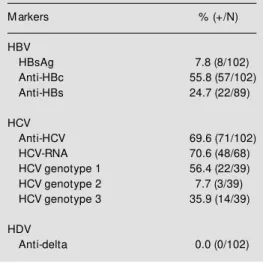
Results for HBV serological markers (HBsAg, anti-HBc and anti-HBs), anti-HCV, HCV-RNA and HCV genotypes and anti-HD are presented in Table 2 and associa-tions between socio-demographic character-istics, parenteral and sexual risk behaviors and infection rates are shown in Table 3.
HBV infection was significantly associ-ated with a history of imprisonment (P<0.04) and male homosexual intercourse within the last 5 years (P<0.04) (Table 3). Conversely, no association was found between HBV
in-fection and parenteral exposure parameters, suggesting that HBV was more efficiently transmitted by the sexual route. Associa-tions between the response variable and the variables shown to be significantly associ-ated with it by univariate analysis were con-trolled for potential confounders and assessed by multiple logistic regression procedures. The final multiple logistic regression model (chi-square model = 4.5; P = 0.03) identified male homosexual intercourse within the last 5 years as the exclusive independent risk factor (odds ratio (OR) 3.1; 95% confi-dence interval (CI) 1.1-8.8) for HBV infec-tion in this sample.
HCV infection was significantly associ-ated with male gender (P<0.04), age (P<0.04), history of imprisonment (P<0.006), age at first injection (P<0.03), longer duration of iv
drug use (P<0.005) and needle sharing (P<0.003) (Table 3). The final multiple lo-gistic regression model (chi-square model = 13.11; P = 0.002) identified as independent risk factors for HCV infection: longer dura-tion of iv drug use (OR 3.1; 95% CI 1.1-8.7)
and needle sharing in the last six months (OR 3.4; 95%CI 1.3-9.2). Although HCV genotype 1 was the most prevalent (56.4%, 22/39), a relatively high frequency of HCV genotype 3 infection was observed (35.9%, 14/39), when compared with other popula-tions from Rio de Janeiro previously as-sessed (15). Genotype 2 was found in only 3 subjects (7.7%), a fact that precludes further evaluation.
The variables associated with HCV type 3 infection (as compared to HCV geno-type 1 infection) were younger age at first injection (P<0.03), a longer duration of iv
drug use (P<0.05) and a higher frequency of injection (P<0.04) (Table 3). Although not statistically significant (probably due to the small size of the subsample), a tendency toward higher levels of HCV genotype 3 infection among individuals with a history of imprisonment and male homosexual in-tercourse was also observed.
Table 1 - Injecting and sexual risk behaviors among IDUs from Rio de Janeiro, Brazil (1994-1996).
* Among 56 interview ees w ho reported homosexual intercourse in the last 6 months before the interview .
Risk behaviors % (N = 102)
Injecting behavior
Frequency of injection in the last 6 months
1 to 3 times a month 24.7
1 to 3 times a w eek 35.5
>3 times a w eek 39.8
Frequency of needle sharing in the last 6 months 64.3
Sexual intercourse in the last 6 months w ith irregular/no use of condoms
Heterosexual intercourse w ith a principal partner 91.1
Heterosexual intercourse w ith an occasional partner 77.4
Heterosexual intercourse w ith a client 89.3
For evaluation of multiple infection, we considered anti-HBc and anti-HCV as mark-ers of HBV and HCV exposure, respec-tively. We found a 38.2% rate (39/102) of HBV/HCV co-infection.
D iscussio n
The present study shows a high preva-lence of blood-borne viral hepatitis among IDUs from Rio de Janeiro. IDUs are more exposed to many viral agents by the sexual and/or parenteral routes, as shown by the high rate of needle sharing (64.3%) and the low rate of condom use. Additionally, sec-ondary risks such as sharing injection para-phernalia other than needles and syringes should be considered (16).
Rio de Janeiro is a region of low ende-micity for HBV infection (<2% HBsAg prevalence) (17). The frequency of HBsAg found in this study (7.8%) is comparable with that observed in areas of high endemic-ity, with more than 8% of HBsAg preva-lence, and agrees with results from other studies of IDUs in Santos, SP, Brazil (18), and in other countries (9). HBV infection was significantly associated with male
ho-Table 2 - Percent frequency and numerical data for samples testing positive (+)/samples (N) tested for different viral hepatitis serological markers among IDUs from Rio de Janeiro, Brazil (1994-1996).
M arkers % (+/N)
HBV
HBsAg 7.8 (8/102)
Anti-HBc 55.8 (57/102)
Anti-HBs 24.7 (22/89)
HCV
Anti-HCV 69.6 (71/102)
HCV-RNA 70.6 (48/68)
HCV genotype 1 56.4 (22/39)
HCV genotype 2 7.7 (3/39)
HCV genotype 3 35.9 (14/39)
HDV
Anti-delta 0.0 (0/102)
mosexual intercourse, but no association with parenteral exposure variables was found. This profile suggests that unsafe sex represents the major risk determinant for HBV trans-mission among IDUs in Rio de Janeiro. The history of imprisonment did not remain in the final logistic regression model, and seems to be a confounder.
In our study, anti-HCV was detected in
Table 3 - M ain associations betw een socio-demographic characteristics, parenteral and sexual risk behaviors and infection rates for HBVa and HCVb infections and HCV genotypes among IDUs from Rio de Janeiro, Brazil (1994-1996).
aHBV infection w as defined by the presence of anti-HBc w ith or w ithout any other HBV serological marker. bHCV infection w as defined by the presence of anti-HCV. cData w ere analyzed statistically by the t-test for means and chi-square/Fisher’s exact test for frequencies. dFourteen and 3 subjects w ere infected w ith HCV genotype 1 and HCV genotype 2, respectively. ns, Not significant.
Socio-demographic characteristics HBV (N = 102) HCV (N = 102) Genotype HCV (N = 39)
Positive Negative P valuec Positive Negative P valuec HCV 3 Other P valuec genotypesd
Gender - male (% ) 83.3 88.4 ns 90.1 74.2 <0.04 92.9 92.0 ns
Age (mean in years) 34.7 32.3 ns 34.7 31.3 <0.04 35.8 33.6 ns
Prison history (% ) 68.6 31.4 <0.04 82.4 17.6 <0.006 71.4 48.0 ns
Age of first injection (mean in years) 19.9 19.0 ns 18.8 21.4 <0.03 17.0 20.6 <0.03
Duration of iv drug use (mean in years) 14.4 13.1 ns 15.5 9.9 <0.005 18.8 13.0 <0.05
Frequency of injection in the last 62.7 57.9 ns 64.7 50.0 ns 85.7 52.0 <0.04
6 months (% ) (³ once a w eek)
Needle sharing in the last 6 months (% ) 61.0 69.2 ns 73.5 41.4 <0.003 64.3 80.0 ns
M ale homosexual intercourse in the 84.3 64.9 <0.04 74.6 83.3 ns 84.6 60.9 ns
69.6% of the subjects, in agreement with other studies carried out among IDUs (19,20). It is noteworthy that the majority of these subjects (70.6%) are able to transmit HCV to other IDUs, since HCV-RNA was found in their sera.
HCV infection was significantly associ-ated, both by univariate and multivariate analyses, with longer duration of iv drug use,
in agreement with previously reported data (21). Likewise, a high rate of needle sharing in the last 6 months (64.3%) was observed, and this variable constituted another risk determinant for HCV infection, as previ-ously observed (19). In the final multiple logistic regression model only these two as-sociations, among the six associations previ-ously identified by univariate analysis, re-mained as independent risk factors for HCV infection. Probably the variables age and age at first injection are, in fact, confound-ers for the other variables associated with higher levels of exposure to parenteral risks of transmission.
HBV and HCV infections were both as-sociated with prison history in the univariate analysis (P<0.04 and P<0.006, respectively), but these associations did not remain in the final multivariate analysis. We should re-mark that in our sample only 5% of individu-als reported needle-sharing while impris-oned. The international literature also high-lights the risks of HIV and HBV transmis-sion due to unprotected sexual intercourse while imprisoned, a fact that should be reas-sessed in future studies to be carried out in Brazil (22,23).
The observed association between higher levels of HCV infection and male gender (P<0.04), although not confirmed by multi-variate analysis, was mentioned in previous studies, which showed that women elimi-nate HCV more frequently than men (24,25). No association was found between HCV infection and sexual risk behavior, confirm-ing previous findconfirm-ings that hepatitis C among IDUs seems to be a consequence of repeated
exposure to contaminated injection equip-ment (21). The distribution of HCV geno-types found here parallels the patterns ob-served in non-IDU populations from Brazil, with a higher prevalence of genotype 1 (26). However, the frequency of HCV genotype 3 among IDUs was relatively high in compari-son with other populations (15), as also ob-served among German IDUs (27). In our investigation, HCV genotype 3 infection was positively associated with younger age at first injection (P<0.03), longer duration of iv
drug use (P<0.05) and frequency of injection (P<0.04). These results suggest that the dis-semination of HCV genotype 3 among IDUs could be a consequence of cumulative and repeated parenteral exposure to this geno-type.
Infections by HDV were not detected in this study. This profile is remarkable since even in areas of low endemicity for HDV, 17-98% of HbsAg-positive IDUs present HDV antibodies (9).
In our sample, the most frequently in-jected drug was cocaine (92.2%). This seems to be an important aspect of the Brazilian drug scene, since cocaine injectors are under higher risk for blood-borne pathogen infec-tions when compared with opiate injectors. Cocaine addicts repeatedly inject drugs over short periods of time, in binges, increasing the chance of viral exposure through the common use of injection equipment (28-30). A significant association between iv cocaine
use and risky sex behavior has been pointed out in previous studies (31).
cocaine users.
IDUs constitute an important source of viral infections and therefore can play an important role in the transmission of viruses to the general population. Hence, a public health intervention with the implementation of comprehensive prevention programs in-cluding information, face-to-face education, empowerment strategies, distribution or ex-change of clean injecting equipment and distribution of condoms must be encour-aged. These measures are especially relevant in developing countries like Brazil, where Public Health programs are underbudgeted and understaffed, and frequently lack exper-tise and political support to implement these
programs (37).
Moreover, hepatitis B vaccination of all IDUs should be mandatory, not only as a direct strategy of prevention of new HBV infections, but also as a way to contact hard-to-reach IDUs and engage them in different preventive activities. Current vaccination programs attest that this is a feasible and practical initiative, with a high cost/benefit ratio both in terms of human lives to be saved and financial resources to be spared (38,39).
Ackno wle dgm e nts
To R.R. Sabino, L.A. Mercadante, L.D.A. Silva and H. Roeske for technical assistance.
Re fe re nce s
1. Purcell RH (1995). The hepatitis viruses: an overview . In: Nishioka K, Suzuki H, M ishiro S & Oda T (Editors), Viral Hepati-tis and Liver Disease. Springer Verlag, To-kyo, Japan.
2. Grosheide P & van Damme P (1996). Pre-vention and control of hepatitis B in the com m unit y. In: Hallauer J, Kane M , M cCoy E, M eleus A & M oure C (Editors), Communicable Diseases Series, 1. World Health Organization, Geneva.
3. Hadziyannis SJ (1997). Hepatitis delta: an overview . In: Rizzetto M , Purcell RH, Gerin JL & Verme G (Editors), Viral Hepa-titis and Liver Disease. Edizioni M inerva M edica, Rome, Italy, 283-289.
4. Gish RG & Lau JYN (1997). Hepatitis C virus: eight years old. Viral Hepatitis Re-view s, 1: 17-37.
5. M oyer LA & M ast EE (1994). Hepatitis B: virology, epidemiology, disease and pre-vention and an overview of viral hepatitis. American Journal of Preventive M edicine, 10: 45-55.
6. Purcell RH & Gerin JL (1996). Hepatitis delta virus. In: Fields BN, Knipe DM , How ley PM , Chamock RM , M elnick JL, M onath TP, Roizman B & Strauss SE (Edi-tors), Fields Virology. Lippincott-Raven Publishers, Philadelphia, Vol. 2. 2819-2829.
7. Colombo M (1997). Hepatocellular carci-noma: an overview . In: Rizzetto M , Purcell RH, Gerin JL & Verme G (Editors), Viral Hepatitis and Liver Disease. Edizioni M inerva M edica, Rome, Italy, 479-483.
8. Telles PR, Bastos FI, Guydish J, Inciardi JA, Surratt HL, Pearl M & Hearst N (1997). Risk behavior and HIV seroprevalence among injecting drug users in Rio de Janeiro, Brazil. AIDS, 11 (Suppl 1): S35-S42.
9. Dan M , Rock M , Lilos P & Shany S (1993). Seroepidemiology of hepatitis B and hepa-titis D virus infection among intravenous drug addicts in Israel. International Jour-nal of Epidemiology, 22: 140-143. 10. Ebeling F (1994). Importance of hepatitis
C virus infection in Europe and North A-merica. In: Reesink HW (Editor), Hepatitis C Virus. Current Studies in Hematology and Blood Transfusion. Karger, Amster-dam, Holland.
11. WHO International Collaborative Group (1994). M ulticity Study on Drug Injecting and Risk of HIVInfection. World Health Organization, Geneva.
12. Lopes CS, Rodrigues LS & Sichieri R (1996). The lack of selection bias in a snow ball sampled case control study on drug abuse. International Journal of Epi-demiology, 25: 1267-1270.
13. Driesel G, Wirth D, Stark K, Baumgarten R, Sucker U & Schreier E (1994). Hepatitis C virus (HCV) genotype distribution in Ger-man isolates: studies on the sequence variability in the E2 and NS5 region. Ar-chives of Virology, 139: 379-388. 14. Simmonds P, Holmes EC, Cha TA, Chan
SW, M cOmish F, Irvine B, Bell E, Yap PL, Kolberg J & Urdea M S (1993). Classifica-tion of hepatitis C virus into six major
genotypes and a series of subtypes by phylogenetic analysis of NS-5 region. Journal of General Virology, 74: 2391-2399.
15. Oliveira M LA, Bastos FI, Sabino RR, Paetzold U, Schreier E, Pauli G & Yoshida CFT (1999). Distribution of HCV geno-types among different exposure catego-ries in Brazil. Brazilian Journal of M edical and Biological Research, 32: 279-282. 16. Koester S, Booth RE & Zhang Y (1996).
The prevalence of additional injection-re-lated IV-risk behaviors among injection drug users. Journal of Acquired Immune Deficiency Syndromes and Human Retro-virology, 12: 202-207.
17. Vanderborght BOM , Reis AM M , Rouzeré CD, Salgado da Silva R, Yoshida CFT, Franco LGP, M aert ens G, van Heuversw injn H & Pereira JM (1993). Prevalence of anti-hepatitis C virus in the blood donor population of Rio de Janeiro. Vox Sanguinis, 65: 122-125.
18. Carvalho HB, M esquita F, M assad E, Bueno TC, Lopes GT, Ruiz M A & Burattini M N (1995). HIV and infections of similar transmission patterns in a drug injectors community of Santos, Brazil. Journal of Acquired Immune DeficiencySyndromes and Human Retrovirology, 12: 84-92. 19. Stark K, Schreier E, M ueller R, Wirth D &
20. Stroffolini T, Fiume A, Fatale G, Regni F, Ciccozzi M , M arzolini A & M ele A (1997). Hepatitis C virus genotypes among intra-venous drug users in Italy. Hepatology Research, 9: 20-27.
21. Tibbs CJ (1995). M ethods of transmission of hepatitis C. Journal of Viral Hepatitis, 2: 113-119.
22. M ueller R, St ark K & Guggenm oos-Holzmann I (1995). Imprisonment: a risk factor for HIV infection counteracting edu-cation and prevention programmes for in-travenous drug users. AIDS, 9: 183-190. 23. Hull HF, Lyons LH, M ann JM , Hadler SC,
Steece R & Skeels M R (1985). Incidence of hepatitis B in the penitentiary of New M exico. Am erican Journal of Public Health, 80: 1129-1131.
24. Yamakaw a Y, Sata M , Suzuki H, Noguchi S & Tanikaw a K (1996). Higher elimination rate of hepatitis C virus among w omen. Journal of Viral Hepatitis, 3: 317-321. 25. Love A, Sigurdsson JR, Stanzeit B, Briem
H, Rikardsdottir H & Widell A (1996). Char-acteristics of hepatitis C virus among in-travenous drug users in Iceland. Ameri-can M edical Journal, 143: 631-636. 26. M art ins RM B, Vanderborght BOM &
Yoshida CFT (1998). Hepatitis C virus genotypes among blood donors from dif-ferent regions of Brazil. M emórias do Instituto Osw aldo Cruz, 93: 299-300. 27. Schreier E, Roggendorf M , Driesel G,
Hoehne M & Viazov S (1996). Genotypes of hepatitis C virus isolates from different parts of the w orld. Archives of Virology, 11 (Suppl): 185-193.
28. De Jarlais DC, Friedman SR, Choopanya K, Vanichseni S & Ward TP (1992). Inter-national epidemiology of HIV and AIDS among injecting drug users. AIDS, 6: 1053-1068.
29. Levine OS, Vlahov D & Nelson KE (1994). Epidemiology of hepatitis B virus infec-tions among injecting drug users: sero-prevalence, risk factors and viral interac-tions. Epidemiological Review s, 16: 418-436.
30. Watters JK, Estilo M J, Clark GL & Lorvick J (1994). Syringe and needle-exchange as HIV/AIDS risk behavior. Journal of the American M edical Association, 271: 115-120.
31. Camacho LM , Brow n BS & Simpson DD (1996). Psychological dysfunction and HIV/AIDS risk behavior. Journal of Ac-quired Immune Deficiency Syndromes and HumanRetrovirology, 11: 198-202. 32. Barcellos C & Bastos FI (1996). Redes
sociais e difusão de AIDS no Brasil. Boletin de la Oficina Sanitaria Panameri-cana, 121: 11-24.
33. Nappo AS, Galduroz SC & Noto AR (1996). Crack use in São Paulo. Substance Use and M isuse, 31: 565-579.
34. Dunn J, Laranjeira RR, da Silveira DX,
Formigoni M L & Ferri CP (1996). Crack cocaine: an increase in use among pa-tients attending clinics in São Paulo: 1990-1993. Substance Use and M isuse, 31: 519-527.
35. Szw arcw ald CL, Bastos FI, Gravato N, Lacerda R, Chequer PN & Castilho EA (1998). The relationship of illicit drug con-sume to HIV-infection among commercial sex w orkers (CSWs) in the city of Santos, São Paulo, Brazil. International Journal of Drug Policy, 9: 427-436.
36. De Jarlais DC, Casriel C, Friedman SR & Rosemblum A (1992). AIDS and the tran-sition to illicit drug injection: results of a randomized trial prevention program. Brit-ishJournal of Addiction, 87: 493-499. 37. De Jarlais DC, Stimson GV, Hagan H,
Perlman D, Choopanya K, Bastos FI & Friedman SR (1996). Emerging infectious diseases and the injection of illicit psycho-active drugs. Current Issues in Public Health, 2: 130-137.
38. M ezzelani P, Venturini L & Turrina G (1991). High compliance w ith a HBV vaccination program among intravenous drug users. Journal of Infectious Diseases, 163: 923. 39. Kerleau M , Flori YA, Nalpas B, Lanoe JL,