Point of View
MULTIPERSPECTIVE ANALYSIS OF EROSION TOLERANCE
Gerd Sparovek1*; Isabella Clerici De Maria2
1
USP/ESALQ - Depto. de Solos e Nutrição de Plantas, C.P. 9 - 13418-900 - Piracicaba, SP - Brasil. 2
IAC/RA - Centro de Solos e Recursos Agroambientais, C.P. 28 - 13020-902 - Campinas, SP - Brasil. *Corresponding author <[email protected]>
ABSTRACT: Erosion tolerance is the most multidisciplinary field of soil erosion research. Scientists have shown lack in ability to adequately analyze the huge list of variables that influence soil loss tolerance definitions. For these the perspectives of erosion made by farmers, environmentalists, society and politicians have to be considered simultaneously. Partial and biased definitions of erosion tolerance may explain not only the polemic nature of the currently suggested values but also, in part, the non-adoption of the desired levels of erosion control. To move towards a solution, considerable changes would have to occur on how this topic is investigated, especially among scientists, who would have to change methods and strategies and extend the perspective of research out of the boundaries of the physical processes and the frontiers of the academy. A more effective integration and communication with the society and farmers, to learn about their perspective of erosion and a multidisciplinary approach, integrating soil, social, economic and environmental sciences are essential for improved erosion tolerance definitions. In the opinion of the authors, soil erosion research is not moving in this direction and a better understanding of erosion tolerance is not to be expected in the near future.
Key words: soil erosion, soil degradation, land use planning
ANÁLISE MULTIPERSPECTIVA DA TOLERÂNCIA À EROSÃO
RESUMO: A tolerância de perda de terra é o campo mais multidisciplinar das pesquisas em erosão do solo. Os cientistas têm demonstrado falta de habilidade para analisar adequadamente a enorme lista de variáveis que influenciam a definição da tolerância de perda de solo. Para isto, a ótica dos agricultores, ambientalistas, sociedade e forças políticas têm que ser considerada simultaneamente. Definições de tolerância parciais ou tendenciosas podem explicar não apenas o caráter polêmico dos valores sugeridos atualmente como também, em parte, a não adoção dos níveis de controle de erosão desejados. Consideráveis mudanças na forma de investigação deste tópico devem ser implementadas visando uma solução mais adequada, especialmente entre os cientistas, que teriam que mudar métodos e estratégias e ampliar a sua ótica para fronteiras além da física dos processos envolvidos e dos limites da academia. Uma integração mais efetiva e uma comunicação mais eficiente com a sociedade e com os agricultores, procurando aprender com as suas óticas sobre erosão e uma abordagem multidisciplinar, integrando as ciências do solo, sociais, econômica e ambiental são essenciais para melhorar a definição da tolerância de perdas. Na opinião dos autores, a ciência do solo não está se movendo nesta direção e uma compreensão melhor da tolerância de perda não deve ser esperada num futuro próximo.
Palavras-chave: erosão do solo, degradação do solo, planejamento do uso da terra
A multiperspective analysis of soil erosion: basic ideas
Soil erosion, resulting mainly from agricultural land use, is associated to environmental impacts (Clark II et al., 1985) and crop productivity loss (Lal, 1995; Pimentel et al., 1995), which makes the understanding of the erosion process important to guarantee food security (Daily et al., 1998) and environmental safety (Matson et al., 1997). A wide range of damaging effects involve not only the farmer’s perspective (profitable crop production), but also the concerns of society related to environmental degradation (e.g. impacts on fresh water resources) and
food security (degradation of the non-renewable natural resource soil, essential for crop production).
has a minor importance in comparison to the question Why have the known erosion control practices not been adopted?
Soil loss tolerance can be defined as the highest value erosion rates should have. If erosion rates are higher than the tolerance, they are considered “non acceptable” and should be reduced. This apparently simple question is still a very polemic topic and very little progress was made since Stamey & Smith (1964) proposed a definition and a mathematical procedure to calculate tolerance values. The usual approach is the definition of threshold values based on soil properties (Grossman & Berdanier, 1982). The lack of success of scientists to deal with tolerance is, to some extend, related to the non-adoption of the desired level of erosion control. Without a ubiquitous understanding on how erosion values should be, it is difficult to convince farmers or decision makers to invest. A closer analysis of this matter will show that threshold values may not be in-dicated for soil loss tolerance definitions, and that only tools that contemplate the multi-perspective nature of this issue may be more successful.
The usual rationale for public economic interven-tion is market failure or a condiinterven-tion where net private ben-efits are less than net social benben-efits. In this case, from the Society's point of view, the private sector will invest too little (Alston & Pardey, 1999). In regard to erosion control, market failure may be accounted to: a) divergent private and social costs and benefits (the socially profit-able option is privately unprofitprofit-able); b) the environmen-tal side-effects or externalities are usually unaccounted thus private decisions are not socially optimal. Market failure conditions may need political interventions or pub-lic incentives to reach a better standard. This is a primary aspect to be considered for the definition of strategies aimed to support erosion control adoption.
Soil erosion in the perspective of the farmer
Farmers clearly distinguish between different forms of soil erosion probably better than the scientific prediction models. Basically, from our field experience, soil erosion under the farmer’s perspective can be divided in two major groups: a) that part of erosion that has short term direct impacts or is visible and b) the invisible ero-sion. Intensive rill or gully processes that may impact crop production directly, damage roads, mud water reservoirs have high priority for erosion control adoption. Farmers in these cases will provide resources for erosion control and no extensive market failure can be expected. The same concept may be applied to visible erosion marks, such as gullies or ephemeral gullies, even if not impact-ing crop production directly (e.g. located at the bound-aries of the fields, or on non-mechanized pastures). The scenic value of landscape is impoverished by visible ero-sion marks (e.g. the picture shown in erosion lectures to shock the audience is not a table with huge erosion rates,
but a landscape with gullies). The preservation of the sce-nic value of landscape is probably an underestimated driv-ing force movdriv-ing farmers towards erosion control. For the invisible part of soil erosion the sensitivity of the farmer is extremely reduced. If farmers are told that we have been estimated higher rates than tolerable, but these can not be seen, the motivation for improving erosion con-trol is significantly reduced.
The distinction farmers use to appraise erosion di-rects their concern to gully and ephemeral gully processes, neglecting in larger extend rill and interrill processes. Most erosion prediction models, which essentially reflect how scientists think about soil erosion, are better improved for predicting rill and interrill processes than gullies. Probably the reason for that is that even in areas where these fea-tures prevail, only a minor part of the erosion can be ac-counted for gullies or ephemeral gullies (visible erosion). In the Ceveiro watershed (2,200 ha), located in the south-eastern part of Brazil, the 3,053 measured gullies or ephem-eral gullies accounted for only 13 % of the erosion esti-mated by USLE (gullies and ephemeral gullies are not es-timated by USLE) (Montolar-Sparovek et al, 1999). When farmers and scientists talk about erosion it may happen that they mean completely different things. Probably, the sci-entists are closer to the society’s perception of soil erosion (i.e. a process that may have off-site impacts and degrade the soil in a longer term), than the farmers perception show me where it is so I can handle it!
Soil erosion is usually more intense in tropical agriculture than in temperate regions. The topsoil in high input tropical agricultural systems may also restore yield capacity and biological functions rapidly, even under ex-tremely high erosion rates (Sparovek, 1998; Sparovek et al., 1999). Intensification of agricultural production repre-sented by increasing inputs (especially fertilizers) and im-proved farm management practices are an established trend for adequately supplying a growing population with food and/or providing for export resources in most tropical re-gions (Dyson, 1999). This intensification, combined with the fast topsoil rehabilitation, may counterbalance soil deg-radation. Thus, erosion-yield estimations for tropical con-ditions (Lal, 1995; Alfsen et al., 1996) may result in a too pessimistic prognosis or predict impacts that indeed will not be experienced by farmers.
to observe factors such as nutritional stress, pests, disease, restricted genetic potential of crops or inadequate manage-ment. If farmers can not see erosion damages directly (vis-ible erosion) or rapid soil degradation through gullies, they have to believe that degradation is occurring to be stimu-lated to improve erosion control. Confidence is mostly re-lated to how convincing the arguments are.
Soil erosion in the perspective of the scientist
Soil erosion R&D may range from more-applied (or near-market) to less-applied (or basic). The design of procedures and technologies for erosion control (e.g. hy-draulic seeders, mats, gabions, chemicals and machines for no-tillage farming) are applied enough to attract pri-vate investors and can run apart from public investments. Most of the erosion research has low potential of appropriability of results (e.g. environmental benefits of erosion control, soil loss tolerance) or relates to basic con-cepts, where the process itself is the main purpose of the investigation (e.g. model development or calibration). These subjects are considered as basic research and the degree of private underinvestment will be greater (Alston & Pardey, 1999). The current trend of slowdown in pub-lic funding and expansion of private execution of agri-cultural R&D in several developed countries (Alston et al., 1999) and the usual prioritization of applied research in the developing countries are not favorable for progress of research in areas like soil loss tolerance.
Another important distinction of tolerance re-search is that this is the most multidisciplinary subject related to soil erosion. Models are physically based (ero-sion process by itself), environmental impacts will inte-grate physical and biological aspects and product/supply development (applied research) will consider economic and physical variables (costs and efficiency). Tolerance will have all ingredients mentioned above (physical, bio-logical and economic), and additionally, has to include social variables. Tolerance research is mostly directed to policy and decision making, so it has to be coherent with the amount the society wants to invest in erosion control. This additional ingredient aggregates significant diversity and complexity to a subject that, even if treated on a pure physical basis is complex enough, e.g. different erosion prediction methods applied to the same area resulting in distinct results (Sparovek et al., 2000).
Soil erosion in the perspective of the society
Scientific reports regard erosion as a major fac-tor related to hazards, e.g. flooding (Xiubin & Juren, 1998); mass movements in urban areas (Guerra & Favis-Mortlock, 1998); global food security (Daily et al., 1998); environmental degradation (Matson et al., 1997); and global biodiversity loss (Sala et al. 2000). Despite some uncertainty, the global greenhouse-gas emissions may even contribute to increase erosion rates in the
fu-ture (Favis-Mortlock & Guerra, 2000). Even considering all these deleterious effects and future prognosis, soil ero-sion is still exceeding tolerable values in the opinion of scientists (Pimentel et al., 1995).
The reason for this may be: a) scientists are too pessimistic in their prognosis, or b) scientists are not effi-cient in convincing the society on the veracity of the state-ments they are reporting. The fact is that the society is re-acting much more effectively to other topics related to ag-riculture than to the reported high erosion rates. Examples are the expansion of agriculture in tropical forest; the qual-ity of food (e.g. BSE, FMD, antibiotics in pig feed, pesti-cide contamination of vegetables); contamination of wa-ter resources with residues of pesticides, phosphate and ni-trate used in agriculture; the prioritization of cash crops for export instead of food crops in regions where food se-curity is endangered; the unfair trade relations between de-veloped and developing regions; and the high amount of subsidies needed to sustain agriculture in developed and industrialized regions are some examples of usual protests from the society related to modern agriculture. Society is concerned about agriculture and wants changes to have fairer trade, to be more friendly to the environment, to guarantee food security worldwide and to increase the healthiness of food supplies. Additionally, as long term concerns, the society recognizes the importance in rethink-ing agriculture to be more efficient in addressrethink-ing the short-age of fossil fuels and as part of the solution for the glo-bal greenhouse-gas emission-related problems.
Erosion, as a subject by itself, is usually not in the broad agenda of society’s concerns related to agricul-ture. It is included as a sub-thematic or as one factor driv-ing faster towards some other undesired effect (e.g. con-tamination of water with phosphate from sediments and runoff). The apparent contradiction is that in most agri-cultural systems soil erosion is greater than soil forma-tion or renewal. Soil is a non-substitutable, non-renewable, indispensable resource for agricultural production and we are consuming this resource until a predictable end, i.e. we can calculate when and where the resource will be exhausted (Figure 2). We can show the society the exact time the isolated factor soil erosion will exhaust the possibility for food production, and addition-ally provide enough data demonstrating that even during this time no positive effects are expected.
A multi-perspective analysis of erosion tolerance
At the beginning of the 1960s, Stamey & Smith (1964) suggested that soil loss tolerance should be de-fined in relation to the available resource and that its ex-cessive amount could be consumed until reaching a mini-mum acceptable level. In their work they suggested that erosion tolerance: “Should: 1) provide for the permanent preservation or improvement of soil as a resource, 2) be adaptable for erosion and renewal rates of any soil char-acteristics, 3) be a function of position, 4) be applicable regardless of the cause of erosion or renewal, and 5) be based on the assumption that if any soil property is
avail-able in excess of present or predictavail-able future require-ments, it is tolerable to use the excess”. They also sug-gested a general mathematical equation for erosion tol-erance considering these points. Later, Skidmore (1982) complemented that erosion tolerance should weigh ero-sion from the standpoint of pollution and other environ-mental concerns and developed the equation suggested by Stamey & Smith (1964) as a function of the soil depth.
Despite the initial suggestion to treat soil loss tol-erance as a variable and some improvement this sugges-tion may have had later, mostly tolerance is defined as
Figure 1 - Sugarcane relative yield maps as a function of time for the Ceveiro watershed, Brazil, White areas are non-sugarcane land uses, (Sparovek & Schnug, 2001).
constant threshold values, based on different criteria (McCormack et al., 1982): a) Soil properties (e.g. Grossmann & Berdanier, 1982; Galindo & Margolis, 1989); b) Loss of nutrients by sediments (e.g. Willis & Bartelli, 1977); c) Economic impact on crop productiv-ity ( Pierce et al., 1984); d) Negative externalities or off-site effects (Clark II et al., 1985); d) Peculiar things (Johnson, 1987) such as the weathering rate of stones of the walls of old European castles.
The attempt to define threshold values instead of treating tolerance as a mathematical function defined by variables that will change in space and time, may be a primary methodological problem. If we think that on one side we have erosion rate estimation uncertainties; the distinct perspectives of farmers, society, decision makers (frequently competitive or opposing); and a broad spectrum of environmental issues to be analyzed simultaneously; it is hard to believe that, at the other side, one single number will have the power to integrate all of these. The reason for the threshold value approach may be an attempt to simplify such a complex question. The problem is that simplification, in this case, may make the tolerance definition easily understandable, but not acceptable by an increasingly skeptic and informed society.
Tolerance in the perspective of the farmer
In the perspective of farmers, we can differenti-ate the visible erosion from the non-visible. Usually, the tolerance for visible erosion (if impacting productivity or not) is extremely reduced when compared to non-visible forms of erosion. If the farmers should reduce erosion rates that are not visible or that are not impacting directly their crop production, the driving forces may be incen-tives or cultural values. In some cases, especially with erosion control methods such as no-tillage, the cultural value may play an important role. The farmers are proud of being part of a selected and differentiated group that is known to adopt no-till, and this may also be the major reason for maintaining this system. Probably, most farm-ers will react more effectively to incentives, such as spe-cial credits, or other benefits to adopt management prac-tices that move towards soil conservation. Policy regula-tions and incentives are essential if the large scale adop-tion of erosion control practices is desired and the im-pacts are not visible to farmers. Although, if the toler-ance is coincident with the farmers perception of erosion, there will be low need for public intervention and the market mechanism will be able to provide the technol-ogy and supplies the farmer needs to achieve the target erosion control level.
Tolerance in the perspective of the scientist
The attention among scientists (soil, economy or social scientists) is low for this topic. The few studies re-lated to tolerance, if compared to the total scientific
pro-duction on soil erosion, usually have important omissions: a) the definition of threshold values without enough at-tention to the theoretical background and applicability; b) sufficient attention to the complexity of the theoreti-cal aspects but lack in suggesting a practitheoreti-cal tool for tol-erance definition. In the first case, values or ranges are suggested for specific site conditions, but these will lack in matching the complexity of the subject and may not be feasible or adequate for all actors (farmer, society and decision makers). In the second case, the conclusion may be that the topic is very complex, a multidisciplinary ap-proach is needed, several parameters from different sources (social, environmental and economical) have to be considered, but no concrete and applicable tools are suggested.
Usually the soil science groups show up with con-crete values of tolerance and the socio-economic group with complexity discussions. Probably, better results could be achieved if soil scientists would think on a more socio-economic basis and economists realize that some parameters or variables they want in the models are un-certain or difficult (if not impossible) to determine. This essentially multidisciplinary approach is among the main problems tolerance definition has. Most other issues re-lated to erosion research can progress on a less diverse basis (prediction models, environmental impacts, off-site impacts, control methods) except tolerance. In this case it is not enough to know how much erosion we have, how it may impact the productivity and the environment and which practices may control it. We have also to consider how much the society and/or farmers want to invest and accept risks, and the broad effects legislation decisions may promote if the aims of society or farmers are stimu-lated or imposed.
A partial analysis in which the comprehensive-ness of the subject is not covered at all, may lack in co-herence and thus not be sufficiently convincing for farm-ers, society or policy makers. Most of the scientific work on this subject is not comprehensive and focus on spe-cific parts of the topic, usually not taking enough care by up-scaling results. The difficulty of obligatory work-ing in such diverse basis to have significant improvements is considered by us, as the main factor restricting progress in erosion tolerance research.
Tolerance in the perspective of the society
to have success. Tropical forests, the resources of non-renewable fuels, and the emission of greenhouse-gases are examples of topics that have efficiently con-vinced the society investing to for solve the problem. By doing so, they have also driven several important politi-cal decisions during the last years.
If one subject sounds confusing and even the most affected parts (in this case the farmers that have to reduce soil erosion and the scientists that have to find out to which level) do not agree, this may discourage the so-ciety to prioritize the issue, because the chance to solve the problem will apparently be lower. Again, not the prob-lem by itself, but the way it is presented, may play the major role for effective actions.
Favorable and opposite factors for achieving tolerance definition
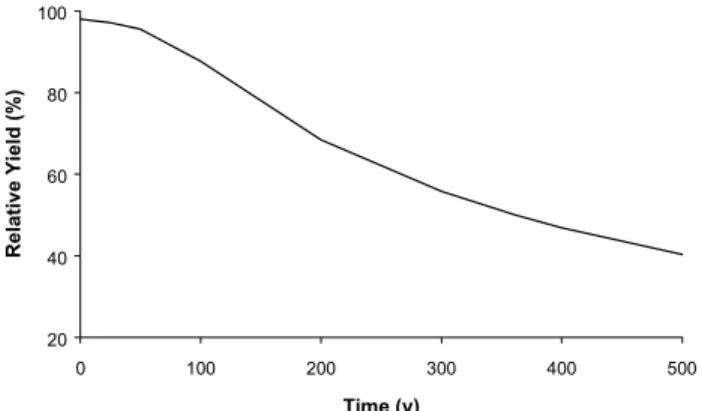
If we consider strictly the farmers’ perspective (short term impacts on productivity; visible erosion) the tolerance levels of erosion are usually achieved as a re-sult of a self regulating process. The effects of erosion on crop productivity can be masked by technological ad-vances, yearly variations in yield and the long periods of 50 to 100 years yield decrease is expected to be felt, rather than the working life-time of a farmer (Boardman & Favis-Mortlock, 1993). The relation of yield decrease and time for the Ceveiro watershed is shown in Figure 3, and confirms this statement. The main objective of farmers is to gain subsistence from their activity and profit from it. The farmers have their own vision of erosion and soil loss tolerance that fit into these objectives. If we ex-pect that farmers improve erosion control beneath their own tolerance definition to avoid yield loss in periods over their working life-time or to improve environmen-tal standards, we are doing that for the benefit of the society, and not for their business. In this case, the so-ciety may have to provide incentives. If the definition of erosion tolerance naturally adopted by the farmers fits social requirements, probably no major incentives will be needed to have erosion values around that limit. This is, probably, another weak point of erosion tolerance re-search: there is lack in analysis of soil erosion under the perspective of the farmers. We do not know in a com-prehensive way, how farmers feel about erosion, what they identify as tolerable and why they refuse to adopt conservation technology. A distinct appraisal of the same problem may restrict communication between sci-entists and farmers when talking about soils (Kundiri et al., 1997). There are only two ways to deal with this: either farmers make a better job in understanding sci-entists or scisci-entists spend more time and resources un-derstanding farmers. The most efficient way is to change or extend the perspective of the scientist with the obvi-ous rationale that there are much less erosion scientists than farmers.
From the scientific perspective the most effective way to reduce erosion rates is to improve the amount of surface residues and soil cover. The reasons for non spon-taneous adoption of no-tillage farming in large scales worldwide, a production system developed and improved since the mid of the 1960s when chemical weed control supplies got more available on the markets, may help to understand this issue. No-tillage reduces the opportuni-ties the farmers have to interfere in the production sys-tem. With conventional tillage, mechanical operations can be done for weed control, incorporation of fertilizers and restoration of soil structure. By excluding mechanical operations, the agroecosystem gets an own dynamic; weeds that usually are easy to control predominate, nu-trients distribution in the soils’ profile and soil structure will change with the time, plant disease and the perfor-mance of varieties may be different as in conventional systems. The possibility to bring the system back to the exact same initial conditions every year is an important cultural value of modern agriculture. Mechanical opera-tions and soil tillage play a major role for that. The change of these cultural values, i.e. the farmers accepting tem-poral dynamic in their system, changing continuously the way they have to think about and interfere in the system and accepting higher fluctuations in productivity, may be the main reason for opposition in the adoption of no-tillage. For that, not only incentives and macro-eco-nomic changes are important, but changes in basic prin-ciples of farmers education. Both are only feasible in a longer time perspective.
From scientists we may expect more creativity and multidisciplinarity when working with tolerance defi-nitions. The threshold value approach should also be avoided, even if the way to a publishable result is shorter when defining tolerance this way. Erosion should be first treated as a variable in both, time and space. The spatial variability observed for erosion rates in the Ceveiro wa-tershed (Figure 4) clearly indicates that prediction tools that estimate mean values will fail in identifying
prior-Figure 3 - Mean sugarcane relative yield as a function of time for the Ceveiro watershed, Brazil (adapted from Sparovek & Schnug, 2001).
20 40 60 80 100
0 100 200 300 400 500
Time (y)
ity areas. Erosion is an extremely variable process and the analysis and appreciation of this variability is impor-tant to work on the same perspective farmers do, i.e. they have to optimize investments so they are used to priori-tize decisions. The inclusion of a time component in the analysis is important to make decision feasible. Probably, if erosion is expected to decrease, this has to be done slowly or in a realistic time frame. Farmers can not adapt to new systems rapidly without increasing risks. These additional components in the analysis of erosion toler-ance, i.e. the definition of a time and spatial function ad-justed to social and environmental needs and observing farmers feasibility (Sparovek & De Jong van Lier, 1997), will require a more critical work from scientists, but may also make the erosion tolerance definitions more accept-able in the perspective of farmers and society. With the acquiescence of society, environmentalists and farmers, policy makers will have an easier way towards the defi-nition of incentives and legal support for improving soil conservation standards.
The main reasons for low progress in erosion tolerance definition are: a) Obligatory of multi-disciplin-ary research; b) Great amount of important variables and uncertainties in their definition; c) Trend to ultra-simplification using threshold values instead of temporal/spatial functions; d) Non consideration of the perspectives of farmers, society, environmentalists and policy makers, simultaneously in the same definition tool.
Possible ways to address these problems are:
a) Stimulate groups to study erosion at the farm level under a wider perspective including the views of
farmers, the goals of the society and environmental im-pacts. Most erosion research is conducted outside the farm scale, under laboratory conditions or small plots and up-scaling to watersheds or regions is made. In this way, the farmer’s perception of erosion becomes lost or is not taken into account. If we consider that in the ultimate stage, who will decide on the adoption of erosion con-trol practices are the farmers, this should also be the ideal scale of erosion tolerance research. The private property scale (farm instead of watershed), extreme multi-disci-plinary groups (environmentalists, farmers, soil scientists, economists and social scientists) the perspective of high complexity and long term studies for results may not be an attractive scenario in a time research founds are get-ting more competitive.
b) The scientist could also be more convincing, providing more understandable and clear definitions on erosion related problems and target (tolerable) levels with the data available by now. In this case, scientists would have to understand more about the reasons farmers do not adopt conservation technology and the society does not claim effectively for erosion control. In this case, the more physically basis on which erosion is usually analyzed, would have to be changed.
In our opinion soil erosion research is not mov-ing in eigther one of these two directions, so we may not expect in the near future better definitions for soil loss tolerance as we have now.
REFERENCES
ALFSEN, K.H.; DE FRANCO M.A.; GLOMSRØD, S.; JOHNSEN, T. The cost of soil erosion in Nicaragua. Ecological Economics, v.16, p.129-145, 1996.
ALSTON, J.M.; PARDEY, P.G. The economics of agricultural R&D policy. In: ALSTON, J.M.; PARDEY, P.G.; SMITH, V.H. Paying for agriculture productivity. Baltimore: John Hopkins University Press, 1999. p.6-30.
ALSTON, J.M.; PARDEY, P.G.; SMITH, V.H. A synthesis. In: ALSTON, J.M.; PARDEY, P.G.; SMITH, V.H. Paying for agriculture productivity. Baltimore: John Hopkins University Press, 1999. p.276-282.
BOARDMAN, J.; FAVIS-MORTLOCK, D.T. Climate change and soil erosion in Britain. The Geographical Journal, v.159, p.179-183, 1993. CLARK II, E.H.; HAVERKAMP, J.A.; CHAPMAN, W. Eroding soils. The off-farm impacts. Washington: The Conservation Foundation, 1985. 252p.
DAILY, G.; DASGUPTA, P.; BOLIN, B.; CROSSON, P.; GUERNY, J. DU; EHRLICH, P.; FOLKE, C.; JANSSON, A.M.; KAUTSKY, N.; KINZIG, LEVIN, S.; MÄLER, K.G.; ANDERSEN, P.P.; SINISCALO, D. WALKER, B. Food production, population growth, and the environment. Science, v.281, p.1291-1292, 1998.
DYSON, T. World food trends and prospects to 2025. Proceedings of the National Academy of Science of the USA, v.96, p.529-539, 1999. FAVIS-MORTLOCK, D.T.; GUERRA, A.J.T. The influence of global
greenhouse-gas emissions on the future rates of soil erosion: a case study from Brazil using WEPP-CO2. In: SCHMIDT, J. (Ed.) Soil erosion: application of physically based models. New York: Springer, 2000. p.3-31.
GALINDO, I.C. DE L.; MARGOLIS, E. Soil loss tolerance limits for Pernambuco, Brazil. Revista Brasileira de Ciência do Solo, v.13, p.95-100, 1989.
GROSSMANN, R.B.; BERDANIER, C.R. Erosion tolerance for cropland: application of the soil survey data base. In: KARL, D.M. (Ed.) Determinants of erosion tolerance. Madison: ASA, 1982. p.113-130. GUERRA, A.J.T.; FAVIS-MORTLOCK, D. Land degradation in Brazil.
Geography Review, v.12, p.18-23, 1998.
JOHNSON, L.C. Soil loss tolerance – fact or myth. Journal of Soil and Water Conservation, v.42, p.155-160, 1987.
KUNDIRI, A.M.; JARVIS, M.G.; BULLOCK, P. Traditional soil and land appraisal on fadama lands in northeast Nigeria. Soil use and management, v.13, p.205-208, 1997.
LAL, R. Erosion-crop productivity relationships for soils of Africa. Soil Science Society of America Journal, v.59, p.661-667, 1995. MATSON, P.A.; PARTON, W.J.; POWER, A.G.; SWIFT, M.J. Agricultural
intensification and ecosystem properties. Science, v.277, p.504-509, 1997.
MCCORMACK, D.E.; YOUNG, K.K.; KIMBERLIN, L.W. Current criteria for determining soil loss tolerance. In: KARL, D.M. (Ed.) Determinants of erosion tolerance. Madison: ASA, 1982. p.95-111.
MONTOLAR-SPAROVEK, R.B.; VIDAL-TORRADO, P.; SPAROVEK, G. Erosão em sulcos, entressulcos e voçorocas em uma microbacia de Piracicaba (SP) intensivamente cultivada. Scientia Agricola, v.56, p.859-865, 1999.
PIERCE, F.J.; LARSON, W.E.; DOWDY, R.H. Soil loss tolerance: maintenance of long-term productivity. Journal of Soil and Water Conservation, v.39, p.136-138, 1984.
PIMENTEL, D.; HARVEY, C.; RESOSUDARMO, P.; SINCLAIR, K.; KURZ, D.; MCNAIR, M.; CRIST, S.; SHPRITZ, L.; FITTON, L.; SAFFOURI, R.; BLAIR, R. Environmental and economic costs of soil erosion and conservation benefits. Science, v.267, p.1117-1123, 1995. SALA, O.E.; CHAPIN III, F.S.; ARMESTO, J.J.; BERLOW, E.; BLOOMFIELD, J.; DIRZO, R.; HUBER-SANWALD, E.; HUENNEKE, L.F.; JACKSON, R.B.; KINZIG, A.; LEEMANS, R.; LODGE, D.M.; MOONEY, H.A.; OESTERHELD, M.; POFF, N.L.; SYKES, M.T.; WALKER, B.H.; WALKER, M.; WALL, D.H. Global biodiversity scenarios for the year 2100. Science, v.287, p.1770-1774, 2000. SKIDMORE, E.L. Soil loss tolerance. In: AMERICAN SOCIETY OF
AGRONOMY. Determinants of soil loss tolerance. Madison: ASA, 1982. p.87-93.
SPAROVEK, G. Influence of organic matter and soil fauna on crop productivity and soil restoration after simulated erosion. Advances in GeoEcology, v.31, p.431-434, 1998.
SPAROVEK, G.; BACCHI, O.O.S.; SCHNUG, E.; RANIERI, S.B.L.; DEMARIA, I.C. Comparison of three water erosion prediction methods (137Cs, WEPP, USLE) in the southeast Brazilian sugarcane production. Der Tropenlandwirt, v.101, p.107-118, 2000.
SPAROVEK, G.; DE JONG VAN LIER, Q. Definition of tolerable soil erosion values, Revista Brasileira de Ciência do Solo, v.21, p.467-471, 1997.
SPAROVEK, G.; LAMBAIS, M.R.;. SILVA, A.P.; TORMENA, C.A. Earthworm (Pontoscolex corethrurus) and organic matter effects on the reclamation of an eroded oxisol. Pedobiologia, v.43, p.698-704, 1999. SPAROVEK, G.; SCHNUG, E. Temporal erosion-induced soil degradation and yield loss. Soil Science Society of America Journal, v.65, p.1479-1486, 2001.
STAMEY, W.L.; SMITH, R.M. A conservation definition of erosion tolerance. Soil Science, v.97, p.183-186, 1964.
WILLIS, W.O.; BARTELLI, L.J. Our soil is valuable. Journal of Soil and Water Conservation, v.32, p.258-259, 1977.
XIUBIN, H.; JUREN, J. The 1998 flood and soil erosion in Yangtze river. Water Policy, v.1, p.653-658, 1998.