Two dystopic visions on the relationship of
humans and progress
–
Emile Souvestre and
Cordwainer Smith
Maria do Rosário MONTEIRO
CHAM, FCSH, Universidade NOVA de Lisboa, Universidade dos Açores E-mail [email protected]
Abstract
Zaha Hadid’s statement that is used as an epigraph to this book is also the cornerstone of this essay: “Non puo esserci progresso senza affrontare l’ignoto”. This sentence has an ambiguous meaning and can be interpreted in at least two different ways: either as a natural challenge or as an aggressive defiance. This ambiguity encompasses the relationship between individuals, communities and progress, reminding the image of Janus, each facing a different side, both forming the same and a different entity. It is a natural and complementary ambivalence. Every endeavour undertook by promoters of progress has a degree of uncertainty, a pending threat of failure, and the outcome always produces positive and negative consequences frequently in uneven ways.
Culturally, in a consistent way at least from the beginning of modernity, Western civilisation has regarded progress as a natural unstoppable endeavour. Sometimes even as a duty of every rational educated person – to pass (or trespass) the frontier of the known, to act, to evolve, to transform, to change, and to discover the “God given world”. This almost linear way to understand progress, to view reality from a dominant, sometimes exclusive point of view, tends to erase the notion and effects of negative consequences both on individuals and on communities, assumed by the dominant culture as acceptable collateral damages in the name/notion of rational evolution.
In this essay, the main goal is to defy this dominant trend of evolution as based mainly on material, objective, rational
progress, and defy the unique view of a future based on quantifiable and technological evolution. This challenge will be done with the comparative analysis of two literary texts: Emile Souvestre’s Le monde tel qu'il sera and Cordwainer Smith’s “Alpha Ralpha Boulevard”.
Keywords: Progress, Emile Souvestre, Cordwainer Smith, unique versus multi-visions of reality, utopia, dystopia
1.
From Enlightenment to the
rational, positivistic point
of view of progress
1.1.
Enlightened philosophical
optimism
The evolution of Western civilisation, from Antiquity to the 20th century, has followed a pattern based on the assumption that there is one world, one reality, and to understand it meant to use an exclusive rational point of view. There were exceptions to this dominant perspective, variations on emphasis, periods of radical defence and sceptical perspective. The history of the idea of progress is not linear, for human history did not evolved this way through time. But the idea of progress is profoundly connected with another fundamental idea analysed by Arthur Lovejoy in his exemplary study The Great Chain of Being (1964).
realising the full extension of such a connection. As Lovejoy states:
To many eighteenth-century minds this conception of a world in which, from the beginning, no emergence of novelty had been or would hereafter be possible seems
to have been wholly satisfying” (1964: 243)1.
Among others, Leibniz had opened the hypotheses of creation being a multitude of worlds (that implying a multitude of different forms of reality), but this world, the one we live in, is seen as the best possible world, in accordance with Western religious and cultural
Weltanschauung.
Following some 17th-century “giants”, Leibniz, Diderot, Voltaire, Rousseau, Newton and so many other philosophers and scientists opened the door to the multitude, diversity and evolution but did not cross its threshold and break off from the idea of an accomplished, finished universe.
WHEN the principle of plenitude was construed either religiously, as an expression of the faith in the divine goodness, or philosophically, as an implicate of the principle of sufficient reason, it was, as usually understood, inconsistent with any belief in progress, or, indeed, in any sort of significant change in the universe as a whole. (Lovejoy, 1964: 242)
Commonly, the optimism implied, for instance, that Leibniz’s theory suited well the 18th-century intellectual elite (Leibniz, 1934: 52-87; 1902: 65-248). Optimism is the fundamental feeling shared by scientist and philosophers during Enlightenment: the absolute faith in Reason facing an infinite universe. The enlightened reason will free itself from constraints of religion and will focus its attention on the intellectual improvement of beings, not through the use of science and technology, but through knowledge, understood as cumulative and progressive (Condorcet, 1822). As Raymond Trousson states even in the first utopia build on the idea of infinite progress, L’An 2440. Rêve s’il en fut jamais (Mercier, 1801: first ed. 1771):
L’essentiel demeure, en 2440, la vie simple et austère fondée sur la morale et
la vertu, et l’étude de la nature a toujours pour fin première de faire comprendre et admirer la création selon les principes, non plus des Églises oppressives et dogmatique, mais d’un pieu déisme. Astronomes et savants sont donc devenus, non seulement des hommes de science respectés, mais “les hérauts de la
Divinité”. (2003: 79)
It was all a matter of time and effort to educate the individuals so they would see the light.
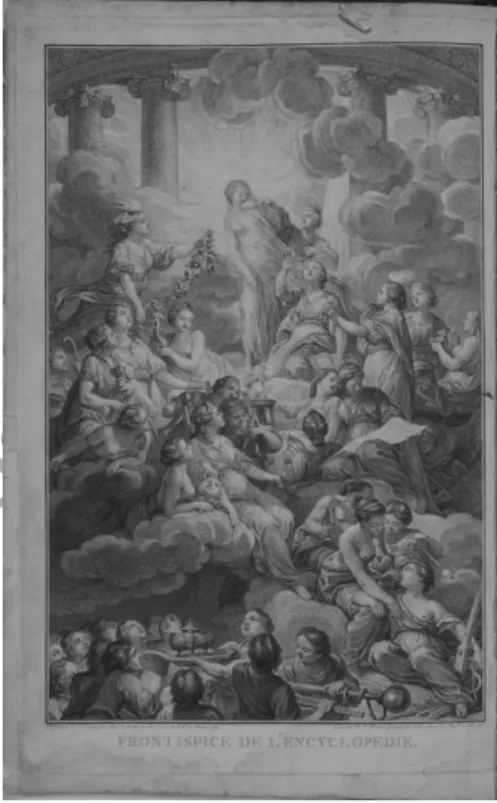
Fig. 1: Frontispiece de L’ Encyclopédie, 1751.
Some years after Mercier wrote his
Utopia, Condorcet, in Esquisse d’un tableau historique des progrès de
l’esprit humain (first edition 1795) expresses the optimism that will stay as the peculiar mark of the 18th-century elite:
des destinées futures de l'espèce humaine, d'après les résultats de son histoire. (1822: vol. 1, 327)2
The same mark we can find previously in the American Declaration of Independence, in the final version revised by Benjamin Franklin (1776):
We hold these truths to be self-evident, that all men are created equal, that they are endowed by their Creator with certain unalienable Rights, that among these are Life, Liberty and the Pursuit of Happiness. That to secure these rights, Governments are instituted among Men, deriving their just powers from the consent of the governed.
In addition, in the French Revolution motto (1789) “Liberté, égalité, fraternité.
1.2.
Rational positivist optimism
and the other side of the coin
By the end of the 18th-century, a profound transformation occurred in Western Weltanschauung. The romantic ideals swept through European countries: rules, unanimity, classical ideals were replaced by a Promethean view of humanity3. From philosophy to the arts,
from economy to politics, human endeavour promised an age of bliss, transformation and progress. Progress was the key word: from the wealth of the nations to the transformation of social and political realities, everything seemed possible.
The progress of science gained a purpose: knowledge was to be used for humanity sake in concrete, objective creations. Science and technology were to be united. The utopian ideal, expressed until then mainly through philosophy and literature gave way to utopianism (Trousson, 2003: 85-91).
The last decades of the 18th and the first decades of the 19th centuries had one goal: progress. The Industrial Revolution fuelled the optimism, inspired philosophers and entrepreneurs who would promise the end of poverty, wealth and prosperity. A golden age for all. Its advocates were Saint-Simon (1760-1825), François Marie Charles Fourier (1772-1837), Étienne Cabet
(1788-1856), Robert Owen (1771-1858), among others. In all of them, we can read the promises of the new age.
L'imagination des poètes a placé l'âge d'or au berceau de l'espèce humaine, parmi l'ignorance et la grossièreté des premiers
temps; […]. L'âge d'or du genre humain n'est point derrière nous, il est au devant, il est dans la perfection de l'ordre social ; nos pères ne l'ont point vu, nos enfants y arriveront un jour; c'est à nous de leur en frayer la route. (Saint-Simon, 1859: 328) As Trousson explains the dream became more comfortable, there should be a general moral improvement, but at the same time, material wealth, in a renewed world where industry and technology spread a fair abundance (2003: 85).
However, Romanticism, even after being surpassed by Realism, left a permanent footprint in Western civilisation: the end of unanimity, the importance of the individual, the liberation from pre-existing codes, the creation of hybrid new genres, the appeal of emotions and their valuation, the importance of the unconscious impulses, etc.
The positivist euphoria never quite silenced pessimism. It laid dormant, almost inaudible, but it was there and grew from the 30s on to explode finally in the creation of dystopias, the dark side of western society. When one looks at the history of utopia, it becomes evident that the 19th century marks the beginning of the end of belief in ever achieving a future state of eutopia4. Most utopias
written during the 19th and 20th centuries reflect a total belief in science and technology in a naïve way. With the exception of Cabet’s Voyage en Icarie, published in 1839, there is no true innovation in utopia form or philosophy5.
Comparing with the previous centuries it is quite a poor site.
The motto that governed the 19th-century utopias may be epitomised in Cabet’s words:
Et remarquez-le bien ! les grandes découvertes dans les sciences et dans
l’industrie ne font pas seulement des Révolutions scientifique et industrielles, mais aussi des Révolutions sociales et
plutôt tout se confond dans la Nature, qui n'est qu'une immense UNITÉ, dans aquelles nous ne distinguons des éléments divers que pour aider la faiblesse de notre intelligence. (1845: 468)
The problem arose precisely on the social and political spheres. The objective evolution on science, technology, in industry and manufacturing, and in communications was undeniable. However, far from this scientific and technological paradise stood millions of underprivileged, the victims of economic crises, of dismissal, those who had no voice, no education, and no future. The ground became, little by little, fertile for a different form to express the hope of a better future. Until then, the wastelands of industrialisation fuelled disbelieve. Using the hybrid form of the novel, another romantic gift, dystopia gave what utopia could no longer offer: a voice to express the doubts, the mistrust and even the desolation with humanity’s present and future, not only in the collective sphere, but particularly taking into account the individual in conflict with dominant society’s values and practices, or, putting it more clearly, the dominant social class of entrepreneurs and capitalists, the bourgeois elite. Far from bringing happiness to all, the industrial transformations have deepened social differences, factories quite different from the pleasant and healthy working stations described by socialist utopians, where silent machines are operated effortlessly by few watchers (Trousson, 2003: 129).
The reality the dreamers of progress could not, or would not see, was the one described by Dickens in Hard Times, in 1854, the same described by Pierre-Joseph Proudhon in 1846 (1867: 135-173; Trousson, 2003: 131). The weight and oppression call to mind Piranesi’s Prisons with the tiny little human figures overwhelmed by the dark, gothic and gigantic prisons walls (Ficacci, 2001). Piranesi picture
2.
A first cry out against
positivist utopia or a call
for help.
In 1846, just one year after Cabet’s quoted words above, a French novelist published the first known dystopia. Emile Souvestre’s Le monde tel qu'il sera [The World as it shall be] (Souvestre, 1846a)6.
Ironically, Souvestre had been an adept of technological progress, a follower of Saint-Simon and other French philosophers of scientific and technological progress.
This novel is Souvestre only adventure in science fiction, or what French critics call roman de l’avenir. If Thomas More
with his foundational text has determined the future persistence of both utopia and dystopia as a new literary genre, as Versins refers, Souvestre’s work became “the model for everything that will be written in the genre during the 19th and 20th centuries” (1984: 824).
Of course, Versins is thinking in terms of dystopia’s major thematic: the danger of technology when used for particular or unclear motives, the possibility of creating human-made hells, etc. However, when we compare Souvestre’s text with Wells, Huxley, or Orwell, surely much was anticipated by Souvestre. However, there is still some naïveté in this first dystopia. The futuristic universe still bears the marks of romanticism and is still very far away from Orwell or Huxley’s realism, a cruel disappointment, even some sense of a claustrophobic universe.
Souvestre’s “enchantment” with Saint -Simon and Fourier theories of progress led him into believing that art should have a useful purpose, should be a way to educate women and the working class (Plötner-Le Lay, 2006: 29). By 1845, he distanced himself from social utopianism, though remaining a Republican and adopting a Christian social and moral philosophy, as Un philosophe sous les toits – journal d’un homme heureux testifies7.
(Souvestre, 2013; 2002; 1871; 1859; 1846a), a Portuguese adaptation in 18598,
reissued in revised edition with a critical introduction by Fátima Vieira in 2006 (Souvestre, 2006; 1860) and an astonishing number of six Spanish translations, all printed in the 19th century (1890; 1883; 1868; 1857; 1852; 1846b)9. The first English translation is
only published in 2004.
As Utopias, dystopias are based on the actual state of affairs the author lives in and, in 1846, the social and political situation in France was characterised by unsteadiness.
The Second Restoration, the failures of July's Monarchy and the Second Republic had vast consequences that went beyond the political sphere, affecting the whole society. By the time Souvestre was writing
Le monde tel qu'il sera, France was facing a violent social and economic crisis: famine, unemployment. Lack of social protection drove many people to despair; the industrialists cut their losses by closing factories, ignoring the social consequences. (Monteiro, 2007: 287) The main characters are a French couple who visited for three days a supposed Utopia set in the year 3000. What they discover, however, is an unfair and unequal society where both rich and poor human beings are deprived of their humanity for the sake of profit. In that dystopian future, the political structures are perfect because they are inexistent and/or ineffective! Stupidity seems to have become the most effective human ability, action and interaction are dominated by faked scientific principles, morality is absent, and there is no social interaction.
The three days Maurice and Marthe visit the world in the year 3000 lead them to a conclusion: the future promised by industrialization and technology will enslave humanity in a vortex of spiritual degradation. (Monteiro, 2007: 290) The Enlightenment ambition and faith on a rational humanity, one that has seen the Lights of reason, will not happen in the following centuries. As Kumar states most 19th and 20th centuries writers of Utopias/Dystopias were “overwhelmed by what seemed to them the invincible
folly and stupidity of mankind” (Kumar, 1991: 91). Souvestre’s dystopia set the mood to face utopias from the mid 19th century onward.
… the realization of utopia was bringing in a world of unprecedented servility and sterility, a world where old forms of tyranny were returning in the new guise of mass democratic politics and benevolent state planning. (Kumar, 1991: 93) However, probably worst than tyranny and collective stupidity, the major menace that utopia presented was the eminent annulment of free will, the complete destruction of individual ego, producing people completely and hopelessly incapable of remonstration (Trousson, 2000: 183).
3.
The confirmation of the
“utopian menace” –
“Alpha
Ralpha Boulevard”
In Thomas More’s Utopia, that is, from the beginning of the genre, Utopia and its twin Dystopia have functioned as Kumar says, as two faces of the same coin, and I add, the obverse being positive (utopia) and the reverse being the negative (dystopia). However, looking at the history of Utopia in the past five hundred years one gets sometimes the feeling that we were given a “loaded coin”, tending to flip systematically to the obverse side, as if this would inevitably be humanity’s destiny.
This feeling has its source in the very nature of utopia, a literary genre deeply connected with the dominant
Weltanschauung. Born in a period of discovery but also of political, social and religious controversy, More’s Utopia
places side by side both twins, as if in equilibrium: neither dystopia was completely negative nor Utopia was faultless.
scientific and technological progress. During this period, there is no place for doubts: Utopia reigns and the reverse hides in the shadows, waiting the right moment to challenge the status quo. Souvestre brought the negative twin to daylight and gave dystopia the possibility of avenging centuries of silence. The revenge was intense: Utopia became the enemy, the hell on earth, the future “Big Brother” that would control individual egos, silencing them, annihilating individuals and turning them into herds.
In the name of a very near and threatening future, utopia warned and recalled people to reason rejecting the myth of indefinite progress and extreme industrialization that Nodier and Souvestre had denounced. (Trousson, 2000: 185)
If there is still some romantic and naïveté in Souvestre’s dystopia, the 20th century struck a deadly blow to the naïve imagination. Now, the situation was reversed: dystopia warned against the evils of static utopia. Evolution is the key to understanding life, and human life is governed by the same natural law: live, adapt and survive. So are human endeavours. After a long period of apparent stagnation in a dystopian vision, the 20th century witnessed several changes in the way Western society perceived the future. This had its reflection in the history of utopia that also had to change and adapt in order to survive in a more realistic and less naïve culture. Since the second half of the 20th century, the announced death of utopia proved to be unrealistic, for the drive for living and imagining a better future is an unconscious one, shared by all humanity. Vita Fortunati summarised this evolution:
Utopia […] is no longer static and is no
longer a system that has been planned one time for all, but it is a Utopia as a continuous battle to achieve a better world. (Fortunati, 2000: 642)
Utopia and dystopia had the help of science fiction to make their point. In addition, if dystopia used this genre from Souvestre onward, utopia profited from a change in science fiction writing, which occurred in the 60s. The era of faith in science and technology ended and science fiction, from the 60s onward,
gave voice to this change.
[The new science fiction] is characterized by literary experimentation and by a growing interest in human sciences, such as psychology, and sociology. These new
themes introduced in science fiction’s
canon were accompanied by a lack of faith in human intelligence, in the human ability to achieve perfection, and a lesser concern for the scientific accuracy of its extrapolation. These alterations made
possible the creation of “ambiguous utopias” such as Cordwainer Smith’s “Alpha Ralpha Boulevard”.10 (Monteiro,
2007: 291)
The short story “Alpha Ralpha Boulevard” was first published in 1961 (Smith, 1993) and it presents several transformations regarding utopian tradition. The most evident is the abandonment of the narrator functioning as an outsider who is guided through the utopian place and describes afterwards what he saw. In this short story, the main character is not an observer but a participant first person narrator, who constantly reformulates his judgements, who is biased and changes his expectations.
However, there are several similitudes between The World as it shall be, and “Alpha Ralpha Boulevard”. For instance, the narrative action starts in the Utopian world that will turn out to be dystopic. The cause of the dystopian state of affairs is not inequality, or moral flaws, or profit, or the extreme liberal code of “laissez-faire laissez-passé” among human beings. It has a cost that is paid by the Underpeople, the genetically modified beings who sustain, literally, the utopian bliss of “genetically pure” human beings.
Through a long period of evolution, human beings achieved Utopia by the 141st century. However, two millennia later, perfection is destroying humanity because
Perfection is now seen and felt as unnatural. Flawlessness is adverse to evolution, for what is perfect simply is, never becomes. Life does not function in accordance with the rule of perfection, but with the rule of evolution. Perfection is killing humanity: the lack of surprise, of problems, of challenges. The lack of uncertainty that gives life its flavour and its intrinsic value.
We are sworn to uphold the dignity of man. Yet we are killing mankind with a bland hopeless happiness which has prohibited news, which has suppressed religion, which has made all history an official secret. I say that the evidence is that we are failing and that mankind,
whom we’ve sworn to cherish, is failing
too. Failing in vitality, strength, numbers, energy. (Smith 1994, 290)
The short story starts in the moment utopia begins to be dismantled: the cholera virus is spread and the news report the first fatalities, the first people being freed from perfection, from a predetermined 400 years lifespan. The old cultures and reintroduced, people are implanted with memories, different languages, different nationalities. The main characters will play the role of Adam and Eve of the new imperfect world.
This transformation is gradual and once again, it is decided by a supreme government and applied by the Underpeople. These, as Souvestre’s workers are the anonymous and ignored victims of human utopia. However, they are not victims, as in Souvestre’s texts. They are creatures of their own destiny: they had no political or social relevance, lived underground, away from the humans who they serve, but even so, they built their own society, their own religion, amusements and economic structures, their moral values and their political aspirations.
Moreover, they watch the new humanity giving the first step in an unpredictable life. They watch the new Adam and Eve (the characters Paul and Virginia) destroy paradise in a similar way that led the primaeval humans to be expelled from the Garden of Eden: expressing doubt regarding authority’s actions, the reality
they are experiencing, that was imposed upon them. It is up to Eve/Virginia to “bite the apple”:
Paul, why does it all happen so fast? This is our first day, and we both feel that we may spend the rest of our lives together.
There’s something about marriage,
whatever that is, we’re supposed to find a
priest, and I don’t understand that, either.
Paul, Paul, Paul, why does it happen so fast? I want to love you. I do love you. But
I don’t want to be made to love you. I want it to be the real me. (1993: 382)11
Virginia has the active role, as in the myth of Eden, and Paul plays the passive role of Adam, bringing to mind the character described in Paradise Lost
(Milton, 2005). Their quest will be the quest for truth concerning their most intimate reality. They do achieve it and it is up to a member of the Underpeople to express that knowledge concerning humanity’s inmost nature, to create it by expressing it aloud:
All of us have been worried about what true people would do to us when you were free. We found out. Some of you are bad and kill other kinds of life. Others of you are good and protect life. (1993: 398)
4.
Conclusion
having two complementary consequences: positive and negative. Human kind has to learn to balance their diverging inclinations. The future progress may offer humanity will have to be “an ambiguous imperfect Utopia where people have to battle constantly to make it a better world” (Monteiro, 2007: 295)
Bibliographical References
Burn, A. (1975) Paul Linebarger. In: Porter, Andrew (ed) Exploring Cordwainer Smith. New York: Algol, 5-11.
Cabet, Etienne. (1845) Voyage en Icarie. 2ª ed. Paris: Bureau du Populaire.
Condorcet, Jean-Antoine-Nicolas de Caritat. (1822) Esquisse d'un tableau historique des progrès de l'esprit humain; suivie de refléxions sur l'esclavages des nègres. Paris: Chez Masson et Fils.
Dessessarts, Alfred. (1833) Prométhée. Revue Universelle: Bibliothèque de l'homme du monde et de l'homme politique. VI. Bruxelles: Louis Hauman et C°, 184-189.
Dickens, Charles. (1920) Hard times. Londres: J.M. Dent.
Elms, Alan C. (1984) The Creation of Cordwainer Smith. Science Fiction Studies (34): 264-283. Ficacci, Luigi. (2001) Piranesi. Catalogo completo
delle acqueforti. Catálogo completo de grabados. Catálogo completo das águas-fortes. Koln Taschen.
Fortunati, Vita. (2000) Utopia as a Literary Genre. In: Fortunati, Vita and Trousson, Raymond (eds). Dictionary of Literary Utopias. Paris: Honoré Champion.
Hellekson, K. L. (2001) The Science Fiction of Cordwainer Smith. Jefferson: McFarland & Company, Inc.
Kumar, Krishan. (1991) Utopianism. Buckingham: Open University Press.
Leibniz, Gottfried Wilhelm Freiherr von. (1934) The Philosophical Writings of Leibniz. Selected and translated by Mary Morris. Londres: J. M. Dent & Sons.
---. (1902) Discourse on metaphysics, correspondence with Arnauld, and Monadology. With an introd. by Paul Janet; translated from the originals by George R. Montgomery. Chicago: Open Court Pub. Co.
Lewis, A. R. (2000) Concordance to Cordwainer Smith. Framingham: NESFA Press.
Lovejoy, Arthur O. (1964) The Great Chain of Being: a study of the history of an idea. Cambridge, Mass.: Harvard University Press.
Mercier, Louis-Sébastien. (1801) L'an deux mille
quatre cent quarante, rêve s'il en fût jamais; suivi de L'homme de fer, songe. nova ed. Paris: Lepetit jeune et Gerard.
Milton, John. (2005) Paradise lost. ed. ilustrada. Introduced by Philip Pullman. Oxford: Oxford University Press.
Monteiro, Maria do Rosário. (2014) From More’s natural Utopia to Cordwainer Smith’s artificial
pseudo-utopia. Spaces of Utopia: An Electronic
Journal 3: 27-40.
http://hdl.handle.net/10362/14927. ---. (2012) People e Underpeople ou as involuções e
evoluções da humanidade. In: Rosa, Jorge Martins (ed) Cibercultura e Ficção. Lisboa: Documenta, pp. 331-340.
---. (2007) Two Technological Dystopias: Le monde tel que'il sera and Alpha Ralpha Boulevard. Morus - Utopia e Renascimento (4): 285-296. http://www.revistamorus.com.br/index.php/ morus/article/view/190;
http://hdl.handle.net/10362/14303. Plötner-Le Lay, Bärbel. (2006) Émile Souvestre:
Écrivain Breton et Saint-Simonien 1806-1854. Morlaix: Skol Vreizh.
Proudhon, Pierre-Joseph. (1867) Système des contradictions économiques ou philosophie de la misère. 3ª ed. vol. IV. Paris: Librairie International.
Saint-Simon, Claude Henri de. (1859) De la réorganisation de la sociéte européene. Oeuvres Choisies; précédées d'un essai sur sa doctrine. 1st ed. 1814. vol. 2. Bruxelles: FR van Meenen et Cie, Imprimeurs, 251-328. Smith, Cordwainer. (1994) Norstrilia. Framingham,
MA: NESFA Press.
---. (1993) Alpha Ralpha Boulevard. In: Mann, James A. (ed) The Rediscovery of Man. The Complete Short Science Fiction of Cordwainer Smith. Framingham: The NESFA Press, 375-399. Souvestre, Émile. (2013) Le monde tel qu'il sera en
l'an 3000. Illustrations et texte d'après l'édition originale de 1846; préface de Claire Barel-Moisan; illustré par MM. Bertall, O. Penguilly et St Germain. Morlaix (Finistère): Skol Vreizh. ---. (2006) O que Há-de Ser: O Mundo no Ano Três
Mil. Edição de texto, introdução e notas de Fátima Vieira. Acomodado ao gosto português por Sebastião José Ribeiro de Sá. Famalicão: Quasi.
---. (2004) The World as it Shall Be. Edition and Introduction by I. F. Clarke. Translation by Margaret Clarke. Middleton, Conn.: Wesleyan University Press.
---. (2002) Le monde tel qu'il será. Edição facsimilada. Apex.
---. (1890) El mundo tal y como será en el año 3000. Valencia: Pascual Aguilar.
---. (1883) El mundo tal y como será en el año 3000. Traductor desconocido. Imprenta de Aznar. ---. (1871) Le monde tel qu'il sera. Poissy: Typ. S.
Lejay et Cie.
ed. Acomodado ao gosto português por Sebastião José Ribeiro de Sá. Lisboa: J.M. Correia Seabra & T. Quintino Antunes. ---. (1859) Le monde tel qu'il sera. Paris: Impr. de
Ch. Jouaust.
---. (1857) El mundo tal cual será el año 3000. Traductor desconocido. Madrid.
---. (1853) The Attic Philosopher in Paris: or, a Peep at the World from a Garret ... From the French of E. Souvestre.
---. (1852) El mundo tal cual será en el año 3000. Madrid: Ediciones Populares.
---. (1851) Un philosophe sous les toits, journal d'un homme heureux. 3rd ed. Paris: Michel-Lévy frères.
---. (1850) Un philosophe sous les toits, journal d'un homme heureux. Paris: Michel-Lévy frères. ---. (1846a) Le monde tel qu'il sera. Ilustré par MM
1 Abbé Pluche wrote in a book that became
almost a bestseller considering the time of
publishing, that: “Nothing more, therefore,
will be produced in all the ages to follow. All the philosophers have deliberated and come to agreement upon this point. Consult the evidence of experience; elements always the same, species that never vary, seeds and germs prepared in advance for the perpetuation of everything, ... so that one can say, Nothing new under the sun, no new production, no species which has not been since the beginning.” (Apud. Lovejoy, 1964: 243)
2 Quoted in modernised French by Trousson
(2003: 74)
3 Trousson (2003: 88)quotes a short piece
written by Alfred Desessarts, in 1833, entitled
“Prométhée; scène psicologique”, and published in Revue Universelle: Bibliothèque de l'homme du monde et de l'homme politique. This short texts ends with Prometheus looking at the future of humanity that, finally, promises to justify the actions
that led to his punishment: “Ne savais-tu pas aussi qu'en symbolisant ma douleur, cette douleur trouverait de la pitié et soulèverait d'éternelles plaintes; que sur mon rocher je représenterais l'humanité étroitement enchainée? Va! l’exemple de mon châtiment
se brisera contre l'insouciante ardeur de ceux qui se précipiteront sur mes traces ver la science. La science, je la vois empreinte du caractère des siècles, grave ou folle, pieuse ou athée, je la vois aspirer à saisir et lever le voile divin; je la vois, à pas lent lents et mesurés, ou impétueux et mal calculés, pénétrer dans le labyrinthe inconnu pour arriver à un sanctuaire, imaginaire peut-être, du moins tant qu'on n'en aura pas trouvé les portes. Bien! science humaine ! courage ! fille de la terre ! Je la vois déjà, je la vois
Bertall, O. Pengilly et S' Germain. Paris: W. Coquebert.
---. (1846b) El mundo tal cual será por Emilio Souvestre traducido por un español del año 3000. Barcelona: Imprenta de José Matas, calle de la Platería.
Trousson, Raymond. (2003) Sciences, techniques et utopies: Du paradis à l'enfer. Paris: Harmattan.
---. (2000) Dystopia. In: Fortunati, Vita and Trousson, Raymond (eds). Dictionary of Literary Utopias. Paris: Honoré Champion, 180-185.
VERSINS, Pierre. (1984) Encyclopédie de l'utopie, des voyages extraordinaires et de la science-fiction. 2ª ed. Lausanne: l'Âge d'homme.
toujours ! elle creuse de ses larges mains, elle efface, creuse encore, grave profondément, elle sue à édifier; puis, obéissant à sa loi d'instabilité, elle laisse une époque railler, détruire le travail de l'époque qui l'a précédée, engendrée … Mais l'œuvre se lègue, se continue, et la science rajeunie, raffermie par son espoir, franchit les dernières limites et va sur le trône d'éternité s’assoir, toute
palpitante, auprès du Dieu immobile! ....”
(Dessessarts, 1833: 189).
4 Comparing the 19th to the 18th century there
is no doubt that there was a huge decay in the writing of utopias that persists until now and the creation dystopias and their progressive increase in the number from the mid 19th century and through the entire following one.
5 Cabet brings no real innovation of form, but
uses the text to expose his political philosophy where science and technology function as the cornerstone of political, social and economic development that he considers inseparable.
6 In this text I will be using the excellent
Clarke’s English translation (Souvestre, 2004).
Part of the analysis of Souvestre’s text was
previously published, in a more thorough version, in “Two Technological Dystopias: Le monde tel qu'il sera and Alpha Ralpha Boulevard” (Monteiro, 2007). The perspective adopted eight years later will be, necessarily somewhat different, in a way I hope will be complementary.
7 The first dated edition of this work is 1850.
One knows that in 1851 the novel was acclaimed by the French Academy, in the
same year, Souvestre’s editors published a
third edition and the first English translation appeared in 1853 (1853; 1851; 1850).
8 The Portuguese edition includes twenty
alter the overall design.
9 These are the Spanish translations that I was
able to identify so far. In these six editions, apparently only the 1846 does include illustrations.
10 For more developed information and
analysis of Cordwainer Smith’s works please see Burn (1975), Elms (1984), Lewis (2000), Hellekson (2001), Monteiro (Monteiro, 2014; 2012; 2007).